EP1160199A2 - Verfahren und Vorrichtung zur Verhinderung von Eisenkontamination in einem Ammoniakwiedergewinnungsverfahren - Google Patents
Verfahren und Vorrichtung zur Verhinderung von Eisenkontamination in einem Ammoniakwiedergewinnungsverfahren Download PDFInfo
- Publication number
- EP1160199A2 EP1160199A2 EP01304298A EP01304298A EP1160199A2 EP 1160199 A2 EP1160199 A2 EP 1160199A2 EP 01304298 A EP01304298 A EP 01304298A EP 01304298 A EP01304298 A EP 01304298A EP 1160199 A2 EP1160199 A2 EP 1160199A2
- Authority
- EP
- European Patent Office
- Prior art keywords
- ammonia
- gas stream
- gas
- piping
- purified
- Prior art date
- Legal status (The legal status is an assumption and is not a legal conclusion. Google has not performed a legal analysis and makes no representation as to the accuracy of the status listed.)
- Granted
Links
- QGZKDVFQNNGYKY-UHFFFAOYSA-N Ammonia Chemical compound N QGZKDVFQNNGYKY-UHFFFAOYSA-N 0.000 title claims abstract description 148
- 229910021529 ammonia Inorganic materials 0.000 title claims abstract description 71
- 238000000034 method Methods 0.000 title claims abstract description 47
- 238000011109 contamination Methods 0.000 title claims abstract description 13
- 238000011084 recovery Methods 0.000 title claims abstract description 13
- XEEYBQQBJWHFJM-UHFFFAOYSA-N Iron Chemical compound [Fe] XEEYBQQBJWHFJM-UHFFFAOYSA-N 0.000 title abstract description 26
- 229910052742 iron Inorganic materials 0.000 title abstract description 13
- 238000009833 condensation Methods 0.000 claims abstract description 13
- 230000005494 condensation Effects 0.000 claims abstract description 13
- 238000005260 corrosion Methods 0.000 claims abstract description 12
- 230000007797 corrosion Effects 0.000 claims abstract description 12
- 239000007788 liquid Substances 0.000 claims abstract description 11
- 239000002245 particle Substances 0.000 claims abstract description 7
- 239000000463 material Substances 0.000 claims description 28
- 238000004821 distillation Methods 0.000 claims description 11
- 238000011143 downstream manufacturing Methods 0.000 claims description 9
- BVCZEBOGSOYJJT-UHFFFAOYSA-N ammonium carbamate Chemical compound [NH4+].NC([O-])=O BVCZEBOGSOYJJT-UHFFFAOYSA-N 0.000 claims description 8
- KXDHJXZQYSOELW-UHFFFAOYSA-N carbonic acid monoamide Natural products NC(O)=O KXDHJXZQYSOELW-UHFFFAOYSA-N 0.000 claims description 8
- 229910001220 stainless steel Inorganic materials 0.000 claims description 7
- 239000010935 stainless steel Substances 0.000 claims description 7
- XLYOFNOQVPJJNP-UHFFFAOYSA-N water Substances O XLYOFNOQVPJJNP-UHFFFAOYSA-N 0.000 claims description 7
- 239000003518 caustics Substances 0.000 claims description 4
- 238000001914 filtration Methods 0.000 claims description 4
- 239000011521 glass Substances 0.000 claims description 4
- 238000010438 heat treatment Methods 0.000 claims description 4
- 238000000746 purification Methods 0.000 claims description 3
- QCWXUUIWCKQGHC-UHFFFAOYSA-N Zirconium Chemical compound [Zr] QCWXUUIWCKQGHC-UHFFFAOYSA-N 0.000 claims description 2
- 229910001026 inconel Inorganic materials 0.000 claims description 2
- JTJMJGYZQZDUJJ-UHFFFAOYSA-N phencyclidine Chemical class C1CCCCN1C1(C=2C=CC=CC=2)CCCCC1 JTJMJGYZQZDUJJ-UHFFFAOYSA-N 0.000 claims description 2
- 229910052726 zirconium Inorganic materials 0.000 claims description 2
- 239000007787 solid Substances 0.000 claims 4
- 229910000619 316 stainless steel Inorganic materials 0.000 claims 3
- 239000010963 304 stainless steel Substances 0.000 claims 1
- 239000010964 304L stainless steel Substances 0.000 claims 1
- 229910000589 SAE 304 stainless steel Inorganic materials 0.000 claims 1
- 229920002313 fluoropolymer Polymers 0.000 claims 1
- 239000004811 fluoropolymer Substances 0.000 claims 1
- UQSXHKLRYXJYBZ-UHFFFAOYSA-N Iron oxide Chemical compound [Fe]=O UQSXHKLRYXJYBZ-UHFFFAOYSA-N 0.000 abstract description 39
- 238000000151 deposition Methods 0.000 abstract description 4
- 230000008030 elimination Effects 0.000 abstract description 2
- 238000003379 elimination reaction Methods 0.000 abstract description 2
- 239000007789 gas Substances 0.000 description 56
- LELOWRISYMNNSU-UHFFFAOYSA-N hydrogen cyanide Chemical compound N#C LELOWRISYMNNSU-UHFFFAOYSA-N 0.000 description 13
- CURLTUGMZLYLDI-UHFFFAOYSA-N Carbon dioxide Chemical compound O=C=O CURLTUGMZLYLDI-UHFFFAOYSA-N 0.000 description 8
- 239000001569 carbon dioxide Substances 0.000 description 6
- 229910002092 carbon dioxide Inorganic materials 0.000 description 6
- VNWKTOKETHGBQD-UHFFFAOYSA-N methane Chemical compound C VNWKTOKETHGBQD-UHFFFAOYSA-N 0.000 description 6
- IJGRMHOSHXDMSA-UHFFFAOYSA-N Atomic nitrogen Chemical compound N#N IJGRMHOSHXDMSA-UHFFFAOYSA-N 0.000 description 4
- 239000002253 acid Substances 0.000 description 4
- 239000003054 catalyst Substances 0.000 description 4
- 239000000356 contaminant Substances 0.000 description 4
- BASFCYQUMIYNBI-UHFFFAOYSA-N platinum Chemical compound [Pt] BASFCYQUMIYNBI-UHFFFAOYSA-N 0.000 description 4
- 229910000975 Carbon steel Inorganic materials 0.000 description 3
- XFXPMWWXUTWYJX-UHFFFAOYSA-N Cyanide Chemical compound N#[C-] XFXPMWWXUTWYJX-UHFFFAOYSA-N 0.000 description 3
- HEMHJVSKTPXQMS-UHFFFAOYSA-M Sodium hydroxide Chemical compound [OH-].[Na+] HEMHJVSKTPXQMS-UHFFFAOYSA-M 0.000 description 3
- 239000006227 byproduct Substances 0.000 description 3
- 239000010962 carbon steel Substances 0.000 description 3
- 239000012535 impurity Substances 0.000 description 3
- 239000000047 product Substances 0.000 description 3
- NLHHRLWOUZZQLW-UHFFFAOYSA-N Acrylonitrile Chemical compound C=CC#N NLHHRLWOUZZQLW-UHFFFAOYSA-N 0.000 description 2
- 238000006189 Andrussov oxidation reaction Methods 0.000 description 2
- 239000004215 Carbon black (E152) Substances 0.000 description 2
- KWYUFKZDYYNOTN-UHFFFAOYSA-M Potassium hydroxide Chemical compound [OH-].[K+] KWYUFKZDYYNOTN-UHFFFAOYSA-M 0.000 description 2
- 239000004809 Teflon Substances 0.000 description 2
- 229920006362 Teflon® Polymers 0.000 description 2
- QVGXLLKOCUKJST-UHFFFAOYSA-N atomic oxygen Chemical compound [O] QVGXLLKOCUKJST-UHFFFAOYSA-N 0.000 description 2
- 230000008901 benefit Effects 0.000 description 2
- 238000006243 chemical reaction Methods 0.000 description 2
- 238000002485 combustion reaction Methods 0.000 description 2
- 229930195733 hydrocarbon Natural products 0.000 description 2
- 150000002430 hydrocarbons Chemical class 0.000 description 2
- 238000009413 insulation Methods 0.000 description 2
- 229910052751 metal Inorganic materials 0.000 description 2
- 239000002184 metal Substances 0.000 description 2
- 239000007769 metal material Substances 0.000 description 2
- 238000012986 modification Methods 0.000 description 2
- 230000004048 modification Effects 0.000 description 2
- 229910052757 nitrogen Inorganic materials 0.000 description 2
- 229910052760 oxygen Inorganic materials 0.000 description 2
- 239000001301 oxygen Substances 0.000 description 2
- 229910052697 platinum Inorganic materials 0.000 description 2
- 230000003449 preventive effect Effects 0.000 description 2
- 239000000376 reactant Substances 0.000 description 2
- 239000000725 suspension Substances 0.000 description 2
- VHUUQVKOLVNVRT-UHFFFAOYSA-N Ammonium hydroxide Chemical compound [NH4+].[OH-] VHUUQVKOLVNVRT-UHFFFAOYSA-N 0.000 description 1
- BVKZGUZCCUSVTD-UHFFFAOYSA-L Carbonate Chemical compound [O-]C([O-])=O BVKZGUZCCUSVTD-UHFFFAOYSA-L 0.000 description 1
- 239000003082 abrasive agent Substances 0.000 description 1
- 150000007513 acids Chemical class 0.000 description 1
- 150000003863 ammonium salts Chemical class 0.000 description 1
- KIZFHUJKFSNWKO-UHFFFAOYSA-M calcium monohydroxide Chemical compound [Ca]O KIZFHUJKFSNWKO-UHFFFAOYSA-M 0.000 description 1
- 239000000084 colloidal system Substances 0.000 description 1
- 150000001875 compounds Chemical class 0.000 description 1
- 230000006835 compression Effects 0.000 description 1
- 238000007906 compression Methods 0.000 description 1
- 238000010276 construction Methods 0.000 description 1
- 238000010586 diagram Methods 0.000 description 1
- 238000005755 formation reaction Methods 0.000 description 1
- 229910052500 inorganic mineral Inorganic materials 0.000 description 1
- UNYOJUYSNFGNDV-UHFFFAOYSA-M magnesium monohydroxide Chemical compound [Mg]O UNYOJUYSNFGNDV-UHFFFAOYSA-M 0.000 description 1
- 239000011707 mineral Substances 0.000 description 1
- 239000000203 mixture Substances 0.000 description 1
- 238000006386 neutralization reaction Methods 0.000 description 1
- -1 nitric Chemical class 0.000 description 1
- 229910000069 nitrogen hydride Inorganic materials 0.000 description 1
- 229910052755 nonmetal Inorganic materials 0.000 description 1
- 239000013618 particulate matter Substances 0.000 description 1
- 239000002574 poison Substances 0.000 description 1
- 231100000614 poison Toxicity 0.000 description 1
- 238000006116 polymerization reaction Methods 0.000 description 1
- 239000002243 precursor Substances 0.000 description 1
- 230000002028 premature Effects 0.000 description 1
- 239000002994 raw material Substances 0.000 description 1
- 239000011347 resin Substances 0.000 description 1
- 229920005989 resin Polymers 0.000 description 1
- 239000000126 substance Substances 0.000 description 1
- ZXQVPEBHZMCRMC-UHFFFAOYSA-R tetraazanium;iron(2+);hexacyanide Chemical compound [NH4+].[NH4+].[NH4+].[NH4+].[Fe+2].N#[C-].N#[C-].N#[C-].N#[C-].N#[C-].N#[C-] ZXQVPEBHZMCRMC-UHFFFAOYSA-R 0.000 description 1
- 239000002351 wastewater Substances 0.000 description 1
Images
Classifications
-
- B—PERFORMING OPERATIONS; TRANSPORTING
- B01—PHYSICAL OR CHEMICAL PROCESSES OR APPARATUS IN GENERAL
- B01D—SEPARATION
- B01D53/00—Separation of gases or vapours; Recovering vapours of volatile solvents from gases; Chemical or biological purification of waste gases, e.g. engine exhaust gases, smoke, fumes, flue gases, aerosols
- B01D53/34—Chemical or biological purification of waste gases
-
- B—PERFORMING OPERATIONS; TRANSPORTING
- B01—PHYSICAL OR CHEMICAL PROCESSES OR APPARATUS IN GENERAL
- B01J—CHEMICAL OR PHYSICAL PROCESSES, e.g. CATALYSIS OR COLLOID CHEMISTRY; THEIR RELEVANT APPARATUS
- B01J8/00—Chemical or physical processes in general, conducted in the presence of fluids and solid particles; Apparatus for such processes
- B01J8/005—Separating solid material from the gas/liquid stream
- B01J8/006—Separating solid material from the gas/liquid stream by filtration
-
- B—PERFORMING OPERATIONS; TRANSPORTING
- B01—PHYSICAL OR CHEMICAL PROCESSES OR APPARATUS IN GENERAL
- B01J—CHEMICAL OR PHYSICAL PROCESSES, e.g. CATALYSIS OR COLLOID CHEMISTRY; THEIR RELEVANT APPARATUS
- B01J19/00—Chemical, physical or physico-chemical processes in general; Their relevant apparatus
- B01J19/0006—Controlling or regulating processes
- B01J19/002—Avoiding undesirable reactions or side-effects, e.g. avoiding explosions, or improving the yield by suppressing side-reactions
-
- B—PERFORMING OPERATIONS; TRANSPORTING
- B01—PHYSICAL OR CHEMICAL PROCESSES OR APPARATUS IN GENERAL
- B01J—CHEMICAL OR PHYSICAL PROCESSES, e.g. CATALYSIS OR COLLOID CHEMISTRY; THEIR RELEVANT APPARATUS
- B01J19/00—Chemical, physical or physico-chemical processes in general; Their relevant apparatus
- B01J19/02—Apparatus characterised by being constructed of material selected for its chemically-resistant properties
-
- C—CHEMISTRY; METALLURGY
- C01—INORGANIC CHEMISTRY
- C01C—AMMONIA; CYANOGEN; COMPOUNDS THEREOF
- C01C1/00—Ammonia; Compounds thereof
- C01C1/02—Preparation, purification or separation of ammonia
- C01C1/024—Purification
-
- C—CHEMISTRY; METALLURGY
- C01—INORGANIC CHEMISTRY
- C01C—AMMONIA; CYANOGEN; COMPOUNDS THEREOF
- C01C1/00—Ammonia; Compounds thereof
- C01C1/02—Preparation, purification or separation of ammonia
- C01C1/12—Separation of ammonia from gases and vapours
-
- B—PERFORMING OPERATIONS; TRANSPORTING
- B01—PHYSICAL OR CHEMICAL PROCESSES OR APPARATUS IN GENERAL
- B01J—CHEMICAL OR PHYSICAL PROCESSES, e.g. CATALYSIS OR COLLOID CHEMISTRY; THEIR RELEVANT APPARATUS
- B01J2219/00—Chemical, physical or physico-chemical processes in general; Their relevant apparatus
- B01J2219/00049—Controlling or regulating processes
- B01J2219/00245—Avoiding undesirable reactions or side-effects
- B01J2219/00247—Fouling of the reactor or the process equipment
-
- B—PERFORMING OPERATIONS; TRANSPORTING
- B01—PHYSICAL OR CHEMICAL PROCESSES OR APPARATUS IN GENERAL
- B01J—CHEMICAL OR PHYSICAL PROCESSES, e.g. CATALYSIS OR COLLOID CHEMISTRY; THEIR RELEVANT APPARATUS
- B01J2219/00—Chemical, physical or physico-chemical processes in general; Their relevant apparatus
- B01J2219/00049—Controlling or regulating processes
- B01J2219/00245—Avoiding undesirable reactions or side-effects
- B01J2219/00252—Formation of deposits other than coke
-
- B—PERFORMING OPERATIONS; TRANSPORTING
- B01—PHYSICAL OR CHEMICAL PROCESSES OR APPARATUS IN GENERAL
- B01J—CHEMICAL OR PHYSICAL PROCESSES, e.g. CATALYSIS OR COLLOID CHEMISTRY; THEIR RELEVANT APPARATUS
- B01J2219/00—Chemical, physical or physico-chemical processes in general; Their relevant apparatus
- B01J2219/02—Apparatus characterised by their chemically-resistant properties
- B01J2219/0204—Apparatus characterised by their chemically-resistant properties comprising coatings on the surfaces in direct contact with the reactive components
-
- B—PERFORMING OPERATIONS; TRANSPORTING
- B01—PHYSICAL OR CHEMICAL PROCESSES OR APPARATUS IN GENERAL
- B01J—CHEMICAL OR PHYSICAL PROCESSES, e.g. CATALYSIS OR COLLOID CHEMISTRY; THEIR RELEVANT APPARATUS
- B01J2219/00—Chemical, physical or physico-chemical processes in general; Their relevant apparatus
- B01J2219/02—Apparatus characterised by their chemically-resistant properties
- B01J2219/0204—Apparatus characterised by their chemically-resistant properties comprising coatings on the surfaces in direct contact with the reactive components
- B01J2219/0209—Apparatus characterised by their chemically-resistant properties comprising coatings on the surfaces in direct contact with the reactive components of glass
-
- B—PERFORMING OPERATIONS; TRANSPORTING
- B01—PHYSICAL OR CHEMICAL PROCESSES OR APPARATUS IN GENERAL
- B01J—CHEMICAL OR PHYSICAL PROCESSES, e.g. CATALYSIS OR COLLOID CHEMISTRY; THEIR RELEVANT APPARATUS
- B01J2219/00—Chemical, physical or physico-chemical processes in general; Their relevant apparatus
- B01J2219/02—Apparatus characterised by their chemically-resistant properties
- B01J2219/0204—Apparatus characterised by their chemically-resistant properties comprising coatings on the surfaces in direct contact with the reactive components
- B01J2219/0245—Apparatus characterised by their chemically-resistant properties comprising coatings on the surfaces in direct contact with the reactive components of synthetic organic material
-
- B—PERFORMING OPERATIONS; TRANSPORTING
- B01—PHYSICAL OR CHEMICAL PROCESSES OR APPARATUS IN GENERAL
- B01J—CHEMICAL OR PHYSICAL PROCESSES, e.g. CATALYSIS OR COLLOID CHEMISTRY; THEIR RELEVANT APPARATUS
- B01J2219/00—Chemical, physical or physico-chemical processes in general; Their relevant apparatus
- B01J2219/02—Apparatus characterised by their chemically-resistant properties
- B01J2219/025—Apparatus characterised by their chemically-resistant properties characterised by the construction materials of the reactor vessel proper
- B01J2219/0277—Metal based
- B01J2219/0286—Steel
Definitions
- This invention relates to processes that generate a gas stream comprising ammonia (NH 3 ) and carbon dioxide (CO 2 ).
- the invention relates to a method for reducing undesirable side products that form when ammonia is removed and recovered from the gas stream.
- An example of a process that generates such a gas stream is the Andrussow method for preparing hydrogen cyanide (see U.S. Patent No. 1,934,838), ammonia, an oxygen-containing gas such as air, and hydrocarbon gases such as methane are fed to a reaction system at ambient or elevated temperature. The reactants are then reacted in the presence of a platinum-containing catalyst at temperatures of 1000°C to 1400°C to produce hydrogen cyanide. A portion of the hydrocarbon/ammonia reactant feed gas is combusted to provide the energy required to maintain the highly endothermic cyanide formation reaction.
- One problem associated with the Andrussow process is that there is a high level of residual ammonia in the exit gas.
- the residual ammonia must be removed from the HCN product stream to avoid polymerization of HCN.
- low levels of ammonia in the exit gas may be neutralized with acid in a purification process, the ammonia concentration in the exit gas of the Andrussow process is too high for the HCN product stream to be sent directly to such a neutralization process. Therefore, the exit gas containing residual ammonia must first be sent to a separate process for removing the majority of the ammonia and then the product stream sent to a purification process.
- Ammonia can be removed from a gas stream by contacting the stream with a mineral acid complex, derived from acids such as nitric, phosphoric, or boric to chemically capture the ammonia.
- a mineral acid complex derived from acids such as nitric, phosphoric, or boric to chemically capture the ammonia.
- the aqueous ammonia/acid complex is then thermally decomposed to free the ammonia, which can be recovered for use in a downstream process (see U.S. Patent 2,797,148 for example).
- a contaminant that is of particular concern is iron oxide, an abrasive material that causes premature wear on equipment and may also lower downstream-process catalyst efficiency.
- the present invention is a series of preventive steps which alleviate iron oxide contamination of processes downstream of ammonia recovery processes.
- One aspect of the invention is a method for reducing iron oxide contamination of the downstream process by physically removing iron oxide and iron oxide precursor compounds from the process stream.
- the pipes and equipment carrying recovered ammonia from an ammonia recovery process are heated to prevent ammonium carbamate from depositing on the inside walls of the pipes and equipment.
- the process piping and associated equipment carrying recovered ammonia from an ammonia recovery process is constructed from a material that is not susceptible to corrosion by ammonium carbamate.
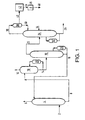
- Figure 1 is a simplified flow diagram of an embodiment of the present invention
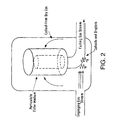
- Figure 2 is a simplified drawing of an embodiment of an apparatus for separating liquids, colloids, and particulate from a gas stream.
- Iron oxide contamination has been observed in process systems downstream from the ammonia recovery process even in systems that incorporate preventive measures such as using raw material feed gases that are free of iron contamination and using filters at the downstream process inputs to remove any particulate iron species. This suggests that contaminants such as iron oxide can be present in the recycled ammonia from the ammonia recovery process and further that such contaminants may be present in forms that are not readily removed by standard particulate filtration..
- the chemical steps leading to iron oxide contamination from an ammonia recovery process have been deduced and are shown below.
- Ammonia reacts with carbon dioxide to yield ammonium carbamate (AC, eq. 1).
- AC can dissolve into liquid that condenses on the inside wall of process piping and equipment where it can react with the iron in carbon steel to produce iron oxide (Eq. 2).
- Iron oxide is abrasive and is particularly damaging to rotating equipment, such as ammonia compression equipment. It is also a poison to many catalysts, such as the Platinum-containing catalysts used in HCN processes. In many applications, particulate filters can be installed to trap iron oxide.
- cyanide is also present in the gas stream, iron oxide will react with cyanide to yield iron hexacyano complexes (IHC) that exist as colloidal suspensions of the corresponding ammonium salts (Eq. 3).
- 2 designates the feed gas comprising ammonia, CO 2 , and possibly other gases such as hydrogen cyanide, acrylonitrile, nitrogen, water vapor, methane, or combustion by-products such as CO.
- the feed gas is contacted with an ammonia-capture solution in capture column 4.
- Ammonia-free gas is withdrawn from column 4 via line 6.
- ammonia-free gas refers to gas that has 75 % lower ammonia concentration than the feed gas. More preferably, the concentration of ammonia in the gas exiting via line 6 is reduced by 90 %. Most preferably, the concentration of ammonia in the gas exiting via line 6 is reduced by more than 99 %.
- Capture solution at the bottom of the capture column which is enriched with ammonia, and also contains absorbed CO 2 and possibly other absorbed gases such as hydrogen cyanide, acrylonitrile, nitrogen, water vapor, methane, or combustion by-products such as CO is routed to stripper 10 via line 8, where it is heated via reboiler 20, to remove impurities.
- Ammonia enriched solution exits stripper 10 via line 14 and is routed to ammonia stripping column 16 where the solution is heated via reboiler 28 to release ammonia from the solution.
- the capture solution, now lean in ammonia is routed back to capture column 4 via line 18.
- the gas exiting ammonia stripper 16 via line 22 consists essentially of ammonia and water vapor, but may also contain CO 2 .
- the stream may be fed as a gas, or alternatively may be condensed prior to feeding, into ammonia distillation column 24 where the ammonia is separated from the water by heating via reboiler 32. Water is withdrawn via line 26 and treated as waste-water.
- ammonia stripper 16 and ammonia distillation column 24 are combined into one column, eliminating the need for reboiler 32 and line 22.
- a gas stream of purified ammonia exits the distillation column 24 via line 30 and is routed to separator 38.
- the term 'gas stream of purified ammonia' as used herein refers to a gas stream comprising at least about 75% ammonia.
- separator 38 condenses a portion of the gas stream and the condensate is refluxed via line 50 back into distillation column 24.
- a portion of any AC present will dissolve into the condensate and will be returned to the distillation column via line 50, where it can accumulate.
- caustic material is added to ammonia distillation column 24 via line 34 to convert the AC to an insoluble carbonate. Suitable caustic materials include NaOH, KOH, MgOH, CaOH and the like, as well as mixtures thereof.
- caustic material is added directly (not shown) into line 50.
- the temperature of line 30 is maintained high enough to prevent condensation on the inside of the line.
- the temperature of the line may be maintained by heating the line with steam or electrical tracing or by jacketing. Insulation may also be present.
- the temperature of the line is maintained above the condensation temperature of the gas and below about 350°C. More preferably, the temperature of the line is maintained in the range from about 70°C to about 200°C.
- line 30 is constructed of a material that is not susceptible to corrosion by AC.
- line 30 is constructed from a metal that has a lower iron content than carbon steel.
- Preferred material include stainless steel, L series stainless steel, Duplex 2205, Hastelloys, Inconels, and Zirconium.
- line 30 is constructed from Type 316L stainless steel.
- the inside wall of line 30 is lined with a non-metallic such as Teflon or glass. .
- line 30 and separator 38 may be constructed from different corrosion-resistant materials, and further that equipment, such as the separator itself, may employ more than one material of construction - for example, in the case where separator 38 comprises a condenser, the condenser tubesheet may be lined/clad with a non-metallic material such as glass or resin and the tubes may be of unlined metal.
- gas exiting separator 38 via line 40 is transferred to optional compressor 42.
- compressor 42 is constructed from materials that are resistant to corrosion by AC. Suitable materials are as listed above.
- the compressor is operated at an elevated temperature, such that the gas is discharged at a temperature between about 80°C and 350°C.
- optional compressor 42 is absent and lines 40 and 44 are contiguous.
- lines 40 and 44 are constructed of a material that is not susceptible to corrosion by AC. Suitable material are as listed above. In one embodiment of the present invention, lines 40 and 44 are constructed from 316L stainless. In an alternative embodiment of the present invention, the inside walls of lines 40 and 44 are lined with a non-metal material, preferably Teflon or glass.
- the temperature of the gas inside lines 40 and 44 is maintained high enough to prevent condensation in these lines or in related equipment.
- lines 40 and 44 as well as any intervening equipment are heated with steam or electrical tracing to prevent condensation on the inside of the lines.
- lines 40 and 44 and any intervening equipment are heated with jacketing. Insulation may also be present.
- the lines and equipment are maintained above the condensation temperature of the gas and below about 350°C, more preferably between 70°C and 200°C.
- the gas in lines 40 and 44 is passed through at least one heat exchanger to elevate and maintain the temperature of the gas above its condensation temperature and below about 350°C. More preferably, the temperature of the gas is maintained in the range from about 70°C to about 200°C.
- Condensation can also be minimized by operating distillation column 24 such that the concentration of water in the purified gas stream exiting the column via line 30 is minimized.
- concentration of ammonia in the gas stream exiting column 24 is preferably greater than 75%, more preferably greater than 90%, and most preferably greater than 95%.
- gas in line 44 passes through a zone 46 where impurities are removed from the gas stream.
- the zone comprises a first component that separates colloidal particles and liquid droplets from the gas stream and a second component that separates particulate matter from the gas stream.
- the two components are combined into one apparatus.
- the gas in line 44 is directed into a chamber, wherein a vector change in the gas stream causes the colloidal material and liquid droplets entrained in the gas to impact internal structures, such as baffles, impingement plates, and (as shown here) the piping elbow, as well as the sides of the chamber.
- the colloid- and liquid-free gas then passes through particulate filtering media which is off the line of the impinging gas stream before exiting the chamber.
- the zone in which impurities are separated from the gas stream may comprise one or more cyclones or impingement separators to physically remove droplets and colloidal materials from the gas stream followed by one or more filters to remove particulate from the gas stream.
- the present invention is a method which reduces iron contamination of a system which receives ammonia from an ammonia recovery process by one or more of the following techniques:
Landscapes
- Chemical & Material Sciences (AREA)
- Organic Chemistry (AREA)
- Chemical Kinetics & Catalysis (AREA)
- Analytical Chemistry (AREA)
- Inorganic Chemistry (AREA)
- Engineering & Computer Science (AREA)
- Environmental & Geological Engineering (AREA)
- Biomedical Technology (AREA)
- Health & Medical Sciences (AREA)
- General Chemical & Material Sciences (AREA)
- Oil, Petroleum & Natural Gas (AREA)
- Gas Separation By Absorption (AREA)
- Separating Particles In Gases By Inertia (AREA)
- Vaporization, Distillation, Condensation, Sublimation, And Cold Traps (AREA)
- Preventing Corrosion Or Incrustation Of Metals (AREA)
- Organic Low-Molecular-Weight Compounds And Preparation Thereof (AREA)
Applications Claiming Priority (2)
| Application Number | Priority Date | Filing Date | Title |
|---|---|---|---|
| US20636700P | 2000-05-23 | 2000-05-23 | |
| US206367P | 2000-05-23 |
Publications (3)
| Publication Number | Publication Date |
|---|---|
| EP1160199A2 true EP1160199A2 (de) | 2001-12-05 |
| EP1160199A3 EP1160199A3 (de) | 2003-06-11 |
| EP1160199B1 EP1160199B1 (de) | 2011-08-03 |
Family
ID=22766059
Family Applications (1)
| Application Number | Title | Priority Date | Filing Date |
|---|---|---|---|
| EP01304298A Expired - Lifetime EP1160199B1 (de) | 2000-05-23 | 2001-05-15 | Verfahren zur Verhinderung von Eisenkontamination in einem Ammoniakwiedergewinnungsverfahren |
Country Status (8)
| Country | Link |
|---|---|
| US (1) | US6706093B2 (de) |
| EP (1) | EP1160199B1 (de) |
| JP (1) | JP5111696B2 (de) |
| KR (1) | KR100861481B1 (de) |
| CN (1) | CN1211282C (de) |
| BR (1) | BR0102071B1 (de) |
| MX (1) | MXPA01004954A (de) |
| TW (1) | TWI291453B (de) |
Cited By (1)
| Publication number | Priority date | Publication date | Assignee | Title |
|---|---|---|---|---|
| EP1921043A1 (de) * | 2006-11-01 | 2008-05-14 | Mitsubishi Gas Chemical Company, Inc. | Verfahren zur Rückgewinnung von Ammoniak |
Families Citing this family (6)
| Publication number | Priority date | Publication date | Assignee | Title |
|---|---|---|---|---|
| US6706093B2 (en) * | 2000-05-23 | 2004-03-16 | Rohm And Haas Company | Method and apparatus for preventing iron contamination in corrosive service |
| JP2006247452A (ja) * | 2005-03-08 | 2006-09-21 | Daiyanitorikkusu Kk | 気相反応装置 |
| DE102005033837B4 (de) | 2005-07-20 | 2019-02-28 | Basf Se | Verfahren zum Entfernen von sauren Gasen und Ammoniak aus einem Fluidstrom |
| AT510893B1 (de) * | 2010-12-20 | 2017-06-15 | Primetals Technologies Austria GmbH | Verfahren und vorrichtung zur aufbereitung von prozesswasser |
| JP2011126890A (ja) * | 2011-01-18 | 2011-06-30 | Daiyanitorikkusu Kk | 気相反応装置 |
| US9994457B2 (en) * | 2014-04-07 | 2018-06-12 | The Boeing Company | System and method for ammonia distillation |
Family Cites Families (27)
| Publication number | Priority date | Publication date | Assignee | Title |
|---|---|---|---|---|
| US1934838A (en) | 1930-04-14 | 1933-11-14 | Ig Farbenindustrie Ag | Production of hydrocyanic acid |
| US2797148A (en) | 1951-03-13 | 1957-06-25 | Du Pont | Recovery of nh3 from a gaseous mixture containing nh3 and hcn |
| US2950173A (en) * | 1956-10-31 | 1960-08-23 | Montedison Spa | Process for separating carbon dioxide from ammonia in the production of melamine from urea |
| US3335071A (en) * | 1963-07-19 | 1967-08-08 | Chevron Res | Ammonia recovery process |
| IT736029A (de) * | 1964-08-07 | |||
| ES341669A1 (es) | 1966-06-13 | 1968-07-01 | Lummus Co | Mejoras introducidas en un procedimiento para la sintesis de urea. |
| US3455659A (en) | 1967-09-06 | 1969-07-15 | American Cyanamid Co | Superheating ammonia |
| NL165712C (nl) * | 1970-05-30 | 1981-05-15 | Stamicarbon | Werkwijze en inrichting voor het bij synthesedruk terug- winnen van ammoniak en kooldioxyde uit het spuigas van een ureumsynthese. |
| CS152137B1 (de) * | 1971-05-10 | 1973-12-19 | ||
| DE2317603C3 (de) * | 1973-04-07 | 1982-03-25 | Basf Ag, 6700 Ludwigshafen | Verfahren zur zumindest teilweisen Trennung von Ammoniak und Kohlendioxid enthaltenden Gasgemischen |
| FR2292503A1 (fr) * | 1974-11-27 | 1976-06-25 | Technigaz | Procede et dispositif de regeneration d'un fluide effluent impur et produit ainsi obtenu |
| DE2527985C3 (de) * | 1975-06-24 | 1981-04-16 | Metallgesellschaft Ag, 6000 Frankfurt | Kontinuierliches Verfahren zur Gewinnung von reinem Ammoniak |
| DE2646804C3 (de) * | 1976-10-16 | 1982-03-11 | Basf Ag, 6700 Ludwigshafen | Verfahren zur Gewinnung von reinem Ammoniak aus Ammoniak und Kohlendioxid enthaltenden Gasgemischen |
| NL7804668A (nl) * | 1978-04-29 | 1979-10-31 | Stamicarbon | Werkwijze voor het scheiden van nh3 en co2 uit meng- sels van nh3 ,co2 en water. |
| US4256471A (en) * | 1979-04-16 | 1981-03-17 | Stamicarbon, B.V. | Process for the separation of ammonia and carbon dioxide from mixtures containing ammonia, carbon dioxide and water |
| NL8200905A (nl) | 1982-03-05 | 1983-10-03 | Stamicarbon | Werkwijze voor het scheiden van ammoniak en kooldioxide uit mengsels van ammoniak, kooldioxide en water. |
| SU1650579A1 (ru) * | 1988-07-18 | 1991-05-23 | Ленинградский институт текстильной и легкой промышленности им.С.М.Кирова | Способ очистки газообразного аммиака от масла и механических примесей |
| NO167082C (no) * | 1989-02-03 | 1991-10-02 | Norsk Hydro As | Fremgangsmaate ved fjerning av ammoniakk fra en gassblanding. |
| ATE167666T1 (de) | 1991-11-14 | 1998-07-15 | Urea Casale Sa | Verfahren zur herstellung von harnstoff mit reaktionsräumen unterschiedlicher ausbeuten |
| DE4217921A1 (de) | 1992-05-30 | 1993-12-02 | Huels Chemische Werke Ag | Verfahren zur Rückgewinnung von Ammoniak und organischen Verbindungen aus mit organischen Stoffen, Kohlendioxid und Ammoniak beladenen Abgasen |
| US5426944A (en) * | 1993-08-31 | 1995-06-27 | American Air Liquide, Inc. | Chemical purification for semiconductor processing by partial condensation |
| JP3223311B2 (ja) * | 1994-04-07 | 2001-10-29 | 東芝プラント建設株式会社 | 復水脱塩再生水の処理方法 |
| JPH08119626A (ja) * | 1994-10-21 | 1996-05-14 | Sumitomo Chem Co Ltd | アンモニア水の製造装置 |
| US6001223A (en) | 1995-07-07 | 1999-12-14 | Air Liquide America Corporation | On-site ammonia purification for semiconductor manufacture |
| US6065306A (en) | 1998-05-19 | 2000-05-23 | The Boc Group, Inc. | Method and apparatus for purifying ammonia |
| ZA200003123B (en) | 1999-06-29 | 2001-01-24 | Boc Group Inc | Ammonia purification method. |
| US6706093B2 (en) * | 2000-05-23 | 2004-03-16 | Rohm And Haas Company | Method and apparatus for preventing iron contamination in corrosive service |
-
2001
- 2001-05-02 US US09/847,126 patent/US6706093B2/en not_active Expired - Lifetime
- 2001-05-11 TW TW090111305A patent/TWI291453B/zh not_active IP Right Cessation
- 2001-05-15 EP EP01304298A patent/EP1160199B1/de not_active Expired - Lifetime
- 2001-05-17 MX MXPA01004954A patent/MXPA01004954A/es not_active Application Discontinuation
- 2001-05-21 KR KR1020010027647A patent/KR100861481B1/ko not_active Expired - Fee Related
- 2001-05-22 BR BRPI0102071-4A patent/BR0102071B1/pt not_active IP Right Cessation
- 2001-05-23 CN CNB011191783A patent/CN1211282C/zh not_active Expired - Lifetime
- 2001-05-23 JP JP2001153662A patent/JP5111696B2/ja not_active Expired - Fee Related
Non-Patent Citations (1)
| Title |
|---|
| None |
Cited By (2)
| Publication number | Priority date | Publication date | Assignee | Title |
|---|---|---|---|---|
| EP1921043A1 (de) * | 2006-11-01 | 2008-05-14 | Mitsubishi Gas Chemical Company, Inc. | Verfahren zur Rückgewinnung von Ammoniak |
| US7785556B2 (en) | 2006-11-01 | 2010-08-31 | Mitsubishi Gas Chemical Company, Inc. | Method of recovering ammonia |
Also Published As
| Publication number | Publication date |
|---|---|
| JP2002020117A (ja) | 2002-01-23 |
| CN1211282C (zh) | 2005-07-20 |
| KR20010107603A (ko) | 2001-12-07 |
| JP5111696B2 (ja) | 2013-01-09 |
| US6706093B2 (en) | 2004-03-16 |
| EP1160199A3 (de) | 2003-06-11 |
| CN1325822A (zh) | 2001-12-12 |
| TWI291453B (en) | 2007-12-21 |
| US20020124728A1 (en) | 2002-09-12 |
| EP1160199B1 (de) | 2011-08-03 |
| BR0102071B1 (pt) | 2010-11-16 |
| BR0102071A (pt) | 2002-04-23 |
| MXPA01004954A (es) | 2002-08-06 |
| KR100861481B1 (ko) | 2008-10-02 |
Similar Documents
| Publication | Publication Date | Title |
|---|---|---|
| EP1157969B1 (de) | Verfahren zur Wiedergewinnung und Wiederverwendung von Ammoniak aus einem Reaktoreffluentstrom | |
| TWI505992B (zh) | 從安德盧梭(andrussow)法中之氨排氣器回收熱之方法 | |
| CN102481519B (zh) | 从气态物流回收氨的方法和设备 | |
| EP1160199B1 (de) | Verfahren zur Verhinderung von Eisenkontamination in einem Ammoniakwiedergewinnungsverfahren | |
| EA034672B1 (ru) | Контроль образования биурета при производстве карбамида | |
| US20250019343A1 (en) | Urea production process and plant | |
| TW382005B (en) | Process for recovery and recycle of ammonia from an acrylonitrile reactor refluent stream using an ammonium phosphate quench system | |
| CN117222620A (zh) | 合成尿素和三聚氰胺的方法和装置 | |
| EP1681269A2 (de) | Verfahren zur Wiedergewinnung und Wiederverwendung von Ammoniak aus einem Reaktoreffluentstrom | |
| JP4124391B2 (ja) | 廃水の処理方法 | |
| CN1840523B (zh) | 尿素制备方法及相关设备 | |
| EP0885843B1 (de) | Verfahren zur Wiedergewinnung von Ammonia aus einem Abfallstrom eines Acrylonitrilreaktors mittels eines Ammoniumphosphatabkühlsystems | |
| RU2237016C2 (ru) | Способ извлечения непрореагировавшего аммиака из вытекающего из реактора потока | |
| AU2014221190B2 (en) | Process of scrubbing volatiles from evaporator water vapor | |
| GB1604076A (en) | Recovery of a salt mixture from a gas | |
| MXPA97004617A (en) | Process to recover and recycle ammonia from an effluent current of the acrylonitril reactor using an amo phosphate cooling system |
Legal Events
| Date | Code | Title | Description |
|---|---|---|---|
| PUAI | Public reference made under article 153(3) epc to a published international application that has entered the european phase |
Free format text: ORIGINAL CODE: 0009012 |
|
| 17P | Request for examination filed |
Effective date: 20010525 |
|
| AK | Designated contracting states |
Kind code of ref document: A2 Designated state(s): AT BE CH CY DE DK ES FI FR GB GR IE IT LI LU MC NL PT SE TR |
|
| AX | Request for extension of the european patent |
Free format text: AL;LT;LV;MK;RO;SI |
|
| RIC1 | Information provided on ipc code assigned before grant |
Ipc: 7C 01C 1/10 B Ipc: 7C 01C 1/12 A |
|
| PUAL | Search report despatched |
Free format text: ORIGINAL CODE: 0009013 |
|
| AK | Designated contracting states |
Designated state(s): AT BE CH CY DE DK ES FI FR GB GR IE IT LI LU MC NL PT SE TR |
|
| AX | Request for extension of the european patent |
Extension state: AL LT LV MK RO SI |
|
| AKX | Designation fees paid |
Designated state(s): AT BE CH CY DE DK ES FI FR GB GR IE IT LI LU MC NL PT SE TR |
|
| 17Q | First examination report despatched |
Effective date: 20051114 |
|
| 17Q | First examination report despatched |
Effective date: 20051114 |
|
| GRAP | Despatch of communication of intention to grant a patent |
Free format text: ORIGINAL CODE: EPIDOSNIGR1 |
|
| RTI1 | Title (correction) |
Free format text: METHOD FOR PREVENTING IRON CONTAMINATION IN AN AMMONIA RECOVERY PROCESS |
|
| RBV | Designated contracting states (corrected) |
Designated state(s): BE DE FR GB IT |
|
| GRAS | Grant fee paid |
Free format text: ORIGINAL CODE: EPIDOSNIGR3 |
|
| GRAA | (expected) grant |
Free format text: ORIGINAL CODE: 0009210 |
|
| AK | Designated contracting states |
Kind code of ref document: B1 Designated state(s): BE DE FR GB IT |
|
| REG | Reference to a national code |
Ref country code: GB Ref legal event code: FG4D |
|
| REG | Reference to a national code |
Ref country code: DE Ref legal event code: R096 Ref document number: 60145065 Country of ref document: DE Effective date: 20110929 |
|
| PG25 | Lapsed in a contracting state [announced via postgrant information from national office to epo] |
Ref country code: IT Free format text: LAPSE BECAUSE OF FAILURE TO SUBMIT A TRANSLATION OF THE DESCRIPTION OR TO PAY THE FEE WITHIN THE PRESCRIBED TIME-LIMIT Effective date: 20110803 |
|
| PLBE | No opposition filed within time limit |
Free format text: ORIGINAL CODE: 0009261 |
|
| STAA | Information on the status of an ep patent application or granted ep patent |
Free format text: STATUS: NO OPPOSITION FILED WITHIN TIME LIMIT |
|
| 26N | No opposition filed |
Effective date: 20120504 |
|
| REG | Reference to a national code |
Ref country code: DE Ref legal event code: R097 Ref document number: 60145065 Country of ref document: DE Effective date: 20120504 |
|
| PGFP | Annual fee paid to national office [announced via postgrant information from national office to epo] |
Ref country code: FR Payment date: 20140509 Year of fee payment: 14 |
|
| REG | Reference to a national code |
Ref country code: FR Ref legal event code: ST Effective date: 20160129 |
|
| PG25 | Lapsed in a contracting state [announced via postgrant information from national office to epo] |
Ref country code: FR Free format text: LAPSE BECAUSE OF NON-PAYMENT OF DUE FEES Effective date: 20150601 |
|
| PGFP | Annual fee paid to national office [announced via postgrant information from national office to epo] |
Ref country code: DE Payment date: 20200506 Year of fee payment: 20 |
|
| PGFP | Annual fee paid to national office [announced via postgrant information from national office to epo] |
Ref country code: GB Payment date: 20200506 Year of fee payment: 20 Ref country code: BE Payment date: 20200416 Year of fee payment: 20 |
|
| REG | Reference to a national code |
Ref country code: DE Ref legal event code: R071 Ref document number: 60145065 Country of ref document: DE |
|
| REG | Reference to a national code |
Ref country code: GB Ref legal event code: PE20 Expiry date: 20210514 |
|
| REG | Reference to a national code |
Ref country code: BE Ref legal event code: MK Effective date: 20210515 |
|
| PG25 | Lapsed in a contracting state [announced via postgrant information from national office to epo] |
Ref country code: GB Free format text: LAPSE BECAUSE OF EXPIRATION OF PROTECTION Effective date: 20210514 |