EP1160366B1 - Procédé pour relier un bout de commencement et/ou bout de fin d'un fil dans un tricot - Google Patents
Procédé pour relier un bout de commencement et/ou bout de fin d'un fil dans un tricot Download PDFInfo
- Publication number
- EP1160366B1 EP1160366B1 EP01105617A EP01105617A EP1160366B1 EP 1160366 B1 EP1160366 B1 EP 1160366B1 EP 01105617 A EP01105617 A EP 01105617A EP 01105617 A EP01105617 A EP 01105617A EP 1160366 B1 EP1160366 B1 EP 1160366B1
- Authority
- EP
- European Patent Office
- Prior art keywords
- knitting
- needles
- yarn
- thread
- needle
- Prior art date
- Legal status (The legal status is an assumption and is not a legal conclusion. Google has not performed a legal analysis and makes no representation as to the accuracy of the status listed.)
- Expired - Lifetime
Links
- 239000004744 fabric Substances 0.000 title claims description 54
- 238000000034 method Methods 0.000 title claims description 30
- 238000009940 knitting Methods 0.000 claims description 126
- 238000010348 incorporation Methods 0.000 description 12
- 241000628997 Flos Species 0.000 description 5
- 230000010354 integration Effects 0.000 description 5
- 230000015572 biosynthetic process Effects 0.000 description 2
- 238000004519 manufacturing process Methods 0.000 description 2
- 239000000463 material Substances 0.000 description 2
- 239000003086 colorant Substances 0.000 description 1
- 238000003780 insertion Methods 0.000 description 1
- 230000037431 insertion Effects 0.000 description 1
- 238000009958 sewing Methods 0.000 description 1
Images



Classifications
-
- D—TEXTILES; PAPER
- D04—BRAIDING; LACE-MAKING; KNITTING; TRIMMINGS; NON-WOVEN FABRICS
- D04B—KNITTING
- D04B1/00—Weft knitting processes for the production of fabrics or articles not dependent on the use of particular machines; Fabrics or articles defined by such processes
- D04B1/10—Patterned fabrics or articles
- D04B1/12—Patterned fabrics or articles characterised by thread material
- D04B1/126—Patterned fabrics or articles characterised by thread material with colour pattern, e.g. intarsia fabrics
-
- D—TEXTILES; PAPER
- D04—BRAIDING; LACE-MAKING; KNITTING; TRIMMINGS; NON-WOVEN FABRICS
- D04B—KNITTING
- D04B1/00—Weft knitting processes for the production of fabrics or articles not dependent on the use of particular machines; Fabrics or articles defined by such processes
- D04B1/22—Weft knitting processes for the production of fabrics or articles not dependent on the use of particular machines; Fabrics or articles defined by such processes specially adapted for knitting goods of particular configuration
Definitions
- the invention relates to methods for incorporating Strickfadenanffiten and / or ends in a knitted fabric produced on a knitting machine.
- EP 0 900 867 A2 describes the incorporation of yarn ends and yarn beginnings in a double-faced Farbringelgetrick, in which at the end of a color strip on a needle bed a final knitting row is formed with the thread of the color in question, being floated on the last needles of the knitting of the thread becomes.
- the integration of the thread end is done by stitching with the thread of the new color on the same needle bed.
- the object of the present invention is to propose a method for the secure incorporation of knitting thread starts and ends into a double-surface knit fabric which can be carried out by machine on a knitting machine and does not require any capping operations.
- the object is achieved by a first method for incorporating a knitting thread beginning and / or end into a knitted fabric formed on a knitting machine, formed with adjacent needles of the front and back needle bed of the knitting fabric, in which subsequently the knitting thread beginning or the knitting thread end floated over several needles and then as a tuck looper is inserted into a needle carrying a stitch, before in reverse knitting direction, starting with the on the Tackle following needle of the same needle bed, only with the needles of the same needle bed in the float area tuck loops are formed.
- a second inventive method for incorporating a Strickfaden creatings and / or -end in a knitted on a knitting double-faced, formed with adjacent needles of the front and rear needle bed knitting machine fabric then the Strickfaden frustrating or the Strickfadenende is floated over several needles and then as a tuck in a stitch-carrying needle of a needle bed is inserted before the knitting thread beginning or the knitting thread end is floated over the needle with the tuck looper and the needles of the first float in the reverse knitting direction and inserted into the last needle of the same needle bed of the first float as a tuck looper.
- the thread starts and ends can be incorporated in a change of color or material within the knitted piece in this.
- the invention also proposes a method of incorporating a knitting thread beginning into a knit fabric formed on a knitting machine knitted with adjacent needles of the front and back needle bed of the knitting machine, in which the knitting thread beginning is then floated over a plurality of needles and then transferred as a loop into a loop Needle is inserted before, in the reverse knitting direction starting with the next needle on the tuck loop of the same needle bed with the needles of the same needle bed in the float area meshes are formed.
- yarn starts can be incorporated into the fabric at any point in the fabric.
- the invention relates to a method of incorporating a knitting thread end into a knitted fabric formed on a knitting machine with adjacent needles of the front and back needle bed of the knitting machine, in which stitches are subsequently formed with the knitting thread end only with a plurality of stitch-supporting adjacent needles of a needle bed before after the last of these needles, the knitting direction is reversed and the knitting thread end is floated in the reverse direction of knitting these needles, the knitting thread end tightly wraps around the last of the needles and is included in the knitting sequence by the knit.
- the incorporation of the knitting thread starts and / or ends can be carried out in all processes, preferably in the area of the knitted edges, where, as a rule, a change in color or material occurs.
- the integration can take place at the distance of the floatation area from the knitting edges.
- a binding in the middle of the fabric is possible.
- the invention also relates to knitted pieces with knit thread starts and / or ends incorporated into the fabric according to a method of the invention.
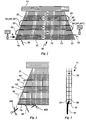
- the collar 10 of Fig. 1 has in the height repeat in alternation Farbringel the two colors F1 and F2.
- the first color yarn 12 is supplied with the knitting yarn via a yarn guide FF1 from the left side and the second color yarn 13 via a yarn guide FF2 from the right side.
- the region of the binding of the knitting yarn in the initial row of the overall knitted fabric 10 is denoted by 15 and the associated yarn end by the reference numeral 16.
- the beginning of the yarn in the second color F2 of the Farbringels 13 is denoted by 18 and the area of its incorporation into the knit 10 with 17.
- the knitting threads of the unused color at the edge are looped on until the next color rollover.
- the loops 19 and 24 are cut off after removal of the knitted fabric 10 from the knitting machine with a pair of scissors 300, as shown schematically in Fig. 2. By cutting the loops 19 and 24, it is necessary to incorporate the resulting yarn ends and starts during the production of the knit fabric in this.
- the integration areas are marked with the numbers 20, 21, 25 and 26.
- the end of the collar forms an aperture 14.
- the collar 1.0 produced as a double-surface knitted fabric can be seen with the front stitches 30 and the back stitches 31.
- the thread end 16 of the starting thread 15 protrudes down in the region of the stitches 31 of the fabric back side out of the stitching association.
- the thread ends of all subsequent threads protrude laterally after the binding out of the mesh, as shown by way of example for the thread end 19 '.
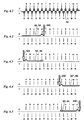
- FIGS. 4.1 to 4.4 An example of the binding of the starting thread 15 of the collar 10 of FIG. 1, which does not fall under the claimed invention, is shown in FIGS. 4.1 to 4.4.
- Fig. 4.1 shows a loop formed with a separating thread 40 on the front needle bed V of a flat knitting machine.
- the beginning 16 of the knitting thread 50 is floated from the left knit edge over the stitches a to d of the back needle bed H, and then the knitting thread 50 is inserted as a loop into the needle e of the back needle bed using the thread guide 100. Subsequently, in the reverse knitting direction, the knitting thread 50 is inserted as a tuck loop with the needle e being cut out into the needles a to d of the float area of FIG. 4.2.
- a fleece thread 15 is formed, which slides onto the knitting thread of the net row when the needles are withdrawn.
- the incorporation of the tuft 15 and the looping of the needle e from the thread 50 ensure that the fabric can not raise.
- the integration of the knitting thread 50 could be carried out on the front needle bed V instead of on the rear needle bed H, if 40 stitches were formed on the rear needle bed H with the separating thread.
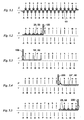
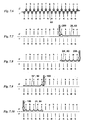
- FIGS. 5.1 to 5.10 a first possibility according to the invention for binding the starting threads 21 and 25 as well as the end threads 20 and 26 of the color cord of the knitted fabric 10 from FIG. 1 is shown.
- Fig. 5.1 illustrates the formation of the last row of the Farbringels with the knitting thread 50 of the first color F1.
- FIG. 5.2 with the knitting thread 50 and the needles a to e of the rear needle bed H in the direction of knitting from the left edge in the direction of the fabric center several Mesh formed.
- the knitting thread 50 is floated over those same needles a to e of the back needle bed H, which have formed stitches in FIG. 5.2.
- the floss thread 19 ' is incorporated in the knitting sequence by the knitted fabric.
- the needle e is tightly looped by the knitting thread 50, so that the knitting thread 50 is secured in the fabric 10.
- FIGS. 5.4 and 5.5 describe the incorporation of the knitting yarn 60 for the color yarn with the second color F2 in FIG. 1.
- the knitting yarn 60 is first floated over a plurality of loops of the rear needle bed n, m, l, k and then into the hanger as a loop Needle j inserted.
- stitches 60 are then formed with the knitting thread beginning with the needle k in the float region 24 "of FIG.
- the floss thread 24 '' is involved in the further knitting sequence of the fabric.
- the needle j is also firmly wrapped by the knitting yarn 60, the knitting yarn 60 thus secured in the fabric.
- FIGS. 5.7 to 5.8 illustrate the incorporation of the end of the knitting yarn 60 at the end of the color wheel 13. This is done analogously to the incorporation of the knitting yarn 50 according to FIGS. 5.2 and 5.3 with the only difference that the integration now takes place on the right fabric edge he follows. Again, a few needles n, m, l, k, j of the rear needle bed H with the knitting yarn 60 form stitches. Subsequently, in the reverse knitting direction, the knitting thread 60 is guided over these needles as floss thread 24 '(FIG. 5.8). The end of the knitting yarn 60 is now secured in the fabric 10.
- the knitted thread 50 is then incorporated, which forms the next color roll. This again takes place in an analogous manner as the incorporation of the knitting thread 60 according to FIGS. 5.4 and 5.5, but now at the left edge of the knitted fabric.
- the knitting thread 50 is floated on the needles a to d of the rear needle bed H and then inserted as a catching handle in the needle e.
- Fig. 5.10 are then formed in the reversal of the knitting direction with the knitting thread 50 starting from the needle d in the float area 19 '' of Fig. 5.9 with the needles a to d of the rear needle bed H stitches.
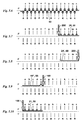
- FIGS. 6.1 to 6.10 relate to a second possibility for incorporating the yarn starts 21 and 25 and the yarn ends 20 and 26 of the two knitting yarns 50 and 60.
- FIG. 6.1 to FIG. 6.3 the securing of the end of the knitting yarn 50 after formation of the last one Knitting row of the Farbringels shown (Fig 6.1).
- the knitting thread 50 is first floated over the needles a to d of the rear needle bed H and then inserted into the needle e as a tuck loop (FIG. 6.2). Then, the knitting direction is reversed and the thread 50 is floated on the needles e, d, c, b and inserted into the needle a as a tuck looper. Since the needle e is firmly wrapped by the thread 50 and the two floats 20 and 19 'are involved in the further knitting sequence of the fabric, thus the end of the thread 50 is secured.
- FIGS. 6.4 and 6.5 the binding of the thread 60 at the beginning of the Farbringels in the second color F2 is shown.
- the knitting thread 60 is again floated on the needles n, m, l, k of the rear needle bed H and inserted as a tuck loop in the needle j.
- the knitting direction is reversed and the knitting thread is floated over the needles j, k, l, m of the rear needle bed H and inserted into the needle n as a tuck loop (FIG. 6.5).
- the needle j is firmly enclosed by the thread 60.
- the floats 24 '' and 25 are involved in the other knitting sequence in the fabric, so that the beginning of the thread 60 is secured.
- Figures 6.7 to 6.8 relate to the incorporation of the end of the knitting yarn 60 at the right fabric edge.
- the thread 60 is floated on the needles n, m, l, k of the rear needle bed H and inserted into the needle j as a tuck loop (Fig. 6.7), before in the reverse knitting direction the thread 60 is floated on the needles j to m and then as a tuck looper is inserted into the needle n.
- the floats 26 and 24 there is an involvement of the floats 26 and 24 'in the other knitting sequence.
- the needle j is firmly wrapped by the thread 60, so that the thread 60 is secured in the fabric.
- Figs. 6.9 and 6.10 describe the incorporation of the beginning of the knitting yarn 50 for the next color roll.
- the thread 50 is floated over the needles a to d starting from the left fabric edge in the direction of the fabric center and then inserted into the needle e as a tuck loop. After reversing the knitting direction, the thread 50 is floated on the needles e, d, c, b and inserted as a tuck in the needle a (Fig. 6.10) and thereby secured in the fabric.
- FIGS. 7.1 to 7.10 now relate to a third possibility of integrating the yarn starts 21, 25 and the yarn ends 20, 26 into a knitted fabric, this process corresponding to that of FIG. 4 for integrating the starting yarn of the knitted fabric.
- the knitting thread 50 is floated as a pile thread 20 from the left knitted side in the direction of the center of the knitting over the needles a to d of the rear needle bed H to secure its end, and then inserted into the needle e as a catch loop.
- tuck loops are formed with the thread 50, as shown in FIG. 7.3.
- the thread 50 is thus secured.
- 7.4 and 7.5 describe the incorporation of the beginning of the thread of the next knitting yarn 60. This is from the right knit edge in the direction of the fabric center on the needles n, m, l, k geflottet and then inserted as a tuck in the needle j (Fig. 7.4) , Subsequently, after reversing the knitting direction with the needles k, l, m, n and the thread 60th Tail loin formed.
- the floss thread 24 'and the filament yarn 25, which forms from the tuck loops of the needles k, l, m, n, are bound into the fabric in the further course of knitting.
- Figs. 7.7 to 7.8 relate to securing the end of the thread 60 at the right edge of the fabric.
- floats are made via the needles n to k and the insertion of a tuck into the needle j (FIG. 7.7) before tuck loops with the needles k to n are formed in the reverse direction of knitting.
- Figs. 7.9 to 7.10 the securing of the beginning of the knitting thread 50 is shown.
- the thread 50 is floated as a floss thread 19 '' from the left fabric edge of the needles a to d and inserted as a tuck looper in the needle e. After reversing the knitting direction, tuck loops are formed with the needles d, c, b, a (FIG. 7.10). Thus, the beginning of the thread 50 is secured in the fabric.
- Figs. 4 to 7 The methods of incorporating knitting thread starts and ends shown in Figs. 4 to 7 were all performed on the back needle bed H, but could equally well be done on the front needle bed V.
- the number of needles over which the binding process takes place can also be varied.
- the thread starts and ends can be integrated not only in the edge region, but also in the middle region of the knitted fabric.
Landscapes
- Engineering & Computer Science (AREA)
- Textile Engineering (AREA)
- Knitting Of Fabric (AREA)
Claims (5)
- Procédé pour intégrer un début et/ou une fin de fil à tricoter dans un tricot (10) à double couche fabriqué sur une machine à tricoter et formé par des aiguilles voisines de la fonture avant et arrière de la machine à tricoter, dans lequel par la suite le début de fil à tricoter (15, 21, 25) ou la fin de fil à tricoter (20, 26) est flotté sur plusieurs aiguilles (a-d ; n, m, 1, k) et est ensuite introduit comme maille flottée dans une aiguille (e ; j) qui porte une maille, avant que, en sens inverse du tricotage, des mailles flottées soient formées uniquement à l'aide des aiguilles (a à d ; n, m, 1, k) de la même fonture (H) dans la zone de flottage en commençant par l'aiguille (d ; k) qui suit la maille flottée et qui se trouve sur la même fonture (H).
- Procédé pour intégrer un début et/ou une fin de fil à tricoter dans un tricot (10) à double couche fabriqué sur une machine à tricoter et formé par des aiguilles voisines de la fonture avant et arrière de la machine à tricoter, dans lequel par la suite le début de fil à tricoter (21, 25) ou la fin de fil à tricoter (20, 26) est flotté sur plusieurs aiguilles (ad ; n, m, 1, k) et est ensuite introduit comme maille flottée dans une aiguille (e ; j) de la même fonture (H), qui porte une maille, avant que, en sens inverse du tricotage, le début de fil à tricoter (21, 25) ou la fin de fil à tricoter (20, 26) soit flotté sur les aiguilles (e ; j) où se trouve la maille flottée et sur les aiguilles (b, c, d ; k, 1, m) du premier flottage et soit introduit comme maille flottée dans la dernière aiguille (a ; n) de la même fonture (H) du premier flottage.
- Procédé pour intégrer un début de fil à tricoter dans un tricot (10) à double couche fabriqué sur une machine à tricoter et formé par des aiguilles voisines de la fonture avant et arrière de la machine à tricoter, dans lequel par la suite le début de fil à tricoter (21, 25) est flotté sur plusieurs aiguilles (n, m, 1, k) et est ensuite introduit comme maille flottée dans une aiguille (j) qui porte une maille, avant que, en sens inverse du tricotage, des mailles soient formées uniquement sur les aiguilles (k, l, m, n) de la même fonture (H) dans la zone de flottage en commençant par l'aiguille (k) qui suit la maille flottée et qui se trouve sur la même fonture (H).
- Procédé pour intégrer une fin de fil à tricoter dans un tricot (10) à double couche fabriqué sur une machine à tricoter et formé par des aiguilles voisines de la fonture avant et arrière de la machine à tricoter, dans lequel par la suite, avec la fin de fil à tricoter (20, 26), des mailles sont formées uniquement par plusieurs aiguilles (a-e) voisines d'une fonture (V, H), qui portent une maille, avant d'inverser le sens de tricotage après la dernière de ces aiguilles (e) et de flotter la fin de fil à tricoter (20, 26) en sens inverse de tricotage sur ces aiguilles (a-e), la fin de fil à tricoter (20, 26) entourant alors solidement la dernière des aiguilles (e) et étant intégrée dans le tricot quand on continue de tricoter.
- Procédé selon l'une des revendications 1 à 4, caractérisé en ce que l'intégration des débuts de fil à tricoter (15, 21, 25) et/ou des fins de fil à tricoter (20, 26) a lieu lorsque la zone de flottage se trouve à distance des bords du tricot.
Applications Claiming Priority (2)
| Application Number | Priority Date | Filing Date | Title |
|---|---|---|---|
| DE10026367 | 2000-05-27 | ||
| DE10026367A DE10026367A1 (de) | 2000-05-27 | 2000-05-27 | Verfahren zum Einbinden eines Strickfadenanfangs und/oder -endes in ein Gestrick |
Publications (3)
| Publication Number | Publication Date |
|---|---|
| EP1160366A2 EP1160366A2 (fr) | 2001-12-05 |
| EP1160366A3 EP1160366A3 (fr) | 2002-12-11 |
| EP1160366B1 true EP1160366B1 (fr) | 2006-07-26 |
Family
ID=7643817
Family Applications (1)
| Application Number | Title | Priority Date | Filing Date |
|---|---|---|---|
| EP01105617A Expired - Lifetime EP1160366B1 (fr) | 2000-05-27 | 2001-03-07 | Procédé pour relier un bout de commencement et/ou bout de fin d'un fil dans un tricot |
Country Status (3)
| Country | Link |
|---|---|
| EP (1) | EP1160366B1 (fr) |
| DE (2) | DE10026367A1 (fr) |
| ES (1) | ES2266036T3 (fr) |
Families Citing this family (7)
| Publication number | Priority date | Publication date | Assignee | Title |
|---|---|---|---|---|
| JP5058817B2 (ja) * | 2005-11-17 | 2012-10-24 | 株式会社島精機製作所 | ボーダー柄を有する筒状編地の編成方法 |
| GB2443627B (en) * | 2006-11-10 | 2011-01-05 | Carraig Donn Patent Ltd | A method of manufacturing a knitted garment |
| DE502007005757D1 (de) | 2007-06-15 | 2011-01-05 | Stoll H Gmbh & Co Kg | Verfahren zum Einbinden eines Strickfadenfangs und/oder-endes |
| CN102634917A (zh) * | 2012-04-05 | 2012-08-15 | 宁波诺布尔制衣实业有限公司 | 夹色针织衫织片时缝边处拉线的编织方法 |
| ITMI20132129A1 (it) * | 2013-12-19 | 2015-06-20 | Santoni & C Spa | Procedimento per la fermatura di almeno un filo all'inizio o alla fine della sua alimentazione nella produzione di un tessuto a maglia in trama con una macchina per maglieria per lavorazioni a moto alternato. |
| CN114438646B (zh) * | 2022-01-05 | 2024-10-01 | 福建泉州凹凸精密机械有限公司 | 一种双面织物防脱线工艺 |
| CN114703590B (zh) * | 2022-03-08 | 2023-06-13 | 嘉兴市蒂维时装有限公司 | 一种全成型浮线移针组织编织方法及针织物 |
Family Cites Families (9)
| Publication number | Priority date | Publication date | Assignee | Title |
|---|---|---|---|---|
| DE3715297A1 (de) * | 1987-05-08 | 1988-11-24 | Stoll & Co H | Verfahren und einrichtung zum behandeln der strickgarne laengs des gestrickrandes |
| DE3939584C2 (de) * | 1989-11-30 | 1996-08-29 | Stoll & Co H | Verfahren zum fortlaufenden Stricken von aneinanderhängenden Gestrickstücken auf einer Flachstrickmaschine |
| DE4329920A1 (de) * | 1993-09-04 | 1995-03-09 | Stoll & Co H | Verfahren zur Bildung eines Fadensicherungsknotens auf einer Flachstrickmaschine |
| JP2529640B2 (ja) * | 1993-06-23 | 1996-08-28 | 株式会社島精機製作所 | 編地の端糸処理方法 |
| DE4330071C2 (de) * | 1993-09-06 | 1996-08-01 | Schieber Universal Maschf | Verfahren zum Stricken von Intarsia-Mustern auf Flachstrickmaschinen |
| JPH09217254A (ja) * | 1996-02-13 | 1997-08-19 | Tsudakoma Corp | 渡り糸止め部の形成方法 |
| IT1289292B1 (it) * | 1996-05-31 | 1998-10-02 | A R M I S R L | Perfezionamenti ad un metodo e ad una apparecchiatura per l'imbrigliamento in corso di tessitura di porzioni terminali di filo |
| DE19701425B4 (de) * | 1997-01-17 | 2005-01-05 | H. Stoll Gmbh & Co. | Verfahren zum Einbinden von Fadenanfängen bzw. Fadenenden in ein Gestrick |
| DE19738213B4 (de) * | 1997-09-02 | 2005-11-24 | H. Stoll Gmbh & Co. | Verfahren zur Herstellung eines Gestrickes auf einer Flachstrickmaschine |
-
2000
- 2000-05-27 DE DE10026367A patent/DE10026367A1/de not_active Withdrawn
-
2001
- 2001-03-07 DE DE50110520T patent/DE50110520D1/de not_active Expired - Fee Related
- 2001-03-07 EP EP01105617A patent/EP1160366B1/fr not_active Expired - Lifetime
- 2001-03-07 ES ES01105617T patent/ES2266036T3/es not_active Expired - Lifetime
Also Published As
| Publication number | Publication date |
|---|---|
| DE50110520D1 (de) | 2006-09-07 |
| ES2266036T3 (es) | 2007-03-01 |
| EP1160366A3 (fr) | 2002-12-11 |
| EP1160366A2 (fr) | 2001-12-05 |
| DE10026367A1 (de) | 2001-11-29 |
Similar Documents
| Publication | Publication Date | Title |
|---|---|---|
| DE836070C (de) | Verfahren zur Herstellung von Kettenwirkware | |
| DE1585514A1 (de) | Verfahren zum Stricken von Florgewebe | |
| DE2313651A1 (de) | Verfahren zur herstellung doppelflaechiger, ein- und/oder zweiseitig plattierter glatter oder gemusterter strickwaren, insbesondere futterwaren und rundstrickmaschine zu deren herstellung | |
| EP2664701B1 (fr) | Procédé de fabrication d'un tricot avec au moins un fil flottant et textile obtenu | |
| DE2656403A1 (de) | Gestrickter rohling fuer kleidungsstuecke und verfahren zu seiner herstellung | |
| CH648069A5 (de) | Verfahren und fadeneinleger an einer nadel-bandwebmaschine zur herstellung eines gurtbandes mit hohlkanten. | |
| DE69816454T2 (de) | Nahtlose kettenstrickwaren | |
| DE3035582C2 (de) | Rundstrickmaschine zur Herstellung einer einflächigen Plüschware | |
| CH639710A5 (de) | Verfahren zur herstellung eines gewebes, webmaschine zur durchfuehrung des verfahrens und nach dem verfahren hergestelltes gewebe. | |
| DE2350459C3 (de) | Einstück-Strumpfhose | |
| DE102008059241A1 (de) | Strickerzeugnis und Verfahren zum Herstellen eines Strickerzeugnisses | |
| EP2336412A1 (fr) | Aiguille de flottaison pour un métier à crochets pour galons | |
| DE69908679T2 (de) | Verfahren zum Weitern | |
| EP1160366A2 (fr) | Procédé pour relier un bout de commencement et/ou bout de fin d'un fil dans un tricot | |
| EP2003231B1 (fr) | Procédé pour relier un bout de commencement et/ou bout de fin d'un fil | |
| DE19630006A1 (de) | Verfahren zur Herstellung von nahtlos zu offen oder geschlossenen an den Rändern verbundenen Flachgestricken | |
| DE2022023B2 (fr) | ||
| DE19738213B4 (de) | Verfahren zur Herstellung eines Gestrickes auf einer Flachstrickmaschine | |
| DE102022208035A1 (de) | Verfahren zum stricken eines gestricks und gestrick | |
| DE3039576C2 (fr) | ||
| EP1111109B1 (fr) | Procédé pour la formation de mailles nouveaux dans un métier à tricoter | |
| EP0305682A2 (fr) | Tricot | |
| DE3217629A1 (de) | Gestricktes oder gewirktes band mit regulaeren kanten zum einfassen eines warengutes sowie verfahren zur herstellung solcher baender | |
| DE927463C (de) | Maschenware und Verfahren zu ihrer Herstellung | |
| DE518021C (de) | Wirkware und Verfahren sowie Vorrichtung zu ihrer Herstellung |
Legal Events
| Date | Code | Title | Description |
|---|---|---|---|
| PUAI | Public reference made under article 153(3) epc to a published international application that has entered the european phase |
Free format text: ORIGINAL CODE: 0009012 |
|
| AK | Designated contracting states |
Kind code of ref document: A2 Designated state(s): AT BE CH CY DE DK ES FI FR GB GR IE IT LI LU MC NL PT SE TR |
|
| AX | Request for extension of the european patent |
Free format text: AL;LT;LV;MK;RO;SI |
|
| PUAL | Search report despatched |
Free format text: ORIGINAL CODE: 0009013 |
|
| RIC1 | Information provided on ipc code assigned before grant |
Free format text: 7D 04B 1/22 A, 7D 04B 1/10 B |
|
| AK | Designated contracting states |
Kind code of ref document: A3 Designated state(s): AT BE CH CY DE DK ES FI FR GB GR IE IT LI LU MC NL PT SE TR |
|
| AX | Request for extension of the european patent |
Free format text: AL;LT;LV;MK;RO;SI |
|
| 17P | Request for examination filed |
Effective date: 20030527 |
|
| AKX | Designation fees paid |
Designated state(s): DE ES IT |
|
| 17Q | First examination report despatched |
Effective date: 20040727 |
|
| GRAP | Despatch of communication of intention to grant a patent |
Free format text: ORIGINAL CODE: EPIDOSNIGR1 |
|
| GRAS | Grant fee paid |
Free format text: ORIGINAL CODE: EPIDOSNIGR3 |
|
| GRAA | (expected) grant |
Free format text: ORIGINAL CODE: 0009210 |
|
| AK | Designated contracting states |
Kind code of ref document: B1 Designated state(s): DE ES IT |
|
| PG25 | Lapsed in a contracting state [announced via postgrant information from national office to epo] |
Ref country code: IT Free format text: LAPSE BECAUSE OF FAILURE TO SUBMIT A TRANSLATION OF THE DESCRIPTION OR TO PAY THE FEE WITHIN THE PRESCRIBED TIME-LIMIT;WARNING: LAPSES OF ITALIAN PATENTS WITH EFFECTIVE DATE BEFORE 2007 MAY HAVE OCCURRED AT ANY TIME BEFORE 2007. THE CORRECT EFFECTIVE DATE MAY BE DIFFERENT FROM THE ONE RECORDED. Effective date: 20060726 |
|
| REF | Corresponds to: |
Ref document number: 50110520 Country of ref document: DE Date of ref document: 20060907 Kind code of ref document: P |
|
| REG | Reference to a national code |
Ref country code: ES Ref legal event code: FG2A Ref document number: 2266036 Country of ref document: ES Kind code of ref document: T3 |
|
| PLBE | No opposition filed within time limit |
Free format text: ORIGINAL CODE: 0009261 |
|
| STAA | Information on the status of an ep patent application or granted ep patent |
Free format text: STATUS: NO OPPOSITION FILED WITHIN TIME LIMIT |
|
| 26N | No opposition filed |
Effective date: 20070427 |
|
| PGFP | Annual fee paid to national office [announced via postgrant information from national office to epo] |
Ref country code: ES Payment date: 20080114 Year of fee payment: 8 |
|
| PGFP | Annual fee paid to national office [announced via postgrant information from national office to epo] |
Ref country code: DE Payment date: 20080404 Year of fee payment: 8 |
|
| PG25 | Lapsed in a contracting state [announced via postgrant information from national office to epo] |
Ref country code: DE Free format text: LAPSE BECAUSE OF NON-PAYMENT OF DUE FEES Effective date: 20091001 |
|
| REG | Reference to a national code |
Ref country code: ES Ref legal event code: FD2A Effective date: 20090309 |
|
| PGFP | Annual fee paid to national office [announced via postgrant information from national office to epo] |
Ref country code: IT Payment date: 20100209 Year of fee payment: 10 |
|
| PG25 | Lapsed in a contracting state [announced via postgrant information from national office to epo] |
Ref country code: ES Free format text: LAPSE BECAUSE OF NON-PAYMENT OF DUE FEES Effective date: 20090309 |
|
| PG25 | Lapsed in a contracting state [announced via postgrant information from national office to epo] |
Ref country code: IT Free format text: LAPSE BECAUSE OF NON-PAYMENT OF DUE FEES Effective date: 20110307 |