EP2003231B1 - Procédé pour relier un bout de commencement et/ou bout de fin d'un fil - Google Patents
Procédé pour relier un bout de commencement et/ou bout de fin d'un fil Download PDFInfo
- Publication number
- EP2003231B1 EP2003231B1 EP07011749A EP07011749A EP2003231B1 EP 2003231 B1 EP2003231 B1 EP 2003231B1 EP 07011749 A EP07011749 A EP 07011749A EP 07011749 A EP07011749 A EP 07011749A EP 2003231 B1 EP2003231 B1 EP 2003231B1
- Authority
- EP
- European Patent Office
- Prior art keywords
- needle
- stitch
- knitted
- yarn
- knitting
- Prior art date
- Legal status (The legal status is an assumption and is not a legal conclusion. Google has not performed a legal analysis and makes no representation as to the accuracy of the status listed.)
- Active
Links
Images



Classifications
-
- D—TEXTILES; PAPER
- D04—BRAIDING; LACE-MAKING; KNITTING; TRIMMINGS; NON-WOVEN FABRICS
- D04B—KNITTING
- D04B1/00—Weft knitting processes for the production of fabrics or articles not dependent on the use of particular machines; Fabrics or articles defined by such processes
- D04B1/22—Weft knitting processes for the production of fabrics or articles not dependent on the use of particular machines; Fabrics or articles defined by such processes specially adapted for knitting goods of particular configuration
-
- D—TEXTILES; PAPER
- D04—BRAIDING; LACE-MAKING; KNITTING; TRIMMINGS; NON-WOVEN FABRICS
- D04B—KNITTING
- D04B1/00—Weft knitting processes for the production of fabrics or articles not dependent on the use of particular machines; Fabrics or articles defined by such processes
- D04B1/10—Patterned fabrics or articles
- D04B1/12—Patterned fabrics or articles characterised by thread material
- D04B1/126—Patterned fabrics or articles characterised by thread material with colour pattern, e.g. intarsia fabrics
Definitions
- the invention relates to a method for incorporating a knitting thread beginning and / or end in a knitted fabric produced on a knitting machine.
- the thread with which the fabric area has been formed is not adequately secured at its beginning and end.
- a tensile force on the floss threads, which lead or lead away to the knit area, or a tensile force on the fabric itself, can reduce or increase the starting or final mesh. This can also lead to a thread break and runs.
- the floats at the beginning and at the end of the fabric sections are cut to short ends of the thread and this then, also by hand and with a much larger Time spent, sewn or knotted at the knitted areas in the knitted piece.
- the EP-A 0 641 879 describes the incorporation of the beginning and the end of a knitting thread at the edges of a infarious field by forming tether loops on both needle beds as well as stitches and being hung over, which is very costly.
- the present invention has for its object to provide a rational method for incorporating Fadenanfnature and thread ends, which makes the time-consuming sewing or knotting thread ends superfluous.
- the object is achieved with a method for incorporating a knitting thread beginning and / or end into a knitted fabric produced on a knitting machine, which is characterized in that the stitch of the border needle of the knitted fabric, with the on or knitting thread to be formed immediately adjacent to the free end of the thread, a stitch is divided by a split-stitch technique, with one loop leg remains on the border needle and the other loop leg is transferred to the opposite needle, before with the border needle and with all others according to the pattern provided therefor needles are formed in this knitting with the thread to be tied or stitched meshes and then the second loop leg is hung back on the border needle.
- the limit needle is the starting needle or the end needle of the fabric produced with the thread knit.
- the yarn starts and ends are thus clamped between the two mesh legs of the split stitch of the border needle. It has been shown that this clamping is sufficient so that no sewing or knotting the thread ends is more necessary.
- the clamping of the thread ends could also be done by the mesh legs of two divided stitches, if this should be required for special yarns. It could then be divided into the mesh of the border needle adjacent mesh.
- the knitting yarn starts and ends of a plurality of adjoining knitted portions to which the yarns are fed from the same knitting side starting from the knitted portion furthest from the yarn feeding side can be inserted into the knitted fabric be involved. This procedure requires for the binding of the threads the fewest slide movements.
- this stitch can be relocated together with the second loop leg of the mesh of the boundary needle on the border needle, after this formed a stitch with the knitting thread or constructive Binenden Has.
- this needle in the case of double-sided knitted fabrics in which the needle opposite the border needle already carries a stitch, this needle can be freed from its stitch before the second loop leg of the loop of the border needle is transferred to it.
- the thread ends are clamped just as securely as single-surface knitted fabrics.
- a knit 100 is shown having a rib-knit waistband 101 and a basic knit 102.
- a knit area 1, 2 and 3 are formed with knitting threads of different color and / or structure.
- the knit areas 1, 2 and 3 are all away from the edge of the knit 100, which means that the limit needles, ie the start needle and the end needle of each of the knit areas lie within the base knit 102.
- the yarn 10 is guided from a nip K1 with a yarn guide FF1 from the left side of the fabric over the area of the base fabric 102 until it can be incorporated by the starting needle 11 by a method according to the invention in the base fabric 102.
- the thread 10 is fastened by the end needle 12 in the knit area 1 according to the method according to the invention and brought to the left side of the knit 100 by the thread guide FF1 over the area of the basic knit 102.
- the associated thread 20 is guided so far from the right side of the knit 102 from a nip K2 by a thread guide FF2 until it is fixed by the starting needle 21 by a method according to the invention in the basic knit 102.
- the thread 20 is fastened by the end needle 22 in the knit area 2 according to a method according to the invention and brought to the left side of the knit 100 by means of the thread guide FF2 over the area of the basic knit 102.
- the associated thread 30 is guided over the region of the basic knit 102 from the right side of the knit 100 from a nip K3 until it can be fastened in the basic knit 102 with the starting needle 31 by a method according to the invention.
- the thread 30 is bound by the end needle 32 and then brought by means of the thread guide FF3 on the right side of the knitted fabric.
- the knitted areas 1 to 3 can have any shapes, be placed anywhere in the fabric 100, even at its edges, and have any patterns and structures.
- the size and the number of knitted areas are arbitrarily changeable.
- Fig. 1 shows here only an example.
- a monofilament knit 100 ' is shown which also has a waistband 101' and a base knit 102 '. Knitted areas 1 ', 2' and 3 'are arranged in the basic knit 102', which adjoin one another directly.
- the knitted fabric 100 'thus represents a typical intarsia knit. All knitted areas 1' to 3 'begin and end at the same height in the knitted fabric.
- the knitted areas 1 ', 2' and 3 ' differ in color with each other and the basic knit 102 ', so all are formed with different knitting yarns, which are supplied in the example shown in each case from the right fabric side.
- the production of the knit regions 1 'to 3' begins with the formation of a starting knitting line for the knit region 1 ', that is, the knit region furthest away from the yarn supply side of the knitted fabric 100', then a starting knitting course for the knit region 2 'and finally for the knitted area 3 '.
- the thread starts are each incorporated by the start needle in 11 ', 21' and 31 'by the method according to the invention in the fabric.
- the thread is bound into the knitted fabric by the respective end needle according to a method according to the invention. It is now started with the fabric area 3 ', the yarn 30' by the end needle 32 'is integrated. Next, the thread 20 'of the knitted area 2' is bound by the needle 22 'and lastly the thread 10' of the knitted area 1 'by the end needle 12'.
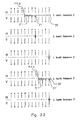
- Fig. 3.1 to 3.2 is the course of stitches for the integration of the knitting threads of the knitted areas 1 'to 3' from Fig. 2 shown by a method according to the invention.
- the basic knit 102 ' has at least one width which corresponds to the sum of the width of the adjoining knitted regions 1' to 3 '.
- the basic knit comprises the needles A - L.
- the border needle here the starting needle of the knitted portion 1 'is divided by a split-stitch method while one of the mesh legs of the divided stitch is hung on the needle d of the back needle bed.
- the thread 10 'of the knitted area 1' with the thread guide FF1 is inserted into the needles of the front needle bed from the limit or start needle D to the needle A.
- the leg of the basic knit stitch which has been transferred to the needle d of the rear needle bed, is hung back onto the limit needle (start needle) D.
- the incorporation of the threads 20 'and 30' of the knitted regions 2 'and 3' takes place in the same manner as in the three steps illustrated for the knit region 1 ', such as Fig. 3.1 to 3.2 clarify.
- the starting needle or limit needle of the knitted portion 2 ' is the needle H of the front needle bed, and the limit needle of the knitted portion 3' is the needle L.
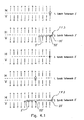
- the Fig. 4.1 and 4.2 illustrate the incorporation of the ends of the knitting threads of the knitted areas 1 'to 3' of the knitted fabric 100 ' Fig. 2 in the respective final knitting series. Also, the binding of the thread ends takes place again in three steps, but now with the knitted area 3 'is started, which is the thread feed side, here the right side of the knitted fabric 100', the closest.
- the loop of the front needle bed formed in the penultimate knitting course is split by a split-stitch method and a looped leg is hung on the needle I of the back needle bed.
- the thread 30 'of the knitted area 3' with the thread guide FF3 are inserted into the needles I to L (end needle) and stitches are formed.
- the leg of the loop which has been transferred from the limit needle (end needle) L to the needle I is hung back onto the needle L and thereby the thread end is clamped between the two stitch legs.
- the ends of the threads 20 'and 10' of the knitted areas 2 'and 1' are incorporated in an analogous manner, the border needle or end needle of the knitted area 2 'being the needle H of the front needle bed and the limit needle or end needle of the knitted area 1' being the needle D. of the front needle bed.
Landscapes
- Engineering & Computer Science (AREA)
- Textile Engineering (AREA)
- Knitting Of Fabric (AREA)
Claims (4)
- Procédé pour relier un début et/ou une fin (10, 20, 30 ; 10', 20', 30') de fil à tricoter à un tricot (100, 100') fabriqué sur une tricoteuse, caractérisé en ce que l'on sépare au moyen d'une technique split-stitch la maille de l'aiguille (D, H, L) limite du tricot (100, 100'), avec laquelle une maille immédiatement voisine de l'extrémité libre du fil doit être formée avec le fil (10', 20', 30') à tricoter à relier ou à nouer, un côté de la maille restant sur l'aiguille (D, H, L) limite, l'autre côté de la maille étant reportée sur l'aiguille (d, h, 1) opposée avant que soient formées avec le fil (10', 20', 30') à relier ou à nouer des mailles avec l'aiguille (D, H, L) limite et avec toutes les autres aiguilles de cette rangée de tricotage prévues à cet effet suivant le modèle et on reporte ensuite le deuxième côté de la maille sur l'aiguille (D, H, L) limite.
- Procédé suivant la revendication 1, caractérisé en ce que les débuts et fins (10, 20, 30 ; 10', 20', 30') de fil à tricoter de plusieurs parties (1, 2, 3 ; 1', 2', 3') de tricot voisines les unes des autres, auxquelles les fils (10, 20, 30 ; 10', 20', 30') sont amenés par le même côté du tricot, sont reliés au tricot (100, 100') en commençant par la partie (1, 2, 3 ; 1', 2', 3') du tricot, qui est la plus éloignée du côté d'amenée du fil.
- Procédé suivant la revendication 1 ou 2, caractérisé en ce que, pour des tricots (100, 100') double-face, dans lesquels les aiguilles (d, h, 1) opposées aux aiguilles (D, H, L) limites portent déjà une maille, on reporte cette maille ensemble avec le deuxième côté de la maille de l'aiguille (D, H, L) limite sur l'aiguille (D, H, L) limite, après que celle-ci a formé une maille avec le fil (10, 20, 30 ; 10', 20', 30') à relier ou à nouer.
- Procédé suivant la revendication 1 ou 2, caractérisé en ce que, pour des tricots (100, 100') double-face, dans lesquels les aiguilles (d, h, 1) opposées aux aiguilles (D, H, L) limites portent déjà une maille, on dégage cette aiguille (d, h, 1) de sa maille, avant que le deuxième côté de la maille de l'aiguille (D, H, L) limite soit reporté sur elle.
Priority Applications (4)
| Application Number | Priority Date | Filing Date | Title |
|---|---|---|---|
| EP07011749A EP2003231B1 (fr) | 2007-06-15 | 2007-06-15 | Procédé pour relier un bout de commencement et/ou bout de fin d'un fil |
| DE502007005757T DE502007005757D1 (de) | 2007-06-15 | 2007-06-15 | Verfahren zum Einbinden eines Strickfadenfangs und/oder-endes |
| ES07011749T ES2354377T3 (es) | 2007-06-15 | 2007-06-15 | Procedimiento para ligar un principio y/o un final de un hilo de género de punto. |
| CN200810125558.7A CN101324006B (zh) | 2007-06-15 | 2008-06-13 | 用于接结针织纱始端和/或末端的方法 |
Applications Claiming Priority (1)
| Application Number | Priority Date | Filing Date | Title |
|---|---|---|---|
| EP07011749A EP2003231B1 (fr) | 2007-06-15 | 2007-06-15 | Procédé pour relier un bout de commencement et/ou bout de fin d'un fil |
Publications (2)
| Publication Number | Publication Date |
|---|---|
| EP2003231A1 EP2003231A1 (fr) | 2008-12-17 |
| EP2003231B1 true EP2003231B1 (fr) | 2010-11-24 |
Family
ID=38755520
Family Applications (1)
| Application Number | Title | Priority Date | Filing Date |
|---|---|---|---|
| EP07011749A Active EP2003231B1 (fr) | 2007-06-15 | 2007-06-15 | Procédé pour relier un bout de commencement et/ou bout de fin d'un fil |
Country Status (4)
| Country | Link |
|---|---|
| EP (1) | EP2003231B1 (fr) |
| CN (1) | CN101324006B (fr) |
| DE (1) | DE502007005757D1 (fr) |
| ES (1) | ES2354377T3 (fr) |
Families Citing this family (4)
| Publication number | Priority date | Publication date | Assignee | Title |
|---|---|---|---|---|
| JP5436279B2 (ja) * | 2010-03-15 | 2014-03-05 | 株式会社島精機製作所 | 編地、およびその編成方法、ならびにデザイン装置 |
| JP5618809B2 (ja) * | 2010-12-16 | 2014-11-05 | 株式会社島精機製作所 | 編地の編成方法、および編地 |
| JP7674204B2 (ja) * | 2021-09-09 | 2025-05-09 | 株式会社島精機製作所 | 編地の編成方法、及び編地 |
| CN114016204B (zh) * | 2021-11-22 | 2022-07-22 | 江南大学 | 一种横编结头全自动处理连续编织工艺方法 |
Family Cites Families (9)
| Publication number | Priority date | Publication date | Assignee | Title |
|---|---|---|---|---|
| DE4140282A1 (de) * | 1991-12-06 | 1993-06-09 | H. Stoll Gmbh & Co, 7410 Reutlingen, De | Verfahren zum formstricken von intarsien-jacquardware |
| JP2816784B2 (ja) * | 1992-06-17 | 1998-10-27 | 株式会社島精機製作所 | 横編機の糸加工位置制御方法および装置 |
| EP0616064B1 (fr) * | 1993-03-16 | 1997-08-27 | H. Stoll GmbH & Co. | Procédé pour la formation d'un noeud de sécurité des fils dans un métier à tricoter rectilinge, tricot comprenant un noeud de sécurité et utilisation d'un métier rectiligne pour son obtention |
| DE4330071C2 (de) | 1993-09-06 | 1996-08-01 | Schieber Universal Maschf | Verfahren zum Stricken von Intarsia-Mustern auf Flachstrickmaschinen |
| US5628209A (en) * | 1994-09-01 | 1997-05-13 | Shima Seiki Manufacturing Ltd. | Method of forming a knot on a flat knitting machine |
| DE19701425B4 (de) | 1997-01-17 | 2005-01-05 | H. Stoll Gmbh & Co. | Verfahren zum Einbinden von Fadenanfängen bzw. Fadenenden in ein Gestrick |
| JP3523501B2 (ja) * | 1998-09-25 | 2004-04-26 | 株式会社島精機製作所 | インレイ編地編成方法およびインレイ編地 |
| DE10026367A1 (de) | 2000-05-27 | 2001-11-29 | Stoll & Co H | Verfahren zum Einbinden eines Strickfadenanfangs und/oder -endes in ein Gestrick |
| DE50303358D1 (de) * | 2003-04-03 | 2006-06-22 | Stoll & Co H | Nadel für Strickmaschinen und Verfahren zum Teilen einer Masche |
-
2007
- 2007-06-15 DE DE502007005757T patent/DE502007005757D1/de active Active
- 2007-06-15 ES ES07011749T patent/ES2354377T3/es active Active
- 2007-06-15 EP EP07011749A patent/EP2003231B1/fr active Active
-
2008
- 2008-06-13 CN CN200810125558.7A patent/CN101324006B/zh active Active
Also Published As
| Publication number | Publication date |
|---|---|
| EP2003231A1 (fr) | 2008-12-17 |
| ES2354377T3 (es) | 2011-03-14 |
| DE502007005757D1 (de) | 2011-01-05 |
| CN101324006A (zh) | 2008-12-17 |
| CN101324006B (zh) | 2013-03-13 |
Similar Documents
| Publication | Publication Date | Title |
|---|---|---|
| EP2664701B1 (fr) | Procédé de fabrication d'un tricot avec au moins un fil flottant et textile obtenu | |
| DE102013013612B4 (de) | Flor-Strickverfahren | |
| DE102013016676A1 (de) | Verfahren zum Stricken eines Gestricks | |
| DE60034958T2 (de) | Strickverfahren zur entsorgung von fadenresten | |
| EP3556921B1 (fr) | Machine à tricoter rectiligne et procédé de fabrication d'un tricot à motifs filigranes | |
| EP2003231A1 (fr) | Procédé pour relier un bout de commencement et/ou bout de fin d'un fil | |
| EP1321552A1 (fr) | Aiguille pour métiers à mailles cueillies ou mailles jetées et machine à tricoter équipé avec celle-ci | |
| DE2909963A1 (de) | Verfahren zur maschinellen maschenbildung sowie strick- oder wirkmaschine zur ausfuehrung des verfahrens | |
| DE3135702A1 (de) | Verfahren zur herstellung einer einflaechigen, gemusterten strickware und rundstrickmaschine zur durchfuehrung des verfahrens | |
| EP0273941B1 (fr) | Tissu plat et metier chaine | |
| EP0680529B1 (fr) | Procede et dispositif permettant de realiser des configurations textiles du type filet | |
| EP1724385B1 (fr) | Procédé pour la production d'un tricot sur un métier à tricoter rectiligne | |
| DE102014013604A1 (de) | Verfahren zum Starten eines auf einer Flachstrickmaschine durchgeführten Strickens | |
| EP2551392B1 (fr) | Procédé de fabrication d'un textile tricoté avec des points de broderie | |
| EP1160366B1 (fr) | Procédé pour relier un bout de commencement et/ou bout de fin d'un fil dans un tricot | |
| CH644410A5 (de) | Verfahren und kettenwirkmaschine zur herstellung eines gemusterten polschlingengewirkes. | |
| DE19630006A1 (de) | Verfahren zur Herstellung von nahtlos zu offen oder geschlossenen an den Rändern verbundenen Flachgestricken | |
| EP1829994B1 (fr) | Procédé pour produire un tricot à motif | |
| DE4033735A1 (de) | Strickmaschine zur herstellung von plueschwaren | |
| EP1811070B1 (fr) | Procédé de fabrication d'une étoffe à boucles pour fermetures par boucles et crochets et étoffe correspondante | |
| EP1111109B1 (fr) | Procédé pour la formation de mailles nouveaux dans un métier à tricoter | |
| WO2017215828A1 (fr) | Machine à tricoter circulaire | |
| EP1288360B1 (fr) | Procédé pour la réalisation des mailles s'étendant sur plusieurs aiguilles | |
| EP0179072B1 (fr) | Procede de fabrication d'un tissu a motifs tricote en chaine et metier chaine pour sa mise en o euvre | |
| EP3214214B1 (fr) | Produit boucle ayant une partie arriere texturee |
Legal Events
| Date | Code | Title | Description |
|---|---|---|---|
| PUAI | Public reference made under article 153(3) epc to a published international application that has entered the european phase |
Free format text: ORIGINAL CODE: 0009012 |
|
| AK | Designated contracting states |
Kind code of ref document: A1 Designated state(s): AT BE BG CH CY CZ DE DK EE ES FI FR GB GR HU IE IS IT LI LT LU LV MC MT NL PL PT RO SE SI SK TR |
|
| AX | Request for extension of the european patent |
Extension state: AL BA HR MK RS |
|
| 17P | Request for examination filed |
Effective date: 20090421 |
|
| 17Q | First examination report despatched |
Effective date: 20090528 |
|
| AKX | Designation fees paid |
Designated state(s): DE ES IT |
|
| GRAP | Despatch of communication of intention to grant a patent |
Free format text: ORIGINAL CODE: EPIDOSNIGR1 |
|
| GRAS | Grant fee paid |
Free format text: ORIGINAL CODE: EPIDOSNIGR3 |
|
| GRAA | (expected) grant |
Free format text: ORIGINAL CODE: 0009210 |
|
| AK | Designated contracting states |
Kind code of ref document: B1 Designated state(s): DE ES IT |
|
| REF | Corresponds to: |
Ref document number: 502007005757 Country of ref document: DE Date of ref document: 20110105 Kind code of ref document: P |
|
| REG | Reference to a national code |
Ref country code: ES Ref legal event code: FG2A Effective date: 20110302 |
|
| PLBE | No opposition filed within time limit |
Free format text: ORIGINAL CODE: 0009261 |
|
| STAA | Information on the status of an ep patent application or granted ep patent |
Free format text: STATUS: NO OPPOSITION FILED WITHIN TIME LIMIT |
|
| 26N | No opposition filed |
Effective date: 20110825 |
|
| REG | Reference to a national code |
Ref country code: DE Ref legal event code: R097 Ref document number: 502007005757 Country of ref document: DE Effective date: 20110825 |
|
| PGFP | Annual fee paid to national office [announced via postgrant information from national office to epo] |
Ref country code: ES Payment date: 20120615 Year of fee payment: 6 |
|
| PGFP | Annual fee paid to national office [announced via postgrant information from national office to epo] |
Ref country code: DE Payment date: 20130612 Year of fee payment: 7 |
|
| REG | Reference to a national code |
Ref country code: DE Ref legal event code: R119 Ref document number: 502007005757 Country of ref document: DE |
|
| REG | Reference to a national code |
Ref country code: DE Ref legal event code: R119 Ref document number: 502007005757 Country of ref document: DE Effective date: 20150101 |
|
| PG25 | Lapsed in a contracting state [announced via postgrant information from national office to epo] |
Ref country code: DE Free format text: LAPSE BECAUSE OF NON-PAYMENT OF DUE FEES Effective date: 20150101 |
|
| REG | Reference to a national code |
Ref country code: ES Ref legal event code: FD2A Effective date: 20160229 |
|
| PG25 | Lapsed in a contracting state [announced via postgrant information from national office to epo] |
Ref country code: ES Free format text: LAPSE BECAUSE OF NON-PAYMENT OF DUE FEES Effective date: 20140616 |
|
| P01 | Opt-out of the competence of the unified patent court (upc) registered |
Effective date: 20230630 |
|
| PGFP | Annual fee paid to national office [announced via postgrant information from national office to epo] |
Ref country code: IT Payment date: 20260623 Year of fee payment: 20 |