EP1160849A2 - Procédé de gravure plasma anisotrope utilisant un gas fluoré non chlorofluorocarboné - Google Patents
Procédé de gravure plasma anisotrope utilisant un gas fluoré non chlorofluorocarboné Download PDFInfo
- Publication number
- EP1160849A2 EP1160849A2 EP01304683A EP01304683A EP1160849A2 EP 1160849 A2 EP1160849 A2 EP 1160849A2 EP 01304683 A EP01304683 A EP 01304683A EP 01304683 A EP01304683 A EP 01304683A EP 1160849 A2 EP1160849 A2 EP 1160849A2
- Authority
- EP
- European Patent Office
- Prior art keywords
- fluorine
- metal
- chamber
- iridium
- platinum
- Prior art date
- Legal status (The legal status is an assumption and is not a legal conclusion. Google has not performed a legal analysis and makes no representation as to the accuracy of the status listed.)
- Withdrawn
Links
Images


Classifications
-
- H—ELECTRICITY
- H10—SEMICONDUCTOR DEVICES; ELECTRIC SOLID-STATE DEVICES NOT OTHERWISE PROVIDED FOR
- H10P—GENERIC PROCESSES OR APPARATUS FOR THE MANUFACTURE OR TREATMENT OF DEVICES COVERED BY CLASS H10
- H10P50/00—Etching of wafers, substrates or parts of devices
- H10P50/20—Dry etching; Plasma etching; Reactive-ion etching
- H10P50/24—Dry etching; Plasma etching; Reactive-ion etching of semiconductor materials
- H10P50/242—Dry etching; Plasma etching; Reactive-ion etching of semiconductor materials of Group IV materials
-
- H—ELECTRICITY
- H10—SEMICONDUCTOR DEVICES; ELECTRIC SOLID-STATE DEVICES NOT OTHERWISE PROVIDED FOR
- H10P—GENERIC PROCESSES OR APPARATUS FOR THE MANUFACTURE OR TREATMENT OF DEVICES COVERED BY CLASS H10
- H10P50/00—Etching of wafers, substrates or parts of devices
- H10P50/20—Dry etching; Plasma etching; Reactive-ion etching
- H10P50/26—Dry etching; Plasma etching; Reactive-ion etching of conductive or resistive materials
- H10P50/264—Dry etching; Plasma etching; Reactive-ion etching of conductive or resistive materials by chemical means
- H10P50/266—Dry etching; Plasma etching; Reactive-ion etching of conductive or resistive materials by chemical means by vapour etching only
- H10P50/267—Dry etching; Plasma etching; Reactive-ion etching of conductive or resistive materials by chemical means by vapour etching only using plasmas
-
- C—CHEMISTRY; METALLURGY
- C23—COATING METALLIC MATERIAL; COATING MATERIAL WITH METALLIC MATERIAL; CHEMICAL SURFACE TREATMENT; DIFFUSION TREATMENT OF METALLIC MATERIAL; COATING BY VACUUM EVAPORATION, BY SPUTTERING, BY ION IMPLANTATION OR BY CHEMICAL VAPOUR DEPOSITION, IN GENERAL; INHIBITING CORROSION OF METALLIC MATERIAL OR INCRUSTATION IN GENERAL
- C23F—NON-MECHANICAL REMOVAL OF METALLIC MATERIAL FROM SURFACE; INHIBITING CORROSION OF METALLIC MATERIAL OR INCRUSTATION IN GENERAL; MULTI-STEP PROCESSES FOR SURFACE TREATMENT OF METALLIC MATERIAL INVOLVING AT LEAST ONE PROCESS PROVIDED FOR IN CLASS C23 AND AT LEAST ONE PROCESS COVERED BY SUBCLASS C21D OR C22F OR CLASS C25
- C23F4/00—Processes for removing metallic material from surfaces, not provided for in group C23F1/00 or C23F3/00
Definitions
- This invention relates generally to semiconductor technology and more particularly to a method of etching metal using fluorine-based chemistry.
- Maintaining critical dimensions is made more difficult in the case of some metals, such as platinum and iridium, in that a suitable method of etching to pattern devices has not been available. Many of the present methods of etching, including plasma etching, produce residue that redeposits onto the substrate.
- Plasma etching is accomplished by a combination of two mechanisms, physical etching (also referred to as "sputtering"), and chemical etching.
- physical etching also referred to as "sputtering”
- chemical etching Prior art methods of etching platinum and iridium have involved primarily sputtering of the metal with some chemical etching.
- the chemical etching that has been reported involves the formation of non-volatile etch products.
- Sputtering is a form of physical etching that works by bombarding the surface with particles causing the underlying material to be removed by the force of the impact.
- Prior art methods of platinum etching with argon/halogen mixed gas plasmas, and similar methods utilize predominately sputtering, which produces a redeposition of etch products along mask sidewalls.
- Prior art methods also utilize chemical reactions in part, but produce etch products that are non-volatile. These non-volatile etch products are often redeposited as well.
- prior art methods often use chlorofluorocarbons or other chlorine containing gases. Iridium, platinum and other metals form metal-chlorides that are non-volatile at reasonably obtainable process temperatures and conditions. This redeposition of sputtered material and non-volatile etch products produce structures commonly referred to as fences, because the redeposited material remains even after the mask has been removed.
- a method of etching, or removing, metal from selected areas of a substrate is provided.
- First a substrate is prepared for further processing according the present method, with any desired circuit structures previously formed on the substrate.
- metal is deposited over the substrate.
- the present method is well suited for use with metals that form volatile compounds with fluorine, such as, iridium, platinum, ruthenium, osmium, and rhenium.
- a substance is generally considered volatile if it readily vaporizes at a relatively low temperature.
- volatile characterizes substances that readily vaporize at temperatures and pressures readily obtainable in connection with the processing of semiconductor devices. Preferred ranges of temperature and pressure are provided within the detailed description.
- a mask layer is formed and patterned to expose selected areas of the metal.
- Methods of forming and patterning masks are well known.
- One common type of mask is a photoresist mask.
- Another common type of mask is referred to as a hard mask, which is commonly formed using silicon dioxide or silicon nitride.
- Photoresist masks are suitable for use of the present method at lower temperatures, but hard masks are generally preferred at higher temperatures, which may be desirable when practicing the present method. Photoresist has a tendency to become unreliable, or breakdown, at lower temperatures than hard mask materials.
- the metal is heated and exposed to a fluorine-containing plasma within a chamber.
- the chamber is preferably an ECR plasma etch chamber at a pressure of between 5 and 50 mTorr.
- the metal is heated by heating the substrate which is placed on a heated chuck. By controlling the temperature of the chuck, it is possible to control the temperature of the substrate and metal.
- the metal is heated to a point where it will produce a volatile metal-fluoride compounds when exposed to the fluorine within the plasma, typically the temperature is above 150 degrees Celsius for iridium and above 190 degree Celsius for platinum.
- the volatile metal-fluoride compounds essentially forms a vapor within the chamber. The vapor is then exhausted by a pump.
- the present invention reduces, or eliminates, residue. Due to the additional effects of sputtering within the chamber as well as the presence of other gases or materials which may form non-volatile compounds, some intermediate residue may be inadvertently deposited. Preferably, the amount of residue that is redeposited will be slight, and continuing etch effects during this process will eliminate residue.
- chlorofluorocarbon gases will preferably not be used as the source of fluorine.
- the preferred sources of fluorine are carbon tetrafluoride (CF 4 ), nitrogen trifluoride (NF 8 ) or sulfur hexafluoride (SF 8 ).
- Oxygen may also be introduced into the chamber to free up additional fluorine.
- inert dilutant gases such as, argon, neon or helium or other common process gases maybe introduced into the chamber.
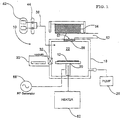
- FIG. 1 is a schematic cross-sectional view showing an ECR plasma etch apparatus.
- FIG. 2 is a block diagram illustrating the steps in the method for etching platinum, iridium and certain other metals on a substrate in a chamber as shown in FIG. 1, in accordance with the present invention.
- FIG. 3 is a graph showing the effect of temperature on the etch rate of iridium using fluorine-based gases.
- FIG. 4 is a graph showing the effect of temperature on the etch rate of platinum using fluorine-based gases.
- the present invention provides a method of etching metals, especially iridium, platinum, ruthenium, osmium, or rhenium using a fluorine-based gas.
- a wafer has been prepared by using well known techniques to form integrated circuit (IC) features (e.g. transistors and other active and passive devices) on the wafer.
- IC integrated circuit
- the type and number of integrated circuit features on the wafer are unimportant to the process of the present invention.
- the form, and architecture of the various structures, as well as the methods of forming such structures, are not described herein and are a matter of design choice well known to those skilled in the art.
- the metals are etched in such a manner as to reduce, or eliminate, residue on the wafer.
- the method of the present invention uses fluorine-based chemistry to etch metals.
- the fluorine-based chemistry will provide a chemical etch mechanism, in addition to, or instead of, the sputtering mechanism that dominates prior art etch methods for iridium and platinum.
- the current applications of the present method are addressed primarily to those employing indium and platinum, the present invention is also suited to etching of ruthenium, osmium, rhenium and other metals producing volatile etch reactants with fluorine.
- FIG. 1 is a schematic illustration of a suitable electron cyclotron resonance (ECR) plasma etching apparatus 10 for carrying out a plasma etch process on a substrate, such as a wafer 12.
- ECR electron cyclotron resonance
- Apparatus 10 includes a chamber 16 of a size suitable for holding one or more wafers 12, which are supported in chamber 16 on a chuck 20.
- an interior 22 can be evacuated or pressurized as desired by a suitable pump and valve apparatus, which is schematically illustrated in FIG. 1 by pump 26.
- Gas pressure within chamber 16 is preferably maintained between approximately 5 mTorr and 50 mTorr during processing.
- Pump 26 is also used to exhaust chamber 16 during processing, while still maintaining the desired pressure with chamber 16. Individual wafers 12 are moved in and out of chamber 16 by a suitable wafer handler 30 through a gate valve 32 in a wall of chamber 16 and onto or off of chuck 20.
- Selected gases used in plasma etch processing are introduced into the chamber through a suitable manifold system 36 from various gas supply reservoirs indicated collectively at 42, controlled by valves 44. Although for purposes of illustration only two supply reservoirs are shown, as many reservoirs as are necessary will be used. It is also possible to combine one or more of the gases into a single supply reservoir prior to introduction into chamber 16. The gases are introduced into apparatus 10 and ionized to form a plasma.
- apparatus 10 In order to ionize the introduced gases to form a plasma, apparatus 10 has a waveguide 52 situated adjacent chamber 16 and a permanent magnet 54 adjacent waveguide 52 opposite chamber 16.
- a window 56 constructed of material transparent to microwave radiation, such as quartz or aluminum oxide, is located just below waveguide 52 to allow microwave radiation to enter chamber 16.
- Waveguide 52 is connected to a power generating source (not shown) and conveys microwave energy produced by the generating source along its length to an end 57 aligned with window 56, whereby microwave energy is directed into chamber 16.
- Microwaves exiting waveguide 52 pass through window 56 and enter chamber 16, propagating in a direction substantially perpendicular to wafer 12.
- the ECR power is in the range of between approximately 300 watts and 2000 watts.
- An RF bias 68 is also applied to chuck 16 to attract ions to wafer 12 in a direction that is also substantially perpendicular to wafer 12.
- the RF bias power is preferably in the range of 60 watts to 1000 watts.
- the power levels are specified above are based upon a 6-inch diameter wafer. One of skill in the art will be able to adjust the power level as needed for different size wafers.
- the bias on the chuck and the low pressure within the chamber help to cause the fluorine ions to travel in a direction substantially perpendicular to the wafer. This cause anisotropic etching in the direction perpendicular to the wafer. This anisotropic etching reduces, or eliminates, undercutting and improves overall critical dimension control.
- Chuck 20 is heated to a desired temperature, a heating element 60 is shown schematically. Heating element 60 and chuck 20 are used together to select the temperature of wafer 12 during processing.
- the chuck is heated to maintain a wafer temperature high enough to produce volatile metal-fluorine reactants.
- the wafer temperature is preferably greater than 150 degrees Celsius. For indium etching, the wafer temperature is preferably between approximately 150 and 400 degrees Celsius. For platinum etching, the wafer temperature is preferably between approximately 190 and 500 degrees Celsius.
- FIG. 2 illustrates the steps of the method of the present invention, which will be described with reference to FIGS 1 and 2.
- a wafer 12 is prepared, and then positioned on chuck 20 in chamber 16 by wafer handler 30.
- Wafer 12 is typically a silicon wafer, which has been prepared for further processing according to the method of the present invention.
- the first step in FIG. 2 is step 70, which is the depositing of a metal on wafer 12.
- the metal is selected from the group consisting of iridium, platinum, ruthenium, osmium, or rhenium.
- the metal is deposited by any desired method, including metal evaporation.
- Step 72 is the formation of a mask.
- a hard mask will be formed using silicon dioxide or silicon nitride.
- the present invention can also utilize a photoresist mask provided that the temperature does not exceed the point at which the photoresist is no longer able to act as a suitable mask.
- the present method is expected to find uses in connection with a variety of additional processes.
- a hard mask is preferred due to the temperatures used in connection the mathod of the present invention.
- Step 74 is the heating of the wafer to a temperature at which the metal will form a volatile compound with fluorine, typically above 150 degrees Celsius.
- Step 78 is the introduction of a fluorine-based gas.
- the fluorine containing gas is preferably carbon tetrafluoride (CF 4 ), nitrogen trifluoride (NF 3 ) or sulfur hexafluoride (SF 6 ).
- chlorofluorocarbons are not used as a source of fluorine, as they also contain chlorine, which produces non-volatile etch reactants with platinum and iridium.
- step 78 suitable microwave power is applied to produce a plasma within chamber 16 as illustrated by step 78.
- the introduced gases are ionized.
- the fluorine-based gasas produce fluorine ions within the plasma.
- oxygen can also be introduced to react within the plasma to free up additional fluorine, which will also react with the metal. Typically between 2% and 20% oxygen will be added to the fluorine-based gas.
- etch reactants are formed. As shown by step 80, the etch reactants are preferably simultaneously removed.
- Six inch p-type (100) wafers are steam oxidized in a tube furnace to form 4000 ⁇ - 6000 ⁇ thick oxide over the wafers prior to deposition of metal films. Wafers are then loaded into a planetary within an e-beam evaporation system. The background pressure of the e-beam system was in the 10 -8 Torr range. During iridium deposition the complete planetary and the wafers are heated by quartz lamps. The temperature was controlled at 225 Celsius by thermocouples inserted near the planetary. In order to improve film adhesion, a thin titanium (Ti) layer of about 200 ⁇ is deposited on the oxide before continuing with iridium deposition.
- Ti titanium
- silicon nitride is deposited over the wafer by plasma-enhanced chemical vapor deposition (PECVD). Then photoresist is applied over the wafer and patterned. The silicon nitride layer is then plasma etched to form a hard mask for subsequent iridium etching.
- PECVD plasma-enhanced chemical vapor deposition
- the plasma etching process is performed in a PlasmaQuest ECR enhanced reactive ion etch system.
- This system is a single-wafer load-lock system.
- ECR plasma is introduced from the top of the process chamber.
- ECR power is maintained at 800 watts.
- the wafer is located on a heated chuck.
- the heated chuck is used to maintain the wafer at a temperature of approximately 300 degrees Celsius.
- the wafer temperature is calibrated with respect to the temperature of the chuck at 15 mTorr.
- RF bias is applied to a bottom electrode maintained at 400 watts.
- the pressure is maintained at 15 mTorr.
- a flow of CF 4 at 50 sccm and a flow of oxygen at 5 sccm is introduced into the system.
- the results of this example produce an etch rate of iridium greater than 1000 ⁇ per minute.
- FIGS 3 and 4 show examples of the affect of temperature on the etch rate carbon tetrafluoride on iridium and platinum.
- the etch rate of iridium is relatively flat and well below 400 ⁇ per minute at temperatures below 100-150 degrees Celsius (shown as 110). This is consistent with the results known in the prior art.
- the etch rate increase significantly. This increase in etch rate is due to the chemical reaction of fluorine with iridium to form a volatile etch reactant. The added heat is necessary to produce a reaction between the iridium and the fluorine within the plasma.
- the etch rate is primarily a function of sputtering. At higher temperatures the etch rate is greatly affected by chemical reactions.
- the etch reactant is believed to be primarily iridium hexafluoride. Iridium hexafluoride has a melting point of 44.0 degrees Celsius and a boiling point of 53.6 degrees Celsius, which suggests that it may be formed as a volatile compound at temperatures where the increase in etch rate becomes noticeable.
- Osmium and rhenium produce osmium hexafluoride and rhenium hexafluoride, respectively. Both of these compounds have melting points and boiling points that are lower than iridium hexafluoride. There similar results can be expected at slightly lower temperatures than when etching iridium.
- Ruthenium produces ruthenium pentafluoride, which has a melting point of 86.5 degrees Celsius and a boiling point of 227 degrees Celsius. 'Due to the higher temperatures, the process will likely need to be at a temperature greater than approximately 227 degrees to produce a volatile etch reactant.
Landscapes
- Chemical & Material Sciences (AREA)
- Engineering & Computer Science (AREA)
- Materials Engineering (AREA)
- Mechanical Engineering (AREA)
- Metallurgy (AREA)
- Organic Chemistry (AREA)
- Drying Of Semiconductors (AREA)
- ing And Chemical Polishing (AREA)
Applications Claiming Priority (2)
| Application Number | Priority Date | Filing Date | Title |
|---|---|---|---|
| US09/584,407 US6350699B1 (en) | 2000-05-30 | 2000-05-30 | Method for anisotropic plasma etching using non-chlorofluorocarbon, fluorine-based chemistry |
| US584407 | 2000-05-30 |
Publications (2)
| Publication Number | Publication Date |
|---|---|
| EP1160849A2 true EP1160849A2 (fr) | 2001-12-05 |
| EP1160849A3 EP1160849A3 (fr) | 2003-07-02 |
Family
ID=24337188
Family Applications (1)
| Application Number | Title | Priority Date | Filing Date |
|---|---|---|---|
| EP01304683A Withdrawn EP1160849A3 (fr) | 2000-05-30 | 2001-05-29 | Procédé de gravure plasma anisotrope utilisant un gas fluoré non chlorofluorocarboné |
Country Status (5)
| Country | Link |
|---|---|
| US (1) | US6350699B1 (fr) |
| EP (1) | EP1160849A3 (fr) |
| JP (1) | JP3894747B2 (fr) |
| KR (1) | KR100433098B1 (fr) |
| TW (1) | TW504767B (fr) |
Families Citing this family (13)
| Publication number | Priority date | Publication date | Assignee | Title |
|---|---|---|---|---|
| DE19856082C1 (de) * | 1998-12-04 | 2000-07-27 | Siemens Ag | Verfahren zum Strukturieren einer metallhaltigen Schicht |
| US6709609B2 (en) * | 2000-12-22 | 2004-03-23 | Applied Materials Inc. | Plasma heating of a substrate with subsequent high temperature etching |
| US6692648B2 (en) * | 2000-12-22 | 2004-02-17 | Applied Materials Inc. | Method of plasma heating and etching a substrate |
| US6605484B2 (en) * | 2001-11-30 | 2003-08-12 | Axcelis Technologies, Inc. | Process for optically erasing charge buildup during fabrication of an integrated circuit |
| US7018929B2 (en) * | 2002-07-02 | 2006-03-28 | Taiwan Semiconductor Manufacturing Co., Ltd | Method for reducing a low volatility byproduct from a wafer surface following an etching process |
| US20050221574A1 (en) * | 2004-03-31 | 2005-10-06 | Hynix Semiconductor, Inc. | Method for fabricating semiconductor device |
| JP2006294845A (ja) * | 2005-04-11 | 2006-10-26 | Matsushita Electric Ind Co Ltd | ドライエッチング方法およびその装置 |
| US20070202704A1 (en) * | 2006-02-28 | 2007-08-30 | Hynix Semiconductor Inc. | Method for etching platinum and method for fabricating capacitor using the same |
| US20080124937A1 (en) * | 2006-08-16 | 2008-05-29 | Songlin Xu | Selective etching method and apparatus |
| US8764995B2 (en) * | 2010-08-17 | 2014-07-01 | Taiwan Semiconductor Manufacturing Company, Ltd. | Extreme ultraviolet light (EUV) photomasks, and fabrication methods thereof |
| JP2024522394A (ja) | 2021-06-03 | 2024-06-19 | アプライド マテリアルズ インコーポレイテッド | 金属フィーチャーの原子層エッチング |
| CN120751924A (zh) * | 2025-06-17 | 2025-10-03 | 北京集成电路装备创新中心有限公司 | 一种阻变存储器的刻蚀方法 |
| CN120769694A (zh) * | 2025-06-19 | 2025-10-10 | 北京集成电路装备创新中心有限公司 | 一种电阻随机存储器的刻蚀方法 |
Family Cites Families (33)
| Publication number | Priority date | Publication date | Assignee | Title |
|---|---|---|---|---|
| US3615956A (en) | 1969-03-27 | 1971-10-26 | Signetics Corp | Gas plasma vapor etching process |
| US3795557A (en) | 1972-05-12 | 1974-03-05 | Lfe Corp | Process and material for manufacturing semiconductor devices |
| US4026742A (en) | 1972-11-22 | 1977-05-31 | Katsuhiro Fujino | Plasma etching process for making a microcircuit device |
| JPS52139372A (en) * | 1976-05-17 | 1977-11-21 | Hitachi Ltd | Selective etching method of thin films |
| JPS5816533A (ja) * | 1981-07-22 | 1983-01-31 | Nec Corp | 選択ドライエツチング方法 |
| JPS6457621A (en) * | 1987-08-28 | 1989-03-03 | Fujitsu Ltd | Manufacture of semiconductor device |
| JP3210359B2 (ja) * | 1991-05-29 | 2001-09-17 | 株式会社東芝 | ドライエッチング方法 |
| US5236550A (en) * | 1992-04-24 | 1993-08-17 | National Semiconductor Corporation | Method for plasma etch of ruthenium |
| KR0126249B1 (ko) * | 1992-06-22 | 1997-12-26 | 모리시타 요이찌 | 드라이에칭법 및 드라이에칭장치 |
| JP2624103B2 (ja) * | 1992-11-19 | 1997-06-25 | 日本電気株式会社 | マグネトロンrieドライエッチング方法 |
| US5384009A (en) * | 1993-06-16 | 1995-01-24 | Applied Materials, Inc. | Plasma etching using xenon |
| JP2697602B2 (ja) * | 1993-06-24 | 1998-01-14 | 日本電気株式会社 | 半導体装置の製造方法 |
| JPH07122534A (ja) * | 1993-10-13 | 1995-05-12 | Oki Electric Ind Co Ltd | 白金のエッチング方法 |
| US5514247A (en) * | 1994-07-08 | 1996-05-07 | Applied Materials, Inc. | Process for plasma etching of vias |
| JP3122579B2 (ja) | 1994-07-27 | 2001-01-09 | シャープ株式会社 | Pt膜のエッチング方法 |
| JP3259000B2 (ja) * | 1994-09-08 | 2002-02-18 | 三菱電機株式会社 | 高融点金属含有膜のエッチング方法及び薄膜キャパシタの製造方法 |
| KR100194789B1 (ko) * | 1995-12-16 | 1999-06-15 | 김영환 | 반도체 소자의 폴리머 제거 방법 |
| US5869802A (en) | 1995-12-21 | 1999-02-09 | Plasmaquest, Inc. | Plasma producing structure |
| JP2882339B2 (ja) * | 1996-02-21 | 1999-04-12 | 日本電気株式会社 | タングステンcvd反応室内のエッチング方法 |
| JPH09260356A (ja) * | 1996-03-22 | 1997-10-03 | Toshiba Corp | ドライエッチング方法 |
| KR100255661B1 (ko) * | 1997-02-22 | 2000-05-01 | 윤종용 | 반도체 소자의 전극층 식각 방법 |
| JPH1068094A (ja) * | 1996-06-13 | 1998-03-10 | Samsung Electron Co Ltd | 遷移金属薄膜用蝕刻ガス混合物およびこれを用いた遷移金属薄膜の蝕刻方法 |
| JPH10340893A (ja) * | 1997-06-09 | 1998-12-22 | Sony Corp | 電子薄膜材料のエッチング方法 |
| US6143191A (en) * | 1997-11-10 | 2000-11-07 | Advanced Technology Materials, Inc. | Method for etch fabrication of iridium-based electrode structures |
| KR100252889B1 (ko) * | 1997-11-14 | 2000-04-15 | 김영환 | 백금식각방법 |
| US6046116A (en) | 1997-11-19 | 2000-04-04 | Tegal Corporation | Method for minimizing the critical dimension growth of a feature on a semiconductor wafer |
| JP2002510146A (ja) * | 1998-01-13 | 2002-04-02 | アプライド マテリアルズ インコーポレイテッド | 異方性プラチナプロファイルのエッチング方法 |
| JPH11214357A (ja) * | 1998-01-21 | 1999-08-06 | Sony Corp | ドライエッチング用ガス組成物およびこれを用いたドライエッチング方法 |
| JP3367600B2 (ja) * | 1998-06-08 | 2003-01-14 | シャープ株式会社 | 誘電体薄膜素子の製造方法 |
| US6438116B1 (en) * | 1998-07-16 | 2002-08-20 | Telefonaktiebolaget L M Ericsson (Publ) | Adaptive power margin for hard handoffs in code division multiple access based systems |
| JP2000138202A (ja) * | 1998-10-30 | 2000-05-16 | Nec Corp | 半導体装置の製造方法及び製造装置 |
| JP2001053064A (ja) * | 1999-08-11 | 2001-02-23 | Nec Corp | ドライエッチング方法 |
| US20030010354A1 (en) * | 2000-03-27 | 2003-01-16 | Applied Materials, Inc. | Fluorine process for cleaning semiconductor process chamber |
-
2000
- 2000-05-30 US US09/584,407 patent/US6350699B1/en not_active Expired - Lifetime
-
2001
- 2001-05-24 JP JP2001156182A patent/JP3894747B2/ja not_active Expired - Fee Related
- 2001-05-28 TW TW090112802A patent/TW504767B/zh not_active IP Right Cessation
- 2001-05-29 EP EP01304683A patent/EP1160849A3/fr not_active Withdrawn
- 2001-05-30 KR KR10-2001-0030190A patent/KR100433098B1/ko not_active Expired - Fee Related
Also Published As
| Publication number | Publication date |
|---|---|
| KR100433098B1 (ko) | 2004-05-28 |
| TW504767B (en) | 2002-10-01 |
| EP1160849A3 (fr) | 2003-07-02 |
| JP2001358133A (ja) | 2001-12-26 |
| JP3894747B2 (ja) | 2007-03-22 |
| US6350699B1 (en) | 2002-02-26 |
| KR20010109187A (ko) | 2001-12-08 |
Similar Documents
| Publication | Publication Date | Title |
|---|---|---|
| US6277763B1 (en) | Plasma processing of tungsten using a gas mixture comprising a fluorinated gas and oxygen | |
| JP6527214B2 (ja) | エッチング耐性ポリマー層を堆積させる方法及びパターンエッチング構造の製造方法 | |
| US5419805A (en) | Selective etching of refractory metal nitrides | |
| US6759286B2 (en) | Method of fabricating a gate structure of a field effect transistor using a hard mask | |
| TWI874697B (zh) | 選擇性各向異性金屬蝕刻 | |
| US6893893B2 (en) | Method of preventing short circuits in magnetic film stacks | |
| US6069092A (en) | Dry etching method and semiconductor device fabrication method | |
| US9881807B2 (en) | Method for atomic layer etching | |
| US6767824B2 (en) | Method of fabricating a gate structure of a field effect transistor using an alpha-carbon mask | |
| US6461974B1 (en) | High temperature tungsten etching process | |
| US7056830B2 (en) | Method for plasma etching a dielectric layer | |
| US6008139A (en) | Method of etching polycide structures | |
| US20060252265A1 (en) | Etching high-kappa dielectric materials with good high-kappa foot control and silicon recess control | |
| US20070199922A1 (en) | Etch methods to form anisotropic features for high aspect ratio applications | |
| KR20010053548A (ko) | 도핑에 독립적인 폴리실리콘용 자기세정 에칭 프로세스 | |
| US6350699B1 (en) | Method for anisotropic plasma etching using non-chlorofluorocarbon, fluorine-based chemistry | |
| US5880033A (en) | Method for etching metal silicide with high selectivity to polysilicon | |
| KR20040090931A (ko) | 전계효과 트랜지스터의 게이트 구조를 제조하는 방법 | |
| CN119968697A (zh) | 使用水结晶相对于氧化硅选择性蚀刻氮化硅的方法 | |
| JPH04137532A (ja) | 表面処理方法及びその装置 | |
| US20050009342A1 (en) | Method for etching an organic anti-reflective coating (OARC) | |
| Coburn | Some fundamental aspects of plasma-assisted etching | |
| JPH10177997A (ja) | Barcおよび窒化物のその場エッチングプロセス | |
| US7192875B1 (en) | Processes for treating morphologically-modified silicon electrode surfaces using gas-phase interhalogens | |
| US7279429B1 (en) | Method to improve ignition in plasma etching or plasma deposition steps |
Legal Events
| Date | Code | Title | Description |
|---|---|---|---|
| PUAI | Public reference made under article 153(3) epc to a published international application that has entered the european phase |
Free format text: ORIGINAL CODE: 0009012 |
|
| AK | Designated contracting states |
Kind code of ref document: A2 Designated state(s): AT BE CH CY DE DK ES FI FR GB GR IE IT LI LU MC NL PT SE TR |
|
| AX | Request for extension of the european patent |
Free format text: AL;LT;LV;MK;RO;SI |
|
| PUAL | Search report despatched |
Free format text: ORIGINAL CODE: 0009013 |
|
| AK | Designated contracting states |
Designated state(s): AT BE CH CY DE DK ES FI FR GB GR IE IT LI LU MC NL PT SE TR |
|
| AX | Request for extension of the european patent |
Extension state: AL LT LV MK RO SI |
|
| 17P | Request for examination filed |
Effective date: 20031009 |
|
| 17Q | First examination report despatched |
Effective date: 20031205 |
|
| AKX | Designation fees paid |
Designated state(s): DE FR GB |
|
| STAA | Information on the status of an ep patent application or granted ep patent |
Free format text: STATUS: THE APPLICATION IS DEEMED TO BE WITHDRAWN |
|
| 18D | Application deemed to be withdrawn |
Effective date: 20141202 |