EP1161994B2 - Plaque de microtitrage - Google Patents
Plaque de microtitrage Download PDFInfo
- Publication number
- EP1161994B2 EP1161994B2 EP01111317A EP01111317A EP1161994B2 EP 1161994 B2 EP1161994 B2 EP 1161994B2 EP 01111317 A EP01111317 A EP 01111317A EP 01111317 A EP01111317 A EP 01111317A EP 1161994 B2 EP1161994 B2 EP 1161994B2
- Authority
- EP
- European Patent Office
- Prior art keywords
- plate
- vessels
- microtitration
- holes
- frame
- Prior art date
- Legal status (The legal status is an assumption and is not a legal conclusion. Google has not performed a legal analysis and makes no representation as to the accuracy of the status listed.)
- Expired - Lifetime
Links
Images



Classifications
-
- B—PERFORMING OPERATIONS; TRANSPORTING
- B01—PHYSICAL OR CHEMICAL PROCESSES OR APPARATUS IN GENERAL
- B01L—CHEMICAL OR PHYSICAL LABORATORY APPARATUS FOR GENERAL USE
- B01L3/00—Containers or dishes for laboratory use, e.g. laboratory glassware; Droppers
- B01L3/50—Containers for the purpose of retaining a material to be analysed, e.g. test tubes
- B01L3/508—Rigid containers without fluid transport within
- B01L3/5085—Rigid containers without fluid transport within for multiple samples, e.g. microtitration plates
-
- C—CHEMISTRY; METALLURGY
- C12—BIOCHEMISTRY; BEER; SPIRITS; WINE; VINEGAR; MICROBIOLOGY; ENZYMOLOGY; MUTATION OR GENETIC ENGINEERING
- C12M—APPARATUS FOR ENZYMOLOGY OR MICROBIOLOGY; APPARATUS FOR CULTURING MICROORGANISMS FOR PRODUCING BIOMASS, FOR GROWING CELLS OR FOR OBTAINING FERMENTATION OR METABOLIC PRODUCTS, i.e. BIOREACTORS OR FERMENTERS
- C12M23/00—Constructional details, e.g. recesses, hinges
- C12M23/02—Form or structure of the vessel
- C12M23/12—Well or multiwell plates
Definitions
- the invention relates to a microtiter plate.
- Microtiter plates are used for a variety of microbiological, cell culture and immunological operations.
- microtiter plates are used for the PCR or the cultivation of microorganisms or cells.
- microtiter plates having a frame with a plate to which a plurality of vessels is fixed, which have a receiving portion projecting from the underside of the plate and are accessible through openings from the top of the plate.
- the vessels are also referred to as "wells”.
- Single-component microtiter plates made of polystyrene are not suitable for the PCR, in particular because the softening temperature of this plastic (about 85 ° C) is exceeded in the PCR.
- One-component polypropylene microtiter plates are basically usable for the PCR. However, they are bend-soft, prone to distortion, are uneven and can only be manufactured with large tolerances and are subject to great tolerance fluctuations in use. They are not particularly suitable for machine handling because their softness makes gripping by the machine more difficult. Furthermore, the small dimensional stability may result, so that the metering needles have wall contact during insertion into the vessels. In addition, because of the thick-walledness of the vessels, the heat transfer into the vessels is poor, which is detrimental to the temperature control and the length of the cycle times in the PCR.
- microtiter plates are in the WO 01/07160 A2 (Publication date: 1.2.2001, priority days: 23.7.1999 and 19.7.2000, filing date: 20.7.2000).
- the vessels of these microtiter plates have a complete flat bottom.
- microtiter plates also try to avoid cross-contamination.
- sealing foils which are welded on the top of the microtiter plate and must be peeled off again, if the contents of the vessels to be accessed.
- rubber mats which have cones on the underside, to engage sealingly in the openings of the vessels when resting on the microtiter plate.
- plastic strips which are executed at the bottom with plugs to be pressed into the openings of a row of vessels of the microtiter plate.
- the object of the invention is to provide a microtiter plate with more favorable application properties.
- microtiter plate In addition, a method for producing the microtiter plate is to be made available.
- microtiter plate having the features of at least one of claims 1, 7, 13, 19, 24, 28 and 31. Furthermore, it is achieved by a method having the features of at least one of claims 42 and 44.
- the frame of the microtiter plate is particularly suitable for machine handling.
- it is provided at the edge with a protruding from the underside of the enclosure, which increases the stability, can form a footprint and offers a surface for the automatic machine.
- the frame can be made particularly low distortion and tolerance.
- the first plastic may be an amorphous or even a partially crystalline, highly filled plastic. This may in particular be polycarbonate, which is in itself unsuitable for the PCR or the oxygen supply. The limitation of this plastic on the frame, however, makes it possible to make use of its advantageous properties even with microtiter plates for the PCR or oxygen supply of samples.
- the vessels are made of a different plastic than the frame. It is a suitable for the PCR and / or oxygen permeability having second plastic.
- the suitability for the PCR can be given in particular by an increased temperature resistance (up to about 90 to 95 ° C).
- the plastic is preferably a soft and / or semi-crystalline plastic.
- the second plastic may be polypropylene.
- Each vessel is molded directly onto the hole assigned to it.
- the connection with the plate can be done by adhesion and / or by positive engagement and / or by material connection.
- it is made by positive engagement by the vessels are connected to holes with axially variable cross-section and / or at the edge region of the holes on at least one side of the plate form-fitting manner with this.
- the direct injection allows very small flow paths of the material during spraying, whereby particularly small wall thicknesses can be achieved, which preferably fall in the range of about 0.05 to 0.25 mm, in particular may be about 0.1 mm.
- an injection point is preferably provided on the vessel bottom of each vessel from which the material fills a first wall section with reduced wall thickness and an upper wall section connected to the plate.
- the upper wall portion is designed as a collar with increased wall thickness, which allows a particularly low-tolerance production of the microtiter plate.
- the frame of a first plastic and the vessels of a second plastic are thus achieved by means of materials that correspond to the desired functions of frame and vessels, the best possible solutions.
- Higher rigidity, better flatness, lower draft and smaller tolerances are achieved by an amorphous, rigid and high temperature resistant material for the frame.
- the extreme thinness for better heat transfer is achieved by direct injection of the vessels.
- the vessels can be injected in soft, PCR-suitable materials.
- the spraying of the frame is not critical. This can advantageously have several edge-side injection points (about four to six).
- the second plastic is a silicone. This may in particular be LSR (Liquid Silicon Rubber).
- the frame and vessels of the microtiter plate are produced in a multi-component injection molding process.
- this is a two-component injection process or "twin-shot" process.
- the frame For a particularly low-tolerance production of the frame is preferably sprayed first and then the vessels.
- This has the advantage that the frame can first perform a certain shrinkage before the vessels are molded.
- the time interval for the spraying of the vessels from spraying the frame can be chosen so that the shrinkage of the frame (by cooling) is substantially complete.
- the tolerance of the distance from vessel to vessel can be limited to very low values (about ⁇ 0.15 mm). This favors the insertion of dispensing needles without wall contact.
- the upper wall portion of the vessels is designed as a collar with increased wall thickness, because the collar can compensate for remaining positional tolerances of the holes during spraying.
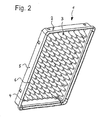
- a microtiter plate 1 consists of a frame 2 and a plurality of vessels 3. In 8 columns and 12 rows a total of 96 vessels 3 are present.
- the frame 2 has a substantially rectangular plate 4, around the outer edge of which surrounds an enclosure 5, approximately perpendicularly protrudes from the underside of the plate 4, and beyond the vessels 3 also. Below the enclosure 5 in a known manner an expansion 6, which ensures a stackability on top of a corresponding microtiter plate 1.
- the frame 2 has a total of 96 holes 6 in the plate 4. These each have a cross-sectional profile extending to the top of the plate 7 in two sections of different conicity and the Bottom 8 of the plate 4 extended in a conical section.
- the frame 2 is integrally molded in a first injection step from a plastic which is relatively rigid when cured.
- the injection points are located at the edge of the frame 2, for example at the lower edge of the enclosure 5.
- the vessels 3 have at the bottom a cup-shaped bottom 9, to which a conical wall section 10 of very small wall thickness (approximately 0.1 mm) is adjacent. Above it is a wall section 11 whose wall thickness gradually increases upward. On the outside, it has the same conicity as the wall section 10. Inside, however, it is almost cylindrical, resulting in an approximately wedge-shaped cross-sectional shape.
- the wall portion 11 terminates in a collar 12, which also has relative to the wall portion 10 significantly increased wall thickness.
- the vessels 3 are molded onto the plate 4.
- the collar 12 is located on the outside of the inner periphery of the holes 6. Further, he has at the top 7 and the bottom 8 of the plate 4 each have a projection 13, 14, whereby a secure connection with the plate 4 results.
- the vessels 3 In the region of the collar 12, the vessels 3 have an upwardly extending in two sections of different conicity cross-section. From the top 7 of the plate 4, the vessels through openings 15 are accessible.
- All vessels are simultaneously molded directly to the frame 1 and the holes 6 thereof.
- Each vessel 6 has its own central injection point on the underside of the bottom 9.
- short spray paths are achieved, which allows the particularly small wall thickness in the wall portion 10.
- the material used in the example is polypropylene or LSR, with regard to the PCR or an oxygen supply to a sample inside the vessel.
- Fig. 4 shows a microtiter plate 1 ', in which, in deviation from the previously discussed the frame 2' and the vessels 3 'are made in a known manner integrally from a single plastic.
- the outer shape of the microtiter plate 1 ' corresponds essentially to the preceding example, but the vessels 3' have a substantially uniform wall thickness profile and are melted without any protrusions with the plate 4 '.
- the plate 4 ' is peripherally connected in the known manner with the enclosure 5', which has the widening 6 'below.
- the vessels 3 ' are accessible from above through openings 15', wherein an annular seal 16 made of an elastic material is arranged around each opening.
- this is a plastic which is able to connect materially to the plastic of the microtiter plate 1 '.
- a positive connection can be created by placing the seal 16 in an undercut groove in the top of the plate 4 '.
- the seals 16 are firmly connected to the microtiter plate 1 'in a multi-component injection molding process.
- the lid may have approximately the dimensions of the plate 4 '.
- a latching takes place in the edge region of the microtiter plate 1 '. The locking can be done for example in the recesses 17, which has the enclosure 5 'directly below the plate 4'.
- Fig. 5 differs from the above-described in that the adjacent annular seals 16 are connected to each other by rectilinear webs 18, 19 which extend in the row and column direction. This can be advantageous in particular for manufacturing reasons, but also for reasons of the fixed connection of the seals with the microtiter plate 1 'or for additional sealing.
- a microtiter plate 1 ' is shown, which corresponds to that of Fig. 4 made of only one material. However, it lacks the annular seals 16.
- a lid 20 On the plate 4 'of the microtiter plate 1' sits a lid 20.
- This has a plate 21 which has substantially the same contour as the plate 4 '.
- the plate 21 is supported in edge regions 21 'on the upper side of the plate 4'. In a region 21 "between the edge regions 21 ', it is spaced a small gap from the plate 4', allowing it to be placed on conventional microtiter plates which have sealing collars on the upper side of the holding plate 4 '.
- the plate 21 has plug-shaped seals 22 which protrude from its underside, these plug-shaped seals 22 having on their outer circumference a circumferential sealing bead 23.
- Each opening 15 'of the vessels 3' is associated with a seal 22.
- the seals 22 engage in the openings 15 'so that they rest with their sealing beads 23 on the inner wall of the vessels 3' sealingly.
- the seals 22 are arranged in corresponding recesses of the plate 21. They are connected to each other by short webs 24, 25, which extend in the row and column direction.
- the lid 21 with the seals 22 is preferably also in a multi-component injection molding process produced.
Landscapes
- Health & Medical Sciences (AREA)
- Chemical & Material Sciences (AREA)
- Zoology (AREA)
- Clinical Laboratory Science (AREA)
- Life Sciences & Earth Sciences (AREA)
- Engineering & Computer Science (AREA)
- Bioinformatics & Cheminformatics (AREA)
- Organic Chemistry (AREA)
- General Health & Medical Sciences (AREA)
- Wood Science & Technology (AREA)
- Biomedical Technology (AREA)
- Sustainable Development (AREA)
- Biochemistry (AREA)
- General Engineering & Computer Science (AREA)
- Microbiology (AREA)
- Genetics & Genomics (AREA)
- Biotechnology (AREA)
- Analytical Chemistry (AREA)
- Hematology (AREA)
- Chemical Kinetics & Catalysis (AREA)
- Apparatus Associated With Microorganisms And Enzymes (AREA)
- Injection Moulding Of Plastics Or The Like (AREA)
- Physical Or Chemical Processes And Apparatus (AREA)
Claims (46)
- Plaque de microtitration, comportant- un cadre (2) composé d'un premier plastique rigide, qui comporte une plaque (4) munie d'une pluralité d'orifices (6),- une pluralité de récipients (3) composés d'un second plastique qui est approprié pour la PCR en ce qui concerne le point de ramollissement et/ou est une silicone, lesquels récipients sont reliés de façon fixe à la plaque (4) par moulage par injection directe sur les orifices (6), ont une partie de réception (9, 10, 11) saillant par rapport à la face inférieure (8) de la plaque (4) et sont accessibles par des ouvertures (15) depuis la face supérieure (7) de la plaque, et- pour laquelle les récipients (3) sont reliés par conjugaison de forme à la plaque (4) par moulage par injection sur des orifices (6) dont la section est variable dans la direction axiale.
- Plaque de microtitration selon la revendication 1, dans laquelle les récipients (3) sont reliés par conjugaison de forme à la plaque (4) par moulage par injection sur le bord des orifices (6), sur une face (7, 8) au moins de celle-ci.
- Plaque de microtitration selon la revendication 1 ou 2, dans laquelle les récipients (3) présentent des points d'injection sur les fonds de récipient (9).
- Plaque de microtitration selon l'une quelconque des revendications 1 à 3, dans laquelle les récipients (3) possèdent en tant que partie de paroi supérieure (12) reliée à la plaque (4) une collerette présentant une épaisseur de paroi augmentée.
- Plaque de microtitration selon l'une quelconque des revendications 1 à 4, dans laquelle les récipients (3) ont des parties de paroi (10) qui sont sensiblement coniques avec une faible épaisseur de paroi, ou dans laquelle les récipients (3) ont des parties de paroi qui sont sensiblement coniques avec une faible épaisseur de paroi avec une partie de paroi (11) adjacente présentant une épaisseur de paroi progressivement croissante vers le haut.
- Plaque de microtitration selon l'une quelconque des revendications 1 à 5, dans laquelle la face extérieure du fond (9) des récipients (3) n'est pas complètement plate.
- Plaque de microtitration, comportant- un cadre (2) composé d'un premier plastique rigide, qui comporte une plaque (4) munie d'une pluralité d'orifices (6),- une pluralité de récipients (3) composés d'un second plastique qui est approprié pour la PCR en ce qui concerne le point de ramollissement et/ou est une silicone, lesquels récipients sont reliés de façon fixe à la plaque (4) par moulage par injection directe sur les orifices (6), ont une partie de réception (9, 10, 11) saillant par rapport à la face inférieure (8) de la plaque (4) et sont accessibles par des ouvertures (15) depuis la face supérieure (7) de la plaque, et- dans laquelle les récipients (3) sont reliés par conjugaison de forme à la plaque (4) par injection sur le bord des orifices (6), sur la face inférieure (8) de la plaque.
- Plaque de microtitration selon la revendication 7, dans laquelle les récipients (3) sont reliés par conjugaison de forme à la plaque (4) par injection sur le bord des orifices (6), sur la face supérieure (7) de la plaque.
- Plaque de microtitration selon la revendication 7 ou 8, dans laquelle les récipients (3) présentent des points d'injection au niveau du fond de récipient (9).
- Plaque de microtitration selon l'une quelconque des revendications 7 à 9, dans laquelle les récipients (3) possèdent en tant que partie supérieure de paroi (12) reliée à la plaque (4) une collerette avec une épaisseur de paroi augmentée.
- Plaque de microtitration selon l'une quelconque des revendications 7 à 10, dans laquelle les récipients (3) ont des parties de paroi (10) qui sont sensiblement coniques avec une faible épaisseur de paroi, ou dans laquelle les récipients (3) ont des parties de paroi qui sont sensiblement coniques avec une faible épaisseur de paroi avec une partie de paroi (11) adjacente présentant une épaisseur de paroi progressivement croissante vers le haut.
- Plaque de microtitration selon l'une quelconque des revendications 7 à 11, dans laquelle la face extérieure du fond (9) des récipients (3) n'est pas complètement plate.
- Plaque de microtitration, comportant- un cadre (2) composé d'un premier plastique rigide, qui comporte une plaque (4) munie d'une pluralité d'orifices (6),- une pluralité de récipients (3) composés d'un second plastique qui est approprié pour la PCR en ce qui concerne le point de ramollissement et/ou est une silicone, lesquels récipients sont reliés de façon fixe à la plaque (4) par moulage par injection directe sur les orifices (6), ont une partie de réception (9, 10, 11) saillant par rapport à la face inférieure (8) de la plaque (4) et sont accessibles par des ouvertures (15) depuis la face supérieure (7) de la plaque, et- dans laquelle les récipients (3) présentent des points d'injection sur les fonds de récipient (9).
- Plaque de microtitration la revendication 13, dans laquelle les récipients (3) sont reliés par conjugaison de forme à la plaque (4).
- Plaque de microtitration selon la revendication 13 ou 14, dans laquelle les récipients (3) sont reliés par conjugaison de forme à la plaque (4) par moulage par injection sur le bord des orifices (6), sur une face (7, 8) au moins de celle-ci.
- Plaque de microtitration selon l'une quelconque des revendications 13 à 15, dans laquelle les récipients (3) possèdent en tant que partie de paroi supérieure (12) reliée à la plaque (4) une collerette présentant une épaisseur de paroi augmentée.
- Plaque de microtitration selon l'une quelconque des revendications 13 à 16, dans laquelle les récipients (3) ont des parties de paroi (10) qui sont sensiblement coniques avec une faible épaisseur de paroi, ou dans laquelle les récipients (3) ont des parties de paroi qui sont sensiblement coniques avec une faible épaisseur de paroi avec une partie de paroi (11) adjacente présentant une épaisseur de paroi progressivement croissante vers le haut.
- Plaque de microtitration selon l'une quelconque des revendications 13 à 17, dans laquelle la face extérieure du fond (9) des récipients (3) n'est pas complètement plate.
- Plaque de microtitration, comportant- un cadre (2) composé d'un premier plastique rigide, qui comporte une plaque (4) munie d'une pluralité d'orifices (6),- une pluralité de récipients (3) composés d'un second plastique qui est approprié pour la PCR en ce qui concerne le point de ramollissement et/ou est une silicone, lesquels récipients sont reliés de façon fixe à la plaque (4) par moulage par injection directe sur les orifices (6), ont une partie de réception (9, 10, 11) saillant par rapport à la face inférieure (8) de la plaque (4) et sont accessibles par des ouvertures (15) depuis la face supérieure (7) de la plaque, et- dans laquelle les récipients (3) possèdent en tant que partie de paroi supérieure (12) reliée à la plaque (4) une collerette présentant une épaisseur de paroi augmentée.
- Plaque de microtitration selon la revendication 19, dans laquelle les récipients (3) sont reliés par conjugaison de forme à la plaque (4).
- Plaque de microtitration selon la revendication 19 ou 20, dans laquelle les récipients (3) sont reliés par conjugaison de forme à la plaque (4) par moulage par injection sur le bord des orifices (6), sur une face (7, 8) au moins de celle-ci.
- Plaque de microtitration selon l'une quelconque des revendications 19 à 21, dans laquelle les récipients (3) ont des parties de paroi (10) qui sont sensiblement coniques avec une faible épaisseur de paroi, ou dans laquelle les récipients (3) ont des parties de paroi qui sont sensiblement coniques avec une faible épaisseur de paroi avec une partie de paroi (11) adjacente présentant une épaisseur de paroi progressivement croissante vers le haut.
- Plaque de microtitration selon l'une quelconque des revendications 19 à 22, dans laquelle la face extérieure du fond (9) des récipients (3) n'est pas complètement plate.
- Plaque de microtitration, comportant- un cadre (2) composé d'un premier plastique rigide, qui comporte une plaque (4) munie d'une pluralité d'orifices (6),- une pluralité de récipients (3) composés d'un second plastique qui est approprié pour la PCR en ce qui concerne le point de ramollissement et/ou est une silicone, lesquels récipients sont reliés de façon fixe à la plaque (4) par moulage par injection directe sur les orifices (6), ont une partie de réception (9, 10, 11) saillant par rapport à la face inférieure (8) de la plaque (4) et sont accessibles par des ouvertures (15) depuis la face supérieure (7) de la plaque, et- dans laquelle les récipients (3) ont une partie de paroi (10) qui est sensiblement conique avec une faible épaisseur de paroi et présentent sur une partie de paroi (11) adjacente une épaisseur de paroi progressivement croissante vers le haut.
- Plaque de microtitration selon la revendication 24, dans laquelle les récipients (3) sont reliés par conjugaison de forme à la plaque (4).
- Plaque de microtitration selon la revendication 24 ou 25, dans laquelle les récipients (3) sont reliés par conjugaison de forme à la plaque (4) par moulage par injection sur le bord des orifices (6), sur une face (7, 8) au moins de celle-ci.
- Plaque de microtitration selon l'une quelconque des revendications 24 à 26, dans laquelle la face extérieure du fond (9) des récipients (3) n'est pas complètement plate.
- Plaque de microtitration, comportant- un cadre (2) composé d'un premier plastique rigide, qui comporte une plaque (4) munie d'une pluralité d'orifices (6),- une pluralité de récipients (3) composés d'un second plastique qui est approprié pour la PCR en ce qui concerne le point de ramollissement et/ou est une silicone, lesquels récipients sont reliés de façon fixe à la plaque (4) par moulage par injection directe sur les orifices (6), ont une partie de réception (9, 10, 11) saillant par rapport à la face inférieure (8) de la plaque (4) et sont accessibles par des ouvertures (15) depuis la face supérieure (7) de la plaque, et- dans laquelle une face extérieure d'un fond (9) d'au moins un des récipients (3) n'est pas complètement plate.
- Plaque de microtitration selon la revendication 28, dans laquelle les récipients (3) sont reliés par conjugaison de forme à la plaque (4).
- Plaque de microtitration selon la revendication 28 ou 29, dans laquelle les récipients (3) sont reliés par conjugaison de forme à la plaque (4) par moulage par injection sur le bord des orifices (6), sur une face (7, 8) au moins de celle-ci.
- Plaque de microtitration, comportant- un cadre (2) composé d'un premier plastique rigide, qui comporte une plaque (4) munie d'une pluralité d'orifices (6),- une pluralité de récipients (3) composés d'un second plastique qui est une silicone, lesquels récipients sont reliés de façon fixe à la plaque (4) par moulage par injection directe sur les orifices (6), ont une partie de réception (9, 10, 11) saillant par rapport à la face inférieure (8) de la plaque (4) et sont accessibles par des ouvertures (15) depuis la face supérieure (7) de la plaque.
- Plaque de microtitration selon l'une quelconque des revendications 1 à 31, dans laquelle les récipients (3) sont reliés à la plaque (4) par adhérence et/ou par continuité de matière.
- Plaque de microtitration selon l'une quelconque des revendications 1 à 32, dans laquelle les récipients (3) ont une partie de paroi (10) adjacente à un fond de récipient (9) avec une très faible épaisseur de paroi et sont reliés par une partie de paroi supérieure (12) à la plaque (4).
- Plaque de microtitration selon l'une quelconque des revendications 1 à 33, dans laquelle les récipients (3) présentent au moins dans une partie de paroi (10) une épaisseur de paroi d'environ 0,05 à 0,25 mm.
- Plaque de microtitration selon l'une quelconque des revendications 1 à 34, dans laquelle les récipients (3) ont un fond (9) sensiblement de la forme d'une cuvette
- Plaque de microtitration selon l'une quelconque des revendications 1 à 35, dans laquelle le cadre (2) comporte au bord de la plaque (4) une bordure (5) faisant saillie depuis la face inférieure (8) de la plaque.
- Plaque de microtitration selon l'une quelconque des revendications 1 à 36, dans laquelle le cadre (2) présente plusieurs points d'injection du côté du bord.
- Plaque de microtitration selon l'une quelconque des revendications 1 à 37, dans laquelle le cadre (2) se compose d'un plastique amorphe ou d'un plastique semi-cristallin très chargé.
- Plaque de microtitration selon l'une quelconque des revendications 1 à 38, dans laquelle le cadre (2) se compose de polycarbonate.
- Plaque de microtitration selon l'une quelconque des revendications 1 à 39, dans laquelle les récipients (3) se composent d'un plastique mou et/ou semi-cristallin.
- Plaque de microtitration selon l'une quelconque des revendications 1 à 40, dans laquelle les récipients se composent de polypropylène ou de caoutchouc de silicone liquide.
- Procédé de fabrication d'une plaque de microtitration comportant- un cadre (2) composé d'un premier plastique rigide, qui comporte une plaque (4) munie d'une pluralité d'orifices (6),- une pluralité de récipients (3) composés d'un second plastique qui est approprié pour la PCR en ce qui concerne le point de ramollissement et/ou est une silicone, lesquels récipients sont reliés de façon fixe à la plaque (4) par moulage par injection directe sur les orifices (6), ont une partie de réception (9, 10, 11) saillant par rapport à la face inférieure (8) de la plaque (4) et sont accessibles par des ouvertures (15) depuis la face supérieure (7) de la plaque, en particulier selon l'une quelconque des revendications 1 à 41,- dans lequel le cadre (2) et les récipients (3) sont fabriqués dans un procédé de moulage par injection de plusieurs composants,- dans lequel le cadre (2) d'abord, puis les récipients (3) sont moulés par injection, et- dans lequel les récipients (3) sont moulés chacun par injection depuis un point d'injection propre de leur fond (9).
- Procédé selon la revendication 42, dans lequel les récipients (3) sont injectés à la suite de l'injection du cadre (2) après écoulement d'un temps assurant à peu près complètement la contraction du cadre (2).
- Procédé de fabrication d'une plaque de microtitration comportant- un cadre (2) composé d'un premier plastique rigide, qui comporte une plaque (4) munie d'une pluralité d'orifices (6),- une pluralité de récipients (3) composés d'un second plastique qui est approprié pour la PCR en ce qui concerne le point de ramollissement et/ou est une silicone, lesquels récipients sont reliés de façon fixe à la plaque (4) par moulage par injection directe sur les orifices (6), ont une partie de réception (9, 10, 11) saillant par rapport à la face inférieure (8) de la plaque (4) et sont accessibles par des ouvertures (15) depuis la face supérieure (7) de la plaque, en particulier selon l'une quelconque des revendications 1 à 41,- dans lequel le cadre (2) et les récipients (3) sont fabriqués dans un procédé de moulage par injection de plusieurs composants,- dans lequel le cadre (2) d'abord, puis les récipients (3) sont moulés par injection, et- dans lequel les récipients (3) sont injectés à la suite de l'injection du cadre (2) après écoulement d'un temps assurant à peu près complètement la contraction du cadre (2).
- Procédé selon la revendication 44, dans lequel les récipients (3) sont moulés chacun par injection depuis un point d'injection propre de leur fond (9).
- Procédé selon l'une quelconque des revendications 42 à 45, dans lequel le cadre (2) est moulé par injection depuis plusieurs points d'injection dans la zone du bord.
Applications Claiming Priority (2)
| Application Number | Priority Date | Filing Date | Title |
|---|---|---|---|
| DE2000128536 DE10028536B4 (de) | 2000-06-08 | 2000-06-08 | Mikrotiterplatte |
| DE10028536 | 2000-06-08 |
Publications (4)
| Publication Number | Publication Date |
|---|---|
| EP1161994A2 EP1161994A2 (fr) | 2001-12-12 |
| EP1161994A3 EP1161994A3 (fr) | 2002-08-14 |
| EP1161994B1 EP1161994B1 (fr) | 2004-04-07 |
| EP1161994B2 true EP1161994B2 (fr) | 2009-02-25 |
Family
ID=7645207
Family Applications (1)
| Application Number | Title | Priority Date | Filing Date |
|---|---|---|---|
| EP01111317A Expired - Lifetime EP1161994B2 (fr) | 2000-06-08 | 2001-05-09 | Plaque de microtitrage |
Country Status (3)
| Country | Link |
|---|---|
| US (1) | US20010051112A1 (fr) |
| EP (1) | EP1161994B2 (fr) |
| DE (3) | DE10066211B4 (fr) |
Cited By (1)
| Publication number | Priority date | Publication date | Assignee | Title |
|---|---|---|---|---|
| DE102010008036A1 (de) | 2010-02-05 | 2011-08-11 | Eppendorf AG, 22339 | Mikrotiterplatte |
Families Citing this family (21)
| Publication number | Priority date | Publication date | Assignee | Title |
|---|---|---|---|---|
| DE10212761B4 (de) * | 2002-03-22 | 2009-12-31 | Eppendorf Ag | Mikrotiterplatte |
| GB0229410D0 (en) * | 2002-12-17 | 2003-01-22 | Molecular Sensing Plc | Sample vessel |
| GB0420881D0 (en) * | 2004-09-20 | 2004-10-20 | Isis Innovation | Bioreactor |
| DE202004018921U1 (de) * | 2004-12-06 | 2005-02-17 | Eppendorf Ag | Mikrotiterplatte |
| GB2428794A (en) * | 2005-08-02 | 2007-02-07 | Advanced Biotech Ltd | Two part microwell plate and method of fabricating same |
| US20070059219A1 (en) * | 2005-09-06 | 2007-03-15 | Bridge Bioscience, Corp | Vessel and method of manufacture thereof |
| WO2008060521A1 (fr) * | 2006-11-14 | 2008-05-22 | Acme Biosystems, Llc | Appareil de culture cellulaire et procédés associés |
| GB0701999D0 (en) * | 2007-02-02 | 2007-03-14 | Advanced Biotech Ltd | Multi-well improved plate |
| US20090004064A1 (en) * | 2007-06-27 | 2009-01-01 | Applera Corporation | Multi-material microplate and method |
| US9492825B2 (en) | 2007-09-06 | 2016-11-15 | It-Is International Limited | Thermal control apparatus for chemical and biochemical reactions |
| US8802000B2 (en) | 2008-08-01 | 2014-08-12 | Bio-Rad Laboratories, Inc. | Microplates with ultra-thin walls by two-stage forming |
| US20100124779A1 (en) * | 2008-11-18 | 2010-05-20 | Roche Diagnostics Operations, Inc. | Two-Step Moulded Capillary |
| EP2338594A1 (fr) * | 2009-12-23 | 2011-06-29 | PEQLAB Biotechnologie GmbH | Plaque thermique |
| US20130029343A1 (en) * | 2010-02-22 | 2013-01-31 | 4Titude Ltd. | Multiwell strips |
| USD920536S1 (en) | 2018-09-28 | 2021-05-25 | Becton, Dickinson And Company | Reagent plate |
| DE102018131123A1 (de) * | 2018-12-06 | 2020-06-10 | Analytik Jena Ag | Deckel für eine Mikrotiterplatte |
| WO2020183195A1 (fr) * | 2019-03-14 | 2020-09-17 | ABgene Limited | Plaques multipuits divisibles |
| DE102019003444A1 (de) * | 2019-05-16 | 2020-11-19 | Evorion Biotechnologies Gmbh | Inkubationssystem |
| KR102374809B1 (ko) * | 2020-07-13 | 2022-03-15 | 홍익대학교세종캠퍼스산학협력단 | 소형 동물 이미징을 위한 멀티 웰 플레이트 |
| RU2760495C1 (ru) * | 2021-02-25 | 2021-11-25 | Общество с ограниченной ответственностью «НПО ТЕХОСНАСТКА» | Пробирки в стрипе |
| CN118076439A (zh) * | 2021-10-06 | 2024-05-24 | 拜耳公司 | 用于微孔板中的化学、生物化学或分子生物学反应的集成系统 |
Citations (1)
| Publication number | Priority date | Publication date | Assignee | Title |
|---|---|---|---|---|
| WO2001007160A2 (fr) † | 1999-07-23 | 2001-02-01 | Mj Research, Inc. | Microplaque perfectionnee a puits minces et procedes de fabrication |
Family Cites Families (29)
| Publication number | Priority date | Publication date | Assignee | Title |
|---|---|---|---|---|
| US4072243A (en) * | 1975-04-21 | 1978-02-07 | Intertec Associates, Inc. | Metal coated brittle containers, conduits and other objects for laboratory and industry |
| US4336288A (en) * | 1980-09-18 | 1982-06-22 | Bell Telephone Laboratories, Incorporated | Technique for preventing salt migration |
| US4396579A (en) * | 1981-08-06 | 1983-08-02 | Miles Laboratories, Inc. | Luminescence detection device |
| US4725388A (en) * | 1982-10-12 | 1988-02-16 | Dynatech Laboratories, Inc. | Non-fluorescent vessels for holding test samples in fluorescent assays |
| ES8501998A1 (es) * | 1982-10-12 | 1984-12-16 | Dynatech Lab | Un recipiente que tiene al menos una cavidad o pocillo para contener al menos una muestra de ensayo durante una medicion fluometrica. |
| DE3304486C2 (de) * | 1983-02-10 | 1986-06-19 | Dieter Prof. Dr.med. 4400 Münster Rühland | Autotransfusionsflasche |
| US4599314A (en) * | 1983-06-14 | 1986-07-08 | Hsc Research Development Corporation | Multiple vessel specimen tray with lid for releasably adhering vessel covers |
| US4746490A (en) * | 1983-09-22 | 1988-05-24 | Saneii Hossain H | Solid phase peptide synthesizer |
| US5073341A (en) * | 1985-08-21 | 1991-12-17 | Biotope, Inc. | Devices for conducting specific binding assays |
| US5282543A (en) * | 1990-11-29 | 1994-02-01 | The Perkin Elmer Corporation | Cover for array of reaction tubes |
| KR100236506B1 (ko) * | 1990-11-29 | 2000-01-15 | 퍼킨-엘머시터스인스트루먼츠 | 폴리머라제 연쇄 반응 수행 장치 |
| DE4217868C2 (de) * | 1992-05-29 | 1995-01-26 | Univ Schiller Jena | Temperierbare Multiküvette |
| GB2268187A (en) * | 1992-07-01 | 1994-01-05 | Univ Hull | Cell culture vessels |
| DE69403955T2 (de) * | 1993-02-17 | 1997-12-04 | Oxoid Ltd | Verbesserungen von behältern |
| DE4321033A1 (de) * | 1993-06-24 | 1995-01-12 | Weber Georg | Apparatur zur vorteilhaften Durchführung histochemischer und immunhistochemischer Methoden sowie ein Verfahren zur Quantifizierung dieser Methoden |
| US5780248A (en) * | 1993-07-15 | 1998-07-14 | Ortho Diagnostic Systems, Inc. | Foil sealed cassette for agglutination reactions and liner therefor |
| CH687592A5 (de) * | 1993-10-18 | 1997-01-15 | Eidgenoess Munitionsfab Thun | Mehrgefaessanordnung zur Instrumental-Analyse. |
| US5516491A (en) * | 1994-07-28 | 1996-05-14 | Merck & Co., Inc. | Disposable reactor vessel |
| GB2319836B (en) * | 1996-11-25 | 2001-04-04 | Porvair Plc | Microplates |
| US5853894A (en) * | 1997-02-03 | 1998-12-29 | Cytonix Corporation | Laboratory vessel having hydrophobic coating and process for manufacturing same |
| DE19712484C2 (de) * | 1997-03-25 | 1999-07-08 | Greiner Gmbh | Microplatte mit transparentem Boden und Verfahren zu deren Herstellung |
| US5910287A (en) * | 1997-06-03 | 1999-06-08 | Aurora Biosciences Corporation | Low background multi-well plates with greater than 864 wells for fluorescence measurements of biological and biochemical samples |
| US6171780B1 (en) * | 1997-06-02 | 2001-01-09 | Aurora Biosciences Corporation | Low fluorescence assay platforms and related methods for drug discovery |
| DE19736630A1 (de) * | 1997-08-22 | 1999-03-11 | Schott Glas | Mikrotiterplatte |
| JP3551293B2 (ja) * | 1998-02-02 | 2004-08-04 | 東洋紡績株式会社 | 核酸抽出装置 |
| US6027695A (en) * | 1998-04-01 | 2000-02-22 | Dupont Pharmaceuticals Company | Apparatus for holding small volumes of liquids |
| US6040171A (en) * | 1998-08-21 | 2000-03-21 | Physical Optics Corporation | Apparatus for analyzing biological samples |
| US6063282A (en) * | 1998-12-22 | 2000-05-16 | Labcon, North America | Simultaneous filtration of numerous samples using microfibers |
| EP1045038A1 (fr) * | 1999-04-08 | 2000-10-18 | Hans-Knöll-Institut Für Naturstoff-Forschung E.V. | Thermocycleur à bloc de régulation rapide |
-
2000
- 2000-06-08 DE DE10066211A patent/DE10066211B4/de not_active Expired - Lifetime
-
2001
- 2001-05-09 DE DE50101883T patent/DE50101883D1/de not_active Expired - Lifetime
- 2001-05-09 DE DE20122846U patent/DE20122846U1/de not_active Expired - Lifetime
- 2001-05-09 EP EP01111317A patent/EP1161994B2/fr not_active Expired - Lifetime
- 2001-05-29 US US09/867,087 patent/US20010051112A1/en not_active Abandoned
Patent Citations (1)
| Publication number | Priority date | Publication date | Assignee | Title |
|---|---|---|---|---|
| WO2001007160A2 (fr) † | 1999-07-23 | 2001-02-01 | Mj Research, Inc. | Microplaque perfectionnee a puits minces et procedes de fabrication |
Cited By (1)
| Publication number | Priority date | Publication date | Assignee | Title |
|---|---|---|---|---|
| DE102010008036A1 (de) | 2010-02-05 | 2011-08-11 | Eppendorf AG, 22339 | Mikrotiterplatte |
Also Published As
| Publication number | Publication date |
|---|---|
| EP1161994A2 (fr) | 2001-12-12 |
| US20010051112A1 (en) | 2001-12-13 |
| EP1161994B1 (fr) | 2004-04-07 |
| DE10066211B4 (de) | 2008-06-26 |
| DE20122846U1 (de) | 2008-10-16 |
| DE50101883D1 (de) | 2004-05-13 |
| EP1161994A3 (fr) | 2002-08-14 |
Similar Documents
| Publication | Publication Date | Title |
|---|---|---|
| EP1161994B2 (fr) | Plaque de microtitrage | |
| EP1346772B1 (fr) | Plaque de microtitration | |
| EP2263797B1 (fr) | Chambre d'analyse | |
| DE69501462T2 (de) | Methode zur herstellung von filterbrunnen | |
| DE4222856C1 (fr) | ||
| DE102010008036A1 (de) | Mikrotiterplatte | |
| DE19828995B4 (de) | Anordnung von Mikroreaktionsgefäßen und Verfahren zur Abgabe einer Flüssigkeit aus einer Anordnung von Mikroreaktionsgefäßen | |
| DE69603787T2 (de) | Verfahren zum Verbinden eines Bedienungspanels einer elektronischen Vorrichtung | |
| WO2023099243A1 (fr) | Entretoise pour maintenir espacés des supports de pointes de pipette qui sont empilés les uns sur les autres | |
| EP2118262B1 (fr) | Bioréacteur, agencement de bioréacteurs, procédé pour leur fabrication et leur utilisation | |
| DE102016006225A1 (de) | Produkt aus mindestens zwei mittels eines Klebstoffs miteinander verbundenen Komponenten und Verfahren zu dessen Herstellung | |
| EP0868275B1 (fr) | Procede de fabrication d'un objet usuel ou de consommation courante, et objet de ce type en un materiau biodegradable et/ou apte au compostage | |
| DE10066431B4 (de) | Mikrotiterplatte | |
| DE10028536B4 (de) | Mikrotiterplatte | |
| DE3037892C2 (de) | Stapel- und wendbare Blockform zur Käseherstellung | |
| EP4331723B1 (fr) | Ensemble comprenant une microplaque, un couvercle et un dispositif de libération d'une liaison encliquetable entre la microplaque et le couvercle | |
| DE2540532A1 (de) | Ebene siebflaechen aufweisendes sieb und verfahren zum herstellen desselben | |
| EP1417032B1 (fr) | Procede de fabrication d'une couverture de fermeture et couverture de fermeture ainsi fabriquee | |
| DE19823876B4 (de) | Mit unterschiedlichen Verbindungen beladenes Bauteil (Biochip) sowie Verfahren zu dessen Herstellung | |
| EP2209569B1 (fr) | Panier à récipients comprenant des compartiments à récipient | |
| AT503822A2 (de) | Gefässhalter und arbeitsweise bei dessen fertigung | |
| DE20311766U1 (de) | Mikrotiterplatte | |
| DE102007014585B4 (de) | Probengefäß und Verfahren zu seiner Herstellung | |
| EP3188766B1 (fr) | Corps de moule pour simuler une structure d'un tissu biologique et son procédé de fabrication | |
| EP1970186A2 (fr) | Procédé de fabrication d'une matière première composite et pièce composite fabriquée à l'aide de celui-ci |
Legal Events
| Date | Code | Title | Description |
|---|---|---|---|
| PUAI | Public reference made under article 153(3) epc to a published international application that has entered the european phase |
Free format text: ORIGINAL CODE: 0009012 |
|
| AK | Designated contracting states |
Kind code of ref document: A2 Designated state(s): AT BE CH CY DE DK ES FI FR GB GR IE IT LI LU MC NL PT SE TR |
|
| AX | Request for extension of the european patent |
Free format text: AL;LT;LV;MK;RO;SI |
|
| RIC1 | Information provided on ipc code assigned before grant |
Free format text: 7B 01L 3/00 A, 7C 12M 1/20 B, 7B 01J 19/00 B |
|
| PUAL | Search report despatched |
Free format text: ORIGINAL CODE: 0009013 |
|
| AK | Designated contracting states |
Kind code of ref document: A3 Designated state(s): AT BE CH CY DE DK ES FI FR GB GR IE IT LI LU MC NL PT SE TR |
|
| AX | Request for extension of the european patent |
Free format text: AL;LT;LV;MK;RO;SI |
|
| 17P | Request for examination filed |
Effective date: 20020829 |
|
| AKX | Designation fees paid |
Designated state(s): DE FR GB IT |
|
| 17Q | First examination report despatched |
Effective date: 20030519 |
|
| GRAP | Despatch of communication of intention to grant a patent |
Free format text: ORIGINAL CODE: EPIDOSNIGR1 |
|
| GRAS | Grant fee paid |
Free format text: ORIGINAL CODE: EPIDOSNIGR3 |
|
| GRAA | (expected) grant |
Free format text: ORIGINAL CODE: 0009210 |
|
| AK | Designated contracting states |
Kind code of ref document: B1 Designated state(s): DE FR GB IT |
|
| REG | Reference to a national code |
Ref country code: GB Ref legal event code: FG4D Free format text: NOT ENGLISH |
|
| GBT | Gb: translation of ep patent filed (gb section 77(6)(a)/1977) |
Effective date: 20040407 |
|
| REF | Corresponds to: |
Ref document number: 50101883 Country of ref document: DE Date of ref document: 20040513 Kind code of ref document: P |
|
| REG | Reference to a national code |
Ref country code: IE Ref legal event code: FG4D Free format text: GERMAN |
|
| PLBI | Opposition filed |
Free format text: ORIGINAL CODE: 0009260 |
|
| PLBQ | Unpublished change to opponent data |
Free format text: ORIGINAL CODE: EPIDOS OPPO |
|
| REG | Reference to a national code |
Ref country code: IE Ref legal event code: FD4D |
|
| ET | Fr: translation filed | ||
| 26 | Opposition filed |
Opponent name: RITTER GMBH Effective date: 20041025 |
|
| PLBI | Opposition filed |
Free format text: ORIGINAL CODE: 0009260 |
|
| PLBQ | Unpublished change to opponent data |
Free format text: ORIGINAL CODE: EPIDOS OPPO |
|
| PLAX | Notice of opposition and request to file observation + time limit sent |
Free format text: ORIGINAL CODE: EPIDOSNOBS2 |
|
| 26 | Opposition filed |
Opponent name: BIO-RAD LABORATORIES INC. Effective date: 20050107 Opponent name: RITTER GMBH Effective date: 20041025 |
|
| PLAX | Notice of opposition and request to file observation + time limit sent |
Free format text: ORIGINAL CODE: EPIDOSNOBS2 |
|
| PLAF | Information modified related to communication of a notice of opposition and request to file observations + time limit |
Free format text: ORIGINAL CODE: EPIDOSCOBS2 |
|
| PLBB | Reply of patent proprietor to notice(s) of opposition received |
Free format text: ORIGINAL CODE: EPIDOSNOBS3 |
|
| APBP | Date of receipt of notice of appeal recorded |
Free format text: ORIGINAL CODE: EPIDOSNNOA2O |
|
| APAH | Appeal reference modified |
Free format text: ORIGINAL CODE: EPIDOSCREFNO |
|
| APBQ | Date of receipt of statement of grounds of appeal recorded |
Free format text: ORIGINAL CODE: EPIDOSNNOA3O |
|
| APBU | Appeal procedure closed |
Free format text: ORIGINAL CODE: EPIDOSNNOA9O |
|
| PLBP | Opposition withdrawn |
Free format text: ORIGINAL CODE: 0009264 |
|
| PUAH | Patent maintained in amended form |
Free format text: ORIGINAL CODE: 0009272 |
|
| STAA | Information on the status of an ep patent application or granted ep patent |
Free format text: STATUS: PATENT MAINTAINED AS AMENDED |
|
| 27A | Patent maintained in amended form |
Effective date: 20090225 |
|
| AK | Designated contracting states |
Kind code of ref document: B2 Designated state(s): DE FR GB IT |
|
| REG | Reference to a national code |
Ref country code: FR Ref legal event code: PLFP Year of fee payment: 16 |
|
| REG | Reference to a national code |
Ref country code: FR Ref legal event code: PLFP Year of fee payment: 17 |
|
| REG | Reference to a national code |
Ref country code: FR Ref legal event code: PLFP Year of fee payment: 18 |
|
| PGFP | Annual fee paid to national office [announced via postgrant information from national office to epo] |
Ref country code: FR Payment date: 20200522 Year of fee payment: 20 Ref country code: DE Payment date: 20200520 Year of fee payment: 20 |
|
| PGFP | Annual fee paid to national office [announced via postgrant information from national office to epo] |
Ref country code: GB Payment date: 20200527 Year of fee payment: 20 Ref country code: IT Payment date: 20200522 Year of fee payment: 20 |
|
| REG | Reference to a national code |
Ref country code: DE Ref legal event code: R071 Ref document number: 50101883 Country of ref document: DE |
|
| REG | Reference to a national code |
Ref country code: GB Ref legal event code: PE20 Expiry date: 20210508 |
|
| PG25 | Lapsed in a contracting state [announced via postgrant information from national office to epo] |
Ref country code: GB Free format text: LAPSE BECAUSE OF EXPIRATION OF PROTECTION Effective date: 20210508 |