EP1162800A2 - Procédé de messagerie vidéo - Google Patents
Procédé de messagerie vidéo Download PDFInfo
- Publication number
- EP1162800A2 EP1162800A2 EP01000153A EP01000153A EP1162800A2 EP 1162800 A2 EP1162800 A2 EP 1162800A2 EP 01000153 A EP01000153 A EP 01000153A EP 01000153 A EP01000153 A EP 01000153A EP 1162800 A2 EP1162800 A2 EP 1162800A2
- Authority
- EP
- European Patent Office
- Prior art keywords
- video
- video message
- reception
- station
- message
- Prior art date
- Legal status (The legal status is an assumption and is not a legal conclusion. Google has not performed a legal analysis and makes no representation as to the accuracy of the status listed.)
- Withdrawn
Links
Images

Classifications
-
- H—ELECTRICITY
- H04—ELECTRIC COMMUNICATION TECHNIQUE
- H04L—TRANSMISSION OF DIGITAL INFORMATION, e.g. TELEGRAPHIC COMMUNICATION
- H04L65/00—Network arrangements, protocols or services for supporting real-time applications in data packet communication
- H04L65/80—Responding to QoS
-
- H—ELECTRICITY
- H04—ELECTRIC COMMUNICATION TECHNIQUE
- H04L—TRANSMISSION OF DIGITAL INFORMATION, e.g. TELEGRAPHIC COMMUNICATION
- H04L51/00—User-to-user messaging in packet-switching networks, transmitted according to store-and-forward or real-time protocols, e.g. e-mail
- H04L51/04—Real-time or near real-time messaging, e.g. instant messaging [IM]
-
- H—ELECTRICITY
- H04—ELECTRIC COMMUNICATION TECHNIQUE
- H04L—TRANSMISSION OF DIGITAL INFORMATION, e.g. TELEGRAPHIC COMMUNICATION
- H04L65/00—Network arrangements, protocols or services for supporting real-time applications in data packet communication
- H04L65/1066—Session management
- H04L65/1101—Session protocols
-
- H—ELECTRICITY
- H04—ELECTRIC COMMUNICATION TECHNIQUE
- H04N—PICTORIAL COMMUNICATION, e.g. TELEVISION
- H04N21/00—Selective content distribution, e.g. interactive television or video on demand [VOD]
- H04N21/40—Client devices specifically adapted for the reception of or interaction with content, e.g. set-top-box [STB]; Operations thereof
- H04N21/41—Structure of client; Structure of client peripherals
- H04N21/422—Input-only peripherals, i.e. input devices connected to specially adapted client devices, e.g. global positioning system [GPS]
- H04N21/42203—Input-only peripherals, i.e. input devices connected to specially adapted client devices, e.g. global positioning system [GPS] sound input device, e.g. microphone
-
- H—ELECTRICITY
- H04—ELECTRIC COMMUNICATION TECHNIQUE
- H04N—PICTORIAL COMMUNICATION, e.g. TELEVISION
- H04N21/00—Selective content distribution, e.g. interactive television or video on demand [VOD]
- H04N21/40—Client devices specifically adapted for the reception of or interaction with content, e.g. set-top-box [STB]; Operations thereof
- H04N21/41—Structure of client; Structure of client peripherals
- H04N21/422—Input-only peripherals, i.e. input devices connected to specially adapted client devices, e.g. global positioning system [GPS]
- H04N21/4223—Cameras
-
- H—ELECTRICITY
- H04—ELECTRIC COMMUNICATION TECHNIQUE
- H04N—PICTORIAL COMMUNICATION, e.g. TELEVISION
- H04N21/00—Selective content distribution, e.g. interactive television or video on demand [VOD]
- H04N21/40—Client devices specifically adapted for the reception of or interaction with content, e.g. set-top-box [STB]; Operations thereof
- H04N21/47—End-user applications
- H04N21/478—Supplemental services, e.g. displaying phone caller identification, shopping application
- H04N21/4788—Supplemental services, e.g. displaying phone caller identification, shopping application communicating with other users, e.g. chatting
-
- H—ELECTRICITY
- H04—ELECTRIC COMMUNICATION TECHNIQUE
- H04N—PICTORIAL COMMUNICATION, e.g. TELEVISION
- H04N21/00—Selective content distribution, e.g. interactive television or video on demand [VOD]
- H04N21/60—Network structure or processes for video distribution between server and client or between remote clients; Control signalling between clients, server and network components; Transmission of management data between server and client, e.g. sending from server to client commands for recording incoming content stream; Communication details between server and client
- H04N21/61—Network physical structure; Signal processing
- H04N21/6106—Network physical structure; Signal processing specially adapted to the downstream path of the transmission network
- H04N21/6125—Network physical structure; Signal processing specially adapted to the downstream path of the transmission network involving transmission via Internet
-
- H—ELECTRICITY
- H04—ELECTRIC COMMUNICATION TECHNIQUE
- H04N—PICTORIAL COMMUNICATION, e.g. TELEVISION
- H04N21/00—Selective content distribution, e.g. interactive television or video on demand [VOD]
- H04N21/60—Network structure or processes for video distribution between server and client or between remote clients; Control signalling between clients, server and network components; Transmission of management data between server and client, e.g. sending from server to client commands for recording incoming content stream; Communication details between server and client
- H04N21/61—Network physical structure; Signal processing
- H04N21/6156—Network physical structure; Signal processing specially adapted to the upstream path of the transmission network
- H04N21/6175—Network physical structure; Signal processing specially adapted to the upstream path of the transmission network involving transmission via Internet
-
- H—ELECTRICITY
- H04—ELECTRIC COMMUNICATION TECHNIQUE
- H04N—PICTORIAL COMMUNICATION, e.g. TELEVISION
- H04N7/00—Television systems
- H04N7/14—Systems for two-way working
- H04N7/141—Systems for two-way working between two video terminals, e.g. videophone
- H04N7/147—Communication arrangements, e.g. identifying the communication as a video-communication, intermediate storage of the signals
-
- H—ELECTRICITY
- H04—ELECTRIC COMMUNICATION TECHNIQUE
- H04L—TRANSMISSION OF DIGITAL INFORMATION, e.g. TELEGRAPHIC COMMUNICATION
- H04L51/00—User-to-user messaging in packet-switching networks, transmitted according to store-and-forward or real-time protocols, e.g. e-mail
- H04L51/07—User-to-user messaging in packet-switching networks, transmitted according to store-and-forward or real-time protocols, e.g. e-mail characterised by the inclusion of specific contents
- H04L51/08—Annexed information, e.g. attachments
Definitions
- the technical field of this invention is the area of exchange of video and particularly video messaging and video answering.
- Video conferencing also provides a number of additional issues. Typically a video conference must be prearranged so that all parties are available at the time of the video conference.
- Video conferencing produces additional latency issues. Video phones have much the same disadvantages as video conferencing. In addition, there is the interruption factor, who wants to answer the video phone when they just got out of the shower?
- This invention is a method of video messaging.
- a transmission station records a video message in digital form and transmitting it to a predetermined reception station.
- the reception station stores the received video message in a nonvolatile memory.
- the reception station displays the stored video message to a user.
- the video message may be encoded at the transmission station and decoded at the reception station.
- the transmission station may transmit a digital attachment file with the video message.
- the attachment file is stored upon reception like the video message.
- the reception station presents the attachment file in a manner perceivable by a user at a time other than reception of the video message.
- This attachment may be a word processing document, a spreadsheet document, a digital still picture or a video clip.
- the reception station preferably runs a compatible application program.
- This attachment may be a audio file which is optionally encoded prior to transmission. In this case the reception station generates an aurally perceivable replication of the original audio file.
- the reception station uses any suitable display, such as a cathode ray tube, a liquid crystal display, a plasma discharge display or any of the various types of projection displays.
- the reception station uses a television receiver to display the video message.
- the reception station outputs a television signal modulated according to the transmission standard of the television receiver.
- Video messages may be archived at the reception station using a video cassette recorder or other storage medium.
- Video messaging is the digital recording and transmission, such as via Internet, of video messages. Video messaging permits high picture quality and full screen video. Video messaging can be accomplished with current technologies. A particular advantage of video messaging is that latency is no longer an issue.
- the second application is video answering machine.
- a video answering machine replicates a digitally recorded video message which can be transmitted, such as via the Internet, stored on a fixed disk drive and played back at the user's convenience. Thus a person does not have to worry about answering a video phone when she is wearing her curlers, bathrobe and slippers. Additionally, the recipient does not have to be at home to receive the message.
- Video messaging essentially is the delivery of a message that includes video and audio content. This transmission may be over the Internet. This technique is analogous to email. Attachments could be added to the video message. These attachments could be content from analog or digital video cameras, digital still cameras, photo CDs or other video generating or storage media as well as any other digital content.
- the second application is used in conjunction with video conferencing.
- a video answering machine provides the ability to leave a video message, when the person you want to video conference with is not available. This is much like the telephone answering machines or voice mail used today.
- the proposed video messaging is non-interactive.
- Non-interactive, digitized messages can be easily sent over the Internet and buffered or stored.
- the video quality can be enhanced over that currently provided by video conferencing, since there is not the huge bandwidth requirement necessary for interactive video. Latency is not an issue in video messaging, because this application technology is not interactive.
- the recipient does not have to be present to participate.
- the video message can be digitally stored, such as in a hard disk drive, at the receiving end and played back whenever the recipient desires.
- the recipient does not have to be home. Further, it doesn't matter if the recipient is not properly dressed to receive a video conference.
- the recipient can reply or forward the video message when and as they desire.
- Figure 1 illustrates a block diagram of an exemplary embodiment of the hardware used to practice this invention.
- Figure 1 illustrates a transmission station including digital video camera 101, digital still camera 102, microphone 103, analog video camera 104, television receiver 105 and transmission appliance 110.
- Figure 1 illustrates a reception station including reception appliance 130, television receiver 141 and video cassette recorder 143.
- Transmission appliance 110 and reception appliance 130 could each be a stand alone apparatus, a personal computer or a resident gateway providing Internet connection, server and networking capability to plural computers in the home.
- Not illustrated in Figure 1 is an input device to receive user commands for the transmission station and the reception station. This could be any input device known in the prior art such as: a keyboard; a keypad; a pointing device like a mouse, a joystick or a track ball; and a touch screen display integral with or separate from television receiver 105.
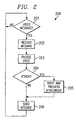
- Video message transmission takes place in a manner outlined in Figure 2.
- Figure 2 illustrates only the general outline of this process.
- Program 200 executes on central processing unit 111 of transmission appliance 110. Initially, program 200 continually tests to determine if a video message is to be recorded (decision block 201). Some form of user input would generally be required to initiate this process.
- central processing unit 111 could be programmed to initiate video recording and transmission upon detection of a predetermined event or set of events, such as expiration of a time period, detection of some external event by a sensor or the like. If not (No at decision block 201), then program 200 repeats this block.
- FIG. 1 illustrates alternate hardware for recording the video message.
- the video message could be captured by digital video camera 101.
- Such cameras typically include an integral microphone for capturing audio corresponding to the video.
- This combined video and audio is transmitted to buffer 116 within transmission appliance 110.
- Digital video cameras typically employ some type of broadband transmission such as 10Bt Ethernet or IEEE 1394, commonly known as FireWire. This connection could also be by way of a Universal Serial Bus (USB) or any other medium providing acceptable transmission bandwidth.
- Buffer 116 provides temporary storage of the received signal from digital video camera 101 until it can be stored in hard disk drive 114. This data may also be intermediately stored in memory 112 prior to storage in hard disk drive 114.
- the video message could be captured by analog video camera 104.
- Figure 1 illustrates microphone 103 separate from analog video camera 104.
- Analog video cameras of the type proposed typically include an integral microphone as described above with regard to digital video camera 101. However, even with an integral microphone, such an analog video camera typically supplies separate audio and video baseband signals as shown in Figure 1. This differs from the typical digital video camera which supplies a combined digital analog and video signal.
- the respective audio and video baseband signals are supplied to analog to digital converter 118 in transmission appliance 110.
- Analog to digital converter 118 converts the respective audio and video baseband signals into digital data streams. These digital data streams are stored in hard disk drive 114 as previously described and optionally may be buffered and temporarily stored in memory 112.
- Program 200 next encodes the digital video data (processing block 203). Such data encoding reduces the amount of data that must be transferred to the reception station.
- Central processing unit 111 recalls the digital video data from hard disk drive 114, encodes it with the selected algorithm and stores the resultant encoded digital video data on hard disk drive 114.
- the MPEG2 (Motion Pictures Expert Group) standard is one of the many standards suitable for this invention. Note that the video data transmission does not need to be in real time as the video is generated.
- Central processing unit 111 may employ more time for data encoding than the run time of the video message.
- the original, unencoded digital video data may be discarded to save disk space within hard disk drive 114.
- the encoded video data need not be stored on hard disk drive 114 but may be simultaneously transmitted via communications interface 113 as it is encoded. Storage is probably necessary if there are to be any attachments described later.
- Program 200 next determines whether any other data is to be attached to the video message (decision block 204). If not (No at decision block 204), then program 200 sends the message (processing block 205). This will be further described below. If so (Yes at decision block 205), then program 200 inputs and processes the attachment (processing block 205).
- An attachment could be text file from another source, a digital still picture from digital still camera 102 by way of buffer 117 or an audio file by way of microphone 103 and analog to digital converter 118. These files may also be encoded using central processing unit 111.
- the JPEG (Joint Picture Expert Group) standard is a suitable standard for digital still pictures.
- MP3 MPEG layer 3 standard
- MP3 MPEG layer 3 standard
- MP3 Several audio encoding standards exist, the MPEG layer 3 standard, known as MP3, is a suitable standard for this invention. As described above in conjunction with digital video data, once encoded the original, unencoded data may be discarded to save space on hard disk drive 114.
- the digital video message and any attached file is then transmitted (processing block 206).
- a number of transmission methods are feasible. It is preferable in this invention to use a broadband connection to the Internet 120 for this transmission.
- a cable modem or a digital subscriber line (DSL) connection are suitable for this invention.
- Central processing unit 111 controls transfer of the desired data from hard disk drive 114 to Internet 120 via communications interface 113.
- Communications interface 113 services any required connection and log on protocols, designation of the destination and then supplies the data to the transmission medium. If the transmission is to be via the Internet, the user of the transmission station must prearrange a relationship with an Internet service provider (ISP) to complete the connection to Internet 120.
- ISP Internet service provider
- Communications interface 113 controls transmission of the video message with any attachments for later review at the reception station.
- a video message may be reviewed on television receiver 105. This may occur in real time as the video message is produced via digital video camera 101 or analog video camera 104, or following storage and encoding of the video message.
- TV encoder 115 receives the video data and produces an appropriate signal for viewing by television receiver 105.
- central processing unit 111 preferably decodes the data or controls decoding of the data. In this case the decoding preferably takes place in real time as the video is viewed.
- TV encoder 115 produces a signal compatible with television receiver 105.
- Television receivers used in North America employ the National Televison Standards Committee (NTSC) standard to receive broadcast signals.
- NTSC National Televison Standards Committee
- Apparatus such as video cassette recorders or video game consoles, which use a television receiver as a display typically modulate the video and audio signals on a carrier according to the NTSC standard at a frequency within the tuning range of the television receiver.
- Analog video cameras such as analog video camera 104 typically produce a signal compatible with the NTSC standard.
- TV encoder 115 need only recover the original input signal.
- Digital video camera 101 may employ a differing encoding standard. In this case, TV encoder 115 also needs to transcode the digital video signal to the NTSC standard.
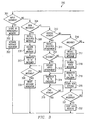
- Video message reception takes place in a manner outlined in Figure 3. As described above in conjunction with Figure 2, a practical application would require a manner to be responsive to user commands.
- Program 300 executes on central processing unit 131 of reception appliance 130. Initially, program 300 includes a polling loop including decision blocks 301, 303, 308 and 314. A negative answer to each of these queries remains in this polling loop. A positive answer to one of these queries branches to a service routine. Following execution of the corresponding service routine, program 300 returns to the polling loop.
- Program 300 checks to determine if a video message is received (decision block 301).
- reception appliance 130 is connected to Internet 120 via communications interface 133.
- the nature of communications interface 133 depends upon the type of connection to Internet 120.
- a dial-up connection via an ordinary telephone line requires communications interface 133 to place a telephone call on the line to the ISP of the user, connect to the ISP server and establish a connection.
- This process typically includes entry of a user identification and password.
- the determination that a video message has been received will only occur following logging on to Internet 120 via communications interface 133 and the user's ISP.
- the connection to Internet 120 is always live and no such log on is required.
- determining that a video message has been received may take place on an interrupt basis.
- communications interface 133 may periodically poll a particular location where the user's ISP stores such messages prior to download. The nature of the reception depends upon the type of transmission medium used in a manner well known to those skilled in the art.
- program 300 Upon determining a video message has been received (Yes at decision block 301), program 300 stores the video message and any attachments in non-volatile memory (processing block 302). Memory is classified as non-volatile if data is not lost upon removal of electrical power. In the preferred embodiment the video message is transferred from communications interface 133 to hard disk drive 134 and optionally may be buffered in memory 132. Following this storage, program 300 produces a "message received" indication" (processing block 303). Reception appliance 130 preferably produces a user indication that a video message has been received. This user indication could be by a visual message displayed via television receiver 141, an audio alarm produced by the audio channel of television receiver 141 or a separate audio channel (not shown) or any other type of visual or audible indicator. Following indication that a message has been received, program 300 returns to the polling loop at decision block 301.
- program 300 checks to determine if the user desires to view a previously received and stored video message (decision block 304). As noted above, reception appliance 130 preferably provides an indication to the user when such a video message has been received. If this is the case (Yes at decision block 304), then the desired video message is recalled (processing block 305). This process preferably takes place by soliciting user input as to which video message to view. It is known in the art to provide a visual menu enabling such user selection. This video menu could be displayed via television receiver 141 in a manner that will be described below. Following recall of the selected video message, program 300 decodes the digital video data (processing block 306).
- This process is the reverse of the encoding process 203 of program 200. The result is recovery of the original video recorded at the transmission station.
- This decoded video data is supplied to TV encoder 135 for display via television receiver 141 (processing block 307).
- the encoded video data can be recalled from hard disk drive 134, decoded by central processing unit 131 and supplied to TV encoder 135 in real time as the video message is viewed. This requires that central processing unit 131 has the computation capacity to perform the decoding in real time, as fast as data is streaming from hard disk drive 134 to TV encoder 135.
- Typical video encoding standards do not require as intensive computation for decoding as for encoding.
- the decoding can take place slower than real time.
- encoded video data is recalled from hard disk drive 134 and decoded by central processing unit 131 at a rate slower than needed to view the video.
- Decoded video data from central processing unit 131 is then stored at another location on hard disk drive 134.
- central processing unit 131 controls recall of the decoded video data from hard disk drive 134 and routes this data to TV encoder 135.
- TV encoder 135 operates similarly to TV encoder 115 previously described.
- TV encoder 135 receives the decoded video data and generates a signal compatible with the technical standard of television receiver 141.
- Program 300 tests to determine the end of the video message (decision block 308). Upon detection of the end of the video message (Yes at decision block 308), program 300 resets the message received indicator (processing block 309). Thereafter, program 300 returns to the polling loop at decision block 301.
- program 300 checks to determine if the user wants to access an attachment (decision block 310). In the preferred embodiment the same menu system used to select accessing a video message alerts the user to the presence of one or more video message attachments and permits the user to select accessing any such attachments. If the user selects accessing a video attachment (Yes at decision block 310), program 300 recalls the selected video attachment (processing block 311). Such video attachments are preferably stored on hard disk drive 134. Upon such recall, program 300 checks to determine if the video attachment is encoded (decision block 312). Recall from the above description that encoding of video attachment is optional.
- central processing unit 131 would identify the proper encoding standard and decode the attachment (processing block 313). If not encoded (No at decision block 312), program 300 would skip this step.
- program 300 transfers the attachment data to TV encoder 135 (processing block 314).
- the manner of this access depends upon the nature of the attachment. Data files such as text, spreadsheet or presentation data should be displayed in the manner of its originating application. Accordingly, hard disk drive 134 should store a compatible application to enable central processing unit 131 to open and make visible the attachment data. In the case of a picture, such as taken by digital still camera 102, hard disk drive 134 should store a picture viewing program permitting central processing unit 131 to format the picture data for viewing via television receiver 141. Large pictures may either be shrunk by reducing picture resolution for display of the whole picture on television receiver 141 or the picture viewing application programmed to permit viewing less than all the picture and scrolling to view other parts.
- audio files are accessed via television receiver 141.
- Central processing unit 131 supplies the audio data to TV encoder 135 in a manner like the soundtrack of a video message.
- TV encoder 135 generates a signal to television receiver 141 with audio data modulation in the same manner as the soundtrack of a video message.
- reception appliance 130 could be constructed with a separate audio channel (not shown) including a digital to analog converter, an audio amplifier and a speaker.
- program 300 tests to determine if the attachment is complete (decision block 315). This may be the end of an audio file of the user deciding to end a text, spreadsheet or picture viewing program. Program 300 remains in decision block 315 if the attachment is not compete (No at decision block 315). Upon detecting the end of the attachment (Yes at decision block 315), program 300 returns to the polling loop at decision block 301.
- program 300 checks to determine if the user wants to archive a previously received video message (decision block 316). It is well known that video data files are very large. Attempting to archive video messages in hard disk drive 134 would quickly fill the available storage space.
- video messages are archived using video cassette recorder 143.
- a video cassette recorder includes: a television receiver to receive and demodulate broadcast or cable cast television signals: a video record/playback tape transport; and a signal generator similar to TV encoders 115 and 135 which supplies a modulated signal within the reception band of television receiver 141. Because a single video cassette can store several hours of video, this is a convenient way to archive video messages.
- program 300 recalls the video message to be archived (decision block 317) in the same fashion as processing block 305.
- Program 300 then decodes the video message (processing block 318) in the same fashion as processing block 306.
- the decoded video is supplied to TV encoder 135 (processing block 319) in the same fashion as processing block 307.
- Program 300 starts video cassette recorder 143 in record mode (processing block 320). Thereafter program 300 waits until the end of the video message (processing block 321) in the same fashion as decision block 308.
- this process may involve real time decoding or the decoded video may be temporarily stored in hard disk drive 134 for later supply to TV encoder 134.
- program 300 stops the recording of video cassette recorder 143 (processing block 322). Note that the record start and stop may be performed manually by the operator with cues from reception appliance 130 or reception appliance 130 may perform this automatically under direction of central processing unit 131. After stopping recording by video cassette recorder 143 (processing block 322), program 300 returns to the polling loop at decision block 301.
- Program 300 illustrates that video message input and access are separate processes that cannot take place simultaneously.
- a new video message blocks 301, 302, 303 and 304
- a video message blocks 304, 305, 306, 307, 308 and 309
- accessing an attachment blocks 310, 311, 312, 313, 314 and 315
- archiving a video message blocks 316, 317, 318, 319, 320, 321 and 322.
Landscapes
- Engineering & Computer Science (AREA)
- Signal Processing (AREA)
- Multimedia (AREA)
- Computer Networks & Wireless Communication (AREA)
- General Engineering & Computer Science (AREA)
- Business, Economics & Management (AREA)
- General Business, Economics & Management (AREA)
- Two-Way Televisions, Distribution Of Moving Picture Or The Like (AREA)
- Information Transfer Between Computers (AREA)
Applications Claiming Priority (2)
| Application Number | Priority Date | Filing Date | Title |
|---|---|---|---|
| US20563800P | 2000-05-18 | 2000-05-18 | |
| US205638 | 2000-05-18 |
Publications (2)
| Publication Number | Publication Date |
|---|---|
| EP1162800A2 true EP1162800A2 (fr) | 2001-12-12 |
| EP1162800A3 EP1162800A3 (fr) | 2003-04-09 |
Family
ID=22763014
Family Applications (1)
| Application Number | Title | Priority Date | Filing Date |
|---|---|---|---|
| EP01000153A Withdrawn EP1162800A3 (fr) | 2000-05-18 | 2001-05-18 | Procédé de messagerie vidéo |
Country Status (2)
| Country | Link |
|---|---|
| US (1) | US20020047892A1 (fr) |
| EP (1) | EP1162800A3 (fr) |
Cited By (1)
| Publication number | Priority date | Publication date | Assignee | Title |
|---|---|---|---|---|
| EP1646239A1 (fr) * | 2004-10-07 | 2006-04-12 | France Telecom S.A. | Procédé et système de transmission d'un message vidéo vers un poste de télévision |
Families Citing this family (50)
| Publication number | Priority date | Publication date | Assignee | Title |
|---|---|---|---|---|
| US7039678B1 (en) * | 2000-09-07 | 2006-05-02 | Axis Mobile, Ltd. | E-mail proxy |
| US20030046705A1 (en) * | 2001-08-28 | 2003-03-06 | Sears Michael E. | System and method for enabling communication between video-enabled and non-video-enabled communication devices |
| JP2003152888A (ja) * | 2001-11-08 | 2003-05-23 | Nec Corp | ビデオ付き留守応答メッセージ機能付き携帯電話機 |
| US7009118B2 (en) * | 2003-05-13 | 2006-03-07 | Dynamic Datum Llc | Vehicle load weighing system and load cells for such systems |
| KR100747444B1 (ko) * | 2004-02-24 | 2007-08-09 | 엘지전자 주식회사 | 이동통신단말기의 동영상 전송 방법 |
| CN101496387B (zh) | 2006-03-06 | 2012-09-05 | 思科技术公司 | 用于移动无线网络中的接入认证的系统和方法 |
| KR101357158B1 (ko) * | 2007-03-15 | 2014-02-03 | 삼성전자 주식회사 | 화상 통신용 디스플레이 장치 및 화상 통신 방법 |
| KR20090001090A (ko) * | 2007-06-29 | 2009-01-08 | 삼성전자주식회사 | 화상통신장치 및 그 제어방법 |
| US8869181B2 (en) | 2007-09-28 | 2014-10-21 | At&T Intellectual Property I, L.P. | Method and system for message notification |
| US8797377B2 (en) | 2008-02-14 | 2014-08-05 | Cisco Technology, Inc. | Method and system for videoconference configuration |
| US10229389B2 (en) * | 2008-02-25 | 2019-03-12 | International Business Machines Corporation | System and method for managing community assets |
| US8319819B2 (en) * | 2008-03-26 | 2012-11-27 | Cisco Technology, Inc. | Virtual round-table videoconference |
| US8253772B2 (en) | 2008-04-04 | 2012-08-28 | Centurylink Intellectual Property Llc | Method, apparatus and system for incorporating voice or video communication into a television or compatible audio capable visual display |
| US8390667B2 (en) | 2008-04-15 | 2013-03-05 | Cisco Technology, Inc. | Pop-up PIP for people not in picture |
| US8694658B2 (en) * | 2008-09-19 | 2014-04-08 | Cisco Technology, Inc. | System and method for enabling communication sessions in a network environment |
| ITTO20080806A1 (it) * | 2008-10-30 | 2010-04-30 | Cnh Italia Spa | Sospensione posteriore indipendente per veicolo agricolo |
| US8619115B2 (en) | 2009-01-15 | 2013-12-31 | Nsixty, Llc | Video communication system and method for using same |
| US8659637B2 (en) * | 2009-03-09 | 2014-02-25 | Cisco Technology, Inc. | System and method for providing three dimensional video conferencing in a network environment |
| US8659639B2 (en) * | 2009-05-29 | 2014-02-25 | Cisco Technology, Inc. | System and method for extending communications between participants in a conferencing environment |
| EP2439941A4 (fr) * | 2009-06-19 | 2013-09-25 | Shenzhen Tcl New Technology | Télévision et procédé de réalisation de message vidéo |
| US9082297B2 (en) | 2009-08-11 | 2015-07-14 | Cisco Technology, Inc. | System and method for verifying parameters in an audiovisual environment |
| US9225916B2 (en) * | 2010-03-18 | 2015-12-29 | Cisco Technology, Inc. | System and method for enhancing video images in a conferencing environment |
| US9313452B2 (en) | 2010-05-17 | 2016-04-12 | Cisco Technology, Inc. | System and method for providing retracting optics in a video conferencing environment |
| US8896655B2 (en) | 2010-08-31 | 2014-11-25 | Cisco Technology, Inc. | System and method for providing depth adaptive video conferencing |
| US8599934B2 (en) | 2010-09-08 | 2013-12-03 | Cisco Technology, Inc. | System and method for skip coding during video conferencing in a network environment |
| US8599865B2 (en) | 2010-10-26 | 2013-12-03 | Cisco Technology, Inc. | System and method for provisioning flows in a mobile network environment |
| US8699457B2 (en) | 2010-11-03 | 2014-04-15 | Cisco Technology, Inc. | System and method for managing flows in a mobile network environment |
| US9143725B2 (en) | 2010-11-15 | 2015-09-22 | Cisco Technology, Inc. | System and method for providing enhanced graphics in a video environment |
| US8902244B2 (en) | 2010-11-15 | 2014-12-02 | Cisco Technology, Inc. | System and method for providing enhanced graphics in a video environment |
| US9338394B2 (en) | 2010-11-15 | 2016-05-10 | Cisco Technology, Inc. | System and method for providing enhanced audio in a video environment |
| US8730297B2 (en) | 2010-11-15 | 2014-05-20 | Cisco Technology, Inc. | System and method for providing camera functions in a video environment |
| US8542264B2 (en) | 2010-11-18 | 2013-09-24 | Cisco Technology, Inc. | System and method for managing optics in a video environment |
| US8723914B2 (en) * | 2010-11-19 | 2014-05-13 | Cisco Technology, Inc. | System and method for providing enhanced video processing in a network environment |
| US9111138B2 (en) | 2010-11-30 | 2015-08-18 | Cisco Technology, Inc. | System and method for gesture interface control |
| USD682854S1 (en) | 2010-12-16 | 2013-05-21 | Cisco Technology, Inc. | Display screen for graphical user interface |
| US8692862B2 (en) | 2011-02-28 | 2014-04-08 | Cisco Technology, Inc. | System and method for selection of video data in a video conference environment |
| US8670019B2 (en) | 2011-04-28 | 2014-03-11 | Cisco Technology, Inc. | System and method for providing enhanced eye gaze in a video conferencing environment |
| US8786631B1 (en) | 2011-04-30 | 2014-07-22 | Cisco Technology, Inc. | System and method for transferring transparency information in a video environment |
| US8934026B2 (en) | 2011-05-12 | 2015-01-13 | Cisco Technology, Inc. | System and method for video coding in a dynamic environment |
| US9369723B2 (en) * | 2011-07-14 | 2016-06-14 | Comcast Cable Communications, Llc | Preserving image quality in temporally compressed video streams |
| WO2013016285A1 (fr) * | 2011-07-22 | 2013-01-31 | Vsnap, Inc. | Transmission d'éléments basée sur de la vidéo |
| JP2013025748A (ja) * | 2011-07-26 | 2013-02-04 | Sony Corp | 情報処理装置、動画要約方法、及びプログラム |
| US8947493B2 (en) | 2011-11-16 | 2015-02-03 | Cisco Technology, Inc. | System and method for alerting a participant in a video conference |
| KR20130058962A (ko) * | 2011-11-28 | 2013-06-05 | 한국전자통신연구원 | 지그비 네트워크 표준 프로토콜 기반의 무선 영상 통신 장치 및 방법 |
| US8682087B2 (en) | 2011-12-19 | 2014-03-25 | Cisco Technology, Inc. | System and method for depth-guided image filtering in a video conference environment |
| EP2820585B1 (fr) | 2012-02-29 | 2019-04-10 | BlackBerry Limited | Procédé de fonctionnement d'un dispositif informatique, dispositif informatique et programme informatique |
| WO2013130555A2 (fr) * | 2012-02-29 | 2013-09-06 | Good Technology Corporation | Procédé de fonctionnement d'un dispositif informatique, dispositif informatique et programme informatique |
| EP2820793B1 (fr) | 2012-02-29 | 2018-07-04 | BlackBerry Limited | Procédé de fonctionnement d'un dispositif informatique, dispositif informatique et programme informatique |
| US9681154B2 (en) | 2012-12-06 | 2017-06-13 | Patent Capital Group | System and method for depth-guided filtering in a video conference environment |
| US9843621B2 (en) | 2013-05-17 | 2017-12-12 | Cisco Technology, Inc. | Calendaring activities based on communication processing |
Family Cites Families (5)
| Publication number | Priority date | Publication date | Assignee | Title |
|---|---|---|---|---|
| GB2299878A (en) * | 1995-04-08 | 1996-10-16 | Richard Taylor | Multimedia computer |
| US5896165A (en) * | 1997-04-09 | 1999-04-20 | Texas Instruments Incorporated | Method and system for a video answering machine |
| US6014689A (en) * | 1997-06-03 | 2000-01-11 | Smith Micro Software Inc. | E-mail system with a video e-mail player |
| US6252588B1 (en) * | 1998-06-16 | 2001-06-26 | Zentek Technology, Inc. | Method and apparatus for providing an audio visual e-mail system |
| US6366949B1 (en) * | 1998-07-30 | 2002-04-02 | Maila Nordic Ab | Method and arrangement relating to communication in a network |
-
2001
- 2001-04-25 US US09/842,532 patent/US20020047892A1/en not_active Abandoned
- 2001-05-18 EP EP01000153A patent/EP1162800A3/fr not_active Withdrawn
Cited By (1)
| Publication number | Priority date | Publication date | Assignee | Title |
|---|---|---|---|---|
| EP1646239A1 (fr) * | 2004-10-07 | 2006-04-12 | France Telecom S.A. | Procédé et système de transmission d'un message vidéo vers un poste de télévision |
Also Published As
| Publication number | Publication date |
|---|---|
| US20020047892A1 (en) | 2002-04-25 |
| EP1162800A3 (fr) | 2003-04-09 |
Similar Documents
| Publication | Publication Date | Title |
|---|---|---|
| EP1162800A2 (fr) | Procédé de messagerie vidéo | |
| US7516203B2 (en) | Network control verification system, control communication terminal, server apparatus, and network control verification method | |
| US8836798B2 (en) | Method and system for processing a composite video image | |
| US8881206B2 (en) | Device and method for outputting data of a wireless terminal to an external device | |
| US9955212B2 (en) | Media content shifting | |
| EP1243137B1 (fr) | Procede et dispositif pour assurer des services de messagerie vocale/unifiee a l'aide de terminaux de television par cable | |
| CN100542279C (zh) | 分布式数字录像机的方法与系统 | |
| JPWO2002056486A1 (ja) | 受信機、携帯端末、および受信システム | |
| EP1372333A2 (fr) | Procédé de transfert d'images entre un terminal mobile et un récepteur de radiodiffusion numérique | |
| KR100872138B1 (ko) | 주문형 멀티미디어 콘텐츠 제공 시스템 및 방법 | |
| CN101480052A (zh) | 具有中断处理和特技播放功能的信号分配系统 | |
| JP2004328741A (ja) | 移動通信端末機で受信されたテレビ信号を伝送する装置及び方法 | |
| CN1218565C (zh) | 利用电视接收机传送话音/图文信息的方法 | |
| US20030046705A1 (en) | System and method for enabling communication between video-enabled and non-video-enabled communication devices | |
| WO2003058965A1 (fr) | Service de conference avec presentation synchrone de programmes media | |
| US7176794B2 (en) | Method and apparatus for capturing audio input using a television | |
| JP2003046880A (ja) | 携帯型ビューワ向け送信機能搭載型受信機および携帯型ビューワならびに携帯型ビューワシステムプログラム | |
| KR20050017436A (ko) | 부재중 메시지 저장 기능을 갖는 pvr 장치 및 그 방법 | |
| JP2002354435A (ja) | ビデオメッセージング方法 | |
| US20070040897A1 (en) | Video communication apparatus and video communication method | |
| US20070207779A1 (en) | Method for confirming message in mobile terminal | |
| JPH10313451A (ja) | 動画像情報の転送方法 | |
| JP2005252843A (ja) | 携帯端末装置、番組録画システム、及び番組録画方法 | |
| WO2003003708A2 (fr) | Interface comprenant une webcamera permettant d'etablir une communication video bidirectionnelle | |
| JPH09130769A (ja) | マルチメディアシステム |
Legal Events
| Date | Code | Title | Description |
|---|---|---|---|
| PUAI | Public reference made under article 153(3) epc to a published international application that has entered the european phase |
Free format text: ORIGINAL CODE: 0009012 |
|
| AK | Designated contracting states |
Kind code of ref document: A2 Designated state(s): AT BE CH CY DE DK ES FI FR GB GR IE IT LI LU MC NL PT SE TR |
|
| AX | Request for extension of the european patent |
Free format text: AL;LT;LV;MK;RO;SI |
|
| PUAL | Search report despatched |
Free format text: ORIGINAL CODE: 0009013 |
|
| AK | Designated contracting states |
Kind code of ref document: A3 Designated state(s): AT BE CH CY DE DK ES FI FR GB GR IE IT LI LU MC NL PT SE TR Designated state(s): AT BE CH CY DE DK ES FI FR GB GR IE IT LI LU MC NL PT SE TR |
|
| AX | Request for extension of the european patent |
Extension state: AL LT LV MK RO SI |
|
| 17P | Request for examination filed |
Effective date: 20031009 |
|
| 17Q | First examination report despatched |
Effective date: 20031030 |
|
| AKX | Designation fees paid |
Designated state(s): AT BE CH CY DE DK ES FI FR GB GR IE IT LI LU MC NL PT SE TR |
|
| STAA | Information on the status of an ep patent application or granted ep patent |
Free format text: STATUS: THE APPLICATION IS DEEMED TO BE WITHDRAWN |
|
| 18D | Application deemed to be withdrawn |
Effective date: 20040310 |