EP1164221A2 - Mehrschichtiges photokatalytisches Papier - Google Patents
Mehrschichtiges photokatalytisches Papier Download PDFInfo
- Publication number
- EP1164221A2 EP1164221A2 EP00125713A EP00125713A EP1164221A2 EP 1164221 A2 EP1164221 A2 EP 1164221A2 EP 00125713 A EP00125713 A EP 00125713A EP 00125713 A EP00125713 A EP 00125713A EP 1164221 A2 EP1164221 A2 EP 1164221A2
- Authority
- EP
- European Patent Office
- Prior art keywords
- pulp
- paper
- photocatalytic
- titanium oxide
- laminated
- Prior art date
- Legal status (The legal status is an assumption and is not a legal conclusion. Google has not performed a legal analysis and makes no representation as to the accuracy of the status listed.)
- Granted
Links
Images


Classifications
-
- D—TEXTILES; PAPER
- D21—PAPER-MAKING; PRODUCTION OF CELLULOSE
- D21D—TREATMENT OF THE MATERIALS BEFORE PASSING TO THE PAPER-MAKING MACHINE
- D21D1/00—Methods of beating or refining; Beaters of the Hollander type
- D21D1/20—Methods of refining
- D21D1/30—Disc mills
-
- D—TEXTILES; PAPER
- D21—PAPER-MAKING; PRODUCTION OF CELLULOSE
- D21B—FIBROUS RAW MATERIALS OR THEIR MECHANICAL TREATMENT
- D21B1/00—Fibrous raw materials or their mechanical treatment
- D21B1/04—Fibrous raw materials or their mechanical treatment by dividing raw materials into small particles, e.g. fibres
- D21B1/12—Fibrous raw materials or their mechanical treatment by dividing raw materials into small particles, e.g. fibres by wet methods, by the use of steam
- D21B1/30—Defibrating by other means
- D21B1/32—Defibrating by other means of waste paper
-
- D—TEXTILES; PAPER
- D21—PAPER-MAKING; PRODUCTION OF CELLULOSE
- D21H—PULP COMPOSITIONS; PREPARATION THEREOF NOT COVERED BY SUBCLASSES D21C OR D21D; IMPREGNATING OR COATING OF PAPER; TREATMENT OF FINISHED PAPER NOT COVERED BY CLASS B31 OR SUBCLASS D21G; PAPER NOT OTHERWISE PROVIDED FOR
- D21H27/00—Special paper not otherwise provided for, e.g. made by multi-step processes
- D21H27/30—Multi-ply
- D21H27/38—Multi-ply at least one of the sheets having a fibrous composition differing from that of other sheets
-
- D—TEXTILES; PAPER
- D21—PAPER-MAKING; PRODUCTION OF CELLULOSE
- D21H—PULP COMPOSITIONS; PREPARATION THEREOF NOT COVERED BY SUBCLASSES D21C OR D21D; IMPREGNATING OR COATING OF PAPER; TREATMENT OF FINISHED PAPER NOT COVERED BY CLASS B31 OR SUBCLASS D21G; PAPER NOT OTHERWISE PROVIDED FOR
- D21H11/00—Pulp or paper, comprising cellulose or lignocellulose fibres of natural origin only
- D21H11/14—Secondary fibres
-
- D—TEXTILES; PAPER
- D21—PAPER-MAKING; PRODUCTION OF CELLULOSE
- D21H—PULP COMPOSITIONS; PREPARATION THEREOF NOT COVERED BY SUBCLASSES D21C OR D21D; IMPREGNATING OR COATING OF PAPER; TREATMENT OF FINISHED PAPER NOT COVERED BY CLASS B31 OR SUBCLASS D21G; PAPER NOT OTHERWISE PROVIDED FOR
- D21H17/00—Non-fibrous material added to the pulp, characterised by its constitution; Paper-impregnating material characterised by its constitution
- D21H17/63—Inorganic compounds
- D21H17/67—Water-insoluble compounds, e.g. fillers, pigments
- D21H17/675—Oxides, hydroxides or carbonates
-
- Y—GENERAL TAGGING OF NEW TECHNOLOGICAL DEVELOPMENTS; GENERAL TAGGING OF CROSS-SECTIONAL TECHNOLOGIES SPANNING OVER SEVERAL SECTIONS OF THE IPC; TECHNICAL SUBJECTS COVERED BY FORMER USPC CROSS-REFERENCE ART COLLECTIONS [XRACs] AND DIGESTS
- Y02—TECHNOLOGIES OR APPLICATIONS FOR MITIGATION OR ADAPTATION AGAINST CLIMATE CHANGE
- Y02W—CLIMATE CHANGE MITIGATION TECHNOLOGIES RELATED TO WASTEWATER TREATMENT OR WASTE MANAGEMENT
- Y02W30/00—Technologies for solid waste management
- Y02W30/50—Reuse, recycling or recovery technologies
- Y02W30/64—Paper recycling
-
- Y—GENERAL TAGGING OF NEW TECHNOLOGICAL DEVELOPMENTS; GENERAL TAGGING OF CROSS-SECTIONAL TECHNOLOGIES SPANNING OVER SEVERAL SECTIONS OF THE IPC; TECHNICAL SUBJECTS COVERED BY FORMER USPC CROSS-REFERENCE ART COLLECTIONS [XRACs] AND DIGESTS
- Y10—TECHNICAL SUBJECTS COVERED BY FORMER USPC
- Y10T—TECHNICAL SUBJECTS COVERED BY FORMER US CLASSIFICATION
- Y10T428/00—Stock material or miscellaneous articles
- Y10T428/25—Web or sheet containing structurally defined element or component and including a second component containing structurally defined particles
- Y10T428/256—Heavy metal or aluminum or compound thereof
Definitions
- the present invention relates to a laminated photocatalytic pulp paper, a molding material of which is mainly a pulp and/or a paper and a wastepaper, preferably a wastepaper of newspaper, and which has the photocatalytic activity and a process for producing the same and, more particularly in considering recycling of wastepapers of newspapers, it provides a laminated photocatalytic pulp paper which can be widely applied to various uses as a furniture, a building material and a general packaging material such as a filter material, a paper sliding screen, a paper for a sliding screen, a wall paper, a blind, a panel, a lamp shade, a bed sheet, a curtain, a carpet, a sofa and a sheet, and a flexible composite packaging material, as well as a particular packaging material for, example, antimold use, an interior material for a car, a facing material of an electric product for house use, and a raw material for and an article of various molded articles such as daily necessaries, and a film, a sheet,
- the present invention also relates to the novel use development of the aforementioned laminated photocatalytic pulp paper and provides a paper string comprising the laminated photocatalytic pulp paper as a packaging material as well as other daily necessaries including a mat, a cage, a reed screen, a shop curtain and a cap, and a clothing, which have the deodorizing property and the antibacterial property, or as a water-soluble pet sand which can be flushed down in a washing toilet and has the antibacterial function and the deodorizing function for more effectively treating bad smell produced from feces and urine of a pet, and other various molded articles or materials, and a molded article comprising the paper string.
- the above kind of titanium oxide has been hitherto used as a deodorizing filter or provided as a coating agent, and used in order to obtain the stainproofing or the antibacterial properties of the surfaces by forming a film by coating on an objective material and drying it.
- a main object of the present invention is to provide a laminated photocatalytic pulp paper having the antibacterial, antimold, stainproofing and bad smell degrading, deodorizing and harmful material oxidatively degrading effects, and which is widely used for a packaging material, a building material, a filtering material and the like, and a process and for producing the same.
- the present invention also provides a paper string and a molded article as a packaging material suitable for the aforementioned various uses, or as a material for various molded articles, which retain the physical properties as a packaging material such as the tensile strength.
- a laminated photocatalytic pulp paper of the present invention is characterized in that a virgin pulp or a wastepaper pulp is laminated on a photocatalytic pulp composition as a blend in which 40-95 wt% of a pulp and/or a paper having the water content of 3 wt% or less, an average fiber diameter of 5-300 ⁇ m and an average fiber length of 0.1-70 mm are blended with 5-60 wt% of titanium oxide.
- thermoplastic resin can be blended with the titanium oxide, the pulp and/or the paper at an amount of 25-100 wt% relative to a total weight of the titanium oxide, the pulp and/or the paper, and a virgin pulp or a wastepaper pulp can be laminated on the blend.
- a process for producing the laminated photocatalytic pulp paper comprises a step of imparting the stirring impact force to a blend obtained by blending 40-95 wt% of a pulp and/or a paper which has been split and disaggregated to an average fiber diameter of 5-300 ⁇ m and an average fiber length of 0.1-70 mm with 5-60 wt% of titanium oxide to stir and, whereby, the shear exothermic heat is generated by a shearing force based on the stirring impact force and the blend is dried by this shear exothermic heat to reduce the water content to 3 wt% or less, a step of swelling the pulp and/or the paper upon the drying to obtain a three-dimensionally entangled material, a treatment step of pushing the titanium oxide against the fiber surface of the pulp and/or the paper by the stirring impact force to fix thereto, and a step of laminating a virgin pulp or a wastepaper pulp in a paper making step after the treatment step of pushing and fixing the titanium oxide.
- thermoplastic resin can be blended with the titanium oxide, the pulp and/or the paper at an amount of 25-100 wt% relative to a total weight of the titanium oxide, the pulp and/or the paper.
- the wastepaper pulp comprises a newspaper wastepaper via a DIP step
- it is suitable for reusing a newspaper wastepaper and lamination can be performed using this wastepaper pulp as a core material or a substrate.
- a synthetic fiber having the average fiber length of 1 to 100 mm, the average diameter of 10 to 40 ⁇ m and a melting point of 120 °C or higher can be blended into 5 to 60 wt% of titanium oxide and 40 to 95 wt% of a pulp and/or a paper at a maximum ratio of 1:9.
- the process includes a splitting or disaggregating step 303 by which the above dry pulp is treated, that is, the dry pulp is cut into a plurality of sections to be treated, and the impact grinding force is applied to the formed individual sections to obtain pulp fibers which are ground and aggregated into cotton-like fibrous pulp fibers, have approximately the same length of a fiber like raw pulp and have no fiber hair even with the grinding.
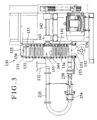
- an apparatus for splitting or disaggregating the dry pulp is for treating a plate-like dry pulp, and is provided with a fixed side impact grinding means in which a port 132 for supplying a plurality of chopped small sections to be treated is past in the center of a fixed disc 131 and respective fixing pins 134 are successively provided on a plurality of rotating loci, a mobile side impact grinding means in which a mobile disc 141 is rotatably and drivably provided opposite to the fixed circular disc 131 and a plurality of mobile pins 144 different from the respective fixing pins 134 are successively provided on a plurality of rotating loci on the mobile disc 141, and preferably a recovery means for discharging contaminants which is opened in a discharge outlet via a screen 151 positioned on a combinatorial circumference of the respective fixing pins 134 and the respective mobile pins 144 and provided with small pores having the predetermined diameter, and further a take-out means for taking out small sections to be treated which remain in the screen 151 and which have been ground
- the thus recovered pulp fibers 84 are transferred to a next step, that is, a step of fixation-treating titanium oxide.
- a paper string comprising the laminated photocatalytic pulp paper of the present invention is characterized in that the laminated photocatalytic pulp paper which have been cut into an arbitrary width of 5-50 mm are twisted at a basis weight of preferably about 20-80 g/m 2 .
- This can be cut into a diameter of about 2-5 mm and a length of about 5-30 mm and can be used as a water-soluble pet sand which has the antibacterial property and the deodorizing property for more effectively treating bad smell produced from pet feces and urine as treatment of pet feces and urine, in addition to the utility as a packaging material and the like.
- the process for production comprises cutting the laminated photocatalytic pulp paper into a width of 5-50 mm, which is wound in a roll-manner and, thereafter, twisted for example at around 15-30 turns.
- a step of stacking a plurality of, for example, 10-40 of the paper strings on the same plane and immersing it in a water-soluble adhesive to dry can be repeated about three times and the adhesive can be removed by sanding to obtain a molded belt-like flat string.
- a woven fabric can be manufactured using the paper string as a weft and a thread comprising a natural fiber such as a cotton yarn or a chemical fiber such as rayon as a warp and, further, the paper string, the flat string and the woven fabric may be combined to use for a variety of utilities.
- Example (1) Material to be laminated for a photocatalytic pulp composition
- a pulp and/or a paper used as a raw material includes not only a so called virgin pulp in a paper making step but also a wastepaper pulp or a pulp obtained by mixing the both at 1:1, and the paper includes a normal paper and widely a wastepaper such as wastepaper of newspaper.
- a wastepaper which is ground with a cutter mill having 10 mm 10 mm screen and, thereafter, treated and which contains a large amount of a printing ink is preferably bleached or colored with a DIP treatment in a paper making step like a wastepaper to be laminated as described below.
- the average fiber diameter is 5 to 300 ⁇ m and the average fiber length is 0.1 to 70 mm, and the bulk specific gravity is 0.005 to 0.04 in the case of the paper fiber and 0.24 in the case of the virgin pulp and/or paper. 80 wt% of it (upon this, the pulp and/or paper contains about 8 wt% of water) and 20 wt% of titanium oxide are incorporated.
- the average fiber diameter of the pulp and/or the paper of 5 to 300 ⁇ m, and the average fiber length of 0.1 to 70 mm means a particle size of 50% by weight in accumulative weight percent of the pulp and/or the paper.
- a paper is grinding treated with a crusher and past through a screen having 10 mm mesh, which is used.
- a printing ink in a wastepaper has no problem upon treatment except that a product is slightly colored.
- the dry pulp is cut into a plurality of sections, and the impact grinding force is applied to the formed individual sections to obtain pulp fibers which are ground and aggregated into cotton-like fibrous pulp fibers, have approximately the same length of that of a fibrous raw pulp and have no fiber hair even with the grinding.
- Such the paperboard like dry pulp after the splitting and disaggregating step 303 is used.
- a separator 130 is past and opened in a port 132 for supplying respective small sections to be treated in the center of a fixed circular disc 131, a fixed end plate 133 is opposite to the fixed circular disc 131 separating by a treating space 155, respective circumferential edges of the fixed end plate 133 are fixed to the fixed circular disc 131 with a circumferential side plate 135.
- a mobile circular disc 141 which is rotated and driven by a rotating transverse axis 142 in the interior of the treating space 155, the rotating transverse axis is supported pivotally by each bearing 143, 143.
- the rotating transverse axis 142 is rotated and driven by a rotating driving means such as a motor and the like.
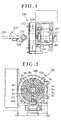
- a plurality (6 in this Example) of respective pins 134 are provided on rotating loci a1 to a6 (relative to a mobile plate 141) (Fig. 5) on a concentric circle, and 16 24 32 36 40 42 of respective fixing pins 134 are successively provided from the center of the fixed circular disc 131 on a concentric circle towards the circumferential edge in this Example.
- a plurality (6 in this Example) of mobile pins 144 which are different from the respective fixing pins 134 and positioned alternately on rotating loci b1 to b6 are successively (4 4 4 4 4 6) provided on the concentric circle from the center of the mobile circular disc 141 towards the circumferential edge, and which are positioned so that the splitting and disaggregating action is obtained between respective fixed and mobile pins 134, 144 by the impact grinding force.
- a screen 151 having the predetermined mesh in which small pores having the desired diameter are formed by punching is circumferentially provided on the circumferential side of a mobile circular disc 141 between the circumferential side plate 135 separating by a discharge port 156, and a discharge port 152 is provided below a discharge space 156.
- a blower 157 is communicated with the discharge port 152 in a separator 130 as shown in Fig. 6.
- a discharge port 152 is communicated with a recovery tank 250 via a discharge tube 239 provided with a blower 157.
- a screen having the diameter of about 0.8 mm to 2.0 mm, though depending upon the rotation number of a mobile pin described below is used.
- a take out port 153 is formed on an lower part in the interior of a screen 151 of a treating space 155 (Fig. 3).
- the grinding force which is applied to small sections to be treated is weakened by increasing the clearance between the respective fixed and mobile pins 134, 144 and the grinding force is strengthened by decreasing the clearance.
- a blower 157 which sucks air in a separator 130 is communicated with the take out port 153 as shown in Fig. 6, and may be communicated with a supply port 132 via this blower 157.
- a take out port 153 and a treating space 155 are communicated via a communicating tube 235, the compressed air which is circulated in a treating space 155 from a take out port 153 and which is from a compressed air supplying source (not shown) is introduced in a communicating tube 235 via a piping 236, and ground pulp fibers and alien substances which are discharged from a take out port 153 are circulated again in a treating space 155 in a separator 130.
- a ramificating tube 237 communicating with a tank 240 for recovering the pulp fibers, or the pulp fibers and alien substances is provided by branching a supply port side of the communication tube 235, a two directional valve 238 which can be appropriately switched every set time, for example, with a timer circuit is provided at a ramificating point of this ramificating tube 237, the downstream side of the communicating tube 235 is closed with a magnetic valve and the ramificating tube 237 side is opened, the pulp fibers which remain in a screen 151 are sucked and recovered in a recovery tank 240 via a ramificating tube 237.
- a magnetic valve which opens and closes the ramificating tube 237 and a magnetic valve which opens and closes the downstream side of the ramificating tube 235 are provided, and these two magnetic valves may be opened and closed alternately (Fig. 6).
- a rotating transverse axis 142 By rotating a rotating transverse axis 142 with a rotating driving means such as a motor or the like to rotate a mobile circular disc 141 and supplying respective small sections to be treated in a supply port 132, the respective small sections to be treated are loosened into smaller fibers between respective fixed and mobile pins 134, 144 by the impact grinding force in the center of the treating space 155 and, on the other hand, the diameter of the alien substances becomes about 2 to 6 mm in an indefinite manner by the impact grinding force.
- a rotating driving means such as a motor or the like
- respective small sections to be treated are beaten and ground or pulverized into small pieces with the impact by respective fixed and mobile pins 133 and 144, and since the bending action is repeatedly applied to the respective small sections to be treated, the finely divided paperboard is separated from small sections to be treated.
- the pulp fibers and alien substances which constitute the small sections to be treated are separated every its kind, respectively, the boardpaper is loosened into fibers and the alien substances are ground into fine pieces, respectively.
- the fiberized pulp is past through a screen 151 which is formed into meshes having the diameter of about 0.8 to 2 mm and discharged into a discharge space 156 and, thereafter, sucked towards the outside via a discharge port 152 and a blower 157, and recovered in a recovery tank 250 via a discharge tube 239.
- the thin substance pieces and a small amount of pulp fibers which are aggregated into a cotton-like fibrous pulp fibers can not pass a screen 151 and remain in the treating space.
- the alien substances which remain in the interior of a treating space 155 are discharged outwards from a take out port 153.
- the discharged substances are recovered into a recovery tank 240 via a ramificating tube 237 by closing the downstream side of the communicating tube 235 and opening the ramificating tube 237 side with a two directional magnetic valve 238 of a ramificating tube 237 which is branched on the supply port side of the communicating tube 23 and which is communicated with a tank 240 for recovering the pulp fibers to suck the alien substances which remain in a screen 151.
- connection of a communication tube 235 to a ramificating tube 237 is carried out via a flange 154 provided on a piping in which the upstream side and the take out 153 side of a communication tube 235 are branched (towards a rear of a paper plane in Fig. 3).
- the pulp fibers thus recovered are transferred to a next step.
- Titanium oxide is effective when its particle size is smaller and, for example, the X ray diameter of 7 to 50 nm can be used.
- the pulp and/or the paper and titanium oxide, or these materials together with synthetic fibers are placed, and the water content of titanium oxide and the pulp and/or the paper is adjusted to 3 wt%, preferably to 1 wt% or less by producing the shearing heat release by the shearing force based on the stirring impact force by a stirring impact blade rotating at a high speed in a mixer to raise a temperature to about 120 °C.
- water is evaporated from the pulp and/or the paper to dry it and at the same time the pulp and/or the paper in the case of a paper undergo the grinding action by the impact force, is swelled at the same time with the drying, the fibers become hairy and aggregated into cotton-like fibrous pulp fibers to obtain three dimensionally entangled fibers.
- titanium oxide is attached to or inserted in to fix the fiber surface and the interior of the fibers by the stirring impact force by the stirring impact blade or the external pressing force accompanied with the shearing force.
- the synthetic fiber is preferable when the average fiber length is 1 to 100 mm, the average diameter is 10 to 40 ⁇ m, and a melting point is 120 °C or higher.
- a virgin pulp has usually the water content of around 10 wt% in the case of a plate-like dry pulp but, also in the case of the higher water content, a virgin pulp is to be pre-dried or is preferably pre-dried to the water content of 10 wt% or less with the mixer or the known drier before mixing of titanium oxide.
- the pulp and/or the paper in the raw material dose not become a large lump, are aggregated while cotton-like fibrous pulp fibers without the mutual firm entanglement of the individual fibers and, in this sense, the three dimensionally entangled fibers are formed and the individual pulp and/or paper are formed in such the form that titanium oxide is attached to all the surface of the fiber of the pulp and/or the paper. Since these individual are aggregated into cotton-like fibrous pulp fibers from a paper, there is no adhesive properties between the simple pulp and/or the paper and the lump itself has the high bulk sepcific gravity. Therefore, the photocatalytic pulp composition formed by this step is a better material as a photocatalytic pulp composition which can be made into a paper in various known paper making steps.
- the present photocatalytic pulp composition can be used as a raw material to form a paper by various paper making methods.
- a plastic fiber or glue, starch, wax or a resin adhesive such as vinyl acetate and acryl system can be mixed therein in a paper making step to prepare a molded photocatalytic pulp composition.
- a photocatalytic pulp paper was prepared using the above pulp composition having the photocatalytic activity.
- titanium oxide ST 01 manufactured by Ishiharatechno Company having the X ray diameter of 7 nm, the titanium oxide content of 90 wt% or more and the specific area of 300 m 2 /g was used to treat with the stirring impact force by a stirring impact blade rotating at a high speed in the mixer (120 °C).
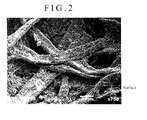
- Photocatalytic pulp composition 2 Example 2 (Fig. 1 and Fig. 2)
- Titanium oxide 0.5 kg (20 wt%)
- the composition was diluted to the pulp concentration of 8 wt% to perform the beating treatment with a beater for 1 hour.
- a beaten pulp raw material such as a virgin pulp including a Japanese paper
- a wastepaper pulp comprising a wastepaper of newspaper after a DIP step (de-inking treatment) was diluted with water to the pulp concentration of 8 wt%, beat treated for 1 hours, then a wet sheet of a pulp comprising a photocatalytic pulp and a wastepaper of newspaper is made into a paper using a paper making machine in the known paper making step.
- a photocatalytic pulp (50 g/m 2 ) and a pulp comprising a wastepaper of newspaper (10 g/m 2 ) after beating treatment were made into a paper using a wire paper machine and a cylinder paper machine, respectively, which were overlapped, transferred to a press part and further dried to make a paper.
- the photocatalytic pulp composition obtained in [Photocatalytic pulp composition 2: Example 2] and a wastepaper of newspaper were made into a paper as in Example 1.
- Paper fibers 2 kg (80 wt%) and titanium oxide; 0.5 kg (20 wt%) were diluted to the pulp concentration of 8 wt% with a beater without using a mixer in the above embodiment and Example, to make a paper.
- Sample size 8 ⁇ 8 cm Basis weight Examples 1, 2 Total 60 g/m 2 Comparative Example 1 50 g/m 2 speed Photocatalyst Co 2 initial producing at 1h Co 2 production rate at 2h Co 2 production rate speed Acetaldehyde initial vanishing ppm/min (%) (%) (ppm/min) Test Ex. 1 29.8 79 100 18.9 Test Ex. 2 24.0 68 100 17.5 Comp. Ex. 1 11.0 38 47 7.4
- the photocatalytic Co 2 initial producing rate is obtained by the following formula; (Apparent Co 2 initial producing rate) - (light control Co 2 producing rate)
- Acetaldehyde initial vanishing rate is the vanishing rate at 30 min. after photo-irradiating.
- the production rate (%) at 1h or 2h is a ratio of the production relative to theoretical value and was calculated by only photocatalyst portion.
- the initial acetaldehyde vanishing rate (%) is concentration at 1 h/initial concentration 100.
- the photocatalyst + pulp paper; a paper of Comparative Example 1 has the extremely low photocatalytic activity and the acetaldehyde vanishing rate is slow.
- the photocatalytic pulp composition Test Example 1 shows 100 % of Co 2 production rate at 2h like Test Example 2, and it can be seen that after the concentration of acetaldehyde is decreased, the sufficient reaction occurs.
- Figs. 1 (A) and (B) and Figs. 2 show scanning microscopic photographs of the photocatalytic pulp composition and photocatalytic pulp composition (Example 2) of Example 2, respectively, it can be seen that titanium oxide is attached and connected to the external face of a pulp raw material and the state where titanium oxide is attached is maintained on the external face of a pulp and also in the interior of a paper even according to a paper making method using water. This is also clear from the fact that little titanium oxide is dissolved in water which was added at a point of stirring in a paper making experiment of Test Example.
- a ratio of blending titanium oxide, a pulp and/or a paper which forms a photocatalytic pulp composition are the same as those of the above Example (1) for preparation.
- the same titanium oxide, the pulp and/or the paper as those of Preparation Example (1) can be used as a raw material.
- thermoplastic resin 25 to 100 wt% of a thermoplastic resin is added to the total weight of the titanium oxide and pulp and/or paper to form a photocatalytic pulp composition (Photocatalytic pulp composition: Example (3)).
- the photocatalytic pulp composition is formed, and a recycled paper comprising a wastepaper pulp obtained by DIP treating a wastepaper of newspaper can be laminated on the composition (Photocatalytic pulp paper: Example (3)) .
- thermoplastic resin various resins can be used.
- a thermoplastic resin in the powder, particle and sheet forms can be used.
- a thermoplastic resin having a particle size of 1 mm or less in the case of a powdery or particulate thermoplastic resin , or a thermoplastic resin having the thickness of 1 mm or less in the case of a sheet like thermoplastic resin is ground into pieces having the side of 10 mm or less to use it.
- thermoplastic resin having a lower melting point such as PE (LLD; linear low density) and vinyl acetate is used as compared with a thermoplastic resin having a relatively high melting point such as polyester, polycarbon and the like.
- a pulp and/or a paper and a thermoplastic resin which constitute the photocatalytic pulp are not required to place in a mixer as a separate raw material and, for example, a composite film having a paper layer laminated with a thermoplastic resin film and which is used for a milk pack is ground into small pieces having the side of around 10 mm and, thereafter, the pieces may be placed in the mixer as described above.
- a paper layer of the composite film becomes a pulp fiber which constitutes a photocatalytic pulp composition
- a thermoplastic resin layer becomes a thermoplastic resin which constitutes the formed photocatalytic pulp composition to be formed.
- an amount of titanium oxide to be blended is determined taking a ratio of a pulp component relative to a thermoplastic resin component contained in a composite film into consideration and at the same time, as necessary, a thermoplastic resin and/or a pulp and/or a paper are added so as to adjust a ratio of respective raw materials to the aforementioned ratio.
- the mixer is actuated to produce the shearing heat by the shearing force based on the stirring impact force by a stirring impact blade which rotates at a high speed in the mixer and a temperature is raised to about 120 °C to adjust the water content of the pulp and/or the paper to 3 wt%, preferably 1 wt% or less.
- water is evaporated from the pulp and/or the paper to dry it and, at the same time, the pulp and/or the paper in the case of a paper undergoes the grinding action by the impact force to become fibrous and, further, which is swelled accompanied with the drying, fibers are scuffed up and aggregated into a cotton-like fibrous to form three dimensionally entangled fibers.
- titanium oxide is attached to or inserted into to fix the surface of the fibers or also the interior of the fibers by the external pressing force accompanied with the stirring impact force or the shearing force by the stirring impact blade.
- thermoplastic resin placed into a mixer also undergoes the grinding action, and are ground into small pieces which are attached to or inserted into to fix the surface of the fibers and the interior of the fibers by the pushing force accompanied with the stirring impact force or the shearing force by the stirring impact blade like the aforementioned titanium oxide.
- a composite film such as a milk pack is used as the aforementioned pulp and/or the paper and thermoplastic resin
- small sections of the composite film placed into a mixer are separated into a thermoplastic resin layer and a paper layer by the stirring impact force by the shearing impact blade and the separated paper layer is ground by the stirring impact force and aggregated into cotton-like fibrous pulp fibers as described above for the paper.
- thermoplastic resin layer is also ground into small pieces by the stirring impact force and attached to or inserted into to fix the surface of the pulp fibers and the interior of the pulp fibers like the aforementioned separately placed thermoplastic resin.
- thermoplastic resin is not required to melt by the heat upon stirring with a mixer as long as it is attached to or inserted into to fix the pulp fibers.
- the present photocatalytic pulp composition can be easily formed into a molded photocatalytic pulp such as a press sheet and the like, for example, by pressing under heating.
- a molded photocatalytic pulp such as a press sheet and the like
- the molded article which was formed by the method binds firmly between pulp fibers because a thermoplastic resin attached to or inserted in to fix the surface or the interior of the pulp fibers serves as a binder, it becomes a molded article such as a tough press sheet and the like.
- a pulp composition having the photocatalytic activity obtained by the aforementioned Preparation Example was used to manufacture a molded, photocatalytic pulp composition (press sheet).
- thermoplastic resin PE Urdozex 4030P (powder): Mitsui Petroleum chemichal Industries Co., Ltd.
- the other raw materials are the same as those of the aforementioned Example 2
- the molded press sheet and a wastepaper pulp comprising a wastepaper of newspaper after a DIP step (deinking treatment) were made into a paper to dry and laminated on one side via an adhesive with hot press.
- the above raw material is placed into a mixer and stirred, and a temperature is raised to about 120 °C to adjust the water content of the paper fiber to 3 wt%, preferably 1 wt% or less.
- 0.51 g of the photocatalytic pulp composition obtained as described above was spread 8 ⁇ 8 cm, nipped with a Teflon sheet, and heated in a thermostatic chamber at 150 °C for 2 hours while applying a load of 1 kg to form a molded photocatalytic pulp (press sheet) having the basis weight of 50 g/m 2 , the molded press sheet and a wastepaper pulp comprising a wastepaper of newspaper after a DIP step (deinking treatment) were made into a paper to dry.
- the basis weight 10 g/m 2 was laminated on one side via an adhesive with hot press which was used as a sample (Example 3).
- a photocatalytic pulp was not treated with a beater.
- Example 3 the molded photocatalytic pulp (press sheet + wastepaper; Example 3) formed from the photocatalytic pulp composition manufactured in Example 3 has approximately the same properties as those of the photocatalytic pulp paper (Comparative Example 2)
- the molded photocatalytic pulp of the aforementioned Example 3 has the effect of improving the photocatalytic activity efficiency which can not be obtained by simply mixing titanium oxide.
- the aforementioned regenerated paper, having the photocatalytic activity function, in which waste papers are laminated can be laminated into a two-layered or a three-layered laminate with a normal paper, a synthetic paper, a plastic film or a non-woven fabric by using as a laminating material such as a wastepaper pulp core material, a substrate or the like, with a paper on the photocatalytic side as an inner, outer or intermediate layer.
- the photocatalytic pulp is positioned on the light source side and is arranged so as to be exposed directly, as well as also in the case where the photocatalytic pulp is not positioned on the light source side such as in the case where the photocatalytic pulp is held between core materials or substrates and the like, the photocatalytic pulp is irradiated with the light having passed through a core material or a substrate and, whereby, the photocatalytic property of titanium oxide is suitably exerted and, at the same time, by providing a core material or a substrate with openings or the like having the air permeability, the molded photocatalytic pulp becomes easy
- Example 1 of a paper string as a molded article comprising the laminated photocatalytic pulp paper [Example 1 of a paper string as a molded article comprising the laminated photocatalytic pulp paper]
- a cow's milk pack was treated in the same splitting and disaggregating step as that of Example 1 to obtain a pulp. To this was fixed about 23 wt% of titanium oxide in the aforementioned fixing-treatment step to obtain a photocatalytic pulp composition. Then, the resulting photocatalytic pulp composition was diluted to the pulp concentration of 8 wt% and beat-treated with a beater for 1 hour.
- 43 g/m 2 of a pulp obtained by treating the same cow's milk pack as described above was diluted with water to the pulp concentration of 8 wt%, beat-treated for 1 hour and, then, a photocatalytic layer (20 g/m 2 ) into which 15 wt% of a photocatalytic pulp had been blended and a pulp layer (43 g/m 2 ) comprising a cow's milk pack were made into a paper with a wire paper machine or a cylinder paper machine, respectively, using a paper machine for making a paper in the known paper making step, and they were stacked, transferred to a press part, further dried and made into a paper to obtain 63 g/m 2 of a two-layered photocatalytic pulp paper.
- This photocatalytic pulp paper was cut into a width of 48 mm with a slitter, and wound into an about 500 m roll, which was twisted by the known ring twister so that the aforementioned photocatalytic pulp layer becomes an outer surface to obtain an about 3 mm ⁇ paper string.
- Example 2 According to the same manner as that of Example 1, there was obtained 38 g/m 2 of two-layered photocatalytic pulp, which was made into a paper, comprising a pulp layer (26 g/m 2 ) obtained by treating a photocatalytic layer (12/m 2 ), to which about 15% of a photocatalytic pulp composition: titanium oxide 23 wt% fixation had been added, with a cow's milk pack. Then, the two-layered photocatalytic pulp was twisted so that the aforementioned photocatalytic pulp layer became an outer surface, to obtain an about 1mm ⁇ paper string.
- 16 paper strings prepared in Example 2 of a paper string were stacked on the same plane, and immersed in the varying concentrations (1st time: 30 wt%, 2nd time: 15 wt%: 3rd time: 3 wt% aqueous solution) of water-soluble poly vinyl alcohol as a water-soluble adhesive and dried (immersion and drying were repeated three times) to obtain a long and narrow string having a width of 20 mm. Then, at least one surface of the long and narrow string was subjected to sanding (manufactured by Amitecs; NS-15D; sandpaper #400) to expose a photocatalytic layer.
- sanding manufactured by Amitecs; NS-15D; sandpaper #400
- a photocatalytic pulp paper including a wastepaper laminated photocatalytic recycling paper having the antibacterial, antimold, stainproofing and bad smell degrading, deodorizing and harmful material oxidatively degrading effects, and which is widely used for a packing material, a building material, a filtering material and the like, a paper string comprising the laminated photocatalytic pulp paper and a molded article comprising the paper string which can quicken the reacting rate and the completion of the reaction remarkably and improve a photocatalytic property of titanium oxide can be provided.
Landscapes
- Engineering & Computer Science (AREA)
- Life Sciences & Earth Sciences (AREA)
- Wood Science & Technology (AREA)
- Mechanical Engineering (AREA)
- Paper (AREA)
- Catalysts (AREA)
- Laminated Bodies (AREA)
- Yarns And Mechanical Finishing Of Yarns Or Ropes (AREA)
Applications Claiming Priority (2)
| Application Number | Priority Date | Filing Date | Title |
|---|---|---|---|
| JP2000182179 | 2000-06-16 | ||
| JP2000182179A JP4634573B2 (ja) | 1999-08-20 | 2000-06-16 | 積層光触媒パルプ紙及びその製造方法、前記積層光触媒パルプ紙から成る紙紐及びその製造方法並びに前記紙紐から成る成形体 |
Publications (3)
| Publication Number | Publication Date |
|---|---|
| EP1164221A2 true EP1164221A2 (de) | 2001-12-19 |
| EP1164221A3 EP1164221A3 (de) | 2002-10-16 |
| EP1164221B1 EP1164221B1 (de) | 2004-03-31 |
Family
ID=18682990
Family Applications (1)
| Application Number | Title | Priority Date | Filing Date |
|---|---|---|---|
| EP20000125713 Expired - Lifetime EP1164221B1 (de) | 2000-06-16 | 2000-11-23 | Mehrschichtiges photokatalytisches Papier, Verfahren zur Herstellung und Formteil das das Papier beinhaltet |
Country Status (12)
| Country | Link |
|---|---|
| US (2) | US6673207B1 (de) |
| EP (1) | EP1164221B1 (de) |
| KR (1) | KR100627437B1 (de) |
| CN (1) | CN1318698C (de) |
| AT (1) | ATE263279T1 (de) |
| BR (1) | BR0005963A (de) |
| CA (1) | CA2326608A1 (de) |
| DE (1) | DE60009471T2 (de) |
| ES (1) | ES2216804T3 (de) |
| MX (1) | MXPA00011630A (de) |
| NO (1) | NO20005869L (de) |
| TW (1) | TW546434B (de) |
Families Citing this family (11)
| Publication number | Priority date | Publication date | Assignee | Title |
|---|---|---|---|---|
| US20060162879A1 (en) * | 2003-07-13 | 2006-07-27 | Tinker Larry C | Compounding of fibrillated fiber |
| US20050183243A1 (en) * | 2003-07-13 | 2005-08-25 | Tinker Larry C. | Fibrillation of natural fiber |
| US20060147693A1 (en) * | 2005-01-04 | 2006-07-06 | James Przybylinski | Foil or film laminated enhanced natural fiber/polymer composite |
| US7875655B2 (en) * | 2006-01-20 | 2011-01-25 | Material Innovations, Llc | Carpet waste composite |
| US20080213562A1 (en) * | 2006-11-22 | 2008-09-04 | Przybylinski James P | Plastic Composites Using Recycled Carpet Waste and Systems and Methods of Recycling Carpet Waste |
| ES2635187T3 (es) | 2008-12-19 | 2017-10-02 | Fiber Composites, Llc | Materiales compuestos de madera y plástico que utilizan capas protectoras de ionómero y métodos para su fabricación |
| US20140044591A1 (en) * | 2012-08-10 | 2014-02-13 | Zentox Corporation | Photocatalytic oxidation media and system |
| US9484489B2 (en) * | 2014-08-05 | 2016-11-01 | Massachusetts Institute Of Technology | Engineered band gaps |
| US12172421B2 (en) | 2020-11-18 | 2024-12-24 | Rise Building Products Llc | Composite building materials and methods of manufacture |
| US11572646B2 (en) | 2020-11-18 | 2023-02-07 | Material Innovations Llc | Composite building materials and methods of manufacture |
| CN113201960B (zh) * | 2021-04-30 | 2023-04-07 | 北京依依星科技有限公司 | 一种光催化纸及其制备方法 |
Family Cites Families (24)
| Publication number | Priority date | Publication date | Assignee | Title |
|---|---|---|---|---|
| DE3610940A1 (de) * | 1986-03-04 | 1987-09-10 | Escher Wyss Gmbh | Hochtemperatur-hochkonsistenz-schnellbleiche |
| IT1196469B (it) * | 1986-07-07 | 1988-11-16 | Nuova Red Italiana Spa | Macchina per la defibrazione a secco di materiale cellulosico fibroso e simili,particolarmente per la preparazione di masse assorbenti per pannolini monouso e simili |
| JP2985909B2 (ja) * | 1991-10-14 | 1999-12-06 | 日本製紙株式会社 | 多層抄きによる機械パルプの色戻り防止法 |
| JPH05168895A (ja) * | 1991-12-25 | 1993-07-02 | Nara Kikai Seisakusho:Kk | 固体粒子の表面改質方法 |
| JP3380568B2 (ja) * | 1991-12-27 | 2003-02-24 | 花王株式会社 | 吸収性物品 |
| JPH06285890A (ja) * | 1993-04-01 | 1994-10-11 | Kobe Steel Ltd | 古紙解繊パルプによる成形品の製造方法 |
| JP3254345B2 (ja) * | 1994-12-27 | 2002-02-04 | 三菱製紙株式会社 | 酸化チタン担持紙 |
| JPH0995044A (ja) * | 1995-04-10 | 1997-04-08 | Canon Inc | 記録紙及びこれを用いたインクジェット記録方法 |
| WO1997000134A1 (fr) * | 1995-06-19 | 1997-01-03 | Nippon Soda Co., Ltd. | Structure porteuse de photocatalyseur et materiau de revetement photocatalytique |
| JP3557747B2 (ja) * | 1995-08-23 | 2004-08-25 | 日板パッケージ株式会社 | 酸化チタン含有紙を用いた段ボールおよび脱臭エレメント |
| DE19541891A1 (de) * | 1995-11-10 | 1997-05-22 | Voith Sulzer Stoffaufbereitung | Vorrichtung zur Behandlung von hochkonsistentem Faserstoff |
| JPH09248826A (ja) * | 1996-03-18 | 1997-09-22 | Ain Eng Kk | 積層熱可塑性樹脂成形品の再生処理方法及び装置 |
| JPH1025696A (ja) * | 1996-07-09 | 1998-01-27 | Moruza Kk | 光触媒を含有するシ−ト及びその製造方法 |
| JPH1181127A (ja) * | 1997-09-03 | 1999-03-26 | Tokushu Paper Mfg Co Ltd | 複合化繊維の製造方法、およびその繊維を使用したシート |
| JP4384276B2 (ja) * | 1997-10-08 | 2009-12-16 | 株式会社経営総合研究所 | 光触媒木質合成材組成物及びその製造方法,及び前記光触媒木質合成材組成物を用いた光触媒木質合成成形体,並びに光触媒木質合成発泡成形体 |
| JP3478086B2 (ja) * | 1997-10-16 | 2003-12-10 | マックス株式会社 | 油圧装置用動力発生機 |
| JP3662753B2 (ja) * | 1997-12-02 | 2005-06-22 | アイン興産株式会社 | 光触媒パルプ組成物、前記光触媒パルプ組成物を用いた光触媒パルプ発泡体、前記光触媒パルプ組成物を用いた光触媒パルプ成形体及び前記光触媒パルプ発泡体を用いた光触媒パルプ発泡成形体並びに前記光触媒パルプ組成物、前記光触媒パルプ発泡体、前記光触媒パルプ成形体及び前記光触媒パルプ発泡成形体の製造方法 |
| JPH11205407A (ja) * | 1998-01-08 | 1999-07-30 | Canon Inc | 通信制御装置およびその制御方法 |
| JP2000073297A (ja) * | 1998-03-31 | 2000-03-07 | Nippon Paper Industries Co Ltd | 酸化チタン塗料組成物及び酸化チタン担持シ―ト |
| JP2000110098A (ja) * | 1998-10-05 | 2000-04-18 | Nippon Paper Industries Co Ltd | 酸化チタン複合粒子担持シートおよび酸化チタン複合粒子の製造方法 |
| JP2000133856A (ja) * | 1998-10-27 | 2000-05-12 | Toto Ltd | 圧電トランス |
| US6239050B1 (en) * | 1998-10-30 | 2001-05-29 | Ppg Industries Ohio, Inc. | Photocatalytic filter with fiber glass mat carrier |
| JP2000133855A (ja) * | 1999-07-05 | 2000-05-12 | Seiko Instruments Inc | セラミックス誘電体装置の製造方法 |
| US6419792B1 (en) * | 1999-08-20 | 2002-07-16 | Ein Kohsan Co., Ltd. | Photocatalytic pulp composition |
-
2000
- 2000-11-21 NO NO20005869A patent/NO20005869L/no not_active Application Discontinuation
- 2000-11-22 CA CA 2326608 patent/CA2326608A1/en not_active Abandoned
- 2000-11-23 DE DE2000609471 patent/DE60009471T2/de not_active Expired - Fee Related
- 2000-11-23 EP EP20000125713 patent/EP1164221B1/de not_active Expired - Lifetime
- 2000-11-23 ES ES00125713T patent/ES2216804T3/es not_active Expired - Lifetime
- 2000-11-23 AT AT00125713T patent/ATE263279T1/de not_active IP Right Cessation
- 2000-11-23 KR KR1020000069839A patent/KR100627437B1/ko not_active Expired - Fee Related
- 2000-11-24 CN CNB001346288A patent/CN1318698C/zh not_active Expired - Fee Related
- 2000-11-24 TW TW89125081A patent/TW546434B/zh not_active IP Right Cessation
- 2000-11-24 US US09/718,375 patent/US6673207B1/en not_active Expired - Fee Related
- 2000-11-24 MX MXPA00011630 patent/MXPA00011630A/es unknown
- 2000-11-24 BR BR0005963A patent/BR0005963A/pt not_active Application Discontinuation
-
2004
- 2004-01-02 US US10/749,413 patent/US20040140071A1/en not_active Abandoned
Also Published As
| Publication number | Publication date |
|---|---|
| US6673207B1 (en) | 2004-01-06 |
| EP1164221A3 (de) | 2002-10-16 |
| KR100627437B1 (ko) | 2006-09-22 |
| MXPA00011630A (es) | 2002-04-24 |
| DE60009471T2 (de) | 2005-01-20 |
| ATE263279T1 (de) | 2004-04-15 |
| ES2216804T3 (es) | 2004-11-01 |
| DE60009471D1 (de) | 2004-05-06 |
| HK1042930A1 (en) | 2002-08-30 |
| TW546434B (en) | 2003-08-11 |
| CA2326608A1 (en) | 2001-12-16 |
| BR0005963A (pt) | 2002-02-13 |
| US20040140071A1 (en) | 2004-07-22 |
| NO20005869D0 (no) | 2000-11-21 |
| EP1164221B1 (de) | 2004-03-31 |
| NO20005869L (no) | 2001-12-17 |
| CN1318698C (zh) | 2007-05-30 |
| CN1330185A (zh) | 2002-01-09 |
| KR20010113449A (ko) | 2001-12-28 |
Similar Documents
| Publication | Publication Date | Title |
|---|---|---|
| US6673207B1 (en) | Laminated photocatalytic pulp paper and process for making thereof | |
| CN103003489B (zh) | 包含多价阳离子型金属和含胺抗静电剂的组合物及制造和使用方法 | |
| US6419792B1 (en) | Photocatalytic pulp composition | |
| EP2891747B1 (de) | Wiederverwertete faser und verfahren zur herstellung der wiederverwerteten faser | |
| DE69720236T2 (de) | Defibrierte zellstoff-produkte und verfahren zu ihrer herstellung | |
| CN109562953A (zh) | 水滑石和纤维的复合体 | |
| US10131096B1 (en) | High strength leather material | |
| JP2003138492A (ja) | 単一化パルプ繊維の製造法 | |
| JP2018087256A (ja) | 粒子状セルロース複合体及びその製造方法 | |
| DE69513774T2 (de) | Schädliche Substanzen reinigendes photoreaktives Mittel und schädliche Substanzen reinigendes photoreaktives Material unter Verwendung dieses Mittels | |
| JPH02503580A (ja) | ポリエステル繊維の改良 | |
| EP4163328A1 (de) | Bindematerial und verfahren zur herstellung eines formkörpers | |
| JP4634573B2 (ja) | 積層光触媒パルプ紙及びその製造方法、前記積層光触媒パルプ紙から成る紙紐及びその製造方法並びに前記紙紐から成る成形体 | |
| JP2000073297A (ja) | 酸化チタン塗料組成物及び酸化チタン担持シ―ト | |
| TWI879175B (zh) | 纖維成形體、纖維狀黏結劑及其應用 | |
| CH665233A5 (de) | Verfahren zur entfernung von druckfarbe aus einem druckfarbe enthaltenden sekundaerfaser-ausgangsmaterial. | |
| HK1042930B (en) | Laminated photocatalytic pulp paper and process for producing the same as well as paper string and process for producing the same and paper product comprising the paper string | |
| CA2281428A1 (en) | Photocatalytic pulp composition, and process for producing and products and apparatus relating thereto | |
| JP2026068515A (ja) | 抄紙体及びその製造方法 | |
| JPH1121600A (ja) | 嵩高な再生皮革紙の製造方法 | |
| WO2025225305A1 (ja) | 繊維成形体およびその応用 | |
| JPS58150411A (ja) | 空気「あ」過用高性能「あ」紙 | |
| JP4933279B2 (ja) | 機能性不織布製造方法、機能性不織布、および、立体マスク | |
| JP2000342978A (ja) | 光触媒部材 | |
| JP2025162199A (ja) | 繊維成形体および繊維状バインダー、並びにその応用 |
Legal Events
| Date | Code | Title | Description |
|---|---|---|---|
| PUAI | Public reference made under article 153(3) epc to a published international application that has entered the european phase |
Free format text: ORIGINAL CODE: 0009012 |
|
| AK | Designated contracting states |
Kind code of ref document: A2 Designated state(s): AT BE CH CY DE DK ES FI FR GB GR IE IT LI LU MC NL PT SE TR |
|
| AX | Request for extension of the european patent |
Free format text: AL;LT;LV;MK;RO;SI |
|
| RIC1 | Information provided on ipc code assigned before grant |
Free format text: 7D 21H 27/38 A, 7D 21B 1/14 B, 7D 21C 9/00 B, 7D 21B 1/06 B, 7D 21H 17/67 B, 7D 21H 15/00 B, 7B 32B 27/00 B, 7B 32B 29/00 B, 7B 27N 1/00 B, 7B 02C 13/00 B |
|
| PUAL | Search report despatched |
Free format text: ORIGINAL CODE: 0009013 |
|
| AK | Designated contracting states |
Kind code of ref document: A3 Designated state(s): AT BE CH CY DE DK ES FI FR GB GR IE IT LI LU MC NL PT SE TR |
|
| AX | Request for extension of the european patent |
Free format text: AL;LT;LV;MK;RO;SI |
|
| 17P | Request for examination filed |
Effective date: 20021210 |
|
| 17Q | First examination report despatched |
Effective date: 20030211 |
|
| AKX | Designation fees paid |
Designated state(s): AT BE CH CY DE DK ES FI FR GB GR IE IT LI LU MC NL PT SE TR |
|
| GRAP | Despatch of communication of intention to grant a patent |
Free format text: ORIGINAL CODE: EPIDOSNIGR1 |
|
| RTI1 | Title (correction) |
Free format text: LAMINATED PHOTOCATALYTIC PAPER, PROCESS FOR PREPARING AND MOLDED ARTICLE COMPRISING THE PAPER |
|
| GRAS | Grant fee paid |
Free format text: ORIGINAL CODE: EPIDOSNIGR3 |
|
| GRAA | (expected) grant |
Free format text: ORIGINAL CODE: 0009210 |
|
| AK | Designated contracting states |
Kind code of ref document: B1 Designated state(s): AT BE CH CY DE DK ES FI FR GB GR IE IT LI LU MC NL PT SE TR |
|
| PG25 | Lapsed in a contracting state [announced via postgrant information from national office to epo] |
Ref country code: TR Free format text: LAPSE BECAUSE OF FAILURE TO SUBMIT A TRANSLATION OF THE DESCRIPTION OR TO PAY THE FEE WITHIN THE PRESCRIBED TIME-LIMIT Effective date: 20040331 Ref country code: NL Free format text: LAPSE BECAUSE OF FAILURE TO SUBMIT A TRANSLATION OF THE DESCRIPTION OR TO PAY THE FEE WITHIN THE PRESCRIBED TIME-LIMIT Effective date: 20040331 Ref country code: FI Free format text: LAPSE BECAUSE OF FAILURE TO SUBMIT A TRANSLATION OF THE DESCRIPTION OR TO PAY THE FEE WITHIN THE PRESCRIBED TIME-LIMIT Effective date: 20040331 Ref country code: CY Free format text: LAPSE BECAUSE OF FAILURE TO SUBMIT A TRANSLATION OF THE DESCRIPTION OR TO PAY THE FEE WITHIN THE PRESCRIBED TIME-LIMIT Effective date: 20040331 |
|
| REG | Reference to a national code |
Ref country code: GB Ref legal event code: FG4D Ref country code: CH Ref legal event code: EP |
|
| REG | Reference to a national code |
Ref country code: IE Ref legal event code: FG4D |
|
| REF | Corresponds to: |
Ref document number: 60009471 Country of ref document: DE Date of ref document: 20040506 Kind code of ref document: P |
|
| REG | Reference to a national code |
Ref country code: CH Ref legal event code: NV Representative=s name: E. BLUM & CO. PATENTANWAELTE |
|
| PGFP | Annual fee paid to national office [announced via postgrant information from national office to epo] |
Ref country code: FR Payment date: 20040629 Year of fee payment: 5 |
|
| PG25 | Lapsed in a contracting state [announced via postgrant information from national office to epo] |
Ref country code: SE Free format text: LAPSE BECAUSE OF FAILURE TO SUBMIT A TRANSLATION OF THE DESCRIPTION OR TO PAY THE FEE WITHIN THE PRESCRIBED TIME-LIMIT Effective date: 20040630 Ref country code: GR Free format text: LAPSE BECAUSE OF FAILURE TO SUBMIT A TRANSLATION OF THE DESCRIPTION OR TO PAY THE FEE WITHIN THE PRESCRIBED TIME-LIMIT Effective date: 20040630 Ref country code: DK Free format text: LAPSE BECAUSE OF FAILURE TO SUBMIT A TRANSLATION OF THE DESCRIPTION OR TO PAY THE FEE WITHIN THE PRESCRIBED TIME-LIMIT Effective date: 20040630 |
|
| PGFP | Annual fee paid to national office [announced via postgrant information from national office to epo] |
Ref country code: BE Payment date: 20040705 Year of fee payment: 5 |
|
| NLV1 | Nl: lapsed or annulled due to failure to fulfill the requirements of art. 29p and 29m of the patents act | ||
| PGFP | Annual fee paid to national office [announced via postgrant information from national office to epo] |
Ref country code: CH Payment date: 20041007 Year of fee payment: 5 |
|
| REG | Reference to a national code |
Ref country code: ES Ref legal event code: FG2A Ref document number: 2216804 Country of ref document: ES Kind code of ref document: T3 |
|
| ET | Fr: translation filed | ||
| PGFP | Annual fee paid to national office [announced via postgrant information from national office to epo] |
Ref country code: GB Payment date: 20041105 Year of fee payment: 5 |
|
| PG25 | Lapsed in a contracting state [announced via postgrant information from national office to epo] |
Ref country code: LU Free format text: LAPSE BECAUSE OF NON-PAYMENT OF DUE FEES Effective date: 20041123 Ref country code: IE Free format text: LAPSE BECAUSE OF NON-PAYMENT OF DUE FEES Effective date: 20041123 |
|
| PGFP | Annual fee paid to national office [announced via postgrant information from national office to epo] |
Ref country code: DE Payment date: 20041124 Year of fee payment: 5 Ref country code: AT Payment date: 20041124 Year of fee payment: 5 |
|
| PGFP | Annual fee paid to national office [announced via postgrant information from national office to epo] |
Ref country code: ES Payment date: 20041129 Year of fee payment: 5 |
|
| PG25 | Lapsed in a contracting state [announced via postgrant information from national office to epo] |
Ref country code: MC Free format text: LAPSE BECAUSE OF NON-PAYMENT OF DUE FEES Effective date: 20041130 |
|
| PLBE | No opposition filed within time limit |
Free format text: ORIGINAL CODE: 0009261 |
|
| STAA | Information on the status of an ep patent application or granted ep patent |
Free format text: STATUS: NO OPPOSITION FILED WITHIN TIME LIMIT |
|
| 26N | No opposition filed |
Effective date: 20050104 |
|
| PG25 | Lapsed in a contracting state [announced via postgrant information from national office to epo] |
Ref country code: IT Free format text: LAPSE BECAUSE OF NON-PAYMENT OF DUE FEES Effective date: 20051123 Ref country code: AT Free format text: LAPSE BECAUSE OF NON-PAYMENT OF DUE FEES Effective date: 20051123 |
|
| PG25 | Lapsed in a contracting state [announced via postgrant information from national office to epo] |
Ref country code: ES Free format text: LAPSE BECAUSE OF NON-PAYMENT OF DUE FEES Effective date: 20051124 |
|
| PG25 | Lapsed in a contracting state [announced via postgrant information from national office to epo] |
Ref country code: LI Free format text: LAPSE BECAUSE OF NON-PAYMENT OF DUE FEES Effective date: 20051130 Ref country code: CH Free format text: LAPSE BECAUSE OF NON-PAYMENT OF DUE FEES Effective date: 20051130 Ref country code: BE Free format text: LAPSE BECAUSE OF NON-PAYMENT OF DUE FEES Effective date: 20051130 |
|
| REG | Reference to a national code |
Ref country code: IE Ref legal event code: MM4A |
|
| PG25 | Lapsed in a contracting state [announced via postgrant information from national office to epo] |
Ref country code: DE Free format text: LAPSE BECAUSE OF NON-PAYMENT OF DUE FEES Effective date: 20060601 |
|
| REG | Reference to a national code |
Ref country code: CH Ref legal event code: PL |
|
| GBPC | Gb: european patent ceased through non-payment of renewal fee |
Effective date: 20051123 |
|
| PG25 | Lapsed in a contracting state [announced via postgrant information from national office to epo] |
Ref country code: FR Free format text: LAPSE BECAUSE OF NON-PAYMENT OF DUE FEES Effective date: 20060731 |
|
| REG | Reference to a national code |
Ref country code: FR Ref legal event code: ST Effective date: 20060731 |
|
| REG | Reference to a national code |
Ref country code: ES Ref legal event code: FD2A Effective date: 20051124 |
|
| BERE | Be: lapsed |
Owner name: *EIN KOHSAN CO. LTD Effective date: 20051130 |
|
| PG25 | Lapsed in a contracting state [announced via postgrant information from national office to epo] |
Ref country code: PT Free format text: LAPSE BECAUSE OF NON-PAYMENT OF DUE FEES Effective date: 20040831 |