EP1164352A1 - Procede de detection de position et detecteur de position, procede d'exposition et appareil correspondant, dispositif et procede de fabrication de ce dispositif - Google Patents
Procede de detection de position et detecteur de position, procede d'exposition et appareil correspondant, dispositif et procede de fabrication de ce dispositif Download PDFInfo
- Publication number
- EP1164352A1 EP1164352A1 EP00903969A EP00903969A EP1164352A1 EP 1164352 A1 EP1164352 A1 EP 1164352A1 EP 00903969 A EP00903969 A EP 00903969A EP 00903969 A EP00903969 A EP 00903969A EP 1164352 A1 EP1164352 A1 EP 1164352A1
- Authority
- EP
- European Patent Office
- Prior art keywords
- measurement
- points
- measurement point
- estimations
- parameters
- Prior art date
- Legal status (The legal status is an assumption and is not a legal conclusion. Google has not performed a legal analysis and makes no representation as to the accuracy of the status listed.)
- Withdrawn
Links
Images




Classifications
-
- G—PHYSICS
- G01—MEASURING; TESTING
- G01B—MEASURING LENGTH, THICKNESS OR SIMILAR LINEAR DIMENSIONS; MEASURING ANGLES; MEASURING AREAS; MEASURING IRREGULARITIES OF SURFACES OR CONTOURS
- G01B11/00—Measuring arrangements characterised by the use of optical techniques
-
- G—PHYSICS
- G03—PHOTOGRAPHY; CINEMATOGRAPHY; ANALOGOUS TECHNIQUES USING WAVES OTHER THAN OPTICAL WAVES; ELECTROGRAPHY; HOLOGRAPHY
- G03F—PHOTOMECHANICAL PRODUCTION OF TEXTURED OR PATTERNED SURFACES, e.g. FOR PRINTING, FOR PROCESSING OF SEMICONDUCTOR DEVICES; MATERIALS THEREFOR; ORIGINALS THEREFOR; APPARATUS SPECIALLY ADAPTED THEREFOR
- G03F9/00—Registration or positioning of originals, masks, frames, photographic sheets or textured or patterned surfaces, e.g. automatically
- G03F9/70—Registration or positioning of originals, masks, frames, photographic sheets or textured or patterned surfaces, e.g. automatically for microlithography
- G03F9/7003—Alignment type or strategy, e.g. leveling, global alignment
- G03F9/7046—Strategy, e.g. mark, sensor or wavelength selection
-
- G—PHYSICS
- G03—PHOTOGRAPHY; CINEMATOGRAPHY; ANALOGOUS TECHNIQUES USING WAVES OTHER THAN OPTICAL WAVES; ELECTROGRAPHY; HOLOGRAPHY
- G03F—PHOTOMECHANICAL PRODUCTION OF TEXTURED OR PATTERNED SURFACES, e.g. FOR PRINTING, FOR PROCESSING OF SEMICONDUCTOR DEVICES; MATERIALS THEREFOR; ORIGINALS THEREFOR; APPARATUS SPECIALLY ADAPTED THEREFOR
- G03F9/00—Registration or positioning of originals, masks, frames, photographic sheets or textured or patterned surfaces, e.g. automatically
- G03F9/70—Registration or positioning of originals, masks, frames, photographic sheets or textured or patterned surfaces, e.g. automatically for microlithography
- G03F9/7003—Alignment type or strategy, e.g. leveling, global alignment
-
- G—PHYSICS
- G03—PHOTOGRAPHY; CINEMATOGRAPHY; ANALOGOUS TECHNIQUES USING WAVES OTHER THAN OPTICAL WAVES; ELECTROGRAPHY; HOLOGRAPHY
- G03F—PHOTOMECHANICAL PRODUCTION OF TEXTURED OR PATTERNED SURFACES, e.g. FOR PRINTING, FOR PROCESSING OF SEMICONDUCTOR DEVICES; MATERIALS THEREFOR; ORIGINALS THEREFOR; APPARATUS SPECIALLY ADAPTED THEREFOR
- G03F9/00—Registration or positioning of originals, masks, frames, photographic sheets or textured or patterned surfaces, e.g. automatically
- G03F9/70—Registration or positioning of originals, masks, frames, photographic sheets or textured or patterned surfaces, e.g. automatically for microlithography
- G03F9/7092—Signal processing
Definitions
- the present invention relates to a position detection method and position detector, an exposure method and exposure apparatus, and a device and device manufacturing method and, more particularly, to a position detection method and position detector for obtaining arrangement information of divided areas on an object, an exposure method and exposure apparatus using the position detection method, and a device manufactured using the exposure method and a manufacturing method thereof.
- an exposure apparatus which transfers a pattern formed on a mask or reticle (to be generally referred to as a "reticle” hereinafter) onto a substrate (to be referred to as a "sensitive substrate or wafer” as needed hereinafter) such as a wafer, glass plate, or the like coated with a resist or the like via a projection optical system is used.
- a mask or reticle to be generally referred to as a "reticle” hereinafter
- a substrate to be referred to as a "sensitive substrate or wafer” as needed hereinafter
- stationary exposure type projection exposure apparatus such as a so-called stepper, or a scanning exposure type projection exposure apparatus such as a so-called scanning stepper is mainly used.
- position adjustment between a reticle and wafer must be accurately performed prior to exposure.
- position detection marks are formed (transferred by exposure) in the previous lithography process on the wafer in each of shot regions, and the position of the wafer (or a circuit pattern on the wafer) can be detected by detecting the positions of the alignment marks. Alignment is performed on the basis of the detection results of the positions of the wafer (or a circuit pattern on the wafer).
- Such alignment schemes include a die-by-die scheme for performing alignment by detecting alignment marks in each shot, and an enhanced global alignment (to be abbreviated as "EGA" hereinafter) scheme for, after measuring alignment marks (position adjustment marks transferred together with a circuit pattern) at several positions in a wafer, computing arrangement coordinate positions of each shot area by a statistical scheme such as a least square approximation and, upon exposure, stepping a wafer using the accuracy of a wafer stage and the computation result.
- EGA enhanced global alignment
- This EGA scheme is disclosed in, e.g., Japanese Patent Laid-Open No. 61-44429 and corresponding U.S. Patent No. 4,780,617. Of these schemes, the EGA scheme is prevalently used nowadays in terms of the throughput of the apparatus.
- Prior art 2 is free from any problem of the accuracy of the arrangement coordinate position determination of shot areas unlike in prior art 1.
- prior art 2 requires a huge computation volume for fuzzy inference, a long period of time is required to determine the arrangement coordinate positions of shot regions, and this makes it difficult to improve the throughput of exposure.
- a large-scale computation resource is needed.
- the use thereof causes the whole exposure apparatus to be large and complicated.
- a sample set of alignment marks as a subset of a set of all alignment marks is determined by an aleatory method, and the validity of determination of that sample set is not quantitatively evaluated. Therefore, it is not guaranteed that the error distribution of the positions of a plurality of alignment marks as elements of a sample set determined by the conventional method appropriately reflects the error distribution of positions of all alignment marks.
- sample set In the case where a wafer is aligned on the basis of the position measurement results of alignment marks included in a subset (sample set) selected from a large number of alignment marks, upon examining the validity of a method for selecting the desired sample set, evaluating separately individual alignment marks in the sample set does not have much sense. This is because it is ideal that the sample set broadly reflects the entire set and because it is preferable that alignment marks in the sample set preferably have a position distribution that corresponds to that of alignment marks in the entire set. For example, in the case where one of five alignment marks in a sample set is an alignment mark contained in an isolated shot region, if one fifth of all the alignment marks are contained in isolated shot regions, the sample set is more valid than a sample set excluding alignment marks of isolated shot regions.
- a second object of the present invention is to provide an exposure method and exposure apparatus that can transfer a predetermined pattern onto a substrate with high accuracy.
- a fourth object of the present invention is to provide a manufacturing method of manufacturing a device on which fine patterns are accurately formed.
- a first position detection method for detecting position information of any area on an object provided with a plurality of position-measurement-points, the position detection method comprising a measurement step of selecting more position-measurement-points than a minimum number of measurements required to calculate values of a predetermined number of parameters, which uniquely specify position information of any area on the object, from the plurality of position-measurement-points and measuring pieces of position information of the respective selected position-measurement-points; an estimation step of calculating respective positions of the selected position-measurement-points, based on the measurement results of the pieces of position information, and estimating probability density functions which each represent occurrence probability of the calculated position for respective one of the selected position-measurement-points; a probability density calculation step of calculating probability density of the calculated position of each of the position-measurement-points, based on respective one of the probability density functions; and a parameter calculation step of evaluating an error of each calculated position relative to respective reference position while using the respective calculated probability density's value as
- the probability density of each calculated mark (a position-measurement-point) position directly reflects the certainty of a respective mark position. Therefore, in the first position detection method of the present invention, the errors are evaluated by multiplying the errors of the calculated positions relative to the respective reference positions by the respective probability densities of the calculated positions.
- position measurement marks can be formed at the position-measurement-points.
- the position of each position-measurement-point can be measured by detecting a respective position measurement mark.
- the position measurement mark can be, e.g., a line-and-space mark, box-in-box mark, and the like.
- a plurality of position detection marks formed at the plurality of position-measurement-points can include a first number of first marks, of which surface states change in a first direction, and the position information of each first mark measured in the measurement step can be position information of a plurality of feature portions in the first direction of each first mark.
- the position of a first mark in the first direction can be calculated by measuring and processing the position information of the first mark.
- a probability density function that represents the occurrence probability of the calculated position can be estimated based on its design reference position and measured position information.
- the average value of positions of a plurality of feature portions in the first direction such as the boundaries between lines and spaces, which represents the central position of the first mark, can be used as the position of the first mark, and the probability density function that represents the occurrence probability of the central position can be estimated.
- the position information of each selected first mark can be measured in the measurement step at a plurality of positions in a direction perpendicular to the first direction.
- the position of the first mark in the first direction can be accurately calculated, and the probability density function that represents the occurrence probability of the calculated position can be accurately estimated.
- the measurement step for each selected first mark, at least one of position information in the first direction of a plurality of feature portions in the first direction and position information in the second direction of a plurality of feature portions in the second direction can be measured.
- the position of the first mark in a direction in which the number of pieces of position information to be processes has increased can be accurately calculated, and the probability density function that represents the occurrence probability of the calculated position can be accurately estimated.
- the plurality of marks can further include a second number of second marks, of which surface states change in a second direction different from the first direction, and the position information of each second mark measured in the measurement step can be position information of a plurality of feature portions in the second direction of the second mark.
- the position of the second mark in the second direction can be calculated by measuring and processing position information of the second mark in the same manner as for the first mark, and a probability density function that represents the occurrence probability of the calculated position can be estimated based on its design reference position and measured position information. That is, information that pertains to a two-dimensional position of the object can be calculated.
- the position information of each selected second mark can be measured at a plurality of positions in a direction perpendicular to the second direction.
- the position of the second mark in the second direction can be accurately calculated, and the probability density function that represents the occurrence probability of the calculated position can be accurately estimated.
- a plurality of divided areas can be arranged on an object, and position measurement marks can be contained in each of the plurality of divided areas.
- the arrangement coordinate position of each divided area on the object can be accurately detected.
- the predetermined number of parameters can include parameters associated with representative points of the plurality of divided areas.
- the arrangement of the representative points, e.g. the central points, of the plurality of divided areas on the object can be calculated, the arrangement being referred to as an arrangement coordinate system.
- the predetermined number of parameters can further include parameters associated with points other than the representative points of the plurality of divided areas.
- a divided area coordinate system that specifies the direction of pattern transfer, scale, and the like on the divided areas can be calculated.
- a second position detection method for detecting position information of any area on an object provided with a first number of position-measurement-points, the position detection method comprising a first step of selecting a plurality of measurement point subsets which each consist of a third number of position-measurement-points and are different from one another, the third number being larger than a second number and smaller than the first number, the second number being a minimum number of measurement points required to calculate a predetermined number of parameters that uniquely specify position information of any area on the object; and a second step of statistically calculating, for each of the plurality of measurement point subsets, estimations of the predetermined number of parameters and certainty of the estimations, based on measurement results of the third number of position-measurement-points.
- the certainty of the estimations of the predetermined number of parameters is calculated using the calculated estimations, and is determined in accordance with position errors of position-measurement-points, which are used to calculate the estimations, relative to respective expected positions. If the deviation of position errors of the position-measurement-points used to calculate the estimations is large, the certainty is low; if the deviation of the position errors is small, the certainty is high.
- a plurality of different measurement point subsets are selected, and for each of the measurement point subsets, estimations and their certainty of the predetermined number of parameters which uniquely specify position information of any area on an object are statistically calculated.
- the estimations and their certainty of the predetermined number of parameters (to be also referred to as "position parameters" hereinafter) of each measurement point subset reflect the position distribution of all position-measurement-points. Therefore, the position distribution of all position-measurement-points can be accurately estimated based on respective groups of the estimations and their certainty of the predetermined number of parameters for the plurality of measurement point subsets that are selected empirically or arbitrarily.
- the second position detection method can further comprise the third step of obtaining statistically valid values of the predetermined number of parameters, based on the respective groups of estimations and certainty for the plurality of measurement point subsets calculated in the second step.
- statistically valid position parameter values are calculated on the basis of respective groups of the estimations and their certainty of position parameters for the measurement point subsets, and the groups of the estimations and certainty each statistically reflect the predetermined number of parameters that are statistically determined by broadly sampling from all position-measurement-points, statistically valid values of the predetermined number of parameters for all the position-measurement-points can be accurately calculated.
- the statistically valid value of each of the predetermined number of parameters is obtained by calculating average of the corresponding estimations weighted with respective certainties, each of the certainties representing a piece of weight information for the respective estimation.
- the weighted mean of estimations is calculated using the respective certainties of the estimations as respective weights of the estimations, the rational evaluation of the estimations can be performed in which estimations with a low certainty contribute less, and in which other estimations with a high certainty contribute more.
- statistically valid values of the predetermined number of parameters for all the position-measurement-points can be accurately and easily calculated.
- certainties of position measurement results of the position-measurement-points can be taken in account for calculating the estimations and certainty thereof.
- the estimations and their certainty of the predetermined number of parameters are calculated considering the certainties of the position measurement results at the position-measurement-points, statistically more valid values of the predetermined number of parameters can be calculated.
- the second step can comprise an estimation step of calculating, for each of the plurality of measurement point subsets, respective positions of the third number of position-measurement-points based on measurement results of the third number of position-measurement-points and estimating probability density functions that each represent occurrence probability of the calculated position of the respective, selected position-measurement-point; a probability density calculation step of calculating respective probability densities of the calculated positions of the position-measurement-points, based on the probability density functions; and a parameter calculation step of evaluating an error of each of the calculated positions relative to respective reference position using the respective calculated probability density's value as a piece of weight information and calculating estimations of the predetermined number of parameters, based on the evaluated errors.
- position measurement marks can be formed at the position-measurement-points as in the first position detection method of the present invention. And, a plurality of divided areas can be arranged on the object, and position measurement marks can be contained in each of the plurality of divided areas.
- a third position detection method for detecting position information of any area on an object provided with a first number of position-measurement-points, the position detection method comprising a first step of selecting a first measurement point subset which consists of a third number of position-measurement-points, the third number being larger than a second number and smaller than the first number, the second number being a minimum number of measurement points required to calculate a predetermined number of parameters that uniquely specify position information of any area on the object; a second step of selecting a plurality of second measurement point subsets which each consist of a fourth number of position-measurement-points and are different from one another, the fourth number being larger than the second number and smaller than the third number; and a third step of statistically evaluating possibility of replacing the first measurement point subset by one of the plurality of second measurement point subsets, based on measurement results of the third number of position-measurement-points composing the first measurement point subset and measurement results of sets of the fourth number of position-measurement
- the second measurement point subset for each of the plurality of second measurement point subsets, it is evaluated whether or not it is possible to replace the initially selected sample set (first measurement point subset) by a sample set including a smaller number of elements. That is, to determine whether or not it is possible to reduce the number of position-measurement-points used to calculate the predetermined number of parameters, it is evaluated, based on the position measurement results at the position-measurement-points of the first measurement point subset and those of each second measurement point subset, whether or not the position error distribution of position-measurement-points in the second measurement point subset is similar to that of position-measurement-points of the first measurement point subset, in other words, whether or not the second measurement point subset and the first measurement point subset equally reflect the entire set of all position-measurement-points. Therefore, upon reducing the number of position-measurement-points as elements of a sample set, statistical validity of the calculated values of the predetermined number of parameters can be maintained.
- the third step can comprise a fourth step of statistically calculating estimations of the predetermined number of parameters and certainty of the estimations, based on measurement results of the third number of position-measurement-points composing the first measurement point subset; a fifth step of statistically calculating estimations of the predetermined number of parameters and certainty of the estimations for each of the plurality of second measurement point subsets, based on measurement results of the fourth number of position-measurement-points; and a sixth step of comparing the estimations and certainty of the first measurement point subset with the estimations and certainty for each of the plurality of second measurement point subsets and evaluating possibility of replacing the first measurement point subset by one of the plurality of second measurement point subsets, the first measurement point subset being used to calculate the predetermined number of parameters.
- the estimations and their certainty of the predetermined number of parameters calculated based on the position measurement results at the position-measurement-points of the first measurement point subset are compared with those calculated based on the position measurement results at the position-measurement-points of each second measurement point subset.
- the certainties of respective groups of the estimations of the two measurement point subsets are compared as well as the groups of the estimations, the certainties each reflecting deviation of the position error distribution of position-measurement-points of the respective measurement point subset.
- the position error distribution of position-measurement-points of the first measurement point subset is compared with that of position-measurement-points of the second measurement point subset. Therefore, it can be determined whether or not one of the plurality of second measurement point subsets and the first measurement point subset equally reflect the entire set of all position-measurement-points.
- certainties of position measurement results of the position-measurement-points can be taken in account for calculating the estimations and certainty thereof.
- the estimations and their certainty of the predetermined number of parameters are calculated considering the certainties of the position measurement results at the position-measurement-points, statistically more valid values of the predetermined number of parameters can be calculated.
- the fourth step can comprise an estimation step of calculating respective positions of the third number of position-measurement-points, which compose the first measurement point subset, based on measurement results of the third number of position-measurement-points and estimating probability density functions that each represent occurrence probability of the calculated position of a respective point of the third number of position-measurement-points; a probability density calculation step of calculating respective probability densities of the calculated positions of the position-measurement-points, based on the probability density functions; and a parameter calculation step of evaluating an error of each of the calculated positions relative to respective reference position using the respective calculated probability density's value as a piece of weight information and calculating estimations of the predetermined number of parameters, based on the evaluated errors.
- the fifth step can comprise an estimation step of calculating respective positions of the fourth number of position-measurement-points, for each of the plurality of second measurement point subsets, based on measurement results of the fourth number of position-measurement-points and estimating probability density functions that each represent occurrence probability of the calculated position of a respective point of the fourth number of position-measurement-points; a probability density calculation step of calculating respective probability densities of the calculated positions of the position-measurement-points, based on the probability density functions; and a parameter calculation step of evaluating an error of each of the calculated positions relative to respective reference position using the respective calculated probability density's value as a piece of weight information and calculating estimations of the predetermined number of parameters, based on the evaluated errors.
- the third step can comprise a fourth step of statistically calculating, for each of the second measurement point subsets, estimations of the predetermined number of parameters and certainty of the estimations, based on measurement results of the fourth number of position-measurement-points; a fifth step of statistically calculating position errors of the position-measurement-points of the first measurement point subset through use of the estimations of the predetermined number of parameters calculated in the fourth step and evaluating possibility of replacing the first measurement point subset by one of the plurality of second measurement point subsets.
- the position error distribution of position-measurement-points in the first measurement point subset can be obtained. Therefore, without calculating the estimations and their certainty of the predetermined number of parameters on the basis of the position measurement results at the position-measurement-points of the first measurement point subset, it can be determined whether or not one of the plurality of second measurement point subsets and the first measurement point subset equally reflect the entire set of all position-measurement-points.
- a second measurement point subset to be compared is a subset of the first measurement point subset
- the estimations and their certainty of the predetermined number of parameters can be calculated for the case where the first measurement point subset is used as a sample set. Therefore, it can be quickly determined whether or not one of the plurality of second measurement point subsets and the first measurement point subset equally reflect the entire set of all position-measurement-points.
- certainties of position measurement results of the position-measurement-points can be taken in account for calculating the estimations and certainty thereof.
- the estimations and their certainty of the predetermined number of parameters are calculated considering the certainties of the position measurement results at the position-measurement-points, statistically more valid values of the predetermined number of parameters can be calculated.
- the fourth step can comprise an estimation step of calculating respective positions of the fourth number of position-measurement-points, for each of the plurality of second measurement point subsets, based on measurement results of the fourth number of position-measurement-points and estimating probability density functions that each represent occurrence probability of the calculated position of a respective point of the fourth number of position-measurement-points; a probability density calculation step of calculating respective probability densities of the calculated positions of the position-measurement-points, based on the probability density functions; and a parameter calculation step of evaluating an error of each of the calculated positions relative to respective reference position using the respective calculated probability density's value as a piece of weight information and calculating estimations of the predetermined number of parameters, based on the evaluated errors.
- the third step finds second measurement point subsets that can replace the first measurement point subset, i.e. if the number of position-measurement-points can be reduced maintaining the statistical validity, the most valid, second measurement point subset for replacement is adopted as the sample set.
- the third step finds no second measurement point subsets that can replace the first measurement point subset, i.e. if the number of position-measurement-points can not be reduced maintaining the statistical validity, the first measurement point subset is adopted as the sample set.
- the estimations of the predetermined number of parameters calculated based on the position measurement results at the position-measurement-points of the sample set are adopted as the values of the predetermined number of parameters. Therefore, the number of position-measurement-points used to calculate the values of the predetermined number of parameters can be reduced while maintaining the statistical validity, and improvement of the position detection speed can be achieved maintaining the accuracy.
- position measurement marks can be formed at the position-measurement-points in the same manner as in the first position detection method, and a plurality of divided areas, each of which is provided with the position measurement marks, can be arranged on the object.
- a fourth position detection method for detecting position information of any area on an object provided with a first number of position-measurement-points, the position detection method comprising a first step of selecting a plurality of first measurement point subsets which each consist of a third number of position-measurement-points and are different from one another, the third number being larger than a second number and smaller than the first number, the second number being a minimum number of measurement points required to calculate a predetermined number of parameters that uniquely specify position information of any area on the object; a second step of selecting a plurality of second measurement point subsets which each consist of a fourth number of position-measurement-points and are different from one another, the fourth number being larger than the second number and smaller than the third number; and a third step of statistically evaluating possibility of replacing the plurality of first measurement point subsets by one of the plurality of second measurement point subsets, as a measurement point set used to calculate the predetermined number of parameters.
- the plurality of second measurement point subsets it is evaluated whether or not it is possible to replace the plurality of initially selected sample sets (the plurality of first measurement point subsets) by one sample set composed of a fewer number of elements. That is, to determine whether or not the number of position-measurement-points used to calculate values of the predetermined number of parameters and the processing volume of the position measurement results can be reduced, it is evaluated whether or not the position error distribution of position-measurement-points in one of the plurality of second measurement point subsets is similar to a position error distribution, for all position-measurement-points, estimated based on the position measurement results at the position-measurement-points of the plurality of first measurement point subsets. Therefore, upon reducing the number of position-measurement-points as elements of a sample set and reducing the processing volume of the position measurement results, statistical validity of the calculated values of the predetermined number of parameters can be maintained.
- the third step can comprise a fourth step of statistically calculating, for each of the plurality of first measurement point subsets, estimations of the predetermined number of parameters and certainty of the estimations, based on measurement results of the third number of position-measurement-points; a fifth step of calculating statistically valid estimations of the predetermined number of parameters and certainty of the estimations, based on groups of the estimations and certainty thereof for the plurality of first measurement point subsets, calculated in the fourth step; a sixth step of statistically calculating estimations of the predetermined number of parameters and certainty of the estimations for each of the plurality of second measurement point subsets, based on measurement results of the fourth number of position-measurement-points; and a seventh step of comparing the statistically valid estimations and certainty with the estimations and certainty for each of the plurality of second measurement point subsets and evaluating possibility of adopting one of the plurality of second measurement point subsets as a measurement point set used to calculate the predetermined number of parameters.
- the statistically valid estimations and their certainty of the predetermined number of parameters calculated based on the position measurement results at the position-measurement-points of the plurality of first measurement point subsets are compared with the estimations and their certainty of the predetermined number of parameters calculated based on the position measurement results at the position-measurement-points of each second measurement point subset.
- the certainties of the two groups of the estimations are compared as well as the groups of the estimations, the certainties each reflecting deviation of the position error distribution of position-measurement-points of the respective measurement point subset.
- the two position error distributions are compared. Therefore, it can be determined whether or not one of the plurality of second measurement point subsets and the first measurement point subset equally reflect the entire set of all position-measurement-points.
- certainties of position measurement results of the position-measurement-points can be taken in account for calculating the estimations and certainty thereof.
- the estimations and their certainty of the predetermined number of parameters are calculated considering the certainties of the position measurement results at the position-measurement-points, statistically more valid values of the predetermined number of parameters can be calculated.
- the fourth step can comprise an estimation step of calculating respective positions of the third number of position-measurement-points, for each of the plurality of first measurement point subsets, based on measurement results of the third number of position-measurement-points and estimating probability density functions that each represent occurrence probability of the calculated position of a respective point of the third number of position-measurement-points; a probability density calculation step of calculating respective probability densities of the calculated positions of the position-measurement-points, based on the probability density functions; and a parameter calculation step of evaluating an error of each of the calculated positions relative to respective reference position using the respective calculated probability density's value as a piece of weight information and calculating estimations of the predetermined number of parameters, based on the evaluated errors.
- the sixth step can comprise an estimation step of calculating respective positions of the fourth number of position-measurement-points, for each of the plurality of second measurement point subsets, based on measurement results of the fourth number of position-measurement-points and estimating probability density functions that each represent occurrence probability of the calculated position of a respective point of the fourth number of position-measurement-points; a probability density calculation step of calculating respective probability densities of the calculated positions of the position-measurement-points, based on the probability density functions; and a parameter calculation step of evaluating an error of each of the calculated positions relative to respective reference position using the respective calculated probability density's value as a piece of weight information and calculating estimations of the predetermined number of parameters, based on the evaluated errors.
- the fourth position detection method can further comprise the eighth step which, if the third step finds second measurement point subsets that can replace the first measurement point subset, selects the most valid, second measurement point subset for replacement and adopts estimations of the predetermined number of parameters, calculated based on measurement results of the fourth number of position-measurement-points of the selected second measurement point subset, as values thereof, and which, if the third step finds no second measurement point subsets that can replace the first measurement point subset, adopts the statistically valid estimations as values of the predetermined number of parameters. Therefore, the number of position-measurement-points used to calculate the values of the predetermined number of parameters can be reduced while maintaining the statistical validity, and improvement of the position detection speed can be achieved maintaining the accuracy.
- the third step can comprise a fourth step of statistically calculating, for each of the second measurement point subsets, estimations of the predetermined number of parameters and certainty of the estimations, based on measurement results of the fourth number of position-measurement-points; a fifth step of calculating position errors of all the position-measurement-points of the plurality of first measurement point subsets through use of the estimations of the predetermined number of parameters calculated for each of the second measurement point subsets and evaluating possibility of replacing the plurality of first measurement point subsets by one of the plurality of second measurement point subsets.
- the position error distribution for all position-measurement-points which will be estimated if the plurality of first measurement point subsets serve as the sample set, can be obtained.
- certainties of position measurement results of the position-measurement-points can be taken in account for calculating the estimations and certainty thereof.
- the estimations and their certainty of the predetermined number of parameters are calculated considering the certainties of the position measurement results at the position-measurement-points, statistically more valid values of the predetermined number of parameters can be calculated.
- the fourth step can comprise an estimation step of calculating respective positions of the fourth number of position-measurement-points, for each of the plurality of second measurement point subsets, based on measurement results of the fourth number of position-measurement-points and estimating probability density functions that each represent occurrence probability of the calculated position of a respective point of the fourth number of position-measurement-points; a probability density calculation step of calculating respective probability densities of the calculated positions of the position-measurement-points, based on the probability density functions; and a parameter calculation step of evaluating an error of each of the calculated positions relative to respective reference position using the respective calculated probability density's value as a piece of weight information and calculating estimations of the predetermined number of parameters, based on the evaluated errors.
- the fourth position detection method can further comprise the fourth step which, if the third step finds second measurement point subsets that can replace the first measurement point subset, selects the most valid one, for replacement, of the second measurement point subsets and adopts estimations of the predetermined number of parameters, calculated based on measurement results of the fourth number of position-measurement-points of the selected second measurement point subset, as values thereof, and which, if the third step finds no second measurement point subsets that can replace the first measurement point subset, statistically calculates estimations of the predetermined number of parameters and certainty of the estimations, based on measurement results of the third number of position-measurement-points for each of the plurality of first measurement point subsets, and adopts as values of the predetermined number of parameters statistically valid estimations thereof calculated based on groups of the estimations and certainty thereof for the plurality of first measurement point subsets. Therefore, the number of position-measurement-points used to calculate the values of the predetermined number of parameters can be reduced while maintaining the statistical validity
- the statistically valid value of each of the predetermined number of parameters can be obtained by calculating average of the corresponding estimations weighted with the respective certainties, each of the certainties representing a piece of weight information for the respective estimation.
- position measurement marks can be formed at the position-measurement-points in the same manner as in the first position detection method. And a plurality of divided areas each of which is provided with the position measurement marks can be arranged on the object.
- a first position detector that detects position information of any area on an object provided with a plurality of position-measurement-points
- the position detector comprising a measurement unit that measures pieces of position information of more position-measurement-points than a minimum number of measurements required to calculate values of a predetermined number of parameters, which uniquely specify position information of any area on the object, the position-measurement-points being selected from the plurality of position-measurement-points; an estimation unit that detects respective positions of the selected position-measurement-points, based on the measurement results of the pieces of position information, estimates probability density functions which each represent occurrence probability of the detected position for respective one of the selected position-measurement-points, and calculates probability density of the detected position of each of the position-measurement-points; and a parameter calculation unit that evaluates detection error of each of the detected positions while using the respective calculated probability density's value as a piece of weight information and calculates such values of the predetermined number of parameters that the detection errors become statistical
- the estimation unit calculates the positions of the selected marks (position-measurement-points) and respective probability densities at the calculated mark positions on the basis of position information of the marks measured by the measurement unit.
- the parameter calculation unit calculates the values of the predetermined number of parameters that uniquely specify position information of any area on an object. Therefore, the predetermined number of parameters can be accurately calculated, and the position information of any area on an object can be accurately detected.
- the measurement unit can comprise an image pickup unit for picking up images of marks formed on the object.
- the position information of a selected mark can be measured on the basis of changes in light intensity according to position in the picked-up mark image.
- a second position detector that detects position information of any area on an object provided with a first number of position-measurement-points, the position detector comprising a measurement unit that measures positions of the position-measurement-points; a set-selection unit that selects a plurality of measurement point subsets which each consist of a third number of position-measurement-points and are different from one another, the third number being larger than a second number and smaller than the first number, the second number being a minimum number of measurement points required to calculate a predetermined number of parameters that uniquely specify position information of any area on the object; and an estimation computing unit that statistically calculates, for each of the plurality of measurement point subsets, estimations of the predetermined number of parameters and certainty of the estimations, based on measurement results of the third number of position-measurement-points.
- the estimation computing unit statistically estimates values of the predetermined number of parameters which uniquely specify position information of any area on an object and calculates the certainty of the estimations on the basis of the positions of position-measurement-points measured by the measurement unit. Therefore, the position distribution of all position-measurement-points can be accurately estimated based on respective groups of the estimations and their certainty of the predetermined number of parameters for the plurality of measurement point subsets that are selected empirically or arbitrarily.
- the parameter calculation unit weights errors between the calculated positions and their reference positions in accordance with the information of the certainties of the calculated positions of the position-measurement-points calculated by the estimation unit, i.e. the probability densities at the calculated positions of the position-measurement-points, and calculates estimations of the predetermined number of parameters which uniquely specify position information of any area on an object and rationally reflect the certainties of the calculated positions of the position-measurement-points. Therefore, statistically valid estimations of the predetermined number of parameters can be obtained.
- the second position detector according to this invention can further comprise a parameter value determining unit that calculates statistically valid estimations of the predetermined number of parameters based on groups of the estimations and certainty thereof, calculated by the estimation computing unit, for the plurality of measurement point subsets. In this case, the statistically valid values of the predetermined number of parameters for all position-measurement-points can be accurately obtained.
- a third position detector that detects position information of any area on an object provided with a first number of position-measurement-points, the position detector comprising a measurement unit that measures positions of the position-measurement-points; a set-selection unit that selects a first measurement point subsets, which each consist of a third number of position-measurement-points, and a plurality of second measurement point subsets which each consist of a fourth number of position-measurement-points and are different from one another, the third number being larger than a second number and smaller than the first number, the second number being a minimum number of measurement points required to calculate a predetermined number of parameters that uniquely specify position information of any area on the object, the fourth number being larger than the second number and smaller than the third number; and an evaluation computing unit that evaluates possibility of replacing the first measurement point subset by one of the plurality of second measurement point subsets, the first measurement point subset being used to calculate the predetermined number of parameters.
- the evaluation computing unit statistically evaluates based on positions of position-measurement-points measured by the measurement unit whether or not it is possible to replace the first measurement point subset as a sample set composed of position-measurement-points to be measured to calculate values of the predetermined number of parameters by one of the plurality of second measurement point subsets each of which is composed of a fewer number of elements than the first measurement point subset. Therefore, upon reducing the number of position-measurement-points as elements of a sample set, statistical validity of the calculated values of the predetermined number of parameters can be maintained.
- the evaluation computing unit can comprise an estimation calculation unit that statistically calculates, for the specific measurement point subset, estimations of the predetermined number of parameters and certainty of the estimations, based on measurement results of position information of position-measurement-points composing the specific measurement point subset which is selected from the first measurement point subset and the plurality of second measurement point subsets; and an evaluation unit that compares the estimations and certainty of the first measurement point subset with the estimations and certainty for each of the plurality of second measurement point subsets and evaluates possibility of replacing the first measurement point subset by one of the plurality of second measurement point subsets, the first measurement point subset being used to calculate the predetermined number of parameters.
- the evaluation unit compares the estimations and their certainty of the predetermined number of parameters calculated by the estimation computing unit for the first measurement point subset with those calculated for each second measurement point subset.
- the certainties of respective groups of the estimations of the two measurement point subsets are compared as well as the groups of the estimations, the certainties each reflecting deviation of the position error distribution of position-measurement-points of the respective measurement point subset.
- the position error distribution of position-measurement-points of the first measurement point subset is compared with that of position-measurement-points of the second measurement point subset. Therefore, it can be determined whether or not one of the plurality of second measurement point subsets and the first measurement point subset equally reflect the entire set of all position-measurement-points.
- the estimation calculation unit can comprise an estimation unit that detects respective positions of position-measurement-points composing the specific measurement point subset, based on the measurement results of position information of position-measurement-points composing the specific measurement point subset, estimates probability density functions which each represent occurrence probability of the detected position for respective one of the position-measurement-points of the specific measurement point subset, and calculates probability density of the detected position of each of the position-measurement-points; and a parameter calculation unit that evaluates detection error of each of the detected positions while using the respective calculated probability density's value as a piece of weight information and calculates such values of the predetermined number of parameters that the detection errors become statistically minimum as a whole, based on the detection errors.
- the evaluation computing unit can comprise an estimation calculation unit that statistically calculates, for the specific measurement point subset, estimations of the predetermined number of parameters and certainty of the estimations, based on measurement results of position information of position-measurement-points composing the specific measurement point subset, which is selected from the plurality of second measurement point subsets; an evaluation unit that calculates position errors of the position-measurement-points, composing the first measurement point subset, through use of estimations of the predetermined number of parameters for each of the polarity of second measurement point subsets and evaluates possibility of replacing the first measurement point subset by one of the plurality of second measurement point subsets.
- the evaluation unit calculating position errors of position-measurement-points composing in the first measurement point subset by using the estimations, calculated by the estimation computing unit, of the predetermined number of parameters for the second measurement point subset, the position error distribution of position-measurement-points in the first measurement point subset can be obtained. Therefore, without calculating the estimations and their certainty of the predetermined number of parameters on the basis of the position measurement results at the position-measurement-points of the first measurement point subset, it can be determined whether or not one of the plurality of second measurement point subsets and the first measurement point subset equally reflect the entire set of all position-measurement-points.
- the estimation calculation unit can comprise an estimation unit that detects respective positions of position-measurement-points composing the specific measurement point subset, based on the measurement results of position information of position-measurement-points composing the specific measurement point subset, estimates probability density functions which each represent occurrence probability of the detected position for respective one of the position-measurement-points of the specific measurement point subset, and calculates probability density of the detected position of each of the position-measurement-points; and a parameter calculation unit that evaluates detection error of each of the detected positions while using the respective calculated probability density's value as a piece of weight information and calculates such values of the predetermined number of parameters that the detection errors become statistically minimum as a whole, based on the detection errors.
- the parameter calculation unit weights errors between the calculated positions and their reference positions in accordance with the information of the certainties of the calculated positions of the position-measurement-points, i.e. the probability densities at the calculated positions of the position-measurement-points, and calculates statistically valid estimations of the predetermined number of parameters which uniquely specify position information of any area on an object. Therefore, statistically valid estimations of the predetermined number of parameters that rationally reflect the certainties of the calculated positions of the position-measurement-points can be obtained.
- the third position detector according to this invention can further comprise a parameter value determining unit that calculates values of the predetermined number of parameters, based on evaluation results of the evaluation computing unit. Therefore, the number of position-measurement-points used to calculate the values of the predetermined number of parameters can be reduced while maintaining the statistical validity, and improvement of the position detection speed can be achieved maintaining the accuracy.
- a fourth position detector that detects position information of any area on an object provided with a first number of position-measurement-points, the position detector comprising a measurement unit that measures positions of the position-measurement-points; a set-selection unit that selects a plurality of first measurement point subsets, which each consist of a third number of position-measurement-points and are different from one another, and a plurality of second measurement point subsets which each consist of a fourth number of position-measurement-points and are different from one another, the third number being larger than a second number and smaller than the first number, the second number being a minimum number of measurement points required to calculate a predetermined number of parameters that uniquely specify position information of any area on the object, the fourth number being larger than the second number and smaller than the third number; and an evaluation computing unit that evaluates possibility of adopting one of the plurality of second measurement point subsets as a measurement point subset to calculate the predetermined number of parameters.
- the evaluation computing unit statistically evaluates based on positions of position-measurement-points measured by the measurement unit whether or not it is possible to replace the plurality of first measurement point subset as a sample set composed of position-measurement-points to be measured to calculate values of the predetermined number of parameters by one of the plurality of second measurement point subsets each of which is composed of a fewer number of elements than the first measurement point subset. Therefore, upon reducing the number of position-measurement-points as elements of a sample set, statistical validity of the calculated values of the predetermined number of parameters can be maintained.
- the evaluation computing unit can comprise an estimation calculation unit that statistically calculates, for the specific measurement point subset, estimations of the predetermined number of parameters and certainty of the estimations, based on measurement results of position information of position-measurement-points composing the specific measurement point subset which is selected from the plurality of first measurement point subset and the plurality of second measurement point subsets, and calculates statistically valid estimations of the predetermined number of parameters and certainty of the estimations, based on groups of estimations of the predetermined number of parameters and certainty of the estimations for the plurality of first measurement point subsets; an evaluation computing unit that compares the statistically valid estimations and certainty of the first measurement point subset with the estimations and certainty for each of the plurality of second measurement point subsets, and evaluates possibility of adopting one of the plurality of second measurement point subsets as a measurement point subset to calculate the predetermined number of parameters.
- the evaluation unit calculates the statistically valid estimations and their certainty of the predetermined number of parameters based on sets of the predetermined number of parameters, for the plurality of first measurement point subsets, calculated by the estimation calculation unit, and compares the statistically valid estimations and their certainty of the predetermined number of parameters, for each second measurement point subset, calculated by the estimation calculation unit with the statistically valid estimations and their certainty of the predetermined number of parameters.
- the certainties of the two groups of the estimations are compared as well as the groups of the estimations, the certainties each reflecting deviation of the position error distribution of position-measurement-points of the respective measurement point subset. And by examining the two comparison results, the two position error distributions are compared. Therefore, it can be determined whether or not one of the plurality of second measurement point subsets and the first measurement point subset equally reflect the entire set of all position-measurement-points.
- the estimation calculation unit can comprise an estimation unit that detects respective positions of position-measurement-points composing the specific measurement point subset, based on the measurement results of position information of position-measurement-points composing the specific measurement point subset, estimates probability density functions which each represent occurrence probability of the detected position for respective one of the position-measurement-points of the specific measurement point subset, and calculates probability density of the detected position of each of the position-measurement-points; and a parameter calculation unit that evaluates detection error of each of the detected positions while using the respective calculated probability density's value as a piece of weight information and calculates such values of the predetermined number of parameters that the detection errors become statistically minimum as a whole, based on the detection errors.
- the parameter calculation unit weights errors between the calculated positions and their reference positions in accordance with the information of the certainties of the calculated positions of the position-measurement-points, i.e. the probability densities at the calculated positions of the position-measurement-points, and calculates statistically valid estimations of the predetermined number of parameters which uniquely specify position information of any area on an object. Therefore, statistically valid estimations of the predetermined number of parameters that rationally reflect the certainties of the calculated positions of the position-measurement-points can be obtained.
- the evaluation computing unit can comprise an estimation calculation unit that statistically calculates, for the specific measurement point subset, estimations of the predetermined number of parameters and certainty of the estimations, based on measurement results of position information of position-measurement-points composing the specific measurement point subset which is selected from the plurality of second measurement point subsets; and an evaluation unit that calculates errors of all the position-measurement-points of the plurality of first measurement point subsets through use of the estimations of the predetermined number of parameters calculated for each of the second measurement point subsets, and evaluates possibility of replacing the plurality of first measurement point subsets by one of the plurality of second measurement point subsets.
- the evaluation unit calculating position errors of position-measurement-points of the plurality of first measurement point subsets by using the estimations, of the predetermined number of parameters for each second measurement point subset, calculated by the estimation calculation unit, the position error distribution for all position-measurement-points, which will be estimated if the plurality of first measurement point subsets serve as the sample set, can be obtained.
- the estimation calculation unit can comprise an estimation unit that detects respective positions of position-measurement-points composing the specific measurement point subset, based on the measurement results of position information of position-measurement-points composing the specific measurement point subset, estimates probability density functions which each represent occurrence probability of the detected position for respective one of the position-measurement-points of the specific measurement point subset, and calculates probability density of the detected position of each of the position-measurement-points; and a parameter calculation unit that evaluates detection error of each of the detected positions while using the respective calculated probability density's value as a piece of weight information and calculates such values of the predetermined number of parameters that the detection errors become statistically minimum as a whole, based on the detection errors.
- the parameter calculation unit weights errors between the calculated positions and their reference positions in accordance with the information of the certainties of the calculated positions of the position-measurement-points, i.e. the probability densities at the calculated positions of the position-measurement-points, and calculates statistically valid estimations of the predetermined number of parameters which uniquely specify position information of any area on an object. Therefore, statistically valid estimations of the predetermined number of parameters that rationally reflect the certainties of the calculated positions of the position-measurement-points can be obtained.
- the fourth position detector according to this invention can further comprise a parameter value determining unit that calculates values of the predetermined number of parameters, based on evaluation results of the evaluation computing unit. Therefore, the number of position-measurement-points used to calculate the values of the predetermined number of parameters can be reduced while maintaining the statistical validity, and improvement of the position detection speed can be achieved maintaining the accuracy.
- an exposure method for transferring a predetermined pattern onto divided areas on a substrate comprising an arrangement information calculation step of calculating a predetermined number of parameters that pertain to positions of the divided areas by a position detection method according to this invention and calculating arrangement information of the divided areas on the substrate; and a transfer step of transferring the pattern onto the divided areas while aligning the substrate based on the arrangement information of the divided areas calculated in the arrangement information calculation step.
- an exposure apparatus that transfers a predetermined pattern onto divided areas on a substrate, comprising a stage unit that moves the substrate along a movement plane; and a position detector according to this invention that calculates arrangement information of the divided areas on the substrate mounted on the stage unit.
- This apparatus transfers a pattern onto divided areas while moving and aligning the substrate through the stage unit on the basis of arrangement of the divided areas detected by the position detection unit of this invention. Therefore, a pattern can be accurately transferred onto the divided areas.
- another aspect of the present invention is a device manufactured by using an exposure apparatus of the present invention and a method of manufacturing a device using an exposure method of the present invention.
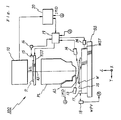
- Fig. 1 shows a schematic arrangement of an exposure apparatus 100 according to an embodiment of the present invention.
- This exposure apparatus 100 is a step-and-scan projection exposure apparatus.
- the exposure apparatus 100 comprises an illumination system 10, a reticle stage RST for holding a reticle R as a mask, a projection optical system PL, a wafer stage WST on which a wafer W as a substrate (object) is placed, an alignment microscope AS as an image pickup unit, a main control system 20 for systematically controlling the overall apparatus, and the like.
- the illumination system 10 includes a light source, an illuminance uniforming optical system comprising a fly-eye lens as an optical integrator, a relay lens, a variable ND filter, a reticle blind, a dichroic mirror, and the like (none of them are shown).
- a light source an illuminance uniforming optical system comprising a fly-eye lens as an optical integrator, a relay lens, a variable ND filter, a reticle blind, a dichroic mirror, and the like (none of them are shown).
- the arrangement of such illumination system is disclosed in, e.g., Japanese Patent Laid-Open No. 10-112433.
- a charged particle beam such as X-rays, electron rays, or the like may be used in place of light sent out from the aforementioned light source unit.
- Illumination light emitted by the light source unit enters the illuminance uniforming optical system when the shutter is open.
- a large number of secondary light sources are formed at the exit end of the illuminance uniforming optical system, and illumination light components sent out from a large number of secondary light sources reach the reticle blind.
- Illumination light transmitted through the reticle blind is output via an imaging lens system.
- This illumination system 10 illuminates slit-like illumination area portions, which are defined by the reticle blind, on the reticle R having circuit patterns and the like formed thereon with illumination light IL with nearly uniform illuminance.
- the reticle R is fixed on the reticle stage RST by, e.g., vacuum chucking.
- the reticle stage RST can be finely driven in the X-Y plane perpendicular to the optical axis (which coincides with an optical axis AX of the projection optical system PL, described later) of the illumination system and can be driven at a designated scan velocity in a predetermined scan direction (Y-direction in this case) by a reticle stage driver (not shown) comprising a magnetic float type two-dimensional linear actuator so as to align the reticle R.
- the magnetic float type two-dimensional linear actuator includes a Z-drive coil in addition to an X-drive coil, Y-drive coil, and the like, the reticle stage can also be finely driven in the Z-direction.
- the position of the reticle stage RST within a stage moving surface is always detected by a reticle laser interferometer (to be referred to as a "reticle interferometer” hereinafter) 16 via a movable mirror 15 at a resolution of around 0.5 to 1 nm.
- the position information of the reticle stage RST from the reticle interferometer 16 is sent to a stage control system 19, which drives the reticle stage RST via the reticle stage driver (not shown) on the basis of the position information of the reticle stage RST.
- the projection optical system PL is disposed below the reticle stage RST in Fig. 1, and the direction of its optical axis AX is defined as the Z-axis direction.
- the projection optical system PL for example, a refraction optical system which is both-side telecentric, and has a predetermined reduction ratio (e.g., 1/5, 1/4, or 1/6) is used. For this reason, when the illumination area of the reticle R is illuminated with illumination light IL coming from the illumination optical system, a reduced-scale image (partial inverted image) of the circuit pattern on the reticle R within that illumination area is formed on the wafer W, the surface of which is applied with a resist (photosensitive agent), via the projection optical system PL.
- the wafer stage WST is disposed on a base BS below the projection optical system PL in Fig. 1, and a wafer holder 25 is mounted on the wafer stage WST.
- the wafer W is fixed by, e.g., vacuum chucking or the like on the wafer holder 25.
- the wafer holder 25 can tilt in any direction with respect to a plane perpendicular to the optical axis of the projection optical system PL by a driver (not shown), and can also be finely movable in the direction of the optical axis (Z-direction) of the projection optical system PL.
- the wafer holder 25 is finely rotatable about the optical axis AX.
- Position information (or velocity information) WPV of the wafer stage WST is sent to the stage control system 19, which controls the wafer stage WST on the basis of this position information (or velocity information) WPV.
- the alignment microscope AS is an offaxis alignment detector disposed on the side surface of the projection optical system PL.
- This alignment microscope AS outputs image pickup results of alignment marks (wafer marks) contained in each shot area on the wafer W.
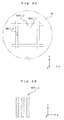
- alignment marks as the alignment marks, an X-position detection mark MX(i, j) and Y-position detection mark MY(i, j), which are formed on street lines around a shot area SA(i, j) on the wafer W, as shown in, e.g., Fig. 2A, are used.
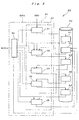
- the main control system 20 comprises a main control unit 30 and storage unit 40.
- the main control unit 30 comprises a control unit 39 which controls the operation of the exposure apparatus 100 by, e.g., supplying stage control data SCD to the stage control system 19 and serves as a set selection unit for selecting a sample set and replacement candidate set, and a position arithmetic unit 37.
- the aforementioned alignment microscope AS, control unit 39, and position arithmetic unit 37 constitute a position detector.
- the mark information arithmetic unit 32, parameter calculation unit 33, and valid value calculation unit 34 constitute an estimation calculation unit
- the estimation calculation unit and evaluation unit 35 constitute an evaluation arithmetic unit.
- the alignment microscope AS and picked-up image data acquisition unit 31 constitute a measurement unit.
- the parameter calculation unit 33 and valid value calculation unit 34 constitute a parameter determination unit.
- the flow of data is indicated by the solid arrows, and the flow of control is indicated by the dotted arrow. The respective operations of the units in the main control system 20 will be described later.
- the main control system 20 is constituted by combining various units.
- the main control system 20 may be constituted as a computer system, and the respective functions of the units that constitute the main control unit 30 may be implemented by programs installed in the computer.
- an oblique-incident-type multi-point focus detection system is fixed to a support portion (not shown) that supports the projection optical system PL, and comprises an illumination optical system 13 which directs imaging light beams used to form a plurality of slit images in an oblique direction with respect to the direction of the optical axis AX toward the best imaging surface of the projection optical system PL, and a light-receiving optical system 14 for receiving these imaging light beams reflected by the surface of the wafer W via slits.
- the stage control system 19 drives the wafer holder 25 in the Z-direction and an oblique direction on the basis of wafer position information from this multi-point focus detection system (13, 14).
- the arrangement coordinate position of each shot area on the wafer W is detected as follows.
- marks MX(i, j) and MY(i, j) are already formed on the wafer W in wafer processing up to the previous layer (e.g., in a process for the first layer).
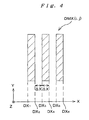
- the X-position DX x of the mark DMX(i, j) is defined by and is known.
- a Y-position DY X (i, j) of the mark DMX(i, j) is determined upon design, and is known.
- the Y-position DY x of the mark DMY(i, j) is defined by and is known. Furthermore, an X-position DX Y (i, j) of the mark DMY(i, j) is determined upon design, and is known.
- M marks MX (i pm , j pm ) and M marks MY(i ps , j ps ) as elements of each sample set S p are respectively selected not to line up upon design. Also, when comparing any two of the sample sets S p , each set includes at least one element that the other does not include.
- N marks MX(i qn , j qn ) and N marks MY(i qt , j qt ) as elements of each replacement candidate set Rq are also respectively selected not to line up upon design. Furthermore, when comparing any two of the replacement candidate sets Rq, each set includes at least one element that the other does not include.
- the numbers of marks MX(i pm , j pm ) and marks MY(i ps , j ps ) as elements of the sample set S p are equal to each other (M), but may be different from each other.
- each of the numbers of marks MX(i pm , j pm ) and marks MY(i ps , j ps ) as elements of the sample set S p must be three or more, and the total of them must be larger than 6.
- the numbers of marks MX(i qn , j qn ) and marks MY(i qt , j qt ) as elements of the replacement candidate set Rq are equal to each other (N), but may be different from each other.
- each of the numbers of marks MX(i qn , j qn ) and marks MY(i qt , j qt ) as elements of the replacement candidate set Rq must be three or more, and the total of them must be larger than 6.
- the first wafer W is loaded onto the wafer holder 25 by a wafer loader (not shown), and alignment with coarse accuracy (prealignment) is done by the main control system 20 moving the wafer via the stage control system 19 so that marks MX(i, j) and MY(i, j) are placed within the observation field of view of the alignment microscope AS.
- prealignment is done by the main control system 20 (more specifically, control unit 39) via the stage control system 19 on the basis of observation of the outer shape of the wafer W, the observation result of marks MX(i, j) and MY(i, j) in a broader field of view, and position information (or velocity information) from the wafer interferometer 18.
- the wafer W is moved to locate the first mark (X-position detection mark MX(i 11 , j 11 )) at the image pickup position of the alignment microscope AS in step 211 in Fig. 6. Such movement is done under the control of the main control system 20 via the stage control system 19.
- the alignment microscope AS picks up an image of the mark MX (i 11 , j 11 ) in step 212. Then, the picked-up image data acquisition unit 31 stores inputted picked-up image data IMD in the picked-up image data storage area 41 in accordance with an instruction from the control unit 39, thus acquiring picked-up image data IMD.
- the mark information calculation unit 32 reads out picked-up image data associated with the mark MX(i 11 , j 11 ) from the picked-up image data storage area 41, and extracts the X-positions of six edges as position information in the mark MX(i 11 , j 11 ) on the basis of the picked-up image data and position information (or velocity information) WPV from the wafer interferometer 18 in accordance with an instruction from the control unit 39.
- Such extraction of the X-positions of the edge can be implemented by analyzing a waveform obtained by scanning the picked-up image data along an XS(i 11 , j 11 ) axis which passes all the three line portions of the mark MX(i 11 , j 11 ) and is parallel to the X-axis, as shown in Fig. 7, or by analyzing a waveform obtained by integrating the picked-up image data in the Y-direction. Note that the latter method requires a larger arithmetic volume but can accurately extract the X-positions of the edges.
- FX (i 11 , j 11 ) DX x (i 11 , j 11 ) + dFX (i 11 , j 11 ) ⁇ (6A)
- the value dFX (i 11 , j 11 ) may be calculated by equation (7), and the X-position may be calculated by equation (6A) using this value in place of a calculation given by equation (5).
- Figs. 8A and 8B show an example wherein the X-position FX(i 11 , j 11 ) of the mark MX(i 11 , j 11 ) and its occurrence probability pFX(i 11 , j 11 ) are calculated on the basis of the measured edge positions FX k (i 11 , j 11 ), and Figs. 9A and 9B show another example.
- Fig. 8A illustrates the edge positions DX k (i 11 , j 11 ) as elements on the X-axis in the mark DMX (i 11 , j 11 ), and has symbols DX k attached onto those elements.
- Fig. 8A illustrates the edge positions FX k (i 11 , j 11 ) as elements on the X-axis in the mark MX(i 11 , j 11 ), and has symbols FX k attached onto those elements.
- the probability density function f X11 (dx) of the error distribution is steep, as shown in Fig. 8B. That is, the standard deviation ⁇ X(i 11 , j 11 ) is small.
- the probability density function f X11 (dx) of the error distribution is gradual, as shown in Fig. 9B. That is, the standard deviation ⁇ X(i 11 , j 11 ) of the error distribution takes a large value.
- the probability density pFX(i 11 , j 11 ) that an error takes the value dFX(i 11 , j 11 ), i.e., the X-position of the mark XM(i 11 , j 11 ) assumes the value FX(i 11 , j 11 ) becomes smaller than that in Fig. 8B mentioned above.
- step 215 it is checked in step 215 if mark information calculations for all the selected marks are complete.
- the answer in step 215 is NO, and the sequence advances to step 216.
- step 216 the control unit 39 moves the wafer W to a position where the next mark falls within the image pickup field of view of the alignment microscope AS.
- Such movement of the wafer W is done by moving the wafer stage WST when the control unit 39 controls the wafer drive unit 24 via the stage control system 19 on the basis of the prealignment result.
- the X-positions FX(i pm , j pm ) of other marks MX(i pm , j pm ) and their probability densities pFX(i pm , j pm ), the Y-positions FY(i ps , j ps ) of marks MY(i ps , j ps ) and their probability densities pFY(i ps , j ps ), the X-positions FX(i qn , j qn ) of marks MX(i qn , j qn ) and their probability densities pFX(i qn , j qn ), and the Y-positions FY(i qt , j qt ) of marks MY(i qt , j qt ) and their probability densities pFY(i qt , j qt ) are computed in the same manner as
- the parameter calculation unit 33 then calculates the estimations of parameters which uniquely specify the arrangement of shot areas SA(i, j).
- the marks MX(i, j) and MY(i, j) formed on the wafer W deviate from their ideal positions due to a mismatch between a stage coordinate system (X, Y) which specifies the position of the wafer stage WST, and the arrangement coordinate system of shot areas as a design coordinate system, i.e., a wafer coordinate system ( ⁇ , ⁇ ), and such a mismatch occurs due to the following four main factors.
- a pattern to be transferred to a target position (DX, DY), in terms of design, on the wafer coordinate system ( ⁇ , ⁇ ) is transferred to a position (EX, EY) on the stage coordinate system (X, Y), of which the position is given by Note that various other error factors are also present in addition to the aforementioned ones upon actual transfer, and the position (EX, EY) is considered as an expected transfer position.
- the target transfer position (DX, DY) and expected transfer position (EX, EY) are related by which expresses a first-order approximation of the trigonometric function in equation (11).
- the parameter calculation unit 33 calculates an expected transfer X-position EX(i pm , j pm ) of each mark MX(i pm , j pm ) from the ideal transfer position (DX X (i pm , j pm ), DY X (i pm , j pm )) of the mark MX(i pm , j pm ) using equation (13), the EX(i pm , j pm ) containing the parameters.
- the parameter calculation unit 33 calculates an expected transfer Y-position EY(i ps , j ps ) of each mark MY(i ps , j ps ) from the ideal transfer position (DX Y (i ps , j ps ), DY Y (i ps , j ps )) of the mark MY(i ps , j ps ) using equation (13), the EY(i ps , j ps ) containing the parameters.
- the mark position is more reliable as it is calculated from the measurement results of the edge positions of the mark having a shape more identical to the ideal mark's shape. Also, the reliability level of the calculated mark position depends on the occurrence probability of the mark position, i.e., the probability density.
- the parameter calculation unit 33 then calculates the estimations of the six parameters A 11 , A 12 , A 21 , A 22 , O X , and O Y which minimize a variation S p given by by applying the method of least squares on the basis of the evaluated errors ⁇ X pm and ⁇ Y ps .
- the parameter calculation unit 33 calculates estimations A 11p , A 12p , A 21p , A 22p , O Xp , and O Yp of the six parameters A 11 , A 12 , A 21 , A 22 , O X , and O Y by solving simultaneous equations made up of six equations obtained by setting partial differentials of the variation S P given by equation (22) by the six parameters A 11 , A 12 , A 21 , A 22 , O X , and O Y to zero.
- the parameter calculation unit 33 stores P groups of estimations (A 11p , A 12p , A 21p , A 22p , O Xp , O Yp ) calculated in this way in the estimation storage area 45.
- the valid value calculation unit 34 reads out the P sets of calculated estimations (A 11p , A 12p , A 21p , A 22p , O Xp , G Yp ) from the estimation storage area 45, and calculates an X-position deviation ⁇ p X, Y-position deviation ⁇ p Y, and covariance ⁇ p XY associated with each sample set S p upon adopting each group of estimations as follows.
- the valid value calculation unit 34 calculates an X-position deviation ⁇ p X, Y-position deviation ⁇ p Y, and covariance ⁇ p XY respectively by
- the calculated deviations ⁇ p indicate the certainties of the respective estimations (A 11p , A 12p , A 21p , A 22p , O Xp , O Yp ), i.e., the degrees by which the respective sample sets S p represent the entire marks MX and MY.
- the parameter calculation unit 33 checks in step 204 if there are a plurality of sample sets S p . In the above, since the number of sample sets S p is P (> 1), the answer in step 204 is YES, and the sequence advances to step 205.
- step 205 on the basis of the P groups of estimations (A 11p , A 12p , A 21p , A 22p , O Xp , O Yp ) and deviations ⁇ p that reflect the certainty, the valid value calculation unit 34 calculates weighted mean of each parameter of the estimations (A 11p , A 12p , A 21p , A 22p , O Xp , O Yp ) using the values (1/ ⁇ p ) as respective weight coefficients of the estimations, and obtains a set of statistically valid parameter values (A 110 , A 120 , A 210 , A 220 , O Xo , O Yo ). That is, the valid value calculation unit 34 computes
- the valid value calculation unit 34 calculates deviation ⁇ o upon adopting the statistically valid parameter values (A 110 , A 120 , A 210 , A 220 , O Xo , O Yo ) by
- the valid value calculation unit 34 stores the statistically valid parameter values (A 110 , A 120 , A 210 , A 220 , O XO , O YO ) and deviation ⁇ o calculated in this way in the valid value storage area 44 as parameter values (AU 11 , AU 12 , AU 21 , AU 22 , OU X , OU Y ) and deviation ⁇ U used upon exposure of the wafer W.
- the evaluation unit 35 calculates a estimation (A 11q , A 12q , A 21q , A 22q , O Xq , and O Yq ) for parameters A 11 , A 12 , A 21 , A 22 , O X , and O Y which uniquely specify the arrangement of shot areas SA(i, j) in the same manner as in the case of the sample sets S p .
- the evaluation device 35 calculates X-position deviations ⁇ q X, Y-position deviations ⁇ q Y, and covariances ⁇ q XY of respective replacement candidate sets Rq upon adopting the Q sets of calculated estimations (A 11q , A 12q , A 21q , A 22q , O Xq , O Yq ), and also deviations ⁇ q upon adopting the Q sets of calculated estimations (A 11q , A 12q , A 21q , A 22q , O Xq , O Yq ) in the same manner as in the case of the sample sets S p .
- the evaluation unit 35 reads out the statistically valid parameter values (AU 11 , AU 12 , AU 21 , AU 22 , OU X , OU Y ) and deviation ⁇ U from the valid value storage area 44, and evaluates similarities with the estimations (A 11q , A 12q , A 21q , A 22q , O Xq , O Yq ) and deviations ⁇ q associated with the replacement candidate sets Rq.
- the evaluation unit 35 checks in step 223 if there is a replacement candidate set Rq that has been found to be similar as a result of evaluation in step 222. If NO in step 223, the evaluation unit 35 sends a report indicating this to the control unit 39.
- the control unit 39 receives the report and selects new Q replacement candidate sets, and stores them in the sample set information storage area 42 in step 225. In this fashion, the process of subroutine 207 executed if NO in step 223 ends.
- the evaluation unit 35 replaces the replacement candidate set information in the sample set information storage area 42 by information that pertains to only the replacement candidate set or sets found to be similar.
- the evaluation unit 35 checks in step 226 if there is a replacement candidate set that is successively found to be similar a predetermined number of times. For example, when the predetermined number of times is three, since similarity evaluation has been done only once for only one wafer, the answer in step 226 is NO, and then the process of subroutine 207 ends.
- step 226 If the predetermined number of times is one, the answer in step 226 is YES, and the evaluation unit 35 selects a replacement candidate set having the highest similarity from those found to be similar as a new sample set, and replaces the sample set information in the sample set information storage area 42 by information that pertains to the new sample set in step S227, thus ending the process of subroutine 207.
- the number of sample sets is one from here on.
- control unit 39 calculates the arrangement coordinate positions of shot areas SA(i, j) using the parameter values (AU 11 , AU 12 , AU 21 , AU 22 , OU X , OU Y ) calculated in step 205 in Fig. 5.
- the reticle R and wafer W are aligned on the basis of the calculated shot area arrangement under the control of the control unit 39, and the wafer W and reticle R are synchronously moved at a velocity ratio corresponding to the projection magnification in opposite directions along the scan direction (Y-direction) while a slit-like illumination area (the center of which nearly coincides with the optical axis AX) is illuminated with illumination light IL, thus transferring a pattern on a pattern area of the reticle R onto each shot area SA(i, j) in the reduced scale.
- the wafer is unloaded under the control of the control unit 39.
- step 208 in Fig. 5 if exposure of all wafers (e.g., wafers for one lot) is complete. In the above process, since exposure of only the first wafer is complete, the answer in step 208 is NO.
- the next wafer is loaded onto the wafer holder 25 by the wafer loader (not shown) in the same manner as the first wafer, and alignment with coarse accuracy (prealignment) is done by the main control system 20 moving the wafer W via the stage control system 19 so that marks MX(i, j) and MY(i, j) can be placed within the observation field of view of the alignment microscope AS. After that, steps 202 to 207 in Fig. 5 are repeated for each wafer W in the same manner as the first wafer until YES is determined n step 208.
- step 208 in Fig. 5 If it is determined in step 208 in Fig. 5 that exposure of all wafers is complete, the exposure process ends.
- step 226 in Fig. 10 If replacement candidate sets which are successively determined first to be similar to the sample set a predetermined number of times are found in step 226 in Fig. 10, since the most similar one of those sets is used as the subsequent sample set, the number of sample sets becomes one. As a result, NO is determined in step 204 in Fig. 5 executed thereafter, and step 206 is executed in place of step 205 mentioned above. That is, the estimations of position parameters calculated based on the position measurement results of marks MX and MY contained in the single sample set are directly adopted as parameter values (AU 11 , AU 12 , AU 21 , AU 22 , OU X , OU Y ) used upon exposure of the wafer W.
- a plurality of sample sets are selected initially, and position parameters are calculated based on the result of estimating the position distribution of the entire marks MX and MY according to respective groups of the estimations and their certainties of position parameters calculated for the sample sets. Accordingly, statistically valid position parameter values can be obtained. Therefore, the wafer W can be aligned very accurately, and the pattern transfer accuracy can be improved.
- the appropriate set is used as a new sample set. Therefore, since the time required for aligning a wafer W can be shortened while maintaining statistical validity of the obtained position parameters, the throughput can be improved.
- a mark position is calculated on the basis of the position information of each position measurement mark (alignment mark) obtained through measuring the alignment marks associated with each sample set, i.e., the measurement results of a plurality of edge positions of each alignment mark; the certainty of that mark position is calculated from the design values of the edge positions and errors, and parameter values (estimations) that uniquely specify the arrangement of shot areas (i, j) on the wafer W are calculated for each sample set using the certainty as the weight. Therefore, because the arrangement of the shot areas (i, j) on the wafer W is calculated using the finally obtained accurate parameter values to align the wafer W, accurate alignment can be performed, and pattern transfer with high overlap accuracy can be achieved.
- Fig. 11 is a flow chart of production of devices (semiconductor chips such as IC or LSI, liquid crystal panels, CCD's, thin-film magnetic heads, micro machines, or the like) in this embodiment.
- step 301 design step
- step 302 mask fabrication step
- step 303 wafer preparation step
- a wafer is prepared using material such as silicon and the like.
- step 304 wafer process step
- step 305 device assembly step
- steps 304 and 305 devices are assembled using the wafer processed in step 304.
- This step 305 includes processes such as an assembly process (dicing, bonding), packaging step (chip encapsulation), and the like.
- step 306 inspection step
- inspections such as an operation confirmation test, durability test, and the like of the devices manufactured in step 305 are performed. After these steps, the process is complete, and the devices are shipped out.
- Fig. 12 shows a detailed, exemplary flow of step 304 for manufacturing semiconductor devices.
- the wafer surface is oxidized in step 311 (oxidation step).
- step 312 CVD step
- step 313 electrode formation step
- step 314 ion implantation step
- ions are implanted into the wafer. Steps 311 to 314 mentioned above constitute a pre-process of each step in the wafer process, and is selectively executed in accordance with the process required in each step.
- a post-process steps is performed as follows.
- the wafer is coated with a photosensitive agent in step 315 (resist formation step), and the above exposure apparatus transfers the circuit pattern on the mask onto the wafer aligned using the aforementioned scheme, in step 316 (exposure step).
- the exposed wafer is developed in step 317 (development step), and an exposing member of portions other than portions where the resist remains is removed by etching in step 318 (etching step). Then, the resist that has become unnecessary after etching is removed in step 319 (resist removal step).
- multi-layer circuit patterns are formed on the wafer.
- one edge position is extracted for each edge using the picked-up image data on a single axis parallel to the direction of the mark pattern change or the integrated data in the direction perpendicular to the direction of the mark pattern change, as described above.
- an average value dFX(i pm , j pm ) and standard deviation ⁇ X (i pm , j pm ) of the errors dFX kh (i pm , j pm ) are respectively calculated by
- the X-position FX(i pm , j pm ) and standard deviation ⁇ X(i pm , j pm ) of the mark MX(i pm , j pm ) calculated in this way are statistically more valid than those in the aforementioned embodiment, since the number of extracted edge positions is larger than that in the above embodiment.
- the Y-position FY(i ps , j ps ) of each mark MY(i ps , j ps ) can be calculated in the same manner as the mark MX(i pm , j pm ).
- the calculated Y position FY(i ps , j ps ) and standard deviation ⁇ Y(i ps , j ps ) of the mark MY(i ps , j ps ) are statistically more valid than those in the above embodiment, since the number of extracted edge positions is larger than that in the above embodiment.
- Rotation of shot region This is caused when a reticle R has rotated with respect to the stage coordinate system (X, Y) upon transferring a pattern formed on the reticle R onto a wafer W or when yawing is accidentally mixed in the movement of a wafer stage WST upon scanning exposure, and is expressed by a rotation error ⁇ of the wafer coordinate system ( ⁇ , ⁇ ) with respect to a shot coordinate system having coordinate axes parallel to the ⁇ - and ⁇ -axes.
- Orthogonality of shot region This is caused by distortion of a pattern formed on a reticle R, distortion (distortion error) of a projection optical system PL, and the like, and is expressed by an orthogonality error ⁇ .
- Linear expansion/shrinkage of shot region This is caused by an error of the projection magnification upon projecting a pattern formed on a reticle R onto a wafer W or by the wafer entirely or partially expanding or shrinking due to a formation process or the like.
- This expansion/shrinkage amount is expressed by wafer scaling values r X and r Y in the coordinate axis directions (i.e., ⁇ - and ⁇ -directions) of the shot coordinate system.
- the wafer scaling value r X in the ⁇ -direction is represented by the ratio between the actually measured value and design value of the distance between two points in the ⁇ -direction on the wafer W
- the wafer scaling value r Y in the ⁇ -direction is represented by the ratio between the actually measured value and design value of the distance between two points in the ⁇ -direction.
- the designed transfer position (DX, DY) and expected transfer position (EX, EY) are related by which expresses a first-order approximation of the trigonometric function in equation (49).
- parameters which uniquely specify the arrangement of shot areas SA(i, j) are ten parameters A 11 , A 12 , A 21 , A 22 , B 11 , B 12 , B 21 , B 22 , O X , and O Y .
- the number of wafer marks is not limited to four, and can be three or more.
- the two-dimensional marks WMp marks having patterns shown in, e.g., Figs. 15A to 15D, can be used.
- optimal values of the error factors (r X , r Y , ⁇ , ⁇ ) are calculated using equations (32) to (35) for the aforementioned controllable error factors (r X , r Y , ⁇ , ⁇ ) and four parameters (B 11 , B 12 , B 21 , B 22 ) of the ten parameters, the optimal values of which have been calculated, and in accordance with those error factors, corrected are the magnification of the projection optical system PL, the synchronous velocity ratio upon scanning exposure, synchronous moving directions upon scanning exposure, and the like.
- the accuracy of superposition is further improved.
- a plurality of initial sample sets are used, but if one sample set from which accurate position parameters can be calculated is known, that sample set may be used as only one initial sample set. Even in such a case, the processing flow of the above embodiment can be applied. Since the number of sample sets is one from the beginning, in the processing flow of the above embodiment, the answer in step 204 is always NO.
- whether or not it is possible to reduce the number of elements of a sample set is evaluated by comparing the position parameter values and their certainties calculated from the sample set, and estimations of position parameters and their certainties calculated from each of a plurality of replacement candidate sets.
- evaluation can be performed by so-called cross-verification.
- the position errors of marks MX and MY included in a sample set are calculated using the estimations of the position parameters calculated for each replacement candidate set, and the position error distribution of the marks MX and MY included in the sample set is calculated based on that calculation result, thus evaluating if each replacement candidate set has statistical characteristics equivalent to that of the sample set.
- replacement possibility can be evaluated without calculating the position parameter values and their certainties from the sample set.
- Such cross-verification is particularly effective when the replacement candidate set is a subset of the sample set.
- a plurality of initial sample sets are replaced by one new sample set.
- the number of elements of each of the plurality of initial sample sets may be reduced.
- a new sample set is searched for that has characteristics equivalent thereto in the statistical characteristics of position errors of marks and consists of fewer elements.
- one-dimensional marks MX and MY are used.
- two-dimensional marks shown in Figs. 15A to 15D may be used.
- one-dimensional marks MX and MY may be used.
- a box-in-box mark may be used in addition to those shown in Figs. 15A to 15D.
- the aforementioned one-dimensional position detection process may be performed twice, or two-dimensional template matching into which the above one-dimensional template matching for one-dimensional signals is extended may be performed on two-dimensional signal waveforms of two-dimensional marks.
- the off-axis alignment method that measures the positions of alignment marks on a wafer without the intervention of a projection optical system is adopted.
- a TTL (through-the-lens) scheme that measures the positions of alignment marks on a wafer via a projection optical system, or a TTR (through-the-reticle) that simultaneously observes a wafer and reticle via a projection optical system may be adopted.
- sample alignment upon observation, sample alignment senses the position of a wafer mark where the deviation between a reticle mark formed on the reticle and a wafer mark formed on the wafer is zero.
- the coordinate positions of the shot areas are calculated.
- the step pitch of each shot may be calculated.
- the fly-eye lens is used as an optical integrator (homogenizer).
- a rod integrator may be used.
- the rod integrator is disposed such that its exit surface is nearly conjugated with the pattern surface of a reticle R.
- Such an illumination optical system using the rod integrator is disclosed in, e.g., U.S. Patent No. 5,675,401, and the disclosures in the above U.S. Patent is incorporated herein by reference as long as the national laws in designated states or elected states, to which this international application is applied, permit.
- the fly-eye lens and rod integrator may be combined, or two fly-eye lenses or rod integrators may be disposed in series to build double optical integrators.
- the present invention is applied to the step-and-scan scanning exposure apparatus.
- the application range of the present invention is not limited to such specific apparatus, and the present invention can be suitably applied to a stationary exposure apparatus such as a stepper or the like.
- an exposure apparatus using, e.g., ultraviolet rays may adopt as a projection optical system a reflection system consisting of reflective optical elements alone or a reflection/refraction system (a catadioptric system) having both reflective and refractive optical elements.
- a reflection/refraction system which is disclosed in, e.g., Japanese Patent Laid-Open No. 8-171054 and corresponding U.S. Patent No. 5,668,672, Japanese Patent Laid-Open No. 10-20195 and corresponding U.S. Patent No. 5,835,275, and the like, and has a beam splitter and concave mirror as reflection optical elements, or a reflection/refraction system which is disclosed in Japanese Patent Laid-Open No.
- a reflection/refraction system which comprises a plurality of refraction optical elements and two mirrors (a main mirror being a concave mirror and a sub-mirror that is a back surface mirror of which the reflection surface is formed on the opposite side to the incident surface of a refraction element or plane parallel plate) that are disposed along one axis, and has the intermediate image, formed by those refraction optical elements, of a reticle pattern again imaged on a wafer using the main mirror and sub-mirror, the reflection/refraction system being disclosed in Japanese Patent Laid-Open No. 10-104513 and U.S. Patent No. 5,488,229 corresponding thereto.
- the main mirror and sub-mirror are disposed in series with the plurality of refraction optical elements, and an illumination light passes through a portion of the main mirror, is reflected by the sub-mirror and the main mirror in turn, passes through a portion of the sub-mirror and reaches the wafer.
- the reflection/refraction-type projection optical system a reduction system may be employed which has, e.g., a circular image field, is telecentric on both the object plane side and image plane side, and has a reduction ratio of, e.g., 1/4 or 1/5.
- the illumination area of the illumination light may be a rectangular-slit-shaped area whose center almost coincides with the optical axis of the projection optical system and which extends along a direction almost perpendicular to the scanning direction of a reticle or wafer.
- a vacuum ultraviolet light ArF excimer laser light or F 2 laser light is used.
- a higher harmonic wave may be used which is obtained with wavelength conversion into ultraviolet by using nonlinear optical crystal after having amplified a single wavelength laser light, infrared or visible, emitted from a DFB semiconductor laser device or a fiber laser by a fiber amplifier having, for example, erbium (or erbium and ytterbium) doped.
- an eight-time-higher harmonic wave of which the wavelength is in the range of 189 to 199nm or a ten-time-higher harmonic wave of which the wavelength is in the range of 151 to 159nm is emitted.
- a seven-time-higher harmonic wave of which the wavelength is in the range of 147 to 160nm is emitted, and, especially, when the oscillation wavelength is in the range of 1.099 to 1.106um, a seven-time-higher harmonic wave of which the wavelength is in the range of 157 to 158nm, that is, almost the same as F 2 laser light (ultraviolet light) is obtained.
- F 2 laser light ultraviolet light
- ytterbium-doped fiber laser can be employed as the single wavelength laser.
- the present invention can be applied not only to an exposure apparatus for producing micro devices such as semiconductor devices but also to an exposure apparatus that transfers a circuit pattern onto a glass substrate or silicon wafer so as to produce reticles or masks used by a light exposure apparatus, EUV (Extreme Ultraviolet) exposure apparatus, X-ray exposure apparatus, electron beam exposure apparatus, etc.
- EUV Extreme Ultraviolet
- X-ray exposure apparatus X-ray exposure apparatus
- electron beam exposure apparatus etc.
- a transmission-type reticle is employed in general.
- quartz glass, quartz glass with fluorine doped, fluorite, magnesium fluoride, or quartz crystal is employed as the substrate of the reticle.
- an X-ray exposure apparatus of a proximity method or electron beam exposure apparatus employs a transmission-type mask (stencil-mask, membrane-mask); an EUV exposure apparatus employs a reflection-type mask, and as the substrate of the mask, silicon wafer or the like is employed.
- a transmission-type mask stencil-mask, membrane-mask
- EUV exposure apparatus employs a reflection-type mask, and as the substrate of the mask, silicon wafer or the like is employed.
- the present invention can be applied not only to a wafer exposure apparatus used in the production of semiconductor devices but also to an exposure apparatus that transfers a device pattern onto a glass plate and is used in the production of displays such as liquid crystal display devices and plasma displays, an exposure apparatus that transfers a device pattern onto a ceramic plate and is used in the production of thin magnetic heads, and an exposure apparatus used in the production of pick-up devices (CCD, etc.).
- an exposure apparatus that transfers a device pattern onto a glass plate and is used in the production of displays such as liquid crystal display devices and plasma displays
- an exposure apparatus that transfers a device pattern onto a ceramic plate and is used in the production of thin magnetic heads and an exposure apparatus used in the production of pick-up devices (CCD, etc.
- CCD pick-up devices
- positional detection and alignment according to the present invention can be applied to positional detection of the alignment marks on a reticle and alignment of the reticle, and also to other units than exposure apparatuses such as a unit to observe objects and a unit that is used to detect positions of objects and align them in an assembly line, process line or inspection line.
- the position detection method and position detection apparatus of the present invention since a statistical process is executed on the basis of position information of position detection points obtained by measurement of the position detection points on an object, position information of any area on the object is accurately and efficiently detected. Therefore, the position detection method and position detection apparatus of the present invention are suitable for detecting the position of any area on an object.
- the positions of a predetermined number of alignment marks formed on a substrate are detected using the position detection method of the present invention, and a predetermined pattern is transferred onto divided areas while aligning the substrate on the basis of the detection result. Therefore, the exposing method and exposure apparatus of the present invention are suitable to perform multi-exposure for forming a multi-layer pattern with improved accuracy of superposition between layers. For this reason, the exposing method and exposure apparatus of the present invention are suitable for mass-production of devices having a fine pattern.
Landscapes
- Physics & Mathematics (AREA)
- General Physics & Mathematics (AREA)
- Engineering & Computer Science (AREA)
- Signal Processing (AREA)
- Exposure Of Semiconductors, Excluding Electron Or Ion Beam Exposure (AREA)
- Exposure And Positioning Against Photoresist Photosensitive Materials (AREA)
Applications Claiming Priority (5)
| Application Number | Priority Date | Filing Date | Title |
|---|---|---|---|
| JP3822099 | 1999-02-17 | ||
| JP3822099 | 1999-02-17 | ||
| JP24504799 | 1999-08-31 | ||
| JP24504799 | 1999-08-31 | ||
| PCT/JP2000/000855 WO2000049367A1 (fr) | 1999-02-17 | 2000-02-16 | Procede de detection de position et detecteur de position, procede d'exposition et appareil correspondant, dispositif et procede de fabrication de ce dispositif |
Publications (3)
| Publication Number | Publication Date |
|---|---|
| EP1164352A1 true EP1164352A1 (fr) | 2001-12-19 |
| EP1164352A9 EP1164352A9 (fr) | 2002-07-03 |
| EP1164352A4 EP1164352A4 (fr) | 2007-09-05 |
Family
ID=26377419
Family Applications (1)
| Application Number | Title | Priority Date | Filing Date |
|---|---|---|---|
| EP00903969A Withdrawn EP1164352A4 (fr) | 1999-02-17 | 2000-02-16 | Procede de detection de position et detecteur de position, procede d'exposition et appareil correspondant, dispositif et procede de fabrication de ce dispositif |
Country Status (5)
| Country | Link |
|---|---|
| US (2) | US20020014601A1 (fr) |
| EP (1) | EP1164352A4 (fr) |
| KR (1) | KR20010102180A (fr) |
| AU (1) | AU2571100A (fr) |
| WO (1) | WO2000049367A1 (fr) |
Families Citing this family (24)
| Publication number | Priority date | Publication date | Assignee | Title |
|---|---|---|---|---|
| JP4798891B2 (ja) * | 2000-09-21 | 2011-10-19 | キヤノン株式会社 | 露光装置及びデバイス製造方法 |
| JP4165871B2 (ja) * | 2002-03-15 | 2008-10-15 | キヤノン株式会社 | 位置検出方法、位置検出装置及び露光装置 |
| JP4018438B2 (ja) | 2002-04-30 | 2007-12-05 | キヤノン株式会社 | 半導体露光装置を管理する管理システム |
| US7069104B2 (en) * | 2002-04-30 | 2006-06-27 | Canon Kabushiki Kaisha | Management system, management apparatus, management method, and device manufacturing method |
| JP2003324055A (ja) * | 2002-04-30 | 2003-11-14 | Canon Inc | 管理システム及び装置及び方法並びに露光装置及びその制御方法 |
| KR20050118309A (ko) * | 2003-04-17 | 2005-12-16 | 가부시키가이샤 니콘 | 선출 방법, 노광 방법, 선출 장치, 노광 장치 및 디바이스제조 방법 |
| US7565219B2 (en) * | 2003-12-09 | 2009-07-21 | Asml Netherlands B.V. | Lithographic apparatus, method of determining a model parameter, device manufacturing method, and device manufactured thereby |
| JP4351955B2 (ja) * | 2004-06-03 | 2009-10-28 | 日立ビアメカニクス株式会社 | 基準点の位置決定方法 |
| JP5044095B2 (ja) | 2004-11-02 | 2012-10-10 | 富士通セミコンダクター株式会社 | 半導体装置の製造方法 |
| US7415319B2 (en) * | 2006-04-04 | 2008-08-19 | Asml Netherlands B.V. | Lithographic apparatus and device manufacturing method |
| US7630059B2 (en) * | 2006-07-24 | 2009-12-08 | Asml Netherlands B.V. | Lithographic apparatus and device manufacturing method |
| JP5010881B2 (ja) * | 2006-09-11 | 2012-08-29 | 株式会社日立ハイテクノロジーズ | 検査装置および検査方法 |
| WO2008070188A1 (fr) * | 2006-12-08 | 2008-06-12 | Applied Materials, Inc. | Procédé et appareil destinés à créer des motifs à exposition multiple |
| US7898653B2 (en) * | 2006-12-20 | 2011-03-01 | Hitachi High-Technologies Corporation | Foreign matter inspection apparatus |
| US20080167889A1 (en) * | 2007-01-05 | 2008-07-10 | Kagarlis Marios A | Price Indexing |
| US20080168001A1 (en) * | 2007-01-05 | 2008-07-10 | Kagarlis Marios A | Price Indexing |
| US20080192253A1 (en) * | 2007-02-08 | 2008-08-14 | Susie Xiuru Yang | Method and test-structure for determining an offset between lithographic masks |
| KR101914101B1 (ko) * | 2011-06-28 | 2018-11-02 | 삼성전자 주식회사 | 척의 제어 장치 및 방법, 노광 장치 및 그 제어 방법 |
| JP2013089804A (ja) * | 2011-10-19 | 2013-05-13 | Renesas Electronics Corp | 半導体装置のスクリーニング装置、半導体装置のスクリーニング方法及びプログラム |
| US9188876B2 (en) * | 2012-02-07 | 2015-11-17 | Taiwan Semiconductor Manufacturing Company, Ltd. | Method of determining overlay error and control system for dynamic control of reticle position |
| US9519285B2 (en) * | 2013-01-23 | 2016-12-13 | Taiwan Semiconductor Manufacturing Company, Ltd. | Systems and associated methods for tuning processing tools |
| CN108431695B (zh) * | 2015-12-24 | 2020-07-21 | Asml荷兰有限公司 | 控制图案形成过程的方法、器件制造方法、用于光刻设备的控制系统以及光刻设备 |
| JP6207671B1 (ja) * | 2016-06-01 | 2017-10-04 | キヤノン株式会社 | パターン形成装置、基板配置方法及び物品の製造方法 |
| EP3745442A1 (fr) * | 2019-05-29 | 2020-12-02 | FEI Company | Procédé d'examen d'un échantillon à l'aide d'un microscope à particules chargées |
Family Cites Families (11)
| Publication number | Priority date | Publication date | Assignee | Title |
|---|---|---|---|---|
| JPS60123706A (ja) * | 1983-12-08 | 1985-07-02 | Matsushita Electric Ind Co Ltd | 形状認識方法 |
| US4780617A (en) * | 1984-08-09 | 1988-10-25 | Nippon Kogaku K.K. | Method for successive alignment of chip patterns on a substrate |
| JPH0789534B2 (ja) | 1986-07-04 | 1995-09-27 | キヤノン株式会社 | 露光方法 |
| US5543921A (en) * | 1989-05-08 | 1996-08-06 | Canon Kabushiki Kaisha | Aligning method utilizing reliability weighting coefficients |
| JPH07120621B2 (ja) | 1989-05-08 | 1995-12-20 | キヤノン株式会社 | 位置合せ方法 |
| JP2897276B2 (ja) * | 1989-09-04 | 1999-05-31 | 株式会社ニコン | 位置合わせ方法及び露光装置 |
| JPH06348851A (ja) * | 1993-04-12 | 1994-12-22 | Sony Corp | 対象物位置検出方法 |
| JPH06310403A (ja) * | 1993-04-21 | 1994-11-04 | Nikon Corp | 位置合わせ方法 |
| KR100377887B1 (ko) * | 1994-02-10 | 2003-06-18 | 가부시키가이샤 니콘 | 정렬방법 |
| JP3666051B2 (ja) * | 1995-04-13 | 2005-06-29 | 株式会社ニコン | 位置合わせ方法及び装置、並びに露光方法及び装置 |
| JP3393251B2 (ja) * | 1996-02-29 | 2003-04-07 | ソニー株式会社 | フォトマスクにおけるパターン転写特性評価方法、露光方法、並びに半導体装置の作製方法 |
-
2000
- 2000-02-16 EP EP00903969A patent/EP1164352A4/fr not_active Withdrawn
- 2000-02-16 AU AU25711/00A patent/AU2571100A/en not_active Abandoned
- 2000-02-16 WO PCT/JP2000/000855 patent/WO2000049367A1/fr not_active Ceased
- 2000-02-16 KR KR1020017010383A patent/KR20010102180A/ko not_active Withdrawn
-
2001
- 2001-08-17 US US09/931,258 patent/US20020014601A1/en not_active Abandoned
-
2003
- 2003-05-16 US US10/438,870 patent/US6803592B2/en not_active Expired - Fee Related
Also Published As
| Publication number | Publication date |
|---|---|
| AU2571100A (en) | 2000-09-04 |
| US20020014601A1 (en) | 2002-02-07 |
| KR20010102180A (ko) | 2001-11-15 |
| US6803592B2 (en) | 2004-10-12 |
| US20030197136A1 (en) | 2003-10-23 |
| WO2000049367A1 (fr) | 2000-08-24 |
| EP1164352A9 (fr) | 2002-07-03 |
| EP1164352A4 (fr) | 2007-09-05 |
Similar Documents
| Publication | Publication Date | Title |
|---|---|---|
| US6803592B2 (en) | Position detection method and position detector, exposure method and exposure apparatus, and device and device manufacturing method | |
| JP3997068B2 (ja) | リトグラフ投影装置の較正方法およびそのような方法を適用できる装置 | |
| US8111376B2 (en) | Feedforward/feedback litho process control of stress and overlay | |
| CN110770653B (zh) | 用于测量对准的系统和方法 | |
| US20110122496A1 (en) | Substrate Used in a Method and Apparatus for Angular-Resolved Spectroscopic Lithography Characterization | |
| US7410735B2 (en) | Method of characterization, method of characterizing a process operation, and device manufacturing method | |
| US20020037460A1 (en) | Stage unit, measurement unit and measurement method, and exposure apparatus and exposure method | |
| EP1195796A1 (fr) | Procede et appareil pour detecter un repere, procede et appareil d'exposition, procede de production du dispositif et dispositif | |
| US6654096B1 (en) | Exposure apparatus, and device manufacturing method | |
| WO2017050503A1 (fr) | Procédé et appareil permettant de déterminer au moins une propriété de caractéristiques de marqueur de dispositif de formation de motif | |
| WO2017215924A1 (fr) | Procédés et appareil permettant de déterminer la position d'une structure cible sur un substrat, procédés et appareil permettant de déterminer la position d'un substrat | |
| US7184594B1 (en) | Pattern matching method and device, position determining method and device, position aligning method and device, exposing method and device, and device and its production method | |
| US6906785B2 (en) | Lithographic apparatus, device manufacturing method, and device manufactured thereby | |
| JP2011119457A (ja) | 位置合わせ条件最適化方法及びシステム、パターン形成方法及びシステム、露光装置、デバイス製造方法、並びに重ね合わせ精度評価方法及びシステム | |
| EP1662327A2 (fr) | Table pour substrat, méthode de mesure de position de substrat et appareil lithographique | |
| EP2103995A2 (fr) | Procédé d'alignement grossier de tranches dans un appareil lithographique | |
| US10429750B2 (en) | Alignment mark recovery method and lithographic apparatus | |
| JP4157518B2 (ja) | 基板を準備する方法、測定方法、デバイス製造方法、リソグラフィ装置、コンピュータ・プログラム、及び基板 | |
| TWI820885B (zh) | 包含處理器可讀指令之電腦程式 | |
| JP3576722B2 (ja) | 走査型露光装置及びそれを用いたデバイス製造方法 | |
| TWI811952B (zh) | 度量衡方法及設備 | |
| EP1477857A1 (fr) | Méthode de caractérisation d'une étape de procédé et méthode de fabrication d'un dispositif | |
| JP2005064369A (ja) | 最適化方法、露光方法、最適化装置、露光装置、デバイス製造方法、及びプログラム、並びに情報記録媒体 | |
| JP2004087562A (ja) | 位置検出方法及びその装置、露光方法及びその装置、並びにデバイス製造方法 | |
| JPWO2002033352A1 (ja) | 形状測定方法、形状測定装置、露光方法、露光装置、制御プログラム、及びデバイス製造方法 |
Legal Events
| Date | Code | Title | Description |
|---|---|---|---|
| PUAI | Public reference made under article 153(3) epc to a published international application that has entered the european phase |
Free format text: ORIGINAL CODE: 0009012 |
|
| 17P | Request for examination filed |
Effective date: 20010911 |
|
| AK | Designated contracting states |
Kind code of ref document: A1 Designated state(s): AT BE CH CY DE DK ES FI FR GB GR IE IT LI LU MC NL PT SE |
|
| AX | Request for extension of the european patent |
Free format text: AL;LT;LV;MK;RO;SI |
|
| A4 | Supplementary search report drawn up and despatched |
Effective date: 20070808 |
|
| STAA | Information on the status of an ep patent application or granted ep patent |
Free format text: STATUS: THE APPLICATION IS DEEMED TO BE WITHDRAWN |
|
| 18D | Application deemed to be withdrawn |
Effective date: 20071030 |