EP1164733B1 - Procede de construction de canaux et station de base utilisant le procede - Google Patents
Procede de construction de canaux et station de base utilisant le procede Download PDFInfo
- Publication number
- EP1164733B1 EP1164733B1 EP01901517.1A EP01901517A EP1164733B1 EP 1164733 B1 EP1164733 B1 EP 1164733B1 EP 01901517 A EP01901517 A EP 01901517A EP 1164733 B1 EP1164733 B1 EP 1164733B1
- Authority
- EP
- European Patent Office
- Prior art keywords
- subcarriers
- control channel
- signal
- common control
- common
- Prior art date
- Legal status (The legal status is an assumption and is not a legal conclusion. Google has not performed a legal analysis and makes no representation as to the accuracy of the status listed.)
- Expired - Lifetime
Links
Images






Classifications
-
- H—ELECTRICITY
- H04—ELECTRIC COMMUNICATION TECHNIQUE
- H04J—MULTIPLEX COMMUNICATION
- H04J11/00—Orthogonal multiplex systems, e.g. using WALSH codes
-
- H—ELECTRICITY
- H04—ELECTRIC COMMUNICATION TECHNIQUE
- H04L—TRANSMISSION OF DIGITAL INFORMATION, e.g. TELEGRAPHIC COMMUNICATION
- H04L5/00—Arrangements affording multiple use of the transmission path
- H04L5/02—Channels characterised by the type of signal
- H04L5/023—Multiplexing of multicarrier modulation signals, e.g. multi-user orthogonal frequency division multiple access [OFDMA]
Definitions
- the present invention relates to a channel structuring method and a base station using such a method.
- the present invention particularly relates to a channel structuring method for a downlink channel between a base station and mobile stations, and relates to the base station using such a method.
- a mobile communication system is operated under a multipath environment where radio wave reaches a reception side through various propagation paths.
- a signal that arrives later interferes with a signal of the present, producing characteristic degradation which is called inter-symbol interference.
- a transmission method that employs an orthogonal frequency division multiplexing (called the OFDM hereinafter, Orthogonal Frequency Division Multiplexing) as a modulation method can realize a high-speed transmission, without causing characteristic degradation by the inter-symbol interference, even if it is under a multipath environment.
- OFDM orthogonal frequency division multiplexing
- Performance of an OFDM-TDMA Mobile Communication System (1593 H. Rohling, R.Grunheid:Proc.of IEEE VTC 1996, and vol. 3, pp.1589-1996 ), for example, uses the OFDM as the modulation method for the signal transmission and examines the time division multiple access (TDMA herein below, Time Division Multiple Access:) for communication between a base station and each mobile station.
- TDMA time division multiple access
- the mobile communication system experiences a phenomenon called fading that is caused by changes in the relative position of the base station and the mobile station, which affects received signals with amplitude fluctuation and phase fluctuation. Therefore, in order to receive a signal transmitted in the mobile communication system by a coherent detection, it is necessary to estimate the amplitude fluctuation and the phase fluctuation accurately to compensate the fluctuations of the received signal using the estimated values for demodulation.
- a pilot symbol with known amplitude and phase is multiplexed with a transmission signal and transmitted, which is used to estimate the amplitude fluctuation and the phase fluctuation of the received signal on the receiving end.
- the channel estimation using the pilot symbol is also necessary in order to perform the coherent detection, and various studies have been made.
- US5,914,981 discloses a method for indicating synchronization lock of a remote station with a base station for a discrete multitone spread spectrum communications system.
- WO98/35473 discloses a remote unit for a personal wireless network, wherein a controller coordinates the sleep mode and standby mode of operations based on frame count that is generated from an identification number of the remote unit.
- WO98/59450 discloses a synchronous coherent orthogonal frequency division multiplexing system, wherein the SC-OFDM signals from each SC-OFDM transmitter include at least one pilot signal code in accordance with a predetermined pilot code scheme.
- the general purpose of the present invention is to provide a new and useful channel structuring method having removed the problems of the conventional technology mentioned above, and a base station using the method.
- the specific purpose of the present invention is to provide the channel structuring method which is capable of inserting the common control channel signal and the common pilot signal in the downlink channel between the base station and the mobile stations, and the base station using the method.
- a channel structuring method of configuring channels wherein transmission signals are modulated by orthogonal frequency division multiplexing comprising n subcarriers and multiplexed by time division multiplexing to configure downlink channels
- the channel structuring method comprising, providing time frames by segmenting a communication channel of the n subcarriers at every predetermined interval; selecting from the n subcarriers, a predetermined number of subcarriers for insertion of common control channel signals and common pilot signals; and characterized by inserting a common control channel signal and a common pilot signal into the time frames by time division multiplexing with respect to the selected subcarriers while ensuring that at least one of the selected subcarriers has both a common control signal and a common pilot signal inserted therein in the time frame and that a common pilot signal in a subcarrier is inserted at the same timing as another common pilot signal in another subcarrier in the time frame.
- the common control channel signal and the common pilot signal can be inserted into the downlink channel between the base station and the mobile station, thereby enabling to realize a channel structuring for transmitting the common control signal between the base station and the mobile station. Further, the insertion of the common pilot signal into the downlink channel makes a countermeasure to the fading phenomenon possible.
- the above-mentioned channel structuring method can include a step wherein time frames that are segmented at a predetermined time interval in a communication channel of the n subcarriers mentioned above are provided, and a step wherein a predetermined number of subcarriers are selected from the n subcarriers mentioned above and the common control channel signal and the common pilot signal are inserted periodically into each of the time frames of the selected subcarriers.
- a predetermined number of subcarriers are selected from the n subcarriers, and the common control channel signal and the common pilot signal are inserted into each time frame of the selected subcarriers.
- the common control channel signal and the common pilot signal can be inserted periodically
- the common control channel signal and the common pilot signal which are periodically inserted into each time frame of a subcarrier selected as mentioned above can be inserted such that either of the common control channel signal or the common pilot signal, or both may be inserted at the same timing as either of the common control channel signal or the common pilot signal of other subcarriers, or both.
- a step of setting up time frames segmented at every predetermined interval in the communication channel of the n subcarriers mentioned above, a step of selecting a predetermined number of subcarriers from the n subcarriers mentioned above and continuously inserting the common control channel signal into the time frames of the selected subcarrier mentioned above, and a step of selecting a predetermined number of subcarriers from the n subcarriers mentioned above and periodically inserting the common pilot signal into each of the time frames of the selected subcarrier mentioned above may be provided.
- the common control channel signal may be continuously inserted into the time frame of the selected subcarrier, and the common pilot signal can be periodically inserted for each time frame of the selected subcarrier.
- a step of setting up time frames segmented at every predetermined interval in the communication channel of the n subcarriers mentioned above, a step of selecting a predetermined number of subcarriers from the n subcarriers mentioned above and continuously inserting the common pilot signal into the time frames of the selected subcarriers mentioned above, and a step of selecting a predetermined number of subcarriers from the n subcarriers mentioned above and periodically inserting the common control channel signal into each of the time frames of the selected subcarriers mentioned above may be provided.
- the common pilot signal can be continuously inserted into the time frame of the selected subcarriers, and the common control channel signal can be periodically inserted for each time frame of the selected subcarrier.
- subcarriers into which the above-mentioned common control channel signal is inserted may be the same completely or partially as subcarriers into which the common pilot signal is inserted.
- the common pilot signal can be inserted into the subcarrier into which the common control channel signal is continuously inserted, or the common control channel signal can be inserted into the subcarrier into which the common pilot signal is continuously inserted.
- the above-mentioned channel structuring method may include a step of setting up the time frames segmented at each predetermined interval in a communication channel of the n subcarriers mentioned above, a step of selecting a predetermined number of subcarriers from the n subcarriers mentioned above and inserting the common control channel signal continuously into the time frames of the selected subcarriers mentioned above, and a step of selecting a predetermined number of subcarriers from the n subcarriers mentioned above and inserting the common pilot signal continuously into the time frames of the selected subcarriers mentioned above.
- each of the common control channel signal and the common pilot signal can be continuously inserted into the time frames of the selected subcarriers.
- a base station in which transmission signals are modulated by orthogonal frequency division multiplexing comprising n subcarriers and multiplexed by time division multiplexing to configure downlink channels, comprising, means for providing time frames by segmenting a communication channel of the n subcarriers at every predetermined interval; means for selecting from the n subcarriers, a predetermined number of subcarriers for insertion of common control channel signals and common pilot signals, and characterized by inserting a common control channel signal and a common pilot signal into the time frames by time division multiplexing with respect to the selected subcarriers while ensuring that at least one of the selected subcarriers has both a common control signal and a common pilot signal inserted therein in the time frame and that a common pilot signal in a subcarrier is inserted at the same timing as another common pilot signal in another subcarrier in the time frame.
- Such a base station can insert the common control channel signal and the common pilot signal into the downlink channel. This is, the channel structuring for transmitting a common control signal between the base station and the mobile stations is realizable. Further, inserting the common pilot signal into the downlink channel makes the measure to a fading phenomenon possible.
- Fig. 1 is a block diagram of an example of equipment which realizes the channel structuring method in the present invention.
- information sources 1a through 1n output information signals to be transmitted to mobile stations from a base station, such as voice and data.
- the information signals outputted from the information sources 1a through 1n are supplied to a time division multiplexing (TDM) unit 3 after being modulated by modulation units 2a through 2n.
- TDM time division multiplexing
- the time division multiplex unit 3 carries out time division multiplexing of the modulated information signals.
- the common pilot signal provided from the common pilot signal insertion unit 6 is inserted into the time multiplexed signal at an adder 4, and the common control channel signal provided from a common control channel insertion unit 7 is inserted at an adder 5.
- the common control channel includes an information channel and an accompanying control channel which are generally used in mobile communication systems.
- the signal into which the common pilot signal and the common control channel signal have been inserted in the adder 4 and the adder 5 is supplied to an OFDM modulation unit 8.
- the OFDM modulation unit 8 carries out an OFDM modulation of the supplied signal, and outputs the transmission signal which has a channel structuring that will be described later.
- the common pilot signal and the common control channel signal can be time-multiplexed by changing an assignment of subcarriers at every time interval and frequency-multiplexed by changing an assignment of the signal for each subcarrier.
- Fig. 2 shows the channel structuring of the first implementation of the channel structuring method in the present invention.
- an OFDM method with subcarriers 1 through n (n : natural number) will be described.
- the common control channel signal and the common pilot signal are inserted into the communication channel of each of the subcarriers 1 through n by time multiplexing. Specifically, the common control channel signal and the common pilot signal are inserted into insertion positions SC 1-1, SC1-2 and the like as shown in Fig. 2 .
- the common control channel signal only the common pilot signal or both of the common control channel signal and the common pilot signal may be inserted.
- any method may be used for inserting the common control channel signal and the common pilot signal into the insertion position SC1-1 and the like of the communication channel of each of the subcarriers 1 through n by the time multiplexing.
- Fig. 3 shows the channel structuring of the second implementation of the channel structuring method in the present invention.
- subcarriers 10, 11, and 12 are selected into which the common control channel signal and the common pilot signal will be inserted, and the common control channel signal and the common pilot signal are frequency-multiplexed using the selected subcarriers 10, 11, and 12.
- the selected subcarrier 10 and the like may include only the common control channel signal, only the common pilot signal, or the both of the common control channel signal and the common pilot signal. Further, any method may be used for inserting the common control channel signal and the common pilot signal into the selected subcarrier 10 and the like by the frequency multiplexing.
- Fig. 4 shows the channel structuring of the third implementation of the channel structuring method in the present invention.
- the time frames segmented at every constant interval are provided in the communication channel of the n subcarriers 1 through n.
- the common control channel signal is inserted into the insertion positions SC 1-1 and SC 1-3 of the subcarrier 1.
- the common pilot signal is inserted into the insertion positions SC 1-2 and SC 1-4 of the subcarrier 1.
- the insertion positions of the common control channel signal and the common pilot signal are different in timing for each subcarrier.
- the relative insertion position and time length within a time frame for the common control channel signal and the common pilot signal can be any insertion position and time length.
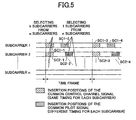
- Fig. 5 shows the channel structuring of the fourth implementation of the channel structuring method in the present invention.
- providing time frames in the communication channel of the n subcarriers 1 through n, and selecting an arbitrary number of subcarriers from n subcarriers 1 through n and inserting the common control channel signal and the common pilot signal are similar to the third implementation, and descriptions thereof are omitted where they are identical.
- the channel structuring of the fourth implementation of the present invention is characterized by the insertion position of the common control channel signal that has the same timing for every subcarrier. However, the insertion position of the common pilot signal is selected at different timing for every subcarrier.
- the common control channel signal is inserted into the insertion position SC 1-1 of the subcarrier 1, and the insertion position SC 2-1 of the subcarrier 2.
- the common pilot signal is inserted into the insertion position SC 1-2 of the subcarrier 1, and the insertion position SC 2-2 of the subcarrier 2.
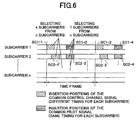
- Fig. 6 shows the channel structuring of the fifth implementation of the channel structuring method in the present invention.
- providing time frames in the communication channel of the n subcarriers 1 through n, and selecting an arbitrary number of subcarriers from n subcarriers 1 through n and inserting the common control channel signal and the common pilot signal are similar to the third implementation, and descriptions thereof are omitted where they are identical.
- the channel structuring of the fifth implementation of the present invention is characterized by the insertion position of the common pilot signal that has the same timing for every subcarrier.
- the insertion position of the common control channel signal is chosen at different timing for every subcarrier.
- the common control channel signal is inserted into the insertion position SC 1-1 of the subcarrier 1, and the insertion position SC 2-1 of the subcarrier 2.
- the common pilot signal is inserted into the insertion position SC 1-2 of the subcarrier 1, and the insertion position SC 2-2 of the subcarrier 2.
- Fig. 7 shows the channel structuring of the sixth implementation of the channel structuring method in the present invention.
- providing time frames in the communication channel of the n subcarriers 1 through n, and selecting an arbitrary number of subcarriers from n subcarriers 1 through n and inserting the common control channel signal and the common pilot signal are similar to the third implementation, and descriptions thereof are omitted where they are identical.
- the channel structuring of the sixth implementation of the present invention is characterized by the insertion position of the common control channel signal and the common pilot signal that have the same timing for every subcarrier.
- the common control channel signal is inserted into the insertion position SC 1-1 of the subcarrier 1, and the insertion position SC 2-1 of the subcarrier 2.
- the common pilot signal is inserted into the insertion position SC 1-2 of the subcarrier 1, and the insertion position SC 2-2 of the subcarrier 2.
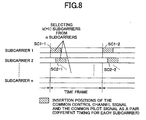
- Fig. 8 shows the channel structuring of the seventh implementation of the channel structuring method in the present invention.
- the time frames segmented at every fixed interval in the communication channel of n subcarriers 1 through n are provided.
- the pair of the common control channel signal and the common pilot signal is inserted into the insertion positions SC 1-1 and SC 1-2 of the subcarrier 1. Further, the insertion position of the pair of the common control channel signal and the common pilot signal is chosen at different timing for every subcarrier, like the insertion position SC 1-1 of the subcarrier 1, and the insertion position SC 2-1 of the subcarrier 2.
- Fig. 9 shows the channel structuring of the eighth implementation of the channel structuring method in the present invention.
- providing time frames in the communication channel of the n subcarriers 1 through n, and selecting an arbitrary number of subcarriers from n subcarriers 1 through n and inserting the common control channel signal and the common pilot signal are similar to the third implementation, and descriptions thereof are omitted where they are identical.
- the channel structuring of the eighth implementation of the present invention is characterized by the insertion position of the pair of the common control channel signal and the common pilot signal that have the same timing for every subcarrier.
- the insertion position of the pair of the common control channel signal and the common pilot signal is chosen at the same timing for every subcarrier like the insertion position SC 1-1 of the subcarrier 1, and the insertion position SC 2-1 of the subcarrier 2.
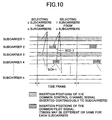
- Fig. 10 shows the channel structuring of the ninth implementation of the channel structuring method in the present invention.
- the time frames which are segmented at every fixed interval in the communication channel of n subcarriers 1 through n are provided.
- the common control channel signal is continuously inserted into the time frame of the selected subcarriers 1 and 3.
- the common pilot signal is inserted into the insertion positions SC 2-1 and SC 4-1 of the selected subcarriers 2 and 4, respectively.
- the insertion position of the common pilot signal may be chosen at different timing, or the same timing for every subcarrier.
- the channel structuring of the ninth implementation of the present invention is characterized by the fact that a subcarrier into which the common control channel signal is inserted is different from a subcarrier into which the common pilot signal is inserted.
- arbitrary insertion positions and time length are possible for the relative insertion position and the time length of the common pilot signal within a time frame.
- Fig. 11 shows the channel structuring of the 10th implementation of the channel structuring method in the present invention.
- providing time frames into the communication channels of the n subcarriers 1 through n and selecting arbitrary subcarriers from the n subcarriers 1 through n, and inserting the common control channel signal and the common pilot signal are the same as in the ninth implementation. And therefore, descriptions are omitted where they are identical.
- channel structuring of the 10th implementation of the present invention is characterized by the fact that a subcarrier into which the common control channel signal is inserted and a subcarrier into which the common pilot signal is inserted are partially overlapping.
- the insertion position SC 1-1 is assigned for the common pilot signal to be inserted. Consequently, as for the subcarrier 1, the common pilot signal is inserted into the insertion position SC 1-1, and the common control channel signal is continuously inserted into time frames other than the insertion position SC1-1 for the common pilot signal.
- Fig. 12 shows the channel structuring of the 11th implementation of the channel structuring method in the present invention.
- the time frames segmented at a fixed interval are set up in the communication channel of the n subcarriers 1 through n.
- the common control channel signal is inserted into the insertion position SC 2-1 and SC 4-1 of the selected subcarriers 2 and 4, respectively.
- the insertion position of the common control channel signal is chosen either at a different timing or the same timing for every subcarrier.
- the common pilot signal is continuously inserted into the time frame of the selected subcarriers 1 and 3.
- channel structuring of the 11th implementation of the present invention is characterized by the fact that a subcarrier into which the common control channel signal is inserted differs from a subcarrier into which the common pilot signal is inserted.
- arbitrary insertion positions and time length are possible for the relative insertion position and the time length of the common control channel signal within a time frame.
- Fig. 13 shows the channel structuring of the 12th implementation of the channel structuring method in the present invention.
- the channel structuring drawing of Fig. 9 providing time frames in the communication channel of the n subcarriers 1 through n, and selecting an arbitrary number of subcarriers from n subcarriers 1 through n and inserting the common control channel signal and the common pilot signal are similar to the third implementation, and descriptions thereof are omitted where they are identical.
- channel structuring of the 12th implementation of the present invention is characterized by the fact that a subcarrier into which the common control channel signal is inserted and a subcarrier into which the common pilot signal is inserted are partially overlapping.
- the insertion position SC 1-1 is assigned for the common control channel signal to be inserted. Consequently, the common control channel signal is inserted into the insertion position SC 1-1, and the common pilot signal is continuously inserted into the time frames of the subcarrier 1 other than the common control channel signal insertion position SC1-1.
- arbitrary insertion positions and time length are possible for the relative insertion position and the time length of the common control channel signal within a time frame.
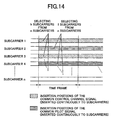
- Fig. 14 shows the channel structuring of the 13th implementation of the channel structuring method in the present invention.
- the time frames segmented at a fixed interval are set up in the communication channel of the n subcarriers 1 through n.
- the common control channel signal is continuously inserted into the time frames of the selected subcarriers 1 and 3.
- the common pilot signal is continuously inserted into the time frames of the selected subcarriers 2 and 4.
- channel structuring of the 13th implementation of the present invention is characterized by the fact that the common control channel signal and the common pilot signal are continuously inserted into the selected subcarriers, respectively.
- the common control channel signal and the common pilot signal can be inserted into the downlink channel between the base station and the mobile stations of the OFDM/TDM transmission method by using the channel structuring in the first through the 13th implementations of the present invention
- the channel structuring method for inserting the common control channel signal and the common pilot signal into the downlink channel between the base station and the mobile stations, and the base station using the channel structuring method can be realized.
- the common control channel signal and the common pilot signal can be inserted into the downlink channel between the base station and the mobile stations, thereby realizing the transmission of the common control signal.
- the OFDM/TDM transmission method can be actually applied to a downlink in a mobile communication system.
Landscapes
- Engineering & Computer Science (AREA)
- Signal Processing (AREA)
- Computer Networks & Wireless Communication (AREA)
- Mobile Radio Communication Systems (AREA)
- Time-Division Multiplex Systems (AREA)
Claims (15)
- Procédé de structuration de canaux permettant de configurer des canaux, où des signaux de transmission sont modulés par multiplexage par répartition orthogonale de la fréquence comprenant n sous-porteuses et multiplexés par multiplexage par répartition dans le temps pour configurer des canaux de liaison descendante, le procédé de structuration de canaux comprenant le fait :de fournir des trames de temps par segmentation d'un canal de communication des n sous-porteuses à chaque intervalle prédéterminé ;de sélectionner parmi les n sous-porteuses, un nombre prédéterminé de k sous-porteuses pour l'insertion de signaux de canal de commande communs et de 1 sous-porteuses pour l'insertion de signaux pilotes communs où 1 < n ; etcaractérisé par l'insertion d'un signal de canal de commande commun et d'un signal pilote commun dans les trames de temps par multiplexage par répartition dans le temps par rapport aux sous-porteuses sélectionnées tout en s'assurant qu'au moins l'une des sous-porteuses sélectionnées comprend à la fois un signal de commande commun et un signal pilote commun insérés dedans dans la trame de temps et que tous les signaux pilotes communs dans les 1 sous-porteuses sont insérés au même moment dans la trame de temps.
- Procédé de structuration de canaux tel que revendiqué dans la revendication 1,
dans lequel ledit signal de canal de commande commun et ledit signal pilote commun sont insérés périodiquement dans chaque trame de temps desdites sous-porteuses sélectionnées. - Procédé de structuration de canaux tel que revendiqué dans la revendication 1 ou la revendication 2, dans lequel, en ce qui concerne le signal de canal de commande commun et le signal pilote commun insérés dans les trames de temps, soit(i) soit le signal de canal de commande commun ou le signal pilote commun, ou les deux, est/sont inséré(s) au même moment que le signal de canal de commande commun d'autres sous-porteuses ; et/ou(ii) le signal de canal de commande commun est inséré au même moment que le signal pilote commun d'autres sous-porteuses.
- Procédé de structuration de canaux tel que revendiqué dans la revendication 1, comprenant :une étape qui consiste à sélectionner un nombre prédéterminé de sous-porteuses à partir desdites n sous-porteuses, et à insérer le signal de canal de commande commun de façon continue dans la trame de temps desdites sous-porteuses sélectionnées, etune étape qui consiste à sélectionner un nombre prédéterminé de sous-porteuses à partir desdites n sous-porteuses, et à insérer le signal pilote commun de façon périodique dans chaque trame de temps desdites sous-porteuses sélectionnées.
- Procédé de structuration de canaux tel que revendiqué dans la revendication 1, comprenant :une étape qui consiste à sélectionner un nombre prédéterminé de sous-porteuses à partir desdites n sous-porteuses, et à insérer le signal pilote commun de façon continue dans la trame de temps de ladite sous-porteuse sélectionnée, etune étape qui consiste à sélectionner un nombre prédéterminé de sous-porteuses à partir desdites n sous-porteuses, et à insérer le signal de canal de commande commun de façon périodique dans chaque trame de temps desdites sous-porteuses sélectionnées.
- Procédé de structuration de canaux tel que revendiqué dans la revendication 4 ou 5, dans lequel des sous-porteuses dans lesquelles ledit signal de canal de commande commun est inséré sont complètement ou partiellement les mêmes que les sous-porteuses dans lesquelles le signal pilote commun est inséré.
- Procédé de structuration de canaux tel que revendiqué dans la revendication 1, comprenant :une étape qui consiste à sélectionner un nombre prédéterminé de sous-porteuses à partir desdites n sous-porteuses, et à insérer le signal de canal de commande commun de façon continue dans la trame de temps desdites sous-porteuses sélectionnées, etune étape qui consiste à sélectionner un nombre prédéterminé de sous-porteuses à partir desdites n sous-porteuses, et à insérer le signal pilote commun de façon continue dans la trame de temps desdites sous-porteuses sélectionnées.
- Station de base dans laquelle des signaux de transmission sont modulés par multiplexage par répartition orthogonale de la fréquence comprenant n sous-porteuses et multiplexés par multiplexage par répartition dans le temps pour configurer des canaux de liaison descendante, comprenant :un moyen destiné à fournir des trames de temps par segmentation d'un canal de communication des n sous-porteuses à chaque intervalle prédéterminé ;un moyen (4, 5, 6, 7) destiné à sélectionner à partir des n sous-porteuses, un nombre prédéterminé de k sous-porteuses pour l'insertion de signaux de canal de commande communs et de 1 sous-porteuses pour l'insertion de signaux pilotes communs où 1 < n, et caractérisé par l'insertion d'un signal de canal de commande commun et d'un signal pilote commun dans les trames de temps par multiplexage par répartition dans le temps par rapport aux sous-porteuses sélectionnées tout en assurant qu'au moins l'une des sous-porteuses sélectionnées comprend à la fois un signal de commande commun et un signal pilote commun insérés dedans dans la trame de temps et que tous les signaux pilotes communs dans les 1 sous-porteuses sont insérés au même moment dans la trame de temps.
- Station de base telle que revendiquée dans la revendication 8, dans laquelle
des trames de temps sont fournies par segmentation d'un canal de communication desdites n sous-porteuses à chaque intervalle prédéterminé, et
ledit moyen d'insertion de signal de canal de commande commun (7) sélectionne un nombre prédéterminé de sous-porteuses à partir desdites n sous-porteuses, et insère le signal de canal de commande commun de façon périodique dans chaque trame de temps desdites sous-porteuses sélectionnées. - Station de base telle que revendiquée dans la revendication 8 ou 9, dans laquelle
des trames de temps sont fournies par segmentation d'un canal de communication desdites n sous-porteuses à chaque intervalle prédéterminé, et
ledit moyen d'insertion de signal pilote commun (6) sélectionne un nombre prédéterminé de sous-porteuses à partir desdites n sous-porteuses, et insère le signal pilote commun de façon périodique dans chaque trame de temps desdites sous-porteuses sélectionnées. - Station de base telle que revendiquée dans la revendication 8 ou la revendication 9, dans laquelle ledit moyen d'insertion de signal pilote commun sélectionne un nombre prédéterminé de sous-porteuses à partir desdites n sous-porteuses et insère le signal pilote commun dans les trames de temps, et
ledit moyen d'insertion de signal de canal de commande commun et ledit moyen d'insertion de signal pilote commun insèrent le signal de canal de commande commun et le signal pilote commun, respectivement, dans lesdites sous-porteuses sélectionnées, de sorte que soit :(i) un moment de l'insertion du signal de canal de commande commun ou du signal pilote commun, ou des deux, soit le même que celui du signal de canal de commande commun d'autres sous-porteuses ; et/ou(ii) un moment de l'insertion du signal de canal de commande commun soit le même que celui du signal pilote commun d'autres sous-porteuses. - Station de base telle que revendiquée dans la revendication 8, dans laquelle
des trames de temps sont fournies par segmentation d'un canal de communication desdites n sous-porteuses à chaque intervalle prédéterminé,
ledit moyen d'insertion de signal de canal de commande commun sélectionne un nombre prédéterminé de sous-porteuses à partir desdites n sous-porteuses, et insère le signal de canal de commande commun de façon continue dans chaque trame de temps desdites sous-porteuses sélectionnées, et
ledit moyen d'insertion de signal pilote commun sélectionne un nombre prédéterminé de sous-porteuses à partir desdites n sous-porteuses, et insère le signal pilote commun de façon périodique dans chaque trame de temps desdites sous-porteuses sélectionnées. - Station de base telle que revendiquée dans la revendication 8, dans laquelle
des trames de temps segmentées dans le canal de communication desdites n sous-porteuses à chaque intervalle prédéterminé sont établies,
ledit moyen d'insertion de signal pilote commun sélectionne un nombre prédéterminé de sous-porteuses à partir desdites n sous-porteuses, et insère le signal pilote commun de façon continue dans chaque trame de temps desdites sous-porteuses sélectionnées, et
ledit moyen d'insertion de signal de canal de commande commun sélectionne un nombre prédéterminé de sous-porteuses à partir desdites n sous-porteuses, et insère le signal de canal de commande commun de façon périodique dans chaque trame de temps desdites sous-porteuses sélectionnées. - Station de base telle que revendiquée dans la revendication 12 ou 13, dans laquelle
les sous-porteuses dans lesquelles ledit signal de canal de commande commun est inséré par ledit moyen d'insertion de signal de canal de commande commun sont complètement ou partiellement les mêmes que les sous-porteuses dans lesquelles le signal pilote commun est inséré par ledit moyen d'insertion de signal pilote commun. - Station de base telle que revendiquée dans la revendication 8, dans laquelle
des trames de temps sont fournies par segmentation d'un canal de communication desdites n sous-porteuses à chaque intervalle prédéterminé, et
ledit moyen d'insertion de signal de canal de commande commun sélectionne un nombre prédéterminé de sous-porteuses à partir desdites n sous-porteuses, et insère le signal de canal de commande commun de façon continue dans chaque trame de temps desdites sous-porteuses sélectionnées, et
ledit moyen d'insertion de signal pilote commun sélectionne un nombre prédéterminé de sous-porteuses à partir desdites n sous-porteuses, et insère le signal pilote commun de façon continue dans chaque trame de temps desdites sous-porteuses sélectionnées.
Applications Claiming Priority (3)
| Application Number | Priority Date | Filing Date | Title |
|---|---|---|---|
| JP2000014931 | 2000-01-24 | ||
| JP2000014931A JP3581072B2 (ja) | 2000-01-24 | 2000-01-24 | チャネル構成方法及びその方法を利用する基地局 |
| PCT/JP2001/000419 WO2001054326A1 (fr) | 2000-01-24 | 2001-01-23 | Procede de construction de canaux et station de base utilisant le procede |
Publications (3)
| Publication Number | Publication Date |
|---|---|
| EP1164733A1 EP1164733A1 (fr) | 2001-12-19 |
| EP1164733A4 EP1164733A4 (fr) | 2009-03-11 |
| EP1164733B1 true EP1164733B1 (fr) | 2013-06-12 |
Family
ID=18542309
Family Applications (1)
| Application Number | Title | Priority Date | Filing Date |
|---|---|---|---|
| EP01901517.1A Expired - Lifetime EP1164733B1 (fr) | 2000-01-24 | 2001-01-23 | Procede de construction de canaux et station de base utilisant le procede |
Country Status (8)
| Country | Link |
|---|---|
| US (2) | US7646747B2 (fr) |
| EP (1) | EP1164733B1 (fr) |
| JP (1) | JP3581072B2 (fr) |
| KR (1) | KR100439877B1 (fr) |
| CN (3) | CN101599823B (fr) |
| AU (1) | AU755354B2 (fr) |
| CA (1) | CA2372247C (fr) |
| WO (1) | WO2001054326A1 (fr) |
Families Citing this family (53)
| Publication number | Priority date | Publication date | Assignee | Title |
|---|---|---|---|---|
| JP4171261B2 (ja) | 2001-08-27 | 2008-10-22 | 松下電器産業株式会社 | 無線通信装置及び無線通信方法 |
| CN100596044C (zh) | 2002-01-10 | 2010-03-24 | 富士通株式会社 | Ofdm系统中的导频复用方法和ofdm接收方法 |
| CA2428576C (fr) | 2002-05-16 | 2008-10-07 | Ntt Docomo, Inc. | Emetteur pour emission multiporteuse et methode d'emission multiporteuse |
| CN100414859C (zh) * | 2002-06-12 | 2008-08-27 | 电子科技大学 | 一种ofdm通信系统的帧尾插入控制比特方法 |
| US20040081131A1 (en) | 2002-10-25 | 2004-04-29 | Walton Jay Rod | OFDM communication system with multiple OFDM symbol sizes |
| US7002900B2 (en) * | 2002-10-25 | 2006-02-21 | Qualcomm Incorporated | Transmit diversity processing for a multi-antenna communication system |
| US7986742B2 (en) | 2002-10-25 | 2011-07-26 | Qualcomm Incorporated | Pilots for MIMO communication system |
| US8134976B2 (en) * | 2002-10-25 | 2012-03-13 | Qualcomm Incorporated | Channel calibration for a time division duplexed communication system |
| US8208364B2 (en) * | 2002-10-25 | 2012-06-26 | Qualcomm Incorporated | MIMO system with multiple spatial multiplexing modes |
| US8320301B2 (en) * | 2002-10-25 | 2012-11-27 | Qualcomm Incorporated | MIMO WLAN system |
| JP4276009B2 (ja) * | 2003-02-06 | 2009-06-10 | 株式会社エヌ・ティ・ティ・ドコモ | 移動局、基地局、無線伝送プログラム、及び無線伝送方法 |
| FR2851384B1 (fr) * | 2003-02-17 | 2009-12-18 | Wavecom | Procede de transmission de donnees radio, signal, systeme et dispositifs correspondant. |
| DE10319090A1 (de) * | 2003-04-28 | 2004-11-25 | Siemens Ag | Verfahren, Funksende-/Funkempfangsvorrichtung, Mobiles Endgerät sowie Basisstation zur Datenübertragung in einem Mehrträgersysem |
| KR100594597B1 (ko) | 2003-10-24 | 2006-06-30 | 한국전자통신연구원 | 이동통신시스템에서의 하향링크 신호 구성 방법 및 그장치와, 이를 이용한 동기화 및 셀 탐색 방법과 그 장치 |
| US7660275B2 (en) * | 2003-10-24 | 2010-02-09 | Qualcomm Incorporated | Local and wide-area transmissions in a wireless broadcast network |
| US9473269B2 (en) | 2003-12-01 | 2016-10-18 | Qualcomm Incorporated | Method and apparatus for providing an efficient control channel structure in a wireless communication system |
| WO2005074166A1 (fr) | 2004-01-29 | 2005-08-11 | Neocific, Inc. | Procedes et appareil de superpositon de signaux multi-porteuses et a spectre etale a sequence directe dans un systeme de transmission sans fil a bande large |
| CN1879426B (zh) | 2004-01-29 | 2010-06-23 | 桥扬科技有限公司 | 用于多载波、多小区无线通信网络的方法和装置 |
| WO2005081439A1 (fr) | 2004-02-13 | 2005-09-01 | Neocific, Inc. | Procedes et dispositif pour des systemes de communication a porteuses multiples comportant une transmission et une retroaction adaptatives |
| WO2005109705A1 (fr) | 2004-05-01 | 2005-11-17 | Neocific, Inc. | Procedes et appareil destines a la communication avec duplexage a repartition dans le temps |
| KR101065687B1 (ko) * | 2004-06-10 | 2011-09-19 | 엘지전자 주식회사 | Ofdm 무선 통신 시스템에 적용되는 시간 동기 획득 방법 |
| US7751305B2 (en) * | 2004-06-25 | 2010-07-06 | Samsung Electronics Co., Ltd. | Method for transmitting and receiving broadcast service data in an OFDMA wireless communication system |
| US20080008256A1 (en) * | 2004-08-02 | 2008-01-10 | Matshushita Electric Industrial Co., Ltd. | Ofdm Transmitting Apparatus, Ofdm Receiving Apparatus, and Their Methods |
| JP4744965B2 (ja) | 2004-08-09 | 2011-08-10 | パナソニック株式会社 | 無線通信装置 |
| WO2006075372A1 (fr) | 2005-01-13 | 2006-07-20 | Fujitsu Limited | Système de communication sans fil |
| JP4515312B2 (ja) * | 2005-03-31 | 2010-07-28 | 株式会社エヌ・ティ・ティ・ドコモ | 移動局、送信方法および移動無線通信システム |
| JP4463723B2 (ja) * | 2005-04-28 | 2010-05-19 | 株式会社エヌ・ティ・ティ・ドコモ | 送信機及び送信方法 |
| US7466749B2 (en) * | 2005-05-12 | 2008-12-16 | Qualcomm Incorporated | Rate selection with margin sharing |
| RU2396715C2 (ru) * | 2005-06-14 | 2010-08-10 | Нтт Досомо, Инк. | Передающее устройство, способ передачи данных, приемное устройство и способ приема данных |
| JP4732808B2 (ja) * | 2005-06-14 | 2011-07-27 | 株式会社エヌ・ティ・ティ・ドコモ | 無線パラメータ群を生成する装置 |
| JP4869724B2 (ja) * | 2005-06-14 | 2012-02-08 | 株式会社エヌ・ティ・ティ・ドコモ | 送信装置、送信方法、受信装置及び受信方法 |
| US7508842B2 (en) * | 2005-08-18 | 2009-03-24 | Motorola, Inc. | Method and apparatus for pilot signal transmission |
| US7903628B2 (en) * | 2005-08-22 | 2011-03-08 | Qualcomm Incorporated | Configurable pilots in a wireless communication system |
| EP1780968A1 (fr) * | 2005-10-28 | 2007-05-02 | Alcatel Lucent | Transmission sur base de OFDM dans un réseau cellulaire à fréquence unique avec une structure de multiplexage de canaux adaptée au pilote |
| KR101259100B1 (ko) * | 2005-11-04 | 2013-04-26 | 엘지전자 주식회사 | Ofdm 또는 ofdma 무선 이동통신 시스템에서의초기 동기를 위한 신호 전송 방법, 초기 동기 획득 방법 및이동통신용 단말 |
| JP5242025B2 (ja) * | 2006-06-19 | 2013-07-24 | 株式会社エヌ・ティ・ティ・ドコモ | 基地局および送信方法 |
| CN101102296B (zh) * | 2006-07-07 | 2011-01-05 | 华为技术有限公司 | 实现数据流复用的方法和多载波通信系统 |
| WO2008036687A1 (fr) * | 2006-09-19 | 2008-03-27 | Qualcomm Incorporated | Décalage de positions de balises dans un système de communication bidirectionnel à répartition dans le temps |
| JP4967561B2 (ja) | 2006-09-20 | 2012-07-04 | 富士通株式会社 | 移動通信端末、移動通信システム、基地局及び通信方法 |
| KR100859716B1 (ko) | 2006-10-04 | 2008-09-23 | 한국전자통신연구원 | Ofdm 기반의 fdd 및 tdd 듀얼모드 단말에 있어서순방향 동기신호 전송방법 및 셀 식별자 검출 방법 |
| CN101163122B (zh) * | 2006-10-09 | 2011-08-10 | 中兴通讯股份有限公司 | 时分双工系统控制信息的发送方法 |
| EP2077634B1 (fr) * | 2006-10-26 | 2016-02-24 | Fujitsu Limited | Appareil de station radio fixe, procédé de transmission de pilotes et appareil terminal |
| US8493930B2 (en) | 2006-10-27 | 2013-07-23 | Kyocera Corporation | Communication system, base station and mobile station used in the communication system, and base station switching method |
| CN101175058B (zh) * | 2006-10-31 | 2010-05-19 | 中兴通讯股份有限公司 | 一种时分双工系统同步信道的发送方法 |
| CN101197803B (zh) * | 2006-12-04 | 2011-12-21 | 华为技术有限公司 | 一种时分双工系统中发送数据的方法、装置及系统 |
| CN101114877B (zh) * | 2007-03-12 | 2010-12-08 | 中兴通讯股份有限公司 | 一种增强的同步信道发送方法 |
| US8571066B2 (en) * | 2007-03-21 | 2013-10-29 | Qualcomm Incorporated | Methods and apparatus for RF channel switching in a multi-frequency network |
| CN101325447B (zh) * | 2007-06-14 | 2012-06-06 | 中兴通讯股份有限公司 | 同步信号发送方法 |
| KR20100025586A (ko) * | 2007-08-02 | 2010-03-09 | 후지쯔 가부시끼가이샤 | 이동 무선 통신 시스템에서의 파일럿 배치 방법 및 이것을 적용하는 송수신 장치 |
| EP2180624B1 (fr) * | 2007-08-13 | 2020-08-05 | Sharp Kabushiki Kaisha | Station de base de radiocommunication |
| US8554209B2 (en) | 2007-08-17 | 2013-10-08 | Telefonaktiebolaget L M Ericsson (Publ) | Sectioned common control channels in cellular networks |
| US8331482B2 (en) * | 2008-12-22 | 2012-12-11 | Industrial Technology Research Institute | System and method for subcarrier allocation and permutation |
| TW201228570A (en) * | 2010-12-17 | 2012-07-01 | Hon Hai Prec Ind Co Ltd | Liquid heat dissipation device |
Family Cites Families (26)
| Publication number | Priority date | Publication date | Assignee | Title |
|---|---|---|---|---|
| US6647000B1 (en) * | 1999-05-28 | 2003-11-11 | Telefonaktiebolaget Lm Ericsson (Publ) | Methods and apparatus for performing slot hopping of logical control channels in wireless communications systems |
| JP3058793B2 (ja) * | 1994-03-18 | 2000-07-04 | 株式会社日立製作所 | 無線通信方式 |
| JP3162581B2 (ja) | 1994-09-16 | 2001-05-08 | 株式会社東芝 | 階層的直交多重伝送方式とその送受信装置 |
| US5724378A (en) * | 1994-12-13 | 1998-03-03 | Nit Mobile Communications Network, Inc. | CDMA multiuser receiver and method |
| SE515752C2 (sv) * | 1995-08-28 | 2001-10-08 | Telia Ab | Direktåtkomst i OFDM-system |
| WO1998035473A2 (fr) * | 1997-02-06 | 1998-08-13 | At & T Wireless Services, Inc. | Unite sans fil a distance presentant un mode de fonctionnement a courant limite |
| US5914981A (en) | 1997-02-24 | 1999-06-22 | At&T Wireless Services Inc. | Method to indicate synchronization lock of a remote station with a base station for a discrete multitone spread spectrum communications system |
| WO1998047253A1 (fr) * | 1997-04-16 | 1998-10-22 | Ntt Mobile Communications Network Inc. | Procede de communication amdc |
| US5867478A (en) * | 1997-06-20 | 1999-02-02 | Motorola, Inc. | Synchronous coherent orthogonal frequency division multiplexing system, method, software and device |
| CN1980215A (zh) * | 1997-07-01 | 2007-06-13 | 松下电器产业株式会社 | 发送方法、接收方法、发送装置、接收装置 |
| US6351458B2 (en) * | 1997-09-22 | 2002-02-26 | Matsushita Electric Industrial Co., Ltd. | CDMA cellular wireless communication system |
| JPH11113044A (ja) | 1997-09-30 | 1999-04-23 | Sony Corp | 通信方法、送信方法、受信方法、基地局及び端末装置 |
| SE522587C2 (sv) * | 1998-02-16 | 2004-02-24 | Ericsson Telefon Ab L M | Förfarande och mottagaranordning för mottagning av upprepade skurar i ett radiokommunikationssystem |
| JP3881770B2 (ja) | 1998-03-10 | 2007-02-14 | 松下電器産業株式会社 | 移動局装置および通信方法 |
| JP3782237B2 (ja) * | 1998-06-18 | 2006-06-07 | 日本放送協会 | Ofdm信号復調装置 |
| US6526091B1 (en) * | 1998-08-17 | 2003-02-25 | Telefonaktiebolaget Lm Ericsson | Communication methods and apparatus based on orthogonal hadamard-based sequences having selected correlation properties |
| JP2000201134A (ja) * | 1999-01-06 | 2000-07-18 | Ntt Mobil Communication Network Inc | マルチキャリア/ds―cdma伝送方法および復調装置 |
| US7324495B1 (en) * | 1999-06-23 | 2008-01-29 | Clearwire Corporation | System and method for broadcasting timing information to remote units in a wireless multiple access network |
| ES2162512T3 (es) * | 1999-06-24 | 2001-12-16 | Cit Alcatel | Receptor y metodo para transmision cdma con buscador de caminos mejorado. |
| JP2001128215A (ja) * | 1999-10-29 | 2001-05-11 | Matsushita Electric Ind Co Ltd | Tdma−tdd方式送受信装置および送受信方法 |
| US6473467B1 (en) * | 2000-03-22 | 2002-10-29 | Qualcomm Incorporated | Method and apparatus for measuring reporting channel state information in a high efficiency, high performance communications system |
| JP3735003B2 (ja) * | 2000-03-30 | 2006-01-11 | 松下電器産業株式会社 | 移動局装置および送信電力制御方法 |
| KR100358120B1 (ko) * | 2000-10-20 | 2002-10-25 | 한국전자통신연구원 | 동일대역 인접채널 방식의 디지털 오디오 방송 전송 시스템 |
| MXPA03005307A (es) * | 2000-12-15 | 2004-12-02 | Adaptix Inc | Comunicaciones de multiportadores con asignacion de subportadora con base en grupos. |
| US7133354B2 (en) * | 2002-08-26 | 2006-11-07 | Qualcomm Incorporated | Synchronization techniques for a wireless system |
| US7660229B2 (en) * | 2005-06-20 | 2010-02-09 | Texas Instruments Incorporated | Pilot design and channel estimation |
-
2000
- 2000-01-24 JP JP2000014931A patent/JP3581072B2/ja not_active Expired - Lifetime
-
2001
- 2001-01-23 WO PCT/JP2001/000419 patent/WO2001054326A1/fr not_active Ceased
- 2001-01-23 AU AU27091/01A patent/AU755354B2/en not_active Ceased
- 2001-01-23 CA CA002372247A patent/CA2372247C/fr not_active Expired - Fee Related
- 2001-01-23 CN CN200910145808.8A patent/CN101599823B/zh not_active Expired - Lifetime
- 2001-01-23 KR KR10-2001-7012089A patent/KR100439877B1/ko not_active Expired - Fee Related
- 2001-01-23 EP EP01901517.1A patent/EP1164733B1/fr not_active Expired - Lifetime
- 2001-01-23 CN CNA200810145185XA patent/CN101330371A/zh active Pending
- 2001-01-23 US US09/926,193 patent/US7646747B2/en not_active Expired - Lifetime
- 2001-01-23 CN CN01800109A patent/CN1358368A/zh active Pending
-
2009
- 2009-12-02 US US12/629,571 patent/US8630244B2/en not_active Expired - Fee Related
Also Published As
| Publication number | Publication date |
|---|---|
| US8630244B2 (en) | 2014-01-14 |
| CN101330371A (zh) | 2008-12-24 |
| US20020159430A1 (en) | 2002-10-31 |
| CN1358368A (zh) | 2002-07-10 |
| WO2001054326A1 (fr) | 2001-07-26 |
| KR100439877B1 (ko) | 2004-07-12 |
| CN101599823B (zh) | 2014-06-18 |
| AU755354B2 (en) | 2002-12-12 |
| JP2001203665A (ja) | 2001-07-27 |
| US20100080207A1 (en) | 2010-04-01 |
| CN101599823A (zh) | 2009-12-09 |
| JP3581072B2 (ja) | 2004-10-27 |
| CA2372247C (fr) | 2006-01-17 |
| US7646747B2 (en) | 2010-01-12 |
| EP1164733A1 (fr) | 2001-12-19 |
| AU2709101A (en) | 2001-07-31 |
| EP1164733A4 (fr) | 2009-03-11 |
| CA2372247A1 (fr) | 2001-07-26 |
| KR20010108372A (ko) | 2001-12-07 |
Similar Documents
| Publication | Publication Date | Title |
|---|---|---|
| EP1164733B1 (fr) | Procede de construction de canaux et station de base utilisant le procede | |
| US20220174754A1 (en) | Initial Access Channel for Scalable Wireless Mobile Communication Networks | |
| EP0939527B1 (fr) | Application de signaux multiporteurs dans des intervalles temporels d'un système GSM | |
| EP1681821B1 (fr) | Séquences de préambule pour un système de communication multiporteuse employant un schéma à plusieurs entrées et sorties | |
| EP1158709B1 (fr) | Format de signal dans un systeme de transmission amrc a porteuses multiples | |
| EP3454516B1 (fr) | Procédé et appareil de multiplexage de données et d'informations de commande dans des systèmes de communication sans fil basés sur un accès multiple par répartition en fréquence | |
| KR100594156B1 (ko) | 다중 입력 다중 출력 방식을 사용하는 직교 주파수 분할다중 통신시스템에서 프리앰블 시퀀스 송/수신 방법 | |
| EP2790331A1 (fr) | Dispositif de transmission MIMO-OFDM et méthode de transmission MIMO-OFDM | |
| KR20050008388A (ko) | 다수개의 송신 안테나들을 사용하는 직교 주파수 분할다중 통신시스템에서 프리앰블 시퀀스 생성 장치 및 방법 | |
| EP2148483B1 (fr) | Système MDFO avec des rotations de phase par groupe de sous-porteuses | |
| US20090080547A1 (en) | Base station apparatus and mobile station apparatus | |
| US6871046B2 (en) | Radio transmitting apparatus and radio transmitting method | |
| US8325594B2 (en) | Apparatus and method for transmitting/receiving uplink pilot in frequency division multiple access system | |
| EP1779570B1 (fr) | Methode pour detecter une synchronisation de symboles mrof dans un systeme mrof | |
| CN101431368A (zh) | 一种信道估计方法及装置 | |
| KR20060082228A (ko) | 다중반송파부호분할다중접속 시스템을 위한 파일럿 기반의채널 추정 방법 | |
| JP2004357339A (ja) | マルチキャリア送信装置、マルチキャリア受信装置およびマルチキャリア無線通信方法 | |
| Ruan et al. | A hybrid integer carrier frequency offset estimator for practical OFDM systems | |
| HK1120698B (en) | Initial access channel for scalable wireless mobile communication networks | |
| HK1120698A (en) | Initial access channel for scalable wireless mobile communication networks | |
| HK1117314B (en) | Initial access channel for scalable wireless mobile communication networks | |
| HK1117314A (en) | Initial access channel for scalable wireless mobile communication networks |
Legal Events
| Date | Code | Title | Description |
|---|---|---|---|
| PUAI | Public reference made under article 153(3) epc to a published international application that has entered the european phase |
Free format text: ORIGINAL CODE: 0009012 |
|
| AK | Designated contracting states |
Kind code of ref document: A1 Designated state(s): AT BE CH CY DE DK ES FI FR GB GR IE IT LI LU MC NL PT SE TR |
|
| 17P | Request for examination filed |
Effective date: 20010924 |
|
| RBV | Designated contracting states (corrected) |
Designated state(s): DE FR GB IT |
|
| A4 | Supplementary search report drawn up and despatched |
Effective date: 20090211 |
|
| 17Q | First examination report despatched |
Effective date: 20090513 |
|
| GRAP | Despatch of communication of intention to grant a patent |
Free format text: ORIGINAL CODE: EPIDOSNIGR1 |
|
| GRAS | Grant fee paid |
Free format text: ORIGINAL CODE: EPIDOSNIGR3 |
|
| GRAA | (expected) grant |
Free format text: ORIGINAL CODE: 0009210 |
|
| AK | Designated contracting states |
Kind code of ref document: B1 Designated state(s): DE FR GB IT |
|
| REG | Reference to a national code |
Ref country code: GB Ref legal event code: FG4D |
|
| REG | Reference to a national code |
Ref country code: DE Ref legal event code: R096 Ref document number: 60148064 Country of ref document: DE Effective date: 20130801 |
|
| PG25 | Lapsed in a contracting state [announced via postgrant information from national office to epo] |
Ref country code: IT Free format text: LAPSE BECAUSE OF NON-PAYMENT OF DUE FEES Effective date: 20130123 |
|
| PLBE | No opposition filed within time limit |
Free format text: ORIGINAL CODE: 0009261 |
|
| STAA | Information on the status of an ep patent application or granted ep patent |
Free format text: STATUS: NO OPPOSITION FILED WITHIN TIME LIMIT |
|
| 26N | No opposition filed |
Effective date: 20140313 |
|
| REG | Reference to a national code |
Ref country code: DE Ref legal event code: R097 Ref document number: 60148064 Country of ref document: DE Effective date: 20140313 |
|
| REG | Reference to a national code |
Ref country code: FR Ref legal event code: PLFP Year of fee payment: 16 |
|
| REG | Reference to a national code |
Ref country code: FR Ref legal event code: PLFP Year of fee payment: 17 |
|
| REG | Reference to a national code |
Ref country code: FR Ref legal event code: PLFP Year of fee payment: 18 |
|
| PGFP | Annual fee paid to national office [announced via postgrant information from national office to epo] |
Ref country code: FR Payment date: 20191216 Year of fee payment: 20 |
|
| PGFP | Annual fee paid to national office [announced via postgrant information from national office to epo] |
Ref country code: IT Payment date: 20200114 Year of fee payment: 20 Ref country code: GB Payment date: 20200115 Year of fee payment: 20 Ref country code: DE Payment date: 20200107 Year of fee payment: 20 |
|
| REG | Reference to a national code |
Ref country code: DE Ref legal event code: R071 Ref document number: 60148064 Country of ref document: DE |
|
| REG | Reference to a national code |
Ref country code: GB Ref legal event code: PE20 Expiry date: 20210122 |
|
| PG25 | Lapsed in a contracting state [announced via postgrant information from national office to epo] |
Ref country code: GB Free format text: LAPSE BECAUSE OF EXPIRATION OF PROTECTION Effective date: 20210122 |
|
| P01 | Opt-out of the competence of the unified patent court (upc) registered |
Effective date: 20230517 |