EP1164842B1 - Flüssige zubereitungen und tensid/lösungsmittel-systeme - Google Patents
Flüssige zubereitungen und tensid/lösungsmittel-systeme Download PDFInfo
- Publication number
- EP1164842B1 EP1164842B1 EP00909356A EP00909356A EP1164842B1 EP 1164842 B1 EP1164842 B1 EP 1164842B1 EP 00909356 A EP00909356 A EP 00909356A EP 00909356 A EP00909356 A EP 00909356A EP 1164842 B1 EP1164842 B1 EP 1164842B1
- Authority
- EP
- European Patent Office
- Prior art keywords
- poly
- alcohols
- weight
- surfactant
- aryl
- Prior art date
- Legal status (The legal status is an assumption and is not a legal conclusion. Google has not performed a legal analysis and makes no representation as to the accuracy of the status listed.)
- Expired - Lifetime
Links
Classifications
-
- A—HUMAN NECESSITIES
- A01—AGRICULTURE; FORESTRY; ANIMAL HUSBANDRY; HUNTING; TRAPPING; FISHING
- A01N—PRESERVATION OF BODIES OF HUMANS OR ANIMALS OR PLANTS OR PARTS THEREOF; BIOCIDES, e.g. AS DISINFECTANTS, AS PESTICIDES OR AS HERBICIDES; PEST REPELLANTS OR ATTRACTANTS; PLANT GROWTH REGULATORS
- A01N25/00—Biocides, pest repellants or attractants, or plant growth regulators, characterised by their forms, or by their non-active ingredients or by their methods of application, e.g. seed treatment or sequential application; Substances for reducing the noxious effect of the active ingredients to organisms other than pests
- A01N25/30—Biocides, pest repellants or attractants, or plant growth regulators, characterised by their forms, or by their non-active ingredients or by their methods of application, e.g. seed treatment or sequential application; Substances for reducing the noxious effect of the active ingredients to organisms other than pests characterised by the surfactants
-
- A—HUMAN NECESSITIES
- A01—AGRICULTURE; FORESTRY; ANIMAL HUSBANDRY; HUNTING; TRAPPING; FISHING
- A01N—PRESERVATION OF BODIES OF HUMANS OR ANIMALS OR PLANTS OR PARTS THEREOF; BIOCIDES, e.g. AS DISINFECTANTS, AS PESTICIDES OR AS HERBICIDES; PEST REPELLANTS OR ATTRACTANTS; PLANT GROWTH REGULATORS
- A01N25/00—Biocides, pest repellants or attractants, or plant growth regulators, characterised by their forms, or by their non-active ingredients or by their methods of application, e.g. seed treatment or sequential application; Substances for reducing the noxious effect of the active ingredients to organisms other than pests
- A01N25/02—Biocides, pest repellants or attractants, or plant growth regulators, characterised by their forms, or by their non-active ingredients or by their methods of application, e.g. seed treatment or sequential application; Substances for reducing the noxious effect of the active ingredients to organisms other than pests containing liquids as carriers, diluents or solvents
Definitions
- the invention relates to the field of combinations of surfactants and solvents (surfactant-solvent systems) for liquid preparations (also called formulations).
- the invention preferably relates to surfactant-solvent systems for single-phase formulations of one or more pesticidal active ingredients, none of the active ingredients being readily soluble in water, preferably each active ingredient having a solubility of 5 grams per liter (g / l) or less than 5 g / l in water.
- the invention relates to emulsion concentrates (English: " e mulsifyable c oncentrates", EC) based on organic solvents and pesticides, for. B.
- herbicidal active ingredients of different polarity especially emulsifiable concentrates, which contain one or more active ingredients from the group Desmedipham, Phenmedipham, ethofumesate and herbicides physically-application-technically similar type, for example the herbicides from the series of phenoxyphenoxypropionates or heteroaryloxyphenoxypropionates.
- active ingredients are not considered pure, but depending on Area of application and desired physical nature of the Application form used in combination with certain auxiliaries, d. H. she are "formulated". Such formulations often contain instead of Single active substances combinations of different active substances to the properties to share the individual active substances in the application or also because the Individual active substances in the combination are synergistic, d. H. superadditive Impact increases result.
- active ingredients can be formulated in different ways, depending on which biological and / or chemical-physical parameters are specified are.
- WP wettable powder
- EW or EO oil-in-water or water-in-oil emulsions
- SC suspensions
- SE suspo emulsions
- EC emulsifiable concentrates
- WG water-dispersible granules
- the active ingredients to be formulated are of such low polarity, z. B. not containing salt-like or predominantly hydrophobic residues and therefore in The formulation options are compounds that are hardly soluble in water naturally limited. This applies, for example, to herbicidal active ingredients such as Desmedipham (DMP) and Phenmedipham (PMP) also belong to the group of Biscarbamate belong and whose water solubility is 7 mg / l or 4.7 mg / l. The situation is similar with herbicidal active ingredients from the group of sulfonates such as for example ethofumesate (water solubility: 50 mg / l) or benfuresate (Water solubility: 261 mg / l).
- DMP Desmedipham
- PMP Phenmedipham
- sulfonates such as for example ethofumesate (water solubility: 50 mg / l) or benfuresate (Water solubility: 261 mg / l
- Liquid formulations of herbicides of the type listed above are already available known.
- WO-A-85101286 describes liquid formulations described that contain PMP and / or metamitron.
- esters of polyalcohols, ethers, ketones, in water insoluble alcohols, (poly) glycols and vegetable oils, but also mineral oils Origin mentioned, and as suitable emulsifiers are only general non-ionic, but also ampholytic, cationic or anionic surfactants for called the liquid formulations described.
- solvent based emulsion concentrates come for the above active ingredients mentioned, inter alia, water-containing suspension concentrates (SC) or Suspoemulsions (SE).
- SC water-containing suspension concentrates
- SE Suspoemulsions
- Such formulations are in WO-A-95/23505, EP-A-0637910 and WO-A-92/09195.
- thermodynamically stable emulsion concentrates characterized by their theoretically unlimited storage stability are suspensions - like macro emulsions too - only kinetically stable, d. H. after an individual of different lengths of time with the latter with phase separation and thus one Expect "disintegration" of the wording.
- Suspensions also face Emulsion concentrates have the disadvantage that only a part of the concentrate in the Usually only a small part of the active ingredient or mixture of active ingredients used in dissolved form is present. When diluting the suspension with water for preparation the spray liquor usually does not dissolve the undissolved portions in the concentrate or not fully achieved, d. H. the spray mixture remains one Suspension.
- emulsion concentrates in contrast to suspensions that require grinding of the active ingredient or ingredients, advantageously with very small energy input and technically simple Mixing tools can be manufactured, i.e. already arise during manufacture the latter benefits through energy cost savings
- Emulsion concentrates which - in deviation from the above cited documents - in connection with (at least) one herbicide from Biscarbamate type (in particular PMP or DMP) one Solvent combination of tributyl phosphate and a water-miscible one Contain solvents such as in particular N-methylpyrrolidone (NMP).
- one herbicide from Biscarbamate type in particular PMP or DMP
- one Solvent combination of tributyl phosphate and a water-miscible one Contain solvents such as in particular N-methylpyrrolidone (NMP).
- WO 91/06215 describes ECs for herbicidal (hetero) aryloxyphenoxypropionates in Combination with safeners such as fenchlorazole, with carboxylic acid esters or Phosphoric acid esters are included as a stabilizing agent.
- safeners such as fenchlorazole
- carboxylic acid esters or Phosphoric acid esters are included as a stabilizing agent.
- EP-A-0328217 describes emulsifiable concentrates, the ethofumesate and contain tributyl phosphate as solvent.
- a disadvantage of the latter Formulation type is the use of tributyl phosphate because it is considered dangerous Chemical applies (see e.g. Chemicals Act). This means that the use of Tributyl phosphate is not impossible or prohibited, however its use in the Usually associated with conditions or generally problematic.
- liquid formulations which when diluted with water Spray liquors with favorable physical and technical properties results, there is preferably also the task of using liquid formulations to provide biologically favorable properties.
- the for the liquid Aids to be used in formulations should therefore be considered with regard to the biological properties and the properties of Support the active ingredients used or, if possible, do not adversely affect them.
- esters or partial esters based on the Orthophosphoric acid and alcohols on alkyl, aryl, alkylaryl, cycloalkyl and / or Heterocycle-based to increase the effectiveness of herbicides for example herbicidal phenylurea derivatives such as monuron, azoles such as amitrole, triazines such as Simazine and propionic acid derivatives such as Dalapon.
- herbicidal phenylurea derivatives such as monuron
- azoles such as amitrole
- triazines such as Simazine
- propionic acid derivatives such as Dalapon.
- the specific as an aid described phosphoric acid esters include only relatively non-polar or entirely water-soluble phosphoric acid esters used for the production of Emulsion concentrates are not particularly suitable.
- active ingredients preferred within the scope of the task such as biscarbamates (Phen- and Desmedipham) or sulfonates (ethofumesate) not mentioned.
- DE-A-2914164 describes synergistic effects which occur with herbicides with a desiccant effect on crops, d. H. for example herbicides from the Group of phenylureas (e.g. metoxuron, diuron) or triazines (e.g. Atrazin, simazin), occur when combined with solvents like them in the metallurgical industry for metal extraction or as a plasticizer for Polymers are used.
- the publication does not indicate which of the Common solvents for the preparation of emulsion concentrates and liquid preparations that can be produced therefrom are suitable.
- surfactant-solvent systems are particularly suitable for the production of emulsifiable Concentrates and corresponding liquid preparations derived therefrom, such as aqueous spray liquors to be used.
- Aromatic-based surfactants which can be used according to the invention are, for example surface-active and substituted with one or more alkyl groups subsequently derivatized benzenes or phenols, which are in the solvent phase are soluble and these - together with the active ingredients dissolved in them Emulsify dilution with water (for spray mixture).
- the alkyleneoxy units are ethyleneoxy, propyleneoxy and butyleneoxy units, especially preferred ethyleneoxy units.
- Preferred surfactants from the group of aromatic-based surfactants are in particular, for example phenol reacted with 4 to 10 mol of ethylene oxide, commercially available, for example, in the form of the Agrisol® brands (Akcros), Triisobutylphenol reacted with 4 to 50 mol of ethylene oxide, commercially available, for example, in the form of the Sapogenat T® brands (Clariant), nonylphenol reacted with 4 to 50 mol of ethylene oxide, commercially available, for example, in the form of the Arkopat® brands (Clariant), Tristyrylphenol reacted with 4 to 150 mol ethylene oxide, for example Soprophor CY / 8® (Rhodia) and acidic (linear) dodecylbenzenesulfonate, commercially available, for example, in the form of the Marlon® brands (Hüls).
- Agrisol® brands Agrisol® brands
- Organic phosphates or phosphonates [component (b2)] in the sense of Invention are fully reacted, unsaponified esters of orthophosphoric acid or an alkyl, aryl, alkylaryl, poly (alkyl) aryl or Poly (arylalkyl) aryl-phosphonic acid.
- Polar (preferably) but at the same time largely water-insoluble compounds, due to their Interface activity is the interfacial tension of the active substance (a) or the Oil droplets containing active substances (a) in the spray mixture compared to the outer one Reduce the aqueous phase so that in combination with those in the formulation additionally contained surfactants / emulsifiers an application technology perfect stable dilution / spray mixture results.
- Particularly preferred compounds of the type mentioned above, which occur before or after the esterification the ortho-phosphoric acid or phosphonic acid were alkoxylated, in particular Tri (butoxyethy)) phosphate (TBEP), which has a water solubility of 1.1 g / l at 20 ° C has.
- TEP Tri (butoxyethy)) phosphate
- the compounds of component (b2) have the common feature that they none in aqueous solution - e.g. with light scattering measurements or other methods form detectable - micellar aggregates. This separates them from the Phosphoric acid ester surfactants and justifies their classification as solvents.
- alkyleneoxy units C 1 -C 4 alkylene oxide units
- B ethyleneoxy, propyleneoxy and / or butyleneoxy units, especially propyleneoxy and / or ethyleneoxy units.
- the alcohol components preferably contain 1-200, in particular 1-150, very particularly 1-100 alkyleneoxy units, preferably ethyleneoxy units,
- the formulations according to the invention contain further solvents, Surfactants and / or polymers without the advantageous properties mentioned of the surfactant / solvent system are lost.
- anionogenic surfactants such as alkyl polyglycol ether carboxylates in the Formulations are incorporated.
- anionogenic surfactants are Akypo RLM 45® (Kao) or Marlowet 4538® (Condea).
- Cationic or other non-ionic surfactants can also be incorporated into the Incorporate emulsion concentrates according to the invention.
- cationogenic Surfactants are Genamin C-200® (Clariant) or Armoblen 557® (Akzo)
- non-ionic surfactants are, for example, Emulsogen EL 400® (Clariant), Serdox NOG 600® (Servo) or surfactant polymers based on alkylene oxide such as ethylene oxide / propylene oxide block copolymers (e.g. Genapol PF40® (Clariant)) in question.
- Combinations of different solvents are also often suitable Contain alcohols such as methanol, ethanol, n- and i-propanol, n-, i-, t- and 2-butanol.
- amides such as dimethylcaprylic / caprin fatty acid amide and N-methylpyrrolidone are the invention.
- the surfactant / solvent systems according to the invention can now be used Surprisingly, optically transparent, thermodynamically stable and liquid Emulsion concentrates from Biscarbamat- (Desmedipham and / or Phenmedipham) and / or sulfonate herbicides (ethofumesate).
- the surfactant system according to the invention influences the pesticides Effect of the incorporated active ingredient (s) in a favorable way.
- the surfactant / solvent system according to the invention also permits production of emulsion concentrates with active substances other than those listed here, provided they have similar properties in terms of their solubilities.
- herbicides from the group of Phenoxyphenoxypropionate such as diclofop-methyl, cyhalofop-butynyl
- the Heteroaryloxyphenoxypropionates such as fenoxaprop-ethyl, fenoxaprop-P-ethyl, Fluazifop-butyl, fluazifop-P-butyl, haloxyfop-methyl, haloxyfop-etotyl, haloxyfop-P-methyl
- Propquizofop quizalofop-ethyl, quizalofop-P-ethyl or clodinafop-propargyl
- triazinones such as metamitron, metribuzin or Hexazinone
- the compounds of the formulas (a1) and (a2) are derivatives of carbamic acid.
- the herbicidal properties of these compounds are e.g. B. described in DE-A-3799758.
- the compounds of formula (a3) contain an asymmetric carbon atom. Both enantiomers are considered to be biologically active.
- Formula (a3) therefore includes all stereoisomers and their mixtures, in particular the racemate. Their herbicidal properties are described, for example, in GB-A-1271659.
- the application rates are between 400 and 2000 g a.i./ha, preferably between 600 and 1500 g a.i./ha.
- Example 4 the "limit concentration" of ethofumesate is exceeded, so that it the active ingredient crystallizes. If you replace this in recipe 4 as Solvent used tributyl phosphate (TBP) through tributoxyethyl phosphate (TBEP), on the other hand, a stable emulsion concentrate is obtained (Example XVII).
- TBP tributyl phosphate
- TBEP tributoxyethyl phosphate
- a critical factor for the selection of further surfactant components is their "acidity or basicity per unit weight or volume", which is expressed by the acid or amine number.
- An excessive increase in the total acid or amine number in the finished formulation is problematic insofar as it leads to flocculation / crystallization of the formulated active ingredient (s). Therefore, when selecting further surfactant components, care must be taken that the total acid or amine number does not increase too much.
- nonionic surfactants only acidic or basic components with a sufficiently low acid or amine number are therefore suitable.
- acidic or basic derivatives of compounds with a high molecular weight can also be used as further surfactant components (example XI).
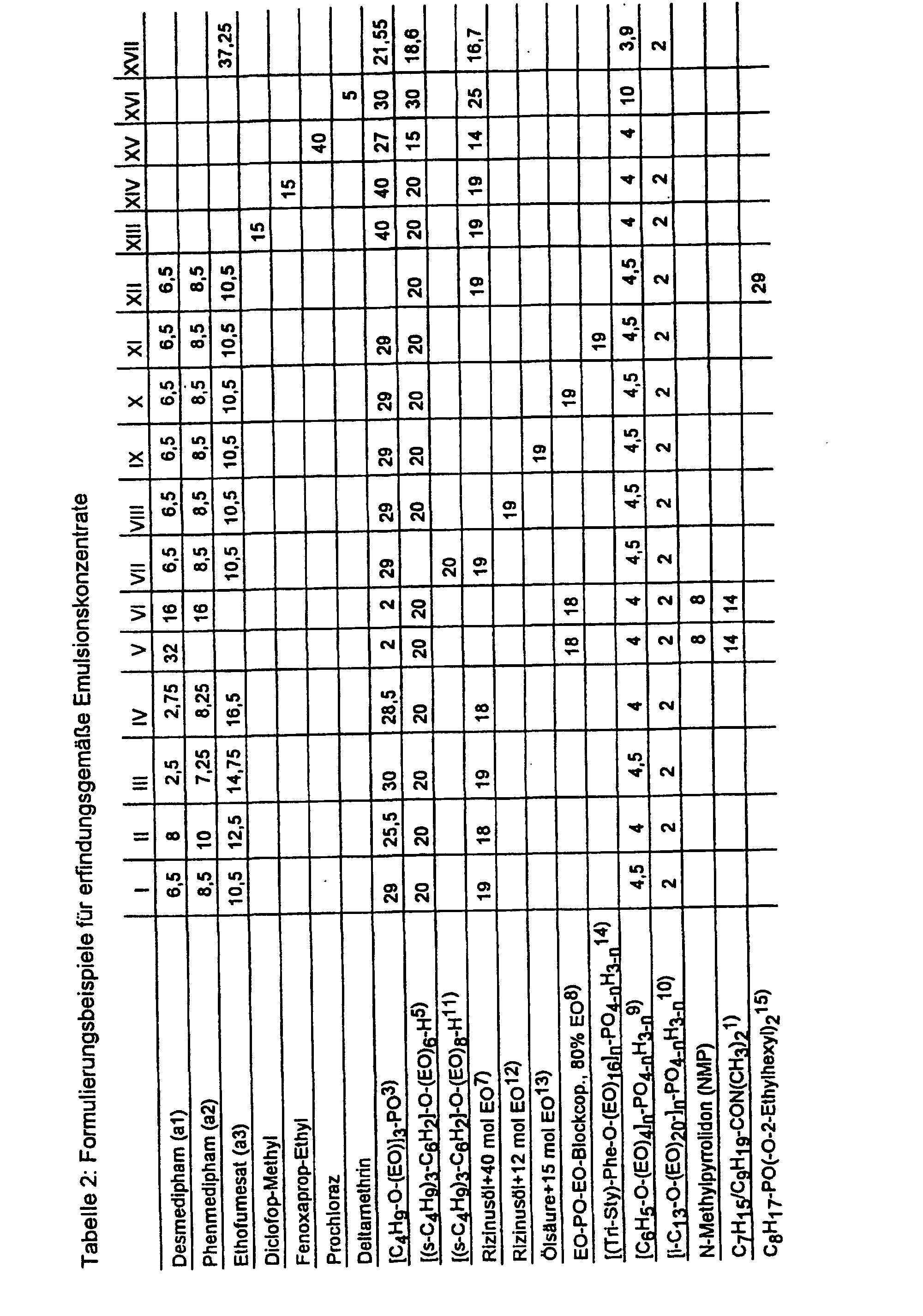
- additional nonionic surfactant components - as examples VIII, IX and X show - in addition to castor oil reacted with 40 mol EO, in particular castor oil reacted with only 12 mol EO, oleic acid reacted with 15 mol EO and EO-PO-EO block copolymers become.
- Example XII also shows that the ortho-phosphoric acid esters can also be replaced by phosphonates.
- the surfactant / solvent systems described enable the production of stable emulsion concentrates with a wide range of active ingredient loading and composition (Examples I-VII): for example, the active ingredient loading can be between 20 and 40, preferably between 24 and 30 weight percent vary (Examples I-IV).
- the active ingredient composition in addition to stable "single-agent emulsion concentrates", those components with two or in particular three active ingredients are also available with this component mixture - preferably of the types a1), a2) and / or a3) (Examples II, V and VI).
- Examples XIII, XIV, XV and XVI further show that the surfactant / solvent systems described are also suitable for the preparation of emulsion concentrates with active ingredients other than those explicitly listed under (a1) - (a3).
- they can also be used to produce emulsion concentrates that contain the active ingredients diclofop-methyl, fenoxaprop-ethyl, prochloraz and / or deltamethrin.
- Preferred weight ratios of the components ortho-phosphoric acid ester / phosphonic acid ester: surfactant based on aromatics are, depending on the active ingredient loading and composition of the emulsion concentrates, 100: 1 to 1: 100, particularly preferably 20: 1 to 1:20, further preferably 5: 1 to 1: 2, for example 1.5: 1 to 1.3: 1.
- Emulsifiable concentrates made in accordance with the present invention do not contain any additional water, but only that in the mentioned commercially available surfactants or surfactant mixtures, polymers residual solvents. Because of the formulations contained surfactants, however, it is possible to extend the formulations mentioned a critical volume break with water without causing a The formulation becomes cloudy or unstable. This creates formal initially W / O microemulsions, which increase in water content in W / O emulsions and finally - with further dilution with water - in O / W emulsions pass.
- the invention therefore also includes surfactant / solvent mixture according to the invention b) (additional) water containing liquid formulations of in particular one or more Active substances of type (a1), (a2) and / or (a3).
- Formulations and spray liquors also show biological use beneficial results. It is observed that the biological activity of the used pesticidal active ingredients through the use of the invention Component (b) can be increased in a synergistic manner.
Landscapes
- Life Sciences & Earth Sciences (AREA)
- General Health & Medical Sciences (AREA)
- Health & Medical Sciences (AREA)
- Dentistry (AREA)
- Zoology (AREA)
- Plant Pathology (AREA)
- Toxicology (AREA)
- Engineering & Computer Science (AREA)
- Agronomy & Crop Science (AREA)
- Wood Science & Technology (AREA)
- Pest Control & Pesticides (AREA)
- Environmental Sciences (AREA)
- Agricultural Chemicals And Associated Chemicals (AREA)
- Detergent Compositions (AREA)
- Emulsifying, Dispersing, Foam-Producing Or Wetting Agents (AREA)
- Medicinal Preparation (AREA)
- Medicines Containing Material From Animals Or Micro-Organisms (AREA)
- Cosmetics (AREA)
Description
Daher sind hochkonzentrierte stabile Formulierungen und Coformulierungen mit umweltfreundlichen Hilfsstoffen von grundsätzlichem Interesse.
- einwertigen Alkanolen mit 5 bis 22 C-Atomen,
- Diolen oder Polyolen,
- Aryl-, Alkylaryl-, Poly(alkyl)aryl- oder Poly(arylalkyl)arylalkoholen,
- alkoxylierten Alkoholen, die durch Umsetzung der vorstehend genannten Alkohole mit Alkylenoxiden erhalten werden, oder
- alkoxylierten Alkoholen, die durch Umsetzung einwertiger Alkanole mit 1 bis 4 C-Atomen und Alkylenoxiden erhalten werden, und
- einwertige Alkanole mit 1 bis 22 C-Atomen,
- Diole oder Polyole,
- Aryl-, Alkylaryl-, Poly(alkyl)aryl-und Poly(arylalky)arylalkoholen oder
- alkoxylierte Alkoholen, die durch Umsetzung der vorstehend genannten Alkohole mit Alkylenoxiden erhalten werden,
(= erfindungsgemäßes Tensid/Lösungsmittel-System) enthalten.
mit 4 bis 10 mol Ethylenoxid umgesetztes Phenol, kommerziell beispielsweise in Form der Agrisol®-Marken (Akcros) erhältlich,
mit 4 bis 50 mol Ethylenoxid umgesetztes Triisobutylphenol, kommerziell beispielsweise in Form der Sapogenat T®-Marken (Clariant) erhältlich,
mit 4 bis 50 mol Ethylenoxid umgesetztes Nonylphenol, kommerziell beispielsweise in Form der Arkopat®-Marken (Clariant) erhältlich,
mit 4 bis 150 mol Ethylenoxid umgesetztes Tristyrylphenol, beispielsweise Soprophor CY/8® (Rhodia) und
saures (lineares) Dodecylbenzolsulfonat, kommerziell beispielsweise in Form der Marlon®-Marken (Hüls) erhältlich.
- einwertigen Alkanolen mit 5 bis 22 C-Atomen, z.B. mit n-, i- oder neo-Pentanol, n-Hexanol, n-Octanol, 2-Ethylhexanol,
- Diolen oder Polyolen, wie Ethylenglykol, Propylenglykol oder Glycerin,
- Aryl-, Alkylaryl-, Poly(alkyl)aryl- und Poly(arylalkyl)arylalkoholen, beispielsweise mit Phenol, Kresol, Octylphenol, Nonylphenol, Triisobutylphenol und/oder Tristyrylphenol,
- alkoxylierten Alkoholen, die durch Umsetzung der vorstehend genannten Alkohole mit Alkylenoxiden, vorzugsweise (C1-C4)Alkylenoxiden erhalten werden, und
- alkoxylierten Alkoholen, die durch Umsetzung einwertiger Alkanole mit 1 bis 4 C-Atomen und Alkylenoxidenerhalten werden,
- einwertigen Alkanolen mit 1 bis 22 C-Atomen, z.B. mit z. B. n-Methanol, n-Ethanol, n- oder i-Propanol, n-, i- oder t-Butanol, n-, i-oder neo-Pentanol, n-Hexanol, n-Octanol, 2-Ethylhexanol, oder auch sec-Butanol,
- Diolen oder Polyolen, wie Ethylenglykol, Propylenglykol oder Glycerin,
- Aryl-, Alkylaryl-, Poly(alkyl)aryl- oder Poly(arylalkyl)arylalkoholen, beispielsweise mit Phenol, Kresol, Octylphenol, Nonylphenol, Triisobutylphenol und/oder Tristyryiphenol oder
- alkoxylierten Alkoholen, die durch Umsetzung der vorstehend genannten Alkohole mit Alkylenoxiden, vorzugsweise (C1-C4)Alkylenoxiden, erhalten werden,
Die Alkoholkomponenten enthalten vorzugsweise 1-200, insbesondere 1-150, ganz besonders 1-100 Alkylenoxyeinheiten, vorzugsweise Ethylenoxyeinheiten,
- mit alkoxylierten kurzkettigen Alkoholen mit 1 bis 22 C-Atomen im Alkylrest und 1 bis 30 Alkylenenoxy-einheiten im Polyalkylenoxy-teil dreifach veresterte ortho-Phosphorsäure, beispielsweise Tributoxyethytphosphat (Clariant),
- mit Alkylalkoholen mit 5 bis 22 C-Atomen dreifach veresterte ortho-Phosphorsäure, beispielsweise Hostaphat CG 120® (Clariant), Tri-n-Octylphosphat ("TOF", Bayer), sowie
- mit gegebenenfalls alkoxylierten Alkoholen mit 1 bis 22 C-Atomen im Alkylrest oder gegebenenfalls alkoxylierten Phenolderivaten, jeweils mit 0 bis 30 Alkylenoxy-einheiten im Polyalkylenoxy-teil teilweise veresterte ortho-Phosphorsäure, wobei die verbleibenden OH-Valenzen der ortho-Phosphorsäure nachfolgend alkoxyliert wurden (z.B. mit 1 bis 10 mol Alkylenoxid mit 1 bis 4 C-Atomen), beispielsweise das Reaktionsprodukt von Mono-/Dibutoxyethylphosphat und 2 mol Ethylenoxid bzw. 2 mol Propylenoxid (Clariant).
- aliphatische oder aromatische Kohlenwasserstoffe, wie z.B. Mineralöle, Paraffine oder Toluol, Xylole und Naphthalinderivate, insbesondere 1-Methylnaphthalin, 2-Methylnaphthalin, 6-16C-Aromatengemische wie z.B. die Solvesso®-Reihe (ESSO) mit den Typen Solvesso® 100 (Kp. 162-177°C), Solvesso® 150 (Kp. 187-207°C) und Solvesso® 200 (Kp. 219-282 °C) und 6-20C-Aliphaten, die linear oder cyclisch sein können, wie die Produkte der Shellsol®-Reihe, Typen T und K oder BP-n Paraffine,
- halogenierte aliphatische oder aromatische Kohlenwasserstoffe wie Methylen-chlorid bzw. Chlorbenzol,
- Ester wie z.B. Triacetin (Essigsäuretriglycerid), Butyrolacton, Propylencarbonat, Triethylzitrat und Phthalsäure-(C1-C22)alkylester, speziell Phthalsäure(C4-C8)alkylester,
- Ether wie Diethylether, Tetrahydrofuran (THF), Dioxan, Alkylenglykolmonoalkyether und -dialkylether wie z.B. Propylenglykolmonomethylether, speziell Dowanol® PM (Propylenglykolmonomethylether), Propylen-glykolmonoethylether, Ethylenglykolmonomethylether oder - monoethylether, Diglyme und Tetraglyme,
- Amide wie Dimethylformamid (DMF), Dimethylacetamid, Dimethyicapryl/caprin-fettsäureamid und N-Alkylpyrrolidone,
- Ketone wie das wasserlösliche Aceton, aber auch mit Wasser nicht mischbare Ketone wie beispielsweise Cyclohexanon oder Isophoron,
- Nitrile wie Acetonitril, Propionitril, Butyronitril und Benzonitril,
- Sulfoxide und Sulfone wie Dimethylsulfoxid (DMSO) und Sulfolan sowie
- Öle im allgemeinen, z.B. auf pflanzlicher Basis wie Maiskeimöl und Rapsöl.
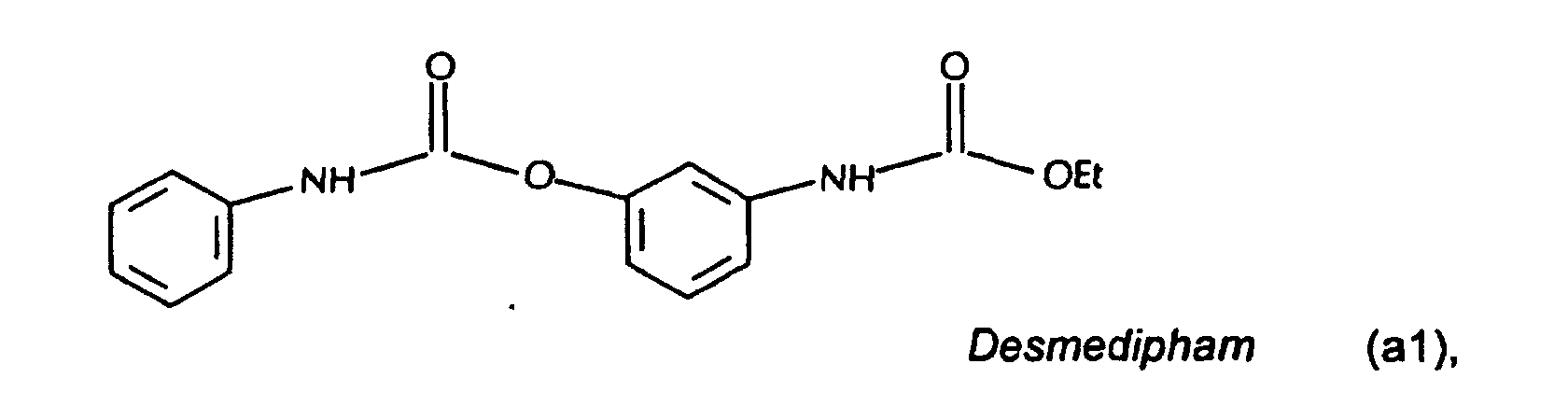


Die Verbindungen der Formel (a3) enthalten ein asymmetrisches C-Atom. Beide Enantiomere werden dabei als biologisch aktiv angesehen. Die Formel (a3) umfaßt daher alle Stereoisomeren und deren Gemische, insbesondere das Racemat. Ihre herbiziden Eigenschaften sind z.B. in GB-A-1271659 beschrieben.
Die Gewichtsverhältnisse der kombinierten herbiziden Wirkstoffe vom Typ a) (Desmedipham(a1) : Phenmedipham(a2) : Ethofumesate(a3)) können innerhalb weiter Grenzen variieren und liegen in der Regel zwischen 1:1:1 und 1:10:100, im Falle reiner Biscarbamt-Mischungen (a1): (a2) zwischen 100:1 und 1:100. Für Mischungen mit allen drei herbiziden Wirkstoffen sind folgende Gewichtsverhältnisse (a1) : (a2) : (a3) besonders bevorzugt:
- (a1): (a2): (a3) wie 1:1:1 bis 1:2:3, insbesondere 1:1.2:1.4 bis 1:1.8:2.4 und
- (a1 ) :(a2) : (a3) wie 1:2:5 bis 1:5:10, insbesondere 1:2.5:5.5 bis 1:3.5:6.5.
Gleichwohl ist jedoch auch der aromatische Charakter der eingesetzten Tenside von Bedeutung. Dies wird aus den Beispielen 2 und 3 ersichtlich: Kommt anstelle eines Tensides auf Aromatenbasis ein (herkömmliches) aliphatisches Kohlenwasserstofftensid zum Einsatz, erhält man ebenfalls instabile Emulsionskonzentrate. Dies unterstreicht die Tatsache, daß die Tensidkomponente auf Aromatenbasis essentieller Bestandteil der beschriebenen Erfindung ist.
In diesem Zusammenhang ist weiterhin darauf hinzuweisen, daß die beschriebenen Tensid/Lösungsmittel-Systeme die Herstellung stabiler Emulsionskonzentrate mit in weiten Grenzen variabler Wirkstoffbeladung und -zusammensetzung ermöglichen (Beispiele I-VII): So kann die Wirkstoffbeladung beispielsweise zwischen 20 und 40, vorzugsweise zwischen 24 und 30 Gewichtsprozent variieren (Beispiele I-IV). Hinsichtlich der Wirkstoffzusammensetzung sind mit dieser Komponentenmischung neben stabilen "Ein-Wirkstoff-Emulsionskonzentraten" auch solche mit zwei oder insbesondere drei Wirkstoffen zugänglich - vorzugsweise vom Typ a1), a2) und/oder a3) (Beispiele II, V und VI).
Ferner zeigen die Beispiele XIII, XIV, XV und XVI, daß sich die beschriebenen Tensid/Lösungsmittelsysteme auch zur Herstellung von Emulsionskonzentraten mit anderen als den unter (a1)-(a3) explizit aufgeführten Wirkstoffen eignen. So lassen sich mit ihnen beispielsweise auch Emulsionskonzentrate herstellen, die die Wirkstoffe Diclofop-methyl, Fenoxaprop-ethyl, Prochloraz und/oder Deltamethrin enthalten.
Bevorzugte Gewichtsverhältnisse der Komponenten Ortho-Phosphorsäureester/Phosphonsäureester:Tensid auf Aromatenbasis sind je nach Wirkstoffbeladung und -Zusammensetzung der Emulsionskonzentrate 100:1 bis 1:100, besonders bevorzugt 20:1 bis 1:20, weiter bevorzugt 5:1 bis 1:2, beispielsweise 1,5:1 bis 1,3:1.
- Frostschutzmittel und Verdunstungshemmer wie Glycerin, z.B. in einer Menge von 2 bis 10 Gew.-% und
- Konservierungsstoffe, z.B. Mergal K9N® (Riedel) oder Cobate C®, in den üblichen Anwendungskonzentrationen für die jeweils speziell eingesetzten Mittel.
| Beispiele für Formulierungen, die keine stabilen Emulsionskonzentrate (EC) ergeben | ||||
| 1 | 2 | 3 | 4 | |
| Desmedipham (a1) | 8 | 2,75 | 2,75 | |
| Phenmedipham (a2) | 10 | 8,25 | 8,25 | |
| Ethofumesat (a3) | 12,5 | 16,5 | 16,5 | 37,25 |
| Rapsöl | 18 | |||
| C7H15/C9H19-CON(CH3)2 1) | 23 | |||
| [C4H9-O]3-PO2) | 21,55 | |||
| [C4H9-O-(EO)]3-PO3) | 28,5 | 28,5 | ||
| N-Methylpyrrolidon (NMP) | 8,5 | |||
| [NP-O-(EO)6-]n-PO4-nH3-n 4) | 2 | |||
| [(s-C4H9)3-C6H2]-O-(EO)6-H5) | 18 | 18,6 | ||
| C12/14-O-(EO)23 6) | 20 | 20 | ||
| Rizinusöl+40 mol EO7) | 18 | 16,7 | ||
| EO-PO-EO-Blockcop., 80% EO8) | 18 | |||
| [C6H5-O-(EO)4]n-PO4-nH3-n 9) | 4 | 4 | 3,9 | |
| [i-C13-O-(EO)20-]n-PO4-nH3-n 10) | 2 | 2 |
- n
- In den Formeln gilt n=0-3, d. h. es handelt sich jeweils um ein Gemisch der Phosphorester mit n=1, 2 und 3, wobei die sauren Anteile mit n = 1 und 2 wesentlich sind;
- Zahlen
- Alle Angaben sind Anteile in Gewichtsprozent bezogen auf das Gewicht der Formulierung (= 100 Gewichtsprozent);
- i-C13- =
- lsotridecyl
- EO =
- "Ethylenoxid", d.h. eine Gruppe der Formel -CH2-CH2-O- (Ethylenoxy) oder, falls endständig, -CH2-CH2O-H (Hydroxyethyl)
- PO =
- "Propylenoxid", d.h. eine Gruppe der Formel -C3H6-O- (Propylenoxy)
- (Tri-Sty-)Phe- =
- Tristyrylphenyl-
- NP- =
- Nonylphenyl
Claims (13)
- Tensid/Lösungsmittel-System für flüssige organische Formulierungen, dadurch gekennzeichnet, daß esb1) ein oder mehrere Tenside auf Aromatenbasis undb2) einen oder mehrere vollständig verestere organische Phosphate und/oder Phosphonate als Lösungsmittel, ausgewählt aus der Gruppe bestehend ausenthält.b2.1) Estern der Phosphorsäure mit Alkoholen aus der Gruppe bestehend auseinwertigen Alkanolen mit 5 bis 22 C-Atomen,Diolen oder Polyolen,Aryl-, Alkylaryl-, Poly(alkyl)aryl- oder Poly(arylalkyl)arylalkoholen,alkoxylierten Alkoholen, die durch Umsetzung der vorstehend genannten Alkohole mit Alkylenoxiden erhalten werden, oderalkoxylierten Alkoholen, die durch Umsetzung einwertiger Alkanole mit 1 bis 4 C-Atomen und Alkylenoxiden erhalten werden, undb2.2) Phosphonaten auf Basis von zweifach mit Alkoholen und/oder alkoxylierten Alkoholen veresterten Alkyl-, Aryl-, Alkylaryl-, Poly(alkyl)-aryl- oder Poly(arylalkyl)-aryl-Phosphonsäuren mit Alkoholen aus der Gruppewobei die drei Alkoholkomponenten des Phosphorsäureesters (b2.1) oder die zwei Alkoholkomponenten des Phosphonats (b2.2) gleich oder verschieden sein können und so ausgewählt sind, dass der Ester ein polares Lösungsmittel ist, das bei 20°C wasserunlöslich oder bis zu 5 g/l in Wasser löslich ist und in wäßriger Lösung keine mizellaren Aggregate ausbildet,einwertige Alkanole mit 1 bis 22 C-Atomen,Diole oder Polyole,Aryl-, Alkylaryl-, Poly(alkyl)aryl- und Poly(arylalkyl)arylalkoholen oderalkoxylierte Alkoholen, die durch Umsetzung der vorstehend genannten Alkohole mit Alkylenoxiden erhalten werden,
- Tensid/Lösungsmittel-System nach Anspruch 1, dadurch gekennzeichnet, daß es ein oder mehrere Tenside auf Aromatenbasis aus der Gruppeb1.1) Phenole, Phenyl-(C1-C4)alkyl-ether oder (poly)alkoxylierte Phenole,b1.2) (Poly)alkylphenole oder (Poly)alkylphenolalkoxylate,b1.3) Polyarylphenole oder Polyarylphenolalkoxylate,b1.4) Verbindungen, die formal die Umsetzungsprodukte der unter b1.1) bis b1.3) beschriebenen Moleküle mit Schwefelsäure oder Phosphorsäure darstellen und deren mit Basen neutralisierte Salze undb1.5) saure und mit Basen neutralisierte (Poly)alkyl- und (Poly)aryl-benzolsulfonate enthält.
- Tensid/Lösungsmittel-System nach Anspruch 1 oder 2, dadurch gekennzeichnet, daß es ein oder mehrere Tenside auf Aromatenbasis aus der Gruppeenthält.mit 4 bis 10 mol Ethylenoxid umgesetztes Phenol,mit 4 bis 50 mol Ethylenoxid umgesetztes Triisobutylphenol,mit 4 bis 50 mol Ethylenoxid umgesetztes Nonylphenol,mit 4 bis 150 mol Ethylenoxid umgesetztes Tristyrylphenol undsaures (lineares) Dodecylbenzolsulfonat
- Tensid/Lösungsmittel-System nach einem der Anprüche 1 bis 3, dadurch gekennzeichnet, daß es als Lösungsmittel ein oder mehrere Verbindungen aus der Gruppemit alkoxylierten kurzkettigen Alkoholen mit 1 bis 22 C-Atomen im Alkylrest und 1 bis 30 Alkylenenoxy-einheiten im Polyalkylenoxy-teil dreifach veresterte ortho-Phosphorsäure,mit Alkylalkoholen mit 5 bis 22 C-Atomen dreifach veresterte ortho-Phosphorsäure,mit gegebenenfalls alkoxylierten Alkoholen mit 1 bis 22 C-Atomen im Alkylrest oder gegebenenfalls alkoxylierten Phenolderivaten, jeweils mit 0 bis 30 Alkylenoxy-einheiten im Polyalkylenoxy-teil, teilweise veresterte ortho-Phosphorsäure, wobei die verbleibenden OH-Vatenzen der ortho-Phosphorsäure nachfolgend alkoxyliert wurden, undformal zweifach mit Alkoholen umgesetzte Ester der n-Octylphosphonsäure, enthält.
- Tensid/Lösungsmittel-System nach einem der Anprüche 1 bis 4, dadurch gekennzeichnet, daß es als Lösungsmittel Tri(butoxyethyl)phosphat enthält.
- Flüssige Formulierung, welcheenthält.(a) einen oder mehrere in Wasser unlösliche Wirkstoffe,(b) das erfindungsgemäße Tensid/Lösungsmittel-System (= Komponentenmischung (b)) gemäß einem der Ansprüche 1 bis 5,(c) gegebenenfalls weitere organische Lösungsmittel,(d) gegebenenfalls weitere Tenside und/oder Polymere und(e) gegebenenfalls Wasser
- Flüssige Formulierung nach Anspruch 6, welchea) 1 bis 50 Gew.-% pestizider Wirkstoffe,b) 5 bis 80 Gew.-% des erfindungsgemäßen Tensid-/Lösungsmittelsystems (b),c) 0 bis 40 Gew.-% weitere organische Lösungsmittel,d) 0 bis 30 Gew.-% weitere Tenside,e) 0 bis 20 Gew.-% übliche Formulierungshilfsmittel undf) 0 bis 96 Gew.-% Wasser enthält.
- Emulsionskonzentrat, dadurch gekennzeichnet, daß esa) 10 bis 40 Gew.-% eines oder mehrerer in Wasser unlöslicher Wirkstoffe,b) 10 bis 60 Gew.-% des erfindungsgemäßen Tensid-/Lösungsmittelsystems (b) gemäß einem der Ansprüche 1 bis 5,c) 5 bis 35 Gew.-% weitere organische Lösungsmittel,d) 10 bis 25 Gew.-% weitere Tenside unde) 0 bis 10 Gew.-% übliche Formulierungshilfsmittel enthält.
- Formulierung gemäß einem der Ansprüche 6 bis 8, dadurch gekennzeichnet, daß sie einen oder mehrere Wirkstoffe aus der Gruppe der Herbizide Desmedipham, Phenmedipham und Ethofumesat enthält.
- Verfahren zur Herstellung einer gemäß einem der Ansprüche 6 bis 8 definierten Formulierung, dadurch gekennzeichnet, daß man die Komponenten miteinander vermischt.
- Verfahren zur Bekämpfung von unerwünschtem Pflanzenwuchs, dadurch gekennzeichnet, daß man eine wirksame Menge einer Formulierung gemäß einem der Ansprüche 6 bis 9, die einen herbiziden Wirkstoff enthält, falls erforderlich nach Verdünnen mit Wasser, auf die Pflanzen, Pflanzenteile oder die Anbaufläche appliziert.
- Verwendung des Tensid-/Lösungsmittelsystems nach Anspruch 1 in flüssigen Zubereitungen von Wirkstoffen.
- Verwendung gemäß Anspruch 12 in Emulsionskonzentraten (EC).
Priority Applications (1)
| Application Number | Priority Date | Filing Date | Title |
|---|---|---|---|
| SI200030361T SI1164842T1 (en) | 1999-03-23 | 2000-03-13 | Liquid formulations and tenside/solvent systems |
Applications Claiming Priority (3)
| Application Number | Priority Date | Filing Date | Title |
|---|---|---|---|
| DE19913036 | 1999-03-23 | ||
| DE19913036A DE19913036A1 (de) | 1999-03-23 | 1999-03-23 | Flüssige Zubereitungen und Tensid/Lösungsmittel-Systeme |
| PCT/EP2000/002207 WO2000056146A1 (de) | 1999-03-23 | 2000-03-13 | Flüssige zubereitungen und tensid/lösungsmittel-systeme |
Publications (2)
| Publication Number | Publication Date |
|---|---|
| EP1164842A1 EP1164842A1 (de) | 2002-01-02 |
| EP1164842B1 true EP1164842B1 (de) | 2004-02-18 |
Family
ID=7902056
Family Applications (1)
| Application Number | Title | Priority Date | Filing Date |
|---|---|---|---|
| EP00909356A Expired - Lifetime EP1164842B1 (de) | 1999-03-23 | 2000-03-13 | Flüssige zubereitungen und tensid/lösungsmittel-systeme |
Country Status (23)
| Country | Link |
|---|---|
| US (3) | US20040214722A1 (de) |
| EP (1) | EP1164842B1 (de) |
| JP (1) | JP4841728B2 (de) |
| AT (1) | ATE259589T1 (de) |
| AU (1) | AU3166300A (de) |
| BG (1) | BG65410B1 (de) |
| CA (1) | CA2366645C (de) |
| CZ (1) | CZ298636B6 (de) |
| DE (2) | DE19913036A1 (de) |
| DK (1) | DK1164842T3 (de) |
| EE (1) | EE04897B1 (de) |
| ES (1) | ES2215616T3 (de) |
| HR (1) | HRP20010691B1 (de) |
| HU (1) | HU225524B1 (de) |
| PL (1) | PL201228B1 (de) |
| PT (1) | PT1164842E (de) |
| RS (1) | RS50084B (de) |
| RU (1) | RU2322059C2 (de) |
| SK (1) | SK287130B6 (de) |
| TR (1) | TR200102652T2 (de) |
| UA (1) | UA72757C2 (de) |
| WO (1) | WO2000056146A1 (de) |
| ZA (1) | ZA200107237B (de) |
Cited By (1)
| Publication number | Priority date | Publication date | Assignee | Title |
|---|---|---|---|---|
| EP1916268A1 (de) * | 2006-10-23 | 2008-04-30 | Cognis IP Management GmbH | Polymerzusammensetzungen |
Families Citing this family (49)
| Publication number | Priority date | Publication date | Assignee | Title |
|---|---|---|---|---|
| DE19963381A1 (de) * | 1999-12-28 | 2001-07-12 | Aventis Cropscience Gmbh | Tensid/Lösungsmittel-Systeme |
| EP1523235A1 (de) * | 2002-07-12 | 2005-04-20 | Bayer CropScience GmbH | Fluessige adjuvantien |
| US8557734B2 (en) | 2004-04-06 | 2013-10-15 | Bayer Cropscience Lp | Herbicidal compositions |
| DE102004047092A1 (de) | 2004-09-29 | 2006-03-30 | Clariant Gmbh | Agrochemische Zusammensetzung enthaltend Phosphorsäureester |
| GB0621440D0 (en) * | 2006-10-27 | 2006-12-06 | Syngenta Crop Protection Ag | Herbicidal compositions |
| EP1938688A1 (de) * | 2006-12-18 | 2008-07-02 | Bayer CropScience AG | Penetrationsförderer für Insektizide |
| EP1938687A1 (de) * | 2006-12-18 | 2008-07-02 | Bayer CropScience AG | Penetrationsförderer für Fungizide |
| EP1938689A1 (de) * | 2006-12-18 | 2008-07-02 | Bayer CropScience AG | Penetrationsförderer für Herbizide |
| CA2675460A1 (en) * | 2007-01-29 | 2008-08-07 | Syngenta Limited | A post-emergent herbicidal composition for controlling the weed avena in wheat crops, said composition comprising pinoxaden, cyprosulfamide, and an additive |
| JP5125126B2 (ja) * | 2007-01-31 | 2013-01-23 | 住友化学株式会社 | 疎水性農薬活性化合物を含有する農薬液剤 |
| EP2090166A1 (de) * | 2008-02-14 | 2009-08-19 | Bayer CropScience AG | Flüssige herbizide Zubereitungen |
| GB0921343D0 (en) | 2009-12-04 | 2010-01-20 | Syngenta Participations Ag | Chemical compounds |
| GB0921344D0 (en) | 2009-12-04 | 2010-01-20 | Syngenta Participations Ag | Chemical compounds |
| GB0921346D0 (en) | 2009-12-04 | 2010-01-20 | Syngenta Participations Ag | Chemical compounds |
| BR112012014564A2 (pt) | 2009-12-18 | 2015-09-15 | Sygenta Ltd | "método de combate e controle de pragas" |
| WO2011107741A1 (en) | 2010-03-05 | 2011-09-09 | Syngenta Participations Ag | Herbicidal composition comprising a mixture of a first herbicide and pinoxaden |
| CN103003239A (zh) | 2010-05-31 | 2013-03-27 | 先正达参股股份有限公司 | 基于螺杂环吡咯烷衍生物的杀虫剂 |
| EP2576554A1 (de) | 2010-05-31 | 2013-04-10 | Syngenta Participations AG | 1, 8 -diazaspiro [4.5]decan- 2, 4 -dion-derivate als pestizide |
| EP2576555A1 (de) | 2010-05-31 | 2013-04-10 | Syngenta Participations AG | 1, 8 -diazaspiro [4.5]decan- 2, 4 -dion-derivate als pestizide |
| AR081768A1 (es) | 2010-05-31 | 2012-10-17 | Syngenta Participations Ag | Composiciones pesticidas |
| KR20130080485A (ko) | 2010-05-31 | 2013-07-12 | 신젠타 파티서페이션즈 아게 | 작물 강화 방법 |
| CA2798320A1 (en) | 2010-05-31 | 2011-12-08 | Syngenta Participations Ag | Pesticidal compositions |
| CN103002739B (zh) | 2010-05-31 | 2015-09-09 | 先正达参股股份有限公司 | 控制抗新烟碱的半翅目的方法 |
| GB201013009D0 (en) | 2010-08-02 | 2010-09-15 | Syngenta Participations Ag | Agricultural method |
| AR087008A1 (es) | 2011-06-22 | 2014-02-05 | Syngenta Participations Ag | Derivados de n-oxi-pirazolo-triazepina-diona |
| ES2585836T3 (es) * | 2011-07-19 | 2016-10-10 | Arysta Lifescience Benelux Sprl | Método mejorado para producir disoluciones de pesticidas emulsionables |
| GB201115564D0 (en) | 2011-09-08 | 2011-10-26 | Syngenta Ltd | Herbicidal composition |
| US20140187426A1 (en) | 2011-09-16 | 2014-07-03 | Syngenta Participations Ag | Crop enhancement |
| JP6063953B2 (ja) | 2011-11-29 | 2017-01-18 | シンジェンタ パーティシペーションズ アーゲー | 殺虫性トリアジノン誘導体 |
| GB201121377D0 (en) | 2011-12-12 | 2012-01-25 | Syngenta Ltd | Formulation component |
| WO2013127780A1 (en) | 2012-03-01 | 2013-09-06 | Syngenta Participations Ag | Chemical compounds |
| WO2013127768A1 (en) | 2012-03-01 | 2013-09-06 | Syngenta Participations Ag | Pyridine carboxamide pesticides |
| EP2647626A1 (de) | 2012-04-03 | 2013-10-09 | Syngenta Participations AG. | 1-Aza-spiro[4.5]dec-3-en- und 1,8-Diaza-spiro[4.5]dec-3-enderivate als Pestizide |
| WO2013167651A1 (en) | 2012-05-11 | 2013-11-14 | Syngenta Participations Ag | Crop enhancement |
| GB201210397D0 (en) | 2012-06-11 | 2012-07-25 | Syngenta Participations Ag | Crop enhancement compositions |
| GB201210398D0 (en) | 2012-06-11 | 2012-07-25 | Syngenta Participations Ag | Crop enhancement |
| GB201210395D0 (en) | 2012-06-11 | 2012-07-25 | Syngenta Participations Ag | Crop enhancement compositions |
| WO2014023531A1 (en) | 2012-08-07 | 2014-02-13 | Syngenta Participations Ag | Trifluoromethylpyridine carboxamides as pesticides |
| EP2738171A1 (de) | 2012-11-30 | 2014-06-04 | Syngenta Participations AG. | Pestizidaktive tricyclische Pyridylderivate |
| CN105072911A (zh) | 2013-03-28 | 2015-11-18 | 先正达参股股份有限公司 | 控制新烟碱抗性有害生物的方法 |
| EP2999333B1 (de) | 2013-05-23 | 2018-06-13 | Syngenta Participations AG | Tankmischungformulierungen |
| WO2015000715A1 (en) | 2013-07-02 | 2015-01-08 | Syngenta Participations Ag | Pesticidally active bi- or tricyclic heterocycles with sulfur containing substituents |
| EP2873668A1 (de) | 2013-11-13 | 2015-05-20 | Syngenta Participations AG. | Pestizidwirksame bicyclische Heterocyclen enthaltende mit schwefelhaltigen Substituenten |
| WO2015091945A1 (en) | 2013-12-20 | 2015-06-25 | Syngenta Participations Ag | Pesticidally active substituted 5,5-bicyclic heterocycles with sulphur containing substituents |
| US20150252310A1 (en) | 2014-03-07 | 2015-09-10 | Ecolab Usa Inc. | Alkyl amides for enhanced food soil removal and asphalt dissolution |
| WO2016016131A1 (en) | 2014-07-31 | 2016-02-04 | Syngenta Participations Ag | Pesticidally active cyclic enaminones |
| CN111296464A (zh) * | 2020-03-19 | 2020-06-19 | 利尔化学股份有限公司 | 一种含有唑啉草酯的除草组合物 |
| WO2022117515A1 (en) | 2020-12-01 | 2022-06-09 | Bayer Aktiengesellschaft | Compositions comprising iodosulfuron-methyl and tehp |
| UA130814C2 (uk) | 2020-12-01 | 2026-05-20 | Баєр Акціенгезельшафт | Композиції, що містять мезосульфурон-метил і tehp |
Family Cites Families (7)
| Publication number | Priority date | Publication date | Assignee | Title |
|---|---|---|---|---|
| SK278523B6 (en) * | 1984-02-29 | 1997-08-06 | Erik Nielsen | A stabilised liquid herbicidal agent and method for killing weed plants |
| FR2599593A1 (fr) * | 1986-06-06 | 1987-12-11 | Rhone Poulenc Agrochimie | Compositions herbicides liquides stabilisees a base de m-bis-carbamates et leur utilisation |
| DE3935977A1 (de) * | 1989-10-28 | 1991-05-02 | Hoechst Ag | Selektive herbizide mittel |
| JPH08291004A (ja) * | 1995-04-24 | 1996-11-05 | Nippon Kayaku Co Ltd | 害虫防除剤組成物 |
| US5674517A (en) * | 1996-04-26 | 1997-10-07 | Henkel Corporation | Emulsifier for pesticide concentrates |
| DE19752552A1 (de) * | 1997-11-27 | 1999-06-02 | Hoechst Schering Agrevo Gmbh | Tensidsysteme für flüssige wässrige Zubereitungen |
| DE19963381A1 (de) * | 1999-12-28 | 2001-07-12 | Aventis Cropscience Gmbh | Tensid/Lösungsmittel-Systeme |
-
1999
- 1999-03-23 DE DE19913036A patent/DE19913036A1/de not_active Withdrawn
-
2000
- 2000-03-13 UA UA2001107178A patent/UA72757C2/uk unknown
- 2000-03-13 PT PT00909356T patent/PT1164842E/pt unknown
- 2000-03-13 TR TR2001/02652T patent/TR200102652T2/xx unknown
- 2000-03-13 HU HU0200351A patent/HU225524B1/hu unknown
- 2000-03-13 EE EEP200100496A patent/EE04897B1/xx unknown
- 2000-03-13 PL PL351811A patent/PL201228B1/pl unknown
- 2000-03-13 WO PCT/EP2000/002207 patent/WO2000056146A1/de not_active Ceased
- 2000-03-13 ES ES00909356T patent/ES2215616T3/es not_active Expired - Lifetime
- 2000-03-13 JP JP2000606064A patent/JP4841728B2/ja not_active Expired - Lifetime
- 2000-03-13 RU RU2001128499/15A patent/RU2322059C2/ru active
- 2000-03-13 CZ CZ20013398A patent/CZ298636B6/cs not_active IP Right Cessation
- 2000-03-13 RS YUP-652/01A patent/RS50084B/sr unknown
- 2000-03-13 CA CA2366645A patent/CA2366645C/en not_active Expired - Lifetime
- 2000-03-13 HR HR20010691A patent/HRP20010691B1/xx not_active IP Right Cessation
- 2000-03-13 DK DK00909356T patent/DK1164842T3/da active
- 2000-03-13 AT AT00909356T patent/ATE259589T1/de active
- 2000-03-13 SK SK1349-2001A patent/SK287130B6/sk not_active IP Right Cessation
- 2000-03-13 DE DE50005330T patent/DE50005330D1/de not_active Expired - Lifetime
- 2000-03-13 EP EP00909356A patent/EP1164842B1/de not_active Expired - Lifetime
- 2000-03-13 AU AU31663/00A patent/AU3166300A/en not_active Abandoned
-
2001
- 2001-03-13 US US09/937,166 patent/US20040214722A1/en not_active Abandoned
- 2001-08-31 ZA ZA200107237A patent/ZA200107237B/en unknown
- 2001-09-18 BG BG105908A patent/BG65410B1/bg unknown
-
2004
- 2004-11-10 US US10/985,606 patent/US20050084507A1/en not_active Abandoned
-
2005
- 2005-12-28 US US11/320,079 patent/US20060142163A1/en not_active Abandoned
Cited By (2)
| Publication number | Priority date | Publication date | Assignee | Title |
|---|---|---|---|---|
| EP1916268A1 (de) * | 2006-10-23 | 2008-04-30 | Cognis IP Management GmbH | Polymerzusammensetzungen |
| WO2008049528A1 (en) * | 2006-10-23 | 2008-05-02 | Cognis Ip Management Gmbh | Polymer compositions |
Also Published As
Similar Documents
| Publication | Publication Date | Title |
|---|---|---|
| EP1164842A1 (de) | Flüssige zubereitungen und tensid/lösungsmittel-systeme | |
| EP1251736B1 (de) | Tensid/lösungsmittel-systeme | |
| EP2244573B1 (de) | Flüssige herbizide zubereitungen | |
| EP0407874B1 (de) | Entschäumer für flüssige Netzmittel und schaumarme flüssige Pflanzenschutzmittel | |
| EP0514769B1 (de) | Neue Suspoemulsionen auf Basis Fenoxapropethyl | |
| DE69133141T2 (de) | Neue Tensidezusammensetzungen, Verfahren zu ihrer Herstellung und diese enhaltende Pestizidezusammensetzungen | |
| DE60008125T2 (de) | Pestizidformulierungen die als oberflächenaktive verbindungen phosphat-ester und alkoxylierte lignosulfonate enthalten | |
| EP0511611A1 (de) | Flüssige herbizide Mittel | |
| DE4013930A1 (de) | Fluessige konzentrierte zusammensetzungen auf der basis von n-phosphonomethylglycin | |
| WO2001082693A2 (de) | Flüssige formulierungen | |
| EP0551650A2 (de) | Kombinationen aus Herbiziden und pflanzenschützenden Stoffen | |
| EP0645964B1 (de) | Herbizide zusammensetzung | |
| EP0400585B1 (de) | Flüssige herbizide Mittel | |
| AU2008203130B2 (en) | Liquid preparations and surfactant/solvent systems | |
| DE102006013998A1 (de) | Emulgierbares Konzentrat | |
| DD292833A5 (de) | Herbizides mittel auf carbamatbasis |
Legal Events
| Date | Code | Title | Description |
|---|---|---|---|
| PUAI | Public reference made under article 153(3) epc to a published international application that has entered the european phase |
Free format text: ORIGINAL CODE: 0009012 |
|
| 17P | Request for examination filed |
Effective date: 20011023 |
|
| AK | Designated contracting states |
Kind code of ref document: A1 Designated state(s): AT BE CH CY DE DK ES FI FR GB GR IE IT LI LU MC NL PT SE |
|
| AX | Request for extension of the european patent |
Free format text: AL;LT PAYMENT 20011023;LV PAYMENT 20011023;MK;RO PAYMENT 20011023;SI PAYMENT 20011023 |
|
| 17Q | First examination report despatched |
Effective date: 20020211 |
|
| RAP1 | Party data changed (applicant data changed or rights of an application transferred) |
Owner name: BAYER CROPSCIENCE GMBH |
|
| GRAP | Despatch of communication of intention to grant a patent |
Free format text: ORIGINAL CODE: EPIDOSNIGR1 |
|
| GRAS | Grant fee paid |
Free format text: ORIGINAL CODE: EPIDOSNIGR3 |
|
| GRAA | (expected) grant |
Free format text: ORIGINAL CODE: 0009210 |
|
| AK | Designated contracting states |
Kind code of ref document: B1 Designated state(s): AT BE CH CY DE DK ES FI FR GB GR IE IT LI LU MC NL PT SE |
|
| AX | Request for extension of the european patent |
Extension state: LT LV RO SI |
|
| PG25 | Lapsed in a contracting state [announced via postgrant information from national office to epo] |
Ref country code: CY Free format text: LAPSE BECAUSE OF FAILURE TO SUBMIT A TRANSLATION OF THE DESCRIPTION OR TO PAY THE FEE WITHIN THE PRESCRIBED TIME-LIMIT Effective date: 20040218 |
|
| REG | Reference to a national code |
Ref country code: GB Ref legal event code: FG4D Free format text: NOT ENGLISH |
|
| PGFP | Annual fee paid to national office [announced via postgrant information from national office to epo] |
Ref country code: MC Payment date: 20040226 Year of fee payment: 5 |
|
| REG | Reference to a national code |
Ref country code: CH Ref legal event code: EP |
|
| PGFP | Annual fee paid to national office [announced via postgrant information from national office to epo] |
Ref country code: LU Payment date: 20040316 Year of fee payment: 5 |
|
| REG | Reference to a national code |
Ref country code: IE Ref legal event code: FG4D Free format text: GERMAN |
|
| REF | Corresponds to: |
Ref document number: 50005330 Country of ref document: DE Date of ref document: 20040325 Kind code of ref document: P |
|
| REG | Reference to a national code |
Ref country code: SE Ref legal event code: TRGR |
|
| GBT | Gb: translation of ep patent filed (gb section 77(6)(a)/1977) |
Effective date: 20040419 |
|
| REG | Reference to a national code |
Ref country code: GR Ref legal event code: EP Ref document number: 20040401235 Country of ref document: GR |
|
| REG | Reference to a national code |
Ref country code: DK Ref legal event code: T3 |
|
| REG | Reference to a national code |
Ref country code: PT Ref legal event code: SC4A Free format text: AVAILABILITY OF NATIONAL TRANSLATION Effective date: 20040517 |
|
| REG | Reference to a national code |
Ref country code: ES Ref legal event code: FG2A Ref document number: 2215616 Country of ref document: ES Kind code of ref document: T3 |
|
| ET | Fr: translation filed | ||
| PLBE | No opposition filed within time limit |
Free format text: ORIGINAL CODE: 0009261 |
|
| STAA | Information on the status of an ep patent application or granted ep patent |
Free format text: STATUS: NO OPPOSITION FILED WITHIN TIME LIMIT |
|
| REG | Reference to a national code |
Ref country code: SI Ref legal event code: IF |
|
| 26N | No opposition filed |
Effective date: 20041119 |
|
| PG25 | Lapsed in a contracting state [announced via postgrant information from national office to epo] |
Ref country code: LU Free format text: LAPSE BECAUSE OF NON-PAYMENT OF DUE FEES Effective date: 20050313 |
|
| PG25 | Lapsed in a contracting state [announced via postgrant information from national office to epo] |
Ref country code: MC Free format text: LAPSE BECAUSE OF NON-PAYMENT OF DUE FEES Effective date: 20050331 |
|
| REG | Reference to a national code |
Ref country code: GB Ref legal event code: 732E |
|
| REG | Reference to a national code |
Ref country code: CH Ref legal event code: PUE Owner name: BAYER CROPSCIENCE AG Free format text: BAYER CROPSCIENCE GMBH#BRUENINGSTRASSE 50#65929 FRANKFURT/MAIN (DE) -TRANSFER TO- BAYER CROPSCIENCE AG#ALFRED-NOBEL-STRASSE 50#40789 MONHEIM (DE) |
|
| NLS | Nl: assignments of ep-patents |
Owner name: BAYER CROPSCIENCE AG Effective date: 20071213 |
|
| REG | Reference to a national code |
Ref country code: PT Ref legal event code: PC4A Owner name: BAYER CROPSCIENCE AG, DE Effective date: 20080327 |
|
| REG | Reference to a national code |
Ref country code: SI Ref legal event code: SP73 Owner name: BAYER CROPSCIENCE AG; DE Effective date: 20080215 |
|
| REG | Reference to a national code |
Ref country code: FR Ref legal event code: TP |
|
| REG | Reference to a national code |
Ref country code: DE Ref legal event code: R081 Ref document number: 50005330 Country of ref document: DE Owner name: BAYER INTELLECTUAL PROPERTY GMBH, DE Free format text: FORMER OWNER: BAYER CROPSCIENCE AG, 40789 MONHEIM, DE Effective date: 20141023 Ref country code: DE Ref legal event code: R081 Ref document number: 50005330 Country of ref document: DE Owner name: BAYER CROPSCIENCE AKTIENGESELLSCHAFT, DE Free format text: FORMER OWNER: BAYER CROPSCIENCE AG, 40789 MONHEIM, DE Effective date: 20141023 |
|
| REG | Reference to a national code |
Ref country code: FR Ref legal event code: PLFP Year of fee payment: 16 |
|
| REG | Reference to a national code |
Ref country code: ES Ref legal event code: PC2A Owner name: BAYER INTELLECTUAL PROPERTY GMBH Effective date: 20150312 |
|
| REG | Reference to a national code |
Ref country code: SI Ref legal event code: SP73 Owner name: BAYER INTELLECTUAL PROPERTY GMBH; DE Effective date: 20150223 |
|
| REG | Reference to a national code |
Ref country code: PT Ref legal event code: PC4A Owner name: BAYER INTELLECTUAL PROPERTY GMBH, DE Effective date: 20150305 |
|
| REG | Reference to a national code |
Ref country code: NL Ref legal event code: SD Effective date: 20150513 |
|
| REG | Reference to a national code |
Ref country code: CH Ref legal event code: PUE Owner name: BAYER INTELLECTUAL PROPERTY GMBH, DE Free format text: FORMER OWNER: BAYER CROPSCIENCE AG, DE |
|
| REG | Reference to a national code |
Ref country code: FR Ref legal event code: TP Owner name: BAYER INTELLECTUAL PROPERTY GMBH, DE Effective date: 20151117 |
|
| REG | Reference to a national code |
Ref country code: GB Ref legal event code: 732E Free format text: REGISTERED BETWEEN 20160107 AND 20160113 |
|
| REG | Reference to a national code |
Ref country code: FR Ref legal event code: PLFP Year of fee payment: 17 |
|
| REG | Reference to a national code |
Ref country code: FR Ref legal event code: PLFP Year of fee payment: 18 |
|
| REG | Reference to a national code |
Ref country code: FR Ref legal event code: PLFP Year of fee payment: 19 |
|
| REG | Reference to a national code |
Ref country code: DE Ref legal event code: R081 Ref document number: 50005330 Country of ref document: DE Owner name: BAYER CROPSCIENCE AKTIENGESELLSCHAFT, DE Free format text: FORMER OWNER: BAYER INTELLECTUAL PROPERTY GMBH, 40789 MONHEIM, DE |
|
| PGFP | Annual fee paid to national office [announced via postgrant information from national office to epo] |
Ref country code: FI Payment date: 20190311 Year of fee payment: 20 Ref country code: IE Payment date: 20190311 Year of fee payment: 20 Ref country code: CH Payment date: 20190314 Year of fee payment: 20 Ref country code: GB Payment date: 20190313 Year of fee payment: 20 Ref country code: FR Payment date: 20190305 Year of fee payment: 20 Ref country code: IT Payment date: 20190326 Year of fee payment: 20 Ref country code: DE Payment date: 20190226 Year of fee payment: 20 |
|
| PGFP | Annual fee paid to national office [announced via postgrant information from national office to epo] |
Ref country code: BE Payment date: 20190226 Year of fee payment: 20 Ref country code: NL Payment date: 20190313 Year of fee payment: 20 Ref country code: SE Payment date: 20190311 Year of fee payment: 20 Ref country code: GR Payment date: 20190226 Year of fee payment: 20 Ref country code: AT Payment date: 20190226 Year of fee payment: 20 Ref country code: DK Payment date: 20190312 Year of fee payment: 20 |
|
| PGFP | Annual fee paid to national office [announced via postgrant information from national office to epo] |
Ref country code: PT Payment date: 20190312 Year of fee payment: 20 Ref country code: ES Payment date: 20190401 Year of fee payment: 20 |
|
| REG | Reference to a national code |
Ref country code: DE Ref legal event code: R071 Ref document number: 50005330 Country of ref document: DE |
|
| REG | Reference to a national code |
Ref country code: DK Ref legal event code: EUP Expiry date: 20200313 |
|
| REG | Reference to a national code |
Ref country code: NL Ref legal event code: MK Effective date: 20200312 |
|
| REG | Reference to a national code |
Ref country code: GB Ref legal event code: PE20 Expiry date: 20200312 |
|
| REG | Reference to a national code |
Ref country code: BE Ref legal event code: MK Effective date: 20200313 |
|
| REG | Reference to a national code |
Ref country code: IE Ref legal event code: MK9A |
|
| PG25 | Lapsed in a contracting state [announced via postgrant information from national office to epo] |
Ref country code: PT Free format text: LAPSE BECAUSE OF EXPIRATION OF PROTECTION Effective date: 20200325 Ref country code: GB Free format text: LAPSE BECAUSE OF EXPIRATION OF PROTECTION Effective date: 20200312 |
|
| REG | Reference to a national code |
Ref country code: SE Ref legal event code: EUG |
|
| REG | Reference to a national code |
Ref country code: FI Ref legal event code: MAE |
|
| PG25 | Lapsed in a contracting state [announced via postgrant information from national office to epo] |
Ref country code: IE Free format text: LAPSE BECAUSE OF EXPIRATION OF PROTECTION Effective date: 20200313 |
|
| REG | Reference to a national code |
Ref country code: ES Ref legal event code: FD2A Effective date: 20200804 |
|
| REG | Reference to a national code |
Ref country code: AT Ref legal event code: MK07 Ref document number: 259589 Country of ref document: AT Kind code of ref document: T Effective date: 20200313 |
|
| PG25 | Lapsed in a contracting state [announced via postgrant information from national office to epo] |
Ref country code: ES Free format text: LAPSE BECAUSE OF EXPIRATION OF PROTECTION Effective date: 20200314 |