EP1165536B1 - Procede de preparation d'alpha-methylenelactones - Google Patents
Procede de preparation d'alpha-methylenelactones Download PDFInfo
- Publication number
- EP1165536B1 EP1165536B1 EP00918019A EP00918019A EP1165536B1 EP 1165536 B1 EP1165536 B1 EP 1165536B1 EP 00918019 A EP00918019 A EP 00918019A EP 00918019 A EP00918019 A EP 00918019A EP 1165536 B1 EP1165536 B1 EP 1165536B1
- Authority
- EP
- European Patent Office
- Prior art keywords
- process according
- catalyst
- unsubstituted
- basic catalyst
- formula
- Prior art date
- Legal status (The legal status is an assumption and is not a legal conclusion. Google has not performed a legal analysis and makes no representation as to the accuracy of the status listed.)
- Expired - Lifetime
Links
- 238000000034 method Methods 0.000 title claims abstract description 40
- 238000002360 preparation method Methods 0.000 title description 3
- WSFSSNUMVMOOMR-UHFFFAOYSA-N Formaldehyde Chemical compound O=C WSFSSNUMVMOOMR-UHFFFAOYSA-N 0.000 claims abstract description 83
- 150000002596 lactones Chemical class 0.000 claims abstract description 18
- 238000004519 manufacturing process Methods 0.000 claims abstract description 9
- 229910052799 carbon Inorganic materials 0.000 claims abstract description 7
- VYPSYNLAJGMNEJ-UHFFFAOYSA-N Silicium dioxide Chemical compound O=[Si]=O VYPSYNLAJGMNEJ-UHFFFAOYSA-N 0.000 claims description 78
- 239000003054 catalyst Substances 0.000 claims description 72
- GSLDEZOOOSBFGP-UHFFFAOYSA-N alpha-methylene gamma-butyrolactone Chemical compound C=C1CCOC1=O GSLDEZOOOSBFGP-UHFFFAOYSA-N 0.000 claims description 48
- 239000000377 silicon dioxide Substances 0.000 claims description 38
- YEJRWHAVMIAJKC-UHFFFAOYSA-N 4-Butyrolactone Chemical compound O=C1CCCO1 YEJRWHAVMIAJKC-UHFFFAOYSA-N 0.000 claims description 34
- 229910052681 coesite Inorganic materials 0.000 claims description 26
- 229910052906 cristobalite Inorganic materials 0.000 claims description 26
- 229910052682 stishovite Inorganic materials 0.000 claims description 26
- 229910052905 tridymite Inorganic materials 0.000 claims description 26
- RQPZNWPYLFFXCP-UHFFFAOYSA-L barium dihydroxide Chemical compound [OH-].[OH-].[Ba+2] RQPZNWPYLFFXCP-UHFFFAOYSA-L 0.000 claims description 23
- HEMHJVSKTPXQMS-UHFFFAOYSA-M Sodium hydroxide Chemical compound [OH-].[Na+] HEMHJVSKTPXQMS-UHFFFAOYSA-M 0.000 claims description 21
- WMFOQBRAJBCJND-UHFFFAOYSA-M Lithium hydroxide Chemical compound [Li+].[OH-] WMFOQBRAJBCJND-UHFFFAOYSA-M 0.000 claims description 20
- 239000010931 gold Substances 0.000 claims description 18
- 229910052737 gold Inorganic materials 0.000 claims description 17
- PCHJSUWPFVWCPO-UHFFFAOYSA-N gold Chemical group [Au] PCHJSUWPFVWCPO-UHFFFAOYSA-N 0.000 claims description 16
- KWYUFKZDYYNOTN-UHFFFAOYSA-M Potassium hydroxide Chemical compound [OH-].[K+] KWYUFKZDYYNOTN-UHFFFAOYSA-M 0.000 claims description 15
- 125000005346 substituted cycloalkyl group Chemical group 0.000 claims description 15
- GWEVSGVZZGPLCZ-UHFFFAOYSA-N Titan oxide Chemical compound O=[Ti]=O GWEVSGVZZGPLCZ-UHFFFAOYSA-N 0.000 claims description 11
- 239000001257 hydrogen Substances 0.000 claims description 11
- 229910052739 hydrogen Inorganic materials 0.000 claims description 11
- MCMNRKCIXSYSNV-UHFFFAOYSA-N Zirconium dioxide Chemical compound O=[Zr]=O MCMNRKCIXSYSNV-UHFFFAOYSA-N 0.000 claims description 10
- 125000004435 hydrogen atom Chemical class [H]* 0.000 claims description 10
- 239000000203 mixture Substances 0.000 claims description 9
- QVQLCTNNEUAWMS-UHFFFAOYSA-N barium oxide Chemical compound [Ba]=O QVQLCTNNEUAWMS-UHFFFAOYSA-N 0.000 claims description 8
- 238000010438 heat treatment Methods 0.000 claims description 8
- CPLXHLVBOLITMK-UHFFFAOYSA-N magnesium oxide Inorganic materials [Mg]=O CPLXHLVBOLITMK-UHFFFAOYSA-N 0.000 claims description 8
- 125000005017 substituted alkenyl group Chemical group 0.000 claims description 8
- 125000000547 substituted alkyl group Chemical group 0.000 claims description 8
- 239000012808 vapor phase Substances 0.000 claims description 8
- 229910001863 barium hydroxide Inorganic materials 0.000 claims description 7
- AXCZMVOFGPJBDE-UHFFFAOYSA-L calcium dihydroxide Chemical compound [OH-].[OH-].[Ca+2] AXCZMVOFGPJBDE-UHFFFAOYSA-L 0.000 claims description 7
- 239000000920 calcium hydroxide Substances 0.000 claims description 7
- 229910001861 calcium hydroxide Inorganic materials 0.000 claims description 7
- 229910001866 strontium hydroxide Inorganic materials 0.000 claims description 7
- PNEYBMLMFCGWSK-UHFFFAOYSA-N aluminium oxide Inorganic materials [O-2].[O-2].[O-2].[Al+3].[Al+3] PNEYBMLMFCGWSK-UHFFFAOYSA-N 0.000 claims description 6
- AYJRCSIUFZENHW-UHFFFAOYSA-L barium carbonate Chemical compound [Ba+2].[O-]C([O-])=O AYJRCSIUFZENHW-UHFFFAOYSA-L 0.000 claims description 6
- MRELNEQAGSRDBK-UHFFFAOYSA-N lanthanum(3+);oxygen(2-) Chemical group [O-2].[O-2].[O-2].[La+3].[La+3] MRELNEQAGSRDBK-UHFFFAOYSA-N 0.000 claims description 6
- 239000000395 magnesium oxide Substances 0.000 claims description 6
- UUCCCPNEFXQJEL-UHFFFAOYSA-L strontium dihydroxide Chemical compound [OH-].[OH-].[Sr+2] UUCCCPNEFXQJEL-UHFFFAOYSA-L 0.000 claims description 6
- OKTJSMMVPCPJKN-UHFFFAOYSA-N Carbon Chemical compound [C] OKTJSMMVPCPJKN-UHFFFAOYSA-N 0.000 claims description 5
- QVGXLLKOCUKJST-UHFFFAOYSA-N atomic oxygen Chemical compound [O] QVGXLLKOCUKJST-UHFFFAOYSA-N 0.000 claims description 5
- CXKCTMHTOKXKQT-UHFFFAOYSA-N cadmium oxide Inorganic materials [Cd]=O CXKCTMHTOKXKQT-UHFFFAOYSA-N 0.000 claims description 5
- 229910044991 metal oxide Inorganic materials 0.000 claims description 5
- 150000004706 metal oxides Chemical class 0.000 claims description 5
- 239000001301 oxygen Substances 0.000 claims description 5
- 229910052760 oxygen Inorganic materials 0.000 claims description 5
- 229920000642 polymer Polymers 0.000 claims description 5
- WFKWXMTUELFFGS-UHFFFAOYSA-N tungsten Chemical compound [W] WFKWXMTUELFFGS-UHFFFAOYSA-N 0.000 claims description 5
- 229910052721 tungsten Inorganic materials 0.000 claims description 5
- 239000010937 tungsten Substances 0.000 claims description 5
- CFEAAQFZALKQPA-UHFFFAOYSA-N cadmium(2+);oxygen(2-) Chemical compound [O-2].[Cd+2] CFEAAQFZALKQPA-UHFFFAOYSA-N 0.000 claims description 4
- 150000004649 carbonic acid derivatives Chemical class 0.000 claims description 4
- 230000003197 catalytic effect Effects 0.000 claims description 4
- AXZKOIWUVFPNLO-UHFFFAOYSA-N magnesium;oxygen(2-) Chemical compound [O-2].[Mg+2] AXZKOIWUVFPNLO-UHFFFAOYSA-N 0.000 claims description 4
- 229910052751 metal Inorganic materials 0.000 claims description 4
- 239000002184 metal Substances 0.000 claims description 4
- 229910000000 metal hydroxide Inorganic materials 0.000 claims description 4
- 229910001952 rubidium oxide Inorganic materials 0.000 claims description 4
- CWBWCLMMHLCMAM-UHFFFAOYSA-M rubidium(1+);hydroxide Chemical compound [OH-].[Rb+].[Rb+] CWBWCLMMHLCMAM-UHFFFAOYSA-M 0.000 claims description 4
- 230000008929 regeneration Effects 0.000 claims description 3
- 238000011069 regeneration method Methods 0.000 claims description 3
- 239000010457 zeolite Substances 0.000 claims description 3
- 150000004692 metal hydroxides Chemical class 0.000 claims description 2
- 229910052746 lanthanum Inorganic materials 0.000 claims 2
- FZLIPJUXYLNCLC-UHFFFAOYSA-N lanthanum atom Chemical compound [La] FZLIPJUXYLNCLC-UHFFFAOYSA-N 0.000 claims 2
- AYJRCSIUFZENHW-DEQYMQKBSA-L barium(2+);oxomethanediolate Chemical compound [Ba+2].[O-][14C]([O-])=O AYJRCSIUFZENHW-DEQYMQKBSA-L 0.000 claims 1
- 229910052747 lanthanoid Inorganic materials 0.000 claims 1
- 150000002601 lanthanoid compounds Chemical class 0.000 claims 1
- 150000002602 lanthanoids Chemical class 0.000 claims 1
- 125000004432 carbon atom Chemical group C* 0.000 abstract description 3
- IJGRMHOSHXDMSA-UHFFFAOYSA-N Atomic nitrogen Chemical compound N#N IJGRMHOSHXDMSA-UHFFFAOYSA-N 0.000 description 60
- 229910052757 nitrogen Inorganic materials 0.000 description 30
- 239000007787 solid Substances 0.000 description 30
- XLYOFNOQVPJJNP-UHFFFAOYSA-N water Substances O XLYOFNOQVPJJNP-UHFFFAOYSA-N 0.000 description 20
- 238000006243 chemical reaction Methods 0.000 description 17
- 239000002002 slurry Substances 0.000 description 16
- 239000012153 distilled water Substances 0.000 description 14
- 125000001183 hydrocarbyl group Chemical group 0.000 description 13
- -1 such as Chemical group 0.000 description 11
- 125000003118 aryl group Chemical group 0.000 description 10
- 125000005842 heteroatom Chemical group 0.000 description 10
- 239000000047 product Substances 0.000 description 9
- 239000000843 powder Substances 0.000 description 6
- 239000000499 gel Substances 0.000 description 5
- 239000008187 granular material Substances 0.000 description 5
- 239000000463 material Substances 0.000 description 5
- 150000004679 hydroxides Chemical class 0.000 description 4
- 239000000376 reactant Substances 0.000 description 4
- 125000001424 substituent group Chemical group 0.000 description 4
- QTBSBXVTEAMEQO-UHFFFAOYSA-N Acetic acid Chemical compound CC(O)=O QTBSBXVTEAMEQO-UHFFFAOYSA-N 0.000 description 3
- OKKJLVBELUTLKV-UHFFFAOYSA-N Methanol Chemical compound OC OKKJLVBELUTLKV-UHFFFAOYSA-N 0.000 description 3
- 229910052788 barium Inorganic materials 0.000 description 3
- 230000015572 biosynthetic process Effects 0.000 description 3
- 150000001875 compounds Chemical class 0.000 description 3
- 125000002485 formyl group Chemical group [H]C(*)=O 0.000 description 3
- XLYOFNOQVPJJNP-UHFFFAOYSA-M hydroxide Chemical compound [OH-] XLYOFNOQVPJJNP-UHFFFAOYSA-M 0.000 description 3
- 239000011541 reaction mixture Substances 0.000 description 3
- 239000002253 acid Substances 0.000 description 2
- 125000000217 alkyl group Chemical group 0.000 description 2
- 229910052791 calcium Inorganic materials 0.000 description 2
- 239000011575 calcium Substances 0.000 description 2
- 239000003153 chemical reaction reagent Substances 0.000 description 2
- 239000011777 magnesium Substances 0.000 description 2
- RZJRJXONCZWCBN-UHFFFAOYSA-N octadecane Chemical compound CCCCCCCCCCCCCCCCCC RZJRJXONCZWCBN-UHFFFAOYSA-N 0.000 description 2
- 239000000741 silica gel Substances 0.000 description 2
- 229910002027 silica gel Inorganic materials 0.000 description 2
- 229910052708 sodium Inorganic materials 0.000 description 2
- 239000011734 sodium Substances 0.000 description 2
- 229910052712 strontium Inorganic materials 0.000 description 2
- 239000000126 substance Substances 0.000 description 2
- 238000003786 synthesis reaction Methods 0.000 description 2
- GEWWCWZGHNIUBW-UHFFFAOYSA-N 1-(4-nitrophenyl)propan-2-one Chemical compound CC(=O)CC1=CC=C([N+]([O-])=O)C=C1 GEWWCWZGHNIUBW-UHFFFAOYSA-N 0.000 description 1
- IPCCKCJEANCRGB-UHFFFAOYSA-N CO[Mg]C.OC(O)=O Chemical compound CO[Mg]C.OC(O)=O IPCCKCJEANCRGB-UHFFFAOYSA-N 0.000 description 1
- BVKZGUZCCUSVTD-UHFFFAOYSA-L Carbonate Chemical compound [O-]C([O-])=O BVKZGUZCCUSVTD-UHFFFAOYSA-L 0.000 description 1
- UFHFLCQGNIYNRP-UHFFFAOYSA-N Hydrogen Chemical compound [H][H] UFHFLCQGNIYNRP-UHFFFAOYSA-N 0.000 description 1
- XBDQKXXYIPTUBI-UHFFFAOYSA-M Propionate Chemical compound CCC([O-])=O XBDQKXXYIPTUBI-UHFFFAOYSA-M 0.000 description 1
- KEAYESYHFKHZAL-UHFFFAOYSA-N Sodium Chemical compound [Na] KEAYESYHFKHZAL-UHFFFAOYSA-N 0.000 description 1
- VMHLLURERBWHNL-UHFFFAOYSA-M Sodium acetate Chemical compound [Na+].CC([O-])=O VMHLLURERBWHNL-UHFFFAOYSA-M 0.000 description 1
- MZCLGVIUXWNOGA-UHFFFAOYSA-M [OH-].[K+].[O-2].[La+3] Chemical compound [OH-].[K+].[O-2].[La+3] MZCLGVIUXWNOGA-UHFFFAOYSA-M 0.000 description 1
- 239000000654 additive Substances 0.000 description 1
- SIFBVNDLLGPEKT-UHFFFAOYSA-N alpha'-angelica lactone Chemical compound C=C1CCC(=O)O1 SIFBVNDLLGPEKT-UHFFFAOYSA-N 0.000 description 1
- 229910001038 basic metal oxide Inorganic materials 0.000 description 1
- 125000000484 butyl group Chemical group [H]C([*])([H])C([H])([H])C([H])([H])C([H])([H])[H] 0.000 description 1
- XIEPJMXMMWZAAV-UHFFFAOYSA-N cadmium nitrate Inorganic materials [Cd+2].[O-][N+]([O-])=O.[O-][N+]([O-])=O XIEPJMXMMWZAAV-UHFFFAOYSA-N 0.000 description 1
- 150000001721 carbon Chemical group 0.000 description 1
- 230000021523 carboxylation Effects 0.000 description 1
- 238000006473 carboxylation reaction Methods 0.000 description 1
- 238000006555 catalytic reaction Methods 0.000 description 1
- 229920001577 copolymer Polymers 0.000 description 1
- 229910052593 corundum Inorganic materials 0.000 description 1
- 239000012043 crude product Substances 0.000 description 1
- 238000002425 crystallisation Methods 0.000 description 1
- 230000008025 crystallization Effects 0.000 description 1
- 230000003247 decreasing effect Effects 0.000 description 1
- 230000018109 developmental process Effects 0.000 description 1
- HPNMFZURTQLUMO-UHFFFAOYSA-N diethylamine Chemical compound CCNCC HPNMFZURTQLUMO-UHFFFAOYSA-N 0.000 description 1
- 230000000694 effects Effects 0.000 description 1
- 125000001495 ethyl group Chemical group [H]C([H])([H])C([H])([H])* 0.000 description 1
- WBJINCZRORDGAQ-UHFFFAOYSA-N formic acid ethyl ester Natural products CCOC=O WBJINCZRORDGAQ-UHFFFAOYSA-N 0.000 description 1
- 239000007789 gas Substances 0.000 description 1
- FDWREHZXQUYJFJ-UHFFFAOYSA-M gold monochloride Chemical compound [Cl-].[Au+] FDWREHZXQUYJFJ-UHFFFAOYSA-M 0.000 description 1
- 125000001072 heteroaryl group Chemical group 0.000 description 1
- 125000004051 hexyl group Chemical group [H]C([H])([H])C([H])([H])C([H])([H])C([H])([H])C([H])([H])C([H])([H])* 0.000 description 1
- 229920001519 homopolymer Polymers 0.000 description 1
- 238000002955 isolation Methods 0.000 description 1
- 125000001449 isopropyl group Chemical group [H]C([H])([H])C([H])(*)C([H])([H])[H] 0.000 description 1
- 229910052744 lithium Inorganic materials 0.000 description 1
- 229910052749 magnesium Inorganic materials 0.000 description 1
- 125000002496 methyl group Chemical group [H]C([H])([H])* 0.000 description 1
- 230000004048 modification Effects 0.000 description 1
- 238000012986 modification Methods 0.000 description 1
- 239000000178 monomer Substances 0.000 description 1
- 125000004123 n-propyl group Chemical group [H]C([H])([H])C([H])([H])C([H])([H])* 0.000 description 1
- 229940038384 octadecane Drugs 0.000 description 1
- 125000001147 pentyl group Chemical group C(CCCC)* 0.000 description 1
- 229920006324 polyoxymethylene Polymers 0.000 description 1
- 229910052700 potassium Inorganic materials 0.000 description 1
- 238000001556 precipitation Methods 0.000 description 1
- 238000010526 radical polymerization reaction Methods 0.000 description 1
- 229910001404 rare earth metal oxide Inorganic materials 0.000 description 1
- 238000000926 separation method Methods 0.000 description 1
- 229910052710 silicon Inorganic materials 0.000 description 1
- 239000010703 silicon Substances 0.000 description 1
- 239000001632 sodium acetate Substances 0.000 description 1
- 235000017281 sodium acetate Nutrition 0.000 description 1
- 239000012312 sodium hydride Substances 0.000 description 1
- 229910000104 sodium hydride Inorganic materials 0.000 description 1
- 159000000000 sodium salts Chemical class 0.000 description 1
- 239000002904 solvent Substances 0.000 description 1
- 238000009987 spinning Methods 0.000 description 1
- 238000005292 vacuum distillation Methods 0.000 description 1
- 239000006200 vaporizer Substances 0.000 description 1
- 229910001845 yogo sapphire Inorganic materials 0.000 description 1
- 229910003158 γ-Al2O3 Inorganic materials 0.000 description 1
Classifications
-
- C—CHEMISTRY; METALLURGY
- C07—ORGANIC CHEMISTRY
- C07D—HETEROCYCLIC COMPOUNDS
- C07D307/00—Heterocyclic compounds containing five-membered rings having one oxygen atom as the only ring hetero atom
- C07D307/02—Heterocyclic compounds containing five-membered rings having one oxygen atom as the only ring hetero atom not condensed with other rings
- C07D307/34—Heterocyclic compounds containing five-membered rings having one oxygen atom as the only ring hetero atom not condensed with other rings having two or three double bonds between ring members or between ring members and non-ring members
- C07D307/56—Heterocyclic compounds containing five-membered rings having one oxygen atom as the only ring hetero atom not condensed with other rings having two or three double bonds between ring members or between ring members and non-ring members with hetero atoms or with carbon atoms having three bonds to hetero atoms with at the most one bond to halogen, e.g. ester or nitrile radicals, directly attached to ring carbon atoms
- C07D307/58—One oxygen atom, e.g. butenolide
-
- C—CHEMISTRY; METALLURGY
- C07—ORGANIC CHEMISTRY
- C07C—ACYCLIC OR CARBOCYCLIC COMPOUNDS
- C07C47/00—Compounds having —CHO groups
- C07C47/02—Saturated compounds having —CHO groups bound to acyclic carbon atoms or to hydrogen
- C07C47/04—Formaldehyde
-
- C—CHEMISTRY; METALLURGY
- C07—ORGANIC CHEMISTRY
- C07D—HETEROCYCLIC COMPOUNDS
- C07D307/00—Heterocyclic compounds containing five-membered rings having one oxygen atom as the only ring hetero atom
- C07D307/02—Heterocyclic compounds containing five-membered rings having one oxygen atom as the only ring hetero atom not condensed with other rings
- C07D307/26—Heterocyclic compounds containing five-membered rings having one oxygen atom as the only ring hetero atom not condensed with other rings having one double bond between ring members or between a ring member and a non-ring member
- C07D307/30—Heterocyclic compounds containing five-membered rings having one oxygen atom as the only ring hetero atom not condensed with other rings having one double bond between ring members or between a ring member and a non-ring member with hetero atoms or with carbon atoms having three bonds to hetero atoms with at the most one bond to halogen, e.g. ester or nitrile radicals, directly attached to ring carbon atoms
- C07D307/32—Oxygen atoms
- C07D307/33—Oxygen atoms in position 2, the oxygen atom being in its keto or unsubstituted enol form
Definitions
- This invention concerns a process for the addition of formaldehyde to the ⁇ carbon atom of lactones to produce ⁇ -methylenelactones, and specifically ⁇ -methylene- ⁇ -butyrolactone.
- ⁇ -Methylene- ⁇ -butyrolactone is useful as a monomer in the preparation of both homopolymers and copolymers.
- the instant invention represents an advance in the art as it is a single step process that produces the desired product in high yields and good selectivity.
- the lactone of Formula I is ⁇ -butyrolactone and the ⁇ -methylenelactone of Formula II is ⁇ -methylene- ⁇ -butyrolactone.
- Catalysts suitable in the present invention may be selected from the group consisting of metal oxides, metal hydroxides, and metal carbonates and may be supported or unsupported and may make use of catalyst promoters.
- the catalyst does not contain the element tungsten (compare JP 10 298172)
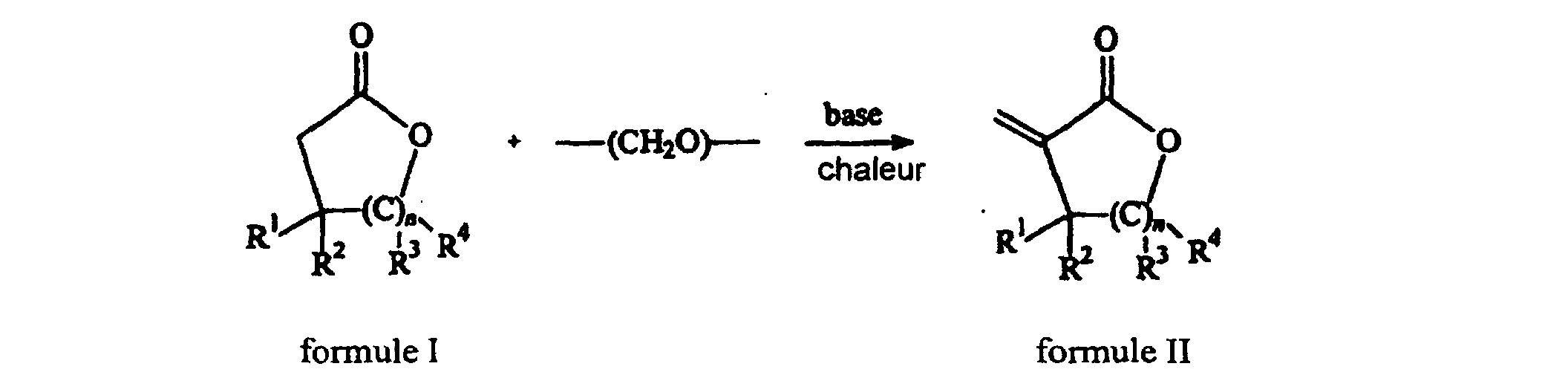
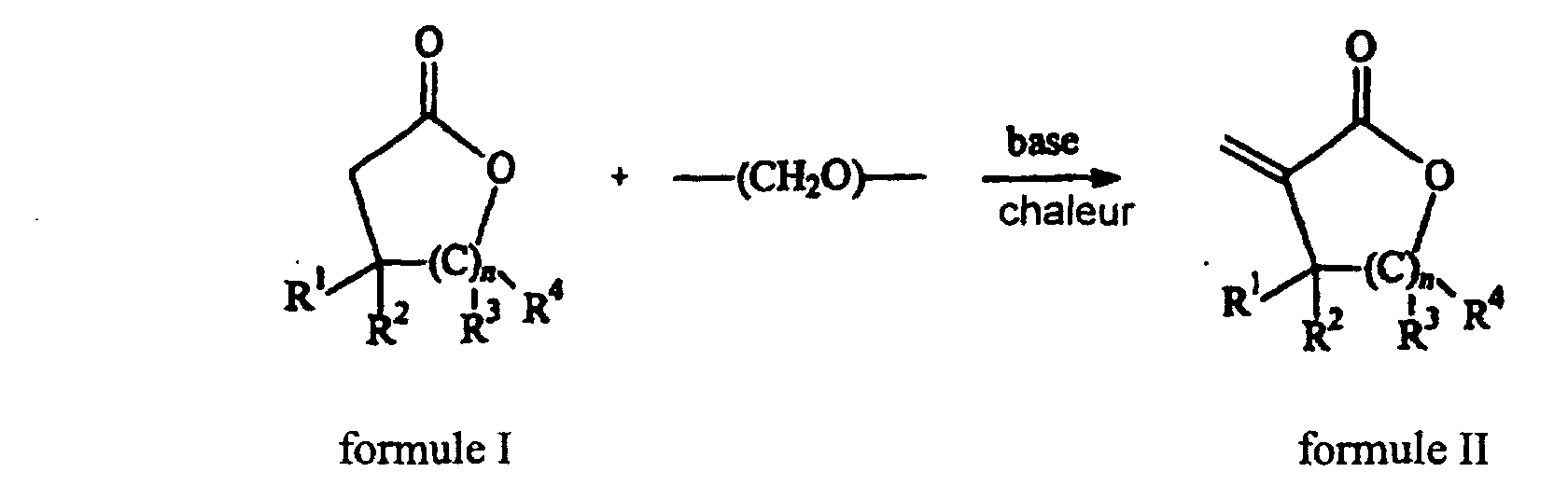
- the invention provides a process for preparing ⁇ -methylene-lactones of Formula II comprising:
- the process of the present invention concerns an efficient methenylation of lactones to yield ⁇ -methylenelactones of which ⁇ -methylene- ⁇ -butyrolactone is a preferred member.
- the lactone of Formula I is ⁇ -butyrolactone and the ⁇ -methylenelactone of Formula II is ⁇ -methylene- ⁇ -butyrolactone.
- R 1 , R 2 ,R 3 , and R 4 may join to form members of a ring structure selected from the group consisting of, unsubstituted or substituted cycloalkyl, unsubstituted or substituted cycloalkyl containing at least one heteroatom in the ring, unsubstituted or substituted aromatic ring, and unsubstituted or substituted aromatic ring containing at least one heteroatom in the ring.
- Most preferred compounds are where the lactone of Formula I is ⁇ -butyrolactone and the ⁇ -methylenelactone of Formula II is ⁇ -methylene- ⁇ -butyrolactone.
- alkyl includes straight-chain or branched alkyl, such as, methyl, ethyl, n -propyl, i -propyl, or the different butyl, pentyl and hexyl isomers. Also included are all isomers up to and including octadecane.
- hydrocarbyl group is a univalent group containing only carbon and hydrogen. If not otherwise stated, it is preferred that hydrocarbyl groups herein contain 1 to about 30 carbon atoms.
- substituted hydrocarbyl herein is meant a hydrocarbyl group which contains one or more substituent groups which are inert under the process conditions to which the compound containing these groups is subjected. The substituent groups also do not substantially interfere with the process. If not otherwise stated, it is preferred that substituted hydrocarbyl groups herein contain 1 to about 30 carbon atoms. Included in the meaning of "substituted” are heteroaromatic rings.
- ⁇ -methylene lactones reactant of the present invention One of skill in the art will know where and how to obtain the ⁇ -methylene lactones reactant of the present invention.
- ⁇ -butyrolactone is readily available from commercial sources such as Aldrich Chemical Company (Millwaukee, WI).
- the process of the present invention is carried out in the vapor state, at temperatures greater than 200°C, over highly basic catalysts. Although any temperature above 200°C is useful, temperature in the range of about 250°C to about 400°C are preferred where ranges of about 300°C to about 340°C are most preferred. In one preferred embodiment the lactone and formaldehyde of the present invention are in the vapor phase.
- the basic catalysts are selected from the metal oxides, hydroxides, and carbonates.
- the oxides, hydroxides and carbonates employed herein may be used as powders, granules, or other particulate forms, or may be supported on an essentially inert support as is common in the art of catalysis.
- Representative catalysts include but are not limited to of magnesium oxide, barium oxide, barium hydroxide, lanthanum oxide potassium hydroxide, cadmium oxide, rubidium oxide, lithium hydroxide, strontium hydroxide, sodium hydroxide, calcium hydroxide, barium carbonate and mixtures thereof.
- Preferred catalysts are barium hydroxide and lanthanum oxide, where barium hydroxide is most preferred.
- reaction conditions may result in decreased catalytic efficiency.
- contacting the present catalysts with O 2 at elevated temperatures has the effect of reactivating the catalyst.
- Contact temperatures with O 2 may range from about 300°C to about 500°C where temperatures of about 400°C to about 425°C are preferred.
- the metal oxide, hydroxide and carbonate catalysts of the present invention may further comprise catalyst additives and promoters which will enhance the efficiency of the catalyst.
- catalyst additives and promoters which will enhance the efficiency of the catalyst.
- Use of theses materials are common and well known in the art (see for example, Kirk-Othmer Encyclopedia of Chemical Technology , Howe-Grant Ed., Vol. 5, pp 326-346, (1993), John Wiley & Sons, New York and Ullmann's Encyclopedia of Industrial Chemistry , Vol. AS, Gerhartz et al., Eds., pp. 337-346, (1986), VCH Publishers, New York, both hereby incorporated by reference.)
- Particularly useful in the present invention is gold used as a promoter with BA(OH) 2 .
- Basic catalysts of the present invention may be supported or unsupported.
- suitable supports include but are not limited to silica, titania, zirconia, alumina, carbon, various zeolites and mixtures thereof.
- Particularly suitable catalyst - support combinations include barium hydroxide and lanthanum oxide supported on SiO 2 .
- Preferred catalysts of the present invention have been effective in producing product at good selectivities. Selectivities of greater than 50% are typical where selectivities of greater than 95% are common.
- selectivities and yields of product may be enhanced by additional contact with the catalyst.
- yields and selectivities may be increase where the reactor effluent containing a mixture of reactant and product may be passed one or more times over the catalyst under the reaction conditions to enhance the conversion of reactant to product.
- Formaldehyde may be supplied in a variety of forms including as a solution or in the form of a formaldehyde polymer.
- Polymers of formaldehyde are more generally denominated polyacetals and include or are characterized by a linear polymer chain containing recurring -(CH 2 O)- units or ggroups.
- a convenient form of formaldehyde was formalin, (37% aqueous formaldehyde).
- the desired products including ⁇ -methylene- ⁇ -butyrolactone
- are recovered using techniques common to the art. For example, when allowed to cool the ⁇ -methylene- ⁇ -butyrolactone reaction mixture forms a viscous, clear mass. Alternatively, when heated under vacuum, the ⁇ -methylene- ⁇ -butyrolactone/ ⁇ -butyrolactone mixture can be distilled directly from the reaction mixture. Additionally, the reaction mixture can be dissolved in water, adjusted to pH 4 with 6N HCl, then distilled. Similarly, the separation of ⁇ -methylene- ⁇ -butyrolactone from ⁇ -butyrolactone can be accomplished using vacuum distillation with a spinning band column.
- Another method to recover the desired product is to polymerize ⁇ -methylene- ⁇ -butyrolactone in the ⁇ -butyrolactone solution using standard free-radical polymerization, isolate the polymer by precipitation from methanol, then thermally depolymerize back to ⁇ -methylene- ⁇ -butyrolactone by heating under vacuum. Finally, ⁇ -methylene- ⁇ -butyrolactone may also be separated from - ⁇ -butyrolactone by melt crystallization.
- Table 1 summarizes the results of Examples 1-29.
- Ca(OH) 2 /SiO 2 NaOH/SiO 2 , LiOH/SiO 2 , Sr(OH) 2 /SiO 2 , KOH/SiO 2 and Ba(OH) 2 /SiO 2 gave yields exceeding 5%.
- the best overall catalyst was 8 wt % Ba(OH) 2 /SiO 2 which gave an 11% yield of ⁇ -methylene- ⁇ -butyrolactone at 37% conversion of the ⁇ -butyrolactone (37% product selectivity) at 340 °C. No significant amounts of other volatile compounds were noted.
- the base oxides or hydroxides of Mg, Ca, Sr and Ba are active catalysts.
- the base oxides or hydroxides of Na, K and Rb(in combination with Mg) (Group IA) are active catalysts.
- These Groups include the most basic metal oxides known. Most of these materials were tested as deposited on an oxide support.
- the support material need not have a special character except that it should be stable to the reaction conditions. Metal oxides of Groups IVB and higher, up to Group IVA, are preferable. Rare earth oxides are also acceptable. It is believed that a support is preferred in order to maintain high catalyst surface areas.
- Table 2 shows examples (30-34) wherein feed ratios are varied. The most significant improvement in the % selectivities to ⁇ -methylene- ⁇ -butyrolactone came from variations in the reactant feed ratio. When the feed ratio was increased from 1:1 to 1:8 (lactone:formaldehyde) the average % yield increased as the ratio of formaldehyde increased.
- Table 3 shows results with the varied catalysts and conditions.
- Example 37 identifies LiOH/Silicon as an especially useful catalysts/support combination.
- Table 4 shows the formation of ⁇ -methylene- ⁇ -butyrolactone and ⁇ -methylene- ⁇ -butyrolactone using preferred catalyst (LaO/SiO 2 ) under varied conditions.
- Example 46 (Table 5) shows the ability to regenerate the catalyst Ba(OH) 2 /SiO 2 with air.
- Example 47 (Table 6) illustrates that there is enhanced conversion of ⁇ -butyrolactone to ⁇ -methylene butyrolactone if the reactor effluent is recycled across the catalyst a second time, indicating that a recycled procedure improves product yield.
- the Tables 1-6 contains the examples and show catalyst, nature and amount, feed ratio of ⁇ -butyrolactone to formalin, temperature, flow rate, observed conversion and yield or selectivity.
- silica-alumina powder ( ⁇ 150 m 2 g -1 ) was slurried into a solution of 2 g Ba(OH) 2 octahydrate in 20mL distilled water. The slurry was stirred for 10 minutes and then evaporated to dryness. The recovered solid was dried in a gold boat under flowing (100 mL/min) nitrogen at 550°C for 2 hours and then collected under nitrogen as a granular white solid.
- Example 47 illustrates that the conversion of ⁇ -butyrolactone (GBL) to ⁇ -methylene butyrolactone (MBL) is enhanced if the reactor effluent is recyceld a second time through the reactor containing the catalyst.
- the molar ratio of GBL/MBL drops from 1 to 0.55 after a second exposure to the catalyst under reaction conditions, indicating further conversion of GBL to MBL.
Landscapes
- Chemical & Material Sciences (AREA)
- Organic Chemistry (AREA)
- Low-Molecular Organic Synthesis Reactions Using Catalysts (AREA)
- Catalysts (AREA)
- Organic Low-Molecular-Weight Compounds And Preparation Thereof (AREA)
- Epoxy Compounds (AREA)
- Furan Compounds (AREA)
Abstract
Claims (31)
- Procédé pour la préparation d'α-méthylènelactones de la Formule II, à une sélectivité d'au moins 85%, comprenant le chauffage de lactones de la Formule I et de formaldéhyde dans la phase vapeur à une température au-dessus de 200°C en présence d'un catalyseur basique sous réserve que le catalyseur basique ne contienne pas l'élément tungstène:où:

n = 1-11;
R1, R2, R3 et R4 pris indépendamment sont un hydrogène, un groupe alkyle non substitué ou substitué, alcényle non substitué ou substitué, cycloalkyle non substitué ou substitué C1-C30. - Procédé suivant la revendication 1, dans lequel R1, R2, R3 et R4 sont joints pour former des éléments d'une structure de cycle choisie dans le groupe constitué d'un groupe cycloalkyle non substitué ou substitué.
- Procédé suivant la revendication 1 ou 2, dans lequel la lactone de la Formule I est la γ-butyrolactone et l'α-méthylènelactone de la Formule II est l'α-méthylène-γ-butyrolactone.
- Procédé suivant la revendication 1 ou 2, dans lequel R3 est CH3.
- Procédé suivant la revendication 1, dans lequel la température est d'environ 250°C à environ 400°C.
- Procédé suivant la revendication 5, dans lequel la température est d'environ 300°C à environ 340°C.
- Procédé suivant la revendication 1, dans lequel le catalyseur basique est choisi dans le groupe constitué d'oxydes métalliques, d'hydroxydes métalliques et de carbonates métalliques.
- Procédé suivant la revendication 7, dans lequel le catalyseur basique est choisi dans le groupe constitué d'oxyde de magnésium, d'hydroxyde de baryum, d'oxyde de baryum, d'hydroxyde de potassium, d'oxyde de cadmium, d'oxyde de rubidium, d'hydroxyde de lithium, d'hydroxyde de strontium, d'hydroxyde de sodium, d'hydroxyde de calcium, de carbonate de baryum et de mélanges de ceux-ci.
- Procédé suivant la revendication 7, dans lequel le catalyseur basique est éventuellement supporté sur un support approprié.
- Procédé suivant la revendication 7, dans lequel le catalyseur basique comprend éventuellement un promoteur de catalyseur.
- Procédé suivant la revendication 10, dans lequel ledit promoteur de catalyseur est de l'or.
- Procédé suivant la revendication 9, dans lequel le support approprié est choisi dans le groupe constitué de silice, de dioxyde de titane, de zircone, d'alumine, de carbone, de zéolites et de mélanges de ceux-ci.
- Procédé suivant la revendication 9, dans lequel le catalyseur basique est choisi dans le groupe constitué d'oxyde de magnésium, d'hydroxyde de baryum, d'oxyde de baryum, d'hydroxyde de potassium, d'oxyde de cadmium, d'oxyde de rubidium, d'hydroxyde de lithium, d'hydroxyde de strontium, d'hydroxyde de sodium, de carbonate de baryum, d'hydroxyde de calcium, et dans lequel le support approprié est SiO2.
- Procédé suivant la revendication 13, dans lequel le catalyseur supporté est BA(OH)2/SiO2.
- Procédé suivant la revendication 12, dans lequel le catalyseur supporté est Ba(OH)2/carbone.
- Procédé suivant la revendication 11, dans lequel le catalyseur supporté est BA(OH)2/AU/SiO2.
- Procédé suivant la revendication 1, dans lequel le formaldéhyde est sous la forme de formaline.
- Procédé suivant la revendication 1, dans lequel le formaldéhyde est sous la forme d'un polymère de formaldéhyde.
- Procédé pour la préparation d'α-méthylènelactones de la Formule II, à une sélectivité d'au moins 85%, comprenant:(a) le chauffage de lactones de la Formule I et de formaldéhyde dans la phase vapeur à une température au-dessus de 200°C en présence d'un catalyseur basique sous réserve que le catalyseur basique ne contienne pas l'élément tungstène pendant un temps suffisant pour que les α-méthylènelactones de la Formule II soient formées;où:

n = 1-11;
R1, R2, R3 et R4 pris indépendamment sont un hydrogène, un groupe alkyle non substitué ou substitué, alcényle non substitué ou substitué, cycloalkyle non substitué ou substitué C1-C30;(b) la séparation entre les lactones de la Formule I et le catalyseur basique;(c) la mise en contact du catalyseur basique avec de l'oxygène pendant un temps suffisant pour permettre la régénération du catalyseur; et(d) la répétition des étapes (a) à (c). - Procédé suivant la revendication 19, dans lequel la mise en contact du catalyseur basique avec de l'oxygène de l'étape (c) se fait pendant un temps d'environ 5 min à environ 60 min.
- Procédé suivant la revendication 19, dans lequel la mise en contact du catalyseur basique avec de l'oxygène de l'étape (c) se fait à une température d'environ 300°C à environ 500°C.
- Procédé suivant la revendication 21, dans lequel la mise en contact du catalyseur basique avec de l'oxygène de l'étape (c) se fait à une température dans l'intervalle de 400°C à 425°C.
- Procédé pour la préparation d'α-méthylènelactones de la Formule II, à une sélectivité d'au moins 85%, comprenant:(a) le chauffage de lactones de la Formule I et de formaldéhyde dans la phase vapeur à une température au-dessus de 200°C en présence d'un catalyseur basique sous réserve que le catalyseur basique ne contienne pas l'élément tungstène pendant un temps suffisant pour que les α-méthylènelactones de la Formule II soient formées dans un effluent de réacteur;où:
n = 1-11;
R1, R2, R3 et R4 pris indépendamment sont un hydrogène, un groupe alkyle non substitué ou substitué, alcényle non substitué ou substitué, cycloalkyle non substitué ou substitué C1-C30;(b) la récupération de l'effluent de réacteur de l'étape (a); et(c) la mise en contact de l'effluent récupéré avec le catalyseur basique à une température au-dessus de 200°C. - Procédé suivant la revendication 23, dans lequel les étapes (b) et (c) sont répétées d'environ 1 à environ 10 fois.
- Procédé pour la préparation d'α-méthylènelactones de la Formule II, comprenant le chauffage de lactones de la Formule I et de formaldéhyde dans la phase vapeur à une température au-dessus de 200°C en présence d'un catalyseur basique sous réserve que le catalyseur basique ne contienne pas l'élément tungstène;où:
n = 1-11;
R1, R2, R3 et R4 pris indépendamment sont un hydrogène, un groupe alkyle non substitué ou substitué, alcényle non substitué ou substitué, cycloalkyle non substitué ou substitué C1-C30, et le catalyseur basique est choisi dans le groupe constitué d'éléments lanthanides et de composés lanthanides. - Procédé suivant la revendication 25, dans lequel le catalyseur basique est éventuellement supporté sur un support approprié.
- Procédé suivant la revendication 26, dans lequel le support approprié est choisi dans le groupe constitué de silice, de dioxyde de titane, de zircone, d'alumine, de carbone, de zéolites et de mélanges de ceux-ci.
- Procédé suivant la revendication 25, dans lequel le catalyseur basique comprend un lanthane métallique catalytique.
- Procédé suivant la revendication 27, dans lequel le catalyseur basique est un lanthane métallique catalytique et le support approprié est SiO2.
- Procédé suivant la revendication 25, dans lequel le catalyseur basique est de l'oxyde de lanthane.
- Procédé suivant la revendication 25, dans lequel le catalyseur basique comprend en outre de l'oxyde de magnésium, de l'hydroxyde de baryum, de l'oxyde de baryum, de l'hydroxyde de potassium, de l'oxyde de cadmium, de l'oxyde de rubidium, de l'hydroxyde de lithium, de l'hydroxyde de strontium, de l'hydroxyde de sodium, de l'hydroxyde de calcium, du carbonate de baryum et des mélanges de ceux-ci.
Applications Claiming Priority (5)
| Application Number | Priority Date | Filing Date | Title |
|---|---|---|---|
| US12688499P | 1999-03-30 | 1999-03-30 | |
| US12688399P | 1999-03-30 | 1999-03-30 | |
| US126883P | 1999-03-30 | ||
| US126884P | 1999-03-30 | ||
| PCT/US2000/006958 WO2000058297A2 (fr) | 1999-03-30 | 2000-03-16 | PROCEDE DE PREPARATION D'α-METHYLENELACTONES |
Publications (2)
| Publication Number | Publication Date |
|---|---|
| EP1165536A2 EP1165536A2 (fr) | 2002-01-02 |
| EP1165536B1 true EP1165536B1 (fr) | 2003-09-17 |
Family
ID=26825123
Family Applications (1)
| Application Number | Title | Priority Date | Filing Date |
|---|---|---|---|
| EP00918019A Expired - Lifetime EP1165536B1 (fr) | 1999-03-30 | 2000-03-16 | Procede de preparation d'alpha-methylenelactones |
Country Status (10)
| Country | Link |
|---|---|
| US (2) | US6313318B1 (fr) |
| EP (1) | EP1165536B1 (fr) |
| JP (1) | JP2002540200A (fr) |
| KR (1) | KR20010111581A (fr) |
| CN (1) | CN1204131C (fr) |
| AU (1) | AU3889900A (fr) |
| BR (1) | BR0010768A (fr) |
| CA (1) | CA2361037A1 (fr) |
| DE (1) | DE60005318T2 (fr) |
| WO (1) | WO2000058297A2 (fr) |
Families Citing this family (26)
| Publication number | Priority date | Publication date | Assignee | Title |
|---|---|---|---|---|
| US6384846B1 (en) * | 1998-12-11 | 2002-05-07 | Hitachi America Ltd. | Methods and apparatus for rendering multiple images using a limited rendering resource |
| TW538056B (en) * | 2000-07-11 | 2003-06-21 | Samsung Electronics Co Ltd | Resist composition comprising photosensitive polymer having lactone in its backbone |
| EP1304340B1 (fr) * | 2000-07-12 | 2008-10-29 | Mitsubishi Rayon Co., Ltd. | Resines pour reserves et compositions de reserve pouvant etre amplifiees chimiquement |
| DK1406895T3 (da) * | 2001-06-13 | 2008-12-01 | Magnachem Int Lab Inc | Lactonformuleringer og fremgangsmåde til anvendelse deraf |
| KR100428408B1 (ko) * | 2001-12-14 | 2004-04-28 | 학교법인 성균관대학 | α-메틸렌-γ-부티로락톤의 제조방법 |
| WO2003057686A1 (fr) * | 2002-01-07 | 2003-07-17 | E.I. Du Pont De Nemours And Company | Synthese d'alpha-methylenelactone dans des fluides supercritiques |
| US6649776B2 (en) | 2002-01-07 | 2003-11-18 | E. I. Du Pont De Nemours And Company | Methylenelactone synthesis in supercritical fluids |
| AU2003287546A1 (en) * | 2002-11-05 | 2004-06-07 | Magnachem International Laboratories, Inc. | Synthetic lactone formulations and method of use |
| WO2005102315A1 (fr) | 2004-04-23 | 2005-11-03 | Magnachem International Laboratories, Inc. | Formulations de lactone synthetique pour maitrise la douleur |
| US7161014B2 (en) * | 2004-07-27 | 2007-01-09 | E. I. Du Pont De Nemours And Company | Gas phase synthesis of methylene lactones using novel grafted catalyst |
| US7166727B2 (en) * | 2004-07-27 | 2007-01-23 | E. I. Du Pont De Nemours And Company | Supercritical fluid phase synthesis of methylene lactones using novel grafted catalyst |
| US7199254B2 (en) * | 2004-07-27 | 2007-04-03 | E. I. Du Pont De Nemours And Company | Liquid phase synthesis of methylene lactones using novel catalyst |
| US7151185B2 (en) * | 2004-07-27 | 2006-12-19 | E. I. Du Pont De Nemours And Company | Gas phase synthesis of methylene lactones using oxynitride catalyst |
| US7205416B2 (en) * | 2004-07-27 | 2007-04-17 | E. I. Du Pont De Nemours And Company | Liquid phase synthesis of methylene lactones using novel grafted catalyst |
| US7141682B2 (en) * | 2004-07-27 | 2006-11-28 | E. I. Du Pont De Nemours And Company | Liquid phase synthesis of methylene lactones using oxnitride catalyst |
| US7164033B2 (en) * | 2004-07-27 | 2007-01-16 | E. I. Du Pont De Nemours And Company | Gas phase synthesis of methylene lactones using novel catalyst |
| US7153981B2 (en) * | 2004-07-27 | 2006-12-26 | E. I. Du Pont De Nemours And Company | Supercritical fluid phase synthesis of methylene lactones using oxynitride catalyst |
| US7348442B2 (en) * | 2004-10-18 | 2008-03-25 | E. I. Du Pont De Nemours And Company | Gas phase synthesis of methylene lactones using catalysts derived from hydrotalcite precursors |
| US20060100449A1 (en) * | 2004-11-10 | 2006-05-11 | Manzer Leo E | Integrated two-step process for the production of gamma-methyl-alpha-methylene-gamma-butyrolactone from levulinic acid and hydrogen |
| TW200811124A (en) * | 2006-08-22 | 2008-03-01 | Nippon Catalytic Chem Ind | Method for producing cyclic unsaturated compound |
| US20080293901A1 (en) * | 2007-05-25 | 2008-11-27 | Basf Corporation | Polymers and compounds prepared with alpha-methylene lactones, methods therefor, and coatings |
| KR20110128785A (ko) * | 2008-10-24 | 2011-11-30 | 매그나켐 인터내셔널 레버러토리즈 아이엔씨 | Rad9와 선택적으로 상호작용하는 화합물들의 스크리닝방법 |
| CN103210014B (zh) | 2010-11-11 | 2016-08-10 | Gf生物化学有限公司 | 离子聚合物及其制造方法和用途 |
| KR101427092B1 (ko) * | 2012-01-13 | 2014-08-07 | 제일모직주식회사 | α-메틸렌락톤의 제조 방법 |
| KR102379889B1 (ko) | 2021-05-17 | 2022-03-29 | 자경케미칼 주식회사 | 메틸렌 락톤계 화합물의 제조방법 |
| WO2025033537A1 (fr) * | 2023-08-10 | 2025-02-13 | 株式会社日本触媒 | Procédé de production d'un composé à base de méthylène lactone |
Family Cites Families (4)
| Publication number | Priority date | Publication date | Assignee | Title |
|---|---|---|---|---|
| DE3719873A1 (de) * | 1987-06-13 | 1988-12-29 | Basf Ag | Verfahren zur herstellung von itaconsaeurediestern und itaconsaeure |
| CA2000041A1 (fr) * | 1988-10-13 | 1990-04-13 | Barry S. Orlek | Composes |
| JP3148134B2 (ja) | 1996-10-18 | 2001-03-19 | 三菱レイヨン株式会社 | α−メチレン−γ−ブチロラクトン類の製造方法 |
| JP3150643B2 (ja) * | 1997-04-24 | 2001-03-26 | 三菱レイヨン株式会社 | α−メチレン−γ−ブチロラクトン類の製造方法 |
-
2000
- 2000-03-16 EP EP00918019A patent/EP1165536B1/fr not_active Expired - Lifetime
- 2000-03-16 CN CNB008040702A patent/CN1204131C/zh not_active Expired - Fee Related
- 2000-03-16 DE DE60005318T patent/DE60005318T2/de not_active Expired - Fee Related
- 2000-03-16 WO PCT/US2000/006958 patent/WO2000058297A2/fr not_active Ceased
- 2000-03-16 KR KR1020017012528A patent/KR20010111581A/ko not_active Withdrawn
- 2000-03-16 AU AU38899/00A patent/AU3889900A/en not_active Abandoned
- 2000-03-16 CA CA002361037A patent/CA2361037A1/fr not_active Abandoned
- 2000-03-16 BR BR0010768-9A patent/BR0010768A/pt not_active IP Right Cessation
- 2000-03-16 JP JP2000608000A patent/JP2002540200A/ja active Pending
- 2000-03-20 US US09/528,632 patent/US6313318B1/en not_active Expired - Fee Related
- 2000-03-27 US US09/536,350 patent/US6232474B1/en not_active Expired - Fee Related
Also Published As
| Publication number | Publication date |
|---|---|
| US6313318B1 (en) | 2001-11-06 |
| CN1204131C (zh) | 2005-06-01 |
| WO2000058297A3 (fr) | 2001-02-08 |
| CN1341112A (zh) | 2002-03-20 |
| CA2361037A1 (fr) | 2000-10-05 |
| JP2002540200A (ja) | 2002-11-26 |
| AU3889900A (en) | 2000-10-16 |
| US6232474B1 (en) | 2001-05-15 |
| WO2000058297A2 (fr) | 2000-10-05 |
| DE60005318T2 (de) | 2004-07-08 |
| DE60005318D1 (de) | 2003-10-23 |
| KR20010111581A (ko) | 2001-12-19 |
| BR0010768A (pt) | 2002-01-15 |
| EP1165536A2 (fr) | 2002-01-02 |
Similar Documents
| Publication | Publication Date | Title |
|---|---|---|
| EP1165536B1 (fr) | Procede de preparation d'alpha-methylenelactones | |
| CA1103272A (fr) | Procede pour la fabrication d'esters carboxyliques | |
| KR100715463B1 (ko) | 산화반응에 유용한 촉매 | |
| US4780552A (en) | Preparation of furan by decarbonylation of furfural | |
| JP2834481B2 (ja) | ケトンの製法 | |
| EP0227461A2 (fr) | Procédé pour la préparartion des amines cycliques | |
| WO2003018540A1 (fr) | Synthese de nitriles insatures a partir de lactones | |
| US3966822A (en) | Catalytic preparation of ketones from aldehydes | |
| US5625076A (en) | Catalyst for production of tertiary N-alkenyl carboxylic acid amide, and process for production of tertiary N-alkenyl carboxylic acid amide using said catalyst | |
| CN113877560B (zh) | 一种丙烯酸甲酯的合成方法及其固体碱催化剂 | |
| US6835849B2 (en) | Synthesis of alkenoate esters from lactones and alcohols | |
| US6013844A (en) | Preparation of catechol monoethers and catechols | |
| JP3148134B2 (ja) | α−メチレン−γ−ブチロラクトン類の製造方法 | |
| EP1165538B1 (fr) | Procede de preparation d'alpha-methylenelactones et d'hydrocarbylidene-lactones alpha-substituees | |
| JPH04139148A (ja) | 低級脂肪酸エステルの製造方法 | |
| JP4048578B2 (ja) | 塩基触媒及びカルボニル化合物誘導体の製造方法 | |
| US4459234A (en) | Process for producing anthraquinone | |
| JPH10120675A (ja) | 2−p−ジオキサノン類の製造方法 | |
| SU789472A1 (ru) | Способ получени виниладамантанов или его замещенных | |
| CN111974442B (zh) | 一种生产丙烯酸和丙烯酸甲酯的催化剂及其制备方法、应用 | |
| SU1286272A1 (ru) | Катализатор дл получени 2-метилпиридина | |
| JPS584704B2 (ja) | メタクリル酸メチルの製造方法 | |
| JPH0516418B2 (fr) | ||
| US4833255A (en) | Process for the preparation of indoline | |
| JPS6197247A (ja) | α−ケトン酸エステル類の製造法 |
Legal Events
| Date | Code | Title | Description |
|---|---|---|---|
| PUAI | Public reference made under article 153(3) epc to a published international application that has entered the european phase |
Free format text: ORIGINAL CODE: 0009012 |
|
| 17P | Request for examination filed |
Effective date: 20010829 |
|
| AK | Designated contracting states |
Kind code of ref document: A2 Designated state(s): AT BE CH CY DE DK ES FI FR GB GR IE IT LI LU MC NL PT SE |
|
| 17Q | First examination report despatched |
Effective date: 20020312 |
|
| GRAH | Despatch of communication of intention to grant a patent |
Free format text: ORIGINAL CODE: EPIDOS IGRA |
|
| GRAS | Grant fee paid |
Free format text: ORIGINAL CODE: EPIDOSNIGR3 |
|
| GRAA | (expected) grant |
Free format text: ORIGINAL CODE: 0009210 |
|
| AK | Designated contracting states |
Kind code of ref document: B1 Designated state(s): DE FR GB IT NL |
|
| PG25 | Lapsed in a contracting state [announced via postgrant information from national office to epo] |
Ref country code: IT Free format text: LAPSE BECAUSE OF FAILURE TO SUBMIT A TRANSLATION OF THE DESCRIPTION OR TO PAY THE FEE WITHIN THE PRESCRIBED TIME-LIMIT;WARNING: LAPSES OF ITALIAN PATENTS WITH EFFECTIVE DATE BEFORE 2007 MAY HAVE OCCURRED AT ANY TIME BEFORE 2007. THE CORRECT EFFECTIVE DATE MAY BE DIFFERENT FROM THE ONE RECORDED. Effective date: 20030917 |
|
| REG | Reference to a national code |
Ref country code: GB Ref legal event code: FG4D |
|
| REF | Corresponds to: |
Ref document number: 60005318 Country of ref document: DE Date of ref document: 20031023 Kind code of ref document: P |
|
| REG | Reference to a national code |
Ref country code: IE Ref legal event code: FG4D |
|
| ET | Fr: translation filed | ||
| PLBE | No opposition filed within time limit |
Free format text: ORIGINAL CODE: 0009261 |
|
| STAA | Information on the status of an ep patent application or granted ep patent |
Free format text: STATUS: NO OPPOSITION FILED WITHIN TIME LIMIT |
|
| 26N | No opposition filed |
Effective date: 20040618 |
|
| PG25 | Lapsed in a contracting state [announced via postgrant information from national office to epo] |
Ref country code: NL Free format text: LAPSE BECAUSE OF NON-PAYMENT OF DUE FEES Effective date: 20041001 |
|
| NLV4 | Nl: lapsed or anulled due to non-payment of the annual fee |
Effective date: 20041001 |
|
| REG | Reference to a national code |
Ref country code: IE Ref legal event code: MM4A |
|
| PGFP | Annual fee paid to national office [announced via postgrant information from national office to epo] |
Ref country code: FR Payment date: 20060308 Year of fee payment: 7 |
|
| PGFP | Annual fee paid to national office [announced via postgrant information from national office to epo] |
Ref country code: DE Payment date: 20060309 Year of fee payment: 7 |
|
| PGFP | Annual fee paid to national office [announced via postgrant information from national office to epo] |
Ref country code: GB Payment date: 20060315 Year of fee payment: 7 |
|
| GBPC | Gb: european patent ceased through non-payment of renewal fee |
Effective date: 20070316 |
|
| REG | Reference to a national code |
Ref country code: FR Ref legal event code: ST Effective date: 20071130 |
|
| PG25 | Lapsed in a contracting state [announced via postgrant information from national office to epo] |
Ref country code: DE Free format text: LAPSE BECAUSE OF NON-PAYMENT OF DUE FEES Effective date: 20071002 |
|
| PG25 | Lapsed in a contracting state [announced via postgrant information from national office to epo] |
Ref country code: GB Free format text: LAPSE BECAUSE OF NON-PAYMENT OF DUE FEES Effective date: 20070316 |
|
| PG25 | Lapsed in a contracting state [announced via postgrant information from national office to epo] |
Ref country code: FR Free format text: LAPSE BECAUSE OF NON-PAYMENT OF DUE FEES Effective date: 20070402 |