EP1165764B1 - Couplage covalent sans lieur de bacteriorhodopsine sous forme de membrane pourpre - Google Patents
Couplage covalent sans lieur de bacteriorhodopsine sous forme de membrane pourpre Download PDFInfo
- Publication number
- EP1165764B1 EP1165764B1 EP00929335.8A EP00929335A EP1165764B1 EP 1165764 B1 EP1165764 B1 EP 1165764B1 EP 00929335 A EP00929335 A EP 00929335A EP 1165764 B1 EP1165764 B1 EP 1165764B1
- Authority
- EP
- European Patent Office
- Prior art keywords
- bacteriorhodopsin
- process according
- membrane
- transglutaminase
- linked
- Prior art date
- Legal status (The legal status is an assumption and is not a legal conclusion. Google has not performed a legal analysis and makes no representation as to the accuracy of the status listed.)
- Expired - Lifetime
Links
- 108010082845 Bacteriorhodopsins Proteins 0.000 title claims description 165
- 210000004676 purple membrane Anatomy 0.000 title claims description 55
- 238000005859 coupling reaction Methods 0.000 title description 17
- 230000008878 coupling Effects 0.000 title description 16
- 238000010168 coupling process Methods 0.000 title description 16
- 108060008539 Transglutaminase Proteins 0.000 claims description 44
- 102000003601 transglutaminase Human genes 0.000 claims description 44
- 239000012528 membrane Substances 0.000 claims description 35
- 238000000034 method Methods 0.000 claims description 34
- 239000000758 substrate Substances 0.000 claims description 22
- 238000004132 cross linking Methods 0.000 claims description 21
- 229920000642 polymer Polymers 0.000 claims description 21
- 230000008569 process Effects 0.000 claims description 19
- 150000001413 amino acids Chemical class 0.000 claims description 16
- 238000006243 chemical reaction Methods 0.000 claims description 12
- 102000004169 proteins and genes Human genes 0.000 claims description 11
- 108090000623 proteins and genes Proteins 0.000 claims description 11
- 108010052285 Membrane Proteins Proteins 0.000 claims description 10
- 239000000975 dye Substances 0.000 claims description 8
- 150000002632 lipids Chemical class 0.000 claims description 8
- 230000001580 bacterial effect Effects 0.000 claims description 7
- 230000002207 retinal effect Effects 0.000 claims description 6
- 230000002255 enzymatic effect Effects 0.000 claims description 5
- 102000039446 nucleic acids Human genes 0.000 claims description 5
- 108020004707 nucleic acids Proteins 0.000 claims description 5
- 150000007523 nucleic acids Chemical class 0.000 claims description 5
- 238000010438 heat treatment Methods 0.000 claims description 4
- 108090000765 processed proteins & peptides Proteins 0.000 claims description 4
- 102000004196 processed proteins & peptides Human genes 0.000 claims description 4
- 239000000126 substance Substances 0.000 claims description 4
- 102000018697 Membrane Proteins Human genes 0.000 claims description 3
- 238000013500 data storage Methods 0.000 claims description 3
- 125000006239 protecting group Chemical group 0.000 claims description 3
- 108010050754 Halorhodopsins Proteins 0.000 claims description 2
- 102000004856 Lectins Human genes 0.000 claims description 2
- 108090001090 Lectins Proteins 0.000 claims description 2
- 238000007792 addition Methods 0.000 claims description 2
- 238000012217 deletion Methods 0.000 claims description 2
- 230000037430 deletion Effects 0.000 claims description 2
- 150000004676 glycans Chemical class 0.000 claims description 2
- 238000003780 insertion Methods 0.000 claims description 2
- 230000037431 insertion Effects 0.000 claims description 2
- 239000002523 lectin Substances 0.000 claims description 2
- 238000004519 manufacturing process Methods 0.000 claims description 2
- 229920001282 polysaccharide Polymers 0.000 claims description 2
- 239000005017 polysaccharide Substances 0.000 claims description 2
- 238000006467 substitution reaction Methods 0.000 claims description 2
- 125000003275 alpha amino acid group Chemical class 0.000 claims 1
- 239000000463 material Substances 0.000 description 37
- 235000018102 proteins Nutrition 0.000 description 10
- 239000010410 layer Substances 0.000 description 9
- 239000000243 solution Substances 0.000 description 9
- 108010010803 Gelatin Proteins 0.000 description 8
- KDXKERNSBIXSRK-UHFFFAOYSA-N Lysine Natural products NCCCCC(N)C(O)=O KDXKERNSBIXSRK-UHFFFAOYSA-N 0.000 description 8
- 229920000159 gelatin Polymers 0.000 description 8
- 239000008273 gelatin Substances 0.000 description 8
- 235000019322 gelatine Nutrition 0.000 description 8
- 235000011852 gelatine desserts Nutrition 0.000 description 8
- 125000000524 functional group Chemical group 0.000 description 6
- 150000003384 small molecules Chemical class 0.000 description 5
- YBJHBAHKTGYVGT-ZKWXMUAHSA-N (+)-Biotin Chemical compound N1C(=O)N[C@@H]2[C@H](CCCCC(=O)O)SC[C@@H]21 YBJHBAHKTGYVGT-ZKWXMUAHSA-N 0.000 description 4
- 239000011541 reaction mixture Substances 0.000 description 4
- -1 retinal aldehyde Chemical class 0.000 description 4
- 238000005204 segregation Methods 0.000 description 4
- 239000004472 Lysine Substances 0.000 description 3
- 239000002671 adjuvant Substances 0.000 description 3
- 230000015572 biosynthetic process Effects 0.000 description 3
- 239000003153 chemical reaction reagent Substances 0.000 description 3
- ZDXPYRJPNDTMRX-UHFFFAOYSA-N glutamine Natural products OC(=O)C(N)CCC(N)=O ZDXPYRJPNDTMRX-UHFFFAOYSA-N 0.000 description 3
- PCHJSUWPFVWCPO-UHFFFAOYSA-N gold Chemical compound [Au] PCHJSUWPFVWCPO-UHFFFAOYSA-N 0.000 description 3
- 239000010931 gold Substances 0.000 description 3
- 229910052737 gold Inorganic materials 0.000 description 3
- 238000006116 polymerization reaction Methods 0.000 description 3
- 238000012545 processing Methods 0.000 description 3
- 239000007787 solid Substances 0.000 description 3
- 125000003396 thiol group Chemical group [H]S* 0.000 description 3
- 108090001008 Avidin Proteins 0.000 description 2
- 108091006146 Channels Proteins 0.000 description 2
- 102000004190 Enzymes Human genes 0.000 description 2
- 108090000790 Enzymes Proteins 0.000 description 2
- SXRSQZLOMIGNAQ-UHFFFAOYSA-N Glutaraldehyde Chemical compound O=CCCCC=O SXRSQZLOMIGNAQ-UHFFFAOYSA-N 0.000 description 2
- 239000000232 Lipid Bilayer Substances 0.000 description 2
- 239000004372 Polyvinyl alcohol Substances 0.000 description 2
- 125000003277 amino group Chemical group 0.000 description 2
- 229960002685 biotin Drugs 0.000 description 2
- 235000020958 biotin Nutrition 0.000 description 2
- 239000011616 biotin Substances 0.000 description 2
- 239000000872 buffer Substances 0.000 description 2
- 230000008859 change Effects 0.000 description 2
- 238000003776 cleavage reaction Methods 0.000 description 2
- 229920001940 conductive polymer Polymers 0.000 description 2
- 239000004020 conductor Substances 0.000 description 2
- 239000013078 crystal Substances 0.000 description 2
- 230000001086 cytosolic effect Effects 0.000 description 2
- 150000002308 glutamine derivatives Chemical class 0.000 description 2
- 238000011534 incubation Methods 0.000 description 2
- 230000004048 modification Effects 0.000 description 2
- 238000012986 modification Methods 0.000 description 2
- 239000003960 organic solvent Substances 0.000 description 2
- 229920002451 polyvinyl alcohol Polymers 0.000 description 2
- 125000002924 primary amino group Chemical group [H]N([H])* 0.000 description 2
- 230000007017 scission Effects 0.000 description 2
- XLYOFNOQVPJJNP-UHFFFAOYSA-N water Substances O XLYOFNOQVPJJNP-UHFFFAOYSA-N 0.000 description 2
- SMZOUWXMTYCWNB-UHFFFAOYSA-N 2-(2-methoxy-5-methylphenyl)ethanamine Chemical compound COC1=CC=C(C)C=C1CCN SMZOUWXMTYCWNB-UHFFFAOYSA-N 0.000 description 1
- NIXOWILDQLNWCW-UHFFFAOYSA-N 2-Propenoic acid Natural products OC(=O)C=C NIXOWILDQLNWCW-UHFFFAOYSA-N 0.000 description 1
- HRPVXLWXLXDGHG-UHFFFAOYSA-N Acrylamide Chemical compound NC(=O)C=C HRPVXLWXLXDGHG-UHFFFAOYSA-N 0.000 description 1
- 241000283690 Bos taurus Species 0.000 description 1
- OYPRJOBELJOOCE-UHFFFAOYSA-N Calcium Chemical compound [Ca] OYPRJOBELJOOCE-UHFFFAOYSA-N 0.000 description 1
- 102000034573 Channels Human genes 0.000 description 1
- 108010037414 Cytoskeletal Proteins Proteins 0.000 description 1
- 108091006027 G proteins Proteins 0.000 description 1
- 102000030782 GTP binding Human genes 0.000 description 1
- 108091000058 GTP-Binding Proteins 0.000 description 1
- 102000009127 Glutaminase Human genes 0.000 description 1
- 108010073324 Glutaminase Proteins 0.000 description 1
- 241001074968 Halobacteria Species 0.000 description 1
- 238000001074 Langmuir--Blodgett assembly Methods 0.000 description 1
- 102000035195 Peptidases Human genes 0.000 description 1
- 108091005804 Peptidases Proteins 0.000 description 1
- 206010034972 Photosensitivity reaction Diseases 0.000 description 1
- 239000004698 Polyethylene Substances 0.000 description 1
- 102000004330 Rhodopsin Human genes 0.000 description 1
- 108090000820 Rhodopsin Proteins 0.000 description 1
- 239000002262 Schiff base Substances 0.000 description 1
- 150000004753 Schiff bases Chemical class 0.000 description 1
- 239000012790 adhesive layer Substances 0.000 description 1
- 230000002411 adverse Effects 0.000 description 1
- 238000004873 anchoring Methods 0.000 description 1
- 230000009830 antibody antigen interaction Effects 0.000 description 1
- 239000003125 aqueous solvent Substances 0.000 description 1
- 230000000903 blocking effect Effects 0.000 description 1
- 229910052791 calcium Inorganic materials 0.000 description 1
- 239000011575 calcium Substances 0.000 description 1
- 239000003710 calcium ionophore Substances 0.000 description 1
- 150000001718 carbodiimides Chemical class 0.000 description 1
- 125000004432 carbon atom Chemical group C* 0.000 description 1
- 239000005018 casein Substances 0.000 description 1
- BECPQYXYKAMYBN-UHFFFAOYSA-N casein, tech. Chemical compound NCCCCC(C(O)=O)N=C(O)C(CC(O)=O)N=C(O)C(CCC(O)=N)N=C(O)C(CC(C)C)N=C(O)C(CCC(O)=O)N=C(O)C(CC(O)=O)N=C(O)C(CCC(O)=O)N=C(O)C(C(C)O)N=C(O)C(CCC(O)=N)N=C(O)C(CCC(O)=N)N=C(O)C(CCC(O)=N)N=C(O)C(CCC(O)=O)N=C(O)C(CCC(O)=O)N=C(O)C(COP(O)(O)=O)N=C(O)C(CCC(O)=N)N=C(O)C(N)CC1=CC=CC=C1 BECPQYXYKAMYBN-UHFFFAOYSA-N 0.000 description 1
- 235000021240 caseins Nutrition 0.000 description 1
- 238000006555 catalytic reaction Methods 0.000 description 1
- 210000004027 cell Anatomy 0.000 description 1
- 210000000170 cell membrane Anatomy 0.000 description 1
- 238000007385 chemical modification Methods 0.000 description 1
- 230000009918 complex formation Effects 0.000 description 1
- 150000001875 compounds Chemical class 0.000 description 1
- 239000000470 constituent Substances 0.000 description 1
- 238000010276 construction Methods 0.000 description 1
- 239000011243 crosslinked material Substances 0.000 description 1
- 230000003436 cytoskeletal effect Effects 0.000 description 1
- 238000000432 density-gradient centrifugation Methods 0.000 description 1
- 230000008021 deposition Effects 0.000 description 1
- 238000001212 derivatisation Methods 0.000 description 1
- 150000004985 diamines Chemical class 0.000 description 1
- 238000002408 directed self-assembly Methods 0.000 description 1
- BFMYDTVEBKDAKJ-UHFFFAOYSA-L disodium;(2',7'-dibromo-3',6'-dioxido-3-oxospiro[2-benzofuran-1,9'-xanthene]-4'-yl)mercury;hydrate Chemical compound O.[Na+].[Na+].O1C(=O)C2=CC=CC=C2C21C1=CC(Br)=C([O-])C([Hg])=C1OC1=C2C=C(Br)C([O-])=C1 BFMYDTVEBKDAKJ-UHFFFAOYSA-L 0.000 description 1
- 238000009826 distribution Methods 0.000 description 1
- 210000003743 erythrocyte Anatomy 0.000 description 1
- CJAONIOAQZUHPN-KKLWWLSJSA-N ethyl 12-[[2-[(2r,3r)-3-[2-[(12-ethoxy-12-oxododecyl)-methylamino]-2-oxoethoxy]butan-2-yl]oxyacetyl]-methylamino]dodecanoate Chemical compound CCOC(=O)CCCCCCCCCCCN(C)C(=O)CO[C@H](C)[C@@H](C)OCC(=O)N(C)CCCCCCCCCCCC(=O)OCC CJAONIOAQZUHPN-KKLWWLSJSA-N 0.000 description 1
- 230000001900 immune effect Effects 0.000 description 1
- 239000003999 initiator Substances 0.000 description 1
- 230000002427 irreversible effect Effects 0.000 description 1
- ZBKFYXZXZJPWNQ-UHFFFAOYSA-N isothiocyanate group Chemical group [N-]=C=S ZBKFYXZXZJPWNQ-UHFFFAOYSA-N 0.000 description 1
- 230000005923 long-lasting effect Effects 0.000 description 1
- 230000007774 longterm Effects 0.000 description 1
- 239000003550 marker Substances 0.000 description 1
- 239000000203 mixture Substances 0.000 description 1
- 238000005442 molecular electronic Methods 0.000 description 1
- 229920005615 natural polymer Polymers 0.000 description 1
- 230000003287 optical effect Effects 0.000 description 1
- 239000012788 optical film Substances 0.000 description 1
- 239000008363 phosphate buffer Substances 0.000 description 1
- 230000036211 photosensitivity Effects 0.000 description 1
- 229920000573 polyethylene Polymers 0.000 description 1
- 235000015277 pork Nutrition 0.000 description 1
- 235000020004 porter Nutrition 0.000 description 1
- 238000002360 preparation method Methods 0.000 description 1
- 235000019833 protease Nutrition 0.000 description 1
- 239000012460 protein solution Substances 0.000 description 1
- 102000005962 receptors Human genes 0.000 description 1
- 108020003175 receptors Proteins 0.000 description 1
- 238000012552 review Methods 0.000 description 1
- 102000012498 secondary active transmembrane transporter activity proteins Human genes 0.000 description 1
- 108040003878 secondary active transmembrane transporter activity proteins Proteins 0.000 description 1
- 238000001338 self-assembly Methods 0.000 description 1
- 238000002415 sodium dodecyl sulfate polyacrylamide gel electrophoresis Methods 0.000 description 1
- 230000007928 solubilization Effects 0.000 description 1
- 238000005063 solubilization Methods 0.000 description 1
- 239000002904 solvent Substances 0.000 description 1
- 229920001059 synthetic polymer Polymers 0.000 description 1
- 238000002411 thermogravimetry Methods 0.000 description 1
- 238000012032 thrombin generation assay Methods 0.000 description 1
- 208000014903 transposition of the great arteries Diseases 0.000 description 1
Images




Classifications
-
- C—CHEMISTRY; METALLURGY
- C09—DYES; PAINTS; POLISHES; NATURAL RESINS; ADHESIVES; COMPOSITIONS NOT OTHERWISE PROVIDED FOR; APPLICATIONS OF MATERIALS NOT OTHERWISE PROVIDED FOR
- C09B—ORGANIC DYES OR CLOSELY-RELATED COMPOUNDS FOR PRODUCING DYES, e.g. PIGMENTS; MORDANTS; LAKES
- C09B61/00—Dyes of natural origin prepared from natural sources, e.g. vegetable sources
-
- C—CHEMISTRY; METALLURGY
- C07—ORGANIC CHEMISTRY
- C07K—PEPTIDES
- C07K14/00—Peptides having more than 20 amino acids; Gastrins; Somatostatins; Melanotropins; Derivatives thereof
- C07K14/195—Peptides having more than 20 amino acids; Gastrins; Somatostatins; Melanotropins; Derivatives thereof from bacteria
- C07K14/215—Peptides having more than 20 amino acids; Gastrins; Somatostatins; Melanotropins; Derivatives thereof from bacteria from Halobacteriaceae (F)
Definitions
- the invention relates to the linker-free covalent coupling of bacteriorhodopsin (BR) in membrane-bound form, in particular in purple membrane form.
- BR bacteriorhodopsin
- Bacteriorhodopsin is a membrane protein, e.g. in halobacteria in the form of a two-dimensional, disk-shaped, water-insoluble crystal, the so-called purple membrane (PM).
- the purple membrane has a thickness of about 5 nm.
- the diameter of the purple membrane is typically in the range of 300 nm to 1000 nm.
- the purple membrane consists of ⁇ -helical bacteriorhodopsin molecules and about 10 lipid molecules per bacteriorhodopsin molecule.
- the bacteriorhodopsin is almost completely embedded in the lipid membrane formed from the lipid molecules. This results in its unusual thermodynamic stability.
- Bacteriorhodopsin in purple membrane form is used technically as a photochromic material for optical applications. Further, bacteriorhodopsin in purple membrane form as a material having photoelectric properties is of technical importance.
- covalent cross-linking of purple membranes is advantageous.
- bacteriorhodopsin in photovoltaics, about 300 mV are obtained per purple membrane layer.
- covalent cross-linking elements can be obtained, which provide higher voltages.
- Another interesting aspect is the covalent coupling of purple membranes to surfaces, polymers or smaller molecules, eg dyes.
- low molecular weight linker molecules e.g. Glutaraldehyde
- these coupling reactions are very poor.
- the reason for this is that only a few amino acids of bacteriorhodopsin are outside the lipid bilayer of the membrane, are sterically hindered and difficult to react with the low molecular weight coupling reagents.
- Low molecular weight coupling reagents have yet another serious disadvantage. They can penetrate through the proton channel into the active center of bacteriorhodopsin.
- the EP 0 417 541 discloses a process for cross-linking oriented proteins using low molecular weight linkers such as glutaraldehyde, carbodiimide or diamines.
- the WO 99/06446 discloses a method for transglutaminase-catalyzed coupling of proteins or peptides to a carrier.
- the document gives no indication as to whether bacteriorhodopsin is suitable as a substrate for a transglutaminase.
- An object of the invention was therefore to provide a method for the covalent linkage of bacteriorhodopsin in membrane form, in particular for the direct crosslinking of purple membranes, without the use of low molecular weight linkers.
- Another field of application is the coupling of bacteriorhodopsin in membrane form to surfaces, polymers or auxiliaries, in particular dyes.
- This object is achieved by a process for the preparation of covalently crosslinked bacteriorhodopsin, which is characterized in that bacteriorhodopsin is reacted in membrane-bound form as a substrate of a transglutaminase, in particular a bacterial transglutaminase and thereby cross-linked covalently.
- bacteriorhodopsin is understood to mean both the bacteriorhodopsin wild type (BR-WT) and bacteriorhodopsin variants.
- bacteriorhodopsin variants includes both bacteriorhodopsin molecules derived from BR-WT by addition, substitution, deletion and / or insertion of amino acids, in particular at least one, more preferably at least two, most preferably at least three, and up to 50, preferably up to 20, and more preferably differentiate up to 10 amino acids.
- variants also includes bacteriorhodopsin molecules in which retinal is replaced by retinal-analogous molecules, and bacteriorhodopsin molecules which have been chemically modified, for example by introducing protective groups or functional side groups.
- bacteriorhodopsin also includes structurally bacteriorhodopsin-related membrane proteins which are in membrane-bound form and have a homology of at least 70%, more preferably at least 80%, most preferably at least 90%, to bacteriorhodopsin wild type.
- membrane-bound membrane protein-related membrane proteins of the invention are halorhodopsin and sensorrhodopsin. These membrane proteins are non-crystalline in the membrane form.
- Bacteriorhodopsin materials preferably used according to the invention include bacteriorhodopsin wild type and bacteriorhodopsin variants with an altered amino acid sequence.
- the bacteriorhodopsin variants preferably have a modified physical function, in particular a modified photosensitivity, a changed color or an altered kinetics of the photochromic behavior of bacteriorhodopsin.
- Most preferred are bacteriorhodopsin variants in which targeted binding sites for enzymatic cross-linking with transglutaminase are deleted or introduced.
- Particularly preferred bacteriorhodopsin variants are used in which Gln or Lys are deleted or replaced by other amino acids.
- the amino acids Gln3 and Lys129 act as binding sites in the transglutaminase reaction.
- bacteriorhodopsin variants in which Gln or Lys are introduced into a loop in such a way that it is accessible to transglutaminase.
- Particularly preferred are those bacteriorhodopsin variants in which one or two binding sites for transglutaminase are present. In the presence of two binding sites accessible to the transglutaminase, the two binding sites may be located either on the same membrane side, or preferably on different membrane sides, i. a binding site on the cytoplasmic side and one on the extracellular side. In this way, directional stacking of membranes is possible, as opposed to statistical crosslinking.
- elements can be generated in which the voltage of 300 mV per layer increases with the number of layers.
- a preferred orientation of about 10% is obtained.
- directional superpositioning with a significantly higher preferred orientation is possible.
- about 4 to 10 BR purple membrane layers are superimposed, whereby a preferred orientation can be obtained by more than 30%, preferably more than 50% and particularly preferably more than 80%.
- bacteriorhodopsin variants are preferred in which retinal is replaced by retinalanaloge molecules, whereby, for example, the photocycle of the bacteriorhodopsin material can be changed.
- Retinal-analogous molecules are molecules that can be incorporated as a chromophore in bacteriorhodopsin and differ from Retinal, for example by derivatization.
- bacteriorhodopsin materials are bacteriorhodopsin variants or bacteriorhodopsin wild type that have been chemically modified. Suitable modifications are, for example, in U.S. Patent 5,922,843 described.
- the variants can also be modified by blocking amino acids, for example by protecting groups or other chemical modification of the amino acid side chains.
- Bacteriorhodopsin variants can also be obtained by enzymatic pretreatment of bacteriorhodopsin wild type or bacteriorhodopsin variants.
- An enzymatic cleavage can be brought about, for example, by means of peptidases, in which case the amino terminus in particular is removed or cleavages are brought about in the loops located outside the membrane.
- bacteriorhodopsin in membrane-bound form and in particular in purple membrane form is a substrate of transglutaminase and in particular of bacterial transglutaminase (bTGA).
- transglutaminase and in particular of bacterial transglutaminase (bTGA).
- bTGA bacterial transglutaminase
- Bacteriorhodopsin purple membranes in particular different variants of bacteriorhodopsin purple membranes, can function both as first and as second substrate for TGA, in particular bTGA. This results in extensive possibilities for the direct crosslinking of purple membranes with one another or / and for the covalent coupling of polymers, surfaces and / or substrates to bacteriorhodopsin in purple membrane form both in cross-linked and in non-crosslinked form.
- One aspect of the invention thus relates to a process for the covalent bonding of bacteriorhodopsin in membrane form, in particular in purple membrane form to polymers, surfaces or / and auxiliaries by means of TGA, wherein the bacteriorhodopsin and the further substrate are reacted with a transglutaminase and covalently linked to one another.
- covalently linked conjugates consisting of bacteriorhodopsin in purple membrane form and another molecule can be formed.
- Suitable polymers to which bacteriorhodopsin in purple membrane form can be covalently bound by TGA include, for example, gelatin, polyvinyl alcohol, and polyethylene, which may be side-group modified.
- Suitable substrates or adjuvants are in particular low molecular weight compounds, such as dyes.
- bacteriorhodopsins in membrane-bound form
- bacteriorhodopsin in soluble form in particular in monomeric or trimeric form
- bacteriorhodopsin as formed by heterologous bacteriorhodopsin or bacteriorhodopsin, as produced by solubilization of purple membranes (monomerized bacteriorhodopsin)
- membrane proteins which are different from bacteriorhodopsin as the substrate of a transglutaminase and to cross-link covalently in so far as they are present in membrane-bound form.
- membrane proteins which contain several, in particular four to eight, helical (especially ⁇ -helical) membrane-spanning amino acid segments can be reacted.
- suitable membrane proteins are channel proteins, porters, receptors, G proteins, etc.
- the method of the invention can be used to covalently cross-link two identical or different bacteriorhodopsin materials as described above.
- the method according to the invention is used to covalently bind a bacteriorhodopsin material to another material.
- a preferred example of this is the covalent binding of bacteriorhodopsin materials, in particular bacteriorhodopsin materials in purple membrane form to a surface, to a polymer or / and to a low molecular weight compound (also referred to herein as adjuvant).
- the bacteriorhodopsin is reacted, for example, as a substrate of the transglutaminase, the second substrate used being a molecule which, in addition to the binding group for the transglutaminase, has a further functional group, for example, a terminal thiol group.
- the adduct formed in the reaction with transglutaminase can then be immobilized on a surface via the introduced functional group.
- the bacteriorhodopsin can be covalently immobilized on a gold surface.
- an oligomer or polymer which may be of natural or synthetic origin, linked to the inventive method with bacteriorhodopsin.
- An example of a natural polymer is gelatin, an example of a preferred synthetic polymer is polyvinyl alcohol.
- the oligomer or polymer contains a side group which is a substrate of transglutaminase, ie contains a glutamine (Gln) or a lysine (Lys) residue or a glutamine analog or a lysine analog contains or contains a glutamine portion or a lysine portion which is recognized by transglutaminase as a substrate, in particular a portion comprising at least three carbon atoms and one amino group.
- An appropriate group may already be present in the polymer, such as in gelatin, or it may be chemically introduced.
- a material is obtained in which bacteriorhodopsin, in particular in the purple membrane form, is covalently coupled to a polymer in a stoichiometric manner.
- this gives you considerable advantages. In particular, no segregation can occur, as occurs frequently in only physically mixed polymers which are not soluble in each other.
- the bacteriorhodopsin is crosslinked with an oligomer / polymer, which in turn can undergo further polymerization reactions or crosslinking reactions.
- Such further crosslinking or polymerization reactions can be initiated, for example, with UV light or by a free-radical initiator.
- This provides the opportunity to produce bulk materials containing a homogeneously distributed bacteriorhodopsin.
- Such materials can be advantageously used to make bacteriorhodopsin cubes as can be used for three-dimensional data storage.
- Such materials have heretofore been prepared by admixing bacteriorhodopsin in the polymerization of, for example, acrylic acid or acrylamide based polymers in aqueous solvents, whereby no covalent cross-linking is formed between the bacteriorhodopsin and the polymer. When removing the water, it often leads to high shrinkage. Moreover, in such prior art materials, segregation phenomena are observed which result in inhomogeneous distribution of the bacteriorhodopsin in the material.
- the bacteriorhodopsin material is covalently bound to a low molecular weight compound.
- the low molecular weight compound is characterized in that it is a substrate of transglutaminase, ie in particular a glutamine analog or a lysine analog.
- the low molecular weight compound also referred to herein as adjuvant, may be selected from the group consisting of dyes, fluorochromes, lipids, peptides, oligomeric and polymeric nucleic acids such as DNA / RNA / PNA, etc., synthetic oligomers and polymers, proteins (avidin Biotin, etc.), lectins, polysaccharides, conductive polymers and others.
- a targeted, stoichiometric, site-selective coupling of the compounds to the bacteriorhodopsin, in particular to bacteriorhodopsin in purple membrane form is possible.
- dyes and fluorochromes are covalently coupled in order to achieve a change in the initial color state of the bacteriorhodopsin or of the purple membrane. It is advantageous that no segregation between bacteriorhodopsin and dye or fluorochrome occurs and that the processing is not adversely affected by different solubilities of the materials.
- Lipids can be covalently coupled in order to obtain an anchoring of bacteriorhodopsin, in particular in membrane form, on another lipid membrane, wherein the further membrane preferably likewise represents a purple membrane and particularly preferably also a bacteriorhodopsin purple membrane.
- Lipid-coupled bacteriorhodopsin materials can furthermore advantageously be used in the Langmuir-Blodgett technique.
- immunological tags By coupling bacteriorhodopsin with peptides, immunological tags can be introduced and materials with selective, high affinity Binding ability (eg, antigen-antibody interaction) can be obtained.
- oligomers in particular oligomeric or polymeric nucleic acids, such as DNA, RNA, PNA, etc.
- the construction of three-dimensional directed structures is possible.
- proton-conductive materials such as proton-conductive polymers, or membranes are preferably coupled to the bacteriorhodopsin.
- Another object of the present invention is a linker-free covalently crosslinked bacteriorhodopsin, which can be obtained by the procedures described above.
- a linker-free covalently crosslinked bacteriorhodopsin which can be obtained by the procedures described above.
- Such a material which may be composed exclusively of bacteriorhodopsin or of bacteriorhodopsin and covalently bonded thereto other materials or materials, has structural differences over known bacteriorhodopsin materials, which provide significant advantages.
- no linker is interposed, so that even in the resulting material, the bacteriorhodopsin materials are bound directly and are not crosslinked via linkers.
- the disadvantages associated with the use of linkers, as described above can be eliminated.
- bacteriorhodopsin to other materials is also achieved by the covalent bonds, in contrast to physical blends known in the art, in that stable, homogeneous materials can be obtained.
- Such materials are particularly suitable for use in data storage.
- By the directed arrangement of several layers of BR-purple membranes with a high preferential orientation materials can be obtained, which in photoelectric applications, such as in F. Hong, Progress in Surface Science 62 (1999), 1-237 , to show improved behavior.
- Such materials generate higher voltages upon exposure than known, less well oriented BR materials and can be used, in particular, as switches or as controls.
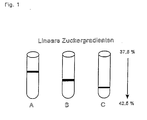
- Fig. 1 is a schematic representation of the results of a sugar density gradient centrifugation.
- Fig. 1A shows bacteriorhodopsin wild type (BR-WT),
- Fig. 1B the bacteriorhodopsin variant BRD2N and
- Fig. 1C cross-linked BR-WT and BR-D2N after 24 hours incubation with BTGase (bacterial transglutaminase).
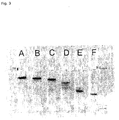
- Fig. 2 shows a schematic representation of SDS-PAGE.
- Fig. 3 shows the formation of cross-linked products of BR-WT and BR-D2N in the presence of bacterial transglutaminase over time.
- Fig. 4 shows the sequence of bacteriorhodopsin with the transmembrane assembly modified according to RR Birge, Photophysics and Molecular Electronic Applications of the Rhodopsins, Annu. Rev. Phys. Chem. 41 (1990), 683-733 ,
- Fig. 5 shows an example of directional deposition of bacteriorhodopsin in membrane form on surfaces.
- a gold-containing layer 2 is applied.
- This surface is contacted with bacteriorhodopsin purple membranes 3 suspended in a solvent, which have been thiol-modified by the method according to the invention.
- Self-assembly 4 of the purple membranes takes place in a directional manner on the gold surface. False orientation purple membranes 5 are not bound to the surface.
- Fig. 6 shows an example of a three-dimensional structuring of bacteriorhodopsin purple membranes.
- An adhesive layer 7, for example nucleic acid oligomers, is applied to a surface or a substrate 6.
- the purple membranes 8 are modified with functional groups such that the functional groups attached on one side of the purple membrane form can each interact with the functional groups applied on the other side of another purple membrane.
- the purple membrane is modified with nucleic acid oligomers in such a way that the oligomers can hybridize with one another on both sides, that is to say that the purple membrane can hybridize extracellularly with the purple membrane cytoplasmic one.
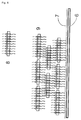
- Fig. 7 shows purple membranes (shown in phantom) with embedded bacteriorhodopsin amino acid columns (shown schematically as solid boxes). Lysine (Lys) and glutamine (Gln), which are accepted by transglutaminase (TGA), are plotted as solid circles (Lys) and solid squares (Gln), respectively.
- bacteriorhodopsin wild type the binding sites accessible to transglutaminase, Gln3 and K129, are on the same side of the membrane ( Fig. 7A ).
- a bacteriorhodopsin variant is used, each having a binding site on the inside and on the outside of the membrane, ie a binding site on the cytoplasmic membrane side and a binding site on the extracellular membrane side.
- Such a variant is preferably obtained by leaving the Lys129 unchanged and deleting the Gln3 and instead introducing a Gln in a loop on the other side of the membrane ( Fig. 7B ).
- a bacteriorhodopsin variant is used which has exactly one binding site (internal or external), which can be obtained, for example, by removing the other possible binding sites ( Fig. 7C ).
- a bacteriorhodopsin wildtype (WT) solution (20 mg / ml) and a solution of the bacteriorhodopsin variant BR-DZN (20 mg / ml) are mixed with buffer (pH 7.0, 100 mM, phosphate buffer) and BTGase ( 9.3 U / ml) solution, so that the BTGase is in quadruple excess compared to bacteriorhodopsin. Incubation takes place at 40 ° C. for 24 h. In the reaction mixture there is then practically only cross-linked bacteriorhodopsin ( Fig. 1c ).
- Reaction batch as in 2). However, the reaction is stopped at any time by brief heating to 80 ° C. Crosslinked and non-crosslinked bacteriorhodopsin is then present in the reaction mixture. By choosing the stopping time, any ratios between crosslinked and uncrosslinked bacteriorhodopsin can be adjusted ( Fig. 2 and 3 ). The higher the degree of crosslinking, the more rigid is the cross-linked bacteriorhodopsin.
- the red gang in Fig. 3 represents BR-WT, the blue band BR-D2N.
- the purple-colored cross-linking product BR-WT x -BR-D2N y is obtained.
- a gelatin solution (pork rind gelatin), 10% (w / v) is added to the same volume of a BR solution (PM concentration 39.1 mg / ml) and BTGase solution (12 U / ml), so that the amount of BTGase is comparable to the amount of BR's.
- the reaction solution is then incubated at 37 ° C overnight. In the reaction mixture, the BR is then bound in gelatin.
Landscapes
- Chemical & Material Sciences (AREA)
- Organic Chemistry (AREA)
- Health & Medical Sciences (AREA)
- Gastroenterology & Hepatology (AREA)
- Life Sciences & Earth Sciences (AREA)
- Biochemistry (AREA)
- Biophysics (AREA)
- General Health & Medical Sciences (AREA)
- Genetics & Genomics (AREA)
- Medicinal Chemistry (AREA)
- Molecular Biology (AREA)
- Proteomics, Peptides & Aminoacids (AREA)
- Peptides Or Proteins (AREA)
Claims (18)
- Procédé de préparation de bactériorhodopsine à réticulation covalente,
caractérisé en ce que
l'on fait réagir la bactériorhodopsine, dans sa forme intégrée à la membrane, de manière à ce qu'elle constitue le substrat d'une transglutaminase et subisse une réticulation covalente. - Procédé selon la revendication 1,
caractérisé en ce que
l'on fait réagir la bactériorhodopsine, sous forme de membrane pourpre, de manière à ce qu'elle constitue le substrat d'une transglutaminase et subisse une réticulation covalente. - Procédé selon les revendications 1 ou 2,
caractérisé en ce que
la bactériorhodopsine correspond à des protéines membranaires, dans leur forme intégrée à la membrane, dont la structure est proche du type naturel de la bactériorhodopsine, leur homologie avec le type naturel de la bactériorhodopsine étant d'au moins 90 %. - Procédé selon l'une des revendications précédentes,
caractérisé en ce que
la bactériorhodopsine est choisie parmi le type naturel bactériorhodopsine et/ou des variantes de la bactériorhodopsine. - Procédé selon l'une des revendications précédentes,
caractérisé en ce que
les variantes de bactériorhodopsine étant choisies parmi les variantes de bactériorhodopsine qui se distinguent du type naturel de la bactériorhodopsine par l'addition, la substitution, la délétion et/ou l'insertion d'acides aminés, notamment d'au moins un acide aminé, les molécules de bactériorhodopsine dans lesquelles le rétinal a été remplacé par des molécules analogues au rétinal, ainsi que les molécules de bactériorhodopsine ayant subi une modification chimique qui consiste en l'introduction de groupes protecteurs ou de groupes fonctionnels latéraux. - Procédé selon l'une des revendications précédentes,
caractérisé en ce que,
chez les variantes de bactériorhodopsine, Gln ou Lys sont délétées ou remplacées par d'autres acides aminés. - Procédé selon l'une des revendications précédentes,
caractérisé en ce que
l'on soumet à la réticulation des bactériorhodopsines ou variantes de bactériorhodopsine qui sont identiques ou différentes. - Procédé selon l'une des revendications précédentes,
caractérisé en ce que
l'on fait réagir au moins une variante de bactériorhodopsine s'agissant de l'halorhodopsine et/ou de la sensorrhodopsine dans leur forme intégrée à la membrane. - Procédé selon l'une des revendications précédentes,
caractérisé en ce que
l'on fait réagir au moins une variante de bactériorhodopsine qui présente, par rapport au type naturel de la bactériorhodopsine, une séquence d'acides aminés modifiée et/ou chez laquelle le rétinal a été remplacé par une molécule analogue au rétinal et/ou qui a subi une modification par un traitement chimique et/ou enzymatique. - Procédé selon la revendication 9,
caractérisé en ce que
l'on fait réagir au moins une variante de bactériorhodopsine qui ne contient qu'un seul site de liaison pour une transglutaminase. - Procédé selon la revendication 9,
caractérisé en ce que
l'on fait réagir au moins une variante de bactériorhodopsine qui contient deux sites de liaison pour une transglutaminase lesquels ne sont pas situés sur le même côté de la membrane. - Procédé selon l'une des revendications précédentes,
caractérisé en ce que
la réaction de réticulation est arrêtée par un réchauffement de courte durée à 80 °C ou plus. - Procédé selon l'une des revendications précédentes,
caractérisé en ce que
l'on utilise une transglutaminase bactérienne. - Procédé selon l'une des revendications précédentes,
caractérisé en ce que
l'on utilise une transglutaminase bactérienne qui est active sans cofacteur. - Procédé selon l'une des revendications précédentes,
caractérisé en ce que
la bactériorhodopsine est réticulée avec un polymère, une surface ou/et un agent auxiliaire, caractérisé en ce que ledit agent auxiliaire est choisi dans le groupe constitué par les colorants, les fluorochromes, les lipides, les peptides, les acides nucléiques, les oligomères et polymères synthétiques, les protéines, lectines, les polysaccharides et les molécules conductrices. - Bactériorhodopsine à réticulation covalente sans groupe de liaison, pouvant être obtenue selon l'une des revendications précédentes.
- Utilisation de la bactériorhodopsine à réticulation covalente sans groupe de liaison selon la revendication 16, pour des applications photoélectriques.
- Utilisation de la bactériorhodopsine à réticulation covalente sans groupe de liaison selon la revendication 16, pour le stockage de données tridimensionnel.
Applications Claiming Priority (5)
| Application Number | Priority Date | Filing Date | Title |
|---|---|---|---|
| DE19914702A DE19914702A1 (de) | 1999-03-31 | 1999-03-31 | Verfahren und Zubereitung zur photochromen Markierung und/oder Sicherung der Authentizität von Gegenständen |
| DE19914702 | 1999-03-31 | ||
| DE1999153607 DE19953607A1 (de) | 1999-11-08 | 1999-11-08 | Linkerfreie kovalente Kopplung von Bakteriorhodopsin in Purpurmembranen-Form |
| DE19953607 | 1999-11-08 | ||
| PCT/EP2000/002904 WO2000058450A1 (fr) | 1999-03-31 | 2000-03-31 | Couplage covalent sans lieur de bacteriorhodopsine sous forme de membrane pourpre |
Publications (2)
| Publication Number | Publication Date |
|---|---|
| EP1165764A1 EP1165764A1 (fr) | 2002-01-02 |
| EP1165764B1 true EP1165764B1 (fr) | 2013-05-01 |
Family
ID=26052698
Family Applications (1)
| Application Number | Title | Priority Date | Filing Date |
|---|---|---|---|
| EP00929335.8A Expired - Lifetime EP1165764B1 (fr) | 1999-03-31 | 2000-03-31 | Couplage covalent sans lieur de bacteriorhodopsine sous forme de membrane pourpre |
Country Status (5)
| Country | Link |
|---|---|
| US (1) | US6927050B1 (fr) |
| EP (1) | EP1165764B1 (fr) |
| AU (1) | AU4746100A (fr) |
| ES (1) | ES2420905T3 (fr) |
| WO (1) | WO2000058450A1 (fr) |
Families Citing this family (3)
| Publication number | Priority date | Publication date | Assignee | Title |
|---|---|---|---|---|
| US11786603B2 (en) | 2016-02-26 | 2023-10-17 | Regeneron Pharmaceuticals, Inc. | Optimized transglutaminase site-specific antibody conjugation |
| US11129790B2 (en) | 2017-05-19 | 2021-09-28 | Northeastern University | Chemo-enzymatic site-specific modification of peptides and proteins to form cleavable conjugates |
| US12470254B2 (en) | 2019-10-03 | 2025-11-11 | collectID AG | Methods and systems for authenticating physical products via near field communication tags and recording authentication transactions on a blockchain |
Family Cites Families (8)
| Publication number | Priority date | Publication date | Assignee | Title |
|---|---|---|---|---|
| JPH0383999A (ja) | 1989-08-28 | 1991-04-09 | Hitachi Ltd | 蛋白質配向膜の作成方法、該蛋白質配向膜からなる人工的構造体及びその用途 |
| DE4130380A1 (de) | 1991-09-12 | 1993-03-18 | Consortium Elektrochem Ind | Purpurmembran-zubereitungen mit erhoehter holographischer beugungseffizienz |
| JP3669390B2 (ja) * | 1995-02-09 | 2005-07-06 | 味の素株式会社 | バチルス属細菌由来のトランスグルタミナーゼ |
| EP0851029A4 (fr) * | 1995-06-08 | 2001-05-23 | Ajinomoto Kk | Procede microbien de production de transglutaminase |
| US5922843A (en) | 1996-10-15 | 1999-07-13 | Syracuse University | Analog bacteriorhodopsin molecules |
| DE19732917C1 (de) | 1997-07-30 | 1998-10-15 | Fuchsbauer Hans Lothar | Verfahren zum Transglutaminase-katalysierten Koppeln von Protein oder Peptid an einen Träger |
| US6140012A (en) * | 1998-05-11 | 2000-10-31 | Bend Research, Inc. | Bacteriorhodopsin preparations having increased information storage times |
| DE19914702A1 (de) * | 1999-03-31 | 2000-10-05 | Norbert Hampp | Verfahren und Zubereitung zur photochromen Markierung und/oder Sicherung der Authentizität von Gegenständen |
-
2000
- 2000-03-31 EP EP00929335.8A patent/EP1165764B1/fr not_active Expired - Lifetime
- 2000-03-31 ES ES00929335T patent/ES2420905T3/es not_active Expired - Lifetime
- 2000-03-31 US US09/937,754 patent/US6927050B1/en not_active Expired - Lifetime
- 2000-03-31 WO PCT/EP2000/002904 patent/WO2000058450A1/fr not_active Ceased
- 2000-03-31 AU AU47461/00A patent/AU4746100A/en not_active Abandoned
Non-Patent Citations (1)
| Title |
|---|
| MIGNEAULT ISABELLE ET AL: "Glutaraldehyde: behavior in aqueous solution, reaction with proteins, and application to enzyme crosslinking", BIOTECHNIQUES, INFORMA HEALTHCARE, US, vol. 37, no. 5, 1 November 2004 (2004-11-01), pages 790 - 796,798, XP001539341, ISSN: 0736-6205 * |
Also Published As
| Publication number | Publication date |
|---|---|
| WO2000058450A1 (fr) | 2000-10-05 |
| AU4746100A (en) | 2000-10-16 |
| ES2420905T3 (es) | 2013-08-27 |
| EP1165764A1 (fr) | 2002-01-02 |
| US6927050B1 (en) | 2005-08-09 |
Similar Documents
| Publication | Publication Date | Title |
|---|---|---|
| DE69938353T2 (de) | Wasserlösliche lumineszente quantum-dots sowie deren biokonjugate | |
| DE60220893T2 (de) | Verfahren und gelzusammensetzungen zum einkapseln lebender zellen und organischer moleküle | |
| DE69531545T2 (de) | Photolabile verbindungen und verfahren für deren verwendung | |
| EP2164864B1 (fr) | Protéines synthétiques répétitives, leur fabrication et utilisation | |
| DE69430479T2 (de) | Zirkoniumoxid partikel | |
| EP0154620B1 (fr) | Structure à membranes poreuses, procédé de fabrication de cette structure ainsi que ses applications | |
| DE60019589T2 (de) | Schnelle dehydrierung von proteinen | |
| DE10164309A1 (de) | Verbesserte strukturiert-funktionale Bindematrices für Biomoleküle | |
| DE2808523A1 (de) | Neue pyridinverbindungen sowie deren verwendung | |
| EP0811846A2 (fr) | Stabilisation de conjugués métalliques | |
| DE60010072T2 (de) | Stereokomplexe hydrogele | |
| DE69621085T2 (de) | Peptide, die Beta-Faltblattstrukturen ausbilden und daraus hergestellte Gele | |
| EP1165764B1 (fr) | Couplage covalent sans lieur de bacteriorhodopsine sous forme de membrane pourpre | |
| DE60301283T2 (de) | Verfahren zur Bestimmung von Biopolymeren | |
| DE60033648T2 (de) | Auf einer Oberfläche befestigte polyfunktionelle Polymernetzwerke für Sensorchips | |
| DE69115327T2 (de) | Peptidderivate mit amphiphatischen Eigenschaften, ihre Zwischenprodukte und Liposome sowie Filme, die diese Derivate enthalten | |
| DE69002742T2 (de) | Trennungsmaterial für Blutgerinnungsfaktoren, seine Herstellung und Verwendung. | |
| EP1390139B1 (fr) | Procede pour produire un jeu ordonne d'echantillons pour detecter des constituants dans un echantillon biologique | |
| DE102012108345A1 (de) | Verfahren zur Herstellung eines Polyglycerin-Nanogels zur Verkapselung und Freisetzung biologisch aktiver Substanzen | |
| EP0431400A1 (fr) | Couches macromoléculaires cristallisées bidimensionnelles | |
| EP1274462B1 (fr) | Transfection ciblee de cellules par dendrimere biotinyle | |
| DE69233300T2 (de) | Kollagenartige Proteinpolymere mit hohen Molikularmassen | |
| EP0628819A2 (fr) | Support revêtu, sa procédure de fabrication et son utilisation pour l'immobilisation des biomolécules sur des surfaces des solides | |
| Troller et al. | Crystallization of a Lignin Peroxidase from the White–Rot Fungus Phanerochaete Chrysosporium | |
| EP0189019A1 (fr) | Structure à membranes pourvues de pores traversants, son procédé de fabrication et ses applications |
Legal Events
| Date | Code | Title | Description |
|---|---|---|---|
| PUAI | Public reference made under article 153(3) epc to a published international application that has entered the european phase |
Free format text: ORIGINAL CODE: 0009012 |
|
| 17P | Request for examination filed |
Effective date: 20010924 |
|
| AK | Designated contracting states |
Kind code of ref document: A1 Designated state(s): AT BE CH CY DE DK ES FI FR GB GR IE IT LI LU MC NL PT SE |
|
| AX | Request for extension of the european patent |
Free format text: AL;LT;LV;MK;RO;SI |
|
| 17Q | First examination report despatched |
Effective date: 20040825 |
|
| RIN1 | Information on inventor provided before grant (corrected) |
Inventor name: HAMPP, NORBERT Inventor name: SEITZ, ARNE Inventor name: PASTERNACK, RALF Inventor name: FUCHSBAUER, H.-L. |
|
| GRAP | Despatch of communication of intention to grant a patent |
Free format text: ORIGINAL CODE: EPIDOSNIGR1 |
|
| GRAS | Grant fee paid |
Free format text: ORIGINAL CODE: EPIDOSNIGR3 |
|
| RAP1 | Party data changed (applicant data changed or rights of an application transferred) |
Owner name: U-NICA TECHNOLOGY AG |
|
| GRAA | (expected) grant |
Free format text: ORIGINAL CODE: 0009210 |
|
| AK | Designated contracting states |
Kind code of ref document: B1 Designated state(s): AT BE CH CY DE DK ES FI FR GB GR IE IT LI LU MC NL PT SE |
|
| REG | Reference to a national code |
Ref country code: GB Ref legal event code: FG4D Free format text: NOT ENGLISH |
|
| REG | Reference to a national code |
Ref country code: CH Ref legal event code: EP Ref country code: AT Ref legal event code: REF Ref document number: 609979 Country of ref document: AT Kind code of ref document: T Effective date: 20130515 |
|
| REG | Reference to a national code |
Ref country code: IE Ref legal event code: FG4D Free format text: LANGUAGE OF EP DOCUMENT: GERMAN |
|
| REG | Reference to a national code |
Ref country code: CH Ref legal event code: NV Representative=s name: ISLER AND PEDRAZZINI AG, CH |
|
| REG | Reference to a national code |
Ref country code: DE Ref legal event code: R096 Ref document number: 50016305 Country of ref document: DE Effective date: 20130627 |
|
| REG | Reference to a national code |
Ref country code: NL Ref legal event code: T3 |
|
| REG | Reference to a national code |
Ref country code: ES Ref legal event code: FG2A Ref document number: 2420905 Country of ref document: ES Kind code of ref document: T3 Effective date: 20130827 |
|
| PG25 | Lapsed in a contracting state [announced via postgrant information from national office to epo] |
Ref country code: GR Free format text: LAPSE BECAUSE OF FAILURE TO SUBMIT A TRANSLATION OF THE DESCRIPTION OR TO PAY THE FEE WITHIN THE PRESCRIBED TIME-LIMIT Effective date: 20130802 Ref country code: SE Free format text: LAPSE BECAUSE OF FAILURE TO SUBMIT A TRANSLATION OF THE DESCRIPTION OR TO PAY THE FEE WITHIN THE PRESCRIBED TIME-LIMIT Effective date: 20130501 Ref country code: FI Free format text: LAPSE BECAUSE OF FAILURE TO SUBMIT A TRANSLATION OF THE DESCRIPTION OR TO PAY THE FEE WITHIN THE PRESCRIBED TIME-LIMIT Effective date: 20130501 Ref country code: PT Free format text: LAPSE BECAUSE OF FAILURE TO SUBMIT A TRANSLATION OF THE DESCRIPTION OR TO PAY THE FEE WITHIN THE PRESCRIBED TIME-LIMIT Effective date: 20130902 |
|
| PG25 | Lapsed in a contracting state [announced via postgrant information from national office to epo] |
Ref country code: DK Free format text: LAPSE BECAUSE OF FAILURE TO SUBMIT A TRANSLATION OF THE DESCRIPTION OR TO PAY THE FEE WITHIN THE PRESCRIBED TIME-LIMIT Effective date: 20130501 |
|
| PLBE | No opposition filed within time limit |
Free format text: ORIGINAL CODE: 0009261 |
|
| STAA | Information on the status of an ep patent application or granted ep patent |
Free format text: STATUS: NO OPPOSITION FILED WITHIN TIME LIMIT |
|
| 26N | No opposition filed |
Effective date: 20140204 |
|
| REG | Reference to a national code |
Ref country code: DE Ref legal event code: R097 Ref document number: 50016305 Country of ref document: DE Effective date: 20140204 |
|
| REG | Reference to a national code |
Ref country code: IE Ref legal event code: MM4A |
|
| PG25 | Lapsed in a contracting state [announced via postgrant information from national office to epo] |
Ref country code: IE Free format text: LAPSE BECAUSE OF NON-PAYMENT OF DUE FEES Effective date: 20140331 |
|
| REG | Reference to a national code |
Ref country code: FR Ref legal event code: PLFP Year of fee payment: 16 |
|
| REG | Reference to a national code |
Ref country code: DE Ref legal event code: R082 Ref document number: 50016305 Country of ref document: DE Representative=s name: HOEGER, STELLRECHT & PARTNER PATENTANWAELTE MB, DE Ref country code: DE Ref legal event code: R082 Ref document number: 50016305 Country of ref document: DE Representative=s name: TERGAU & WALKENHORST PATENTANWAELTE PARTGMBB, DE |
|
| REG | Reference to a national code |
Ref country code: FR Ref legal event code: PLFP Year of fee payment: 17 |
|
| PG25 | Lapsed in a contracting state [announced via postgrant information from national office to epo] |
Ref country code: MC Free format text: LAPSE BECAUSE OF FAILURE TO SUBMIT A TRANSLATION OF THE DESCRIPTION OR TO PAY THE FEE WITHIN THE PRESCRIBED TIME-LIMIT Effective date: 20130501 |
|
| PG25 | Lapsed in a contracting state [announced via postgrant information from national office to epo] |
Ref country code: CY Free format text: LAPSE BECAUSE OF FAILURE TO SUBMIT A TRANSLATION OF THE DESCRIPTION OR TO PAY THE FEE WITHIN THE PRESCRIBED TIME-LIMIT Effective date: 20130501 |
|
| REG | Reference to a national code |
Ref country code: FR Ref legal event code: PLFP Year of fee payment: 18 |
|
| PGFP | Annual fee paid to national office [announced via postgrant information from national office to epo] |
Ref country code: DE Payment date: 20170322 Year of fee payment: 18 Ref country code: FR Payment date: 20170322 Year of fee payment: 18 Ref country code: NL Payment date: 20170321 Year of fee payment: 18 Ref country code: CH Payment date: 20170313 Year of fee payment: 18 |
|
| PGFP | Annual fee paid to national office [announced via postgrant information from national office to epo] |
Ref country code: AT Payment date: 20170322 Year of fee payment: 18 Ref country code: GB Payment date: 20170322 Year of fee payment: 18 Ref country code: LU Payment date: 20170321 Year of fee payment: 18 |
|
| PGFP | Annual fee paid to national office [announced via postgrant information from national office to epo] |
Ref country code: ES Payment date: 20170315 Year of fee payment: 18 Ref country code: IT Payment date: 20170324 Year of fee payment: 18 |
|
| PG25 | Lapsed in a contracting state [announced via postgrant information from national office to epo] |
Ref country code: BE Free format text: LAPSE BECAUSE OF NON-PAYMENT OF DUE FEES Effective date: 20140331 |
|
| REG | Reference to a national code |
Ref country code: DE Ref legal event code: R082 Ref document number: 50016305 Country of ref document: DE Representative=s name: TERGAU & WALKENHORST PATENTANWAELTE PARTGMBB, DE |
|
| REG | Reference to a national code |
Ref country code: DE Ref legal event code: R119 Ref document number: 50016305 Country of ref document: DE |
|
| REG | Reference to a national code |
Ref country code: CH Ref legal event code: PL |
|
| REG | Reference to a national code |
Ref country code: NL Ref legal event code: MM Effective date: 20180401 |
|
| REG | Reference to a national code |
Ref country code: AT Ref legal event code: MM01 Ref document number: 609979 Country of ref document: AT Kind code of ref document: T Effective date: 20180331 |
|
| GBPC | Gb: european patent ceased through non-payment of renewal fee |
Effective date: 20180331 |
|
| PG25 | Lapsed in a contracting state [announced via postgrant information from national office to epo] |
Ref country code: LU Free format text: LAPSE BECAUSE OF NON-PAYMENT OF DUE FEES Effective date: 20180331 Ref country code: NL Free format text: LAPSE BECAUSE OF NON-PAYMENT OF DUE FEES Effective date: 20180401 |
|
| PG25 | Lapsed in a contracting state [announced via postgrant information from national office to epo] |
Ref country code: DE Free format text: LAPSE BECAUSE OF NON-PAYMENT OF DUE FEES Effective date: 20181002 Ref country code: AT Free format text: LAPSE BECAUSE OF NON-PAYMENT OF DUE FEES Effective date: 20180331 |
|
| PG25 | Lapsed in a contracting state [announced via postgrant information from national office to epo] |
Ref country code: GB Free format text: LAPSE BECAUSE OF NON-PAYMENT OF DUE FEES Effective date: 20180331 Ref country code: LI Free format text: LAPSE BECAUSE OF NON-PAYMENT OF DUE FEES Effective date: 20180331 Ref country code: CH Free format text: LAPSE BECAUSE OF NON-PAYMENT OF DUE FEES Effective date: 20180331 Ref country code: IT Free format text: LAPSE BECAUSE OF NON-PAYMENT OF DUE FEES Effective date: 20180331 |
|
| PG25 | Lapsed in a contracting state [announced via postgrant information from national office to epo] |
Ref country code: FR Free format text: LAPSE BECAUSE OF NON-PAYMENT OF DUE FEES Effective date: 20180331 |
|
| REG | Reference to a national code |
Ref country code: ES Ref legal event code: FD2A Effective date: 20190826 |
|
| PG25 | Lapsed in a contracting state [announced via postgrant information from national office to epo] |
Ref country code: ES Free format text: LAPSE BECAUSE OF NON-PAYMENT OF DUE FEES Effective date: 20180401 |