EP1167016A2 - Sauerstoff absorbierendes Laminat und Herstellungsverfahren dafür - Google Patents
Sauerstoff absorbierendes Laminat und Herstellungsverfahren dafür Download PDFInfo
- Publication number
- EP1167016A2 EP1167016A2 EP01810582A EP01810582A EP1167016A2 EP 1167016 A2 EP1167016 A2 EP 1167016A2 EP 01810582 A EP01810582 A EP 01810582A EP 01810582 A EP01810582 A EP 01810582A EP 1167016 A2 EP1167016 A2 EP 1167016A2
- Authority
- EP
- European Patent Office
- Prior art keywords
- layer
- oxygen
- laminate
- oxygen absorbable
- water
- Prior art date
- Legal status (The legal status is an assumption and is not a legal conclusion. Google has not performed a legal analysis and makes no representation as to the accuracy of the status listed.)
- Withdrawn
Links
- 239000001301 oxygen Substances 0.000 title claims abstract description 377
- 229910052760 oxygen Inorganic materials 0.000 title claims abstract description 377
- QVGXLLKOCUKJST-UHFFFAOYSA-N atomic oxygen Chemical compound [O] QVGXLLKOCUKJST-UHFFFAOYSA-N 0.000 title claims abstract description 371
- 238000004519 manufacturing process Methods 0.000 title claims abstract description 20
- XLYOFNOQVPJJNP-UHFFFAOYSA-N water Substances O XLYOFNOQVPJJNP-UHFFFAOYSA-N 0.000 claims abstract description 143
- 238000011282 treatment Methods 0.000 claims abstract description 27
- 238000010348 incorporation Methods 0.000 claims abstract description 20
- 229920005989 resin Polymers 0.000 claims description 99
- 239000011347 resin Substances 0.000 claims description 99
- 239000002245 particle Substances 0.000 claims description 65
- 230000035699 permeability Effects 0.000 claims description 23
- 239000010954 inorganic particle Substances 0.000 claims description 19
- 239000011146 organic particle Substances 0.000 claims description 18
- VGGSQFUCUMXWEO-UHFFFAOYSA-N Ethene Chemical compound C=C VGGSQFUCUMXWEO-UHFFFAOYSA-N 0.000 claims description 15
- 239000005977 Ethylene Substances 0.000 claims description 15
- 238000004804 winding Methods 0.000 claims description 15
- 238000000034 method Methods 0.000 claims description 13
- 238000007788 roughening Methods 0.000 claims description 13
- 235000013324 preserved food Nutrition 0.000 abstract description 16
- 239000010410 layer Substances 0.000 description 347
- VYPSYNLAJGMNEJ-UHFFFAOYSA-N Silicium dioxide Chemical compound O=[Si]=O VYPSYNLAJGMNEJ-UHFFFAOYSA-N 0.000 description 29
- 239000006096 absorbing agent Substances 0.000 description 23
- 229920001684 low density polyethylene Polymers 0.000 description 22
- -1 polypropylenes Polymers 0.000 description 22
- XEEYBQQBJWHFJM-UHFFFAOYSA-N Iron Chemical compound [Fe] XEEYBQQBJWHFJM-UHFFFAOYSA-N 0.000 description 16
- 239000000843 powder Substances 0.000 description 16
- 230000004888 barrier function Effects 0.000 description 15
- 238000004049 embossing Methods 0.000 description 14
- 239000007789 gas Substances 0.000 description 14
- 229920005992 thermoplastic resin Polymers 0.000 description 14
- 239000005909 Kieselgur Substances 0.000 description 12
- 230000032683 aging Effects 0.000 description 12
- 229920000092 linear low density polyethylene Polymers 0.000 description 12
- GWEVSGVZZGPLCZ-UHFFFAOYSA-N Titan oxide Chemical compound O=[Ti]=O GWEVSGVZZGPLCZ-UHFFFAOYSA-N 0.000 description 11
- 238000002156 mixing Methods 0.000 description 11
- 230000000052 comparative effect Effects 0.000 description 10
- 239000000463 material Substances 0.000 description 10
- 238000007789 sealing Methods 0.000 description 10
- 238000011156 evaluation Methods 0.000 description 9
- 238000004806 packaging method and process Methods 0.000 description 9
- 238000005488 sandblasting Methods 0.000 description 9
- 230000003746 surface roughness Effects 0.000 description 9
- FAPWRFPIFSIZLT-UHFFFAOYSA-M Sodium chloride Chemical compound [Na+].[Cl-] FAPWRFPIFSIZLT-UHFFFAOYSA-M 0.000 description 8
- 229910052751 metal Inorganic materials 0.000 description 8
- 239000002184 metal Substances 0.000 description 8
- 239000000203 mixture Substances 0.000 description 8
- 244000269722 Thea sinensis Species 0.000 description 7
- 230000001070 adhesive effect Effects 0.000 description 7
- 239000011342 resin composition Substances 0.000 description 7
- 239000000377 silicon dioxide Substances 0.000 description 7
- 229920000089 Cyclic olefin copolymer Polymers 0.000 description 6
- 239000000853 adhesive Substances 0.000 description 6
- 239000003795 chemical substances by application Substances 0.000 description 6
- 238000010586 diagram Methods 0.000 description 6
- 235000013305 food Nutrition 0.000 description 6
- 238000003475 lamination Methods 0.000 description 6
- 150000002926 oxygen Chemical class 0.000 description 6
- 229920005672 polyolefin resin Polymers 0.000 description 6
- 239000004743 Polypropylene Substances 0.000 description 5
- 239000004840 adhesive resin Substances 0.000 description 5
- 229920006223 adhesive resin Polymers 0.000 description 5
- 230000015556 catabolic process Effects 0.000 description 5
- 238000006731 degradation reaction Methods 0.000 description 5
- 229920001903 high density polyethylene Polymers 0.000 description 5
- 238000005259 measurement Methods 0.000 description 5
- 229920001155 polypropylene Polymers 0.000 description 5
- 150000003839 salts Chemical class 0.000 description 5
- OGIDPMRJRNCKJF-UHFFFAOYSA-N titanium oxide Inorganic materials [Ti]=O OGIDPMRJRNCKJF-UHFFFAOYSA-N 0.000 description 5
- 239000004594 Masterbatch (MB) Substances 0.000 description 4
- 229910052782 aluminium Inorganic materials 0.000 description 4
- XAGFODPZIPBFFR-UHFFFAOYSA-N aluminium Chemical compound [Al] XAGFODPZIPBFFR-UHFFFAOYSA-N 0.000 description 4
- 229920001577 copolymer Polymers 0.000 description 4
- 229920006244 ethylene-ethyl acrylate Polymers 0.000 description 4
- 235000009569 green tea Nutrition 0.000 description 4
- 229920001200 poly(ethylene-vinyl acetate) Polymers 0.000 description 4
- 229920000139 polyethylene terephthalate Polymers 0.000 description 4
- 239000005020 polyethylene terephthalate Substances 0.000 description 4
- 239000011780 sodium chloride Substances 0.000 description 4
- 235000010215 titanium dioxide Nutrition 0.000 description 4
- 229920001866 very low density polyethylene Polymers 0.000 description 4
- 239000004952 Polyamide Substances 0.000 description 3
- 239000004372 Polyvinyl alcohol Substances 0.000 description 3
- 239000012298 atmosphere Substances 0.000 description 3
- 230000015572 biosynthetic process Effects 0.000 description 3
- 235000015895 biscuits Nutrition 0.000 description 3
- 235000009508 confectionery Nutrition 0.000 description 3
- 230000006872 improvement Effects 0.000 description 3
- 229910052742 iron Inorganic materials 0.000 description 3
- 238000010030 laminating Methods 0.000 description 3
- 229920001179 medium density polyethylene Polymers 0.000 description 3
- 230000003647 oxidation Effects 0.000 description 3
- 238000007254 oxidation reaction Methods 0.000 description 3
- 239000005022 packaging material Substances 0.000 description 3
- 229920002647 polyamide Polymers 0.000 description 3
- 229920002635 polyurethane Polymers 0.000 description 3
- 239000004814 polyurethane Substances 0.000 description 3
- 229920002451 polyvinyl alcohol Polymers 0.000 description 3
- VTYYLEPIZMXCLO-UHFFFAOYSA-L Calcium carbonate Chemical compound [Ca+2].[O-]C([O-])=O VTYYLEPIZMXCLO-UHFFFAOYSA-L 0.000 description 2
- 229920002943 EPDM rubber Polymers 0.000 description 2
- 229920000181 Ethylene propylene rubber Polymers 0.000 description 2
- 229920000219 Ethylene vinyl alcohol Polymers 0.000 description 2
- PEDCQBHIVMGVHV-UHFFFAOYSA-N Glycerine Chemical compound OCC(O)CO PEDCQBHIVMGVHV-UHFFFAOYSA-N 0.000 description 2
- 229910000831 Steel Inorganic materials 0.000 description 2
- 235000006468 Thea sinensis Nutrition 0.000 description 2
- 239000003082 abrasive agent Substances 0.000 description 2
- 238000010521 absorption reaction Methods 0.000 description 2
- 239000002253 acid Substances 0.000 description 2
- PNEYBMLMFCGWSK-UHFFFAOYSA-N aluminium oxide Inorganic materials [O-2].[O-2].[O-2].[Al+3].[Al+3] PNEYBMLMFCGWSK-UHFFFAOYSA-N 0.000 description 2
- OSGAYBCDTDRGGQ-UHFFFAOYSA-L calcium sulfate Chemical compound [Ca+2].[O-]S([O-])(=O)=O OSGAYBCDTDRGGQ-UHFFFAOYSA-L 0.000 description 2
- 239000000470 constituent Substances 0.000 description 2
- 238000003851 corona treatment Methods 0.000 description 2
- 230000007423 decrease Effects 0.000 description 2
- 230000002950 deficient Effects 0.000 description 2
- 230000000593 degrading effect Effects 0.000 description 2
- 238000001035 drying Methods 0.000 description 2
- 230000000694 effects Effects 0.000 description 2
- 239000005038 ethylene vinyl acetate Substances 0.000 description 2
- 239000005042 ethylene-ethyl acrylate Substances 0.000 description 2
- 238000001125 extrusion Methods 0.000 description 2
- 239000000945 filler Substances 0.000 description 2
- 239000000796 flavoring agent Substances 0.000 description 2
- 235000019634 flavors Nutrition 0.000 description 2
- 239000011888 foil Substances 0.000 description 2
- 229920000554 ionomer Polymers 0.000 description 2
- 150000002500 ions Chemical class 0.000 description 2
- JEIPFZHSYJVQDO-UHFFFAOYSA-N iron(III) oxide Inorganic materials O=[Fe]O[Fe]=O JEIPFZHSYJVQDO-UHFFFAOYSA-N 0.000 description 2
- 239000004707 linear low-density polyethylene Substances 0.000 description 2
- 239000011159 matrix material Substances 0.000 description 2
- 238000000465 moulding Methods 0.000 description 2
- 229920003229 poly(methyl methacrylate) Polymers 0.000 description 2
- 229920001748 polybutylene Polymers 0.000 description 2
- 239000004926 polymethyl methacrylate Substances 0.000 description 2
- 229920000306 polymethylpentene Polymers 0.000 description 2
- 239000011116 polymethylpentene Substances 0.000 description 2
- 229920000098 polyolefin Polymers 0.000 description 2
- 238000002360 preparation method Methods 0.000 description 2
- 239000011241 protective layer Substances 0.000 description 2
- 238000006479 redox reaction Methods 0.000 description 2
- 239000004576 sand Substances 0.000 description 2
- 230000001953 sensory effect Effects 0.000 description 2
- 239000010959 steel Substances 0.000 description 2
- 238000003860 storage Methods 0.000 description 2
- 235000013616 tea Nutrition 0.000 description 2
- 238000012360 testing method Methods 0.000 description 2
- 239000004408 titanium dioxide Substances 0.000 description 2
- 238000005406 washing Methods 0.000 description 2
- 239000012463 white pigment Substances 0.000 description 2
- 241000251468 Actinopterygii Species 0.000 description 1
- 229910000838 Al alloy Inorganic materials 0.000 description 1
- 241001474374 Blennius Species 0.000 description 1
- 239000004278 EU approved seasoning Substances 0.000 description 1
- LFQSCWFLJHTTHZ-UHFFFAOYSA-N Ethanol Chemical compound CCO LFQSCWFLJHTTHZ-UHFFFAOYSA-N 0.000 description 1
- UFHFLCQGNIYNRP-UHFFFAOYSA-N Hydrogen Chemical compound [H][H] UFHFLCQGNIYNRP-UHFFFAOYSA-N 0.000 description 1
- 239000004677 Nylon Substances 0.000 description 1
- 229920002292 Nylon 6 Polymers 0.000 description 1
- 239000004698 Polyethylene Substances 0.000 description 1
- 244000299461 Theobroma cacao Species 0.000 description 1
- 229910021536 Zeolite Inorganic materials 0.000 description 1
- 230000001133 acceleration Effects 0.000 description 1
- 239000007864 aqueous solution Substances 0.000 description 1
- 239000011324 bead Substances 0.000 description 1
- 235000020279 black tea Nutrition 0.000 description 1
- 229910000019 calcium carbonate Inorganic materials 0.000 description 1
- 239000000378 calcium silicate Substances 0.000 description 1
- 229910052918 calcium silicate Inorganic materials 0.000 description 1
- OYACROKNLOSFPA-UHFFFAOYSA-N calcium;dioxido(oxo)silane Chemical compound [Ca+2].[O-][Si]([O-])=O OYACROKNLOSFPA-UHFFFAOYSA-N 0.000 description 1
- 238000003490 calendering Methods 0.000 description 1
- 239000006229 carbon black Substances 0.000 description 1
- 238000006243 chemical reaction Methods 0.000 description 1
- 235000010675 chips/crisps Nutrition 0.000 description 1
- 235000019219 chocolate Nutrition 0.000 description 1
- 239000004927 clay Substances 0.000 description 1
- 229910052570 clay Inorganic materials 0.000 description 1
- 239000011248 coating agent Substances 0.000 description 1
- 238000000576 coating method Methods 0.000 description 1
- 235000016213 coffee Nutrition 0.000 description 1
- 235000013353 coffee beverage Nutrition 0.000 description 1
- 235000014510 cooky Nutrition 0.000 description 1
- 238000001816 cooling Methods 0.000 description 1
- 239000002537 cosmetic Substances 0.000 description 1
- 235000012495 crackers Nutrition 0.000 description 1
- 230000003247 decreasing effect Effects 0.000 description 1
- 230000006866 deterioration Effects 0.000 description 1
- 238000009792 diffusion process Methods 0.000 description 1
- HNPSIPDUKPIQMN-UHFFFAOYSA-N dioxosilane;oxo(oxoalumanyloxy)alumane Chemical compound O=[Si]=O.O=[Al]O[Al]=O HNPSIPDUKPIQMN-UHFFFAOYSA-N 0.000 description 1
- 238000002845 discoloration Methods 0.000 description 1
- 239000003814 drug Substances 0.000 description 1
- 235000021463 dry cake Nutrition 0.000 description 1
- 238000009820 dry lamination Methods 0.000 description 1
- 238000007765 extrusion coating Methods 0.000 description 1
- 235000011194 food seasoning agent Nutrition 0.000 description 1
- 230000002431 foraging effect Effects 0.000 description 1
- 235000011389 fruit/vegetable juice Nutrition 0.000 description 1
- 239000011521 glass Substances 0.000 description 1
- 235000011187 glycerol Nutrition 0.000 description 1
- 239000001257 hydrogen Substances 0.000 description 1
- 229910052739 hydrogen Inorganic materials 0.000 description 1
- 238000007654 immersion Methods 0.000 description 1
- 238000001802 infusion Methods 0.000 description 1
- 235000021539 instant coffee Nutrition 0.000 description 1
- 230000001788 irregular Effects 0.000 description 1
- 238000004898 kneading Methods 0.000 description 1
- 239000005001 laminate film Substances 0.000 description 1
- 239000007788 liquid Substances 0.000 description 1
- 239000004702 low-density polyethylene Substances 0.000 description 1
- 238000002844 melting Methods 0.000 description 1
- 230000008018 melting Effects 0.000 description 1
- 229910001507 metal halide Inorganic materials 0.000 description 1
- 150000005309 metal halides Chemical class 0.000 description 1
- 150000002739 metals Chemical class 0.000 description 1
- 239000010445 mica Substances 0.000 description 1
- 229910052618 mica group Inorganic materials 0.000 description 1
- 238000012986 modification Methods 0.000 description 1
- 230000004048 modification Effects 0.000 description 1
- 238000012544 monitoring process Methods 0.000 description 1
- 235000012149 noodles Nutrition 0.000 description 1
- 229920001778 nylon Polymers 0.000 description 1
- 235000020333 oolong tea Nutrition 0.000 description 1
- 239000003960 organic solvent Substances 0.000 description 1
- TWNQGVIAIRXVLR-UHFFFAOYSA-N oxo(oxoalumanyloxy)alumane Chemical compound O=[Al]O[Al]=O TWNQGVIAIRXVLR-UHFFFAOYSA-N 0.000 description 1
- 238000005191 phase separation Methods 0.000 description 1
- 230000000704 physical effect Effects 0.000 description 1
- 229920000728 polyester Polymers 0.000 description 1
- 229920001225 polyester resin Polymers 0.000 description 1
- 239000004645 polyester resin Substances 0.000 description 1
- 229920000573 polyethylene Polymers 0.000 description 1
- 235000013606 potato chips Nutrition 0.000 description 1
- 235000008476 powdered milk Nutrition 0.000 description 1
- 238000003825 pressing Methods 0.000 description 1
- 230000008569 process Effects 0.000 description 1
- 230000009257 reactivity Effects 0.000 description 1
- 230000000717 retained effect Effects 0.000 description 1
- 235000019685 rice crackers Nutrition 0.000 description 1
- 238000007761 roller coating Methods 0.000 description 1
- 235000014102 seafood Nutrition 0.000 description 1
- 235000011888 snacks Nutrition 0.000 description 1
- 235000014347 soups Nutrition 0.000 description 1
- 238000005507 spraying Methods 0.000 description 1
- 239000000454 talc Substances 0.000 description 1
- 229910052623 talc Inorganic materials 0.000 description 1
- 229920002725 thermoplastic elastomer Polymers 0.000 description 1
- 239000005028 tinplate Substances 0.000 description 1
- 230000005068 transpiration Effects 0.000 description 1
- 235000013311 vegetables Nutrition 0.000 description 1
- 239000010457 zeolite Substances 0.000 description 1
Images


Classifications
-
- B—PERFORMING OPERATIONS; TRANSPORTING
- B32—LAYERED PRODUCTS
- B32B—LAYERED PRODUCTS, i.e. PRODUCTS BUILT-UP OF STRATA OF FLAT OR NON-FLAT, e.g. CELLULAR OR HONEYCOMB, FORM
- B32B38/00—Ancillary operations in connection with laminating processes
-
- B—PERFORMING OPERATIONS; TRANSPORTING
- B32—LAYERED PRODUCTS
- B32B—LAYERED PRODUCTS, i.e. PRODUCTS BUILT-UP OF STRATA OF FLAT OR NON-FLAT, e.g. CELLULAR OR HONEYCOMB, FORM
- B32B27/00—Layered products comprising a layer of synthetic resin
- B32B27/06—Layered products comprising a layer of synthetic resin as the main or only constituent of a layer, which is next to another layer of the same or of a different material
- B32B27/08—Layered products comprising a layer of synthetic resin as the main or only constituent of a layer, which is next to another layer of the same or of a different material of synthetic resin
-
- B—PERFORMING OPERATIONS; TRANSPORTING
- B32—LAYERED PRODUCTS
- B32B—LAYERED PRODUCTS, i.e. PRODUCTS BUILT-UP OF STRATA OF FLAT OR NON-FLAT, e.g. CELLULAR OR HONEYCOMB, FORM
- B32B27/00—Layered products comprising a layer of synthetic resin
- B32B27/18—Layered products comprising a layer of synthetic resin characterised by the use of special additives
- B32B27/20—Layered products comprising a layer of synthetic resin characterised by the use of special additives using fillers, pigments, thixotroping agents
-
- B—PERFORMING OPERATIONS; TRANSPORTING
- B32—LAYERED PRODUCTS
- B32B—LAYERED PRODUCTS, i.e. PRODUCTS BUILT-UP OF STRATA OF FLAT OR NON-FLAT, e.g. CELLULAR OR HONEYCOMB, FORM
- B32B27/00—Layered products comprising a layer of synthetic resin
- B32B27/32—Layered products comprising a layer of synthetic resin comprising polyolefins
-
- B—PERFORMING OPERATIONS; TRANSPORTING
- B32—LAYERED PRODUCTS
- B32B—LAYERED PRODUCTS, i.e. PRODUCTS BUILT-UP OF STRATA OF FLAT OR NON-FLAT, e.g. CELLULAR OR HONEYCOMB, FORM
- B32B38/00—Ancillary operations in connection with laminating processes
- B32B38/0012—Mechanical treatment, e.g. roughening, deforming, stretching
-
- B—PERFORMING OPERATIONS; TRANSPORTING
- B32—LAYERED PRODUCTS
- B32B—LAYERED PRODUCTS, i.e. PRODUCTS BUILT-UP OF STRATA OF FLAT OR NON-FLAT, e.g. CELLULAR OR HONEYCOMB, FORM
- B32B7/00—Layered products characterised by the relation between layers; Layered products characterised by the relative orientation of features between layers, or by the relative values of a measurable parameter between layers, i.e. products comprising layers having different physical, chemical or physicochemical properties; Layered products characterised by the interconnection of layers
- B32B7/02—Physical, chemical or physicochemical properties
-
- B—PERFORMING OPERATIONS; TRANSPORTING
- B32—LAYERED PRODUCTS
- B32B—LAYERED PRODUCTS, i.e. PRODUCTS BUILT-UP OF STRATA OF FLAT OR NON-FLAT, e.g. CELLULAR OR HONEYCOMB, FORM
- B32B38/00—Ancillary operations in connection with laminating processes
- B32B38/0012—Mechanical treatment, e.g. roughening, deforming, stretching
- B32B2038/0016—Abrading
-
- B—PERFORMING OPERATIONS; TRANSPORTING
- B32—LAYERED PRODUCTS
- B32B—LAYERED PRODUCTS, i.e. PRODUCTS BUILT-UP OF STRATA OF FLAT OR NON-FLAT, e.g. CELLULAR OR HONEYCOMB, FORM
- B32B38/00—Ancillary operations in connection with laminating processes
- B32B38/0012—Mechanical treatment, e.g. roughening, deforming, stretching
- B32B2038/002—Sandblasting
-
- B—PERFORMING OPERATIONS; TRANSPORTING
- B32—LAYERED PRODUCTS
- B32B—LAYERED PRODUCTS, i.e. PRODUCTS BUILT-UP OF STRATA OF FLAT OR NON-FLAT, e.g. CELLULAR OR HONEYCOMB, FORM
- B32B38/00—Ancillary operations in connection with laminating processes
- B32B2038/0052—Other operations not otherwise provided for
- B32B2038/0056—Moistening
-
- B—PERFORMING OPERATIONS; TRANSPORTING
- B32—LAYERED PRODUCTS
- B32B—LAYERED PRODUCTS, i.e. PRODUCTS BUILT-UP OF STRATA OF FLAT OR NON-FLAT, e.g. CELLULAR OR HONEYCOMB, FORM
- B32B38/00—Ancillary operations in connection with laminating processes
- B32B2038/0052—Other operations not otherwise provided for
- B32B2038/0076—Curing, vulcanising, cross-linking
-
- B—PERFORMING OPERATIONS; TRANSPORTING
- B32—LAYERED PRODUCTS
- B32B—LAYERED PRODUCTS, i.e. PRODUCTS BUILT-UP OF STRATA OF FLAT OR NON-FLAT, e.g. CELLULAR OR HONEYCOMB, FORM
- B32B2307/00—Properties of the layers or laminate
- B32B2307/50—Properties of the layers or laminate having particular mechanical properties
- B32B2307/538—Roughness
-
- B—PERFORMING OPERATIONS; TRANSPORTING
- B32—LAYERED PRODUCTS
- B32B—LAYERED PRODUCTS, i.e. PRODUCTS BUILT-UP OF STRATA OF FLAT OR NON-FLAT, e.g. CELLULAR OR HONEYCOMB, FORM
- B32B2307/00—Properties of the layers or laminate
- B32B2307/70—Other properties
- B32B2307/74—Oxygen absorber
-
- B—PERFORMING OPERATIONS; TRANSPORTING
- B32—LAYERED PRODUCTS
- B32B—LAYERED PRODUCTS, i.e. PRODUCTS BUILT-UP OF STRATA OF FLAT OR NON-FLAT, e.g. CELLULAR OR HONEYCOMB, FORM
- B32B2439/00—Containers; Receptacles
- B32B2439/40—Closed containers
- B32B2439/46—Bags
-
- B—PERFORMING OPERATIONS; TRANSPORTING
- B32—LAYERED PRODUCTS
- B32B—LAYERED PRODUCTS, i.e. PRODUCTS BUILT-UP OF STRATA OF FLAT OR NON-FLAT, e.g. CELLULAR OR HONEYCOMB, FORM
- B32B2553/00—Packaging equipment or accessories not otherwise provided for
-
- B—PERFORMING OPERATIONS; TRANSPORTING
- B32—LAYERED PRODUCTS
- B32B—LAYERED PRODUCTS, i.e. PRODUCTS BUILT-UP OF STRATA OF FLAT OR NON-FLAT, e.g. CELLULAR OR HONEYCOMB, FORM
- B32B38/00—Ancillary operations in connection with laminating processes
- B32B38/06—Embossing
-
- Y—GENERAL TAGGING OF NEW TECHNOLOGICAL DEVELOPMENTS; GENERAL TAGGING OF CROSS-SECTIONAL TECHNOLOGIES SPANNING OVER SEVERAL SECTIONS OF THE IPC; TECHNICAL SUBJECTS COVERED BY FORMER USPC CROSS-REFERENCE ART COLLECTIONS [XRACs] AND DIGESTS
- Y10—TECHNICAL SUBJECTS COVERED BY FORMER USPC
- Y10T—TECHNICAL SUBJECTS COVERED BY FORMER US CLASSIFICATION
- Y10T428/00—Stock material or miscellaneous articles
- Y10T428/13—Hollow or container type article [e.g., tube, vase, etc.]
- Y10T428/1334—Nonself-supporting tubular film or bag [e.g., pouch, envelope, packet, etc.]
- Y10T428/1338—Elemental metal containing
-
- Y—GENERAL TAGGING OF NEW TECHNOLOGICAL DEVELOPMENTS; GENERAL TAGGING OF CROSS-SECTIONAL TECHNOLOGIES SPANNING OVER SEVERAL SECTIONS OF THE IPC; TECHNICAL SUBJECTS COVERED BY FORMER USPC CROSS-REFERENCE ART COLLECTIONS [XRACs] AND DIGESTS
- Y10—TECHNICAL SUBJECTS COVERED BY FORMER USPC
- Y10T—TECHNICAL SUBJECTS COVERED BY FORMER US CLASSIFICATION
- Y10T428/00—Stock material or miscellaneous articles
- Y10T428/13—Hollow or container type article [e.g., tube, vase, etc.]
- Y10T428/1334—Nonself-supporting tubular film or bag [e.g., pouch, envelope, packet, etc.]
- Y10T428/1341—Contains vapor or gas barrier, polymer derived from vinyl chloride or vinylidene chloride, or polymer containing a vinyl alcohol unit
-
- Y—GENERAL TAGGING OF NEW TECHNOLOGICAL DEVELOPMENTS; GENERAL TAGGING OF CROSS-SECTIONAL TECHNOLOGIES SPANNING OVER SEVERAL SECTIONS OF THE IPC; TECHNICAL SUBJECTS COVERED BY FORMER USPC CROSS-REFERENCE ART COLLECTIONS [XRACs] AND DIGESTS
- Y10—TECHNICAL SUBJECTS COVERED BY FORMER USPC
- Y10T—TECHNICAL SUBJECTS COVERED BY FORMER US CLASSIFICATION
- Y10T428/00—Stock material or miscellaneous articles
- Y10T428/13—Hollow or container type article [e.g., tube, vase, etc.]
- Y10T428/1352—Polymer or resin containing [i.e., natural or synthetic]
- Y10T428/1355—Elemental metal containing [e.g., substrate, foil, film, coating, etc.]
-
- Y—GENERAL TAGGING OF NEW TECHNOLOGICAL DEVELOPMENTS; GENERAL TAGGING OF CROSS-SECTIONAL TECHNOLOGIES SPANNING OVER SEVERAL SECTIONS OF THE IPC; TECHNICAL SUBJECTS COVERED BY FORMER USPC CROSS-REFERENCE ART COLLECTIONS [XRACs] AND DIGESTS
- Y10—TECHNICAL SUBJECTS COVERED BY FORMER USPC
- Y10T—TECHNICAL SUBJECTS COVERED BY FORMER US CLASSIFICATION
- Y10T428/00—Stock material or miscellaneous articles
- Y10T428/13—Hollow or container type article [e.g., tube, vase, etc.]
- Y10T428/1352—Polymer or resin containing [i.e., natural or synthetic]
- Y10T428/1355—Elemental metal containing [e.g., substrate, foil, film, coating, etc.]
- Y10T428/1359—Three or more layers [continuous layer]
-
- Y—GENERAL TAGGING OF NEW TECHNOLOGICAL DEVELOPMENTS; GENERAL TAGGING OF CROSS-SECTIONAL TECHNOLOGIES SPANNING OVER SEVERAL SECTIONS OF THE IPC; TECHNICAL SUBJECTS COVERED BY FORMER USPC CROSS-REFERENCE ART COLLECTIONS [XRACs] AND DIGESTS
- Y10—TECHNICAL SUBJECTS COVERED BY FORMER USPC
- Y10T—TECHNICAL SUBJECTS COVERED BY FORMER US CLASSIFICATION
- Y10T428/00—Stock material or miscellaneous articles
- Y10T428/13—Hollow or container type article [e.g., tube, vase, etc.]
- Y10T428/1352—Polymer or resin containing [i.e., natural or synthetic]
- Y10T428/1379—Contains vapor or gas barrier, polymer derived from vinyl chloride or vinylidene chloride, or polymer containing a vinyl alcohol unit
- Y10T428/1383—Vapor or gas barrier, polymer derived from vinyl chloride or vinylidene chloride, or polymer containing a vinyl alcohol unit is sandwiched between layers [continuous layer]
-
- Y—GENERAL TAGGING OF NEW TECHNOLOGICAL DEVELOPMENTS; GENERAL TAGGING OF CROSS-SECTIONAL TECHNOLOGIES SPANNING OVER SEVERAL SECTIONS OF THE IPC; TECHNICAL SUBJECTS COVERED BY FORMER USPC CROSS-REFERENCE ART COLLECTIONS [XRACs] AND DIGESTS
- Y10—TECHNICAL SUBJECTS COVERED BY FORMER USPC
- Y10T—TECHNICAL SUBJECTS COVERED BY FORMER US CLASSIFICATION
- Y10T428/00—Stock material or miscellaneous articles
- Y10T428/24—Structurally defined web or sheet [e.g., overall dimension, etc.]
- Y10T428/24355—Continuous and nonuniform or irregular surface on layer or component [e.g., roofing, etc.]
-
- Y—GENERAL TAGGING OF NEW TECHNOLOGICAL DEVELOPMENTS; GENERAL TAGGING OF CROSS-SECTIONAL TECHNOLOGIES SPANNING OVER SEVERAL SECTIONS OF THE IPC; TECHNICAL SUBJECTS COVERED BY FORMER USPC CROSS-REFERENCE ART COLLECTIONS [XRACs] AND DIGESTS
- Y10—TECHNICAL SUBJECTS COVERED BY FORMER USPC
- Y10T—TECHNICAL SUBJECTS COVERED BY FORMER US CLASSIFICATION
- Y10T428/00—Stock material or miscellaneous articles
- Y10T428/24—Structurally defined web or sheet [e.g., overall dimension, etc.]
- Y10T428/24942—Structurally defined web or sheet [e.g., overall dimension, etc.] including components having same physical characteristic in differing degree
- Y10T428/24992—Density or compression of components
-
- Y—GENERAL TAGGING OF NEW TECHNOLOGICAL DEVELOPMENTS; GENERAL TAGGING OF CROSS-SECTIONAL TECHNOLOGIES SPANNING OVER SEVERAL SECTIONS OF THE IPC; TECHNICAL SUBJECTS COVERED BY FORMER USPC CROSS-REFERENCE ART COLLECTIONS [XRACs] AND DIGESTS
- Y10—TECHNICAL SUBJECTS COVERED BY FORMER USPC
- Y10T—TECHNICAL SUBJECTS COVERED BY FORMER US CLASSIFICATION
- Y10T428/00—Stock material or miscellaneous articles
- Y10T428/25—Web or sheet containing structurally defined element or component and including a second component containing structurally defined particles
- Y10T428/256—Heavy metal or aluminum or compound thereof
-
- Y—GENERAL TAGGING OF NEW TECHNOLOGICAL DEVELOPMENTS; GENERAL TAGGING OF CROSS-SECTIONAL TECHNOLOGIES SPANNING OVER SEVERAL SECTIONS OF THE IPC; TECHNICAL SUBJECTS COVERED BY FORMER USPC CROSS-REFERENCE ART COLLECTIONS [XRACs] AND DIGESTS
- Y10—TECHNICAL SUBJECTS COVERED BY FORMER USPC
- Y10T—TECHNICAL SUBJECTS COVERED BY FORMER US CLASSIFICATION
- Y10T428/00—Stock material or miscellaneous articles
- Y10T428/25—Web or sheet containing structurally defined element or component and including a second component containing structurally defined particles
- Y10T428/258—Alkali metal or alkaline earth metal or compound thereof
-
- Y—GENERAL TAGGING OF NEW TECHNOLOGICAL DEVELOPMENTS; GENERAL TAGGING OF CROSS-SECTIONAL TECHNOLOGIES SPANNING OVER SEVERAL SECTIONS OF THE IPC; TECHNICAL SUBJECTS COVERED BY FORMER USPC CROSS-REFERENCE ART COLLECTIONS [XRACs] AND DIGESTS
- Y10—TECHNICAL SUBJECTS COVERED BY FORMER USPC
- Y10T—TECHNICAL SUBJECTS COVERED BY FORMER US CLASSIFICATION
- Y10T428/00—Stock material or miscellaneous articles
- Y10T428/31—Surface property or characteristic of web, sheet or block
-
- Y—GENERAL TAGGING OF NEW TECHNOLOGICAL DEVELOPMENTS; GENERAL TAGGING OF CROSS-SECTIONAL TECHNOLOGIES SPANNING OVER SEVERAL SECTIONS OF THE IPC; TECHNICAL SUBJECTS COVERED BY FORMER USPC CROSS-REFERENCE ART COLLECTIONS [XRACs] AND DIGESTS
- Y10—TECHNICAL SUBJECTS COVERED BY FORMER USPC
- Y10T—TECHNICAL SUBJECTS COVERED BY FORMER US CLASSIFICATION
- Y10T428/00—Stock material or miscellaneous articles
- Y10T428/31504—Composite [nonstructural laminate]
- Y10T428/31855—Of addition polymer from unsaturated monomers
- Y10T428/31909—Next to second addition polymer from unsaturated monomers
-
- Y—GENERAL TAGGING OF NEW TECHNOLOGICAL DEVELOPMENTS; GENERAL TAGGING OF CROSS-SECTIONAL TECHNOLOGIES SPANNING OVER SEVERAL SECTIONS OF THE IPC; TECHNICAL SUBJECTS COVERED BY FORMER USPC CROSS-REFERENCE ART COLLECTIONS [XRACs] AND DIGESTS
- Y10—TECHNICAL SUBJECTS COVERED BY FORMER USPC
- Y10T—TECHNICAL SUBJECTS COVERED BY FORMER US CLASSIFICATION
- Y10T428/00—Stock material or miscellaneous articles
- Y10T428/31504—Composite [nonstructural laminate]
- Y10T428/31855—Of addition polymer from unsaturated monomers
- Y10T428/31909—Next to second addition polymer from unsaturated monomers
- Y10T428/31913—Monoolefin polymer
Definitions
- the present invention relates to an oxygen absorbable laminate and a production method thereof. More specifically, it relates to an oxygen absorbable laminate which can effectively exert oxygen absorbability even when used in dried foods and the like; and a production method thereof.
- packaging containers such as packaging bags comprising a laminate film having resin layers to which an oxygen absorber utilizing an oxidation-reduction reaction has been added.
- Japanese Patent Application Laid-Open No. 051786/1997 discloses a packaging material for dried foods which is obtained by bringing a metal iron powder-containing sheet material into contact with water and allowing the resulting material to cure in a sealed system, and a production method thereof comprising winding up the metal iron powder-containing sheet material into the form of a coil after the contact with watery welding-sealing the coil-like material by using a material having oxygen barrier properties and allowing the material to cure.
- Japanese Patent Application Laid-Open No. 151783/1999 discloses a laminate for packaging which is obtained by preparing a laminate which comprises an external layer comprising continuous layers of a thermoplastic resin, an oxygen-barrierable intermediate layer, an oxygen absorbable intermediate layer and an internal layer comprising continuous layers of a moisture-resistant thermoplastic resin, winding up the laminate on a roll with 0.2 to 25 g/m 2 of water uniformly present on its surface and allowing the rolled laminate to age in an oxygen-blocking atmosphere.
- Japanese Patent Application Publication No. 21083/1995 discloses a film product comprising an oxygen absorbable resin composition to which a hydrophilic filler has been added in order to supply a required amount of water.
- the film product is obtained by melting an oxygen absorbable resin composition to which 50 to 400 parts by weight of fine iron powders of at least 100 meshes, at least 2 parts by weight of sodium chloride fine powders of at least 100 meshes and at least 5 parts by weight of hydrophilic filler based on 100 parts by weight of a thermoplastic resin have been added to form the composition into a film, immersing the film in a water bath or humidified bath at room or elevated temperatures, removing water from the film and drying the film.
- an oxygen absorbable resin composition to which 50 to 400 parts by weight of fine iron powders of at least 100 meshes, at least 2 parts by weight of sodium chloride fine powders of at least 100 meshes and at least 5 parts by weight of hydrophilic filler based on 100 parts by weight of a thermoplastic resin have been added to form the composition into a film, immersing the film in a water bath or humidified bath at room or elevated temperatures, removing water from the film and drying the film.
- the conventionally known oxygen absorbable film product has a smooth surface, it is difficult for the product to contain water in the amount required to exert oxygen absorbability effectively in a series of water incorporation treatments comprising applying water to the film, winding it up into a roll form and allowing the wound roll to age.
- the conventional water-absorbed oxygen absorbable film product when simply used under low-moisture atmosphere, it fails to fully exert the oxygen absorbability for preventing a degradation in the quality of foods and the like, and this is particularly noticeable when the film product is used for packaging dried foods.
- the present inventors have made intense studies on the problems and found that there is a correlation between the surface roughness of a surface of the oxygen absorbable laminate and the water content of the laminate after the water-applied laminate is rolled up and allowed to age and that the water content can be increased qualitatively and significantly by roughening at least one surface of the laminate.
- the laminate in which the resins constituting an internal layer and an oxygen absorbable layer are ethylene resins, by making the resin density of the internal layer higher than the resin density of the oxygen absorbable layer, the laminate can exhibit stable oxygen absorbability even under low-moisture atmosphere.
- an oxygen absorbable laminate comprising an internal layer, an oxygen absorbable layer and an external layer, in which at least one surface of the oxygen absorbable laminate is roughened and subjected to a water incorporation treatment.
- the laminate can effectively exert oxygen absorbability even when used for dried foods and the like.
- the present invention can also apply to any materials other than dried foods.
- the roughened surface preferably has an arithmetic average roughness (Ra) (in accordance with JIS B0601) of 0,4 to 20 ⁇ m.
- the laminate can effectively exert excellent oxygen absorbability over a long time period even when used for dried foods and the like.
- the water content is preferably 0.5 to 25 g/m 2 after water is applied to the laminate and the resulting laminate is rolled up and allowed to age.
- the laminate can quantitatively exert oxygen absorbability even when used for dried foods and the like.
- the water content is specifically defined by the following expression (1).
- W1 (W2 - W3)/A
- inorganic particles and organic particles are preferably added to at least one of the internal layer, oxygen absorbable layer and external layer.
- a surface with the controlled roughness is formed easily and securely on a surface of the internal layer and/or a surface of the external layer, thereby increasing the water content of the oxygen absorbable laminate securely.
- a flattening layer is preferably provided between the oxygen absorbable layer and the external layer.
- the flattening layer By providing the flattening layer, even when pits and projections are formed on a surface of the oxygen absorbable layer by the oxygen absorber particles contained therein or when the oxygen absorber particles are present on the surface of the oxygen absorbable layer, the flattening layer absorbs these particles, thereby not only preventing deterioration of the outer appearance but also facilitating the bonding between the oxygen absorbable layer and the external layer.
- the internal layer and the oxygen absorbable layer preferably comprise ethylene resins and the relationship between the resin density (d1) of the internal layer and the resin density (d2) of the oxygen absorbable layer is preferably d1 > d2.
- the moisture retainability can be improved by preventing water entered the oxygen absorbable layer from dissipating to the outside of the layer and the permeability of oxygen to the above oxygen absorbable layer via the internal layer can be improved.
- This oxygen absorbable laminate can then exert more excellent oxygen absorbability.
- the density (d1) of the ethylene resin constituting the internal layer is preferably 0.915 g/cm 3 to 0.950 g/cm 3 . This resin density allows more remarkable improvement in the above properties.
- a water-vapor permeability coefficient (H1) of the ethylene resin constituting the oxygen absorbable layer is preferably higher than or equal to a water-vapor permeability coefficient (H2) of the ethylene resin constituting the internal layer.
- an oxygen permeability coefficient (01) of the ethylene resin constituting the oxygen absorbable layer is preferably higher than or equal to an oxygen permeability coefficient (02) of the ethylene resin constituting the internal layer.
- oxygen reaches the inside of the oxygen absorbable layer effectively, thereby exerting excellent oxygen absorbability.
- an oxygen absorbable laminate comprising an internal layer, an oxygen absorbable layer and an external layer, comprising the steps of:
- the method allows easy production of the oxygen absorbable laminate which has good moisture retainability in the oxygen absorbable layer and effectively exerts oxygen absorbability even when used for packages of dried foods and the like.
- water is preferably applied to the oxygen absorbable laminate after the laminate is cured.
- the peeling of the oxygen absorbable laminate is securely prevented when water is applied to the surface of the laminate.
- the roughened surface preferably has an arithmetic average roughness (Ra) (in accordance with JIS B0601) of 0.4 to 20 ⁇ m.
- the oxygen absorbable laminate By producing the oxygen absorbable laminate in such a manner, the water content is increased securely and quantitatively after water is applied to the laminate and the laminate is allowed to age. Therefore, the laminate can effectively exert excellent oxygen absorbability over a long time period even when used for dried foods and the like.
- inorganic particles and organic particles or either of these particles are preferably added to at least one of the internal layer, oxygen absorbable layer and external layer to roughen a surface of the above oxygen absorbable laminate.
- the surface of the oxygen absorbable laminate can be roughened easily without subjecting the surface to a mechanical treatment and the like.
- Fig. 1 is a sectional view of one embodiment of the oxygen absorbable laminate according to the present invention.
- Fig. 2 is a sectional view of another embodiment of the oxygen absorbable laminate according to the present invention.
- Fig. 3 is a diagram showing the relationship between surface roughness (Ra) and critical amount of applied water.
- Fig. 4 is a diagram showing the relationship between the amount of applied water and amount of absorbed oxygen.
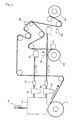
- Fig. 5 is a diagram illustrating the slit step, water-application step and winding step in the process of producing the oxygen absorbable laminate.
- Fig. 1 is a sectional view of one embodiment of the oxygen absorbable laminate according to the present invention.
- This oxygen absorbable laminate 1 comprises an internal layer (concealed layer) 2, an oxygen absorbable layer 3, a first adhesive resin layer 4a, a gas barrier layer 5, a second adhesive resin layer 4b, and an external layer (protective layer) 6.
- the oxygen absorbable laminate 1 is an oxygen absorbable laminate in which one or both of the internal layer 2 and the external layer 6 have a rough surface.
- a resin layer other than the first adhesive resin layer 4a particularly a flattening layer (shock-absorbing layer) which is the same type of layer as the internal layer or the oxygen absorbable layer may be provided between the oxygen absorbable layer 3 and the gas barrier layer 5.
- Fig. 2 is a schematic view of the oxygen absorbable laminate having the flattening layer.
- Fig. 2 is a sectional view of another embodiment of the oxygen absorbable laminate according to the present invention.
- This oxygen absorbable laminate 10 comprises an internal layer 2, an oxygen absorbable layer 3, a flattening layer 7, a first adhesive resin layer 4a, a gas barrier layer 5, a second adhesive resin layer 4b, and an external layer 6.
- the oxygen absorbable laminate 10 is an oxygen absorbable laminate in which one or both of the internal layer 2 and the external layer 6 have a rough surface.
- the oxygen absorbable laminate 10 since the oxygen absorbable layer 3 containing an oxygen absorber, the internal layer 2 and the flattening layer 7 are coextruded with the layer 3 sandwiched between the layer 2 and the layer 7 to be firmly integrated, the exposure of the oxygen absorber is prevented in spite of the volume expansion caused by oxidation of the oxygen absorber. Therefore, it has excellent appearance, adhesive properties and flavor retainability.
- thermoplastic resin having heat sealability and excellent moisture resistance is preferably used.
- Illustrative examples of the resin constituting the internal layer include olefin resins such as low-density polyethylenes (LDPE), medium-density polyethylenes, high-density polyethylenes, linear low-density polyethylenes (LLDPE), very low-density polyethylenes.
- LDPE low-density polyethylenes
- LLDPE linear low-density polyethylenes
- very low-density polyethylenes such as low-density polyethylenes (LDPE), medium-density polyethylenes, high-density polyethylenes, linear low-density polyethylenes (LLDPE), very low-density polyethylenes.
- polypropylenes ethylene-propylene copolymers, ethylene-a-olefin copolymers, poly(1-butene), poly(4-methyl-1-pentene), ethylene-vinyl acetate copolymers (EVA), ethylene-ethyl acrylate copolymers (EEA), ion crosslinked olefin copolymers (ionomers) and acid denatured olefin resins.
- EVA ethylene-vinyl acetate copolymers
- EAA ethylene-ethyl acrylate copolymers
- ion crosslinked olefin copolymers ionomers
- acid denatured olefin resins acid denatured olefin resins.
- ethylene resins such as low-density polyethylenes (LDPE), medium-density polyethylenes, high-density polyethylenes, linear low-density polyethylenes (LLDPE), very low-density polyethylenes, ethylene-propylene copolymers, ethylene-a-olefin copolymers and the like are preferable.
- LDPE low-density polyethylenes
- LLDPE linear low-density polyethylenes
- very low-density polyethylenes ethylene-propylene copolymers
- ethylene-a-olefin copolymers ethylene-a-olefin copolymers and the like are preferable.
- a concealing agent such as white pigment, e.g., titanium dioxide, is preferably added to the above internal layer for the purpose of concealing the coloration caused by the oxygen absorber in the oxygen absorbable layer.
- the amount of the concealing agent is preferably 1 to 20 parts by weight based on 100 parts by weight of the resin constituting the internal layer.
- the thickness of the internal layer is preferably 5 to 250 ⁇ m because when the thickness is smaller than 5 ⁇ m, oxygen absorbability is deactivated as an early stage and heat sealability also lowers, while the thickness is larger than 250 ⁇ m, the oxygen absorbability and the heat sealability lower.
- the thickness of the internal layer is more preferably 10 to 100 ⁇ m, much more preferably 15 to 50 ⁇ m.
- the oxygen absorbable layer used in the oxygen absorbable laminate is made of a thermoplastic resin containing an oxygen absorber made of metal powders such as iron powders, aluminum powders and the like and salts.
- the metal powders are preferably reduced iron powders from the viewpoint of reactivity with oxygen in particular.
- the particle diameters of the reduced iron powders are preferably 1 to 100 ⁇ m, and the shapes thereof are flat, spherical and the like, and a flat shape is preferable particularly from the viewpoint of the adhesion between the oxygen absorbable layer and the layers adjacent to it.
- the salts used in the present invention are generally water-soluble, and metal halides are suitably used particularly from the viewpoint of the acceleration of the oxidation of the reduced iron powders.
- thermoplastic resin used in the oxygen absorbable layer examples include olefin resins such as low-density polyethylenes (LDPE), linear low-density polyethylenes (LLDPE), very low-density polyethylenes, medeium density polyethylenes high-density polyethylenes, polypropylenes, ethylene-propylene copolymers, ethylene-á-olefin copolymers, poly(1-butene), poly(4-methyl-1-pentene), ethylene-vinyl acetate copolymers (EVA), ethylene-ethyl acrylate copolymers (EEA), ion crosslinked olefin copolymers (ionomers) and acid denatured olefin resins; thermoplastic elastomers such as ethylene-propylene rubber (EPR) and ethylene-propylene-diene rubber (EPDM); and mixtures thereof.
- LDPE low-density polyethylenes
- LLDPE linear low-dens
- ethylene resins such as low-density polyethylenes (LDPE), medium-density polyethylenes, high-density polyethylenes, linear low-density polyethylenes (LLDPE), very low-density polyethylenes, ethylene-propylene copolymers, ethylene-á-olefin copolymers and the like are preferable because they absorb oxygen quickly and have excellent oxygen permeability.
- LDPE low-density polyethylenes
- medium-density polyethylenes high-density polyethylenes
- LLDPE linear low-density polyethylenes
- very low-density polyethylenes ethylene-propylene copolymers
- ethylene-á-olefin copolymers and the like are preferable because they absorb oxygen quickly and have excellent oxygen permeability.
- the olefin resins are resins with little moisture retainability, the water required for oxygen absorption can be smoothly replenished by the coexistence with the salts.
- the oxygen absorbable resin composition constituting the oxygen absorbable layer preferably contains 1 to 200 parts by weight of the oxygen absorber based on 100 parts by weight of the thermoplastic resin.
- the oxygen absorbable resin composition more preferably contains 5 to 100 parts by weight of the oxygen absorber based on 100 parts by weight of the thermoplastic resin.
- the mixing ratio (weight ratio) of the reduced iron powders and the salts is preferably 100:0.1 to 100:30, more preferably 100:1 to 100:10.
- the thickness of the oxygen absorbable layer varies depending on the absorbed amount of oxygen and forming shape required for the oxygen absorbable laminate, it is preferably 10 to 200 ⁇ m, more preferably 15 to 150 ⁇ m, much more preferably 20 to 100 ⁇ m.
- the thickness of the oxygen absorbable layer is smaller than 10 ⁇ m, the relative amount of oxygen absorber decreases, thereby making it difficult to maintain the oxygen absorbability over a long time period in some cases, while when the thickness is larger than 200 ⁇ m, the oxygen absorbable layer sticks out of the oxygen absorbable laminate at the time of heat-sealing, thereby degrading the appearance of the laminate.
- the oxygen absorbable laminate may contain a gas barrier layer.
- the gas barrier layer is not limited to certain layers. Generally used materials such as metal leaves, gas-barrierable resins or inorganic deposited resin films and the like can be used as a gas barrier layer.
- metal leaves include leaves light metals such as aluminum and aluminum alloys, iron leaf, tin plate leaf, and steel leaves such as surface-treated steel leaves.
- the gas-barrierable resins preferably have a low oxygen permeability coefficient.
- gas-barrierable resins include an ethylene-vinyl alcohol copolymer and polyamides.
- the inorganic deposited resin films include resin films on which silica, alumina or the like is deposited.
- the laminate is formed such that the deposited side of the film faces inward. That is, the deposited layer acts as a barrier layer, and the resin film layer acts as an external layer to be described later.
- any layer comprising continuous layers (non-permeable resin layers) of a thermoplastic resin can be used as the external layer of the oxygen absorbable laminate.
- Illustrative examples of the resin constituting this external layer include polyolefins such as low-density polyethylenes, high-density polyethylenes and polypropylenes; polyamides such as nylon 6; and polyesters such as polyethylene terephthalate.
- thermoplastic resin for the external layer a thermoplastic resin which has excellent strength, thrust resistance and heat resistance as compared with the resin for the internal layer.
- monoaxially or biaxially stretched films such as olefin resins, nylon resins and polyester resins are suitably used.
- the laminate may have poor adhesion and/or poor appearance in some cases.
- the flattening layer is preferably interposed between the layers.
- the same resins as those used in the above oxygen absorbable layer may be used.
- the internal layer, the oxygen absorbable layer and the flattening layer may comprise ethylene resins.
- the thickness of the flattening layer is preferably 2 to 100 ⁇ m. When it is smaller than 2 ⁇ m, it is difficult to absorb the pits and projections formed on the surface of the oxygen absorbable layer by the flattening layer, while when it is larger than 100 ⁇ m, the flattening layer sticks out of the laminate at the time of heat sealing, thereby degrading the appearance of the laminate.
- the thickness of the flattening layer is more preferably 3 to 50 ⁇ m, much more preferably 5 to 25 ⁇ m.
- a concealing agent such as white pigment, e.g., titanium dioxide, is preferably added to the above flattening layer, as in the case of the internal layer, for the purpose of concealing the coloration caused by the oxygen absorber in the oxygen absorbable layer.
- the arithmetic average roughness (Ra) (in accordance with JIS B0601) of the surface of the oxygen absorbable laminate is preferably 0.4 to 20 ⁇ m.
- an arithmetic average roughness of larger than 20 ⁇ m causes poor appearance.
- the arithmetic average roughness (Ra) of the roughened surface formed on the surface of the internal layer is more preferably 0.5 to 10 ⁇ m, much more preferably 0.6 to 5 ⁇ m, since the balance between oxygen absorbability and the ease of production of the laminate further improves.
- the water content defined as expression (1) described above is preferably 0.5 to 25 g/m 2 .
- oxygen absorbability may deteriorate significantly, while when it is higher than 25 g/m 2 , heat sealability may deteriorate.
- the oxygen absorbability and moisture retainability of the oxygen absorbable layer in the oxygen absorbable laminate are improved securely.
- the oxygen absorbable laminate can effectively exert excellent oxygen absorbability even when used for dried foods and the like.
- the effect of the arithmetic average roughness (Ra) of the roughened surface formed on the surface of the internal layer will be described in more detail with reference to Figs. 3 and 4 hereinafter.
- Fig. 3 is a diagram showing the relationship between the arithmetic average roughness (Ra) and a critical water content.
- the horizontal axis represents the arithmetic average roughness (Ra), and the vertical axis represents the critical water content (g/m 2 ).
- the “critical water content” is the critical (maximum) amount of water which can be contained in the oxygen absorbable laminate by the method comprising the steps of applying water to the oxygen absorbable laminate, winding it up into a roll form, sealing the roll by packaging materials or the like and allowing the roll to age.
- the arithmetic average roughness (Ra) and the critical water content are almost in a proportional relationship. Therefore, for example, by setting the arithmetic average roughness to be a value of not smaller than 0.5 ⁇ m, a value of not lower than 0.7 g/m 2 can be obtained as the critical water content.
- Fig. 4 is a diagram showing the relationship between the water content and the amount of absorbed oxygen under dry conditions.
- the horizontal axis represents the water content (g/m 2 ), and the vertical axis represents the amount of absorbed oxygen (cm 3 /cm 2 ).
- amount of absorbed oxygen as used herein mean the amount of oxygen which can be absorbed per unit area under the dry conditions of 22°C and 20%RH by the oxygen absorbable laminate. It is calculated from the amount of absorbed oxygen totaled until the oxygen absorbability becomes ineffective.
- the water content and the amount of absorbed oxygen are almost in a proportional relationship. Therefore, for example, by setting the water content to be a value of not lower than 1 g/m 2 , a value of not smaller than 0.017 cm 3 /cm 2 can be obtained as the amount of absorbed oxygen.
- the oxygen absorbable laminate of the present invention To roughen the surface of the oxygen absorbable laminate of the present invention and cause it to have a given surface roughness (Ra) to be described later, it is particularly preferable to add inorganic particles and organic particles or either of these particles to the internal layer, the oxygen absorbable layer or the external layer and secure the particles after extrusion.
- Ra surface roughness
- the addition of these particles makes the surface of the oxygen absorbable laminate a rough surface which is ascribable to the sizes and amounts of the particles added to the internal layer, the oxygen absorbable layer or the external layer.
- the blending of the inorganic particles and/or the organic particles with the resin matrix may be carried out by dry blending or melt blending. In general, it is preferable to produce a master batch containing inorganic particles and/or organic particles in high concentrations and dilute the resin matrix with the above master batch to a predetermined amount of the particles.
- inorganic particles and organic particles are not particularly limited.
- Illustrative examples of these particles include carbon black, white carbon, talc, clay, mica, calcium silicate, zeolite, diatomaceous earth, silica sand, synthetic silica, alumina hydrate, calcium carbonate, calcium sulfate, aluminum oxide, metal powders, glass powders, PMMA particles and St particles. They can be used solely or in combination of two or more.
- the average particle diameter (agglomerate diameter when the particles are agglomerated) of the particles is preferably 1 to 100 ⁇ m.
- the average particle diameter of the particles is more preferably 3 to 50 ⁇ m, much more preferably 5 to 30 ⁇ m.
- the amount of the inorganic particles and organic particles is preferably 0.1 to 20 parts by weight, more preferably 3 to 15 parts by weight, based on 100 parts by weight of the resin constituting the internal layer.
- the average particle diameter (agglomerate diameter when the particles are agglomerated) of the particles is preferably 1 to 100 ⁇ m.
- the average particle diameter of the particles is more preferably 5 to 80 ⁇ m, much more preferably 10 to 60 ⁇ m.
- the roughened surface formed on the surface of the oxygen absorbable layer is also formed on the surface(s) of the internal layer and/or the external layer via its adjacent layers.
- the amount of the inorganic particles and organic particles is preferably 1 to 30 parts by weight based on 100 parts by weight of the resin constituting the oxygen absorbable layer.
- the amount of the particles is preferably 5 to 20 parts by weight.
- the average particle diameter (agglomerate diameter when the particles are agglomerated) of the particles is preferably 0.5 to 100 ⁇ m.
- the average particle diameter of the particles is more preferably 1 to 50 ⁇ m, much more preferably 3 to 30 ⁇ m.
- the amount of the inorganic particles and organic particles is preferably 0.1 to 20 parts by weight based on 100 parts by weight of the resin constituting the external layer.
- the above inorganic particles and organic particles or either of these particles may not have to be contained in only one of the internal layer, the oxygen absorbable layer and the external. They may be contained in a plurality of the above layers as appropriate.
- an incompatible resin may be blended into the resins used in the above internal layer, oxygen absorbable layer or external layer.
- the blending of the resins may be carried out by dry blending or melt blending.
- an incompatible resin such as a polyvinyl alcohol resin is preferably added in an amount of 0.1 to 50 parts by weight based on 100 parts by weight of low-density polyethylene.
- the incompatible resin when the internal layer, the oxygen absorbable layer or the external layer is formed, the incompatible resin is phase-separated from the resins used in these layers. By utilizing this phase separation, the surface of the oxygen absorbable laminate can be roughened easily.
- the roughened surface formed on the surface of the oxygen absorbable layer is formed on the surface(s) of the internal layer and/or the external layer via its adjacent layers.
- the above incompatible resin is a water-soluble resin
- the surface(s) of the internal layer and/or the external layer can be further roughened.
- embossing on the surface(s) of the internal layer and/or the external layer by use of a roll having pits and projections on the surface, such as an embossing roll (calendaring roll).
- embossing may be carried out in an extrusion embossing device at the time of melt-extruding the above internal layer and/or the above external layer, or the surfaces of the internal layer and/or the external layer may be roughened by the embossing roll at the time of forming the above internal layer film and/or the external layer film prior to the lamination of the layers.
- embossing may be carried out on the surfaces of the internal layer and/or the external layer.
- the conditions for carrying out the embossing depend on the types of the thermoplastic resins used in the internal layer and the external layer, the embossed pattern on the embossing roll, and the like. In general, however, the temperature of the surface of the embossing roll is preferably 5°C to 200°C, and the embossing rate is preferably 0.1 to 200 m/min.
- the surface(s) of the internal layer and/or the external layer may be roughened by forming other layer(s) having pits and projections formed on the surface.
- the surface of the oxygen absorbable laminate can be formed into a surface having a given surface roughness by laminating a layer having the roughened surface formed thereon.
- the method for laminating the layer having the roughened surface formed thereon is not particularly limited. For example, by bringing a molten film into contact with a member having a roughened surface such as an embossing roll, a given roughened surface can be formed on the surface of the film and, at the same time, the film is laminated on the surface of the oxygen absorbable laminate, whereby the layer having the roughened surface formed thereon can be easily provided.
- the conditions for sandblasting can be selected as appropriate in consideration of the types of the thermoplastic resins used in the internal layer and the external layer, the type of sand to be used, and the like.
- abrasive roll including a mat roll and the like.
- the conditions for rubbing depend on the types of the thermoplastic resins used in the internal layer, the external layer and the like, the type of abrasive roll to be used, and the like. In general, however, the pressing linear load is preferably 100 to 2,000 N/cm, and the rubbing rate is preferably 0.1 to 200 m/min.
- the density (d1) of the ethylene resin of the internal layer and the density (d2) of the ethylene resin of the oxygen absorbable layer preferably satisfy the relationship d1 > d2.
- the density (d1) of the ethylene resin in the internal layer is preferably 0.915 g/cm 3 to 0.950 g/cm 3 .
- the resin density is more preferably 0.918 g/cm 3 to 0.945 g/cm 3 , much more preferably 0.920 g/cm 3 to 0.940 g/cm 3 , since the balance between oxygen absorbability and water vapor permeability further improves.
- a water-vapor permeability coefficient (H1) of the resin in the oxygen absorbable layer is preferably set to be higher than or equal to a water-vapor permeability coefficient (H2) of the resin in the internal layer, whereby the moisture in the oxygen absorbable layer is blocked by the internal layer.
- An oxygen permeability coefficient (01) of the oxygen absorbable layer is preferably set to be higher than or equal to an oxygen permeability coefficient (02) of the internal layer.
- 01 By setting 01 to be higher than or equal to 02, the oxygen absorber absorbs oxygen quickly, thereby improving oxygen absorbability.
- the oxygen absorbable laminate of the present invention is useful for preserving so-called dried foods, as exemplified by confections such as cookies, crackers, biscuits, rice crackers, candies, chocolates, dry cakes and dog biscuits; snack foods such as crisps and potato chips; powdered foods such as, powdered coffee, instant coffee, powdered milk, powdered juices and powdered soups; sea foods such as seaweeds and boiled-dried fishes; seasonings; dried noodles; dried vegetables; and tea leaves such as green tea leaves, roasted green tea leaves, oolong tea leaves and black tea leaves.
- confections such as cookies, crackers, biscuits, rice crackers, candies, chocolates, dry cakes and dog biscuits
- snack foods such as crisps and potato chips
- powdered foods such as, powdered coffee, instant coffee, powdered milk, powdered juices and powdered soups
- sea foods such as seaweeds and boiled-dried fishes
- seasonings dried noodles
- dried vegetables
- the oxygen absorbable laminate of the present invention is also useful for foods such as raw sweets biscuits de Savoie and the like which require quick oxygen removal for the sake of bacteriostasis. Further, in addition to these foods, it is also useful for medicaments such as infusion bags and poultices as well as cosmetics.
- the form of a container by forming the above oxygen absorbable laminate into the form of a bag, cup, tray, or a sealing cap used for a cap, tray or bottle, it can exert excellent storage stability to the contents.
- the present production method is a production method of an oxygen absorbable laminate which comprises the following steps (1) to (4).
- a production method of an oxygen absorbable laminate comprising an internal layer, an oxygen absorbable layer and an external layer, comprising the steps of:
- a three-layer film comprising the internal layer, the oxygen absorbable layer and the flattening layer is formed without using an adhesive or the like.
- the formation of the above three-layer film is not limited by the use of the multilayer simultaneous extruder and can also be accomplished by laminating each of the layers in turn with an adhesive or the like.
- the flattening layer which is an optional constituent may be omitted to form a two-layer-coextruded film, or other resin layer may be additionally formed to form a four-layer-coextruded film.
- a gas barrier layer and an external layer are laminated on the flattening layer side of the obtained three-layer-coextruded film comprising the internal layer, the oxygen absorbable layer and the flattening layer by dry lamination or the like to form the oxygen absorbable laminate.
- the oxygen absorbable laminate may be formed by producing a laminate comprising the gas barrier layer and the external layer in advance and extrusion-coating the three-layer-coextruded film comprising the internal layer, the oxygen absorbable layer and the flattening layer on the gas barrier layer side of this laminate.
- the oxygen absorbable laminate after lamination is cured.
- the peeling of the above oxygen absorbable laminate is securely prevented in the water-application step to be described later.
- the conditions for curing depend on the adhesive used, in general, curing is carried out at 35 to 55°C for 2 to 7 days.
- the thus-obtained oxygen absorbable laminate may be used directly in the following step or used after slit to a predetermined width by using a shear slitter or a scoring roll.
- the arithmetic average roughness (Ra) (in accordance with JIS B0601) of the surface of the oxygen absorbable laminate after a surface roughening treatment is preferably 0.4 to 20 ⁇ m.
- Illustrative examples of a method for carrying out the surface roughening treatment include the aforementioned addition of inorganic and organic particles, blending of incompatible resins, embossing, lamination of layers having pits and projections, sandblasting and rubbing with abrasives.
- a wide variety of means may be employed as long as a predetermined rough surface can be formed on the surface of the oxygen absorbable laminate.
- the addition of inorganic particles and organic particles or either of these particles to at least one of the internal layer, the oxygen absorbable layer and the external layer is preferable from the viewpoints of forming a controlled rough surface easily and securely and increasing the water content of the oxygen absorbable laminate securely.
- Water may not have to be applied to the roughened surface side and may be applied to the smooth surface side. Further, water may be applied to not only one surface but also both surfaces.
- the water supplied to the water atomizers is preferably the one which is sterilized by passing through sterile filters 32 and 33 and whose amount of flow is controlled by flowmeters 34 and 35.
- the application of water by means of such water atomizers is preferably carried out by such methods as spray coating, roller coating and immersion coating.
- the application of a mixture of water and alcohol is also preferable to increase the permeability of water to the oxygen absorbable layer.
- the surface of the oxygen absorbable laminate is also preferable to subject the surface of the oxygen absorbable laminate to a corona treatment in advance in order to achieve the more uniform application of water.
- the water to be applied is not limited to a liquid form and may be applied in vapor form.
- the formation of rust at the edges can be prevented effectively. That is, even if the oxygen absorber is exposed at the edges, the discoloration (formation of rust) by the oxidation of the oxygen absorber contained in the oxygen absorbable layer can be suppressed.
- the conditions for winding are selected as appropriate in consideration of the physical properties, thicknesses and the like of the materials of the oxygen absorbable laminate in order to prevent the occurrences of irregular winding, telescope and the like.
- the schematic diagram of Fig. 5 shows a line on which the aforementioned slitting, water-application and winding steps can be performed continuously.
- Aging is carried out in a sealed system with water present on the surface of oxygen absorbable laminate.
- aging is preferably carried out by sealing a roll of the oxygen absorbable laminate having water applied to the surface in a packaging bag made of a resin film or a special container having sealability.
- the conditions for aging are not preferably limited as long as the water present on the surface of the oxygen absorbable laminate is incorporated into the above oxygen absorbable laminate.
- the laminate is preferably left to stand at temperatures of not lower than 31°C and lower than 60°C for 15 to 400 hours after the application of water.
- Aging is carried out by the diffuse permeation of water through the internal and external layer resins.
- the water permeated through the internal layer and/or the external layer into the oxygen absorbable layer activates the oxygen absorber.
- the water content after aging is preferably 0.5 to 25 g/m 2 .
- the water content is more preferably 0.7 to 10 g/m 2 , much more preferably 1 to 5 g/m 2 .
- the water-applied oxygen absorbable laminate is preferably aged by winding it up into a roll form and then sealing the roll with a packaging material made of polyolefins, particularly a linear low-density polyethylene of 50 to 200 ⁇ m.
- the oxygen absorber in the laminate can be maintained in an activated state, and hydrogen generated due to reaction of the oxygen absorber and water in the laminate can be effectively exhausted.
- a vacuum chamber having sealability or the like can be employed.
- a three-layer coextruded film comprising the internal layer, oxygen absorbable layer and flattening layer having the following constitutions was prepared.
- internal layer a 20- ⁇ m-thick concealed layer comprising a composition containing 15 parts by weight of titanium oxide (titanium white) having an average particle diameter of 0.3 ⁇ m and 11 parts by weight of diatomaceous earth having an average particle diameter of 10 ⁇ m based on 100 parts by weight of LDPE.
- the titanium oxide and diatomaceous earth were compounded as an LDPE-based high-concentration master batch.
- oxygen absorbable layer a 25- ⁇ m-thick oxygen absorbable resin layer comprising 43 parts by weight of a composition containing reduced iron powders (average particle diameter: 25 ⁇ m) and sodium chloride in the ratio of 100:4 based on 100 parts by weight of LDPE.
- flatting layer LDPE having a thickness of 10 ⁇ m.
- An aluminum foil (7 ⁇ m) was bonded to a polyethylene terephthalate film (12 ⁇ m) by a polyurethane adhesive to form a laminate. Then, after the flattening layer of the above three-layer coextruded film was subjected to a corona treatment, the aluminum foil side of the laminate is bonded to the flattening layer side of the above three-layer coextruded film by a polyurethane adhesive to form an oxygen absorbable laminate.
- the oxygen absorbable laminate obtained in roll form in the above (ii) was left to stand at 35°C for 3 days to cure the polyurethane adhesive.
- the cured oxygen absorbable laminate in roll form was unrolled and slit into strips having a width of 155 mm by slitter.
- sterilized water was applied by a rotor dampening device (manufactured by WEKO Co., Ltd.). Further, the amount of the sterilized water was adjusted to be 1.9 g/m 2 by monitoring it by an infrared moisture meter.
- the rotor dampening device was adjusted such that the water was applied to a width of 120 mm in the 155-mm-wide strip with 17.5-mm-wide non-water-applied portions on both sides thereof.
- the oxygen absorbable laminate immediately after the application of water was immediately wound up into a roll having an unrolled length of 1,000 m by winder.
- the water-applied and rolled oxygen absorbable laminate was sealed in a packaging bag made of a 100- ⁇ m-thick LLDPE (linear low-density polyethylene) film.
- LLDPE linear low-density polyethylene
- the packaged oxygen absorbable laminate was left to stand at 35°C for 3 days to allow the laminate to incorporate the applied water therein.
- the arithmetic average roughness (Ra) of the internal layer in the oxygen absorbable laminate was measured by using a surface roughness measuring instrument SURFCOM (manufactured by TOKYO SEIMITSU Co., Ltd.) in accordance with JIS B0601. With a cutoff value of 0.8 mm and an evaluation length of 4 mm, the arithmetic average roughness was measured at 10 or more sites in each of MD (direction in which the film was formed) and TD (direction perpendicular to MD) directions and evaluated by the average value. As a result, it was 1.25 ⁇ m.
- a green tea bag was put in this bag, and the bag was heat-sealed with a head space of 13.4 ml.
- the concentration of the residual oxygen in the above bag was measured by a gas chromatograph (GC-8A, product of SHIMADZU CORPORATION).
- the quality of the green tea bag in the above bag which had been stored for a predetermined time period was evaluated by the sensory test involving 10 panelists.
- the evaluation was made by a 5-scale evaluation method with the quality of the tea bag before storage being 5 (highest point) on a scale of 1 to 5.
- the items to be evaluated were color, flavor and taste, and the average value of the results of evaluating these three items was taken as the overall evaluation point. The result is shown in Table 1.
- An oxygen absorbable laminate was produced, subjected to the water incorporation treatment and evaluated in the same manner as in Example 1 except that the amount of the diatomaceous earth having an average particle diameter of 10 ⁇ m in Example 1 was decreased from 11 parts by weight to 3 parts by weight and that the surface roughness Ra of the surface of the internal layer was 0.80 ⁇ m. The obtained results are shown in Table 1.
- An oxygen absorbable laminate was produced, subjected to the water incorporation treatment and evaluated in the same manner as in Example 1 except that PMMA beads (5 parts by weight) having an average particle diameter of 10 ⁇ m were used in place of the diatomaceous earth in the internal layer in Example 1. The obtained results are shown in Table 1.
- An oxygen absorbable laminate was produced, subjected to the water incorporation treatment and evaluated in the same manner as in Example 1 except that in place of using the diatomaceous earth in the internal layer in Example 1, silica (7 parts by weight) having an average particle diameter of 29 ⁇ m was added to the oxygen absorbable layer. The obtained results are shown in Table 1.
- An oxygen absorbable laminate was produced, subjected to the water incorporation treatment and evaluated in the same manner as in Example 1 except that the diatomaceous earth in the internal layer in Example 1 was not used and that a polypropylene film (20 ⁇ m) to which silica (3 parts by weight) having an average particle diameter of 4 ⁇ m had been added was used in place of a polyethylene terephthalate film (12 ⁇ m) as the external layer.
- the obtained results are shown in Table 1.
- An oxygen absorbable laminate was produced, subjected to the water incorporation treatment and evaluated in the same manner as in Example 1 except that in place of adding the diatomaceous earth to the internal layer in Example 1, 10 parts by weight of polyvinyl alcohol resin was added as the incompatible resin based on 100 parts by weight of the LDPE resin and that the arithmetic average roughness (Ra) of the surface of the internal layer was 0.85 ⁇ m.
- Ra arithmetic average roughness
- An oxygen absorbable laminate was produced, subjected to the water incorporation treatment and evaluated in the same manner as in Example 1 except that in place of using the diatomaceous earth in the internal layer in Example 1, 10 parts by weight of polyvinyl alcohol resin was added to the oxygen absorbable layer based on 100 parts by weight of the LDPE resin. The obtained results are shown in Table 1.
- An oxygen absorbable laminate was produced, subjected to the water incorporation treatment and evaluated in the same manner as in Example 1 except that in place of adding the diatomaceous earth to the internal layer, the three-layer coextrusion of the internal layer, the oxygen absorbable layer and the flattening layer was carried out by a T-die method and a sandblasting roll was pressed against the internal layer side of the molten film to form a roughened surface having an arithmetic average roughness (Ra) of 1.53 ⁇ m. The obtained results are shown in Table 1.
- An oxygen absorbable laminate was produced, subjected to the water incorporation treatment and evaluated in the same manner as in Example 1 except that in place of adding the diatomaceous earth to the internal layer, an LDPE resin was extrusion-laminated on the internal layer side of the laminate to a thickness of 15 ⁇ m by using a sandblasting roll as a cooling roller to form a roughened surface having an arithmetic average roughness (Ra) of 1.53 ⁇ m on the surface of the laminate.
- Ra arithmetic average roughness
- An oxygen absorbable laminate was produced, subjected to the water incorporation treatment and evaluated in the same manner as in Example 1 except that the addition of inorganic particles to the internal layer in Example 1 was not carried out and that the surface roughening treatment was not carried out. The obtained results are shown in Table 1.
- An oxygen absorbable laminate was produced and subjected to the water incorporation treatment in the same manner as in Example 1 except that a roughened surface having an arithmetic average roughness (Ra) of 25 ⁇ m was formed on the surface of the internal layer by changing the sandblasting roll used at the time of producing the three-layer coextruded film in Example 8 to an embossing roll having larger pits and projections.
- Ra arithmetic average roughness
- An oxygen absorbable laminate was produced, subjected to the water incorporation treatment and evaluated in the same manner as in Example 1 except that the amount of the sterilized water to be applied was adjusted to be 0.4 g/m 2 in the water-application step. The obtained results are shown in Table 1.
- Example 1 The preparation of the three-layer coextruded film in Example 1 was carried out by a T-die method based on the following constitution, and a sandblasting roll was pressed against the internal layer side of the molten film to form a roughened surface having an arithmetic average roughness (Ra) of 19.8 ⁇ m.
- internal layer a 20- ⁇ m-thick concealed layer comprising a composition containing 15 parts by weight of titanium oxide having an average particle diameter of 0.3 ⁇ m based on 100 parts by weight of LDPE.
- the titanium oxide was compounded as an LDPE-based high-concentration master batch.
- oxygen absorbable layer a 25- ⁇ m-thick oxygen absorbable resin layer comprising 43 parts by weight of a composition containing reduced iron powders (average particle diameter: 25 ⁇ m) and sodium chloride in the ratio of 100:20 based on 100 parts by weight of LDPE.
- flattening layer LDPE having a thickness of 10 ⁇ m.
- An oxygen absorbable laminate was produced in the same manner as in Example 1 except that a polypropylene film which had been caused to have an arithmetic average surface roughness (Ra) of 3.5 ⁇ m by the addition of silica (7 parts by weight) having an average particle diameter of 29 ⁇ m was used in this three-layer coextruded film in place of the polyethylene terephthalate film as the external layer.
- Ra arithmetic average surface roughness
- the water incorporation treatment was carried out on this oxygen absorbable laminate in the same manner as in Example 1 except that the amount of the sterilized water to be applied was controlled to be 30 g/m 2 and that the aging time was set to be 10 days.
- the water content of the oxygen absorbable laminate after aging was 27 g/m 2 .
- an oxygen absorbable laminate was produced and subject to the water incorporation treatment in the same manner as in Example 1.
- internal layer a 20- ⁇ m-thick concealed layer comprising a composition containing 15 parts by weight of titanium oxide (titanium white) having an average particle diameter of 0.3 ⁇ m and 11 parts by weight of diatomaceous earth having an average particle diameter of 10 ⁇ m based on 100 parts by weight of LLDPE having a resin density of 0.940 g/cm 3 .
- oxygen absorbable layer a 25- ⁇ m-thick oxygen absorbable resin layer comprising 43 parts by weight of an oxygen absorber containing reduced iron powders (average particle diameter: 25 ⁇ m) and sodium chloride in the ratio of 100:4 based on 100 parts by weight of LDPE having a resin density of 0.924 g/cm 3 .
- flattening layer LPPE having a thickness of 10 ⁇ m.
- the cup was stored at 22° C for 7 days, after which the concentration of oxygen in the container was analyzed by a gas chromatograph, and the amount of oxygen absorbed per unit film area was calculated. The result is shown in Table 2.
- An oxygen absorbable laminate was produced and evaluated in the same manner as in Example 10 except that the resin density (d1) of the internal layer was changed from 0.940 g/cm 3 to 0.930 g/cm 3 and it satisfied the relationship d1 > d2.
- the results are shown in Table 2.
- An oxygen absorbable laminate was produced and evaluated in the same manner as in Example 10 except that the resin density (d2) of the oxygen absorbable layer was changed from 0.924 g/cm 3 to 0.907 g/cm 3 and it satisfied the relationship d1 > d2.
- the results are shown in Table 2.
- An oxygen absorbable laminate was produced and evaluated in the same manner as in Example 10 except that the resin density (d2) of the oxygen absorbable layer was changed from 0.924 g/cm 3 to 0.940 g/cm 3 and it satisfied the relationship d1 ⁇ d2. The results are shown in Table 2.
- An oxygen absorbable laminate was produced and evaluated in the same manner as in Example 10 except that the resin density (d1) of the internal layer was changed from 0.940 g/cm 3 to 0.910 g/cm 3 and it satisfied the relationship d1 ⁇ d2. The results are shown in Table 2.
- the water contents and the amounts of absorbed oxygen were measured in accordance with the aforementioned measurements of the water content and the amount of absorbed oxygen, respectively.
- the oxygen absorbable laminates of Examples 10 to 12 and Comparative Examples 5 to 7 had the same water content, while as for the amounts of absorbed oxygen, the oxygen absorbable laminates of Examples 10 to 12 exhibited greater and more excellent oxygen absorbability than those of Comparative Examples 5 to 7 and were marked with ⁇ .
- the present invention is based on Japanese Patent Application No. 2000-182561, No. 2000-219150, which are hereby incorporated by reference.
Landscapes
- Engineering & Computer Science (AREA)
- Mechanical Engineering (AREA)
- Laminated Bodies (AREA)
- Food Preservation Except Freezing, Refrigeration, And Drying (AREA)
Applications Claiming Priority (4)
| Application Number | Priority Date | Filing Date | Title |
|---|---|---|---|
| JP2000182561A JP2002001879A (ja) | 2000-06-19 | 2000-06-19 | 酸素吸収性積層体およびその製造方法 |
| JP2000182561 | 2000-06-19 | ||
| JP2000219150 | 2000-07-19 | ||
| JP2000219150A JP4852781B2 (ja) | 2000-07-19 | 2000-07-19 | 酸素吸収性積層体 |
Publications (2)
| Publication Number | Publication Date |
|---|---|
| EP1167016A2 true EP1167016A2 (de) | 2002-01-02 |
| EP1167016A3 EP1167016A3 (de) | 2003-09-17 |
Family
ID=26594159
Family Applications (1)
| Application Number | Title | Priority Date | Filing Date |
|---|---|---|---|
| EP20010810582 Withdrawn EP1167016A3 (de) | 2000-06-19 | 2001-06-15 | Sauerstoff absorbierendes Laminat und Herstellungsverfahren dafür |
Country Status (3)
| Country | Link |
|---|---|
| US (1) | US6500519B2 (de) |
| EP (1) | EP1167016A3 (de) |
| KR (1) | KR100726261B1 (de) |
Cited By (2)
| Publication number | Priority date | Publication date | Assignee | Title |
|---|---|---|---|---|
| EP2552804A4 (de) * | 2010-03-31 | 2014-11-12 | Multisorb Tech Inc | Sauerstoff-, wasserdampf- und kohlendioxidabsorption in einem einmal-container |
| EP1901920B1 (de) | 2005-06-15 | 2016-05-04 | Amcor Flexibles Kreuzlingen Ltd. | Blisterbodenteil und blisterpackung |
Families Citing this family (13)
| Publication number | Priority date | Publication date | Assignee | Title |
|---|---|---|---|---|
| US7185780B2 (en) * | 2003-12-15 | 2007-03-06 | Sonoco Develpoment, Inc. | Container overcap with drying agent layer |
| US20050238846A1 (en) * | 2004-03-10 | 2005-10-27 | Fuji Photo Film Co., Ltd. | Gas barrier laminate film, method for producing the same and image display device utilizing the film |
| ITUD20050069A1 (it) * | 2005-04-26 | 2006-10-27 | Arcadia Srl | Imballaggio attivo ad azione conservativa |
| ATE466311T1 (de) * | 2006-03-10 | 2010-05-15 | Fujifilm Corp | Flachdruckplattenvorläufer und stapel davon |
| US20110244085A1 (en) * | 2010-03-31 | 2011-10-06 | Multisorb Technologies Inc. | Oxygen, water vapor, and carbon dioxide absorption in a single use container |
| US8885289B2 (en) * | 2011-08-17 | 2014-11-11 | HGST Netherlands B.V. | Magnetic storage device with multi-functional component for controlling chemical and water vapor therein |
| US8867164B2 (en) | 2011-08-17 | 2014-10-21 | HGST Netherlands B.V. | Magnetic storage device with humidity control device incorporating a differentially permeable membrane |
| US8861127B2 (en) | 2011-08-17 | 2014-10-14 | HGST Netherlands B.V. | Magnetic storage device with dynamic humidity control system to mitigate water vapor transients |
| US10549893B2 (en) * | 2011-12-22 | 2020-02-04 | G3 Enterprises, Inc. | Method for controlling oxygen ingress in cap closure |
| EP2794412B1 (de) * | 2011-12-22 | 2020-08-12 | G3 Enterprises, Inc. | Kappenverschluss und verfahren zur kontrolle des sauerstoffeintritts in einen kappenverschluss |
| PL3099595T3 (pl) | 2014-01-28 | 2022-05-30 | G3 Enterprises, Inc. | Zamknięcie nasadkowe dla napojów gazowanych i wrażliwych na tlen |
| JP6198182B1 (ja) * | 2016-12-09 | 2017-09-20 | 三菱瓦斯化学株式会社 | 多層体、包装容器、及び食品の保存方法 |
| KR102307435B1 (ko) * | 2021-02-15 | 2021-09-30 | 삼화화학공업주식회사 | 변형방지 특성을 가지는 산소흡수수지 조성물 |
Family Cites Families (7)
| Publication number | Priority date | Publication date | Assignee | Title |
|---|---|---|---|---|
| JPS6469332A (en) * | 1987-09-11 | 1989-03-15 | Tosoh Corp | Manufacture of permeable composite film |
| JPH05310274A (ja) * | 1992-05-08 | 1993-11-22 | Toagosei Chem Ind Co Ltd | 酸素吸収剤包装体 |
| JPH0951786A (ja) | 1995-08-14 | 1997-02-25 | Ajinomoto Co Inc | 乾燥食品用包材および乾燥食品の包装方法 |
| US6063503A (en) * | 1995-12-28 | 2000-05-16 | Mitsubishi Gas Chemical Company, Inc. | Oxygen-absorbing multi-layer film and method for preparing same |
| DE69720571T2 (de) * | 1996-02-03 | 2004-01-08 | Mitsubishi Gas Chemical Co., Inc. | Sauerstoff absorbierende Harzzusammensetzung und Verpackungsmaterial, mehrschichtiges Verpackungsmaterial, Verpackung und Verpackungsverfahren die dieses verwendet |
| GB9710549D0 (en) * | 1997-05-23 | 1997-07-16 | Horsell Graphic Ind Ltd | Planographic printing |
| JP3282567B2 (ja) * | 1997-11-21 | 2002-05-13 | 東洋製罐株式会社 | 活性化型酸素吸収剤を含む包装用積層体 |
-
2001
- 2001-06-15 US US09/880,790 patent/US6500519B2/en not_active Expired - Lifetime
- 2001-06-15 KR KR1020010033962A patent/KR100726261B1/ko not_active Expired - Fee Related
- 2001-06-15 EP EP20010810582 patent/EP1167016A3/de not_active Withdrawn
Cited By (2)
| Publication number | Priority date | Publication date | Assignee | Title |
|---|---|---|---|---|
| EP1901920B1 (de) | 2005-06-15 | 2016-05-04 | Amcor Flexibles Kreuzlingen Ltd. | Blisterbodenteil und blisterpackung |
| EP2552804A4 (de) * | 2010-03-31 | 2014-11-12 | Multisorb Tech Inc | Sauerstoff-, wasserdampf- und kohlendioxidabsorption in einem einmal-container |
Also Published As
| Publication number | Publication date |
|---|---|
| US20020012808A1 (en) | 2002-01-31 |
| EP1167016A3 (de) | 2003-09-17 |
| KR100726261B1 (ko) | 2007-06-08 |
| KR20010113512A (ko) | 2001-12-28 |
| US6500519B2 (en) | 2002-12-31 |
Similar Documents
| Publication | Publication Date | Title |
|---|---|---|
| US6500519B2 (en) | Oxygen absorbable laminate and production method thereof | |
| EP3034163B1 (de) | Adsorptionsmittelzusammensetzung, adsorptionsmittel enthaltender film und verfahren zu seiner herstellung | |
| CN107074419B (zh) | 泡罩包装及其包装体、泡罩包装用层叠体及其制备方法 | |
| JP2653337B2 (ja) | 二重包装体 | |
| EP2812262B1 (de) | Film mit sauerstoffabsorbierenden regionen | |
| WO2015186585A1 (ja) | 易カット性の吸収性積層体、及びそれを用いた包装袋 | |
| AU709511B2 (en) | Resin composition and laminate for storage of liquid food | |
| JP4019339B2 (ja) | 炭酸ガス吸収積層体、これを用いた容器及び食品類の保存方法 | |
| JPWO2000056542A1 (ja) | 包装用積層体の製造方法 | |
| JP2005007837A (ja) | 吸湿剤入りペレットとその製造方法、及び吸湿性成形品の製造方法 | |
| EP2898870A1 (de) | Bahnmaterial zur arzneimittelverpackung und arzneimittelpackprodukt | |
| JP2677176B2 (ja) | 積層体およびそれから構成される包装体 | |
| JP4852781B2 (ja) | 酸素吸収性積層体 | |
| JPS6225101B2 (de) | ||
| JPH11151783A (ja) | 活性化型酸素吸収剤を含む包装用積層体 | |
| JP2002001879A (ja) | 酸素吸収性積層体およびその製造方法 | |
| JPH0655485B2 (ja) | 板紙容器およびその製造方法 | |
| JPH04148640A (ja) | ブロック状生肉の包装体及びブロック状生肉の包装方法 | |
| JP4411646B2 (ja) | 積層包装材料 | |
| JP4552311B2 (ja) | 包装容器 | |
| CN223546804U (zh) | 一种复合包装袋 | |
| JP4085218B2 (ja) | 脱酸素剤組成物及び保存方法 | |
| JP4492762B2 (ja) | 酸素吸収性多層フィルム及び包装容器 | |
| JP2000255008A (ja) | 酸素吸収性多層体 | |
| JP2018034875A (ja) | 酸素吸収性フィルム |
Legal Events
| Date | Code | Title | Description |
|---|---|---|---|
| PUAI | Public reference made under article 153(3) epc to a published international application that has entered the european phase |
Free format text: ORIGINAL CODE: 0009012 |
|
| AK | Designated contracting states |
Kind code of ref document: A2 Designated state(s): AT BE CH CY DE DK ES FI FR GB GR IE IT LI LU MC NL PT SE TR |
|
| AX | Request for extension of the european patent |
Free format text: AL;LT;LV;MK;RO;SI |
|
| RIN1 | Information on inventor provided before grant (corrected) |
Inventor name: ICHIKAWA, KENTARO Inventor name: NISHIZUKA, HIDEHIKO Inventor name: ISHIZAKI, YOUICHI |
|
| PUAL | Search report despatched |
Free format text: ORIGINAL CODE: 0009013 |
|
| RIC1 | Information provided on ipc code assigned before grant |
Ipc: 7B 65D 81/26 B Ipc: 7B 32B 27/18 B Ipc: 7B 32B 27/32 B Ipc: 7B 32B 27/08 B Ipc: 7B 32B 33/00 B Ipc: 7B 32B 31/00 B Ipc: 7B 32B 27/20 A |
|
| AK | Designated contracting states |
Kind code of ref document: A3 Designated state(s): AT BE CH CY DE DK ES FI FR GB GR IE IT LI LU MC NL PT SE TR |
|
| AX | Request for extension of the european patent |
Extension state: AL LT LV MK RO SI |
|
| 17P | Request for examination filed |
Effective date: 20040107 |
|
| AKX | Designation fees paid |
Designated state(s): DE FR GB |
|
| 17Q | First examination report despatched |
Effective date: 20070226 |
|
| RAP1 | Party data changed (applicant data changed or rights of an application transferred) |
Owner name: TOYO SEIKAN KAISHA, LTD. |
|
| GRAP | Despatch of communication of intention to grant a patent |
Free format text: ORIGINAL CODE: EPIDOSNIGR1 |
|
| RIC1 | Information provided on ipc code assigned before grant |
Ipc: B32B 27/20 20060101ALI20151127BHEP Ipc: B32B 38/00 20060101AFI20151127BHEP Ipc: B32B 38/06 20060101ALI20151127BHEP |
|
| INTG | Intention to grant announced |
Effective date: 20160105 |
|
| STAA | Information on the status of an ep patent application or granted ep patent |
Free format text: STATUS: THE APPLICATION IS DEEMED TO BE WITHDRAWN |
|
| 18D | Application deemed to be withdrawn |
Effective date: 20160518 |