EP1167457B1 - Composition de silicone thermoconductrice et dispositif semi-conducteur - Google Patents
Composition de silicone thermoconductrice et dispositif semi-conducteur Download PDFInfo
- Publication number
- EP1167457B1 EP1167457B1 EP01305496A EP01305496A EP1167457B1 EP 1167457 B1 EP1167457 B1 EP 1167457B1 EP 01305496 A EP01305496 A EP 01305496A EP 01305496 A EP01305496 A EP 01305496A EP 1167457 B1 EP1167457 B1 EP 1167457B1
- Authority
- EP
- European Patent Office
- Prior art keywords
- composition
- heat
- weight
- component
- conductive silicone
- Prior art date
- Legal status (The legal status is an assumption and is not a legal conclusion. Google has not performed a legal analysis and makes no representation as to the accuracy of the status listed.)
- Expired - Lifetime
Links
Images
Classifications
-
- C—CHEMISTRY; METALLURGY
- C10—PETROLEUM, GAS OR COKE INDUSTRIES; TECHNICAL GASES CONTAINING CARBON MONOXIDE; FUELS; LUBRICANTS; PEAT
- C10M—LUBRICATING COMPOSITIONS; USE OF CHEMICAL SUBSTANCES EITHER ALONE OR AS LUBRICATING INGREDIENTS IN A LUBRICATING COMPOSITION
- C10M111/00—Lubrication compositions characterised by the base-material being a mixture of two or more compounds covered by more than one of the main groups C10M101/00 - C10M109/00, each of these compounds being essential
- C10M111/04—Lubrication compositions characterised by the base-material being a mixture of two or more compounds covered by more than one of the main groups C10M101/00 - C10M109/00, each of these compounds being essential at least one of them being a macromolecular organic compound
-
- C—CHEMISTRY; METALLURGY
- C08—ORGANIC MACROMOLECULAR COMPOUNDS; THEIR PREPARATION OR CHEMICAL WORKING-UP; COMPOSITIONS BASED THEREON
- C08K—Use of inorganic or non-macromolecular organic substances as compounding ingredients
- C08K3/00—Use of inorganic substances as compounding ingredients
- C08K3/02—Elements
- C08K3/08—Metals
-
- C—CHEMISTRY; METALLURGY
- C08—ORGANIC MACROMOLECULAR COMPOUNDS; THEIR PREPARATION OR CHEMICAL WORKING-UP; COMPOSITIONS BASED THEREON
- C08K—Use of inorganic or non-macromolecular organic substances as compounding ingredients
- C08K3/00—Use of inorganic substances as compounding ingredients
- C08K3/18—Oxygen-containing compounds, e.g. metal carbonyls
- C08K3/20—Oxides; Hydroxides
- C08K3/22—Oxides; Hydroxides of metals
-
- C—CHEMISTRY; METALLURGY
- C08—ORGANIC MACROMOLECULAR COMPOUNDS; THEIR PREPARATION OR CHEMICAL WORKING-UP; COMPOSITIONS BASED THEREON
- C08K—Use of inorganic or non-macromolecular organic substances as compounding ingredients
- C08K5/00—Use of organic ingredients
- C08K5/54—Silicon-containing compounds
- C08K5/541—Silicon-containing compounds containing oxygen
- C08K5/5415—Silicon-containing compounds containing oxygen containing at least one Si—O bond
- C08K5/5419—Silicon-containing compounds containing oxygen containing at least one Si—O bond containing at least one Si—C bond
-
- C—CHEMISTRY; METALLURGY
- C08—ORGANIC MACROMOLECULAR COMPOUNDS; THEIR PREPARATION OR CHEMICAL WORKING-UP; COMPOSITIONS BASED THEREON
- C08L—COMPOSITIONS OF MACROMOLECULAR COMPOUNDS
- C08L83/00—Compositions of macromolecular compounds obtained by reactions forming in the main chain of the macromolecule a linkage containing silicon with or without sulfur, nitrogen, oxygen or carbon only; Compositions of derivatives of such polymers
- C08L83/04—Polysiloxanes
-
- H—ELECTRICITY
- H10—SEMICONDUCTOR DEVICES; ELECTRIC SOLID-STATE DEVICES NOT OTHERWISE PROVIDED FOR
- H10W—GENERIC PACKAGES, INTERCONNECTIONS, CONNECTORS OR OTHER CONSTRUCTIONAL DETAILS OF DEVICES COVERED BY CLASS H10
- H10W40/00—Arrangements for thermal protection or thermal control
- H10W40/20—Arrangements for cooling
- H10W40/25—Arrangements for cooling characterised by their materials
- H10W40/251—Organics
-
- H—ELECTRICITY
- H10—SEMICONDUCTOR DEVICES; ELECTRIC SOLID-STATE DEVICES NOT OTHERWISE PROVIDED FOR
- H10W—GENERIC PACKAGES, INTERCONNECTIONS, CONNECTORS OR OTHER CONSTRUCTIONAL DETAILS OF DEVICES COVERED BY CLASS H10
- H10W40/00—Arrangements for thermal protection or thermal control
- H10W40/70—Fillings or auxiliary members in containers or in encapsulations for thermal protection or control
- H10W40/77—Auxiliary members characterised by their shape
- H10W40/778—Auxiliary members characterised by their shape in encapsulations
-
- C—CHEMISTRY; METALLURGY
- C08—ORGANIC MACROMOLECULAR COMPOUNDS; THEIR PREPARATION OR CHEMICAL WORKING-UP; COMPOSITIONS BASED THEREON
- C08G—MACROMOLECULAR COMPOUNDS OBTAINED OTHERWISE THAN BY REACTIONS ONLY INVOLVING UNSATURATED CARBON-TO-CARBON BONDS
- C08G77/00—Macromolecular compounds obtained by reactions forming a linkage containing silicon with or without sulfur, nitrogen, oxygen or carbon in the main chain of the macromolecule
- C08G77/04—Polysiloxanes
- C08G77/12—Polysiloxanes containing silicon bound to hydrogen
-
- C—CHEMISTRY; METALLURGY
- C08—ORGANIC MACROMOLECULAR COMPOUNDS; THEIR PREPARATION OR CHEMICAL WORKING-UP; COMPOSITIONS BASED THEREON
- C08G—MACROMOLECULAR COMPOUNDS OBTAINED OTHERWISE THAN BY REACTIONS ONLY INVOLVING UNSATURATED CARBON-TO-CARBON BONDS
- C08G77/00—Macromolecular compounds obtained by reactions forming a linkage containing silicon with or without sulfur, nitrogen, oxygen or carbon in the main chain of the macromolecule
- C08G77/04—Polysiloxanes
- C08G77/20—Polysiloxanes containing silicon bound to unsaturated aliphatic groups
-
- C—CHEMISTRY; METALLURGY
- C08—ORGANIC MACROMOLECULAR COMPOUNDS; THEIR PREPARATION OR CHEMICAL WORKING-UP; COMPOSITIONS BASED THEREON
- C08K—Use of inorganic or non-macromolecular organic substances as compounding ingredients
- C08K3/00—Use of inorganic substances as compounding ingredients
- C08K3/02—Elements
- C08K3/08—Metals
- C08K2003/0812—Aluminium
-
- C—CHEMISTRY; METALLURGY
- C08—ORGANIC MACROMOLECULAR COMPOUNDS; THEIR PREPARATION OR CHEMICAL WORKING-UP; COMPOSITIONS BASED THEREON
- C08K—Use of inorganic or non-macromolecular organic substances as compounding ingredients
- C08K3/00—Use of inorganic substances as compounding ingredients
- C08K3/18—Oxygen-containing compounds, e.g. metal carbonyls
- C08K3/20—Oxides; Hydroxides
- C08K3/22—Oxides; Hydroxides of metals
- C08K2003/2296—Oxides; Hydroxides of metals of zinc
-
- C—CHEMISTRY; METALLURGY
- C10—PETROLEUM, GAS OR COKE INDUSTRIES; TECHNICAL GASES CONTAINING CARBON MONOXIDE; FUELS; LUBRICANTS; PEAT
- C10M—LUBRICATING COMPOSITIONS; USE OF CHEMICAL SUBSTANCES EITHER ALONE OR AS LUBRICATING INGREDIENTS IN A LUBRICATING COMPOSITION
- C10M2201/00—Inorganic compounds or elements as ingredients in lubricant compositions
- C10M2201/04—Elements
- C10M2201/05—Metals; Alloys
- C10M2201/053—Metals; Alloys used as base material
-
- C—CHEMISTRY; METALLURGY
- C10—PETROLEUM, GAS OR COKE INDUSTRIES; TECHNICAL GASES CONTAINING CARBON MONOXIDE; FUELS; LUBRICANTS; PEAT
- C10M—LUBRICATING COMPOSITIONS; USE OF CHEMICAL SUBSTANCES EITHER ALONE OR AS LUBRICATING INGREDIENTS IN A LUBRICATING COMPOSITION
- C10M2201/00—Inorganic compounds or elements as ingredients in lubricant compositions
- C10M2201/06—Metal compounds
- C10M2201/062—Oxides; Hydroxides; Carbonates or bicarbonates
- C10M2201/0623—Oxides; Hydroxides; Carbonates or bicarbonates used as base material
-
- C—CHEMISTRY; METALLURGY
- C10—PETROLEUM, GAS OR COKE INDUSTRIES; TECHNICAL GASES CONTAINING CARBON MONOXIDE; FUELS; LUBRICANTS; PEAT
- C10M—LUBRICATING COMPOSITIONS; USE OF CHEMICAL SUBSTANCES EITHER ALONE OR AS LUBRICATING INGREDIENTS IN A LUBRICATING COMPOSITION
- C10M2207/00—Organic non-macromolecular hydrocarbon compounds containing hydrogen, carbon and oxygen as ingredients in lubricant compositions
- C10M2207/02—Hydroxy compounds
- C10M2207/021—Hydroxy compounds having hydroxy groups bound to acyclic or cycloaliphatic carbon atoms
-
- C—CHEMISTRY; METALLURGY
- C10—PETROLEUM, GAS OR COKE INDUSTRIES; TECHNICAL GASES CONTAINING CARBON MONOXIDE; FUELS; LUBRICANTS; PEAT
- C10M—LUBRICATING COMPOSITIONS; USE OF CHEMICAL SUBSTANCES EITHER ALONE OR AS LUBRICATING INGREDIENTS IN A LUBRICATING COMPOSITION
- C10M2227/00—Organic non-macromolecular compounds containing atoms of elements not provided for in groups C10M2203/00, C10M2207/00, C10M2211/00, C10M2215/00, C10M2219/00 or C10M2223/00 as ingredients in lubricant compositions
- C10M2227/04—Organic non-macromolecular compounds containing atoms of elements not provided for in groups C10M2203/00, C10M2207/00, C10M2211/00, C10M2215/00, C10M2219/00 or C10M2223/00 as ingredients in lubricant compositions having a silicon-to-carbon bond, e.g. organo-silanes
-
- C—CHEMISTRY; METALLURGY
- C10—PETROLEUM, GAS OR COKE INDUSTRIES; TECHNICAL GASES CONTAINING CARBON MONOXIDE; FUELS; LUBRICANTS; PEAT
- C10M—LUBRICATING COMPOSITIONS; USE OF CHEMICAL SUBSTANCES EITHER ALONE OR AS LUBRICATING INGREDIENTS IN A LUBRICATING COMPOSITION
- C10M2229/00—Organic macromolecular compounds containing atoms of elements not provided for in groups C10M2205/00, C10M2209/00, C10M2213/00, C10M2217/00, C10M2221/00 or C10M2225/00 as ingredients in lubricant compositions
- C10M2229/04—Siloxanes with specific structure
- C10M2229/043—Siloxanes with specific structure containing carbon-to-carbon double bonds
- C10M2229/0435—Siloxanes with specific structure containing carbon-to-carbon double bonds used as base material
-
- C—CHEMISTRY; METALLURGY
- C10—PETROLEUM, GAS OR COKE INDUSTRIES; TECHNICAL GASES CONTAINING CARBON MONOXIDE; FUELS; LUBRICANTS; PEAT
- C10M—LUBRICATING COMPOSITIONS; USE OF CHEMICAL SUBSTANCES EITHER ALONE OR AS LUBRICATING INGREDIENTS IN A LUBRICATING COMPOSITION
- C10M2229/00—Organic macromolecular compounds containing atoms of elements not provided for in groups C10M2205/00, C10M2209/00, C10M2213/00, C10M2217/00, C10M2221/00 or C10M2225/00 as ingredients in lubricant compositions
- C10M2229/04—Siloxanes with specific structure
- C10M2229/044—Siloxanes with specific structure containing silicon-to-hydrogen bonds
- C10M2229/0445—Siloxanes with specific structure containing silicon-to-hydrogen bonds used as base material
-
- C—CHEMISTRY; METALLURGY
- C10—PETROLEUM, GAS OR COKE INDUSTRIES; TECHNICAL GASES CONTAINING CARBON MONOXIDE; FUELS; LUBRICANTS; PEAT
- C10N—INDEXING SCHEME ASSOCIATED WITH SUBCLASS C10M RELATING TO LUBRICATING COMPOSITIONS
- C10N2010/00—Metal present as such or in compounds
- C10N2010/16—Groups 8, 9, or 10
-
- C—CHEMISTRY; METALLURGY
- C10—PETROLEUM, GAS OR COKE INDUSTRIES; TECHNICAL GASES CONTAINING CARBON MONOXIDE; FUELS; LUBRICANTS; PEAT
- C10N—INDEXING SCHEME ASSOCIATED WITH SUBCLASS C10M RELATING TO LUBRICATING COMPOSITIONS
- C10N2040/00—Specified use or application for which the lubricating composition is intended
- C10N2040/14—Electric or magnetic purposes
-
- C—CHEMISTRY; METALLURGY
- C10—PETROLEUM, GAS OR COKE INDUSTRIES; TECHNICAL GASES CONTAINING CARBON MONOXIDE; FUELS; LUBRICANTS; PEAT
- C10N—INDEXING SCHEME ASSOCIATED WITH SUBCLASS C10M RELATING TO LUBRICATING COMPOSITIONS
- C10N2050/00—Form in which the lubricant is applied to the material being lubricated
- C10N2050/10—Form in which the lubricant is applied to the material being lubricated semi-solid; greasy
-
- H—ELECTRICITY
- H10—SEMICONDUCTOR DEVICES; ELECTRIC SOLID-STATE DEVICES NOT OTHERWISE PROVIDED FOR
- H10W—GENERIC PACKAGES, INTERCONNECTIONS, CONNECTORS OR OTHER CONSTRUCTIONAL DETAILS OF DEVICES COVERED BY CLASS H10
- H10W72/00—Interconnections or connectors in packages
- H10W72/071—Connecting or disconnecting
- H10W72/072—Connecting or disconnecting of bump connectors
- H10W72/07251—Connecting or disconnecting of bump connectors characterised by changes in properties of the bump connectors during connecting
-
- H—ELECTRICITY
- H10—SEMICONDUCTOR DEVICES; ELECTRIC SOLID-STATE DEVICES NOT OTHERWISE PROVIDED FOR
- H10W—GENERIC PACKAGES, INTERCONNECTIONS, CONNECTORS OR OTHER CONSTRUCTIONAL DETAILS OF DEVICES COVERED BY CLASS H10
- H10W72/00—Interconnections or connectors in packages
- H10W72/20—Bump connectors, e.g. solder bumps or copper pillars; Dummy bumps; Thermal bumps
-
- H—ELECTRICITY
- H10—SEMICONDUCTOR DEVICES; ELECTRIC SOLID-STATE DEVICES NOT OTHERWISE PROVIDED FOR
- H10W—GENERIC PACKAGES, INTERCONNECTIONS, CONNECTORS OR OTHER CONSTRUCTIONAL DETAILS OF DEVICES COVERED BY CLASS H10
- H10W72/00—Interconnections or connectors in packages
- H10W72/851—Dispositions of multiple connectors or interconnections
- H10W72/874—On different surfaces
- H10W72/877—Bump connectors and die-attach connectors
-
- H—ELECTRICITY
- H10—SEMICONDUCTOR DEVICES; ELECTRIC SOLID-STATE DEVICES NOT OTHERWISE PROVIDED FOR
- H10W—GENERIC PACKAGES, INTERCONNECTIONS, CONNECTORS OR OTHER CONSTRUCTIONAL DETAILS OF DEVICES COVERED BY CLASS H10
- H10W90/00—Package configurations
- H10W90/701—Package configurations characterised by the relative positions of pads or connectors relative to package parts
- H10W90/721—Package configurations characterised by the relative positions of pads or connectors relative to package parts of bump connectors
- H10W90/724—Package configurations characterised by the relative positions of pads or connectors relative to package parts of bump connectors between a chip and a stacked insulating package substrate, interposer or RDL
-
- H—ELECTRICITY
- H10—SEMICONDUCTOR DEVICES; ELECTRIC SOLID-STATE DEVICES NOT OTHERWISE PROVIDED FOR
- H10W—GENERIC PACKAGES, INTERCONNECTIONS, CONNECTORS OR OTHER CONSTRUCTIONAL DETAILS OF DEVICES COVERED BY CLASS H10
- H10W90/00—Package configurations
- H10W90/701—Package configurations characterised by the relative positions of pads or connectors relative to package parts
- H10W90/731—Package configurations characterised by the relative positions of pads or connectors relative to package parts of die-attach connectors
- H10W90/736—Package configurations characterised by the relative positions of pads or connectors relative to package parts of die-attach connectors between a chip and a stacked lead frame, conducting package substrate or heat sink
Definitions
- This invention relates to silicone compositions having heat transfer ability, and semiconductor devices using the same.
- IC packages such as central processing units (CPU) and other electronic parts mounted on printed circuit boards will deteriorate their performance or even fail on account of temperature rises by the heat generated during operation.
- heat dissipating sheets or grease having a good heat transfer ability is employed between the IC package and the finned heat sink.
- the heat dissipating sheets have the advantage of easy mounting. Since the surface of CPU or finned heat sink is microscopically irregular despite apparent flatness, it is difficult in practice to intimately bond the heat dissipating sheet to the adherend surface, often leaving an air gap therebetween. This leads to the disadvantage that the heat dissipating sheet fails to exert the heat dissipating effect as desired.
- the silicone rubber compositions in the cured state tend to gradually harden, finally losing flexibility so that they peel off from the substrate or CPU. As a result, the compositions undesirably increase their thermal resistance with the lapse of time.
- the aim of the invention is to provide new and useful heat conductive silicone compositions which combine thermal conductivity, preferably higher than in previous such compositions, with flexibility which preferably is well maintained even after exposure to heat over a long period of time.
- aspects to be protected include the uncured and cured compositions, articles and especially films of the cured composition, methods of making and using any of these, semiconductor or IC devices including them, and the manufacture of such devices.
- silicone compositions of the addition reaction curing type comprising (A) organopolysiloxane having at least two alkenyl groups in a molecule and (B) organohydrogenpolysiloxane having at least two silicon atom-bonded hydrogen atoms per molecule.
- organohydrogenpolysiloxane of the following general formula (1) as component (B), blending a mixture of aluminium powder and zinc oxide powder as a filler, and further blending a long chain alkyl group-bearing organosilane of the following general formula (2), we can obtain heat conductive silicone compositions with a good thermal conductivity - by virtue of a possible increase in the amount of filler blended - which keep flexibility even when exposed to heat for a long period of time. Efficient heat dissipation is achievable by providing a cured film of the heat conductive silicone composition between a semiconductor chip and a heat dissipator.
- the heat conductive silicone composition is cast between the IC package and the heat dissipator and heat cured thereat to form a cured film e.g. of a thickness of 25 to 100 ⁇ m.
- one aspect herein is a heat conductive silicone composition
- a heat conductive silicone composition comprising
- a semiconductor device comprising a semiconductor chip and a heat dissipator wherein a cured film of the heat conductive silicone composition having a thickness of 25 to 100 ⁇ m is interposed between the chip and the heat dissipator.
- a semiconductor device comprising an IC package mounted on a printed circuit board and a heat dissipator disposed on the surface of the IC package wherein a cured film of the heat conductive silicone composition having a thickness of 25 to 100 ⁇ m is interposed between the IC package and the heat dissipator.
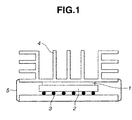
- FIG. 1 is a schematic cross-sectional view of a semiconductor device according to one embodiment of the invention.
- Component (A) of the heat conductive silicone composition according to the invention is an organopolysiloxane having at least two alkenyl groups, each directly attached to a silicon atom, in a molecule. It may be either straight or branched while a mixture of two or more organopolysiloxanes having different viscosity is acceptable.
- the organopolysiloxane used herein is preferably of the following average compositional formula (3).
- R 5 which may be the same or different, is a substituted or unsubstituted monovalent hydrocarbon group of 1 to 18 carbon atoms, preferably 1 to 3 carbon atoms, and c is a positive number in the range of 1.5 to 2.8, preferably 1.8 to 2.5, and more preferably 1.95 to 2.05.
- Examples of the substituted or unsubstituted monovalent hydrocarbon group attached to a silicon atom represented by R 5 include alkyl groups such as methyl, ethyl, propyl, isopropyl, butyl, isobutyl, tert-butyl, pentyl, neopentyl, hexyl, cyclohexyl, octyl, nonyl, decyl and dodecyl; aryl groups such as phenyl, tolyl, xylyl and naphthyl; aralkyl groups such as benzyl, phenylethyl and 2-phenylpropyl; alkenyl groups such as vinyl, allyl, propenyl, isopropenyl, 1-butenyl, 1-hexenyl, cyclohexenyl and octenyl; and substituted ones of the foregoing groups in which some or all of the hydrogen atoms are substitute
- At least two of the R 5 groups should be alkenyl groups, preferably of 2 to 8 carbon atoms, especially 2 to 6 carbon atoms. It is preferred that the content of alkenyl groups be 0.001 to 20 mol%, especially 0.01 to 10 mol%, of the entire organic groups attached to silicon atoms, that is, the entire substituted or unsubstituted monovalent hydrocarbon groups represented by R 5 in formula (3).
- the alkenyl groups may be attached to the silicon atoms at the ends of the molecular chain or silicon atoms intermediate the molecular chain or both. From the standpoints of composition curing rate and cured physical properties, the organopolysiloxane used herein should preferably have at least an alkenyl group attached to the silicon atom at the end of the molecular chain.
- the organopolysiloxane (A) should preferably have a viscosity at 25°C in the range of 10 to 100,000 mm 2 /s, especially 100 to 50,000 mm 2 /s. With a viscosity of less than 10 mm 2 /s, the composition may become less stable during storage. With a viscosity of more than 100,000 mm 2 /s, the composition may become less castable.
- Component (B) is an organohydrogenpolysiloxane having at least two, preferably at least three, silicon atom-bonded hydrogen atoms (i.e., Si-H groups) in a molecule. Specifically, it is a linear organohydrogenpolysiloxane having Si-H groups on side chains, represented by the following general formula (1): wherein R 1 is an alkyl group of 1 to 6 carbon atoms, and n and m are integers satisfying 0.01 ⁇ n/(n+m) ⁇ 0.3.
- R 1 is an alkyl group selected from among methyl, ethyl, propyl, butyl, hexyl and analogues. Of these, methyl is preferred because of ease of synthesis and cost.
- n/(n+m) in formula (1) is less than 0.01, the composition is prevented from crosslinking into a network structure. If n/(n+m) is more than 0.3, more Si-H groups are left unreacted after initial cure, so that moisture or other factors can drive crosslinking reaction to an excessive extent with the lapse of time, resulting in the composition losing flexibility. For this reason, n/(n+m) in formula (1) should be in the range of 0.01 to 0.3, preferably 0.05 to 0.2. The sum of n+m is preferably about 5 to 500, especially about 10 to 300, though not limited thereto.
- the amount of component (B) blended is such that the ratio of the number of Si-H groups in component (B) to the number of alkenyl groups in component (A) may range from 0.8/1 to 1.5/1, preferably from 0.9/1 to 1.3/1. If (number of Si-H groups)/(number of alkenyl groups) is less than 0.8, the composition fails to form a satisfactory network structure or reach the necessary cured hardness. If (number of Si-H groups)/(number of alkenyl groups) is more than 1.5, unreacted Si-H groups can undergo excessive crosslinking reaction with moisture so that the composition loses flexibility. Usually, 0.1 to 50 parts, especially 0.5 to 30 parts by weight of component (B) is blended per 100 parts by weight of component (A).
- Component (C) is a filler for imparting thermal conductivity to the inventive composition.
- the filler used herein is a mixture of aluminum powder and zinc oxide powder. If the aluminum powder used herein has a mean particle size of less than 0.1 ⁇ m, the resulting composition may be rather viscous and less castable. If the aluminum powder used herein has a mean particle size of more than 50 ⁇ m, the composition may become non-uniform. For this reason, the aluminum powder used herein should preferably have a mean particle size of 0.1 to 50 ⁇ m, more preferably 1 to 20 ⁇ m. If the zinc oxide powder used herein has a mean particle size of less than 0.1 ⁇ m, the resulting composition may be rather viscous and less castable.
- the zinc oxide powder used herein has a mean particle size of more than 5 ⁇ m, the composition may become non-uniform. For this reason, the zinc oxide powder used herein should preferably have a mean particle size of 0.1 to 5 ⁇ m, more preferably 1 to 4 ⁇ m.
- the aluminum and zinc oxide powder particles may be of spherical or irregular shape.
- Aluminium and zinc oxide powders generally have a thermal conductivity of about 237 W/mK and about 20 W/mK, respectively, indicating that aluminum powder alone is more advantageous in achieving a higher thermal conductivity.
- aluminum powder used alone gives a composition which is unstable and prone to oil separation. It has been found that mixing aluminum powder with zinc oxide powder is effective for preventing oil separation. If the weight ratio of aluminum powder/zinc oxide powder is less than 1/1, the resulting composition becomes less heat conductive. If the same ratio is more than 10/1, noticeable oil separation occurs with time. Therefore, the weight ratio of aluminum powder/zinc oxide powder is from 1 to 10, preferably at least 2, preferably not more then 8.
- the amount of the aluminum powder/zinc oxide powder mixture blended is 800 to 1,200 parts, preferably 850 to 1,150 parts by weight per 100 parts by weight of component (A). On this basis, the composition containing less than 800 parts of the powder mixture becomes less heat conductive whereas the composition containing more than 1,200 parts of the powder mixture becomes less castable.
- Component (D) is an organosilane of the following general formula (2): R 2 a R 3 b Si(OR 4 ) 4-a-b wherein R 2 is an alkyl group of 9 to 15 carbon atoms, R 3 is a monovalent hydrocarbon group of 1 to 8 carbon atoms, R 4 is an alkyl group of 1 to 6 carbon atoms, "a” is an integer of 1 to 3, "b” is an integer of 0 to 2, and the sum of a+b is an integer of 1 to 3, preferably 1 or 2.
- the organosilane serves as a wetter. Since component (A) has a poor wettability to the filler, a large amount of the filler cannot be loaded unless the wetter is added upon mixing. It has been found that the addition of the organosilane of formula (2) permits the composition to be loaded with a significantly increased amount of the filler.
- R 2 is an alkyl group of 9 to 15 carbon atoms, for example, nonyl, decyl, dodecyl and tetradecyl. With less than 9 carbon atoms, the wettability to the filler is insufficient. With more than 15 carbon atoms, the organosilane becomes inconvenient to handle because of solidification at room temperature and the resulting composition has poor low-temperature properties.
- the letter a is 1, 2 or 3, preferably equal to 1.
- R 3 is selected from saturated or unsaturated monovalent hydrocarbon groups of 1 to 8 carbon atoms, for example, alkyl groups such as methyl, ethyl, propyl, hexyl and octyl, cycloalkyl groups such as cyclopentyl and cyclohexyl, alkenyl groups such as vinyl and allyl, aryl groups such as phenyl and tolyl, aralkyl groups such as 2-phenylethyl and 2-methyl-2-phenylethyl, and halogenated hydrocarbon groups such as 3,3,3-trifluoropropyl, 2-(perfluorobutyl)ethyl, 2-(perfluorooctyl)ethyl and p-chlorophenyl.
- alkyl groups such as methyl, ethyl, propyl, hexyl and octyl
- cycloalkyl groups such as cyclopentyl and
- R 4 is an alkyl group of 1 to 6 carbon atoms, for example, methyl, ethyl, propyl, butyl, pentyl and hexyl, with methyl and ethyl being preferred.
- An appropriate amount of the organosilane blended is 0.01 to 10 parts, preferably 0.1 to 5 parts by weight per 100 parts by weight of component (A). Less than 0.01 part of the organosilane exerts less wetting effects whereas more than 10 parts of the organosilane gives little further effects and is uneconomical.
- Component (E) is a catalyst selected from among platinum and platinum compounds, which serves to promote addition reaction between alkenyl groups in component (A) and Si-H groups in component (B).
- exemplary catalysts are elemental platinum, chloroplatinic acid, platinum-olefin complexes, platinum-alcohol complexes, and platinum coordinate compounds.
- An appropriate amount of the catalyst is usually to give 0.1 to 500 parts by weight of platinum atoms per million parts by weight of component (A). Less than 0.1 ppm of platinum may be insufficiently catalytic. Usually no further increase in curing rate is expectable with more than 500 ppm of platinum.
- Component (F) is a regulator, for restraining the progress of hydrosilylation reaction at room temperature and thereby extending the shelf life and pot life.
- the reaction regulator may be selected from well-known compounds, for example, acetylene compounds, nitrogen compounds, organic phosphorus compounds, oxime compounds and organic chlorine compounds.
- An appropriate amount of the regulator (F) is 0.01 to 1 part by weight per 100 parts by weight of component (A). Less than 0.01 part of the regulator may only insignificantly improve shelf life or pot life whereas more than 1 part of the regulator may reduce curability.
- the heat conductive silicone composition of the invention may have added thereto additives if desired.
- additives for example, there may be added adhesion aids for chemically bond and secure the IC package (such as CPU) to the heat dissipator (such as heat sink) and antioxidants for preventing deterioration.
- the heat conductive silicone composition is obtainable by mixing the above-mentioned essential and any desired optional components.
- the composition in the one-part addition form allows for long-term, low-temperature storage.
- the heat conductive silicone composition of the invention is interposed between a semiconductor chip and a heat dissipator so the composition serves as a heat transfer member for conducting the heat produced by the semiconductor chip to the heat dissipator.
- the composition is used as a heat transfer member or in another application, it is cured under appropriate conditions, for example, by heating at a temperature of about 60 to 200°C for about 5 to 120 minutes.
- a semiconductor device wherein a cured film of the heat conductive silicone composition is interposed between a semiconductor chip and a heat dissipator.
- a heat dissipating apparatus for IC package comprising an IC package mounted on a printed circuit board and a heat dissipator disposed on the surface of the IC package wherein a cured film of the heat conductive silicone composition is interposed between the IC package and the heat dissipator.
- the heat conductive silicone composition is contained in a syringe, which may be conventional, and dispensed therefrom onto the surface of IC packages such as CPU.
- the composition should preferably have a viscosity in the range of 100 to 1,000 Pa ⁇ s, more preferably 200 to 400 Pa ⁇ s at 25°C. A composition with a viscosity of less than 100 Pa ⁇ s may drip upon dispensing whereas a viscosity of higher than 1,000 Pa ⁇ s may impede efficient dispensing.
- the composition is secured and compressed between the IC package and the heat dissipator.
- the composition interposed between the IC package and the heat dissipator preferably has a thickness in the range of 25 to 100 ⁇ m, preferably 25 to 50 ⁇ m. A thickness of less than 25 ⁇ m allows a slight shift of compression to create a gap between the IC package and the heat dissipator whereas a thickness of more than 100 ⁇ m provides a substantial thermal resistance which may in some cases be unacceptable for heat dissipation.
- the composition cures with the heat produced by the IC package. Once cured, the composition has a sufficient tack to prevent displacement and a long-lasting flexibility to prevent its peeling from the substrates. Alternatively, the composition may be positively heat cured after dispensing.
- the heat conductive silicone composition to be interposed between the IC package and the heat dissipator is pasty and castable, so that even when the IC package and the heat dissipator have irregularities on their surface, the gaps therebetween can be evenly filled with the silicone composition simply by pressing the heat dissipator onto the silicone composition on the IC package.
- the silicone composition is cured and bonded in situ.
- the silicone composition does not lose flexibility with time or peel from the substrates. Therefore, the silicone composition ensures to exert the desired heat dissipating effects, improving the reliability of the overall electronic part.
- Organohydrogenpolysiloxanes B-1 to B-4 were used.
- Powder mixtures C-1 to C-6 were obtained by mixing aluminum powder and zinc oxide powder in a weight ratio as shown in Table 1 at room temperature for 15 minutes in a 5-liter planetary mixer (Inoue Mfg. K.K.).
- Organosilanes D-1 to D-7 were used.
- Heat conductive silicone compositions of Examples 1-7 and Comparative Examples 1-11 were prepared by mixing components (A) to (F) as follows. In a 5-liter planetary mixer (Inoue Mfg. K.K.), component (A) was placed, components (C) and (D) were added thereto in the amounts shown in Tables 2 and 3, and the contents were mixed for one hour at 70°C. The mixture was cooled down to room temperature, to which components (B), (E) and (F) were added thereto in the amounts shown in Tables 2 and 3, and the contents were mixed until uniform.
- FIG. 1 is an elevational cross section of a semiconductor device having an IC package according to one embodiment of the invention.
- the semiconductor device includes a CPU 2 mounted on a printed circuit board 3, a heat sink 4 disposed on the CPU 2, and a cured film 1 of the heat conductive silicone composition interposed between the CPU 2 and the heat sink 4.
- the heat sink 4 is formed of aluminum and provided with fins for increasing the surface area for enhancing heat dissipating effects.
- the printed circuit board 3 and the heat sink 4 are fastened and secured by a clamp 5, whereby the film 1 is compressed therebetween.
- the IC package heat dissipating structure of the above-described arrangement was applied to CPU's having a heating temperature of the order of 150°C as commonly used in host computers and personal computers. Stable heat dissipation and diffusion took place, preventing the CPU's from performance deterioration or failure by heat accumulation.
Landscapes
- Chemical & Material Sciences (AREA)
- Chemical Kinetics & Catalysis (AREA)
- Organic Chemistry (AREA)
- Health & Medical Sciences (AREA)
- Medicinal Chemistry (AREA)
- Polymers & Plastics (AREA)
- General Chemical & Material Sciences (AREA)
- Oil, Petroleum & Natural Gas (AREA)
- Compositions Of Macromolecular Compounds (AREA)
- Cooling Or The Like Of Semiconductors Or Solid State Devices (AREA)
Claims (9)
- Composition de silicone thermoconductrice comprenant(A) 100 parties en poids d'un organopolysiloxane ayant au moins deux groupes alcényles dans une molécule.(B) un organohydrogénopolysiloxane ayant au moins deux atomes d'hydrogène liés à l'atome de silicium dans une molécule, représentée par la formule générale (1) qui suit:où R1 est un groupe alkyle de 1 à 6 atomes de carbone, et n et m sont des entiers satisfaisant 0,01 ≤ n/(n+m) ≤ 0,3, en une quantité telle que le rapport du nombre des groupes Si-H dans le composant (B) au nombre des groupes alcényles dans le composant (A) puisse être compris entre 0,8/1 et 1,5/1,
 (C) 800 à 1200 parties en poids au total d'une charge d'une poudre d'aluminium et d'une poudre d'oxyde de zinc, lesdites poudres étant à un rapport pondéral de 1/1 à 10/1,(D) 0,01 à 10 parties en poids d'organosilane de la formule générale (2) qui suit:(E) un catalyseur de durcissement sélectionné parmi le platine et des composés de platine, et(F) 0,01 à 1 partie en poids d'un régulateur pour restreindre la progression de la réaction d'hydrosilylation à température ambiante.
 - Composition de la revendication 1 où le composant (A) a une viscosité de 10 à 100 000 mm2/s à 25°C.
- Composition de la revendication 1 ou 2 où la charge (C) est un mélange de poudre d'aluminium ayant une dimension moyenne de particules de 0,1 à 50 µm et poudre d'oxyde de zinc ayant une dimension moyenne de particules de 0,1 à 5 µm.
- Composition de la revendication 1, 2 ou 3 où le régulateur (F) est sélectionné dans le groupe consistant en composés d'acétylène, composés d'azote, composés de phosphore organique, composés d'oxyme et composés de chlore organique.
- Composition de l'une quelconque des revendications 1 à 4 ayant une viscosité de 100 à 1000 Pa.s à 25°C.
- Dispositif semiconducteur comprenant une puce de semiconducteur et un dissipateur de chaleur, avec un film durci d'une composition de silicone thermoconductrice de l'une quelc onque des revendications 1 à 5 ayant une épaisseur de 25 à 100 µm entre la puce et le dissipateur de chaleur.
- Dispositif semiconducteur comprenant un ensemble CI monté sur une planche de circuit imprimé et un dissipateur de chaleur disposé à la surface de l'ensemble CI avec un film durci d'une composition de silicone thermoconductrice de l'une quelconque des revendications 1 à 5 ayant une épaisseur de 25 à 100 µm entre l'ensemble CI et le dissipateur de chaleur.
- Méthode de fabrication d'un dispositif selon la revendication 6 ou 7 dans laquelle la composition est appliquée et durcie in situ entre lesdits substrats.
- Article ou film d'une composition durcie selon l'une quelconque des revendications 1 à 5.
Applications Claiming Priority (2)
| Application Number | Priority Date | Filing Date | Title |
|---|---|---|---|
| JP2000189821A JP3580358B2 (ja) | 2000-06-23 | 2000-06-23 | 熱伝導性シリコーン組成物及び半導体装置 |
| JP2000189821 | 2000-06-23 |
Publications (3)
| Publication Number | Publication Date |
|---|---|
| EP1167457A2 EP1167457A2 (fr) | 2002-01-02 |
| EP1167457A3 EP1167457A3 (fr) | 2002-09-11 |
| EP1167457B1 true EP1167457B1 (fr) | 2004-08-18 |
Family
ID=18689405
Family Applications (1)
| Application Number | Title | Priority Date | Filing Date |
|---|---|---|---|
| EP01305496A Expired - Lifetime EP1167457B1 (fr) | 2000-06-23 | 2001-06-25 | Composition de silicone thermoconductrice et dispositif semi-conducteur |
Country Status (4)
| Country | Link |
|---|---|
| US (1) | US6555905B2 (fr) |
| EP (1) | EP1167457B1 (fr) |
| JP (1) | JP3580358B2 (fr) |
| DE (1) | DE60104944T2 (fr) |
Families Citing this family (51)
| Publication number | Priority date | Publication date | Assignee | Title |
|---|---|---|---|---|
| US7060747B2 (en) | 2001-03-30 | 2006-06-13 | Intel Corporation | Chain extension for thermal materials |
| JP4796704B2 (ja) * | 2001-03-30 | 2011-10-19 | 株式会社タイカ | 押出可能な架橋済グリース状放熱材を充填・封入した容器の製法 |
| JP3580366B2 (ja) * | 2001-05-01 | 2004-10-20 | 信越化学工業株式会社 | 熱伝導性シリコーン組成物及び半導体装置 |
| JP4588285B2 (ja) * | 2002-01-25 | 2010-11-24 | 信越化学工業株式会社 | 熱伝導性シリコーンゴム組成物 |
| US7195720B2 (en) | 2002-02-20 | 2007-03-27 | Kaneka Corporation | Curable composition for heat conductive material |
| JP4130091B2 (ja) | 2002-04-10 | 2008-08-06 | 信越化学工業株式会社 | 放熱用シリコーングリース組成物 |
| JP3932125B2 (ja) * | 2003-08-14 | 2007-06-20 | 信越化学工業株式会社 | 熱軟化性熱伝導性部材 |
| JP2005064291A (ja) * | 2003-08-14 | 2005-03-10 | Nissan Motor Co Ltd | 絶縁シートおよびこの絶縁シートを用いた半導体装置組立体 |
| FR2860340B1 (fr) * | 2003-09-30 | 2006-01-27 | Soitec Silicon On Insulator | Collage indirect avec disparition de la couche de collage |
| JP4219793B2 (ja) * | 2003-11-25 | 2009-02-04 | 信越化学工業株式会社 | 放熱用シリコーングリース組成物 |
| JP2005330426A (ja) * | 2004-05-21 | 2005-12-02 | Shin Etsu Chem Co Ltd | 放熱用シリコーングリース組成物 |
| TWI385246B (zh) | 2004-05-21 | 2013-02-11 | 信越化學工業股份有限公司 | 聚矽氧烷潤滑油組成物 |
| JP4687887B2 (ja) * | 2004-10-14 | 2011-05-25 | 信越化学工業株式会社 | 熱伝導性シリコーングリース組成物 |
| DE102004053309B3 (de) | 2004-11-04 | 2006-03-02 | Wacker-Chemie Gmbh | Wärmeleitfähige und mikrowellenaktive Lebensmittelformen |
| JP4942978B2 (ja) * | 2005-09-30 | 2012-05-30 | モメンティブ・パフォーマンス・マテリアルズ・ジャパン合同会社 | 熱伝導性シリコーングリース組成物及びそれを用いた半導体装置 |
| CN1986643B (zh) * | 2005-12-23 | 2010-05-12 | 富准精密工业(深圳)有限公司 | 硅脂组合物 |
| JP4933094B2 (ja) | 2005-12-27 | 2012-05-16 | 信越化学工業株式会社 | 熱伝導性シリコーングリース組成物 |
| CN101003685A (zh) * | 2006-01-18 | 2007-07-25 | 富准精密工业(深圳)有限公司 | 导热聚硅氧烷组合物 |
| US20070219312A1 (en) * | 2006-03-17 | 2007-09-20 | Jennifer Lynn David | Silicone adhesive composition and method for preparing the same |
| KR100722464B1 (ko) | 2006-07-14 | 2007-05-28 | 주식회사 두산 | 패키징용 게터, 고활성 산화칼슘, 및 고활성 산화칼슘의제조방법 |
| US20080166552A1 (en) * | 2006-11-06 | 2008-07-10 | Arlon, Inc. | Silicone based compositions for thermal interface materials |
| JP2007150349A (ja) * | 2007-02-09 | 2007-06-14 | Shin Etsu Chem Co Ltd | 熱軟化性熱伝導性部材 |
| JP5168732B2 (ja) * | 2007-09-21 | 2013-03-27 | 信越化学工業株式会社 | 変位耐久性を有する硬化物を与えるシリコーンゲル組成物 |
| JP5093488B2 (ja) * | 2008-04-15 | 2012-12-12 | 信越化学工業株式会社 | 熱伝導性シリコーン組成物及び接着構造体並びに半導体装置 |
| JP5105308B2 (ja) * | 2008-06-04 | 2012-12-26 | 信越化学工業株式会社 | 低温加熱時における硬化速度を促進した熱伝導性シリコーン組成物 |
| JP6014299B2 (ja) * | 2008-09-01 | 2016-10-25 | 東レ・ダウコーニング株式会社 | 熱伝導性シリコーン組成物及び半導体装置 |
| EP2406321A1 (fr) | 2009-03-12 | 2012-01-18 | Dow Corning Corporation | Matériaux d'interface thermique et leurs procédés de fabrication et d'utilisation |
| JP2011138857A (ja) * | 2009-12-28 | 2011-07-14 | Shin-Etsu Chemical Co Ltd | 放熱性及びリワーク性に優れる電子装置の製造方法及び電子装置 |
| WO2011125753A1 (fr) | 2010-04-02 | 2011-10-13 | 株式会社カネカ | Composition de résine durcissable, tablette à base d'une composition de résine durcissable, corps moulé, emballage de semi-conducteur, composant de semi-conducteur et diode électroluminescente |
| JP2012107096A (ja) * | 2010-11-16 | 2012-06-07 | Kaneka Corp | 熱伝導性硬化性樹脂組成物及び硬化性樹脂成形体 |
| JP2012052137A (ja) * | 2011-11-28 | 2012-03-15 | Shin-Etsu Chemical Co Ltd | 熱伝導性シリコーングリース組成物 |
| JP5614909B2 (ja) * | 2012-03-02 | 2014-10-29 | 富士高分子工業株式会社 | パテ状伝熱材及びその製造方法 |
| CN103827277B (zh) * | 2012-05-11 | 2016-07-06 | 信越化学工业株式会社 | 导热性硅脂组合物 |
| JP2014080522A (ja) * | 2012-10-17 | 2014-05-08 | Shin Etsu Chem Co Ltd | 熱伝導性樹脂組成物 |
| JP5898139B2 (ja) * | 2013-05-24 | 2016-04-06 | 信越化学工業株式会社 | 熱伝導性シリコーン組成物 |
| JP5947267B2 (ja) * | 2013-09-20 | 2016-07-06 | 信越化学工業株式会社 | シリコーン組成物及び熱伝導性シリコーン組成物の製造方法 |
| WO2015092889A1 (fr) * | 2013-12-18 | 2015-06-25 | ポリマテック・ジャパン株式会社 | Graisse durcissable thermoconductrice, structure de dissipation de chaleur et procédé de production de structure de dissipation de chaleur |
| JP6023737B2 (ja) * | 2014-03-18 | 2016-11-09 | 信越化学工業株式会社 | ウエハ加工体、ウエハ加工用仮接着材、及び薄型ウエハの製造方法 |
| CN104098915A (zh) * | 2014-07-23 | 2014-10-15 | 赵雪雅 | 一种改性硅胶材料、其制备方法以及用途 |
| CN104387642B (zh) * | 2014-09-25 | 2016-12-28 | 李准 | 一种微流控芯片模具 |
| JP6436035B2 (ja) * | 2015-09-25 | 2018-12-12 | 信越化学工業株式会社 | 熱軟化性熱伝導性シリコーングリース組成物、熱伝導性被膜の形成方法、放熱構造及びパワーモジュール装置 |
| TWI738743B (zh) * | 2016-03-23 | 2021-09-11 | 美商道康寧公司 | 金屬-聚有機矽氧烷 |
| EP3580790B1 (fr) | 2017-02-08 | 2024-01-24 | Elkem Silicones USA Corp. | Paquet de batterie secondaire avec la direction thermale améliorée |
| EP3608384B1 (fr) * | 2017-06-27 | 2022-02-09 | Sekisui Polymatech Co., Ltd. | Feuille thermoconductrice |
| CN108912689A (zh) * | 2018-07-17 | 2018-11-30 | 德阳中碳新材料科技有限公司 | 一种导热界面材料的制备方法 |
| KR102326677B1 (ko) * | 2018-10-12 | 2021-11-15 | 주식회사 엘지화학 | 방열 패드용 조성물 및 이의 경화물을 포함하는 방열 패드 |
| CN111117576A (zh) * | 2019-12-30 | 2020-05-08 | 江智秦 | 一种硅胶垫的制备方法 |
| JP7731420B2 (ja) | 2020-09-23 | 2025-08-29 | ダウ グローバル テクノロジーズ エルエルシー | 分配粘度が低く、分配後の鉛直流が少なく、硬化後の熱インピーダンスが低い熱界面材料 |
| CN116997613A (zh) | 2022-01-28 | 2023-11-03 | 瓦克化学股份公司 | 含铝导热膏 |
| CN119137215A (zh) | 2022-02-28 | 2024-12-13 | 信越化学工业株式会社 | 导热性有机硅组合物 |
| CN119570265A (zh) * | 2024-11-11 | 2025-03-07 | 北京化工大学 | 一种导热硅脂及其制备方法和应用 |
Family Cites Families (5)
| Publication number | Priority date | Publication date | Assignee | Title |
|---|---|---|---|---|
| JPS61157569A (ja) | 1984-12-28 | 1986-07-17 | Shin Etsu Polymer Co Ltd | 熱伝導性接着組成物 |
| TW218887B (fr) | 1991-01-24 | 1994-01-11 | Shinetsu Chem Ind Co | |
| JPH08208993A (ja) | 1995-11-27 | 1996-08-13 | Toshiba Silicone Co Ltd | 熱伝導性シリコーン組成物 |
| JP4015722B2 (ja) * | 1997-06-20 | 2007-11-28 | 東レ・ダウコーニング株式会社 | 熱伝導性ポリマー組成物 |
| JP3948642B2 (ja) | 1998-08-21 | 2007-07-25 | 信越化学工業株式会社 | 熱伝導性グリース組成物及びそれを使用した半導体装置 |
-
2000
- 2000-06-23 JP JP2000189821A patent/JP3580358B2/ja not_active Expired - Lifetime
-
2001
- 2001-06-25 DE DE60104944T patent/DE60104944T2/de not_active Expired - Lifetime
- 2001-06-25 EP EP01305496A patent/EP1167457B1/fr not_active Expired - Lifetime
- 2001-06-25 US US09/887,266 patent/US6555905B2/en not_active Expired - Lifetime
Also Published As
| Publication number | Publication date |
|---|---|
| EP1167457A2 (fr) | 2002-01-02 |
| DE60104944T2 (de) | 2005-09-01 |
| JP2002003718A (ja) | 2002-01-09 |
| EP1167457A3 (fr) | 2002-09-11 |
| US20020014692A1 (en) | 2002-02-07 |
| DE60104944D1 (de) | 2004-09-23 |
| JP3580358B2 (ja) | 2004-10-20 |
| US6555905B2 (en) | 2003-04-29 |
Similar Documents
| Publication | Publication Date | Title |
|---|---|---|
| EP1167457B1 (fr) | Composition de silicone thermoconductrice et dispositif semi-conducteur | |
| EP1254924B1 (fr) | Composition de silicone thermoconductrice et dispositif semi-conducteur | |
| EP3533837B1 (fr) | Composition de graisse silicone thermoconductrice monocomposant de type durcissable et composant électronique/électrique | |
| JP5233325B2 (ja) | 熱伝導性硬化物及びその製造方法 | |
| KR101488029B1 (ko) | 열 전도성 적층체 및 그의 제조 방법 | |
| CN1247700C (zh) | 导热性硅氧烷组合物,以及使用该组合物的散热结构 | |
| EP1878767A1 (fr) | Composition de graisse de silicone conductrice de chaleur et produit durci associé | |
| EP3872135B1 (fr) | Composition de silicone thermoconductrice et son produit durci | |
| US20070042533A1 (en) | Heat conductive silicone grease composition and cured product thereof | |
| KR20080092267A (ko) | 열전도성 경화물 및 그의 제조 방법 | |
| KR20050000392A (ko) | 열전도성 상 전이 물질 | |
| EP4349915A1 (fr) | Composition de silicone thermoconductrice | |
| WO2022230600A1 (fr) | Composition de silicone durcissable et dispositif à semi-conducteur | |
| EP4328019A1 (fr) | Feuille composite thermoconductrice et procédé de montage de composant électronique générateur de chaleur | |
| EP4082970A1 (fr) | Composition de résine de silicone thermoconductrice | |
| JP2009235279A (ja) | 熱伝導性成形体およびその製造方法 | |
| KR20080045685A (ko) | 절연성 액상 다이 결합제 및 반도체 디바이스 | |
| JP4162955B2 (ja) | 放熱部材用粘着性シリコーン組成物 | |
| WO2022239519A1 (fr) | Composition de silicone thermoconductrice et produit durci associé | |
| KR102821250B1 (ko) | 열전도성 실리콘 조성물 및 그의 경화물 | |
| TW202340377A (zh) | 導熱性矽氧組成物 |
Legal Events
| Date | Code | Title | Description |
|---|---|---|---|
| PUAI | Public reference made under article 153(3) epc to a published international application that has entered the european phase |
Free format text: ORIGINAL CODE: 0009012 |
|
| AK | Designated contracting states |
Kind code of ref document: A2 Designated state(s): AT BE CH CY DE DK ES FI FR GB GR IE IT LI LU MC NL PT SE TR |
|
| AX | Request for extension of the european patent |
Free format text: AL;LT;LV;MK;RO;SI |
|
| PUAL | Search report despatched |
Free format text: ORIGINAL CODE: 0009013 |
|
| RIC1 | Information provided on ipc code assigned before grant |
Free format text: 7C 08L 83/07 A, 7H 01L 23/00 B, 7C 08L 83/04 B, 7C 08K 3/00 B, 7C 08K 3/08 B, 7C 08K 3/22 B, 7H 01L 23/373 B |
|
| AK | Designated contracting states |
Kind code of ref document: A3 Designated state(s): AT BE CH CY DE DK ES FI FR GB GR IE IT LI LU MC NL PT SE TR |
|
| AX | Request for extension of the european patent |
Free format text: AL;LT;LV;MK;RO;SI |
|
| 17P | Request for examination filed |
Effective date: 20021125 |
|
| AKX | Designation fees paid |
Designated state(s): DE FR GB |
|
| 17Q | First examination report despatched |
Effective date: 20030704 |
|
| GRAP | Despatch of communication of intention to grant a patent |
Free format text: ORIGINAL CODE: EPIDOSNIGR1 |
|
| RIN1 | Information on inventor provided before grant (corrected) |
Inventor name: TOBA, KAZUHIRO,C/O SILICONE-ELECTRONICS M. R. C. Inventor name: YAMADA, KUNIHIRO,C/O SILICONE-ELECTRONICS M. R. C Inventor name: TAKAHASHI, TAKAYUKI,C/O SILICONE-ELECTRONICSM.R.C Inventor name: ISOBE, KENICHI,C/O SILICONE-ELECTRONICS M. R. C. |
|
| GRAS | Grant fee paid |
Free format text: ORIGINAL CODE: EPIDOSNIGR3 |
|
| GRAA | (expected) grant |
Free format text: ORIGINAL CODE: 0009210 |
|
| AK | Designated contracting states |
Kind code of ref document: B1 Designated state(s): DE FR GB |
|
| REG | Reference to a national code |
Ref country code: GB Ref legal event code: FG4D |
|
| REG | Reference to a national code |
Ref country code: IE Ref legal event code: FG4D |
|
| REF | Corresponds to: |
Ref document number: 60104944 Country of ref document: DE Date of ref document: 20040923 Kind code of ref document: P |
|
| ET | Fr: translation filed | ||
| PLBE | No opposition filed within time limit |
Free format text: ORIGINAL CODE: 0009261 |
|
| STAA | Information on the status of an ep patent application or granted ep patent |
Free format text: STATUS: NO OPPOSITION FILED WITHIN TIME LIMIT |
|
| 26N | No opposition filed |
Effective date: 20050519 |
|
| REG | Reference to a national code |
Ref country code: FR Ref legal event code: PLFP Year of fee payment: 16 |
|
| REG | Reference to a national code |
Ref country code: FR Ref legal event code: PLFP Year of fee payment: 17 |
|
| REG | Reference to a national code |
Ref country code: FR Ref legal event code: PLFP Year of fee payment: 18 |
|
| PGFP | Annual fee paid to national office [announced via postgrant information from national office to epo] |
Ref country code: DE Payment date: 20190612 Year of fee payment: 19 |
|
| PGFP | Annual fee paid to national office [announced via postgrant information from national office to epo] |
Ref country code: FR Payment date: 20190510 Year of fee payment: 19 |
|
| PGFP | Annual fee paid to national office [announced via postgrant information from national office to epo] |
Ref country code: GB Payment date: 20190619 Year of fee payment: 19 |
|
| REG | Reference to a national code |
Ref country code: DE Ref legal event code: R119 Ref document number: 60104944 Country of ref document: DE |
|
| GBPC | Gb: european patent ceased through non-payment of renewal fee |
Effective date: 20200625 |
|
| PG25 | Lapsed in a contracting state [announced via postgrant information from national office to epo] |
Ref country code: GB Free format text: LAPSE BECAUSE OF NON-PAYMENT OF DUE FEES Effective date: 20200625 Ref country code: FR Free format text: LAPSE BECAUSE OF NON-PAYMENT OF DUE FEES Effective date: 20200630 |
|
| PG25 | Lapsed in a contracting state [announced via postgrant information from national office to epo] |
Ref country code: DE Free format text: LAPSE BECAUSE OF NON-PAYMENT OF DUE FEES Effective date: 20210101 |