EP1168244A2 - Bildverarbeitungsverfahren und -Vorrichtung, Aufahmemedium und Abildungsgerät - Google Patents
Bildverarbeitungsverfahren und -Vorrichtung, Aufahmemedium und Abildungsgerät Download PDFInfo
- Publication number
- EP1168244A2 EP1168244A2 EP01305292A EP01305292A EP1168244A2 EP 1168244 A2 EP1168244 A2 EP 1168244A2 EP 01305292 A EP01305292 A EP 01305292A EP 01305292 A EP01305292 A EP 01305292A EP 1168244 A2 EP1168244 A2 EP 1168244A2
- Authority
- EP
- European Patent Office
- Prior art keywords
- squares
- histogram
- image
- function
- variance
- Prior art date
- Legal status (The legal status is an assumption and is not a legal conclusion. Google has not performed a legal analysis and makes no representation as to the accuracy of the status listed.)
- Withdrawn
Links
Images



Classifications
-
- G—PHYSICS
- G06—COMPUTING OR CALCULATING; COUNTING
- G06T—IMAGE DATA PROCESSING OR GENERATION, IN GENERAL
- G06T1/00—General purpose image data processing
-
- G—PHYSICS
- G06—COMPUTING OR CALCULATING; COUNTING
- G06T—IMAGE DATA PROCESSING OR GENERATION, IN GENERAL
- G06T5/00—Image enhancement or restoration
- G06T5/20—Image enhancement or restoration using local operators
Definitions
- the present invention relates to an image processing method and apparatus, a recording medium and an imaging apparatus, and more particularly to an image processing method and apparatus for determining the variance of noise of an image, a medium for recording a program for a computer to perform such an image processing function, and an imaging apparatus comprising such an image processing apparatus.
- a magnetic resonance imaging (MRI) apparatus an object to be imaged is carried into an internal space of a magnet system, i.e., a space in which a static magnetic field is generated; a gradient magnetic field and a high frequency magnetic field are applied to generate a magnetic resonance signal inside the object; and a tomographic image is produced (reconstructed) based on the received signal.
- a magnet system i.e., a space in which a static magnetic field is generated
- a gradient magnetic field and a high frequency magnetic field are applied to generate a magnetic resonance signal inside the object
- a tomographic image is produced (reconstructed) based on the received signal.
- filtering is performed to remove noise in the image.
- the filtering is basically low-pass filtering, since the sharpness of the image is lowered by using the low-pass filtering alone, filtering with an additional process for preserving the sharpness is employed.
- a method is contemplated involving previously evaluating the variance of noise contained in an image, and identifying a local portion as noise if the variance of pixel values in the local portion and the variance of noise have no significant difference, or otherwise, identifying the local portion as a structure.
- an object of the present invention seeks to provide an image processing method and apparatus for determining the variance of image noise, a medium for recording a program for a computer to perform such an image processing function, and an imaging apparatus comprising such an image processing apparatus.
- the variance of noise can be determined for an image captured using magnetic resonance.
- the present invention can provide an image processing method and apparatus for determining the variance of noise of an image, a medium for recording a program for a computer to perform such an image processing function, and an imaging apparatus comprising such an image processing apparatus.
- FIG. 1 shows a block diagram of an imaging apparatus, which is an embodiment of the present invention.
- the configuration of the apparatus represents an embodiment of the apparatus in accordance with the present invention.
- the operation of the apparatus represents an embodiment of the method in accordance with the present invention.
- the present apparatus has a magnet system 100.
- the magnet system 100 has a main magnetic field coil section 102, a gradient coil section 106 and an RF (radio frequency) coil section 108. These coil sections have a generally cylindrical shape and are concentrically disposed.
- An object to be imaged 300 is rested on a cradle 500 and carried into and out of the generally cylindrical internal space (bore) of the magnet system 100 by carrier means, which is not shown.
- the main magnetic field coil section 102 generates a static magnetic field in the internal space of the magnet system 100.
- the direction of the static magnetic field is generally in parallel with the direction of the body axis of the object 300. That is, a "horizontal" magnetic field is generated.
- the main magnetic field coil section 102 is made using a superconductive coil, for example. It will be easily recognized that the main magnetic field coil section 102 is not limited to the superconductive coil, but may be made using a normal conductive coil or the like.
- the gradient coil section 106 generates gradient magnetic fields for imparting gradients to the static magnetic field strength.
- the gradient magnetic fields to be generated are the following three: a slice gradient magnetic field, a readout gradient magnetic field and a phase encoding gradient magnetic field.
- the gradient coil section 106 has three gradient coils, which are not shown, corresponding to these three gradient magnetic fields.
- the RF coil section 108 generates a high frequency magnetic field for exciting spins within the object 300 in the static magnetic field space.
- the generation of the high frequency magnetic field will be referred to as transmission of an RF excitation signal hereinafter.
- the RF coil section 108 also receives electromagnetic wave, i.e., a magnetic resonance signal, generated by the excited spins.
- the RF coil section 108 has transmission and receive coils, which are not shown.
- the same coil or separate dedicated coils may be used.
- the gradient coil section 106 is connected with a gradient driving section 130.
- the gradient driving section 130 supplies driving signals to the gradient coil section 106 to generate the gradient magnetic fields.
- the gradient driving section 130 has three driving circuits, which are not shown, corresponding to the three gradient coils in the gradient coil section 106.
- the RF coil section 108 is connected with an RF driving section 140.
- the RF driving section 140 supplies driving signals to the RF coil section 108 to transmit the RF excitation signal, thereby exciting the spins within the object 300.
- the RF coil section 108 is connected with a data acquisition section 150.
- the data acquisition section 150 gathers receive signals received by the RF coil section 108 and acquires the signals as view data.
- the gradient driving section 130, RF driving section 140 and data acquisition section 150 are connected with a control section 160.
- the control section 160 controls the gradient driving section 130 ⁇ the data acquisition section 150 to perform imaging.
- the output of the data acquisition section 150 is connected to a data processing section 170.
- the data processing section 170 is made using, for example, a computer.
- the data processing section 170 has a memory, which is not shown.
- the memory stores programs for the data processing section 170 and several kinds of data.
- the function of the present apparatus is achieved by the data processing section 170 executing the program stored in the memory.
- the data processing section 170 stores data gathered from the data acquisition section 150 into the memory.
- a data space is formed in the memory.
- the data space constitutes a two-dimensional Fourier space.
- the two-dimensional Fourier space is sometimes referred to as a k-space.
- the data processing section 170 performs a two-dimensional inverse Fourier transformation on the data in the two-dimensional Fourier space to produce (reconstruct) an image of the object 300.
- the image reconstructed by the two-dimensional inverse Fourier transformation has pixel values of a complex number.
- the absolute value of the complex number is used to construct an absolute-value image.
- the real part of the complex number can be used to construct a real-part image.
- the imaginary part of the complex number can be used to construct an imaginary-part image.
- the real part and the imaginary part can be positive and negative values. Such image is sometimes referred to as a positive-negative image.
- the data processing section 170 has a function of performing image processing for determining the variance of noise of the reconstructed image.
- the image processing function of the data processing section 170 will be described later in more detail.
- the data processing section 170 is an embodiment of the image processing apparatus of the present invention.
- the configuration of the apparatus represents an embodiment of the apparatus in accordance with the present invention.
- the operation of the apparatus represents an embodiment of the method in accordance with the present invention.
- the data processing section 170 is connected to the control section 160.
- the data processing section 170 is above the control section 160 and controls it.
- the data processing section 170 is connected with a display section 180 and an operating section 190.
- the display section 180 comprises a graphic display, etc.
- the operating section 190 comprises a keyboard, etc., provided with a pointing device.
- the display section 180 displays the reconstructed image and several kinds of information output from the data processing section 170.
- the operating section 190 is operated by a human operator, and the section 190 inputs several commands, information and so forth to the data processing section 170.
- the operator interactively operates the present apparatus via the display section 180 and operating section 190.
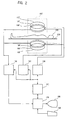
- Fig. 2 illustrates a block diagram of an imaging apparatus of another type, which is another embodiment of the present invention.
- the configuration of the apparatus represents an embodiment of the apparatus in accordance with the present invention.
- the apparatus shown in Fig. 2 has a magnet system 100' of a type different from that in the apparatus shown in Fig. 1. Since the apparatus has the configuration similar to that of the apparatus shown in Fig. 1 except the magnet system 100', similar portions are designated by similar reference numerals and the explanation thereof will be omitted.
- the magnet system 100' has a main magnetic field magnet section 102', a gradient coil section 106' and an RF coil section 108'.
- the main magnetic field magnet section 102' and the coil sections each comprises a pair of members facing each other across a space. These sections have a generally disk-like shape and are disposed to have a common center axis.
- the object 300 is rested on the cradle 500 and carried into and out of the internal space (bore) of the magnet system 100' by carrier means, which is not shown.
- the main magnetic field magnet section 102' generates a static magnetic field in the internal space of the magnet system 100'.
- the direction of the static magnetic field is generally orthogonal to the direction of the body axis of the object 300. That is, a "vertical" magnetic field is generated.
- the main magnetic field magnet section 102' is made using a permanent magnet, for example. It will be easily recognized that the main magnetic field magnet section 102' is not limited to the permanent magnet, but may be made using a super or normal conductive electromagnet or the like.
- the gradient coil section 106' generates gradient magnetic fields for imparting gradients to the static magnetic field strength.
- the gradient magnetic fields to be generated are the following three: a slice gradient magnetic field, a readout gradient magnetic field and a phase encoding gradient magnetic field.
- the gradient coil section 106' has three gradient coils, which are not shown, corresponding to these three gradient magnetic fields.
- the RF coil section 108' transmits an RF excitation signal for exciting spins within the object 300 in the static magnetic field space.
- the RF coil section 108' also receives a magnetic resonance signal generated by the excited spins.
- the RF coil section 108' has transmission and receive coils, which are not shown. For the transmission and receive coils, the same coil or separate dedicated coils may be used.
- Fig. 3 shows an exemplary pulse sequence for use in magnetic resonance imaging.
- the pulse sequence is one in accordance with a gradient echo (GRE) technique.
- GRE gradient echo
- (1) is a sequence of an ⁇ ° pulse for RF excitation of the GRE technique
- (2), (3), (4) and (5) are sequences of a slice gradient Gs, a readout gradient Gr, a phase encoding gradient Gp and a gradient echo MR, respectively, of the GRE technique.
- the ⁇ ° pulse is represented by its central signal. The pulse sequence proceeds from the left to the right along a time axis t.
- the ⁇ ° pulse achieves ⁇ ° excitation of the spins, wherein the flip angle ⁇ ° is not greater than 90°.
- the slice gradient Gs is applied to achieve selective excitation for a certain slice.
- the spins are phase-encoded by the phase encoding gradient Gp.
- the spins are first dephased and are subsequently rephased by the readout gradient Gr to generate a gradient echo MR.
- the gradient echo MR has its maximum signal intensity at an echo time TE after the ⁇ ° excitation.
- the gradient echo MR is collected by the data acquisition section 150 as view data.
- Such a pulse sequence is repeated 64 ⁇ 512 times in a cycle of TR (repetition time).
- the phase encoding gradient Gp is varied for each repetition to provide a different phase encoding each time.
- view data for 64 ⁇ 512 views filling the k-space are obtained.
- FIG. 4 Another example of the magnetic resonance imaging pulse sequence is illustrated in Fig. 4.
- the pulse sequence is one in accordance with a spin echo (SE) technique.
- SE spin echo
- (1) is a sequence of 90° and 180° pulses for RF excitation of the SE technique
- (2), (3), (4) and (5) are sequences of a slice gradient Gs, a readout gradient Gr, a phase encoding gradient Gp and a spin echo MR, respectively, of the SE technique.
- the 90° and 180° pulses are represented by their respective central signals.
- the pulse sequence proceeds from the left to the right along a time axis t.
- the 90° pulse achieves 90° excitation of the spins.
- the slice gradient Gs is applied to achieve selective excitation for a certain slice.
- 180° excitation by the 180° pulse, or spin inversion is performed.
- the slice gradient Gs is applied at the same time to achieve selective inversion for the same slice.
- the readout gradient Gr and phase encoding gradient Gp are applied.
- the readout gradient Gr dephases the spins.
- the phase encoding gradient Gp phase-encodes the spins.
- the spins are rephased by the readout gradient Gr to generate a spin echo MR.
- the spin echo MR has its maximum signal intensity at TE after the 90° excitation.
- the spin echo MR is collected by the data acquisition section 150 as view data.
- Such a pulse sequence is repeated 64 ⁇ 512 times in a cycle of TR.
- the phase encoding gradient Gp is varied for each repetition to provide a different phase encoding each time.
- view data for 64 ⁇ 512 views filling the k-space are obtained.
- pulse sequence employed in the imaging is not limited to that of the GRE or SE technique, but may be of any other appropriate technique, such as FSE (fast spin echo), fast recovery FSE and echo planar imaging (EPI) techniques.
- FSE fast spin echo
- EPI echo planar imaging
- the data processing section 170 performs a two-dimensional inverse Fourier transformation on the view data in the k-space to reconstruct a tomographic image of the object 300.
- the reconstructed image is stored in the memory, and displayed by the display section 180.
- An image captured by the magnetic resonance imaging has a character that it often has a uniform structure in a local portion.
- the distribution of pixel values is a Gaussian distribution centering the average value of the pixel values in the region, and their standard deviation ⁇ represents the variance of noise.
- Such a property is used to determine the variance of noise in an image in accordance with the following image processing.
- Fig. 5 shows a flow chart of an image processing operation by the data processing section 170.
- a local region is defined in an image.
- the local region is a region to which the pixel values used in the calculation in the next step belong. For example, a local region in the center of the image is selected as the first region.
- a pixel matrix of N ⁇ N is employed as the local region.
- N is, for example, 9. It should be noted that the matrix size is not limited thereto but may be any appropriate one. Moreover, the pixel matrix is not limited to the NxN matrix but may be any appropriate region centering a pixel. The local region will sometimes be referred to simply as a region hereinbelow.
- Step 504 a residual sum of squares S of pixel values in the region is determined. Specifically, wherein:
- Step 506 a decision is made whether the above processes are finished for all the local regions, and if not, the local region is changed at Step 508.
- an adjacent NxN region for example, is selected as a new local region.
- Step 504 The process of Step 504 is performed on the new local region to determine the residual sum of squares of pixel values. Thereafter, the residual sum of squares of pixel values is determined for every local region in the image in a similar manner.
- the data processing section 170 for performing the processes of Steps 502 ⁇ 508 is an embodiment of the residual sum of squares calculating means of the present invention.
- the processes of Steps 502 ⁇ 508 constitute an embodiment of the residual sum of squares calculating function of the present invention.
- the residual sums of squares thus obtained have a ⁇ 2 distribution, and the average value thereof is k ⁇ 2 .
- the ⁇ 2 distribution approximates to a Gaussian distribution, and the peak position lies approximately at k ⁇ ⁇ 2 .
- Step 510 a histogram of the residual sums of squares S is generated.
- the data processing section 170 for performing the process of Step 510 is an embodiment of the histogram calculating means of the present invention.
- the process of Step 510 is an embodiment of the histogram calculating function of the present invention.
- Fig. 6 shows the concept of the histogram of the residual sums of squares S when the image is an absolute-value image. As shown, the histogram consists of three distribution curves a, b and c.
- the distribution curve a is a Gaussian distribution curve, resulted from noise in the uniform structure portion.
- the distribution curve b is a Rayleigh distribution curve, resulted from noise in a portion of an FOV (field of view) which does not contain the object 300, i.e., noise in a background. Because the image is an absolute-value image, the distribution curve resulted from noise in the background does not conform to the Gaussian distribution but to the Rayleigh distribution.
- the distribution curve c results from the fine structure of the object, and exhibits an indeterminate distribution, unlike the two other curves.
- Step 512 peak position detection is performed for the histogram.
- a peak position s1 is detected for the Gaussian distribution curve a
- a peak position s2 is detected for the Rayleigh distribution curve b.
- fitting to a function is preferably performed at Step 512 prior to the peak detection, in that the peak positions can be detected with a good accuracy.
- the functions employed in the fitting are, for example, a Gaussian distribution function and a Rayleigh distribution function, respectively. However, the functions are not limited thereto but may be any appropriate function.
- the data processing section 170 for performing the fitting is an embodiment of the fitting means of the present invention.
- the process of Step 512 is an embodiment of the fitting function of the present invention.
- Step 514 the variance of noise is calculated.
- the calculation of the variance of noise is performed based on the peak position s1 or s2.
- the peak position s1 of the Gaussian distribution curve a may not accurately be detected.
- the value of ⁇ is determined based on the peak position s2 of the Rayleigh distribution curve b.
- the Rayleigh distribution curve b is more suitable for determining the variance of noise with a good accuracy.
- the data processing section 170 for performing the processes of Steps 512 and 514 is an embodiment of the noise variance calculating means of the present invention.
- the processes of Steps 512 and 514 constitute an embodiment of the noise variance calculating function of the present invention.
- the histogram generated at Step 510 becomes one as exemplarily shown in Fig. 7, and it has no longer the Rayleigh distribution.
- the variance of noise is determined based on the peak position s1 of the Gaussian distribution curve a at Step 514.
- the variance of noise thus obtained can be employed as a reference of decision for appropriately switching the filtering technique depending on a local structure in the image to be processed.
- the pixel value of the pixel of interest is determined by, for example, low-pass filtering the pixel values in the region.
- the image probably has a specific structure, such as an edge, in the local region, and the variance of pixel values probably originates from the structure of the image.
- the pixel value of the pixel of interest is determined by, for example, performing filtering in combination with the sharpness preservation process on the pixel values in the region.
- Fig. 8 shows a flow chart of a process involving switching of the filtering with reference to the variance of noise.
- a pixel of interest in an image is defined.
- the first pixel of interest is, for example, a pixel in the center of the image.
- Step 804 the variance of pixel values in a local region containing the pixel of interest is calculated.
- the local region containing the pixel of interest is, for example, a 5 ⁇ 5 matrix centering the pixel of interest i, as shown in Fig. 9.
- Step 806 a decision is made whether the variance of pixel values is larger than the variance of noise.
- the filtering in combination with the sharpness preservation process is performed at Step 808, and the result is set to the pixel value of the pixel of interest. If the variance of pixel values is not larger than the variance of noise, the low-pass filtering is performed at Step 810, and the result is set to the pixel value of the pixel of interest.
- Step 812 a decision is made whether the above processes are finished for all the pixels of interest, and if not, the pixel of interest is changed to the adjacent one, for example, at Step 814, and the processes from Step 804 are performed. Thereafter, the same processes are repeated to determine the pixel values of all the pixels of interest. Then, an image is produced using the determined pixel values at Step 816.
- a program for a computer to perform the functions as described above is recorded on a recording medium in a computer-readable manner.
- a recording medium for example, any one of a magnetic recording medium, an optical recording medium, a magneto-optical recording medium and any other appropriate type of recording medium is employed.
- the recording medium may be a semiconductor storage medium.
- a storage medium is synonymous with a recording medium in the present specification.
- the image processing is performed by a data processing section in a magnetic resonance imaging apparatus; however, it will be easily recognized that the image processing may be performed by a data processing apparatus separate from the magnetic resonance imaging apparatus, such as an EWS (engineering workstation) or PC (personal computer).
- EWS engineering workstation
- PC personal computer
- the imaging apparatus is described as being a magnetic resonance imaging apparatus in the preceding description, the imaging apparatus is not limited thereto but may be any other type of imaging apparatus, such as an X-ray CT (computed tomography) apparatus, an X-ray imaging apparatus, PET (positron emission tomography) or a ⁇ -camera.
- X-ray CT computed tomography
- X-ray imaging apparatus PET (positron emission tomography)
- PET positron emission tomography
- ⁇ -camera positron emission tomography
- the object to be processed is not limited to the medical image, but the present invention can generally be applied to, for example, calculation of the variance of noise for a variety of images, such as a digital image captured by an optical instrument.
Landscapes
- Physics & Mathematics (AREA)
- General Physics & Mathematics (AREA)
- Engineering & Computer Science (AREA)
- Theoretical Computer Science (AREA)
- Image Analysis (AREA)
- Image Processing (AREA)
- Facsimile Image Signal Circuits (AREA)
- Magnetic Resonance Imaging Apparatus (AREA)
- Apparatus For Radiation Diagnosis (AREA)
- Picture Signal Circuits (AREA)
Applications Claiming Priority (2)
| Application Number | Priority Date | Filing Date | Title |
|---|---|---|---|
| JP2000183049 | 2000-06-19 | ||
| JP2000183049A JP4090671B2 (ja) | 2000-06-19 | 2000-06-19 | 画像処理方法、画像処理装置および画像撮影装置 |
Publications (2)
| Publication Number | Publication Date |
|---|---|
| EP1168244A2 true EP1168244A2 (de) | 2002-01-02 |
| EP1168244A3 EP1168244A3 (de) | 2004-12-15 |
Family
ID=18683692
Family Applications (1)
| Application Number | Title | Priority Date | Filing Date |
|---|---|---|---|
| EP01305292A Withdrawn EP1168244A3 (de) | 2000-06-19 | 2001-06-18 | Bildverarbeitungsverfahren und -Vorrichtung, Aufahmemedium und Abildungsgerät |
Country Status (5)
| Country | Link |
|---|---|
| US (1) | US6804383B2 (de) |
| EP (1) | EP1168244A3 (de) |
| JP (1) | JP4090671B2 (de) |
| KR (1) | KR100444094B1 (de) |
| CN (1) | CN1237487C (de) |
Cited By (2)
| Publication number | Priority date | Publication date | Assignee | Title |
|---|---|---|---|---|
| WO2007061744A3 (en) * | 2005-11-17 | 2008-02-28 | Vital Images Inc | Image enhancement using anisotropic noise filtering |
| CN111311525A (zh) * | 2019-11-20 | 2020-06-19 | 重庆邮电大学 | 一种基于直方图概率修正的图像梯度场双区间均衡化算法 |
Families Citing this family (15)
| Publication number | Priority date | Publication date | Assignee | Title |
|---|---|---|---|---|
| JP4344964B2 (ja) * | 1999-06-01 | 2009-10-14 | ソニー株式会社 | 画像処理装置および画像処理方法 |
| US7015401B2 (en) * | 2001-11-23 | 2006-03-21 | Aiptek International, Inc. | Image processing system with handwriting input function and the method for forming the same |
| FR2854974B1 (fr) * | 2003-05-14 | 2005-07-08 | Ge Med Sys Global Tech Co Llc | Procede d'amelioration de contraste/luminosite d'images radiographiques |
| JP4407243B2 (ja) * | 2003-11-10 | 2010-02-03 | ソニー株式会社 | 照合処理装置とその方法 |
| KR101097512B1 (ko) * | 2004-11-23 | 2011-12-22 | 엘지디스플레이 주식회사 | 액정표시장치 및 구동방법 |
| CN1328901C (zh) * | 2005-01-26 | 2007-07-25 | 北京中星微电子有限公司 | 一种去除图像噪声的方法 |
| JP4707471B2 (ja) * | 2005-06-10 | 2011-06-22 | 株式会社日立メディコ | 画像処理プログラム、装置及び方法 |
| JP2009511106A (ja) * | 2005-10-07 | 2009-03-19 | コーニンクレッカ フィリップス エレクトロニクス エヌ ヴィ | マルチチャネル送信磁気共鳴 |
| TWI319676B (en) * | 2006-10-18 | 2010-01-11 | Quanta Comp Inc | Image processing apparatus and method |
| DE102008023915A1 (de) * | 2008-05-16 | 2009-12-10 | Siemens Aktiengesellschaft | Verfahren zur Einstellung von wenigstens einer Stellgröße eines Entrauschungsfilters in medizinischen Bildern |
| JP5227244B2 (ja) * | 2008-08-18 | 2013-07-03 | 日立アロカメディカル株式会社 | 画像処理装置 |
| DE102008058740B4 (de) * | 2008-11-24 | 2012-05-31 | Siemens Aktiengesellschaft | Korrektur von Artefakten in der "Time of Flight"- MR-Angiographie |
| JP7455508B2 (ja) * | 2018-12-26 | 2024-03-26 | キヤノンメディカルシステムズ株式会社 | 磁気共鳴イメージング装置および医用複素数画像処理装置 |
| JP7395523B2 (ja) * | 2021-02-02 | 2023-12-11 | 富士フイルムヘルスケア株式会社 | 医用画像処理装置および医用画像処理方法 |
| CN114859352B (zh) * | 2022-07-07 | 2022-10-28 | 自然资源部第二海洋研究所 | Sar卫星海洋观测图像自适应拉伸方法及装置 |
Citations (1)
| Publication number | Priority date | Publication date | Assignee | Title |
|---|---|---|---|---|
| EP0574969A2 (de) | 1992-06-19 | 1993-12-22 | Agfa-Gevaert N.V. | Verfahren und Vorrichtung zur Geräuschunterdrückung |
Family Cites Families (13)
| Publication number | Priority date | Publication date | Assignee | Title |
|---|---|---|---|---|
| US4761819A (en) * | 1987-02-27 | 1988-08-02 | Picker International, Inc. | Adaptive noise reduction filter for reconstructed images |
| JPH02294786A (ja) * | 1989-05-09 | 1990-12-05 | Hitachi Ltd | 画像輝度レベル値の自動正規化方法 |
| JP2800633B2 (ja) * | 1993-04-30 | 1998-09-21 | 富士ゼロックス株式会社 | 画像符号化装置 |
| JP3410778B2 (ja) * | 1993-09-14 | 2003-05-26 | 株式会社東芝 | リカーシブフィルタ、x線診断装置 |
| US5803082A (en) * | 1993-11-09 | 1998-09-08 | Staplevision Inc. | Omnispectramammography |
| US5594807A (en) * | 1994-12-22 | 1997-01-14 | Siemens Medical Systems, Inc. | System and method for adaptive filtering of images based on similarity between histograms |
| JPH119595A (ja) * | 1997-06-27 | 1999-01-19 | Aloka Co Ltd | 超音波診断装置 |
| US5876342A (en) * | 1997-06-30 | 1999-03-02 | Siemens Medical Systems, Inc. | System and method for 3-D ultrasound imaging and motion estimation |
| JPH1176232A (ja) * | 1997-09-11 | 1999-03-23 | Hitachi Medical Corp | 超音波診断装置 |
| JP2000126182A (ja) * | 1998-10-27 | 2000-05-09 | Mitani Sangyo Co Ltd | 腫瘍診断方法 |
| JP4313869B2 (ja) * | 1998-11-12 | 2009-08-12 | 株式会社東芝 | 超音波診断装置 |
| JP4344964B2 (ja) * | 1999-06-01 | 2009-10-14 | ソニー株式会社 | 画像処理装置および画像処理方法 |
| KR100317674B1 (ko) * | 1999-06-19 | 2001-12-24 | 윤종용 | 순환 노이즈 제거 시스템 |
-
2000
- 2000-06-19 JP JP2000183049A patent/JP4090671B2/ja not_active Expired - Fee Related
-
2001
- 2001-05-01 US US09/846,631 patent/US6804383B2/en not_active Expired - Fee Related
- 2001-06-18 EP EP01305292A patent/EP1168244A3/de not_active Withdrawn
- 2001-06-18 KR KR10-2001-0034301A patent/KR100444094B1/ko not_active Expired - Fee Related
- 2001-06-19 CN CNB011219661A patent/CN1237487C/zh not_active Expired - Fee Related
Patent Citations (1)
| Publication number | Priority date | Publication date | Assignee | Title |
|---|---|---|---|---|
| EP0574969A2 (de) | 1992-06-19 | 1993-12-22 | Agfa-Gevaert N.V. | Verfahren und Vorrichtung zur Geräuschunterdrückung |
Non-Patent Citations (2)
| Title |
|---|
| AHN ET AL.: "Local Shape Adaptive Template Filtering for Signal to Noise Ratio Enhancement in Magnetic Resonance Imaging", SPIE, vol. 3338, 1998, pages 884 - 892 |
| AHN ET AL: "Local shape adaptive template filtering dor Signal-to-Noise ratio enhancement in Magnetic resonance imaging", SPIE, vol. 3338, 1998, pages 884 - 892, XP002421371 * |
Cited By (3)
| Publication number | Priority date | Publication date | Assignee | Title |
|---|---|---|---|---|
| WO2007061744A3 (en) * | 2005-11-17 | 2008-02-28 | Vital Images Inc | Image enhancement using anisotropic noise filtering |
| US7660481B2 (en) | 2005-11-17 | 2010-02-09 | Vital Images, Inc. | Image enhancement using anisotropic noise filtering |
| CN111311525A (zh) * | 2019-11-20 | 2020-06-19 | 重庆邮电大学 | 一种基于直方图概率修正的图像梯度场双区间均衡化算法 |
Also Published As
| Publication number | Publication date |
|---|---|
| CN1329325A (zh) | 2002-01-02 |
| US6804383B2 (en) | 2004-10-12 |
| KR20010113535A (ko) | 2001-12-28 |
| CN1237487C (zh) | 2006-01-18 |
| US20020009216A1 (en) | 2002-01-24 |
| EP1168244A3 (de) | 2004-12-15 |
| KR100444094B1 (ko) | 2004-08-09 |
| JP2002024820A (ja) | 2002-01-25 |
| JP4090671B2 (ja) | 2008-05-28 |
Similar Documents
| Publication | Publication Date | Title |
|---|---|---|
| US6885763B2 (en) | Image processing method and apparatus, recording medium, and imaging apparatus | |
| US6804383B2 (en) | Image processing method and apparatus, recording medium, and imaging apparatus | |
| US6985613B2 (en) | Image processing method and apparatus, recording medium and imaging apparatus | |
| US6515476B1 (en) | Magnetic field inhomogeneity measurement method and apparatus, phase correction method and apparatus, and magnetic resonance imaging apparatus | |
| EP0621546A2 (de) | Verfahren und Apparat zur Angiographie mittels magnetischer Resonanz unter Verwendung einer integrierten Projektion | |
| EP3201643B1 (de) | Magnetresonanzbildgebung mit verbesserter knochenvisualisierung | |
| US7848554B2 (en) | Sub-voxel motion correction for phase-contrast magnetic resonance imaging | |
| CN1109899C (zh) | 三维图象的限带插值法和投影 | |
| JP3454760B2 (ja) | 位相分布測定方法および装置、位相補正方法および装置、並びに、磁気共鳴撮像装置 | |
| US6397096B1 (en) | Methods of rendering vascular morphology in MRI with multiple contrast acquisition for black-blood angiography | |
| US6486667B1 (en) | Combination of fluid-attenuated inversion-recovery complex images acquired using magnetic resonance imaging | |
| Zhu | Medical image processing overview | |
| US5785042A (en) | Magnetic resonance imaging method providing for correction of striation artifacts | |
| EP1176555B1 (de) | Bildverarbeitungsvorrichtung und -verfahren, Aufzeichnungsmedium und Bildgebungsgerät | |
| Sinha et al. | Quality assessment in magnetic resonance images | |
| EP1942350A1 (de) | Korrektur von geometrischen verzerrungen in magnetresonanzbildern | |
| Corbin et al. | Whole‐brain T2 mapping with radial sampling and retrospective motion correction at 3T | |
| Ye et al. | Simultaneous super-resolution and distortion correction for single-shot epi dwi using deep learning | |
| Joshi et al. | Effect of Regularization parameter on Total Variation based denoising of Magnetic Resonance Images | |
| JPH0576517A (ja) | 磁気共鳴イメージング装置における投影処理方法 | |
| Garach | Robust phase sensitive inversion recovery imaging | |
| NL8603148A (nl) | Verbeterde werkwijze voor magnetische resonantie-afbeelding. |
Legal Events
| Date | Code | Title | Description |
|---|---|---|---|
| PUAI | Public reference made under article 153(3) epc to a published international application that has entered the european phase |
Free format text: ORIGINAL CODE: 0009012 |
|
| AK | Designated contracting states |
Kind code of ref document: A2 Designated state(s): AT BE CH CY DE DK ES FI FR GB GR IE IT LI LU MC NL PT SE TR |
|
| AX | Request for extension of the european patent |
Free format text: AL;LT;LV;MK;RO;SI |
|
| PUAL | Search report despatched |
Free format text: ORIGINAL CODE: 0009013 |
|
| AK | Designated contracting states |
Kind code of ref document: A3 Designated state(s): AT BE CH CY DE DK ES FI FR GB GR IE IT LI LU MC NL PT SE TR |
|
| AX | Request for extension of the european patent |
Extension state: AL LT LV MK RO SI |
|
| RIC1 | Information provided on ipc code assigned before grant |
Ipc: 7G 06T 5/20 B Ipc: 7G 06T 5/00 A |
|
| 17P | Request for examination filed |
Effective date: 20050615 |
|
| AKX | Designation fees paid |
Designated state(s): DE FR GB |
|
| 17Q | First examination report despatched |
Effective date: 20060123 |
|
| STAA | Information on the status of an ep patent application or granted ep patent |
Free format text: STATUS: THE APPLICATION IS DEEMED TO BE WITHDRAWN |
|
| 18D | Application deemed to be withdrawn |
Effective date: 20150106 |