EP1168326A2 - Informationswiedergabeverfahren und -gerät - Google Patents
Informationswiedergabeverfahren und -gerät Download PDFInfo
- Publication number
- EP1168326A2 EP1168326A2 EP01305366A EP01305366A EP1168326A2 EP 1168326 A2 EP1168326 A2 EP 1168326A2 EP 01305366 A EP01305366 A EP 01305366A EP 01305366 A EP01305366 A EP 01305366A EP 1168326 A2 EP1168326 A2 EP 1168326A2
- Authority
- EP
- European Patent Office
- Prior art keywords
- transfer rate
- information
- average transfer
- read
- data
- Prior art date
- Legal status (The legal status is an assumption and is not a legal conclusion. Google has not performed a legal analysis and makes no representation as to the accuracy of the status listed.)
- Granted
Links
Images




Classifications
-
- G—PHYSICS
- G11—INFORMATION STORAGE
- G11B—INFORMATION STORAGE BASED ON RELATIVE MOVEMENT BETWEEN RECORD CARRIER AND TRANSDUCER
- G11B19/00—Driving, starting, stopping record carriers not specifically of filamentary or web form, or of supports therefor; Control thereof; Control of operating function ; Driving both disc and head
- G11B19/20—Driving; Starting; Stopping; Control thereof
- G11B19/28—Speed controlling, regulating, or indicating
-
- G—PHYSICS
- G11—INFORMATION STORAGE
- G11B—INFORMATION STORAGE BASED ON RELATIVE MOVEMENT BETWEEN RECORD CARRIER AND TRANSDUCER
- G11B19/00—Driving, starting, stopping record carriers not specifically of filamentary or web form, or of supports therefor; Control thereof; Control of operating function ; Driving both disc and head
- G11B19/02—Control of operating function, e.g. switching from recording to reproducing
- G11B19/04—Arrangements for preventing, inhibiting, or warning against double recording on the same blank or against other recording or reproducing malfunctions
-
- G—PHYSICS
- G11—INFORMATION STORAGE
- G11B—INFORMATION STORAGE BASED ON RELATIVE MOVEMENT BETWEEN RECORD CARRIER AND TRANSDUCER
- G11B19/00—Driving, starting, stopping record carriers not specifically of filamentary or web form, or of supports therefor; Control thereof; Control of operating function ; Driving both disc and head
- G11B19/02—Control of operating function, e.g. switching from recording to reproducing
- G11B19/04—Arrangements for preventing, inhibiting, or warning against double recording on the same blank or against other recording or reproducing malfunctions
- G11B19/041—Detection or prevention of read or write errors
- G11B19/044—Detection or prevention of read or write errors by using a data buffer
-
- G—PHYSICS
- G11—INFORMATION STORAGE
- G11B—INFORMATION STORAGE BASED ON RELATIVE MOVEMENT BETWEEN RECORD CARRIER AND TRANSDUCER
- G11B19/00—Driving, starting, stopping record carriers not specifically of filamentary or web form, or of supports therefor; Control thereof; Control of operating function ; Driving both disc and head
- G11B19/20—Driving; Starting; Stopping; Control thereof
- G11B19/26—Speed-changing arrangements; Reversing arrangements; Drive-transfer means therefor
Definitions
- the present invention relates to an information reproducing apparatus and method, and more particularly, to an information reproducing apparatus and method for reproducing AV (audio Visual) data recorded on an information recording medium rotationally driven, such as a CD-ROM disc, a CD-R disc or a CD-RW disc.
- AV audio Visual
- the WAV file is a most popular audio file format handled by Windows that is an OS of Microsoft and has an extension "wav”.
- the MP3 file is the name of a standardized audio compression technique and has an extension "mp3", wherein MP is an abbreviation of MPeg audio layer 3.
- AV data recorded on a disc such as music data, video data and WAV data
- MP data is reproduced at an average transfer rate approximately equal to one tenth of that for AV data. That is, it takes a much longer time to read AV data and MP data than ordinary data. This does not need to rotate the disc fast.
- Japanese Unexamined Laid-Open Publication No. 2000-132901 proposes a disc apparatus capable of controlling the read rate.
- the proposal shown in this publication analyzes a disc revolution corresponding to the transfer rate of a file to be read, more specifically, the type of data (such as type of file and file size), and thus determines the optimal read rate.
- the proposal avoids necessity of a requirement for always reading data at the maximum rate, and is therefore preferable in terms of read rate, vibration/noise and power consumption when totally viewed.
- the technique disclosed in the above publication does not satisfy a request such that the same file is read at different reproduction rates because the unique disc revolution (read rate) is automatically defined based on the type of data to be read (type of file or file size).
- the proposed technique does not meet different requests for reading data of the same WAV file (for example, WAV reproduction and data ribbing).
- an information reproducing method comprises the steps of: reading information from an information medium that is rotated; and determining a rotation velocity of the information medium on the basis of a data transfer rate based on a specification of a read request.
- an information reproducing apparatus comprises: a motor rotating an information medium; an optical pickup reading information from the information medium; and a part determining a rotation velocity of the information medium on the basis of a data transfer rate based on a specification of a read request.
- the transfer rate at which data is read is based on the specification of the read request which may be supplied from a user.
- the data read rate is defined by a rotation velocity of the information medium. The higher the rotation velocity, the higher the read rate, and the lower the rotation velocity, the lower the read rate.
- the rotation velocity of the information medium may be lowered in a case that a low data transfer rate is acceptable, for example, a case where AV data is retrieved. This avoids reading data at an excessively high bit rate and contributes to reduction of noise and power consumption because of high-speed rotation. Even for AV data, if it is requested to data in ripping, the rotation velocity may be raised to the upper limit. Thus, data can be read at the maximum bit rate.
- an information reproducing method comprises the steps of: reading information from an information medium that is rotated; and measuring an average transfer rate in data read and lowering a rotation velocity of the information medium if the average transfer rate measured is equal to or lower than a predetermined threshold value.
- an information reproducing apparatus comprises: a motor rotating an information medium; an optical pickup reading information from the information medium; a measuring part measuring an average transfer rate in data read; a comparing part comparing the average transfer rate measured with a predetermined threshold value; and a rotation velocity control part lowering a rotation velocity of the information medium by the motor if a result of comparison shows that the average transfer rate measured is equal to or lower than a predetermined threshold value.
- the second aspect of the invention is basically the same as the first aspect thereof, the second aspect may be preferably applied to a specification of the read request in which AV data such as music CD is retrieved.
- the average transfer rate of reading data is much lower than that in ordinary data read.
- the average transfer rate is measured and is compared with the predetermined threshold value. If the average transfer rate is equal to or lower than the predetermined threshold value, the rotation velocity is lowered.
- AV data such as music CD can preferably be read.
- an information reproducing method comprises the steps of: reading information from an information medium that is rotated; and measuring an average transfer rate in data read and raising a rotation velocity of the information medium if the average transfer rate measured is greater than a predetermined threshold value.
- an information reproducing apparatus comprises: a motor rotating an information medium; an optical pickup reading information from the information medium; a measuring part measuring an average transfer rate in data read; a comparing part comparing the average transfer rate measured with a predetermined threshold value; and a rotation velocity control part raising a rotation velocity of the information medium by the motor if a result of comparison shows that the average transfer rate measured exceeds a predetermined threshold value.
- the third aspect of the invention is basically the same as the first aspect thereof, the third aspect may be preferably applied to a specification of the read request in which AV data such as music CD is ripped.
- AV data such as music CD
- the measured average transfer rate exceeds the predetermined threshold value, the rotation velocity of the information medium is raised, so that data can be ripped at a high bit rate.
- an information reproducing method comprises the steps of: reading information from an information medium that is rotated; measuring an average transfer rate in data read and raising a rotation velocity of the information medium if the average transfer rate measured is greater than a predetermined threshold value; and lowering the rotation velocity if the average transfer rate is equal to or lower than the predetermined threshold value.
- an information reproducing apparatus comprises: a motor rotating an information medium; an optical pickup reading information from the information medium; a measuring part measuring an average transfer rate in data read; a comparing part comparing the average transfer rate measured with a predetermined threshold value; and a rotation velocity control part lowering a rotation velocity of the information medium by the motor if a result of comparison shows that the average transfer rate measured is equal to or lower than a predetermined threshold value and raising the rotation velocity if the result of comparison shows the average transfer rate measured exceeds the predetermined threshold value.
- the user requests to alternately read reproduction of AV data and ripping thereof from the same information medium.
- the average transfer rate is constantly measured while data is being read, and the rotation velocity of the information medium is switched to the low-speed side or high-velocity side with respect to the threshold value serving as a boundary.
- the information medium is rotated at a low velocity in retrieval of AV data and is rotated at a high velocity in ripping of data. It is therefore possible to suppress occurrence of a problem such as noise and read error in reproduction of AV data and rip data at a high bit rate.
- the information reproducing method may be configured so that it further comprises the steps of: monitoring whether the read request is issued; and restarting measurement of the average transfer rate if the read request is not issued for a predetermined time in measurement of the average transfer rate.
- the apparatus may be configured similarly.
- the measurement of the transfer rate is performed without discriminating AV data files and ordinary data files over each other.
- the read request from the user tends to be periodically issued at the time of retrieving AV data. This may be a factor for determining whether AV data is being reproduced.
- the AV data read request is periodically issued to some extent, although this depends on how an application reads data.
- ordinary data file is read at random and irregularly.
- the read process is interrupted when the user does not operate.
- the reading is deemed to be the reading of an ordinary data file if the read request is not issued for the predetermined time, and the measurement of the average transfer rate is restarted. This improves the precision of measurement. It is therefore possible to avoid interruption of sound or video because of changing the rate to the maximum level during retrieval of AV data. That is, it is possible to appropriately distinguish reproduction of AV data files over reproduction of ordinary data files.
- the information reproducing method may be configured so that it further comprises the steps of: monitoring a read address of the read request; and restarting measurement of the average transfer rate if the read address is arranged in a formation other than an increasing order.
- the information reproducing apparatus may be configured similarly.
- the measurement of the transfer rate is performed without discriminating AV data files and ordinary data files over each other.
- the measured average transfer rate For example, in a case where a read request from the user is temporarily interrupted and ripping of data is restarted in the reading of an ordinary data file, there is a tendency for the measured average transfer rate to be lower than the actual rate.
- the read address in the read request from the user is arranged in the increasing order. This may be a factor for determining whether AV data is being reproduced.
- the reading is deemed to be the reading of an ordinary data file if the address is not arranged in the increasing order, and the measurement of the average transfer rate is restarted. This improves the precision of measurement. It is therefore possible to avoid interruption of sound or video because of changing the rate to the maximum level during retrieval of AV data. That is, it is possible to appropriately distinguish reproduction of AV data files over reproduction of ordinary data files.
- the information reproducing method may be configured so that it further comprises the steps of: determining validity of the average transfer rate on the basis of average transfer rates obtained a number of times of measurement; and validating the average transfer rate if the average transfer rates obtained a number of times of measurement are close to each other.
- the information reproducing apparatus may be configured similarly.
- the average transfer rate will be temporarily raised so that the rotation velocity is unwillingly raised to the maximum level whereby sound of AV data may be interrupted or video may be stopped.
- the average transfer rates of one set obtained by measurement performed several times are nearly equal to each other, the average transfer rate (which may, for example, be one of the nearly equal rates) is validated. That is, the valid average transfer rate is defined based on condition that the average transfer rates obtained several times are close to each other. This improves the reliability of the average transfer rate and copes with a temporary change of the transfer rate such that the average transfer rate is temporarily raised due to the application.
- the information reproducing method may be configured so that a first threshold value which is one of said predetermined threshold value and is used for raising the rotation velocity of the information medium is greater than a second threshold value which is another one of said predetermined threshold value and is used for lowering the rotation velocity of the information medium.
- the information reproducing apparatus may be configured similarly.
- the information reproducing method may be configured so that it further comprises the steps of: temporarily storing information read from the information medium in a cache memory; pre-reading information if a space is available in the cache memory; and causing measurement of the average transfer rate to be initiated when the cache memory is full of data and the pre-reading of information is completed in a case where information is read from the information medium at a maximum rate.
- measurement of the average transfer rate is started at the time when a cache memory becomes full of data and the data pre-reading process is completed. It follows that there is no need to measure the average transfer rate meaninglessly while information is being read at the maximum rate and that degradation of the performance in the read process can be avoided.
- the average transfer rate is originally low, and the pre-reading process is completed after the cache memory is full of data. Hence, measurement of the transfer rate is initiated as it stands.
- Fig. 1 is a schematic block diagram of a structure of an information reproducing apparatus according to an embodiment of thee present invention.
- the apparatus illustrated in Fig. 1 is an optical disc drive 2, which may be installed integrally with or separate from a host 1 such as a personal computer.
- An information recording medium 3 stores AV data and may, for example, be a CD-ROM for storing data, a music CD (CD-DA), a video CD, or AV data recorded on a CD such as a WAV file or MP3 file.
- the optical disc drive 2 is configured as a system capable of reproducing the AV data as audio through USB speakers installed in the host 1 or as video on a display and ripping data from a memory.
- the information recording medium 3 is rotationally driven by a spindle motor 4.
- An optical pickup 5 condenses a laser light and projects it onto the information medium 3 driven by the spindle motor 4.
- the optical pickup 5 is provided in such a way as to be free to seek in the radial direction of the medium 3 by means of a coarse motion motor 6.
- the optical pickup 5 includes a semiconductor laser emitting a laser light, an objective lens for condensing the laser diode, and a light-receiving/sensing system for receiving a reflected light from the information medium 3 and sensing a reproduced signal and various signals.
- the reproduced signal (read signal) sensed by the light receiving/sensing system of the optical pickup 5 is processed by a signal processing system 7, and is then stored in a cache memory 8 temporarily. Then, the reproduced signal is transferred to the host 1 via an external interface 9.
- the spindle motor 4, the optical pickup 5 and the coarse motion motor 6 are respectively equipped with control systems 10, 11 and 12, which are controlled by a controller 13 having a microcomputer configuration.
- the cache memory 8 is also controlled by the controller 13.
- the controller 13 is responsible for various controls including analyzing of a user's read request received via the host 1 and the data transfer rate, and realizes various functions that will be described later.
- step S1 When a data read request is received (step S1), the information recording medium 3 is rotated at a given velocity by the spindle motor 4 under the control of the rotation control system 10, and a process of reading data from the information medium 3 by the optical pickup 5 is initiated (step S2).
- Read data is sequentially stored in the cache memory 8, and is then transferred to the host 1 via the external interface 9.
- the average transfer rate of the above transfer is measured (step S3).
- the process of step S3 is executed as a function of measuring means.
- the average transfer rate is compared with a predetermined threshold value (step S4).
- step S4 is executed as a function of comparing means. The comparison results shows that the average transfer rate is higher than the threshold value (N of step S4), the read process is caused to continue at the present rotation velocity, and the read process ends (step S7).
- step S5 it is determined whether the current rotation velocity is equal to the maximum velocity (step S5). If the answer is NO, the read process continues at the current velocity and the read process ends (step S7). In contrast, if the read process is being performed at the maximum velocity (Y of step S5), the rotation velocity of the information medium 3 is lowered to the predetermined reproduction rate at which data is read (step S6). Then, the process ends (step S7).
- the process of step S6 is executed as a function of rotation velocity control means for reducing the velocity of the information medium 3.
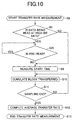
- step S3 An example of the process for measuring the average transfer rate at step S3 is shown in Fig. 3.
- step S8 After measurement of the average transfer rate is started (step S8), the measurement starting time is measured (step S9). Then, the number of blocks transferred to the host via the external interface 9 in response to the read request from the user is cumulated (step S10). Thereafter, it is determined whether the cumulative number of blocks (the number of blocks sampled) has reached a predetermined number of blocks (S11). If the cumulative number of blocks has not yet reached the predetermined number of samples (N of step S11), the sampling continues (Step S10).
- step S11 if the cumulative number of blocks has reached the predetermined number of blocks (Y of step S11), the average transfer rate is computed from the transfer rate measuring time starting from the start time and the number of blocks (step S12). Then, the measurement of the average transfer rate is finished (step S13).
- the average transfer rate is employed in the present embodiment taking into account the following. Even when the same file is read, the file may be read at different transfer rates based on the specification of the user's read request given via the host 1.
- the measurement of the average transfer rate is used to make a decision as to whether data should be read at a low bit rate or the maximum bit rate in accordance of the specification of the read request. For example, when a read request for WAV reproduction of a WAV file is given by the user, the rotation velocity is lowered to the predetermined reproduction bit rate (step S6) if the disc is being rotated at the maximum velocity, because the data transfer to the host 1 is performed at a comparatively low bit rate (Y of steps S3 and S4).
- a data read request from the user is received (S1), and reading of data is started (S2). Then, the average transfer rate is measured (S3), and it is determined whether the average transfer rate is equal to or higher than the predetermined threshold value (S14).
- the process of step S14 is executed as a function of the comparing means. If the comparison result shows that the average transfer rate is lower than the predetermined threshold value (N of S14), the read operation on the information medium 3 continues without changing the bit rate, and ends (S7). In contrast, if the average transfer rate is equal to or higher than the threshold value (Y of S14), it is determined whether data is being read at the predetermined reproduction rate (S15). If the answer is negative (N of S15), the read operation continues and ends (S7).
- step S16 is executed as a function of rotation velocity control means for raising the rotation velocity of the information medium 3.
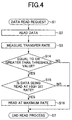
- the user's read request specifies data ribbing on an information medium on which AV data is recorded, such as a music CD
- the average transfer rate is measured by the measuring means. If the average transfer rate is higher than the predetermined threshold value (Y of S14), the rotation velocity of the information medium is raised to the upper limit by the rotation velocity control means (S16).
- the predetermined threshold value Y of S14
- the rotation velocity of the information medium is raised to the upper limit by the rotation velocity control means (S16).
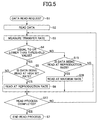
- a data read request from the user is received (S1), and reading of data is started (S2). Then, the average transfer rate is measured (S3), and it is determined whether the average transfer rate is equal to or lower than the predetermined threshold value (S4). If the comparison result shows that the average transfer rate is lower than the predetermined threshold value (Y of S4), it is determined whether the current read rate is equal to the maximum rate (S5). If data is not being read at the maximum rate (N of S5), data is continuously read at the same rate. In contrast, if data is being read at the maximum rate (Y of S5), the read rate is lowered to the given reproduction rate (S6).
- the average transfer rate exceeds the given threshold value (N of S4), it is determined whether the current read rate is equal to the predetermined reproduction rate (S15). If data is not being read at the predetermined reproduction rate (N of S15), data is read at the same read rate. In contrast, if data is being read at the predetermined reproduction rate (Y of S15), the read rate is raised to the maximum read rate (S16). Then, if the read process is completed (S17), the transfer rate is continuously measured (S3). If the read process is completed, the process ends (S7).
- the average transfer rate is constantly measured by the measuring means while data is being read (S3).
- the comparison result is compared with the threshold value (S4), and the rotation velocity of the information medium 3 is switched to the low-speed side or high-speed side with reference to the threshold value serving as a boundary by the rotation velocity control means (S6, S16).
- S6, S16 the rotation velocity control means
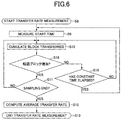
- the measurement start time is measured (S9). Then, the number of blocks transferred to the host 1 upon read requests from the user is cumulated (S10). After a given time, it is determined whether the cumulated number of blocks (the number of sampled blocks) increases (S18). If the number of sampled blocks does not increase (N of S18), it is determined whether a predetermined constant time has lapsed (S19). If the answer is NO (N of S19), transferred blocks are continuously sampled (S10). In contrast, if the predetermined constant time has lapsed (Y of S19), the measurement of the transfer rate is newly started (S9).
- steps S18 and S19 are executed as a function of monitor means, and the processes of steps S19 and S9 are executed by a function of re-measurement means. Therefore, blocks are cumulated by a predetermined number of blocks.
- the sampling is completed (Y of S11)
- the average transfer rate is computed from the transfer rate measurement time starting from the start time and the number of blocks transferred (S12). Then, the measurement of the average transfer rate is ended (S13).
- the measurement of the transfer rate is performed without discrimination between AV data files and ordinary data files.
- the average transfer rate actually measured tends to be lower than the true rate in a case where the data read request from the user is temporarily interrupted and read of the involved data file is restarted in the ordinary operation of reading data files.
- the read request from the user tends to be periodically issued at the time of retrieving AV data. This may be a factor for determining whether AV data is being reproduced. That is, the AV data read request is periodically issued to some extent, although this depends on how an application reads data.
- ordinary data file is read at random and irregularly.
- the read process is interrupted when the user does not operate.
- the fourth embodiment of the present invention in the measurement of the average transfer rate at step S3, if the read request is not received for a predetermined time (N of S18, Y of S19), the reading is deemed to be the reading of an ordinary data file, and the measurement of the average transfer rate is restarted (Y of S19, S9).
- N of S18, Y of S19 the reading is deemed to be the reading of an ordinary data file
- the measurement of the average transfer rate is restarted (Y of S19, S9).
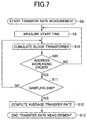
- FIG. 7 A description will be given of a fifth embodiment of the present invention by referring to Fig. 7.
- This embodiment takes into account a general tendency for the data read request from the user to be issued in increasing order of address, which is different from that for the reading of ordinary data files. Based on the above consideration, the fifth embodiment attempts to improve the precision of the measurement of the average transfer rate necessary for realizing the first through third embodiments of the present invention.
- step S8 After the measurement of the average transfer rate is started (S8), the number of blocks transferred to the host 1 by the read request from the user is counted (S10). Then, it is determined whether the read address is issued in the increasing order of decreasing order (S20). If the read address is not arranged in the increasing order (N of S20), the transfer rate measurement is newly started (S9). In contrast, if the read address is arranged in the increasing order (Y of S20), the sampling is continuously performed, and it is determined whether the cumulative number of blocks reaches the predetermined number of transferred blocks (S11). That is, the process of step S20 is executed as a function of monitoring means, and the processes of Y of S20 and S9 are executed as a function of measurement restart means.
- the sampling is continuously performed (S10).
- the sampling is completed (Y of S11)
- the average transfer rate is computed on the basis of the transfer rate measurement time from the start time and the number of transferred blocks (S12). Then, the measurement of the transfer rate is ended (S13).
- the transfer rate is measured without discriminating the AV data files and ordinary data files.
- the ordinary data file is read at a low rate or sound or video is interrupted because of changing the rate to the maximum during retrieval of AV data
- the average transfer rate actually measured tends to be lower than the true rate in a case where the data read request from the user is temporarily interrupted and read of the involved data file is restarted in the ordinary operation of reading data files.
- the read address from the user is arranged in the increasing order at the time of reproducing AV data.
- This tendency may be a factor for determining whether AV data is being reproduced.
- data is sequentially arranged from the inner circumference thereof to the outer circumference.
- a similar arrangement is made for video data, WAV data and MP3 data.
- These kinds of data are read in the increasing order of the address. That is, when a length Y is read from address X by a read request from the user, the next read address is (X+Y).
- the address involved in the request is at random. For example, file information may be read or the file body may be read.
- the fifth embodiment of the present invention in the measurement of the average transfer rate at step S3, if the address of the read request is not arranged in the increasing order (N of S20), it is judged that the reading is that of an ordinary data file and the measurement of the average transfer rate is restarted (S9). Thus, it is possible to avoid interrupt of sound or video because of changing to the maximum rate during retrieval of AV data.
- a sixth embodiment of the present invention which is also directed to improving the measurement of the average transfer rate necessary for realizing the first through third embodiments of the present invention. More particularly, the sixth embodiment provides a specific application with the process of measuring the average transfer rate. Such a specific application is such that, when the user designates a reproduction skip during retrieval of AV data at a low rotation velocity, data involved in the skip is read at one time and is stored in a buffer memory of the host 1.
- the number of blocks transferred to the host 1 by the read request from the user is counted (S10). It is determined whether the cumulative number of blocks has been sampled by the predetermined number of blocks (S11). If the cumulative number of blocks has not reached the predetermined number of blocks (N of S11), the sampling is continuously performed. In contrast, if the sampling is completed (Y of S11), it is determined whether computation of the average transfer rate has been performed by a predetermined number of times equal to one set (S21). If the measurement has not yet been performed by the predetermined number of times (N of S21), the measurement of the average transfer rate is continued (S9).
- the average transfer rates obtained by performing the measurement several times are handled as one set and the validity thereof is judged. If the average transfer rates of the set are close to each other, the average transfer rates are recognized to be valid. That is, the valid average transfer rate is defined based on condition that the average transfer rates obtained several times are close to each other. This improves the reliability of the average transfer rate and copes with a temporary change of the transfer rate such that the average transfer rate is temporarily raised due to the application.
- step S23 is executed as a function of comparing means. If the average transfer rate measured is neither equal to nor lower that the threshold value M (N of S23), the data is read at the same bit rate. In contrast, if the average transfer rate is equal to or lower than the threshold value M (Y of S23), the read rate is lowered to a predetermined reproduction rate and data is read thereat (S6).
- step S24 is executed as a function of the comparing means.
- the threshold values M and N are different from each other so that M ⁇ N. If the average transfer rate does not exceed the threshold value N (N of S24), reading of data is continued at the same rate. In contrast, if the average transfer rate exceeds the threshold value N (Y of S24), the read rate is changed to the maximum rate at which data is read (S16). Thereafter, if the read process is not completed (N of S17), the average transfer rate is continuously measured (S3). If the read process is completed (Y of S17), the process is ended (S7).
- the threshold value M for lowering the rotation velocity of the information medium 3 is set greater than the threshold value N for raising the rotation velocity of the information medium 3 (N > M). This makes it possible to avoid a problem that lowering and raising of the rotation speed of the information medium are repeatedly performed at the time of reading at a transfer rate close to the threshold value although the data transfer rate requested by the user is close to the threshold value for switching the rotation velocity of the information medium.
- the optical disc drive 2 has a buffer called cache memory 8 therein, and data is pre-read and stored in the cache memory 8.
- the optical disc drive 2 reads the requested address on the information medium 3, and transfers data to the host 1. Then, the optical disc drive 2 ends the process necessary for the read request.
- the reading itself is not interrupted, but is continued so that data is stored in the cache memory 8 (look-ahead caching process). The caching is terminated when the cache memory is full of data.
- the pre-reading process data in the cache memory 8 is merely sent back to the host when a read request is successively issued without accessing the information medium 3. Hence, the speeding up of read process can be attained.
Landscapes
- Signal Processing For Digital Recording And Reproducing (AREA)
- Rotational Drive Of Disk (AREA)
- Optical Recording Or Reproduction (AREA)
Applications Claiming Priority (2)
| Application Number | Priority Date | Filing Date | Title |
|---|---|---|---|
| JP2000185120 | 2000-06-20 | ||
| JP2000185120A JP3860394B2 (ja) | 2000-06-20 | 2000-06-20 | 情報再生方法及び情報再生装置 |
Publications (3)
| Publication Number | Publication Date |
|---|---|
| EP1168326A2 true EP1168326A2 (de) | 2002-01-02 |
| EP1168326A3 EP1168326A3 (de) | 2003-03-12 |
| EP1168326B1 EP1168326B1 (de) | 2012-11-21 |
Family
ID=18685480
Family Applications (1)
| Application Number | Title | Priority Date | Filing Date |
|---|---|---|---|
| EP01305366A Expired - Lifetime EP1168326B1 (de) | 2000-06-20 | 2001-06-20 | Informationswiedergabeverfahren und -gerät |
Country Status (3)
| Country | Link |
|---|---|
| US (4) | US6711106B2 (de) |
| EP (1) | EP1168326B1 (de) |
| JP (1) | JP3860394B2 (de) |
Cited By (3)
| Publication number | Priority date | Publication date | Assignee | Title |
|---|---|---|---|---|
| WO2003096335A1 (en) * | 2002-05-13 | 2003-11-20 | Nokia Corporation | Setting the rotation speed of a rotating disk memory |
| WO2004102559A1 (en) * | 2003-05-19 | 2004-11-25 | Koninklijke Philips Electronics N.V. | Method for setting data carrier speed in a data carrier drive apparatus |
| EP1465183A3 (de) * | 2003-03-31 | 2006-01-18 | Kabushiki Kaisha Toshiba | Informationsaufzeichnungsmedium, Informationsverarbeitungsverfahren, Informationsverarbeitungsvorrichtung und Wiedergabevorrichtung |
Families Citing this family (43)
| Publication number | Priority date | Publication date | Assignee | Title |
|---|---|---|---|---|
| US7017188B1 (en) * | 1998-11-16 | 2006-03-21 | Softricity, Inc. | Method and apparatus for secure content delivery over broadband access networks |
| US6981728B2 (en) * | 1999-11-23 | 2006-01-03 | Happijac Company | Sliding mechanisms and systems |
| JP3860394B2 (ja) * | 2000-06-20 | 2006-12-20 | 株式会社リコー | 情報再生方法及び情報再生装置 |
| US20050050343A1 (en) * | 2000-06-30 | 2005-03-03 | Selinfreund Richard H. | Storage media access control method and system |
| JP3878442B2 (ja) * | 2001-07-30 | 2007-02-07 | 株式会社リコー | 情報記録再生装置とプログラム |
| US7562396B2 (en) * | 2001-08-21 | 2009-07-14 | Ecd Systems, Inc. | Systems and methods for media authentication |
| JP3886800B2 (ja) * | 2001-12-19 | 2007-02-28 | 株式会社リコー | データ管理情報取得方法、情報再生装置、並びにデータ管理情報取得プログラム及び記録媒体 |
| JP4100913B2 (ja) * | 2002-01-15 | 2008-06-11 | 株式会社リコー | 情報再生装置、データ管理情報取得方法、データ管理情報取得プログラム、記憶媒体、及び再生システム |
| US7716485B2 (en) * | 2002-02-01 | 2010-05-11 | Sca Ipla Holdings Inc. | Systems and methods for media authentication |
| JP2004005842A (ja) * | 2002-05-31 | 2004-01-08 | Ricoh Co Ltd | 記録方法、記録媒体、プログラム及び情報記録媒体、並びに情報記録装置 |
| JP4027726B2 (ja) * | 2002-06-17 | 2007-12-26 | 株式会社リコー | 情報記録再生装置と情報記録再生方法とプログラムと記録媒体及び情報記録再生システム |
| AU2003259399A1 (en) * | 2002-09-09 | 2004-03-29 | Koninklijke Philips Electronics N.V. | Method and apparatus for managing power consumption of a disk drive |
| JP4183553B2 (ja) * | 2002-09-19 | 2008-11-19 | 株式会社リコー | 記録方法、プログラム及び記録媒体、並びに情報記録装置 |
| JP4270991B2 (ja) * | 2002-10-11 | 2009-06-03 | 株式会社リコー | 情報記録装置、情報記録方法、情報記録用プログラム、情報記録用プログラムを記憶する記憶媒体、及び情報記録システム |
| TWI233092B (en) * | 2002-11-21 | 2005-05-21 | Benq Corp | Method for changing rotational speed of CD-ROM drive and CD-ROM drive with function of changing rotational speed |
| JP4082670B2 (ja) * | 2003-01-23 | 2008-04-30 | 株式会社リコー | 記録方法及び情報記録装置 |
| JP3710790B2 (ja) * | 2003-03-24 | 2005-10-26 | 株式会社リコー | 情報記録方法及びその装置 |
| JP3594243B1 (ja) * | 2003-03-25 | 2004-11-24 | 株式会社リコー | 光情報記録方法、光情報記録装置、情報処理装置、光情報記録媒体 |
| JP2004310972A (ja) * | 2003-03-25 | 2004-11-04 | Ricoh Co Ltd | 情報処理装置、情報記録装置、情報処理システム、情報記録方法、情報記録用プログラム及び記憶媒体 |
| JP3856449B2 (ja) * | 2003-04-24 | 2006-12-13 | 株式会社リコー | 再生方法、プログラム及び記録媒体、並びにドライブ装置 |
| US7515517B2 (en) * | 2003-04-30 | 2009-04-07 | Samsung Electronics Co., Ltd. | Method and apparatus for data detection in blue laser optical disk drives |
| US7746749B2 (en) * | 2003-04-30 | 2010-06-29 | Samsung Electronics Co., Ltd. | Look-ahead maximum-likelihood data detector for optical disk drives |
| JP2004362733A (ja) * | 2003-05-09 | 2004-12-24 | Pioneer Electronic Corp | 情報再生装置、回転制御プログラム、及び情報再生方法 |
| JP3595551B1 (ja) | 2003-07-02 | 2004-12-02 | 株式会社リコー | 情報記録装置と情報記録方法とプログラム |
| US7164640B2 (en) * | 2005-03-01 | 2007-01-16 | Ricoh Company, Ltd. | Information storage method that assures compatibility of writable medium with read only medium |
| KR100589518B1 (ko) * | 2003-10-14 | 2006-06-13 | 주식회사 히타치엘지 데이터 스토리지 코리아 | 광디스크 드라이버에서의 데이터 독출 속도 가변 제어방법 |
| JP4223431B2 (ja) | 2004-01-27 | 2009-02-12 | 株式会社リコー | 欠陥管理情報設定方法、記録方法及び情報記録装置 |
| JP4095977B2 (ja) * | 2004-03-11 | 2008-06-04 | 株式会社リコー | 欠陥管理方法及び情報記録装置 |
| JP4037382B2 (ja) * | 2004-03-11 | 2008-01-23 | 株式会社リコー | 欠陥管理方法、再生方法、プログラム及び記録媒体、情報記録装置並びに情報再生装置 |
| KR100599128B1 (ko) * | 2004-07-08 | 2006-07-12 | 삼성전자주식회사 | 광디스크 재생장치 및 그의 최적 재생속도 결정방법 |
| KR101114943B1 (ko) * | 2004-09-23 | 2012-03-06 | 주식회사 히타치엘지 데이터 스토리지 코리아 | 광 기록매체의 재생배속 제어방법 및 장치 |
| JP2006114169A (ja) * | 2004-10-18 | 2006-04-27 | Ricoh Co Ltd | 再生方法、光ディスク装置、プログラム及び記録媒体 |
| JP2006114168A (ja) * | 2004-10-18 | 2006-04-27 | Ricoh Co Ltd | 再生方法、光ディスク装置、プログラム及び記録媒体 |
| JP4281720B2 (ja) * | 2004-10-26 | 2009-06-17 | ソニー株式会社 | データ処理装置、データ処理方法、データ処理システム、プログラムおよび記録媒体 |
| TWI259443B (en) * | 2005-03-11 | 2006-08-01 | Lite On It Corp | Dynamic speed control method for storage device |
| TW200636680A (en) * | 2005-04-08 | 2006-10-16 | Benq Corp | Adjustment of recording speed of optical drive based on under-run |
| JP2009059393A (ja) * | 2005-12-28 | 2009-03-19 | Pioneer Electronic Corp | 情報処理装置、情報処理方法及び情報処理用プログラム並びに情報記録媒体 |
| US20070153651A1 (en) * | 2006-01-05 | 2007-07-05 | Cheng-Chieh Lin | Optical storage apparatus with dynamic rotational speed control by monitoring storage status of buffer memory and related method thereof |
| JP4737155B2 (ja) | 2007-07-13 | 2011-07-27 | ティアック株式会社 | ディスク装置 |
| JP2009076145A (ja) | 2007-09-21 | 2009-04-09 | Teac Corp | ディスク装置及びこれを有する情報処理システム |
| KR100952947B1 (ko) * | 2008-12-12 | 2010-04-15 | 주식회사 히타치엘지 데이터 스토리지 코리아 | 광 디스크 장치에서 속도 조절 방법 |
| US8254050B2 (en) * | 2009-06-25 | 2012-08-28 | Oracle America, Inc. | System and method for determining vibration of at least one hard disk drive |
| JP6648540B2 (ja) * | 2016-01-28 | 2020-02-14 | コニカミノルタ株式会社 | 画像形成制御方法及び画像形成システム並びに画像形成装置 |
Family Cites Families (34)
| Publication number | Priority date | Publication date | Assignee | Title |
|---|---|---|---|---|
| US4643662A (en) | 1984-06-08 | 1987-02-17 | Monsanto Company | Pelletizing apparatus |
| JPS61170959A (ja) | 1985-01-23 | 1986-08-01 | Canon Inc | 情報記録再生装置 |
| JPH02220271A (ja) | 1989-02-20 | 1990-09-03 | Pioneer Electron Corp | ディスク演奏装置 |
| JPH03150765A (ja) | 1989-11-06 | 1991-06-27 | Sharp Corp | 再生装置 |
| JPH04134526A (ja) | 1990-09-26 | 1992-05-08 | Sankyo Seiki Mfg Co Ltd | テープ式データ記録再生装置 |
| JP2570004B2 (ja) | 1991-06-10 | 1997-01-08 | ヤマハ株式会社 | Cd−i再生装置 |
| JP3150765B2 (ja) | 1992-05-25 | 2001-03-26 | 日本工営株式会社 | 送電線近接監視システム |
| JP2945245B2 (ja) | 1993-06-18 | 1999-09-06 | シャープ株式会社 | 静止画像伝送装置 |
| US5572335A (en) | 1994-04-01 | 1996-11-05 | Xerox Corporation | Method and system for transferring image data between two devices having different bandwidths |
| JPH0877691A (ja) | 1994-05-26 | 1996-03-22 | Toshiba Corp | ディスク再生装置及び信号処理回路 |
| US5708796A (en) | 1994-11-18 | 1998-01-13 | Lucent Technologies Inc. | Method of retrieving continuous and non-continuous media data from a file system |
| JPH08255414A (ja) | 1995-03-16 | 1996-10-01 | Nec Eng Ltd | 外部記憶装置 |
| JPH0973729A (ja) * | 1995-09-07 | 1997-03-18 | Pioneer Electron Corp | 情報読取装置 |
| US5659799A (en) * | 1995-10-11 | 1997-08-19 | Creative Technology, Ltd. | System for controlling disk drive by varying disk rotation speed when buffered data is above high or below low threshold for predetermined damping period |
| JPH09274771A (ja) * | 1996-04-03 | 1997-10-21 | Sanyo Electric Co Ltd | ディスクプレーヤ |
| KR100235326B1 (ko) * | 1996-10-19 | 2000-01-15 | 구자홍 | 멀티-레이트 광디스크 기록 방법 및 그 장치 |
| US5870363A (en) * | 1996-10-25 | 1999-02-09 | Oak Technology, Inc. | Optical disk motor servo and method for closed loop speed control |
| JP2954055B2 (ja) | 1996-12-26 | 1999-09-27 | 米沢日本電気株式会社 | 磁気テープ装置サブシステム |
| JP2000515706A (ja) | 1997-05-26 | 2000-11-21 | コーニンクレッカ フィリップス エレクトロニクス エヌ ヴィ | ストリームサーバにおいてデータを取り出すシステム |
| JP3619673B2 (ja) * | 1997-07-02 | 2005-02-09 | 三星電子株式会社 | 光ディスク状態による光ディスクプレーヤーの倍速決定方法 |
| JPH1166763A (ja) | 1997-08-21 | 1999-03-09 | Nec Corp | データディスクの読み出し方法および読み出し手順を記録した記録媒体 |
| JPH1158738A (ja) | 1997-08-21 | 1999-03-02 | Hitachi Koki Co Ltd | インクジェットヘッド |
| JPH11110903A (ja) | 1997-10-03 | 1999-04-23 | Nec Home Electron Ltd | 光ディスク装置 |
| JP3559836B2 (ja) | 1998-04-22 | 2004-09-02 | 株式会社ケンウッド | 光ディスク用データ読み出し装置 |
| US6404771B1 (en) | 1998-06-17 | 2002-06-11 | Advanced Micro Devices, Inc. | Clock lead/lag extraction in an isochronous data bus |
| JP2000119438A (ja) | 1998-08-11 | 2000-04-25 | Yokohama Rubber Co Ltd:The | ゴム複合体及び加硫ゴム組成物の分離方法 |
| JP2000090608A (ja) | 1998-09-16 | 2000-03-31 | Sony Corp | 磁気ディスク装置 |
| JP2000132901A (ja) | 1998-10-23 | 2000-05-12 | Nec Corp | ディスク装置 |
| JP2000200152A (ja) | 1999-01-06 | 2000-07-18 | Toshiba Corp | 磁気ディスク装置 |
| JP2000260108A (ja) | 1999-03-05 | 2000-09-22 | Sanyo Electric Co Ltd | ディスク判別方法 |
| JP4196491B2 (ja) | 1999-08-03 | 2008-12-17 | ソニー株式会社 | ディスクドライブ装置、ビデオカメラ装置およびディスクドライブ装置におけるデータ処理方法 |
| JP2001307411A (ja) | 2000-04-20 | 2001-11-02 | Teac Corp | ディスクドライブ装置 |
| JP3860394B2 (ja) | 2000-06-20 | 2006-12-20 | 株式会社リコー | 情報再生方法及び情報再生装置 |
| JP4134526B2 (ja) | 2001-05-09 | 2008-08-20 | 富士ゼロックス株式会社 | 記録ヘッド駆動制御装置 |
-
2000
- 2000-06-20 JP JP2000185120A patent/JP3860394B2/ja not_active Expired - Lifetime
-
2001
- 2001-06-19 US US09/884,210 patent/US6711106B2/en not_active Expired - Lifetime
- 2001-06-20 EP EP01305366A patent/EP1168326B1/de not_active Expired - Lifetime
-
2004
- 2004-02-27 US US10/789,235 patent/US6958960B2/en not_active Expired - Lifetime
-
2005
- 2005-07-19 US US11/185,275 patent/US7808864B2/en not_active Expired - Fee Related
-
2006
- 2006-08-22 US US11/508,536 patent/US7593297B2/en not_active Expired - Fee Related
Cited By (5)
| Publication number | Priority date | Publication date | Assignee | Title |
|---|---|---|---|---|
| WO2003096335A1 (en) * | 2002-05-13 | 2003-11-20 | Nokia Corporation | Setting the rotation speed of a rotating disk memory |
| EP1365400A1 (de) * | 2002-05-13 | 2003-11-26 | Nokia Corporation | Einstellung der Rotationsgeschwindigkeit eines rotierenden Plattenspeichers |
| US7262929B2 (en) | 2002-05-13 | 2007-08-28 | Nokia Corporation | Setting the rotation speed of a rotating disk memory |
| EP1465183A3 (de) * | 2003-03-31 | 2006-01-18 | Kabushiki Kaisha Toshiba | Informationsaufzeichnungsmedium, Informationsverarbeitungsverfahren, Informationsverarbeitungsvorrichtung und Wiedergabevorrichtung |
| WO2004102559A1 (en) * | 2003-05-19 | 2004-11-25 | Koninklijke Philips Electronics N.V. | Method for setting data carrier speed in a data carrier drive apparatus |
Also Published As
| Publication number | Publication date |
|---|---|
| EP1168326B1 (de) | 2012-11-21 |
| US6958960B2 (en) | 2005-10-25 |
| US7808864B2 (en) | 2010-10-05 |
| US20020024902A1 (en) | 2002-02-28 |
| US7593297B2 (en) | 2009-09-22 |
| JP2002008316A (ja) | 2002-01-11 |
| JP3860394B2 (ja) | 2006-12-20 |
| US20040165499A1 (en) | 2004-08-26 |
| US20060280432A1 (en) | 2006-12-14 |
| US6711106B2 (en) | 2004-03-23 |
| US20050259980A1 (en) | 2005-11-24 |
| EP1168326A3 (de) | 2003-03-12 |
Similar Documents
| Publication | Publication Date | Title |
|---|---|---|
| US6711106B2 (en) | Information reproducing method and apparatus | |
| US7142490B2 (en) | Optical recording method and apparatus with different recording rates | |
| EP0762416B1 (de) | Informationslesegerät | |
| EP1229534B1 (de) | Verfahren zur Speicherung von Information mit parallelen Formattierung des Aufzeichnungsmedium | |
| US7573789B2 (en) | Method and apparatus for recording data at accurate location on recording medium | |
| JP2004362733A (ja) | 情報再生装置、回転制御プログラム、及び情報再生方法 | |
| US7260676B2 (en) | Optical disc recording/reproducing method and recording/reproducing apparatus | |
| EP1339055B1 (de) | Aufzeichnungsgerät | |
| JP3914253B2 (ja) | 情報再生装置、システム、ホスト、及び情報再生方法 | |
| KR20040004733A (ko) | 광디스크 장치에서의 데이터 기록속도 조절방법 | |
| JP3870804B2 (ja) | 光ディスク再生装置 | |
| JP3442701B2 (ja) | 情報読み取り装置 | |
| JP3655372B2 (ja) | デ−タ記憶装置 | |
| JP3412498B2 (ja) | 光ディスク再生装置 | |
| US20040260871A1 (en) | Method of controlling rotating speed of an optical drive | |
| JPH11338645A (ja) | 光ディスク記録方法 | |
| JPH1186419A (ja) | ディスク再生方法 | |
| JP2004127432A (ja) | ドライブ装置 | |
| JP2005085410A (ja) | 光ディスク装置及びその制御方法 | |
| KR20050045452A (ko) | 광디스크 장치에서의 기록 배속 조절방법 | |
| JP2005190606A (ja) | ディスク装置、そのディスク回転速度制御方法及びキャッシュデータ転送制御方法 | |
| JP2001023295A (ja) | データ記録方法およびデータ記録装置 | |
| JPH05342753A (ja) | ディスク再生装置及び地図表示装置 | |
| CN1567455A (zh) | 光盘机提高转速时机的判定方法 |
Legal Events
| Date | Code | Title | Description |
|---|---|---|---|
| PUAI | Public reference made under article 153(3) epc to a published international application that has entered the european phase |
Free format text: ORIGINAL CODE: 0009012 |
|
| 17P | Request for examination filed |
Effective date: 20010627 |
|
| AK | Designated contracting states |
Kind code of ref document: A2 Designated state(s): AT BE CH CY DE DK ES FI FR GB GR IE IT LI LU MC NL PT SE TR |
|
| AX | Request for extension of the european patent |
Free format text: AL;LT;LV;MK;RO;SI |
|
| PUAL | Search report despatched |
Free format text: ORIGINAL CODE: 0009013 |
|
| AK | Designated contracting states |
Kind code of ref document: A3 Designated state(s): AT BE CH CY DE DK ES FI FR GB GR IE IT LI LU MC NL PT SE TR |
|
| AX | Request for extension of the european patent |
Extension state: AL LT LV MK RO SI |
|
| AKX | Designation fees paid |
Designated state(s): DE FR GB |
|
| 17Q | First examination report despatched |
Effective date: 20040603 |
|
| 17Q | First examination report despatched |
Effective date: 20040603 |
|
| REG | Reference to a national code |
Ref country code: DE Ref legal event code: R079 Ref document number: 60147392 Country of ref document: DE Free format text: PREVIOUS MAIN CLASS: G11B0019280000 Ipc: G11B0019260000 |
|
| RIC1 | Information provided on ipc code assigned before grant |
Ipc: G11B 19/04 20060101ALI20120424BHEP Ipc: G11B 19/26 20060101AFI20120424BHEP |
|
| GRAP | Despatch of communication of intention to grant a patent |
Free format text: ORIGINAL CODE: EPIDOSNIGR1 |
|
| GRAS | Grant fee paid |
Free format text: ORIGINAL CODE: EPIDOSNIGR3 |
|
| GRAA | (expected) grant |
Free format text: ORIGINAL CODE: 0009210 |
|
| AK | Designated contracting states |
Kind code of ref document: B1 Designated state(s): DE FR GB |
|
| REG | Reference to a national code |
Ref country code: GB Ref legal event code: FG4D |
|
| REG | Reference to a national code |
Ref country code: DE Ref legal event code: R096 Ref document number: 60147392 Country of ref document: DE Effective date: 20130117 |
|
| PLBE | No opposition filed within time limit |
Free format text: ORIGINAL CODE: 0009261 |
|
| STAA | Information on the status of an ep patent application or granted ep patent |
Free format text: STATUS: NO OPPOSITION FILED WITHIN TIME LIMIT |
|
| 26N | No opposition filed |
Effective date: 20130822 |
|
| REG | Reference to a national code |
Ref country code: DE Ref legal event code: R097 Ref document number: 60147392 Country of ref document: DE Effective date: 20130822 |
|
| REG | Reference to a national code |
Ref country code: FR Ref legal event code: PLFP Year of fee payment: 16 |
|
| REG | Reference to a national code |
Ref country code: FR Ref legal event code: PLFP Year of fee payment: 17 |
|
| REG | Reference to a national code |
Ref country code: FR Ref legal event code: PLFP Year of fee payment: 18 |
|
| PGFP | Annual fee paid to national office [announced via postgrant information from national office to epo] |
Ref country code: DE Payment date: 20200618 Year of fee payment: 20 Ref country code: FR Payment date: 20200619 Year of fee payment: 20 |
|
| PGFP | Annual fee paid to national office [announced via postgrant information from national office to epo] |
Ref country code: GB Payment date: 20200625 Year of fee payment: 20 |
|
| REG | Reference to a national code |
Ref country code: DE Ref legal event code: R071 Ref document number: 60147392 Country of ref document: DE |
|
| REG | Reference to a national code |
Ref country code: GB Ref legal event code: PE20 Expiry date: 20210619 |
|
| PG25 | Lapsed in a contracting state [announced via postgrant information from national office to epo] |
Ref country code: GB Free format text: LAPSE BECAUSE OF EXPIRATION OF PROTECTION Effective date: 20210619 |