EP1171406B1 - Verfahren zur herstellung von biarylen - Google Patents
Verfahren zur herstellung von biarylen Download PDFInfo
- Publication number
- EP1171406B1 EP1171406B1 EP00916828A EP00916828A EP1171406B1 EP 1171406 B1 EP1171406 B1 EP 1171406B1 EP 00916828 A EP00916828 A EP 00916828A EP 00916828 A EP00916828 A EP 00916828A EP 1171406 B1 EP1171406 B1 EP 1171406B1
- Authority
- EP
- European Patent Office
- Prior art keywords
- palladium
- alkyl
- group
- formula
- independently
- Prior art date
- Legal status (The legal status is an assumption and is not a legal conclusion. Google has not performed a legal analysis and makes no representation as to the accuracy of the status listed.)
- Expired - Lifetime
Links
Classifications
-
- C—CHEMISTRY; METALLURGY
- C07—ORGANIC CHEMISTRY
- C07C—ACYCLIC OR CARBOCYCLIC COMPOUNDS
- C07C17/00—Preparation of halogenated hydrocarbons
- C07C17/26—Preparation of halogenated hydrocarbons by reactions involving an increase in the number of carbon atoms in the skeleton
- C07C17/263—Preparation of halogenated hydrocarbons by reactions involving an increase in the number of carbon atoms in the skeleton by condensation reactions
-
- C—CHEMISTRY; METALLURGY
- C07—ORGANIC CHEMISTRY
- C07B—GENERAL METHODS OF ORGANIC CHEMISTRY; APPARATUS THEREFOR
- C07B37/00—Reactions without formation or introduction of functional groups containing hetero atoms, involving either the formation of a carbon-to-carbon bond between two carbon atoms not directly linked already or the disconnection of two directly linked carbon atoms
- C07B37/04—Substitution
-
- C—CHEMISTRY; METALLURGY
- C07—ORGANIC CHEMISTRY
- C07C—ACYCLIC OR CARBOCYCLIC COMPOUNDS
- C07C1/00—Preparation of hydrocarbons from one or more compounds, none of them being a hydrocarbon
- C07C1/32—Preparation of hydrocarbons from one or more compounds, none of them being a hydrocarbon starting from compounds containing hetero-atoms other than or in addition to oxygen or halogen
- C07C1/321—Preparation of hydrocarbons from one or more compounds, none of them being a hydrocarbon starting from compounds containing hetero-atoms other than or in addition to oxygen or halogen the hetero-atom being a non-metal atom
-
- C—CHEMISTRY; METALLURGY
- C07—ORGANIC CHEMISTRY
- C07C—ACYCLIC OR CARBOCYCLIC COMPOUNDS
- C07C201/00—Preparation of esters of nitric or nitrous acid or of compounds containing nitro or nitroso groups bound to a carbon skeleton
- C07C201/06—Preparation of nitro compounds
- C07C201/12—Preparation of nitro compounds by reactions not involving the formation of nitro groups
-
- C—CHEMISTRY; METALLURGY
- C07—ORGANIC CHEMISTRY
- C07C—ACYCLIC OR CARBOCYCLIC COMPOUNDS
- C07C41/00—Preparation of ethers; Preparation of compounds having groups, groups or groups
- C07C41/01—Preparation of ethers
- C07C41/18—Preparation of ethers by reactions not forming ether-oxygen bonds
- C07C41/30—Preparation of ethers by reactions not forming ether-oxygen bonds by increasing the number of carbon atoms, e.g. by oligomerisation
-
- C—CHEMISTRY; METALLURGY
- C07—ORGANIC CHEMISTRY
- C07C—ACYCLIC OR CARBOCYCLIC COMPOUNDS
- C07C45/00—Preparation of compounds having >C = O groups bound only to carbon or hydrogen atoms; Preparation of chelates of such compounds
- C07C45/61—Preparation of compounds having >C = O groups bound only to carbon or hydrogen atoms; Preparation of chelates of such compounds by reactions not involving the formation of >C = O groups
- C07C45/67—Preparation of compounds having >C = O groups bound only to carbon or hydrogen atoms; Preparation of chelates of such compounds by reactions not involving the formation of >C = O groups by isomerisation; by change of size of the carbon skeleton
- C07C45/68—Preparation of compounds having >C = O groups bound only to carbon or hydrogen atoms; Preparation of chelates of such compounds by reactions not involving the formation of >C = O groups by isomerisation; by change of size of the carbon skeleton by increase in the number of carbon atoms
Definitions
- the present invention relates to a method for producing biarylene with Catalysts based on palladium compounds with phosphite ligands
- Biaryl compounds especially biphenyte compounds, have technical Importance as fine chemicals, intermediates for pharmaceuticals, optical Brighteners and agrochemicals.
- a frequently used method for the synthesis of biarylene on a laboratory scale is the Suzuki reaction, in which iodine or bromoaromatics and, in exceptional cases, chloroaromatics are reacted with aryl, vinyl or alkylboronic acid derivatives in the presence of palladium catalysts.
- Review articles describing this methodology can be found, for example, in N. Miyaura, A. Suzuki, Chem. Rev. 1995, 95, 2457.
- Catalysts used in the Suzuki reaction are generally palladium and nickel compounds. Despite the economic advantage of nickel catalysts (cf. AF Indolese, Tetrahedron Lett.
- palladium catalysts are preferred over nickel catalysts because of the lower toxicity and the greater tolerance towards functional groups. If palladium catalysts are used, both palladium (II) and palladium (0) complexes are used in Suzuki reactions (cf. M. Beller, H. Fischer, WA Herrmann, K. ⁇ fele, C. Broßmer , Angew. Chem. 1995, 107 , 1992).
- As catalytically active species coordinated unsaturated 14- and 16-electron palladium (0) species are formulated in the literature, which are stabilized with donor ligands such as phosphines. In particular when using cheaper educts such as aryl bromides or aryl chlorides, the addition of stabilizing ligands is required in order to achieve a satisfactory catalytic activation of the educts.
- the object of the present invention is to provide a new method for the production of biarylene, which does not have the disadvantages of the known processes has, is suitable for large-scale implementation and biaryls in high Deliver yield, catalyst productivity and purity.
- the carbon bridge E can have up to seven substituents which are selected independently of one another from the group of (C 1 -C 4 ) alkyl, O-alkyl- (C 1 -C 4 ), OH and Ar , where Ar has the same meaning as in formula (I).
- Q 1 and Q 2 independently of one another are a (C 1 -C 4 ) alkyl, (C 1 -C 4 ) alkoxy, (C 6 -C 10 ) - Aryl and / or (C 6 -C 10 ) aryloxy radical which are substituted by at least one halogen atom or a (C 1 -C 4 ) alkoxy or (C 1 -C 4 ) alkyl radical; or that Q 1 and Q 2 in the formula (IIIa) together represent an alkylenedioxy or alkylene group having one to four carbon atoms, which are optionally substituted by up to four (C 1 -C 4 ) alkyl and / or (C 6 -C 10 ) aryl radicals is substituted.
- the radicals Ar and Ar ' can independently represent a heteroaromatic, with up to four further aromatic, heteroaromatic and / or aliphatic rings being fused onto the heteroaromatic ring.
- the process according to the invention is particularly suitable for the synthesis of biarylene, in which Ar and Ar 'for a substituted phenyl, naphthyl, anthryl, phenanthryl, biphenyl radical and / or a five-, six- or seven-membered heteroaromatic compound with optionally nitrogen -, oxygen or sulfur atoms in the ring.
- heteroaromatics such as substituted pyridines, pyrimidines, oxazoles, imidazoles, pyrazines, quinolines, indoles, furans, benzofurans and / or thiophenes are particularly preferred.
- the process according to the invention has proven particularly useful for the preparation of compounds of the formula (I) in which the radicals Ar and Ar 'independently of one another have up to 5 substituents selected from the group consisting of alkyl- (C 1 -C 8 ), O -Alkyl- (C 1 -C 8 ), OCO-alkyl- (C 1 -C 8 ), N-alkyl 2 - (C 1 -C 8 ), phenyl, aryl, fluorine, chlorine, NO 2 , CN, COOH , CHO, SO 2 -alkyl- (C 1 -C 4 ), NH-alkyl- (C 1 -C 8 ), COO-alkyl- (C 1 -C 8 ), CONH 2 , CONH-alkyl- (C 1 -C 8 ), CO-alkyl- (C 1 -C 8 ), CO-phenyl and PO-phenyl 2 .
- the reaction generally takes place in the presence of at least one solvent selected from the group consisting of water, aliphatic ethers, aromatic or aliphatic hydrocarbons, alcohols, esters, aromatic or aliphatic nitriles and dipolar aprotic solvents such as dialkyl sulfoxides, N, N-dialkylamides of aliphatic carboxylic acids or alkylated lactams.
- at least one solvent selected from the group consisting of water, aliphatic ethers, aromatic or aliphatic hydrocarbons, alcohols, esters, aromatic or aliphatic nitriles and dipolar aprotic solvents such as dialkyl sulfoxides, N, N-dialkylamides of aliphatic carboxylic acids or alkylated lactams.
- the solvent is preferably THF, dioxane, diethyl ether, diglyme, MTBE, DME, acetonitrile, toluene, xylenes, anisole, ethyl acetate, methanol, ethanol, butanol, ethylene glycol, ethylene carbonate, propylene carbonate, dimethyl sulfoxide, N, N-dimethylacetamide, N, N- Dimethylformamide or N-methylpyrrolidone.
- the base is preferably a carbonate, hydroxide or phosphate of lithium, Sodium, potassium, calcium, magnesium or cesium.
- the base used can also have a positive effect on the course of the reaction by activating the arylboronic acid to form anionic boranate species.
- activation can also be achieved by adding fluoride salts such as CaF 2 , NaF, KF, LiF, CsF or (C 1 -C 8 ) alkyl 4 NF.
- the palladium catalysts of the general formula (IVa) or (IVb) used are generally generated in situ from at least one palladium (II) salt or a palladium (0) compound and the corresponding phosphite ligands.
- the palladium (II) salt is preferably selected from the group of palladium (II) acetate, palladium (II) chloride, palladium (II) bromide, lithium tetrachloropalladate (II), palladium (II) acetylacetonate, palladium (II) propionate, palladium (II) chloride bis (acetonitrile), palladium (II) bis (triphenylphosphine) dichloride and palladium (II) chloride bis (benzonitrile).
- the palladium (0) compound is particularly selected from the group of palladium (0) dibenzylidene acetone complexes, palladium (0) tetrakis (triphenylphosphite), palladium (0) tetrakis (triethylphosphite), palladium (0) tetrakis (triphenylphosphine) ), Palladium (0) -bis (tri-o-tolylphosphane), palladium (0) tricyclohexylphosphane-diallyl ether complex and palladium (0) bis (tricyclo-hexylphosphine).
- a cocatalyst is selected from the group of halogen salts, in particular a halide of the alkali elements and / or alkaline earth elements, an ammonium halide and / or a phosphonium halide, preferably a bromide and / or chloride.
- the halogen salts LiBr, LiCl, NaBr, KBr, CsBr, Bu 4 NCl, Bu 4 NBr, benzyltrimethylammonium bromide, trioctylmethylammonium bromide or tetraphenylphosphonium bromide are particularly preferred.
- the cocatalyst is usually used in an amount of from 0.001 mol% to 100 mol%, in particular from 0.01 to 50 mol%, based on the compound of the formula (II). In the case of process engineering advantages, the reaction can also be carried out in the cocatalyst as a solvent (molten salt).
- the reaction is generally carried out at a temperature between 20 and 200 ° C. preferably between 60 and 180 ° C, in particular between 80 and 160 ° C, and at a pressure up to 100 bar, preferably at a pressure between Normal pressure and 60 bar.
- tumor values of the catalysts in of the order of 100,000 or more for bromoaromatics as starting materials as well as 10,000 and more can be realized for chloroaromatics. This Values correspond to the best known results with phosphine ligands were achieved.
- the process according to the invention makes it possible for the first time to use extremely small amounts of catalyst, so that the catalyst costs in comparison to the known Suzuki reactions are not cost-limiting for the corresponding process.
- catalyst contents of 1 to 2 mol%, usually ⁇ 1 mol%, particularly preferably ⁇ 0.2 mol%, are used in the process according to the invention.
- phosphite ligands are easier and cheaper to produce, easier to modify and more stable to oxidation reactions.
- the biaryls produced according to the invention are, among other things, technical used as intermediates for pharmaceuticals (ATII antagonists) and Agrochemicals, as ligand precursors for metallocene catalysts, optical brighteners and building blocks for polymers.
- the solids are dissolved in 10 ml CH 2 Cl 2 and 10 ml 1N sodium hydroxide solution.
- the organic phase is analyzed by gas chromatography.
- the products are isolated by distillation, crystallization from methanol / acetone mixtures or by column chromatography (silica gel, hexane / ethyl acetate mixtures).
Landscapes
- Chemical & Material Sciences (AREA)
- Organic Chemistry (AREA)
- Chemical Kinetics & Catalysis (AREA)
- Organic Low-Molecular-Weight Compounds And Preparation Thereof (AREA)
- Low-Molecular Organic Synthesis Reactions Using Catalysts (AREA)
- Steroid Compounds (AREA)
- Medicines Containing Material From Animals Or Micro-Organisms (AREA)
Description
Katalysatoren, die im Rahmen der Suzuki-Reaktion verwendet werden, sind generell Palladium- und Nickelverbindungen. Trotz des ökonomischen Vorteils von Nickel-Katalysatoren (vgl. A.F. Indolese, Tetrahedron Lett. 1997, 38, 3513) werden aufgrund der geringeren Toxizität und der größeren Toleranz gegenüber funktionellen Gruppen Palladium-Katalysatoren gegenüber Nickel-Katalysatoren bevorzugt.
Im Falle des Einsatzes von Palladium-Katalysatoren werden sowohl Palladium(II)-, als auch Palladium(0)-Komplexe bei Suzuki-Reaktionen eingesetzt (vgl. M. Beller, H. Fischer, W. A. Herrmann, K. Öfele, C. Broßmer, Angew. Chem. 1995, 107, 1992). Als katalytisch aktive Spezies formuliert man gemäß Angaben in der Literatur koordinativ ungesättigte 14- und 16-Elektronen Palladium(0)-Spezies, welche mit Donorliganden wie Phosphanen stabilisiert werden. Insbesondere beim Einsatz von kostengünstigeren Edukten wie Arylbromiden oder Arylchloriden benötigt man den Zusatz von stabilisierenden Liganden, damit eine befriedigende katalytische Aktivierung der Edukte erzielt wird.
Aufgrund der Komplexität der Reaktionsgemische ist zudem kein einfaches Katalysatorrecycling möglich, so daß auch die Katalysatorkosten in der Regel einer technischen Realisierung entgegenstehen.
Neuere Katalysatorsysteme auf Basis wasserlöslicher Phosphane ergeben zwar für die industriell bedeutsame Umsetzung von 2-Chlorbenzonitril mit p-TolyBboronsäure befriedigende Katalysatoraktivitäten, jedoch beinhalten die Katalysatoren teure sulfonierte Phosphane. Darüber hinaus sind eine Reihe von Chloraromaten auch mit diesen Katalysatoren noch nicht technisch befriedigend zu aktivieren (vgl. S. Haber, Fine Chemical Syntheses, in B. Cornils, W. A. Herrmann, Aqueous Phase Organometallic Catalysis, Wiley-VCH: Weinheim, New York, Chichester 1998, S. 440 ff.)
- einen aromatischen Rest mit bis zu 14 Kohlenstoffatomen oder
- einen Heteroaromaten darstellen, ausgewählt aus der Gruppe der fünf-, sechsoder siebengliedrigen Ringe mit mindestens einem Stickstoff-, Sauerstoffund/oder Schwefelatom im Ring;
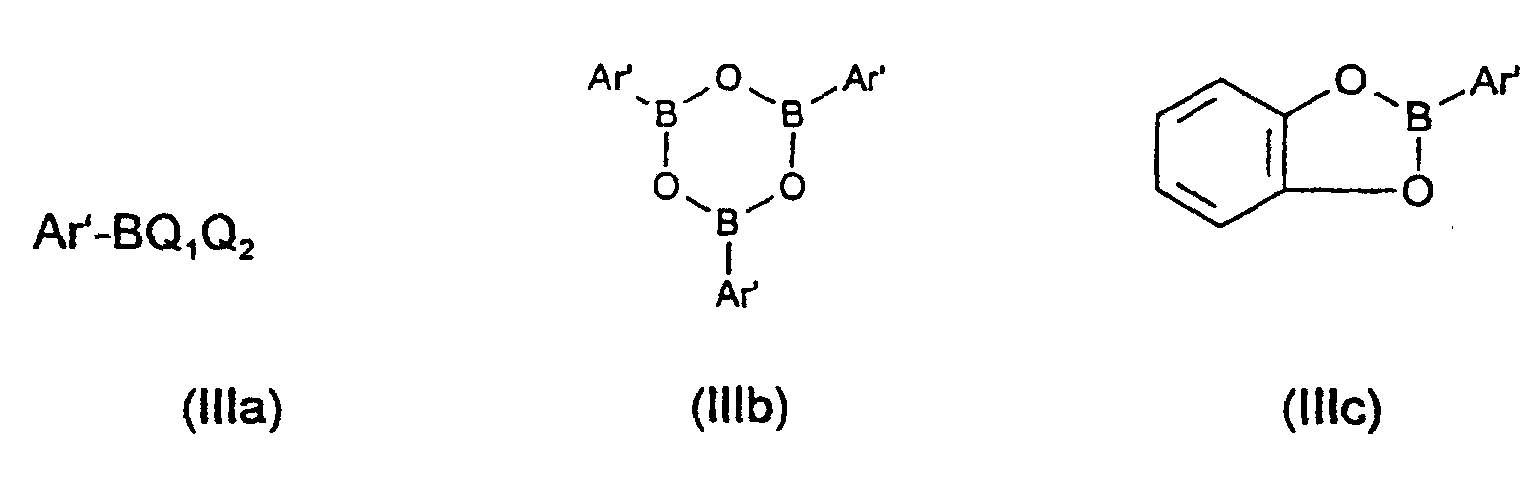
- Ar und Ar' die gleiche Bedeutung haben wie in Formel (I);
- X ausgewählt ist aus der Gruppe von Chlor, Brom, Iod, OSO2CF3, OSO2Aryl-(C6-C10), OSO2Alkyl-(C1-C8) und N2 +Y-, wobei Y ein Chlor-, Brom- oder lodatom oder ein Tetrafluoroborat- oder Tetraphenylboratanion darstellt;
- Q1 und Q2 unabhängig voneinander ausgewählt sind aus der Gruppe von OH, Fluor, Chlor, Brom, Iod, Alkyl-(C1-C4), Aryl-(C6-C10), Alkoxy-(C1-C4) und Aryloxy-(C6-C10);
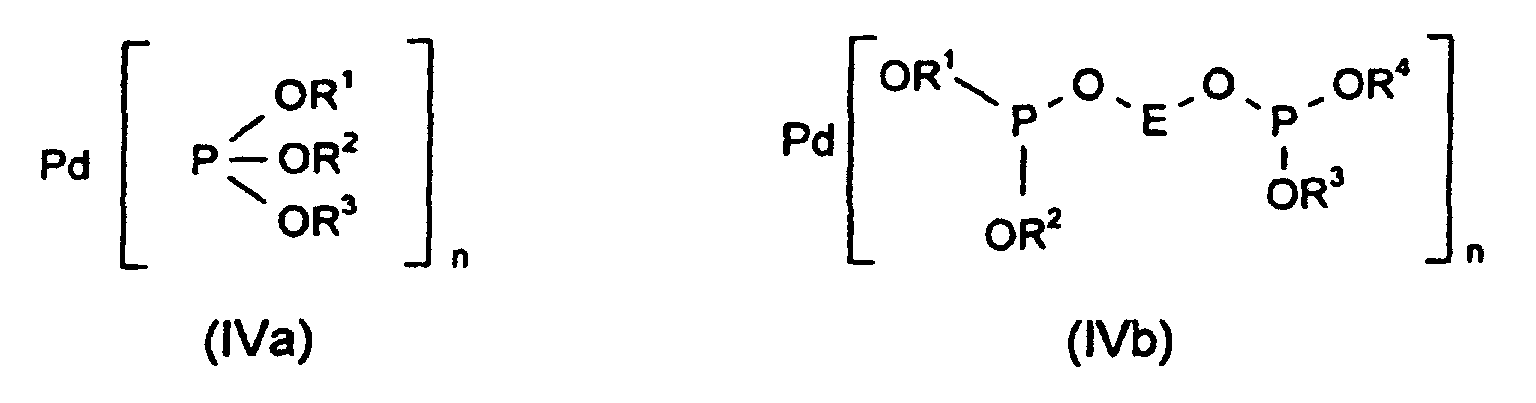
- die Reste R1 bis R4 unabhängig voneinander einen (C1-C18)-Alkylrest oder einen der zuvor beschriebenen Reste Ar darstellen;
- E eine Kohlenstoffbrücke mit zwei bis sieben Kohlenstoffatomen darstellt; und
- n eine ganze Zahl von 1 bis 4 darstellt
- die aromatischen Reste Ar und Ar' bis zu acht Substituenten;
- der Heteroaromat bis zu fünf Substituenten; und/oder
- die Reste R1bis R4 bis zu acht Substituenten
Das erfindungsgemäße Verfahren ist besonders geeignet für die Synthese von Biarylen, worin Ar und Ar' für einen substituierten Phenyl-, Naphthyl-, Anthryl-, Phenanthryl-, Biphenyl-Rest und/oder einen fünf-, sechs- oder siebengliedrigen Heteroaromaten mit gegebenenfalls Stickstoff-, Sauerstoff- oder Schwefelatomen im Ring stehen. Im Falle der Heteroaromaten sind besonders Heteroaromaten wie substituierte Pyridine, Pyrimidine, Oxazole, Imidazole, Pyrazine, Chinoline, Indole, Furane, Benzofurane oder/und Thiophene bevorzugt.
Das Lösungsmittel ist bevorzugt THF, Dioxan, Diethylether, Diglyme, MTBE, DME, Acetonitril, Toluol, Xylole, Anisol, Ethylacetat, Methanol, Ethanol, Butanol, Ethylenglycol, Ethylencarbonat, Propylencarbonat, Dimethylsulfoxid, N,N-Dimethylacetamid, N,N-Dimethylformamid oder N-Methylpyrrolidon.
- primäre, sekundäre und tertiäre Amine wie Alkylamine, Dialkylamine, Trialkylamine, die alicyclisch oder offenkettig sein können;
- Alkali- und Erdalkalisalze aliphatischer oder/und aromatischer Carbonsäuren, wie Acetate, Propionate, Benzoate, insbesondere deren Carbonate, Hydrogencarbonate, Phosphate, Hydrogenphosphate oder/und Hydroxide; sowie
- Metallalkoxide, insbesondere Alkali- oder Erdalkalialkoxide, wie Natriummethanolat, Kaliummethanolat, Natriumethanolat, Magnesiummethanolat und Calciumethanolat.
Die Palladium(0)verbindung ist insbesondere ausgewählt aus der Gruppe der Palladium(0)-dibenzylidenaceton-Komplexe, Palladium(0)-tetrakis(triphenylphosphit), Palladium(0)-tetrakis(triethylphosphit), Palladium(0)-tetrakis(triphenylphosphan), Palladium(0)-bis(tri-o-tolylphosphan), Palladium(0)tricyclohexylphosphan-diallylether-Komplex und Palladium(0)bis(tricyclo-hexylphosphan).
Besonders bevorzugt sind die Halogensalze LiBr, LiCl, NaBr, KBr, CsBr, Bu4NCl, Bu4NBr, Benzyltrimethylammoniumbromid, Trioctylmethylammoniumbromid oder Tetraphenylphosphoniumbromid.
Der Co-Katalysator wird bezogen auf die Verbindung der Formel (II) üblicherweise in einer Menge von 0,001 mol% bis 100 mol%, insbesondere von 0,01 bis 50 mol%, eingesetzt.
Bei verfahrenstechnischen Vorteilen kann die Reaktion auch im Co-Katalysator als Lösungsmittel (Salzschmelze) durchgeführt werden.
Bei dem erfindungsgemäßen Verfahren werden ausnahmsweise Gehalte an Katalysatoren von 1 bis 2 mol%, üblicherweise < 1 mol%, besonders bevorzugt < 0,2 mol% verwendet.
Darüberhinaus sind Phosphitliganden gegenüber den bisher verwendeten Phosphanliganden einfacher und kostengünstiger herzustellen, leichter modifizierbar sowie stabiler gegenüber Oxidationsreaktionen.
Nach einer Dauer von 20 h wird es auf Raumtemperatur abgekühlt. Die Feststoffe werden in 10 ml CH2Cl2 und 10 ml 1 n Natronlauge gelöst. Die organische Phase wird gaschromatographisch analysiert. Die Produkte werden durch Destillation, Kristallisation aus Methanol/Aceton-Mischungen oder säulenchromatographisch (Kieselgel, Hexan/Ethylacetat-Mischungen) isoliert.
| Übersicht über die erfindungsgemäßen Beispiele | ||||||||
| Nr. | Halogenaromat | Base | Co-Kat. (mol%) | Phosphit | Pd [mol%] | P/Pd | GC-Ausbeute [%] | TON |
| 1 | 4-Chlorbenzotrifluorid | Na2CO3 | - | P(OiPr)3 | 1 | 50 | 52 | 52 |
| 2 | 4-Chlorbenzotrifluorid | Na2CO3 | CsF (10) | P(OiPr)3 | 1 | 50 | 58 | 58 |
| 3 | 4-Chlorbenzotrifluorid | Na2CO3 | CaF2 (10) | P(OiPr)3 | 1 | 50 | 69 | 69 |
| 4 | 4-Chlorbenzotrifluorid | Na2CO3 | H2O (50) | P(OiPr)3 | 1 | 50 | 70 | 70 |
| 5 | 4-Chlorbenzotrifluorid | K3PO4 | - | P(OiPr)3 | 1 | 50 | 61 | 61 |
| 6 | 4-Chlorbenzotrifluorid | K3PO4 | - | P(OiPr)3 | 0,001 | 50 | 15 | 15.000 |
| 7 | 4-Chlorbenzotrifluorid | NaOH | - | P(OiPr)3 | 1 | 50 | 71 | 71 |
| 8 | 4-Chlorbenzotrifluorid | Na2CO3 | H2O (50) | P(O-2,4-tBu2C6H3)3 | 1 | 10 | 70 | 70 |
| 9 | 4-Chlorbenzotrifluorid | Na2CO3 | H2O (50) | P(OEt)3 | 1 | 50 | 43 | 43 |
| 10 | 3-Chlorbenzotrifluorid | Na2CO3 | - | P(OiPr)3 | 1 | 50 | 52 | 52 |
| 11 | 4-Chlornitrobenzol | Na2CO3 | - | P(O-2,4-tBu2C6H3)3 | 0,1 | 10 | 57 | 570 |
| 12 | 4-Chloracetophenon | Na2CO3 | - | P(O-2,4-tBu2C6H3)3 | 0,1 | 10 | 53 | 530 |
| 13 | 2-Chlorbenzonitril | Na2CO3 | - | P(OiPr)3 | 1 | 10 | 80 | 80 |
| 14 | 4-Bromfluorbenzol | Na2CO3 | - | P(O-2,4-tBu2C6H3)3 | 0,1 | 10 | 72 | 720 |
| 15 | 4-Bromfluorbenzol | Na2CO3 | - | P(O-2,4-tBu2C6H3)3 | 0,0001 | 10 | 24 | 240.000 |
| 16 | 4-Bromtoluot | Na2CO3 | - | P(O-2,4-tBu2C6H3)3 | 0,1 | 10 | 86 | 860 |
| 17 | Brombenzol | Na2CO3 | - | P(O-2,4-tBu2C6H3)3 | 0,1 | 10 | 87 | 870 |
| 18 | 2-Brom-6methoxynaphthalin | Na2CO3 | - | P(O-2,4-tBu2C6H3)3 | 0,1 | 10 | 69 | 690 |
| 19 | Chlorbenzol | NaOH | - | P(O-2,4-tBu2C6H3)3 | 1 | 10 | 54 | 54 |
| 20 | 4-Chlortoluol | NaOH | - | P(O-2,4-tBu2C6H3)3 | 1 | 10 | 45 | 45 |
| 21 | 2-Brom-6-methoxynaphthalin | NaOH | - | P(OiPr)3 | 0,0001 | 100 | 82 | 820.000 |
| 22 | 4-Bromfluorbenzol | NaOH | - | P(O-2,4-tBu2C6H3)3 | 0,0001 | 100 | 66 | 660.000 |
| 23 | Brombenzol | NaOH | - | P(O-2,4-tBu2C6H3)3 | 0,0001 | 100 | 85 | 850.000 |
| 24 | 4-Bromtoluol | NaOH | - | P(O-2,4-tBu2C6H3)3 | 0,0001 | 100 | 69 | 690.000 |
Claims (21)
- Verfahren zur Herstellung mono-, bi- und/oder polyfunktioneller Biaryle der allgemeinen Formel (I)durch Umsetzung von Halogenarometen der allgemeinen Formel (II)einen aromatischen Rest mit bis zu 14 Kohlenstoffatomen odereinen Heteroaromaten darstellen, ausgewählt aus der Gruppe der fünf-. sechs- oder siebengliedrigen Ringe mit mindestens einem Stickstoff-, Sauerstoff- und/oder Schwefelatom im Ring;wobei in den Formeln (II), (IIIa), (IIIb) und (IIIc)
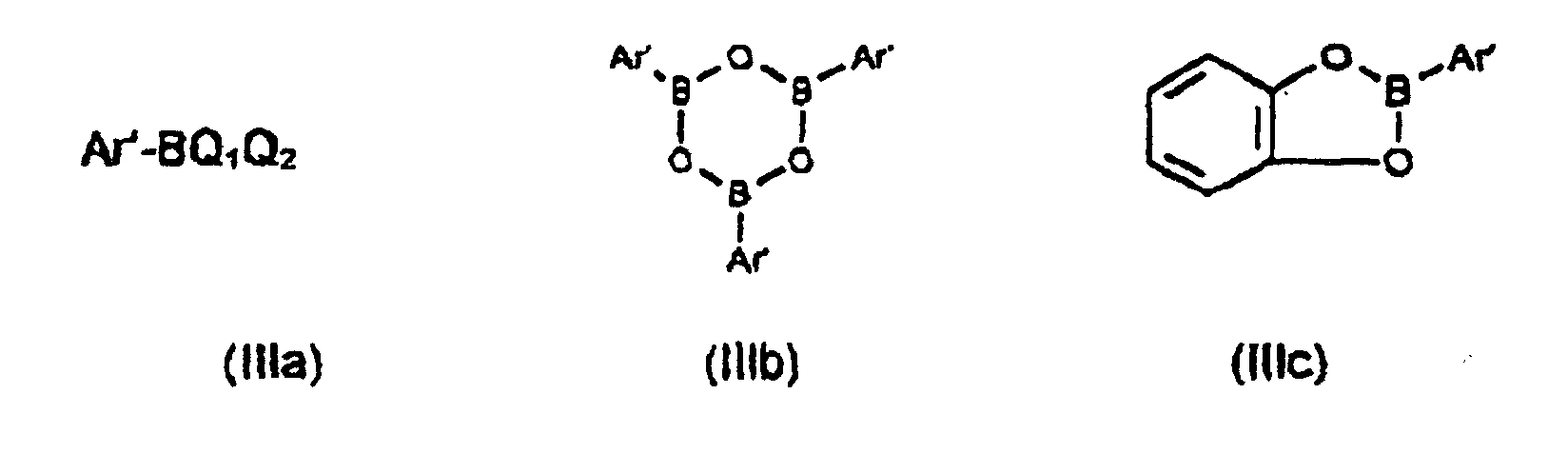 in Gegenwart mindestens eines Palladiumkomplexes der allgemeinen Formel (IVa) oder (IVb)Ar und Ar' die gleiche Bedeutung haben wie in Formel (I);X ausgewählt ist aus der Gruppe von Chlor, Brom, Iod, OSO2CF3, OSO2Aryl-(C6-C10), OSO2Alkyl-(C1-C8) und N2 +Y-, wobei Y ein Chlor-, Brom- oder Iodatom oder ein Tetrafluoroborat- oder Tetraphenylboratanion darstellt;Q1 und Q2 unabhängig voneinander ausgewählt sind aus der Gruppe von OH, Fluor, Chlor, Brom, Iod, Alkyl-(C1-C4), Aryl-(C8-C10), Alkoxy-(C1-C4) und Aryloxy-(C8-C10);in denen
 die Reste R1 bis R4 unabhängig voneinander einen (C1-C18)-Alkylrest oder einen der zuvor beschriebenen Reste Ar darstellen;E eine Kohlenstoffbrücke mit zwei bis sieben Kohlenstoffatomen darstellt; undn und m unabhängig voneinander eine ganze Zahl von 1 bis 4 darstellen und wobei die Palladiumkomplexe der allgemeinen Formel (IVa) oder (IVb) in situ aus mindestens einem Palladium(II)salz oder einer Palladium(0)verbindung und dem entsprechenden Phosphitliganden erhalten werden und das molare Verhältnis der eingesetzten Palladium(0)verbindung oder des Palladium (II)salzes zu eingesetztem Phosphitligand zwischen 1 : 5 und 1 : 200 liegt.
 - Verfahren nach Anspruch 1, dadurch gekennzeichnet, daßaufweisen, die unabhängig voneinander ausgewählt sind aus der Gruppe von Fluor, Chlor, CF3, OH, NO2, CN, R5, O-R5, CHO, CO-R5, COOH, COO-R5, OCO-R5, SiR5 3, NH2, NH-R5, N-R5 2, SO-R5, SO2-R5, SO3H, SO3-R5, CONH2, NHCOH, NHCO-R5, NHCOO-R5, CHCH-CO2-Alkyl-(C1-C8), PO-R5 2, P-R5 2, PO3H2, PO(O-Alkyl-(C1-C6))2 und CHCHCO2H; wobei R5 einen Alkylrest mit 1 bis 8 Kohlenstoffatomen oder einen Arylrest mit 6 bis 10 Kohlenstoffatomen, wie z.B. Phenyl, darstellt.die aromatischen Reste Ar und Ar' bis zu acht Substituenten;der Heteroaromat bis zu fünf Substituenten; und/oderdie Reste R1bis R4 bis zu acht Substituenten
- Verfahren nach Anspruch 1 oder 2, dadurch gekennzeichnet, daß die Kohlenstoffbrücke E bis zu sieben Substituenten aufweist, die unabhängig voneinander ausgewählt sind aus der Gruppe von (C1-C4)-Alkyl, O-Alkyl-(C1-C4), OH und Ar, wobei Ar die gleiche Bedeutung hat wie in Formel (I).
- Verfahren nach einem der Ansprüche 1 bis 3, dadurch gekennzeichnet, daß in der Formel (IIIa) Q1 und Q2 unabhängig voneinander einen (C1-C4)-Alkyl-, (C1-C4)-Alkoxy-, (C6-C10)-Alryl- und/oder (C6-C10)-Aryloxyrest darstellen, die durch mindestens ein Halogenatom oder einen (C1-C4)-Alkoxy- oder (C1-C4)-Alkylrest substituiert sind.
- Verfahren nach einem der Ansprüche 1 bis 3, dadurch gekennzeichnet, daß in der Formel (IIIa) Q1 und Q2 zusammen eine Alkylendioxy- oder Alkylengruppe mit ein bis vier Kohlenstoffatomen darstellen, die gegebenenfalls durch bis zu vier (C1-C4)-Alkyl- und/oder (C8-C10)-Arylreste substituiert ist.
- Verfahren nach einem der vorhergehenden Ansprüche, dadurch gekennzeichnet, daß die Reste Ar und Ar' unabhängig voneinander einen Heteroaromaten darstellen, wobei an den heteroaromatischen Ring bis zu vier weitere aromatische, heteroaromatische und/oder aliphatische Ringe ankondensiert sind.
- Verfahren nach einem der vorhergehenden Ansprüche, dadurch gekennzeichnet, daß die Reste Ar und Ar' unabhängig voneinander einen substituierten Phenyl-, Naphthyl-, Anthryl-, Phenanthryl-, Biphenyl-, Pyridin-, Pyrimidin-, Oxazol-, Imidazol-, Pyrazin-, Chinolin-, Indol-, Furan, Benzofuranoder Thiophenrest darstellen.
- Verfahren nach einem der vorhergehenden Ansprüche, dadurch gekennzeichnet, daß die Reste Ar und Ar' unabhängig voneinander bis zu 5 Substituenten aufweisen, ausgewählt aus der Gruppe von Alkyl-(C1-C8), O-Alkyl-(C1-C8), OCO-Alkyl-(C1-C8), N-Alkyl2-(C1-C8), Phenyl, Aryl, Fluor, Chlor, NO2, CN, COOH, CHO, SO2-Alkyl-(C1-C4), NH-Alkyl-(C1-C8), COO-Alkyl-(C1-C8), CONH2, CONH-Alkyl-(C1-C8), CO-Alkyl-(C1-C8), CO-Phenyl und PO-Phenyl2.
- Verfahren nach einem der vorhergehenden Ansprüche, dadurch gekennzeichnet, daß die Umsetzung in Gegenwart mindestens eines Lösungsmittels durchgeführt wird, ausgewählt aus der Gruppe von Wasser, aliphatischen Ethem, aromatischen oder aliphatischen Kohlenwasserstoffen, Alkoholen, Estern, aromatischen oder aliphatischen Nitrilen und dipolar aprotischen Lösungsmitteln wie Dialkylsulfoxiden, N,N-Dialkylamiden aliphatischer Carbonsäuren oder alkylierten Lactamen.
- Verfahren nach Anspruch 9, dadurch gekennzeichnet, daß das Lösungsmittel THF, Dioxan, Diethylether, Diglyme, MTBE, DME, Acetonitril, Toluol, Xylol, Anisol, Ethylacetat, Methanol, Ethanol, Butanol, Ethylenglycol, Ethylencarbonat, Propylencarbonat, Dimethylsulfoxid, N,N-Dimethylacetamid, N,N-Dimethylformamid oder N-Methylpyrrolidon ist.
- Verfahren nach einem der vorhergehenden Ansprüche, dadurch gekennzeichnet, daß die Umsetzung in Gegenwart mindestens einer Base durchgeführt wird, ausgewählt aus der Gruppe derprimären, sekundären und tertiären Amine wie Alkylamine, Dialkylamine, Trialkylamine, die alicyclisch oder offenkettig sein können;Alkali- und Erdalkalisalze aliphatischer oder/und aromatischer Carbonsäuren, wie Acetate, Propionate, Benzoate, insbesondere deren Carbonate, Hydrogencarbonate, Phosphate, Hydrogenphosphate oder/und Hydroxide;Metallalkoxide, insbesondere Alkali- oder Erdalkalialkoxide, wie Natriummethanolat, Kaliummethanolat, Natriumethanolat, Magnesiummethanolat und Calciumethanolat.
- Verfahren nach Anspruch 11, dadurch gekennzeichnet, daß die Base ein Carbonat, Hydroxid oder Phosphat von Lithium, Natrium, Kalium, Calcium, Magnesium oder Cäsium ist.
- Verfahren nach einem der vorhergehenden Ansprüche, dadurch gekennzeichnet, daß die Umsetzung in Gegenwart mindestens eines Fluoridsalzes durchgeführt wird, das insbesondere ausgewählt ist aus der Gruppe von CaF2, NaF, KF, LiF, CsF und (C1-C8)-Alkyl4NF.
- Verfahren nach Anspruch 1, dadurch gekennzeichnet, daß die Palladium(0)verbindung ausgewählt ist aus der Gruppe der Palladium(0)-dibenzylidenaceton-Komplexe, Palladium(0)-tetrakis(triphenylphosphit), Palladium(0)-tetrakis(triethylphosphit), Palladium(0)-tetrakis(triphenyl phosphan), Palladium(0)-bis(tri-o-tolylphosphan), Palladium(0)tricyclohexyl phosphan-diallylether-Komplex und Palladium(0)bis(tricyclo-hexylphosphan).
- Verfahren nach Anspruch1, dadurch gekennzeichnet, daß das Palladium(II) salz ausgewählt ist aus der Gruppe von Palladium(II)acetat, Palla dium(II)chlorid, Palladium(II)bromid, Lithiumtetrachloropalladat(II), Palladium(II) acetylacetonat, Palladium(II)-propionat, Palladium(II)chlorid-bis(acetonitril), Palladium(II)-bis(triphenylphosphan)-dichlorid und Palladium(II)chloridbis(benzonitril).
- Verfahren nach einem der vorhergehenden Ansprüche, dadurch gekennzeichnet, daß die Umsetzung in Gegenwart mindestens eines Co-Katalysators durchgeführt wird, ausgewählt aus der Gruppe von Halogensalzen, insbesondere ein Halogenid der Alkalielemente oder/und Erdalkalielemente, ein Ammoniumhalogenid oder/und ein Phosphoniumhalogenid, vorzugsweise ein Bromid oder/und Chlorid.
- Verfahren nach Anspruch 16, dadurch gekennzeichnet, daß das Halogensalz LiBr, LiCl, NaBr, KBr, CsBr, Bu4NCl, Bu4NBr, Benzyltrimethylammoniumbromid, Trioctylmethylammoniumbromid oder Tetraphenylphosphoniumbromid ist.
- Verfahren nach Anspruch 16 oder 17, dadurch gekennzeichnet, daß der Co-Katalysator in einer Menge von 0,001 mol% bis 100 mol%, insbesondere von 0.01 bis 50 mol%, bezogen auf die Verbindung der Formel (II) eingesetzt wird.
- Verfahren nach einem der Ansprüche 16 bis 18, dadurch gekennzeichnet, daß die Umsetzung in Gegenwart des geschmolzenen Co-Katalysators (Salz schmelze) durchgeführt wird.
- Verfahren nach einem der vorhergehenden Ansprüche, dadurch gekennzeichnet, daß die Umsetzung bei einer Temperatur zwischen 20 und 200° C, vorzugsweise zwischen 60 und 180° C, insbesondere zwischen 80 und 160° C, durchgeführt wird.
- Verfahren nach einem der vorhergehenden Ansprüche, dadurch gekennzeichnet, daß die Umsetzung bei einem Druck bis zu 100 bar, vorzugsweise bei einem Druck zwischen Normaldruck und 60 bar, durchgeführt wird.
Applications Claiming Priority (3)
| Application Number | Priority Date | Filing Date | Title |
|---|---|---|---|
| DE19916222 | 1999-04-10 | ||
| DE19916222A DE19916222A1 (de) | 1999-04-10 | 1999-04-10 | Verfahren zur Herstellung von Biarylen |
| PCT/EP2000/001111 WO2000061531A1 (de) | 1999-04-10 | 2000-02-11 | Verfahren zur herstellung von biarylen |
Publications (2)
| Publication Number | Publication Date |
|---|---|
| EP1171406A1 EP1171406A1 (de) | 2002-01-16 |
| EP1171406B1 true EP1171406B1 (de) | 2004-04-21 |
Family
ID=7904137
Family Applications (1)
| Application Number | Title | Priority Date | Filing Date |
|---|---|---|---|
| EP00916828A Expired - Lifetime EP1171406B1 (de) | 1999-04-10 | 2000-02-11 | Verfahren zur herstellung von biarylen |
Country Status (9)
| Country | Link |
|---|---|
| US (1) | US6566571B1 (de) |
| EP (1) | EP1171406B1 (de) |
| JP (1) | JP2002541232A (de) |
| AT (1) | ATE264828T1 (de) |
| DE (2) | DE19916222A1 (de) |
| DK (1) | DK1171406T3 (de) |
| ES (1) | ES2219325T3 (de) |
| PT (1) | PT1171406E (de) |
| WO (1) | WO2000061531A1 (de) |
Cited By (2)
| Publication number | Priority date | Publication date | Assignee | Title |
|---|---|---|---|---|
| US7425556B2 (en) | 2005-12-20 | 2008-09-16 | Astrazeneca Ab | Compounds and uses thereof |
| US7465795B2 (en) | 2005-12-20 | 2008-12-16 | Astrazeneca Ab | Compounds and uses thereof |
Families Citing this family (8)
| Publication number | Priority date | Publication date | Assignee | Title |
|---|---|---|---|---|
| US20030220646A1 (en) * | 2002-05-23 | 2003-11-27 | Thelen Sarah L. | Method and apparatus for reducing femoral fractures |
| JP4802379B2 (ja) * | 2001-03-15 | 2011-10-26 | Dic株式会社 | ビアリール化合物の製造方法 |
| JP4552405B2 (ja) * | 2003-09-08 | 2010-09-29 | 三菱化学株式会社 | ビアリール化合物類の製造方法 |
| JP4864342B2 (ja) * | 2005-04-27 | 2012-02-01 | 北興化学工業株式会社 | ビアリール化合物の製造方法 |
| AR067028A1 (es) * | 2007-06-19 | 2009-09-30 | Astrazeneca Ab | Compuestos y usos de los mismos 849 |
| EP2008991A1 (de) | 2007-06-29 | 2008-12-31 | Bayer CropScience AG | Verfahren zur Herstellung von Biarylen |
| JP2014129255A (ja) * | 2012-12-28 | 2014-07-10 | Fujifilm Corp | 組成物およびフィルムならびにそれらの製造方法 |
| CN113087591B (zh) * | 2020-01-08 | 2022-05-03 | 浙江中欣氟材股份有限公司 | 一种2,2′,3,3′,5,5′,6,6′-八氟联苯的制备方法 |
Family Cites Families (5)
| Publication number | Priority date | Publication date | Assignee | Title |
|---|---|---|---|---|
| DE3925437C1 (en) * | 1988-12-17 | 1990-09-20 | Bayer Ag, 5090 Leverkusen, De | Bi:aryl cpds. prepn. - by coupling two halo-aromatic cpds. |
| EP0501268B1 (de) | 1991-02-25 | 1996-06-12 | F. Hoffmann-La Roche Ag | Flüssigkristalline Verbindungen mit endständigem 1-Alkinylrest |
| EP1384717B1 (de) | 1991-11-18 | 2008-05-14 | E.I. Dupont De Nemours And Company | 2-(2'-Triphenylmethyl-2'H-tetrazol-5'-yl)phenylborsäure als Zwischenprodukt zur Synthese von A II Receptorenantagonisten |
| US5254776A (en) | 1992-07-17 | 1993-10-19 | Mallinckrodt Specialty Chemicals Company | Synthesis of bromobiphenyls |
| DE4414499A1 (de) | 1994-04-26 | 1995-11-02 | Hoechst Ag | Verfahren zur Kreuzkupplung von aromatischen Borverbindungen mit aromatischen Halogenverbindungen oder Perfluoralkylsulfonaten |
-
1999
- 1999-04-10 DE DE19916222A patent/DE19916222A1/de not_active Withdrawn
-
2000
- 2000-02-11 US US09/926,269 patent/US6566571B1/en not_active Expired - Fee Related
- 2000-02-11 JP JP2000610808A patent/JP2002541232A/ja active Pending
- 2000-02-11 AT AT00916828T patent/ATE264828T1/de not_active IP Right Cessation
- 2000-02-11 PT PT00916828T patent/PT1171406E/pt unknown
- 2000-02-11 DE DE50006154T patent/DE50006154D1/de not_active Expired - Fee Related
- 2000-02-11 EP EP00916828A patent/EP1171406B1/de not_active Expired - Lifetime
- 2000-02-11 WO PCT/EP2000/001111 patent/WO2000061531A1/de not_active Ceased
- 2000-02-11 ES ES00916828T patent/ES2219325T3/es not_active Expired - Lifetime
- 2000-02-11 DK DK00916828T patent/DK1171406T3/da active
Cited By (2)
| Publication number | Priority date | Publication date | Assignee | Title |
|---|---|---|---|---|
| US7425556B2 (en) | 2005-12-20 | 2008-09-16 | Astrazeneca Ab | Compounds and uses thereof |
| US7465795B2 (en) | 2005-12-20 | 2008-12-16 | Astrazeneca Ab | Compounds and uses thereof |
Also Published As
| Publication number | Publication date |
|---|---|
| DE50006154D1 (de) | 2004-05-27 |
| DE19916222A1 (de) | 2000-10-19 |
| WO2000061531A1 (de) | 2000-10-19 |
| US6566571B1 (en) | 2003-05-20 |
| JP2002541232A (ja) | 2002-12-03 |
| EP1171406A1 (de) | 2002-01-16 |
| PT1171406E (pt) | 2004-08-31 |
| ATE264828T1 (de) | 2004-05-15 |
| DK1171406T3 (da) | 2004-08-02 |
| ES2219325T3 (es) | 2004-12-01 |
Similar Documents
| Publication | Publication Date | Title |
|---|---|---|
| EP2185500B1 (de) | Verfahren zur herstellung von biarylen | |
| DE60131985T2 (de) | Katalysator für aromatische c-o, c-n und c-c-bindungsbildung | |
| WO2001004076A1 (de) | Verfahren zur herstellung von biarylen unter palladaphosphacyclobutan-katalyse | |
| DE19503119A1 (de) | Verfahren zur Herstellung von aromatischen Olefinen unter Katalyse von Palladacyclen | |
| EP1171406B1 (de) | Verfahren zur herstellung von biarylen | |
| DE10037961A1 (de) | Neue Phosphanliganden, deren Herstellung und ihre Verwendung in katalytischen Reaktionen | |
| WO2006136135A2 (de) | Verfahren zur decarboxylierenden c-c verknüpfung von carbonsäuren mit kohlenstoffelektrophilen | |
| EP1903023A1 (de) | Verfahren zur Herstellung von Arylaminen oder Arylamiden | |
| DE4423061C1 (de) | Verfahren zur Herstellung von Biphenylen mit Palladacyclen als Katalysatoren | |
| EP0846676A1 (de) | Synthese von aromatischen Aminen aus Chloraromaten | |
| EP0938459B1 (de) | Verfahren zur herstellung von aromatischen olefinen mittels katalyse durch palladaphosphacyclobutane | |
| EP0962434B1 (de) | Verfahren zur Herstellung von aromatischen Olefinen unter Katalyse von Palladiumkatalysatoren mit Phosphitliganden | |
| EP1453774B1 (de) | Verfahren zur arylierung von olefinen | |
| EP0970028B1 (de) | Verfahren zur synthese von aromatisch substituierten olefinen | |
| DE68919478T2 (de) | Herstellung von biaryl-verbindungen. | |
| EP1308157B1 (de) | Komplexe N-heterocyclischer Carbene und ihre Verwendung | |
| EP0979809B1 (de) | Vefahren zur Herstellung von 4-Chlorbiphenylen | |
| US6686495B2 (en) | Process for the preparation of mono-, bi- or poly-functional biaryls | |
| DE60100262T2 (de) | Organische Verbindungen durch Kopplung von Nukleophilen, Vinylverbindungen oder CO mit Wasser, Alkohole oder Aminen | |
| EP1899289B1 (de) | Verfahren zur herstellung von arylaminen, arylethern und arylthioethern | |
| WO2011098375A2 (de) | Verfahren zur allylierung und vinylierung von aryl-, heteroaryl-, alkyl- und alkenylhalogeniden unter übergangsmetallkatalyse | |
| DE4333711A1 (de) | 2,4,5-Trihalogenzimtsäurenitrile und Verfahren zu ihrer Herstellung | |
| CA2466959A1 (en) | Synthesis of aryl ethers, methods and reagents related thereto | |
| WO2013135552A2 (de) | Phosphinite und amidophosphinite als liganden in katalytischen reaktionen |
Legal Events
| Date | Code | Title | Description |
|---|---|---|---|
| PUAI | Public reference made under article 153(3) epc to a published international application that has entered the european phase |
Free format text: ORIGINAL CODE: 0009012 |
|
| 17P | Request for examination filed |
Effective date: 20011112 |
|
| AK | Designated contracting states |
Kind code of ref document: A1 Designated state(s): AT BE CH CY DE DK ES FI FR GB GR IE IT LI LU MC NL PT SE |
|
| 17Q | First examination report despatched |
Effective date: 20030213 |
|
| GRAP | Despatch of communication of intention to grant a patent |
Free format text: ORIGINAL CODE: EPIDOSNIGR1 |
|
| GRAS | Grant fee paid |
Free format text: ORIGINAL CODE: EPIDOSNIGR3 |
|
| GRAA | (expected) grant |
Free format text: ORIGINAL CODE: 0009210 |
|
| AK | Designated contracting states |
Kind code of ref document: B1 Designated state(s): AT BE CH CY DE DK ES FI FR GB GR IE IT LI LU MC NL PT SE |
|
| REG | Reference to a national code |
Ref country code: GB Ref legal event code: FG4D Free format text: NOT ENGLISH |
|
| REG | Reference to a national code |
Ref country code: CH Ref legal event code: EP |
|
| REG | Reference to a national code |
Ref country code: IE Ref legal event code: FG4D Free format text: GERMAN |
|
| REF | Corresponds to: |
Ref document number: 50006154 Country of ref document: DE Date of ref document: 20040527 Kind code of ref document: P |
|
| REG | Reference to a national code |
Ref country code: CH Ref legal event code: NV Representative=s name: BOVARD AG PATENTANWAELTE |
|
| REG | Reference to a national code |
Ref country code: DK Ref legal event code: T3 |
|
| REG | Reference to a national code |
Ref country code: SE Ref legal event code: TRGR |
|
| GBT | Gb: translation of ep patent filed (gb section 77(6)(a)/1977) |
Effective date: 20040726 |
|
| REG | Reference to a national code |
Ref country code: GR Ref legal event code: EP Ref document number: 20040402233 Country of ref document: GR |
|
| REG | Reference to a national code |
Ref country code: PT Ref legal event code: SC4A Free format text: AVAILABILITY OF NATIONAL TRANSLATION Effective date: 20040706 |
|
| REG | Reference to a national code |
Ref country code: ES Ref legal event code: FG2A Ref document number: 2219325 Country of ref document: ES Kind code of ref document: T3 |
|
| ET | Fr: translation filed | ||
| PGFP | Annual fee paid to national office [announced via postgrant information from national office to epo] |
Ref country code: DK Payment date: 20050211 Year of fee payment: 6 |
|
| PLBE | No opposition filed within time limit |
Free format text: ORIGINAL CODE: 0009261 |
|
| STAA | Information on the status of an ep patent application or granted ep patent |
Free format text: STATUS: NO OPPOSITION FILED WITHIN TIME LIMIT |
|
| 26N | No opposition filed |
Effective date: 20050124 |
|
| PGFP | Annual fee paid to national office [announced via postgrant information from national office to epo] |
Ref country code: PT Payment date: 20060124 Year of fee payment: 7 |
|
| PGFP | Annual fee paid to national office [announced via postgrant information from national office to epo] |
Ref country code: CY Payment date: 20060127 Year of fee payment: 7 |
|
| PGFP | Annual fee paid to national office [announced via postgrant information from national office to epo] |
Ref country code: FI Payment date: 20060210 Year of fee payment: 7 |
|
| PGFP | Annual fee paid to national office [announced via postgrant information from national office to epo] |
Ref country code: MC Payment date: 20060213 Year of fee payment: 7 |
|
| PGFP | Annual fee paid to national office [announced via postgrant information from national office to epo] |
Ref country code: DE Payment date: 20060214 Year of fee payment: 7 Ref country code: SE Payment date: 20060214 Year of fee payment: 7 |
|
| PGFP | Annual fee paid to national office [announced via postgrant information from national office to epo] |
Ref country code: AT Payment date: 20060215 Year of fee payment: 7 Ref country code: CH Payment date: 20060215 Year of fee payment: 7 Ref country code: LU Payment date: 20060215 Year of fee payment: 7 Ref country code: NL Payment date: 20060215 Year of fee payment: 7 |
|
| PGFP | Annual fee paid to national office [announced via postgrant information from national office to epo] |
Ref country code: FR Payment date: 20060216 Year of fee payment: 7 |
|
| PGFP | Annual fee paid to national office [announced via postgrant information from national office to epo] |
Ref country code: GB Payment date: 20060221 Year of fee payment: 7 Ref country code: GR Payment date: 20060221 Year of fee payment: 7 |
|
| PGFP | Annual fee paid to national office [announced via postgrant information from national office to epo] |
Ref country code: IE Payment date: 20060223 Year of fee payment: 7 |
|
| PGFP | Annual fee paid to national office [announced via postgrant information from national office to epo] |
Ref country code: ES Payment date: 20060227 Year of fee payment: 7 |
|
| PGFP | Annual fee paid to national office [announced via postgrant information from national office to epo] |
Ref country code: IT Payment date: 20060228 Year of fee payment: 7 |
|
| PGFP | Annual fee paid to national office [announced via postgrant information from national office to epo] |
Ref country code: BE Payment date: 20060310 Year of fee payment: 7 |
|
| PG25 | Lapsed in a contracting state [announced via postgrant information from national office to epo] |
Ref country code: FI Free format text: LAPSE BECAUSE OF NON-PAYMENT OF DUE FEES Effective date: 20070211 |
|
| PG25 | Lapsed in a contracting state [announced via postgrant information from national office to epo] |
Ref country code: SE Free format text: LAPSE BECAUSE OF NON-PAYMENT OF DUE FEES Effective date: 20070212 |
|
| PG25 | Lapsed in a contracting state [announced via postgrant information from national office to epo] |
Ref country code: MC Free format text: LAPSE BECAUSE OF NON-PAYMENT OF DUE FEES Effective date: 20070228 Ref country code: LI Free format text: LAPSE BECAUSE OF NON-PAYMENT OF DUE FEES Effective date: 20070228 Ref country code: CH Free format text: LAPSE BECAUSE OF NON-PAYMENT OF DUE FEES Effective date: 20070228 |
|
| PG25 | Lapsed in a contracting state [announced via postgrant information from national office to epo] |
Ref country code: PT Free format text: LAPSE BECAUSE OF NON-PAYMENT OF DUE FEES Effective date: 20070813 |
|
| REG | Reference to a national code |
Ref country code: PT Ref legal event code: MM4A Free format text: LAPSE DUE TO NON-PAYMENT OF FEES Effective date: 20070813 |
|
| REG | Reference to a national code |
Ref country code: CH Ref legal event code: PL Ref country code: DK Ref legal event code: EBP |
|
| EUG | Se: european patent has lapsed | ||
| GBPC | Gb: european patent ceased through non-payment of renewal fee |
Effective date: 20070211 |
|
| NLV4 | Nl: lapsed or anulled due to non-payment of the annual fee |
Effective date: 20070901 |
|
| PG25 | Lapsed in a contracting state [announced via postgrant information from national office to epo] |
Ref country code: CY Free format text: LAPSE BECAUSE OF NON-PAYMENT OF DUE FEES Effective date: 20070211 Ref country code: AT Free format text: LAPSE BECAUSE OF NON-PAYMENT OF DUE FEES Effective date: 20070211 |
|
| REG | Reference to a national code |
Ref country code: IE Ref legal event code: MM4A |
|
| REG | Reference to a national code |
Ref country code: FR Ref legal event code: ST Effective date: 20071030 |
|
| BERE | Be: lapsed |
Owner name: *DEGUSSA A.G. Effective date: 20070228 |
|
| PG25 | Lapsed in a contracting state [announced via postgrant information from national office to epo] |
Ref country code: BE Free format text: LAPSE BECAUSE OF NON-PAYMENT OF DUE FEES Effective date: 20070228 |
|
| PG25 | Lapsed in a contracting state [announced via postgrant information from national office to epo] |
Ref country code: IE Free format text: LAPSE BECAUSE OF NON-PAYMENT OF DUE FEES Effective date: 20070212 Ref country code: DK Free format text: LAPSE BECAUSE OF NON-PAYMENT OF DUE FEES Effective date: 20070228 Ref country code: NL Free format text: LAPSE BECAUSE OF NON-PAYMENT OF DUE FEES Effective date: 20070901 Ref country code: DE Free format text: LAPSE BECAUSE OF NON-PAYMENT OF DUE FEES Effective date: 20070901 |
|
| PG25 | Lapsed in a contracting state [announced via postgrant information from national office to epo] |
Ref country code: GB Free format text: LAPSE BECAUSE OF NON-PAYMENT OF DUE FEES Effective date: 20070211 Ref country code: FR Free format text: LAPSE BECAUSE OF NON-PAYMENT OF DUE FEES Effective date: 20070228 |
|
| REG | Reference to a national code |
Ref country code: ES Ref legal event code: FD2A Effective date: 20070212 |
|
| PG25 | Lapsed in a contracting state [announced via postgrant information from national office to epo] |
Ref country code: ES Free format text: LAPSE BECAUSE OF NON-PAYMENT OF DUE FEES Effective date: 20070212 |
|
| PG25 | Lapsed in a contracting state [announced via postgrant information from national office to epo] |
Ref country code: GR Free format text: LAPSE BECAUSE OF NON-PAYMENT OF DUE FEES Effective date: 20070904 |
|
| PG25 | Lapsed in a contracting state [announced via postgrant information from national office to epo] |
Ref country code: LU Free format text: LAPSE BECAUSE OF NON-PAYMENT OF DUE FEES Effective date: 20070211 |
|
| PG25 | Lapsed in a contracting state [announced via postgrant information from national office to epo] |
Ref country code: IT Free format text: LAPSE BECAUSE OF NON-PAYMENT OF DUE FEES Effective date: 20070211 |