EP1172959A2 - Hybrid-Wiederholungsaufforderungssystem und -Verfahren - Google Patents
Hybrid-Wiederholungsaufforderungssystem und -Verfahren Download PDFInfo
- Publication number
- EP1172959A2 EP1172959A2 EP01114984A EP01114984A EP1172959A2 EP 1172959 A2 EP1172959 A2 EP 1172959A2 EP 01114984 A EP01114984 A EP 01114984A EP 01114984 A EP01114984 A EP 01114984A EP 1172959 A2 EP1172959 A2 EP 1172959A2
- Authority
- EP
- European Patent Office
- Prior art keywords
- sequences
- signals
- unit
- puncturing
- encoded
- Prior art date
- Legal status (The legal status is an assumption and is not a legal conclusion. Google has not performed a legal analysis and makes no representation as to the accuracy of the status listed.)
- Granted
Links
- 238000000034 method Methods 0.000 title claims abstract description 29
- 238000004891 communication Methods 0.000 claims abstract description 17
- 230000005540 biological transmission Effects 0.000 claims description 17
- 239000000470 constituent Substances 0.000 description 8
- 101000741965 Homo sapiens Inactive tyrosine-protein kinase PRAG1 Proteins 0.000 description 4
- 102100038659 Inactive tyrosine-protein kinase PRAG1 Human genes 0.000 description 4
- 238000010295 mobile communication Methods 0.000 description 4
- 230000009897 systematic effect Effects 0.000 description 4
- 239000000654 additive Substances 0.000 description 1
- 230000000996 additive effect Effects 0.000 description 1
- 230000009286 beneficial effect Effects 0.000 description 1
- 125000004122 cyclic group Chemical group 0.000 description 1
- 230000000593 degrading effect Effects 0.000 description 1
Images


Classifications
-
- H—ELECTRICITY
- H04—ELECTRIC COMMUNICATION TECHNIQUE
- H04L—TRANSMISSION OF DIGITAL INFORMATION, e.g. TELEGRAPHIC COMMUNICATION
- H04L1/00—Arrangements for detecting or preventing errors in the information received
- H04L1/12—Arrangements for detecting or preventing errors in the information received by using return channel
- H04L1/16—Arrangements for detecting or preventing errors in the information received by using return channel in which the return channel carries supervisory signals, e.g. repetition request signals
- H04L1/18—Automatic repetition systems, e.g. Van Duuren systems
- H04L1/1812—Hybrid protocols; Hybrid automatic repeat request [HARQ]
- H04L1/1819—Hybrid protocols; Hybrid automatic repeat request [HARQ] with retransmission of additional or different redundancy
-
- H—ELECTRICITY
- H04—ELECTRIC COMMUNICATION TECHNIQUE
- H04B—TRANSMISSION
- H04B7/00—Radio transmission systems, i.e. using radiation field
- H04B7/02—Diversity systems; Multi-antenna system, i.e. transmission or reception using multiple antennas
- H04B7/04—Diversity systems; Multi-antenna system, i.e. transmission or reception using multiple antennas using two or more spaced independent antennas
- H04B7/06—Diversity systems; Multi-antenna system, i.e. transmission or reception using multiple antennas using two or more spaced independent antennas at the transmitting station
- H04B7/0602—Diversity systems; Multi-antenna system, i.e. transmission or reception using multiple antennas using two or more spaced independent antennas at the transmitting station using antenna switching
- H04B7/0604—Diversity systems; Multi-antenna system, i.e. transmission or reception using multiple antennas using two or more spaced independent antennas at the transmitting station using antenna switching with predefined switching scheme
-
- H—ELECTRICITY
- H04—ELECTRIC COMMUNICATION TECHNIQUE
- H04B—TRANSMISSION
- H04B7/00—Radio transmission systems, i.e. using radiation field
- H04B7/14—Relay systems
- H04B7/15—Active relay systems
- H04B7/155—Ground-based stations
- H04B7/15528—Control of operation parameters of a relay station to exploit the physical medium
- H04B7/15535—Control of relay amplifier gain
-
- H—ELECTRICITY
- H04—ELECTRIC COMMUNICATION TECHNIQUE
- H04L—TRANSMISSION OF DIGITAL INFORMATION, e.g. TELEGRAPHIC COMMUNICATION
- H04L1/00—Arrangements for detecting or preventing errors in the information received
- H04L1/004—Arrangements for detecting or preventing errors in the information received by using forward error control
- H04L1/0041—Arrangements at the transmitter end
-
- H—ELECTRICITY
- H04—ELECTRIC COMMUNICATION TECHNIQUE
- H04L—TRANSMISSION OF DIGITAL INFORMATION, e.g. TELEGRAPHIC COMMUNICATION
- H04L1/00—Arrangements for detecting or preventing errors in the information received
- H04L1/004—Arrangements for detecting or preventing errors in the information received by using forward error control
- H04L1/0045—Arrangements at the receiver end
-
- H—ELECTRICITY
- H04—ELECTRIC COMMUNICATION TECHNIQUE
- H04L—TRANSMISSION OF DIGITAL INFORMATION, e.g. TELEGRAPHIC COMMUNICATION
- H04L1/00—Arrangements for detecting or preventing errors in the information received
- H04L1/004—Arrangements for detecting or preventing errors in the information received by using forward error control
- H04L1/0056—Systems characterized by the type of code used
- H04L1/0064—Concatenated codes
- H04L1/0066—Parallel concatenated codes
-
- H—ELECTRICITY
- H04—ELECTRIC COMMUNICATION TECHNIQUE
- H04L—TRANSMISSION OF DIGITAL INFORMATION, e.g. TELEGRAPHIC COMMUNICATION
- H04L1/00—Arrangements for detecting or preventing errors in the information received
- H04L1/004—Arrangements for detecting or preventing errors in the information received by using forward error control
- H04L1/0056—Systems characterized by the type of code used
- H04L1/0067—Rate matching
- H04L1/0068—Rate matching by puncturing
- H04L1/0069—Puncturing patterns
-
- H—ELECTRICITY
- H04—ELECTRIC COMMUNICATION TECHNIQUE
- H04L—TRANSMISSION OF DIGITAL INFORMATION, e.g. TELEGRAPHIC COMMUNICATION
- H04L1/00—Arrangements for detecting or preventing errors in the information received
- H04L1/004—Arrangements for detecting or preventing errors in the information received by using forward error control
- H04L1/0056—Systems characterized by the type of code used
- H04L1/0071—Use of interleaving
-
- H—ELECTRICITY
- H04—ELECTRIC COMMUNICATION TECHNIQUE
- H04L—TRANSMISSION OF DIGITAL INFORMATION, e.g. TELEGRAPHIC COMMUNICATION
- H04L1/00—Arrangements for detecting or preventing errors in the information received
- H04L1/02—Arrangements for detecting or preventing errors in the information received by diversity reception
- H04L1/06—Arrangements for detecting or preventing errors in the information received by diversity reception using space diversity
-
- H—ELECTRICITY
- H04—ELECTRIC COMMUNICATION TECHNIQUE
- H04L—TRANSMISSION OF DIGITAL INFORMATION, e.g. TELEGRAPHIC COMMUNICATION
- H04L1/00—Arrangements for detecting or preventing errors in the information received
- H04L1/08—Arrangements for detecting or preventing errors in the information received by repeating transmission, e.g. Verdan system
-
- H—ELECTRICITY
- H04—ELECTRIC COMMUNICATION TECHNIQUE
- H04L—TRANSMISSION OF DIGITAL INFORMATION, e.g. TELEGRAPHIC COMMUNICATION
- H04L1/00—Arrangements for detecting or preventing errors in the information received
- H04L1/12—Arrangements for detecting or preventing errors in the information received by using return channel
- H04L1/16—Arrangements for detecting or preventing errors in the information received by using return channel in which the return channel carries supervisory signals, e.g. repetition request signals
- H04L1/18—Automatic repetition systems, e.g. Van Duuren systems
- H04L1/1829—Arrangements specially adapted for the receiver end
- H04L1/1835—Buffer management
- H04L1/1841—Resequencing
-
- H—ELECTRICITY
- H04—ELECTRIC COMMUNICATION TECHNIQUE
- H04L—TRANSMISSION OF DIGITAL INFORMATION, e.g. TELEGRAPHIC COMMUNICATION
- H04L1/00—Arrangements for detecting or preventing errors in the information received
- H04L1/12—Arrangements for detecting or preventing errors in the information received by using return channel
- H04L1/16—Arrangements for detecting or preventing errors in the information received by using return channel in which the return channel carries supervisory signals, e.g. repetition request signals
- H04L1/18—Automatic repetition systems, e.g. Van Duuren systems
- H04L1/1829—Arrangements specially adapted for the receiver end
- H04L1/1848—Time-out mechanisms
-
- H—ELECTRICITY
- H04—ELECTRIC COMMUNICATION TECHNIQUE
- H04L—TRANSMISSION OF DIGITAL INFORMATION, e.g. TELEGRAPHIC COMMUNICATION
- H04L27/00—Modulated-carrier systems
- H04L27/26—Systems using multi-frequency codes
- H04L27/2601—Multicarrier modulation systems
- H04L27/2602—Signal structure
-
- H—ELECTRICITY
- H04—ELECTRIC COMMUNICATION TECHNIQUE
- H04L—TRANSMISSION OF DIGITAL INFORMATION, e.g. TELEGRAPHIC COMMUNICATION
- H04L47/00—Traffic control in data switching networks
- H04L47/10—Flow control; Congestion control
-
- H—ELECTRICITY
- H04—ELECTRIC COMMUNICATION TECHNIQUE
- H04L—TRANSMISSION OF DIGITAL INFORMATION, e.g. TELEGRAPHIC COMMUNICATION
- H04L47/00—Traffic control in data switching networks
- H04L47/10—Flow control; Congestion control
- H04L47/28—Flow control; Congestion control in relation to timing considerations
-
- H—ELECTRICITY
- H04—ELECTRIC COMMUNICATION TECHNIQUE
- H04L—TRANSMISSION OF DIGITAL INFORMATION, e.g. TELEGRAPHIC COMMUNICATION
- H04L47/00—Traffic control in data switching networks
- H04L47/10—Flow control; Congestion control
- H04L47/34—Flow control; Congestion control ensuring sequence integrity, e.g. using sequence numbers
-
- H—ELECTRICITY
- H04—ELECTRIC COMMUNICATION TECHNIQUE
- H04L—TRANSMISSION OF DIGITAL INFORMATION, e.g. TELEGRAPHIC COMMUNICATION
- H04L5/00—Arrangements affording multiple use of the transmission path
- H04L5/0001—Arrangements for dividing the transmission path
- H04L5/0014—Three-dimensional division
- H04L5/0023—Time-frequency-space
-
- H—ELECTRICITY
- H04—ELECTRIC COMMUNICATION TECHNIQUE
- H04L—TRANSMISSION OF DIGITAL INFORMATION, e.g. TELEGRAPHIC COMMUNICATION
- H04L5/00—Arrangements affording multiple use of the transmission path
- H04L5/003—Arrangements for allocating sub-channels of the transmission path
- H04L5/0042—Intra-user or intra-terminal allocation
-
- H—ELECTRICITY
- H04—ELECTRIC COMMUNICATION TECHNIQUE
- H04L—TRANSMISSION OF DIGITAL INFORMATION, e.g. TELEGRAPHIC COMMUNICATION
- H04L5/00—Arrangements affording multiple use of the transmission path
- H04L5/003—Arrangements for allocating sub-channels of the transmission path
- H04L5/0044—Allocation of payload; Allocation of data channels, e.g. PDSCH or PUSCH
-
- H—ELECTRICITY
- H04—ELECTRIC COMMUNICATION TECHNIQUE
- H04L—TRANSMISSION OF DIGITAL INFORMATION, e.g. TELEGRAPHIC COMMUNICATION
- H04L5/00—Arrangements affording multiple use of the transmission path
- H04L5/003—Arrangements for allocating sub-channels of the transmission path
- H04L5/0078—Timing of allocation
- H04L5/0082—Timing of allocation at predetermined intervals
- H04L5/0083—Timing of allocation at predetermined intervals symbol-by-symbol
-
- H—ELECTRICITY
- H04—ELECTRIC COMMUNICATION TECHNIQUE
- H04W—WIRELESS COMMUNICATION NETWORKS
- H04W28/00—Network traffic management; Network resource management
- H04W28/02—Traffic management, e.g. flow control or congestion control
- H04W28/10—Flow control between communication endpoints
- H04W28/14—Flow control between communication endpoints using intermediate storage
-
- H—ELECTRICITY
- H04—ELECTRIC COMMUNICATION TECHNIQUE
- H04W—WIRELESS COMMUNICATION NETWORKS
- H04W52/00—Power management, e.g. Transmission Power Control [TPC] or power classes
- H04W52/04—Transmission power control [TPC]
- H04W52/06—TPC algorithms
- H04W52/14—Separate analysis of uplink or downlink
- H04W52/143—Downlink power control
-
- H—ELECTRICITY
- H04—ELECTRIC COMMUNICATION TECHNIQUE
- H04W—WIRELESS COMMUNICATION NETWORKS
- H04W52/00—Power management, e.g. Transmission Power Control [TPC] or power classes
- H04W52/04—Transmission power control [TPC]
- H04W52/18—TPC being performed according to specific parameters
- H04W52/24—TPC being performed according to specific parameters using SIR [Signal to Interference Ratio] or other wireless path parameters
-
- H—ELECTRICITY
- H04—ELECTRIC COMMUNICATION TECHNIQUE
- H04W—WIRELESS COMMUNICATION NETWORKS
- H04W52/00—Power management, e.g. Transmission Power Control [TPC] or power classes
- H04W52/04—Transmission power control [TPC]
- H04W52/18—TPC being performed according to specific parameters
- H04W52/24—TPC being performed according to specific parameters using SIR [Signal to Interference Ratio] or other wireless path parameters
- H04W52/245—TPC being performed according to specific parameters using SIR [Signal to Interference Ratio] or other wireless path parameters taking into account received signal strength
-
- H—ELECTRICITY
- H04—ELECTRIC COMMUNICATION TECHNIQUE
- H04W—WIRELESS COMMUNICATION NETWORKS
- H04W52/00—Power management, e.g. Transmission Power Control [TPC] or power classes
- H04W52/04—Transmission power control [TPC]
- H04W52/38—TPC being performed in particular situations
- H04W52/46—TPC being performed in particular situations in multi-hop networks, e.g. wireless relay networks
-
- H—ELECTRICITY
- H04—ELECTRIC COMMUNICATION TECHNIQUE
- H04W—WIRELESS COMMUNICATION NETWORKS
- H04W8/00—Network data management
- H04W8/02—Processing of mobility data, e.g. registration information at HLR [Home Location Register] or VLR [Visitor Location Register]; Transfer of mobility data, e.g. between HLR, VLR or external networks
- H04W8/04—Registration at HLR or HSS [Home Subscriber Server]
-
- H—ELECTRICITY
- H04—ELECTRIC COMMUNICATION TECHNIQUE
- H04B—TRANSMISSION
- H04B7/00—Radio transmission systems, i.e. using radiation field
- H04B7/14—Relay systems
- H04B7/15—Active relay systems
- H04B7/155—Ground-based stations
- H04B7/15507—Relay station based processing for cell extension or control of coverage area
-
- H—ELECTRICITY
- H04—ELECTRIC COMMUNICATION TECHNIQUE
- H04L—TRANSMISSION OF DIGITAL INFORMATION, e.g. TELEGRAPHIC COMMUNICATION
- H04L1/00—Arrangements for detecting or preventing errors in the information received
- H04L1/12—Arrangements for detecting or preventing errors in the information received by using return channel
- H04L1/16—Arrangements for detecting or preventing errors in the information received by using return channel in which the return channel carries supervisory signals, e.g. repetition request signals
- H04L1/18—Automatic repetition systems, e.g. Van Duuren systems
- H04L1/1829—Arrangements specially adapted for the receiver end
- H04L1/1835—Buffer management
- H04L1/1845—Combining techniques, e.g. code combining
-
- H—ELECTRICITY
- H04—ELECTRIC COMMUNICATION TECHNIQUE
- H04L—TRANSMISSION OF DIGITAL INFORMATION, e.g. TELEGRAPHIC COMMUNICATION
- H04L1/00—Arrangements for detecting or preventing errors in the information received
- H04L2001/0092—Error control systems characterised by the topology of the transmission link
- H04L2001/0096—Channel splitting in point-to-point links
-
- H—ELECTRICITY
- H04—ELECTRIC COMMUNICATION TECHNIQUE
- H04W—WIRELESS COMMUNICATION NETWORKS
- H04W52/00—Power management, e.g. Transmission Power Control [TPC] or power classes
- H04W52/04—Transmission power control [TPC]
- H04W52/18—TPC being performed according to specific parameters
- H04W52/22—TPC being performed according to specific parameters taking into account previous information or commands
- H04W52/225—Calculation of statistics, e.g. average or variance
-
- H—ELECTRICITY
- H04—ELECTRIC COMMUNICATION TECHNIQUE
- H04W—WIRELESS COMMUNICATION NETWORKS
- H04W52/00—Power management, e.g. Transmission Power Control [TPC] or power classes
- H04W52/04—Transmission power control [TPC]
- H04W52/18—TPC being performed according to specific parameters
- H04W52/24—TPC being performed according to specific parameters using SIR [Signal to Interference Ratio] or other wireless path parameters
- H04W52/241—TPC being performed according to specific parameters using SIR [Signal to Interference Ratio] or other wireless path parameters taking into account channel quality metrics, e.g. SIR, SNR, CIR or Eb/lo
-
- H—ELECTRICITY
- H04—ELECTRIC COMMUNICATION TECHNIQUE
- H04W—WIRELESS COMMUNICATION NETWORKS
- H04W52/00—Power management, e.g. Transmission Power Control [TPC] or power classes
- H04W52/04—Transmission power control [TPC]
- H04W52/18—TPC being performed according to specific parameters
- H04W52/24—TPC being performed according to specific parameters using SIR [Signal to Interference Ratio] or other wireless path parameters
- H04W52/242—TPC being performed according to specific parameters using SIR [Signal to Interference Ratio] or other wireless path parameters taking into account path loss
Definitions
- the present invention relates to the 3rd generation mobile communication system. More Particularly, the present invention Relates to a communication system and method for turbo encoding And decoding of data
- next generation mobile communication systems based on code division multiple access (CDMA) mode support high speed data transmission of Mbps and require very low packet error rate of 10 -5 ⁇ 10 -6 unlike voice communication systems.
- CDMA code division multiple access
- a turbo coding mode is widely used to maintain a low packet error rate even under a poor mobile communication environment. It is recent tendency that the turbo coding mode is widely adopted as the standard of a mobile communication system.
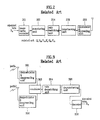
- Fig. 1 shows a related art parallel concatenated turbo encoder for generating turbo codes.
- a parallel concatenated turbo encoder consists of two identical constituent encoders 10 and 11 connected with each other in parallel and an interleaving unit 12 interposed between them.
- First parity bits Y 0k and Y 1k of a information bit X k are generated from the first constituent encoder 10 while second parity bits Y 0k ' and Y 1k ' of an interleaved information bit X k ' are generated from the second constituent encoder 11.
- the related art parallel concatenated turbo encoder outputs information bits and parity bits in the order of X k Y 0k Y 1k X k ' Y 0k ' Y 1k ' and consequently-the coding rate of the turbo encoder is 1/6.
- Fig. 2 shows an apparatus for generating a transmission signal based on a related art turbo encoder.
- a basic turbo encoder 201 is provided with the parallel concatenated turbo encoder of Fig.1 .
- the basic turbo encoder 201 encodes the information bit sequence into an encoded bit sequence whose coding rate is 1/6.
- a puncturing unit 202 performs puncturing on the encoded bit sequence so that the resulting coding rate can be matched with the required coding rate. The puncturing is performed according to a predetermined puncturing pattern that gives the best performance.
- a rate matching unit 204 performs symbol repetition or puncturing on the punctured bits sequence to match the encoded bits sequence with the size N of the interleaving unit 205.
- an interleaving unit 205 interleaves the output bits sequence of the rate matching unit 204 to overcome the burst error characteristic of the channel.
- a modulator and spreading unit 206 modulates and spreads the interleaved bits sequence.
- the encoded bits sequence from the basic turbo encoder 201 has an output order such as "X k Y 0k Y 1k X k ' Y 0k ' Y 1k '" punctured with the puncturing pattern determined by the required coding rate.
- the transmitted signal from the transmitter based on information bits sequence has one output order.
- the transmitter needs to memorize the combinations of puncturing patterns that are used in both the puncturing unit 202 and the rate matching unit 204.
- Fig. 3 shows a related art apparatus for decoding a received signals when identical signals are used for transmission diversity.
- the two modulated signals transmitted from the transmitter are received by two receiver antenna. Then, the signals are demodulated and despread by a demodulator 301 and a despreading unit 302. The output signals from the demodulator 301 and a despreading units 302 are soft combined with each other by a combiner 303 to get a bit sequence with low error rate.
- the combined bit sequence is deinterleaved and rate dematched through a rate dematching unit 304 and depunctured through a depunturing unit 305.
- the resultant bit sequence is decoded to get the unit 305 originally transmitted information bit sequence X k .
- Two antenna transmit diversity is assumed and the desired coding rate after the puncturing unit 202 is assumed to be 1/2.
- the symbol puncturing block punctures the bits according to the puncturing pattern (not shown).
- the encoded bit sequence from the turbo encoder 201 is punctured according to the puncturing pattern and the resultant sequence is in the order "X k Y 0k X k+1 Y 0k+1 '".
- the punctured sequences are rate matched, interleaved, modulated and transmitted via the two transmit antennas through the noisy channel.
- the two signals go through different channel environments and are received at the receiver antenna separately.
- the combiner 303 combines the power of the demodulated bit sequences from two antenna in the order as they are transmitted, i.e. "X k Y 0k X k+1 Y 0k+1 '".
- the combiner 303 performs maximal ratio combining on the demodulated bit sequences and the effective coding rate does not change compared with that of the transmitted signal.
- the encoded bit sequence from the turbo encoder 201 is punctured by different puncturing patterns that give the same performance. Assuming that puncturing patterns "110000100010” and "100010110000" are found to have same performance, two different signals can be generated from them. Namely, the encoded bit sequence from the turbo encoder 201 is punctured using the different puncturing patterns. The resultant sequences are in the order "X k Y 0k X k-1 Y 0k+1 '" and "X k Y 0k ' X k+1 Y 0k+1 ". These sequences are rate matched, interleaved, modulated and transmitted via two transmit antenna through the noisy channel.
- the two signals are received at the receiver, demodulated, despread, deinterleaved, depunctured separately and combined at the combiner .
- the combiner should be intelligent enough so that it can perform maximal ratio combining to the systematic bits while performing code combining to the parity bits, i.e. the combined bit sequence is in the order "X k Y 0k Y 0k ' X K+1 Y 0k+1 ' Y 0k+1 ".
- the combiner performs code combining as well as maximal ratio combining on the received signals and the effective coding rate reduces to 1/3, which enhances the error correcting capability.
- H-ARQ hybrid type automatic repeat request
- Fig. 4 is the flow chart illustrating the procedure of a related art hybrid type ARQ mode.
- a transmitter adds a cyclic redundancy check (CRC) code to the information bit sequence, and the information bit sequence to which the CRC is added is encoded to generate a encoded bit sequence.
- the encoded bit sequence is then punctured, rate matched, interleaved, modulated into a transmission signal and transmitted to the receiver.
- the receiver receives the signal (S20) and demodulates and decodes the signal.
- the receiver determines whether the demodulated bit sequence is "New signal” or "Retransmitted signal” by examining if the same bit sequence as the demodulated bit sequence of the receiver exists in a buffer (S21).
- the received bit sequence is directly stored in the buffer (S22). If the same bit sequence exists in the buffer, the received bit sequence is combined with the bit sequence in the buffer and then stored in the buffer (S23). the bit sequence stored in the buffer is checked if there is any error in the received bit sequence by CRC (S24). If no error exists in the received bit sequence, the receiver transmits an acknowledgement (ACK) signal to the transmitter and empties the buffer (S26).
- ACK acknowledgement
- the received bit sequence is stored in a buffer, and the receiver transmits a non-ACK(NACK) signal to the transmitter (S25).
- the transmitter transmits the next new information data. If the transmitter has received the NACK signal, the transmitter retransmits the previously transmitted information data.
- the receiver demodulates the retransmitted signal and combines it with the bit sequence stored in the buffer, so that the received bit sequence is decoded. If no error exists in the combined bit sequence, the receiver transmits the ACK signal to the transmitter. If any error exists in the combined bit sequence, the receiver transmits the NACK signal to the transmitter to request another retransmission of the same data, and at the same time stores the combined bit sequence in the buffer.
- the combining gain that can be obtained at the receiver is only maximal ratio combining gain in the AWGN (Additive White Gaussian Noise) channel.
- AWGN Additional White Gaussian Noise
- Getting differently encoded sequences based on a information source is beneficial when the encoded sequences are used in the transmit diversity system.
- the method of getting differently encoded sequences by changing the puncturing patterns of the transmitter can add complexity because both the transmitter and the receiver should use not one puncturing pattern but several puncturing patterns. Besides, it is difficult to find puncturing patterns that have the same performance.
- an object of the present invention is to provide a communication system and a method for Transmitting a signal in the communication system ,in which turbo codes having the same performance are generated without increasing complexity
- Another object of the present invention is to generate differently encoded sequences without changing the puncturing pattern.
- encoded bit sequence of turbo encoder can be in the order of X k ' Y 0k ' Y 1k ' X k Y 0k Y 1k or X k Y 0k ' Y 1k ' X k ' Y 0k Y 1k as well as X k Y 0k Y 1k X k ' Y 0k ' Y 1k '.
- a parallel concatenated turbo encoder of a turbo code includes two constituent encoders and an interleaving unit interposed between them.
- the two constituent encoders are both recursive systematic convolutional encoders and have same performance.
- the first constituent encoder outputs an input value X k as it is and at the same time outputs two parity bits Y 0k and Y 1k
- the second constituent encoder outputs X k ' which is the interleaved version of X k as it is and at the same time outputs two parity bits Y 0k ' and Y 1k '.
- the basic turbo encoder in Fig 1. outputs bit sequence that has 1/6 coding rate.
- symbol puncturing block punctures the bits according to the rule described in table 1.
- the desired coding rate may be 1/2, 1/3, 1/4 or 1/5.
- '0' means the bit should be punctured and '1' means that the bit should not be punctured.
- a switch can be used which may be a part of the turbo encoder and decides the output order of encoded bit sequence so that the bit sequences output from respective constituent encoders of a basic turbo encoder 401, as shown in Fig. 5, have different output bit orders, thereby outputting a bits sequence in a desired order.
- the turbo encoder itself should have the ability to output the encoded bit sequence in not only one order but several orders.
- Fig. 5 shows an apparatus for generating a transmission signal based on a turbo encoder according to the present invention.
- the apparatus for generating a transmission signal based on the turbo encoder includes a basic turbo encoder 401, a switch 402, a puncturing unit 403, a rate matching unit 405, an interleaving unit 406, and a modulator & spreading unit 407.
- the switch 402 decides the output order of encoded bit sequence from the turbo encoder 404.
- the switch 402 can be omitted if the basic turbo encoder 401 itself can output the encoded bit sequence not only in one fixed output order but in several output orders.
- the turbo encoder 404 is defined as a turbo encoder that can output the encoded bit sequence in not only one output order but in several output orders.
- the output order of the encoded bit sequence from the turbo encoder 404 may be X k ' Y 0k ' Y 1k ' X k Y 0k Y 1k or X k Y 0k ' Y 1k ' X k ' Y 0k Y 1k in the present invention.
- the encoded bit sequence as mentioned above is punctured to meet a desired coding rate by the puncturing unit 403 according to the puncturing pattern described in table 1. Thereafter, the punctured bit sequence is rate matched, interleaved, spread, and modulated. At this time, the puncturing unit 403 needs to store one puncturing pattern according to the desired coding rate.
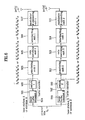
- Fig. 6 shows another apparatus for generating a transmission signal according to the present invention when differently encoded bit sequences are used for the transmit diversity.
- the encoded bit sequences from the turbo encoder 504, 512 are different from each other and are punctured at the puncturing unit 503, 511 with the same puncturing pattern.
- the resultant sequences are rate matched, interleaved, modulated and transmitted via different antenna.
- the puncturing unit 503 and 511 should have different puncturing patterns to get sequences that have different parity bits, which adds complexity to the system.
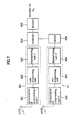
- Fig. 7 shows an apparatus for decoding a received signal when different signals are used for transmit diversity
- the two transmitted signals are decoded as shown in Fig. 7.
- the two different signals are received at the receiver, demodulated, despread, deinterleaved, depunctured separately and combined at the combiner 604.
- the combiner should be intelligent enough so that it can perform maximal ratio combining to the systematic bits while performing code combining to the parity bits.
- the depuncturing unit 603 and 608 use one puncturing pattern in the present invention. But, in the conventional system the depuncturing unit 603 and 608 should use different puncturing patterns since the transmitter uses different puncturing patterns to generate different signals.
- Two antenna transmit diversity is assumed and the desired coding rate after the puncturing unit 503, 511 is assumed to be 1/2.
- the puncturing pattern for the coding rate 1/2 can be read as "110000100010" and this pattern is used in both the puncturing unit 503 and 511. If the encoded bit sequence from the turbo encoder 504 is in the order of "X k Y 0k Y 1k X k ' Y 0k ' Y 1k ''', the encoded bit sequence from the turbo encoder 512 should be in a different order, e.g. "X k Y 0k ' Y 1k ' X k ' Y 0k Y 1k ".
- the puncturing unit 503 and 511 puncture the encoded sequences with the same pattern and the resultant sequences become "X k Y 0k X k+1 Y 0k+1 '" and "X k Y 0k ' X k+1 Y 0k+1 ".
- the sequences are rate matched, interleaved, modulated and transmitted via different antenna.
- the two signals are received at the receiver, demodulated, despread, deinterleaved, depunctured separately and combined at the combiner 604.
- the depuncturing units for each signal uses the same depuncturing pattern.
- the combiner performs maximal ratio combining to the systematic bits while perform code combining to the parity bits, i.e. the combined sequence is in the order "X k Y 0k Y 0k ' X k+1 Y 0k-1 ' Y 0k+1 ".
- the combiner performs code combining as well as maximal ratio combining on the received signals and the effective coding rate reduces to 1/3, which enhances the error correcting capability.
- H-ARQ hybrid type automatic repeat request
- the desired coding rate after the puncturing unit 403 is assumed to be 1/2.
- the transmitter generates signals as in Fig. 5.
- the transmitter encodes the "New" bit sequence in the order "X k Y 0k Y 1k X k ' Y 0k ' Y 1k '" and punctures it according to the puncturing pattern "110000100010".
- the resultant bit sequence is "X k Y 0k X k+1 Y 0k+1 '" and the sequences are rate matched, interleaved, modulated and transmitted to the receiver.
- the transmitter then encodes the "Retransmitted” bit sequence in the order "X k Y 0k ' Y 1k ' X k ' Y 0k Y 1k " and punctures it according to the same pattern.
- the resultant bit sequence is "X k Y 0k ' X k+1 Y 0k+1 " and the sequences are rate matched, interleaved, modulated and transmitted to the receiver.
- the receiver combines the "Retransmitted" signal with the "New" signal stored in the buffer. Since the two signals are different from each other, code combining gain as well as maximal ratio combining gain can be obtained.
- the communication system and the method for transmitting a signal in the communication system according to the present invention have the following advantages.
- the present invention can generate different signals easily without adding complexity to both the transmitter and receiver.
- the different signals can be used to enhance the performance of the system when transmit diversity, e.g. two antenna diversity or H-ARQ, is used.
Landscapes
- Engineering & Computer Science (AREA)
- Signal Processing (AREA)
- Computer Networks & Wireless Communication (AREA)
- Computer Security & Cryptography (AREA)
- Databases & Information Systems (AREA)
- Detection And Prevention Of Errors In Transmission (AREA)
- Error Detection And Correction (AREA)
- Radio Transmission System (AREA)
- Medicines Containing Antibodies Or Antigens For Use As Internal Diagnostic Agents (AREA)
- Measurement Of The Respiration, Hearing Ability, Form, And Blood Characteristics Of Living Organisms (AREA)
- Infusion, Injection, And Reservoir Apparatuses (AREA)
Applications Claiming Priority (4)
| Application Number | Priority Date | Filing Date | Title |
|---|---|---|---|
| KR2000039521 | 2000-07-11 | ||
| KR1020000039521A KR100339343B1 (ko) | 2000-07-11 | 2000-07-11 | 통신 시스템 및 이 시스템의 신호 처리 방법 |
| KR1020000076786A KR100830486B1 (ko) | 2000-12-15 | 2000-12-15 | 통신 시스템에서의 신호 송수신 방법 |
| KR2000076786 | 2000-12-15 |
Publications (3)
| Publication Number | Publication Date |
|---|---|
| EP1172959A2 true EP1172959A2 (de) | 2002-01-16 |
| EP1172959A3 EP1172959A3 (de) | 2005-12-14 |
| EP1172959B1 EP1172959B1 (de) | 2010-05-26 |
Family
ID=26638204
Family Applications (1)
| Application Number | Title | Priority Date | Filing Date |
|---|---|---|---|
| EP20010114984 Expired - Lifetime EP1172959B1 (de) | 2000-07-11 | 2001-06-20 | Übertragungsdiversität mit einem einzigen Punktierungsmuster |
Country Status (6)
| Country | Link |
|---|---|
| US (1) | US7251285B2 (de) |
| EP (1) | EP1172959B1 (de) |
| JP (1) | JP4213879B2 (de) |
| CN (1) | CN100466497C (de) |
| AT (1) | ATE469477T1 (de) |
| DE (1) | DE60142207D1 (de) |
Cited By (11)
| Publication number | Priority date | Publication date | Assignee | Title |
|---|---|---|---|---|
| GB2376393A (en) * | 2001-02-13 | 2002-12-11 | Samsung Electronics Co Ltd | A Quasi-Complementary Turbo Code (QCTC) generating apparatus |
| EP1298829A1 (de) * | 2001-09-28 | 2003-04-02 | Lucent Technologies Inc. | HARQ verfahren für eine Mehrantennenanordnung |
| WO2004028063A1 (en) * | 2002-09-20 | 2004-04-01 | Nortel Networks Limited | Space-time codes with incremental redundancy |
| EP1596550A1 (de) * | 2004-05-10 | 2005-11-16 | Lucent Technologies Inc. | Reglung des Verhältnisses von Spitzen- zu Mittelleistung |
| RU2288541C2 (ru) * | 2002-02-11 | 2006-11-27 | Моторола, Инк. | Усовершенствованное последовательное повышение избыточности на основе турбокодирования |
| US7154961B2 (en) | 2002-10-18 | 2006-12-26 | Matsushita Electric Industrial Co., Ltd. | Constellation rearrangement for ARQ transmit diversity schemes |
| WO2007129271A1 (en) * | 2006-05-10 | 2007-11-15 | Koninklijke Philips Electronics N.V. | Wireless communication system using harq and method of operating the system |
| WO2014012925A1 (en) * | 2012-07-18 | 2014-01-23 | Telefonica, S.A. | A method and a system implementing a turbo-diversity scheme for wireless ofdm systems |
| EP2424142A4 (de) * | 2009-03-26 | 2014-10-01 | Fujitsu Ltd | Kommunikationsvorrichtung mit mehreren antennen und verfahren zur kommunikation mit mehreren antennen |
| US10700800B2 (en) | 2003-05-21 | 2020-06-30 | Regents Of The University Of Minnesota | Estimating frequency-offsets and multi-antenna channels in MIMO OFDM systems |
| CN116455526A (zh) * | 2023-03-30 | 2023-07-18 | 广州技象科技有限公司 | 数据重传方法、电子设备及存储介质 |
Families Citing this family (29)
| Publication number | Priority date | Publication date | Assignee | Title |
|---|---|---|---|---|
| JP3464649B2 (ja) * | 2000-12-27 | 2003-11-10 | 松下電器産業株式会社 | 送信装置、受信装置および通信方法 |
| JP4634672B2 (ja) * | 2001-09-25 | 2011-02-16 | 三菱電機株式会社 | サイトダイバーシチ送受信装置 |
| US7260761B2 (en) * | 2002-01-07 | 2007-08-21 | Siemens Aktiengesellschaft | Method and device for transferring data wherein a bit rate adaptation model is signaled between the transmitter and the receiver |
| JP3629241B2 (ja) | 2002-01-30 | 2005-03-16 | 松下電器産業株式会社 | レートマッチング装置及びレートマッチング方法 |
| US7209483B2 (en) * | 2002-02-19 | 2007-04-24 | Nokia Corporation | Apparatus, and associated method, for operating upon packet data communicated in a packet communication system utilizing a packet retransmission scheme |
| US7245598B2 (en) * | 2002-02-21 | 2007-07-17 | Qualcomm Incorporated | Feedback of channel quality information |
| US7684329B2 (en) * | 2002-05-06 | 2010-03-23 | Qualcomm Incorporated | Method and apparatus for augmenting physical layer ARQ in a wireless data communication system |
| US6693910B2 (en) * | 2002-06-28 | 2004-02-17 | Interdigital Technology Corporation | System and method for avoiding stall of an H-ARQ reordering buffer in a receiver |
| KR100584170B1 (ko) * | 2002-07-11 | 2006-06-02 | 재단법인서울대학교산학협력재단 | 터보 부호화된 복합 재전송 방식 시스템 및 오류 검출 방법 |
| CN100521555C (zh) * | 2002-12-16 | 2009-07-29 | 美商内数位科技公司 | 实施涡轮码时所用同位位流中问题穿刺型态的检测、避免及/或改正 |
| US7293217B2 (en) | 2002-12-16 | 2007-11-06 | Interdigital Technology Corporation | Detection, avoidance and/or correction of problematic puncturing patterns in parity bit streams used when implementing turbo codes |
| US7719991B2 (en) | 2003-01-21 | 2010-05-18 | Qualcomm Incorporated | Reverse rate indicator detection |
| JP2004266586A (ja) | 2003-03-03 | 2004-09-24 | Hitachi Ltd | 移動通信システムのデータ送受信方法 |
| US7260659B2 (en) * | 2003-06-30 | 2007-08-21 | Intel Corporation | Rate matching apparatus, systems, and methods |
| US7613985B2 (en) * | 2003-10-24 | 2009-11-03 | Ikanos Communications, Inc. | Hierarchical trellis coded modulation |
| JP4765260B2 (ja) * | 2004-03-31 | 2011-09-07 | 日本電気株式会社 | データ処理装置およびその処理方法ならびにプログラムおよび携帯電話装置 |
| CN101091347B (zh) * | 2004-12-29 | 2013-09-18 | 英特尔公司 | 前向纠错和自动重复请求联合操作的方法和装置 |
| US20090022079A1 (en) * | 2005-05-04 | 2009-01-22 | Fei Frank Zhou | Method and apparatus for providing enhanced channel interleaving |
| AU2006202144A1 (en) * | 2005-06-23 | 2007-01-11 | Nec Australia Pty Ltd | MBMS soft combining scheme |
| US7852951B2 (en) * | 2005-09-30 | 2010-12-14 | Intel Corporation | Multicarrier receiver for multiple-input multiple-output wireless communication systems and method |
| US8904265B2 (en) * | 2007-05-02 | 2014-12-02 | Broadcom Corporation | Optimal period rate matching for turbo coding |
| KR101224561B1 (ko) | 2007-08-20 | 2013-01-21 | 삼성전자주식회사 | 이동통신 시스템에서 고속 공용 제어 채널을 사용하지 않은경우를 위한 메모리 할당 장치 및 방법 |
| JP4858496B2 (ja) * | 2008-06-23 | 2012-01-18 | 株式会社日立製作所 | 移動通信システム、送信局、無線通信システム |
| US8843799B2 (en) * | 2010-01-04 | 2014-09-23 | Zte Corporation | Serial processing method, parallel processing method of bit rate matching and device thereof |
| US8817936B2 (en) * | 2012-05-23 | 2014-08-26 | The Boeing Company | Multiple synchronous IQ demodulators |
| JP5598558B2 (ja) * | 2013-01-11 | 2014-10-01 | 株式会社日立製作所 | 送信局及び送信方法 |
| CN108632003B (zh) * | 2017-03-24 | 2021-03-23 | 华为技术有限公司 | 一种信息传输方法和装置 |
| CN110190934B (zh) * | 2019-06-18 | 2022-02-18 | 普联技术有限公司 | 一种数据打孔的方法及设备 |
| WO2022098377A1 (en) * | 2020-12-17 | 2022-05-12 | Futurewei Technologies, Inc. | Qualitative communication using adaptive network coding with a sliding window |
Family Cites Families (17)
| Publication number | Priority date | Publication date | Assignee | Title |
|---|---|---|---|---|
| US5937015A (en) * | 1994-01-11 | 1999-08-10 | Dent; Paul W. | Interference mitigation by joint decoding of overlapped signals |
| DE69521525T2 (de) * | 1995-10-18 | 2002-04-25 | Kanoldt Arzneimittel Gmbh | Lignane, verfahren zu ihrer herstellung, ihre pharmazeutische compositionen und anwendungen |
| EP2280494A3 (de) | 1996-04-26 | 2011-12-07 | AT & T Corp. | Verfahren und Vorrichtung zur Datenübertragung mit mehreren Sendeantennen |
| US6023783A (en) * | 1996-05-15 | 2000-02-08 | California Institute Of Technology | Hybrid concatenated codes and iterative decoding |
| US5983384A (en) | 1997-04-21 | 1999-11-09 | General Electric Company | Turbo-coding with staged data transmission and processing |
| US5983364A (en) * | 1997-05-12 | 1999-11-09 | System Soft Corporation | System and method for diagnosing computer faults |
| US5907582A (en) * | 1997-08-11 | 1999-05-25 | Orbital Sciences Corporation | System for turbo-coded satellite digital audio broadcasting |
| FI104133B1 (fi) * | 1997-11-28 | 1999-11-15 | Nokia Mobile Phones Ltd | Koodaus- ja modulointimenetelmä ja laite sen soveltamiseksi |
| KR100557177B1 (ko) * | 1998-04-04 | 2006-07-21 | 삼성전자주식회사 | 적응 채널 부호/복호화 방법 및 그 부호/복호 장치 |
| US6269129B1 (en) * | 1998-04-24 | 2001-07-31 | Lsi Logic Corporation | 64/256 quadrature amplitude modulation trellis coded modulation decoder |
| KR100334819B1 (ko) * | 1998-06-05 | 2002-05-02 | 윤종용 | 레이트 매칭을 위한 채널 부호화 장치 및 방법 |
| JP2000004215A (ja) * | 1998-06-16 | 2000-01-07 | Matsushita Electric Ind Co Ltd | 送受信システム |
| US5978365A (en) * | 1998-07-07 | 1999-11-02 | Orbital Sciences Corporation | Communications system handoff operation combining turbo coding and soft handoff techniques |
| US6334197B1 (en) * | 1998-08-17 | 2001-12-25 | Hughes Electronics Corporation | Turbo code interleaver with near optimal performance |
| JP2000068863A (ja) * | 1998-08-19 | 2000-03-03 | Fujitsu Ltd | 符号化装置及びその方法 |
| JP2000068862A (ja) * | 1998-08-19 | 2000-03-03 | Fujitsu Ltd | 誤り訂正符号化装置 |
| IL141800A0 (en) * | 1999-07-06 | 2002-03-10 | Samsung Electronics Co Ltd | Rate matching device and method for a data communication system |
-
2001
- 2001-06-11 US US09/877,199 patent/US7251285B2/en not_active Expired - Lifetime
- 2001-06-11 JP JP2001176352A patent/JP4213879B2/ja not_active Expired - Lifetime
- 2001-06-18 CN CNB011188227A patent/CN100466497C/zh not_active Expired - Fee Related
- 2001-06-20 DE DE60142207T patent/DE60142207D1/de not_active Expired - Lifetime
- 2001-06-20 EP EP20010114984 patent/EP1172959B1/de not_active Expired - Lifetime
- 2001-06-20 AT AT01114984T patent/ATE469477T1/de not_active IP Right Cessation
Cited By (25)
| Publication number | Priority date | Publication date | Assignee | Title |
|---|---|---|---|---|
| EP2262144A3 (de) * | 2001-02-13 | 2013-12-25 | Qualcomm Incorporated | Vorrichtung und Verfahren für Kodegenerierung in einem Kommunikationssystem |
| EP1231735A3 (de) * | 2001-02-13 | 2003-04-09 | Samsung Electronics Co., Ltd. | Vorrichtung und Verfahren für Kodegenerierung in einem Kommunikationssystem |
| US7200796B2 (en) | 2001-02-13 | 2007-04-03 | Samsung Electronics Co., Ltd. | Apparatus for generating codes in communication system |
| AU2002233774B2 (en) * | 2001-02-13 | 2004-09-02 | Qualcomm Incorporated | Method for Generating Codes in Communication System |
| GB2376393B (en) * | 2001-02-13 | 2005-08-24 | Samsung Electronics Co Ltd | Apparatus and method for generating codes in a communication system |
| GB2376393A (en) * | 2001-02-13 | 2002-12-11 | Samsung Electronics Co Ltd | A Quasi-Complementary Turbo Code (QCTC) generating apparatus |
| US7093185B2 (en) | 2001-02-13 | 2006-08-15 | Samsung Electronics Co., Ltd. | Apparatus and method for generating codes in communication system |
| EP1298829A1 (de) * | 2001-09-28 | 2003-04-02 | Lucent Technologies Inc. | HARQ verfahren für eine Mehrantennenanordnung |
| RU2288541C2 (ru) * | 2002-02-11 | 2006-11-27 | Моторола, Инк. | Усовершенствованное последовательное повышение избыточности на основе турбокодирования |
| WO2004028063A1 (en) * | 2002-09-20 | 2004-04-01 | Nortel Networks Limited | Space-time codes with incremental redundancy |
| US7397864B2 (en) | 2002-09-20 | 2008-07-08 | Nortel Networks Limited | Incremental redundancy with space-time codes |
| US7154961B2 (en) | 2002-10-18 | 2006-12-26 | Matsushita Electric Industrial Co., Ltd. | Constellation rearrangement for ARQ transmit diversity schemes |
| US7567622B2 (en) | 2002-10-18 | 2009-07-28 | Panasonic Corporation | Constellation rearrangement for ARQ transmit diversity schemes |
| US8325845B2 (en) | 2002-10-18 | 2012-12-04 | Panasonic Corporation | Constellation rearrangement for ARQ transmit diversity schemes |
| US11303377B2 (en) | 2003-05-21 | 2022-04-12 | Regents Of The University Of Minnesota | Estimating frequency-offsets and multi-antenna channels in MIMO OFDM systems |
| US10700800B2 (en) | 2003-05-21 | 2020-06-30 | Regents Of The University Of Minnesota | Estimating frequency-offsets and multi-antenna channels in MIMO OFDM systems |
| EP1596550A1 (de) * | 2004-05-10 | 2005-11-16 | Lucent Technologies Inc. | Reglung des Verhältnisses von Spitzen- zu Mittelleistung |
| CN101444030B (zh) * | 2006-05-10 | 2013-11-13 | 皇家飞利浦电子股份有限公司 | 使用harq的无线通信系统和操作该系统的方法 |
| US8259696B2 (en) | 2006-05-10 | 2012-09-04 | Koninklijke Philips Electronics N.V. | Wireless communication system using HARQ and method of operating the system |
| WO2007129271A1 (en) * | 2006-05-10 | 2007-11-15 | Koninklijke Philips Electronics N.V. | Wireless communication system using harq and method of operating the system |
| EP2424142A4 (de) * | 2009-03-26 | 2014-10-01 | Fujitsu Ltd | Kommunikationsvorrichtung mit mehreren antennen und verfahren zur kommunikation mit mehreren antennen |
| WO2014012925A1 (en) * | 2012-07-18 | 2014-01-23 | Telefonica, S.A. | A method and a system implementing a turbo-diversity scheme for wireless ofdm systems |
| ES2439143R1 (es) * | 2012-07-18 | 2014-04-29 | Telefonica, S.A. | Método y sistema que implementan un esquema de turbo-diversidad para sistemas ofdm inalámbricos |
| US9537512B2 (en) | 2012-07-18 | 2017-01-03 | Telefonica, S.A. | Method and a system implementing a turbo-diversity scheme for wireless OFDM systems |
| CN116455526A (zh) * | 2023-03-30 | 2023-07-18 | 广州技象科技有限公司 | 数据重传方法、电子设备及存储介质 |
Also Published As
| Publication number | Publication date |
|---|---|
| EP1172959A3 (de) | 2005-12-14 |
| EP1172959B1 (de) | 2010-05-26 |
| JP2002051030A (ja) | 2002-02-15 |
| US20020027956A1 (en) | 2002-03-07 |
| CN1333605A (zh) | 2002-01-30 |
| US7251285B2 (en) | 2007-07-31 |
| ATE469477T1 (de) | 2010-06-15 |
| DE60142207D1 (de) | 2010-07-08 |
| CN100466497C (zh) | 2009-03-04 |
| JP4213879B2 (ja) | 2009-01-21 |
Similar Documents
| Publication | Publication Date | Title |
|---|---|---|
| EP1172959A2 (de) | Hybrid-Wiederholungsaufforderungssystem und -Verfahren | |
| KR100464325B1 (ko) | 이동통신시스템에서 패킷 재전송을 위한 송수신 장치 및 방법 | |
| JP3701263B2 (ja) | Cdma移動通信システムにおけるデータの送受信装置およびその方法 | |
| US7289567B2 (en) | Apparatus and method for transmitting and receiving data using partial chase combining | |
| KR100557167B1 (ko) | 이동통신시스템에서의 재전송 장치 및 방법 | |
| JP3476807B2 (ja) | 複合再伝送方式を使用するデータ通信システムにおけるデータ送信装置及び方法 | |
| US20020196812A1 (en) | Transmitter, receiver, transmitter-receiver, and communication system with retransmission management | |
| KR20030010402A (ko) | 다수의 안테나를 이용한 신호 송수신 방법 및 이를 위한시스템 | |
| JP2002051030A5 (de) | ||
| CN114679241A (zh) | 基于混合自动重传请求harq的通信方法和装置 | |
| KR100739182B1 (ko) | 시공간 harq 기법을 제공하는 이동 통신 단말기 및 그방법 | |
| KR100403085B1 (ko) | 하이브리드 arq 시스템에서 레이트매칭 알고리즘의초기치 설정방법 | |
| US20040177306A1 (en) | Transmission device and transmission method | |
| KR100830486B1 (ko) | 통신 시스템에서의 신호 송수신 방법 | |
| CN101471753B (zh) | 通信系统和在其中发送信号的方法 | |
| JP2005223620A (ja) | 無線通信装置及び無線通信システム | |
| Yu et al. | Comparative analysis on HARQ with turbo codes in Rician fading channel with low Rician factor | |
| JP2005142977A (ja) | データ通信システム |
Legal Events
| Date | Code | Title | Description |
|---|---|---|---|
| PUAI | Public reference made under article 153(3) epc to a published international application that has entered the european phase |
Free format text: ORIGINAL CODE: 0009012 |
|
| AK | Designated contracting states |
Kind code of ref document: A2 Designated state(s): AT BE CH CY DE DK ES FI FR GB GR IE IT LI LU MC NL PT SE TR |
|
| AX | Request for extension of the european patent |
Free format text: AL;LT;LV;MK;RO;SI |
|
| PUAL | Search report despatched |
Free format text: ORIGINAL CODE: 0009013 |
|
| AK | Designated contracting states |
Kind code of ref document: A3 Designated state(s): AT BE CH CY DE DK ES FI FR GB GR IE IT LI LU MC NL PT SE TR |
|
| AX | Request for extension of the european patent |
Extension state: AL LT LV MK RO SI |
|
| 17P | Request for examination filed |
Effective date: 20060613 |
|
| AKX | Designation fees paid |
Designated state(s): AT BE CH CY DE DK ES FI FR GB GR IE IT LI LU MC NL PT SE TR |
|
| 17Q | First examination report despatched |
Effective date: 20061221 |
|
| RTI1 | Title (correction) |
Free format text: TRANSMISSION DIVERSITY USING SINGLE PUNCTURING PATTERN |
|
| GRAP | Despatch of communication of intention to grant a patent |
Free format text: ORIGINAL CODE: EPIDOSNIGR1 |
|
| GRAS | Grant fee paid |
Free format text: ORIGINAL CODE: EPIDOSNIGR3 |
|
| GRAA | (expected) grant |
Free format text: ORIGINAL CODE: 0009210 |
|
| AK | Designated contracting states |
Kind code of ref document: B1 Designated state(s): AT BE CH CY DE DK ES FI FR GB GR IE IT LI LU MC NL PT SE TR |
|
| REG | Reference to a national code |
Ref country code: GB Ref legal event code: FG4D |
|
| REG | Reference to a national code |
Ref country code: CH Ref legal event code: EP |
|
| REG | Reference to a national code |
Ref country code: IE Ref legal event code: FG4D |
|
| REF | Corresponds to: |
Ref document number: 60142207 Country of ref document: DE Date of ref document: 20100708 Kind code of ref document: P |
|
| REG | Reference to a national code |
Ref country code: SE Ref legal event code: TRGR |
|
| REG | Reference to a national code |
Ref country code: NL Ref legal event code: VDEP Effective date: 20100526 |
|
| PG25 | Lapsed in a contracting state [announced via postgrant information from national office to epo] |
Ref country code: FI Free format text: LAPSE BECAUSE OF FAILURE TO SUBMIT A TRANSLATION OF THE DESCRIPTION OR TO PAY THE FEE WITHIN THE PRESCRIBED TIME-LIMIT Effective date: 20100526 Ref country code: AT Free format text: LAPSE BECAUSE OF FAILURE TO SUBMIT A TRANSLATION OF THE DESCRIPTION OR TO PAY THE FEE WITHIN THE PRESCRIBED TIME-LIMIT Effective date: 20100526 |
|
| PG25 | Lapsed in a contracting state [announced via postgrant information from national office to epo] |
Ref country code: GR Free format text: LAPSE BECAUSE OF FAILURE TO SUBMIT A TRANSLATION OF THE DESCRIPTION OR TO PAY THE FEE WITHIN THE PRESCRIBED TIME-LIMIT Effective date: 20100827 Ref country code: CY Free format text: LAPSE BECAUSE OF NON-PAYMENT OF DUE FEES Effective date: 20100526 |
|
| PG25 | Lapsed in a contracting state [announced via postgrant information from national office to epo] |
Ref country code: PT Free format text: LAPSE BECAUSE OF FAILURE TO SUBMIT A TRANSLATION OF THE DESCRIPTION OR TO PAY THE FEE WITHIN THE PRESCRIBED TIME-LIMIT Effective date: 20100927 Ref country code: DK Free format text: LAPSE BECAUSE OF FAILURE TO SUBMIT A TRANSLATION OF THE DESCRIPTION OR TO PAY THE FEE WITHIN THE PRESCRIBED TIME-LIMIT Effective date: 20100526 Ref country code: MC Free format text: LAPSE BECAUSE OF NON-PAYMENT OF DUE FEES Effective date: 20100630 Ref country code: NL Free format text: LAPSE BECAUSE OF FAILURE TO SUBMIT A TRANSLATION OF THE DESCRIPTION OR TO PAY THE FEE WITHIN THE PRESCRIBED TIME-LIMIT Effective date: 20100526 |
|
| REG | Reference to a national code |
Ref country code: CH Ref legal event code: PL |
|
| PG25 | Lapsed in a contracting state [announced via postgrant information from national office to epo] |
Ref country code: BE Free format text: LAPSE BECAUSE OF FAILURE TO SUBMIT A TRANSLATION OF THE DESCRIPTION OR TO PAY THE FEE WITHIN THE PRESCRIBED TIME-LIMIT Effective date: 20100526 |
|
| PG25 | Lapsed in a contracting state [announced via postgrant information from national office to epo] |
Ref country code: IT Free format text: LAPSE BECAUSE OF FAILURE TO SUBMIT A TRANSLATION OF THE DESCRIPTION OR TO PAY THE FEE WITHIN THE PRESCRIBED TIME-LIMIT Effective date: 20100526 |
|
| PLBE | No opposition filed within time limit |
Free format text: ORIGINAL CODE: 0009261 |
|
| STAA | Information on the status of an ep patent application or granted ep patent |
Free format text: STATUS: NO OPPOSITION FILED WITHIN TIME LIMIT |
|
| PG25 | Lapsed in a contracting state [announced via postgrant information from national office to epo] |
Ref country code: IE Free format text: LAPSE BECAUSE OF NON-PAYMENT OF DUE FEES Effective date: 20100620 Ref country code: LI Free format text: LAPSE BECAUSE OF NON-PAYMENT OF DUE FEES Effective date: 20100630 Ref country code: CH Free format text: LAPSE BECAUSE OF NON-PAYMENT OF DUE FEES Effective date: 20100630 |
|
| 26N | No opposition filed |
Effective date: 20110301 |
|
| REG | Reference to a national code |
Ref country code: DE Ref legal event code: R097 Ref document number: 60142207 Country of ref document: DE Effective date: 20110228 |
|
| PG25 | Lapsed in a contracting state [announced via postgrant information from national office to epo] |
Ref country code: LU Free format text: LAPSE BECAUSE OF NON-PAYMENT OF DUE FEES Effective date: 20100620 |
|
| PG25 | Lapsed in a contracting state [announced via postgrant information from national office to epo] |
Ref country code: TR Free format text: LAPSE BECAUSE OF FAILURE TO SUBMIT A TRANSLATION OF THE DESCRIPTION OR TO PAY THE FEE WITHIN THE PRESCRIBED TIME-LIMIT Effective date: 20100526 |
|
| PG25 | Lapsed in a contracting state [announced via postgrant information from national office to epo] |
Ref country code: ES Free format text: LAPSE BECAUSE OF FAILURE TO SUBMIT A TRANSLATION OF THE DESCRIPTION OR TO PAY THE FEE WITHIN THE PRESCRIBED TIME-LIMIT Effective date: 20100906 |
|
| REG | Reference to a national code |
Ref country code: FR Ref legal event code: PLFP Year of fee payment: 16 |
|
| REG | Reference to a national code |
Ref country code: FR Ref legal event code: PLFP Year of fee payment: 17 |
|
| REG | Reference to a national code |
Ref country code: FR Ref legal event code: PLFP Year of fee payment: 18 |
|
| REG | Reference to a national code |
Ref country code: FR Ref legal event code: PLFP Year of fee payment: 19 |
|
| PGFP | Annual fee paid to national office [announced via postgrant information from national office to epo] |
Ref country code: DE Payment date: 20190503 Year of fee payment: 19 |
|
| PGFP | Annual fee paid to national office [announced via postgrant information from national office to epo] |
Ref country code: SE Payment date: 20190507 Year of fee payment: 19 Ref country code: FR Payment date: 20190508 Year of fee payment: 19 |
|
| PGFP | Annual fee paid to national office [announced via postgrant information from national office to epo] |
Ref country code: GB Payment date: 20190503 Year of fee payment: 19 |
|
| REG | Reference to a national code |
Ref country code: DE Ref legal event code: R119 Ref document number: 60142207 Country of ref document: DE |
|
| GBPC | Gb: european patent ceased through non-payment of renewal fee |
Effective date: 20200620 |
|
| PG25 | Lapsed in a contracting state [announced via postgrant information from national office to epo] |
Ref country code: GB Free format text: LAPSE BECAUSE OF NON-PAYMENT OF DUE FEES Effective date: 20200620 Ref country code: FR Free format text: LAPSE BECAUSE OF NON-PAYMENT OF DUE FEES Effective date: 20200630 |
|
| PG25 | Lapsed in a contracting state [announced via postgrant information from national office to epo] |
Ref country code: DE Free format text: LAPSE BECAUSE OF NON-PAYMENT OF DUE FEES Effective date: 20210101 Ref country code: SE Free format text: LAPSE BECAUSE OF NON-PAYMENT OF DUE FEES Effective date: 20200621 |
|
| REG | Reference to a national code |
Ref country code: SE Ref legal event code: EUG |