EP1174831A2 - Internet-Endgerät mit Identifikationsmodul - Google Patents
Internet-Endgerät mit Identifikationsmodul Download PDFInfo
- Publication number
- EP1174831A2 EP1174831A2 EP01117467A EP01117467A EP1174831A2 EP 1174831 A2 EP1174831 A2 EP 1174831A2 EP 01117467 A EP01117467 A EP 01117467A EP 01117467 A EP01117467 A EP 01117467A EP 1174831 A2 EP1174831 A2 EP 1174831A2
- Authority
- EP
- European Patent Office
- Prior art keywords
- internet
- identification module
- terminal
- connection
- internet terminal
- Prior art date
- Legal status (The legal status is an assumption and is not a legal conclusion. Google has not performed a legal analysis and makes no representation as to the accuracy of the status listed.)
- Withdrawn
Links
Images




Classifications
-
- H—ELECTRICITY
- H04—ELECTRIC COMMUNICATION TECHNIQUE
- H04L—TRANSMISSION OF DIGITAL INFORMATION, e.g. TELEGRAPHIC COMMUNICATION
- H04L63/00—Network architectures or network communication protocols for network security
- H04L63/08—Network architectures or network communication protocols for network security for authentication of entities
- H04L63/0869—Network architectures or network communication protocols for network security for authentication of entities for achieving mutual authentication
-
- G—PHYSICS
- G06—COMPUTING OR CALCULATING; COUNTING
- G06F—ELECTRIC DIGITAL DATA PROCESSING
- G06F1/00—Details not covered by groups G06F3/00 - G06F13/00 and G06F21/00
- G06F1/16—Constructional details or arrangements
- G06F1/1613—Constructional details or arrangements for portable computers
- G06F1/1626—Constructional details or arrangements for portable computers with a single-body enclosure integrating a flat display, e.g. Personal Digital Assistants [PDAs]
-
- G—PHYSICS
- G06—COMPUTING OR CALCULATING; COUNTING
- G06F—ELECTRIC DIGITAL DATA PROCESSING
- G06F1/00—Details not covered by groups G06F3/00 - G06F13/00 and G06F21/00
- G06F1/16—Constructional details or arrangements
- G06F1/1613—Constructional details or arrangements for portable computers
- G06F1/1632—External expansion units, e.g. docking stations
-
- G—PHYSICS
- G06—COMPUTING OR CALCULATING; COUNTING
- G06F—ELECTRIC DIGITAL DATA PROCESSING
- G06F1/00—Details not covered by groups G06F3/00 - G06F13/00 and G06F21/00
- G06F1/16—Constructional details or arrangements
- G06F1/1613—Constructional details or arrangements for portable computers
- G06F1/1633—Constructional details or arrangements of portable computers not specific to the type of enclosures covered by groups G06F1/1615 - G06F1/1626
- G06F1/1656—Details related to functional adaptations of the enclosure, e.g. to provide protection against EMI, shock, water, or to host detachable peripherals like a mouse or removable expansions units like PCMCIA cards, or to provide access to internal components for maintenance or to removable storage supports like CDs or DVDs, or to mechanically mount accessories
-
- G—PHYSICS
- G06—COMPUTING OR CALCULATING; COUNTING
- G06F—ELECTRIC DIGITAL DATA PROCESSING
- G06F21/00—Security arrangements for protecting computers, components thereof, programs or data against unauthorised activity
- G06F21/30—Authentication, i.e. establishing the identity or authorisation of security principals
- G06F21/31—User authentication
- G06F21/34—User authentication involving the use of external additional devices, e.g. dongles or smart cards
- G06F21/35—User authentication involving the use of external additional devices, e.g. dongles or smart cards communicating wirelessly
-
- H—ELECTRICITY
- H04—ELECTRIC COMMUNICATION TECHNIQUE
- H04L—TRANSMISSION OF DIGITAL INFORMATION, e.g. TELEGRAPHIC COMMUNICATION
- H04L63/00—Network architectures or network communication protocols for network security
- H04L63/08—Network architectures or network communication protocols for network security for authentication of entities
- H04L63/0853—Network architectures or network communication protocols for network security for authentication of entities using an additional device, e.g. smartcard, SIM or a different communication terminal
-
- H—ELECTRICITY
- H04—ELECTRIC COMMUNICATION TECHNIQUE
- H04L—TRANSMISSION OF DIGITAL INFORMATION, e.g. TELEGRAPHIC COMMUNICATION
- H04L69/00—Network arrangements, protocols or services independent of the application payload and not provided for in the other groups of this subclass
- H04L69/30—Definitions, standards or architectural aspects of layered protocol stacks
- H04L69/32—Architecture of open systems interconnection [OSI] 7-layer type protocol stacks, e.g. the interfaces between the data link level and the physical level
- H04L69/322—Intralayer communication protocols among peer entities or protocol data unit [PDU] definitions
- H04L69/329—Intralayer communication protocols among peer entities or protocol data unit [PDU] definitions in the application layer [OSI layer 7]
Definitions
- the invention relates to an Internet terminal (Internet Terminal) and a Identification module (Subscriber Information Module, SIM) for use with the Internet terminal.
- Internet Terminal Internet Terminal
- SIM Subscriber Information Module
- the invention relates to a mobile Internet terminal, hereinafter also referred to as WebPad, and a chip card, in hereinafter also referred to as SmartCard.
- an internet terminal comprises, for example, one Keyboard with specific keys or a computer mouse with additional ones Cogs that make it easier to navigate the Internet.
- Other internet devices each include a touch sensitive Display that allow navigation by direct selection on the display.
- internet end devices are used portable and cordless. Such mobile Internet devices are compact and essentially flat, and are therefore also referred to as WebPads.
- Computers in general and internet terminals in particular increasingly with a preinstalled operating system and preinstalled Application programs equipped to give users a time consuming and to save laborious installation of the programs.
- the programs are doing so with default settings configured for a majority of users should apply.
- the connection to the Internet includes one physical connection to an Internet service provider (Internet Service Provider) and a logical connection via the Internet service provider in the Internet.
- the physical connection includes, for example, an interface between the computer or internet terminal and a public telephone network, through which a connection to the Internet service provider is established.
- a connection to the Internet service provider requires a phone number of the Internet service provider, an identification of the user and a Password. It is understandable that for the correct establishment of a connection Expertise as well as a lot of different information are necessary to make it especially a user for whom the use of the Internet is new and is unknown, difficult, if not impossible, to make the necessary Make settings yourself.
- a technically unversed person can also Users can easily use Internet services.
- connection to a predefined Internet service provider can be carried out automatically and without user intervention in order to Only the services offered by this Internet service provider are available to users close.
- connection to a predefined Internet portal can be carried out automatically and without user intervention in order to Only the information available via this Internet portal is available to users close.
- unauthorized or unwanted access can to the Internet or the Internet portal can be prevented by third parties.
- the connection to the Internet is through an Internet terminal with a device for communication with a connectable identification module and an identification module with configuration data for connecting the Internet terminals reached to the Internet, the Internet terminal for the Connection receives configuration data from the identification module.
- the internet terminal is preferably designed as a WebPad.
- the internet terminal can a touch-sensitive display and a device for wireless Communication, preferably according to the DECT (Digital European Cordless Telecommunication-) standard, comprising a base station, the Internet terminal connect to the internet through the wireless facility Establishes communication.
- the Internet terminal can connect Set up automatically after communication with the identification module.
- the Internet terminal can set up the connection via an Internet service provider, which is determined by the configuration data.
- the Internet terminal can automatically activate for communication with the identification module, if the identification module to the Internet terminal, for example by Inserting the identification module into the Internet terminal is coupled. Furthermore, the Internet terminal can only use the connection Establish communication with an identification module, the key data contains that unlock the Internet terminal.
- the identification module can be used as contact chip card or be designed as a contactless transponder.
- the Identification module can access data to an Internet service provider, Subscriber data that identify a user of the Internet terminal, Key data that unlock the Internet terminal, service data that Specify activated services of the internet service provider, Payment data that allow payment for the connection and services, Credit data that shows a current billing of the connection and services enable, and contain encryption data to secure the connection.
- the identification module can also be used to ensure be that the connection of the Internet terminal to the Internet exclusively can take place via a predetermined Internet service provider or only predetermined information services are provided. On the one hand, this can reduce the risk of theft for the Internet device, since the creation of a suitable identification module is required, and for others use a particular internet service provider for that Internet terminal device can be set, creating a partial or complete Financing of the Internet terminal device made possible by the Internet service provider becomes.
- Unauthorized or unwanted access to the Internet or an Internet portal can be prevented by third parties by the identification module from the Internet terminal is removed.
- a replica of an identification module is, for example, a Authorization code (software dongle) that is coordinated with the Internet terminal, prevented or at least considerably more difficult.
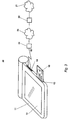
- Fig. 1 shows a system 10 comprising the Internet terminal 11 and the Identification module 15 according to the preferred embodiment of the invention.
- the internet terminal 11 comprises a touch-sensitive display 12, a Device 13 for communication with the connectable identification module 15 and a device 14 for communication.
- the touch sensitive Display 12 of a housing of the Internet terminal 11 frame-like enclosed.
- the user can see the Internet terminal 11 in front of him, place it on a table, for example, and study the contents of the display 12.
- Appropriate shaping of the housing can cause a slight inclination of the display 12 can be achieved, whereby the readability of the display 12 is improved can be.
- the device 13 for communication with the identification module 15 is like this designed that the Internet terminal 11 configuration data from the Identification module 15 can receive.
- the design of the device 13 for Communication with the identification module 15 depends on the features of the identification module 15. In the preferred embodiment, this is Identification module 15 designed as a contact-type chip card, whereby appropriate dimensions and arrangements of contacts for the facility 13 for communication with the identification module 15. Alternatively, it can Identification module 15 as a contactless transponder, for example as a radio frequency identification module (Radio Frequency Identification Module, RFID) be executed.
- the transponder also known as a contactless chip card is easier to use, is more robust and has one less susceptibility to failure. Because transponders have a certain communication range it is not necessary to insert the transponder 15 into the device 13 for communication to insert the configuration data into the Internet terminal 11 to transfer.
- the device 14 serves as an interface between the Internet terminal 11 and a communication network that enables connection to the Internet.
- Communication network can be a public landline or cellular network act.
- the internet terminal 11 can be operated via the device 14 with a computer network, for example a local network (local area Network, LAN) or wide area network (WAN) become.
- the design of the device 14 depends on the Characteristics of the respective communication network.
- the device 14 it can alternatively a conventional serial, parallel or USB (Universal Serial Bus) interface or the like act, the connection with the for example, public fixed telephone network can be done via a modem. at the public fixed telephone network can be an analog as well as a act digital and in particular an ISDN telephone system.
- the Internet terminal 11 also has a processor and memory.
- An operating system for example, is located in a non-volatile part of the memory based on linux, and an internet browser. This preferably includes Internet terminal an operating system that starts immediately (instant-on Operating system).
- the Internet terminal 11 further comprises a power supply, which is preferably designed as an accumulator.
- the internet terminal 11 can also be a device for absorbing operating energy, for example from an external power supply.
- the internet terminal 11 can also standard interfaces, a device for loading the Accumulators, disk storage, cameras and other conventional computer devices include.
- the identification module 15 contains, preferably in encrypted form, Configuration data for the connection of the Internet terminal 11 to the Internet.
- the Configuration data can be stored in blocks in the communication module 15 be arranged.
- a first block contains the access data for the Internet service provider; the access data include customer number, user identification number, Access code, personal identification number (Personal Identification Number, PIN) and telephone number of the dial-in node with portal selection.
- a second block contains data on content and services; the data include general information selection, personal choice of information, general selection of services, personal Service selection and information on the personal mail server.
- a third block contains authorization data; the authorization data include a terminal identification number and an identification module identification number.
- the identification module 15 preferably additionally contains an encrypted one Authorization code (software dongle) that prevents the use of replica or unauthorized identification modules prevented or complicated. The authorization code is coordinated with the Internet terminal 11.
- the system 10 for configuring the Internet terminal 11 by means of the Identification module 15 can be integrated into an existing chip card system be, for example, the identification module 15 part of a chip card Authentication, for example a money card. Furthermore, that Identification module 15 contain configuration data, for example for Authentication of the user on the Internet, for example for online orders and online payments. The identification module 15 can continue Contain configuration data that enable the data that is stored on the Connection to the internet to be encrypted.
- Fig. 2 shows a system 20 with a corded connection to the public telephone network 23.
- the Internet terminal 11 contains a conventional one serial interface 14, which is connected via a serial line 25 with a conventional Modem 24 is connected.
- the modem 24 is connected to the public telephone network 23 connected, whereby the public telephone network can be analog or digital.
- the Internet terminal 11 is connected to the Internet 21 via an Internet service provider 22, which is connected to the public telephone network 23. If the identification module 15 is coupled to the device 13 for communication is, the Internet terminal 11 receives the to establish a connection to the Internet 21 required configuration data from the identification module 15. Die Connection to the Internet 21 supports, for example, receiving and sending electronic letters (emails) and surfing the World-Wide Web.
- a Embodiment takes place in connection to the Internet first via a portal of the Internet service provider 22, d. H. a homepage with content from the Internet service provider 22.
- the connection to Internet exclusively through this portal, so that the Internet service provider 22 at least partially influences the content shown on the display 12 become.
- the Internet terminal 11 can automatically connect to the Establish communication with the identification module 15.
- the construction takes place the connection to the Internet 21 via the service provider 22, which by the Configuration data is determined. Since the Internet terminal 11 the connection builds up only after communication with an identification module 15 that Contains key data that the Internet terminal 11 can unlock ensure that the connection to the Internet 21 is made exclusively via the predetermined Internet service provider 22 takes place.
- Communication between the Internet terminal 11 and the communication module 15 takes place after a predetermined mechanism.
- the mechanism can be one-sided Authentication include, in which either the Internet terminal 11 compared to the identification module 15 or the identification module 15 opposite legitimized the Internet terminal 11. Alternatively, the mechanism can be mutual Authentication include, in which the Internet terminal 11 and Identify identification module 15 against each other. Authentication can for example symmetrical or asymmetrical encryption methods use. Mutual authentication enables a terminal / module pair are formed so that a specific Internet terminal 11 exclusively via a specific identification module 15 can be activated.
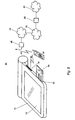
- Fig. 3 shows a system 30, for example for use at home or in Office is suitable, with a cordless connection to the public telephone network 23.
- the interface 14 is for wireless Communication 32 with a base station 31 suitable.
- Wireless communication 32 can for example optically, i. H. by means of light or by radio, d. H. by means of Radio waves.
- the range of the communication 32 becomes the range of motion of the user. While the range for an optical Communication 32 can be limited to a few centimeters or meters, it can for radio communication 32 are in the order of 100 m.
- In the Optical communication 32 for example, infrared light can be used.
- the radio communication 32 can preferably according to the DECT standard respectively.
- the DECT DMAP standard is particularly suitable for Communication 32 between the Internet terminal 11 and the base station 31, the is connected to the public telephone network.
- the interface 14 and the base station 31 according to the Bluetooth specification for wireless Communication of data and voice must be carried out.
- While the interface 14 can be fully integrated into the Internet terminal interface 14 in the preferred embodiment is PCMCIA (Personal Computer Memory Card International Association-) or PC card or The same is carried out so that the interface 14 by the user without problems can be exchanged. Thus, the user can choose the most suitable one Select wired or wireless interface 14 and with the Internet terminal Use 11.
- PCMCIA Personal Computer Memory Card International Association-
- Fig. 4 shows a mobile system 40 which is for use in, for example, a cellular cellular network 41 is suitable.
- the interface 14 is for example according to the GSM (Global System for Mobile Communications) standard or the UMTS (Universal Mobile Telecommunications System) standard and a wireless connection 43, i. H. a telephone connection, with a base station 42 of the cellular network 41.
- the connection to The Internet can then be accessed directly via the Internet service provider 22, or as in FIG. 4 shown over the public switched telephone network 23 and the Internet service provider 22 respectively.
- FIG. 5 shows a further mobile system 50, in which the connection to the Internet 21 again takes place via the cellular network 41.
- System 50 includes a cellular phone 51, for example according to the GSM standard or the UMTS standard is executed, and for communication 43 with the base station 42 of the Mobile network 41 is suitable.
- Communication 52 between the internet terminal 11 and the mobile telephone 51 is carried out, similarly to the FIG. 3 described, using radio waves or light.
- the interface 14 and the mobile phone For this purpose, 51 are designed, for example, in accordance with the Bluetooth specification. Since the communications 43 and 52 are wireless, in this embodiment achieved high mobility and flexibility.
- Fig. 6 illustrates the use of the Internet terminal 11 and the Identification module 15 in a commercial system 600.
- a manufacturer 610 produces the Internet terminal 11, which can be used directly or via a commercial or Sales partner to user 620 gets 612. The manufacturer 610 expects for the Internet terminal 11 an appropriate revenue.
- An internet service provider 22 offers the user 620 access to the Internet 21. This access to the Internet 21 can be paid or free of charge for the user 620.
- a paid Access can, for example, over the duration of the access and possibly calculated for a monthly fee, for example will be charged, or be settled as a lump sum.
- access to the Internet 21 can be funded entirely or partially by advertising his.
- user 620 calls during a connection to the Internet 21 information 641 from an information provider (content provider) 640, this information becomes 642 via the Internet 21 and the Internet service provider 22 transferred to user 620.
- the Internet service provider 22 has agreed with an advertiser 630 that the Internet service provider 22 advertising 633 of advertiser 630 together with information 642 to user 620 transmits, wherein the advertiser 630 feeds the advertisement 632 into the Internet 21.
- the Internet service provider 22 expects an appropriate remuneration 634 from the advertiser 630.
- the advertiser 630 can send the advertisement 632 directly to the Internet service providers 22 deliver.
- the Internet service provider 22 may share some of its revenue from the paid access and, if applicable, advertising-related remuneration to the Manufacturer 610 passes 611, the compensation 613, which the user 620 for the Internet terminal 11 provides to the manufacturer 610, reduced or even completely eliminated.
- the Internet service provider 22, which is the Internet terminal 11 of the user 620 funded in whole or in part to ensure that user 620 the Internet terminal 11 uses 614 only for connection 617 via its service, output the identification module 15 to the user 620. Because the Internet terminal 11 the connection 617 to the Internet 21 only via the Internet service provider 22 in connection 616 with the identification module 15, a prevent other, improper use of the Internet device.
- the identification module 15 Contain configuration data, which in addition to the Internet service provider 22 also Identify information provider 640 so that the information provider 640 in that System 600 can be further integrated.
- the system 600 thus supports a method for providing an Internet service 22 to a user 620, the method comprises: assigning an identification module 15 to an Internet terminal 11 and the Internet service 22, the identification module 15 being suitable for the Unlock Internet terminal 11 and the Internet terminal 11 with the Internet service 22 to connect, the provision of the Internet terminal 11 and the Identification module 15 to the user 620, providing the Internet service 22 via the Internet terminal 11 to the user 620 under the Prerequisite that the Internet terminal 11 through the identification module 15th is unlocked, and the financing of the Internet terminal 11 based on the Use of the Internet service 22 by the user 620. Furthermore, this can Procedures to block access to the Internet 21 include in the event that Internet terminal 11 is not activated by identification module 15. The method can also block access to other Internet services include.
- the step of providing the Internet service 22 to the user 620 providing advertising 632, 633 one Advertisers 630 include to user 620 within Internet service 22 and the step of funding charging advertiser 630 for deployment advertising 632, 632 to user 620 within Internet service 22 include.
- the method can manufacture the Internet terminal 11 by a manufacturer 610, and the step of funding at least partly the basis for payment of the manufacturer 's selling price for the Form Internet terminal 11 to the manufacturer.
Landscapes
- Engineering & Computer Science (AREA)
- Computer Hardware Design (AREA)
- Theoretical Computer Science (AREA)
- General Engineering & Computer Science (AREA)
- Physics & Mathematics (AREA)
- General Physics & Mathematics (AREA)
- Computer Security & Cryptography (AREA)
- Computer Networks & Wireless Communication (AREA)
- Human Computer Interaction (AREA)
- Signal Processing (AREA)
- Computing Systems (AREA)
- Software Systems (AREA)
- Information Transfer Between Computers (AREA)
- Telephonic Communication Services (AREA)
- Maintenance And Management Of Digital Transmission (AREA)
- Data Exchanges In Wide-Area Networks (AREA)
Abstract
Description
Claims (19)
- Internet-Endgerät (11), umfassend:wobeieine berührungsempfindliche Anzeige (12) undeine Einrichtung (13) zur Kommunikation mit einem koppelbaren Identifikationsmodul (15),
das Endgerät (11) für eine Verbindung zum Internet (21) Konfigurationsdaten von dem Identifikationsmodul (15) erhält. - Internet-Endgerät (11) nach Anspruch 1, wobei das Endgerät (11) als WebPad ausgeführt ist.
- Internet-Endgerät (11) nach Anspruch 1 oder 2, weiterhin umfassend:
eine Einrichtung (14) zur drahtlosen Kommunikation, vorzugsweise gemäß dem DECT-Standard, mit einer Basisstation (31),
wobei
das Endgerät (11) die Verbindung über die Einrichtung (14) zur drahtlosen Kommunikation aufbaut. - Internet-Endgerät (11) nach einem der Ansprüche 1 bis 3, wobei das Endgerät (11) die Verbindung automatisch nach Kommunikation mit dem Identifikationsmodul (15) aufbaut.
- Internet-Endgerät (11) nach einem der Ansprüche 1 bis 4, wobei das Endgerät (11) die Verbindung über einen Internet-Dienstanbeiter(22), der durch die Konfigurationsdaten bestimmt ist, aufbaut.
- Internet-Endgerät (11) nach einem der Ansprüche 1 bis 5, wobei sich das Endgerät (11) automatisch zur Kommunikation mit dem Identifikationsmodul (15) aktiviert, wenn das Identfikationsmodul (15) an das Endgerät (11) gekoppelt wird.
- Internet-Endgerät (11) nach einem der Ansprüche 1 bis 6, wobei das Endgerät (11) die Verbindung nur nach Kommunikation mit einem Identifikationsmodul (15) aufbaut, das Schlüsseldaten enthält, die das Endgerät (11) freischalten.
- Internet-Endgerät (11) nach einem der Ansprüche 1 bis 7, wobei das Identifikationsmodul (15) als Chipkarte ausgeführt ist.
- Internet-Endgerät (11) nach einem der Ansprüche 1 bis 7, wobei das Identifikationsmodul (15) als Transponder ausgeführt ist.
- Identifikationsmodul (15), umfassend:
Konfigurationsdaten für eine Verbindung eines Internet-Endgeräts (11) zum Internet (21). - Identifikationsmodul (15) nach Anspruch 10, wobei die Konfigurationsdaten umfassen:
Zugangsdaten zu einen Internet-Dienstanbieter (22). - Identifikationsmodul (15) nach Anspruch 10 oder 11, wobei die Konfigurationsdaten umfassen:
Teilnehmerdaten, die einen Benutzer des Endgeräts (11) identifizeren. - Identifikationsmodul (15) nach einem der Ansprüche 10 bis 12, wobei die Konfigurationsdaten umfassen:
Schlüsseldaten, die das Endgerät (11) freischalten. - Identifikationsmodul (15) nach einem der Ansprüche 10 bis 13, wobei die Konfigurationsdaten umfassen:
Dienstleistungsdaten, die freigeschaltete Dienstleistungen spezifizieren. - Identifikationsmodul (15) nach einem der Ansprüche 10 bis 14, wobei die Konfigurationsdaten umfassen:
Zahlungsdaten, die eine Vergütung für die Verbindung ermöglichen. - Identifikationsmodul (15) nach einem der Ansprüche 10 bis 15, wobei die Konfigurationsdaten umfassen:
Guthabendaten, die eine aktuelle Abrechnung der Verbindung ermöglichen. - Identifikationsmodul (15) nach einem der Ansprüche 10 bis 16, wobei das Identifikationsmodul (15) als Chipkarte ausgeführt ist.
- Identifikationsmodul (15) nach einem der Ansprüche 10 bis 16, wobei das Identifikationsmodul (15) als Transponder ausgeführt ist.
- Internet-basiertes System (60) zum Verbreiten von Informationen über einen spezifischen Dienstanbieter (22) an einen Teilnehmer, wobei:der spezifische Dienstanbieter Zugang zum Internet (21) und ein Identifikationsmodul (15) nach einem der Ansprüche 10 bis 18 bereitstellt,der Teilnehmer Daten, die die Informationen repräsentieren, über den Zugang bezieht und mittels eines Internet-Endgeräts (11) nach einem der Ansprüche 1 bis 9 auswertet, unddas Internet-Endgerät (11) nur in Verbindung mit dem Identifikationsmodul (15) des spezifischen Dienstanbieters Zugang zum Internet (21) erhält.
Applications Claiming Priority (2)
| Application Number | Priority Date | Filing Date | Title |
|---|---|---|---|
| DE20012538U | 2000-07-19 | ||
| DE20012538U DE20012538U1 (de) | 2000-07-19 | 2000-07-19 | Internet-Endgerät mit Identifikationsmodul |
Publications (2)
| Publication Number | Publication Date |
|---|---|
| EP1174831A2 true EP1174831A2 (de) | 2002-01-23 |
| EP1174831A3 EP1174831A3 (de) | 2005-01-26 |
Family
ID=7944159
Family Applications (1)
| Application Number | Title | Priority Date | Filing Date |
|---|---|---|---|
| EP01117467A Withdrawn EP1174831A3 (de) | 2000-07-19 | 2001-07-19 | Internet-Endgerät mit Identifikationsmodul |
Country Status (3)
| Country | Link |
|---|---|
| US (1) | US20020069364A1 (de) |
| EP (1) | EP1174831A3 (de) |
| DE (1) | DE20012538U1 (de) |
Cited By (1)
| Publication number | Priority date | Publication date | Assignee | Title |
|---|---|---|---|---|
| WO2004004279A1 (en) * | 2002-06-26 | 2004-01-08 | Intel Corporation | Active key for wireless device configuration |
Families Citing this family (38)
| Publication number | Priority date | Publication date | Assignee | Title |
|---|---|---|---|---|
| US6820802B2 (en) * | 2001-02-27 | 2004-11-23 | American Express Travel Related Services Company, Inc. | Online card activation system and method |
| EP1537517B1 (de) | 2002-06-26 | 2011-12-07 | Nokia Corporation | Einrichtung zum anleiten des betriebs einer persönlichen kommunikationsvorrichtung eines benutzers |
| GB2394327B (en) * | 2002-10-17 | 2006-08-02 | Vodafone Plc | Device for facilitating and authenticating transactions |
| JP4509930B2 (ja) * | 2002-10-17 | 2010-07-21 | ヴォウダフォン・グループ・ピーエルシー | トランザクションの容易化および認証 |
| KR100529878B1 (ko) * | 2002-11-08 | 2005-11-22 | 엘지전자 주식회사 | 웹패드가 탑재된 인터넷 냉장고 |
| GB0319918D0 (en) * | 2003-08-23 | 2003-09-24 | Ibm | Method system and device for mobile subscription content access |
| JP4558295B2 (ja) * | 2003-09-10 | 2010-10-06 | 株式会社メルコホールディングス | リモートアクセスシステム、リモートアクセス方法およびリモートアクセスプログラム |
| FR2863425B1 (fr) * | 2003-12-04 | 2006-02-10 | Gemplus Card Int | Procede et systeme de configuration automatique d'appareil dans un reseau de communication |
| WO2005086802A2 (en) | 2004-03-08 | 2005-09-22 | Proxense, Llc | Linked account system using personal digital key (pdk-las) |
| US20070082703A1 (en) * | 2004-10-28 | 2007-04-12 | Koninklijke Kpn N.V. | Method and system for providing wireless identification |
| GB0507285D0 (en) * | 2005-04-11 | 2005-05-18 | Innovision Res & Tech Plc | Nfc enabled high-speed data |
| GB2442360B (en) * | 2005-04-11 | 2010-04-07 | Innovision Res & Tech Plc | communications apparatus |
| US7298272B2 (en) * | 2005-04-29 | 2007-11-20 | Hewlett-Packard Development Company, L.P. | Remote detection employing RFID |
| DE102005045118B4 (de) * | 2005-09-21 | 2007-08-23 | Siemens Ag | Anmeldeverfahren zwischen Teilnehmern eines Kommunikationssystems und Teilnehmer |
| EP1791315A1 (de) * | 2005-11-23 | 2007-05-30 | Research In Motion Limited | System und Verfahren zur Bereitstellung mobiler VPN Konnektivität |
| US7882557B2 (en) * | 2005-11-23 | 2011-02-01 | Research In Motion Limited | System and method to provide built-in and mobile VPN connectivity |
| US8433919B2 (en) | 2005-11-30 | 2013-04-30 | Proxense, Llc | Two-level authentication for secure transactions |
| US11206664B2 (en) | 2006-01-06 | 2021-12-21 | Proxense, Llc | Wireless network synchronization of cells and client devices on a network |
| US8340672B2 (en) | 2006-01-06 | 2012-12-25 | Proxense, Llc | Wireless network synchronization of cells and client devices on a network |
| US9269221B2 (en) | 2006-11-13 | 2016-02-23 | John J. Gobbi | Configuration of interfaces for a location detection system and application |
| WO2009062194A1 (en) * | 2007-11-09 | 2009-05-14 | Proxense, Llc | Proximity-sensor supporting multiple application services |
| US8171528B1 (en) | 2007-12-06 | 2012-05-01 | Proxense, Llc | Hybrid device having a personal digital key and receiver-decoder circuit and methods of use |
| US9251332B2 (en) | 2007-12-19 | 2016-02-02 | Proxense, Llc | Security system and method for controlling access to computing resources |
| DE102008004657B4 (de) * | 2008-01-16 | 2009-09-03 | Siemens Aktiengesellschaft | Datenverarbeitungsnetzwerk und Verfahren zum Betrieb eines Datenverarbeitungsnetzwerks |
| WO2009102979A2 (en) | 2008-02-14 | 2009-08-20 | Proxense, Llc | Proximity-based healthcare management system with automatic access to private information |
| US11120449B2 (en) | 2008-04-08 | 2021-09-14 | Proxense, Llc | Automated service-based order processing |
| US9418205B2 (en) | 2010-03-15 | 2016-08-16 | Proxense, Llc | Proximity-based system for automatic application or data access and item tracking |
| USD664144S1 (en) * | 2010-05-12 | 2012-07-24 | Apple Inc. | Electronic device |
| USD908696S1 (en) * | 2010-05-12 | 2021-01-26 | Apple Inc. | Electronic device |
| US9322974B1 (en) | 2010-07-15 | 2016-04-26 | Proxense, Llc. | Proximity-based system for object tracking |
| US9265450B1 (en) | 2011-02-21 | 2016-02-23 | Proxense, Llc | Proximity-based system for object tracking and automatic application initialization |
| USD707211S1 (en) * | 2012-12-20 | 2014-06-17 | Novatel Wireless, Inc. | Mobile hotspot device having a cylindrical battery pack and integrated kickstand |
| USD714784S1 (en) * | 2013-02-01 | 2014-10-07 | Samsung Electronics Co., Ltd. | Tablet PC |
| US9405898B2 (en) | 2013-05-10 | 2016-08-02 | Proxense, Llc | Secure element as a digital pocket |
| SE540658C2 (sv) * | 2013-07-31 | 2018-10-09 | Vaederstad Holding Ab | Hållare för en surfplatta |
| WO2015102880A1 (en) * | 2013-12-30 | 2015-07-09 | Vasco Data Security, Inc. | An authentication apparatus with a bluetooth interface |
| USD749073S1 (en) * | 2014-06-18 | 2016-02-09 | Kverneland Group Mechatronics B.V. | Terminal including a display and operating units |
| USD924236S1 (en) * | 2018-01-19 | 2021-07-06 | Panasonic Avionics Corporation | Display system for mounting in a cabin |
Family Cites Families (14)
| Publication number | Priority date | Publication date | Assignee | Title |
|---|---|---|---|---|
| US5553314A (en) * | 1994-04-12 | 1996-09-03 | Motorola, Inc. | Method of configuring a communication unit using a wireless portable configuration device |
| US6194992B1 (en) * | 1997-04-24 | 2001-02-27 | Nomadix, Llc | Mobile web |
| EP0917327B1 (de) * | 1996-12-13 | 2002-07-24 | TELEFONAKTIEBOLAGET L M ERICSSON (publ) | Verfahren und System zur Durchführung von elektronischen Geldtransaktionen |
| US5900875A (en) * | 1997-01-29 | 1999-05-04 | 3Com Corporation | Method and apparatus for interacting with a portable computer system |
| AU8113798A (en) * | 1997-06-13 | 1998-12-30 | Gemplus S.C.A. | Smart card, cordless telephone, system and method for access and communication by internet |
| US5987430A (en) * | 1997-08-28 | 1999-11-16 | Atcom, Inc. | Communications network connection system and method |
| US6141694A (en) * | 1997-09-16 | 2000-10-31 | Webtv Networks, Inc. | Determining and verifying user data |
| US5983273A (en) * | 1997-09-16 | 1999-11-09 | Webtv Networks, Inc. | Method and apparatus for providing physical security for a user account and providing access to the user's environment and preferences |
| US6282082B1 (en) * | 1998-07-31 | 2001-08-28 | Qubit, Llc | Case for a modular tablet computer system |
| US6250557B1 (en) * | 1998-08-25 | 2001-06-26 | Telefonaktiebolaget Lm Ericsson (Publ) | Methods and arrangements for a smart card wallet and uses thereof |
| FR2785135B1 (fr) * | 1998-10-22 | 2000-12-29 | Sfr Sa | Procede de lancement d'une application par un terminal, sous commande d'un module d'identification d'abonne, module d'identification d'abonne et terminal correspondants |
| US6446127B1 (en) * | 1998-10-30 | 2002-09-03 | 3Com Corporation | System and method for providing user mobility services on a telephony network |
| US6434403B1 (en) * | 1999-02-19 | 2002-08-13 | Bodycom, Inc. | Personal digital assistant with wireless telephone |
| US6711419B1 (en) * | 2000-07-13 | 2004-03-23 | Sun Microsystems, Inc. | Integrated information appliance |
-
2000
- 2000-07-19 DE DE20012538U patent/DE20012538U1/de not_active Expired - Lifetime
-
2001
- 2001-07-19 EP EP01117467A patent/EP1174831A3/de not_active Withdrawn
- 2001-07-19 US US09/909,470 patent/US20020069364A1/en not_active Abandoned
Cited By (1)
| Publication number | Priority date | Publication date | Assignee | Title |
|---|---|---|---|---|
| WO2004004279A1 (en) * | 2002-06-26 | 2004-01-08 | Intel Corporation | Active key for wireless device configuration |
Also Published As
| Publication number | Publication date |
|---|---|
| US20020069364A1 (en) | 2002-06-06 |
| DE20012538U1 (de) | 2000-10-12 |
| EP1174831A3 (de) | 2005-01-26 |
Similar Documents
| Publication | Publication Date | Title |
|---|---|---|
| EP1174831A2 (de) | Internet-Endgerät mit Identifikationsmodul | |
| EP0990355B1 (de) | Chipkarte und verfahren zur kommunikation zwischen einer externen vorrichtung und einer chipkarte | |
| DE69431964T2 (de) | Mikro-tragbarer rechner | |
| DE69524733T2 (de) | Echtzeit-telebezahlsystem | |
| US8789161B2 (en) | Device and method for authenticating a transaction with a data processing apparatus | |
| CA2384256C (en) | Application management for multi application devices | |
| DE69934911T2 (de) | Mobiltelefon auto-pc-logon | |
| EP1130495A2 (de) | Verfahren und Vorrichtung zum Herunterladen einer Anwendung mit unterschiedlicher Laufzeit | |
| DE10219668A1 (de) | System zum Darbieten und Bezahlen von Produkten und Dienstleistungen für mobilen E-Commerce | |
| KR20020022035A (ko) | 휴대 단말기를 이용하는 프린팅 시스템 및 프린팅 요금징수 방법 | |
| DE29624476U1 (de) | System zum Ermöglichen des Bestellens und Bezahlens von Dienstleistungen mittels eines Kommunikationsnetzwerkes | |
| DE202005010615U1 (de) | Elektronisches Abrechnungssystem mit höherer Sicherheit | |
| US20020035479A1 (en) | Access contract changing method for automatically changing an access contract between a prepaid contract and a postpaid contract | |
| US20070158402A1 (en) | Data writing apparatus, method, and program for portable terminal memory | |
| DE60018307T2 (de) | Selbstbedienungsterminal | |
| CN112465496A (zh) | 一种基于二维码的多次收款的实现方法及系统 | |
| CN105809504A (zh) | 一种构建快速存储数据的应用商店系统 | |
| DE60108853T2 (de) | Verfahren und system zum bestellen von dienstleistungen | |
| JP2005010964A (ja) | 携帯通信端末を用いた決済システム | |
| EP1128340A1 (de) | Verfahren zum Aufladen eines Kundenkontos für Telekommunikationsdienste und entsprechendes Aufladesystem | |
| CN109801154A (zh) | 信贷还款配置方法、装置、设备和存储介质 | |
| JP2003067661A (ja) | ポイント購入サーバーシステムを用いた、小額決済のための回収代行システム | |
| CN106875172A (zh) | 微信用户在使用充电桩充电时支持一号多充的实现方法 | |
| EP1450315A1 (de) | Bedienteil für eine Endgeräteanordnung | |
| CN107945398A (zh) | 充电计费方法及系统 |
Legal Events
| Date | Code | Title | Description |
|---|---|---|---|
| PUAI | Public reference made under article 153(3) epc to a published international application that has entered the european phase |
Free format text: ORIGINAL CODE: 0009012 |
|
| AK | Designated contracting states |
Kind code of ref document: A2 Designated state(s): AT BE CH CY DE DK ES FI FR GB GR IE IT LI LU MC NL PT SE TR |
|
| AX | Request for extension of the european patent |
Free format text: AL;LT;LV;MK;RO;SI |
|
| PUAL | Search report despatched |
Free format text: ORIGINAL CODE: 0009013 |
|
| AK | Designated contracting states |
Kind code of ref document: A3 Designated state(s): AT BE CH CY DE DK ES FI FR GB GR IE IT LI LU MC NL PT SE TR |
|
| AX | Request for extension of the european patent |
Extension state: AL LT LV MK RO SI |
|
| 17P | Request for examination filed |
Effective date: 20050726 |
|
| AKX | Designation fees paid | ||
| REG | Reference to a national code |
Ref country code: DE Ref legal event code: 8566 |
|
| RBV | Designated contracting states (corrected) |
Designated state(s): AT BE CH CY DE DK ES FI FR GB GR IE IT LI LU MC NL PT SE TR |
|
| RAP1 | Party data changed (applicant data changed or rights of an application transferred) |
Owner name: DETEWE SYSTEMS GMBH |
|
| 17Q | First examination report despatched |
Effective date: 20061018 |
|
| RAP1 | Party data changed (applicant data changed or rights of an application transferred) |
Owner name: AASTRA DETEWE GMBH |
|
| STAA | Information on the status of an ep patent application or granted ep patent |
Free format text: STATUS: THE APPLICATION IS DEEMED TO BE WITHDRAWN |
|
| 18D | Application deemed to be withdrawn |
Effective date: 20070801 |