EP1175512B1 - Verfahren zur Analyse von AFLP Reaktionsmischungen unter Verwendung von Primer Verlängerungstechniken - Google Patents
Verfahren zur Analyse von AFLP Reaktionsmischungen unter Verwendung von Primer Verlängerungstechniken Download PDFInfo
- Publication number
- EP1175512B1 EP1175512B1 EP00921163A EP00921163A EP1175512B1 EP 1175512 B1 EP1175512 B1 EP 1175512B1 EP 00921163 A EP00921163 A EP 00921163A EP 00921163 A EP00921163 A EP 00921163A EP 1175512 B1 EP1175512 B1 EP 1175512B1
- Authority
- EP
- European Patent Office
- Prior art keywords
- aflp
- sequence
- detection
- nucleotide
- primer
- Prior art date
- Legal status (The legal status is an assumption and is not a legal conclusion. Google has not performed a legal analysis and makes no representation as to the accuracy of the status listed.)
- Expired - Lifetime
Links
- 238000000034 method Methods 0.000 title claims abstract description 91
- 208000005652 acute fatty liver of pregnancy Diseases 0.000 title claims description 174
- 239000011541 reaction mixture Substances 0.000 title claims description 18
- 238000004458 analytical method Methods 0.000 title description 16
- 239000012634 fragment Substances 0.000 claims abstract description 176
- 125000003729 nucleotide group Chemical group 0.000 claims abstract description 107
- 239000002773 nucleotide Substances 0.000 claims abstract description 90
- 108091034117 Oligonucleotide Proteins 0.000 claims abstract description 72
- 239000000203 mixture Substances 0.000 claims abstract description 41
- 230000000295 complement effect Effects 0.000 claims abstract description 22
- 238000009396 hybridization Methods 0.000 claims abstract description 16
- 238000006243 chemical reaction Methods 0.000 claims description 86
- 239000003550 marker Substances 0.000 claims description 35
- 230000003321 amplification Effects 0.000 claims description 14
- 238000003199 nucleic acid amplification method Methods 0.000 claims description 14
- 108091008146 restriction endonucleases Proteins 0.000 claims description 11
- JLCPHMBAVCMARE-UHFFFAOYSA-N [3-[[3-[[3-[[3-[[3-[[3-[[3-[[3-[[3-[[3-[[3-[[5-(2-amino-6-oxo-1H-purin-9-yl)-3-[[3-[[3-[[3-[[3-[[3-[[5-(2-amino-6-oxo-1H-purin-9-yl)-3-[[5-(2-amino-6-oxo-1H-purin-9-yl)-3-hydroxyoxolan-2-yl]methoxy-hydroxyphosphoryl]oxyoxolan-2-yl]methoxy-hydroxyphosphoryl]oxy-5-(5-methyl-2,4-dioxopyrimidin-1-yl)oxolan-2-yl]methoxy-hydroxyphosphoryl]oxy-5-(6-aminopurin-9-yl)oxolan-2-yl]methoxy-hydroxyphosphoryl]oxy-5-(6-aminopurin-9-yl)oxolan-2-yl]methoxy-hydroxyphosphoryl]oxy-5-(6-aminopurin-9-yl)oxolan-2-yl]methoxy-hydroxyphosphoryl]oxy-5-(6-aminopurin-9-yl)oxolan-2-yl]methoxy-hydroxyphosphoryl]oxyoxolan-2-yl]methoxy-hydroxyphosphoryl]oxy-5-(5-methyl-2,4-dioxopyrimidin-1-yl)oxolan-2-yl]methoxy-hydroxyphosphoryl]oxy-5-(4-amino-2-oxopyrimidin-1-yl)oxolan-2-yl]methoxy-hydroxyphosphoryl]oxy-5-(5-methyl-2,4-dioxopyrimidin-1-yl)oxolan-2-yl]methoxy-hydroxyphosphoryl]oxy-5-(5-methyl-2,4-dioxopyrimidin-1-yl)oxolan-2-yl]methoxy-hydroxyphosphoryl]oxy-5-(6-aminopurin-9-yl)oxolan-2-yl]methoxy-hydroxyphosphoryl]oxy-5-(6-aminopurin-9-yl)oxolan-2-yl]methoxy-hydroxyphosphoryl]oxy-5-(4-amino-2-oxopyrimidin-1-yl)oxolan-2-yl]methoxy-hydroxyphosphoryl]oxy-5-(4-amino-2-oxopyrimidin-1-yl)oxolan-2-yl]methoxy-hydroxyphosphoryl]oxy-5-(4-amino-2-oxopyrimidin-1-yl)oxolan-2-yl]methoxy-hydroxyphosphoryl]oxy-5-(6-aminopurin-9-yl)oxolan-2-yl]methoxy-hydroxyphosphoryl]oxy-5-(4-amino-2-oxopyrimidin-1-yl)oxolan-2-yl]methyl [5-(6-aminopurin-9-yl)-2-(hydroxymethyl)oxolan-3-yl] hydrogen phosphate Polymers Cc1cn(C2CC(OP(O)(=O)OCC3OC(CC3OP(O)(=O)OCC3OC(CC3O)n3cnc4c3nc(N)[nH]c4=O)n3cnc4c3nc(N)[nH]c4=O)C(COP(O)(=O)OC3CC(OC3COP(O)(=O)OC3CC(OC3COP(O)(=O)OC3CC(OC3COP(O)(=O)OC3CC(OC3COP(O)(=O)OC3CC(OC3COP(O)(=O)OC3CC(OC3COP(O)(=O)OC3CC(OC3COP(O)(=O)OC3CC(OC3COP(O)(=O)OC3CC(OC3COP(O)(=O)OC3CC(OC3COP(O)(=O)OC3CC(OC3COP(O)(=O)OC3CC(OC3COP(O)(=O)OC3CC(OC3COP(O)(=O)OC3CC(OC3COP(O)(=O)OC3CC(OC3COP(O)(=O)OC3CC(OC3COP(O)(=O)OC3CC(OC3CO)n3cnc4c(N)ncnc34)n3ccc(N)nc3=O)n3cnc4c(N)ncnc34)n3ccc(N)nc3=O)n3ccc(N)nc3=O)n3ccc(N)nc3=O)n3cnc4c(N)ncnc34)n3cnc4c(N)ncnc34)n3cc(C)c(=O)[nH]c3=O)n3cc(C)c(=O)[nH]c3=O)n3ccc(N)nc3=O)n3cc(C)c(=O)[nH]c3=O)n3cnc4c3nc(N)[nH]c4=O)n3cnc4c(N)ncnc34)n3cnc4c(N)ncnc34)n3cnc4c(N)ncnc34)n3cnc4c(N)ncnc34)O2)c(=O)[nH]c1=O JLCPHMBAVCMARE-UHFFFAOYSA-N 0.000 claims description 10
- 239000007787 solid Substances 0.000 claims description 8
- 150000003839 salts Chemical class 0.000 claims description 2
- 239000011535 reaction buffer Substances 0.000 claims 1
- 238000011144 upstream manufacturing Methods 0.000 abstract 1
- 238000001514 detection method Methods 0.000 description 179
- 108020004414 DNA Proteins 0.000 description 59
- 239000002777 nucleoside Substances 0.000 description 23
- 150000007523 nucleic acids Chemical group 0.000 description 21
- 125000003835 nucleoside group Chemical group 0.000 description 19
- 239000000523 sample Substances 0.000 description 16
- 239000011521 glass Substances 0.000 description 14
- 239000000047 product Substances 0.000 description 13
- 230000035772 mutation Effects 0.000 description 12
- 239000011324 bead Substances 0.000 description 11
- OAKPWEUQDVLTCN-NKWVEPMBSA-N 2',3'-Dideoxyadenosine-5-triphosphate Chemical compound C1=NC=2C(N)=NC=NC=2N1[C@H]1CC[C@@H](CO[P@@](O)(=O)O[P@](O)(=O)OP(O)(O)=O)O1 OAKPWEUQDVLTCN-NKWVEPMBSA-N 0.000 description 10
- 238000003491 array Methods 0.000 description 10
- 230000035945 sensitivity Effects 0.000 description 10
- 230000002068 genetic effect Effects 0.000 description 9
- 108020004707 nucleic acids Proteins 0.000 description 9
- 102000039446 nucleic acids Human genes 0.000 description 9
- TWRXJAOTZQYOKJ-UHFFFAOYSA-L Magnesium chloride Chemical compound [Mg+2].[Cl-].[Cl-] TWRXJAOTZQYOKJ-UHFFFAOYSA-L 0.000 description 8
- 208000037265 diseases, disorders, signs and symptoms Diseases 0.000 description 8
- -1 polytetrafluoroethylene Polymers 0.000 description 8
- 235000010724 Wisteria floribunda Nutrition 0.000 description 7
- ARLKCWCREKRROD-POYBYMJQSA-N [[(2s,5r)-5-(4-amino-2-oxopyrimidin-1-yl)oxolan-2-yl]methoxy-hydroxyphosphoryl] phosphono hydrogen phosphate Chemical compound O=C1N=C(N)C=CN1[C@@H]1O[C@H](COP(O)(=O)OP(O)(=O)OP(O)(O)=O)CC1 ARLKCWCREKRROD-POYBYMJQSA-N 0.000 description 7
- 201000010099 disease Diseases 0.000 description 7
- 241000894007 species Species 0.000 description 7
- 101100440286 Mus musculus Cntrl gene Proteins 0.000 description 6
- 108091028043 Nucleic acid sequence Proteins 0.000 description 6
- 229920001213 Polysorbate 20 Polymers 0.000 description 6
- 239000000872 buffer Substances 0.000 description 6
- 239000000499 gel Substances 0.000 description 6
- 238000003205 genotyping method Methods 0.000 description 6
- 238000002493 microarray Methods 0.000 description 6
- 239000000256 polyoxyethylene sorbitan monolaurate Substances 0.000 description 6
- 235000010486 polyoxyethylene sorbitan monolaurate Nutrition 0.000 description 6
- 102000004190 Enzymes Human genes 0.000 description 5
- 108090000790 Enzymes Proteins 0.000 description 5
- 101001106523 Homo sapiens Regulator of G-protein signaling 1 Proteins 0.000 description 5
- UGQMRVRMYYASKQ-KQYNXXCUSA-N Inosine Chemical compound O[C@@H]1[C@H](O)[C@@H](CO)O[C@H]1N1C2=NC=NC(O)=C2N=C1 UGQMRVRMYYASKQ-KQYNXXCUSA-N 0.000 description 5
- 102100021269 Regulator of G-protein signaling 1 Human genes 0.000 description 5
- 108010090804 Streptavidin Proteins 0.000 description 5
- 238000000376 autoradiography Methods 0.000 description 5
- 239000000463 material Substances 0.000 description 5
- 238000012163 sequencing technique Methods 0.000 description 5
- 239000001226 triphosphate Substances 0.000 description 5
- 235000011178 triphosphate Nutrition 0.000 description 5
- YBJHBAHKTGYVGT-ZKWXMUAHSA-N (+)-Biotin Chemical compound N1C(=O)N[C@@H]2[C@H](CCCCC(=O)O)SC[C@@H]21 YBJHBAHKTGYVGT-ZKWXMUAHSA-N 0.000 description 4
- QKNYBSVHEMOAJP-UHFFFAOYSA-N 2-amino-2-(hydroxymethyl)propane-1,3-diol;hydron;chloride Chemical compound Cl.OCC(N)(CO)CO QKNYBSVHEMOAJP-UHFFFAOYSA-N 0.000 description 4
- 241000238557 Decapoda Species 0.000 description 4
- ZHNUHDYFZUAESO-UHFFFAOYSA-N Formamide Chemical compound NC=O ZHNUHDYFZUAESO-UHFFFAOYSA-N 0.000 description 4
- VYPSYNLAJGMNEJ-UHFFFAOYSA-N Silicium dioxide Chemical compound O=[Si]=O VYPSYNLAJGMNEJ-UHFFFAOYSA-N 0.000 description 4
- FAPWRFPIFSIZLT-UHFFFAOYSA-M Sodium chloride Chemical compound [Na+].[Cl-] FAPWRFPIFSIZLT-UHFFFAOYSA-M 0.000 description 4
- 108010058966 bacteriophage T7 induced DNA polymerase Proteins 0.000 description 4
- 239000012620 biological material Substances 0.000 description 4
- 239000002299 complementary DNA Substances 0.000 description 4
- 150000001875 compounds Chemical class 0.000 description 4
- SUYVUBYJARFZHO-RRKCRQDMSA-N dATP Chemical compound C1=NC=2C(N)=NC=NC=2N1[C@H]1C[C@H](O)[C@@H](COP(O)(=O)OP(O)(=O)OP(O)(O)=O)O1 SUYVUBYJARFZHO-RRKCRQDMSA-N 0.000 description 4
- SUYVUBYJARFZHO-UHFFFAOYSA-N dATP Natural products C1=NC=2C(N)=NC=NC=2N1C1CC(O)C(COP(O)(=O)OP(O)(=O)OP(O)(O)=O)O1 SUYVUBYJARFZHO-UHFFFAOYSA-N 0.000 description 4
- RGWHQCVHVJXOKC-SHYZEUOFSA-J dCTP(4-) Chemical compound O=C1N=C(N)C=CN1[C@@H]1O[C@H](COP([O-])(=O)OP([O-])(=O)OP([O-])([O-])=O)[C@@H](O)C1 RGWHQCVHVJXOKC-SHYZEUOFSA-J 0.000 description 4
- 230000001419 dependent effect Effects 0.000 description 4
- 238000001502 gel electrophoresis Methods 0.000 description 4
- 229910001629 magnesium chloride Inorganic materials 0.000 description 4
- 238000012986 modification Methods 0.000 description 4
- 230000004048 modification Effects 0.000 description 4
- 238000002360 preparation method Methods 0.000 description 4
- 238000011160 research Methods 0.000 description 4
- 238000010561 standard procedure Methods 0.000 description 4
- XLYOFNOQVPJJNP-UHFFFAOYSA-N water Substances O XLYOFNOQVPJJNP-UHFFFAOYSA-N 0.000 description 4
- 102000053602 DNA Human genes 0.000 description 3
- 241000196324 Embryophyta Species 0.000 description 3
- 108700020796 Oncogene Proteins 0.000 description 3
- 102000043276 Oncogene Human genes 0.000 description 3
- 240000007594 Oryza sativa Species 0.000 description 3
- 235000007164 Oryza sativa Nutrition 0.000 description 3
- HEMHJVSKTPXQMS-UHFFFAOYSA-M Sodium hydroxide Chemical compound [OH-].[Na+] HEMHJVSKTPXQMS-UHFFFAOYSA-M 0.000 description 3
- 239000007983 Tris buffer Substances 0.000 description 3
- 238000003556 assay Methods 0.000 description 3
- 230000015572 biosynthetic process Effects 0.000 description 3
- 238000009835 boiling Methods 0.000 description 3
- 230000001351 cycling effect Effects 0.000 description 3
- 238000004925 denaturation Methods 0.000 description 3
- 230000036425 denaturation Effects 0.000 description 3
- 238000002264 polyacrylamide gel electrophoresis Methods 0.000 description 3
- 125000002924 primary amino group Chemical group [H]N([H])* 0.000 description 3
- 235000009566 rice Nutrition 0.000 description 3
- 239000007790 solid phase Substances 0.000 description 3
- 238000011895 specific detection Methods 0.000 description 3
- 238000003786 synthesis reaction Methods 0.000 description 3
- 238000012360 testing method Methods 0.000 description 3
- 125000002264 triphosphate group Chemical class [H]OP(=O)(O[H])OP(=O)(O[H])OP(=O)(O[H])O* 0.000 description 3
- LENZDBCJOHFCAS-UHFFFAOYSA-N tris Chemical compound OCC(N)(CO)CO LENZDBCJOHFCAS-UHFFFAOYSA-N 0.000 description 3
- 102000002260 Alkaline Phosphatase Human genes 0.000 description 2
- 108020004774 Alkaline Phosphatase Proteins 0.000 description 2
- 108010014303 DNA-directed DNA polymerase Proteins 0.000 description 2
- 102000016928 DNA-directed DNA polymerase Human genes 0.000 description 2
- AHCYMLUZIRLXAA-SHYZEUOFSA-N Deoxyuridine 5'-triphosphate Chemical compound O1[C@H](COP(O)(=O)OP(O)(=O)OP(O)(O)=O)[C@@H](O)C[C@@H]1N1C(=O)NC(=O)C=C1 AHCYMLUZIRLXAA-SHYZEUOFSA-N 0.000 description 2
- KCXVZYZYPLLWCC-UHFFFAOYSA-N EDTA Chemical compound OC(=O)CN(CC(O)=O)CCN(CC(O)=O)CC(O)=O KCXVZYZYPLLWCC-UHFFFAOYSA-N 0.000 description 2
- 229930010555 Inosine Natural products 0.000 description 2
- 235000007688 Lycopersicon esculentum Nutrition 0.000 description 2
- 241001465754 Metazoa Species 0.000 description 2
- 238000012300 Sequence Analysis Methods 0.000 description 2
- 240000003768 Solanum lycopersicum Species 0.000 description 2
- ISAKRJDGNUQOIC-UHFFFAOYSA-N Uracil Chemical compound O=C1C=CNC(=O)N1 ISAKRJDGNUQOIC-UHFFFAOYSA-N 0.000 description 2
- HDRRAMINWIWTNU-NTSWFWBYSA-N [[(2s,5r)-5-(2-amino-6-oxo-3h-purin-9-yl)oxolan-2-yl]methoxy-hydroxyphosphoryl] phosphono hydrogen phosphate Chemical compound C1=2NC(N)=NC(=O)C=2N=CN1[C@H]1CC[C@@H](COP(O)(=O)OP(O)(=O)OP(O)(O)=O)O1 HDRRAMINWIWTNU-NTSWFWBYSA-N 0.000 description 2
- 230000006978 adaptation Effects 0.000 description 2
- 125000003277 amino group Chemical group 0.000 description 2
- 229960002685 biotin Drugs 0.000 description 2
- 235000020958 biotin Nutrition 0.000 description 2
- 239000011616 biotin Substances 0.000 description 2
- 238000001311 chemical methods and process Methods 0.000 description 2
- 239000007795 chemical reaction product Substances 0.000 description 2
- 239000003153 chemical reaction reagent Substances 0.000 description 2
- 239000011248 coating agent Substances 0.000 description 2
- 238000000576 coating method Methods 0.000 description 2
- UFJPAQSLHAGEBL-RRKCRQDMSA-N dITP Chemical compound O1[C@H](COP(O)(=O)OP(O)(=O)OP(O)(O)=O)[C@@H](O)C[C@@H]1N1C(N=CNC2=O)=C2N=C1 UFJPAQSLHAGEBL-RRKCRQDMSA-N 0.000 description 2
- 230000003247 decreasing effect Effects 0.000 description 2
- 238000011161 development Methods 0.000 description 2
- 239000000975 dye Substances 0.000 description 2
- 238000005516 engineering process Methods 0.000 description 2
- MHMNJMPURVTYEJ-UHFFFAOYSA-N fluorescein-5-isothiocyanate Chemical compound O1C(=O)C2=CC(N=C=S)=CC=C2C21C1=CC=C(O)C=C1OC1=CC(O)=CC=C21 MHMNJMPURVTYEJ-UHFFFAOYSA-N 0.000 description 2
- 230000014509 gene expression Effects 0.000 description 2
- 238000010191 image analysis Methods 0.000 description 2
- 229960003786 inosine Drugs 0.000 description 2
- 238000002372 labelling Methods 0.000 description 2
- 239000002184 metal Substances 0.000 description 2
- 229910052751 metal Inorganic materials 0.000 description 2
- 230000000813 microbial effect Effects 0.000 description 2
- 238000010369 molecular cloning Methods 0.000 description 2
- 238000001668 nucleic acid synthesis Methods 0.000 description 2
- 150000003833 nucleoside derivatives Chemical class 0.000 description 2
- 238000003976 plant breeding Methods 0.000 description 2
- 229920002401 polyacrylamide Polymers 0.000 description 2
- 102000054765 polymorphisms of proteins Human genes 0.000 description 2
- 108090000623 proteins and genes Proteins 0.000 description 2
- 230000002441 reversible effect Effects 0.000 description 2
- 239000000377 silicon dioxide Substances 0.000 description 2
- 239000011780 sodium chloride Substances 0.000 description 2
- 238000004611 spectroscopical analysis Methods 0.000 description 2
- 239000000126 substance Substances 0.000 description 2
- 239000005451 thionucleotide Substances 0.000 description 2
- 230000003612 virological effect Effects 0.000 description 2
- 238000005406 washing Methods 0.000 description 2
- 108091032973 (ribonucleotides)n+m Proteins 0.000 description 1
- 108700028369 Alleles Proteins 0.000 description 1
- 241000143060 Americamysis bahia Species 0.000 description 1
- OKTJSMMVPCPJKN-UHFFFAOYSA-N Carbon Chemical compound [C] OKTJSMMVPCPJKN-UHFFFAOYSA-N 0.000 description 1
- 208000035473 Communicable disease Diseases 0.000 description 1
- 108020004635 Complementary DNA Proteins 0.000 description 1
- 229920000742 Cotton Polymers 0.000 description 1
- 108010017826 DNA Polymerase I Proteins 0.000 description 1
- 102000004594 DNA Polymerase I Human genes 0.000 description 1
- 102000004163 DNA-directed RNA polymerases Human genes 0.000 description 1
- 108090000626 DNA-directed RNA polymerases Proteins 0.000 description 1
- 229920002307 Dextran Polymers 0.000 description 1
- 206010059866 Drug resistance Diseases 0.000 description 1
- 241000701832 Enterobacteria phage T3 Species 0.000 description 1
- 241000588724 Escherichia coli Species 0.000 description 1
- 241000701533 Escherichia virus T4 Species 0.000 description 1
- 108010007577 Exodeoxyribonuclease I Proteins 0.000 description 1
- 102100029075 Exonuclease 1 Human genes 0.000 description 1
- 241000233866 Fungi Species 0.000 description 1
- 208000028782 Hereditary disease Diseases 0.000 description 1
- 244000043261 Hevea brasiliensis Species 0.000 description 1
- 241000282412 Homo Species 0.000 description 1
- DGAQECJNVWCQMB-PUAWFVPOSA-M Ilexoside XXIX Chemical compound C[C@@H]1CC[C@@]2(CC[C@@]3(C(=CC[C@H]4[C@]3(CC[C@@H]5[C@@]4(CC[C@@H](C5(C)C)OS(=O)(=O)[O-])C)C)[C@@H]2[C@]1(C)O)C)C(=O)O[C@H]6[C@@H]([C@H]([C@@H]([C@H](O6)CO)O)O)O.[Na+] DGAQECJNVWCQMB-PUAWFVPOSA-M 0.000 description 1
- 206010028980 Neoplasm Diseases 0.000 description 1
- 108020004711 Nucleic Acid Probes Proteins 0.000 description 1
- 239000004677 Nylon Substances 0.000 description 1
- 108020005187 Oligonucleotide Probes Proteins 0.000 description 1
- 239000004698 Polyethylene Substances 0.000 description 1
- 239000002202 Polyethylene glycol Substances 0.000 description 1
- 239000004743 Polypropylene Substances 0.000 description 1
- 239000004793 Polystyrene Substances 0.000 description 1
- 108020004518 RNA Probes Proteins 0.000 description 1
- 239000003391 RNA probe Substances 0.000 description 1
- 108700005075 Regulator Genes Proteins 0.000 description 1
- 240000004808 Saccharomyces cerevisiae Species 0.000 description 1
- 108010006785 Taq Polymerase Proteins 0.000 description 1
- 238000003975 animal breeding Methods 0.000 description 1
- 230000003466 anti-cipated effect Effects 0.000 description 1
- 239000012062 aqueous buffer Substances 0.000 description 1
- 238000000149 argon plasma sintering Methods 0.000 description 1
- 238000002306 biochemical method Methods 0.000 description 1
- 229920005549 butyl rubber Polymers 0.000 description 1
- 201000011510 cancer Diseases 0.000 description 1
- 229910052799 carbon Inorganic materials 0.000 description 1
- 239000000969 carrier Substances 0.000 description 1
- 238000004587 chromatography analysis Methods 0.000 description 1
- 239000000084 colloidal system Substances 0.000 description 1
- 239000002131 composite material Substances 0.000 description 1
- 238000012790 confirmation Methods 0.000 description 1
- 230000001276 controlling effect Effects 0.000 description 1
- 230000008878 coupling Effects 0.000 description 1
- 238000010168 coupling process Methods 0.000 description 1
- 238000005859 coupling reaction Methods 0.000 description 1
- HAAZLUGHYHWQIW-KVQBGUIXSA-N dGTP Chemical compound C1=NC=2C(=O)NC(N)=NC=2N1[C@H]1C[C@H](O)[C@@H](COP(O)(=O)OP(O)(=O)OP(O)(O)=O)O1 HAAZLUGHYHWQIW-KVQBGUIXSA-N 0.000 description 1
- URGJWIFLBWJRMF-JGVFFNPUSA-N ddTTP Chemical compound O=C1NC(=O)C(C)=CN1[C@@H]1O[C@H](COP(O)(=O)OP(O)(=O)OP(O)(O)=O)CC1 URGJWIFLBWJRMF-JGVFFNPUSA-N 0.000 description 1
- 239000005549 deoxyribonucleoside Substances 0.000 description 1
- 238000013461 design Methods 0.000 description 1
- 238000003745 diagnosis Methods 0.000 description 1
- 208000035475 disorder Diseases 0.000 description 1
- 239000003814 drug Substances 0.000 description 1
- 238000001962 electrophoresis Methods 0.000 description 1
- 238000006911 enzymatic reaction Methods 0.000 description 1
- 238000002474 experimental method Methods 0.000 description 1
- 239000000835 fiber Substances 0.000 description 1
- 238000007429 general method Methods 0.000 description 1
- 238000010353 genetic engineering Methods 0.000 description 1
- 150000004676 glycans Chemical class 0.000 description 1
- PCHJSUWPFVWCPO-UHFFFAOYSA-N gold Chemical compound [Au] PCHJSUWPFVWCPO-UHFFFAOYSA-N 0.000 description 1
- 239000010931 gold Substances 0.000 description 1
- 229910052737 gold Inorganic materials 0.000 description 1
- 238000013537 high throughput screening Methods 0.000 description 1
- 238000011065 in-situ storage Methods 0.000 description 1
- 101150044508 key gene Proteins 0.000 description 1
- 238000011005 laboratory method Methods 0.000 description 1
- 239000007788 liquid Substances 0.000 description 1
- 230000000873 masking effect Effects 0.000 description 1
- 239000012528 membrane Substances 0.000 description 1
- 108020004999 messenger RNA Proteins 0.000 description 1
- 150000002739 metals Chemical class 0.000 description 1
- 238000000386 microscopy Methods 0.000 description 1
- 229920003052 natural elastomer Polymers 0.000 description 1
- 229920001194 natural rubber Polymers 0.000 description 1
- 239000002853 nucleic acid probe Substances 0.000 description 1
- 229920001778 nylon Polymers 0.000 description 1
- 238000002966 oligonucleotide array Methods 0.000 description 1
- 239000002751 oligonucleotide probe Substances 0.000 description 1
- 231100000590 oncogenic Toxicity 0.000 description 1
- 230000002246 oncogenic effect Effects 0.000 description 1
- 230000003287 optical effect Effects 0.000 description 1
- 238000004806 packaging method and process Methods 0.000 description 1
- 239000008363 phosphate buffer Substances 0.000 description 1
- 229920003023 plastic Polymers 0.000 description 1
- 239000004033 plastic Substances 0.000 description 1
- 229920003229 poly(methyl methacrylate) Polymers 0.000 description 1
- 229920002239 polyacrylonitrile Polymers 0.000 description 1
- 239000004417 polycarbonate Substances 0.000 description 1
- 229920000515 polycarbonate Polymers 0.000 description 1
- 229920000573 polyethylene Polymers 0.000 description 1
- 229920001223 polyethylene glycol Polymers 0.000 description 1
- 229920000642 polymer Polymers 0.000 description 1
- 239000002861 polymer material Substances 0.000 description 1
- 239000004926 polymethyl methacrylate Substances 0.000 description 1
- 239000011116 polymethylpentene Substances 0.000 description 1
- 229920000306 polymethylpentene Polymers 0.000 description 1
- 108091033319 polynucleotide Proteins 0.000 description 1
- 102000040430 polynucleotide Human genes 0.000 description 1
- 239000002157 polynucleotide Substances 0.000 description 1
- 229920001155 polypropylene Polymers 0.000 description 1
- 229920001282 polysaccharide Polymers 0.000 description 1
- 239000005017 polysaccharide Substances 0.000 description 1
- 229920002223 polystyrene Polymers 0.000 description 1
- 229920001343 polytetrafluoroethylene Polymers 0.000 description 1
- 239000004810 polytetrafluoroethylene Substances 0.000 description 1
- 229920002689 polyvinyl acetate Polymers 0.000 description 1
- 239000011118 polyvinyl acetate Substances 0.000 description 1
- 239000004800 polyvinyl chloride Substances 0.000 description 1
- 229920000915 polyvinyl chloride Polymers 0.000 description 1
- 229920002981 polyvinylidene fluoride Polymers 0.000 description 1
- 229920000036 polyvinylpyrrolidone Polymers 0.000 description 1
- 239000001267 polyvinylpyrrolidone Substances 0.000 description 1
- 235000013855 polyvinylpyrrolidone Nutrition 0.000 description 1
- 239000013641 positive control Substances 0.000 description 1
- 238000000746 purification Methods 0.000 description 1
- 230000002285 radioactive effect Effects 0.000 description 1
- 239000012857 radioactive material Substances 0.000 description 1
- 238000002601 radiography Methods 0.000 description 1
- 229920005989 resin Polymers 0.000 description 1
- 239000011347 resin Substances 0.000 description 1
- 239000012056 semi-solid material Substances 0.000 description 1
- 150000003376 silicon Chemical class 0.000 description 1
- 229910052708 sodium Inorganic materials 0.000 description 1
- 239000011734 sodium Substances 0.000 description 1
- 239000011343 solid material Substances 0.000 description 1
- 239000000243 solution Substances 0.000 description 1
- 239000007858 starting material Substances 0.000 description 1
- 229920003048 styrene butadiene rubber Polymers 0.000 description 1
- 239000000758 substrate Substances 0.000 description 1
- 229960002317 succinimide Drugs 0.000 description 1
- 239000006228 supernatant Substances 0.000 description 1
- BFKJFAAPBSQJPD-UHFFFAOYSA-N tetrafluoroethene Chemical group FC(F)=C(F)F BFKJFAAPBSQJPD-UHFFFAOYSA-N 0.000 description 1
- 229940035893 uracil Drugs 0.000 description 1
- 210000002268 wool Anatomy 0.000 description 1
Images




Classifications
-
- C—CHEMISTRY; METALLURGY
- C12—BIOCHEMISTRY; BEER; SPIRITS; WINE; VINEGAR; MICROBIOLOGY; ENZYMOLOGY; MUTATION OR GENETIC ENGINEERING
- C12Q—MEASURING OR TESTING PROCESSES INVOLVING ENZYMES, NUCLEIC ACIDS OR MICROORGANISMS; COMPOSITIONS OR TEST PAPERS THEREFOR; PROCESSES OF PREPARING SUCH COMPOSITIONS; CONDITION-RESPONSIVE CONTROL IN MICROBIOLOGICAL OR ENZYMOLOGICAL PROCESSES
- C12Q1/00—Measuring or testing processes involving enzymes, nucleic acids or microorganisms; Compositions therefor; Processes of preparing such compositions
- C12Q1/68—Measuring or testing processes involving enzymes, nucleic acids or microorganisms; Compositions therefor; Processes of preparing such compositions involving nucleic acids
- C12Q1/6813—Hybridisation assays
- C12Q1/6827—Hybridisation assays for detection of mutation or polymorphism
- C12Q1/683—Hybridisation assays for detection of mutation or polymorphism involving restriction enzymes, e.g. restriction fragment length polymorphism [RFLP]
-
- C—CHEMISTRY; METALLURGY
- C12—BIOCHEMISTRY; BEER; SPIRITS; WINE; VINEGAR; MICROBIOLOGY; ENZYMOLOGY; MUTATION OR GENETIC ENGINEERING
- C12Q—MEASURING OR TESTING PROCESSES INVOLVING ENZYMES, NUCLEIC ACIDS OR MICROORGANISMS; COMPOSITIONS OR TEST PAPERS THEREFOR; PROCESSES OF PREPARING SUCH COMPOSITIONS; CONDITION-RESPONSIVE CONTROL IN MICROBIOLOGICAL OR ENZYMOLOGICAL PROCESSES
- C12Q1/00—Measuring or testing processes involving enzymes, nucleic acids or microorganisms; Compositions therefor; Processes of preparing such compositions
- C12Q1/68—Measuring or testing processes involving enzymes, nucleic acids or microorganisms; Compositions therefor; Processes of preparing such compositions involving nucleic acids
- C12Q1/6844—Nucleic acid amplification reactions
- C12Q1/6853—Nucleic acid amplification reactions using modified primers or templates
- C12Q1/6855—Ligating adaptors
Definitions
- the present invention relates to a method for analysing nucleic acid sequences and to an array for use in such a method.
- the invention relates to arrays and methods for determining whether a specific nucleic acid sequence is present or absent in a nucleic acid sequence or mixture of nucleic acid sequences.
- the invention relates to a method and array for determining the presence or absence, in genomic DNA or a sample of restriction fragments derived from genomic DNA, of sequences that correspond to unique restriction fragments that can serve as genetic markers, such as AFLP-markers.
- the method and arrays of the invention are in particular suited for the analysis of amplified mixtures of restriction fragments, such as reaction mixtures resulting from AFLP.
- a number of methods for analyzing nucleic acid sequences are known. In general, these methods comprise immobilization of the sequences to be analysed, for instance by blotting; hybridization of the sequences with a labeled DNA- or RNA-probe; stringency washes to remove non-hybridized material; followed by detection of those sequences that have hybridized with the probe.
- Such techniques are sometimes carried out after prior amplification -such as by PCR- of the starting nucleic acid sequences, usually a mixture of restriction fragments from a genomic DNA.
- the resulting mixture of amplified fragments is then separated, for instance on the basis of differences in length or molecular weight, such as by gel-electrophoresis, and then visualised, i.e. by blotting followed by hybridization.
- the resulting pattern of bands is referred to as a DNA fingerprint.
- fingerprints of closely related species, subspecies, varieties, cultivars, races or individuals are compared.
- Such related fingerprints can be identical or very similar, i.e. contain a large number of corresponding -and therefore less informative- bands.
- DNA polymorphisms Differences between two related fingerprints are referred to as "DNA polymorphisms". These are DNA fragments (i.e. bands) which are unique in or for a specific fingerprint. The presence or absence of such polymorphic bands, or the pattern thereof, can be used as a genetic marker, i.e. to identify a specific species, subspecies, variety, cultivar, race or individual, to establish the presence or absence of a specific inheritable trait, of a gene, or to determine the state of a disease.
- DNA polymorphisms DNA fragments (i.e. bands) which are unique in or for a specific fingerprint.
- the presence or absence of such polymorphic bands, or the pattern thereof can be used as a genetic marker, i.e. to identify a specific species, subspecies, variety, cultivar, race or individual, to establish the presence or absence of a specific inheritable trait, of a gene, or to determine the state of a disease.
- oligonucleotide arrays for analysing nucleic acid sequences or mixtures thereof, vide for instance WO 97/27317 , WO 97/22720 , WO 97/43450 , EP 0 799 897 , EP 0 785 280 , WO 97/31256 , WO 97/27317 and WO 98/08083 .
- WO9325563 describes an allele specific primer extension method.
- WO9631622 describes a method for detecting mutations, whereby target sequences are incubated with an oligonucleotide probe on a solid support to form a duplex.
- WO9905321 discloses the use of solid substrates for performing amplification or enzymatic reactions thereon.
- WO 90/09455 WO 91/02087 , WO 91/13075 , WO 92/15712 and EP 0 123 513 all describe techniques for detecting point mutations at a predetermined site of a DNA sequence (usually full length genomic DNA or cDNA), which are generally referred to as "minisequencing”. See also Syvänen, 1999 (Human Mutation 13:1-10 ).
- Minisequencing is based upon extension of a primer that hybridizes with part of the DNA sequence such that the 3' end of the primer is immediately adjacent to the point mutation.
- the hybrid thus obtained is contacted - usually in a single "one-tube" reaction step - with a mixture containing at least one detectable nucleotide, under conditions that extension of the primer with the detectable nucleotide takes place when the detectable nucleotide is complementary to the nucleotide present at the site of the point mutation, but no extension takes place when the detectable nucleotide does not correspond to the nucleotide present at the point mutation, so that whether or not extension of the primer takes place provides information on the nucleotide present at the site of the point mutation.
- 2-4 differently labeled nucleotides can be used simultaneously, the extension with a specific labeled nucleotide being indicative for the presence of a complementary nucleotide at the site of mutation).
- the detectable nucleotide(s) and reaction mixtures/conditions used in mini-sequencing are also chosen such that, after the labeled nucleotide has been added to the primer, no further extension of the primer takes place ("terminator mixtures").
- terminator mixtures For instance, chain-terminating dideoxyribonucleoside triphosphates (ddNTPs) or thionucleotides can be used.
- the method described differs from minisequencing at least in the following, non-limiting aspects:
- the thus amplified DNA-fragments can then be analysed and/or visualised, for instance by means of gel-electrophoresis, to provide a genetic fingerprint showing bands corresponding to those restriction fragments that have been linked to the adapter, recognized by the primer, and therefore amplified during the amplification step; the resulting bands providing information on the specific restriction site pattern of the starting DNA.
- AFLP-markers By comparing AFLP-fingerprints from related individuals, bands which are unique for each fingerprint can be identified. These polymorfisms are referred to as "AFLP-markers", and can again be used to identify a specific individual, cultivar, race, variety, subspecies or species, and/or to establish the presence or absence of a specific inherited trait, gene or disease state.
- EP-A-0 534 858 For a further description of AFLP, its advantages, its embodiments, as well as the techniques, enzymes, adapters, primers and further compounds and tools used therein, reference is made to EP-A-0 534 858 and co-pending European applications EP 0 976 835 and EP 0 974 672 all by applicant. Also, in the description hereinbelow, the definitions given in paragraph 5.1 of EP-0 534 858 will be used, unless indicated otherwise.
- AFLP is generally less time-consuming than hybridisation-based techniques, it still suffers from the disadvantage that the amplified fragments have to be separated (i.e. by gel-electrophoresis) and visualized (i.e. by generation of a fingerprint). These are very elaborate and time consuming procedures, which require special apparatus, such as electrophoresis and auto-radiography equipment. Thereafter, the fingerprints have to be analysed -nowadays generally performed by "reading" the fingerprint into a computer- to identify the polymorphic bands.
- WO98/30721 discloses a method based on AFLP, whereby the need for PAGE is rendered superfluous by testing the amplified sample for its ability to hybridize with an AFLP-generated polynucleotide probe.
- a first aim of the invention is to provide an alternative technique to WO98/30721 for analysing nucleic acid sequences - in particular for determining the presence or absence of AFLP markers - which no longer requires the use of gel-electrophoresis and preferably also avoids the use of autoradiography and/or of radioactive materials, and thereby improves throughput (and provides a method for high-throughput AFLP marker detection).
- the method of the invention is based upon specific extension/elongation of a oligonucleotide sequence (i.e. primer) that is complementary to (part of) the fragment to be detected, such that extension of the complementary oligonucleotide will only take place when the fragment to be detected is present, and will not take place when the fragment to be detected is absent.
- a oligonucleotide sequence i.e. primer
- extension of the complementary oligonucleotide will only take place when the fragment to be detected is present, and will not take place when the fragment to be detected is absent.
- whether or not the oligonucleotide is extended will be indicative for the presence or absence (respectively) of the fragment to be detected.
- This extension-based detection can be used instead of getectrophoresis/autoradiography, in analysing AFLP reaction mixtures, in particular for routine, high throughput genotyping.
- the invention inter alia also provides an array of oligonucleotides that can be used to test an AFLP reaction mixture for the presence of several AFLP markers simultaneously, i.e. in a single detection step.
- the invention therefore relates to a method for determining the presence or absence of a target restriction fragment in a mixture of restriction fragments, using an oligonucleotide sequence that is essentially complementary to part of the target restriction fragment, said method comprising the steps of:
- the method of the invention may further contain one or more steps in which the hybrid formed between the target restriction fragment and the oligonucleotide sequence is separated from any restriction fragments not hybridized to a oligonucleotide sequence, as well as any other unwanted sequences or compounds.
- Such a step may be carried out after step a), after step b), or both.
- the invention further relates to a method for determining the presence or absence of one or more target restriction fragments in a mixture of restriction fragments, comprising the steps of:
- this method can contain one or two optional steps for separating the target restriction fragments hybridized with the oligonucleotide sequence from any restriction fragments not hybridized to a oligonucleotide sequence; as well as other unwanted sequences and excess reagents.
- the mixture of restriction fragments will usually be contacted with simultaneously with at least 3, preferably at least 10, more preferably at least 50, most preferably at least 100 different oligonucleotide sequences, wherein each oligonucleotide sequence is most preferably specific for only one target restriction fragment.
- the oligonucleotide sequence(s) used preferably are bound to a solid support, more preferably so as to form an array, and such arrays form a further aspect of the invention.
- an oligonucleotide specific for a target restriction fragment is meant that the oligonucleotide sequence is essentially complementary only to the intended target restriction fragment, but most preferably not essentially complementary to any other restriction fragment in the mixture.
- An oligonucleotide sequence is considered "essentially complementary to" a target restriction fragment when it has a high degree of sequence homology with the corresponding part of the target restriction fragment (determined on the basis of the full length of the oligonucleotide sequence), i.e. of at least 90%, preferably at least 95%, most preferably at least 99%.
- the restriction fragment to be detected is referred to as the "Target Sequence”.
- a Target Sequence will be characterized in that it is obtainable/obtained by cutting a starting DNA, usually a genomic DNA or cDNA, with at least one, but commonly with at least two restriction enzymes, of which preferably at least one is a "frequent cutter” restriction enzyme and at least one is a “rare cutter” restriction enzyme.
- a starting DNA usually a genomic DNA or cDNA
- restriction enzymes of which preferably at least one is a "frequent cutter” restriction enzyme and at least one is a "rare cutter” restriction enzyme.
- the "frequent cutter” serves the purpose of reducing the size of the restriction fragments to a range of sizes which are amplified efficiently and in a manner compatible with the detection technique used
- the "rare cutter” serves the purpose of controlling the total number of fragments generated.
- Non-limiting examples of suitable frequent cutter enzymes include Mse I and Taq I.
- suitable frequent cutter enzymes include Mse I and Taq I.
- suitable frequent cutter enzymes include Mse I and Taq I.
- suitable rare cutters include Pst I , Hpa II , Msp I , Cla I , Hha I , EcoR I , EcoR II , BstB I , HinP 1 , Hin DIII , Mae II , Bbv I , Pvu II , Xma I , Sma I , Nci I , Ava I , Hae II , Sal I , Xho I , Bst YI , Bam HI , Bgl II and Pvu II , of which Pst I , Hpa II , Msp I , Cla I , EcoR I , EcoR II , Bst BI , Hin P1 , Hin DIII, Bam HI, Bg
- the Target Sequence is a restriction fragment as present in a mixture of restriction fragments, more preferably an amplified restriction fragment as present in a mixture of restriction fragments and/or amplified restriction fragments.
- the Target Sequence is a restriction fragment that corresponds to a polymorphic fragment or band of interest, such as an AFLP-marker.
- the Target Sequence may be a non-amplified fragment present in a mixture of restricted DNA, or may be a restriction fragment amplified by AFLP as present in reaction mixture obtained after AFLP amplification.
- oligonucleotide sequence used to detect the Target Sequence will be referred to hereinbelow as the "Detection Oligonucleotide”, the “Detection Sequence” or the “Detection Primer”, which terms are to be considered equivalent.
- the Detection Sequences may further contain a "tail" -such as a polyT sequence- to improve accessability for the Target Sequence.
- Each Detection Sequence should at least in part be complementary to a specific Target Sequence, as defined above.
- the Detection Sequence may be any nucleic acid (i.e. DNA or RNA) but is preferably DNA.
- the Detection Sequence will generally have a size of about 10 to 100 base pairs, preferably about 20 to 50 base pairs.
- the Detection Sequences may all be of the same size, or may be of different sizes.
- the Detection Sequence can be obtained in any suitable manner.
- the sequence of each band/fragment may be determined in a manner known per se, and Detection Sequences may be synthesized that are complementary to any part of the sequence of each of the polymorphic bands, i.e. using an automated DNA-synthesizer or in any other manner known per se.
- solid phase nucleic acid synthesis techniques may be used, which may result directly in an array with the desired Detection Sequences, as described below.
- the Detection Sequence may be obtained using known techniques of genetic engineering, for instance by primer extension using the Target Sequence as a template, and/or by using one or more restriction enzymes, optionally using amplification.
- the Detection Sequence may obtain one or more "alternative nucleosides" as described in applicants copending European application EP 0 974 672 , so that the Detection Sequence is an "alternative primer” as described therein.
- the Detection Sequence may be extended with such an alternative nucleoside/nucleotide, provided with a label. Examples thereof include the bases Inosine (I) and Uracil (U), as well as dUTP and dITP, and these are included within the term "labeled nucleotide analog" as mentioned above. It is to be understood that the presence of such alternative nucleosides does not prevent the Detection Sequence and the Target Sequence to be essentially complementary to one another as defined above.
- the Detection Sequence may be complementary to (part of) the original restriction fragment, to (part of) the adapter sequence, or both.
- the Detection Sequence corresponds to an AFLP-primer with one or more (further) selective nucleotides added to the 3' end. More preferably, the Detection Sequence corresponds to (one of) the AFLP primer(s) used to amplify the restriction fragments, with one or more (further) selective nucleotides added to the 3' end.
- one or more +(n+q) primers may be used as a Detection Sequence, which incorporate (part of) the constant region of the original +(n) AFLP primer as well as the (n) selective nucleotides of the original primer, with (q) further nucleotide(s) added at the 3' end (n usually being 0-6, q usually being 1-10).
- such a Detection Sequence based on an AFLP primer contains a total 5-15, preferably 7-12 selective nucleotides, i.e. at the 3' end of the sequence that corresponds to the constant region of the AFLP primer.
- AFLP-primer and Detection Sequence are a +4 to +6 AFLP primer for the amplification, combined with a corresponding +7 to + 12 Detection Sequence in step b) of the invention.
- Already good results i.e. sensitivity and selectivily
- the Detection Sequences are preferably bound to a solid support, more preferably so as to form an array.
- Such an array will generally comprise at least 10, more specifically at least 100, more preferably at least 1000 different Detection Sequences.
- the total number of Detection Sequences can be in the range of 1000- 100.000 per cm 2 of surface area.
- the Detection Sequences will generally be bound to the carrier in such a way that each Detection Sequence is attached to, and corresponds with, a specific, distinct part of the carrier, so as to form an independently detectable area on the carrier, such as a spot or band. This makes it possible to "read" the array by scanning (i.e. visually or otherwise) the areas to which each Detection Sequence (i.e. a sequence corresponding to a marker of interest) is attached.
- the Detection Sequences are bound to the carrier in accordance with a predetermined, regularly distributed pattern, in which for instance related Detection Sequences (i.e. corresponding to related markers) can be grouped together, i.e. in one or more lines, columns, rows, squares, rectangles, etc, preferably in an "adressable" form. This further facilitates analysis of the array.
- the density of the different Detection Sequences will generally be in the range of 1-100,000 different Detection Sequences/cm 2 , usually 5-50,000 Detection Sequences/cm 2 , generally between 10-10,000 Detection Sequences/cm 2 .
- An array of the invention can (also) contain sets of Detection Sequences that correspond to markers indicative for different (i.e. genetically unrelated) traits or properties, and such an array can be used to analyse an individual (genome) for the presence or absence of all these properties simultaneously.
- the Detection Sequences will usually correspond to markers from within one "genotyping collection", i.e. from markers as may be present in individuals that belong to the same family, genus or preferably species, i.e. so as to provide -for instance- a "maize-array", a "tomato-array”, a "wheat-array” etc..
- the Detection Sequences present on the array will correspond to AFLP-markers that are representative of different subspecies, varieties, cultivars, lines or races of the same species.
- An array of the invention can also contain Detection Sequences that correspond to markers that are representative of a certain genetic state of an individual, such as the presence or absence of a disease state, i.e. of oncogenes and of genetically determined diseases.
- each Detection Sequence on the array will correspond to a polymorphic band of interest (i.e. a marker)
- the presence on the array of some non- or less informative Detection Sequences is not excluded. However, these will usually constitute less than 50%, preferably less than 30%, more preferably less than 10% of all Detection Sequences present on the array. It is also included that some or most of the Detection Sequences may be informative for one specific application or genome, but not for another. However, preferably 95-100% of all Detection Sequences will correspond to or be representative of an AFLP-marker.
- the solid support (i.e. carrier) for the array may be any solid material to which nucleic acid sequences can be attached, including porous, fibrous, woven and non-woven materials, as well as composite materials. Also, semi-solid materials such as gels or matrices (for instance as used in chromatography) may be used, although this is not preferred.
- Suitable carriers include, but are not limited to, those made of plastics, resins, polysaccharides, silica or silica-based materials, functionalized glass, modified silicon, carbon, metals, inorganic glasses, membranes, nylon, natural fibers such as silk, wool and cotton, and polymer materials such as polystyrene, polyethylene glycol tetra-phthalate, polyvinyl acetate, polyvinyl chloride, polyvinyl pyrrolidone, polyacrylonitrile, polymethyl methacrylate, polytetrafluoroethylene, butyl rubber, styrenebutadiene rubber, natural rubber, polyethylene, polypropylene, (poly)tetrafluoroethylene, (poly)vinylidenefluoride, polycarbonate and polymethylpentene.
- polystyrene polyethylene glycol tetra-phthalate
- polyvinyl acetate polyvinyl chloride
- polyvinyl pyrrolidone polyacryl
- the carrier will have an essentially flat, rectangular shape, with the Detection Sequences bound to one surface thereof.
- any other suitable two- or three-dimensional form may also be used, such as a disc, a sphere or beads, or materials or structures that allow a liquid medium containing the sample to be analysed to pass or flow through the carrier, such as columns, tubes or capillairies, as well as (macro)porous- , web- or membrane-type structures, including the flow-through genosensor devices referred to in WO 97/22720 .
- the size of the array, as well as of the individual areas corresponding to each of the different Detection Sequences, may vary, depending upon the total amount of Detection Sequences, as well as the intended method for analysing the array.
- the total array and the separate areas thereon may be of such a size that they can be seen and distinguished with the naked eye or through a microscope, i.e. in the range of 1 to 12 cm 2 for the total array, and 0.01 -1 cm 2 for the individual areas.
- Arrays that are analysed using other types of (usually automated) scanning equipment may be of smaller size, and are preferably in the form of high-density or micro-arrays, in the range of 0.01 -12 cm 2 for the total array, and 0.0001 - 1 cm 2 for the individual areas. This allows hybridization to be carried out in a small volume on a small sample, or even the use of flow-through techniques.
- the Detection Sequences may be bound to the carrier in any manner known per se, and the specific technique used will mainly depend upon the carrier used. Binding will be at the 5'-end, or somewhere else on the Detection Sequences, as appropriate, but preferably not at the 3'-end, as this is to be extended during the primer extension reaction.
- the Detection Sequences will be covalently bonded to the array, i.e. by a suitable chemical technique.
- the Detection Sequences and/or the carrier may be modified to carry one or more groups or functionalities for attaching the Detection Sequence to the array.
- the surface of the carrier may be activated to carry one or more groups such as carboxy, amino, hydroxy, etc..
- any method for attaching a nucleic acid to a solid support can be used, including the methods described in US-A-5,427,779 ; US-A-4,973,493 ; US-A-4,979,959 ; US-A-5,002,582 ; US-A-5,217,492 ; US-A-5,525,041 ; US-A-5,263,992 ; WO 97/46313 and WO 97/22720 , as well as the references cited therein.
- coupling can proceed using photoreactive groups such as N-oxy-succinimide, in which either the array-bound Nucleic Acid Sequence is derivatized with a photoreactive group and attached to the surface, or the surface is first treated with a photoreactive group, followed by application of the Detection Sequence, for instance in N-terminal amino-modified form.
- photoreactive groups such as N-oxy-succinimide
- the array-bound Nucleic Acid Sequence is derivatized with a photoreactive group and attached to the surface, or the surface is first treated with a photoreactive group, followed by application of the Detection Sequence, for instance in N-terminal amino-modified form.
- a suitable protocol following the general method described in Amos et al., Surface Modification of Polymers by Photochemical Immobilization, The 17th Annual Meeting of the Society of Biomaterials, May 1991, Scottsdale AZ, in given in WO 97/46313 .
- An example of a strong, but non-covalent binding technique involves the attachment of a biotinylated Detection Sequence onto a carrier coated with streptavidin.
- masking techniques or known microdispensing techniques may be used, for instance as described in WO 97/46313 and WO 97/22720 .
- the Detection Sequences may be synthesized in situ on the array using solid phase nucleic acid synthesis techniques, again as described in the above reference.
- the array After attachment of the Detection Sequences to the carrier, the array will generally be ready for use.
- the one or more Detection Sequences are contacted with the sample (i.e. mixture of restriction fragments) to be analysed under hybridizing conditions known per se.
- Suitable hybridisation conditions i.e. buffers used, salt strength, temperature, duration
- these conditions may vary, depending on factors such the size of the Detection Sequences, the CG-content of the Detection Sequences and whether the Detection Sequence or Target Sequence is bound to an array as described below.
- Suitable hybridisation conditions are for instance described in Sambrook et al., Molecular Cloning: A Laboratory manual, (1989) 2nd. Ed. Cold Spring Harbour, N.Y .; Berger and Kimmel, "Guide to Molecular Cloning Techniques", Methods in Enzymology", (1987), Volume 152, Academic Press Inc., San Diego, CA ; Young and Davis (1983) Proc. Natl. Acad Sci.(USA) 80: 1194 ; Laboratory Techniques in Biochemistry and Molecular Biology, Vol.24, Hybridization with Nucleic Acid Probes, P. Thijssen, ed., Elsevier, N.Y. (1993 ), as well as WO 97/43450 .
- hybridisation conditions are preferably chosen such that each Detection Sequence will only form a hybrid (duplex) with a Target Sequence with which the Detection Sequence is essentially complementary as defined above, if such a Target Sequence is present, and otherwise will not form any hybrid.
- Especially preferred hybridisation conditions are those known per se for primer extension, such as the primer extension conditions used in minisequencing techniques, i.e. as described in WO 90/09455 , WO 91/02087 , WO 91/13075 , WO 92/15712 and EP 0 123 513 .
- This has the advantage that both step a) and step b) above can be carried out under the same "primer extension conditions", i.e. in a single reaction, using the same buffer, etc, optionally under repeated temperature cycling.
- a hybrid between the Target Sequence and the Detection Sequence will be formed.
- Said hybrid should be such - i.e. the Detection Sequence should be designed to be complementary to the Target Sequence such - that there is at least one unpaired nucleotide of the Target Sequence directly adjacent to the 3' end of the Detection Sequence.
- step b) of the method of the invention the at least one position corresponding to said unpaired nucleotide(s) in the Target Sequence is "filled in” with at least one nucleotide, by means of elongation of the Detection Sequence, in which the Target Sequence serves as a template for an extension reaction. Therefore, if the Target Sequence that corresponds to the specific Detection Sequence is not present, no hybrid will be formed, and said Detection Sequence will not be extended, showing that the Target Sequence was not present in the starting mixture.
- the Detection Sequence is preferably extended with at most five, preferably at least most three, and most preferably only one nucleotide.
- the nucleotide used in step b) to extend the Detection Sequence is a nucleotide or nucleotide analog that can be detected in a manner known per se, for instance by means of a detectable label, and such a nucleotide is referred to as a "Detectable Nucleotide".
- Detectable Nucleotide also incorporates the extension of the Detection Sequence with several nucleotides, at least one of which is labeled or otherwise can be detected in a manner known per se.
- Suitable labels for use in the Detectable Nucleotide are for instance described in WO 97/27317 , WO 97/22720 , WO 97/43450 , EP 0 799 897 , WO 97/31256 , WO 97/27317 and WO 98/08083 and include fluorescent labels, phosphorescent labels, chemoluminescent labels, bioluminescent labels, chemical labels, biochemical labels such as enzymes, biological labels such as biotin/streptavidin, radioisotopes, spin or resonance labels, metal colloids such as gold, magnetic beads, chromogens, dyes, and similar labels.
- labelling techniques and/or labeled nucleotides known per se for use in minisequencing can be used, such as those mentioned in WO 90/09455 , WO 91/02087 , WO 91/13075 , WO 92/15712 and/or EP 0 123 513 .
- the Detectable Nucleotide is preferably such that - optionally in conjunction with the further components of the reaction mixture and/or the conditions used for extension of the Detection Sequence - the extension of the Detection Sequence terminates after the Detectable Nucleotide has been added to the Detection Sequence.
- chain terminating nucleotides and/or chain terminating conditions may be used, again as known per se for use in minisequencing, for instance from WO 90/09455 , WO 91/02087 , WO 91/13075 , WO 92/15712 and/or EP 0 123 513 .
- a combination of a Detectable Nucleotide and a terminating nucleotide may be used, provided that the Detectable Nucleotide is build into the Detection Sequence before extension of the Detection Sequence is terminated.
- dNTPs deoxyribonucleoside triphosphates
- ddNTPs dideoxyribonucleoside triphosphates
- thionucleotides all provided with suitable labels as described above.
- dATP dCTP
- dGTP dGTP
- dUTP dideoxyribonucleoside triphosphates
- thionucleotides all provided with suitable labels as described above.
- the conditions for extension of the Detection Sequence with the Detectable Nucleotide may include all conditions known per se for the extension of a oligonucleotide or primer hybridized to a nucleic acid template, for instance as described in the art for minisequencing, such as in WO 90/09455 , WO 91/02087 , WO 91/13075 , WO 92/15712 and/or EP 0 123 513 . These include use of a polymerase such as E.
- coli DNA polymerase Klenow fragment, bacteriophage T7 DNA polymerase, bacteriophage T4 DNA polymerase, Taq DNA polymerase and AMV transcriptase, in a suitable buffer, such as an aqueous buffer containing Mg-salts, at a temperature of 20-80°C, preferably 30-70 °C.
- a suitable buffer such as an aqueous buffer containing Mg-salts
- the mixture used in step b) for extending the Detection Sequence contains only one (type of) Detectable Nucleotide, i.e. one or more Detectable Nucleotides that are complementary to only one of A, T, C or G.
- the use of a Dectectable Nucleotide corresponding to said unpaired nucleotide provides a further selection or confirmation of the identity of the Target Sequence.
- two or more known nucleotides adjacent to the 3' end of the Detection Sequence may be "filled in” with labeled nucleotides (preferably labeled in a distinguisable manner), i.e. in one cycle of steps a) and b) or several cycles.
- the mixture used in step b) for extending the Detection Sequence may also contain two, three or four different Detectable Nucleotides.
- different Detectable Nucleotide is meant that each Detectable Nucleotide is complementary to a different unpaired nucleotide A, T, G or C on the Target Sequence, and each Detectable Nucleotide is labeled in such a way that it can be distinguished - i.e.
- any restriction fragments not hybridized to a Detection Sequence may be removed, for instance by washing the array.
- the resulting mixture is analysed to determine which Detection Sequence have been extended with a DN, using a suitable detection technique. This analysis may be carried out while the Detection Sequence(s) are still hybridized to the corresponding Target Sequence(s), or Target Sequence(s) may be removed/separated from the Detection Sequence(s) in a separate step prior to dectection and analysis.
- the array is analysed to determine to which areas on the array (i.e. which Detection Sequence(s)) show the Detectable Nucleotide. These areas will generally be detected as a positive signal indicating the presence of the pertinent marker in the sample.
- the analysis of the array may be carried out in any manner known per se, including optical techniques, spectroscopy, chemical techniques, biochemical techniques, photochemical techniques, electrical techniques, light scattering techniques, colorimetric techniques, radiography techniques, etc., depending on the label in the Detectable Nucleotide. Suitable techniques are for instance described in WO 97/27317 , WO 97/22720 , WO 97/43450 , EP 0 799 897 , WO 97/31256 , WO 97/27317 and WO 98/08083 .
- the array may be inspected visually or by (confocal) microscopy; by spectroscopy; using photographic film, electronic detectors or a CCD camera; by colorimetric or (bio)chemical assay; or by any other suitable method, for which again reference is made to WO 97/27317 , WO 97/22720 , WO 97/43450 , EP 0 799 897 , WO 97/31256 , WO 97/27317 and WO 98/08083 . Automated scanning equipment based upon such techniques may also be used.
- the relative intensity or absolute magnitude of a signal generated by a Detectable Nucleotide on a specific site on the array may be used as a relative indication or an absolute measure of the amount of the corresponding Target Sequence fragment present in the original sample, for instance as described in WO 98/08083 .
- the analysis of the array may as such provide useful results, i.e. show the presence or absence of a genetic marker or genetic trait of interest, identify an individual, or otherwise provide information on the individual analysed, such as to which strain, variety, cultivar or race it belongs. It may also directly indicate the presence or absence of a disease state.
- the data obtained from "reading” the array may also be processed further, i.e. by comparing it to references, to earlier results or to a database, optionally using computer algorithms.
- the method and array of the invention can be used to replace conventional fingerprinting/autoradiography analysis in AFLP.
- This aspect of the invention comprises steps (a) - (e) of the general AFLP-method described above, in which step (e) is carried out by the extension/elongation reaction of steps a) to c) above.
- using the method and array of the invention may be faster, and several markers that would require generating several separate fingerprints could be detected on a single array. All this makes the method and arrays of the invention especially suited for routine and/or high throughput screening, for instance in plant breeding.
- the array of the invention can conveniently be provided as a kit of parts comprising the array and other components for use with the array, such as hybridization buffers, extension buffers, polymerase, labeled nucleotides, containers/packaging and manuals, as well as components for AFLP-kits known per se.
- the array of the invention may even be in the form of a hand-held device such as a dipstick.
- the array of the invention can be used to analyse any kind of nucleic acid sequence or mixture of nucleic acid sequences, including but not limited to plant-derived sequences, animal-derived sequences, human-derived sequences, microbial sequences, yeast sequences, sequences from fungi and algi, and viral sequences, including genomic DNA, cDNA, structural genes, regulatory sequences and/or parts thereof.
- these starting nucleic acids Prior to use in the method of the invention, these starting nucleic acids are restricted, most preferably using the same restriction enzymes as used in generating the sequences from which the Detection Sequence(s) were derived, thereby providing a mixture of restriction fragments that can be used directly in step a) above.
- the restricted mixture in analysing a mixture of restriction fragments suspected of containing at least one Target Sequence, is amplified prior to contacting with the Detection Sequence(s) in step a) above.
- said amplification is by "AFLP", by which in this context is more generally meant that the starting DNA is cut using at least one restriction enzyme and then amplified using adapters and primers.
- AFLP AFLP
- Said (AFLP) amplification may or may not involve the use of selective AFLP primers.
- High-throughput analysis of AFLP markers can be achieved particularly when Target Sequences are generated using less selective nucleosides then used for detection of the same AFLP markers by PAGE.
- method and arrays of the invention can be applied to, and can be used for, any purpose for which a polymorphic marker can be used and/or identified.
- a polymorphic marker can be used and/or identified.
- the method and arrays of the invention are of course especially suited for applications for which an AFLP-marker can be used and/or identified, including those mentioned above and in EP-A-0 534 858 and the co-pending European applications EP 0 976 835 and EP 0 974 672 .
- Possible fields of use are for instance plant and animal breeding, variety or cultivar identification, diagnostic medicine, disease diagnosis in plants and animals, identification of genetically inherited diseases in humans, family relationship analysis, forensic science, organ-transplant, microbial and viral typing such as multiplex testing for strains of infectious diseases; as well as the study of genetic inheritance, gene expression, mutations, oncogenes and/or drug resistance; or for mRNA detection.
- arrays of the invention can be developed that carry Detection Sequences representative for most or even all markers of interest for a specific genotyping collection, such as for a specific species.
- Other arrays of the invention may contain Detection Sequences that are representative for most or all markers necessary to classify an individual within a genotyping collection, i.e. as belonging to a certain species, subspecies, variety, cultivar, race, strain or line, or to study the inheritance of a genetic trait or property.
- an array of the invention may contain Detection Sequences representative of markers that are indicative of the presence, the absence or the state of a genetically determined or genetically influenced disease or disorder, including cancer, oncogenes and oncogenic mutations. Such an array may then be used for diagnostic purposes.
- the invention relates to results and/or data obtainable by analysing a mixture of restriction fragments with the method of the invention.
- results or data may for instance be in the form of an image, of a score, of digital or analog data, or in another suitable form, and may optionally be stored on a suitable data carrier, including paper, photographic film, computer disc of files, a database, etc.. This data may be as directly obtained from analysing or scoring the array, or may have been processed further.
- AFLP templates were prepared according to standard procedures ( Vos et al. 1995 Nucleic Acids Research vol 23, no. 21: 4407-4414 ; Zabeau and Vos; European Patent Application, EP 0534858 ), using EcoR I and Mse I as the enzyme combination. AFLP reactions were preceeded by preamplifications with one selective nucleoside on each primer. AFLP reactions were performed with the number of selective nucleosides on each primer as indicated e.g. +3+3 implies 3 selective nucleosides on each primer, the first number relates to the EcoR I primer, the second number relates to the Mse I primer.
- AFLP-fragments were cut out from a dried polyacrylamide gel, reamplified with one primer having M13 reverse primer sequence extended with the sequence of the constant part of the AFLP EcoRJ primer and an Msel AFLP primer without selective nucleosides and reamplified fragments were sequenced directly from the M13 reverse primer. Sequencing reactions were performed using the dye-terminator sequencing kit purchased from Perkin-Elmer and were analyzed on an ABI 377 sequencer. Subsequently, detection step primers were designed. Sequence analysis also revealed the nature of the dNTP or ddNTP to be added for primer extension.
- AFLP reactions were used as template for primer extension reactions, AFLP reactions were performed without radioactively or fluorescently labeled primers and with 75ng of both primers in a volume of 50 ul.
- the primer extension reaction on ss DNA was performed according to Syvänen et al. ( Syvänen et al. 1990 Genomics 8: 684-692 ; Syvänen et al. 1993 Am.J.Hum.Genet.52: 46-59 ) with the following modifications. 10 to 25 ul of AFLP reaction mix was used for an primer extension reaction. AFLP reactions were performed using one biotinylated primer ("bio-primer”) and one standard primer and biotinylated AFLP products were collected on streptavidine-coated magnetic beads (Dyna beads, Dynal, Norway) or in streptavidin-coated microtiter plate wells (Labsystems, Helsinki, Finland).
- the primer extension reaction was performed on either 1) the biotinylated strand ("bio-strand”) that remained bound to the beads/ microtiterplate wells after denaturation with NaOH or 2) the non-bio-strand that could be seperated from the bio-strand by boiling and pipetting off the supernatant.
- the primer extension reaction on the bio-strand was done in 10 mM Tris-HCl pH 9.5, 5 mM KCI, 2 mM MgCl 2 , 0.002% Tween-20, 2 ⁇ l of 5 ⁇ M detection primer, 0.3 ⁇ l labeled 33 P ddNTP (Amersham), 3.2 units of Thermosequenase and water to a total volume of 50 ⁇ l.
- the reaction was incubated for 10' at 50 °C, wells/beads were washed and minisequencing products were released from the beads by denaturation in 20 ul formamide dye (80% formamide with 10mg/ml Blue dextran) at 94 °C, spotted on Whatman paper and exposed to Fuji phosphoimage screens for 16 hours. Patterns were visualized using a Fuji BAS-2000 phosphoimage analysis system (Fuji Photo Film Company Ltd, Japan).
- the minisequencing reaction on the non-biostrand was performed in the same way as described above, however primer extension reactions were performed on glass slides with modified primers attached to them (vide the non-limiting schematic drawing of Figure 9 ).
- Non- biostrands of AFLP fragments were added to the reaction mixture.
- Coating of glass slides and binding of primers was performed as described by Guo et al. ( Guo et al. 1994 Nucleic Acids Research vol 22, no. 24: 5456-5465 .). 1 ⁇ l of primers was spotted manually. Detection step primers were 5'amino and 5' (T) 15 modified. Slides were washed and exposed to Fuji phosphoimage screens for 16 hours. Patterns were visualized using a Fuji BAS-2000 phosphoimage analysis system (Fuji Photo Film Company Ltd, Japan).
- the primer extension reaction on ds DNA was performed according to Syvänen et al. (1990, 1993) with the following adaptations. AFLP reactions were performed and treated with shrimp alkaline phosphatase and exonucleaseI to get rid of any leftover primer and dNTPs (Chen et al. 1997).
- the primer extension reaction was performed in 50 ul in 10 mM Tris-HCl pH 9.5, 5 mM KCI, 2 mM MgCl 2 , 0.002% Tween-20, 2 ⁇ l of 5 ⁇ M modified detection primer, 0.3 ⁇ l labeled 33 P ddNTP (Amersham), 2.5 ⁇ l 2 ⁇ M ddNTPs, 3.2 unit of Thermosequenase.
- the PCR profile consisted of 35 cycles 15" 95 °C , 30 " 58 °C (Chen et al. 1997). Primer extension reactions were performed on glass strips with primers attached to them in PCR tubes. Coating of glass strips and binding of primers was performed as described by Guo et al. (1994). 1 ⁇ l of primers was spotted manually. Detection step primers were 5'amino and 5' (T) 15 modified.
- Oligonucleotides were synthesized according to standard procedures, or they were purchased from MWG - Biotech GmbH (Germany).
- Example 3 Detection of two polymorphic AFLP fragments in tomato.
- This example illustrates the detection of two polymorphic AFLP fragments in tomato, 243 and 335, generated with +3+3 AFLP primer combinations bio-EcoAAC/MseCAA and bio-EcoACT/ MseCAC respectively, or +6+6 AFLP primer combinations bio-EcoAACCAC/ MseCAACAG and bio-EcoACTTTT/ MseCACGAA, respectively.
- AFLP reactions were performed using a biotinylated Eco -primer and one standard Mse-primer and biotinylated AFLP products were captured in streptavidin-coated microtiter plate wells. Subsequently, the primer extension reaction was performed on the bio-strand as described above, however using 32 P labeled dNTP (0.1ul/reaction; Amersham).
- dNTP 32 P labeled dNTP
- polymorphic fragment 243 in +6+6 AFLP template 4 samples having the fragment were assayed (9,10,11,12; Fig.1B ); for polymorphic fragment 335 2 samples having the fragment (13,15) and 2 samples not having the fragment (14,16) were assayed.
- primer 1 was used; which has to be extended with an C
- fragment 335 detection step primer 2 was used, which has to be extended with an A. Reactions were performed with both dATP and dCTP. Extension products were spotted on Whatmann 3MM paper. Results show that a positive reaction only occurs if the targeted AFLP fragment is present and if primers according to the sequence information are extended with the appropriate nucleoside triphosphate.
- AFLP reactions were performed with primer combinations with increasing numbers of selective nucleosides, for panels of 3 individuals (+, -, +). AFLP primer extensions were chosen to generate fragment 243 and 335, respectively. AFLP reactions were performed using a biotinylated EcoRI-primer and one standard MseI-primer and biotinylated AFLP products were captured on streptavidine-coated magnetic beads. Subsequently, the primer extension reaction was performed on the bio-strand as described above, however using fluorescently labeled ddNTPs (0.1ul/ reaction Joe-ddATP, Joe-ddCTP, NEN, Boston, USA). Detection step primer and extensions were as in example 3. Extension products were analyzed on an ABI sequencing gel. Results show that a positive reaction only occurs if the targeted AFLP fragment is present. ( Fig.2 )
- AFLP reactions were performed with primer combinations with increasing numbers of selective nucleosides, for panels of 2 individuals (+, -). Primer extensions were chosen to generate fragment 243 and 335, respectively. AFLP reactions were performed using a biotinylated Eco -primer and one standard Mse-primer and biotinylated AFLP products were captured on streptavidine-coated magnetic beads (Dynal). Subsequently, the primer extension reaction was performed on the bio-strand as described in example 2, however using both standard AFLP primers and degenerate AFLP primers in which some selective nucleosides had been replaced by inosine, as detection step primers.
- ddNTPs Fluorescently labeled ddNTPs were used (0.1ul/ reaction (Joe ddATP, Fam ddCTP, NEN, Boston, USA). Extension products were analyzed on an ABI sequencing gel. Results show that a positive reaction only occurs if the targeted AFLP fragment is present and that standard AFLP primers can be replaced by primers in which nucleosides have been replaced by 1, 2, or 3 inosine residues, respectively ( Fig.3A for fragment 243; Fig. 3B for fragment. 335). Non-selective nucleosides are only introduced in primers at positions that have been fixed in the AFLP reaction used as template for the primer extension reaction.
- Example 6 Detection of polymorphic AFLP fragment 243 generated with +3+3 AFLP primer combinations EcoAAC/ MseCAA in ds AFLP template.
- Primer extension reactions were performed as described for ds DNA with temperature cycling. 2 samples having the fragment and 2 samples not having the fragment were assayed; modified detection step primer 1 was used. Results show that a positive reaction only occurs if the targeted AFLP fragment is present ( Fig.4 ).
- Example 7 Detection of polymorphic AFLP fragment 149 in rice, using an AFLP +6 primer as detection step primer
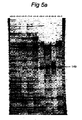
- AFLP fingerprints were generated with primer combinations with increasing numbers of selective nucleosides, for panels of 4 individuals (-, +, +, +; Fig 5A ). Primer extensions were chosen to generate fragment 149 as indicated. AFLP fingerprints show the complexity of AFLP reactions dependent on the number of selective nucleosides.
- AFLP reactions used as template for primer extension reactions were performed as described in example 3 using a biotinylated EcoRI -primer and one standard MseI-primer and biotinylated AFLP products were captured in streptavidin-coated microtiter plate wells (Labsystems, Helsinki, Finland. Subsequently, the primer extension reaction was performed on the bio-strand using all four 33P labeled ddNTPs and using a standard AFLP +6 primer, that had to be extended with a G.
- Primer Mse CTAAAT was used as detection step primer in +6+4 and +4+4 AFLP reactions on 6 individuals with three sample not having the fragment and three samples having the fragment in the order (-, +, -, +, +, -, Fig. 5B )
- Results show that a positive reaction only occurs if the targeted AFLP fragment is present and if primers according to the sequence information are extended with the appropriate nucleoside triphosphate.
- Minisequencing was explored as a method to detect AFLP fragments.
- Minisequencing using AFLP template can be applied as 1) a method to addresss sensitivity of minisequencing since the number of template fragments can easily be varied; 2) a non-random method for AFLP marker detection by using predetermined sequence information; 3) a random method for marker detection by using extended AFLP primers. So far, minisequencing as a method to detect AFLP fragments has been explored using predetermined sequence information for the design of detection primers, that were either extended AFLP primers, or internal detection primers.
- +6 primers do not detect unique fragments as was shown by determining the +6 sequences for the EcoRI-primer as well as for the MseI-primer for all fragments in 2 fingerprints generated with an EcoR1 +2 and a MseI +3 primer. The optimal number of selective nucleosides added to AFLP-primers when used as detection primers remains to be determined.
- AFLP reactions were carried out using increasing numbers of selective nucleosides for 3 AFLP markers ( Figs 6 and 7 ).
- Minisequencing to detect the 3 AFLP markers was applied following the protocol as described for minisequencing on ss template using the bio-strand. +6 AFLP primers were used as detection primers. It was shown that the maximum complexity of the template was dependent on the marker to be detected: for marker 1 this was +6+4 amplified template; for marker 2 this was +6+4 for marker 3 this was +2+3 amplified template. This implies a detection limit at 10 10 molecules, which is less sensitive than is claimed for detection on microarrays in gene expression studies (10 6 molecules).
- minisequencing was performed on ds template using a two-step PCR cycle profile: a denaturation step followed by the primer-elongation step: in this way template could be reused every cycle and the amount of signal generated by the elongated primer increased ( Fig. 8 ).
- This adaptation of the protocol is a time-saving step since there is no need to make single-stranded template before the minisequencing reaction.
- Detection primers were biotin-labeled to easily purify minisequencing reaction products as an alternative for amino-labeled detection primers on a solid support.
- the minisequencing protocol was improved by using dsDNA and performing minisequencing in a number of cycles to increase sensitivity of marker detection.
- Minisequencing can now be performed on glass slides, which is an important step towards multiplex detection of AFLP-and other markers on chips.
- the current sensitivity is similar to sensitivity of marker detection in AFLP using polyacrylamide gels. It is anticipated that by using new microarray and chip technology sensitivity of detection can be improved.
- EXAMPLE 8 The development of a fluorescent AFLP marker detection system.
- the biological materials used are rice lines IR20 and 6383.
- AFLP templates were prepared using the restriction enzymes EcoRI and MseI and preamplification reactions were carried out according to standard procedures described by Vos et al., (Nucleic Acids Research 23: no 21, pp. 4407-4414, 1995 ; and patent application EP0534858 ). Final selective amplification reactions were carried out from a 20-fold diluted +1/+1 preamplification mixture using an EcoRI selective +2 primer in combination with a MseI +3 primer.
- AFLP markers 1 through 5 were excised, reamplified and cloned. The colonies were amplified and AFLP templates were made, all according to standard procedures. Preamplification reactions were carried out using an EcoRI +0 primer in combination with a biotinylated Mse +0 primer. The DNA was purified with Shrimp Alkaline Phoshatase and Exonuclease I as refered to in Example 1.
- the sequences of the adapters, AFLP preamplification primers and (selective AFLP) amplification primers used are as follows:
- Oligonucleotide minisequencing detection primers were purchased from MWG- Biotech GmbH. They were 5' amino-modified and they have a poly T tail of 15 nucleotides at the 5' end.
- the sequences of the oligonucleotides are as follows:
- 3D-Link activated slides were used and processed according to the manufacturer's instructions. Oligonucleotide minisequencing detection primers were printed using a genetic microsystems QMS417 microarrayer at a concentration of 0.8 ⁇ g/ ⁇ l ( ⁇ 100 pmol/ ⁇ l) in 150 mM sodium phospate pH 8.5.
- the minisequencing reaction was carried out with 20 ⁇ l ss reaction of AFLP marker 1A1 in 10 mM TRIS-HCl pH 9.5, 50 mM KCI, 20 mM MgCl 2 , 0.02 % Tween-20, 2 ⁇ l 0.01 mM FAM ddATP, 4.5 units of Thermosequenase and water to a total volume of 40 ⁇ l.
- the reaction was incubated for 20 minutes at 55°C.
- the slides were then washed in 40 mM Tris pH 8.8, 1 mM EDTA, 50 mM NaCl, 0.1 % Tween-20.
- the slides were scanned at the FITC and Cy-3 channel for 180 sec using a Genetac 1000 microarray slide scanner (Genomic Solutions). The image is shown in Figure 10 .
- Oligonucleotide 99f41 can be extended by ddATP if the ss AFLP marker 1A1 is used. A strong signal is seen on position B3 where the oligo 99f41 is spotted after extension by minisequencing with FAM ddATP. In the duplo the strong signal is also seen. The spots in B1 and D9 are the positive control spots.
- This example demonstrates the specific detection of an AFLP marker by minisequencing on an array containing minisequencing detection primers for 7 different AFLP markers using a single ss AFLP marker fragment.
- EXAMPLE 9 The development of a radioactive AFLP marker detection system on a microchip.
- the minisequencing reaction was carried out with 1.25 ⁇ l ss reaction of AFLP marker 1A8,1.25 ⁇ l reaction of marker 1A11, 1.25 ⁇ l reaction of marker 1B1 and 1.25 ⁇ l reaction of marker 1G6 in 10 mM TRIS-HCl pH 9.5, 50 mM KCI, 20 mM MgCl 2 , 0.02 % Tween-20, 0.42 ⁇ l labeled 33 P ddATP (Amersham), 4.5 units of Thermosequenase and water to a total volume of 40 ⁇ l. The reaction was incubated for 20 ' at 55°.
- the slides were then washed in 40 mM Tris pH 8.8, 1 mM EDTA, 50 mM NaCl, 0.1 % Tween-20.
- the slides were exposed to Fuji phospho image screens for 16 hours. Patterns were visualized using an Fuji BAS-2000 phosho image analysis system. The image of the minisequencing reaction is shown in Figure 11 .
- Figure 11 shows a section of the slide containing the same oligonucleotides as described in Example 9. Oligonucleotides 99f42, 99f44 and 99f45 can be extended with ddATP if respectively ss AFLP reaction 1A8, 1A11 and 1B1 are used. Strong signals are seen at position B5 where oligo 99f42 is spotted, at position B9 where oligo 99f44 is spotted and at position D3 where oligo 99f45 is spotted. In the duplo the strong signals are also seen.
- the ss AFLP template 1 G6 had a strong signal on another section of the slide (not shown).
- This example demonstrates the specific detection of 3 AFLP markers by minisequencing on an array containing minisequencing detection primers for 7 different AFLP markers using a mixture of 4 different ss AFLP marker fragments.
Landscapes
- Chemical & Material Sciences (AREA)
- Organic Chemistry (AREA)
- Life Sciences & Earth Sciences (AREA)
- Zoology (AREA)
- Wood Science & Technology (AREA)
- Proteomics, Peptides & Aminoacids (AREA)
- Health & Medical Sciences (AREA)
- Engineering & Computer Science (AREA)
- Microbiology (AREA)
- Biochemistry (AREA)
- Physics & Mathematics (AREA)
- Molecular Biology (AREA)
- Biotechnology (AREA)
- Biophysics (AREA)
- Analytical Chemistry (AREA)
- Immunology (AREA)
- Bioinformatics & Cheminformatics (AREA)
- General Engineering & Computer Science (AREA)
- General Health & Medical Sciences (AREA)
- Genetics & Genomics (AREA)
- Chemical Kinetics & Catalysis (AREA)
- Measuring Or Testing Involving Enzymes Or Micro-Organisms (AREA)
- Application Of Or Painting With Fluid Materials (AREA)
Claims (12)
- Verfahren zum Analysieren einer AFLP-Reaktionsmischung auf die Gegenwart oder Abwesenheit von Zielrestriktionsfragmenten in einer Mischung aus Restriktionsfragmenten unter Verwendung von Oligonukleotidsequenzen, welche jeweils nur für ein Zielrestriktionsfragment spezifisch sind, wobei das Verfahren folgende Schritte umfasst,a) das in Kontakt bringen einer AFLP-Reaktionsmischung mit mindestens drei Oligonukleotidsequenzen unter Hybridisierungsbedingungen, so dass, wenn die Zielrestriktionsfragmente vorliegen, Hybride zwischen den Zielrestriktionsfragmenten und den Oligonukleotidsequenzen gebildet werden, so dass die entstehenden Hybride mindestens ein ungepaartes Nukleotid des Zielrestriktionsfragmentes direkt neben dem 3'-Ende der Oligonukleotidsequenz aufweisen;b) das Hinzufügen von mindestens einem gekennzeichneten Nukleotid oder einem Nukleotidanalog zu der Mischung resultierend aus Schritt a), unter Bedingungen, die für die Erweiterung der Oligonukleotide geeignet sind, so dass, wenn die Hybride vorliegen, die Oligonukleotide mit dem gekennzeichneten Oligonukleotid oder dem Nukleotidanalog erweitert werden; undc) das Erkennen der Gegenwart oder Abwesenheit von einem beliebigen Hybrid mit einem hinzugefügten gekennzeichneten Nukleotid oder Nukleotidanalog und/oder einer Oligonukleotidsequenz mit einem hinzugefügten gekennzeichneten Nukleotid oder Nukleotidanalog.
- Verfahren nach Anspruch 1, wobei jedes der Oligonukleotide mindestens 90% Sequenzhomologie mit dem Teil des Zielrestriktionsfragmentes aufweist, für welchen das Oligonukleotid spezifisch ist.
- Verfahren nach einem der vorhergehenden Ansprüche, wobei während des Schrittes b) die Oligonukleotidsequenzen durch ein einzelnes gekennzeichnetes Nukleotid oder Nukleotidanalog erweitert werden.
- Verfahren nach einem der vorhergehenden Ansprüche, wobei während des Schrittes a) die AFLP-Reaktionsmischung gleichzeitig mit mindestens 10, bevorzugter mindestens 50, am bevorzugtesten mindestens 100 unterschiedlichen Oligonukleotidsequenzen in Kontakt gebracht wird, wobei jede Oligonukleotidsequenz nur für ein Zielrestriktionsfragment spezifisch ist.
- Verfahren nach einem der vorhergehenden Ansprüche, wobei die Oligonukleotidsequenzen eine Größe von etwa 10 bis 100 Basenpaaren, bevorzugt etwa 20 bis 50 Basenpaaren aufweisen und optional einen "Schwanz" enthalten, wie etwa eine Poly-T-Sequenz.
- Verfahren nach einem der vorhergehenden Ansprüche, wobei die Oligonukleotidsequenzen auf einem festen Träger, bevorzugt in Form eines Arrays, immobilisiert sind.
- Verfahren nach einem der vorhergehenden Ansprüche, wobei die AFLP-Reaktionsmischung durch Restriktion der DNA mit mindestens einem, und bevorzugt mit zwei Restriktionsenzymen, und bevorzugter mit mindestens einem selten-schneidenden Restriktionsenzym und mindestens einem häufig-schneidenden Restriktionsenzym, optional gefolgt von einer Adapterligation und Amplifikation der Restriktionsfragmente, erhalten wird/zu erhalten ist.
- Verfahren nach einem der vorhergehenden Ansprüche, wobei nach der Restriktion, jedoch vor Schritt a), die AFLP-Reaktionsmischung unter Verwendung von AFLP-Primern amplifiziert wurde.
- Verfahren nach Anspruch 8, wobei die AFLP-Reaktionsmischung unter Verwendung von AFLP-Primern amplifiziert wurde, welche ein oder mehrere selektive Nukleotide am 3'-Ende umfassen.
- Verfahren nach einem der vorhergehenden Ansprüche, wobei das Zielrestriktionsfragment einem AFLP-Marker entspricht.
- Verfahren nach Anspruch 1, wobei die gleiche/n Reaktionspuffer, Salzstärke, Temperatur und Reaktionsdauer für die Hybridisierung von Schritt a) und für die Oligonukleotiderweiterung von Schritt b) verwendet werden.
- Verfahren nach einem der vorhergehenden Ansprüche, wobei Schritt b) durch das in Kontakt bringen der Hybride mit einer Reaktionsmischung, welche ein gekennzeichnetes Nukleotid oder Nukleotidanalog umfasst, welches nur zu einem aus A, T, C oder G komplementär ist, durchgeführt wird.
Priority Applications (1)
| Application Number | Priority Date | Filing Date | Title |
|---|---|---|---|
| EP00921163A EP1175512B1 (de) | 1999-04-09 | 2000-04-10 | Verfahren zur Analyse von AFLP Reaktionsmischungen unter Verwendung von Primer Verlängerungstechniken |
Applications Claiming Priority (4)
| Application Number | Priority Date | Filing Date | Title |
|---|---|---|---|
| EP99201112 | 1999-04-09 | ||
| EP99201112 | 1999-04-10 | ||
| PCT/NL2000/000234 WO2000061800A2 (en) | 1999-04-09 | 2000-04-10 | Method for the analysis of aflp® reaction mixtures using primer extension techniques |
| EP00921163A EP1175512B1 (de) | 1999-04-09 | 2000-04-10 | Verfahren zur Analyse von AFLP Reaktionsmischungen unter Verwendung von Primer Verlängerungstechniken |
Publications (2)
| Publication Number | Publication Date |
|---|---|
| EP1175512A2 EP1175512A2 (de) | 2002-01-30 |
| EP1175512B1 true EP1175512B1 (de) | 2008-02-20 |
Family
ID=8240081
Family Applications (2)
| Application Number | Title | Priority Date | Filing Date |
|---|---|---|---|
| EP00921164A Expired - Lifetime EP1173612B1 (de) | 1999-04-09 | 2000-04-10 | Verfahren zur erkennung und/oder analyse, unter verwendung von primertechniken, von einfachen nukleotidpolymorphismen in restriktionsfragmenten speziell aus amplifizierten restriktionsfragmenten generiert durch aflp |
| EP00921163A Expired - Lifetime EP1175512B1 (de) | 1999-04-09 | 2000-04-10 | Verfahren zur Analyse von AFLP Reaktionsmischungen unter Verwendung von Primer Verlängerungstechniken |
Family Applications Before (1)
| Application Number | Title | Priority Date | Filing Date |
|---|---|---|---|
| EP00921164A Expired - Lifetime EP1173612B1 (de) | 1999-04-09 | 2000-04-10 | Verfahren zur erkennung und/oder analyse, unter verwendung von primertechniken, von einfachen nukleotidpolymorphismen in restriktionsfragmenten speziell aus amplifizierten restriktionsfragmenten generiert durch aflp |
Country Status (8)
| Country | Link |
|---|---|
| US (1) | US7169552B1 (de) |
| EP (2) | EP1173612B1 (de) |
| AT (2) | ATE278034T1 (de) |
| AU (2) | AU773854B2 (de) |
| CA (2) | CA2366374C (de) |
| DE (2) | DE60038109T2 (de) |
| ES (1) | ES2298139T3 (de) |
| WO (2) | WO2000061801A2 (de) |
Families Citing this family (17)
| Publication number | Priority date | Publication date | Assignee | Title |
|---|---|---|---|---|
| CA2366374C (en) * | 1999-04-09 | 2009-09-22 | Keygene N.V. | Method for the detection and/or analysis, by means of primer extension techniques, of single nucleotide polymorphisms in restriction fragments, in particular in amplified restriction fragments generated using aflp |
| US6596487B2 (en) | 2000-03-10 | 2003-07-22 | Ana-Gen Technologies, Inc. | Mutation detection using denaturing gradients |
| FR2806419A1 (fr) * | 2000-03-14 | 2001-09-21 | Limagrain Sa | Sequence d'acide nucleique constituant des marqueurs de l'androgenese vegetale |
| JP2004526453A (ja) * | 2001-04-16 | 2004-09-02 | アプレラ コーポレイション | ヌクレオチド分析のための方法および組成物 |
| DE10245145B4 (de) * | 2002-09-27 | 2004-12-02 | IPK-Institut für Pflanzengenetik und Kulturpflanzenforschung | Verfahren zum Nachweis von SNPs auf polydimensionalen Microarrays |
| EP1636337A4 (de) | 2003-06-20 | 2007-07-04 | Illumina Inc | Verfahren und zusammensetzungen zur ganzgenomischen amplifikation und genotypisierung |
| DE602006013831D1 (de) * | 2005-06-23 | 2010-06-02 | Keygene Nv | Verbesserte strategien zur sequenzierung komplexer genome unter verwendung von sequenziertechniken mit hohem durchsatz |
| CN105039313B (zh) | 2005-06-23 | 2018-10-23 | 科因股份有限公司 | 用于多态性的高通量鉴定和检测的策略 |
| US10316364B2 (en) | 2005-09-29 | 2019-06-11 | Keygene N.V. | Method for identifying the source of an amplicon |
| CA2910861C (en) | 2005-09-29 | 2018-08-07 | Michael Josephus Theresia Van Eijk | High throughput screening of mutagenized populations |
| JP5452021B2 (ja) | 2005-12-22 | 2014-03-26 | キージーン ナムローゼ フェンノートシャップ | ハイスループットaflp系多型検出法 |
| ES2301342B1 (es) * | 2006-03-14 | 2009-05-01 | Oryzon Genomics, S.A. | "metodo de analisis de acidos nucleicos". |
| US20090253581A1 (en) | 2006-04-04 | 2009-10-08 | Keygene N.V. | High Throughput Detection of Molecular Markers Based on AFLP and High Throughput Sequencing |
| DE102007010311A1 (de) * | 2007-02-23 | 2008-08-28 | Thines, Marco, Dr. | Organismusspezifisches hybridisierbares Nucleinsäuremolekül |
| JP5526556B2 (ja) * | 2008-02-28 | 2014-06-18 | 株式会社リコー | トナー、並びに現像剤、プロセスカートリッジ、画像形成装置、及び画像形成方法 |
| US20090253121A1 (en) * | 2008-04-04 | 2009-10-08 | Micah Halpern | Method for amt-rflp dna fingerprinting |
| EP3577233B1 (de) | 2017-03-31 | 2021-07-14 | Marcella Chiari | Genotypisierung von mutationen durch kombination von in-tube-hybridisierung und universellem tag-mikroarray |
Family Cites Families (19)
| Publication number | Priority date | Publication date | Assignee | Title |
|---|---|---|---|---|
| AU3694689A (en) * | 1988-04-28 | 1989-11-24 | Mark H. Skolnick | Amplified sequence polymorphisms (asps) |
| AU656514B2 (en) * | 1989-02-13 | 1995-02-09 | Geneco Pty Ltd | Detection of a nucleic acid sequence or a change therein |
| US5547839A (en) * | 1989-06-07 | 1996-08-20 | Affymax Technologies N.V. | Sequencing of surface immobilized polymers utilizing microflourescence detection |
| HU223760B1 (hu) * | 1991-09-24 | 2005-01-28 | Keygene N.V. | Szelektív restrikciós fragmentumsokszorosítás, általános módszer DNS-fingerprint analízisére |
| WO1993025563A1 (en) * | 1992-06-17 | 1993-12-23 | City Of Hope | A method of detecting and discriminating between nucleic acid sequences |
| DE69531542T2 (de) * | 1994-02-07 | 2004-06-24 | Beckman Coulter, Inc., Fullerton | Ligase/polymerase-vermittelte analyse genetischer elemente von einzelnukleotid-polymorphismen und ihre verwendung in der genetischen analyse |
| EP0804618B1 (de) | 1994-11-28 | 1999-01-27 | E.I. Du Pont De Nemours And Company | Mikrosatelliteverbindung für detektion genetisches polymorphismen |
| EP0721987A1 (de) * | 1995-01-16 | 1996-07-17 | Keygene N.V. | Amplifikation von einfachen Sequenz-Wiederholungen |
| GB9507238D0 (en) * | 1995-04-07 | 1995-05-31 | Isis Innovation | Detecting dna sequence variations |
| JP2002515738A (ja) * | 1996-01-23 | 2002-05-28 | アフィメトリックス,インコーポレイティド | 核酸分析法 |
| AU2264197A (en) | 1996-02-09 | 1997-08-28 | Government Of The United States Of America, As Represented By The Secretary Of The Department Of Health And Human Services, The | Restriction display (rd-pcr) of differentially expressed mrnas |
| AUPO427996A0 (en) | 1996-12-20 | 1997-01-23 | Co-Operative Research Centre For Diagnostic Technologies | Method for detecting a nucleotide at a specific location within a polynucleotide sequence and apparatus therefor |
| US6100030A (en) * | 1997-01-10 | 2000-08-08 | Pioneer Hi-Bred International, Inc. | Use of selective DNA fragment amplification products for hybridization-based genetic fingerprinting, marker assisted selection, and high-throughput screening |
| EP1498494A3 (de) * | 1997-04-01 | 2007-06-20 | Solexa Ltd. | Methode zur Sequenzierung von Nukleinsäuren |
| WO1998059066A1 (en) * | 1997-06-25 | 1998-12-30 | Orchid Biocomputer, Inc. | Methods for the detection of multiple single nucleotide polymorphisms in a single reaction |
| WO1999005321A1 (en) * | 1997-07-22 | 1999-02-04 | Rapigene, Inc. | Amplification and other enzymatic reactions performed on nucleic acid arrays |
| WO1999008321A1 (en) | 1997-08-07 | 1999-02-18 | Matsushita Electric Works, Ltd. | Epoxy resin sealing material for molding semiconductor chip and method for manufacturing the same |
| JP2002532070A (ja) | 1998-12-04 | 2002-10-02 | ケイゲーネ エヌブイ | 核酸配列を解析するためのアレイおよび方法 |
| CA2366374C (en) * | 1999-04-09 | 2009-09-22 | Keygene N.V. | Method for the detection and/or analysis, by means of primer extension techniques, of single nucleotide polymorphisms in restriction fragments, in particular in amplified restriction fragments generated using aflp |
-
2000
- 2000-04-10 CA CA002366374A patent/CA2366374C/en not_active Expired - Fee Related
- 2000-04-10 DE DE60038109T patent/DE60038109T2/de not_active Expired - Fee Related
- 2000-04-10 EP EP00921164A patent/EP1173612B1/de not_active Expired - Lifetime
- 2000-04-10 DE DE60014350T patent/DE60014350T2/de not_active Expired - Lifetime
- 2000-04-10 AU AU41509/00A patent/AU773854B2/en not_active Ceased
- 2000-04-10 US US09/958,345 patent/US7169552B1/en not_active Expired - Fee Related
- 2000-04-10 AT AT00921164T patent/ATE278034T1/de not_active IP Right Cessation
- 2000-04-10 WO PCT/NL2000/000235 patent/WO2000061801A2/en not_active Ceased
- 2000-04-10 EP EP00921163A patent/EP1175512B1/de not_active Expired - Lifetime
- 2000-04-10 AT AT00921163T patent/ATE386819T1/de not_active IP Right Cessation
- 2000-04-10 AU AU41508/00A patent/AU773855B2/en not_active Ceased
- 2000-04-10 ES ES00921163T patent/ES2298139T3/es not_active Expired - Lifetime
- 2000-04-10 CA CA002366365A patent/CA2366365A1/en not_active Abandoned
- 2000-04-10 WO PCT/NL2000/000234 patent/WO2000061800A2/en not_active Ceased
Also Published As
| Publication number | Publication date |
|---|---|
| CA2366374C (en) | 2009-09-22 |
| ATE386819T1 (de) | 2008-03-15 |
| DE60038109T2 (de) | 2008-11-27 |
| DE60014350T2 (de) | 2005-10-13 |
| WO2000061800A2 (en) | 2000-10-19 |
| AU4150900A (en) | 2000-11-14 |
| ATE278034T1 (de) | 2004-10-15 |
| WO2000061800A3 (en) | 2001-03-15 |
| CA2366365A1 (en) | 2000-10-19 |
| ES2298139T3 (es) | 2008-05-16 |
| CA2366374A1 (en) | 2000-10-19 |
| DE60038109D1 (de) | 2008-04-03 |
| AU773854B2 (en) | 2004-06-10 |
| AU4150800A (en) | 2000-11-14 |
| WO2000061801A3 (en) | 2001-03-01 |
| EP1173612A2 (de) | 2002-01-23 |
| US7169552B1 (en) | 2007-01-30 |
| DE60014350D1 (de) | 2004-11-04 |
| WO2000061801A2 (en) | 2000-10-19 |
| EP1173612B1 (de) | 2004-09-29 |
| EP1175512A2 (de) | 2002-01-30 |
| WO2000061800A8 (en) | 2002-05-30 |
| AU773855B2 (en) | 2004-06-10 |
Similar Documents
| Publication | Publication Date | Title |
|---|---|---|
| US6156502A (en) | Arbitrary sequence oligonucleotide fingerprinting | |
| US7414115B2 (en) | Length determination of nucleic acid repeat sequences by discontinuous primer extension | |
| EP1453978B9 (de) | Analyse und detektion von mehreren zielsequenzen unter verwendung von zirkulären proben | |
| AU773855B2 (en) | Method for the analysis of AFLP reaction mixtures using primer extension techniques | |
| US20030082576A1 (en) | High throughput polymorphism screening | |
| US20070172873A1 (en) | Molecular counting | |
| EP1613773B1 (de) | Methode zur charakterisierung von nukleinsäuren | |
| CN101142325A (zh) | 制备用于分析的多核苷酸的方法 | |
| JP2003521252A (ja) | ユニバーサルプライミングを用いる核酸検出方法 | |
| AU8162498A (en) | Methods for the detection of multiple single nucleotide polymorphisms in a single reaction | |
| WO2000058516A2 (en) | Universal arrays | |
| EP1602733A1 (de) | Nachweis von Zielnukleotidsequenzen unter Verwendung eines asymmetrischen Oligonudkleotid-Ligation-Verfahrens | |
| EP1631681A2 (de) | Verfahren für die identifizierung von molekulären merkmahle mittels ihre konverzion zu einer polinukleotid sequenz | |
| JP2018000057A (ja) | Dnaプローブの作製方法及びdnaプローブを用いたゲノムdna解析方法 | |
| IE83464B1 (en) | Process for amplifying and detecting nucleic acid sequences |
Legal Events
| Date | Code | Title | Description |
|---|---|---|---|
| PUAI | Public reference made under article 153(3) epc to a published international application that has entered the european phase |
Free format text: ORIGINAL CODE: 0009012 |
|
| 17P | Request for examination filed |
Effective date: 20011009 |
|
| AK | Designated contracting states |
Kind code of ref document: A2 Designated state(s): AT BE CH CY DE DK ES FI FR GB GR IE IT LI LU MC NL PT SE |
|
| AX | Request for extension of the european patent |
Free format text: AL;LT;LV;MK;RO;SI |
|
| 17Q | First examination report despatched |
Effective date: 20050414 |
|
| 17Q | First examination report despatched |
Effective date: 20050414 |
|
| GRAP | Despatch of communication of intention to grant a patent |
Free format text: ORIGINAL CODE: EPIDOSNIGR1 |
|
| RTI1 | Title (correction) |
Free format text: METHOD FOR THE ANALYSIS OF AFLP REACTION MIXTURES USING PRIMER EXTENSION TECHNIQUES |
|
| GRAS | Grant fee paid |
Free format text: ORIGINAL CODE: EPIDOSNIGR3 |
|
| GRAJ | Information related to disapproval of communication of intention to grant by the applicant or resumption of examination proceedings by the epo deleted |
Free format text: ORIGINAL CODE: EPIDOSDIGR1 |
|
| GRAL | Information related to payment of fee for publishing/printing deleted |
Free format text: ORIGINAL CODE: EPIDOSDIGR3 |
|
| GRAP | Despatch of communication of intention to grant a patent |
Free format text: ORIGINAL CODE: EPIDOSNIGR1 |
|
| GRAJ | Information related to disapproval of communication of intention to grant by the applicant or resumption of examination proceedings by the epo deleted |
Free format text: ORIGINAL CODE: EPIDOSDIGR1 |
|
| GRAP | Despatch of communication of intention to grant a patent |
Free format text: ORIGINAL CODE: EPIDOSNIGR1 |
|
| GRAS | Grant fee paid |
Free format text: ORIGINAL CODE: EPIDOSNIGR3 |
|
| GRAA | (expected) grant |
Free format text: ORIGINAL CODE: 0009210 |
|
| AK | Designated contracting states |
Kind code of ref document: B1 Designated state(s): AT BE CH CY DE DK ES FI FR GB GR IE IT LI LU MC NL PT SE |
|
| REG | Reference to a national code |
Ref country code: GB Ref legal event code: FG4D |
|
| REG | Reference to a national code |
Ref country code: CH Ref legal event code: EP |
|
| REG | Reference to a national code |
Ref country code: IE Ref legal event code: FG4D |
|
| REF | Corresponds to: |
Ref document number: 60038109 Country of ref document: DE Date of ref document: 20080403 Kind code of ref document: P |
|
| REG | Reference to a national code |
Ref country code: ES Ref legal event code: FG2A Ref document number: 2298139 Country of ref document: ES Kind code of ref document: T3 |
|
| REG | Reference to a national code |
Ref country code: CH Ref legal event code: NV Representative=s name: BUGNION S.A. |
|
| PG25 | Lapsed in a contracting state [announced via postgrant information from national office to epo] |
Ref country code: FI Free format text: LAPSE BECAUSE OF FAILURE TO SUBMIT A TRANSLATION OF THE DESCRIPTION OR TO PAY THE FEE WITHIN THE PRESCRIBED TIME-LIMIT Effective date: 20080220 |
|
| PG25 | Lapsed in a contracting state [announced via postgrant information from national office to epo] |
Ref country code: AT Free format text: LAPSE BECAUSE OF FAILURE TO SUBMIT A TRANSLATION OF THE DESCRIPTION OR TO PAY THE FEE WITHIN THE PRESCRIBED TIME-LIMIT Effective date: 20080220 |
|
| ET | Fr: translation filed | ||
| PG25 | Lapsed in a contracting state [announced via postgrant information from national office to epo] |
Ref country code: SE Free format text: LAPSE BECAUSE OF FAILURE TO SUBMIT A TRANSLATION OF THE DESCRIPTION OR TO PAY THE FEE WITHIN THE PRESCRIBED TIME-LIMIT Effective date: 20080520 Ref country code: PT Free format text: LAPSE BECAUSE OF FAILURE TO SUBMIT A TRANSLATION OF THE DESCRIPTION OR TO PAY THE FEE WITHIN THE PRESCRIBED TIME-LIMIT Effective date: 20080721 Ref country code: DK Free format text: LAPSE BECAUSE OF FAILURE TO SUBMIT A TRANSLATION OF THE DESCRIPTION OR TO PAY THE FEE WITHIN THE PRESCRIBED TIME-LIMIT Effective date: 20080220 |
|
| PG25 | Lapsed in a contracting state [announced via postgrant information from national office to epo] |
Ref country code: MC Free format text: LAPSE BECAUSE OF NON-PAYMENT OF DUE FEES Effective date: 20080430 |
|
| PLBE | No opposition filed within time limit |
Free format text: ORIGINAL CODE: 0009261 |
|
| STAA | Information on the status of an ep patent application or granted ep patent |
Free format text: STATUS: NO OPPOSITION FILED WITHIN TIME LIMIT |
|
| 26N | No opposition filed |
Effective date: 20081121 |
|
| PG25 | Lapsed in a contracting state [announced via postgrant information from national office to epo] |
Ref country code: IE Free format text: LAPSE BECAUSE OF NON-PAYMENT OF DUE FEES Effective date: 20080410 |
|
| PG25 | Lapsed in a contracting state [announced via postgrant information from national office to epo] |
Ref country code: CY Free format text: LAPSE BECAUSE OF FAILURE TO SUBMIT A TRANSLATION OF THE DESCRIPTION OR TO PAY THE FEE WITHIN THE PRESCRIBED TIME-LIMIT Effective date: 20080220 |
|
| PGFP | Annual fee paid to national office [announced via postgrant information from national office to epo] |
Ref country code: ES Payment date: 20090415 Year of fee payment: 10 |
|
| PG25 | Lapsed in a contracting state [announced via postgrant information from national office to epo] |
Ref country code: IT Free format text: LAPSE BECAUSE OF FAILURE TO SUBMIT A TRANSLATION OF THE DESCRIPTION OR TO PAY THE FEE WITHIN THE PRESCRIBED TIME-LIMIT Effective date: 20080220 |
|
| PGFP | Annual fee paid to national office [announced via postgrant information from national office to epo] |
Ref country code: DE Payment date: 20090423 Year of fee payment: 10 Ref country code: NL Payment date: 20090424 Year of fee payment: 10 |
|
| PG25 | Lapsed in a contracting state [announced via postgrant information from national office to epo] |
Ref country code: LU Free format text: LAPSE BECAUSE OF NON-PAYMENT OF DUE FEES Effective date: 20080410 |
|
| PGFP | Annual fee paid to national office [announced via postgrant information from national office to epo] |
Ref country code: FR Payment date: 20100428 Year of fee payment: 11 |
|
| PG25 | Lapsed in a contracting state [announced via postgrant information from national office to epo] |
Ref country code: GR Free format text: LAPSE BECAUSE OF FAILURE TO SUBMIT A TRANSLATION OF THE DESCRIPTION OR TO PAY THE FEE WITHIN THE PRESCRIBED TIME-LIMIT Effective date: 20080521 |
|
| PGFP | Annual fee paid to national office [announced via postgrant information from national office to epo] |
Ref country code: CH Payment date: 20100512 Year of fee payment: 11 Ref country code: BE Payment date: 20100419 Year of fee payment: 11 |
|
| REG | Reference to a national code |
Ref country code: NL Ref legal event code: V1 Effective date: 20101101 |
|
| PGFP | Annual fee paid to national office [announced via postgrant information from national office to epo] |
Ref country code: GB Payment date: 20100406 Year of fee payment: 11 |
|
| PG25 | Lapsed in a contracting state [announced via postgrant information from national office to epo] |
Ref country code: NL Free format text: LAPSE BECAUSE OF NON-PAYMENT OF DUE FEES Effective date: 20101101 |
|
| PG25 | Lapsed in a contracting state [announced via postgrant information from national office to epo] |
Ref country code: DE Free format text: LAPSE BECAUSE OF NON-PAYMENT OF DUE FEES Effective date: 20101103 |
|
| REG | Reference to a national code |
Ref country code: ES Ref legal event code: FD2A Effective date: 20110714 |
|
| PG25 | Lapsed in a contracting state [announced via postgrant information from national office to epo] |
Ref country code: ES Free format text: LAPSE BECAUSE OF NON-PAYMENT OF DUE FEES Effective date: 20110704 |
|
| PG25 | Lapsed in a contracting state [announced via postgrant information from national office to epo] |
Ref country code: ES Free format text: LAPSE BECAUSE OF NON-PAYMENT OF DUE FEES Effective date: 20100411 |
|
| BERE | Be: lapsed |
Owner name: KEYGENE N.V. Effective date: 20110430 |
|
| REG | Reference to a national code |
Ref country code: CH Ref legal event code: PL |
|
| GBPC | Gb: european patent ceased through non-payment of renewal fee |
Effective date: 20110410 |
|
| REG | Reference to a national code |
Ref country code: FR Ref legal event code: ST Effective date: 20111230 |
|
| PG25 | Lapsed in a contracting state [announced via postgrant information from national office to epo] |
Ref country code: CH Free format text: LAPSE BECAUSE OF NON-PAYMENT OF DUE FEES Effective date: 20110430 Ref country code: BE Free format text: LAPSE BECAUSE OF NON-PAYMENT OF DUE FEES Effective date: 20110430 Ref country code: FR Free format text: LAPSE BECAUSE OF NON-PAYMENT OF DUE FEES Effective date: 20110502 Ref country code: LI Free format text: LAPSE BECAUSE OF NON-PAYMENT OF DUE FEES Effective date: 20110430 |
|
| PG25 | Lapsed in a contracting state [announced via postgrant information from national office to epo] |
Ref country code: GB Free format text: LAPSE BECAUSE OF NON-PAYMENT OF DUE FEES Effective date: 20110410 |