EP1176516A2 - Rechnereinrichtung von einer rekursiven, diskreten Fourier-Transformation - Google Patents
Rechnereinrichtung von einer rekursiven, diskreten Fourier-Transformation Download PDFInfo
- Publication number
- EP1176516A2 EP1176516A2 EP01116721A EP01116721A EP1176516A2 EP 1176516 A2 EP1176516 A2 EP 1176516A2 EP 01116721 A EP01116721 A EP 01116721A EP 01116721 A EP01116721 A EP 01116721A EP 1176516 A2 EP1176516 A2 EP 1176516A2
- Authority
- EP
- European Patent Office
- Prior art keywords
- data
- supplied
- signal
- fourier transformation
- recursive
- Prior art date
- Legal status (The legal status is an assumption and is not a legal conclusion. Google has not performed a legal analysis and makes no representation as to the accuracy of the status listed.)
- Withdrawn
Links
Images




Classifications
-
- G—PHYSICS
- G06—COMPUTING OR CALCULATING; COUNTING
- G06F—ELECTRIC DIGITAL DATA PROCESSING
- G06F17/00—Digital computing or data processing equipment or methods, specially adapted for specific functions
- G06F17/10—Complex mathematical operations
- G06F17/14—Fourier, Walsh or analogous domain transformations, e.g. Laplace, Hilbert, Karhunen-Loeve, transforms
- G06F17/141—Discrete Fourier transforms
- G06F17/142—Fast Fourier transforms, e.g. using a Cooley-Tukey type algorithm
-
- G—PHYSICS
- G06—COMPUTING OR CALCULATING; COUNTING
- G06F—ELECTRIC DIGITAL DATA PROCESSING
- G06F17/00—Digital computing or data processing equipment or methods, specially adapted for specific functions
- G06F17/10—Complex mathematical operations
- G06F17/14—Fourier, Walsh or analogous domain transformations, e.g. Laplace, Hilbert, Karhunen-Loeve, transforms
- G06F17/141—Discrete Fourier transforms
Definitions
- the present invention relates to an arithmetic operation apparatus for Fourier transformation and more particularly to an arithmetic operation apparatus for carrying out Fourier transformation with simple arithmetic processing so as to obtain an operation result of Fourier transformation in a short time.
- the Fourier transformation method used in frequency analysis and the like of time-series data stream has been employed in high compression encoding of audio signal and moving picture signal as well as spectrum analysis of signals in audio signal processing field, moving picture data processing field for medical system and the like. Further, the Fourier transformation method has been widely used as modulation technology and demodulation technology in communication field.
- data stream sampled as digital amount is treated as N groups (N is an integer, for example, 1024) and a time interval, in which the N-data stream exist, is assumed as a window period while that window period is assumed to be basic frequency. Then, signal components of data stream existing in the window period are obtained as real part and imaginary part of a harmonic signal of the basic frequency.
- DFT discrete Fourier transformation
- supplied signals are sampled at every predetermined time interval and a voltage value obtained by the sampling is obtained as sampled data.
- the data stream which is a group of the obtained data, is N data obtained in a predetermined time t, x(t), x(t+1), x(t+2), ..., x(t+N-2), x(t+N-1), a value x (k, t) of the discrete Fourier transformation obtained with respect to the N data is defined in a following equation.
- the Fourier transformation is carried out on supplied data stream just such that its inherent basic function is convoluted in every point to be obtained and an operation for convoluting the basic function is conducted by a plurality of multiplication processings.
- a transformation equation expressed with the aforementioned equation (1) needs multiplications of 4 ⁇ N 2 times, so that in case where N is 1024, for example, the multiplication frequency is about 4,200,000 times. Therefore, the load of the arithmetic operation is very large and further, if the number N of points to be handled as the data stream is increased, the multiplication processing frequency is increased by second power, which is unfavorable in terms of actual field.
- FFT fast Fourier transformation
- butterfly operation An arithmetic operation method called butterfly operation is employed for the FFT.
- the butterfly operation is so constructed that a simple integer, for example, 2 is defined as a basic number and supplied binary complex data is subjected to complex operation comprised of a single addition, subtraction and multiplication each so as to output binary complex data.
- the N-point FFT is comprised of log 2 N-step stage and (N/2)log 2 N butterfly operations and an operation result of the FFT can be obtained depending on the number of multiplications of (2N)log 2 N times. Consequently, the N-point FFT is used as a Fourier transformation method ensuring a high operating efficiency.
- the FFT or discrete Fourier transformation is used in such a manner, so that data stream, sampled successively at a predetermined time interval and then supplied, is subjected to Fourier transformation.
- the sampled data stream is stored in a memory circuit in succession temporarily and when the number of data stored in the memory circuit temporarily reaches N, the Fourier transformation processing for that N data is started.
- a memory circuit for storing N data streams is provided as another system and each time when N data is supplied, temporary storage processing and arithmetic operation are carried out alternately and Fourier transformation processing is carried out continuously on time-series data.
- the Fourier transformation conducts arithmetic operation processing on N temporarily stored data streams while handling the data stream as a block unit, a delay time corresponding to at least N data is generated in such Fourier transformation processing, so that any transformation processing result cannot be obtained at real time.
- FFT arithmetic operation processing method In Fourier transformation, generally, FFT arithmetic operation processing method is employed. Usually, the FFT arithmetic operation processing is carried out on N-point data stream supplied by quantitizing sampling frequency with fs at a frequency interval of fs/N.
- this method employs block processing method, in which N supplied time-series data are handled in batch, a result of the Fourier transformation to the fetched N-point data is not outputted until N sampling time passes. As an analysis result obtained at that time, only a result of the Fourier transformation processing on every N samples is outputted.
- the result of the Fourier transformation on the newest N-point data containing data sampled successively and supplied cannot be outputted at real time.
- the Fourier transformation processing at every sampling period is necessary to output the result of the transformation at real time.
- the Fourier transformation is carried out continuously at every sampling time interval, the amount of arithmetic operation per unit time is enormously increased, which is a not realistic method.
- This publication describes a method for Fourier-transforming a vibration waveform value sampled and supplied. According to the same method, a difference between a newly supplied vibration waveform value and an old vibration waveform value already supplied and used for Fourier transformation processing is obtained and a newer complex vibration value than the old complex vibration value provided by the arithmetic operation is obtained each time when a sampling value of the vibration waveform is supplied.
- frequency analysis may be considered, if such application is taken into account, any frequency band is required to be analyzed at any resolution.
- Japanese Patent Application Laid-Open No. H3-63875 has disclosed "A computation method for discrete Fourier transformation using cyclic technology", in which discrete Fourier transformation for carrying out energy spectrum calculation with an ultrasonic diagnosis apparatus is described.
- the same publication describes discrete Fourier transformation, which continuously computes using a sample data file by cyclic filter operation.
- this invention has described the method for achieving a circuit to be configured with complex data as input, it has not considered a cyclic Fourier transformation method having a simple structure, in which only real-part signals are supplied to transform signals supplied as time-series data for use in frequency analysis.
- an object of the present invention is to provide a recursive discrete Fourier transformation device in which Fourier analysis is configured for supplied real-part signals in a simple way, and more particularly, a recursive discrete Fourier transformation device suitable for frequency analysis to be executed at any desired resolution in any desired frequency band.
- a recursive discrete Fourier transformation device wherein data values x(t), x(t+1), x(t+2), x(t+3), ..., x(t+N-1), x(t+N) sampled at times t, t+1, t+2, t+3, ..., t+N-1, t+N (N is a positive integer which is 1 or more) each having an equal interval are supplied and as complex Fourier coefficients under degree k (k is 0 or a positive integer smaller than N) obtained by, with such N data values supplied since time t as a data stream, carrying out complex Fourier transformation on the data stream, a real part X r (k, t) and an imaginary part X i (k, t) are obtained, the discrete Fourier transformation device comprising: a first temporary storage means for storing the data stream x(t), x(t+1), x(t+2), x(t+3), ...
- data stream comprised of supplied N samples is subjected to complex Fourier transformation and then, the oldest sample value used for complex Fourier transformation is subtracted from the value of a new sample to be supplied next so as to obtain a subtraction value.
- discrete Fourier arithmetic operation result on new N samples, which are renewed by each sample can be obtained based on that subtraction value and the result of the complex Fourier operation.
- the positive constant value A for providing with an amplitude corresponding to a difference between the x(t+N) and the x(t) can be set selectively with 1, square root of N or 1/N.
- the operation can be carried out by FFT in which the positive constant value A is set up by selecting appropriately 1, N or a square root of N.
- FFT inverse fast Fourier transformation
- the constant value A corresponding to the constant value a which is, for example, 1, N or the square root of N used for the IFFT operation, is employed in the FFT operation processing circuit, so as to construct the FFT which operates in a complementary way with the IFFT to decode the information signal.
- a recursive discrete Fourier transformation device wherein datavaluesx(t), x(t+1), x(t+2), x(t+3), ..., x(t+N-1), x(t+N) sampled at times t, t+1, t+2, t+3, ..., t+N-1, t+N (N is a positive integer which is 1 or more) each having an equal interval are supplied and as complex Fourier coefficients under degree k (k is 0 or a positive integer smaller than N) obtained by, with such N data values supplied since time t as a data stream, carrying out complex Fourier transformation on the data stream, a real part X r (k, t) and an imaginary part X i (k, t) are obtained, the discrete Fourier transformation device comprising: a first temporary storage means for storing the data stream x(t), x(t+1), x(t+2), x(t+3),
- data stream comprised of suppliedN samples is subjected to complex Fourier transformation and then, by carrying out arithmetic operation according to a predetermined equation based on a value of a new sample supplied next, the oldest sample value used for complex Fourier transformation and a result of the already obtained complex Fourier operation result, discrete Fourier operation result on new N samples, which are renewed by each sample, can be obtained.
- a recursive Fourier transformation device which obtains a result of fast Fourier operation on points N so as to provide with an analysis resolution necessary in a sample period.
- the positive constant value A for providing with an amplitude corresponding to a difference between the x(t+N) and the x(t) is capable of being set selectively with 1, square root of N or 1/N.
- a recursive discrete Fourier transformation device wherein datavaluesx(t),x(t+1),x(t+2),x(t+3), ..., x(t+N-1), x(t+N) sampled at times t, t+1, t+2, t+3, ..., t+N-1, t+N (N is a positive integer which is 1 or more) each having an equal interval are supplied and with such N data values supplied since time t as a data stream, complex Fourier transformation is carried out to the data stream using a plurality of degrees k (k is 0 or a positive integer smaller than N) so as to obtain real parts X r (k, t) and imaginary parts X i (k, t) as plural sets of complex Fourier coefficients, the discrete Fourier transformation device comprising: a first temporary storage means for storing the data stream x(t), x(t+1), x(t+2), x(t+3)
- data stream comprised of supplied N samples is subjected to complex Fourier transformation in terms of plural basic frequencies and then, the oldest sample value used for complex Fourier transformation is subtracted from the value of a new sample to be supplied next so as to obtain a subtraction value.
- discrete Fourier operation result on new N samples, which are renewed by each sample can be obtained based on that subtraction value and the result of the complex Fourier operation in terms of plural basic frequencies.
- the quantity of the degrees k is N.
- a recursive Fourier transformation device which is operated fast so as to obtain a result of Fourier operation for all N basic frequencies, can be configured.
- the positive constant value A for providing with an amplitude corresponding to a difference between the x(t+N) and the x(t) is capable of being set selectively with 1, square root of N or 1/N.
- a recursive discrete Fourier transformation device wherein datavaluesx(t),x(t+1),x(t+2), x(t+3), ..., x(t+N-1), x(t+N) sampled at times t, t+1, t+2, t+3, ..., t+N-1, t+N (N is a positive integer which is 1 or more) each having an equal interval are supplied and with such N data values supplied since time t as a data stream, complex Fourier transformation is carried out to the data stream using a plurality of degrees k (k is 0 or a positive integer smaller than N) so as to obtain real parts X r (k, t) and imaginary parts X i (k, t) as plural sets of complex Fourier coefficients, the discrete Fourier transformation device comprising: a first temporary storage means for storing the data stream x(t), x(t+1), x(t+2), x(t+
- data stream comprised of supplied N samples is subjected to complex Fourier transformation in terms of plural basic frequencies and then, the oldest sample value used for complex Fourier transformation is subtracted from the value of a new sample to be supplied next so as to obtain a subtraction value.
- discrete Fourier operation result on new N samples, which are renewed by each sample can be obtained based on that subtraction value and the result of the complex Fourier operation in terms of plural basic frequencies.
- the first primary storage means, subtracting portion and constant multiplying portion can be used in common.
- the quantity of the degrees k is N.
- the positive constant value A for providing with an amplitude corresponding to a difference between the x(t+N) and the x(t) is capable of being set selectively with 1, square root of N or 1/N.
- a recursive discrete Fourier transformation device wherein datavaluesx(t),x(t+1),x(t+2),x(t+3), ..., x(t+N-1), x(t+N) sampled at times t, t+1, t+2, t+3, ..., t+N-1, t+N (N is a positive integer which is 1 or more) each having an equal interval are supplied and as a complex Fourier coefficient under degree k (k is 0 or a positive integer smaller than N) obtained by, with such N data values supplied since time t as a data stream, carrying out complex Fourier transformation on the data stream, a real part X r (k, t) and an imaginary part X i (k, t) are obtained, the discrete Fourier transformation device comprising: a data updating means for obtaining a first subtraction signal by subtracting data x(t) supplied before N sampling period from data x(t+N) supplied at
- data stream comprised of supplied N samples is subjected to complex Fourier transformation and then, the oldest sample value used for complex Fourier transformation is subtracted from the value of a new sample to be supplied next so as to obtain a subtraction value.
- discrete Fourier operation result on new N samples which are renewed by each sample, can be obtained based on that subtraction value and the result of the complex Fourier operation.
- a recursive Fourier transformation device which obtains a result of fast Fourier arithmetic operation on points N so as to provide with an analysis resolution necessary in a sample period can be configured.
- a recursive discrete Fourier transformation device wherein data values x(t), x(t+1), x(t+2), x(t+3), ..., x(t+N-1), x(t+N) sampled at times t, t+1, t+2, t+3, ..., t+N-1, t+N (N is a positive integer which is 1 or more) each having an equal interval are supplied and as a complex Fourier coefficient under degree k (k is 0 or a positive integer smaller than N) obtained by, with such N data values supplied since time t as a data stream, carrying out complex Fourier transformation on the data stream, a real part X r (k, t) and an imaginary part X i (k, t) are obtained, the discrete Fourier transformation device comprising: a data updating means for obtaining a first subtraction signal by subtracting data x(t) supplied before N sampling period from data x(t+N
- data stream comprised of supplied N samples is subjected to complex Fourier transformation and then, by carrying out arithmetic operation according to a predetermined equation based on a value of a new sample supplied next, the oldest sample value used for complex Fourier transformation and a result of the already obtained complex Fourier operation result, discrete Fourier operation result on new N samples, which are renewed by each sample, can be obtained.
- a recursive Fourier transformation device which obtains a result of fast Fourier arithmetic operation on points N so as to provide with an analysis resolution necessary in a sample period can be configured.
- the positive constant value A for providing with an amplitude corresponding to a difference between the x(t+N) and the x(t) is capable of being set selectively with 1, an inverse number of square root of N or 1/N.
- the operation can be carried out by FFT in which the positive constant value A is set up by selecting appropriately 1, N or an inverse number of square root of N.
- This is employed in, for example, communication apparatus.
- IFFT inverse fast Fourier transformation
- the constant value A corresponding to the constant value a which is, for example, 1, N or an inverse number of the square root of N used for the IFFT operation, is employed in the FFT operation processing circuit, so as to construct the FFT which operates in a complementary way with the IFFT to decode the information signal.
- a recursive discrete Fourier transformation device wherein datavaluesx(t), x(t+1), x(t+2), x(t+3), ..., x(t+N-1), x(t+N) sampled at times t, t+1, t+2, t+3, ..., t+N-1, t+N (N is a positive integer which is 1 or more) each having an equal interval are supplied and with such N data values supplied since time t as a data stream, complex Fourier transformation is carried out to the data stream using a plurality of degrees k (k is 0 or a positive integer smaller than N) so as to obtain real parts X r (k, t) and imaginary parts X i (k, t) as plural sets of complex Fourier coefficients, the discrete Fourier transformation device comprising: plural data updating means corresponding to the plurality of degrees k, for obtaining a first subtraction signal by subtracting data x(t)
- data stream comprised of supplied N samples is subjected to complex Fourier transformation in terms of plural basic frequencies and then, the oldest sample value used for complex Fourier transformation is subtracted from the value of a new sample to be supplied next so as to obtain a subtraction value.
- discrete Fourier operation result on new N samples, which are renewed by each sample can be obtained based on that subtraction value and the result of the complex Fourier operation in terms of plural basic frequencies.
- a recursive Fourier transformation device which is operated fast to obtain a result of Fourier operation in terms of plural basic frequencies within a sample period, can be configured.
- the quantity of the degrees k is N.
- a recursive Fourier transformation device which is operated fast so as to obtain a result of Fourier operation for all N basic frequencies, can be configured.
- a recursive discrete Fourier transformation device wherein datavaluesx(t),x(t+1), x(t+2),x(t+3), ..., x(t+N-1), x(t+N) sampled at times t, t+1, t+2, t+3, ..., t+N-1, t+N (N is a positive integer which is 1 or more) each having an equal interval are supplied, data x(t) supplied before N sampling period is subtracted from data x(t+N) supplied at time t+N so as to obtain a first subtraction signal, and with such N data values supplied since time t as a data stream based on the obtained first subtraction signal, a complex Fourier transformation is carried out to the data stream using a plurality of degrees k (k is 0 or a positive integer smaller than N) so as to obtain real parts X r (k, t) and imaginary parts X i (k, t) as plural
- the quantity of the degrees k is N.
- Fig. 1 shows schematically the structure of the recursive discrete Fourier transformation device according to the first embodiment of the present invention, which will be described with the same Figure.
- the recursive discrete Fourier transformation device comprises a data updating portion 1 to which data sampled in a predetermined time interval is supplied and which stores temporarily supplied new N (N: positive integer) data therein, a basic frequency setting portion 2 in which the basic frequency for carrying out the discrete Fourier transformation is set up, a recursive DFT operating portion 3 for carrying out recursive DFT operation, and a memory 4 for storing temporarily computed data.
- supplied data is sampled with a sampling circuit (not shown) every predetermined time interval and then, the sampled and quantitized discrete data is supplied to the data updating portion 1.
- the sampling circuit samples data values supplied at every time of a predetermined interval, t, t+1, t+2, t+3, ..., t+N-1, t+N (N: natural number) and generates data streams x(t), x(t+1), x(t+2), x(t+3), ..., x(t+N-1), x(t+N) by converting the data values supplied at the respective times to sampling values corresponding to the respective times.
- the operation of the sampling circuit is the same as that of an A/D converter which converts supplied analog signal to digital signal, converting an analog signal voltage value supplied at a predetermined time interval, given in the form of an inverse number of a sampling frequency, to a digital signal value.
- the converted digital signal value is a voltage having an analogous relation with an analog voltage, which gives a pulse amplitude modulation signal or that voltage value is expressed with a binary digital value.
- sampling data x(t) sampled at time t, x(t+1) sampled at time t+1, ..., x(t+N-1) sampled at t+N-1, x(t+N) sampled at time t+N, ..., are supplied to the data updating portion 1.
- the data-updating portion 1 updates the newest N data (N: positive integer) of the supplied data, and stores them temporarily.
- data supply is started from x(t) and when data x(t+1), x(t+2), x(t+3) are supplied, all the supplied data x(t), x(t+1), x(t+2), x(t+3) are stored temporarily. This temporary storage operation is continued until data x(t+N-1) is entered and when data x(t+N-1) is entered, the total data number becomes N, so that data region of the data updating portion becomes full.
- the data updating portion 1 subtracts x(t) from x(t+N) and then supplies data obtained by that subtraction to the recursive DFT operating portion 3 while removing the oldest data x(t) from the memory portion. Consequently, the data updating portion 1 temporarilystoresNdatax(t+1),x(t+2),x(t+3), ..., x(t+N-1), x(t+N).
- the data updating portion 1 obtains x(t+N+1)-x(t+1) and supplies it to the recursive DFT operating portion 3 while removing x(t+1) from the memory. Consequently, the newest N data among supplied data is always stored in the data-updating portion 1 temporarily.
- Such temporarily stored N data is supplied to the recursive DFT operating portion 3 and a last FFT operation result stored temporarily in the memory 4 is supplied to the recursive DFT operating portion 3 as recursive data. Then, the recursive DFT operating portion 3 carries out recursive discrete Fourier transformation based on a method described later, according to frequency resolution information set up by the basic frequency setting portion 2 and outputs a result of the operation.
- Fig.2 explains schematically a relation between data value obtained by sampling the waveform of supplied signal in a sampling period ts and corresponding DFT operation.
- the same Figure shows a set of N real number data values x(t), x(t+1), x(t+2), x(t+3), ..., x(t+N-1)sampled in a predetermined sampling period from time t and a set of N real number data values x(t+1), x(t+2), x(t+3), ..., x(t+N-1), x(t+N) sampled from time t+1.
- Transformation of real part X r (k, t) and imaginary part X i (k, t) of complex Fourier transformation of sampling data stream x(t) - x(t+N-1) supplied since arbitrary time t is defined as follows.
- the sampling data stream supplied since the time t+1 is expressed as a set of x(t+1), x(t+2), x(t+3), ..., x(t+N-1), x(t+N). Because data x(t) is deleted from data stream supplied since time t while new data is added, transformation of the real part is expressed in a following equation (5) and that expressed equation (5) is developed as follows.
- a Fourier coefficient Y r (k, t+1) can be expressed with Fourier coefficient X r (k, t) and likewise, Y i (k, t+1) can be expressed with X i (k, t).
- the discrete Fourier transformation at time t+1 can be executed according to the equations (11), (12) by using the result of the discrete Fourier arithmetic operation at time t recursively and further using data value which is a difference between newly fetched sample value x(t+N) and a sample value x(t) to be deleted.
- the discrete Fourier transformation obtained here is FIR filter (acyclic digital filter) which originally carries out processing for finite sample number N
- the discrete Fourier transformation at current sampling time is realized using IIR filter (cyclic digital filter), which introduces the discrete Fourier transformation using a result of the discrete Fourier transformation obtained at a previous sampling time, as evident from the aforementioned equations (11), (12).
- the hardware configuration for arithmetic operation can be made simpler than constructing the DFT with the FIR filter.
- the recursive discrete Fourier transformation expressed with the aforementioned transformation equation is carried out, it is possible to supply new sampled data successively at every sampling time interval shown in Fig.2 and carry out high efficiency Fourier transformation to the newest data stream containing new data values.
- the equation (13) indicates that the real part X r (k, t+1) of Fourier coefficient at time t+1 can be obtained at object basic frequencies ⁇ c, ⁇ s by using data x(k, t+N), x(k, 1) supplied at time t+N and time t and real part X r (k, t) and imaginary part X i (k, t) of Fourier coefficient obtained at time t recursively.
- Fig.3 is a recursive discrete Fourier transformation circuit composing major components of the recursive discrete Fourier transformation device and Fig.4 is a diagram showing the basic function arithmetic processing portion 30 further in detail.
- the recursive discrete Fourier transformation device will be explained with reference to these Figures.
- the recursive discrete Fourier transformation circuit comprises a delay circuit 11 and a subtractor 12, which compose a data updating portion 1, a plurality of multipliers 31-35, which compose a recursive DFT operating portion 3, a plurality of adders 36-38 and delay circuits 41, 42 which compose a memory portion 4.
- supplied input signals are sampled at times x(t), x(t+1), x(t+2), x(t+3), ..., x(t+N-1), x(t+N) (N is a natural number) with an equal interval by a sampling circuit (not shown) and then, discrete data that input signal levels at those times are gathered in the form of data stream x(t), x(t+1), x(t+2), x(t+3), ..., x(t+N-1), x(t+N) as sampling values are supplied to the data updating portion 1.
- one part of supplied data is supplied to a delay unit 11 while other part is supplied to the subtractor 12.
- the delay unit 11 delays a signal by a time corresponding to the period of N sampling clocks.
- the delay unit 11 has a function for updating N data supplied newly while storing them temporarily.
- data supply is started from x(t) and when data x(t+1), x(t+2), x(t+3) are supplied, the delay unit 11 stores all the supplied data x(t), x(t+1), x(t+2), x(t+3) temporarily. This temporary storage operation is continued until data x(t+N-1) is entered and when data x(t+N-1) is entered, the total data number becomes N, so that data region of the data updating portion becomes full.
- the delay unit 11 supplies the oldest data x(t) to the subtractor 12 and the subtractor 12 subtracts that oldest data x(t) from supplied data x(t+N). Then, [x(t+N)-x(t)] obtained by the subtraction is supplied to the recursive DFT operating portion 3.
- the recursive DFT operating portion 3 carries out multiplication and addition of such supplied signals.
- the multiplier 31 multiplies the supplied signal [x(t+N)-x(t)] with the aforementioned constant A and the multiplied signal is supplied to the adder 36.
- a signal supplied from the multiplier 31 and a signal obtained by delaying the real part of an output signal from the recursive discrete Fourier operation circuit by a sampling period by the delay unit 41 are supplied to the adder 36 so that they are summed up and that summed signal is supplied to the multipliers 32, 33.
- Such summed signal by the adder 37 is supplied as real part signal X r (k, t+1) of an output signal from the recursive discrete Fourier operation circuit and part of the signal is supplied to the delay circuit 41 as a recursive signal.
- the summed signal by the adder 38 is supplied as imaginary part signal X i (k, t+1) of an output signal from the recursive discrete Fourier operation circuit and part of this signal is supplied to the delay circuit 42 as a recursive signal.
- the multiplication coefficients ⁇ c and ⁇ s given to the multipliers 32-35 are set up by the basic frequency setting portion 2 shown in Fig.1.
- N is set up for an object resolution according to this set frequency and the coefficient of the discrete Fourier transformation is computed depending on the N and then outputted.
- complex Fourier transformation result X r (k, t+1) - jX i (k, t+1) can be obtained with respect to the supplied data stream x (t), x(t+1), x(t+2), x(t+3), ..., x(t+N-1), x(k, t+1).
- Fig.5 shows the structure of the recursive DFT operation device for N points constructed of arithmetic operation modules using N basic frequencies.
- ⁇ c and ⁇ s in each module are expressed as follows as shown in the same Figure.
- the value k in ⁇ c and ⁇ s of each module in the N-point recursive DFT operation device is set up to be N different basic frequencies under 0 ⁇ k ⁇ N -1.
- Arithmetic operations in the recursive DFT operating portion achieved in this way are carried out every sampling period t according to the equations (11), (12).
- k used in that operation By changing the value k used in that operation from 0 to N-1, a result of Fourier transformation under each basic frequency can be obtained.
- the Fourier transformation value at a predetermined frequency can be obtained independently, for example, if attention is paid to a specific frequency point or k is selected to a specific value, the value of an expression of trigonometric function shown in the aforementioned equations (11), (12) is a constant.
- This recursive DFT can obtain a result of the DFT transformation at a selected frequency point with a simple calculation by selecting the value k corresponding to a frequency to be analyzed.
- the Fourier analysis can be carried out by selecting only a basic frequency desired to be subjected thereto, the number of points to be handled in a conventional FFT is not restricted to points of exponentiation number based on 2 (value indicated with power of 2; 2, 4, 8, 16, 32, 64, 128, ⁇ ) and the Fourier analysis can be carried out by specifying any point number.
- the recursive Fourier transformation operation for N points shown in Fig.5 has components which carry out the same operation in the N modules disposed in parallel and thus a Fourier transformation circuit including a common portion for carrying out the operation instead of the plural components can be structured.
- Fig.6 shows the structure of the N-point recursive DFT transformation device in which part of the modules is made common.
- the delay unit 11 which accumulates data supplied by sampling by the amount corresponding to N samples, the subtractor 12, which subtracts the oldest data value stored temporarily in the delay unit 11 from the data supplied by sampling and the multiplier 31, which multiplies a signal supplied from the subtractor 12 with a predetermined coefficient A, are used as common components.
- the sub-modules 1 to (N-1) are so constructed that such common components are removed from the modules 1 to (N-1).
- Each of the sub-modules 1 to (N-1) utilizes a signal supplied from the common delay unit 11, subtractor 12 and multiplier 31, so as to reduce the size and power consumption of the circuit.
- the recursive discrete Fourier transformation device has been described above. Further, as a device, which performs transformation of signal format inversely, there is a recursive inverse discrete Fourier transformation device.
- the recursive discrete Fourier transformation device is a device for transforming time-series data to frequency-basis data
- the recursive inverse discrete Fourier transformation device is a device for transforming the frequency-basis data to time-series data.
- the recursive inverse discrete Fourier transformation device can be realized by applying the construction method of the device described here.
- Such parameters are numerical values for specifying the amplitude indicated as A in the aforementioned equations (13), (14) and as this numerical value, 1, N or square root of N is allocated.
- the Fourier transformation side If the amplitude of a signal given with the a and A is 1 on the Fourier inverse transformation side, 1/N is given on the Fourier transformation side, and if 1/N is given on the Fourier inverse transformation side, 1 is given on the Fourier transformation side and if the Fourier inverse transformation side depends on an inverse number of square root of N, the Fourier transformation side also give an amplitude based on an inverse number of square root of N. Consequently, data prior to transformation can be obtained by Fourier-transforming a signal subjected to Fourier inverse transformation.
- the multiplier 3 is designed such that the constant A in the recursive DFT is selected as a value corresponding to a constant a in the corresponding IDFT, an appropriate value which is in complementary relation with the IDFT side such as 1 or 1/N as well as 1 N
- the Fourier inverse transformation is employed in orthogonal frequency division multiplexing modulation (OFDM) signal generating unit and the Fourier transformation is employed in OFDM signal receiving unit so as to generate a signal to be digital-modulated and transmitted by the Fourier inverse transformation.
- OFDM orthogonal frequency division multiplexing modulation
- a transmitted signal is decoded by Fourier transformation and the constant a and A for determining the amplitude may be set up to a corresponding value as described above.
- the OFDM signal to be generated and transmitted actually in such a manner has many factors which may change the amplitude value (gain of a signal to be transmitted) in its process, the amplitude at the discrete Fourier transformation time does not has to accurately coincide with a value at the inverse discrete Fourier transformation time and thus the value A in discrete Fourier transformation may be set up by selecting a value easy to be incorporated appropriately.
- the cosine ⁇ c and sine ⁇ s of the basic frequency used in the discrete Fourier transformation introduced from the equations (13), (14) indicate that the recursive DFT transformation device can be constructed by using functions orthogonal to each other, and thus by using orthogonal functions to each other, for example, replacing the ⁇ c with sine ⁇ s, the same analysis method can be realized.
- a combination of a relation between the real part and imaginary part of a Fourier coefficient for use as a recursive signal and the polarities of these signals needs to be determined so that the Fourier coefficient can be obtained in as a simple format as possible and then, a Fourier coefficient has to be introduced according to that determined method.
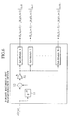
- Fig.7 shows a second embodiment of the recursive discrete Fourier transformation device and it is described with the Figure.
- the recursive discrete Fourier transformation device comprises a data updating portion 101 to which data sampled in a predetermined time interval is supplied and which stores temporarily supplied new N (N: positive integer) data, a basic frequency setting portion 102 in which the basic frequency for carrying out the discrete Fourier transformation is set up, a recursive processing portion 103 for carrying out signal processing while using a signal temporarily stored recursively and a multiplication processing portion 104 for carrying out multiplication processing and outputting an obtained Fourier transformation coefficient.
- N positive integer
- An operation of the data updating portion 101 is the same as the first embodiment.
- N data stored temporarily in the data updating portion 101 is supplied to the recursive processing portion 103 and thus Fourier transformation operation is carried out by the recursive processing portion 103 and the multiplication processing portion 104 according to a method, which will be described later.
- the recursive processing portion 103 stores an intermediate result of arithmetic operation temporarily in a memory circuit contained therein and carries out signal pre-processing for executing Fourier arithmetic operation while using the temporarily stored signal recursively.
- the pre-processed signal is supplied to the multiplication processing portion 104, in which the multiplication processing as post processing is carried out so as to obtain the real part X r (k, t+1) and imaginary part X i (k, t+1) of the Fourier coefficient.
- a basic frequency for giving a desired resolution is set up by the basic frequency setting portion 102 and operation parameters of the recursive processing portion 103 and the multiplication processing portion 104 are set up. Following the set parameters, the result of the Fourier analysis based on predetermined frequency resolution information is computed and outputted.
- equations (11), (12) are introduced like the first embodiment so that complex Fourier transformation result X r (k, t+1)-jX i (k, t+1) can be obtained at time t+1.
- H(z) Y ( z ) X ( z )
- equations (19), (20) are treated as simultaneous equations and it is intended to obtain respective transfer functions of the real part and imaginary part, they can be obtained as shown in following equations (21), (22).
- 1-Z -N indicates deletion of the oldest data upon updating the input data and a portion expressed with a fraction is so constructed that its numerator and its denominator are IIR filters (cyclic filter) having primary and secondary degrees respectively.
- the DFT is a FIR filter for carrying out processing to a finite point number N, if it is achieved with a IIR filter as shown in the aforementioned equation (23), it can be constructed with a simpler hardware than the FIR filter.
- Fig.8 shows a recursive DFT operation unit for carrying out the discrete Fourier transformation and the structure and operation thereof will be described in detail.
- the recursive DFT operation unit comprises an updating processing portion 101 including a memory 111 and a subtractor 112, a recursive processing portion 103 including a subtractor 131, an adder 132, memories 133, 134 and a multiplier 135 and a multiplication processing portion 104 including multipliers 141, 142, 143 and 144.
- the memory 111 is notated with Z -N and the memories 133, 134 are notated with Z -1 .
- the number of this exponent indicates a period during which supplied data is stored temporarily.
- -N indicates temporarily storing in N sampling period while -1 indicates temporarily storing in a sampling period.
- subtractors 112, 131 subtracts signals supplied in a vertical direction (from down to up) from signals supplied in a horizontal direction in the same Figure and a signal obtained by the subtraction is supplied as subtraction output.
- the adders 132, 144 sum up two supplied signals indicated with arrows, so that a signal obtained by the summing is outputted.
- the multipliers 135, 141, 142, 143 multiply a supplied signal with a value based on a symbol indicated on the side of a multiplier in the same Figure and supply a result of the multiplication.
- the values with which those multipliers multiply are -2 ⁇ c, A ⁇ c, -A, -A ⁇ s.
- x(t+N) is supplied to the subtractor 112 and the memory 111 as an input signal.
- the memory 111 delays a supplied signal by N sampling periods.
- the output signal of the memory 111 at this time is supplied as a signal supplied before the N sampling periods, that is, x(t) is outputted while it is supplied as a subtraction signal to the subtracter 112.
- the updating processing portion 101 carries out arithmetic operation of x(t+N)-x(t).
- the updating processing portion 101 updates data accumulated in each of N sample clocks .
- signal processing is a processing in which an input signal is multiplied with 1-Z -N which is a first transfer function.
- a signal obtained by such processing is supplied to the subtractor 131 in the recursive processing portion 103.
- a signal from the adder 132 is subtracted and part of signals obtained by the subtraction is supplied to the multiplication processing portion 104 while the other part thereof is supplied to the memory 133.
- Signals delayed by a sample period by the memory 133 are supplied to the multiplier 135, the memory 134 and the multiplier 142 of the multiplication processing portion 104.
- a signal multiplied with a predetermined number by the multiplier 135, supplied by the memory 133 is supplied to an input terminal of the adder 132. Then, a signal delayed by one more sample period by the memory 134 is supplied to other input terminal of the adder 132 and summed up with the aforementioned signal, and the summed signal is supplied to a subtraction signal terminal of the subtractor 131.
- a signal obtained by providing a signal outputted from the subtractor 131 with the characteristic -2 ⁇ c ⁇ Z -1 from the memory 133 and the multiplier 135 and a signal obtained by providing a signal outputted from the subtractor 131 with the characteristic Z -2 from the memories 133, 134 are summed up by the adder 132. Then, the result of the summing is supplied to the subtraction signal terminal of the subtractor 131.
- the subtractor 131 subtracts a result of the summing from a signal from the updating processing portion 101. Therefore, the recursive processing portion 103 carries out multiplication processing expressed with a second transfer function 1/(1-2 ⁇ c ⁇ Z -1 + Z -2 ) to carry out arithmetic operation using old data recursively.
- a signal q1 obtained by multiplying with a second transfer function and a signal q2 obtained by delaying the signal q1 by a sample period by the memory 133 are supplied to the multiplying portion 104.
- one of the signals q1 is multiplied with A ⁇ c by the multiplier 41 to obtain a first multiplication signal and the signal q2 is multiplied with -A by the multiplier 142 to obtain a second multiplication signal.
- These first and second multiplication signals are supplied to the adder 144, in which they are summed up to obtain a signal X r (k, t+1). This obtained signal is supplied as a real-part signal of a Fourier coefficient.
- the other of the signals q1 supplied to the multiplication processing portion 104 is multiplied with -A ⁇ c to obtain a signal X i (k. t+1) and the obtained signal is supplied as an imaginary part signal of the Fourier coefficient.
- the recursive DFT arithmetic operation device can introduce complex Fourier transformation result X r (k, t+1)-jX i (k, t+1) at time t+1 by using data x(t+N) sampled and supplied at time t+1 and using recursively intermediate data under Fourier operation for data supplied before.
- the signals supplied from the recursive processing portion 103 are two signals, q1 and q2, if the multiplication processing portion 104 contains the memory 133, it is permissible to omit a signal line of the q2.
- Fig.9 shows the structure in case where the recursive processing portion 103 and the multiplication processing portion 104 are connected through a single signal line q1.
- the multiplication processing portion 104 requires additionally a memory 145 compared with the multiplication processing 104 of Fig.8.
- the recursive DFT operation device can be constructed by dividing the transfer function shown in the aforementioned equation (24) to first transfer function 1-Z -N , second transfer function 1/(1-2 ⁇ c Z -1 +Z -2 ) and third transfer function A( ⁇ c -j ⁇ s -Z -1 ).
- the arithmetic logic circuits having these delay, addition/subtraction and multiplication functions with digital circuits, it is possible to configure the recursive discrete Fourier transformation circuit with a smaller, simple circuit block.
- the Fourier analysis can be carried out by selecting a desired basic frequency.
- the number of points to be handled is not restricted to power of 2 unlike in case of the FFT, so that any positive integer can be adopted.
- the recursive discrete Fourier transformation circuit having such a structure can execute the Fourier transformation processing by selecting any resolution.
- the recursive DFT operation device can execute the Fourier transformation processing by selecting any resolution.
- the frequency resolution can be set to any resolution depending on each frequency subjected to analysis.
- the Fourier transformation can be carried out to individual frequencies at the same time with the structure shown in Fig.5 like the first embodiment.
- N-point recursive DFT transformation device whose part of the modules are used in common like the first embodiment.
- Fig.10 shows the structure of the N-point recursive DFT transformation device whose part of the modules are used in common according to the second embodiment.
- the delay units 111 for accumulating data sampled and supplied by the amount corresponding to N samples and the subtractors 112 which subtract the oldest data stored temporarily in the delay unit 111 from data value sampled and supplied are used in common.
- the sub-modules 1 to (N-1) are so constructed that these common components are removed from the modules 1 to (N-1).
- the sub-modules 1 to (N-1) employ signals supplied from the common delay units 111 and subtractors 112 in common, thereby achieving reductions of circuit size and power consumption.
- the recursive inverse discrete Fourier transformation device which carries out transformation of signal format inversely, can be constructed like the first embodiment. Therefore, a description about the recursive inverse discrete Fourier transformation device of the first embodiment is applicable to the second embodiment just as it is.
Landscapes
- Physics & Mathematics (AREA)
- Mathematical Physics (AREA)
- Engineering & Computer Science (AREA)
- General Physics & Mathematics (AREA)
- Computational Mathematics (AREA)
- Mathematical Analysis (AREA)
- Mathematical Optimization (AREA)
- Pure & Applied Mathematics (AREA)
- Data Mining & Analysis (AREA)
- Theoretical Computer Science (AREA)
- Discrete Mathematics (AREA)
- Algebra (AREA)
- Databases & Information Systems (AREA)
- Software Systems (AREA)
- General Engineering & Computer Science (AREA)
- Complex Calculations (AREA)
Applications Claiming Priority (4)
| Application Number | Priority Date | Filing Date | Title |
|---|---|---|---|
| JP2000217113A JP2002032356A (ja) | 2000-07-18 | 2000-07-18 | 再帰型離散フーリエ変換装置 |
| JP2000217113 | 2000-07-18 | ||
| JP2000234131 | 2000-08-02 | ||
| JP2000234131 | 2000-08-02 |
Publications (2)
| Publication Number | Publication Date |
|---|---|
| EP1176516A2 true EP1176516A2 (de) | 2002-01-30 |
| EP1176516A3 EP1176516A3 (de) | 2004-03-24 |
Family
ID=26596216
Family Applications (1)
| Application Number | Title | Priority Date | Filing Date |
|---|---|---|---|
| EP01116721A Withdrawn EP1176516A3 (de) | 2000-07-18 | 2001-07-18 | Rechnereinrichtung von einer rekursiven, diskreten Fourier-Transformation |
Country Status (3)
| Country | Link |
|---|---|
| US (1) | US20020029234A1 (de) |
| EP (1) | EP1176516A3 (de) |
| CN (1) | CN1333618A (de) |
Cited By (4)
| Publication number | Priority date | Publication date | Assignee | Title |
|---|---|---|---|---|
| GB2421405A (en) * | 2004-12-17 | 2006-06-21 | Chung Shan Inst Of Science And Tech | Time domain spreading receiver which exchanges and inverts real and imaginary UWB signal elements |
| US7327776B2 (en) | 2004-12-20 | 2008-02-05 | Chung Shan Institute Of Science And Technology, Armaments Bureau, M.N.D. | Time domain spreading method and apparatus for a UWB receiver comprising fast fourier transform and exchange of real and imaginary complex signal components |
| CN107632292A (zh) * | 2017-09-21 | 2018-01-26 | 北京工业大学 | 一种对雷达信号进行调频傅立叶变换的方法 |
| CN109444515A (zh) * | 2018-09-26 | 2019-03-08 | 徐文涛 | 一种基于sdft算法的无功、不平衡与谐波检测方法 |
Families Citing this family (10)
| Publication number | Priority date | Publication date | Assignee | Title |
|---|---|---|---|---|
| WO2005111857A2 (en) * | 2004-05-07 | 2005-11-24 | Pelton Walter E | Rotational sliding aperture fourier transform |
| FR2892914B1 (fr) * | 2005-11-09 | 2008-06-20 | Labosserie Sarl | Procede d'analyse et de traitement d'un parametre representatif des phases de sommeil. |
| US8787501B2 (en) * | 2009-01-14 | 2014-07-22 | Qualcomm Incorporated | Distributed sensing of signals linked by sparse filtering |
| CN101574585B (zh) * | 2009-05-31 | 2011-06-29 | 北京必创科技有限公司 | 一种智能加油棒 |
| US8477885B2 (en) | 2011-01-21 | 2013-07-02 | Northrop Grumman Systems Corporation | Recursive frequency estimation |
| KR20130070321A (ko) * | 2011-12-19 | 2013-06-27 | 삼성전자주식회사 | 이산 푸리에변환 장치 및 방법 |
| CN104778150B (zh) * | 2015-03-27 | 2018-12-14 | 华为技术有限公司 | 一种频域处理方法及装置 |
| DE102021207032A1 (de) * | 2021-07-05 | 2023-01-05 | Robert Bosch Gesellschaft mit beschränkter Haftung | SA-Radarsensor für Kraftfahrzeuge |
| CN114710139B (zh) * | 2021-12-20 | 2023-06-02 | 昆山帝森华途工业物联网科技有限公司 | 一种apf控制系统的谐波提取及合成器 |
| CN118171092B (zh) * | 2024-05-15 | 2024-08-13 | 威胜信息技术股份有限公司 | 一种高效递归离散傅里叶变换方法及系统 |
Family Cites Families (7)
| Publication number | Priority date | Publication date | Assignee | Title |
|---|---|---|---|---|
| US3778606A (en) * | 1972-02-23 | 1973-12-11 | Sanders Associates Inc | Continuously updating fourier coefficients every sampling interval |
| US4023028A (en) * | 1974-08-20 | 1977-05-10 | The United States Of America As Represented By The Secretary Of The Navy | Method and apparatus for computing the discrete Fourier transform recursively |
| FR2584213B1 (fr) * | 1985-06-28 | 1994-03-11 | Thomson Csf | Dispositif de calcul d'une transformee de fourier discrete, glissante, et son application a un systeme radar. |
| FR2587819B1 (fr) * | 1985-09-24 | 1989-10-06 | Thomson Csf | Dispositif de calcul d'une transformee de fourier discrete, glissante et non recursive, et son application a un systeme radar |
| US4965761A (en) * | 1988-06-03 | 1990-10-23 | General Dynamics Corporation, Pomona Div. | Fast discrete fourier transform apparatus and method |
| US4972358A (en) * | 1989-06-08 | 1990-11-20 | General Electric Company | Computation of discrete fourier transform using recursive techniques |
| US20020016807A1 (en) * | 2000-06-30 | 2002-02-07 | Katsumi Takaoka | Recursive discrete fourier transformation method and recursive inverse discrete fourier transformation method |
-
2001
- 2001-07-06 CN CN01120030.8A patent/CN1333618A/zh active Pending
- 2001-07-13 US US09/903,573 patent/US20020029234A1/en not_active Abandoned
- 2001-07-18 EP EP01116721A patent/EP1176516A3/de not_active Withdrawn
Cited By (6)
| Publication number | Priority date | Publication date | Assignee | Title |
|---|---|---|---|---|
| GB2421405A (en) * | 2004-12-17 | 2006-06-21 | Chung Shan Inst Of Science And Tech | Time domain spreading receiver which exchanges and inverts real and imaginary UWB signal elements |
| GB2421405B (en) * | 2004-12-17 | 2007-12-12 | Chung Shan Inst Of Science And Tech | Time domain spreading method and apparatus |
| US7327776B2 (en) | 2004-12-20 | 2008-02-05 | Chung Shan Institute Of Science And Technology, Armaments Bureau, M.N.D. | Time domain spreading method and apparatus for a UWB receiver comprising fast fourier transform and exchange of real and imaginary complex signal components |
| CN107632292A (zh) * | 2017-09-21 | 2018-01-26 | 北京工业大学 | 一种对雷达信号进行调频傅立叶变换的方法 |
| CN109444515A (zh) * | 2018-09-26 | 2019-03-08 | 徐文涛 | 一种基于sdft算法的无功、不平衡与谐波检测方法 |
| CN109444515B (zh) * | 2018-09-26 | 2021-01-26 | 徐文涛 | 一种基于sdft算法的无功、不平衡与谐波检测方法 |
Also Published As
| Publication number | Publication date |
|---|---|
| US20020029234A1 (en) | 2002-03-07 |
| CN1333618A (zh) | 2002-01-30 |
| EP1176516A3 (de) | 2004-03-24 |
Similar Documents
| Publication | Publication Date | Title |
|---|---|---|
| AU689439B2 (en) | Digital filter having high accuracy and efficiency | |
| EP1176516A2 (de) | Rechnereinrichtung von einer rekursiven, diskreten Fourier-Transformation | |
| US5150413A (en) | Extraction of phonemic information | |
| US4829463A (en) | Programmed time-changing coefficient digital filter | |
| US5200978A (en) | Process for actuation of multi-level digital modulation by a digital signal processor | |
| US5648777A (en) | Data converter with FIFO | |
| JP3066241B2 (ja) | ディジタルフィルタ及び同ディジタルフィルタを用いたオーバサンプリング型アナログ/ディジタル変換器 | |
| US9337805B2 (en) | Efficient digital microphone decimation filter architecture | |
| JP2002506603A (ja) | 多項式補間を用いたサンプルレート変換器 | |
| JPH036689B2 (de) | ||
| CN110957996B (zh) | 一种基于abc算法的无乘法器frm滤波器组优化设计方法 | |
| US4794556A (en) | Method and apparatus for sampling in-phase and quadrature components | |
| EP1372085A2 (de) | Verfahren zur Ausführung einer schnellen Fourier-Transformation und einer schnellen Invers-Fourier-Transformation | |
| JPWO2008123317A1 (ja) | 信号処理装置、エコーキャンセラ、信号処理方法 | |
| US20010043154A1 (en) | Method and device for analog-to-digital conversion of a signal | |
| EP0037130B1 (de) | Anordnung zur Berechnung der diskreten Fourier-Transformation mittels zweier Kreisfaltungen | |
| US20020016807A1 (en) | Recursive discrete fourier transformation method and recursive inverse discrete fourier transformation method | |
| JP2002117017A (ja) | 再帰型離散フーリエ変換装置 | |
| EP1458097A1 (de) | Beliebige Abtastratenkonversion | |
| US8340285B2 (en) | Method for efficient and zero latency filtering in a long impulse response system | |
| Lowdermilk et al. | Finite arithmetic considerations for the FFT implemented in FPGA-based embedded processors in synthetic instruments | |
| CN111884655B (zh) | 一种可变模小数变频的串行信号处理方法及装置 | |
| JP2002032356A (ja) | 再帰型離散フーリエ変換装置 | |
| EP3716480B1 (de) | Verfahren zur abtastratenumsetzung | |
| Ching et al. | Matrix formulation: fast filter bank |
Legal Events
| Date | Code | Title | Description |
|---|---|---|---|
| PUAI | Public reference made under article 153(3) epc to a published international application that has entered the european phase |
Free format text: ORIGINAL CODE: 0009012 |
|
| 17P | Request for examination filed |
Effective date: 20010718 |
|
| AK | Designated contracting states |
Kind code of ref document: A2 Designated state(s): AT BE CH CY DE DK ES FI FR GB GR IE IT LI LU MC NL PT SE TR |
|
| AX | Request for extension of the european patent |
Free format text: AL;LT;LV;MK;RO;SI |
|
| PUAL | Search report despatched |
Free format text: ORIGINAL CODE: 0009013 |
|
| AK | Designated contracting states |
Kind code of ref document: A3 Designated state(s): AT BE CH CY DE DK ES FI FR GB GR IE IT LI LU MC NL PT SE TR |
|
| AX | Request for extension of the european patent |
Extension state: AL LT LV MK RO SI |
|
| AKX | Designation fees paid |
Designated state(s): DE FR GB |
|
| 17Q | First examination report despatched |
Effective date: 20050224 |
|
| STAA | Information on the status of an ep patent application or granted ep patent |
Free format text: STATUS: THE APPLICATION IS DEEMED TO BE WITHDRAWN |
|
| 18D | Application deemed to be withdrawn |
Effective date: 20050707 |