EP1177950A1 - Verfahren zum Optimieren der Schwingungsdämpfung - Google Patents
Verfahren zum Optimieren der Schwingungsdämpfung Download PDFInfo
- Publication number
- EP1177950A1 EP1177950A1 EP00116847A EP00116847A EP1177950A1 EP 1177950 A1 EP1177950 A1 EP 1177950A1 EP 00116847 A EP00116847 A EP 00116847A EP 00116847 A EP00116847 A EP 00116847A EP 1177950 A1 EP1177950 A1 EP 1177950A1
- Authority
- EP
- European Patent Office
- Prior art keywords
- vibration
- vibration damping
- mobility
- vibrational response
- maximum
- Prior art date
- Legal status (The legal status is an assumption and is not a legal conclusion. Google has not performed a legal analysis and makes no representation as to the accuracy of the status listed.)
- Withdrawn
Links
- 238000013016 damping Methods 0.000 title claims abstract description 49
- 238000000034 method Methods 0.000 title claims abstract description 35
- 230000008569 process Effects 0.000 title claims abstract description 22
- 239000000463 material Substances 0.000 claims abstract description 46
- 230000004044 response Effects 0.000 claims abstract description 17
- 239000000203 mixture Substances 0.000 claims description 19
- 229920001971 elastomer Polymers 0.000 claims description 15
- 239000005060 rubber Substances 0.000 claims description 14
- 230000005284 excitation Effects 0.000 claims description 10
- 229920001944 Plastisol Polymers 0.000 claims description 7
- 239000004999 plastisol Substances 0.000 claims description 7
- 238000001228 spectrum Methods 0.000 claims description 7
- 230000001133 acceleration Effects 0.000 claims description 3
- 238000013507 mapping Methods 0.000 description 14
- 239000010426 asphalt Substances 0.000 description 7
- 230000001070 adhesive effect Effects 0.000 description 5
- 238000000576 coating method Methods 0.000 description 5
- 239000000853 adhesive Substances 0.000 description 4
- 239000011248 coating agent Substances 0.000 description 4
- 229920000642 polymer Polymers 0.000 description 4
- 239000002184 metal Substances 0.000 description 3
- 229920001195 polyisoprene Polymers 0.000 description 3
- 239000000047 product Substances 0.000 description 3
- 238000005507 spraying Methods 0.000 description 3
- 238000003860 storage Methods 0.000 description 3
- 238000005299 abrasion Methods 0.000 description 2
- 238000005452 bending Methods 0.000 description 2
- 230000008901 benefit Effects 0.000 description 2
- 239000008199 coating composition Substances 0.000 description 2
- 230000009977 dual effect Effects 0.000 description 2
- 230000000694 effects Effects 0.000 description 2
- 239000003517 fume Substances 0.000 description 2
- 230000009477 glass transition Effects 0.000 description 2
- 238000013007 heat curing Methods 0.000 description 2
- 239000007788 liquid Substances 0.000 description 2
- 238000005259 measurement Methods 0.000 description 2
- 239000003973 paint Substances 0.000 description 2
- 239000004014 plasticizer Substances 0.000 description 2
- 239000000565 sealant Substances 0.000 description 2
- 239000007787 solid Substances 0.000 description 2
- 239000000758 substrate Substances 0.000 description 2
- 238000012360 testing method Methods 0.000 description 2
- 230000009466 transformation Effects 0.000 description 2
- 238000004073 vulcanization Methods 0.000 description 2
- XLYOFNOQVPJJNP-UHFFFAOYSA-N water Substances O XLYOFNOQVPJJNP-UHFFFAOYSA-N 0.000 description 2
- 239000004593 Epoxy Substances 0.000 description 1
- 239000004820 Pressure-sensitive adhesive Substances 0.000 description 1
- 229910000639 Spring steel Inorganic materials 0.000 description 1
- 229910000831 Steel Inorganic materials 0.000 description 1
- NINIDFKCEFEMDL-UHFFFAOYSA-N Sulfur Chemical compound [S] NINIDFKCEFEMDL-UHFFFAOYSA-N 0.000 description 1
- XTXRWKRVRITETP-UHFFFAOYSA-N Vinyl acetate Chemical compound CC(=O)OC=C XTXRWKRVRITETP-UHFFFAOYSA-N 0.000 description 1
- BZHJMEDXRYGGRV-UHFFFAOYSA-N Vinyl chloride Chemical compound ClC=C BZHJMEDXRYGGRV-UHFFFAOYSA-N 0.000 description 1
- 230000032683 aging Effects 0.000 description 1
- 239000011324 bead Substances 0.000 description 1
- 230000005540 biological transmission Effects 0.000 description 1
- 239000006227 byproduct Substances 0.000 description 1
- 150000001875 compounds Chemical class 0.000 description 1
- 238000011109 contamination Methods 0.000 description 1
- 229920001577 copolymer Polymers 0.000 description 1
- 230000002950 deficient Effects 0.000 description 1
- 230000002939 deleterious effect Effects 0.000 description 1
- 238000013461 design Methods 0.000 description 1
- 238000009826 distribution Methods 0.000 description 1
- 239000000428 dust Substances 0.000 description 1
- 239000000806 elastomer Substances 0.000 description 1
- 239000000839 emulsion Substances 0.000 description 1
- 238000002474 experimental method Methods 0.000 description 1
- 239000000945 filler Substances 0.000 description 1
- 238000009472 formulation Methods 0.000 description 1
- 230000006872 improvement Effects 0.000 description 1
- 238000004519 manufacturing process Methods 0.000 description 1
- 230000000737 periodic effect Effects 0.000 description 1
- 239000004033 plastic Substances 0.000 description 1
- 229920003023 plastic Polymers 0.000 description 1
- 239000000843 powder Substances 0.000 description 1
- 239000002994 raw material Substances 0.000 description 1
- 230000009467 reduction Effects 0.000 description 1
- 238000011160 research Methods 0.000 description 1
- 238000007789 sealing Methods 0.000 description 1
- 239000002904 solvent Substances 0.000 description 1
- 230000003068 static effect Effects 0.000 description 1
- 239000010959 steel Substances 0.000 description 1
- 230000035882 stress Effects 0.000 description 1
- 239000011593 sulfur Substances 0.000 description 1
- 229910052717 sulfur Inorganic materials 0.000 description 1
- 239000000725 suspension Substances 0.000 description 1
- 238000010557 suspension polymerization reaction Methods 0.000 description 1
- 229920001169 thermoplastic Polymers 0.000 description 1
- 230000001052 transient effect Effects 0.000 description 1
- 230000007704 transition Effects 0.000 description 1
- 238000012384 transportation and delivery Methods 0.000 description 1
- 239000013585 weight reducing agent Substances 0.000 description 1
Images
Classifications
-
- F—MECHANICAL ENGINEERING; LIGHTING; HEATING; WEAPONS; BLASTING
- F16—ENGINEERING ELEMENTS AND UNITS; GENERAL MEASURES FOR PRODUCING AND MAINTAINING EFFECTIVE FUNCTIONING OF MACHINES OR INSTALLATIONS; THERMAL INSULATION IN GENERAL
- F16F—SPRINGS; SHOCK-ABSORBERS; MEANS FOR DAMPING VIBRATION
- F16F15/00—Suppression of vibrations in systems; Means or arrangements for avoiding or reducing out-of-balance forces, e.g. due to motion
- F16F15/02—Suppression of vibrations of non-rotating, e.g. reciprocating systems; Suppression of vibrations of rotating systems by use of members not moving with the rotating systems
-
- G—PHYSICS
- G01—MEASURING; TESTING
- G01M—TESTING STATIC OR DYNAMIC BALANCE OF MACHINES OR STRUCTURES; TESTING OF STRUCTURES OR APPARATUS, NOT OTHERWISE PROVIDED FOR
- G01M7/00—Vibration-testing of structures; Shock-testing of structures
- G01M7/02—Vibration-testing by means of a shake table
- G01M7/025—Measuring arrangements
Definitions
- This invention relates to a process for optimizing the vibration damping of parts, and its use for noise and vibration reduction of automotive parts or appliances.
- Vibration, or dynamic motion are inherent in structures and machines having moving components. Especially since today's machines, electrical appliances and automobiles are made of thin gauge metal sheets or plastics, they are prone to strong vibration from external or internal forces like moving parts or running engines, noise from impact of gravel or water, vibration of the car body during driving. These vibrations are unpleasant and unwanted phenomena causing noise, which results in discomfort since many of these vibrations have frequencies in the audible frequency range which can propagate as solid-borne sound through the entire structure or body of e.g. a car. Also, malfunctioning or even wear and fatigue of vibrating parts may occur, if no provisions for vibration damping are taken.
- bitumen pads which have only the function of vibration damping. These pads have to be extruded, die-cut and shaped in separate steps. Prior to application they frequently have to be heat formed to fit them to non flat structures and then glued to the car body, machine or appliance. Although these bitumen based pads are reasonable in their price per mass unit cost, they involve extensive stock keeping and can in most cases be applied only by manual labor.
- bitumen based pads are their high specific weight which adds significantly to the weight of a car or appliance. Therefore, various methods have been developed to replace this costly manual procedure by products which have a lower specific weight and can be easily applied by robots from bulk deliveries. Plastisol formulations serving the dual function of underbody coating (protection against abrasion) and acoustic damping have been described in EP-A-358598, or DE-A-3444863.
- DE-A-4013318 discloses a two layer underbody coating which performs the dual functions of protecting against abrasion and absorbing noise resulting from impact (stones, gravel, water, etc.).
- plastisol compositions based on vinyl chloride/vinyl acetate copolymers produced by a suspension polymerization process, have a low viscosity. Even when the composition contains a high amount of polymer relative to the amount of plasticizer present, they can be made into plastisol compositions suitable for airless spraying application. These compositions are storage stable and easy to gel. Coatings based on these plastisols have good sound-proofing properties even when their vinyl acetate content is high.
- plastisols are applied to the surface by spraying either manually or by a robot.
- US-A-4075288 discloses rubber sheets based on polyisoprenes having a minimum of 60% of 1,2- and 3,4-vinyl structure to be useful as vibration-damping materials. This reference suggests to vulcanize said rubber sheets and bond them with a solvent borne adhesive to the metal sheet.
- EP-A-658597 discloses sealant, adhesive and / or coating compositions with damping properties for use in the automotive industry containing 3,4-polyisoprene and blends of liquid and/or solid rubbers and/or finely divided polymer powders and optionally plasticizers, fillers and other conventional raw materials. The compositions may be cured similar to the conventional sealant/adhesive and/or coating compositions. According to this reference, these materials exhibit superior vibration damping properties compared to conventional compositions not containing 3.4-polyisoprene.
- WO9616136 discloses elastomer products with acoustic attenuation properties based on single component heat-curing reactive compounds which comprise liquid rubber(s) with reactive olefinic double bonds and optionally solid rubber and sulfur-based vulcanization systems having a high acoustic loss factor maximum at the vulcanized state in a large range of use temperatures from about +10 °C to +40 °C. These compositions may also contain finely powdered thermoplastic polymers. These compositions are useful as acoustically dampening adhesives, sealing or coating masses.
- compositions can be supplied in bulk and are applied to the surfaces to be dampened by spraying or extruding from drums or they can be preformed as sheets, tapes or ribbons which have pressure sensitive adhesive properties prior to vulcanization, so they can be laid on the structures to be dampened and will adhere to the substrate initially followed by a heat curing step.
- the first essential property is, of course, that such a material should have a high damping coefficient (tan ⁇ ) within the widest possible temperature and frequency ranges.
- Amorphous macromolecular materials exhibit a high damping coefficient in the transition zone between the vitreous state and the rubbery state, i.e. at their glass transition temperature.
- the anti-vibration material must have a glass transition temperature (or temperature maximum of the tan ⁇ ) in the stress vibrations frequency range close to the use temperature. For automobile applications this would be the temperature range between about -10°C and about +40°C.
- the modulus of the damping material should be capable of being adjusted over a wide range to withstand mechanical strain.
- a third desirable property of the damping material is good stability under static load. It is known that in the use zone and for the deformations which are imposed a good anti-vibration material has to have viscoelastic properties. If the material consists of a linear polymer, it will exhibit a significant tendency to creep.
- the objective of the present invention is therefore to develop a strategy to minimize the covered surface and the applied volume of the vibration damping material. According to the present invention, this object is achieved by a process for optimizing the vibration damping of parts which comprises the following essentials steps.
- the vibration mode of a bare part is analyzed by a mapping procedure, determining the points of maximum vibrational response, applying to these areas a damping material, which is preferably a highly effective material.
- This damping material is preferably based on curable rubber compositions, for example those disclosed WO 9616136, which are incorporated by reference. Alternatively plastisol compositions as disclosed in WO 9535345 or DE - A - 4013318 may also be used. The preferred materials are the above mentioned curable rubber compositions.
- the vibration modes and mapping procedure is repeated after the dampening material has been applied, to verify that the dampening effect has reached a satisfactory level.
- the method according to the present invention can also be used for effectively applying hot bitumen compositions as disclosed in EP-A-617098, aqueous bitumen emulsions as disclosed in EP-A-685880, epoxy based materials or other compositions of high damping properties.
- the mapping is being done by Modal Vibration analysis. The basic principles of this Modal Analysis are known. Theoretical and Basic Experimental procedures have been disclosed by N. M. Mendes Maia and J. M. Montalvao e Silva in "Theoretical and Modal Analysis", Research Studies Press Ltd., Baldock, England, 1997.
- the excitation of a part is done by means of a shaker or a hammer at a selected point, followed by measurement of the vibrational response in each area element.
- the preferred vibration pattern is a random vibration of homogenous intensity over a chosen range of frequencies between 0 and 800 Hz, preferably between 0 and 400 Hz.
- other excitation modes may also be applied using deterministic transient or periodic dynamic signals such as sinusoidal vibration, see N. M. Mendes Maia et al, chapter 1.
- the excitation spot is selected as the spot of most likely ingress of disturbing vibrations. For example, if the part to be analyzed is a door of a car, the excitation spot will be close to the hinge of the door.
- the sensing or measurement of the vibrational response is done by means of a transducer.
- the transducer senses the acceleration at the measuring spot. This numeric value for acceleration at the sensed spot is subsequently transformed by known algorithms into mobility values.
- the mobility is the average speed of vibrating element per unit of the exciting force [(m/s)/N].
- the excitation by the shaker is done by a random vibration because this offers the advantage, that a complete spectrum can be measured in one sweep as compared to single frequency sinus excitations.
- the whole area of the part to be analyzed is mapped, which means that pickup spots, spaced at distances of 2-15 cm, preferably 2-5 cm, are sensed by means of the transducer within each mapping element.
- This mapping can be done by placing the sensing transducer manually on each mapping element (for example square of 5 x 5 cm).
- the sensing transducer can also be moved automatically by robot control.
- Another method of measuring the response is laser scanning of the mobility. Since the scanning by a laser utilizes the response of the reflected laser beam, no transducer is necessary as a sensor.
- the signal generated from the transducer or laser is amplified and processed through a Fast Fourier Transformation (FFT), thus generating a mobility versus frequency response.
- FFT Fast Fourier Transformation
- the damping material applied can cover one single larger area or several small areas. Its shape may have any geometric form like rectangular, square, triangular, circular or elliptical patches or small continuous or discontinuous beads.
- a door of a car is being analyzed, selecting a spot close to the hinge as excitation spot.
- the door to be analyzed is suspended from rubber cords to isolate the part acoustically from the suspending device, thus avoiding acoustical transmission to and from the suspension frame work.
- the ratio of input excitation energy to output excitation energy is approximately 1 in order to verify coherence, i.e. there is no disturbance of the system.
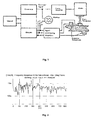
- Figure 1 shows schematically the modal vibration analysis with the tested structure being excited by a shaker via a force transducer which receives the vibrational signal from a generator via a power amplifier.
- the vibrations at the different spots of the part are picked up by response transducers, the signals are amplified and analyzed using a FFT - Analyzer.
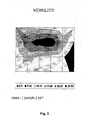
- Figure 2 shows the spectrum of mobility versus frequency of one vibrating element obtained via Fast Fourier Transformation.
- Figure 3 shows the result of mapping the maximum peak value of mobility within a selected spectrum displaying the distribution of mobility over a given area of the part. Mobility value ranges are given in 10 -3 [m/s/N].
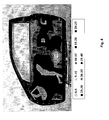
- Figure 4 shows the result of a mapping procedure for a complete door of a car prior to applying damping material. Areas of low vibration can be clearly depicted from the low mobility values (0-5), equally, areas of highest vibration are identified by the highest mobility values (35-40)
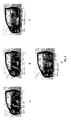
- Figure 5 illustrates the whole process for optimizing the vibration damping of a part - again this a door from a car.
- the areas of maximum mobility are identified by the procedure described above resulting in a map of the peak value of mobility(A).
- the selected areas of peak mobility are being covered by a rubber - based vibration damping material as disclosed in WO 9616136.
- the mapping of maximum mobility is repeated with a door having the cured rubber patches applied to the door (C). This can be compared with the result from applying standard melt sheets based on bitumen-materials at high application load (D). Said standard melt sheets were placed in areas according to previous experience by trial and error and not from a mapping procedure. From this comparison it is very obvious that the process for optimizing the vibration damping to the present invention allows for minimizing the amount of highly effective rubber based material on those areas which are determined by the mapping procedure.
- the process according to this invention allows optimizing the amount of vibration material to be minimized, thus reducing the overall cost per unit car with an equal performance compared to the vibration damping of the state of the art.
- this mapping analysis has to be carried out only on a prototype part, thus identifying the areas of maximum mobility to be dampened on every part of the same design.
Landscapes
- Engineering & Computer Science (AREA)
- Physics & Mathematics (AREA)
- General Engineering & Computer Science (AREA)
- Acoustics & Sound (AREA)
- Aviation & Aerospace Engineering (AREA)
- Mechanical Engineering (AREA)
- General Physics & Mathematics (AREA)
- Vibration Prevention Devices (AREA)
Priority Applications (3)
| Application Number | Priority Date | Filing Date | Title |
|---|---|---|---|
| EP00116847A EP1177950A1 (de) | 2000-08-04 | 2000-08-04 | Verfahren zum Optimieren der Schwingungsdämpfung |
| AU2001289748A AU2001289748A1 (en) | 2000-08-04 | 2001-07-25 | A process for optimizing vibration damping |
| PCT/EP2001/008599 WO2002012025A1 (en) | 2000-08-04 | 2001-07-25 | A process for optimizing vibration damping |
Applications Claiming Priority (1)
| Application Number | Priority Date | Filing Date | Title |
|---|---|---|---|
| EP00116847A EP1177950A1 (de) | 2000-08-04 | 2000-08-04 | Verfahren zum Optimieren der Schwingungsdämpfung |
Publications (1)
| Publication Number | Publication Date |
|---|---|
| EP1177950A1 true EP1177950A1 (de) | 2002-02-06 |
Family
ID=8169445
Family Applications (1)
| Application Number | Title | Priority Date | Filing Date |
|---|---|---|---|
| EP00116847A Withdrawn EP1177950A1 (de) | 2000-08-04 | 2000-08-04 | Verfahren zum Optimieren der Schwingungsdämpfung |
Country Status (3)
| Country | Link |
|---|---|
| EP (1) | EP1177950A1 (de) |
| AU (1) | AU2001289748A1 (de) |
| WO (1) | WO2002012025A1 (de) |
Cited By (3)
| Publication number | Priority date | Publication date | Assignee | Title |
|---|---|---|---|---|
| EP1524613A1 (de) | 2003-10-15 | 2005-04-20 | Rieter Technologies A.G. | Optimierungsverfahren zur Schwingungsdämpfung |
| EP1610113A1 (de) * | 2004-06-23 | 2005-12-28 | Rieter Technologies A.G. | Vorrichtung für die Bestimmung der Verlustzahl von Dämpfungsmaterialien |
| US8378254B2 (en) | 2009-09-11 | 2013-02-19 | Honda Motor Co., Ltd. | Adaptive vehicle manufacturing system and method |
Families Citing this family (2)
| Publication number | Priority date | Publication date | Assignee | Title |
|---|---|---|---|---|
| DE102005003057A1 (de) | 2005-01-22 | 2006-07-27 | Henkel Kgaa | Spritzbare, niedrigviskose Kautschuk-Dämpfungsmassen |
| FR3160926A1 (fr) | 2024-04-09 | 2025-10-10 | Stellantis Auto Sas | Ouvrant latéral de véhicule automobile avec panneau inférieur de protection |
Citations (5)
| Publication number | Priority date | Publication date | Assignee | Title |
|---|---|---|---|---|
| DE2732483A1 (de) * | 1977-07-19 | 1979-02-01 | Teroson Gmbh | Verfahren zur schalldaemmung und -daempfung von schallabstrahlenden flaechen sowie dafuer geeignete verkleidung |
| US4374172A (en) * | 1977-12-19 | 1983-02-15 | Teroson Gmbh | Sound insulating material |
| EP0358598A2 (de) * | 1988-09-07 | 1990-03-14 | Teroson GmbH | Spritzbare Plastisolzusammensetzung und deren Verwendung zur Schalldämpfung |
| EP0370801A1 (de) * | 1988-11-22 | 1990-05-30 | Nec Environment Engineering, Ltd. | Verfahren zur Beobachtung von Schwingungsformen |
| WO1993015386A1 (en) * | 1992-01-31 | 1993-08-05 | Virginia Tech Intellectual Properties, Inc. | Laser measurement system for dynamic structural analysis |
Family Cites Families (2)
| Publication number | Priority date | Publication date | Assignee | Title |
|---|---|---|---|---|
| DE19639213A1 (de) * | 1996-09-25 | 1998-03-26 | Wolfgang Prof Dr Ing Steinchen | Verfahren und Vorrichtung für die Shearing-Speckle-Interferometrie an schwingenden Objekten |
| DE19707109C1 (de) * | 1997-02-22 | 1998-06-25 | Bosch Gmbh Robert | Optisches Vibrometer |
-
2000
- 2000-08-04 EP EP00116847A patent/EP1177950A1/de not_active Withdrawn
-
2001
- 2001-07-25 AU AU2001289748A patent/AU2001289748A1/en not_active Abandoned
- 2001-07-25 WO PCT/EP2001/008599 patent/WO2002012025A1/en not_active Ceased
Patent Citations (5)
| Publication number | Priority date | Publication date | Assignee | Title |
|---|---|---|---|---|
| DE2732483A1 (de) * | 1977-07-19 | 1979-02-01 | Teroson Gmbh | Verfahren zur schalldaemmung und -daempfung von schallabstrahlenden flaechen sowie dafuer geeignete verkleidung |
| US4374172A (en) * | 1977-12-19 | 1983-02-15 | Teroson Gmbh | Sound insulating material |
| EP0358598A2 (de) * | 1988-09-07 | 1990-03-14 | Teroson GmbH | Spritzbare Plastisolzusammensetzung und deren Verwendung zur Schalldämpfung |
| EP0370801A1 (de) * | 1988-11-22 | 1990-05-30 | Nec Environment Engineering, Ltd. | Verfahren zur Beobachtung von Schwingungsformen |
| WO1993015386A1 (en) * | 1992-01-31 | 1993-08-05 | Virginia Tech Intellectual Properties, Inc. | Laser measurement system for dynamic structural analysis |
Cited By (4)
| Publication number | Priority date | Publication date | Assignee | Title |
|---|---|---|---|---|
| EP1524613A1 (de) | 2003-10-15 | 2005-04-20 | Rieter Technologies A.G. | Optimierungsverfahren zur Schwingungsdämpfung |
| EP1610113A1 (de) * | 2004-06-23 | 2005-12-28 | Rieter Technologies A.G. | Vorrichtung für die Bestimmung der Verlustzahl von Dämpfungsmaterialien |
| WO2006000365A1 (en) * | 2004-06-23 | 2006-01-05 | Rieter Technologies Ag | Device for determining the loss factor of damping materials |
| US8378254B2 (en) | 2009-09-11 | 2013-02-19 | Honda Motor Co., Ltd. | Adaptive vehicle manufacturing system and method |
Also Published As
| Publication number | Publication date |
|---|---|
| WO2002012025A1 (en) | 2002-02-14 |
| AU2001289748A1 (en) | 2002-02-18 |
Similar Documents
| Publication | Publication Date | Title |
|---|---|---|
| US5635562A (en) | Expandable vibration damping materials | |
| US6790520B1 (en) | Vibration dampening laminate | |
| US8900691B2 (en) | Method for selecting an interlayer for vibroacoustic damping, interlayer for vibroacoustic damping and glazing unit comprising such an interlayer | |
| US5840797A (en) | Light weight, high performance vibration-damping system | |
| US20050019590A1 (en) | Vibration damping material and vibration damper | |
| US20070281095A1 (en) | Constrained layer damper | |
| JPH08511047A (ja) | 音響学的に有効なプラスチゾル | |
| US9243402B2 (en) | Constrained-layer damping material | |
| GB1599020A (en) | Sound insulation and damping of sound-radiating surfaces | |
| CN106687523A (zh) | 具有改进的噪声抑制的聚合物组合物 | |
| WO2002012025A1 (en) | A process for optimizing vibration damping | |
| Akyüz et al. | Effects of NR/SBR ratio on mechanical properties and artificial mechanical performance of anti-vibration bushings | |
| EP1853396B1 (de) | Verfahren zur herstellung einer schallisolierenden tragenden decke | |
| JP4972689B2 (ja) | 振動移動の減少 | |
| Kari et al. | Constrained polymer layers to reduce noise: reality or fiction?—An experimental inquiry into their effectiveness | |
| JPH0535053B2 (de) | ||
| EP0176306B1 (de) | Verfahren zum Herstellen schwingungsdämpfender Werkstoffe | |
| JPH0835539A (ja) | 衝撃緩衝装置 | |
| CN101034046A (zh) | 一种降低振动环境中品质因素的方法 | |
| Singh et al. | Lightweight, high-performance, constrained-layer sound dampers | |
| JP2001241496A (ja) | 車両用制振装置およびその製造方法 | |
| WO2022040386A1 (en) | A layered liquid applied sound damper | |
| Nakauchi et al. | Rubber insulators.(I) | |
| MXPA99002488A (en) | Light weight, high performance vibration-damping system | |
| Sukontasukkul et al. | Results in Engineering |
Legal Events
| Date | Code | Title | Description |
|---|---|---|---|
| PUAI | Public reference made under article 153(3) epc to a published international application that has entered the european phase |
Free format text: ORIGINAL CODE: 0009012 |
|
| 17P | Request for examination filed |
Effective date: 20000804 |
|
| AK | Designated contracting states |
Kind code of ref document: A1 Designated state(s): AT BE CH CY DE DK ES FI FR GB GR IE IT LI LU MC NL PT SE |
|
| AX | Request for extension of the european patent |
Free format text: AL;LT;LV;MK;RO;SI |
|
| AKX | Designation fees paid |
Free format text: AT BE CH CY DE DK ES FI FR GB GR IE IT LI LU MC NL PT SE |
|
| 17Q | First examination report despatched |
Effective date: 20030822 |
|
| STAA | Information on the status of an ep patent application or granted ep patent |
Free format text: STATUS: THE APPLICATION IS DEEMED TO BE WITHDRAWN |
|
| 18D | Application deemed to be withdrawn |
Effective date: 20040103 |