EP1178014A1 - Verfahren zur Behandlung von chromatbelastetem Abwasser - Google Patents
Verfahren zur Behandlung von chromatbelastetem Abwasser Download PDFInfo
- Publication number
- EP1178014A1 EP1178014A1 EP01118162A EP01118162A EP1178014A1 EP 1178014 A1 EP1178014 A1 EP 1178014A1 EP 01118162 A EP01118162 A EP 01118162A EP 01118162 A EP01118162 A EP 01118162A EP 1178014 A1 EP1178014 A1 EP 1178014A1
- Authority
- EP
- European Patent Office
- Prior art keywords
- waste liquid
- chromium
- chromate waste
- process according
- chromate
- Prior art date
- Legal status (The legal status is an assumption and is not a legal conclusion. Google has not performed a legal analysis and makes no representation as to the accuracy of the status listed.)
- Granted
Links
- 239000007788 liquid Substances 0.000 title claims abstract description 241
- 239000002699 waste material Substances 0.000 title claims abstract description 191
- ZCDOYSPFYFSLEW-UHFFFAOYSA-N chromate(2-) Chemical compound [O-][Cr]([O-])(=O)=O ZCDOYSPFYFSLEW-UHFFFAOYSA-N 0.000 title claims abstract description 149
- 238000000034 method Methods 0.000 title claims abstract description 50
- 239000011651 chromium Substances 0.000 claims abstract description 158
- VYZAMTAEIAYCRO-UHFFFAOYSA-N Chromium Chemical compound [Cr] VYZAMTAEIAYCRO-UHFFFAOYSA-N 0.000 claims abstract description 140
- 229910052804 chromium Inorganic materials 0.000 claims abstract description 140
- 238000001556 precipitation Methods 0.000 claims abstract description 61
- 239000003795 chemical substances by application Substances 0.000 claims abstract description 57
- 239000011575 calcium Substances 0.000 claims abstract description 24
- 239000011777 magnesium Substances 0.000 claims abstract description 20
- FYYHWMGAXLPEAU-UHFFFAOYSA-N Magnesium Chemical compound [Mg] FYYHWMGAXLPEAU-UHFFFAOYSA-N 0.000 claims abstract description 18
- 229910052749 magnesium Inorganic materials 0.000 claims abstract description 18
- OYPRJOBELJOOCE-UHFFFAOYSA-N Calcium Chemical compound [Ca] OYPRJOBELJOOCE-UHFFFAOYSA-N 0.000 claims abstract description 14
- 229910052791 calcium Inorganic materials 0.000 claims abstract description 14
- 150000007524 organic acids Chemical class 0.000 claims abstract description 14
- 230000001376 precipitating effect Effects 0.000 claims abstract description 4
- 239000011701 zinc Substances 0.000 claims description 48
- HEMHJVSKTPXQMS-UHFFFAOYSA-M Sodium hydroxide Chemical compound [OH-].[Na+] HEMHJVSKTPXQMS-UHFFFAOYSA-M 0.000 claims description 39
- 239000002244 precipitate Substances 0.000 claims description 38
- 229910052725 zinc Inorganic materials 0.000 claims description 34
- HCHKCACWOHOZIP-UHFFFAOYSA-N Zinc Chemical compound [Zn] HCHKCACWOHOZIP-UHFFFAOYSA-N 0.000 claims description 33
- AXCZMVOFGPJBDE-UHFFFAOYSA-L calcium dihydroxide Chemical compound [OH-].[OH-].[Ca+2] AXCZMVOFGPJBDE-UHFFFAOYSA-L 0.000 claims description 28
- 239000000920 calcium hydroxide Substances 0.000 claims description 28
- 229910001861 calcium hydroxide Inorganic materials 0.000 claims description 28
- TWRXJAOTZQYOKJ-UHFFFAOYSA-L Magnesium chloride Chemical compound [Mg+2].[Cl-].[Cl-] TWRXJAOTZQYOKJ-UHFFFAOYSA-L 0.000 claims description 22
- 239000003002 pH adjusting agent Substances 0.000 claims description 21
- UXVMQQNJUSDDNG-UHFFFAOYSA-L Calcium chloride Chemical compound [Cl-].[Cl-].[Ca+2] UXVMQQNJUSDDNG-UHFFFAOYSA-L 0.000 claims description 15
- 239000001110 calcium chloride Substances 0.000 claims description 15
- 229910001628 calcium chloride Inorganic materials 0.000 claims description 15
- 150000001875 compounds Chemical class 0.000 claims description 11
- 230000003247 decreasing effect Effects 0.000 claims description 11
- 229910001629 magnesium chloride Inorganic materials 0.000 claims description 11
- 238000006386 neutralization reaction Methods 0.000 claims description 11
- 239000002253 acid Substances 0.000 claims description 10
- KWYUFKZDYYNOTN-UHFFFAOYSA-M Potassium hydroxide Chemical compound [OH-].[K+] KWYUFKZDYYNOTN-UHFFFAOYSA-M 0.000 claims description 9
- 150000002484 inorganic compounds Chemical class 0.000 claims description 7
- 229910010272 inorganic material Inorganic materials 0.000 claims description 7
- 229920002401 polyacrylamide Polymers 0.000 claims description 7
- WMFOQBRAJBCJND-UHFFFAOYSA-M Lithium hydroxide Chemical compound [Li+].[OH-] WMFOQBRAJBCJND-UHFFFAOYSA-M 0.000 claims description 6
- 238000001223 reverse osmosis Methods 0.000 claims description 4
- 238000005342 ion exchange Methods 0.000 claims description 2
- 239000000701 coagulant Substances 0.000 claims 2
- 238000003756 stirring Methods 0.000 description 32
- 238000006243 chemical reaction Methods 0.000 description 31
- 238000005189 flocculation Methods 0.000 description 19
- 230000016615 flocculation Effects 0.000 description 19
- 229910052751 metal Inorganic materials 0.000 description 17
- 239000002184 metal Substances 0.000 description 17
- XLYOFNOQVPJJNP-UHFFFAOYSA-N water Substances O XLYOFNOQVPJJNP-UHFFFAOYSA-N 0.000 description 17
- 238000010438 heat treatment Methods 0.000 description 16
- 238000004062 sedimentation Methods 0.000 description 16
- QAOWNCQODCNURD-UHFFFAOYSA-N Sulfuric acid Chemical compound OS(O)(=O)=O QAOWNCQODCNURD-UHFFFAOYSA-N 0.000 description 15
- 238000007747 plating Methods 0.000 description 15
- 239000007864 aqueous solution Substances 0.000 description 14
- 239000008139 complexing agent Substances 0.000 description 13
- 238000005406 washing Methods 0.000 description 13
- 235000011121 sodium hydroxide Nutrition 0.000 description 12
- 230000007246 mechanism Effects 0.000 description 10
- 239000010953 base metal Substances 0.000 description 8
- 239000008394 flocculating agent Substances 0.000 description 8
- 239000000843 powder Substances 0.000 description 8
- 239000012212 insulator Substances 0.000 description 7
- 150000003839 salts Chemical group 0.000 description 7
- 230000015572 biosynthetic process Effects 0.000 description 6
- JOPOVCBBYLSVDA-UHFFFAOYSA-N chromium(6+) Chemical compound [Cr+6] JOPOVCBBYLSVDA-UHFFFAOYSA-N 0.000 description 6
- 239000006228 supernatant Substances 0.000 description 6
- OFOBLEOULBTSOW-UHFFFAOYSA-N Malonic acid Chemical compound OC(=O)CC(O)=O OFOBLEOULBTSOW-UHFFFAOYSA-N 0.000 description 5
- 230000001133 acceleration Effects 0.000 description 5
- 229910001430 chromium ion Inorganic materials 0.000 description 5
- 230000001105 regulatory effect Effects 0.000 description 5
- XEEYBQQBJWHFJM-UHFFFAOYSA-N Iron Chemical compound [Fe] XEEYBQQBJWHFJM-UHFFFAOYSA-N 0.000 description 4
- CSNNHWWHGAXBCP-UHFFFAOYSA-L Magnesium sulfate Chemical compound [Mg+2].[O-][S+2]([O-])([O-])[O-] CSNNHWWHGAXBCP-UHFFFAOYSA-L 0.000 description 4
- 239000003153 chemical reaction reagent Substances 0.000 description 4
- UFMZWBIQTDUYBN-UHFFFAOYSA-N cobalt dinitrate Chemical compound [Co+2].[O-][N+]([O-])=O.[O-][N+]([O-])=O UFMZWBIQTDUYBN-UHFFFAOYSA-N 0.000 description 4
- 238000004090 dissolution Methods 0.000 description 4
- 238000000926 separation method Methods 0.000 description 4
- VWDWKYIASSYTQR-UHFFFAOYSA-N sodium nitrate Chemical compound [Na+].[O-][N+]([O-])=O VWDWKYIASSYTQR-UHFFFAOYSA-N 0.000 description 4
- 239000000243 solution Substances 0.000 description 4
- 239000002918 waste heat Substances 0.000 description 4
- 229910000975 Carbon steel Inorganic materials 0.000 description 3
- MUBZPKHOEPUJKR-UHFFFAOYSA-N Oxalic acid Chemical compound OC(=O)C(O)=O MUBZPKHOEPUJKR-UHFFFAOYSA-N 0.000 description 3
- 239000000654 additive Substances 0.000 description 3
- 230000000996 additive effect Effects 0.000 description 3
- 229910052925 anhydrite Inorganic materials 0.000 description 3
- OSGAYBCDTDRGGQ-UHFFFAOYSA-L calcium sulfate Chemical compound [Ca+2].[O-]S([O-])(=O)=O OSGAYBCDTDRGGQ-UHFFFAOYSA-L 0.000 description 3
- 239000010962 carbon steel Substances 0.000 description 3
- KRKNYBCHXYNGOX-UHFFFAOYSA-N citric acid Chemical compound OC(=O)CC(O)(C(O)=O)CC(O)=O KRKNYBCHXYNGOX-UHFFFAOYSA-N 0.000 description 3
- 230000001276 controlling effect Effects 0.000 description 3
- 229920001577 copolymer Polymers 0.000 description 3
- 238000005260 corrosion Methods 0.000 description 3
- 230000007797 corrosion Effects 0.000 description 3
- 239000006185 dispersion Substances 0.000 description 3
- 238000012423 maintenance Methods 0.000 description 3
- 239000012528 membrane Substances 0.000 description 3
- 238000010979 pH adjustment Methods 0.000 description 3
- 239000000725 suspension Substances 0.000 description 3
- HRPVXLWXLXDGHG-UHFFFAOYSA-N Acrylamide Chemical compound NC(=O)C=C HRPVXLWXLXDGHG-UHFFFAOYSA-N 0.000 description 2
- CIWBSHSKHKDKBQ-JLAZNSOCSA-N Ascorbic acid Chemical compound OC[C@H](O)[C@H]1OC(=O)C(O)=C1O CIWBSHSKHKDKBQ-JLAZNSOCSA-N 0.000 description 2
- IJGRMHOSHXDMSA-UHFFFAOYSA-N Atomic nitrogen Chemical compound N#N IJGRMHOSHXDMSA-UHFFFAOYSA-N 0.000 description 2
- 229910021556 Chromium(III) chloride Inorganic materials 0.000 description 2
- VEXZGXHMUGYJMC-UHFFFAOYSA-N Hydrochloric acid Chemical compound Cl VEXZGXHMUGYJMC-UHFFFAOYSA-N 0.000 description 2
- GRYLNZFGIOXLOG-UHFFFAOYSA-N Nitric acid Chemical compound O[N+]([O-])=O GRYLNZFGIOXLOG-UHFFFAOYSA-N 0.000 description 2
- KKEYFWRCBNTPAC-UHFFFAOYSA-N Terephthalic acid Chemical compound OC(=O)C1=CC=C(C(O)=O)C=C1 KKEYFWRCBNTPAC-UHFFFAOYSA-N 0.000 description 2
- XLOMVQKBTHCTTD-UHFFFAOYSA-N Zinc monoxide Chemical compound [Zn]=O XLOMVQKBTHCTTD-UHFFFAOYSA-N 0.000 description 2
- 238000010521 absorption reaction Methods 0.000 description 2
- 150000007513 acids Chemical class 0.000 description 2
- WNLRTRBMVRJNCN-UHFFFAOYSA-N adipic acid Chemical compound OC(=O)CCCCC(O)=O WNLRTRBMVRJNCN-UHFFFAOYSA-N 0.000 description 2
- 125000000129 anionic group Chemical group 0.000 description 2
- ZCCIPPOKBCJFDN-UHFFFAOYSA-N calcium nitrate Chemical compound [Ca+2].[O-][N+]([O-])=O.[O-][N+]([O-])=O ZCCIPPOKBCJFDN-UHFFFAOYSA-N 0.000 description 2
- QSWDMMVNRMROPK-UHFFFAOYSA-K chromium(3+) trichloride Chemical compound [Cl-].[Cl-].[Cl-].[Cr+3] QSWDMMVNRMROPK-UHFFFAOYSA-K 0.000 description 2
- 239000011636 chromium(III) chloride Substances 0.000 description 2
- 239000000498 cooling water Substances 0.000 description 2
- 230000008021 deposition Effects 0.000 description 2
- 230000000694 effects Effects 0.000 description 2
- 230000007613 environmental effect Effects 0.000 description 2
- 238000001704 evaporation Methods 0.000 description 2
- 230000008020 evaporation Effects 0.000 description 2
- 238000001914 filtration Methods 0.000 description 2
- 239000010419 fine particle Substances 0.000 description 2
- 229910052742 iron Inorganic materials 0.000 description 2
- 229910052943 magnesium sulfate Inorganic materials 0.000 description 2
- 239000003595 mist Substances 0.000 description 2
- 229910017604 nitric acid Inorganic materials 0.000 description 2
- BDJRBEYXGGNYIS-UHFFFAOYSA-N nonanedioic acid Chemical compound OC(=O)CCCCCCCC(O)=O BDJRBEYXGGNYIS-UHFFFAOYSA-N 0.000 description 2
- 150000002894 organic compounds Chemical class 0.000 description 2
- 238000001139 pH measurement Methods 0.000 description 2
- XNGIFLGASWRNHJ-UHFFFAOYSA-N phthalic acid Chemical compound OC(=O)C1=CC=CC=C1C(O)=O XNGIFLGASWRNHJ-UHFFFAOYSA-N 0.000 description 2
- WLJVNTCWHIRURA-UHFFFAOYSA-N pimelic acid Chemical compound OC(=O)CCCCCC(O)=O WLJVNTCWHIRURA-UHFFFAOYSA-N 0.000 description 2
- 229920000642 polymer Polymers 0.000 description 2
- 230000002829 reductive effect Effects 0.000 description 2
- CXMXRPHRNRROMY-UHFFFAOYSA-N sebacic acid Chemical compound OC(=O)CCCCCCCCC(O)=O CXMXRPHRNRROMY-UHFFFAOYSA-N 0.000 description 2
- 239000002002 slurry Substances 0.000 description 2
- 229940047670 sodium acrylate Drugs 0.000 description 2
- 239000007787 solid Substances 0.000 description 2
- TYFQFVWCELRYAO-UHFFFAOYSA-N suberic acid Chemical compound OC(=O)CCCCCCC(O)=O TYFQFVWCELRYAO-UHFFFAOYSA-N 0.000 description 2
- BJEPYKJPYRNKOW-REOHCLBHSA-N (S)-malic acid Chemical compound OC(=O)[C@@H](O)CC(O)=O BJEPYKJPYRNKOW-REOHCLBHSA-N 0.000 description 1
- PQUXFUBNSYCQAL-UHFFFAOYSA-N 1-(2,3-difluorophenyl)ethanone Chemical compound CC(=O)C1=CC=CC(F)=C1F PQUXFUBNSYCQAL-UHFFFAOYSA-N 0.000 description 1
- RTBFRGCFXZNCOE-UHFFFAOYSA-N 1-methylsulfonylpiperidin-4-one Chemical compound CS(=O)(=O)N1CCC(=O)CC1 RTBFRGCFXZNCOE-UHFFFAOYSA-N 0.000 description 1
- QTBSBXVTEAMEQO-UHFFFAOYSA-M Acetate Chemical compound CC([O-])=O QTBSBXVTEAMEQO-UHFFFAOYSA-M 0.000 description 1
- 229920001661 Chitosan Polymers 0.000 description 1
- ZAMOUSCENKQFHK-UHFFFAOYSA-N Chlorine atom Chemical compound [Cl] ZAMOUSCENKQFHK-UHFFFAOYSA-N 0.000 description 1
- FEWJPZIEWOKRBE-JCYAYHJZSA-N Dextrotartaric acid Chemical compound OC(=O)[C@H](O)[C@@H](O)C(O)=O FEWJPZIEWOKRBE-JCYAYHJZSA-N 0.000 description 1
- DGAQECJNVWCQMB-PUAWFVPOSA-M Ilexoside XXIX Chemical compound C[C@@H]1CC[C@@]2(CC[C@@]3(C(=CC[C@H]4[C@]3(CC[C@@H]5[C@@]4(CC[C@@H](C5(C)C)OS(=O)(=O)[O-])C)C)[C@@H]2[C@]1(C)O)C)C(=O)O[C@H]6[C@@H]([C@H]([C@@H]([C@H](O6)CO)O)O)O.[Na+] DGAQECJNVWCQMB-PUAWFVPOSA-M 0.000 description 1
- 229910000831 Steel Inorganic materials 0.000 description 1
- KDYFGRWQOYBRFD-UHFFFAOYSA-N Succinic acid Natural products OC(=O)CCC(O)=O KDYFGRWQOYBRFD-UHFFFAOYSA-N 0.000 description 1
- FEWJPZIEWOKRBE-UHFFFAOYSA-N Tartaric acid Natural products [H+].[H+].[O-]C(=O)C(O)C(O)C([O-])=O FEWJPZIEWOKRBE-UHFFFAOYSA-N 0.000 description 1
- 239000001361 adipic acid Substances 0.000 description 1
- 235000011037 adipic acid Nutrition 0.000 description 1
- 230000002411 adverse Effects 0.000 description 1
- 230000002776 aggregation Effects 0.000 description 1
- 238000004220 aggregation Methods 0.000 description 1
- BJEPYKJPYRNKOW-UHFFFAOYSA-N alpha-hydroxysuccinic acid Natural products OC(=O)C(O)CC(O)=O BJEPYKJPYRNKOW-UHFFFAOYSA-N 0.000 description 1
- PNEYBMLMFCGWSK-UHFFFAOYSA-N aluminium oxide Inorganic materials [O-2].[O-2].[O-2].[Al+3].[Al+3] PNEYBMLMFCGWSK-UHFFFAOYSA-N 0.000 description 1
- JFCQEDHGNNZCLN-UHFFFAOYSA-N anhydrous glutaric acid Natural products OC(=O)CCCC(O)=O JFCQEDHGNNZCLN-UHFFFAOYSA-N 0.000 description 1
- 229910052787 antimony Inorganic materials 0.000 description 1
- WATWJIUSRGPENY-UHFFFAOYSA-N antimony atom Chemical compound [Sb] WATWJIUSRGPENY-UHFFFAOYSA-N 0.000 description 1
- 239000011668 ascorbic acid Substances 0.000 description 1
- 235000010323 ascorbic acid Nutrition 0.000 description 1
- 229960005070 ascorbic acid Drugs 0.000 description 1
- QVGXLLKOCUKJST-UHFFFAOYSA-N atomic oxygen Chemical compound [O] QVGXLLKOCUKJST-UHFFFAOYSA-N 0.000 description 1
- 150000007514 bases Chemical class 0.000 description 1
- 238000005452 bending Methods 0.000 description 1
- 230000033228 biological regulation Effects 0.000 description 1
- KDYFGRWQOYBRFD-NUQCWPJISA-N butanedioic acid Chemical compound O[14C](=O)CC[14C](O)=O KDYFGRWQOYBRFD-NUQCWPJISA-N 0.000 description 1
- 125000002091 cationic group Chemical group 0.000 description 1
- 239000000919 ceramic Substances 0.000 description 1
- 239000002738 chelating agent Substances 0.000 description 1
- 239000000460 chlorine Substances 0.000 description 1
- 229910052801 chlorine Inorganic materials 0.000 description 1
- 150000001844 chromium Chemical class 0.000 description 1
- 235000007831 chromium(III) chloride Nutrition 0.000 description 1
- 235000015165 citric acid Nutrition 0.000 description 1
- 239000002826 coolant Substances 0.000 description 1
- 238000001816 cooling Methods 0.000 description 1
- PMHQVHHXPFUNSP-UHFFFAOYSA-M copper(1+);methylsulfanylmethane;bromide Chemical compound Br[Cu].CSC PMHQVHHXPFUNSP-UHFFFAOYSA-M 0.000 description 1
- 239000008367 deionised water Substances 0.000 description 1
- 229910021641 deionized water Inorganic materials 0.000 description 1
- 150000001991 dicarboxylic acids Chemical class 0.000 description 1
- 238000001035 drying Methods 0.000 description 1
- 230000005611 electricity Effects 0.000 description 1
- 230000003311 flocculating effect Effects 0.000 description 1
- 239000011521 glass Substances 0.000 description 1
- 239000012510 hollow fiber Substances 0.000 description 1
- 125000002887 hydroxy group Chemical group [H]O* 0.000 description 1
- 238000007654 immersion Methods 0.000 description 1
- 230000002401 inhibitory effect Effects 0.000 description 1
- YIXJRHPUWRPCBB-UHFFFAOYSA-N magnesium nitrate Inorganic materials [Mg+2].[O-][N+]([O-])=O.[O-][N+]([O-])=O YIXJRHPUWRPCBB-UHFFFAOYSA-N 0.000 description 1
- VZCYOOQTPOCHFL-UPHRSURJSA-N maleic acid Chemical compound OC(=O)\C=C/C(O)=O VZCYOOQTPOCHFL-UPHRSURJSA-N 0.000 description 1
- 239000011976 maleic acid Substances 0.000 description 1
- 239000001630 malic acid Substances 0.000 description 1
- 235000011090 malic acid Nutrition 0.000 description 1
- 150000007522 mineralic acids Chemical class 0.000 description 1
- 239000000203 mixture Substances 0.000 description 1
- 230000003472 neutralizing effect Effects 0.000 description 1
- 229910052757 nitrogen Inorganic materials 0.000 description 1
- 235000006408 oxalic acid Nutrition 0.000 description 1
- 239000001301 oxygen Substances 0.000 description 1
- 229910052760 oxygen Inorganic materials 0.000 description 1
- 230000002093 peripheral effect Effects 0.000 description 1
- 229920001495 poly(sodium acrylate) polymer Polymers 0.000 description 1
- 238000007789 sealing Methods 0.000 description 1
- 239000010802 sludge Substances 0.000 description 1
- 239000011734 sodium Substances 0.000 description 1
- 229910052708 sodium Inorganic materials 0.000 description 1
- 239000004317 sodium nitrate Substances 0.000 description 1
- 235000010344 sodium nitrate Nutrition 0.000 description 1
- NNMHYFLPFNGQFZ-UHFFFAOYSA-M sodium polyacrylate Chemical compound [Na+].[O-]C(=O)C=C NNMHYFLPFNGQFZ-UHFFFAOYSA-M 0.000 description 1
- 238000005507 spraying Methods 0.000 description 1
- 230000006641 stabilisation Effects 0.000 description 1
- 238000011105 stabilization Methods 0.000 description 1
- 230000000087 stabilizing effect Effects 0.000 description 1
- 239000010959 steel Substances 0.000 description 1
- 239000000126 substance Substances 0.000 description 1
- 239000011975 tartaric acid Substances 0.000 description 1
- 235000002906 tartaric acid Nutrition 0.000 description 1
- 229910052718 tin Inorganic materials 0.000 description 1
- VZCYOOQTPOCHFL-UHFFFAOYSA-N trans-butenedioic acid Natural products OC(=O)C=CC(O)=O VZCYOOQTPOCHFL-UHFFFAOYSA-N 0.000 description 1
- 150000003628 tricarboxylic acids Chemical class 0.000 description 1
- 239000011787 zinc oxide Substances 0.000 description 1
Images




Classifications
-
- C—CHEMISTRY; METALLURGY
- C25—ELECTROLYTIC OR ELECTROPHORETIC PROCESSES; APPARATUS THEREFOR
- C25D—PROCESSES FOR THE ELECTROLYTIC OR ELECTROPHORETIC PRODUCTION OF COATINGS; ELECTROFORMING; APPARATUS THEREFOR
- C25D21/00—Processes for servicing or operating cells for electrolytic coating
- C25D21/16—Regeneration of process solutions
-
- C—CHEMISTRY; METALLURGY
- C02—TREATMENT OF WATER, WASTE WATER, SEWAGE, OR SLUDGE
- C02F—TREATMENT OF WATER, WASTE WATER, SEWAGE, OR SLUDGE
- C02F1/00—Treatment of water, waste water, or sewage
- C02F1/52—Treatment of water, waste water, or sewage by flocculation or precipitation of suspended impurities
- C02F1/5236—Treatment of water, waste water, or sewage by flocculation or precipitation of suspended impurities using inorganic agents
- C02F1/5254—Treatment of water, waste water, or sewage by flocculation or precipitation of suspended impurities using inorganic agents using magnesium compounds and phosphoric acid for removing ammonia
-
- C—CHEMISTRY; METALLURGY
- C02—TREATMENT OF WATER, WASTE WATER, SEWAGE, OR SLUDGE
- C02F—TREATMENT OF WATER, WASTE WATER, SEWAGE, OR SLUDGE
- C02F1/00—Treatment of water, waste water, or sewage
- C02F1/52—Treatment of water, waste water, or sewage by flocculation or precipitation of suspended impurities
- C02F1/5236—Treatment of water, waste water, or sewage by flocculation or precipitation of suspended impurities using inorganic agents
-
- C—CHEMISTRY; METALLURGY
- C02—TREATMENT OF WATER, WASTE WATER, SEWAGE, OR SLUDGE
- C02F—TREATMENT OF WATER, WASTE WATER, SEWAGE, OR SLUDGE
- C02F1/00—Treatment of water, waste water, or sewage
- C02F1/52—Treatment of water, waste water, or sewage by flocculation or precipitation of suspended impurities
- C02F1/5236—Treatment of water, waste water, or sewage by flocculation or precipitation of suspended impurities using inorganic agents
- C02F1/5245—Treatment of water, waste water, or sewage by flocculation or precipitation of suspended impurities using inorganic agents using basic salts, e.g. of aluminium and iron
-
- C—CHEMISTRY; METALLURGY
- C02—TREATMENT OF WATER, WASTE WATER, SEWAGE, OR SLUDGE
- C02F—TREATMENT OF WATER, WASTE WATER, SEWAGE, OR SLUDGE
- C02F1/00—Treatment of water, waste water, or sewage
- C02F1/58—Treatment of water, waste water, or sewage by removing specified dissolved compounds
- C02F1/62—Heavy metal compounds
-
- C—CHEMISTRY; METALLURGY
- C02—TREATMENT OF WATER, WASTE WATER, SEWAGE, OR SLUDGE
- C02F—TREATMENT OF WATER, WASTE WATER, SEWAGE, OR SLUDGE
- C02F2101/00—Nature of the contaminant
- C02F2101/10—Inorganic compounds
- C02F2101/20—Heavy metals or heavy metal compounds
- C02F2101/22—Chromium or chromium compounds, e.g. chromates
-
- C—CHEMISTRY; METALLURGY
- C02—TREATMENT OF WATER, WASTE WATER, SEWAGE, OR SLUDGE
- C02F—TREATMENT OF WATER, WASTE WATER, SEWAGE, OR SLUDGE
- C02F2101/00—Nature of the contaminant
- C02F2101/30—Organic compounds
- C02F2101/303—Complexing agents
-
- C—CHEMISTRY; METALLURGY
- C02—TREATMENT OF WATER, WASTE WATER, SEWAGE, OR SLUDGE
- C02F—TREATMENT OF WATER, WASTE WATER, SEWAGE, OR SLUDGE
- C02F2101/00—Nature of the contaminant
- C02F2101/30—Organic compounds
- C02F2101/34—Organic compounds containing oxygen
-
- C—CHEMISTRY; METALLURGY
- C02—TREATMENT OF WATER, WASTE WATER, SEWAGE, OR SLUDGE
- C02F—TREATMENT OF WATER, WASTE WATER, SEWAGE, OR SLUDGE
- C02F2209/00—Controlling or monitoring parameters in water treatment
- C02F2209/06—Controlling or monitoring parameters in water treatment pH
-
- C—CHEMISTRY; METALLURGY
- C23—COATING METALLIC MATERIAL; COATING MATERIAL WITH METALLIC MATERIAL; CHEMICAL SURFACE TREATMENT; DIFFUSION TREATMENT OF METALLIC MATERIAL; COATING BY VACUUM EVAPORATION, BY SPUTTERING, BY ION IMPLANTATION OR BY CHEMICAL VAPOUR DEPOSITION, IN GENERAL; INHIBITING CORROSION OF METALLIC MATERIAL OR INCRUSTATION IN GENERAL
- C23C—COATING METALLIC MATERIAL; COATING MATERIAL WITH METALLIC MATERIAL; SURFACE TREATMENT OF METALLIC MATERIAL BY DIFFUSION INTO THE SURFACE, BY CHEMICAL CONVERSION OR SUBSTITUTION; COATING BY VACUUM EVAPORATION, BY SPUTTERING, BY ION IMPLANTATION OR BY CHEMICAL VAPOUR DEPOSITION, IN GENERAL
- C23C2222/00—Aspects relating to chemical surface treatment of metallic material by reaction of the surface with a reactive medium
- C23C2222/10—Use of solutions containing trivalent chromium but free of hexavalent chromium
-
- Y—GENERAL TAGGING OF NEW TECHNOLOGICAL DEVELOPMENTS; GENERAL TAGGING OF CROSS-SECTIONAL TECHNOLOGIES SPANNING OVER SEVERAL SECTIONS OF THE IPC; TECHNICAL SUBJECTS COVERED BY FORMER USPC CROSS-REFERENCE ART COLLECTIONS [XRACs] AND DIGESTS
- Y10—TECHNICAL SUBJECTS COVERED BY FORMER USPC
- Y10S—TECHNICAL SUBJECTS COVERED BY FORMER USPC CROSS-REFERENCE ART COLLECTIONS [XRACs] AND DIGESTS
- Y10S210/00—Liquid purification or separation
- Y10S210/902—Materials removed
- Y10S210/911—Cumulative poison
- Y10S210/912—Heavy metal
-
- Y—GENERAL TAGGING OF NEW TECHNOLOGICAL DEVELOPMENTS; GENERAL TAGGING OF CROSS-SECTIONAL TECHNOLOGIES SPANNING OVER SEVERAL SECTIONS OF THE IPC; TECHNICAL SUBJECTS COVERED BY FORMER USPC CROSS-REFERENCE ART COLLECTIONS [XRACs] AND DIGESTS
- Y10—TECHNICAL SUBJECTS COVERED BY FORMER USPC
- Y10S—TECHNICAL SUBJECTS COVERED BY FORMER USPC CROSS-REFERENCE ART COLLECTIONS [XRACs] AND DIGESTS
- Y10S210/00—Liquid purification or separation
- Y10S210/902—Materials removed
- Y10S210/911—Cumulative poison
- Y10S210/912—Heavy metal
- Y10S210/913—Chromium
Definitions
- the present invention relates to a process for treating a chromate waste liquid, which is produced in a chromate treatment line, and particularly to a process for removing a dissolved chromium component from the chromate waste liquid.
- a chromate film may be formed on such plating layer by a chromate treatment, when a higher anti-corrosiveness is required.
- a zinc plating layer is able to provide an iron surface with superior anti-corrosiveness. It is, however, well known that such zinc plating layer tends corrode by a so-called sacrifice corrosion. The zinc oxide resulting from this corrosion has a white color, thereby making the external appearance inferior. Thus, it is often to cover the zinc plating layer with a chromate film in order to prevent corrosion of the plating layer.
- Yellow chromate has widely been used for the chromate treatment, since it is good in anti-corrosiveness.
- a part of chromium component of yellow chromate is in the form of hexavalent chromium. Therefore, it is a recent trend to avoid the use of such yellow chromate from the viewpoint of environmental protection. Since a yellow chromate treatment bath contains hexavalent chromium of a relatively high concentration, it is necessary to conduct a reducing treatment for reducing the hexavalent chromium to trivalent chromium. This increases the chromate treatment cost.
- German Patent Laid-open Publication DE 19638176 A1 discloses a process for forming a condensed, thick, trivalent chromium layer, using a trivalent chromium salt and a complexing agent containing an organic acid as its major component.
- a chromate waste liquid such as (1) a waste liquid generated by washing a work after its chromate treatment and (2) a chromate treatment liquid that has reached its lifetime.
- a chromate waste liquid such as (1) a waste liquid generated by washing a work after its chromate treatment and (2) a chromate treatment liquid that has reached its lifetime.
- a chromate treatment liquid contains a large amount of an organic acid component (as a complexing agent or the like), as disclosed in the above-mentioned German Patent Publication, the chromate waste liquid also contains a large amount of the organic acid component.
- This organic acid component may be strongly bonded with chromium. Thus, it may be difficult to separate and remove such chromium component from the waste liquid.
- a process for treating a chromate waste liquid containing an organic acid component comprises (a) adding a chromium precipitation accelerating agent comprising at least one of a calcium component and a magnesium component, to said chromate waste liquid; and (b) adjusting said chromate waste liquid to having a first pH of 9 or higher, thereby precipitating a chromium component from said chromate waste liquid and thereby reducing a concentration of a dissolved chromium component of said chromate waste liquid.
- chromium precipitation accelerating agent e.g., Ca(OH) 2
- the pH value of the waste liquid has a great influence on the generation and the flocculation of the chromium-containing precipitate (hereinafter these generation and flocculation may be referred to as "chromium component precipitation"). Therefore, it is important to adjust and maintain the pH value to a proper value in order to smoothly proceed the chromium component precipitation.
- the inventors found that it is possible to smoothly proceed the chromium component precipitation at a pH of about 8 by adding a chromium precipitation accelerating agent to conventional chromate waste liquids (e.g., a waste liquid of a yellow chromate treatment).
- a chromate waste liquid contains a large amount of an organic acid component (e.g., complexing agent)
- an organic acid component e.g., complexing agent
- the reason of this is that the chromium component precipitation is suppressed by a complex formed by a strong bonding between the organic acid component and chromium ions.
- the target pH of the chromate waste liquid to be obtained by the pH adjustment is lower than 9, the rate of the chromium component precipitation becomes too low. Furthermore, the chromium component precipitate becomes too fine in size and thereby does not tend to flocculate. With this, it becomes difficult to separate and collect the precipitate.
- the target pH of the chromate waste liquid has a minimum value of 9, but does not have a particular maximum value. In theory, 14 is the maximum value. It is, however, preferable to set a suitable maximum value for the target pH in order that the amount of a pH adjusting additive may not become too much.
- the chromium precipitation accelerating agent can be used as the pH adjusting additive.
- the term of "precipitate" is defined as containing a suspended matter of the waste liquid as well as a solid matter precipitated in the waste liquid.
- the chromate waste liquid to be treated may include (1) a washing waste liquid generated by washing a work after its chromate treatment and (2) a chromate treatment liquid that has reached its lifetime.
- This washing waste liquid may have a dissolved chromium concentration of about 10-200 ppm, and this chromate treatment liquid may have a dissolved chromium concentration of about 8,000-12,000 ppm. It is easily possible by the invention to decrease the dissolved chromium concentration of these liquids to 2 ppm or lower.
- the chromate waste liquid to be treated is not particularly limited, as long as it contains an organic acid component.
- a chromate treatment bath containing particularly a large amount of an organic acid which is disclosed in German Patent Laid-open Publication DE 19638176 A1, can effectively be treated by the process of the invention.
- a chromate treatment liquid of this publication is used for forming a condensed, thick, chromate film (e.g., 0.2-0.5 ⁇ m in thickness) of trivalent chromium. It is difficult to form this film by other general chromate treatment processes.
- the mechanism of the formation of such chromate film is generally assumed as follows. At first, a base metal (e.g., zinc) is oxidized and dissolved in a chromate treatment liquid.
- a base metal e.g., zinc
- the dissolved base metal reacts with a solution containing chromate ions.
- a complex in the form of polymer
- This complex precipitates or deposits in the form of gel on the base metal surface.
- the base metal dissolution it is necessary to simultaneously have the base metal dissolution, the reaction between the dissolved base metal and the chromate ions in the bath, and the complex deposition.
- the base metal layer dissolution a heterogeneous reaction
- the complexing agent may be selected from various chelating agents, that is, dicarboxylic acids, tricarboxylic acids, hydroxydicarboxylic acids and hydroxytricarboxylic acids, such as oxalic acid, malonic acid, succinic acid, glutaric acid, adipic acid, pimelic acid, cork acid, azelaic acid, sebacic acid, maleic acid, phthalic acid, terephthalic acid, tartaric acid, citric acid, malic acid, ascorbic acid, and mixtures of at least two of these. Furthermore, it can also be selected from other complexing agents, as described in the above-mentioned German Patent publication.
- a chromate treatment liquid that is prior to the chromate treatment may contain, for example, about 2-10 wt% of a complexing agent, and one that reached its lifetime may still contain about 2-10 wt% of the complexing agent.
- a washing waste liquid generated by washing a chromate treated work may also contain about 0.01-0.03 wt% of a complexing agent.
- the chromium precipitation accelerating agent is preferably at least one of a calcium-containing inorganic compound and a magnesium-containing inorganic compound.
- this agent can be an organic compound, some organic compounds may be bonded as a complexing agent with chromium ions, thereby stabilizing chromium ions in the dissolved condition. This stabilization can be avoided by using an inorganic compound.
- the above-mentioned calcium-containing and magnesium-containing compounds are relatively low in price and superior in accelerating the reaction for generating a chromium component precipitate.
- the calcium-containing compound can be at least one selected from Ca(OH) 2 , CaCl 2 , and Ca(NO 3 ) 2 .
- the magnesium-containing compound can be at least one selected from MgCl 2 , Mg(NO 3 ) 2 , and MgSO 4 .
- this compound itself is a strong base. Therefore, the compound serves as this agent and at the same time serves to adjust the pH of the chromate waste liquid within a basic region. Consequently, it becomes possible to omit the addition of a basic pH adjusting agent, which is different from the chromium precipitation accelerating agent, to the chromate waste liquid, or to reduce the amount of the basic pH adjusting agent.
- This pH adjusting agent is used for adjusting the chromate waste liquid to have a first pH of 9 or higher.
- Ca(OH) 2 can be used as the basic pH adjusting agent, too.
- the chromium precipitation accelerating agent is preferably a substance having a high solubility in water in order to make the chromium precipitation rate higher.
- CaCl 2 and MgCl 2 can be used as this agent, since they have a high solubility in water and are low in price.
- Ca(OH) 2 is used as the chromium precipitation accelerating agent
- its amount in terms of Ca is preferably about 50-1,000 mg per liter of the chromate waste liquid. If it is less than 50 mg, the chromium precipitation acceleration may become insufficient. If it is greater than 1,000 mg, it may not be possible to further significantly improve the chromium precipitation acceleration. This increases the treatment cost, too.
- CaCl 2 is used as the agent
- its amount in terms of Ca is preferably about 500-1,000 mg per liter of the chromate waste liquid by the same reason as above.
- MgCl 2 is used as the agent
- its amount in terms of Mg is preferably about 200-500 mg per liter of the chromate waste liquid by the same reason as above.
- This pH adjusting agent is preferably a strongly basic compound having a high solubility in water and can be at least one compound selected from NaOH, KOH, LiOH and Ca(OH) 2 .
- NaOH can preferably be used, since it is low in price and is capable of remarkably increasing the pH of the chromate waste liquid.
- Each of the chromium precipitation accelerating agent and the basic pH adjusting agent may be added in the form of solid or solution (e.g., aqueous solution). It is, however, preferably in the form of solution, when the reaction rate, the reaction uniformity, and the easiness for adjusting its amount are concerned. Furthermore, a compound (e.g., Ca(OH) 2 ) having a relatively low solubility in water may be added in the form of suspension.
- the adjustment of the chromate waste liquid to have a first pH of 9 or higher and its maintenance at this pH can be conducted, while the chromate waste liquid is maintained at a temperature of 20°C or higher. With this temperature maintenance, it is possible to considerably accelerate the precipitation of the chromium component. Therefore, the following advantageous effects can be obtained. Firstly, it is possible to lower the dissolved chromium component concentration with a short time, thereby remarkably improving the treatment efficiency. Secondly, it is possible to sufficiently lower the dissolved chromium component concentration even if the amount of the chromium precipitation accelerating agent is reduced by a certain degree. Consequently, it is possible to reduce the cost of the chromium precipitation accelerating agent.
- the chromate waste liquid it is preferable to maintain the chromate waste liquid at a temperature of 25°C or higher, more preferably 30°C or higher for conducting the above-mentioned pH adjustment and pH maintenance of the waste liquid.
- the chromium component precipitation efficiency is improved with a higher waste liquid temperature until about 60°C. Therefore, it becomes possible on the one hand to reduce the cost for treating the waste liquid.
- a higher waste liquid temperature increases the energy cost.
- the waste liquid temperature is 85°C or higher, an excessive amount of a mist is generated by the evaporation of the waste liquid. Thus, it is necessary to provide an additional facility for collecting the mist. Therefore, it is preferable to maintain the chromate waste liquid at a temperature that is lower than 85°C.
- Ca(OH) 2 is used as the chromium precipitation accelerating agent, it is possible to greatly reduce the amount of this compound by increasing the waste liquid temperature. With this, it may not be possible to adjust the waste liquid to having a pH of 9 or higher by adding only Ca(OH) 2 since solubility of Ca(OH) 2 in water becomes smaller as the liquid temperature increases. In this case, it is preferable to adjust the waste liquid to having a pH of 9 or higher by adding a basic pH adjusting agent (e.g., NaOH, KOH and LiOH) other than Ca(OH) 2 .
- a basic pH adjusting agent e.g., NaOH, KOH and LiOH
- Fig. 1 shows a chromate treated spark plug 10.
- the spark plug 10 is formed with (1) a cylindrical metal body 1, (2) an insulator 2 partly inserted in the metal body 1, (3) a central electrode 3 that has an end portion projecting from the insulator 2, and (4) an earth electrode 4 that has one end attached to the metal body 1 and another end opposed to the end of the central electrode 3.
- the insulator 2 is a ceramic sintered body, for example, of alumina or aluminum nitride.
- a terminal metal 13 is inserted into one side of a through hole 6 of the insulator 2 and fixed to the insulator 2.
- the central electrode 3 is inserted into the other side of the through hole 6 and fixed to the insulator 2.
- a resistor 15 is disposed in the through hole 6 at a position between the terminal metal 13 and the central electrode 3. This resistor 15 is electrically connected at its both ends with the central electrode 3 and the terminal metal 13 with an interposal of conductive glass sealing layers 16, 17 therebetween.
- the cylindrical metal body 1 which is made of carbon steel or the like, forms a housing of the spark plug 10 and has at its peripheral surface a threaded portion 7 for fixing the spark plug 10 to an engine block (not shown).
- Designated by a symbol of 1e is a hexagonal portion to be engaged with a spanner, wrench or the like when the metal body 1 is fixed to an engine block.
- a base layer 40 made of, for example, carbon steel
- the gasket 30 is coated with a zinc plating layer 45 and a chromate film 46.
- the zinc plating layer 41 can be formed by a conventional electrolytic zinc plating method, and has a thickness, for example, of about 3-10 ⁇ m.
- the chromate film 42 may have a thickness of 0.2-0.5 ⁇ m and may be characterized in that at least 95 wt% of the chromium component of this film is trivalent chromium.
- the trivalent chromium content of the chromium component is preferably as high as possible. It is more preferable that substantially all of the chromium component of the film are in the form of trivalent chromium.
- Fig. 2 schematically shows a process for forming the chromate film 42 on the metal body 1.
- the metal body 1 which has a zinc plating layer of a predetermined thickness formed by a conventional electrolytic zinc plating method or the like, can be immersed in a chromate treatment bath 50.
- the chromate film 42 is formed on the zinc plating layer 41.
- the chromate treatment bath 50 may contain a necessary amount of chromate ions and a certain amount of an organic acid as a complexing agent.
- a conventional barrel plating in which a liquid permeable barrel (container) containing the metal bodies 1 is rotated in the chromate treatment bath 50, or the like for improving the treatment efficiency.
- a liquid permeable barrel (container) containing the metal bodies 1 is rotated in the chromate treatment bath 50, or the like for improving the treatment efficiency.
- the metal body 1 is withdrawn from the chromate treatment bath 50, it is washed by immersion in a washing water or by spraying with a washing water. After drying, the next step is conducted.
- the used washing water must be treated as a chromate waste liquid, since it may contain the dissolved chromium component, zinc component and an organic component(s) (e.g., complexing agent).
- a chromate treatment liquid that has reached its lifetime after its repeated use can be diluted to have a suitable solute concentration that is, for example, the same as that of the used washing water.
- the diluted chromate treatment liquid must be treated as a chromate waste liquid, too.
- such chromate waste liquid is subjected to the chromium component removal and the neutralization, as described in detail as follows.
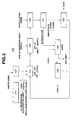
- Fig. 3 schematically shows an exemplary chromate waste liquid treatment line 100.
- a chromate waste liquid generated in a chromate treatment line 102 such as the chromate treatment bath 50 and a washing bath (not shown) is stored in a storage vessel 103.
- the waste liquid is transferred from the storage vessel 103 to the reaction vessel 104.
- a suitable amount of a chromium precipitation accelerating agent, Ca(OH) 2 or CaCl 2 is added to the waste liquid.
- Ca(OH) 2 or CaCl 2 a chromium precipitation accelerating agent
- NaOH is also added as a basic pH adjusting agent.
- pH of the waste liquid is adjusted to and maintained at a first value of 9-12.5 (preferably 10-12.5).
- the dissolved chromium component (Cr 3+ ) is precipitated in the reaction vessel 104 in the form of Cr(OH) 3 and/or the like.
- the resulting precipitate is in the form of fine particles, and most of them are dispersed in the liquid.
- the sedimentation rate of the fine particles is slow.
- After adding the chromium precipitation accelerating agent it is preferable to conduct stirring of the waste liquid in order to further accelerate the chromium precipitation.
- the stirring time is preferably 0.5 hr or longer in order to sufficiently accelerate the reaction.
- the maximum stirring time is not particularly limited, and may be about 2 hours in view of the balance between the reaction acceleration and the working efficiency.
- a resulting waste liquid contains a significant amount of a zinc component (for example, about 5-100 ppm of dissolved zinc) as well as the chromium component.
- a zinc component for example, about 5-100 ppm of dissolved zinc
- this pH decrease may be effective for optimizing the after-mentioned flocculation treatment using an anion-type high-molecular flocculation agent.
- An acid pH adjusting agent for decreasing the pH of the waste liquid can be selected from inorganic acids (e.g., H 2 SO 4 , HNO 3 and HCl). Of these, it is preferable to use H 2 SO 4 , since HNO 3 and HCl respectively contain nitrogen and chlorine that may cause environmental problem.
- H 2 SO 4 as the pH adjusting agent, a large amount of CaSO 4 may be precipitated by decreasing the pH value to a value of lower than 8 through the reaction between H 2 SO 4 and CaCl 2 or Ca(OH) 2 , thereby inhibiting a smooth treatment. Therefore, the second value should be 8 or higher in pH in order to suppress the formation of CaSO 4 .
- the waste liquid (overflow) is introduced from the reaction vessel into a pH adjusting vessel 105, and then H 2 SO 4 is added to the waste liquid for adjusting the pH of the waste liquid.
- the flocculating agent can be selected from nonionic (or weakly anionic) flocculating agents such as polyacrylamide; cationic flocculating agents such as quaternary salt polymers (or copolymers) of aminoalkylacrylate (or aminoalkylmethacrylate), salts (or quaternary salts) of polyaminomethylacrylamide, and chitosan (acetate); and anionic flocculating agents such as acrylamide/sodium acrylate copolymer, acrylamide/sodium acrylate/sodium 2-acryloylamino-2-methylpropanesulfonate copolymer, and sodium polyacrylate.
- polyacrylamide it is particularly preferable to use polyacrylamide, since it has a high solubility in water and a high capability for flocculating the chromium component containing precipitate.
- the amount of the high-molecular flocculating agent may be varied-depending on its type. For example, it may be preferable to add about 1-5 ml of a solution containing about 0.01% of a flocculating agent, per liter of the waste liquid. As shown in Fig. 3, the waste liquid (overflow) after its pH adjustment 105 is introduced into a flocculation vessel 106, followed by addition of a flocculation agent. Then, the sedimentation of the flocculated precipitate (chromium containing precipitate and/or zinc-containing precipitate) is allowed in a sedimentation vessel 107 to achieve a solid-liquid separation.
- a predetermined time e.g. 30 minutes or longer
- it is possible to decrease the dissolved chromium and zinc component concentrations by allowing the waste liquid to stand for a predetermined time from the completion of adding the high-molecular flocculating agent until the completion of the solid-liquid separation.
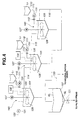
- Fig. 4 schematically shows details of the chromate waste liquid treatment line of Fig. 3.
- a chromate waste liquid is introduced into the reaction vessel 104 through a waste liquid supplying conduit 130.
- This conduit 130 is equipped with a pump 131 for moving the waste liquid toward the reaction vessel 104.
- a chromium precipitation accelerating agent L 1 is stored in a reagent tank 110 and is introduced into the reaction vessel 104 through a conduit 111.
- the amount of this agent to be introduced into the reaction vessel 104 can easily be regulated by a magnetic valve 112 on the conduit 111.
- a pH meter 120 is provided in the reaction vessel 104 for measuring pH of the waste liquid. This pH meter can be a conventional one using an antimony electrode or a liquid membrane type electrode.
- the amount of this agent to be introduced into the reaction vessel 104 is controlled by a controller 132 to adjust the waste liquid to having a first pH in a range of 9-12.5 (preferably 10-12.5), based on the pH value obtained by the pH meter 120.
- the amount of a basic pH adjusting agent (NaOH) to be introduced into the reaction vessel 104 can be controlled by the controller 132 to adjust the waste liquid to having the above first pH range, based on the pH value obtained by the pH meter 120.
- the controller 132 shown in Fig. 4 is, for example, mainly formed of a computer and controls the magnetic valve 112 by sending a signal to open or close the same, based on the pH value obtained by the pH meter 120, thereby regulating the amount of the chromium precipitation accelerating agent or the basic pH adjusting agent to be introduced into the reaction vessel 104 and thereby adjusting the waste liquid to having the above pH range.
- the magnetic valve 112 can be one that takes only a fully opened position and a fully closed position. In this case, the control of this valve can be conducted by adjusting the opening time of the valve 112 or by controlling the duty ratio of the opening time and the closing time.
- the magnetic valve 112 can be a magnetic proportional control valve in which the degree of opening is variable. In this case, the control of this valve can be conducted by adjusting the degree of opening to regulate the flow rate of the above-mentioned reagent.
- the reaction vessel is provided with a stirring mechanism 140 for accelerating the precipitation and for temporarily dispersing the precipitate.
- the waste liquid is introduced from the reaction vessel 104 into the pH adjusting vessel 105 through a waste liquid conduit 114, while the precipitate is dispersed in the reaction vessel 104. With this, the precipitate does not accumulate in the reaction vessel 104, and it becomes possible to collect the precipitate at one time at a downstream position of the treatment line.
- the stirring mechanism 140 comprises a stirring blade 128 and a motor 127 for rotating this blade. Alternatively, this stirring may be conducted by ultrasonic stirring or the like.
- the waste liquid conduit 114 can be constructed in a manner to dispose an inlet of this conduit at the liquid level or at a position slightly lower than the liquid level for allowing overflow into this conduit.
- the waste liquid (dispersion) is introduced from the reaction vessel 104 into the pH adjusting vessel 105 through the conduit 114. Then, the first pH of 9-12.5 is lowered to the second pH of 8 or higher in the pH adjusting vessel 105 by controlling the amount of an acid pH adjusting agent L 2 (e.g., sulfuric acid) to be added from a reagent tank 110 to the pH adjusting vessel 105.
- an acid pH adjusting agent L 2 e.g., sulfuric acid
- This control is conducted by a controller 132 to regulate a magnetic valve 112.
- the pH adjusting vessel 105 is also provided with a stirring mechanism 140. With this, the precipitate is allowed to flow downstream.
- the waste liquid (dispersion) is introduced from the pH adjusting vessel 105 into the flocculation vessel 106 through a conduit 115.
- a high-molecular flocculation agent L 3 is added from a reagent tank 110 to the flocculation vessel 106, while the amount of the flocculation agent L 3 is regulated in accordance with the amount of the waste liquid introduced into the flocculation vessel 106.
- This regulation is conducted by controlling a magnetic valve 112.
- the flocculation vessel 106 is also provided with a stirring mechanism 140. With this, the precipitate is allowed to flow downstream.
- the waste liquid (dispersion) is introduced from the flocculation vessel 106 into a sedimentation vessel 107 through a conduit 116.
- the waste liquid is allowed to stand still for achieving sedimentation of the precipitate SL.
- the resulting waste liquid (supernatant) KL is introduced from the sedimentation vessel 107 into the neutralization vessel 108.
- the precipitate SL accumulates in a predetermined amount, the precipitate (slurry) containing the chromium component is introduced from the sedimentation vessel 107 into a filter press device 109 (see Fig. 3) by opening a valve 121 In the filter press device 109, liquid is removed from the slurry to collect a cake containing the chromium component.
- This liquid is returned to the reaction vessel 104.
- the waste liquid (supernatant) is neutralized in the neutralization vessel 108 (see Fig. 3) and then discharged as a final effluent.
- an acid e.g., H 2 SO 4
- this acid is H 2 SO 4
- the resulting salt is CaSO 4 . It is optional to collect this salt (precipitate) by using the filter press device 109.
- Fig. 5 shows another exemplary chromate waste liquid treatment line 200, in which a magnesium-containing compound is used as the chromium precipitation accelerating agent.
- the steps of this treatment line 200 until the neutralization 108 are substantially the same as those of the above-mentioned treatment line 100 of Fig. 3. Therefore, parts substantially the same as those of the treatment line 100 are denoted by the same numerals and a detailed explanation of them will be omitted from the following description.
- MgCl 2 chromium precipitation accelerating agent
- NaOH basic pH adjusting agent
- a neutralization in the neutralization vessel 108 it is possible to conduct a neutralization in the neutralization vessel 108 by using an acid (e.g., H 2 SO 4 ) that does not form a precipitate with the dissolved magnesium component. With this neutralization, a water-soluble salt (MgSO 4 ) is formed, thereby not generating a precipitate.
- the liquid can be subjected to a reverse osmosis filtration 113 or an ion exchange, thereby removing the dissolved magnesium together with other electrolytic components.
- This reverse osmosis filtration 113 can be conducted by using a conventional reverse osmosis membrane module such as a hollow fiber type membrane module.
- the liquid can be returned to the storage vessel 103, the reaction vessel 104 or the neutralization vessel 108.
- the liquid can be reused as a washing water in the chromate treatment line 102 or for preparing a chromate treatment bath. With this, a closed treatment line is achieved.
- the liquid temperature may have a highest temperature of about 85°C.
- the temperature of a washing water may have a temperature of 10°C or lower in the winter and a temperature of about 15°C or lower in the summer.
- Figs. 6(a), 6(b), 6(c) and 6(d) schematically show various mechanisms for heating the waste liquid.
- the heating mechanism of Fig. 6(a) includes a heater 155 for heating the waste liquid W in the storage vessel 103 or the reaction vessel 104.
- the heater 155 can be an electric heater that generates heat by applying electricity from a heating power source 151.
- the heating mechanism of Fig. 6(b) includes a heater 152 for heating the waste liquid supplying conduit 130 from outside.
- That of Fig. 6(c) includes a heater 153 disposed in the conduit 130 for directly heating the waste liquid W.
- a waste heat source 154 in a factory such as an incinerator for spark plug insulators and various heat treatment furnaces, is used as a source for heating the waste liquid.
- a warm water used as a cooling water for cooling the waste heat source 154 is introduced into a heat exchanger 156 through a cooling water pipe 145. Then, the waste liquid is introduced into the heat exchanger 156 through a conduit 130 and is brought into contact with the warm water for heating the waste liquid.
- the present invention can be used for treating a chromate waste liquid generated by a chromate treatment of various members other than the spark plug metal body.
- a chromate treatment bath was prepared by dissolving, 50 g of chromium(III) chloride (CrCl 3 ⁇ 6H 2 O), 3 g of cobalt(II) nitrate (Co(NO 3 ) 2 ), 100 g of sodium nitrate (NaNO 3 ), and 31.2 g of malonic acid, per liter of deionized water. Then, the liquid temperature of the bath was maintained at 60°C by heater, and its pH was adjusted to 2.0 by adding a caustic soda aqueous solution. The resulting chromate treatment bath was repeatedly used for a chromate treatment of zinc-plated steel members until it reached lifetime.
- the liquid was diluted with pure water to prepare first, second and third initial chromate waste liquids respectively containing 10 ppm by weight, 50 ppm by weight and 100 ppm by weight of the dissolved chromium. Then, a suspension of Ca(OH) 2 (chromium precipitation accelerating agent) was added in an amount to have a pH after 30 minutes stirring (see Table 1). Then, a 75% sulfuric acid aqueous solution was added to the waste liquid to adjust its pH to 8.
- Ca(OH) 2 chromium precipitation accelerating agent
- the dissolved chromium content after the sedimentation of the precipitate decreased, irrespective of the initial dissolved chromium content prior to the treatment.
- the dissolved chromium content was remarkably low if the pH adjusted by the addition of Ca(OH) 2 was 9 or higher, particularly 10 or higher.
- the dissolved zinc content was lower than 1 ppm by weight if the adjusted pH was 9 or higher.
- the initial chromate waste liquid may contain a small amount of hexavalent chromium. Even in this case, it is also possible to reduce the dissolved hexavalent chromium by increasing the pH of the waste liquid.
- An initial chromate waste liquid containing 70 ppm by weight of the dissolved chromium and 5 ppm by weight of the dissolved zinc was prepared by substantially the same process as that of Example 1. Then, 500 mg or 1,000 mg (in terms of Ca) of a CaCl 2 powder per liter of the waste liquid were added to the waste liquid. In fact, as shown in Table 2, first to fourth chromate liquids were each prepared by adding 500 mg (in terms of Ca) of the CaCl 2 powder per liter of the waste liquid, and fifth and sixth chromate waste liquids were each prepared by adding 1,000 mg (in terms of Ca) of the same. Then, a 2% NaOH aqueous solution was added to the first to sixth liquids to adjust their pH values to having those values shown in Table 2.
- each liquid was stirred for a period of time (0.5-2.0 hr) shown in Table 2. Then, a 75% H 2 SO 4 aqueous solution was added to each liquid to adjust its pH to 8, followed by the same steps as those of Example 1. The results are shown in Table 2.
- An initial chromate waste liquid containing 60 ppm by weight of the dissolved chromium and 30 ppm by weight of the dissolved zinc was prepared by substantially the same process as that of Example 1. Then, a 60% CaCl 2 aqueous solution in an amount of 600 mg (in terms of Ca) per liter of the waste liquid was added to the waste liquid. Then, a 2% NaOH aqueous solution (basic pH adjusting agent) was added to the waste liquid, thereby adjusting its pH to 11. While its pH was maintained at 11, the waste liquid was stirred for 5 min. Then, its pH was adjusted to a pH of 9-10 by adding H 2 SO 4 .
- a 0.01% polyacrylamide (high-molecular flocculation agent) aqueous solution in an amount of 2 ml per liter of the waste liquid was added to the waste liquid, followed by stirring. Then, the waste liquid was allowed to stand still for periods of time (0-900 min) shown in Figs. 7a and 7b, thereby achieving sedimentation of the precipitate. After a period of time of Figs. 7a and 7b, the resulting supernatant was analyzed to determine the total dissolved chromium content and the dissolved zinc content. It is understood from Fig. 7a that the total dissolved chromium content decreased with a longer time of the standing still.
- An initial chromate waste liquid was prepared by the same process as that of Example 3. Then, a MgCl 2 powder, in place of the CaCl 2 aqueous solution, in amounts (in terms of magnesium) per liter of the waste liquid as shown in Table 3, was added to the waste liquid, thereby preparing each of first to eighth liquids of Table 3. Then, each liquid was adjusted to having a pH of Table 3 by adding a 10% NaOH aqueous solution (basic pH adjusting agent). While maintaining this pH, each liquid was stirred for a period of time shown in Table 3.
- a first process was conducted as follows. Initial chromate waste liquids each containing 100 ppm by weight of the dissolved chromium and 200 ppm by weight of the dissolved zinc were prepared by substantially the same process as that of Example 1. Then, each waste liquid was heated by a heater to a temperature of 19°C, 25°C, 30°C or 40°C (see Table 4) and maintained at this temperature. Then, a Ca(OH) 2 powder (chromium precipitation accelerating agent) in an amount of 0.4 g, 0.6 g or 0.9 g (in terms of Ca) per liter of the waste liquid was added to the waste liquid, followed by stirring for 30 min and then pH measurement. The results of this pH measurement are shown in Table 4.
- the dissolved chromium concentration has reached a regulated value of 5 ppm by weight or lower with a shorter time as the exhaust liquid temperature became higher.
- the dissolved chromium concentration has reached the regulated value with a stirring time or 5 min or shorter although the amount of Ca(OH) 2 powder was decreased to 0.4 g per liter of the waste liquid.
Landscapes
- Chemical & Material Sciences (AREA)
- Engineering & Computer Science (AREA)
- Organic Chemistry (AREA)
- Life Sciences & Earth Sciences (AREA)
- Hydrology & Water Resources (AREA)
- Environmental & Geological Engineering (AREA)
- Water Supply & Treatment (AREA)
- Inorganic Chemistry (AREA)
- Chemical Kinetics & Catalysis (AREA)
- Electrochemistry (AREA)
- Materials Engineering (AREA)
- Metallurgy (AREA)
- Removal Of Specific Substances (AREA)
- Chemical Treatment Of Metals (AREA)
- Separation Using Semi-Permeable Membranes (AREA)
- Separation Of Suspended Particles By Flocculating Agents (AREA)
- Treatment Of Water By Ion Exchange (AREA)
- Treatment Of Water By Oxidation Or Reduction (AREA)
Applications Claiming Priority (2)
| Application Number | Priority Date | Filing Date | Title |
|---|---|---|---|
| JP2000232518A JP4077143B2 (ja) | 2000-07-31 | 2000-07-31 | クロメート排液の処理方法 |
| JP2000232518 | 2000-07-31 |
Publications (2)
| Publication Number | Publication Date |
|---|---|
| EP1178014A1 true EP1178014A1 (de) | 2002-02-06 |
| EP1178014B1 EP1178014B1 (de) | 2006-09-06 |
Family
ID=18725192
Family Applications (1)
| Application Number | Title | Priority Date | Filing Date |
|---|---|---|---|
| EP01118162A Expired - Lifetime EP1178014B1 (de) | 2000-07-31 | 2001-07-26 | Verfahren zur Behandlung von chromatbelastetem Abwasser |
Country Status (7)
| Country | Link |
|---|---|
| US (1) | US6846416B2 (de) |
| EP (1) | EP1178014B1 (de) |
| JP (1) | JP4077143B2 (de) |
| KR (1) | KR100469872B1 (de) |
| BR (1) | BR0106411B1 (de) |
| DE (1) | DE60122839T2 (de) |
| MY (1) | MY132572A (de) |
Cited By (4)
| Publication number | Priority date | Publication date | Assignee | Title |
|---|---|---|---|---|
| WO2003064331A1 (en) * | 2002-01-31 | 2003-08-07 | University Of Dayton | Recovery process for wastes containing hexavalent chromium |
| CN101891315A (zh) * | 2010-07-07 | 2010-11-24 | 西安皓海嘉水处理科技有限责任公司 | 一种纳米氧化锌生产废水的处理工艺 |
| US8552399B2 (en) | 2005-10-11 | 2013-10-08 | K2R Co., Ltd. | Apparatus for producing photocatalytic reaction water |
| CN103484888A (zh) * | 2012-06-14 | 2014-01-01 | 兰州大学 | 一种不锈钢生产中含铬硫酸钠废液及硫酸酸洗废液的处理方法 |
Families Citing this family (19)
| Publication number | Priority date | Publication date | Assignee | Title |
|---|---|---|---|---|
| JP4559755B2 (ja) * | 2003-03-11 | 2010-10-13 | 株式会社トクヤマ | 排水の処理方法 |
| JP4232019B2 (ja) * | 2003-09-16 | 2009-03-04 | 三菱瓦斯化学株式会社 | フッ素含有排水の処理方法 |
| JP4515273B2 (ja) * | 2005-01-27 | 2010-07-28 | 株式会社ミクニ | 汚濁排水の凝集分離浄化剤及び浄化方法 |
| KR100902018B1 (ko) * | 2007-08-01 | 2009-06-15 | 한국동서발전(주) | 중화약품을 이용한 산업폐수 처리방법 |
| CN101659487B (zh) * | 2009-01-23 | 2011-07-27 | 云南祥云飞龙有色金属股份有限公司 | 铅锌冶炼厂废水零排放方法 |
| CN103183406B (zh) * | 2013-03-14 | 2014-04-16 | 济南大学 | 高浓度pam-铝锌铁复合水处理药剂的制备方法 |
| US9856159B2 (en) | 2013-04-12 | 2018-01-02 | Psmg, Llc | Polymer blends for flocculation |
| TWI539032B (zh) * | 2013-08-01 | 2016-06-21 | Chang Chun Petrochemical Co | Electrolytic copper foil, cleaning fluid composition and cleaning copper foil method |
| US9714342B2 (en) | 2013-08-22 | 2017-07-25 | Psmg, Llc | Particle suspensions of flocculating polymer powders |
| US10011717B2 (en) | 2013-11-27 | 2018-07-03 | Psmg, Llc | Particle suspensions of flocculating polymer powders and powder flocculant polymer blends |
| JP6700668B2 (ja) * | 2015-04-01 | 2020-05-27 | キヤノン株式会社 | 画像形成装置、該装置の制御方法、及びプログラム |
| JP6486877B2 (ja) * | 2016-09-21 | 2019-03-20 | 株式会社ダイワエクセル | 排水処理装置及び当該排水処理装置を用いた排水処理方法 |
| JP7399080B2 (ja) | 2017-05-12 | 2023-12-15 | ケメオン サーフェス テクノロジー, エルエルシー | pH安定な三価クロムコーティング液 |
| CN107697951B (zh) * | 2017-11-23 | 2020-01-03 | 舒城联科环境科技有限公司 | 一种利用铬系树脂柱再生液制备碱式硫酸铬的方法 |
| CN110642425B (zh) * | 2019-10-12 | 2021-10-08 | 广州超邦化工有限公司 | 包含氢氟酸和羧酸的三价铬钝化废水的处理方法 |
| CN110642395B (zh) * | 2019-10-12 | 2021-10-08 | 广州超邦化工有限公司 | 含氟离子的硫酸盐三价铬镀铬废水的处理方法 |
| CN110902881A (zh) * | 2019-12-02 | 2020-03-24 | 沈阳环境科学研究院 | 一种短程混凝沉淀与过滤的高效联合水处理工艺 |
| CN111484183A (zh) * | 2020-05-27 | 2020-08-04 | 武汉钢铁有限公司 | 钢铁行业含铬废水零排放和铬减量化处理方法 |
| CN112159025A (zh) * | 2020-10-28 | 2021-01-01 | 中国科学院生态环境研究中心 | 一种含六价铬废水的处理方法及其应用 |
Citations (3)
| Publication number | Priority date | Publication date | Assignee | Title |
|---|---|---|---|---|
| EP0072885A1 (de) * | 1982-01-19 | 1983-03-02 | industrie automation Sondertechnik GmbH & Co | Verfahren zur Dekontamination natürlicher und technischer Schlämme |
| US5114592A (en) * | 1989-03-31 | 1992-05-19 | Walhalla-Kalk, Entwichlungs- Und Vertriebsgesellschaft Mbh | Procedure for separating arsenic from waste material |
| WO1993016961A1 (en) * | 1992-02-24 | 1993-09-02 | Unichema Australia Pty. Ltd. | Removal of contaminants from wastewater |
Family Cites Families (30)
| Publication number | Priority date | Publication date | Assignee | Title |
|---|---|---|---|---|
| US3575853A (en) * | 1968-12-24 | 1971-04-20 | Lab Betz Inc | Waste water treatment |
| JPS4892270A (de) * | 1972-03-09 | 1973-11-30 | ||
| JPS5182958A (ja) * | 1975-01-17 | 1976-07-21 | Stanley Electric Co Ltd | Jukinzokusakuenhaisuihaieki no shorihoho |
| JPS5268860A (en) | 1975-12-08 | 1977-06-08 | Hitachi Ltd | Method for treating waste liquid of nitric secondary cerium ammonium |
| JPS5348086A (en) | 1976-10-14 | 1978-05-01 | Nippon Fuirutaa Kk | Method and apparatus for treating waste liquid or washed water of trihydric chromium plating process |
| JPS53113795A (en) * | 1977-03-17 | 1978-10-04 | Tamotsu Morimasa | Method of separating metallic ions |
| NL7802123A (nl) * | 1978-02-25 | 1979-08-28 | Akzo Nv | Werkwijze voor het verwijderen van zware metalen uit waterige stoffen. |
| JPS5518229A (en) | 1978-07-26 | 1980-02-08 | Noritake Co Ltd | Treating heavy metal containing waste liquid and sludge |
| JPS5550467A (en) | 1978-10-06 | 1980-04-12 | Katsukawa Heitaro | Treating method for exhaust liquid containing chromium |
| US4260491A (en) * | 1978-11-15 | 1981-04-07 | Amchem Products, Inc. | Chrome removal waste treatment process |
| JPS5776598U (de) * | 1980-10-30 | 1982-05-12 | ||
| US4419246A (en) * | 1982-09-30 | 1983-12-06 | E. I. Du Pont De Nemours & Co. | Removal of heavy metal ions |
| JPS60166087A (ja) * | 1984-02-09 | 1985-08-29 | Hitachi Plant Eng & Constr Co Ltd | 高濃度塩類、銅、亜鉛含有廃水の処理方法 |
| US5314623A (en) * | 1984-04-30 | 1994-05-24 | Kdf Fluid Treatment, Inc. | Method for treating fluids |
| JPS614593A (ja) * | 1984-06-18 | 1986-01-10 | Hitachi Plant Eng & Constr Co Ltd | ホウフツ化物及びクロムを含む廃水の処理方法 |
| KR890002277B1 (ko) * | 1984-07-13 | 1989-06-27 | 가부시기가이샤 히다찌세이사꾸쇼 | 중금속 키일레이트 화합물을 포함하는 폐액의 처리 방법 |
| JPS61192386A (ja) * | 1985-02-22 | 1986-08-26 | Kurita Water Ind Ltd | 重金属錯体を含む廃水の処理方法 |
| US4705639A (en) * | 1985-05-10 | 1987-11-10 | The United States Of America As Represented By The Secretary Of The Air Force | Ferrous and sulfide treatment of electroplating wastewater |
| US4680126A (en) * | 1986-02-18 | 1987-07-14 | Frankard James M | Separation and recovery of reusable heavy metal hydroxides from metal finishing wastewaters |
| US4971775A (en) * | 1987-06-30 | 1990-11-20 | Dowell Schlumberger | Process for removal of nickel from effluent containing EDTA |
| US4846978A (en) * | 1988-11-16 | 1989-07-11 | The Dow Chemical Company | Recovery of metals from solutions containing chelants |
| JPH04349990A (ja) * | 1991-05-28 | 1992-12-04 | Kawasaki Steel Corp | 金属イオンを高濃度に含有する廃液の処理方法 |
| US5160631A (en) * | 1991-08-05 | 1992-11-03 | Halliburton Company | Method for treating chelant solutions to remove metals in solution |
| JP3303332B2 (ja) * | 1992-06-08 | 2002-07-22 | 栗田工業株式会社 | 重金属含有排水の処理方法 |
| US5330658A (en) * | 1993-03-17 | 1994-07-19 | Westinghouse Electric Corporation | Solution decontamination method using precipitation and flocculation techniques |
| US5753125A (en) * | 1995-05-19 | 1998-05-19 | Kreisler; Lawrence | Method for recovering and separating metals from waste streams |
| DE19638176A1 (de) | 1996-09-18 | 1998-04-16 | Surtec Produkte Und Systeme Fu | Chrom(VI)freie Chromatschicht sowie Verfahren zu ihrer Herstellung |
| US6607651B2 (en) * | 1998-09-10 | 2003-08-19 | Cws Parts Company | Process and system for treating the discharge stream from an ion exchanger |
| JP3842907B2 (ja) * | 1998-10-09 | 2006-11-08 | 新日本製鐵株式会社 | 金属含有排水の処理および有価金属の回収方法 |
| JP4374636B2 (ja) * | 1999-01-11 | 2009-12-02 | 栗田工業株式会社 | 重金属錯体含有排液の処理方法 |
-
2000
- 2000-07-31 JP JP2000232518A patent/JP4077143B2/ja not_active Expired - Fee Related
-
2001
- 2001-05-31 MY MYPI20012590 patent/MY132572A/en unknown
- 2001-07-26 DE DE60122839T patent/DE60122839T2/de not_active Expired - Lifetime
- 2001-07-26 EP EP01118162A patent/EP1178014B1/de not_active Expired - Lifetime
- 2001-07-26 BR BRPI0106411-8A patent/BR0106411B1/pt not_active IP Right Cessation
- 2001-07-30 US US09/916,532 patent/US6846416B2/en not_active Expired - Fee Related
- 2001-07-30 KR KR10-2001-0045821A patent/KR100469872B1/ko not_active Expired - Fee Related
Patent Citations (3)
| Publication number | Priority date | Publication date | Assignee | Title |
|---|---|---|---|---|
| EP0072885A1 (de) * | 1982-01-19 | 1983-03-02 | industrie automation Sondertechnik GmbH & Co | Verfahren zur Dekontamination natürlicher und technischer Schlämme |
| US5114592A (en) * | 1989-03-31 | 1992-05-19 | Walhalla-Kalk, Entwichlungs- Und Vertriebsgesellschaft Mbh | Procedure for separating arsenic from waste material |
| WO1993016961A1 (en) * | 1992-02-24 | 1993-09-02 | Unichema Australia Pty. Ltd. | Removal of contaminants from wastewater |
Cited By (7)
| Publication number | Priority date | Publication date | Assignee | Title |
|---|---|---|---|---|
| WO2003064331A1 (en) * | 2002-01-31 | 2003-08-07 | University Of Dayton | Recovery process for wastes containing hexavalent chromium |
| US6833124B2 (en) | 2002-01-31 | 2004-12-21 | University Of Dayton | Recovery process for wastes containing hexavalent chromium |
| US8552399B2 (en) | 2005-10-11 | 2013-10-08 | K2R Co., Ltd. | Apparatus for producing photocatalytic reaction water |
| CN101891315A (zh) * | 2010-07-07 | 2010-11-24 | 西安皓海嘉水处理科技有限责任公司 | 一种纳米氧化锌生产废水的处理工艺 |
| CN101891315B (zh) * | 2010-07-07 | 2012-03-21 | 西安皓海嘉水处理科技有限责任公司 | 一种纳米氧化锌生产废水的处理工艺 |
| CN103484888A (zh) * | 2012-06-14 | 2014-01-01 | 兰州大学 | 一种不锈钢生产中含铬硫酸钠废液及硫酸酸洗废液的处理方法 |
| CN103484888B (zh) * | 2012-06-14 | 2015-11-04 | 兰州大学 | 一种不锈钢生产中含铬硫酸钠废液及硫酸酸洗废液的处理方法 |
Also Published As
| Publication number | Publication date |
|---|---|
| DE60122839T2 (de) | 2006-12-21 |
| BR0106411A (pt) | 2002-04-09 |
| US20020033368A1 (en) | 2002-03-21 |
| DE60122839D1 (de) | 2006-10-19 |
| BR0106411B1 (pt) | 2011-10-18 |
| JP2002045871A (ja) | 2002-02-12 |
| JP4077143B2 (ja) | 2008-04-16 |
| EP1178014B1 (de) | 2006-09-06 |
| US6846416B2 (en) | 2005-01-25 |
| MY132572A (en) | 2007-10-31 |
| KR100469872B1 (ko) | 2005-02-02 |
| KR20020010865A (ko) | 2002-02-06 |
Similar Documents
| Publication | Publication Date | Title |
|---|---|---|
| US6846416B2 (en) | Process for treating chromate waste liquid | |
| CN114751582B (zh) | 一种电镀混合废水的处理方法 | |
| JP3739480B2 (ja) | 排煙脱硫排水の処理方法 | |
| CN110092503A (zh) | 焦磷酸盐-柠檬酸体系铜镍合金电镀废水的处理方法 | |
| CN111533318A (zh) | 不锈钢生产中的含氟酸洗钝化废水处理方法 | |
| AU748300B2 (en) | Removal of pollutants from effluents with electrochemical treatment | |
| JP2004008860A (ja) | 有害性陰イオン含有排水の処理方法及びそれに使用する薬剤 | |
| EP1412546B1 (de) | Verfahren zur entfernung von metallen aus einer wässrigen lösung mittels kalkfällung | |
| KR100672189B1 (ko) | 슬러지 발생이 없는 인산아연 처리액 및 인산아연 처리방법 | |
| CN110092502A (zh) | 一种焦磷酸盐-柠檬酸锌镍合金电镀废水的处理方法 | |
| JP5205089B2 (ja) | 廃棄電解液の処理方法 | |
| JP2006219691A (ja) | 金属表面処理方法 | |
| AU2002352521A1 (en) | A method for the removal of metals from an aqueous solution using lime precipitation | |
| JPS634478B2 (de) | ||
| CN216236433U (zh) | 镀镍废液处理装置 | |
| JP3764929B2 (ja) | 有害重金属イオン除去剤 | |
| JPH0820876A (ja) | リン酸塩化成処理方法 | |
| JP4214319B2 (ja) | セレン含有水の処理方法 | |
| CN119392343B (zh) | 一种电镀镍磷合金废液的再生方法 | |
| CN111039459A (zh) | 一种含间-硝基苯磺酸钠的退镀镍废水的处理工艺 | |
| CN113912225B (zh) | 一种含焦铜废水的处理及回用的方法 | |
| JP3173981B2 (ja) | 廃液処理方法 | |
| RU2195430C1 (ru) | Способ очистки и регенерации концентрированных отработанных хромсодержащих растворов | |
| KR20150008084A (ko) | 아연계 도금 금속 부재 표면의 질산 활성 처리 용액의 재생 방법 및 그것을 이용한 재생 처리 장치 | |
| JPH0344839B2 (de) |
Legal Events
| Date | Code | Title | Description |
|---|---|---|---|
| PUAI | Public reference made under article 153(3) epc to a published international application that has entered the european phase |
Free format text: ORIGINAL CODE: 0009012 |
|
| AK | Designated contracting states |
Kind code of ref document: A1 Designated state(s): DE FR Kind code of ref document: A1 Designated state(s): AT BE CH CY DE DK ES FI FR GB GR IE IT LI LU MC NL PT SE TR |
|
| AX | Request for extension of the european patent |
Free format text: AL;LT;LV;MK;RO;SI |
|
| 17P | Request for examination filed |
Effective date: 20020614 |
|
| AKX | Designation fees paid |
Free format text: DE FR |
|
| 17Q | First examination report despatched |
Effective date: 20040506 |
|
| GRAP | Despatch of communication of intention to grant a patent |
Free format text: ORIGINAL CODE: EPIDOSNIGR1 |
|
| GRAS | Grant fee paid |
Free format text: ORIGINAL CODE: EPIDOSNIGR3 |
|
| GRAA | (expected) grant |
Free format text: ORIGINAL CODE: 0009210 |
|
| AK | Designated contracting states |
Kind code of ref document: B1 Designated state(s): DE FR |
|
| REF | Corresponds to: |
Ref document number: 60122839 Country of ref document: DE Date of ref document: 20061019 Kind code of ref document: P |
|
| ET | Fr: translation filed | ||
| PLBE | No opposition filed within time limit |
Free format text: ORIGINAL CODE: 0009261 |
|
| STAA | Information on the status of an ep patent application or granted ep patent |
Free format text: STATUS: NO OPPOSITION FILED WITHIN TIME LIMIT |
|
| 26N | No opposition filed |
Effective date: 20070607 |
|
| REG | Reference to a national code |
Ref country code: FR Ref legal event code: PLFP Year of fee payment: 15 |
|
| PGFP | Annual fee paid to national office [announced via postgrant information from national office to epo] |
Ref country code: DE Payment date: 20150722 Year of fee payment: 15 |
|
| PGFP | Annual fee paid to national office [announced via postgrant information from national office to epo] |
Ref country code: FR Payment date: 20150629 Year of fee payment: 15 |
|
| REG | Reference to a national code |
Ref country code: DE Ref legal event code: R119 Ref document number: 60122839 Country of ref document: DE |
|
| PG25 | Lapsed in a contracting state [announced via postgrant information from national office to epo] |
Ref country code: FR Free format text: LAPSE BECAUSE OF NON-PAYMENT OF DUE FEES Effective date: 20160801 Ref country code: DE Free format text: LAPSE BECAUSE OF NON-PAYMENT OF DUE FEES Effective date: 20170201 |
|
| REG | Reference to a national code |
Ref country code: FR Ref legal event code: ST Effective date: 20170331 |