EP1180480A1 - Dispositif et procede de thermoscellage, procede d'emboutissage, dispositif de pressage de piece, et piece pressee - Google Patents
Dispositif et procede de thermoscellage, procede d'emboutissage, dispositif de pressage de piece, et piece pressee Download PDFInfo
- Publication number
- EP1180480A1 EP1180480A1 EP01901547A EP01901547A EP1180480A1 EP 1180480 A1 EP1180480 A1 EP 1180480A1 EP 01901547 A EP01901547 A EP 01901547A EP 01901547 A EP01901547 A EP 01901547A EP 1180480 A1 EP1180480 A1 EP 1180480A1
- Authority
- EP
- European Patent Office
- Prior art keywords
- package
- workpiece
- sealing
- male
- layer
- Prior art date
- Legal status (The legal status is an assumption and is not a legal conclusion. Google has not performed a legal analysis and makes no representation as to the accuracy of the status listed.)
- Granted
Links
- 238000003825 pressing Methods 0.000 title claims description 93
- 238000000034 method Methods 0.000 title claims description 81
- 238000004049 embossing Methods 0.000 title claims description 56
- 238000007789 sealing Methods 0.000 claims abstract description 134
- 229920000642 polymer Polymers 0.000 claims abstract description 84
- 229910052782 aluminium Inorganic materials 0.000 claims description 97
- XAGFODPZIPBFFR-UHFFFAOYSA-N aluminium Chemical compound [Al] XAGFODPZIPBFFR-UHFFFAOYSA-N 0.000 claims description 97
- 239000000126 substance Substances 0.000 claims description 75
- 229920005989 resin Polymers 0.000 claims description 73
- 239000011347 resin Substances 0.000 claims description 73
- -1 polypropylene Polymers 0.000 claims description 39
- 230000004888 barrier function Effects 0.000 claims description 35
- 238000003475 lamination Methods 0.000 claims description 32
- 229920005672 polyolefin resin Polymers 0.000 claims description 31
- 238000007739 conversion coating Methods 0.000 claims description 26
- 239000004743 Polypropylene Substances 0.000 claims description 25
- 238000009820 dry lamination Methods 0.000 claims description 25
- 229920001155 polypropylene Polymers 0.000 claims description 24
- 229920000098 polyolefin Polymers 0.000 claims description 8
- 230000008569 process Effects 0.000 claims description 8
- 239000010410 layer Substances 0.000 claims 26
- 239000012790 adhesive layer Substances 0.000 claims 4
- 239000011888 foil Substances 0.000 description 75
- 238000006243 chemical reaction Methods 0.000 description 45
- 238000002844 melting Methods 0.000 description 27
- 230000008018 melting Effects 0.000 description 27
- 238000004806 packaging method and process Methods 0.000 description 27
- 239000004840 adhesive resin Substances 0.000 description 25
- 229920006223 adhesive resin Polymers 0.000 description 25
- 238000012545 processing Methods 0.000 description 25
- XEEYBQQBJWHFJM-UHFFFAOYSA-N Iron Chemical compound [Fe] XEEYBQQBJWHFJM-UHFFFAOYSA-N 0.000 description 14
- 239000003792 electrolyte Substances 0.000 description 14
- 239000007788 liquid Substances 0.000 description 14
- 230000001070 adhesive effect Effects 0.000 description 12
- 229920013716 polyethylene resin Polymers 0.000 description 12
- 238000012360 testing method Methods 0.000 description 12
- 239000000853 adhesive Substances 0.000 description 11
- 230000000052 comparative effect Effects 0.000 description 11
- 229920006284 nylon film Polymers 0.000 description 10
- 239000005022 packaging material Substances 0.000 description 10
- 239000004677 Nylon Substances 0.000 description 9
- 229920001778 nylon Polymers 0.000 description 9
- 229920000139 polyethylene terephthalate Polymers 0.000 description 9
- 239000005020 polyethylene terephthalate Substances 0.000 description 9
- 238000000576 coating method Methods 0.000 description 8
- 229920006267 polyester film Polymers 0.000 description 8
- 238000000926 separation method Methods 0.000 description 8
- 238000010438 heat treatment Methods 0.000 description 7
- 229910052742 iron Inorganic materials 0.000 description 7
- 229920000092 linear low density polyethylene Polymers 0.000 description 7
- 239000004707 linear low-density polyethylene Substances 0.000 description 7
- 229910052751 metal Inorganic materials 0.000 description 7
- 239000002184 metal Substances 0.000 description 7
- 239000002313 adhesive film Substances 0.000 description 6
- 239000011248 coating agent Substances 0.000 description 6
- 238000005520 cutting process Methods 0.000 description 6
- NBVXSUQYWXRMNV-UHFFFAOYSA-N fluoromethane Chemical compound FC NBVXSUQYWXRMNV-UHFFFAOYSA-N 0.000 description 6
- 229920002050 silicone resin Polymers 0.000 description 6
- 239000004925 Acrylic resin Substances 0.000 description 5
- 229920000178 Acrylic resin Polymers 0.000 description 5
- KRHYYFGTRYWZRS-UHFFFAOYSA-N Fluorane Chemical compound F KRHYYFGTRYWZRS-UHFFFAOYSA-N 0.000 description 5
- PXHVJJICTQNCMI-UHFFFAOYSA-N Nickel Chemical compound [Ni] PXHVJJICTQNCMI-UHFFFAOYSA-N 0.000 description 5
- 230000000694 effects Effects 0.000 description 5
- 229910000040 hydrogen fluoride Inorganic materials 0.000 description 5
- 230000008595 infiltration Effects 0.000 description 5
- 238000001764 infiltration Methods 0.000 description 5
- 230000003993 interaction Effects 0.000 description 5
- 238000004519 manufacturing process Methods 0.000 description 5
- NBIIXXVUZAFLBC-UHFFFAOYSA-N Phosphoric acid Chemical compound OP(O)(O)=O NBIIXXVUZAFLBC-UHFFFAOYSA-N 0.000 description 4
- 230000015572 biosynthetic process Effects 0.000 description 4
- 208000018999 crinkle Diseases 0.000 description 4
- 238000010030 laminating Methods 0.000 description 4
- WHXSMMKQMYFTQS-UHFFFAOYSA-N Lithium Chemical compound [Li] WHXSMMKQMYFTQS-UHFFFAOYSA-N 0.000 description 3
- 239000004698 Polyethylene Substances 0.000 description 3
- 230000002411 adverse Effects 0.000 description 3
- 238000010276 construction Methods 0.000 description 3
- 238000001816 cooling Methods 0.000 description 3
- 230000032798 delamination Effects 0.000 description 3
- 230000001419 dependent effect Effects 0.000 description 3
- 238000001035 drying Methods 0.000 description 3
- 229910052744 lithium Inorganic materials 0.000 description 3
- 238000003892 spreading Methods 0.000 description 3
- 230000007480 spreading Effects 0.000 description 3
- KXGFMDJXCMQABM-UHFFFAOYSA-N 2-methoxy-6-methylphenol Chemical compound [CH]OC1=CC=CC([CH])=C1O KXGFMDJXCMQABM-UHFFFAOYSA-N 0.000 description 2
- 229920002292 Nylon 6 Polymers 0.000 description 2
- 229920002302 Nylon 6,6 Polymers 0.000 description 2
- VYPSYNLAJGMNEJ-UHFFFAOYSA-N Silicium dioxide Chemical compound O=[Si]=O VYPSYNLAJGMNEJ-UHFFFAOYSA-N 0.000 description 2
- 229910000147 aluminium phosphate Inorganic materials 0.000 description 2
- 238000000137 annealing Methods 0.000 description 2
- 229910021563 chromium fluoride Inorganic materials 0.000 description 2
- 229920001577 copolymer Polymers 0.000 description 2
- 230000007797 corrosion Effects 0.000 description 2
- 238000005260 corrosion Methods 0.000 description 2
- 239000000839 emulsion Substances 0.000 description 2
- 238000001125 extrusion Methods 0.000 description 2
- 229910052759 nickel Inorganic materials 0.000 description 2
- 230000002093 peripheral effect Effects 0.000 description 2
- 229920001568 phenolic resin Polymers 0.000 description 2
- 239000005011 phenolic resin Substances 0.000 description 2
- 229920006350 polyacrylonitrile resin Polymers 0.000 description 2
- 229920001225 polyester resin Polymers 0.000 description 2
- 239000004645 polyester resin Substances 0.000 description 2
- QQONPFPTGQHPMA-UHFFFAOYSA-N propylene Natural products CC=C QQONPFPTGQHPMA-UHFFFAOYSA-N 0.000 description 2
- 125000004805 propylene group Chemical group [H]C([H])([H])C([H])([*:1])C([H])([H])[*:2] 0.000 description 2
- 238000011144 upstream manufacturing Methods 0.000 description 2
- SMZOUWXMTYCWNB-UHFFFAOYSA-N 2-(2-methoxy-5-methylphenyl)ethanamine Chemical compound COC1=CC=C(C)C=C1CCN SMZOUWXMTYCWNB-UHFFFAOYSA-N 0.000 description 1
- NIXOWILDQLNWCW-UHFFFAOYSA-N 2-Propenoic acid Natural products OC(=O)C=C NIXOWILDQLNWCW-UHFFFAOYSA-N 0.000 description 1
- GVNWZKBFMFUVNX-UHFFFAOYSA-N Adipamide Chemical compound NC(=O)CCCCC(N)=O GVNWZKBFMFUVNX-UHFFFAOYSA-N 0.000 description 1
- OKTJSMMVPCPJKN-UHFFFAOYSA-N Carbon Chemical compound [C] OKTJSMMVPCPJKN-UHFFFAOYSA-N 0.000 description 1
- BVKZGUZCCUSVTD-UHFFFAOYSA-L Carbonate Chemical compound [O-]C([O-])=O BVKZGUZCCUSVTD-UHFFFAOYSA-L 0.000 description 1
- RYGMFSIKBFXOCR-UHFFFAOYSA-N Copper Chemical compound [Cu] RYGMFSIKBFXOCR-UHFFFAOYSA-N 0.000 description 1
- VGGSQFUCUMXWEO-UHFFFAOYSA-N Ethene Chemical compound C=C VGGSQFUCUMXWEO-UHFFFAOYSA-N 0.000 description 1
- JOYRKODLDBILNP-UHFFFAOYSA-N Ethyl urethane Chemical compound CCOC(N)=O JOYRKODLDBILNP-UHFFFAOYSA-N 0.000 description 1
- 239000005977 Ethylene Substances 0.000 description 1
- KMTRUDSVKNLOMY-UHFFFAOYSA-N Ethylene carbonate Chemical compound O=C1OCCO1 KMTRUDSVKNLOMY-UHFFFAOYSA-N 0.000 description 1
- KRHYYFGTRYWZRS-UHFFFAOYSA-M Fluoride anion Chemical compound [F-] KRHYYFGTRYWZRS-UHFFFAOYSA-M 0.000 description 1
- 101000576320 Homo sapiens Max-binding protein MNT Proteins 0.000 description 1
- HBBGRARXTFLTSG-UHFFFAOYSA-N Lithium ion Chemical compound [Li+] HBBGRARXTFLTSG-UHFFFAOYSA-N 0.000 description 1
- CERQOIWHTDAKMF-UHFFFAOYSA-N Methacrylic acid Chemical compound CC(=C)C(O)=O CERQOIWHTDAKMF-UHFFFAOYSA-N 0.000 description 1
- 229920000305 Nylon 6,10 Polymers 0.000 description 1
- CBENFWSGALASAD-UHFFFAOYSA-N Ozone Chemical compound [O-][O+]=O CBENFWSGALASAD-UHFFFAOYSA-N 0.000 description 1
- 229910019142 PO4 Inorganic materials 0.000 description 1
- 229920002873 Polyethylenimine Polymers 0.000 description 1
- 239000004721 Polyphenylene oxide Substances 0.000 description 1
- 229920006121 Polyxylylene adipamide Polymers 0.000 description 1
- 239000004830 Super Glue Substances 0.000 description 1
- RTAQQCXQSZGOHL-UHFFFAOYSA-N Titanium Chemical compound [Ti] RTAQQCXQSZGOHL-UHFFFAOYSA-N 0.000 description 1
- 239000002253 acid Substances 0.000 description 1
- 230000003213 activating effect Effects 0.000 description 1
- 229910045601 alloy Inorganic materials 0.000 description 1
- 239000000956 alloy Substances 0.000 description 1
- PNEYBMLMFCGWSK-UHFFFAOYSA-N aluminium oxide Inorganic materials [O-2].[O-2].[O-2].[Al+3].[Al+3] PNEYBMLMFCGWSK-UHFFFAOYSA-N 0.000 description 1
- 239000007864 aqueous solution Substances 0.000 description 1
- 238000005422 blasting Methods 0.000 description 1
- 229910052799 carbon Inorganic materials 0.000 description 1
- 239000006229 carbon black Substances 0.000 description 1
- 150000001732 carboxylic acid derivatives Chemical class 0.000 description 1
- ZCDOYSPFYFSLEW-UHFFFAOYSA-N chromate(2-) Chemical compound [O-][Cr]([O-])(=O)=O ZCDOYSPFYFSLEW-UHFFFAOYSA-N 0.000 description 1
- 229910000151 chromium(III) phosphate Inorganic materials 0.000 description 1
- IKZBVTPSNGOVRJ-UHFFFAOYSA-K chromium(iii) phosphate Chemical compound [Cr+3].[O-]P([O-])([O-])=O IKZBVTPSNGOVRJ-UHFFFAOYSA-K 0.000 description 1
- 238000005097 cold rolling Methods 0.000 description 1
- 229920000891 common polymer Polymers 0.000 description 1
- 229910052802 copper Inorganic materials 0.000 description 1
- 239000010949 copper Substances 0.000 description 1
- 238000003851 corona treatment Methods 0.000 description 1
- 238000005336 cracking Methods 0.000 description 1
- 229920003020 cross-linked polyethylene Polymers 0.000 description 1
- 239000004703 cross-linked polyethylene Substances 0.000 description 1
- IEJIGPNLZYLLBP-UHFFFAOYSA-N dimethyl carbonate Chemical compound COC(=O)OC IEJIGPNLZYLLBP-UHFFFAOYSA-N 0.000 description 1
- 238000004090 dissolution Methods 0.000 description 1
- 238000004146 energy storage Methods 0.000 description 1
- 229920006332 epoxy adhesive Polymers 0.000 description 1
- UQOULBWSWCWZJC-UHFFFAOYSA-N ethene;methyl hydrogen carbonate Chemical compound C=C.COC(O)=O UQOULBWSWCWZJC-UHFFFAOYSA-N 0.000 description 1
- 238000011156 evaluation Methods 0.000 description 1
- 238000001704 evaporation Methods 0.000 description 1
- 230000008020 evaporation Effects 0.000 description 1
- 238000002474 experimental method Methods 0.000 description 1
- 238000011049 filling Methods 0.000 description 1
- 239000012530 fluid Substances 0.000 description 1
- 229920001903 high density polyethylene Polymers 0.000 description 1
- 239000004700 high-density polyethylene Substances 0.000 description 1
- 150000003949 imides Chemical class 0.000 description 1
- 150000002484 inorganic compounds Chemical class 0.000 description 1
- 229910010272 inorganic material Inorganic materials 0.000 description 1
- 239000012948 isocyanate Substances 0.000 description 1
- 150000002513 isocyanates Chemical class 0.000 description 1
- 229910001416 lithium ion Inorganic materials 0.000 description 1
- 229910044991 metal oxide Inorganic materials 0.000 description 1
- 150000004706 metal oxides Chemical class 0.000 description 1
- 229910052976 metal sulfide Inorganic materials 0.000 description 1
- 238000013508 migration Methods 0.000 description 1
- 230000005012 migration Effects 0.000 description 1
- 239000000203 mixture Substances 0.000 description 1
- 238000012986 modification Methods 0.000 description 1
- 230000004048 modification Effects 0.000 description 1
- 239000003921 oil Substances 0.000 description 1
- 230000003647 oxidation Effects 0.000 description 1
- 238000007254 oxidation reaction Methods 0.000 description 1
- TWNQGVIAIRXVLR-UHFFFAOYSA-N oxo(oxoalumanyloxy)alumane Chemical compound O=[Al]O[Al]=O TWNQGVIAIRXVLR-UHFFFAOYSA-N 0.000 description 1
- 230000035515 penetration Effects 0.000 description 1
- NBIIXXVUZAFLBC-UHFFFAOYSA-K phosphate Chemical compound [O-]P([O-])([O-])=O NBIIXXVUZAFLBC-UHFFFAOYSA-K 0.000 description 1
- 239000010452 phosphate Substances 0.000 description 1
- 229920003207 poly(ethylene-2,6-naphthalate) Polymers 0.000 description 1
- 229920006122 polyamide resin Polymers 0.000 description 1
- 229920001707 polybutylene terephthalate Polymers 0.000 description 1
- 239000004431 polycarbonate resin Substances 0.000 description 1
- 229920005668 polycarbonate resin Polymers 0.000 description 1
- 229920001690 polydopamine Polymers 0.000 description 1
- 229920000867 polyelectrolyte Polymers 0.000 description 1
- 229920000728 polyester Polymers 0.000 description 1
- 229920000570 polyether Polymers 0.000 description 1
- 239000011112 polyethylene naphthalate Substances 0.000 description 1
- RUOJZAUFBMNUDX-UHFFFAOYSA-N propylene carbonate Chemical compound CC1COC(=O)O1 RUOJZAUFBMNUDX-UHFFFAOYSA-N 0.000 description 1
- 230000001681 protective effect Effects 0.000 description 1
- 239000000565 sealant Substances 0.000 description 1
- 235000012239 silicon dioxide Nutrition 0.000 description 1
- 239000000377 silicon dioxide Substances 0.000 description 1
- 239000013464 silicone adhesive Substances 0.000 description 1
- 239000010935 stainless steel Substances 0.000 description 1
- 229910001220 stainless steel Inorganic materials 0.000 description 1
- 238000003860 storage Methods 0.000 description 1
- 239000010936 titanium Substances 0.000 description 1
- 229910052719 titanium Inorganic materials 0.000 description 1
- XLYOFNOQVPJJNP-UHFFFAOYSA-N water Substances O XLYOFNOQVPJJNP-UHFFFAOYSA-N 0.000 description 1
Images





Classifications
-
- B—PERFORMING OPERATIONS; TRANSPORTING
- B29—WORKING OF PLASTICS; WORKING OF SUBSTANCES IN A PLASTIC STATE IN GENERAL
- B29C—SHAPING OR JOINING OF PLASTICS; SHAPING OF MATERIAL IN A PLASTIC STATE, NOT OTHERWISE PROVIDED FOR; AFTER-TREATMENT OF THE SHAPED PRODUCTS, e.g. REPAIRING
- B29C65/00—Joining or sealing of preformed parts, e.g. welding of plastics materials; Apparatus therefor
- B29C65/02—Joining or sealing of preformed parts, e.g. welding of plastics materials; Apparatus therefor by heating, with or without pressure
- B29C65/18—Joining or sealing of preformed parts, e.g. welding of plastics materials; Apparatus therefor by heating, with or without pressure using heated tools
-
- B—PERFORMING OPERATIONS; TRANSPORTING
- B29—WORKING OF PLASTICS; WORKING OF SUBSTANCES IN A PLASTIC STATE IN GENERAL
- B29C—SHAPING OR JOINING OF PLASTICS; SHAPING OF MATERIAL IN A PLASTIC STATE, NOT OTHERWISE PROVIDED FOR; AFTER-TREATMENT OF THE SHAPED PRODUCTS, e.g. REPAIRING
- B29C48/00—Extrusion moulding, i.e. expressing the moulding material through a die or nozzle which imparts the desired form; Apparatus therefor
- B29C48/03—Extrusion moulding, i.e. expressing the moulding material through a die or nozzle which imparts the desired form; Apparatus therefor characterised by the shape of the extruded material at extrusion
- B29C48/07—Flat, e.g. panels
- B29C48/08—Flat, e.g. panels flexible, e.g. films
-
- B—PERFORMING OPERATIONS; TRANSPORTING
- B29—WORKING OF PLASTICS; WORKING OF SUBSTANCES IN A PLASTIC STATE IN GENERAL
- B29C—SHAPING OR JOINING OF PLASTICS; SHAPING OF MATERIAL IN A PLASTIC STATE, NOT OTHERWISE PROVIDED FOR; AFTER-TREATMENT OF THE SHAPED PRODUCTS, e.g. REPAIRING
- B29C48/00—Extrusion moulding, i.e. expressing the moulding material through a die or nozzle which imparts the desired form; Apparatus therefor
- B29C48/16—Articles comprising two or more components, e.g. co-extruded layers
- B29C48/18—Articles comprising two or more components, e.g. co-extruded layers the components being layers
- B29C48/19—Articles comprising two or more components, e.g. co-extruded layers the components being layers the layers being joined at their edges
-
- B—PERFORMING OPERATIONS; TRANSPORTING
- B29—WORKING OF PLASTICS; WORKING OF SUBSTANCES IN A PLASTIC STATE IN GENERAL
- B29C—SHAPING OR JOINING OF PLASTICS; SHAPING OF MATERIAL IN A PLASTIC STATE, NOT OTHERWISE PROVIDED FOR; AFTER-TREATMENT OF THE SHAPED PRODUCTS, e.g. REPAIRING
- B29C48/00—Extrusion moulding, i.e. expressing the moulding material through a die or nozzle which imparts the desired form; Apparatus therefor
- B29C48/16—Articles comprising two or more components, e.g. co-extruded layers
- B29C48/18—Articles comprising two or more components, e.g. co-extruded layers the components being layers
- B29C48/21—Articles comprising two or more components, e.g. co-extruded layers the components being layers the layers being joined at their surfaces
-
- B—PERFORMING OPERATIONS; TRANSPORTING
- B29—WORKING OF PLASTICS; WORKING OF SUBSTANCES IN A PLASTIC STATE IN GENERAL
- B29C—SHAPING OR JOINING OF PLASTICS; SHAPING OF MATERIAL IN A PLASTIC STATE, NOT OTHERWISE PROVIDED FOR; AFTER-TREATMENT OF THE SHAPED PRODUCTS, e.g. REPAIRING
- B29C48/00—Extrusion moulding, i.e. expressing the moulding material through a die or nozzle which imparts the desired form; Apparatus therefor
- B29C48/25—Component parts, details or accessories; Auxiliary operations
- B29C48/30—Extrusion nozzles or dies
- B29C48/305—Extrusion nozzles or dies having a wide opening, e.g. for forming sheets
- B29C48/307—Extrusion nozzles or dies having a wide opening, e.g. for forming sheets specially adapted for bringing together components, e.g. melts within the die
-
- B—PERFORMING OPERATIONS; TRANSPORTING
- B29—WORKING OF PLASTICS; WORKING OF SUBSTANCES IN A PLASTIC STATE IN GENERAL
- B29C—SHAPING OR JOINING OF PLASTICS; SHAPING OF MATERIAL IN A PLASTIC STATE, NOT OTHERWISE PROVIDED FOR; AFTER-TREATMENT OF THE SHAPED PRODUCTS, e.g. REPAIRING
- B29C53/00—Shaping by bending, folding, twisting, straightening or flattening; Apparatus therefor
- B29C53/16—Straightening or flattening
- B29C53/18—Straightening or flattening of plates or sheets
-
- B—PERFORMING OPERATIONS; TRANSPORTING
- B29—WORKING OF PLASTICS; WORKING OF SUBSTANCES IN A PLASTIC STATE IN GENERAL
- B29C—SHAPING OR JOINING OF PLASTICS; SHAPING OF MATERIAL IN A PLASTIC STATE, NOT OTHERWISE PROVIDED FOR; AFTER-TREATMENT OF THE SHAPED PRODUCTS, e.g. REPAIRING
- B29C65/00—Joining or sealing of preformed parts, e.g. welding of plastics materials; Apparatus therefor
- B29C65/02—Joining or sealing of preformed parts, e.g. welding of plastics materials; Apparatus therefor by heating, with or without pressure
-
- B—PERFORMING OPERATIONS; TRANSPORTING
- B29—WORKING OF PLASTICS; WORKING OF SUBSTANCES IN A PLASTIC STATE IN GENERAL
- B29C—SHAPING OR JOINING OF PLASTICS; SHAPING OF MATERIAL IN A PLASTIC STATE, NOT OTHERWISE PROVIDED FOR; AFTER-TREATMENT OF THE SHAPED PRODUCTS, e.g. REPAIRING
- B29C65/00—Joining or sealing of preformed parts, e.g. welding of plastics materials; Apparatus therefor
- B29C65/02—Joining or sealing of preformed parts, e.g. welding of plastics materials; Apparatus therefor by heating, with or without pressure
- B29C65/40—Applying molten plastics, e.g. hot melt
- B29C65/405—Applying molten plastics, e.g. hot melt characterised by the composition of the applied molten plastics
-
- B—PERFORMING OPERATIONS; TRANSPORTING
- B29—WORKING OF PLASTICS; WORKING OF SUBSTANCES IN A PLASTIC STATE IN GENERAL
- B29C—SHAPING OR JOINING OF PLASTICS; SHAPING OF MATERIAL IN A PLASTIC STATE, NOT OTHERWISE PROVIDED FOR; AFTER-TREATMENT OF THE SHAPED PRODUCTS, e.g. REPAIRING
- B29C66/00—General aspects of processes or apparatus for joining preformed parts
- B29C66/01—General aspects dealing with the joint area or with the area to be joined
- B29C66/05—Particular design of joint configurations
- B29C66/10—Particular design of joint configurations particular design of the joint cross-sections
- B29C66/11—Joint cross-sections comprising a single joint-segment, i.e. one of the parts to be joined comprising a single joint-segment in the joint cross-section
- B29C66/112—Single lapped joints
- B29C66/1122—Single lap to lap joints, i.e. overlap joints
-
- B—PERFORMING OPERATIONS; TRANSPORTING
- B29—WORKING OF PLASTICS; WORKING OF SUBSTANCES IN A PLASTIC STATE IN GENERAL
- B29C—SHAPING OR JOINING OF PLASTICS; SHAPING OF MATERIAL IN A PLASTIC STATE, NOT OTHERWISE PROVIDED FOR; AFTER-TREATMENT OF THE SHAPED PRODUCTS, e.g. REPAIRING
- B29C66/00—General aspects of processes or apparatus for joining preformed parts
- B29C66/01—General aspects dealing with the joint area or with the area to be joined
- B29C66/05—Particular design of joint configurations
- B29C66/10—Particular design of joint configurations particular design of the joint cross-sections
- B29C66/13—Single flanged joints; Fin-type joints; Single hem joints; Edge joints; Interpenetrating fingered joints; Other specific particular designs of joint cross-sections not provided for in groups B29C66/11 - B29C66/12
- B29C66/133—Fin-type joints, the parts to be joined being flexible
-
- B—PERFORMING OPERATIONS; TRANSPORTING
- B29—WORKING OF PLASTICS; WORKING OF SUBSTANCES IN A PLASTIC STATE IN GENERAL
- B29C—SHAPING OR JOINING OF PLASTICS; SHAPING OF MATERIAL IN A PLASTIC STATE, NOT OTHERWISE PROVIDED FOR; AFTER-TREATMENT OF THE SHAPED PRODUCTS, e.g. REPAIRING
- B29C66/00—General aspects of processes or apparatus for joining preformed parts
- B29C66/01—General aspects dealing with the joint area or with the area to be joined
- B29C66/346—Making joints having variable thicknesses in the joint area, e.g. by using jaws having an adapted configuration
-
- B—PERFORMING OPERATIONS; TRANSPORTING
- B29—WORKING OF PLASTICS; WORKING OF SUBSTANCES IN A PLASTIC STATE IN GENERAL
- B29C—SHAPING OR JOINING OF PLASTICS; SHAPING OF MATERIAL IN A PLASTIC STATE, NOT OTHERWISE PROVIDED FOR; AFTER-TREATMENT OF THE SHAPED PRODUCTS, e.g. REPAIRING
- B29C66/00—General aspects of processes or apparatus for joining preformed parts
- B29C66/40—General aspects of joining substantially flat articles, e.g. plates, sheets or web-like materials; Making flat seams in tubular or hollow articles; Joining single elements to substantially flat surfaces
- B29C66/41—Joining substantially flat articles ; Making flat seams in tubular or hollow articles
- B29C66/43—Joining a relatively small portion of the surface of said articles
- B29C66/433—Casing-in, i.e. enclosing an element between two sheets by an outlined seam
-
- B—PERFORMING OPERATIONS; TRANSPORTING
- B29—WORKING OF PLASTICS; WORKING OF SUBSTANCES IN A PLASTIC STATE IN GENERAL
- B29C—SHAPING OR JOINING OF PLASTICS; SHAPING OF MATERIAL IN A PLASTIC STATE, NOT OTHERWISE PROVIDED FOR; AFTER-TREATMENT OF THE SHAPED PRODUCTS, e.g. REPAIRING
- B29C66/00—General aspects of processes or apparatus for joining preformed parts
- B29C66/80—General aspects of machine operations or constructions and parts thereof
-
- B—PERFORMING OPERATIONS; TRANSPORTING
- B29—WORKING OF PLASTICS; WORKING OF SUBSTANCES IN A PLASTIC STATE IN GENERAL
- B29C—SHAPING OR JOINING OF PLASTICS; SHAPING OF MATERIAL IN A PLASTIC STATE, NOT OTHERWISE PROVIDED FOR; AFTER-TREATMENT OF THE SHAPED PRODUCTS, e.g. REPAIRING
- B29C66/00—General aspects of processes or apparatus for joining preformed parts
- B29C66/80—General aspects of machine operations or constructions and parts thereof
- B29C66/81—General aspects of the pressing elements, i.e. the elements applying pressure on the parts to be joined in the area to be joined, e.g. the welding jaws or clamps
- B29C66/814—General aspects of the pressing elements, i.e. the elements applying pressure on the parts to be joined in the area to be joined, e.g. the welding jaws or clamps characterised by the design of the pressing elements, e.g. of the welding jaws or clamps
- B29C66/8141—General aspects of the pressing elements, i.e. the elements applying pressure on the parts to be joined in the area to be joined, e.g. the welding jaws or clamps characterised by the design of the pressing elements, e.g. of the welding jaws or clamps characterised by the surface geometry of the part of the pressing elements, e.g. welding jaws or clamps, coming into contact with the parts to be joined
- B29C66/81427—General aspects of the pressing elements, i.e. the elements applying pressure on the parts to be joined in the area to be joined, e.g. the welding jaws or clamps characterised by the design of the pressing elements, e.g. of the welding jaws or clamps characterised by the surface geometry of the part of the pressing elements, e.g. welding jaws or clamps, coming into contact with the parts to be joined comprising a single ridge, e.g. for making a weakening line; comprising a single tooth
-
- B—PERFORMING OPERATIONS; TRANSPORTING
- B29—WORKING OF PLASTICS; WORKING OF SUBSTANCES IN A PLASTIC STATE IN GENERAL
- B29C—SHAPING OR JOINING OF PLASTICS; SHAPING OF MATERIAL IN A PLASTIC STATE, NOT OTHERWISE PROVIDED FOR; AFTER-TREATMENT OF THE SHAPED PRODUCTS, e.g. REPAIRING
- B29C66/00—General aspects of processes or apparatus for joining preformed parts
- B29C66/80—General aspects of machine operations or constructions and parts thereof
- B29C66/81—General aspects of the pressing elements, i.e. the elements applying pressure on the parts to be joined in the area to be joined, e.g. the welding jaws or clamps
- B29C66/814—General aspects of the pressing elements, i.e. the elements applying pressure on the parts to be joined in the area to be joined, e.g. the welding jaws or clamps characterised by the design of the pressing elements, e.g. of the welding jaws or clamps
- B29C66/8141—General aspects of the pressing elements, i.e. the elements applying pressure on the parts to be joined in the area to be joined, e.g. the welding jaws or clamps characterised by the design of the pressing elements, e.g. of the welding jaws or clamps characterised by the surface geometry of the part of the pressing elements, e.g. welding jaws or clamps, coming into contact with the parts to be joined
- B29C66/81431—General aspects of the pressing elements, i.e. the elements applying pressure on the parts to be joined in the area to be joined, e.g. the welding jaws or clamps characterised by the design of the pressing elements, e.g. of the welding jaws or clamps characterised by the surface geometry of the part of the pressing elements, e.g. welding jaws or clamps, coming into contact with the parts to be joined comprising a single cavity, e.g. a groove
-
- B—PERFORMING OPERATIONS; TRANSPORTING
- B29—WORKING OF PLASTICS; WORKING OF SUBSTANCES IN A PLASTIC STATE IN GENERAL
- B29C—SHAPING OR JOINING OF PLASTICS; SHAPING OF MATERIAL IN A PLASTIC STATE, NOT OTHERWISE PROVIDED FOR; AFTER-TREATMENT OF THE SHAPED PRODUCTS, e.g. REPAIRING
- B29C66/00—General aspects of processes or apparatus for joining preformed parts
- B29C66/80—General aspects of machine operations or constructions and parts thereof
- B29C66/81—General aspects of the pressing elements, i.e. the elements applying pressure on the parts to be joined in the area to be joined, e.g. the welding jaws or clamps
- B29C66/814—General aspects of the pressing elements, i.e. the elements applying pressure on the parts to be joined in the area to be joined, e.g. the welding jaws or clamps characterised by the design of the pressing elements, e.g. of the welding jaws or clamps
- B29C66/8141—General aspects of the pressing elements, i.e. the elements applying pressure on the parts to be joined in the area to be joined, e.g. the welding jaws or clamps characterised by the design of the pressing elements, e.g. of the welding jaws or clamps characterised by the surface geometry of the part of the pressing elements, e.g. welding jaws or clamps, coming into contact with the parts to be joined
- B29C66/81433—General aspects of the pressing elements, i.e. the elements applying pressure on the parts to be joined in the area to be joined, e.g. the welding jaws or clamps characterised by the design of the pressing elements, e.g. of the welding jaws or clamps characterised by the surface geometry of the part of the pressing elements, e.g. welding jaws or clamps, coming into contact with the parts to be joined being toothed, i.e. comprising several teeth or pins, or being patterned
- B29C66/81435—General aspects of the pressing elements, i.e. the elements applying pressure on the parts to be joined in the area to be joined, e.g. the welding jaws or clamps characterised by the design of the pressing elements, e.g. of the welding jaws or clamps characterised by the surface geometry of the part of the pressing elements, e.g. welding jaws or clamps, coming into contact with the parts to be joined being toothed, i.e. comprising several teeth or pins, or being patterned comprising several parallel ridges, e.g. for crimping
-
- B—PERFORMING OPERATIONS; TRANSPORTING
- B29—WORKING OF PLASTICS; WORKING OF SUBSTANCES IN A PLASTIC STATE IN GENERAL
- B29C—SHAPING OR JOINING OF PLASTICS; SHAPING OF MATERIAL IN A PLASTIC STATE, NOT OTHERWISE PROVIDED FOR; AFTER-TREATMENT OF THE SHAPED PRODUCTS, e.g. REPAIRING
- B29C66/00—General aspects of processes or apparatus for joining preformed parts
- B29C66/80—General aspects of machine operations or constructions and parts thereof
- B29C66/81—General aspects of the pressing elements, i.e. the elements applying pressure on the parts to be joined in the area to be joined, e.g. the welding jaws or clamps
- B29C66/818—General aspects of the pressing elements, i.e. the elements applying pressure on the parts to be joined in the area to be joined, e.g. the welding jaws or clamps characterised by the cooling constructional aspects, or by the thermal or electrical insulating or conducting constructional aspects of the welding jaws or of the clamps ; comprising means for compensating for the thermal expansion of the welding jaws or of the clamps
- B29C66/8181—General aspects of the pressing elements, i.e. the elements applying pressure on the parts to be joined in the area to be joined, e.g. the welding jaws or clamps characterised by the cooling constructional aspects, or by the thermal or electrical insulating or conducting constructional aspects of the welding jaws or of the clamps ; comprising means for compensating for the thermal expansion of the welding jaws or of the clamps characterised by the cooling constructional aspects
-
- B—PERFORMING OPERATIONS; TRANSPORTING
- B29—WORKING OF PLASTICS; WORKING OF SUBSTANCES IN A PLASTIC STATE IN GENERAL
- B29C—SHAPING OR JOINING OF PLASTICS; SHAPING OF MATERIAL IN A PLASTIC STATE, NOT OTHERWISE PROVIDED FOR; AFTER-TREATMENT OF THE SHAPED PRODUCTS, e.g. REPAIRING
- B29C66/00—General aspects of processes or apparatus for joining preformed parts
- B29C66/80—General aspects of machine operations or constructions and parts thereof
- B29C66/83—General aspects of machine operations or constructions and parts thereof characterised by the movement of the joining or pressing tools
- B29C66/832—Reciprocating joining or pressing tools
- B29C66/8322—Joining or pressing tools reciprocating along one axis
-
- B—PERFORMING OPERATIONS; TRANSPORTING
- B29—WORKING OF PLASTICS; WORKING OF SUBSTANCES IN A PLASTIC STATE IN GENERAL
- B29C—SHAPING OR JOINING OF PLASTICS; SHAPING OF MATERIAL IN A PLASTIC STATE, NOT OTHERWISE PROVIDED FOR; AFTER-TREATMENT OF THE SHAPED PRODUCTS, e.g. REPAIRING
- B29C66/00—General aspects of processes or apparatus for joining preformed parts
- B29C66/90—Measuring or controlling the joining process
- B29C66/91—Measuring or controlling the joining process by measuring or controlling the temperature, the heat or the thermal flux
- B29C66/919—Measuring or controlling the joining process by measuring or controlling the temperature, the heat or the thermal flux characterised by specific temperature, heat or thermal flux values or ranges
- B29C66/9192—Measuring or controlling the joining process by measuring or controlling the temperature, the heat or the thermal flux characterised by specific temperature, heat or thermal flux values or ranges in explicit relation to another variable, e.g. temperature diagrams
- B29C66/91921—Measuring or controlling the joining process by measuring or controlling the temperature, the heat or the thermal flux characterised by specific temperature, heat or thermal flux values or ranges in explicit relation to another variable, e.g. temperature diagrams in explicit relation to another temperature, e.g. to the softening temperature or softening point, to the thermal degradation temperature or to the ambient temperature
-
- H—ELECTRICITY
- H01—ELECTRIC ELEMENTS
- H01M—PROCESSES OR MEANS, e.g. BATTERIES, FOR THE DIRECT CONVERSION OF CHEMICAL ENERGY INTO ELECTRICAL ENERGY
- H01M10/00—Secondary cells; Manufacture thereof
- H01M10/04—Construction or manufacture in general
- H01M10/0404—Machines for assembling batteries
-
- H—ELECTRICITY
- H01—ELECTRIC ELEMENTS
- H01M—PROCESSES OR MEANS, e.g. BATTERIES, FOR THE DIRECT CONVERSION OF CHEMICAL ENERGY INTO ELECTRICAL ENERGY
- H01M50/00—Constructional details or processes of manufacture of the non-active parts of electrochemical cells other than fuel cells, e.g. hybrid cells
- H01M50/10—Primary casings; Jackets or wrappings
- H01M50/116—Primary casings; Jackets or wrappings characterised by the material
- H01M50/117—Inorganic material
- H01M50/119—Metals
-
- H—ELECTRICITY
- H01—ELECTRIC ELEMENTS
- H01M—PROCESSES OR MEANS, e.g. BATTERIES, FOR THE DIRECT CONVERSION OF CHEMICAL ENERGY INTO ELECTRICAL ENERGY
- H01M50/00—Constructional details or processes of manufacture of the non-active parts of electrochemical cells other than fuel cells, e.g. hybrid cells
- H01M50/10—Primary casings; Jackets or wrappings
- H01M50/116—Primary casings; Jackets or wrappings characterised by the material
- H01M50/121—Organic material
-
- H—ELECTRICITY
- H01—ELECTRIC ELEMENTS
- H01M—PROCESSES OR MEANS, e.g. BATTERIES, FOR THE DIRECT CONVERSION OF CHEMICAL ENERGY INTO ELECTRICAL ENERGY
- H01M50/00—Constructional details or processes of manufacture of the non-active parts of electrochemical cells other than fuel cells, e.g. hybrid cells
- H01M50/10—Primary casings; Jackets or wrappings
- H01M50/116—Primary casings; Jackets or wrappings characterised by the material
- H01M50/124—Primary casings; Jackets or wrappings characterised by the material having a layered structure
- H01M50/126—Primary casings; Jackets or wrappings characterised by the material having a layered structure comprising three or more layers
- H01M50/129—Primary casings; Jackets or wrappings characterised by the material having a layered structure comprising three or more layers with two or more layers of only organic material
-
- H—ELECTRICITY
- H01—ELECTRIC ELEMENTS
- H01M—PROCESSES OR MEANS, e.g. BATTERIES, FOR THE DIRECT CONVERSION OF CHEMICAL ENERGY INTO ELECTRICAL ENERGY
- H01M50/00—Constructional details or processes of manufacture of the non-active parts of electrochemical cells other than fuel cells, e.g. hybrid cells
- H01M50/10—Primary casings; Jackets or wrappings
- H01M50/172—Arrangements of electric connectors penetrating the casing
- H01M50/174—Arrangements of electric connectors penetrating the casing adapted for the shape of the cells
- H01M50/178—Arrangements of electric connectors penetrating the casing adapted for the shape of the cells for pouch or flexible bag cells
-
- H—ELECTRICITY
- H01—ELECTRIC ELEMENTS
- H01M—PROCESSES OR MEANS, e.g. BATTERIES, FOR THE DIRECT CONVERSION OF CHEMICAL ENERGY INTO ELECTRICAL ENERGY
- H01M50/00—Constructional details or processes of manufacture of the non-active parts of electrochemical cells other than fuel cells, e.g. hybrid cells
- H01M50/50—Current conducting connections for cells or batteries
- H01M50/543—Terminals
- H01M50/547—Terminals characterised by the disposition of the terminals on the cells
- H01M50/55—Terminals characterised by the disposition of the terminals on the cells on the same side of the cell
-
- H—ELECTRICITY
- H01—ELECTRIC ELEMENTS
- H01M—PROCESSES OR MEANS, e.g. BATTERIES, FOR THE DIRECT CONVERSION OF CHEMICAL ENERGY INTO ELECTRICAL ENERGY
- H01M50/00—Constructional details or processes of manufacture of the non-active parts of electrochemical cells other than fuel cells, e.g. hybrid cells
- H01M50/50—Current conducting connections for cells or batteries
- H01M50/543—Terminals
- H01M50/552—Terminals characterised by their shape
- H01M50/553—Terminals adapted for prismatic, pouch or rectangular cells
- H01M50/557—Plate-shaped terminals
-
- B—PERFORMING OPERATIONS; TRANSPORTING
- B29—WORKING OF PLASTICS; WORKING OF SUBSTANCES IN A PLASTIC STATE IN GENERAL
- B29C—SHAPING OR JOINING OF PLASTICS; SHAPING OF MATERIAL IN A PLASTIC STATE, NOT OTHERWISE PROVIDED FOR; AFTER-TREATMENT OF THE SHAPED PRODUCTS, e.g. REPAIRING
- B29C2791/00—Shaping characteristics in general
- B29C2791/001—Shaping in several steps
-
- B—PERFORMING OPERATIONS; TRANSPORTING
- B29—WORKING OF PLASTICS; WORKING OF SUBSTANCES IN A PLASTIC STATE IN GENERAL
- B29C—SHAPING OR JOINING OF PLASTICS; SHAPING OF MATERIAL IN A PLASTIC STATE, NOT OTHERWISE PROVIDED FOR; AFTER-TREATMENT OF THE SHAPED PRODUCTS, e.g. REPAIRING
- B29C2793/00—Shaping techniques involving a cutting or machining operation
- B29C2793/0036—Slitting
-
- B—PERFORMING OPERATIONS; TRANSPORTING
- B29—WORKING OF PLASTICS; WORKING OF SUBSTANCES IN A PLASTIC STATE IN GENERAL
- B29C—SHAPING OR JOINING OF PLASTICS; SHAPING OF MATERIAL IN A PLASTIC STATE, NOT OTHERWISE PROVIDED FOR; AFTER-TREATMENT OF THE SHAPED PRODUCTS, e.g. REPAIRING
- B29C2793/00—Shaping techniques involving a cutting or machining operation
- B29C2793/0081—Shaping techniques involving a cutting or machining operation before shaping
-
- B—PERFORMING OPERATIONS; TRANSPORTING
- B29—WORKING OF PLASTICS; WORKING OF SUBSTANCES IN A PLASTIC STATE IN GENERAL
- B29C—SHAPING OR JOINING OF PLASTICS; SHAPING OF MATERIAL IN A PLASTIC STATE, NOT OTHERWISE PROVIDED FOR; AFTER-TREATMENT OF THE SHAPED PRODUCTS, e.g. REPAIRING
- B29C2793/00—Shaping techniques involving a cutting or machining operation
- B29C2793/009—Shaping techniques involving a cutting or machining operation after shaping
-
- B—PERFORMING OPERATIONS; TRANSPORTING
- B29—WORKING OF PLASTICS; WORKING OF SUBSTANCES IN A PLASTIC STATE IN GENERAL
- B29C—SHAPING OR JOINING OF PLASTICS; SHAPING OF MATERIAL IN A PLASTIC STATE, NOT OTHERWISE PROVIDED FOR; AFTER-TREATMENT OF THE SHAPED PRODUCTS, e.g. REPAIRING
- B29C48/00—Extrusion moulding, i.e. expressing the moulding material through a die or nozzle which imparts the desired form; Apparatus therefor
- B29C48/001—Combinations of extrusion moulding with other shaping operations
-
- B—PERFORMING OPERATIONS; TRANSPORTING
- B29—WORKING OF PLASTICS; WORKING OF SUBSTANCES IN A PLASTIC STATE IN GENERAL
- B29C—SHAPING OR JOINING OF PLASTICS; SHAPING OF MATERIAL IN A PLASTIC STATE, NOT OTHERWISE PROVIDED FOR; AFTER-TREATMENT OF THE SHAPED PRODUCTS, e.g. REPAIRING
- B29C48/00—Extrusion moulding, i.e. expressing the moulding material through a die or nozzle which imparts the desired form; Apparatus therefor
- B29C48/001—Combinations of extrusion moulding with other shaping operations
- B29C48/0011—Combinations of extrusion moulding with other shaping operations combined with compression moulding
-
- B—PERFORMING OPERATIONS; TRANSPORTING
- B29—WORKING OF PLASTICS; WORKING OF SUBSTANCES IN A PLASTIC STATE IN GENERAL
- B29C—SHAPING OR JOINING OF PLASTICS; SHAPING OF MATERIAL IN A PLASTIC STATE, NOT OTHERWISE PROVIDED FOR; AFTER-TREATMENT OF THE SHAPED PRODUCTS, e.g. REPAIRING
- B29C51/00—Shaping by thermoforming, i.e. shaping sheets or sheet like preforms after heating, e.g. shaping sheets in matched moulds or by deep-drawing; Apparatus therefor
- B29C51/08—Deep drawing or matched-mould forming, i.e. using mechanical means only
- B29C51/082—Deep drawing or matched-mould forming, i.e. using mechanical means only by shaping between complementary mould parts
-
- B—PERFORMING OPERATIONS; TRANSPORTING
- B29—WORKING OF PLASTICS; WORKING OF SUBSTANCES IN A PLASTIC STATE IN GENERAL
- B29C—SHAPING OR JOINING OF PLASTICS; SHAPING OF MATERIAL IN A PLASTIC STATE, NOT OTHERWISE PROVIDED FOR; AFTER-TREATMENT OF THE SHAPED PRODUCTS, e.g. REPAIRING
- B29C51/00—Shaping by thermoforming, i.e. shaping sheets or sheet like preforms after heating, e.g. shaping sheets in matched moulds or by deep-drawing; Apparatus therefor
- B29C51/14—Shaping by thermoforming, i.e. shaping sheets or sheet like preforms after heating, e.g. shaping sheets in matched moulds or by deep-drawing; Apparatus therefor using multilayered preforms or sheets
-
- B—PERFORMING OPERATIONS; TRANSPORTING
- B29—WORKING OF PLASTICS; WORKING OF SUBSTANCES IN A PLASTIC STATE IN GENERAL
- B29C—SHAPING OR JOINING OF PLASTICS; SHAPING OF MATERIAL IN A PLASTIC STATE, NOT OTHERWISE PROVIDED FOR; AFTER-TREATMENT OF THE SHAPED PRODUCTS, e.g. REPAIRING
- B29C51/00—Shaping by thermoforming, i.e. shaping sheets or sheet like preforms after heating, e.g. shaping sheets in matched moulds or by deep-drawing; Apparatus therefor
- B29C51/26—Component parts, details or accessories; Auxiliary operations
- B29C51/30—Moulds
- B29C51/32—Moulds having cutting means
-
- B—PERFORMING OPERATIONS; TRANSPORTING
- B29—WORKING OF PLASTICS; WORKING OF SUBSTANCES IN A PLASTIC STATE IN GENERAL
- B29C—SHAPING OR JOINING OF PLASTICS; SHAPING OF MATERIAL IN A PLASTIC STATE, NOT OTHERWISE PROVIDED FOR; AFTER-TREATMENT OF THE SHAPED PRODUCTS, e.g. REPAIRING
- B29C65/00—Joining or sealing of preformed parts, e.g. welding of plastics materials; Apparatus therefor
- B29C65/02—Joining or sealing of preformed parts, e.g. welding of plastics materials; Apparatus therefor by heating, with or without pressure
- B29C65/04—Dielectric heating, e.g. high-frequency welding, i.e. radio frequency welding of plastic materials having dielectric properties, e.g. PVC
-
- B—PERFORMING OPERATIONS; TRANSPORTING
- B29—WORKING OF PLASTICS; WORKING OF SUBSTANCES IN A PLASTIC STATE IN GENERAL
- B29C—SHAPING OR JOINING OF PLASTICS; SHAPING OF MATERIAL IN A PLASTIC STATE, NOT OTHERWISE PROVIDED FOR; AFTER-TREATMENT OF THE SHAPED PRODUCTS, e.g. REPAIRING
- B29C65/00—Joining or sealing of preformed parts, e.g. welding of plastics materials; Apparatus therefor
- B29C65/02—Joining or sealing of preformed parts, e.g. welding of plastics materials; Apparatus therefor by heating, with or without pressure
- B29C65/08—Joining or sealing of preformed parts, e.g. welding of plastics materials; Apparatus therefor by heating, with or without pressure using ultrasonic vibrations
-
- B—PERFORMING OPERATIONS; TRANSPORTING
- B29—WORKING OF PLASTICS; WORKING OF SUBSTANCES IN A PLASTIC STATE IN GENERAL
- B29C—SHAPING OR JOINING OF PLASTICS; SHAPING OF MATERIAL IN A PLASTIC STATE, NOT OTHERWISE PROVIDED FOR; AFTER-TREATMENT OF THE SHAPED PRODUCTS, e.g. REPAIRING
- B29C65/00—Joining or sealing of preformed parts, e.g. welding of plastics materials; Apparatus therefor
- B29C65/02—Joining or sealing of preformed parts, e.g. welding of plastics materials; Apparatus therefor by heating, with or without pressure
- B29C65/10—Joining or sealing of preformed parts, e.g. welding of plastics materials; Apparatus therefor by heating, with or without pressure using hot gases (e.g. combustion gases) or flames coming in contact with at least one of the parts to be joined
-
- B—PERFORMING OPERATIONS; TRANSPORTING
- B29—WORKING OF PLASTICS; WORKING OF SUBSTANCES IN A PLASTIC STATE IN GENERAL
- B29C—SHAPING OR JOINING OF PLASTICS; SHAPING OF MATERIAL IN A PLASTIC STATE, NOT OTHERWISE PROVIDED FOR; AFTER-TREATMENT OF THE SHAPED PRODUCTS, e.g. REPAIRING
- B29C65/00—Joining or sealing of preformed parts, e.g. welding of plastics materials; Apparatus therefor
- B29C65/02—Joining or sealing of preformed parts, e.g. welding of plastics materials; Apparatus therefor by heating, with or without pressure
- B29C65/10—Joining or sealing of preformed parts, e.g. welding of plastics materials; Apparatus therefor by heating, with or without pressure using hot gases (e.g. combustion gases) or flames coming in contact with at least one of the parts to be joined
- B29C65/103—Joining or sealing of preformed parts, e.g. welding of plastics materials; Apparatus therefor by heating, with or without pressure using hot gases (e.g. combustion gases) or flames coming in contact with at least one of the parts to be joined direct heating both surfaces to be joined
-
- B—PERFORMING OPERATIONS; TRANSPORTING
- B29—WORKING OF PLASTICS; WORKING OF SUBSTANCES IN A PLASTIC STATE IN GENERAL
- B29C—SHAPING OR JOINING OF PLASTICS; SHAPING OF MATERIAL IN A PLASTIC STATE, NOT OTHERWISE PROVIDED FOR; AFTER-TREATMENT OF THE SHAPED PRODUCTS, e.g. REPAIRING
- B29C65/00—Joining or sealing of preformed parts, e.g. welding of plastics materials; Apparatus therefor
- B29C65/02—Joining or sealing of preformed parts, e.g. welding of plastics materials; Apparatus therefor by heating, with or without pressure
- B29C65/10—Joining or sealing of preformed parts, e.g. welding of plastics materials; Apparatus therefor by heating, with or without pressure using hot gases (e.g. combustion gases) or flames coming in contact with at least one of the parts to be joined
- B29C65/106—Joining or sealing of preformed parts, e.g. welding of plastics materials; Apparatus therefor by heating, with or without pressure using hot gases (e.g. combustion gases) or flames coming in contact with at least one of the parts to be joined using flames coming in contact with at least one of the parts to be joined
-
- B—PERFORMING OPERATIONS; TRANSPORTING
- B29—WORKING OF PLASTICS; WORKING OF SUBSTANCES IN A PLASTIC STATE IN GENERAL
- B29C—SHAPING OR JOINING OF PLASTICS; SHAPING OF MATERIAL IN A PLASTIC STATE, NOT OTHERWISE PROVIDED FOR; AFTER-TREATMENT OF THE SHAPED PRODUCTS, e.g. REPAIRING
- B29C65/00—Joining or sealing of preformed parts, e.g. welding of plastics materials; Apparatus therefor
- B29C65/02—Joining or sealing of preformed parts, e.g. welding of plastics materials; Apparatus therefor by heating, with or without pressure
- B29C65/14—Joining or sealing of preformed parts, e.g. welding of plastics materials; Apparatus therefor by heating, with or without pressure using wave energy, i.e. electromagnetic radiation, or particle radiation
- B29C65/1403—Joining or sealing of preformed parts, e.g. welding of plastics materials; Apparatus therefor by heating, with or without pressure using wave energy, i.e. electromagnetic radiation, or particle radiation characterised by the type of electromagnetic or particle radiation
- B29C65/1412—Infrared [IR] radiation
- B29C65/1416—Near-infrared radiation [NIR]
-
- B—PERFORMING OPERATIONS; TRANSPORTING
- B29—WORKING OF PLASTICS; WORKING OF SUBSTANCES IN A PLASTIC STATE IN GENERAL
- B29C—SHAPING OR JOINING OF PLASTICS; SHAPING OF MATERIAL IN A PLASTIC STATE, NOT OTHERWISE PROVIDED FOR; AFTER-TREATMENT OF THE SHAPED PRODUCTS, e.g. REPAIRING
- B29C65/00—Joining or sealing of preformed parts, e.g. welding of plastics materials; Apparatus therefor
- B29C65/02—Joining or sealing of preformed parts, e.g. welding of plastics materials; Apparatus therefor by heating, with or without pressure
- B29C65/14—Joining or sealing of preformed parts, e.g. welding of plastics materials; Apparatus therefor by heating, with or without pressure using wave energy, i.e. electromagnetic radiation, or particle radiation
- B29C65/1403—Joining or sealing of preformed parts, e.g. welding of plastics materials; Apparatus therefor by heating, with or without pressure using wave energy, i.e. electromagnetic radiation, or particle radiation characterised by the type of electromagnetic or particle radiation
- B29C65/1412—Infrared [IR] radiation
- B29C65/1422—Far-infrared radiation [FIR]
-
- B—PERFORMING OPERATIONS; TRANSPORTING
- B29—WORKING OF PLASTICS; WORKING OF SUBSTANCES IN A PLASTIC STATE IN GENERAL
- B29C—SHAPING OR JOINING OF PLASTICS; SHAPING OF MATERIAL IN A PLASTIC STATE, NOT OTHERWISE PROVIDED FOR; AFTER-TREATMENT OF THE SHAPED PRODUCTS, e.g. REPAIRING
- B29C65/00—Joining or sealing of preformed parts, e.g. welding of plastics materials; Apparatus therefor
- B29C65/02—Joining or sealing of preformed parts, e.g. welding of plastics materials; Apparatus therefor by heating, with or without pressure
- B29C65/18—Joining or sealing of preformed parts, e.g. welding of plastics materials; Apparatus therefor by heating, with or without pressure using heated tools
- B29C65/24—Joining or sealing of preformed parts, e.g. welding of plastics materials; Apparatus therefor by heating, with or without pressure using heated tools characterised by the means for heating the tool
- B29C65/26—Hot fluid
-
- B—PERFORMING OPERATIONS; TRANSPORTING
- B29—WORKING OF PLASTICS; WORKING OF SUBSTANCES IN A PLASTIC STATE IN GENERAL
- B29C—SHAPING OR JOINING OF PLASTICS; SHAPING OF MATERIAL IN A PLASTIC STATE, NOT OTHERWISE PROVIDED FOR; AFTER-TREATMENT OF THE SHAPED PRODUCTS, e.g. REPAIRING
- B29C65/00—Joining or sealing of preformed parts, e.g. welding of plastics materials; Apparatus therefor
- B29C65/02—Joining or sealing of preformed parts, e.g. welding of plastics materials; Apparatus therefor by heating, with or without pressure
- B29C65/38—Impulse heating
-
- B—PERFORMING OPERATIONS; TRANSPORTING
- B29—WORKING OF PLASTICS; WORKING OF SUBSTANCES IN A PLASTIC STATE IN GENERAL
- B29C—SHAPING OR JOINING OF PLASTICS; SHAPING OF MATERIAL IN A PLASTIC STATE, NOT OTHERWISE PROVIDED FOR; AFTER-TREATMENT OF THE SHAPED PRODUCTS, e.g. REPAIRING
- B29C66/00—General aspects of processes or apparatus for joining preformed parts
- B29C66/70—General aspects of processes or apparatus for joining preformed parts characterised by the composition, physical properties or the structure of the material of the parts to be joined; Joining with non-plastics material
- B29C66/71—General aspects of processes or apparatus for joining preformed parts characterised by the composition, physical properties or the structure of the material of the parts to be joined; Joining with non-plastics material characterised by the composition of the plastics material of the parts to be joined
-
- B—PERFORMING OPERATIONS; TRANSPORTING
- B29—WORKING OF PLASTICS; WORKING OF SUBSTANCES IN A PLASTIC STATE IN GENERAL
- B29C—SHAPING OR JOINING OF PLASTICS; SHAPING OF MATERIAL IN A PLASTIC STATE, NOT OTHERWISE PROVIDED FOR; AFTER-TREATMENT OF THE SHAPED PRODUCTS, e.g. REPAIRING
- B29C66/00—General aspects of processes or apparatus for joining preformed parts
- B29C66/70—General aspects of processes or apparatus for joining preformed parts characterised by the composition, physical properties or the structure of the material of the parts to be joined; Joining with non-plastics material
- B29C66/72—General aspects of processes or apparatus for joining preformed parts characterised by the composition, physical properties or the structure of the material of the parts to be joined; Joining with non-plastics material characterised by the structure of the material of the parts to be joined
- B29C66/723—General aspects of processes or apparatus for joining preformed parts characterised by the composition, physical properties or the structure of the material of the parts to be joined; Joining with non-plastics material characterised by the structure of the material of the parts to be joined being multi-layered
- B29C66/7232—General aspects of processes or apparatus for joining preformed parts characterised by the composition, physical properties or the structure of the material of the parts to be joined; Joining with non-plastics material characterised by the structure of the material of the parts to be joined being multi-layered comprising a non-plastics layer
- B29C66/72321—General aspects of processes or apparatus for joining preformed parts characterised by the composition, physical properties or the structure of the material of the parts to be joined; Joining with non-plastics material characterised by the structure of the material of the parts to be joined being multi-layered comprising a non-plastics layer consisting of metals or their alloys
-
- B—PERFORMING OPERATIONS; TRANSPORTING
- B29—WORKING OF PLASTICS; WORKING OF SUBSTANCES IN A PLASTIC STATE IN GENERAL
- B29C—SHAPING OR JOINING OF PLASTICS; SHAPING OF MATERIAL IN A PLASTIC STATE, NOT OTHERWISE PROVIDED FOR; AFTER-TREATMENT OF THE SHAPED PRODUCTS, e.g. REPAIRING
- B29C66/00—General aspects of processes or apparatus for joining preformed parts
- B29C66/70—General aspects of processes or apparatus for joining preformed parts characterised by the composition, physical properties or the structure of the material of the parts to be joined; Joining with non-plastics material
- B29C66/72—General aspects of processes or apparatus for joining preformed parts characterised by the composition, physical properties or the structure of the material of the parts to be joined; Joining with non-plastics material characterised by the structure of the material of the parts to be joined
- B29C66/723—General aspects of processes or apparatus for joining preformed parts characterised by the composition, physical properties or the structure of the material of the parts to be joined; Joining with non-plastics material characterised by the structure of the material of the parts to be joined being multi-layered
- B29C66/7234—General aspects of processes or apparatus for joining preformed parts characterised by the composition, physical properties or the structure of the material of the parts to be joined; Joining with non-plastics material characterised by the structure of the material of the parts to be joined being multi-layered comprising a barrier layer
- B29C66/72343—General aspects of processes or apparatus for joining preformed parts characterised by the composition, physical properties or the structure of the material of the parts to be joined; Joining with non-plastics material characterised by the structure of the material of the parts to be joined being multi-layered comprising a barrier layer for liquids
-
- B—PERFORMING OPERATIONS; TRANSPORTING
- B29—WORKING OF PLASTICS; WORKING OF SUBSTANCES IN A PLASTIC STATE IN GENERAL
- B29C—SHAPING OR JOINING OF PLASTICS; SHAPING OF MATERIAL IN A PLASTIC STATE, NOT OTHERWISE PROVIDED FOR; AFTER-TREATMENT OF THE SHAPED PRODUCTS, e.g. REPAIRING
- B29C66/00—General aspects of processes or apparatus for joining preformed parts
- B29C66/80—General aspects of machine operations or constructions and parts thereof
- B29C66/81—General aspects of the pressing elements, i.e. the elements applying pressure on the parts to be joined in the area to be joined, e.g. the welding jaws or clamps
- B29C66/814—General aspects of the pressing elements, i.e. the elements applying pressure on the parts to be joined in the area to be joined, e.g. the welding jaws or clamps characterised by the design of the pressing elements, e.g. of the welding jaws or clamps
- B29C66/8141—General aspects of the pressing elements, i.e. the elements applying pressure on the parts to be joined in the area to be joined, e.g. the welding jaws or clamps characterised by the design of the pressing elements, e.g. of the welding jaws or clamps characterised by the surface geometry of the part of the pressing elements, e.g. welding jaws or clamps, coming into contact with the parts to be joined
- B29C66/81411—General aspects of the pressing elements, i.e. the elements applying pressure on the parts to be joined in the area to be joined, e.g. the welding jaws or clamps characterised by the design of the pressing elements, e.g. of the welding jaws or clamps characterised by the surface geometry of the part of the pressing elements, e.g. welding jaws or clamps, coming into contact with the parts to be joined characterised by its cross-section, e.g. transversal or longitudinal, being non-flat
- B29C66/81415—General aspects of the pressing elements, i.e. the elements applying pressure on the parts to be joined in the area to be joined, e.g. the welding jaws or clamps characterised by the design of the pressing elements, e.g. of the welding jaws or clamps characterised by the surface geometry of the part of the pressing elements, e.g. welding jaws or clamps, coming into contact with the parts to be joined characterised by its cross-section, e.g. transversal or longitudinal, being non-flat being bevelled
-
- B—PERFORMING OPERATIONS; TRANSPORTING
- B29—WORKING OF PLASTICS; WORKING OF SUBSTANCES IN A PLASTIC STATE IN GENERAL
- B29K—INDEXING SCHEME ASSOCIATED WITH SUBCLASSES B29B, B29C OR B29D, RELATING TO MOULDING MATERIALS OR TO MATERIALS FOR MOULDS, REINFORCEMENTS, FILLERS OR PREFORMED PARTS, e.g. INSERTS
- B29K2023/00—Use of polyalkenes or derivatives thereof as moulding material
- B29K2023/04—Polymers of ethylene
- B29K2023/06—PE, i.e. polyethylene
- B29K2023/0608—PE, i.e. polyethylene characterised by its density
- B29K2023/0625—LLDPE, i.e. linear low density polyethylene
-
- B—PERFORMING OPERATIONS; TRANSPORTING
- B29—WORKING OF PLASTICS; WORKING OF SUBSTANCES IN A PLASTIC STATE IN GENERAL
- B29L—INDEXING SCHEME ASSOCIATED WITH SUBCLASS B29C, RELATING TO PARTICULAR ARTICLES
- B29L2009/00—Layered products
- B29L2009/003—Layered products comprising a metal layer
-
- B—PERFORMING OPERATIONS; TRANSPORTING
- B29—WORKING OF PLASTICS; WORKING OF SUBSTANCES IN A PLASTIC STATE IN GENERAL
- B29L—INDEXING SCHEME ASSOCIATED WITH SUBCLASS B29C, RELATING TO PARTICULAR ARTICLES
- B29L2031/00—Other particular articles
- B29L2031/34—Electrical apparatus, e.g. sparking plugs or parts thereof
- B29L2031/3468—Batteries, accumulators or fuel cells
-
- H—ELECTRICITY
- H01—ELECTRIC ELEMENTS
- H01M—PROCESSES OR MEANS, e.g. BATTERIES, FOR THE DIRECT CONVERSION OF CHEMICAL ENERGY INTO ELECTRICAL ENERGY
- H01M10/00—Secondary cells; Manufacture thereof
- H01M10/05—Accumulators with non-aqueous electrolyte
-
- H—ELECTRICITY
- H01—ELECTRIC ELEMENTS
- H01M—PROCESSES OR MEANS, e.g. BATTERIES, FOR THE DIRECT CONVERSION OF CHEMICAL ENERGY INTO ELECTRICAL ENERGY
- H01M50/00—Constructional details or processes of manufacture of the non-active parts of electrochemical cells other than fuel cells, e.g. hybrid cells
- H01M50/10—Primary casings; Jackets or wrappings
- H01M50/116—Primary casings; Jackets or wrappings characterised by the material
- H01M50/124—Primary casings; Jackets or wrappings characterised by the material having a layered structure
-
- H—ELECTRICITY
- H01—ELECTRIC ELEMENTS
- H01M—PROCESSES OR MEANS, e.g. BATTERIES, FOR THE DIRECT CONVERSION OF CHEMICAL ENERGY INTO ELECTRICAL ENERGY
- H01M6/00—Primary cells; Manufacture thereof
- H01M6/14—Cells with non-aqueous electrolyte
- H01M6/18—Cells with non-aqueous electrolyte with solid electrolyte
- H01M6/181—Cells with non-aqueous electrolyte with solid electrolyte with polymeric electrolytes
-
- Y—GENERAL TAGGING OF NEW TECHNOLOGICAL DEVELOPMENTS; GENERAL TAGGING OF CROSS-SECTIONAL TECHNOLOGIES SPANNING OVER SEVERAL SECTIONS OF THE IPC; TECHNICAL SUBJECTS COVERED BY FORMER USPC CROSS-REFERENCE ART COLLECTIONS [XRACs] AND DIGESTS
- Y02—TECHNOLOGIES OR APPLICATIONS FOR MITIGATION OR ADAPTATION AGAINST CLIMATE CHANGE
- Y02E—REDUCTION OF GREENHOUSE GAS [GHG] EMISSIONS, RELATED TO ENERGY GENERATION, TRANSMISSION OR DISTRIBUTION
- Y02E60/00—Enabling technologies; Technologies with a potential or indirect contribution to GHG emissions mitigation
- Y02E60/10—Energy storage using batteries
-
- Y—GENERAL TAGGING OF NEW TECHNOLOGICAL DEVELOPMENTS; GENERAL TAGGING OF CROSS-SECTIONAL TECHNOLOGIES SPANNING OVER SEVERAL SECTIONS OF THE IPC; TECHNICAL SUBJECTS COVERED BY FORMER USPC CROSS-REFERENCE ART COLLECTIONS [XRACs] AND DIGESTS
- Y02—TECHNOLOGIES OR APPLICATIONS FOR MITIGATION OR ADAPTATION AGAINST CLIMATE CHANGE
- Y02P—CLIMATE CHANGE MITIGATION TECHNOLOGIES IN THE PRODUCTION OR PROCESSING OF GOODS
- Y02P70/00—Climate change mitigation technologies in the production process for final industrial or consumer products
- Y02P70/50—Manufacturing or production processes characterised by the final manufactured product
-
- Y—GENERAL TAGGING OF NEW TECHNOLOGICAL DEVELOPMENTS; GENERAL TAGGING OF CROSS-SECTIONAL TECHNOLOGIES SPANNING OVER SEVERAL SECTIONS OF THE IPC; TECHNICAL SUBJECTS COVERED BY FORMER USPC CROSS-REFERENCE ART COLLECTIONS [XRACs] AND DIGESTS
- Y10—TECHNICAL SUBJECTS COVERED BY FORMER USPC
- Y10T—TECHNICAL SUBJECTS COVERED BY FORMER US CLASSIFICATION
- Y10T29/00—Metal working
- Y10T29/53—Means to assemble or disassemble
- Y10T29/5313—Means to assemble electrical device
- Y10T29/53135—Storage cell or battery
-
- Y—GENERAL TAGGING OF NEW TECHNOLOGICAL DEVELOPMENTS; GENERAL TAGGING OF CROSS-SECTIONAL TECHNOLOGIES SPANNING OVER SEVERAL SECTIONS OF THE IPC; TECHNICAL SUBJECTS COVERED BY FORMER USPC CROSS-REFERENCE ART COLLECTIONS [XRACs] AND DIGESTS
- Y10—TECHNICAL SUBJECTS COVERED BY FORMER USPC
- Y10T—TECHNICAL SUBJECTS COVERED BY FORMER US CLASSIFICATION
- Y10T29/00—Metal working
- Y10T29/53—Means to assemble or disassemble
- Y10T29/5313—Means to assemble electrical device
- Y10T29/53135—Storage cell or battery
- Y10T29/53139—Storage cell or battery including deforming means
Definitions
- the present invention relates to a heat-sealing machine, heat-sealing method, an embossing method, a work pressing machine and a workpiece for fabricating a polymer battery.
- a polymer battery which is also called a lithium secondary battery, generates current by the migration of lithium ions.
- the polymer battery includes a polymer battery module having a polyelectrolyte and positive and negative electrodes formed of active polymers, and a protective package for containing the polymer battery module.
- the polymer battery is used as a power supply for personal computers, portable terminal devices (portable telephone sets and PDAs), video cameras, electric vehicles, energy storage batteries, robots, artificial satellites and the like.
- the package of the polymer battery is a cylindrical or parallelepipedic metal can formed by pressing a metal sheet or a pouch formed by processing a laminated sheet consisting of a base layer, an aluminum layer and a sealant layer.
- Such known packages for polymer batteries have the following problems.
- the metal can has rigid walls and hence the shape of the lithium battery module is dependent on that of the metal can. Since the hardware is designed so as to conform to the shape of the battery, the dimensions of the hardware are dependent on the shape of the battery, which reduces the degree of freedom of designing the shape of the hardware.
- a pouch formed by heat-sealing two laminated sheets to contain a polymer battery module therein and an embossed package formed in the shape of a vessel by subjecting the laminated sheet to an embossing process to contain a polymer battery therein have been developed.
- the embossed package, as compared with the pouch, is a compact package. Satisfactory moistureproof property, strength including piecing resistance and insulating property are essential to polymer battery packages.
- the polymer battery module is put in a package and peripheral parts of the package is heat-sealed hermetically.
- the polymer battery module is provided with electrodes having the shape of a plate, i.e., tabs, to supply an electric current produced therein to an external device. Therefore, the tabs are sandwiched between the walls of the package when sealing the package by heat-sealing. Since the tabs have a thickness in the range of 50 to 200 ⁇ m, it is possible that a resin forming the heat-sealable layer of the package is unable to fill up unsealed gaps formed beside the opposite sides of the tabs and the package cannot be sealed perfectly.
- the present invention has been made in view of the aforesaid problem and it is therefore an object of the present invention to provide a heat-sealing machine, a heat-sealing method, an embossing method, a work pressing machine and a workpiece capable of accurately fabricating a polymer battery.
- the present invention provides a heat-sealing machine for heat-sealing an end part of a package containing a polymer battery module provided with tabs, including a pair of sealing heads each provided with a sealing surface, wherein the sealing surface of at least one of the sealing heads is provided with recesses in parts thereof corresponding to the tabs placed in the end part of the package.
- the present invention provides a heat-sealing method including the steps of putting a polymer battery module provided with tabs in a pouch package having one unsealed part through the unsealed part so that the tabs are placed in the unsealed part of the pouch package, and heat-sealing the unsealed part of the pouch with a pair of sealing heads respectively having sealing surfaces, at least one of which being provided with recesses in parts corresponding to the tabs.
- the present invention provides a heat-sealing method including the steps of putting a polymer battery module provided with tabs in an embossed package, and heat-sealing the embossed package with a pair of sealing heads respectively having sealing surfaces, at least one of which being provided with recesses in parts corresponding to the tabs.
- the present invention provides a workpiece comprising a plurality of package forming sections, which is to be embossed by an embossing machine provided with a male die part having male corrugated parts formed so as to correspond to boundary parts between the adjacent package sections of the workpiece, a male pressing part extending between the male corrugated parts and provided with an opening, and a male forming part placed in the opening formed in the male pressing part, and a female die part having female corrugated parts corresponding to the male corrugated parts, a female pressing part extending between the female corrugated parts and provided with a forming recess corresponding to the male forming part, further comprising cuts in parts of each package section to be placed between the male pressing part and the female pressing parts.
- the present invention provides a workpiece pressing machine for pressing a part of a workpiece other than a part having an embossed hollow part formed by embossing of the workpiece includes a first die part provided with a recess for receiving the embossed part of the workpiece and disposed on one side of the workpiece, and a second die part disposed on the other side of the workpiece to compress the workpiece between the first and the second die part; wherein at least either the first or the second die part is heated.
- a heat-sealing machine for sealing a polymer battery module provided with tabs in a package so that the tabs are held between walls of the package by a heat-sealing process is capable of preventing the formation of unsealed gaps beside the tabs.
- Sealing heads included in the heat-sealing machine are capable of effectively applying pressure and temperature necessary for perfect sealing to parts of the package corresponding to the opposite sides of the tabs.
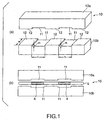
- Fig. 1(a) is a perspective view of assistance in explaining the shapes of sealing heads for sealing a polymer battery module in a package and Fig. 1(b) is a typical view of assistance in explaining a heat-sealing operation.
- Fig. 2(a) is a perspective view of a polymer battery formed by sealing a polymer battery module in a package by using the sealing heads
- Fig. 2(b) is a sectional view taken on line X 1 -X 1 in Fig. 2(a)
- Fig. 2(c) is an enlarged view of a part Y 1 in Fig. 2(b)
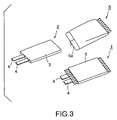
- Fig. 3 is a perspective view of assistance in explaining a pouch package for a polymer battery
- Figs. 4(a) to 4(d) and 4(e) are perspective views and a sectional view, respectively, of assistance in explaining embossed packages for a polymer battery
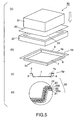
- FIG. 5(a) is a perspective view of assistance in explaining a method of forming an emboss package
- Fig. 5(b) is a perspective view of an embossed package
- Fig. 5(c) is a sectional view taken on line X 3 -X 3 in Fig. 5(b)
- Fig. 5(d) is an enlarged view of a part Y 2 in Fig. 5(c).
- Figs. 6(a) to 6(d) are typical perspective views of laminated structures for forming a package for a polymer battery according to the present invention.
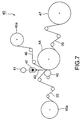
- Fig. 7 is a skeleton view of a sandwich lamination system for manufacturing a laminated structure for forming a package for a polymer battery.
- FIG. 8 is a skeleton view of a coextrusion system for manufacturing a laminated structure for forming a package for a polymer battery.
- Figs. 9(a) to 9(e) are views of assistance in explaining a method of attaching an adhesive film to the tabs of a polymer battery module to bond the tabs to a package.
- a polymer battery is fabricated by the following procedure.
- a pouch package having one open end i.e., a package, for containing a polymer battery module is formed by processing a laminated structure having laminated construction of nylon layer/bonding layer/aluminum layer/bonding layer/poly-ethylene resin layer.
- the polymer battery module provided with tabs is put through the open end in the pouch so that the tabs extend through the open end. Then the open end is sealed by heat-sealing to complete a polymer battery.
- a conventional sealing heads for heat-sealing has flat sealing surfaces.
- the laminated structure forming the package 5 has, in addition to the heat-sealable resin layer 24, a base layer 21, a barrier layer 22 and an adhesive resin layer 23.
- the inventors of the present invention made earnest studies to devise a method capable of stably heat-sealing an end part holding the tabs 4 of a package and have developed a heat-sealing machine 10 as shown in Fig. 1(a).
- the heat-sealing machine 10 is provided with a pair of sealing heads 10a and 10b respectively having sealing surfaces 12. Recesses 11 are formed in the sealing surfaces 12 of the sealing heads 10a and 10b. The recesses coincide with the tabs 4 lying in an end part of the package 5, respectively.
- the recesses 11 are formed in the sealing surfaces 12 of both the sealing heads 10a and 10b shown in Figs. 1(a) and 1(b), the recesses 11 may be formed only in the sealing surface 12 of one of the sealing heads 10a and 10b, for example, only in the sealing surface 12 of the sealing head 10a.
- the depth m of the recesses 11 is in the range of 1/3 of the thickness of the tabs 4 to the thickness of the tabs 4, and the width n of the recesses 11 is in the range of the width of the tabs 4 plus 0.2 mm to the width of the tabs 4 plus 2.0 mm, preferably, in the range of the width of the tabs 4 plus 0.3 mm to the width of the tabs 4 plus 1.0 mm.
- tabs 4 in a common polymer battery 1, have a thickness in the range of about 50 to about 200 ⁇ m and a width in the range of about 5 to abut 20 mm.
- the heat-sealing machine 10 provided with the sealing heads 10a and 10b is applied to fabricating a polymer battery 1 by sealing a polymer battery module 2 in a package 5, i.e., a pouch package, as shown in Figs. 2 and 3, and to fabricating a polymer battery 1 by sealing a polymer battery module 2 in a package 5, i.e., an embossed package provided with a hollow part 7, as shown in Fig. 4 formed by pressing a packaging material.
- the package (pouch) 5 has an unsealed end part 5a.
- the polymer battery module 2 is inserted through the unsealed end part 5a into the package 5, and the unsealed end part 5a is heat-sealed such that the tabs 4 are sandwiched between the walls of the package 5.
- the package 5 shown in Fig. 3 is formed by a pillow-type pouch package forming system.
- the package 5 may be formed by a three-sided seal pouch package forming system or a four-sided seal pouch forming system.
- the package (embossed package) 5 has a package body 5p provided with the hollow part 7, and a cover 5t.
- the polymer battery module 2 is placed in the hollow part 7 of the package body 5t, the cover 5t is put on the package body 5p, and peripheral parts of the package body 5p and the cover 5t are heat-sealed.
- a package 5 shown in Fig. 4(a) has an embossed package body 5p and a flat cover 5t.
- a package 5 shown in Fig. 4(b) has an embossed package body 5p and an embossed cover 5t, and has four sealed sides.
- a package 5 shown in Fig. 4(c) has a body 5b and an embossed cover 5t, and has three sealed sides.
- the package body 5p and the cover 5t are formed by processing a laminated structure, i.e., a packaging material, which will be described later.
- Any suitable heat-sealing method may be used for forming the package 5, provided that the heat-sealing method is capable of melting and bonding together the innermost layers of the walls of the package 5.
- Possible heat-sealing methods includes a hot plate method using a hot plate heated by a heating fluid (water or oil) or a built-in heater, an electric impulse heat-sealing method, a radio-frequency heat-sealing method that applies a radio-frequency voltage to films and uses heat induced in the films, a ultrasonic sealing method using ultrasonic vibrations and a sealing method that heats the inner surfaces of films to be bonded together with flame or hot air and bonds the films together.
- a cooling device provided with cooling heads provided with recesses similar to the recesses 11 of the sealing heads 10a and 10b of the heat-sealing machine 10 may be used for cooling the heat-sealed parts of the package 5.
- the polymer battery 1 includes the polymer battery module 2 and the package 5 containing the polymer battery module 2.
- the polymer battery module 2 consists of a cell unit (storage unit) 3 and tabs (electrodes) 4.
- the cell unit 3 of the polymer battery module 2 includes a positive collector (aluminum or nickel), a positive electrode active layer (a metal oxide, carbon black, a metal sulfide, an electrolyte or a polymer, such as a polyacrylonitrile resin), an electrolytic layer (a carbonate electrolyte, such as propylene carbonate, ethylene carbonate, dimethyl carbonate or ethylene methyl carbonate), a negative electrode active layer (lithium, an alloy, carbon, an electrolyte or a polymer, such as polyacrylonitrile resin) and a negative collector (copper, nickel or a stainless steel).
- a positive collector aluminum or nickel
- a positive electrode active layer a metal oxide, carbon black, a metal sulfide, an electrolyte or a polymer, such as a polyacrylonitrile resin
- an electrolytic layer a carbonate electrolyte, such as propylene carbonate, ethylene carbonate, dimethyl carbonate or ethylene methyl
- a packaging material for forming the package 5 has, as essential components, a base layer, a barrier layer and an innermost layer. Chemical conversion coatings formed on the opposite surfaces of the barrier layer, respectively, feature the present invention.
- the innermost layer may be formed by a dry lamination method, a hot lamination method, a sandwich lamination method or a coextrusion lamination method.
- a laminated structure formed by the aforesaid lamination method is subjected to postheating to enhance the bond strength of the barrier layer and the innermost layer and to prevent delamination that may be caused by the effect of hydrogen fluoride produced by the interaction between the electrolyte of the polymer battery module and moisture.
- a polymer battery packaging material is used for forming the package 5 for packaging the polymer battery module 2.
- the package 5 is a pouch package as shown in Figs. 2 and 3 or an embossed package as shown in Fig. 4.
- the pouch may be a three-sided seal pouch, a four-sided seal pouch or a pillow type pouch.
- Figs. 2 and 3 show a pillow type package 5.
- the package 5 shown in Fig. 4(a) is an embossed package having an embossed package body 5p provided with a hollow part 7, and a flat cover 5t and have four heat-sealed sides.
- a package 5 shown in Fig. 4(b) is an embossed package having an embossed package body 5p provided with a hollow part 7, and an embossed cover 5t provided with a hollow part 7, and having four heat-sealed sides.
- a package 5 shown in Fig. 4(c) is an embossed package having a body 5b and hollow parts 7 formed on the opposite sides of the body 5b, and having three heat-sealed sides.
- the package body 5p has side walls 8 forming the hollow part 7, and a flange 9 extending from the side walls 8, and a cover 5t.
- the package body 5p of the package 5 is formed by inserting a laminated structure 20 in a space between a male die part 31 and a female die part 32 constituting a forming die 30 and pressing the laminated structure 20 between the male die part 31 and the female die part 32.
- the package body 50 thus formed has the hollow part 7 having the side walls 8 and the flange 9.
- the laminated structure 20 forming the package 5 has, as essential components, a base layer 21, a first chemical conversion coating 25a, a barrier layer 22, a second chemical conversion coating 25b and an innermost layer 24.
- the innermost layer 24 is formed by a sandwich lamination method.
- the innermost layer 24 is an unoriented film of a polyethylene resin (hereinafter referred to as "PE resin") or a polypropylene resin.
- PE resin polyethylene resin
- the laminated structure 20 is required to be excellent in formability because the hollow part 7 for containing the polymer battery module 2 must be formed by embossing. Lamination of the component layers of the laminated structure 20 will be explained hereinafter.
- the base layer 21 is an oriented film of a polyester resin or a nylon resin.
- Possible polyester resins are polyethylene terephthalate resins, polybutylene terephthalate resins, polyethylene naphthalate resins, polybutylene naphthalate resins, interpolyester resins and polycarbonate resins.
- Possible nylon resins are polyamide resins including nylon 6, nylon 66, copolymers of nylon 6 and nylon 66, nylon 610 and polymethaxylilene adipamide (MXD6).
- the base layer 21 comes into direct contact with the piece of hardware. Therefore, it is basically desirable to form the base layer 21 of an intrinsically insulating resin. Since a film forming the base layer 21 has pinholes and pinholes will be formed in the film during processing, the thickness of the base layer 21 must be 6 ⁇ m or above, preferably, in the range of 12 to 25 ⁇ m.
- the base layer 21 may be a laminated film in view of providing the base layer 21 with pinhole resistance and improved insulating ability.
- a laminated film for the base layer 21 includes at least one resin layer consisting of two or more layers each having a thickness of 6 ⁇ m or above, preferably, in the range of 12 to 25 ⁇ m.
- the following laminated structures 1) to 7), not shown, are examples of the laminated base layer 21.
- the barrier layer 22 prevents the penetration of moisture into the polymer battery.
- the barrier layer 22 has a thickness of 15 ⁇ m or above and is formed from a metal foil, such as an aluminum foil or a nickel foil, or a film coated with an inorganic compound, such as silicon dioxide or alumina, by evaporation.
- the barrier layer 22 is an aluminum foil of a thickness in the range of 20 to 80 ⁇ m.
- the inventors of the present invention made studies to reduce pinholes and to prevent the cracking of an embossed package and decided to use aluminum having an iron content in the range of 0.3 to 9.0% by weight, preferably, 0.7 to 2.0% by weight for forming the barrier layer 22.
- Aluminum having such an iron content is more satisfactory in ductility than aluminum not containing any iron, the barrier layer 22 of aluminum having such an iron content is less subject to the formation of pinholes when the packaging laminated sheet is bent and is more capable of facilitating forming the side walls 8 of the embossed package 5 than a barrier layer of aluminum not containing any iron.
- a barrier layer of aluminum having an iron content less than 0.3% by weight is not satisfactorily pinhole-resistant and do not improve the formability of the packaging laminated structure.
- a barrier layer of aluminum having an iron content exceeding 9.0% by weight is unsatisfactory in flexibility and affect adversely to the workability of the packaging laminated structure in forming a pouch.
- the flexibility, stiffness and hardness of an aluminum foil formed by cold rolling are dependent on annealing conditions.
- the present invention prefers rather soft, slightly or completely annealed aluminum foils to those treated by a hardening process and not annealed.
- Annealing conditions that affect the flexibility, stiffness and hardness of aluminum foils may be properly determined according to the required workability (ease of forming pouches or embossed packages) of the packaging laminated sheet. For example, to prevent the formation of creases or pinholes in making a package by an embossing process, a soft aluminum foil properly annealed according to the degree of forming may be used.
- the inventors of the present invention found through studies that a satisfactory packaging laminated structure 20 can be formed by using an aluminum foil having opposite surfaces coated with chemical conversion coatings 25a and 25b formed by chemical conversion treatment as the barrier layer 12.
- the chemical conversion treatment forms an acid-resistant film of a phosphate, a chromate, a fluoride or a triazine thiol compound.
- the chemical conversion treatment improves the adhesive property (wettability) of the surface of the barrier layer 22 of aluminum, the separation of the base layer 21 and the barrier layer 22 can be prevented and the separation of the barrier layer 22 and the innermost layer due to the effect of hydrogen fluoride produced by the interaction between the electrolyte and moisture can be prevented by the chemical conversion treatment of the barrier layer 22 of aluminum.
- the laminated structure 20 When the laminated structure 20 is intended for use for forming pouch packages, only one surface on the side of the innermost layer 24 of the barrier layer 22 needs to be processed by the chemical conversion treatment.
- the laminated sheet 20 including the barrier layer 22 having both the surfaces processed by the chemical conversion treatment may be used for forming pouch packages.
- a base laminated structure 20a of construction base layer 21/first bonding layer 26a/first chemical conversion coating 25a/barrier layer 22/second chemical conversion layer 25b is fabricated, and then an innermost layer 24 is bonded to the chemical conversion coating 25b of the base laminated structure 20a with a second bonding layer 26b by dry lamination.
- a base laminated structure 20a similar to that shown in Fig. 6(a) is fabricated, and an acid-modified polyolefin resin layer 27 may be formed on the second chemical conversion coating 25b of the base laminated structure 20a, and then a polyolefin resin film may be laminated as an innermost layer 24 to the acid-modified polyolefin resin layer 27 by a hot lamination method.
- a base laminated structure 20a similar to that shown in Fig. 6(a) is fabricated, and a polyolefin resin film as an innermost layer 24 may be laminated to the second chemical conversion coating 25b of the base laminated structure 20a by extruding an acid-modified polyolefin resin layer 23 on the second chemical conversion coating 25b by a sandwich lamination method.
- Fig. 7 shows a sandwich lamination system 40.
- a base laminated structure 20a is unwound from a base laminated structure roll 40a, and a polyolefin resin film 46 is unwound from a polyolefin resin film 46a.
- the base laminated structure 20a and the polyolefin resin film 46 are joined and pressed together between a chill roller 44 and a pressure roller 45, and a molten acid-modified polyolefin resin film 43 is extruded between the base laminated structure 20a and the polyolefin resin film 46 through a die 42 by an extruder 41 to form a laminated structure 20 by bonding together the base laminated structure 20a and the polyolefin resin film 46.
- the laminated structure 20 thus formed is rolled in a laminated structure roll 47.
- a base laminated structure 20a similar to that shown in Fig. 6(a) is fabricated, and an adhesive resin layer 23 of an acid-modified polyolefin resin and an innermost resin layer 24 of a polyolefin resin may be laminated to the second chemical conversion coating 25b of the base laminated structure 20a by coextrusion.
- Fig. 8 shows a coextrusion lamination system 50..
- a base laminated structure 20a is unwound from a base laminated structure roll 50a and, at the same time, a molten resin film 53 consisting of an acid-modified polyolefin resin and a polyolefin resin is extruded through a coextrusion die 52 by extruders 51a and 51b onto the base laminated structure 20a.
- the base laminated structure 20a and the molten resin film 53 are compressed and bonded together between a chill roller 54 and a pressure roller 55 to form a laminated structure 20.
- the laminated structure 20 is rolled in a laminated structure roll 57.
- the innermost layer 24 is formed of a polypropylene resin.
- the acid-modified polyolefin resin serving as the adhesive resin or forming the adhesive resin film is an acid-modified polyethylene resin
- the innermost layer 24 is formed of a polyethylene resin.
- the acid-modified polyolefin resin is unable to adhere satisfactorily to the second chemical conversion coating 25b when laminating the innermost layer 24 to the second chemical conversion coating 25b to form the laminated structure 20.
- an emulsion of the acid-modified polyolefin resin may be applied to the second chemical conversion coating 25b in an acid-modified polyolefin coating by a roll coating method or the like, the acid-modified polyolefin coating may be dried, if the acid-modified polyolefin resin is an acid-modified polypropylene, the acid-modified polyolefin coating may be baked at a temperature in the range of 170 to 200 °C, and a polypropylene resin film for forming the innermost layer 24 may be laminated to the second chemical conversion coating 25b by sandwich lamination.
- a baking process for baking the acid-modified polyolefin coating takes a long time and productivity is reduced.
- the laminated sheet 20 may be heated by any one of a contact heating method using a hot roller, a hot air heating method using hot air and an infrared heating method using near or far infrared rays, provided that the adhesive resin can be heated at a temperature not lower than the softening point thereof.
- Another method of laminating the innermost layer 24 to the base laminated structure 20a heats the base laminated structure 20a such that the surface of the barrier layer 22 of aluminum to which the innermost layer 22 is to be bonded at a temperature equal to the softening point of the acid-modified polyolefin resin, and then the innermost layer 24 is laminated to the base laminated structure 20a by a sandwich lamination method or a coextrusion lamination method.
- the component layers of the laminated structure 20 thus formed are bonded together by stable bond strength.
- the laminated structure 20 as a polymer battery packaging material may be provided, in addition to the base layer 21, the barrier layer 22 and the innermost layer 24, an intermediate layer between the barrier layer 22 and the innermost layer 24.
- the intermediate layer is added to the laminated structure 20 to enhances the strength of the polymer battery packaging material and to improve and stabilize the barrier property.
- the surfaces of the component layers of the laminated structure 20 of the present invention may be processed by a surface activating treatment, such as a corona discharge treatment, a blasting treatment, an oxidation treatment or ozone treatment, to improve and stabilize film forming property, lamination property, formability (ease of forming pouches or embossed packages).
- a surface activating treatment such as a corona discharge treatment, a blasting treatment, an oxidation treatment or ozone treatment, to improve and stabilize film forming property, lamination property, formability (ease of forming pouches or embossed packages).
- adhesive films 6 that can be bonded to both a metal member and the innermost layer 24 by heat-sealing are interposed between the tabs 4 and the innermost layers 24 of the laminated sheets 20 forming a package 5 as shown in Figs. 9(a), 9(b) and 9(c) to ensure that gaps between the tabs 4 and the innermost layers 24 are sealed.
- the adhesive films 6 may be wound round predetermined parts of the tabs 4 as shown in Figs. 9(d), 9(e) and 9(f).
- the adhesive film 6 may be formed of an unsaturated carboxylic acid graft propylene resin, a metal-crosslinked polyethylene resin or a copolymer of ethylene or propylene, and an acrylic acid or a methacrylic acid.
- the base layer 21 and the first chemical conversion coating 25a formed on a surface of the barrier layer 22 on the side of the base layer 21 are bonded together by a dry lamination method.
- the first bonding layer 26a for bonding together by dry lamination the base layer 21 and the first chemical conversion coating 25a formed by a chemical conversion treatment using chromium phosphate may be formed of any one of adhesives including polyester adhesives, polyethylene imine adhesives, polyether adhesives, cyanoacrylate adhesives, urethane adhesives, organic titanium adhesives, polyether-urethane adhesives, epoxy adhesives, polyester-urethane adhesives, imide adhesives, isocyanate adhesives, polyolefin adhesives and silicone adhesives.
- the size of the cell unit 3 of a polymer battery module 2 is 30 mm ⁇ 45 mm ⁇ 3.0 mm.
- the size of the tabs 4 of the polymer battery module 2 is 30 mm ⁇ 6.0 mm ⁇ 100 ⁇ m.
- the chemical conversion treatment for treating the barrier layer of the laminated structure used an aqueous solution of a phenolic resin, a trivalent chromium fluoride compound and phosphoric acid as a processing liquid.
- the processing liquid was applied to the surface of the barrier layer by a roll coating method in a film, and the film was baked at 180 °C or above.
- the weight per unit area of the film was 10 mg/m 2 .
- Pouch packages 5 are pillow type pouches having a size of 60 mm ⁇ 50 mm.
- Embossed packages 5 includes package body provided with a hollow part of 30 mm ⁇ 50 mm ⁇ 3.5 mm.
- the A-type sealing surface 12 was provided with recesses 11 of 40 ⁇ m in depth m and 7.5 mm in length n, and the width W of the A-type sealing surface 12 corresponding to the width of a sealed fin was 5 mm.
- the B-type sealing surface 12 was provided with recesses 11 of 80 ⁇ m in depth m and 6.5 mm in length n, and the width W of the B-type sealing surface 12 corresponding to the width of a sealed fin was 5 mm.
- a heat-sealing machine in a comparative example used sealing heads having flat sealing surfaces.
- Adhesive films 6 of an acid-modified polyolefin resin were placed on the opposite sides of the tabs in a part of the package to be sealed.
- the adhesive resin layers 23 and 27 were formed of a polypropylene resin having a melting point T mpp ⁇ 20 °C when the innermost layer 24 was formed of a polypropylene resin having a melting point T mpp .
- the adhesive resin layers 23 and 27 were formed of an acid-modified polyethylene resin having a melting point T mpe ⁇ 30 °C when the innermost layer 24 was formed of a polyethylene resin having a melting point T mpe .
- One of the surfaces of a 20 ⁇ m thick aluminum foil 22 was subjected to chemical conversion treatment.
- a 12 ⁇ m thick oriented polyester film 21 was laminated to the other surface, i.e., the surface not processed by the chemical conversion treatment, of the aluminum foil 22 by a dry lamination method.
- a 30 ⁇ m thick film 24 of an LLDPE resin having a softening point of 115 °C and a melting point of 123 °C was laminated to the surface processed by the chemical conversion treatment of the aluminum foil 22 by dry lamination to complete a laminated structure 20.
- Sample pouch packages in Example 1 were formed by processing the laminated structure 20.
- Both the surfaces of a 20 ⁇ m thick aluminum foil 22 were subjected to chemical conversion treatment.
- a 16 ⁇ m thick oriented polyester film 21 was laminated to one of the surfaces of the aluminum foil 22 by a dry lamination method.
- a 30 ⁇ m thick adhesive resin layer 23 of an acid-modified polypropylene resin having a softening point of 123 °C and a melting point of 145 °C and a 30 ⁇ m thick innermost layer 24 of a polypropylene resin having a softening point of 120 °C and a melting point of 140 °C were formed by coextrusion on the other surface processed by the chemical conversion treatment of the aluminum foil 22 to form a laminated structure 20.
- the laminated structure 20 thus formed was heated so that the surface of the aluminum foil 22 was heated at 150 °C or above to complete the laminated structure 20.
- Sample pouch packages in Example 5 were formed by processing the laminated structure 20.
- a pair of elongate cuts 122 are formed in a part of each section 120 of the workpiece W corresponding to the male pressing part 117 and the female pressing part 113.
- the elongate cuts 122 are formed by a cutter including a cutting blade 125 and a cutting block 126 disposed on the upstream side of the embossing machine 110 having the male die part 115 and the female die part 111.
- the part of the section 120 corresponding to the male pressing part 117 and the female pressing part 113 includes all the parts of the section 120 excluding a part of the section 120 for forming the embossed hollow part 107.
- an embossed hollow part 107 formed in the preceding section 120 of the workpiece W is not deformed when the succeeding section 120 is subjected to embossing.
- the corrugations 121 in boundary parts are formed between the adjacent sections 120 of the workpiece W.
- each section 120 is cut along cutting lines on the inner side of the pair of cuts 122 to divide the workpiece W into individual embossed packaging sheets 105.
- the work pressing machine 130 is provided with a first die part 131 provided with a recess 134 capable of receiving the embossed hollow part 107 of the workpiece W and disposed above the workpiece W, and a second die part 135 disposed below the workpiece W to compress the workpiece W in cooperation with the first die part 131.
- a workpiece W formed by sandwiching an aluminum layer 105a between a base layer 105b and a heat-sealable layer 105c is prepared.
- the workpiece W has a plurality of sections (package sections) 120 respectively for forming a plurality of embossed packaging sheets 105.
- Corrugations 121 are formed in boundary parts between the sections 120 of the workpiece W with the male corrugating parts 116 and the female corrugated parts 112.
- the forming die part 118 tends to draw the workpiece W into the forming recess 114.
- the pair of cuts 122 are extended perpendicularly to directions in which the workpiece W is drawn.
- the opposite end parts of the pair of cuts 122 extend beyond the opposite ends of a part of the section 120 corresponding to the forming recess 114, respectively, as shown in Fig. 12.
- the cuts 122 may be curved slits 122 as shown in Fig. 13.
- the forming die part 118 of the male die part 115 is advanced into the forming recess 114 of the female die part 111 for embossing. Consequently, a part of the section 120 of the workpiece W is embossed to form an embossed hollow part 107.
- the section 120 of the workpiece W is compressed lightly between the respective pressing surfaces 117a and 113a of the male pressing part 117 and the female pressing part 113 during embossing. Since the pair of cuts 122 are formed in the section 120 of the workpiece W, a part of the section 120 between the cuts 122 is drawn smoothly into the forming recess 114.
- the section 120 is held between the male corrugated parts 116 and the female corrugated parts 112, the part of the section 120 between the cuts 122 are relatively free to move, and hence the part of the section 120 between the cuts 122 is movable. Accordingly, the section 120 of the workpiece W can be easily and accurately embossed and the embossed hollow part 107 can be accurately formed in the section 120 of the workpiece W.
- parts excluding the embossed hollow part 107 of the workpiece W are crinkled when forming the embossed hollow part 107 by the embossing machine 110.
- the first die part 131 is heated by the heater 133 to heat the workpiece W properly. Crinkles can be surely taken out of the workpiece W by compressing the properly heated workpiece W between the first die part 131 and the second die part 135.
- each section 120 is cut along cutting lines on the inner side of the pair of cuts 122 to divide the workpiece W into individual embossed packaging sheets 105.
Landscapes
- Engineering & Computer Science (AREA)
- Mechanical Engineering (AREA)
- Chemical & Material Sciences (AREA)
- Chemical Kinetics & Catalysis (AREA)
- Electrochemistry (AREA)
- General Chemical & Material Sciences (AREA)
- Manufacturing & Machinery (AREA)
- Physics & Mathematics (AREA)
- Thermal Sciences (AREA)
- Inorganic Chemistry (AREA)
- Sealing Battery Cases Or Jackets (AREA)
Applications Claiming Priority (7)
| Application Number | Priority Date | Filing Date | Title |
|---|---|---|---|
| JP2000017337 | 2000-01-26 | ||
| JP2000017343A JP4414041B2 (ja) | 2000-01-26 | 2000-01-26 | エンボス成形装置とワーク押圧装置の組合体 |
| JP2000017343 | 2000-01-26 | ||
| JP2000017337A JP4414040B2 (ja) | 2000-01-26 | 2000-01-26 | エンボス成形方法、およびそのエンボス成形装置 |
| JP2000037490 | 2000-02-16 | ||
| JP2000037490A JP5042402B2 (ja) | 2000-02-16 | 2000-02-16 | ポリマー電池包装用シールヘッド |
| PCT/JP2001/000530 WO2001054985A1 (fr) | 2000-01-26 | 2001-01-26 | Dispositif et procede de thermoscellage, procede d'emboutissage, dispositif de pressage de piece, et piece pressee |
Publications (3)
| Publication Number | Publication Date |
|---|---|
| EP1180480A1 true EP1180480A1 (fr) | 2002-02-20 |
| EP1180480A4 EP1180480A4 (fr) | 2004-06-16 |
| EP1180480B1 EP1180480B1 (fr) | 2012-11-14 |
Family
ID=27342140
Family Applications (1)
| Application Number | Title | Priority Date | Filing Date |
|---|---|---|---|
| EP20010901547 Expired - Lifetime EP1180480B1 (fr) | 2000-01-26 | 2001-01-26 | Procede de thermoscellage |
Country Status (7)
| Country | Link |
|---|---|
| US (1) | US6877216B2 (fr) |
| EP (1) | EP1180480B1 (fr) |
| KR (1) | KR100676989B1 (fr) |
| CN (1) | CN1280155C (fr) |
| CA (1) | CA2368006C (fr) |
| TW (1) | TW479016B (fr) |
| WO (1) | WO2001054985A1 (fr) |
Cited By (5)
| Publication number | Priority date | Publication date | Assignee | Title |
|---|---|---|---|---|
| US7012232B1 (en) | 2004-08-31 | 2006-03-14 | Mark Gruenspecht | RF welding device |
| EP1708214A3 (fr) * | 2005-03-30 | 2007-05-30 | TDK Corporation | Dispositif électrochimique |
| EP2822055A4 (fr) * | 2012-02-29 | 2015-10-21 | Nisshin Steel Co Ltd | Matériau externe pour batterie stratifiée, procédé pour fabriquer un matériau externe pour batterie stratifiée, procédé pour fabriquer une batterie stratifiée et batterie stratifiée |
| CN111391284A (zh) * | 2020-04-08 | 2020-07-10 | 安徽风驰新能源科技股份有限公司 | 一种软包装锂电池铝塑膜整形夹具 |
| EP4397469A4 (fr) * | 2022-11-07 | 2025-01-29 | Lg Energy Solution, Ltd. | Dispositif d'étanchéité pour batterie secondaire |
Families Citing this family (53)
| Publication number | Priority date | Publication date | Assignee | Title |
|---|---|---|---|---|
| EP1102336B1 (fr) * | 1999-04-08 | 2007-09-12 | Dai Nippon Printing Co., Ltd. | Materiau multicouches stratifié d'envelope de pile au lithium |
| JP3698320B2 (ja) * | 2002-06-03 | 2005-09-21 | 日産自動車株式会社 | 組電池 |
| JP2004303759A (ja) * | 2003-03-28 | 2004-10-28 | Tdk Corp | 電気化学デバイスの製造方法 |
| CN100361326C (zh) * | 2004-03-23 | 2008-01-09 | 日本电气株式会社 | 薄膜覆盖电器件及其制造方法 |
| KR100571269B1 (ko) * | 2004-09-22 | 2006-04-13 | 삼성에스디아이 주식회사 | 이차전지용 파우치 및 파우치형 이차전지 |
| EP1844508B1 (fr) * | 2005-01-21 | 2018-08-22 | LG Chem, Ltd. | Accumulateur a excellente capacite d'adherence |
| US7906057B2 (en) * | 2005-07-14 | 2011-03-15 | 3M Innovative Properties Company | Nanostructured article and method of making the same |
| US7651863B2 (en) * | 2005-07-14 | 2010-01-26 | 3M Innovative Properties Company | Surface-enhanced spectroscopic method, flexible structured substrate, and method of making the same |
| US20070014997A1 (en) * | 2005-07-14 | 2007-01-18 | 3M Innovative Properties Company | Tool and method of making and using the same |
| CN101083312B (zh) * | 2006-05-31 | 2011-05-25 | 上海德朗能电池有限公司 | 一种聚合物锂离子电池的密封方法和设备 |
| KR100917734B1 (ko) | 2007-07-19 | 2009-09-21 | 삼성에스디아이 주식회사 | 파우치형 리튬 이차전지 |
| US8092631B2 (en) | 2008-02-28 | 2012-01-10 | Solmax International Inc. | Apparatus and die for welding plastic and a method of use thereof |
| KR101049841B1 (ko) | 2008-03-12 | 2011-07-15 | 주식회사 엘지화학 | 휘어진 형상의 전지셀 및 이를 포함하는 전지팩 |
| WO2010097909A1 (fr) * | 2009-02-25 | 2010-09-02 | セイコーインスツル株式会社 | Boîtier, procédé de fabrication de boîtier et procédé de fabrication de vibreur piézoélectrique |
| US8586526B2 (en) | 2010-05-17 | 2013-11-19 | Sangamo Biosciences, Inc. | DNA-binding proteins and uses thereof |
| US9178189B2 (en) | 2010-01-19 | 2015-11-03 | Enax, Inc. | Sheet-type secondary battery and method of manufacturing same |
| US9077027B2 (en) * | 2010-03-04 | 2015-07-07 | Samsung Sdi Co., Ltd. | Electrode assembly and secondary battery using the same |
| US8940429B2 (en) | 2010-07-16 | 2015-01-27 | Apple Inc. | Construction of non-rectangular batteries |
| KR101269935B1 (ko) | 2010-08-30 | 2013-05-31 | 주식회사 엘지화학 | 신규한 구조의 이차전지 |
| US20120177953A1 (en) * | 2011-01-06 | 2012-07-12 | Apple Inc. | Batteries with variable terrace positions |
| JP5820138B2 (ja) * | 2011-04-07 | 2015-11-24 | 株式会社京都製作所 | 袋詰電極の製造装置、および袋詰電極の製造方法 |
| JP5883694B2 (ja) * | 2011-04-07 | 2016-03-15 | 日産自動車株式会社 | 袋詰電極の製造装置、および袋詰電極の製造方法 |
| KR20120126932A (ko) * | 2011-05-13 | 2012-11-21 | 에스케이이노베이션 주식회사 | 파우치형 이차전지의 실링방법 및 실링장치 |
| CN104953149B (zh) * | 2014-03-27 | 2019-02-19 | 惠州亿纬锂能股份有限公司 | 电池卷芯包装装置及包装方法 |
| CN106165143B (zh) * | 2014-04-09 | 2020-07-07 | 凸版印刷株式会社 | 蓄电装置用封装材料、蓄电装置及压花型封装材料的制造方法 |
| TW201620791A (zh) * | 2014-08-28 | 2016-06-16 | 葛蘭素史密斯克萊有限責任公司 | 包裝盒及熱密封裝置 |
| KR101775230B1 (ko) * | 2014-10-02 | 2017-09-05 | 주식회사 엘지화학 | 이차전지용 라미네이팅 장치 및 이차전지의 라미네이팅 방법 |
| US9929393B2 (en) | 2015-09-30 | 2018-03-27 | Apple Inc. | Wound battery cells with notches accommodating electrode connections |
| WO2017086593A1 (fr) * | 2015-11-18 | 2017-05-26 | 주식회사 엘지화학 | Dispositif d'étanchéité pour batterie secondaire |
| KR101925090B1 (ko) | 2015-11-18 | 2018-12-04 | 주식회사 엘지화학 | 이차전지용 실링장치 |
| KR102077273B1 (ko) * | 2015-12-15 | 2020-02-13 | 주식회사 엘지화학 | 파우치형 이차 전지의 테라스 성형 장치 |
| KR101947149B1 (ko) * | 2015-12-16 | 2019-02-13 | 주식회사 엘지화학 | 가압과 열 인가 면적이 증대된 전지케이스의 밀봉 장치 |
| US10868290B2 (en) | 2016-02-26 | 2020-12-15 | Apple Inc. | Lithium-metal batteries having improved dimensional stability and methods of manufacture |
| US9837682B1 (en) * | 2016-08-29 | 2017-12-05 | Microsoft Technology Licensing, Llc | Variable layer thickness in curved battery cell |
| KR102196262B1 (ko) * | 2016-09-29 | 2020-12-29 | 주식회사 엘지화학 | 고정용 돌기가 형성되어 있는 냉각핀을 포함하는 전지모듈 |
| CN107499613A (zh) * | 2017-08-24 | 2017-12-22 | 郑州大学 | 一种气调保鲜包装机的压装循环机构 |
| CN110116149A (zh) * | 2018-02-07 | 2019-08-13 | 世界中心科技股份有限公司 | 化学气相沉积机台之板状构件的平坦度处理方法 |
| JP6996421B2 (ja) | 2018-05-28 | 2022-02-21 | 大日本印刷株式会社 | 電池、ヒートシール装置、及び電池の製造方法 |
| KR102549539B1 (ko) | 2019-03-28 | 2023-06-29 | 주식회사 엘지에너지솔루션 | 이차전지용 실링장치 및 실링방법 |
| KR102728738B1 (ko) * | 2019-09-18 | 2024-11-08 | 주식회사 엘지에너지솔루션 | 파우치형 이차전지의 실링 장치 및 이를 이용한 실링 방법 |
| KR102851596B1 (ko) * | 2019-10-22 | 2025-08-28 | 주식회사 엘지에너지솔루션 | 이차전지용 파우치 필름 성형 장치 및 방법 |
| KR102793092B1 (ko) | 2019-11-13 | 2025-04-08 | 주식회사 엘지에너지솔루션 | 이차 전지 및 실링 블록 |
| KR102779856B1 (ko) * | 2020-02-13 | 2025-03-12 | 주식회사 엘지에너지솔루션 | 이차전지 가압장치 및 가압방법 |
| CN111618588A (zh) * | 2020-06-01 | 2020-09-04 | 江西优特汽车技术有限公司 | 一种软包电芯的极耳焊接方法 |
| KR102843785B1 (ko) * | 2020-08-11 | 2025-08-07 | 주식회사 엘지에너지솔루션 | 이차전지용 실링장치 |
| KR102752537B1 (ko) * | 2020-10-27 | 2025-01-10 | 주식회사 엘지에너지솔루션 | 이차전지 제조방법 및 이차전지 |
| KR20220057098A (ko) | 2020-10-29 | 2022-05-09 | 주식회사 엘지에너지솔루션 | 파우치형 전지 제조 장치 |
| JP7517644B2 (ja) * | 2020-12-01 | 2024-07-17 | エルジー エナジー ソリューション リミテッド | 位置調節部を含むパウチ形電池シーリング装置及びこれを用いたパウチ形電池シーリング方法 |
| DE102021213570A1 (de) * | 2021-11-30 | 2023-06-01 | Ropex Industrie-Elektronik Gmbh | Siegelwerkzeug zum thermischen Siegeln einer Batteriezellenhülle und Batteriezelle |
| CN114551964B (zh) * | 2022-01-21 | 2025-10-10 | 江西省倍特力新能源有限责任公司 | 软包电池热封结构及热封设备 |
| JP2025539548A (ja) * | 2022-12-12 | 2025-12-05 | エルジー エナジー ソリューション リミテッド | 加熱部位をターゲティングすることのできるパウチシール装置 |
| EP4621947A4 (fr) * | 2022-12-22 | 2026-04-22 | Lg Energy Solution Ltd | Dispositif d'étanchéité et batterie secondaire de type poche scellée par celui-ci |
| CN117261262B (zh) * | 2023-11-16 | 2024-02-27 | 珠海市嘉德电能科技有限公司 | 一种用于电芯头部的自动贴异型胶设备及其贴胶方法 |
Family Cites Families (18)
| Publication number | Priority date | Publication date | Assignee | Title |
|---|---|---|---|---|
| US3671709A (en) * | 1970-09-14 | 1972-06-20 | Monsanto Co | Heat sealing of porous materials |
| JPS55128435A (en) * | 1979-03-28 | 1980-10-04 | Toyo Ink Mfg Co Ltd | Manufacture of laminated body |
| JPS60230352A (ja) * | 1984-04-26 | 1985-11-15 | Matsushita Electric Ind Co Ltd | 密閉形鉛蓄電池 |
| JPS61198550A (ja) * | 1985-02-27 | 1986-09-02 | Matsushita Electric Ind Co Ltd | 密閉形鉛蓄電池 |
| JPS61206161A (ja) * | 1985-03-08 | 1986-09-12 | Matsushita Electric Ind Co Ltd | 密閉形鉛蓄電池 |
| JPH0821371B2 (ja) * | 1986-02-13 | 1996-03-04 | 松下電器産業株式会社 | 密閉形鉛蓄電池の製造法 |
| US5197994A (en) * | 1990-11-26 | 1993-03-30 | Daniell Battery Manufacturing Co., Inc. | Method of heat sealing a battery |
| JP2670593B2 (ja) * | 1992-02-10 | 1997-10-29 | 積水化成品工業株式会社 | 結晶性ポリエチレンテレフタレートシートの成形方法 |
| US5563007A (en) * | 1995-01-11 | 1996-10-08 | Entek Manufacturing Inc. | Method of enveloping and assembling battery plates and product produced thereby |
| JP4016217B2 (ja) * | 1997-03-21 | 2007-12-05 | 株式会社ジーエス・ユアサコーポレーション | 電池の製造方法 |
| JPH10284021A (ja) * | 1997-04-03 | 1998-10-23 | Sanyo Electric Co Ltd | 薄型電池 |
| JPH11105939A (ja) | 1997-10-02 | 1999-04-20 | Showa Alum Corp | 耐内容物性に優れた包装材料 |
| JP3839156B2 (ja) * | 1998-03-03 | 2006-11-01 | 本田技研工業株式会社 | 基材・シート一体成形方法 |
| US6207318B1 (en) * | 1998-06-22 | 2001-03-27 | Eagle-Picher Energy Products Corporation | Electrochemical batteries with restricted liquid electrolyte volume |
| US7048822B2 (en) * | 1999-12-17 | 2006-05-23 | Dai Nippon Printing Co., Ltd. | Packaging material for polymer cell and method for producing the same |
| JP4414040B2 (ja) * | 2000-01-26 | 2010-02-10 | 大日本印刷株式会社 | エンボス成形方法、およびそのエンボス成形装置 |
| JP2001219468A (ja) * | 2000-02-07 | 2001-08-14 | Dainippon Printing Co Ltd | エンボス成形装置 |
| JP2003245970A (ja) * | 2002-02-27 | 2003-09-02 | Shibaura Mechatronics Corp | シート成形方法及び装置 |
-
2001
- 2001-01-26 CN CNB018001270A patent/CN1280155C/zh not_active Expired - Lifetime
- 2001-01-26 EP EP20010901547 patent/EP1180480B1/fr not_active Expired - Lifetime
- 2001-01-26 KR KR1020017012152A patent/KR100676989B1/ko not_active Expired - Fee Related
- 2001-01-26 US US09/936,512 patent/US6877216B2/en not_active Expired - Lifetime
- 2001-01-26 WO PCT/JP2001/000530 patent/WO2001054985A1/fr not_active Ceased
- 2001-01-26 CA CA 2368006 patent/CA2368006C/fr not_active Expired - Fee Related
- 2001-01-29 TW TW90101687A patent/TW479016B/zh not_active IP Right Cessation
Cited By (6)
| Publication number | Priority date | Publication date | Assignee | Title |
|---|---|---|---|---|
| US7012232B1 (en) | 2004-08-31 | 2006-03-14 | Mark Gruenspecht | RF welding device |
| EP1708214A3 (fr) * | 2005-03-30 | 2007-05-30 | TDK Corporation | Dispositif électrochimique |
| US7326491B2 (en) | 2005-03-30 | 2008-02-05 | Tdk Corporation | Electrochemical device |
| EP2822055A4 (fr) * | 2012-02-29 | 2015-10-21 | Nisshin Steel Co Ltd | Matériau externe pour batterie stratifiée, procédé pour fabriquer un matériau externe pour batterie stratifiée, procédé pour fabriquer une batterie stratifiée et batterie stratifiée |
| CN111391284A (zh) * | 2020-04-08 | 2020-07-10 | 安徽风驰新能源科技股份有限公司 | 一种软包装锂电池铝塑膜整形夹具 |
| EP4397469A4 (fr) * | 2022-11-07 | 2025-01-29 | Lg Energy Solution, Ltd. | Dispositif d'étanchéité pour batterie secondaire |
Also Published As
| Publication number | Publication date |
|---|---|
| WO2001054985A1 (fr) | 2001-08-02 |
| KR20010110686A (ko) | 2001-12-13 |
| CN1362926A (zh) | 2002-08-07 |
| US6877216B2 (en) | 2005-04-12 |
| EP1180480B1 (fr) | 2012-11-14 |
| CA2368006C (fr) | 2008-12-30 |
| US20020157242A1 (en) | 2002-10-31 |
| CN1280155C (zh) | 2006-10-18 |
| CA2368006A1 (fr) | 2001-08-02 |
| KR100676989B1 (ko) | 2007-01-31 |
| TW479016B (en) | 2002-03-11 |
| EP1180480A4 (fr) | 2004-06-16 |
Similar Documents
| Publication | Publication Date | Title |
|---|---|---|
| US6877216B2 (en) | Heat-sealing machine, heat-sealing method, embossing method, work pressing machine and workpiece | |
| EP1353390B1 (fr) | Ensemble pile et film de fil conducteur | |
| EP1209094B1 (fr) | Materiau d'emballage pour cellule polymere et son procede de fabrication | |
| US9865846B2 (en) | Polymer battery module packaging sheet and a method of manufacturing the same | |
| JP5042402B2 (ja) | ポリマー電池包装用シールヘッド | |
| JP2002245983A (ja) | リチウムイオン電池用包装材料 | |
| JP5644718B2 (ja) | ポリマー電池包装用シールヘッドを用いたシール方法 | |
| JP5055654B2 (ja) | リチウム電池用包装材料の製造方法 | |
| JP2002279967A (ja) | 被覆帯を設けた電池用リード線およびそれを用いた包装材料 | |
| JP2001229887A (ja) | ポリマー電池用包装材料およびその製造方法 | |
| JP4620233B2 (ja) | リチウム電池用包装材料の製造方法 | |
| JP4498630B2 (ja) | リチウムイオン電池の包装材料およびそれを用いたリチウムイオン電池 | |
| JP2001291497A (ja) | ポリマー電池外装体の製造方法 | |
| JP4620232B2 (ja) | リチウム電池用包装材料の製造方法 | |
| JP2002093389A (ja) | リチウム電池タブ部に用いる接着性樹脂物 | |
| HK1137855A (en) | Battery and lead-insulating film |
Legal Events
| Date | Code | Title | Description |
|---|---|---|---|
| PUAI | Public reference made under article 153(3) epc to a published international application that has entered the european phase |
Free format text: ORIGINAL CODE: 0009012 |
|
| 17P | Request for examination filed |
Effective date: 20010920 |
|
| AK | Designated contracting states |
Kind code of ref document: A1 Designated state(s): AT BE CH CY DE DK ES FI FR GB GR IE IT LI LU MC NL PT SE TR |
|
| AX | Request for extension of the european patent |
Free format text: AL;LT;LV;MK;RO;SI |
|
| RIC1 | Information provided on ipc code assigned before grant |
Ipc: 7B 29C 65/18 A Ipc: 7B 65B 51/10 B Ipc: 7H 01M 2/02 B Ipc: 7B 65B 7/02 B |
|
| RBV | Designated contracting states (corrected) |
Designated state(s): DE DK FR GB IT |
|
| RIC1 | Information provided on ipc code assigned before grant |
Ipc: 7B 29C 53/18 B Ipc: 7B 29C 51/08 B Ipc: 7H 01M 2/02 B Ipc: 7B 29C 65/18 A Ipc: 7B 65B 7/02 B Ipc: 7B 65B 51/10 B |
|
| A4 | Supplementary search report drawn up and despatched |
Effective date: 20040430 |
|
| 17Q | First examination report despatched |
Effective date: 20050218 |
|
| GRAP | Despatch of communication of intention to grant a patent |
Free format text: ORIGINAL CODE: EPIDOSNIGR1 |
|
| GRAS | Grant fee paid |
Free format text: ORIGINAL CODE: EPIDOSNIGR3 |
|
| GRAA | (expected) grant |
Free format text: ORIGINAL CODE: 0009210 |
|
| AK | Designated contracting states |
Kind code of ref document: B1 Designated state(s): DE DK FR GB IT |
|
| REG | Reference to a national code |
Ref country code: GB Ref legal event code: FG4D |
|
| REG | Reference to a national code |
Ref country code: DE Ref legal event code: R096 Ref document number: 60147362 Country of ref document: DE Effective date: 20130110 |
|
| PG25 | Lapsed in a contracting state [announced via postgrant information from national office to epo] |
Ref country code: DK Free format text: LAPSE BECAUSE OF FAILURE TO SUBMIT A TRANSLATION OF THE DESCRIPTION OR TO PAY THE FEE WITHIN THE PRESCRIBED TIME-LIMIT Effective date: 20121114 |
|
| PG25 | Lapsed in a contracting state [announced via postgrant information from national office to epo] |
Ref country code: IT Free format text: LAPSE BECAUSE OF FAILURE TO SUBMIT A TRANSLATION OF THE DESCRIPTION OR TO PAY THE FEE WITHIN THE PRESCRIBED TIME-LIMIT Effective date: 20121114 |
|
| PLBE | No opposition filed within time limit |
Free format text: ORIGINAL CODE: 0009261 |
|
| STAA | Information on the status of an ep patent application or granted ep patent |
Free format text: STATUS: NO OPPOSITION FILED WITHIN TIME LIMIT |
|
| 26N | No opposition filed |
Effective date: 20130815 |
|
| REG | Reference to a national code |
Ref country code: DE Ref legal event code: R097 Ref document number: 60147362 Country of ref document: DE Effective date: 20130815 |
|
| REG | Reference to a national code |
Ref country code: FR Ref legal event code: PLFP Year of fee payment: 16 |
|
| REG | Reference to a national code |
Ref country code: FR Ref legal event code: PLFP Year of fee payment: 17 |
|
| REG | Reference to a national code |
Ref country code: FR Ref legal event code: PLFP Year of fee payment: 18 |
|
| PGFP | Annual fee paid to national office [announced via postgrant information from national office to epo] |
Ref country code: DE Payment date: 20190123 Year of fee payment: 19 Ref country code: FR Payment date: 20190123 Year of fee payment: 19 Ref country code: GB Payment date: 20190121 Year of fee payment: 19 |
|
| REG | Reference to a national code |
Ref country code: DE Ref legal event code: R119 Ref document number: 60147362 Country of ref document: DE |
|
| GBPC | Gb: european patent ceased through non-payment of renewal fee |
Effective date: 20200126 |
|
| PG25 | Lapsed in a contracting state [announced via postgrant information from national office to epo] |
Ref country code: DE Free format text: LAPSE BECAUSE OF NON-PAYMENT OF DUE FEES Effective date: 20200801 Ref country code: FR Free format text: LAPSE BECAUSE OF NON-PAYMENT OF DUE FEES Effective date: 20200131 Ref country code: GB Free format text: LAPSE BECAUSE OF NON-PAYMENT OF DUE FEES Effective date: 20200126 |