EP1184376B1 - Nouveaux derives carboxamide heterocycliques - Google Patents
Nouveaux derives carboxamide heterocycliques Download PDFInfo
- Publication number
- EP1184376B1 EP1184376B1 EP00935619A EP00935619A EP1184376B1 EP 1184376 B1 EP1184376 B1 EP 1184376B1 EP 00935619 A EP00935619 A EP 00935619A EP 00935619 A EP00935619 A EP 00935619A EP 1184376 B1 EP1184376 B1 EP 1184376B1
- Authority
- EP
- European Patent Office
- Prior art keywords
- alkyl
- carboxamide
- alkylene
- cis
- aminocyclohexylamino
- Prior art date
- Legal status (The legal status is an assumption and is not a legal conclusion. Google has not performed a legal analysis and makes no representation as to the accuracy of the status listed.)
- Expired - Lifetime
Links
- 0 CC1=C(C)N=C(C)**1 Chemical compound CC1=C(C)N=C(C)**1 0.000 description 1
Classifications
-
- C—CHEMISTRY; METALLURGY
- C07—ORGANIC CHEMISTRY
- C07D—HETEROCYCLIC COMPOUNDS
- C07D213/00—Heterocyclic compounds containing six-membered rings, not condensed with other rings, with one nitrogen atom as the only ring hetero atom and three or more double bonds between ring members or between ring members and non-ring members
- C07D213/02—Heterocyclic compounds containing six-membered rings, not condensed with other rings, with one nitrogen atom as the only ring hetero atom and three or more double bonds between ring members or between ring members and non-ring members having three double bonds between ring members or between ring members and non-ring members
- C07D213/04—Heterocyclic compounds containing six-membered rings, not condensed with other rings, with one nitrogen atom as the only ring hetero atom and three or more double bonds between ring members or between ring members and non-ring members having three double bonds between ring members or between ring members and non-ring members having no bond between the ring nitrogen atom and a non-ring member or having only hydrogen or carbon atoms directly attached to the ring nitrogen atom
- C07D213/60—Heterocyclic compounds containing six-membered rings, not condensed with other rings, with one nitrogen atom as the only ring hetero atom and three or more double bonds between ring members or between ring members and non-ring members having three double bonds between ring members or between ring members and non-ring members having no bond between the ring nitrogen atom and a non-ring member or having only hydrogen or carbon atoms directly attached to the ring nitrogen atom with hetero atoms or with carbon atoms having three bonds to hetero atoms with at the most one bond to halogen, e.g. ester or nitrile radicals, directly attached to ring carbon atoms
- C07D213/78—Carbon atoms having three bonds to hetero atoms, with at the most one bond to halogen, e.g. ester or nitrile radicals
- C07D213/81—Amides; Imides
- C07D213/82—Amides; Imides in position 3
-
- A—HUMAN NECESSITIES
- A61—MEDICAL OR VETERINARY SCIENCE; HYGIENE
- A61P—SPECIFIC THERAPEUTIC ACTIVITY OF CHEMICAL COMPOUNDS OR MEDICINAL PREPARATIONS
- A61P29/00—Non-central analgesic, antipyretic or antiinflammatory agents, e.g. antirheumatic agents; Non-steroidal antiinflammatory drugs [NSAID]
-
- A—HUMAN NECESSITIES
- A61—MEDICAL OR VETERINARY SCIENCE; HYGIENE
- A61P—SPECIFIC THERAPEUTIC ACTIVITY OF CHEMICAL COMPOUNDS OR MEDICINAL PREPARATIONS
- A61P37/00—Drugs for immunological or allergic disorders
- A61P37/02—Immunomodulators
- A61P37/06—Immunosuppressants, e.g. drugs for graft rejection
-
- A—HUMAN NECESSITIES
- A61—MEDICAL OR VETERINARY SCIENCE; HYGIENE
- A61P—SPECIFIC THERAPEUTIC ACTIVITY OF CHEMICAL COMPOUNDS OR MEDICINAL PREPARATIONS
- A61P37/00—Drugs for immunological or allergic disorders
- A61P37/08—Antiallergic agents
-
- A—HUMAN NECESSITIES
- A61—MEDICAL OR VETERINARY SCIENCE; HYGIENE
- A61P—SPECIFIC THERAPEUTIC ACTIVITY OF CHEMICAL COMPOUNDS OR MEDICINAL PREPARATIONS
- A61P43/00—Drugs for specific purposes, not provided for in groups A61P1/00-A61P41/00
-
- C—CHEMISTRY; METALLURGY
- C07—ORGANIC CHEMISTRY
- C07D—HETEROCYCLIC COMPOUNDS
- C07D239/00—Heterocyclic compounds containing 1,3-diazine or hydrogenated 1,3-diazine rings
- C07D239/02—Heterocyclic compounds containing 1,3-diazine or hydrogenated 1,3-diazine rings not condensed with other rings
- C07D239/24—Heterocyclic compounds containing 1,3-diazine or hydrogenated 1,3-diazine rings not condensed with other rings having three or more double bonds between ring members or between ring members and non-ring members
- C07D239/28—Heterocyclic compounds containing 1,3-diazine or hydrogenated 1,3-diazine rings not condensed with other rings having three or more double bonds between ring members or between ring members and non-ring members with hetero atoms or with carbon atoms having three bonds to hetero atoms with at the most one bond to halogen, directly attached to ring carbon atoms
- C07D239/46—Two or more oxygen, sulphur or nitrogen atoms
- C07D239/48—Two nitrogen atoms
-
- C—CHEMISTRY; METALLURGY
- C07—ORGANIC CHEMISTRY
- C07D—HETEROCYCLIC COMPOUNDS
- C07D241/00—Heterocyclic compounds containing 1,4-diazine or hydrogenated 1,4-diazine rings
- C07D241/02—Heterocyclic compounds containing 1,4-diazine or hydrogenated 1,4-diazine rings not condensed with other rings
- C07D241/10—Heterocyclic compounds containing 1,4-diazine or hydrogenated 1,4-diazine rings not condensed with other rings having three double bonds between ring members or between ring members and non-ring members
- C07D241/14—Heterocyclic compounds containing 1,4-diazine or hydrogenated 1,4-diazine rings not condensed with other rings having three double bonds between ring members or between ring members and non-ring members with hetero atoms or with carbon atoms having three bonds to hetero atoms with at the most one bond to halogen, e.g. ester or nitrile radicals, directly attached to ring carbon atoms
- C07D241/24—Carbon atoms having three bonds to hetero atoms with at the most one bond to halogen, e.g. ester or nitrile radicals
- C07D241/26—Carbon atoms having three bonds to hetero atoms with at the most one bond to halogen, e.g. ester or nitrile radicals with nitrogen atoms directly attached to ring carbon atoms
-
- C—CHEMISTRY; METALLURGY
- C07—ORGANIC CHEMISTRY
- C07D—HETEROCYCLIC COMPOUNDS
- C07D253/00—Heterocyclic compounds containing six-membered rings having three nitrogen atoms as the only ring hetero atoms, not provided for by group C07D251/00
- C07D253/02—Heterocyclic compounds containing six-membered rings having three nitrogen atoms as the only ring hetero atoms, not provided for by group C07D251/00 not condensed with other rings
- C07D253/06—1,2,4-Triazines
- C07D253/065—1,2,4-Triazines having three double bonds between ring members or between ring members and non-ring members
- C07D253/07—1,2,4-Triazines having three double bonds between ring members or between ring members and non-ring members with hetero atoms, or with carbon atoms having three bonds to hetero atoms with at the most one bond to halogen, e.g. ester or nitrile radicals, directly attached to ring carbon atoms
Definitions
- the present invention relates to a heterocyclecarboxamide derivative useful as a medicament, particularly a Syk inhibitor.
- type I immediate type allergic reaction which plays a main role at allergic diseases as typified by bronchial asthma, allergic rhinitis or atopic dermatitis is initiated by the interaction between an extrinsic antigen such as pollen or house dust and immunoglobulin E (IgE) specific thereto.
- IgE is captured on the cell surface of mast cell and basophile manifesting IgE receptor (Fc ⁇ RI) having a high affinity.
- Fc ⁇ RI IgE receptor
- the antigen binds thereto and cross-links the receptor, the cell is activated and inflammatory mediators such as histamine or serotonin inducing anaphylaxis reaction are released from cytoplasmic secretory granules.
- inflammatory mediators such as histamine or serotonin inducing anaphylaxis reaction are released from cytoplasmic secretory granules.
- cytokine which takes part in the progress of inflammatory reactions is accelerated.
- Syk undergoes tyrosine phosphorylation by the action of Lyn after crosslinking of Fc ⁇ RI by an antigen, whereby the activity of the tyrosine kinase increases (Hutchcroft, J.E. et al., Proc. Natl. Acad. Sci. USA, 89:. 9107-9111 (1992)). It has been also shown that the activation of Syk is necessary for the degranulation and cytokine production acceleration induced by the activation of Fc ⁇ RI (Rivera, V. M. and Brugge, J. S., Mol. Cell. Biol., 15: 1582-1590 (1995)).
- Syk is essential for a life-extending signal of eosinophiles mediated by GM-CSF receptor, because antisense oligonucleotide of Syk inhibits the eosinophile's life-extending action of GM-CSF (Yousefi, S. et al., J. Exp. Med., 183: 1407-1414 (1996)).
- Syk takes part in allergic or inflammatory reaction through controlling the functions of mast cell, basophile, and eosinophile.
- Syk is suggested to be concerned in various diseases as described below.
- Syk is deeply concerned in the phosphatidylinositol metabolism and increase in the intracellular calcium concentration caused by the stimulation of B cell antigen receptor and thus plays an important role at the activation of B cells (Hutchcroft, J. E. et al., J. Biol. Chem., 267: 8613-8619 (1992) and Takata, M. et al., EMBO J., 13: 1341-1349 (1994)).
- a Syk inhibitor may control the function of B cell and therefore is expected as a therapeutic agent for the diseases in which the antibody produced by B cell is concerned.
- heterocyclecarboxamide derivatives having a substituted amino group the following compound is disclosed in Indian J. Chem., Sect. B, 16B(10), 932-933 (1978), the following compound in EP475206 and US5104877, and the following compound in Japanese Patent Laid-Open No. 94677/1974, but the action on Syk of these compounds is neither disclosed nor suggested.
- a heterocyclecarboxamide derivative has a satisfactory Syk inhibitory activity and is useful as an agent for preventing, treating, or diagnosing diseases in which Syk takes part, and thereby have accomplished the invention.
- the invention relates to a novel heterocyclecarboxamide derivative represented by the following general formula (I) or a pharmaceutically acceptable salt thereof, and a medicament comprising the same as the active ingredient. (wherein the symbols in the formula have the meanings as defined in the appended claim 1).
- the central heterocycle part represents any of the following formulae: and when Y-Z represents N(R 5 )-C(O), C (O)-N (R 5 ), N (R 5 )-N (R 5 ), or C(O)-C(O) in the formula, the central heterocycle part represents any of the following formulae:
- a pharmaceutical composition particularly a Syk tyrosine kinase inhibitor comprising the above heterocyclecarboxamide derivative or a salt thereof.
- lower means a linear or branched hydrocarbon chain having from 1 to 6 carbon atoms.
- the "lower alkyl group” is preferably a lower alkyl group having from 1 to 4 carbon atoms, and more preferred is methyl, ethyl, or isopropyl group.
- the "lower alkylene” is preferably a lower alkylene having from 1 to 4 carbon atoms, and particularly preferred is methylene, ethylene, or butylene.
- halogen includes F, Cl, Br, and I.
- lower alkyl substituted by halogen(s) is preferably fluoromethyl, trifluoromethyl, or trifluoroethyl group.
- arylene means divalent groups formed by removing hydrogen atom at any position of "aryl group”, “heteroaryl group”, and “cycloalkyl group”, respectively.
- the "aryl group” is preferably a monocyclic to tricyclic aryl group having from 6 to 14 carbon atoms, more preferably, a phenyl group or a naphthyl group. Also, the phenyl group may be condensed with a five- to eight-membered cycloalkyl ring to form, for example, an indanyl group or a 5,6,7,8-tetrahydronaphthyl group, which combines from the aromatic ring.
- the "arylene” is preferably 1,2-phenylene or 1,4-phenylene.
- the "cycloalkyl group” is preferably a cycloalkyl group having from 3 to 8 carbon atoms. More preferred as the "cycloalkylene” is cyclohexane-1,1-diyl, 1,2-cyclopentylene, 1,2-cyclohexylene, or 1,4-cyclohexylene. Also, the cycloalkyl group may be condensed with a benzene ring to form, for example, 1- or 2-indanyl or a 1,2,3,4-tetrahydronaphthyl group.
- heteroaryl group is a five- to six-membered monocyclic heteroaryl group having from 1 to 4 hetero atoms selected from O, S and N, and is preferably pyridyl, pyrimidinyl, imidazolyl, thienyl, furyl, or thiazolyl group.
- Substituents of the "lower alkylene which may have substituent(s)", "arylene which may have substituent(s)", “heteroarylene which may have substituent(s)”, “cycloalkylene which may have substituent(s)” and “aryl which may have substituent(s)” are not particularly limited so long as they can be used as substituents of these rings, but are preferably the substituents selected from the following group. One to four of these substituents may be present:
- the "-NH 2 in a prodrug form” means (Z)-3-[2-(acetoxy)phenyl]-2-propenoylamino-, (acetoxy)methoxycarbonylamino-, 4-azidobenzyloxycarbonylamino-, (5-methyl-2-oxo-1,3-dioxol-4-en-4-yl)methoxycarbonylamino- and [(2-hydroxyphenyl)(phenyl)methylidene]amino-.
- a in the formula (I) is preferably a C 1 -C 6 alkylene or cycloalkylene, more preferably ethylene or cyclohexylene.
- R 3 is preferably -CO 2 H, -CO 2 - C 1 -C 6 alkyl, C 1 -C 6 alkylene-CO 2 H, -C 1 -C 6 alkylene-CO 2 -C 1 -C 6 alkyl, -NH 2 , -(NH 2 in a prodrug form), -C 1 -C 6 alkylene-NH 2 , or -C 1 -C 6 alkylene-(NH 2 in a prodrug form), further preferably -NH 2 , -(NH 2 in a prodrug form), -C 1 -C 6 alkylene-NH 2 , or -C 1 -C 6 alkylene-(NH 2 in a prodrug form) , more preferably -NH 2 or -(NH 2 in
- X is preferably NR 4 .
- the compound of the invention may exist in the form of geometrical isomers or tautomers, and isolated forms or mixtures of these isomers are included in the invention.
- the compound of the present invention may contain an asymmetric carbon atom in some cases, so that isomers based on the asymmetric carbon atom may exist. Mixtures or isolated forms of these optical isomers are included in the present invention.
- the compound of the present invention sometimes forms an acid addition salt or, depending on the kinds of substituents, a salt with a base.
- Such salts are pharmaceutically acceptable salts, and illustrative examples thereof include acid addition salts with inorganic acids such as hydrochloric acid, hydrobromic acid, hydroiodic acid, sulfuric acid, nitric acid, phosphoric acid or with organic acids such as formic acid, acetic acid, propionic acid, oxalic acid, malonic acid, succinic acid, fumaric acid, maleic acid, lactic acid, malic acid, tartaric acid, citric acid, methanesulfonic acid, ethanesulfonic acid, aspartic acid, glutamic acid ; salts with inorganic bases such as sodium, potassium, magnesium, calcium, aluminum or with organic bases such as methylamine, ethylamine, ethanolamine, lysine, ornithine; or ammonium salts .
- the compound of the present invention and pharmaceutically acceptable salt thereof can be produced by applying various known synthesis methods, making use of their characteristics based on the basic structures or kinds of substituents.
- the desired compound can be obtained by removing the protecting group as occasion demands.
- functional groups include amino group, hydroxyl group, carboxyl group.
- protecting groups include the protecting groups described in "Protective Groups in Organic Synthesis (2nd. Ed.)" edited by Greene and Wuts, and these groups are optionally used depending on the reaction conditions.
- This production method is a method in which the compound of the present invention represented by the general formula (I) is obtained by reacting a compound (II) with a compound (III).
- the leaving group L include halogen atoms and methylsulfanyl, 1H-benzotriazol-1-yloxy, methylsulfinyl, methanesulfonyl, methanesulfonyloxy, p-toluenesulfonyloxy, trifluoromethanesulfonyloxy.
- the reaction can be carried out from under cooling to under heating to reflux using the compounds (II) and (III) in equimolar amounts or in an excess amount of one of them, without solvent or in a solvent inert to the reaction such as aromatic hydrocarbons, e.g., benzene, toluene, xylene ; ethers, e.g., diethyl ether, tetrahydrofuran (THF), dioxane ; halogenated hydrocarbons, e.g., dichloromethane, 1,2-dichloroethane, chloroform ; N,N-dimethylformamide (DMF); N,N-dimethylacetamide (DMA); N-methylpyrrolidone; ethyl acetate; acetonitrile .
- aromatic hydrocarbons e.g., benzene, toluene, xylene
- ethers e.g., diethyl ether,
- the reaction temperature can be optionally selected depending on the compounds. Depending on the compounds, it is advantageous in some cases to carry out the reaction in the presence of an organic base (preferably diisopropylethylamine, N-methylmorpholine, pyridine, or 4-(N,N-dimethylamino)pyridine) or a metal salt base (preferably sodium hydride, potassium carbonate, sodium carbonate, sodium hydrogen carbonate, sodium hydroxide, or potassium hydroxide).
- an organic base preferably diisopropylethylamine, N-methylmorpholine, pyridine, or 4-(N,N-dimethylamino)pyridine
- a metal salt base preferably sodium hydride, potassium carbonate, sodium carbonate, sodium hydrogen carbonate, sodium hydroxide, or potassium hydroxide.
- This production method is a method in which the compound (I) of the invention is obtained by converting the nitrile group of a nitrile compound (IV) into a carboxamido group under various conditions.
- the reaction can be carried out from at room temperature to under heating to reflux without solvent or in a solvent inert to the reaction such as aromatic hydrocarbons; ethers; halogenated hydrocarbons; alcohols, e.g., methanol, ethanol ; DMF; pyridine; water; dimethyl sulfoxide (DMSO) , in the presence of a mineral acid, e.g., sulfuric acid, hydrochloric acid, hydrobromic acid ; an organic acid, e.g., formic acid, acetic acid ; or a base, e.g., sodium hydroxide, potassium hydroxide, potassium carbonate, sodium carbonate, ammonia . It is advantageous in some cases to carry out the reaction in the presence of hydrogen peroxide , for the purpose of effecting smooth progress
- a starting compound (II) can be produced by substitution reaction between a compound (VIII) and an aniline derivative (IX).
- the reaction can be carried out under conditions similar to the above first production method.
- the intermediate (VIII) can be produced by treating a carboxylic acid compound (VI) with ammonia in the presence of a condensing agent (e.g., dicyclohexylcarbodiimide (DCC), diisopropylcarbodiimide (DIPC), 1-ethyl-3-(3-dimethylaminopropyl)carbodiimide (WSC), 1,1'-carbonylbis-1H-imidazole (CDI) and, in some cases, an additive (e.g., N-hydroxysuccinimide (HONSu), 1-hydroxybenzotriazole (HOBt)).
- a condensing agent e.g., dicyclohexylcarbodiimide (DCC), diisopropylcarbodiimide (DIPC), 1-ethyl-3-(3-dimethylaminopropyl)carbodiimide (WSC), 1,1'-carbonylbis-1H-imidazole (
- the intermediate (VI) can be produced by introducing a carboxylic acid into a compound (V) under various conditions.
- the reaction can be carried out from at -78°C to under ice cooling in a solvent inert to the reaction such as ethers or hexane by converting the compound into an anion under a basic condition (e.g., n-butyllithium, sec-butyllithium, tert-butyllithium, 2,2,6,6-tetramethylpiperidine lithium salt (LiTMP), diisopropylamine lithium salt (LDA), or N,N,N',N'-tetramethylethylenediamine, hexamethylphosphoramide (HMPA), DMA may be added thereto in order to assist the reaction), and then adding dry ice or blowing carbon dioxide into the solution.
- the reaction temperature can be selected optionally, depending on the compound.
- the intermediate (VIII) can also be produced by hydrolyzing a nitrile compound (VII).
- the conditions similar to those in the above second production method can be adopted as the reaction conditions.
- L 2 represents a leaving group similar to the above L or R 6 or R 7
- R 8 represents -aryl which may have substituent(s), -C 1 -C 6 alkylene-aryl which may have substituent(s), or -aryl group which may have substituent(s)
- W represents O or NR 1 .
- Other symbols are defined as above
- the starting compound (IVb) can be produced by reacting a compound (IVa) with a compound (XII).
- the reaction can be carried out from under cooling to under heating in a solvent inert to the reaction such as aromatic hydrocarbons, ethers, halogenated hydrocarbons, DMF, DMSO, pyridine . It is advantageous in some cases to carry out the reaction in the presence of a metal salt base, for the purpose of effecting smooth progress of the reaction.
- the starting compound (IVa) can be produced by reacting a compound (XI) with the compound (III).
- the conditions similar to those in the above first production method can be adopted.
- the intermediate (XI) can be produced by the substitution reaction between a nitrile compound (X) and an aniline compound (IX).
- the conditions similar to those in the above first production method can be adopted.
- the compound wherein the substituent R 1 is an alkyl, -CO-C 1 -C 6 alkyl, or -SO 2 -C 1 -C 6 alkyl can be produced in the usual way using the compound wherein R 1 is H.
- the introduction of an alkyl group can be carried out using an alkyl halide or an alkyl ester in a similar manner to the above first production method.
- the introduction of the -CO-C 1 -C 6 alkyl or -SO 2 -C 1 -C 6 alkyl group can be carried out from under cooling to under heating in a solvent inert to the reaction such as halogenated hydrocarbons, ethers, DMF by an acid halide method, a mixed or symmetric acid anhydride method, an active ester method, a condensing agent (DCC, WSC, CDI, etc.) method . It is advantageous in some cases to carry out the reaction in the presence of a base, for the purpose of effecting smooth progress of the reaction.
- reaction product obtained by each of the aforementioned production methods is isolated and purified as a free compound, a salt thereof or any of various types of solvate such as hydrate. Salts can be produced by the usual salt-forming treatment.
- the isolation and purification are carried out by employing usual chemical operations such as extraction, concentration, evaporation, crystallization, filtration, recrystallization, various chromatographic techniques.
- optical isomers can be isolated in the usual way making use of a physicochemical difference among the isomers.
- optical isomers can be separated by a general optical resolution method such as fractional crystallization or a chromatography.
- an optical isomer can also be produced from an appropriate optically active starting compound.
- the compound of the invention is useful as an active ingredient for pharmaceutical preparations. Particularly, since it has a Syk inhibitory activity, it is useful as an agent for preventing and treating the following diseases in which Syk takes part.
- the diseases in which an allergic or inflammatory reaction becomes the main cause e.g., asthma, rhinitis, atopic dermatitis, contact dermatitis, nettle rash, food allergy, conjunctivitis, vernal conjunctivitis ); autoimmune diseases (e.g., rheumatoid arthritis, systemic lupus erythematosus, psoriasis ); cancers ; diseases in which immune reaction takes part (e.g., rejection at the time of organ transplantation, graft versus host disease ); diseases in which ADCC takes part (e.g., autoimmune hemolytic anemia, myasthenia gravis); and diseases in which platelet agglutination takes part.
- Human Syk gene in the form where a gene of FLAG tag consisting of 8 amino acid residues was linked to the 3'-end, was cloned using RT-PCR method from total RNA prepared from Jurkat cells.
- the amplified cDNA was incorporated into a vector, pFASTBAC HT, contained in Baculovirus Expression System (GIBCO BRL Inc.).
- the pFASTBAC HT is designed in such a manner that a His tag consisting of 6 histidine residues can be fused to the 5'-end of Syk.
- This plasmid DNA was introduced into competent cells, DH10BAC, contained in the Baculovirus Expression System to prepare DNA of recombinant virus. Thereafter, the recombinant virus (culture supernatant) was obtained by transfection of the DNA of recombinant virus into Sf-9 cells (ATCC).
- the Sf-9 cells infected with this recombinant virus were recovered and lysed using a lysis buffer containing 1% Triton X-100. After centrifugation of the soluble fraction, the supernatant was mixed with TALON resin (CLONTECH) to allow the His-tag fused protein of Syk to be adsorbed by the resin. After several times of washing of the resin, the His-tag fused protein of Syk was eluted with a buffer containing imidazole.
- a peptide of 18 amino acid residues (MEELQDDYEDMMEENLEQ) (Sequence No.: 1) containing Tyr-8 of human erythrocyte Band 3 (Harrison, M. L. et al., J. Biol. Chem., 269: 955-959 (1994)) was synthesized using a peptide synthesizer. Using a biotinylation kit manufactured by Pierce, the N-terminal of the peptide in a resin-linked state was biotinylated, and purification was carried out using an HPLC.
- SPA Scintillation Proximity Assay
- Amersham making use of a phenomenon in which scintillation occurs when a molecule having a radioactivity is in the proximity of (linked to) the surface of plastic beads containing a scintillant included therein. These beads are coated in advance with streptoavidin to which the biotin moiety of substrate peptide is bound.
- reaction-terminating solution 1% Triton X-100 (reaction-terminating solution) in an amount of 150 ⁇ l per well.
- the plate was sealed, stirred, allowed to stand at room temperature for 15 minutes and then centrifuged at 1,500 rpm for 3 minutes to precipitate the SPA beads. Radioactivity of each well was measured using TOP COUNT (PACKARD), and the tyrosine phosphorylation activity by Syk was calculated.
- the compounds of Examples of the invention exhibited an inhibitory activity of 0.05 ⁇ M or less as IC 50 value against Syk.
- comparative compounds having a substituent in the carboxamido group 2-(2-aminoethylamino)-N-methyl-4-(3-trifluoromethylanilino)pyrimidine-5-carboxamide and 2-(2-aminoethylamino)-N,N-dimethyl-4-(3-trifluoromethylanilino)pyrimidine-5-carboxamide did not exhibit any inhibitory activity at 1 ⁇ M.
- the compounds of Examples 1, 2, 8, 10, and 11 exhibited an inhibitory activity of 0.1 ⁇ M or less as IC 50 value against the release of serotonin.
- mice of 5 weeks of age were sensitized by subcutaneously injecting 10 ⁇ l of anti-dinitrophenyl-IgE (DNP-IgE) (1,000 times dilution of a roughly purified product of ascites of Balb/c mouse to which a DNP-IgE producing hybridoma had been administered by intraperitoneal injection) into the right ear pinna while lightly anesthetizing with ether.
- DNP-IgE anti-dinitrophenyl-IgE
- 200 ⁇ l of 0.5% Evans blue solution containing 50 ⁇ g of DNP-conjugated bovine serum albumin was intravenously administered, and, after 30 minutes, each mouse was sacrificed through exsanguination to isolate both ears.
- Each test compound or the vehicle alone as a control was administered subcutaneously 30 minutes before the antigen challenge or orally 2 hours before the challenge.
- the dye in the tissues was extracted with formamide and colorimetrically determined at 620 nm. A value obtained by subtracting the dye content of the left ear from the dye content of the right ear was used as the amount of dye leaked into the tissues by the PCA reaction.
- the PCA inhibition ratio by the test compound was calculated based on the following equation.
- C amount of the dye leaked into the tissue at the time of the administration of the vehicle alone
- X amount of the dye leaked into the tissue at the time of the administration of-the test compound.
- Inhibition ratio (%) ⁇ C - X ⁇ x 100/C
- the compound of the invention inhibits the release of inflammatory mediator and suppresses the anaphylaxis reaction, and especially has a Syk inhibitory activity.
- the compound is useful as an agent for preventing and treating the diseases in which Syk takes part.
- the pharmaceutical composition comprising one or two or more of the compounds represented by the general formula (I) or salts thereof as the active ingredient can be prepared by generally used methods using pharmaceutical carriers, fillers which are generally used in this field.
- Its administration form may be either oral administration by tablets, pills, capsules, granules, powders, liquids , or parenteral administration by intravenous, intramuscular injections, suppositories, eye drops, eye ointments, percutaneous liquids, ointments, percutaneous adhesive preparations, transmucosal liquids, transmucosal adhesive preparations, inhalants.
- the solid composition for use in the oral administration according to the invention is used in the form of tablets, powders, granules .
- one or more active substances are mixed with at least one inert diluent such as lactose, mannitol, glucose, hydroxypropylcellulose, microcrystalline cellulose, starch, polyvinyl pyrrolidone, magnesium aluminate metasilicate.
- the composition may contain other additives than the inert diluent, such as a lubricant, e.g., magnesium stearate, a disintegrating agent, e.g., calcium cellulose glycolate , a stabilizing agent, e.g., lactose , and a solubilization-assisting agent, e.g., glutamic acid, aspartic acid .
- a lubricant e.g., magnesium stearate
- a disintegrating agent e.g., calcium cellulose glycolate
- a stabilizing agent e.g., lactose
- a solubilization-assisting agent e.g., glutamic acid, aspartic acid
- tablets or pills may be coated with a sugar or a film of gastric or enteric substance such as sucrose, gelatin, hydroxypropylcellulose, hydroxypropylmethylcellulose phthalate.
- the liquid composition for oral administration includes pharmaceutically acceptable emulsions, solutions, suspensions, syrups, elixirs and contains a generally used inert diluent such as purified water or ethanol.
- this composition may also contain auxiliary agents such as a solubilizing agent, a moistening agent, a suspending agent , as well as sweeteners, flavors, aromatics and antiseptics.
- the injections for parenteral administration include aseptic aqueous or non-aqueous solutions, suspensions and emulsions.
- the aqueous solutions and suspensions include distilled water for injection or physiological saline.
- propylene glycol, polyethylene glycol, vegetable oil such as olive oil, alcohols such as ethanol, polysorbate 80 (trade name) may be used.
- Such a composition may further contain auxiliary agents such as a tonicity, an antiseptic, a moisturizing agent, an emulsifying agent, a dispersing agent, a stabilizing agent (e.g., lactose) and a solubilization-assisting agent (e.g., glutamic acid or aspartic acid).
- compositions are sterilized by filtration through a bacteria-retaining filter, blending of a germicide, or irradiation. Alternatively, they may be used by firstly making into sterile solid compositions and dissolving them in sterile water or a sterile solvent for injection prior to their use.
- transmucosal preparations such as transnasal preparations are in the solid, liquid or semisolid form and can be produced by methods known per se. For example, they are formed into a solid, liquid or semisolid state by optionally adding known pH adjusting agents, antiseptics, thickeners, excipients .
- the transnasal preparations are administered using generally used sprayers, nasal drops containers, tubes, nasal cavity-inserting tools .
- the suitable daily dose is generally from about 0.001 to 100 mg/kg body weight, preferably from 0.1 to 10 mg/kg, which is administered in one portion or by dividing into two to four doses.
- the suitable daily dose is from about 0.0001 to 10 mg/kg body weight, which is administered in one portion or by dividing into several doses.
- a dose of from about 0.001 to 10 mg/kg body weight is administered once a day or by dividing into several doses. The dose is optionally determined in consideration of symptoms, age, sex at individual case.
- Example 2 The compounds of Examples 5 to 7 shown in Table 2 were produced in a similar manner to Example 1, the compounds of Examples 8 to 11 shown in Table 2 were produced in a similar manner to Example 2, the compounds of Examples 12 to 14 shown in Table 2 were produced in a similar manner to Example 3, and the compounds of Examples 15 and 16 were produced in a similar manner to Example 4, using corresponding raw materials. Structures and physicochemical data of the compounds of Examples 1 to 16 are shown in Table 2.
- Rex Reference Example number, Ex: Example number, Cmpd: compound number, Ph: phenyl, Me: methyl, Et: ethyl, tBu: tert-butyl, Boc: tBuO-CO-, Bn: benzyl, Ac: acetyl, BCA: cis-2-(tert-butoxycarbonylamino)cyclohexylamino, PEA: (1'S,1R,2S)-2-(1'-phenylethylamino)cyclohexylamino, CCA: cis-2-aminocyclohexylamino, ACA: (1R,2S)-2-aminocyclohexylamino.
Landscapes
- Organic Chemistry (AREA)
- Chemical & Material Sciences (AREA)
- Health & Medical Sciences (AREA)
- Medicinal Chemistry (AREA)
- General Chemical & Material Sciences (AREA)
- Bioinformatics & Cheminformatics (AREA)
- Chemical Kinetics & Catalysis (AREA)
- Life Sciences & Earth Sciences (AREA)
- Pharmacology & Pharmacy (AREA)
- Nuclear Medicine, Radiotherapy & Molecular Imaging (AREA)
- Veterinary Medicine (AREA)
- Engineering & Computer Science (AREA)
- Immunology (AREA)
- Animal Behavior & Ethology (AREA)
- General Health & Medical Sciences (AREA)
- Public Health (AREA)
- Pulmonology (AREA)
- Transplantation (AREA)
- Pain & Pain Management (AREA)
- Rheumatology (AREA)
- Pharmaceuticals Containing Other Organic And Inorganic Compounds (AREA)
- Plural Heterocyclic Compounds (AREA)
- Thiazole And Isothizaole Compounds (AREA)
Claims (6)
- Dérivé carboxamide hétérocyclique représenté par la formule générale (I) ou un sel de celui-ci(dans laquelle les symboles dans la formule ont les significations suivantes :
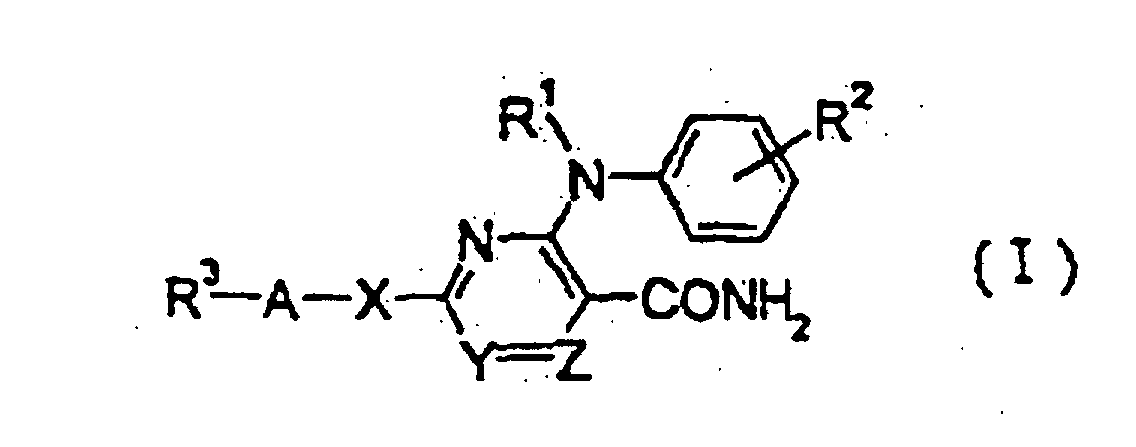 dans lequel -(NH2 sous forme de promédicament) signifie un groupe choisi parmi (Z)-3[2-acétoxy phényle]-2-propenoyleamino-, (acétoxy)méthoxycarbonylamino-, 4-azidobenzyloxycarbonylamino-, (5-méthyl-2-oxo-1,3-dioxol-4-èn-4-yl)méthoxycarbonylamino-, et [(2-hydroxyphényl) (phényl)méthylidène]amino- ;A : un groupe alkylène C1 à C6 qui peut comporter un (des) substituant(s), un groupe arylène qui peut comporter un (des) substituant(s), un groupe hétéroarylène qui peut comporter un (des) substituant(s), ou un groupe cycloalkylène qui peut comporter un (des) substituant(s) ;X : NR4 ;une ligne en pointillés entre Y et Z : présence (Y=Z) ou absence (Y-Z) d'une liaison ;Y-Z : N(R5)-C(O), C(O)-N(R5), N(R5)-N(R5) ou C(O)-C(O) ;Y=Z : N=C (R6), C(R7)=N, N=N, ou C(R7)=C(R7) ;R1 : H, un groupe alkyle en C1 à C6, -CO- alkyle en C1 à C6 ou - SO2- alkyle en C1 à C6 ;R2 représente un ou plusieurs substituants choisis parmi H, un groupe alkyle en C1 à C6, un atome d'halogène, un groupe alkyle en C1 à C6 substitué par un (des) atome(s) d'halogène, -O-alkyle en C1 à C6, -S- alkyle en C1 à C6, -O- aryle, -O-alkylène en C1 à C6 -aryle, -S- alkylène en C1 à C6 -aryle, nitro, cyano, -OCH2O-, -CH2OH, -NH2, -COCH3 ou -(CH=CH-CH=CH)- ;R3 : -CO2H, -CO2- alkyle en C1 à C6, -alkylène en C1 à C6-CO2H, - alkylène en C1 à C6-CO2-alkyle en C1 à C6, -CONHOH, -CONHO-alkyle en C1 à C6, -alkylène en C1 à C6-CONHOH, -alkylène en C1 à C6-CONHO-alkyle en C1 à C6, -NH2, -(NH2 sous forme de promédicament), -alkylène en C1 à C6-NH2 ou -alkylène en en C1 à C6-(NH2 sous forme de promédicament) ;
R6 : un groupe alkyle en C1 à C6, -OH, -O-alkyle en C1 à C6, -O-aryle qui peut comporter un (des) substituant(s), -O-alkylène en C1 à C6-aryle qui peut comporter un (des) substituant(s), - NR1-aryle qui peut comporter un (des) substituant(s), CO-alkyle en C1 à C6 ou -aryle qui peut comporter un (des) substituant(s) ;
R4, R5 et R7 : H). - Composé ou sel de celui-ci selon la revendication 1, dans lequel X est NR4 et A est un groupe alkylène en C1 à C6 ou cycloalkylène.
- Composé ou sel de celui-ci selon la revendication 2, dans lequel Y=Z est N=C(R6), C(R7)=N ou C(R7)=C(R7).
- Composé ou sel de celui-ci selon la revendication 1, dans lequel le composé est choisi parmi le 6-(2-aminoéthylamino) -2- (3-éthylanilino)pyridine-3-carboxamide, le 6-(2-aminoéthylamino)-2-(3-trifluorométhylanilino)pyridine-3-carboxamide, le 2-(2-aminoéthylamino)-4-hydroxy-6-(3-méthylanilino)pyrimidine-5-carboxamide, le 6-(cis-2-aminocyclohexylamino)-2-(3-méthylanilino)pyridine-3-carboxamide, le 6-(cis-2-aminocyclohexylamino)-2-(3,5-diméthylanilino)pyridine-3-carboxamide, le 5-(cis-2-aminocyclohexylamino)-3-(3-méthylanilino)pyrazine-2-carboxamide, le 5-(cis-2-aminocyclohexylamino)-3-(3-méthoxyanilino)pyrazine-2-carboxamide, le 5-(cis-2-aminocyclohexylamino)-3-(3-phénoxyanilino)pyrazine-2-carboxamide, le 5-(cis-2-aminocyclohexylamino)-3-(4-méthylsulfanylanilino)pyrazine-2-carboxamide, le 5-(cis-2-aminocyclohexylamino)-3-(3,5-diméthoxyanilino)pyrazine-2-carboxamide, le 2-(cis-2-aminocyclohexylamino)-4-hydroxy-6-(3-méthylanilino)pyrimidine-5-carboxamide, le 2-(cis-2-aminocyclohexylamino)-4-(3-bromoanilino)-6-hydroxypyrimidine-5-carboxamide, et le 2-(cis-2-aminocyclohexylamino)-4-(2-chlorophénoxy)-6-(3-méthylanilino)pyrimidine-5-carboxamide.
- Composition pharmaceutique qui comprend le composé selon la revendication 1 ou un sel de celui-ci et un véhicule pharmaceutiquement acceptable.
- Composition pharmaceutique qui comprend le composé selon la revendication 1 qui est un inhibiteur de la Syk ou un sel de celui-ci et un véhicule pharmaceutiquement acceptable.
Applications Claiming Priority (3)
| Application Number | Priority Date | Filing Date | Title |
|---|---|---|---|
| JP16269299 | 1999-06-09 | ||
| JP16269299 | 1999-06-09 | ||
| PCT/JP2000/003767 WO2000075113A1 (fr) | 1999-06-09 | 2000-06-09 | Nouveaux derives carboxamide heterocycliques |
Publications (3)
| Publication Number | Publication Date |
|---|---|
| EP1184376A1 EP1184376A1 (fr) | 2002-03-06 |
| EP1184376A4 EP1184376A4 (fr) | 2002-10-09 |
| EP1184376B1 true EP1184376B1 (fr) | 2005-02-02 |
Family
ID=15759494
Family Applications (1)
| Application Number | Title | Priority Date | Filing Date |
|---|---|---|---|
| EP00935619A Expired - Lifetime EP1184376B1 (fr) | 1999-06-09 | 2000-06-09 | Nouveaux derives carboxamide heterocycliques |
Country Status (8)
| Country | Link |
|---|---|
| US (1) | US6797706B1 (fr) |
| EP (1) | EP1184376B1 (fr) |
| AT (1) | ATE288420T1 (fr) |
| AU (1) | AU5107900A (fr) |
| DE (1) | DE60017898T2 (fr) |
| ES (1) | ES2237430T3 (fr) |
| PT (1) | PT1184376E (fr) |
| WO (1) | WO2000075113A1 (fr) |
Cited By (6)
| Publication number | Priority date | Publication date | Assignee | Title |
|---|---|---|---|---|
| WO2010097248A1 (fr) | 2009-01-13 | 2010-09-02 | Glaxo Group Limited | Dérivés de pyrimidine carboxamide comme inhibiteurs de la kinase syk |
| US7893074B2 (en) | 2003-08-15 | 2011-02-22 | Novartis Ag | 2, 4-pyrimidinediamines useful in the treatment of neoplastic diseases, inflammatory and immune system disorders |
| US7964592B2 (en) | 2003-03-14 | 2011-06-21 | Novartis Ag | 2,4-di (phenylamino) pyrimidines useful in the treatment of neoplastic diseases, inflammatory and immune system disorders |
| US8039479B2 (en) | 2006-12-08 | 2011-10-18 | Irm Llc | Compounds and compositions as protein kinase inhibitors |
| RU2625309C2 (ru) * | 2011-04-22 | 2017-07-13 | СИГНАЛ ФАРМАСЬЮТИКАЛЗ, ЭлЭлСи | Замещенные диаминокарбоксамидные и диаминокарбонитрильные производные пиримидинов, их композиции и способы лечения с их помощью |
| KR20190133725A (ko) * | 2017-03-30 | 2019-12-03 | 브리스톨-마이어스 스큅 컴퍼니 | 6-(시클로프로판아미도)-4-((2-메톡시-3-(1-메틸-1h-1,2,4-트리아졸-3-일)페닐)아미노)-n-(메틸-d3)피리다진-3-카르복스아미드의 제조 방법 |
Families Citing this family (67)
| Publication number | Priority date | Publication date | Assignee | Title |
|---|---|---|---|---|
| GB0206215D0 (en) * | 2002-03-15 | 2002-05-01 | Novartis Ag | Organic compounds |
| EP2316459B1 (fr) * | 2002-07-29 | 2013-11-06 | Rigel Pharmaceuticals, Inc. | Composants de 2,4-pyrimidinediamine pour être utilisés dans des procédés de traitement ou de prévention des maladies auto-immunes |
| US20040253178A1 (en) * | 2002-12-20 | 2004-12-16 | Shane Atwell | Crystals and structures of spleen tyrosine kinase SYKKD |
| EP1590334B1 (fr) | 2003-01-30 | 2009-08-19 | Boehringer Ingelheim Pharmaceuticals Inc. | Derives de 2,4-diaminopyrimidine utiles en tant qu'inhibiteurs de l'enzyme pkc-theta |
| US7504396B2 (en) | 2003-06-24 | 2009-03-17 | Amgen Inc. | Substituted heterocyclic compounds and methods of use |
| DE10350717A1 (de) * | 2003-10-30 | 2005-06-02 | Boehringer Ingelheim Pharma Gmbh & Co. Kg | Verwendung von Tyrosinkinase-Inhibitoren zur Behandlung inflammatorischer Prozesse |
| US7601714B2 (en) | 2004-07-08 | 2009-10-13 | Boehringer Ingelheim Pharmaceuticals, Inc. | Pyrimidine derivatives useful as inhibitors of PKC-theta |
| CN101611035A (zh) | 2006-12-28 | 2009-12-23 | 大正制药株式会社 | 吡唑并嘧啶化合物 |
| PE20081636A1 (es) | 2007-01-26 | 2009-01-10 | Smithkline Beecham Corp | Inhibidores de antranilamida para aurora quinasa |
| US8138339B2 (en) | 2008-04-16 | 2012-03-20 | Portola Pharmaceuticals, Inc. | Inhibitors of protein kinases |
| US8063058B2 (en) | 2008-04-16 | 2011-11-22 | Portola Pharmaceuticals, Inc. | Inhibitors of syk and JAK protein kinases |
| KR20100132550A (ko) * | 2008-04-16 | 2010-12-17 | 포톨라 파마슈티컬스, 인코포레이티드 | syk 또는 JAK 키나제 억제제로서의 2,6-디아미노-피리미딘-5-일-카르복스아미드 |
| JP5487692B2 (ja) | 2009-04-10 | 2014-05-07 | 国立大学法人京都大学 | 複素環骨格を有する化合物および該化合物を不斉触媒として用いる光学活性化合物の製造方法 |
| MX2011011875A (es) * | 2009-05-08 | 2011-12-08 | Astellas Pharma Inc | Compuesto de carboxamida heterociclica diamino. |
| CN102458402B (zh) * | 2009-06-12 | 2013-10-02 | 百时美施贵宝公司 | 用作激酶调节剂的烟酰胺化合物 |
| EP2516434B1 (fr) | 2009-12-23 | 2015-05-27 | Takeda Pharmaceutical Company Limited | Pyrrolidinones accolés en tant d'inhibiteurs de syk |
| JP5744021B2 (ja) | 2010-06-30 | 2015-07-01 | 富士フイルム株式会社 | 新規なニコチンアミド誘導体またはその塩 |
| JP2014005206A (ja) * | 2010-10-22 | 2014-01-16 | Astellas Pharma Inc | アリールアミノヘテロ環カルボキサミド化合物 |
| WO2012061415A1 (fr) * | 2010-11-01 | 2012-05-10 | Portola Pharmaceuticals, Inc. | Oxypyrimidines en tant que modulateurs de syk |
| EP2975027A1 (fr) * | 2010-11-01 | 2016-01-20 | Portola Pharmaceuticals, Inc. | Nicotinamides comme modulateurs de la kinase jak |
| AU2011323484B2 (en) * | 2010-11-01 | 2016-10-06 | Portola Pharmaceuticals, Inc. | Benzamides and nicotinamides as Syk modulators |
| CA2834062A1 (fr) | 2011-05-10 | 2012-11-15 | Merck Sharp & Dohme Corp. | Pyridylaminopyridines en tant qu'inhibiteurs de syk |
| WO2012154518A1 (fr) | 2011-05-10 | 2012-11-15 | Merck Sharp & Dohme Corp. | Bipyridylaminopyridines en tant qu'inhibiteurs de syk |
| AU2012253885A1 (en) | 2011-05-10 | 2013-10-31 | Merck Sharp & Dohme Corp. | Aminopyrimidines as Syk inhibitors |
| WO2012177714A1 (fr) | 2011-06-22 | 2012-12-27 | Takeda Pharmaceutical Company Limited | Dérivés de 6-aza-isoindolin-1-one substitués |
| WO2013047813A1 (fr) | 2011-09-30 | 2013-04-04 | 大鵬薬品工業株式会社 | Dérivé de 1,2,4-triazine-6-carboxamide |
| EP2763976B1 (fr) * | 2011-10-05 | 2016-05-18 | Merck Sharp & Dohme Corp. | Inhibiteurs de tyrosine kinase de la rate (syk) contenant un 2-pyridyl carboxamide |
| US8987456B2 (en) | 2011-10-05 | 2015-03-24 | Merck Sharp & Dohme Corp. | 3-pyridyl carboxamide-containing spleen tyrosine kinase (SYK) inhibitors |
| WO2013052391A1 (fr) | 2011-10-05 | 2013-04-11 | Merck Sharp & Dohme Corp. | Inhibiteurs de tyrosine kinase de la rate (syk) contenant un phényl carboxamide |
| EP2773207B1 (fr) * | 2011-10-31 | 2018-03-07 | Merck Sharp & Dohme Corp. | Aminopyrimidinones en tant qu'inhibiteurs de kinases associées au récepteur de l'interleukine |
| EP2782579B1 (fr) * | 2011-11-23 | 2019-01-02 | Portola Pharmaceuticals, Inc. | Inhibiteurs de de la pyrazine kinase |
| DK2799431T3 (en) | 2011-12-28 | 2018-03-26 | Fujifilm Corp | Hitherto unknown nicotinamide derivatives or salts thereof |
| KR20140108594A (ko) | 2012-01-10 | 2014-09-11 | 에프. 호프만-라 로슈 아게 | 피리다진 아미드 화합물 및 syk 저해제로서의 이의 용도 |
| UY34807A (es) * | 2012-05-16 | 2013-12-31 | Novartis Ag | Derivados monocíclicos de heteroarilcicloalquil- diamina |
| EP2863913B1 (fr) | 2012-06-20 | 2018-09-12 | Merck Sharp & Dohme Corp. | Analogues d'imidazolyle en tant qu'inhibiteurs de syk |
| WO2013192088A1 (fr) | 2012-06-22 | 2013-12-27 | Merck Sharp & Dohme Corp. | Inhibiteurs de tyrosine kinase splénique (syk) diazines et triazines substituées |
| US20140113931A1 (en) * | 2012-06-22 | 2014-04-24 | Portola Pharmaceuticals, Inc. | Substituted picolinamide kinase inhibitors |
| US9040530B2 (en) * | 2012-06-22 | 2015-05-26 | Portola Pharmaceuticals, Inc. | 1,2,4-triazine-6-carboxamide kinase inhibitors |
| US9376418B2 (en) | 2012-06-22 | 2016-06-28 | Merck Sharp & Dohme Corp. | Substituted pyridine spleen tyrosine kinase (SYK) inhibitors |
| EP2884982B1 (fr) | 2012-08-20 | 2017-09-20 | Merck Sharp & Dohme Corp. | Inhibiteurs de la phényle tyrosine kinase de la rate (syk) substitués |
| US9533989B2 (en) | 2012-09-18 | 2017-01-03 | Ziarco Pharma Ltd. | Substituted pyrimidine-5-carboxamides as spleen tyrosine kinase inhibitors |
| WO2014048065A1 (fr) | 2012-09-28 | 2014-04-03 | Merck Sharp & Dohme Corp. | Dérivés triazolyle en tant qu'inhibiteurs de la syk |
| MX2015004801A (es) * | 2012-10-19 | 2015-08-14 | Hoffmann La Roche | Inhibidores de la syk. |
| HRP20220766T1 (hr) * | 2012-11-08 | 2022-09-16 | Bristol-Myers Squibb Company | Amidom-supstituirani heterociklički spojevi korisni kao modulatori il-12, il-23 i/ili ifn alfa odgovora |
| EP2931281B1 (fr) | 2012-12-12 | 2018-01-17 | Merck Sharp & Dohme Corp. | Inhibiteurs de tyrosine kinase splénique contenant une aminopyridine |
| EP2934525B1 (fr) | 2012-12-21 | 2019-05-08 | Merck Sharp & Dohme Corp. | Aminopyridines substituées par thiazole en tant qu'inhibiteurs de la tyrosine kinase de la rate |
| WO2014111031A1 (fr) * | 2013-01-17 | 2014-07-24 | 四川恒康发展有限责任公司 | Composé triazine, sel pharmaceutique, isomère, ou hydrate de celui-ci, et composition pharmaceutique de celui-ci |
| JP2016113366A (ja) * | 2013-03-29 | 2016-06-23 | 大鵬薬品工業株式会社 | アセトアミド基を有する1,2,4−トリアジン−6−カルボキサミド誘導体 |
| EP2988744A4 (fr) | 2013-04-26 | 2016-11-02 | Merck Sharp & Dohme | Composés aminohétéroaryle à substitution thiazole inhibiteurs de tyrosine kinase splénique |
| WO2014176216A1 (fr) | 2013-04-26 | 2014-10-30 | Merck Sharp & Dohme Corp. | Aminopyrimidines substituées par thiazole utilisées en tant qu'inhibiteurs de tyrosine kinase splénique |
| US10329270B2 (en) | 2013-10-21 | 2019-06-25 | Merck Patent Gmbh | Heteroaryl compounds as BTK inhibitors and uses thereof |
| AU2014360446A1 (en) | 2013-12-05 | 2016-06-09 | Pharmacyclics, Llc | Inhibitors of Bruton's tyrosine kinase |
| US9670196B2 (en) | 2013-12-20 | 2017-06-06 | Merck Sharp & Dohme Corp. | Thiazole-substituted aminoheteroaryls as Spleen Tyrosine Kinase inhibitors |
| WO2015094997A1 (fr) | 2013-12-20 | 2015-06-25 | Merck Sharp & Dohme Corp. | Composés aminohétéroaryle à substitution thiazole utilisés comme inhibiteurs de la tyrosine kinase splénique |
| EP3083559B1 (fr) | 2013-12-20 | 2021-03-10 | Merck Sharp & Dohme Corp. | Composés aminohétéroaryles à substitution thiazole utilisés comme inhibiteurs de la tyrosine kinase splénique |
| NZ715903A (en) | 2014-01-30 | 2017-06-30 | Signal Pharm Llc | Solid forms of 2-(tert-butylamino)-4-((1r,3r,4r)-3-hydroxy-4-methylcyclohexylamino)-pyrimidine-5-carboxamide, compositions thereof and methods of their use |
| WO2015123453A1 (fr) * | 2014-02-14 | 2015-08-20 | Portola Pharmaceuticals, Inc. | Composés de pyridazine en tant qu'inhibiteurs de jak |
| WO2015138273A1 (fr) | 2014-03-13 | 2015-09-17 | Merck Sharp & Dohme Corp. | Composés 2-pyrazine carboxamide utiles comme inhibiteurs de la tyrosine kinase splénique |
| US9513297B2 (en) | 2014-12-16 | 2016-12-06 | Signal Pharmaceuticals, Llc | Methods for measurement of inhibition of c-Jun N-terminal kinase in skin |
| EP3712134B1 (fr) | 2014-12-16 | 2023-11-29 | Signal Pharmaceuticals, LLC | Sels de 2-(tert-butylamino)-4-((1r,3r,4r)-3-hydroxy-4-méthylcyclohexylamino)-pyrimidine-5-carboxamide |
| EP3250557B1 (fr) | 2015-01-29 | 2024-11-20 | Signal Pharmaceuticals, LLC | Isotopologues de 2-(tert-butylamino)-4-((1r,3r,4r) -3-hydroxy-4-méthylcyclohexylamino)-pyrimidine-5-carboxamide |
| BR112017025986A2 (pt) * | 2015-06-02 | 2018-08-14 | Pharmacyclics Llc | inibidores de tirosina quinase de bruton. |
| EP3325432B1 (fr) | 2015-07-24 | 2020-09-02 | Celgene Corporation | Procédés de synthèse de chlorhydrate de (1r,2r,5r)-5-amino-2-méthylcyclohexanol et intermédiaires utiles à cet effet |
| AU2018350683A1 (en) | 2017-10-19 | 2020-04-02 | Bayer Animal Health Gmbh | Use of fused heteroaromatic pyrrolidones for treatment and prevention of diseases in animals |
| CA3129665A1 (fr) | 2019-03-21 | 2020-09-24 | Onxeo | Molecule dbait associee a un inhibiteur de kinase pour le traitement du cancer |
| KR20220098759A (ko) | 2019-11-08 | 2022-07-12 | 인쎄름 (엥스띠뛰 나씨오날 드 라 쌍떼 에 드 라 흐쉐르슈 메디깔) | 키나제 억제제에 대해 내성을 획득한 암의 치료 방법 |
| WO2021148581A1 (fr) | 2020-01-22 | 2021-07-29 | Onxeo | Nouvelle molécule dbait et son utilisation |
Family Cites Families (8)
| Publication number | Priority date | Publication date | Assignee | Title |
|---|---|---|---|---|
| GB1405308A (en) | 1972-12-13 | 1975-09-10 | Basf Ag | Amino-pytidines as coupling components for azo dyes |
| US4442095A (en) * | 1982-12-27 | 1984-04-10 | Merck & Co., Inc. | N-[(5-Halo-2,6-(substituted)pyrazinyl)methylene]amine antimicrobial compounds, compositions and use |
| EP0600832A1 (fr) * | 1992-11-27 | 1994-06-08 | Ciba-Geigy Ag | Dérivés de diamino acid benzoique et diamino acid phthalique et leur application à titre des inhibiteurs de protéine kinase |
| JPH09507846A (ja) * | 1993-12-30 | 1997-08-12 | スミスクライン・ビーチャム・コーポレイション | フェニルメチルヘキサンアミドおよびその使用 |
| GB9523675D0 (en) * | 1995-11-20 | 1996-01-24 | Celltech Therapeutics Ltd | Chemical compounds |
| GB9622363D0 (en) * | 1996-10-28 | 1997-01-08 | Celltech Therapeutics Ltd | Chemical compounds |
| GB9705361D0 (en) * | 1997-03-14 | 1997-04-30 | Celltech Therapeutics Ltd | Chemical compounds |
| ATE401312T1 (de) | 1997-12-15 | 2008-08-15 | Astellas Pharma Inc | Pyrimidin-5-carboxamid-derivate |
-
2000
- 2000-06-09 EP EP00935619A patent/EP1184376B1/fr not_active Expired - Lifetime
- 2000-06-09 DE DE60017898T patent/DE60017898T2/de not_active Expired - Lifetime
- 2000-06-09 PT PT00935619T patent/PT1184376E/pt unknown
- 2000-06-09 ES ES00935619T patent/ES2237430T3/es not_active Expired - Lifetime
- 2000-06-09 AU AU51079/00A patent/AU5107900A/en not_active Abandoned
- 2000-06-09 WO PCT/JP2000/003767 patent/WO2000075113A1/fr not_active Ceased
- 2000-06-09 AT AT00935619T patent/ATE288420T1/de active
- 2000-06-09 US US10/009,276 patent/US6797706B1/en not_active Expired - Lifetime
Cited By (13)
| Publication number | Priority date | Publication date | Assignee | Title |
|---|---|---|---|---|
| US7964592B2 (en) | 2003-03-14 | 2011-06-21 | Novartis Ag | 2,4-di (phenylamino) pyrimidines useful in the treatment of neoplastic diseases, inflammatory and immune system disorders |
| US7893074B2 (en) | 2003-08-15 | 2011-02-22 | Novartis Ag | 2, 4-pyrimidinediamines useful in the treatment of neoplastic diseases, inflammatory and immune system disorders |
| US8399450B2 (en) | 2006-12-08 | 2013-03-19 | Irm Llc | Compounds and compositions as protein kinase inhibitors |
| US8039479B2 (en) | 2006-12-08 | 2011-10-18 | Irm Llc | Compounds and compositions as protein kinase inhibitors |
| US8372858B2 (en) | 2006-12-08 | 2013-02-12 | Irm Llc | Compounds and compositions as protein kinase inhibitors |
| US8377921B2 (en) | 2006-12-08 | 2013-02-19 | Irm Llc | Compounds and compositions as protein kinase inhibitors |
| US8957081B2 (en) | 2006-12-08 | 2015-02-17 | Irm Llc | Compounds and compositions as protein kinase inhibitors |
| WO2010097248A1 (fr) | 2009-01-13 | 2010-09-02 | Glaxo Group Limited | Dérivés de pyrimidine carboxamide comme inhibiteurs de la kinase syk |
| RU2625309C2 (ru) * | 2011-04-22 | 2017-07-13 | СИГНАЛ ФАРМАСЬЮТИКАЛЗ, ЭлЭлСи | Замещенные диаминокарбоксамидные и диаминокарбонитрильные производные пиримидинов, их композиции и способы лечения с их помощью |
| KR20190133725A (ko) * | 2017-03-30 | 2019-12-03 | 브리스톨-마이어스 스큅 컴퍼니 | 6-(시클로프로판아미도)-4-((2-메톡시-3-(1-메틸-1h-1,2,4-트리아졸-3-일)페닐)아미노)-n-(메틸-d3)피리다진-3-카르복스아미드의 제조 방법 |
| KR20190133726A (ko) * | 2017-03-30 | 2019-12-03 | 브리스톨-마이어스 스큅 컴퍼니 | 6-(시클로프로판카르복스아미도)-4-((2-메톡시-3-(1-메틸-1H-1,2,4-트리아졸-3-일)페닐)아미노)-N-(메틸-d3)피리다진-3-카르복스아미드의 결정 형태 |
| KR102642407B1 (ko) | 2017-03-30 | 2024-02-28 | 브리스톨-마이어스 스큅 컴퍼니 | 6-(시클로프로판카르복스아미도)-4-((2-메톡시-3-(1-메틸-1H-1,2,4-트리아졸-3-일)페닐)아미노)-N-(메틸-d3)피리다진-3-카르복스아미드의 결정 형태 |
| KR102720054B1 (ko) | 2017-03-30 | 2024-10-22 | 브리스톨-마이어스 스큅 컴퍼니 | 6-(시클로프로판아미도)-4-((2-메톡시-3-(1-메틸-1h-1,2,4-트리아졸-3-일)페닐)아미노)-n-(메틸-d3)피리다진-3-카르복스아미드의 제조 방법 |
Also Published As
| Publication number | Publication date |
|---|---|
| WO2000075113A8 (fr) | 2001-03-15 |
| PT1184376E (pt) | 2005-04-29 |
| ATE288420T1 (de) | 2005-02-15 |
| US6797706B1 (en) | 2004-09-28 |
| AU5107900A (en) | 2000-12-28 |
| ES2237430T3 (es) | 2005-08-01 |
| EP1184376A4 (fr) | 2002-10-09 |
| DE60017898T2 (de) | 2006-01-12 |
| EP1184376A1 (fr) | 2002-03-06 |
| DE60017898D1 (de) | 2005-03-10 |
| WO2000075113A1 (fr) | 2000-12-14 |
Similar Documents
| Publication | Publication Date | Title |
|---|---|---|
| US6797706B1 (en) | Heterocyclecarboxamide derivative | |
| EP1054004B1 (fr) | Nouveaux derives de pyrimidine-5-carboxamide | |
| TW202144345A (zh) | Kras突變蛋白抑制劑 | |
| TW202115065A (zh) | Kras突變蛋白抑制劑 | |
| WO2022121813A1 (fr) | Inhibiteur de sos1, composition pharmaceutique le comprenant et son utilisation | |
| CN114409653A (zh) | 一种桥环并嘧啶并环类化合物及其用途 | |
| WO2018196677A1 (fr) | Dérivé de fluoroallylamine et son utilisation | |
| JPWO1999031073A1 (ja) | 新規なピリミジン−5−カルボキサミド誘導体 | |
| WO2022242767A1 (fr) | Composé spiro et son utilisation | |
| WO2019101086A1 (fr) | Inhibiteur de ssao/vap-1 halo-allylamine et son utilisation | |
| US20220213122A1 (en) | Substituted 1,6-dihydropyridinones and 1,2-dihydroisoquinolinones as bet inhibitors | |
| AU2022216707B2 (en) | Heterocyclic compound, and intermediate thereof, preparation method therefor and use thereof | |
| JP2003012653A (ja) | キナゾリン誘導体 | |
| JP2002308882A (ja) | チエノピリミジン誘導体 | |
| CN112566900A (zh) | 免疫调节剂及其组合物和制备方法 | |
| US20250346571A1 (en) | Bicyclic derivative parp inhibitor and use thereof | |
| JP4622047B2 (ja) | 新規なヘテロ環カルボキサミド誘導体 | |
| CN105473573A (zh) | 用作激酶抑制剂的咔唑甲酰胺化合物 | |
| CN107074856A (zh) | CaMKII抑制剂及其用途 | |
| CN101687801A (zh) | 用作癌症治疗的萘甲酸酰胺的醚 | |
| IL296632A (en) | phd inhibitory compounds, compositions and use | |
| CN110753691A (zh) | 化合物 | |
| CN112513041A (zh) | 三环化合物 | |
| KR102938808B1 (ko) | Rip2 키나아제 억제제로서의 헤테로아릴 화합물, 이의 조성물 및 용도 | |
| CN111875583A (zh) | 三氮唑衍生物及其制备方法和用途 |
Legal Events
| Date | Code | Title | Description |
|---|---|---|---|
| PUAI | Public reference made under article 153(3) epc to a published international application that has entered the european phase |
Free format text: ORIGINAL CODE: 0009012 |
|
| 17P | Request for examination filed |
Effective date: 20011207 |
|
| AK | Designated contracting states |
Kind code of ref document: A1 Designated state(s): AT BE CH CY DE DK ES FI FR GB GR IE IT LI LU MC NL PT SE |
|
| AX | Request for extension of the european patent |
Free format text: AL;LT;LV;MK;RO;SI |
|
| A4 | Supplementary search report drawn up and despatched |
Effective date: 20020828 |
|
| AK | Designated contracting states |
Kind code of ref document: A4 Designated state(s): AT BE CH CY DE DK ES FI FR GB GR IE IT LI LU MC NL PT SE |
|
| RIC1 | Information provided on ipc code assigned before grant |
Free format text: 7C 07D 213/82 A, 7C 07D 239/48 B, 7C 07D 241/26 B, 7C 07D 253/075 B, 7A 61K 31/455 B, 7A 61K 31/505 B, 7A 61K 31/4965 B, 7A 61P 37/06 B, 7A 61P 37/08 B, 7A 61P 29/00 B, 7A 61P 43/00 B |
|
| 17Q | First examination report despatched |
Effective date: 20030312 |
|
| GRAP | Despatch of communication of intention to grant a patent |
Free format text: ORIGINAL CODE: EPIDOSNIGR1 |
|
| GRAS | Grant fee paid |
Free format text: ORIGINAL CODE: EPIDOSNIGR3 |
|
| GRAA | (expected) grant |
Free format text: ORIGINAL CODE: 0009210 |
|
| AK | Designated contracting states |
Kind code of ref document: B1 Designated state(s): AT BE CH CY DE DK ES FI FR GB GR IE IT LI LU MC NL PT SE |
|
| REG | Reference to a national code |
Ref country code: GB Ref legal event code: FG4D |
|
| REG | Reference to a national code |
Ref country code: CH Ref legal event code: EP |
|
| REG | Reference to a national code |
Ref country code: IE Ref legal event code: FG4D |
|
| REG | Reference to a national code |
Ref country code: CH Ref legal event code: NV Representative=s name: BOVARD AG PATENTANWAELTE |
|
| REF | Corresponds to: |
Ref document number: 60017898 Country of ref document: DE Date of ref document: 20050310 Kind code of ref document: P |
|
| REG | Reference to a national code |
Ref country code: SE Ref legal event code: TRGR |
|
| REG | Reference to a national code |
Ref country code: GR Ref legal event code: EP Ref document number: 20050401095 Country of ref document: GR |
|
| REG | Reference to a national code |
Ref country code: PT Ref legal event code: SC4A Free format text: AVAILABILITY OF NATIONAL TRANSLATION Effective date: 20050301 |
|
| REG | Reference to a national code |
Ref country code: DK Ref legal event code: T3 |
|
| PG25 | Lapsed in a contracting state [announced via postgrant information from national office to epo] |
Ref country code: CY Free format text: LAPSE BECAUSE OF FAILURE TO SUBMIT A TRANSLATION OF THE DESCRIPTION OR TO PAY THE FEE WITHIN THE PRESCRIBED TIME-LIMIT Effective date: 20050609 |
|
| PG25 | Lapsed in a contracting state [announced via postgrant information from national office to epo] |
Ref country code: MC Free format text: LAPSE BECAUSE OF NON-PAYMENT OF DUE FEES Effective date: 20050630 |
|
| REG | Reference to a national code |
Ref country code: ES Ref legal event code: FG2A Ref document number: 2237430 Country of ref document: ES Kind code of ref document: T3 |
|
| PLBE | No opposition filed within time limit |
Free format text: ORIGINAL CODE: 0009261 |
|
| STAA | Information on the status of an ep patent application or granted ep patent |
Free format text: STATUS: NO OPPOSITION FILED WITHIN TIME LIMIT |
|
| ET | Fr: translation filed | ||
| 26N | No opposition filed |
Effective date: 20051103 |
|
| NLT1 | Nl: modifications of names registered in virtue of documents presented to the patent office pursuant to art. 16 a, paragraph 1 |
Owner name: ASTELLAS PHARMA INC. |
|
| REG | Reference to a national code |
Ref country code: CH Ref legal event code: PFA Owner name: ASTELLAS PHARMA INC. Free format text: YAMANOUCHI PHARMACEUTICAL CO. LTD.#NO. 3-11 NIHONBASHI-HONCHO, 2-CHOME CHUO-KU#TOKYO 103-8411 (JP) -TRANSFER TO- ASTELLAS PHARMA INC.#3-11, NIHONBASHI-HONCHO 2-CHOME, CHUO-KU#TOKYO 103-8411 (JP) |
|
| REG | Reference to a national code |
Ref country code: PT Ref legal event code: PC4A Owner name: ASTELLAS PHARMA INC., JP Effective date: 20060412 |
|
| BECN | Be: change of holder's name |
Owner name: *ASTELLAS PHARMA INC. Effective date: 20050202 |
|
| REG | Reference to a national code |
Ref country code: FR Ref legal event code: CD |
|
| REG | Reference to a national code |
Ref country code: CH Ref legal event code: PFA Owner name: ASTELLAS PHARMA INC. Free format text: ASTELLAS PHARMA INC.#3-11, NIHONBASHI-HONCHO 2-CHOME, CHUO-KU#TOKYO 103-8411 (JP) -TRANSFER TO- ASTELLAS PHARMA INC.#3-11, NIHONBASHI-HONCHO 2-CHOME, CHUO-KU#TOKYO 103-8411 (JP) |
|
| REG | Reference to a national code |
Ref country code: FR Ref legal event code: PLFP Year of fee payment: 17 |
|
| REG | Reference to a national code |
Ref country code: FR Ref legal event code: PLFP Year of fee payment: 18 |
|
| REG | Reference to a national code |
Ref country code: FR Ref legal event code: PLFP Year of fee payment: 19 |
|
| PGFP | Annual fee paid to national office [announced via postgrant information from national office to epo] |
Ref country code: NL Payment date: 20190515 Year of fee payment: 20 Ref country code: LU Payment date: 20190524 Year of fee payment: 20 |
|
| PGFP | Annual fee paid to national office [announced via postgrant information from national office to epo] |
Ref country code: IT Payment date: 20190620 Year of fee payment: 20 Ref country code: FI Payment date: 20190610 Year of fee payment: 20 Ref country code: DE Payment date: 20190528 Year of fee payment: 20 Ref country code: PT Payment date: 20190606 Year of fee payment: 20 Ref country code: IE Payment date: 20190610 Year of fee payment: 20 Ref country code: DK Payment date: 20190613 Year of fee payment: 20 |
|
| PGFP | Annual fee paid to national office [announced via postgrant information from national office to epo] |
Ref country code: FR Payment date: 20190510 Year of fee payment: 20 Ref country code: SE Payment date: 20190611 Year of fee payment: 20 Ref country code: BE Payment date: 20190516 Year of fee payment: 20 Ref country code: GR Payment date: 20190514 Year of fee payment: 20 |
|
| PGFP | Annual fee paid to national office [announced via postgrant information from national office to epo] |
Ref country code: CH Payment date: 20190614 Year of fee payment: 20 |
|
| PGFP | Annual fee paid to national office [announced via postgrant information from national office to epo] |
Ref country code: AT Payment date: 20190528 Year of fee payment: 20 Ref country code: GB Payment date: 20190605 Year of fee payment: 20 Ref country code: ES Payment date: 20190702 Year of fee payment: 20 |
|
| REG | Reference to a national code |
Ref country code: NL Ref legal event code: MK Effective date: 20200608 |
|
| REG | Reference to a national code |
Ref country code: DK Ref legal event code: EUP Expiry date: 20200609 Ref country code: CH Ref legal event code: PL |
|
| REG | Reference to a national code |
Ref country code: GB Ref legal event code: PE20 Expiry date: 20200608 |
|
| REG | Reference to a national code |
Ref country code: FI Ref legal event code: MAE |
|
| REG | Reference to a national code |
Ref country code: IE Ref legal event code: MK9A |
|
| REG | Reference to a national code |
Ref country code: SE Ref legal event code: EUG |
|
| PG25 | Lapsed in a contracting state [announced via postgrant information from national office to epo] |
Ref country code: PT Free format text: LAPSE BECAUSE OF EXPIRATION OF PROTECTION Effective date: 20200622 |
|
| REG | Reference to a national code |
Ref country code: AT Ref legal event code: MK07 Ref document number: 288420 Country of ref document: AT Kind code of ref document: T Effective date: 20200609 |
|
| REG | Reference to a national code |
Ref country code: BE Ref legal event code: MK Effective date: 20200609 |
|
| PG25 | Lapsed in a contracting state [announced via postgrant information from national office to epo] |
Ref country code: GB Free format text: LAPSE BECAUSE OF EXPIRATION OF PROTECTION Effective date: 20200608 |
|
| REG | Reference to a national code |
Ref country code: ES Ref legal event code: FD2A Effective date: 20200925 |
|
| PG25 | Lapsed in a contracting state [announced via postgrant information from national office to epo] |
Ref country code: IE Free format text: LAPSE BECAUSE OF EXPIRATION OF PROTECTION Effective date: 20200609 Ref country code: ES Free format text: LAPSE BECAUSE OF EXPIRATION OF PROTECTION Effective date: 20200610 |