EP1191438A2 - Interface noyau entre un serveur ouèbe et un système de transport de données et un gestionnaire de cache - Google Patents
Interface noyau entre un serveur ouèbe et un système de transport de données et un gestionnaire de cache Download PDFInfo
- Publication number
- EP1191438A2 EP1191438A2 EP01307433A EP01307433A EP1191438A2 EP 1191438 A2 EP1191438 A2 EP 1191438A2 EP 01307433 A EP01307433 A EP 01307433A EP 01307433 A EP01307433 A EP 01307433A EP 1191438 A2 EP1191438 A2 EP 1191438A2
- Authority
- EP
- European Patent Office
- Prior art keywords
- http
- data
- connection identifier
- sending
- http request
- Prior art date
- Legal status (The legal status is an assumption and is not a legal conclusion. Google has not performed a legal analysis and makes no representation as to the accuracy of the status listed.)
- Withdrawn
Links
- 230000004044 response Effects 0.000 claims abstract description 102
- 238000000034 method Methods 0.000 claims abstract description 83
- 230000008569 process Effects 0.000 claims abstract description 42
- 238000012545 processing Methods 0.000 claims description 13
- 230000005540 biological transmission Effects 0.000 claims description 10
- 238000010586 diagram Methods 0.000 description 17
- 238000004891 communication Methods 0.000 description 5
- 230000007246 mechanism Effects 0.000 description 5
- 238000007726 management method Methods 0.000 description 4
- 238000012546 transfer Methods 0.000 description 4
- 102100025570 Cancer/testis antigen 1 Human genes 0.000 description 2
- 101000856237 Homo sapiens Cancer/testis antigen 1 Proteins 0.000 description 2
- 230000009471 action Effects 0.000 description 2
- 238000013500 data storage Methods 0.000 description 2
- 238000005538 encapsulation Methods 0.000 description 2
- 238000012986 modification Methods 0.000 description 2
- 230000004048 modification Effects 0.000 description 2
- 241000699670 Mus sp. Species 0.000 description 1
- 230000009286 beneficial effect Effects 0.000 description 1
- 238000011010 flushing procedure Methods 0.000 description 1
- 230000006870 function Effects 0.000 description 1
- 230000006855 networking Effects 0.000 description 1
Images




Classifications
-
- H—ELECTRICITY
- H04—ELECTRIC COMMUNICATION TECHNIQUE
- H04L—TRANSMISSION OF DIGITAL INFORMATION, e.g. TELEGRAPHIC COMMUNICATION
- H04L67/00—Network arrangements or protocols for supporting network services or applications
- H04L67/50—Network services
- H04L67/56—Provisioning of proxy services
- H04L67/566—Grouping or aggregating service requests, e.g. for unified processing
-
- H—ELECTRICITY
- H04—ELECTRIC COMMUNICATION TECHNIQUE
- H04L—TRANSMISSION OF DIGITAL INFORMATION, e.g. TELEGRAPHIC COMMUNICATION
- H04L9/00—Cryptographic mechanisms or cryptographic arrangements for secret or secure communications; Network security protocols
- H04L9/40—Network security protocols
-
- H—ELECTRICITY
- H04—ELECTRIC COMMUNICATION TECHNIQUE
- H04L—TRANSMISSION OF DIGITAL INFORMATION, e.g. TELEGRAPHIC COMMUNICATION
- H04L69/00—Network arrangements, protocols or services independent of the application payload and not provided for in the other groups of this subclass
- H04L69/30—Definitions, standards or architectural aspects of layered protocol stacks
- H04L69/32—Architecture of open systems interconnection [OSI] 7-layer type protocol stacks, e.g. the interfaces between the data link level and the physical level
- H04L69/322—Intralayer communication protocols among peer entities or protocol data unit [PDU] definitions
- H04L69/329—Intralayer communication protocols among peer entities or protocol data unit [PDU] definitions in the application layer [OSI layer 7]
Definitions
- the present invention relates generally to computer software. More particularly, the present invention relates to methods and apparatus for providing an in-kernel interface to a web server.
- FIG. 1 is a block diagram illustrating a conventional web server 104.
- a user may access a web page stored on the web server 104 through the Internet.
- multiple Hypertext Transfer Protocol (HTTP) clients e.g., web browsers
- HTTP Hypertext Transfer Protocol
- a browser user enters HTTP file requests by either "opening" a Web file (e.g., typing in a Uniform Resource Locator or URL) or clicking on a hypertext link.
- the browser builds a HTTP request and sends it to the Internet Protocol (IP) address indicated by the URL.
- IP Internet Protocol
- the web server 104 receives the request and, after any necessary processing, the requested file (i.e., HTTP response data) is returned.
- IP Internet Protocol
- HTTP requests that are received are processed by a HTTP daemon 105.
- the HTTP daemon 105 is a program that runs continuously on the web server 104 and exists for the purpose of handling HTTP requests.
- the HTTP daemon 105 forwards the received HTTP requests to other programs or processes as appropriate.
- each web server has a HTTP daemon 105 that continually waits for requests to come in from Web clients and their users.
- a file i.e., HTTP response data
- the data is transmitted by the daemon 105 to the client 100 or 102 that requested the data.
- the web server cache 106 is often used to store HTTP response data.
- the HTTP daemon 105 may have other storage media associated with it. Such media, for example, can include a hard drive.
- HTTP requests are typically initially handled by a kernel 107 that is responsible for forwarding the requests from the client 100 or 102 to the HTTP daemon 105.
- the kernel 107 is the essential central part of a computer operating system, the core that provides basic services for all other parts of the operating system.
- a kernel includes an interrupt handler that handles all requests or completed I/O operations that compete for the kernel's services, a scheduler that determines which programs share the kernel's processing time in what order, and a supervisor that actually gives use of the computer to each process when it is scheduled.
- the kernel 107 may also include a manager of the operating system's memory address spaces, sharing these among all components and other users of the kernel's services.
- a kernel's services are requested by other parts of the operating system or by applications through a specified set of program interfaces sometimes known as system calls.
- the kernel 107 also provides services such as buffer management, message routing, and standardized interfaces to protocols which enable data to be routed between clients 100, 102 and a server 104.
- the kernel structure consists of three layers: a socket layer 108, a protocol layer 110, and a device layer 111.
- the socket layer 108 supplies the interface between the HTTP daemon 105 and lower (protocol and device) layers
- the protocol layer 110 contains protocol modules for communication
- the device layer 111 contains device drivers that control network devices.
- a server and client process may communicate with one another through the socket layer 108.
- a socket file system 109 SOCKFS
- SOCKFS socket file system 109
- a "socket” is a method for communication between a client program and a server program in a network.
- a socket is defined as "the endpoint in a connection.” Sockets are created and used with a set of programming requests or “function calls” sometimes called the sockets application programming interface (API).
- API application programming interface
- a file descriptor is typically an integer that identifies an open file within a process which is obtained as a result of opening the file. In other words, a separate socket is required for each network connection.
- each network connection corresponding to a client request has an associated socket layer 112 and protocol layer 114, which may send data via a network interface card 116 via a transmission medium 118 to one or more clients 100, 102.
- Each socket has its own socket data structure. Since a separate file descriptor is opened on a socket for each network connection, in-kernel resources are unnecessarily consumed. Moreover, there are limits to the number of file descriptors that may be opened at a particular instant in time.
- STREAMS is a general, flexible programming model for Unix system communication services.
- STREAMS defines standard interfaces for character input/output (I/O) within the kernel, and between the kernel and the rest of the UNIX system. The mechanism consists of a set of system calls, kernel resources, and kernel routines.
- STREAMS enables the creation of modules to provide standard data communications services.
- a STREAMS module is a defined set of kernel-level routines and data structures. From the application level, modules can be dynamically selected and interconnected. No kernel programming, compiling, and link editing are required to create the interconnection.
- STREAMS provides an effective environment for kernel services and drivers requiring modularity. STREAMS parallels the layering model found in networking protocols.
- a stream is a data path that passes data in both directions between a STREAMS driver in kernel space and a process in user space.
- An application creates a stream by opening a STREAMS device.
- the stream consists of only a stream head and a STREAMS driver.
- a STREAMS driver is a device driver that implements the STREAMS interface.
- a STREAMS device driver exists below the stream head and any modules. It can act on an external I/O device, or it can be an internal software driver, called a pseudo-device driver.
- a stream-head is the end of the stream nearest the user process. It is the interface between the stream and the user process.
- the STREAMS device driver transfers data between the kernel and the device. STREAMS enables the manipulation of the modules on a stream.
- a new stream is typically created for each connection. Since a stream is associated with a single connection, the stream does not include identifying information that identifies the connection. On the contrary, since a separate stream is opened for each connection, such identifying information is stored in association with the connection (e.g., by the TCP protocol layer and by the SOCKFS).
- This private state which uniquely identifies the connection includes information such as a remote IP address, a remote port, a local IP address, and a local port. It is important to note that since such identifying information is not included in the stream, data for only a single connection may be sent in the stream.
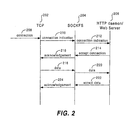
- FIG. 2 is an exemplary diagram illustrating data flow associated with a HTTP request.
- TCP protocol layer is represented by line 202
- socket file system (SOCKFS) is represented by line 204
- HTTP daemon is represented by line 206.
- the TCP protocol layer 202 sends a connection indication 210 to the socket file system 204.
- the SOCKFS 204 then sends a connection indication 212 to the HTTP daemon 206.
- the HTTP daemon 206 accepts the connection by sending a message as shown at 214 to the SOCKFS 204.
- the SOCKFS then sends an acknowledgement 216 to the TCP protocol layer 202.
- acknowledgement 216 is sent to the SOCKFS 204.
- the data is then transmitted as shown at 220 to the HTTP daemon 206.
- the HTTP daemon 206 accepts the data as shown at 222.
- the SOCKFS 204 then sends an acknowledgement 224 to the TCP protocol layer 202.
- multiple steps must typically be performed in order to transmit HTTP request data to a web server. Accordingly, it would be beneficial if the time required to send HTTP request data to a web server could be reduced while minimizing memory and processing resources. Similarly, it would be desirable if HTTP response data could be sent in a compatible and efficient manner from the web server to the requesting client. In addition, it would be preferable if such a system could be implemented without requiring modifications to the HTTP daemon.
- the present invention enables HTTP requests to be transmitted to a web server while minimizing memory and processing resources. Similarly, HTTP response data is sent in a compatible and efficient manner from the web server to the requesting client.
- a HTTP request is sent to a web server.
- a HTTP request including HTTP request data is received.
- a connection identifier is associated with the HTTP request.
- the receiving and associating steps are repeated for one or more HTTP requests.
- the connection identifier and the associated HTTP request data for the one or more HTTP requests are then sent in a single stream to the web server (e.g., HTTP process).
- a HTTP response including HTTP response data received from a web server is processed.
- HTTP response data and an associated connection identifier are received from a HTTP process.
- a stream is created.
- the HTTP response data and the associated connection identifier are then sent in the stream.
- a HTTP request including HTTP request data are processed by a web server.
- HTTP request data and an associated connection identifier are received.
- HTTP response data associated with the HTTP request data is obtained.
- the HTTP response data and the connection identifier are then sent.
- HTTP request and response data are transferred between a HTTP daemon (i.e., web server) and a network cache accelerator.
- the present invention may be implemented using any appropriate mechanism (e.g., Remote Procedure Call mechanism) for communicating between an application and an in-kernel module.
- the present invention may be applicable in a Unix system and makes use of the Unix notion of the filesystem as a universal name space.
- the present invention may implement a Remote Procedure Call (RPC) mechanism which has built in support for multi-threading.
- RPC Remote Procedure Call
- the present invention may be implemented on any system which includes an application and a kernel.
- the invention may be applicable to a system having a kernel and an application transport protocol layer (e.g., FTP) which is data intensive.
- FTP application transport protocol layer
- FIG. 3 is a block diagram illustrating a system in which a network cache accelerator and associated file system are implemented in accordance with an embodiment of the invention.
- multiple clients 100, 102 may send HTTP requests to a web server 302.
- a network cache accelerator (NCA) 304 includes a cache manager 305 and a data transport module 306.
- An in-kernel cache 307 is managed by the cache manager 305 which has an associated protocol stack 308.
- the data transport module 306 routes HTTP requests or portions thereof (and/or other information or requests) to a HTTP daemon 310 via a NCA file system 312.
- the data transport module 306 places an object (e.g., containing the HTTP request data, connection identifier and/or other requests or information) for one or more HTTP requests in a single listening stream.
- object e.g., containing the HTTP request data, connection identifier and/or other requests or information
- the prior art method sent a connection indication to SOCKFS, which would forward it to the web server.
- the web server would then accept the connection and a new stream would then be created between the SOCKFS and the web server. Once the stream was created, the data could be sent to the web server via the SOCKFS.
- the NCA file system 312 preferably stores the HTTP request data and associated connection identifier for the HTTP requests.
- the HTTP daemon 310 obtains the HTTP request data from the NCA file system 312.
- the connection identifier is preferably maintained as private information between the NCA and the NCAFS to enable the present invention to be used with any web server. In other words, the web server need not be modified to accommodate the present invention.
- a method implemented by the HTTP daemon 310 is invoked and the HTTP daemon 310 returns a HTTP response (or portion thereof) and/or directives to control information that is stored in the in-kernel cache 307 or control the transmission of information to a client 100 or 102.
- This information is sent to the NCA 304.
- the HTTP daemon 210 provides an object containing the HTTP response and/or directives to the NCA file system 312.
- the NCA file system 312 obtains the object, provides the connection identifier in the object, creates a new stream, and sends this object to the NCA 304 via the newly created stream. It is important to note that the new stream may be created while the web server 302 is processing the request.
- the NCA 304 may then obtain the HTTP response and/or directives from the object so that it may determine how to manage the transmission and/or storage of response data received from the HTTP daemon 310.
- the HTTP daemon 310 may manage information that is stored, modified and/or purged from the in-kernel cache 307 as well as control information that is transmitted to the clients 100 and 102.
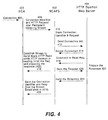
- FIG. 4 is a process flow diagram illustrating stream creation and management of HTTP request data in accordance with an embodiment of the invention.
- the NCA is represented by vertical line 400
- the NCA file system is represented by vertical line 402
- the HTTP daemon is represented by vertical line 404.
- a connection 406 i.e., HTTP request
- the NCA 400 sends a connection identifier and HTTP data for the HTTP request as shown at 408. More particularly, the NCA 400 sends a connection identifier and associated HTTP data for one or more HTTP requests in a single stream. This is possible since the amount of data that must be sent for a HTTP request is relatively minimal in comparison to a HTTP response. In other words, a new stream need not be created for each new HTTP request received.
- the NCA file system 402 stores the connection identifier and HTTP request data for the HTTP requests as shown at 410. For each HTTP request, the NCA file system 402 sends a connection indication 412 to the HTTP daemon 404. The HTTP daemon sends an accept command 414 followed by a read request as shown at 418 to the NCA file system 402. Since the NCA file system 402 has already obtained the HTTP request data for the HTTP request, the NCA file system responds by sending the associated HTTP request data at 420 to the HTTP daemon 404.
- the HTTP daemon 404 then prepares the response 422. As shown at 416, the NCAFS establishes a stream to send the HTTP response prepared at 422. More particularly, the stream may be established in parallel with steps 418 and 422. Once the response is prepared at 422, the response is sent to the NCAFS at 424. At 426 the NCAFS 402 then sends the response and associated connection identifier over the stream established at 416.
- the connection identifier is sent to the HTTP daemon with the HTTP request as well as from the HTTP daemon with the HTTP response. More particularly, when the HTTP daemon 404 accepts the connection as shown at 414, a new file descriptor is returned to it. It then "reads" the HTTP request on this new file descriptor. In accordance with the present invention, a segment of private information is attached to this new file descriptor. More particularly, the private information includes a connection identifier associated with the HTTP request. The private information is intended to be shared by the NCA and the NCAFS to identify the HTTP request and therefore need not be obtained or examined by the web server.
- the NCAFS may obtain the connection identifier related to that connection from the private information such that the HTTP response may be associated with the previously sent HTTP request.
- FIG. 5 is a process flow diagram illustrating a method of configuring a web server in accordance with an embodiment of the invention.
- the web server is booted up at block 502.
- a permanent listening stream is then created at block 504.
- the connection identifier and associated HTTP request data for one or more HTTP requests may be sent in the permanent listening stream to the web server or HTTP process such as a HTTP daemon.
- HTTP request data for multiple HTTP requests may be sent simultaneously for access by a web server.
- the listening stream may then be removed.
- HTTP requests may be sent to the web server.
- HTTP responses may be sent to the requesting clients. Processing of HTTP requests and responses will be described in further detail below with reference to FIG. 6 and FIG. 7, respectively.
- FIG. 6 is a process flow diagram illustrating a method of processing a HTTP request in accordance with an embodiment of the invention.
- a HTTP request including HTTP request data is received at block 602.
- a connection identifier is then associated with the HTTP request at block 604. If it is determined that there are more HTTP requests at block 606, steps 602 and 604 are repeated for one or more HTTP requests.
- the NCA continually sends HTTP requests as and when they arrive. In other words, the NCA need not wait for more HTTP requests to be received.
- the connection identifier and the associated HTTP request data for the one or more HTTP requests are sent (e.g., by the NCA) in a single stream such as the permanent listening stream described above with reference to FIG. 5.
- connection identifier and the associated HTTP request data may be provided to a cache manager capable of storing the connection identifier and the associated HTTP request data and retrieving the HTTP request data when the connection identifier is received.
- the connection identifier and the associated HTTP request data for the one or more HTTP requests may be provided in an object which is then sent to a HTTP process.
- the connection identifier and the associated HTTP request data for each of the one or more HTTP requests may then be stored temporarily (e.g., by the NCA file system) at block 610 for retrieval by the HTTP process (i.e., HTTP daemon).
- the cache manager may therefore store the HTTP request and response data so that the same request may be handled by the NCA file system in the future.
- the connection indication for one of the HTTP requests is sent to the HTTP process at block 612.
- the HTTP process When the HTTP process receives the connection indication for a HTTP request, the HTTP process accepts the connection and sends a read command at block 614. In response, the HTTP request data associated with the connection identifier received from the HTTP process is obtained at block 616. The obtained HTTP request data and the associated connection identifier is then sent to the HTTP process at block 618. If it is determined at block 620 that there are more HTTP requests, the process repeats at block 612. Otherwise, the process ends at block 622.
- FIG. 7 is a process flow diagram illustrating a method of processing a HTTP response in accordance with an embodiment of the invention.
- the web server i.e., HTTP process
- the HTTP process processes the HTTP request to obtain HTTP response data associated with the HTTP request data at block 702.
- the HTTP process then performs a write by sending HTTP response data to the NCAFS at 703.
- the NCAFS then packages the HTTP response data with the connection identifier identifying one of the HTTP requests received by the web server at block 704.
- a new stream is created at block 706.
- the new stream may be created by the NCA file system.
- the HTTP response data and the associated connection identifier are then sent in the newly created stream at block 708.
- an object may be instantiated in which the HTTP response data and the connection identifier are provided.
- the NCA e.g., data transport module
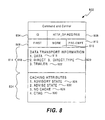
- FIG. 8 is a block diagram illustrating an exemplary data type that may be transported in accordance with an embodiment of the invention. More particularly, in accordance with one embodiment, the data transport module 306 and the HTTP daemon 310 both transmit a HTTP request-response object. The information that may be provided in the HTTP request-response object is illustrated generally in FIG. 8.
- a HTTP request-response object 802 is shown to identify the data stream through an identifier ID 804 between the data transport module and the HTTP daemon. In addition, the HTTP request-response object 802 may transmit either a HTTP request or a HTTP response.
- a HTTP_OP field 806 indicates whether the object is transmitting request or response data.
- the HTTP_OP field 806 may also indicate that an error message is being transmitted.
- a FIRST field 808 indicates whether this is the first block of data in a set of request or response data.
- a MORE field 810 indicates whether more request or response data is to follow for the associated HTTP request or response, respectively.
- the HTTP request-response object 302 also transmits information that can modify the flow of data between the data transport module and the HTTP daemon as well as the flow of data to the client.
- a PREEMPT field 812 may be set to preempt data flow from the data transport module to the HTTP daemon as well as to preempt data flow from the HTTP daemon to the data transport module.
- data transport information 814 may specify HTTP request data or HTTP response data that is to be transmitted to the client in accordance with the HTTP_OP field 806.
- the data transport information 814 may include HTTP request/response DATA 816 (e.g., byte stream), a DIRECT field 818 that identifies data (e.g., file, shared memory segment, previously cached object) that is directly accessible by the data transport module. Thus, this data need not be transported by the object from the HTTP daemon to the data transport module.
- the DIRECT TYPE 820 e.g., file, shared memory segment, previously cached object
- a TRAILER 822 field may be used to include encapsulation information such as whether the response needs to be encapsulated prior to being transmitted to the client or indicate a method of encapsulation.
- Caching attributes 824 may be provided in the HTTP request-response object 802 by the HTTP daemon in order to manage information that is stored in the HTTP cache as well as to control transmission of the response data.
- the set of exemplary caching attributes 824 includes an advisory state 826, a nocache state 828, a CTAG 830, and an advise state 832.
- the advisory state 826 indicates whether the cache manager 305 must communicate with the HTTP daemon 310 in order to determine whether response data can be transmitted to a client that has sent a HTTP request.
- the nocache state 828 indicates whether the HTTP response and associated data are to be stored in the in-kernel HTTP cache 307.
- the CTAG 830 is a unique identifier associated with a HTTP response that enables the response to be associated with multiple HTTP requests in the HTTP cache.
- the advise state 832 may be provided by the HTTP daemon 310 in response to a HTTP request from the cache manager 305 as well as independently without receiving a request from the cache manager 305.
- the advise state 816 indicates an action to be taken with the response data and may specify a variety of actions, including but not limited to, modifying, storing, or flushing data from the in-kernel HTTP cache as well as controlling the response data that is transmitted to a client that has submitted a HTTP request.
- the advise state 832 and the advisory state 826 are shown as separate states, they may be implemented as a single field.
- the HTTP daemon 310 may optionally provide response data in data field 816 in the HTTP request-response object.
- the NCA and the HTTP daemon exchange information through sending a HTTP request-response object in which the information is provided.
- the data transport module and HTTP daemon transmit the same type of object (e.g., HTTP request-response object)
- the data transport module and the HTTP daemon may transmit the information in a variety of formats. Accordingly, the HTTP request-response object is merely illustrative and other mechanisms for storing and transmitting data between the data transport module and the HTTP daemon are contemplated.
- the transmission of data that is provided in a HTTP request is accelerated. This is accomplished, in part, through enabling efficient use of resources such as the CPU (e.g., threads) through providing HTTP request data for multiple HTTP requests in a single stream.
- the HTTP request data for each HTTP request is identified through a unique connection identifier.
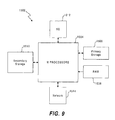
- FIG. 9 illustrates a typical, general-purpose computer system 1502 suitable for implementing the present invention.
- the computer system may take any suitable form.
- Computer system 1502 or, more specifically, CPUs 1504, maybe arranged to support a virtual machine, as will be appreciated by those skilled in the art.
- the computer system 1502 includes any number of processors 1504 (also referred to as central processing units, or CPUs) that may be coupled to memory devices including primary storage device 1506 (typically a read only memory, or ROM) and primary storage device 1508 (typically a random access memory, or RAM).
- primary storage device 1506 typically a read only memory, or ROM
- RAM random access memory
- Both the primary storage devices 1506, 1508 may include any suitable computer-readable media.
- the CPUs 1504 may generally include any number of processors.
- a secondary storage medium 1510 which is typically a mass memory device, may also be coupled bi-directionally to CPUs 1504 and provides additional data storage capacity.
- the mass memory device 1510 is a computer-readable medium that may be used to store programs including computer code, data, and the like.
- the mass memory device 1510 is a storage medium such as a hard disk which is generally slower than primary storage devices 1506, 1508.
- the CPUs 1504 may also be coupled to one or more input/output devices 1512 that may include, but are not limited to, devices such as video monitors, track balls, mice, keyboards, microphones, touch-sensitive displays, transducer card readers, magnetic or paper tape readers, tablets, styluses, voice or handwriting recognizers, or other well-known input devices such as, of course, other computers.
- the CPUs 1504 optionally may be coupled to a computer or telecommunications network, e.g., an internet network or an intranet network, using a network connection as shown generally at 1514. With such a network connection, it is contemplated that the CPUs 1504 might receive information from the network, or might output information to the network in the course of performing the above-described method steps. Such information, which is often represented as a sequence of instructions to be executed using the CPUs 1504, may be received from and output to the network, for example, in the form of a computer data signal embodied in a carrier wave.
- the web server and associated software may run on the CPUs 1504. Similarly, web pages and associated information may be stored in data storage devices 1506, 1508, and 1510.
Landscapes
- Engineering & Computer Science (AREA)
- Computer Networks & Wireless Communication (AREA)
- Signal Processing (AREA)
- Computer Security & Cryptography (AREA)
- Computer And Data Communications (AREA)
- Information Retrieval, Db Structures And Fs Structures Therefor (AREA)
Applications Claiming Priority (2)
| Application Number | Priority Date | Filing Date | Title |
|---|---|---|---|
| US654103 | 2000-08-31 | ||
| US09/654,103 US7028091B1 (en) | 2000-08-31 | 2000-08-31 | Web server in-kernel interface to data transport system and cache manager |
Publications (2)
| Publication Number | Publication Date |
|---|---|
| EP1191438A2 true EP1191438A2 (fr) | 2002-03-27 |
| EP1191438A3 EP1191438A3 (fr) | 2004-09-22 |
Family
ID=24623441
Family Applications (1)
| Application Number | Title | Priority Date | Filing Date |
|---|---|---|---|
| EP01307433A Withdrawn EP1191438A3 (fr) | 2000-08-31 | 2001-08-31 | Interface noyau entre un serveur ouèbe et un système de transport de données et un gestionnaire de cache |
Country Status (2)
| Country | Link |
|---|---|
| US (1) | US7028091B1 (fr) |
| EP (1) | EP1191438A3 (fr) |
Cited By (7)
| Publication number | Priority date | Publication date | Assignee | Title |
|---|---|---|---|---|
| FR2853177A1 (fr) * | 2003-03-31 | 2004-10-01 | France Telecom | Procede et systeme de controle d'acces a des sites internet |
| WO2005050950A1 (fr) * | 2003-11-13 | 2005-06-02 | Cryptek, Inc. | Systeme et procede destine a traverser des metadonnees de commande d'acces a travers des domaines de reseau multiple |
| US6934761B1 (en) * | 2000-02-25 | 2005-08-23 | Sun Microsystems, Inc. | User level web server cache control of in-kernel http cache |
| CN1295621C (zh) * | 2002-09-30 | 2007-01-17 | 国际商业机器公司 | 在操作系统内核环境中高速缓存应用数据的系统和方法 |
| US7363383B2 (en) * | 2003-04-23 | 2008-04-22 | Sun Microsytems, Inc. | Running a communication protocol state machine through a packet classifier |
| EP1968284A1 (fr) | 2007-03-08 | 2008-09-10 | Sap Ag | Système et procédé d'emballage de message |
| CN110166506A (zh) * | 2018-02-12 | 2019-08-23 | 中国移动通信有限公司研究院 | 超文本传输协议Http的连接方法及节点设备 |
Families Citing this family (20)
| Publication number | Priority date | Publication date | Assignee | Title |
|---|---|---|---|---|
| US7506358B1 (en) * | 1999-12-09 | 2009-03-17 | Cisco Technology, Inc. | Method and apparatus supporting network communications through a firewall |
| US7594230B2 (en) * | 2001-06-11 | 2009-09-22 | Microsoft Corporation | Web server architecture |
| US7430738B1 (en) | 2001-06-11 | 2008-09-30 | Microsoft Corporation | Methods and arrangements for routing server requests to worker processes based on URL |
| US7159025B2 (en) * | 2002-03-22 | 2007-01-02 | Microsoft Corporation | System for selectively caching content data in a server based on gathered information and type of memory in the server |
| US7490137B2 (en) | 2002-03-22 | 2009-02-10 | Microsoft Corporation | Vector-based sending of web content |
| US7418709B2 (en) * | 2004-08-31 | 2008-08-26 | Microsoft Corporation | URL namespace to support multiple-protocol processing within worker processes |
| US7418712B2 (en) * | 2004-08-31 | 2008-08-26 | Microsoft Corporation | Method and system to support multiple-protocol processing within worker processes |
| US7418719B2 (en) * | 2004-08-31 | 2008-08-26 | Microsoft Corporation | Method and system to support a unified process model for handling messages sent in different protocols |
| US8874691B2 (en) * | 2005-06-22 | 2014-10-28 | Core Wireless Licensing S.A.R.L. | System and method for establishing peer to peer connections between PCS and smart phones using networks with obstacles |
| US20070058123A1 (en) * | 2005-09-15 | 2007-03-15 | Samsung Electronics Co., Ltd. | Liquid crystal display |
| TW200826571A (en) * | 2006-12-08 | 2008-06-16 | Univ Nat Chiao Tung | Identification and management system and method applicable to a point-to-point gateway |
| US8775550B2 (en) * | 2008-02-08 | 2014-07-08 | Microsoft Corporation | Caching HTTP request and response streams |
| US8418174B2 (en) * | 2008-02-14 | 2013-04-09 | International Business Machines Corporation | Enhancing the scalability of network caching capability in virtualized environment |
| US8204206B2 (en) * | 2008-08-29 | 2012-06-19 | 8X8, Inc. | Systems and methods for selection of a communication path |
| US10033869B2 (en) * | 2008-08-29 | 2018-07-24 | 8X8, Inc. | Methods and systems for information streaming to user interface |
| US8275116B2 (en) * | 2008-08-29 | 2012-09-25 | 8X8, Inc. | Networked contact center |
| US8515833B2 (en) * | 2008-08-29 | 2013-08-20 | 8X8, Inc. | Methods and systems for multilayer provisioning of networked contact centers |
| US8972885B2 (en) | 2008-08-29 | 2015-03-03 | 8X8, Inc. | Networked contact center user interface |
| US8243913B2 (en) | 2008-08-29 | 2012-08-14 | 8×8, Inc. | Limiting contact in a networked contact center environment |
| US8468545B2 (en) | 2010-08-18 | 2013-06-18 | 8X8, Inc. | Interaction management |
Family Cites Families (31)
| Publication number | Priority date | Publication date | Assignee | Title |
|---|---|---|---|---|
| EP0330425B1 (fr) | 1988-02-23 | 1995-12-06 | Digital Equipment Corporation | Dispositif de commande symétrique de multitraitement |
| US5819091A (en) | 1994-12-22 | 1998-10-06 | Arendt; James Wendell | User level control of degree of client-side processing |
| US5805809A (en) | 1995-04-26 | 1998-09-08 | Shiva Corporation | Installable performance accelerator for maintaining a local cache storing data residing on a server computer |
| US5659757A (en) | 1995-04-27 | 1997-08-19 | International Business Machines Corporation | Method and system for lock instrumentation in a data processing system |
| US5774668A (en) * | 1995-06-07 | 1998-06-30 | Microsoft Corporation | System for on-line service in which gateway computer uses service map which includes loading condition of servers broadcasted by application servers for load balancing |
| US6170018B1 (en) | 1995-11-27 | 2001-01-02 | Sun Microsystems, Inc. | Remote procedure calling using an existing descriptor mechanism |
| US5832222A (en) | 1996-06-19 | 1998-11-03 | Ncr Corporation | Apparatus for providing a single image of an I/O subsystem in a geographically dispersed computer system |
| US5835724A (en) | 1996-07-03 | 1998-11-10 | Electronic Data Systems Corporation | System and method for communication information using the internet that receives and maintains information concerning the client and generates and conveys the session data to the client |
| US6115712A (en) | 1996-07-12 | 2000-09-05 | International Business Machines Corporation | Mechanism for combining data analysis algorithms with databases on the internet |
| JPH1055269A (ja) * | 1996-08-08 | 1998-02-24 | Fuji Xerox Co Ltd | 情報処理装置 |
| US5852717A (en) | 1996-11-20 | 1998-12-22 | Shiva Corporation | Performance optimizations for computer networks utilizing HTTP |
| US5991802A (en) | 1996-11-27 | 1999-11-23 | Microsoft Corporation | Method and system for invoking methods of objects over the internet |
| US6223204B1 (en) | 1996-12-18 | 2001-04-24 | Sun Microsystems, Inc. | User level adaptive thread blocking |
| US6138162A (en) * | 1997-02-11 | 2000-10-24 | Pointcast, Inc. | Method and apparatus for configuring a client to redirect requests to a caching proxy server based on a category ID with the request |
| US6012090A (en) | 1997-03-14 | 2000-01-04 | At&T Corp. | Client-side parallel requests for network services using group name association |
| US6334142B1 (en) * | 1997-04-15 | 2001-12-25 | British Telecommunications Public Limited Company | Method for automatic and periodic requests for messages to an e-mail server from the client |
| US6374305B1 (en) * | 1997-07-21 | 2002-04-16 | Oracle Corporation | Web applications interface system in a mobile-based client-server system |
| US6411998B1 (en) | 1997-09-08 | 2002-06-25 | International Business Machines Corporation | World wide web internet delay monitor |
| US6073212A (en) | 1997-09-30 | 2000-06-06 | Sun Microsystems, Inc. | Reducing bandwidth and areas needed for non-inclusive memory hierarchy by using dual tags |
| US6192398B1 (en) | 1997-10-17 | 2001-02-20 | International Business Machines Corporation | Remote/shared browser cache |
| US6163812A (en) | 1997-10-20 | 2000-12-19 | International Business Machines Corporation | Adaptive fast path architecture for commercial operating systems and information server applications |
| US6292835B1 (en) | 1997-11-26 | 2001-09-18 | International Business Machines Corporation | Network bandwidth and object obsolescence sensitive scheduling method and apparatus for objects distributed broadcasting |
| US6216173B1 (en) | 1998-02-03 | 2001-04-10 | Redbox Technologies Limited | Method and apparatus for content processing and routing |
| US6421675B1 (en) | 1998-03-16 | 2002-07-16 | S. L. I. Systems, Inc. | Search engine |
| US6131122A (en) * | 1998-06-01 | 2000-10-10 | Nortel Networks Corporation | Programmable internet automation |
| US6260120B1 (en) | 1998-06-29 | 2001-07-10 | Emc Corporation | Storage mapping and partitioning among multiple host processors in the presence of login state changes and host controller replacement |
| US6321181B1 (en) * | 1998-08-24 | 2001-11-20 | Agere Systems Guardian Corp. | Device and method for parallel simulation |
| JP2000155736A (ja) * | 1998-11-24 | 2000-06-06 | Nec Corp | サービス要求の振り分け方法及びアドレス変換装置 |
| US6389462B1 (en) * | 1998-12-16 | 2002-05-14 | Lucent Technologies Inc. | Method and apparatus for transparently directing requests for web objects to proxy caches |
| US6418544B1 (en) * | 1999-06-22 | 2002-07-09 | International Business Machines Corporation | Use of a client meta-cache for realistic high-level web server stress testing with minimal client footprint |
| US6377984B1 (en) * | 1999-11-02 | 2002-04-23 | Alta Vista Company | Web crawler system using parallel queues for queing data sets having common address and concurrently downloading data associated with data set in each queue |
-
2000
- 2000-08-31 US US09/654,103 patent/US7028091B1/en not_active Expired - Lifetime
-
2001
- 2001-08-31 EP EP01307433A patent/EP1191438A3/fr not_active Withdrawn
Non-Patent Citations (2)
| Title |
|---|
| SCHMIDT D.C.: "Asynchronous Completion Token", INTERNET ARTICLE, 26 November 1999 (1999-11-26), WASHINTON UNIVERSITY HOMEPAGE, pages 1 - 16, Retrieved from the Internet <URL:http://www.cs.wustl.edu/~schmidt/PDF/ACT.pdf> [retrieved on 20060830] * |
| STEVENS R.W.: "UNIX Network Programming", 1999, PRENTICE HALL PTR, UPPER SADDLE RIVER, NJ 07458 USA * |
Cited By (11)
| Publication number | Priority date | Publication date | Assignee | Title |
|---|---|---|---|---|
| US6934761B1 (en) * | 2000-02-25 | 2005-08-23 | Sun Microsystems, Inc. | User level web server cache control of in-kernel http cache |
| CN1295621C (zh) * | 2002-09-30 | 2007-01-17 | 国际商业机器公司 | 在操作系统内核环境中高速缓存应用数据的系统和方法 |
| FR2853177A1 (fr) * | 2003-03-31 | 2004-10-01 | France Telecom | Procede et systeme de controle d'acces a des sites internet |
| EP1471713A1 (fr) * | 2003-03-31 | 2004-10-27 | France Telecom | Procédé et système de contrôle d'accès à des sites internet au moyen d'un serveur cache |
| US7363383B2 (en) * | 2003-04-23 | 2008-04-22 | Sun Microsytems, Inc. | Running a communication protocol state machine through a packet classifier |
| WO2005050950A1 (fr) * | 2003-11-13 | 2005-06-02 | Cryptek, Inc. | Systeme et procede destine a traverser des metadonnees de commande d'acces a travers des domaines de reseau multiple |
| US7561578B2 (en) | 2003-11-13 | 2009-07-14 | Cryptek, Inc. | System and method for traversing metadata across multiple network domains at various layers of the protocol stack |
| US7990884B2 (en) | 2003-11-13 | 2011-08-02 | Api Cryptek Inc. | System and method for traversing metadata across multiple network domains at various layers of the protocol stack |
| EP1968284A1 (fr) | 2007-03-08 | 2008-09-10 | Sap Ag | Système et procédé d'emballage de message |
| US7739387B2 (en) | 2007-03-08 | 2010-06-15 | Sap Ag | System and method for message packaging |
| CN110166506A (zh) * | 2018-02-12 | 2019-08-23 | 中国移动通信有限公司研究院 | 超文本传输协议Http的连接方法及节点设备 |
Also Published As
| Publication number | Publication date |
|---|---|
| US7028091B1 (en) | 2006-04-11 |
| EP1191438A3 (fr) | 2004-09-22 |
Similar Documents
| Publication | Publication Date | Title |
|---|---|---|
| US7028091B1 (en) | Web server in-kernel interface to data transport system and cache manager | |
| US7222152B1 (en) | Generic communications framework | |
| EP1027796B1 (fr) | Serveur d'application web reparti | |
| EP0876648B1 (fr) | Procede et systeme permettant une insertion dynamique de messages objets entre des modeles objets | |
| US8205007B2 (en) | Native format tunneling | |
| US6141705A (en) | System for querying a peripheral device to determine its processing capabilities and then offloading specific processing tasks from a host to the peripheral device when needed | |
| US5721876A (en) | Sockets application program mechanism for proprietary based application programs running in an emulation environment | |
| US6845505B1 (en) | Web request broker controlling multiple processes | |
| US9729664B2 (en) | System and method for managing connections between a client and a server | |
| US6708223B1 (en) | Accelerating a distributed component architecture over a network using a modified RPC communication | |
| EP0412232B1 (fr) | Dispositif et procédé pour réaliser une communication de haute performance entre des processus de logiciel | |
| KR101137132B1 (ko) | 맞춤형 태그기반 프로토콜에서의 참조에 의한 전송 | |
| US6795864B2 (en) | System using lookup service proxy object having code and request rate for managing rate at which client can request for services from server are transmitted | |
| US6163812A (en) | Adaptive fast path architecture for commercial operating systems and information server applications | |
| US20060230119A1 (en) | Apparatus and method for packet transmission over a high speed network supporting remote direct memory access operations | |
| JPH08502841A (ja) | 分散適用業務処理ネットワーク | |
| US6934761B1 (en) | User level web server cache control of in-kernel http cache | |
| KR20030060884A (ko) | 웹 운영체제 및 웹 데스크탑 | |
| US20030055862A1 (en) | Methods, systems, and articles of manufacture for managing systems using operation objects | |
| EP1195677A1 (fr) | Chargement dynamique de classes | |
| CN100399277C (zh) | 访问计算网格的方法和系统 | |
| US6668279B1 (en) | User level web server in-kernel network I/O accelerator | |
| US20020169881A1 (en) | Method and apparatus for distributed access to services in a network data processing system | |
| US20060206453A1 (en) | Dynamically Sizing Buffers to Optimal Size in Network Layers When Supporting Data Transfers Related to Database Applications | |
| CN113176957B (zh) | 一种基于rpc的远程应用自动化系统 |
Legal Events
| Date | Code | Title | Description |
|---|---|---|---|
| PUAI | Public reference made under article 153(3) epc to a published international application that has entered the european phase |
Free format text: ORIGINAL CODE: 0009012 |
|
| AK | Designated contracting states |
Kind code of ref document: A2 Designated state(s): AT BE CH CY DE DK ES FI FR GB GR IE IT LI LU MC NL PT SE TR |
|
| AX | Request for extension of the european patent |
Free format text: AL;LT;LV;MK;RO;SI |
|
| PUAL | Search report despatched |
Free format text: ORIGINAL CODE: 0009013 |
|
| RIC1 | Information provided on ipc code assigned before grant |
Ipc: 7H 04L 29/06 B Ipc: 7G 06F 17/30 B Ipc: 7G 06F 9/46 A |
|
| AK | Designated contracting states |
Kind code of ref document: A3 Designated state(s): AT BE CH CY DE DK ES FI FR GB GR IE IT LI LU MC NL PT SE TR |
|
| AX | Request for extension of the european patent |
Extension state: AL LT LV MK RO SI |
|
| 17P | Request for examination filed |
Effective date: 20050202 |
|
| AKX | Designation fees paid |
Designated state(s): DE GB |
|
| 17Q | First examination report despatched |
Effective date: 20050614 |
|
| 17Q | First examination report despatched |
Effective date: 20050614 |
|
| GRAP | Despatch of communication of intention to grant a patent |
Free format text: ORIGINAL CODE: EPIDOSNIGR1 |
|
| STAA | Information on the status of an ep patent application or granted ep patent |
Free format text: STATUS: THE APPLICATION IS DEEMED TO BE WITHDRAWN |
|
| 18D | Application deemed to be withdrawn |
Effective date: 20070703 |