EP1193933A2 - Syboltaktsynchronisierung in Mehrträgerempfängern - Google Patents
Syboltaktsynchronisierung in Mehrträgerempfängern Download PDFInfo
- Publication number
- EP1193933A2 EP1193933A2 EP01119747A EP01119747A EP1193933A2 EP 1193933 A2 EP1193933 A2 EP 1193933A2 EP 01119747 A EP01119747 A EP 01119747A EP 01119747 A EP01119747 A EP 01119747A EP 1193933 A2 EP1193933 A2 EP 1193933A2
- Authority
- EP
- European Patent Office
- Prior art keywords
- timing
- signal
- symbols
- short
- components
- Prior art date
- Legal status (The legal status is an assumption and is not a legal conclusion. Google has not performed a legal analysis and makes no representation as to the accuracy of the status listed.)
- Granted
Links
Images
Classifications
-
- H—ELECTRICITY
- H04—ELECTRIC COMMUNICATION TECHNIQUE
- H04L—TRANSMISSION OF DIGITAL INFORMATION, e.g. TELEGRAPHIC COMMUNICATION
- H04L27/00—Modulated-carrier systems
- H04L27/26—Systems using multi-frequency codes
- H04L27/2601—Multicarrier modulation systems
- H04L27/2647—Arrangements specific to the receiver only
- H04L27/2655—Synchronisation arrangements
- H04L27/2668—Details of algorithms
- H04L27/2681—Details of algorithms characterised by constraints
- H04L27/2685—Speed of convergence
-
- H—ELECTRICITY
- H04—ELECTRIC COMMUNICATION TECHNIQUE
- H04B—TRANSMISSION
- H04B7/00—Radio transmission systems, i.e. using radiation field
- H04B7/02—Diversity systems; Multi-antenna system, i.e. transmission or reception using multiple antennas
- H04B7/04—Diversity systems; Multi-antenna system, i.e. transmission or reception using multiple antennas using two or more spaced independent antennas
- H04B7/08—Diversity systems; Multi-antenna system, i.e. transmission or reception using multiple antennas using two or more spaced independent antennas at the receiving station
- H04B7/0802—Diversity systems; Multi-antenna system, i.e. transmission or reception using multiple antennas using two or more spaced independent antennas at the receiving station using antenna selection
- H04B7/0805—Diversity systems; Multi-antenna system, i.e. transmission or reception using multiple antennas using two or more spaced independent antennas at the receiving station using antenna selection with single receiver and antenna switching
- H04B7/0808—Diversity systems; Multi-antenna system, i.e. transmission or reception using multiple antennas using two or more spaced independent antennas at the receiving station using antenna selection with single receiver and antenna switching comparing all antennas before reception
- H04B7/0811—Diversity systems; Multi-antenna system, i.e. transmission or reception using multiple antennas using two or more spaced independent antennas at the receiving station using antenna selection with single receiver and antenna switching comparing all antennas before reception during preamble or gap period
-
- H—ELECTRICITY
- H04—ELECTRIC COMMUNICATION TECHNIQUE
- H04L—TRANSMISSION OF DIGITAL INFORMATION, e.g. TELEGRAPHIC COMMUNICATION
- H04L27/00—Modulated-carrier systems
- H04L27/26—Systems using multi-frequency codes
- H04L27/2601—Multicarrier modulation systems
- H04L27/2647—Arrangements specific to the receiver only
- H04L27/2655—Synchronisation arrangements
- H04L27/2662—Symbol synchronisation
Definitions
- the apparatus and methods consistent with the present invention generally relate to orthogonal frequency division multiplexing (OFDM) communications systems and, more particularly, to achieving faster timing synchronization in an OFDM receiver.
- OFDM orthogonal frequency division multiplexing
- a wireless local area network typically uses infrared (IR) or radio frequency (RF) communications channels to communicate between portable or mobile computer terminals and stationary access points or base stations. These access points are, in turn, connected by a wired or wireless communications channel to a network infrastructure which connects groups of access points together to form the LAN, including, optionally, one or more host computer systems.
- IR infrared
- RF radio frequency
- Wireless IR and RP protocols are known which support the logical interconnections of such portable roaming terminals having a variety of types of communication capabilities to host computers.
- the logical interconnections are based upon an infrastructure in which at least some of the terminals are capable of communicating with at least two of the access points when located within a predetermined range therefrom, each terminal being normally associated, and in communication, with a single one of such access points.
- IEEE Project 802 is concerned with network architecture for LANs.
- the IEEE 802.11 Standard is directed to wireless LANs, and in particular specifies the MAC and the PHY layers. These layers are intended to correspond closely to the two lowest layers of the ISO Basic Reference Model of OSI, i.e., the data link layer and the physical layer.
- the IEEE 802.11 Standard permits either IR or RF communications at 1 Mbps, 2 Mbps and higher data rates, a medium access technique similar to carrier sense multiple access/collision avoidance (CSMA/CA), a power-save mode for battery-operated mobile stations, seamless roaming in a full cellular network, high throughput operation, diverse antenna systems designed to eliminate "dead spots", and an easy interface to existing network infrastructures.
- CSMA/CA carrier sense multiple access/collision avoidance
- HIPERLAN European Telecommunications Standards Institute
- CEPT European Conference of Postal and Telecommunications Administrations
- the current implementations of commercial wireless LANs utilize a radio operating in the 2.4 to 2.4835 GHz spread spectrum band which is the industrial, scientific, and medical (ISM) band allocated for unlicenced use by the Federal Communications Commission (FCC).
- ISM industrial, scientific, and medical
- FCC Federal Communications Commission
- the current systems utilize one of two basic types of spread spectrum modulation: direct-sequence and frequency-hopping.
- direct-sequence the specific modulation parameters specified by the IEEE 802.11 Standard shall be used to illustrate the different modulation techniques.
- each binary bit of data in a data signal is spread over each of 11 discrete frequency channels at the same time, i.e., an 11-bit pseudo-random noise (PN) code.
- the data of each user is coded using a different PN code so that the signals of different users are orthogonal to each other. Thus, another user's signal is merely interpreted as noise.
- the IEEE 802.11 Standard provides two modulation formats and data rates in the DSSS system - a basic access rate using differential binary phase shift keying (DBPSK) modulation operating at 1 Mbps, and an enhanced access rate using differential quadrature phase shift keying (DQPSK) modulation operating at 2 Mbps.
- DBPSK differential binary phase shift keying
- DQPSK differential quadrature phase shift keying
- each binary bit of data in the data signal is associated with a group of distinct "chips", or discrete signal frequency output, in different parts of a frequency band, with a minimum hop of at least 6 MHZ (in North America/Europe).
- the chipping pattern or hopping sequence is a pseudo-random sequence uniformly distributed throughout the band and set forth in the IEEE 802.11 Standard.
- Each access point executes a unique hopping pattern across 79 non-overlapping frequencies at a rate of one hop every 100 milliseconds.
- the RF modulation technique used in the FHSS system is 2-level or 4-level Gaussian filtered frequency shift keying (GFSK).
- GFSK Gaussian filtered frequency shift keying
- the IEEE 802.11 FHSS systems hop over channels with an effective raw data rate of 1 Mbps or 2 Mbps.
- Current commercial systems can typically cover from an area of 25,000 to 70,000 square feet with a process gain of 10 dB.
- the relatively low power output used in such systems is a consequence of limits placed by regulatory agencies. Power output standards currently in effect limit the power output to either 100mW, 230 mW, or 500 mW depending on the country.
- CDMA code division multiple access
- Most wireless LANs are not CDMA systems since users belonging to the same wireless LAN utilize the same spreading key.
- the MAC set forth in the IEEE 802.11 Standard provides that use access to the channel is multiplexed in time using nearly the same Carrier Sense Multiple Access (CSMA) protocol as in the Ethernet.
- CSMA Carrier Sense Multiple Access
- the CDMA modulation technique is one of several techniques for facilitating communications in which a large number of system users is present.
- the use of CDMA in a digital cellular spread spectrum communications system was adopted by the Telecommunication Industry Association in 1993 as standard IS-95.
- Other multiple access communications system techniques such as time division multiple access (TDMA), frequency division multiple access (FDMA), and AM modulation schemes such as amplitude companded single sideband (ACSSB) are known in the art.
- TDMA time division multiple access
- FDMA frequency division multiple access
- AM modulation schemes such as amplitude companded single sideband (ACSSB) are known in the art.
- the use of CDMA techniques in a multiple access communication system is disclosed in U.S. Patent No. 4,901,307.
- the IEEE 802.11a Standard also specifies the PHY layer operating in the 5 GHz band, which is open to unlicensed devices in the U.S.
- the IEEE 802.11a Standard is based on orthogonal frequency division multiplexing (OFDM) to modulate the data.
- Digital data is divided among a large number of adjacent carriers so that a relatively small amount of data is carried on each carrier.
- Adjacent carriers are mathematically orthogonal. Their sidebands may overlap but signals can be received without adjacent carrier interference.
- the main benefit of OFDM modulation is its robustness to multipath echoes, which are encountered in the indoor and mobile environments.
- Each OFDM symbol is composed of fifty-two non-zero subcarriers of which forty-eight are data subcarriers and the remaining four are carrier pilot subcarriers.
- the PHY specifications encompass data rates from 6 Mbit/s up to 54 Mbit/s, with 20 MHZ spacing between adjacent channels. All implementations are required to support 6, 12 and 24 Mbit/s. Optional extensions are for 9, 18, 36, 48 and 54 Mbit/s.
- the range of data rates is provided to match the wide range of radio channel characteristics in both indoor and outdoor environments.
- the multirate mechanism of the MAC protocol ensures that all devices communicate with each other at the best data rate in the present channel.
- data symbols are transmitted serially using some modulation scheme, and the spectrum of each symbol is allowed to occupy the entire channel bandwidth.
- data symbols are transmitted in parallel on multiple subcarriers that share the channel bandwidth using some form of frequency-division multiplexing (FDM).
- FDM frequency-division multiplexing
- the modulation scheme on one subcarrier may be chosen independent of that used on other subcarriers.
- subcarriers in frequency segments of the channel with a high signal-to-noise ratio (SNR) may use high-rate modulation, while those with degraded SNR use low-rate modulation, or are not modulated.
- SNR signal-to-noise ratio
- DMT discrete multitone
- the spectra of the subcarriers overlap, and their spacing is chosen so that each subcarrier is orthogonal to all other subcarriers.
- the common method of obtaining orthogonality of subcarriers is to choose their frequency spacing equal to the inverse of the subcarrier symbol duration.
- Baseband processing of the OFDM signal is then conveniently effected using the discrete Fourier transform, implemented as an inverse fast Fourier transform (IFFT) and a fast Fourier transform (FFT) that modulate and demodulate parallel data blocks, respectively.
- IFFT inverse fast Fourier transform
- FFT fast Fourier transform
- the set of subcarriers generated during one transform defines an OFDM symbol.
- the subcarriers are conveyed by serial transmission over the channel of the time samples generated by the IFFT.
- the duration of the OFDM symbol which is the same as that of the subcarrier symbol, is thus equal to the time window of the transform.
- U.S. Patent No. 5,838,734 describes a receiver in which the phase errors in a received OFDM signal are analyzed and corrected phase values derived.
- U.S. Patent No. 5,838,734 discloses an FFT with outputs for the I and Q values of each of the carriers which were originally encoded at the transmitter. These pass to a converter which derives the magnitude Z for each vector from the quadrature amplitude modulation (QAM) phase diagram which they represent. These I and Q values also pass to a converter which derives an angle for each vector in the QAM phase diagram and supplies this to a phase error analyzer as well as to a phase error compensator. The phase error analyzer removes phase noise due to the local oscillator, and the phase angles are then corrected in the phase error compensator to provide a corrected output.
- QAM quadrature amplitude modulation
- An OFDM signal includes a preamble followed by a signal symbol and a variable number of data symbols.
- two of the short symbols are correlated to obtain a peak whose time of occurrence is compared to a reference time, thereby establishing timing information.
- the use of two short symbols for obtaining timing information is too much time for some applications.
- some OFDM receivers have two antennas, and it is desired to select one for the OFDM signal reception.
- one short symbol is used for automatic gain control
- another short symbol is used for buffering
- two more short symbols are used for the timing.
- the same usage of symbols is needed for the second antenna, and still another short symbol is needed for selection between the antennas.
- the invention relates to a method of synchronizing a receiver to a received orthogonal frequency division multiplexing (OFDM) signal having a preamble with short and long duration symbols, comprising the steps of converting the received OFDM signal by fast Fourier transform to frequency domain components; processing the frequency domain components to timing components; deriving timing information from the timing components; applying the timing information to the received OFDM signal to synchronize the receiver; and all of said steps being performed during one of the short symbols.
- OFDM orthogonal frequency division multiplexing
- Another feature of this invention is embodied in a method of antenna selection in a dual antenna receiver for receiving an orthogonal frequency division multiplexing (OFDM) signal having a preamble with short and long duration symbols, comprising the steps of converting an OFDM signal received by a first antenna by fast Fourier transform to frequency domain components; processing the frequency domain components to timing components; deriving timing information from the timing components; applying the timing information to the received OFDM signal to synchronize the receiver; analyzing a signal-to-noise ratio (SNR) of the OFDM signal received by the first antenna of the synchronized receiver during one of the short symbols; repeating the aforementioned steps for a second antenna during another of the short symbols; and selecting the antenna which has a higher SNR during another of the short symbols.
- SNR signal-to-noise ratio
- Yet another feature of this invention resides in an arrangement for synchronizing a receiver to a received orthogonal frequency division multiplexing (OFDM) signal having a preamble with short and long duration symbols, comprising a Fourier transform (FT) circuit for converting the received OFDM signal to frequency domain components; a constellation processing (CP) circuit connected to the FT circuit, for processing the frequency domain components to timing components; and a timing synchronizing circuit connected to the CP circuit, and operative for deriving timing information from the timing components, and for applying the timing information to the received OFDM signal to synchronize the receiver during one of the short symbols.
- FT Fourier transform
- CP constellation processing
- timing synchronizing circuit connected to the CP circuit, and operative for deriving timing information from the timing components, and for applying the timing information to the received OFDM signal to synchronize the receiver during one of the short symbols.
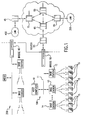
- FIG. 1 shows a data communications network according to one embodiment of the invention.
- a first local area network (LAN) 100 is illustrated, including a host computer or processor 10 which is connected by a wired communications link 11 to a number of stationary access points or base stations 12,13.
- Other base stations 14 can be coupled to the host computer 10 through the base stations 12, 13 or by an RF link.
- Each one of the base stations 12,13,14 is coupled by an RF link to a number of remote mobile units 15.
- the remote mobile units 15 are hand-held, battery-operated data terminals or voice communication handsets such as described in U.S. Patent No. 5,029,183; and U.S. Serial No. 08/794,782, filed February 3, 1997, and U.S. Serial No. 09/008,710, filed January 16, 1998, all assigned to the assignee of the instant application and incorporated herein by reference.
- remote terminals may be advantageously employed in a system having features of the invention.
- These remote terminals ordinarily would include data entry facilities such as a magnetic card reader or the like, as well as a display (or printer) for indicating to a user information detected, transmitted and/or received by the terminal.
- data entry facilities such as a magnetic card reader or the like
- display or printer
- the network may be expanded by merely changing the size of address fields and the like in the digital system, as will appear, but a limiting factor is the RF traffic and attendant delays in waiting for a quiet channel.
- the first LAN 100 may be coupled to additional LANs 200,300,400 etc. through controllers such as bridges 50, 60, etc. or routers 55, 65, 75, 85, 95, 45, etc.
- This communications network as seen in Fig. 1 would ordinarily be used in a manufacturing facility, office building complex, warehouse, retail establishment, or like commercial facility or combination of these facilities, where the data-gathering terminals would be used for inventory control in stockroom or receiving/shipping facilities, at checkout (point of sale) counters, for reading forms or invoices of the like, for personnel security checking at gates or other checkpoints, at time clocks, for manufacturing or process flow control, and many other such uses.
- the mobile units 15 may advantageously be hand-held, laser scanning bar-code reader data terminals, or bar-code readers of the CCD or wand type, and may be portable or stationary, rather than hand-held.
- the mobile units 15 may also be voice communication handsets, pagers, still image or video cameras, or any combination of the foregoing.
- Other types of data gathering devices may be utilized as terminals and use the features of the invention, such as temperature, pressure, or other environmental measuring devices, event counters, voice or sound activated devices, intrusion detectors, etc.
- FIG. 1 illustrates a distributed computing environment or physical layer with clients and servers interconnected through a network link, although additional clients and servers as well as other types of nodes, may be distributed along the network link as well.
- clients will generally denote a user of some type.
- server includes any device directed for controlling and coordinating shared usage of a network resource, such as a storage disk or printer.
- the next OSI layer is directed to the transmission of data streams that enable communication among the nodes at the physical layer, and is commonly referred to as medium access.
- Bits of information are typically arranged in logical units known as frames or envelopes. These envelopes define the protocol which the physical nodes use to intercommunicate. Ethernet as defined in IEEE Standard 802.3, Token Ring as defined in IEEE Standard 802.5, and Fiber Distributed Data Interface (FDDI) are examples of popular frame/physical protocols used in networking systems.
- the envelopes are divided into segments including a header, a trailer, and a data segment.
- the header includes information such as the physical address of the destination node, which enables any given node to direct a communication to another specified node number.
- the trailer usually provides some type of parity or other data integrity check to ensure proper data transmission.
- the data segment includes the information embedded and passed down from the higher OSI layers.
- the network layer builds on the data link layer and is directed to the routing of information packets among the physical nodes.
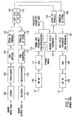
- FIG. 2 shows a block diagram of a typical OFDM transceiver known in the prior art.
- binary input data is first encoded using a convolutional encoder 101.
- the coding rate is 1 ⁇ 2 or 24 Mbit/s at a quadrature amplitude modulation (QAM) of 16 bits, or is 3 ⁇ 4 or 36 Mbit/s at 16 QAM.
- the coding rate is 2 / 3 or 48 Mbit/s at 64 QAM, or is 3 ⁇ 4 at 54 Mbit/s at 64 QAM.
- the coded output data is interleaved at interleaver 102 to get the benefit of time and frequency diversity.
- the binary data is mapped on QAM symbols at a mapper 103.
- These QAM symbols are then converted from serial to parallel at converter 104 with a block length equal to the number of subcarriers.
- an OFDM symbol has 48 data subcarriers and 4 carrier pilot subcarriers.
- the inverse Fast Fourier Transform (IFFT) 105 is calculated with a size that is larger than the number of subcarriers to make an output spectrum with low enough out-of-band radiation.
- the IFFT output is converted from parallel to serial at converter 106 after which the final OFDM symbol is formed at circuit 107 by adding a cyclic extension and a windowing function.
- the cyclic extension should be at least two times the expected delay spread in order to reduce intersymbol interference to an acceptable level.
- the digital data is then applied to a digital to analog converter (DAC) 108, and then to an RF transmitter 109.
- DAC digital to analog converter
- a signal is received by RF receiver 110, and converted into digital data by an analog to digital converter (ADC) 111. Timing and frequency synchronization is performed at circuit 112 to recover the OFDM signal, and the cyclic extensions are then removed at circuit 113.
- a serial to parallel conversion is made at converter 114, with the block length equal to the number of subcarriers.
- the Fast Fourier Transform is calculated at calculator 115. The FFT output is converted from parallel to serial at converter 116 after which the QAM symbols are demapped at demapper 117.
- the interleaving process is reversed at deinterleaver 118, and the QAM symbols are decoded at decoder 119 into the binary output data.
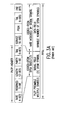
- FIG. 3A shows a packet structure of a frame in an IEEE 802.1 la system.
- a PPDU frame consists of a PLCP preamble and signal and data fields as shown.
- the receiver uses the preamble to acquire the incoming OFDM signal and synchronize a demodulator in the receiver.
- a PLCP header contains information about the PSDU from the sending OFDM PHY.
- BPSK binary phase shift keying
- the PLCP preamble field is used to acquire the incoming signal and train and synchronize the receiver.
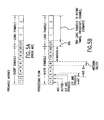
- the PLCP preamble is depicted in FIG. 5A and includes ten short symbols (1-10) as defined above, a medium symbol (1 ⁇ 2) as defined above, and two long symbols (1, 2) as defined above. To repeat, if the duration of each short symbol is 0.8 ⁇ s, then the medium symbol has a duration of 1.6 ⁇ s, and each long symbol has a duration of 3.2 ⁇ s.
- the short symbols are used to train the receiver's automatic gain control (AGC) and obtain a coarse estimate of the carrier frequency and the channel.
- the long symbols are used to fine-tune the frequency and channel estimates.
- the training of an OFDM receiver is typically accomplished over several of the short symbols and typically not less than the duration of two short symbols.
- the PLCP preamble is BPSK-OFDM modulated at 6 Mbps.
- the signal field is a 24-bit field which contains information about the rate and length of the PSDU.
- the signal field is convolutional encoded rate 1 ⁇ 2, BPSK-OFDM modulated.
- R1-R4 there are four bits (R1-R4) used to encode the rate, twelve bits are defined for the length, one reserved bit, a parity bit, and six "0" tail bits.
- the mandatory data rates for IEEE 802.11a-compliant systems are 6 Mbps, 12 Mbps, and 24 Mbps.
- the length field is an unassigned 12-bit integer that indicates the number of octets in the PSDU.
- the data field contains a 16 bit service field, the PSDU, six tail bits, and pad bits. A total of six tail bits containing 0s are appended to the PPDU to ensure that the convolutional encoder is brought back to zero state.
- the determination of the number of bits in the data field, the number of tail bits, the number of OFDM symbols, and the number of pad bits is defined in the IEEE 802.11a Standard.
- the data portion of the packet is transmitted at the data rate indicated in the signal field.
- All the bits transmitted by the OFDM signal in the data field are scrambled using a frame-synchronous 127-bit sequence generator. Scrambling is used to randomize the service, PSDU, pad bit, and data patterns, which may contain long strips of binary 1s or 0s. The tail bits are not scrambled.
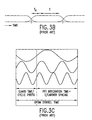
- FIG. 3B shows the OFDM symbol structure.
- T is the FFT duration and T G is the guard time.
- Each OFDM symbol is windowed by a raised cosine window to reduce the out-of-band radiation.
- the purpose of the guard time and the cyclic prefix is to prevent both intersymbol interference (ISI) and intercarrier interference (ICI).
- ISI intersymbol interference
- ICI intercarrier interference
- FIG. 3C An OFDM receiver uses only a part of this signal to calculate the FFT. In the FFT interval, every subcarrier has exactly an integer number of cycles, which ensures orthogonality.
- the wideband multipath fading is experienced in OFDM as a set of narrowband fading subcarriers without ISI or ICI.
- the effect of narrowband fading is that the received subcarriers have different amplitudes, and some may be almost lost in deep fades.
- forward error correcting coding is used.
- an arrangement according to the present invention seeks to improve the timing synchronization as performed in block 112 in the prior art OFDM transceiver depicted in FIG. 2.
- this invention achieves timing synchronization over the course of one short symbol in the preamble of a received OFDM signal, thus allowing such functions as, for example, antenna selection, to be performed reliably before the preamble has passed.
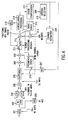
- An incoming OFDM signal is input to an analog-to-digital converter (AID) 201 which is sampled at a frequency F a of 40 million samples per second (MSPS).
- the sampled signal is applied to an automatic gain controller (AGC) 202 which supplies iterative feedback to an RF circuit for gain control, and is also applied to an I/Q sequencer 202 for non-coherently converting the real intermediate frequency samples into I and Q signals having baseband and other frequency components.
- the I and Q signals are passed through low pass filters (LPF) 203, 204 for removing unwanted frequencies and forming a continuous baseband signal at a sampling rate of 40 MSPS.
- a decimater (D) 205 reduces the sampling rate in half to 20 MSPS by removing every other sample.
- a buffering circuit 206 holds the short, medium and long symbols of the preamble of the OFDM received signal.
- the buffer output is applied to a first multiplier 208 to which the gain of an AGC circuit 207 is applied.
- the output of the first multiplier 208 is applied to a second multiplier 209 to which the output of a frequency synchronizer 210 is applied.
- the output of the second multiplier 209 is applied to a fast Fourier transform (FFT) circuit 211 which performs a fast Fourier transform on the incoming signal at a burst processing rate of 40 MHz.
- the output of the FFT circuit 211 is applied to a third multiplier 212 to which the output of a summer 213 is applied.
- the output of the third multiplier 212 is applied to a constellation processing circuit 214 operative for performing logical processing of the subcarriers.
- One output of the constellation processing circuit 214 is applied to a discriminator (DSL) 215 of short and long symbols, the output of the discriminator being fed back to the FFT circuit 211 to switch between short and long symbols.
- DSL discriminator
- Another output of the constellation processing circuit 214 is applied to a timing synchronizer circuit 216 in accordance with this invention which acquires the boundaries of the short and long symbols and provides a fractional bin timing pulse for output to the summer 213.
- Still another output of the constellation processing circuit 214 is applied to an error compensation circuit 217 having a first output to an antenna selection circuit 218, a second output to the AGC circuit 207 for providing iterative feedback to the FFT circuit 211 through the multiplier 208, and a third output to a channel estimation circuit 219 operative for looking at the channel in use and assigning a bin weight for application to the summer 213.
- the timing synchronizer 216 of this invention has another output connected to the buffer 206 for adjusting the timing prior to reaching the FFT circuit 211. This is an integer sample timing correction. The final timing adjustment is provided after the FFT circuit 211 at the multiplier 212. This is a fractional sample timing correction.
- DFT discrete or fast Fourier transform
- a time delay is derived at the output of the FFT circuit 211 when multiplied by the complex exponential.
- the time delayed signal represented by the short symbols in the OFDM preamble can be used to estimate the time delay as a common phase rotation. This time estimate represents both the integer sample timing correction and the fractional sample timing correction.
- signal samples are buffered and applied to, for example, a 16 point FFT.
- An average complex point or differential angle is computed according to the following equation: where smask(f) is a masking function which provides sign information to map all points to the same quadrant.
- the arctangent of the average differential angle is calculated, and then scaled, in this case, by multiplying by the factor 16/360 in order to obtain the timing estimate.
- the integer part represents whole sample offsets or coarse timing, while the fractional part represents fine tuning.
- this invention proposes to use only the duration of one short symbol by subjecting the one short symbol to the Fourier transform processing of the FFT circuit 211 and by calculating the time delay or spread between a sample point and a reference point to determine the phase error.
- FIG. 5B schematically depicts the processing flow during receipt of the preamble of the OFDM signal depicted in FIG. 5A.
- automatic gain control is performed by,the AGC 202 of FIG. 4.
- buffering is performed by the buffer circuit 206.
- the Fourier transform circuit 211, the constellation processing circuit 214 and the synchronizing circuits 210, 216 perform their respective functions. This is sufficient time for an antenna to be selected by the selection circuit 218.
- the remaining short symbols represent a safety margin to repeat any of the foregoing functions, or to perform new ones.
- the receiver has two antennas A and B, and it is desired to choose between them.
- the second antenna B can be processed during short symbols 3, 4 and 5.
- the selection between antennas A and B occurs during short symbol 6.
- FIG. 5B depicts that, during the medium symbol, the discrimination between short and long symbols is performed by the DSL circuit 215.
- the two long symbols are used to refine timing, frequency and channel estimates.
- the faster timing synchronization of this invention can be used for other functions different from antenna selection.
- higher order constellation processing could be performed by circuit 214, or a longer range could be acquired for the antenna, or the signal to noise ratio generated by the error compensation circuit 217 could be increased.
- the invention relates to a method of synchronizing a received orthogonal frequency division multiplexing (OFDM) signal having a preamble with short and long duration symbols, comprising the steps of: converting the received OFDM signal by Fourier transform to frequency domain components; and processing the frequency domain components to timing components.
- OFDM orthogonal frequency division multiplexing
Landscapes
- Engineering & Computer Science (AREA)
- Computer Networks & Wireless Communication (AREA)
- Signal Processing (AREA)
- Mobile Radio Communication Systems (AREA)
- Synchronisation In Digital Transmission Systems (AREA)
- Radio Transmission System (AREA)
Applications Claiming Priority (2)
| Application Number | Priority Date | Filing Date | Title |
|---|---|---|---|
| US675955 | 1996-07-05 | ||
| US09/675,955 US6754170B1 (en) | 2000-09-29 | 2000-09-29 | Timing synchronization in OFDM communications receivers |
Publications (3)
| Publication Number | Publication Date |
|---|---|
| EP1193933A2 true EP1193933A2 (de) | 2002-04-03 |
| EP1193933A3 EP1193933A3 (de) | 2005-06-22 |
| EP1193933B1 EP1193933B1 (de) | 2008-08-06 |
Family
ID=24712618
Family Applications (1)
| Application Number | Title | Priority Date | Filing Date |
|---|---|---|---|
| EP01119747A Expired - Lifetime EP1193933B1 (de) | 2000-09-29 | 2001-08-27 | Symboltaktsynchronisierung in Mehrträgerempfängern |
Country Status (6)
| Country | Link |
|---|---|
| US (1) | US6754170B1 (de) |
| EP (1) | EP1193933B1 (de) |
| JP (1) | JP2002185428A (de) |
| AT (1) | ATE404010T1 (de) |
| AU (1) | AU781609B2 (de) |
| DE (1) | DE60135193D1 (de) |
Cited By (6)
| Publication number | Priority date | Publication date | Assignee | Title |
|---|---|---|---|---|
| EP1734711A1 (de) * | 2005-06-13 | 2006-12-20 | Alcatel | Verfahren zur OFDM-Symbolfolgeanpassung für das Vermeiden von benachbarter Subträgerinterferenz, Sender, Programmmodul und Mobilfunknetz dafür |
| EP1953982A1 (de) * | 2007-02-05 | 2008-08-06 | Sequans Communications | Verfahren und Vorrichtung zur Zeitsynchronisation und Scanning von Nachbarzellen für zelluläre OFDM-Systeme |
| WO2009022269A2 (en) | 2007-08-15 | 2009-02-19 | Nokia Corporation | A method and apparatus for transmitter timing adjustment |
| WO2013181439A1 (en) * | 2012-06-01 | 2013-12-05 | Qualcomm Incorporated | Antenna selection during preamble period for fast diversity |
| EP3308512A1 (de) * | 2015-06-11 | 2018-04-18 | u-blox AG | Modemvorrichtung, kommunikationssystem und verfahren zur verarbeitung eines zyklischen präfix |
| CN112379585A (zh) * | 2020-11-12 | 2021-02-19 | 中国船舶重工集团公司第七0七研究所 | 基于光纤环形架构下具备节点跳跃能力的时频系统及方法 |
Families Citing this family (74)
| Publication number | Priority date | Publication date | Assignee | Title |
|---|---|---|---|---|
| US7952511B1 (en) | 1999-04-07 | 2011-05-31 | Geer James L | Method and apparatus for the detection of objects using electromagnetic wave attenuation patterns |
| US6985432B1 (en) * | 2000-01-28 | 2006-01-10 | Zion Hadad | OFDM communication channel |
| US7106709B2 (en) * | 2000-11-29 | 2006-09-12 | Telefonaktiebologet Lm Ericsson (Publ) | Timing drift compensation in wireless packet-based systems |
| US6950475B1 (en) * | 2000-12-11 | 2005-09-27 | Cisco Technology, Inc. | OFDM receiver clock synchronization system |
| US7218691B1 (en) | 2001-03-05 | 2007-05-15 | Marvell International Ltd. | Method and apparatus for estimation of orthogonal frequency division multiplexing symbol timing and carrier frequency offset |
| US8619922B1 (en) | 2002-02-04 | 2013-12-31 | Marvell International Ltd. | Method and apparatus for acquisition and tracking of orthogonal frequency division multiplexing symbol timing, carrier frequency offset and phase noise |
| US7116906B2 (en) * | 2001-03-06 | 2006-10-03 | Incucomm, Inc. | Wireless optical system for high bandwidth communications |
| US7039140B2 (en) * | 2001-03-08 | 2006-05-02 | Proxim Wireless Corporation | OFDM data demodulators synchronization |
| US7804772B2 (en) * | 2001-06-08 | 2010-09-28 | Broadcom Corporation | Receiver having integrated spectral analysis capability |
| WO2003017505A2 (en) * | 2001-08-04 | 2003-02-27 | Enikia Llc | Adaptive radiated emission control |
| US7161987B2 (en) | 2001-09-26 | 2007-01-09 | Conexant, Inc. | Single-carrier to multi-carrier wireless architecture |
| DE60108534T2 (de) * | 2001-10-16 | 2006-03-23 | Telefonaktiebolaget Lm Ericsson (Publ) | Synchronisation von mobilen geräten in einem zeitmultiplex duplex (tdd) cdma system |
| US7039000B2 (en) * | 2001-11-16 | 2006-05-02 | Mitsubishi Electric Research Laboratories, Inc. | Timing synchronization for OFDM-based wireless networks |
| US7239648B1 (en) | 2001-11-27 | 2007-07-03 | Marvell International Ltd. | Extension mode for wireless lans complying with short interframe space requirement |
| US20030112883A1 (en) * | 2001-12-13 | 2003-06-19 | Ihrie David Wayne | Method and apparatus for bi-directional communication in systems broadcasting multi-carrier signals |
| US7173990B2 (en) * | 2001-12-27 | 2007-02-06 | Dsp Group Inc. | Joint equalization, soft-demapping and phase error correction in wireless system with receive diversity |
| US20030215000A1 (en) * | 2002-05-20 | 2003-11-20 | Hansen Carl C. | Pseudo-random bit mapping for multitone transceivers |
| US7577122B1 (en) * | 2002-06-18 | 2009-08-18 | Richard Douglas Schultz | Method for minimizing receive packet processing for a personal computer implementation of a wireless local area network adapter |
| US7379417B2 (en) * | 2003-02-19 | 2008-05-27 | Wipro Limited | Orthogonal frequency division multiplexing transmitter system and VLSI implementation thereof |
| US7324612B2 (en) * | 2003-02-21 | 2008-01-29 | Conexant, Inc. | Carrier tracking circuit and method including dual numerically controlled oscillators and feedforward phase correction coefficient |
| US7418040B2 (en) * | 2003-05-30 | 2008-08-26 | Motorola, Inc. | Method and apparatus for determining a timing offset for processing a multi-carrier signal |
| DE602004026723D1 (de) * | 2003-06-19 | 2010-06-02 | Sony Corp | Funkkommunikationssystem, Empfangseinrichtung und Empfangsverfahren für Mehrträger-Übertragung |
| KR20060036086A (ko) * | 2003-07-11 | 2006-04-27 | 코닌클리즈케 필립스 일렉트로닉스 엔.브이. | 수신기, 시스템, 동기화 스테이지, 주파수 신호 수신 방법및 프로세서 프로그램 제품 |
| JP4356392B2 (ja) | 2003-08-07 | 2009-11-04 | パナソニック株式会社 | 通信装置 |
| US6917311B2 (en) * | 2003-08-11 | 2005-07-12 | Texas Instruments Incorporated | Orthogonal preamble encoder, method of encoding orthogonal preambles and multiple-input, multiple-output communication system employing the same |
| US20050078598A1 (en) * | 2003-08-21 | 2005-04-14 | Anuj Batra | Enhancement to the multi-band OFDM physical layer |
| US7480234B1 (en) * | 2003-10-31 | 2009-01-20 | Cisco Technology, Inc. | Initial timing estimation in a wireless network receiver |
| US7633850B2 (en) | 2003-12-18 | 2009-12-15 | National Institute Of Information And Communications Technology | Transmitter, receiver, transmitting method, receiving method, and program |
| US20060007898A1 (en) * | 2003-12-23 | 2006-01-12 | Maltsev Alexander A | Method and apparatus to provide data packet |
| US7593347B2 (en) * | 2003-12-29 | 2009-09-22 | Intel Corporation | Method and apparatus to exchange channel information |
| US7433395B2 (en) * | 2004-02-04 | 2008-10-07 | 2Wire, Inc. | Reliable multicarrier communication in the presence of timing phase error |
| JP2005303691A (ja) * | 2004-04-13 | 2005-10-27 | Oki Electric Ind Co Ltd | 同期検出装置および同期検出方法 |
| EP1756991B1 (de) * | 2004-05-20 | 2016-09-28 | Intellectual Ventures I LLC | Zyklische diversity-systeme und verfahren |
| US7643453B2 (en) * | 2004-06-22 | 2010-01-05 | Webster Mark A | Legacy compatible spatial multiplexing systems and methods |
| US8077592B2 (en) * | 2004-06-22 | 2011-12-13 | Intellectual Ventures I Llc | Packet processing systems and methods |
| WO2006057677A1 (en) * | 2004-07-21 | 2006-06-01 | Conexant Systems, Inc. | Packet processing systems and methods |
| US20060029017A1 (en) * | 2004-07-26 | 2006-02-09 | Beceem Communications Inc. | Method and system for transmitting training information in a block transmission system |
| US20080317142A1 (en) * | 2005-07-29 | 2008-12-25 | Qualcomm Incorporated | System and method for frequency diversity |
| US20070081484A1 (en) * | 2004-07-29 | 2007-04-12 | Wang Michael M | Methods and apparatus for transmitting a frame structure in a wireless communication system |
| US9246728B2 (en) | 2004-07-29 | 2016-01-26 | Qualcomm Incorporated | System and method for frequency diversity |
| JP2008508815A (ja) * | 2004-07-29 | 2008-03-21 | クゥアルコム・インコーポレイテッド | 変調ダイバーシティのためのシステム及び方法 |
| US8391410B2 (en) * | 2004-07-29 | 2013-03-05 | Qualcomm Incorporated | Methods and apparatus for configuring a pilot symbol in a wireless communication system |
| US7298772B1 (en) | 2004-09-03 | 2007-11-20 | Redpine Signals, Inc. | Packet detection, symbol timing, and coarse frequency estimation in an OFDM communications system |
| CN101023611B (zh) * | 2004-09-18 | 2010-12-01 | 三星电子株式会社 | 用于在正交频分复用系统中频率同步的设备和方法 |
| CA2582957C (en) | 2004-10-11 | 2013-09-03 | 2Wire Inc. | Periodic impulse noise mitigation in a dsl system |
| US20060104341A1 (en) * | 2004-11-16 | 2006-05-18 | Magee David P | Systems and methods for providing training data |
| US7953163B2 (en) | 2004-11-30 | 2011-05-31 | Broadcom Corporation | Block linear equalization in a multicarrier communication system |
| US7852950B2 (en) | 2005-02-25 | 2010-12-14 | Broadcom Corporation | Methods and apparatuses for canceling correlated noise in a multi-carrier communication system |
| US9374257B2 (en) | 2005-03-18 | 2016-06-21 | Broadcom Corporation | Methods and apparatuses of measuring impulse noise parameters in multi-carrier communication systems |
| WO2006105047A2 (en) * | 2005-03-25 | 2006-10-05 | Nokia Corporation | Method and apparatus for co-channel interference reduction in single-sideband ofdm transmissions |
| US20070011554A1 (en) * | 2005-06-27 | 2007-01-11 | Intel Corporation | Block acknowledgement request apparatus, systems, and methods |
| US9391751B2 (en) * | 2005-07-29 | 2016-07-12 | Qualcomm Incorporated | System and method for frequency diversity |
| US9042212B2 (en) * | 2005-07-29 | 2015-05-26 | Qualcomm Incorporated | Method and apparatus for communicating network identifiers in a communication system |
| BRPI0618248A2 (pt) * | 2005-11-04 | 2011-08-23 | Thomson Licensing | aparelho e método para perceber um sinal atsc em proporção de sinal para ruìdo baixa |
| US20090232759A1 (en) * | 2005-12-16 | 2009-09-17 | Fraser Ian Bell | Hair Treatment Compositions |
| US7813439B2 (en) | 2006-02-06 | 2010-10-12 | Broadcom Corporation | Various methods and apparatuses for impulse noise detection |
| GB0609601D0 (en) * | 2006-05-15 | 2006-06-21 | Ttp Communications Ltd | Timing errors |
| KR100821921B1 (ko) * | 2006-10-23 | 2008-04-16 | 전자부품연구원 | 리피티션 코딩과 딥 페이드 디텍션을 이용한 직교주파수분할다중시스템의 채널간 간섭제거 방법 |
| US8014457B2 (en) * | 2006-10-31 | 2011-09-06 | Freescale Semiconductor, Inc. | Method of providing a data signal for channel estimation and circuit thereof |
| US7684504B2 (en) * | 2006-10-31 | 2010-03-23 | Freescale Semiconductor, Inc. | System and method for reducing edge effect |
| MX2009012392A (es) * | 2007-05-16 | 2009-12-01 | Thomson Licensing | Aparato y metodo para codificar y descodificar señales. |
| TWI366350B (en) * | 2007-09-05 | 2012-06-11 | Ite Tech Inc | Apparatus for channel estimation |
| CA2701634A1 (en) | 2007-10-15 | 2009-04-23 | Richard W. Citta | High definition television transmission with mobile capability |
| KR101490877B1 (ko) * | 2007-10-15 | 2015-02-06 | 톰슨 라이센싱 | 디지털 텔레비전 시스템을 위한 프리앰블 |
| JP4766072B2 (ja) * | 2008-05-20 | 2011-09-07 | ソニー株式会社 | 通信装置 |
| JP5216440B2 (ja) * | 2008-06-27 | 2013-06-19 | 京楽産業.株式会社 | 多重伝送装置及び多重伝送方法 |
| JP5288596B2 (ja) * | 2008-06-27 | 2013-09-11 | 京楽産業.株式会社 | 多重伝送装置及び多重伝送方法 |
| JP5294447B2 (ja) * | 2008-06-27 | 2013-09-18 | 京楽産業.株式会社 | 多重伝送装置及び多重伝送方法 |
| JP5288595B2 (ja) * | 2008-06-27 | 2013-09-11 | 京楽産業.株式会社 | 多重伝送装置及び多重伝送方法 |
| US8605837B2 (en) | 2008-10-10 | 2013-12-10 | Broadcom Corporation | Adaptive frequency-domain reference noise canceller for multicarrier communications systems |
| JP2009135940A (ja) * | 2009-01-07 | 2009-06-18 | Victor Co Of Japan Ltd | Ofdm信号、nak信号 |
| JP5104829B2 (ja) * | 2009-08-26 | 2012-12-19 | 株式会社Jvcケンウッド | Ofdm信号の受信装置およびofdm信号の受信方法 |
| US8699625B2 (en) * | 2011-02-09 | 2014-04-15 | Nec Laboratories America, Inc. | Generalized OFDM (GOFDM) for ultra-high-speed serial optical transport networks |
| WO2013147764A1 (en) * | 2012-03-28 | 2013-10-03 | Intel Corporation | Device, system and method of communicating a wireless communication orthogonal-frequency-division-multiplexing signal |
Family Cites Families (12)
| Publication number | Priority date | Publication date | Assignee | Title |
|---|---|---|---|---|
| WO1995016314A2 (en) * | 1993-12-03 | 1995-06-15 | Philips Electronics N.V. | A digital communication system and a receiver for use in such a system |
| US5758274A (en) | 1996-03-13 | 1998-05-26 | Symbol Technologies, Inc. | Radio frequency receiver with automatic gain control |
| US6169751B1 (en) * | 1997-03-10 | 2001-01-02 | Matsushita Electric Industrial Co., Ltd. | OFDM receiving apparatus |
| JP3797397B2 (ja) * | 1997-05-02 | 2006-07-19 | ソニー株式会社 | 受信装置および受信方法 |
| JPH1117643A (ja) * | 1997-06-19 | 1999-01-22 | Hitachi Denshi Ltd | Ofdm変調器 |
| KR100442816B1 (ko) * | 1998-07-08 | 2004-09-18 | 삼성전자주식회사 | 직교주파수분할다중화(ofdm)수신기 동기화 방법 및 장치 |
| EP1722527B1 (de) * | 1999-01-08 | 2008-08-06 | Sony Deutschland Gmbh | Synchronisierungssymbolstruktur für ein OFDM-System |
| US6611551B1 (en) * | 1999-01-21 | 2003-08-26 | Cisco Technology, Inc. | OFDM channel identification |
| US6539063B1 (en) * | 1999-02-18 | 2003-03-25 | Ibiquity Digital Corporation | System and method for recovering symbol timing offset and carrier frequency error in an OFDM digital audio broadcast system |
| JP3412558B2 (ja) * | 1999-04-30 | 2003-06-03 | 日本電気株式会社 | クロック周波数制御方法及びこれに用いる受信装置 |
| AU740804B2 (en) * | 1999-07-19 | 2001-11-15 | Nippon Telegraph & Telephone Corporation | OFDM packet communication receiver system |
| US6587526B1 (en) * | 1999-10-12 | 2003-07-01 | Lucent Technologies Inc. | Apparatus and method for timing synchronization in OFDM-based wireless systems |
-
2000
- 2000-09-29 US US09/675,955 patent/US6754170B1/en not_active Expired - Lifetime
-
2001
- 2001-08-27 AT AT01119747T patent/ATE404010T1/de not_active IP Right Cessation
- 2001-08-27 DE DE60135193T patent/DE60135193D1/de not_active Expired - Fee Related
- 2001-08-27 EP EP01119747A patent/EP1193933B1/de not_active Expired - Lifetime
- 2001-09-04 AU AU65642/01A patent/AU781609B2/en not_active Ceased
- 2001-09-28 JP JP2001300974A patent/JP2002185428A/ja active Pending
Non-Patent Citations (4)
| Title |
|---|
| KIM D.K. ET AL: 'A NEW JOINT ALGORITHM OF SYMBOL TIMING RECOVERY AND SAMPLING CLOCK ADJUSTMENT FOR OFDM SYSTEMS' IEEE TRANSACTIONS ON CONSUMER ELECTRONICS vol. 44, no. 3, August 1998, IEEE SERVICE CENTER, NEW YORK, NY, US, pages 1142 - 1149 * |
| MIZOGUCHI M ET AL: "A fast burst synchronization scheme for OFDM" 5 October 1998 (1998-10-05), UNIVERSAL PERSONAL COMMUNICATIONS, 1998. ICUPC '98. IEEE 1998 INTERNATIONAL CONFERENCE ON FLORENCE, ITALY 5-9 OCT. 1998, NEW YORK, NY, USA,IEEE, US, PAGE(S) 125-129 , XP010314868 ISBN: 0-7803-5106-1 * page 125, right-hand column, line 1 - line 6 * * |
| MOCHIZUKI N ET AL: "A symbol timing synchronization and broadcast-channel-incorporating timing adjustment scheme for DSA-based OFDM systems" VEHICULAR TECHNOLOGY CONFERENCE, 1999. VTC 1999 - FALL. IEEE VTS 50TH AMSTERDAM, NETHERLANDS 19-22 SEPT. 1999, PISCATAWAY, NJ, USA,IEEE, US, vol. 2, 19 September 1999 (1999-09-19), pages 673-677, XP010353067 ISBN: 0-7803-5435-4 * |
| MOOSE P H: "A TECHNIQUE FOR ORTHOGONAL FREQUENCY DIVISION MULTIPLEXING FREQUENCY OFFSET CORRECTION" IEEE TRANSACTIONS ON COMMUNICATIONS, IEEE INC. NEW YORK, US, vol. 42, no. 10, October 1994 (1994-10), pages 2908-2914, XP002019915 ISSN: 0090-6778 * |
Cited By (11)
| Publication number | Priority date | Publication date | Assignee | Title |
|---|---|---|---|---|
| EP1734711A1 (de) * | 2005-06-13 | 2006-12-20 | Alcatel | Verfahren zur OFDM-Symbolfolgeanpassung für das Vermeiden von benachbarter Subträgerinterferenz, Sender, Programmmodul und Mobilfunknetz dafür |
| EP1953982A1 (de) * | 2007-02-05 | 2008-08-06 | Sequans Communications | Verfahren und Vorrichtung zur Zeitsynchronisation und Scanning von Nachbarzellen für zelluläre OFDM-Systeme |
| WO2009022269A2 (en) | 2007-08-15 | 2009-02-19 | Nokia Corporation | A method and apparatus for transmitter timing adjustment |
| WO2009022269A3 (en) * | 2007-08-15 | 2009-08-06 | Nokia Corp | A method and apparatus for transmitter timing adjustment |
| CN101779431A (zh) * | 2007-08-15 | 2010-07-14 | 诺基亚公司 | 用于发射机定时调整的方法和设备 |
| US8031586B2 (en) | 2007-08-15 | 2011-10-04 | Nokia Corporation | Method and apparatus for transmitter timing adjustment |
| CN101779431B (zh) * | 2007-08-15 | 2013-03-27 | 诺基亚公司 | 用于发射机定时调整的方法和设备 |
| WO2013181439A1 (en) * | 2012-06-01 | 2013-12-05 | Qualcomm Incorporated | Antenna selection during preamble period for fast diversity |
| US8953726B2 (en) | 2012-06-01 | 2015-02-10 | Qualcomm Incorporated | Antenna selection technique for fast diversity |
| EP3308512A1 (de) * | 2015-06-11 | 2018-04-18 | u-blox AG | Modemvorrichtung, kommunikationssystem und verfahren zur verarbeitung eines zyklischen präfix |
| CN112379585A (zh) * | 2020-11-12 | 2021-02-19 | 中国船舶重工集团公司第七0七研究所 | 基于光纤环形架构下具备节点跳跃能力的时频系统及方法 |
Also Published As
| Publication number | Publication date |
|---|---|
| US6754170B1 (en) | 2004-06-22 |
| EP1193933A3 (de) | 2005-06-22 |
| ATE404010T1 (de) | 2008-08-15 |
| EP1193933B1 (de) | 2008-08-06 |
| AU781609B2 (en) | 2005-06-02 |
| JP2002185428A (ja) | 2002-06-28 |
| AU6564201A (en) | 2002-04-11 |
| DE60135193D1 (de) | 2008-09-18 |
Similar Documents
| Publication | Publication Date | Title |
|---|---|---|
| US6754170B1 (en) | Timing synchronization in OFDM communications receivers | |
| US7742388B2 (en) | Packet generation systems and methods | |
| US8363696B2 (en) | Low-rate long-range mode for OFDM wireless LAN | |
| EP0599632B3 (de) | Gerät und Verfahren für drahtlose Kommunikation | |
| US5914933A (en) | Clustered OFDM communication system | |
| KR100793216B1 (ko) | 무선 통신 시스템, 무선 직교 주파수 분할 다중 수신기 및 직교 주파수 분할 다중 심볼 수신 방법 | |
| US6934340B1 (en) | Adaptive control system for interference rejections in a wireless communications system | |
| EP0851602B1 (de) | Signalerfassung von Phasendifferenzumtastungsspreizspektrumpaketen | |
| US7782750B2 (en) | Radio communication method, radio communication system, radio communication base station, radio communication terminal station, and radio communication program | |
| EP1610514A1 (de) | Verfahren und Vorrichtung zur Erzeugung eines Pilotsignals mit einer Zellenidentifikation in einem OFDM-System | |
| KR20050042786A (ko) | 다중 경로 채널과 잡음 분산 추정 방법 및 시스템 | |
| WO2005086445A2 (en) | Dual carrier modulator for a multiband ofdm transceiver | |
| KR20010032995A (ko) | 대역-확산 디지털 송신을 위한 병렬 상관기를 갖는 수신기 | |
| EP1276288A1 (de) | Referenzsymbole zur Kanalschätzung bei Mehrträgerübertragung | |
| US6370160B1 (en) | Base to handset epoch synchronization in multi-line wireless telephone | |
| JPH1168696A (ja) | 通信方法及び送信装置及び受信装置並びにセルラー無線通信システム | |
| EP1832077A1 (de) | Anfängliche pilotfrequenzauswahl | |
| US8817918B2 (en) | Cyclic prefix and precursor joint estimation | |
| JP2009543405A (ja) | 帯域幅非対称通信システム | |
| US7577122B1 (en) | Method for minimizing receive packet processing for a personal computer implementation of a wireless local area network adapter | |
| US6456669B1 (en) | Data communication method, transmitter, and cellular radio communication system | |
| JP4264550B2 (ja) | 受信装置並びにチャネル推定装置 | |
| US6072769A (en) | Method for multitone division multiple access communications | |
| US20050180375A1 (en) | System and method for channelization and data multiplexing in a wireless communication network | |
| US20050135517A1 (en) | Increasing effective number of data tones in a multi-antenna multi-tone communication system |
Legal Events
| Date | Code | Title | Description |
|---|---|---|---|
| PUAI | Public reference made under article 153(3) epc to a published international application that has entered the european phase |
Free format text: ORIGINAL CODE: 0009012 |
|
| AK | Designated contracting states |
Kind code of ref document: A2 Designated state(s): AT BE CH CY DE DK ES FI FR GB GR IE IT LI LU MC NL PT SE TR |
|
| AX | Request for extension of the european patent |
Free format text: AL;LT;LV;MK;RO;SI |
|
| PUAL | Search report despatched |
Free format text: ORIGINAL CODE: 0009013 |
|
| AK | Designated contracting states |
Kind code of ref document: A3 Designated state(s): AT BE CH CY DE DK ES FI FR GB GR IE IT LI LU MC NL PT SE TR |
|
| AX | Request for extension of the european patent |
Extension state: AL LT LV MK RO SI |
|
| 17P | Request for examination filed |
Effective date: 20051212 |
|
| AKX | Designation fees paid |
Designated state(s): AT BE CH CY DE DK ES FI FR GB GR IE IT LI LU MC NL PT SE TR |
|
| 17Q | First examination report despatched |
Effective date: 20060214 |
|
| GRAP | Despatch of communication of intention to grant a patent |
Free format text: ORIGINAL CODE: EPIDOSNIGR1 |
|
| GRAS | Grant fee paid |
Free format text: ORIGINAL CODE: EPIDOSNIGR3 |
|
| GRAA | (expected) grant |
Free format text: ORIGINAL CODE: 0009210 |
|
| AK | Designated contracting states |
Kind code of ref document: B1 Designated state(s): AT BE CH CY DE DK ES FI FR GB GR IE IT LI LU MC NL PT SE TR |
|
| REG | Reference to a national code |
Ref country code: GB Ref legal event code: FG4D |
|
| REG | Reference to a national code |
Ref country code: CH Ref legal event code: EP |
|
| REG | Reference to a national code |
Ref country code: IE Ref legal event code: FG4D |
|
| REF | Corresponds to: |
Ref document number: 60135193 Country of ref document: DE Date of ref document: 20080918 Kind code of ref document: P |
|
| PGFP | Annual fee paid to national office [announced via postgrant information from national office to epo] |
Ref country code: DE Payment date: 20080829 Year of fee payment: 8 |
|
| PGFP | Annual fee paid to national office [announced via postgrant information from national office to epo] |
Ref country code: FR Payment date: 20080822 Year of fee payment: 8 |
|
| PGFP | Annual fee paid to national office [announced via postgrant information from national office to epo] |
Ref country code: GB Payment date: 20080915 Year of fee payment: 8 |
|
| PG25 | Lapsed in a contracting state [announced via postgrant information from national office to epo] |
Ref country code: ES Free format text: LAPSE BECAUSE OF FAILURE TO SUBMIT A TRANSLATION OF THE DESCRIPTION OR TO PAY THE FEE WITHIN THE PRESCRIBED TIME-LIMIT Effective date: 20081117 Ref country code: NL Free format text: LAPSE BECAUSE OF FAILURE TO SUBMIT A TRANSLATION OF THE DESCRIPTION OR TO PAY THE FEE WITHIN THE PRESCRIBED TIME-LIMIT Effective date: 20080806 |
|
| PG25 | Lapsed in a contracting state [announced via postgrant information from national office to epo] |
Ref country code: AT Free format text: LAPSE BECAUSE OF FAILURE TO SUBMIT A TRANSLATION OF THE DESCRIPTION OR TO PAY THE FEE WITHIN THE PRESCRIBED TIME-LIMIT Effective date: 20080806 Ref country code: FI Free format text: LAPSE BECAUSE OF FAILURE TO SUBMIT A TRANSLATION OF THE DESCRIPTION OR TO PAY THE FEE WITHIN THE PRESCRIBED TIME-LIMIT Effective date: 20080806 |
|
| PG25 | Lapsed in a contracting state [announced via postgrant information from national office to epo] |
Ref country code: BE Free format text: LAPSE BECAUSE OF FAILURE TO SUBMIT A TRANSLATION OF THE DESCRIPTION OR TO PAY THE FEE WITHIN THE PRESCRIBED TIME-LIMIT Effective date: 20080806 Ref country code: MC Free format text: LAPSE BECAUSE OF NON-PAYMENT OF DUE FEES Effective date: 20080831 |
|
| REG | Reference to a national code |
Ref country code: CH Ref legal event code: PL |
|
| PG25 | Lapsed in a contracting state [announced via postgrant information from national office to epo] |
Ref country code: DK Free format text: LAPSE BECAUSE OF FAILURE TO SUBMIT A TRANSLATION OF THE DESCRIPTION OR TO PAY THE FEE WITHIN THE PRESCRIBED TIME-LIMIT Effective date: 20080806 |
|
| PG25 | Lapsed in a contracting state [announced via postgrant information from national office to epo] |
Ref country code: PT Free format text: LAPSE BECAUSE OF FAILURE TO SUBMIT A TRANSLATION OF THE DESCRIPTION OR TO PAY THE FEE WITHIN THE PRESCRIBED TIME-LIMIT Effective date: 20090106 |
|
| PLBE | No opposition filed within time limit |
Free format text: ORIGINAL CODE: 0009261 |
|
| STAA | Information on the status of an ep patent application or granted ep patent |
Free format text: STATUS: NO OPPOSITION FILED WITHIN TIME LIMIT |
|
| PG25 | Lapsed in a contracting state [announced via postgrant information from national office to epo] |
Ref country code: CH Free format text: LAPSE BECAUSE OF NON-PAYMENT OF DUE FEES Effective date: 20080831 Ref country code: LI Free format text: LAPSE BECAUSE OF NON-PAYMENT OF DUE FEES Effective date: 20080831 |
|
| 26N | No opposition filed |
Effective date: 20090507 |
|
| PG25 | Lapsed in a contracting state [announced via postgrant information from national office to epo] |
Ref country code: IE Free format text: LAPSE BECAUSE OF NON-PAYMENT OF DUE FEES Effective date: 20080827 |
|
| PG25 | Lapsed in a contracting state [announced via postgrant information from national office to epo] |
Ref country code: IT Free format text: LAPSE BECAUSE OF FAILURE TO SUBMIT A TRANSLATION OF THE DESCRIPTION OR TO PAY THE FEE WITHIN THE PRESCRIBED TIME-LIMIT Effective date: 20080806 |
|
| PG25 | Lapsed in a contracting state [announced via postgrant information from national office to epo] |
Ref country code: SE Free format text: LAPSE BECAUSE OF FAILURE TO SUBMIT A TRANSLATION OF THE DESCRIPTION OR TO PAY THE FEE WITHIN THE PRESCRIBED TIME-LIMIT Effective date: 20081106 |
|
| GBPC | Gb: european patent ceased through non-payment of renewal fee |
Effective date: 20090827 |
|
| REG | Reference to a national code |
Ref country code: FR Ref legal event code: ST Effective date: 20100430 |
|
| PG25 | Lapsed in a contracting state [announced via postgrant information from national office to epo] |
Ref country code: CY Free format text: LAPSE BECAUSE OF FAILURE TO SUBMIT A TRANSLATION OF THE DESCRIPTION OR TO PAY THE FEE WITHIN THE PRESCRIBED TIME-LIMIT Effective date: 20080806 Ref country code: FR Free format text: LAPSE BECAUSE OF NON-PAYMENT OF DUE FEES Effective date: 20090831 Ref country code: DE Free format text: LAPSE BECAUSE OF NON-PAYMENT OF DUE FEES Effective date: 20100302 Ref country code: LU Free format text: LAPSE BECAUSE OF NON-PAYMENT OF DUE FEES Effective date: 20080827 |
|
| PG25 | Lapsed in a contracting state [announced via postgrant information from national office to epo] |
Ref country code: TR Free format text: LAPSE BECAUSE OF FAILURE TO SUBMIT A TRANSLATION OF THE DESCRIPTION OR TO PAY THE FEE WITHIN THE PRESCRIBED TIME-LIMIT Effective date: 20080806 |
|
| PG25 | Lapsed in a contracting state [announced via postgrant information from national office to epo] |
Ref country code: GR Free format text: LAPSE BECAUSE OF FAILURE TO SUBMIT A TRANSLATION OF THE DESCRIPTION OR TO PAY THE FEE WITHIN THE PRESCRIBED TIME-LIMIT Effective date: 20081107 |
|
| PG25 | Lapsed in a contracting state [announced via postgrant information from national office to epo] |
Ref country code: GB Free format text: LAPSE BECAUSE OF NON-PAYMENT OF DUE FEES Effective date: 20090827 |