EP1200507B1 - Zwitterionische polyetherpolyamine und verfahren zu deren herstellung - Google Patents
Zwitterionische polyetherpolyamine und verfahren zu deren herstellung Download PDFInfo
- Publication number
- EP1200507B1 EP1200507B1 EP00945873A EP00945873A EP1200507B1 EP 1200507 B1 EP1200507 B1 EP 1200507B1 EP 00945873 A EP00945873 A EP 00945873A EP 00945873 A EP00945873 A EP 00945873A EP 1200507 B1 EP1200507 B1 EP 1200507B1
- Authority
- EP
- European Patent Office
- Prior art keywords
- polyetherpolyamine
- formula
- group
- zwitterionic
- backbone
- Prior art date
- Legal status (The legal status is an assumption and is not a legal conclusion. Google has not performed a legal analysis and makes no representation as to the accuracy of the status listed.)
- Expired - Lifetime
Links
- 238000000034 method Methods 0.000 title claims abstract description 19
- 238000004519 manufacturing process Methods 0.000 title claims abstract description 10
- IAYPIBMASNFSPL-UHFFFAOYSA-N Ethylene oxide Chemical group C1CO1 IAYPIBMASNFSPL-UHFFFAOYSA-N 0.000 claims abstract description 28
- WYURNTSHIVDZCO-UHFFFAOYSA-N Tetrahydrofuran Chemical class C1CCOC1 WYURNTSHIVDZCO-UHFFFAOYSA-N 0.000 claims abstract description 25
- GOOHAUXETOMSMM-UHFFFAOYSA-N Propylene oxide Chemical group CC1CO1 GOOHAUXETOMSMM-UHFFFAOYSA-N 0.000 claims abstract description 23
- 125000004433 nitrogen atom Chemical group N* 0.000 claims abstract description 22
- 229910052739 hydrogen Inorganic materials 0.000 claims abstract description 14
- 239000001257 hydrogen Substances 0.000 claims abstract description 10
- QGZKDVFQNNGYKY-UHFFFAOYSA-O Ammonium Chemical group [NH4+] QGZKDVFQNNGYKY-UHFFFAOYSA-O 0.000 claims abstract description 9
- 229910052783 alkali metal Inorganic materials 0.000 claims abstract description 8
- 150000001340 alkali metals Chemical group 0.000 claims abstract description 8
- UFHFLCQGNIYNRP-UHFFFAOYSA-N Hydrogen Chemical compound [H][H] UFHFLCQGNIYNRP-UHFFFAOYSA-N 0.000 claims abstract description 5
- 150000002431 hydrogen Chemical group 0.000 claims abstract description 5
- 125000001302 tertiary amino group Chemical group 0.000 claims abstract description 5
- 239000007795 chemical reaction product Substances 0.000 claims description 21
- QJGQUHMNIGDVPM-UHFFFAOYSA-N nitrogen group Chemical group [N] QJGQUHMNIGDVPM-UHFFFAOYSA-N 0.000 claims description 16
- 150000001875 compounds Chemical class 0.000 claims description 15
- IJGRMHOSHXDMSA-UHFFFAOYSA-N nitrogen Substances N#N IJGRMHOSHXDMSA-UHFFFAOYSA-N 0.000 claims description 15
- 125000002947 alkylene group Chemical group 0.000 claims description 14
- 238000005956 quaternization reaction Methods 0.000 claims description 13
- 239000000203 mixture Substances 0.000 claims description 11
- 229910052757 nitrogen Inorganic materials 0.000 claims description 10
- QTBSBXVTEAMEQO-UHFFFAOYSA-N Acetic acid Chemical compound CC(O)=O QTBSBXVTEAMEQO-UHFFFAOYSA-N 0.000 claims description 9
- 229910052736 halogen Inorganic materials 0.000 claims description 9
- 150000002367 halogens Chemical class 0.000 claims description 9
- 125000001424 substituent group Chemical group 0.000 claims description 9
- CTKINSOISVBQLD-UHFFFAOYSA-N Glycidol Chemical compound OCC1CO1 CTKINSOISVBQLD-UHFFFAOYSA-N 0.000 claims description 7
- XTHPWXDJESJLNJ-UHFFFAOYSA-N chlorosulfonic acid Substances OS(Cl)(=O)=O XTHPWXDJESJLNJ-UHFFFAOYSA-N 0.000 claims description 7
- 125000002924 primary amino group Chemical group [H]N([H])* 0.000 claims description 7
- 150000003254 radicals Chemical class 0.000 claims description 7
- 125000000467 secondary amino group Chemical group [H]N([*:1])[*:2] 0.000 claims description 7
- KEQGZUUPPQEDPF-UHFFFAOYSA-N 1,3-dichloro-5,5-dimethylimidazolidine-2,4-dione Chemical compound CC1(C)N(Cl)C(=O)N(Cl)C1=O KEQGZUUPPQEDPF-UHFFFAOYSA-N 0.000 claims description 6
- VAYGXNSJCAHWJZ-UHFFFAOYSA-N dimethyl sulfate Chemical compound COS(=O)(=O)OC VAYGXNSJCAHWJZ-UHFFFAOYSA-N 0.000 claims description 6
- -1 hydroxypropyl group Chemical group 0.000 claims description 6
- 239000002253 acid Substances 0.000 claims description 4
- NEHMKBQYUWJMIP-UHFFFAOYSA-N chloromethane Chemical compound ClC NEHMKBQYUWJMIP-UHFFFAOYSA-N 0.000 claims description 4
- 229910052700 potassium Inorganic materials 0.000 claims description 4
- 229910052708 sodium Inorganic materials 0.000 claims description 4
- SMZOUWXMTYCWNB-UHFFFAOYSA-N 2-(2-methoxy-5-methylphenyl)ethanamine Chemical compound COC1=CC=C(C)C=C1CCN SMZOUWXMTYCWNB-UHFFFAOYSA-N 0.000 claims description 3
- NIXOWILDQLNWCW-UHFFFAOYSA-N 2-Propenoic acid Natural products OC(=O)C=C NIXOWILDQLNWCW-UHFFFAOYSA-N 0.000 claims description 3
- LSNNMFCWUKXFEE-UHFFFAOYSA-M Bisulfite Chemical compound OS([O-])=O LSNNMFCWUKXFEE-UHFFFAOYSA-M 0.000 claims description 3
- CERQOIWHTDAKMF-UHFFFAOYSA-N Methacrylic acid Chemical compound CC(=C)C(O)=O CERQOIWHTDAKMF-UHFFFAOYSA-N 0.000 claims description 3
- 150000007513 acids Chemical class 0.000 claims description 3
- 150000003863 ammonium salts Chemical class 0.000 claims description 3
- KCXMKQUNVWSEMD-UHFFFAOYSA-N benzyl chloride Chemical compound ClCC1=CC=CC=C1 KCXMKQUNVWSEMD-UHFFFAOYSA-N 0.000 claims description 3
- 229940073608 benzyl chloride Drugs 0.000 claims description 3
- ISIJQEHRDSCQIU-UHFFFAOYSA-N tert-butyl 2,7-diazaspiro[4.5]decane-7-carboxylate Chemical compound C1N(C(=O)OC(C)(C)C)CCCC11CNCC1 ISIJQEHRDSCQIU-UHFFFAOYSA-N 0.000 claims description 3
- NLVXSWCKKBEXTG-UHFFFAOYSA-N vinylsulfonic acid Chemical compound OS(=O)(=O)C=C NLVXSWCKKBEXTG-UHFFFAOYSA-N 0.000 claims description 3
- SMOXLGSFWOUPHC-UHFFFAOYSA-N C(=C)P(O)(O)O Chemical compound C(=C)P(O)(O)O SMOXLGSFWOUPHC-UHFFFAOYSA-N 0.000 claims description 2
- GAWIXWVDTYZWAW-UHFFFAOYSA-N C[CH]O Chemical group C[CH]O GAWIXWVDTYZWAW-UHFFFAOYSA-N 0.000 claims description 2
- 229910006069 SO3H Inorganic materials 0.000 claims description 2
- 125000004122 cyclic group Chemical group 0.000 claims description 2
- 125000004051 hexyl group Chemical group [H]C([H])([H])C([H])([H])C([H])([H])C([H])([H])C([H])([H])C([H])([H])* 0.000 claims description 2
- 229940050176 methyl chloride Drugs 0.000 claims description 2
- 125000000020 sulfo group Chemical group O=S(=O)([*])O[H] 0.000 claims description 2
- 125000002768 hydroxyalkyl group Chemical group 0.000 claims 1
- GINSRDSEEGBTJO-UHFFFAOYSA-N thietane 1-oxide Chemical compound O=S1CCC1 GINSRDSEEGBTJO-UHFFFAOYSA-N 0.000 claims 1
- 125000000129 anionic group Chemical group 0.000 abstract description 12
- 239000003599 detergent Substances 0.000 abstract description 6
- 230000019635 sulfation Effects 0.000 abstract description 5
- 238000005670 sulfation reaction Methods 0.000 abstract description 5
- 239000000654 additive Substances 0.000 abstract description 2
- 230000001180 sulfating effect Effects 0.000 abstract 1
- 150000001412 amines Chemical class 0.000 description 22
- PEDCQBHIVMGVHV-UHFFFAOYSA-N glycerol group Chemical group OCC(O)CO PEDCQBHIVMGVHV-UHFFFAOYSA-N 0.000 description 15
- 229920001515 polyalkylene glycol Polymers 0.000 description 11
- XLYOFNOQVPJJNP-UHFFFAOYSA-N water Substances O XLYOFNOQVPJJNP-UHFFFAOYSA-N 0.000 description 11
- 125000002887 hydroxy group Chemical group [H]O* 0.000 description 10
- 239000003795 chemical substances by application Substances 0.000 description 9
- 239000000047 product Substances 0.000 description 9
- QGZKDVFQNNGYKY-UHFFFAOYSA-N Ammonia Chemical compound N QGZKDVFQNNGYKY-UHFFFAOYSA-N 0.000 description 8
- XKRFYHLGVUSROY-UHFFFAOYSA-N Argon Chemical compound [Ar] XKRFYHLGVUSROY-UHFFFAOYSA-N 0.000 description 8
- 238000006243 chemical reaction Methods 0.000 description 8
- ZJCCRDAZUWHFQH-UHFFFAOYSA-N Trimethylolpropane Chemical group CCC(CO)(CO)CO ZJCCRDAZUWHFQH-UHFFFAOYSA-N 0.000 description 7
- 239000011541 reaction mixture Substances 0.000 description 7
- YMWUJEATGCHHMB-UHFFFAOYSA-N Dichloromethane Chemical compound ClCCl YMWUJEATGCHHMB-UHFFFAOYSA-N 0.000 description 6
- OKKJLVBELUTLKV-UHFFFAOYSA-N Methanol Chemical compound OC OKKJLVBELUTLKV-UHFFFAOYSA-N 0.000 description 6
- DNIAPMSPPWPWGF-UHFFFAOYSA-N Propylene glycol Chemical compound CC(O)CO DNIAPMSPPWPWGF-UHFFFAOYSA-N 0.000 description 6
- HEMHJVSKTPXQMS-UHFFFAOYSA-M Sodium hydroxide Chemical compound [OH-].[Na+] HEMHJVSKTPXQMS-UHFFFAOYSA-M 0.000 description 6
- 229920001400 block copolymer Polymers 0.000 description 6
- LYCAIKOWRPUZTN-UHFFFAOYSA-N Ethylene glycol Chemical compound OCCO LYCAIKOWRPUZTN-UHFFFAOYSA-N 0.000 description 5
- 125000006850 spacer group Chemical group 0.000 description 5
- 229910021529 ammonia Inorganic materials 0.000 description 4
- 229910052786 argon Inorganic materials 0.000 description 4
- 239000004927 clay Substances 0.000 description 4
- 150000002009 diols Chemical class 0.000 description 4
- 229920005862 polyol Polymers 0.000 description 4
- 150000003077 polyols Chemical class 0.000 description 4
- 229920001451 polypropylene glycol Polymers 0.000 description 4
- 239000002689 soil Substances 0.000 description 4
- 238000005160 1H NMR spectroscopy Methods 0.000 description 3
- YOOSAIJKYCBPFW-UHFFFAOYSA-N 3-[4-(3-aminopropoxy)butoxy]propan-1-amine Chemical compound NCCCOCCCCOCCCN YOOSAIJKYCBPFW-UHFFFAOYSA-N 0.000 description 3
- NLHHRLWOUZZQLW-UHFFFAOYSA-N Acrylonitrile Chemical compound C=CC#N NLHHRLWOUZZQLW-UHFFFAOYSA-N 0.000 description 3
- WSFSSNUMVMOOMR-UHFFFAOYSA-N Formaldehyde Chemical compound O=C WSFSSNUMVMOOMR-UHFFFAOYSA-N 0.000 description 3
- 239000002202 Polyethylene glycol Substances 0.000 description 3
- MTHSVFCYNBDYFN-UHFFFAOYSA-N diethylene glycol Chemical compound OCCOCCO MTHSVFCYNBDYFN-UHFFFAOYSA-N 0.000 description 3
- 229920001223 polyethylene glycol Polymers 0.000 description 3
- 229920000642 polymer Polymers 0.000 description 3
- 239000004094 surface-active agent Substances 0.000 description 3
- FSSPGSAQUIYDCN-UHFFFAOYSA-N 1,3-Propane sultone Chemical compound O=S1(=O)CCCO1 FSSPGSAQUIYDCN-UHFFFAOYSA-N 0.000 description 2
- 238000006845 Michael addition reaction Methods 0.000 description 2
- 239000004698 Polyethylene Substances 0.000 description 2
- WQDUMFSSJAZKTM-UHFFFAOYSA-N Sodium methoxide Chemical compound [Na+].[O-]C WQDUMFSSJAZKTM-UHFFFAOYSA-N 0.000 description 2
- 238000007259 addition reaction Methods 0.000 description 2
- 150000001298 alcohols Chemical class 0.000 description 2
- 239000007864 aqueous solution Substances 0.000 description 2
- GZUXJHMPEANEGY-UHFFFAOYSA-N bromomethane Chemical compound BrC GZUXJHMPEANEGY-UHFFFAOYSA-N 0.000 description 2
- WERYXYBDKMZEQL-UHFFFAOYSA-N butane-1,4-diol Chemical compound OCCCCO WERYXYBDKMZEQL-UHFFFAOYSA-N 0.000 description 2
- 150000004985 diamines Chemical class 0.000 description 2
- 238000009826 distribution Methods 0.000 description 2
- 238000007046 ethoxylation reaction Methods 0.000 description 2
- 239000004744 fabric Substances 0.000 description 2
- 238000009472 formulation Methods 0.000 description 2
- LELOWRISYMNNSU-UHFFFAOYSA-N hydrogen cyanide Chemical compound N#C LELOWRISYMNNSU-UHFFFAOYSA-N 0.000 description 2
- 229920000573 polyethylene Polymers 0.000 description 2
- 238000006116 polymerization reaction Methods 0.000 description 2
- 239000011734 sodium Substances 0.000 description 2
- 239000000243 solution Substances 0.000 description 2
- 238000003756 stirring Methods 0.000 description 2
- PCFXNRMPQRDHCU-UHFFFAOYSA-N 1-[3-(3-aminopropoxy)-2,2-dimethylpropoxy]pentan-3-amine Chemical compound CCC(N)CCOCC(C)(C)COCCCN PCFXNRMPQRDHCU-UHFFFAOYSA-N 0.000 description 1
- MPPPKRYCTPRNTB-UHFFFAOYSA-N 1-bromobutane Chemical compound CCCCBr MPPPKRYCTPRNTB-UHFFFAOYSA-N 0.000 description 1
- MLRVZFYXUZQSRU-UHFFFAOYSA-N 1-chlorohexane Chemical compound CCCCCCCl MLRVZFYXUZQSRU-UHFFFAOYSA-N 0.000 description 1
- VILCJCGEZXAXTO-UHFFFAOYSA-N 2,2,2-tetramine Chemical compound NCCNCCNCCN VILCJCGEZXAXTO-UHFFFAOYSA-N 0.000 description 1
- GXVUZYLYWKWJIM-UHFFFAOYSA-N 2-(2-aminoethoxy)ethanamine Chemical compound NCCOCCN GXVUZYLYWKWJIM-UHFFFAOYSA-N 0.000 description 1
- QIXUNLGUNNUKGI-UHFFFAOYSA-N 2-(2-aminopropoxy)pentan-3-amine Chemical compound CCC(N)C(C)OCC(C)N QIXUNLGUNNUKGI-UHFFFAOYSA-N 0.000 description 1
- SFRDXVJWXWOTEW-UHFFFAOYSA-N 2-(hydroxymethyl)propane-1,3-diol Chemical group OCC(CO)CO SFRDXVJWXWOTEW-UHFFFAOYSA-N 0.000 description 1
- MROAXPAWZYCGJW-UHFFFAOYSA-N 2-[2-(2-aminopropoxy)propoxy]pentan-3-amine Chemical compound CCC(N)C(C)OCC(C)OCC(C)N MROAXPAWZYCGJW-UHFFFAOYSA-N 0.000 description 1
- NIQFAJBKEHPUAM-UHFFFAOYSA-N 2-[2-[2-(2-aminoethoxy)ethoxy]ethoxy]ethanamine Chemical compound NCCOCCOCCOCCN NIQFAJBKEHPUAM-UHFFFAOYSA-N 0.000 description 1
- KZXOUIOAKUWAKB-UHFFFAOYSA-N 2-[3-(2-aminoethoxy)propoxy]ethanamine Chemical compound NCCOCCCOCCN KZXOUIOAKUWAKB-UHFFFAOYSA-N 0.000 description 1
- IVFLRGJMYXNABF-UHFFFAOYSA-N 2-[4-(2-aminoethoxy)butoxy]ethanamine Chemical compound NCCOCCCCOCCN IVFLRGJMYXNABF-UHFFFAOYSA-N 0.000 description 1
- PUAQLLVFLMYYJJ-UHFFFAOYSA-N 2-aminopropiophenone Chemical compound CC(N)C(=O)C1=CC=CC=C1 PUAQLLVFLMYYJJ-UHFFFAOYSA-N 0.000 description 1
- POTQBGGWSWSMCX-UHFFFAOYSA-N 3-[2-(3-aminopropoxy)ethoxy]propan-1-amine Chemical compound NCCCOCCOCCCN POTQBGGWSWSMCX-UHFFFAOYSA-N 0.000 description 1
- JCEZOHLWDIONSP-UHFFFAOYSA-N 3-[2-[2-(3-aminopropoxy)ethoxy]ethoxy]propan-1-amine Chemical compound NCCCOCCOCCOCCCN JCEZOHLWDIONSP-UHFFFAOYSA-N 0.000 description 1
- FVUIAOHMTFHVTE-UHFFFAOYSA-N 3-[2-[2-[2-(3-aminopropoxy)ethoxy]ethoxy]ethoxy]propan-1-amine Chemical compound NCCCOCCOCCOCCOCCCN FVUIAOHMTFHVTE-UHFFFAOYSA-N 0.000 description 1
- WLWJPJZSXQXJRZ-UHFFFAOYSA-N 3-[2-[2-[2-(3-aminopropoxy)propoxy]propoxy]propoxy]propan-1-amine Chemical compound NCCCOCC(C)OCC(C)OCC(C)OCCCN WLWJPJZSXQXJRZ-UHFFFAOYSA-N 0.000 description 1
- MYCRGPYEHTUKSH-UHFFFAOYSA-N 3-[4-[4-(3-aminopropoxy)butoxy]butoxy]propan-1-amine Chemical compound NCCCOCCCCOCCCCOCCCN MYCRGPYEHTUKSH-UHFFFAOYSA-N 0.000 description 1
- FDPCVOXXUBYMTQ-UHFFFAOYSA-N 4-(4-aminobutoxy)butan-1-amine Chemical compound NCCCCOCCCCN FDPCVOXXUBYMTQ-UHFFFAOYSA-N 0.000 description 1
- JYAAAZQOFRAHOL-UHFFFAOYSA-N 4-[2-(3-aminopropoxy)propoxy]butan-2-amine Chemical compound CC(N)CCOCC(C)OCCCN JYAAAZQOFRAHOL-UHFFFAOYSA-N 0.000 description 1
- FBPFZTCFMRRESA-KVTDHHQDSA-N D-Mannitol Chemical compound OC[C@@H](O)[C@@H](O)[C@H](O)[C@H](O)CO FBPFZTCFMRRESA-KVTDHHQDSA-N 0.000 description 1
- OAKJQQAXSVQMHS-UHFFFAOYSA-N Hydrazine Chemical compound NN OAKJQQAXSVQMHS-UHFFFAOYSA-N 0.000 description 1
- KWYHDKDOAIKMQN-UHFFFAOYSA-N N,N,N',N'-tetramethylethylenediamine Chemical compound CN(C)CCN(C)C KWYHDKDOAIKMQN-UHFFFAOYSA-N 0.000 description 1
- OAICVXFJPJFONN-UHFFFAOYSA-N Phosphorus Chemical compound [P] OAICVXFJPJFONN-UHFFFAOYSA-N 0.000 description 1
- 229920002873 Polyethylenimine Polymers 0.000 description 1
- 239000004721 Polyphenylene oxide Substances 0.000 description 1
- NINIDFKCEFEMDL-UHFFFAOYSA-N Sulfur Chemical compound [S] NINIDFKCEFEMDL-UHFFFAOYSA-N 0.000 description 1
- XSQUKJJJFZCRTK-UHFFFAOYSA-N Urea Chemical compound NC(N)=O XSQUKJJJFZCRTK-UHFFFAOYSA-N 0.000 description 1
- 238000005576 amination reaction Methods 0.000 description 1
- 125000003277 amino group Chemical group 0.000 description 1
- 238000005902 aminomethylation reaction Methods 0.000 description 1
- PASDCCFISLVPSO-UHFFFAOYSA-N benzoyl chloride Chemical compound ClC(=O)C1=CC=CC=C1 PASDCCFISLVPSO-UHFFFAOYSA-N 0.000 description 1
- AGEZXYOZHKGVCM-UHFFFAOYSA-N benzyl bromide Chemical compound BrCC1=CC=CC=C1 AGEZXYOZHKGVCM-UHFFFAOYSA-N 0.000 description 1
- RDHPKYGYEGBMSE-UHFFFAOYSA-N bromoethane Chemical compound CCBr RDHPKYGYEGBMSE-UHFFFAOYSA-N 0.000 description 1
- 239000004202 carbamide Substances 0.000 description 1
- 229910052799 carbon Inorganic materials 0.000 description 1
- 150000001244 carboxylic acid anhydrides Chemical class 0.000 description 1
- 125000002091 cationic group Chemical group 0.000 description 1
- 150000001805 chlorine compounds Chemical class 0.000 description 1
- NEHMKBQYUWJMIP-NJFSPNSNSA-N chloro(114C)methane Chemical compound [14CH3]Cl NEHMKBQYUWJMIP-NJFSPNSNSA-N 0.000 description 1
- FOCAUTSVDIKZOP-UHFFFAOYSA-N chloroacetic acid Chemical class OC(=O)CCl FOCAUTSVDIKZOP-UHFFFAOYSA-N 0.000 description 1
- HRYZWHHZPQKTII-UHFFFAOYSA-N chloroethane Chemical compound CCCl HRYZWHHZPQKTII-UHFFFAOYSA-N 0.000 description 1
- 239000003245 coal Substances 0.000 description 1
- 230000001419 dependent effect Effects 0.000 description 1
- 150000008050 dialkyl sulfates Chemical class 0.000 description 1
- DENRZWYUOJLTMF-UHFFFAOYSA-N diethyl sulfate Chemical compound CCOS(=O)(=O)OCC DENRZWYUOJLTMF-UHFFFAOYSA-N 0.000 description 1
- 229940008406 diethyl sulfate Drugs 0.000 description 1
- 239000002270 dispersing agent Substances 0.000 description 1
- 229960003750 ethyl chloride Drugs 0.000 description 1
- IWBOPFCKHIJFMS-UHFFFAOYSA-N ethylene glycol bis(2-aminoethyl) ether Chemical compound NCCOCCOCCN IWBOPFCKHIJFMS-UHFFFAOYSA-N 0.000 description 1
- 239000012467 final product Substances 0.000 description 1
- 229940100603 hydrogen cyanide Drugs 0.000 description 1
- 238000005984 hydrogenation reaction Methods 0.000 description 1
- 230000007062 hydrolysis Effects 0.000 description 1
- 238000006460 hydrolysis reaction Methods 0.000 description 1
- WGCNASOHLSPBMP-UHFFFAOYSA-N hydroxyacetaldehyde Natural products OCC=O WGCNASOHLSPBMP-UHFFFAOYSA-N 0.000 description 1
- 150000008040 ionic compounds Chemical class 0.000 description 1
- 238000010907 mechanical stirring Methods 0.000 description 1
- 229940102396 methyl bromide Drugs 0.000 description 1
- 238000006386 neutralization reaction Methods 0.000 description 1
- 239000012457 nonaqueous media Substances 0.000 description 1
- 239000002245 particle Substances 0.000 description 1
- WXZMFSXDPGVJKK-UHFFFAOYSA-N pentaerythritol Chemical group OCC(CO)(CO)CO WXZMFSXDPGVJKK-UHFFFAOYSA-N 0.000 description 1
- 229910052698 phosphorus Inorganic materials 0.000 description 1
- 239000011574 phosphorus Substances 0.000 description 1
- 229920000768 polyamine Polymers 0.000 description 1
- 229920001748 polybutylene Polymers 0.000 description 1
- 229920000570 polyether Polymers 0.000 description 1
- 238000002360 preparation method Methods 0.000 description 1
- 239000008213 purified water Substances 0.000 description 1
- 239000002002 slurry Substances 0.000 description 1
- 239000002904 solvent Substances 0.000 description 1
- 239000012258 stirred mixture Substances 0.000 description 1
- 238000003860 storage Methods 0.000 description 1
- 238000006467 substitution reaction Methods 0.000 description 1
- 238000006277 sulfonation reaction Methods 0.000 description 1
- 229910052717 sulfur Inorganic materials 0.000 description 1
- 239000011593 sulfur Substances 0.000 description 1
- FAGUFWYHJQFNRV-UHFFFAOYSA-N tetraethylenepentamine Chemical compound NCCNCCNCCNCCN FAGUFWYHJQFNRV-UHFFFAOYSA-N 0.000 description 1
- YLQBMQCUIZJEEH-UHFFFAOYSA-N tetrahydrofuran Natural products C=1C=COC=1 YLQBMQCUIZJEEH-UHFFFAOYSA-N 0.000 description 1
- 238000004448 titration Methods 0.000 description 1
- QXJQHYBHAIHNGG-UHFFFAOYSA-N trimethylolethane Chemical group OCC(C)(CO)CO QXJQHYBHAIHNGG-UHFFFAOYSA-N 0.000 description 1
- ZTWTYVWXUKTLCP-UHFFFAOYSA-N vinylphosphonic acid Chemical compound OP(O)(=O)C=C ZTWTYVWXUKTLCP-UHFFFAOYSA-N 0.000 description 1
Classifications
-
- C—CHEMISTRY; METALLURGY
- C08—ORGANIC MACROMOLECULAR COMPOUNDS; THEIR PREPARATION OR CHEMICAL WORKING-UP; COMPOSITIONS BASED THEREON
- C08G—MACROMOLECULAR COMPOUNDS OBTAINED OTHERWISE THAN BY REACTIONS ONLY INVOLVING UNSATURATED CARBON-TO-CARBON BONDS
- C08G65/00—Macromolecular compounds obtained by reactions forming an ether link in the main chain of the macromolecule
- C08G65/02—Macromolecular compounds obtained by reactions forming an ether link in the main chain of the macromolecule from cyclic ethers by opening of the heterocyclic ring
- C08G65/32—Polymers modified by chemical after-treatment
- C08G65/329—Polymers modified by chemical after-treatment with organic compounds
- C08G65/334—Polymers modified by chemical after-treatment with organic compounds containing sulfur
-
- C—CHEMISTRY; METALLURGY
- C08—ORGANIC MACROMOLECULAR COMPOUNDS; THEIR PREPARATION OR CHEMICAL WORKING-UP; COMPOSITIONS BASED THEREON
- C08G—MACROMOLECULAR COMPOUNDS OBTAINED OTHERWISE THAN BY REACTIONS ONLY INVOLVING UNSATURATED CARBON-TO-CARBON BONDS
- C08G65/00—Macromolecular compounds obtained by reactions forming an ether link in the main chain of the macromolecule
- C08G65/02—Macromolecular compounds obtained by reactions forming an ether link in the main chain of the macromolecule from cyclic ethers by opening of the heterocyclic ring
- C08G65/26—Macromolecular compounds obtained by reactions forming an ether link in the main chain of the macromolecule from cyclic ethers by opening of the heterocyclic ring from cyclic ethers and other compounds
- C08G65/2618—Macromolecular compounds obtained by reactions forming an ether link in the main chain of the macromolecule from cyclic ethers by opening of the heterocyclic ring from cyclic ethers and other compounds the other compounds containing nitrogen
- C08G65/2621—Macromolecular compounds obtained by reactions forming an ether link in the main chain of the macromolecule from cyclic ethers by opening of the heterocyclic ring from cyclic ethers and other compounds the other compounds containing nitrogen containing amine groups
- C08G65/2624—Macromolecular compounds obtained by reactions forming an ether link in the main chain of the macromolecule from cyclic ethers by opening of the heterocyclic ring from cyclic ethers and other compounds the other compounds containing nitrogen containing amine groups containing aliphatic amine groups
-
- C—CHEMISTRY; METALLURGY
- C08—ORGANIC MACROMOLECULAR COMPOUNDS; THEIR PREPARATION OR CHEMICAL WORKING-UP; COMPOSITIONS BASED THEREON
- C08G—MACROMOLECULAR COMPOUNDS OBTAINED OTHERWISE THAN BY REACTIONS ONLY INVOLVING UNSATURATED CARBON-TO-CARBON BONDS
- C08G65/00—Macromolecular compounds obtained by reactions forming an ether link in the main chain of the macromolecule
- C08G65/02—Macromolecular compounds obtained by reactions forming an ether link in the main chain of the macromolecule from cyclic ethers by opening of the heterocyclic ring
- C08G65/32—Polymers modified by chemical after-treatment
- C08G65/321—Polymers modified by chemical after-treatment with inorganic compounds
- C08G65/325—Polymers modified by chemical after-treatment with inorganic compounds containing nitrogen
- C08G65/3255—Ammonia
-
- C—CHEMISTRY; METALLURGY
- C08—ORGANIC MACROMOLECULAR COMPOUNDS; THEIR PREPARATION OR CHEMICAL WORKING-UP; COMPOSITIONS BASED THEREON
- C08G—MACROMOLECULAR COMPOUNDS OBTAINED OTHERWISE THAN BY REACTIONS ONLY INVOLVING UNSATURATED CARBON-TO-CARBON BONDS
- C08G65/00—Macromolecular compounds obtained by reactions forming an ether link in the main chain of the macromolecule
- C08G65/02—Macromolecular compounds obtained by reactions forming an ether link in the main chain of the macromolecule from cyclic ethers by opening of the heterocyclic ring
- C08G65/32—Polymers modified by chemical after-treatment
- C08G65/329—Polymers modified by chemical after-treatment with organic compounds
-
- C—CHEMISTRY; METALLURGY
- C08—ORGANIC MACROMOLECULAR COMPOUNDS; THEIR PREPARATION OR CHEMICAL WORKING-UP; COMPOSITIONS BASED THEREON
- C08G—MACROMOLECULAR COMPOUNDS OBTAINED OTHERWISE THAN BY REACTIONS ONLY INVOLVING UNSATURATED CARBON-TO-CARBON BONDS
- C08G2650/00—Macromolecular compounds obtained by reactions forming an ether link in the main chain of the macromolecule
- C08G2650/28—Macromolecular compounds obtained by reactions forming an ether link in the main chain of the macromolecule characterised by the polymer type
- C08G2650/34—Oligomeric, e.g. cyclic oligomeric
Definitions
- the present invention relates to zwitterionic polyetherpolyamines and a process for their production by alkoxylation of polyetherpolyamines, introduction of anionic groups, and quaternization of from 25 to 100 % of the tertiary nitrogen atoms.
- EP-A-0111976 and EP-A-0112592 relate to zwitterionic polymers which are for example obtained by alkoxylation of polyalkyleneamines such as triethylenetetramine or tetraethylenepentamine or of polyethyleneimines, sulfonation of the alkoxylated products and subsequent quaternization.
- These zwitterionic products have clay-soil removal and anti-redeposition properties when used in detergent compositions, however their effectiveness in dispersing and removing clay embedded in the fabric into the laundry liquor is not sufficient. Furthermore it was found, that preferred embodiments of the above mentioned patents show thermal instability.
- U.S. Patent 4,739,094 discloses alkoxylated aminopolyethers containing units of ethylene oxide and propylene oxide and having a molecular weight of from 10,000 to 150,000.
- the alkoxylated aminopolyethers are water-soluble and are used in 5 to 60 % strength by weight aqueous solution in the preparation of coal/water slurries. If appropriate, the alkoxylated aminopolyethers can also be reacted with carboxylic acid anhydrides, amidosulfonic acids and urea, acid chlorides of sulfur or of phosphorus or chloroacetic acid esters. The reaction products can be converted into ionic compounds by subsequent neutralization or hydrolysis.
- a zwitterionic polyetherpolyamine comprising a linear or branched polyetherpolyamine backbone having 2 to 10 tertiary amino nitrogen atoms and a molecular weight of from 100 to 800, at least one tertiary amine end group of the polyetherpolyamine backbone contains at least two groups having the formula -(A) n -X or wherein
- the object is also achieved with a process for the production of a zwitterionic polyetherpolyamine which comprises a first step wherein
- Preferred zwitterionic polyetherpolyamines contain two groups of formula I or II attached to the tertiary nitrogen atoms of the end groups of the polyetherpolyamine backbone.
- Especially preferred zwitterionic polyetherpolyamines contain the nitrogen atoms of the end groups of the polyetherpolyamine backbone quaternized and, as substituents, two groups of formula I or II and one C 1 -to C 22 -alkyl group.
- the substituent A in formulae I and II may have the following structures: ⁇ CH 2 ⁇ CH 2 ⁇ O ⁇ ⁇ CH 2 ⁇ CH 2 ⁇ CH 2 ⁇ CH 2 ⁇ O ⁇ ,
- zwitterionic polyetherpolyamines wherein the nitrogen atoms of the end groups of the polyetherpolyamine backbone are quaternized and contain, as substituents, two groups of formula I and a C 1 -to C 22 -alkyl group.
- Other zwitterionic polyetherpolyamines which are of particular interest are those wherein the nitrogen atoms of the end groups of the polyetherpolyamine backbone are quaternized and contain, as substituents, two groups of formula I and a hydroxyethyl or a hydroxypropyl group.
- the polyetherpolyamine backbone of the zwitterionic polyetherpolyamines can be linear or branched and contains 2 to 10, preferably 2 to 6 and most preferably 2 to 4 tertiary nitrogen atoms and has a molecular weight without pending group of from 100 to 800, preferably 120 to 500.
- the polyetherpolyamine backbone can be described by the following formulae.
- the polyetherpolyamine backbone without the nitrogen end groups comprises, for instance, units having the formula -(B-O) m -(D-O) o -(B-O) p -B- wherein
- the polyetherpolyamine backbone of formula III is derived from diamines having the formula H 2 N-(B-O) n -(D-O) o -(B-O) p -B-NH 2 wherein the symbols have the same meaning as in formula III.
- Examples of compounds of the above formula IIIa are hydrogenated cyanomethylated C 3 - to C 12 -diols. These compounds are obtained by reacting first a diol with formaldehyde and hydrogencyanide and subsequently hydrogenating the addition product in the presence of ammonia. This method of producing amines is hereinafter referred to as aminoethylation. Compounds so produced are especially 1,9-diamino-3,7-dioxa-nonane, 1,10-diamino-3,8-dioxadecane, 1,12-diamino-3,10-dodecane and 1,14-diamino-3,12-tetradecane.
- Suitable polyalkylene glycols contain preferably 2 to 10 repeating units and are derived from polyethylene glycol, polypropylene glycol, polybutylene glycol and polytetrahydrofurane.
- the polyalkylene glycols may contain the repeating units in statistical distribution or as blocks.
- Examples of such compounds are 1,5-diamino-3-oxapentane, 1,8-diamino-3,6-dioxa-octane, 1,11-diamino-3,6,9-trioxa-undecane, 1,5-diamino-1,4-dimethyl-3-oxa-heptane, 1,8-diamino-1,4,7-trimethyl-3,6-dioxadecane, 1,9-diamino-5-oxa-nonane and 1,14-diamino-5,10-dioxa-tridecane.
- Further compounds of formula IIIa are hydrogenated cyanoethylated C 2 - to C 12 -diols which are obtained by reacting a diol with acrylonitrile in a molar ratio of about 1 to 2 in a Michael type addition reaction and hydrogenating the Michael addition product thus obtained in the presence of ammonia.
- This method of producing amines is hereinafter referred to as aminopropylation.
- Examples of such compounds are 1,10-diamino-4,7-dioxa-decane, 1,10-diamino-5-methyl-4,7-dioxa-undecane, 1,11-diamino-6,6-dimethyl-4,8-dioxa-tridecane, 1,12-diamino-4,9-dodecane and 1,14-diamino-4,11-tetradecane.
- Another group of compounds of formula IIIa are hydrogenated cyanoethylated polyalkylene glycols having 2 to 10 repeating units. These compounds are obtained by reacting a polyalkylene glycol with acrylonitrile according to a Michael addition to acrylonitrile in a molar ratio of 1 to 2 and hydrogenating the addition products (aminopropylation). Suitable polyalkylene glycols are specified above.
- Examples of compounds of this group are 1,13-diamino-4,7,10-trioxa-tridecane, 1,13-diamino-5,8-dimethyl-4,7,10-trioxa-undecane, 1,16-diamino-4,7,10,13-tetraoxa-hexadecane, 1,16-diamino-5,8,11-trimethyl-4,7,10,13-tetraoxa-hexadecane and 1,17-diamino-4,9,14-trioxa-heptadecane.
- Suitable amines of this type are obtained by amination of polyethylene glycol, polypropylene glycol or polytetrahydrofurane containing blockcopolymers containing 7 to 10 ethylene oxide units and 2 to 5 propylene oxide units, i.e. reaction of ammonia with said blockcopolymers under exchange of the OH end groups of the blockcopolymers by NH 2 groups.
- Preferred diamines IIIa are the aminoethylated and aminopropylated diols and polyalkylene glycols. Most preferred are the aminopropylated diols and polyalkylene glycols.
- the preferred total number of alkylene oxide units within these polyalkylene glycols is of from 3 to 9 most preferred from 3 to 6.
- the polyetherpolyamine backbone without the nitrogen end may consist of units having the formula -(B-O) m -E-(O-B) m - wherein
- the polyetherpolyamine backbone of formula IV is derived from branched structures which can be obtained from polyols having 3 to 6 hydroxy groups such as glycerol, trimethylolmethane, trimethylolethane, trimethylolpropane, pentaerythritol, sorbit and mannit, by alkoxylation with 1 to 4 molecules of ethylene oxide, propylene oxide, butylene oxide or their mixtures per OH group in the polyol and subsequent reaction with ammonia in order to convert the OH groups into NH groups.
- Other methods of producing amines having a spacer of formula IV consist either in aminomethylation or aminopropylation of the above polyols with 3 to 6 hydroxy groups.
- Examples of such compounds are the aminated reaction products of 1 mole of glycerol with 3 to 7 moles of ethylene oxide, aminated block copolymers obtained by reacting 1 mole of glycerol with 3 moles of propylene oxide and subsequently with 7 moles of ethylene oxide, aminated reaction products of 1 mole of trimethylolpropane with 3 to 7 moles of ethylene oxide, aminated reaction products of block copolymers obtained by reacting 1 mole of trimethylolpropane with 3 moles of propylene oxide and further with 7 moles of ethylene oxide, aminated reaction products of an ethoxylated pentaerythrit containing 4 to 8 ethylene oxide units and aminated reaction products of an alkoxylated pentaerythrit containing blocks of 4 propylene oxide units and 8 ethylene oxide units.
- Of specific interest is an aminated propoxylated trimethylolpropane containing 9 propylene oxide units.
- Preferred polyetherpolyamines derived from backbones of formula IV are those obtained from glycerol, trimethylolpropane and pentaerythrit. Especially preferred are those obtained by aminopropylation.
- the polyetherpolyamine backbone without the nitrogen end groups may also be characterized by units having the formula -(CH 2 ) q -O-E-O-(CH 2 ) q - wherein
- Preferred amines containing the spacer of formula v are the reaction products obtained by aminoethylation of glycerol, trimethylolpropane or pentaerythrit or the aminopropylated reaction products of the said alcohols with the proviso that all OH groups of the polyols are aminoethylated or aminopropylated respectively.
- Suitable polyetherpolyamines for producing zwitterionic polyetherpolyamines with polyetherpolyamine backbone having more than 2 tertiary amino nitrogen atoms may for instance have the following formulae or
- polyetherpolyamine backbone without the nitrogen end groups may be given by units having the formula -(CH 2 ) q -O-D-O-(CH 2 ) q - wherein
- Preferred amines containing the spacer of formula VI are bis(aminoethylated) or bis(aminopropylated) alcohols selected from the group consisting of ethylene glycol, propylene glycol, butanediol-1,4, hexanediol-1,6 and diethylene glycol.
- Preferred zwitterionic polyetherpolyamine may have the formula wherein
- the compounds of formula VII contain as spacer between the nitrogen end groups a bis(aminopropylated) butanediol-1,4 which is especially preferred.
- Especially preferred zwitterionic polyetherpolyamines are those having the formula wherein
- the weight average molecular weight Mw of the zwitterionic polyetherpolyamines is up to 9,000, preferably of from 1,500 to 7,500 and more preferably of from 2,000 to 6,000.
- the zwitterionic polyetherpolyamines can be soluble or dispersible in water and aqueous or nonaqueous solvents or formulations. In one preferred embodiment of the present invention they are water soluble. These water-soluble zwitterionic polyetherpolyamines are used in laundry detergent compositions and have an excellent degree of clay soil removal from fabrics.
- the zwitterionic polyetherpolyamines are net anionic.
- the average number of anionic charges resulting from groups X exceeds the average number of cationic charges resulting from protonated or quaternized amine groups by a factor of more than 1.2, more preferred of more than 1.5, most preferred of more than 1.8.
- the zwitterionic polyetherpolyamines of the invention are prepared in a multistage process.
- a linear or branched polyetherpolyamine having a molecular weight of from 100 to 800, 2 to 10 nitrogen atoms and containing at least 2 primary or secondary amino nitrogen end groups is reacted with at least one C 2 - to C 4 -alkylene oxide or tetrahydrofurane at such a ratio that on each NH group of the polyetherpolyamine 1 to 50, preferably 15 to 25 alkylene oxide units are added.
- Ethylene oxide and propylene oxide are the preferred alkoxylating agents.
- the polymerized alkylene oxides may be present in statistical distribution or as blocks. For example one can add first 10 to 20 of ethylene oxide units per NH group in the polyetherpolyamine and then add 5 to 10 propylene oxide units or vice versa.
- ethylene oxide alone or a combination of 1-15% propylene oxide or 1-10% butylene oxide with 85-99, 90-99% ethylene oxide respectively are used. If a combination of ethylene oxide and propylene oxide or butylene oxide is used preferrably the propylene oxide or butylene oxide is reacted first with the NH and OH-groups of the polyetherpolyamine and the ethylene oxide is added after that.
- the linear or branched polyetherpolyamines are preferably ethoxylated in the first step of the production of the zwitterionic polyetherpolyamines.
- a linear or branched polyetherpolyamine having a molecular weight of from 100 to 800, 2 to 10 nitrogen atoms, containing at least 2 primary or secondary amino nitrogen groups and having up to 1 glycidol unit added per NH group is in the first step of the process according to the invention alkoxylated at the OH groups and remaining NH groups as described above.
- the amines containing between the nitrogen end groups the spacer having the formula III to VI can, for example, be reacted with up to one molecule of glycidol per NH group of the polyetherpolyamines.
- the reaction of glycidol with said polyetherpolyamine may be carried out to such an extent that at least 50 to 100% of the NH groups of the polyetherpolyamine are substituted by one glycidol unit.
- an anionic group is introduced into the alkoxylated polyetherpolyamines obtained in the first step.
- This may be achieved by reacting the alkoxylated polyetherpolyamines in a Michael type addition reaction with acrylic acid, methacrylic acid, vinyl sulfonic acid, vinylphosphonic acid or their alkalimetal or ammonium salts or by reacting them with halogen sulfonic acid, halogen phosphorous acid, propane sultone or halogen acetic acid.
- the preferred component for introducing anionic groups is chlorosulfonic acid.
- zwitterionic products which contain either two substituents of formula I or II or contain only one of them, if, for instance, only one mole of the anionic agent is used per one mole of OH end group of the alkoxylated polyetherpolyamine.
- the non-reacted end groups of the alkoxylated polyetherpolyamine may be characterized by a group selected from radicals consisting of ⁇ (A) n ⁇ H, and the meaning of A and n is the same as in formula I or II.
- the degree of substitution of the OH groups in the alkoxylated polyether polyamines is such, that the finally resulting zwitterionic polyetherpolyamine is net anionic at the pH of intended use; e.g. from 40% up to 100% of the OH group are substituted by an anionic group.
- the zwitterionic polyetherpolyamines may also contain only one substituent of formula I or II and instead of the above described radicals a C 1 - C 22 -alkyl group or a C 7 - to C 22 -aralkyl group.
- Such compounds result when the polyetherpolyamine used in the first step contains secondary amino groups having a C 1 - to C 22 -alkyl or a C 7 - to C 22 -aralkyl substituent.
- the zwitterionic polyetherpolyamines obtained in the second step are reacted in a third step with a quaternizing agent.
- the quaternized products can also be obtained by first quaternizing the reaction products obtained in the first step, i.e. the polyalkoxylated polyetherpolyamines.
- Suitable quaternization agents are for example C 1 - to C 22 -alkylhalides, C 7 - to C 22 -aralkyl halides, C 1 -C 2 -dialkylsulfates or alkylene oxides.
- quaternizing agents are dimethyl sulfate, diethyl sulfate, methylchloride, ethyl chloride, methyl bromide, ethyl bromide, butyl bromide, hexyl chloride, benzyl chloride, benzyl bromide, ethylene oxide or propylene oxide.
- Dialkylsulfates, C 1 -C 4 -alkylchlorides and benzoylchloride are preferred.
- Dimethyl sulfate is the most preferred quaternizing agent.
- Up to 100% of the tertiary nitrogen atoms of the zwitterionic polyetherpolyamine are quaternized. The degree of quaternization is at least 25 % and preferably 75 to 100%.
- the quaternization can also be carried out as a second step in the multistage process for the production of zwitterionic polyetherpolyamines.
- the alkoxylated polyetherpolyamine obtained in the first step is quaternized from 25 to 100 % and subsequently reacted with chlorosulfonic acid or another agent capable to introduce an anionic group. This procedure is preferred for the production of quaternized zwitterionic polyetherpolyamines.
- the zwitterionic polyetherpolyamines are used as additives in laundry detergent compositions which provide enhanced hydrophilic soil, inter alia, clay, removal benefits.
- the new zwitterionic polyetherpolyamines are especially useful in detergents comprising a surfactant system which comprises mid-chain branched surfactants inter alia mid-chain branched alkyl sulphonates.
- the zwitterionic polyetherpolyamines are additionally used as effective dispersants for hydrophilic particles within aqueous and nonaqueous solutions and formulations.
- the degree of quaternization and of sulfation was determined by 1 H-NMR.
- the amine number was determind by amine titration according to DIN 16 945.
- DODD 1,12-diamino-4,9-dioxa-dodecan
- the autoclave was then sealed and vacuum continuously applied to remove the water.
- the contents of the reactor were heated for four hours at 120°C and at a pressure of 10 mbar.
- Example 1 The alkoxylated amines were then quaternized as described in Example 1 (b) and subsequently sulfated according to the procedure of Example 1 (c). The amounts of dimethylsulfate and chlorsulfonic acid were so adjusted that the degree of quaternization and sulfatation given in Table 1 was achieved.
Landscapes
- Chemical & Material Sciences (AREA)
- Organic Chemistry (AREA)
- Health & Medical Sciences (AREA)
- Chemical Kinetics & Catalysis (AREA)
- Medicinal Chemistry (AREA)
- Polymers & Plastics (AREA)
- General Chemical & Material Sciences (AREA)
- Inorganic Chemistry (AREA)
- Detergent Compositions (AREA)
- Polyethers (AREA)
- Macromolecular Compounds Obtained By Forming Nitrogen-Containing Linkages In General (AREA)
- Organic Low-Molecular-Weight Compounds And Preparation Thereof (AREA)
- Polyamides (AREA)
- Biological Depolymerization Polymers (AREA)
Claims (14)
- Zwitterionisches Polyetherpolyamin, enthaltend eine lineare oder verzweigte Polyetherpolyaminhauptkette mit 2 bis 10 tertiären Aminostickstoffatomen und einem Molekulargewicht von 100 bis 800, worin mindestens eine tertiäre Aminendgruppe der Polyetherpolyaminhauptkette zwei Gruppen der Formelworin

- A
- eine Ethylenoxid-Einheit, eine Propylenoxid-Einheit, eine Butylenoxid-Einheit und eine Tetrahydrofuran-Einheit bedeutet,
- n
- für eine ganze Zahl von 1 bis 50 steht,
- X
- für

mit der Maßgabe, daß in Formel II ein X auch für Wasserstoff stehen kann, und - M
- für Wasserstoff, Alkalimetall oder Ammonium steht,
C1- bis C22-Alkyl und C7- bis C22-Aralkyl, wobei A und n die gleiche Bedeutung wie in Formel I oder II besitzen, ausgewählte Gruppe enthält,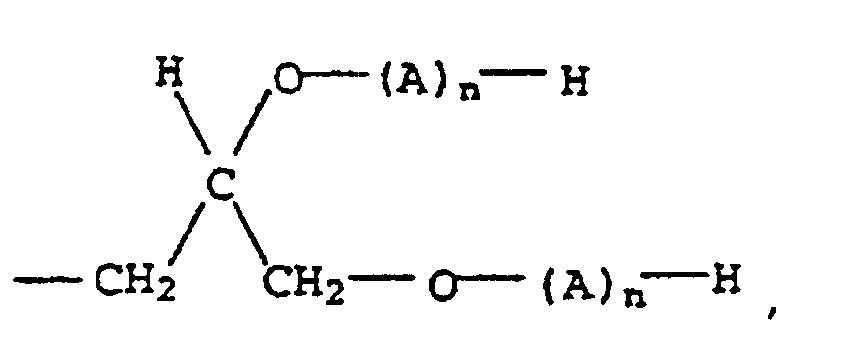
wobei das zwitterionische Polyetherpolyamin ein Molekulargewicht bis zu 9000 aufweist und 25 bis 100% der Stickstoffatome quaternisiert enthält. - Zwitterionisches Polyetherpolyamin nach Anspruch 1, bei dem die tertiären Stickstoffatome der Endgruppen der Polyetherpolyaminhauptkette zwei Gruppen der Formel I oder II enthalten.
- Zwitterionisches Polyetherpolyamin nach Anspruch 1, bei dem die Stickstoffatome der Endgruppen der Polyetherpolyaminhauptkette quaternisiert sind und als Substituenten zwei Gruppen der Formel I oder II und eine C1- bis C22-Alkylgruppe oder eine Hydroxyalkylgruppe enthalten.
- Zwitterionisches Polyetherpolyamin nach Anspruch 1, bei dem die Stickstoffatome der Endgruppen der Polyetherpolyaminhauptkette quaternisiert sind und als Substituenten zwei Gruppen der Formel I und eine C1- bis C22-Alkylgruppe enthalten.
- Zwitterionisches Polyetherpolyamin nach Anspruch 1, bei dem die Stickstoffatome der Endgruppen der Polyetherpolyaminhauptkette quaternisiert sind und als Substituenten zwei Gruppen der Formel I und eine Hydroxyethyl- oder Hydroxypropylgruppe enthalten.
- Zwitterionisches Polyetherpolyamin nach Anspruch 1, bei dem die Polyetherpolyaminhauptkette ohne die Stickstoffendgruppen Einheiten der Formel
- B
- für ein lineares oder verzweigtes C2- bis C4-Alkylen steht,
- D
- für ein lineares, verzweigtes oder cyclisches C5- bis C16-Alkylen, C4- bis C16-Oxaalkylen oder C5- bis C16-Azaalkylen steht,
- m
- für 0-7 steht,
- o
- für 0 oder 1 steht,
- p
- für 0-6 steht, mit der Maßgabe, daß m+o+p ≥ 1 bis 9,
- Zwitterionisches Polyetherpolyamin nach Anspruch 1, bei dem die Polyetherpolyaminhauptkette ohne die Stickstoffendgruppen Einheiten der Formel
- B
- für ein lineares oder verzweigtes C2- bis C4-Alkylen steht,
- E
- für.
 steht,
- R2
- für -H oder C1- bis C6-Alkyl steht,
- T
- für
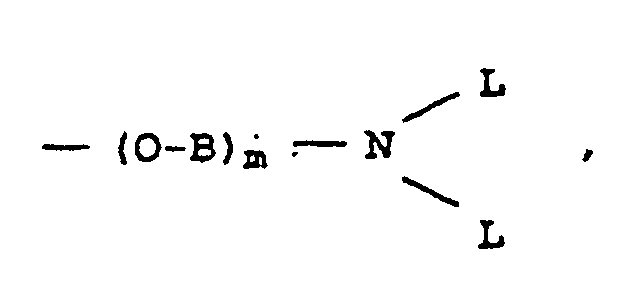
- L
- für einen aus der Gruppe bestehend aus Formel
I, Formel II,
wobei A und n die gleiche Bedeutung wie in Formel I oder II besitzen, ausgewählten Rest steht,

- i
- für 1-4 steht,
- m
- für 0-7 steht,
- Zwitterionisches Polyetherpolyamin nach Anspruch 1, bei dem die Polyetherpolyaminhauptkette ohne die Stickstoffendgruppen Einheiten der Formel
- E
- für
 steht,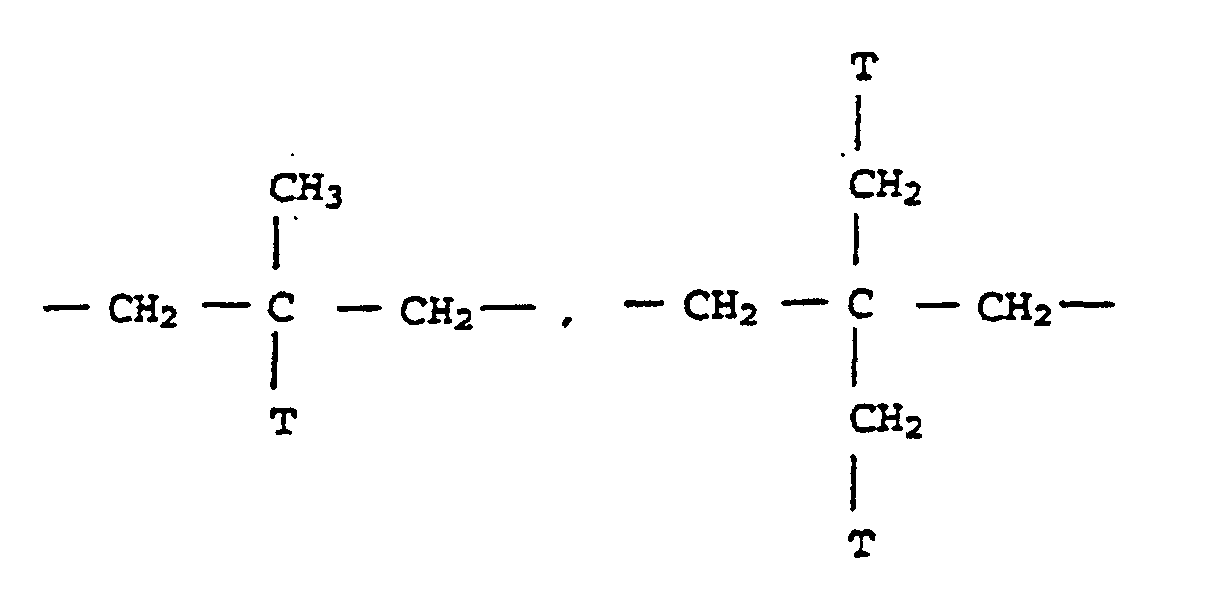
- T
- für

- R1
- für H, CH3 oder C2H5 steht,
- L
- für eine Gruppe der Formel I oder II,
steht,
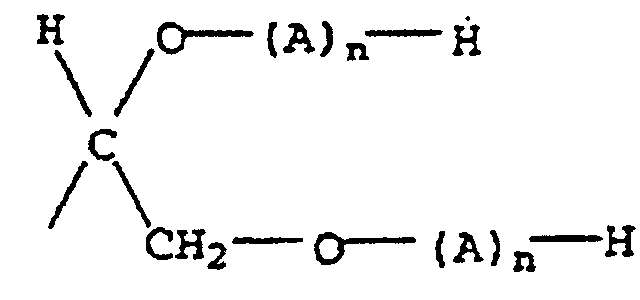
und - q
- für 2 oder 3 steht,
- Zwitterionisches Polyetherpolyamin nach Anspruch 1, bei dem die Polyetherpolyaminhauptkette ohne die Stickstoffendgruppen Einheiten der Formel
- D
- für
steht,

- q
- für 2 oder 3 steht,
- Zwitterionisches Polyetherpolyamin nach Anspruch 1 mit der Formelworin

- A
- für
 steht,
- M
- für H, Na, K oder Ammonium steht und
- n
- für 15-25 steht.
- Zwitterionisches Polyetherpolyamin nach Anspruch 1 mit der Formelworin

- EO
- für -CH2-CH2-O- steht,
- M
- für H, Na, K oder Ammonium steht und
- n
- für 15-25 steht.
- Verfahren zur Herstellung eines zwitterionischen Polyetherpolyamins mit einem ersten Schritt, bei dem maneinem zweiten Schritt, bei dem man das im ersten Schritt erhaltene alkoxylierte Polyetherpolyamin mit einer Verbindung aus der Gruppe bestehend aus einer Halogensulfonsäure, einer Halogenphosphonsäure, Vinylsulfonsäure, Propansulfon, einer Halogenessigsäure, Acrylsäure, Methacrylsäure, Vinylphosphonsäure und den Alkalimetall- oder Ammoniumsalzen dieser Säuren so umsetzt, daß mindestens eine tertiäre Aminendgruppe des alkoxylierten Polyetherpolyamins zwei Gruppen der Formel(i) ein lineares oder verzweigtes Polyetherpolyamin mit einem Molekulargewicht von 100 bis 800, 2 bis 10 Stickstoffatomen und mindestens 2 primären oder sekundären Aminostickstoffendgruppen oder das Produkt der Umsetzung dieses Polyetherpolyamins mit bis zu 1 Glycidol pro NH-Gruppe des Polyetherpolyamins mit(ii) mindestens einem C2- bis C4-Alkylenoxid oder Tetrahydrofuran in einem solchen Verhältnis umsetzt, daß an jede NH-Gruppe des Polyetherpolyamins 1 bis 50 Einheiten des Alkylenoxids addiert werden,worin
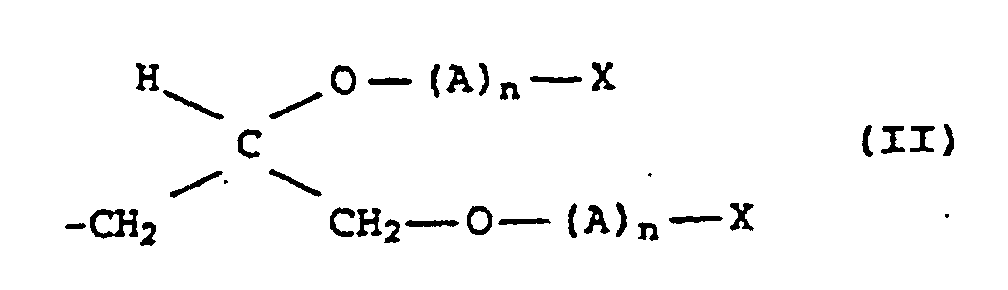
- A
- eine Ethylenoxid-Einheit, eine Propylenoxid-Einheit, eine Butylenoxid-Einheit und eine Tetrahydrofuran-Einheit bedeutet,
- n
- für eine ganze Zahl von 1 bis 50 steht,
- X
- für

mit der Maßgabe, daß in Formel II ein X auch für Wasserstoff stehen kann, und- M
- für Wasserstoff, Alkalimetall oder Ammonium steht,
C1- bis C22-Alkyl und C7- bis C22-Aralkyl, wobei A und n die gleiche Bedeutung wie in Formel I oder II besitzen, ausgewählte Gruppe enthält,
und einem dritten Schritt, bei dem man 25 bis 100% der tertiären Stickstoffatome des im zweiten Schritt erhaltenen Reaktionsprodukts quaternisiert, wobei der Quaternisierungsgrad auch dadurch erhältlich ist, daß man zuerst das im ersten Schritt erhaltene Reaktionsprodukt quaternisiert und erst danach den zweiten Schritt durchführt. - Verfahren nach Anspruch 12, bei dem man
im ersten Schrittim zweiten Schritt(i) ein lineares oder verzweigtes Polyetherpolyamin mit einem Molekulargewicht von 120 bis 750, 2 bis 4 Stickstoffatomen und 2 bis 4 primären oder sekundären Aminostickstoffendgruppen mit(ii) einem Alkylenoxid aus der Gruppe bestehend aus Ethylenoxid, Propylenoxid, Butylenoxid und Gemischen dieser Alkylenoxide in einem solchen Verhältnis umsetzt, daß an jede NH-Gruppe des Polyetherpolyamins 15 bis 40 Einheiten des Alkylenoxids addiert werden,
das im ersten Schritt erhaltene alkoxylierte Polyetherpolyamin in einem solchen Verhältnis mit Chlorsulfonsäure umsetzt, daß mindestens eine tertiäre Endgruppe des Polyetherpolyamins zwei Gruppen der Formel- A
- für eine Ethylenoxid-Einheit, eine Propylenoxid-Einheit oder eine Butylenoxid-Einheit steht,
- n
- für 15-40 steht und
- X
- für SO3H steht, enthält,
das zwitterionische Reaktionsprodukt aus dem zweiten Schritt mit Dimethylsulfat, Methylchlorid oder Benzylchlorid quaternisiert. - Verfahren nach Anspruch 12, bei dem man das im ersten Schritt erhaltene alkoxylierte Polyetherpolyamin bis zu 100% quaternisiert und danach mit Chlorsulfonsäure umsetzt.
Applications Claiming Priority (3)
| Application Number | Priority Date | Filing Date | Title |
|---|---|---|---|
| US14408399P | 1999-07-16 | 1999-07-16 | |
| US144083P | 1999-07-16 | ||
| PCT/EP2000/006295 WO2001005872A1 (en) | 1999-07-16 | 2000-07-05 | Zwitterionic polyetherpolyamines and a process for their production |
Publications (2)
| Publication Number | Publication Date |
|---|---|
| EP1200507A1 EP1200507A1 (de) | 2002-05-02 |
| EP1200507B1 true EP1200507B1 (de) | 2003-11-19 |
Family
ID=22506968
Family Applications (1)
| Application Number | Title | Priority Date | Filing Date |
|---|---|---|---|
| EP00945873A Expired - Lifetime EP1200507B1 (de) | 1999-07-16 | 2000-07-05 | Zwitterionische polyetherpolyamine und verfahren zu deren herstellung |
Country Status (7)
| Country | Link |
|---|---|
| EP (1) | EP1200507B1 (de) |
| JP (1) | JP4653365B2 (de) |
| AT (1) | ATE254642T1 (de) |
| AU (1) | AU5982000A (de) |
| DE (1) | DE60006679T2 (de) |
| ES (1) | ES2211571T3 (de) |
| WO (1) | WO2001005872A1 (de) |
Families Citing this family (5)
| Publication number | Priority date | Publication date | Assignee | Title |
|---|---|---|---|---|
| US9550965B2 (en) * | 2013-08-26 | 2017-01-24 | The Procter & Gamble Company | Cleaning compositions containing a polyetheramine |
| CN105492586B (zh) * | 2013-08-26 | 2018-02-16 | 宝洁公司 | 包含具有低熔点的烷氧基化聚胺的组合物 |
| EP3122848A1 (de) * | 2014-03-27 | 2017-02-01 | The Procter & Gamble Company | Reinigungszusammensetzungen mit einem polyetheramin |
| US9388368B2 (en) * | 2014-09-26 | 2016-07-12 | The Procter & Gamble Company | Cleaning compositions containing a polyetheramine |
| WO2020123129A1 (en) * | 2018-12-11 | 2020-06-18 | Dow Global Technologies Llc | Aqueous solutions of poorly soluble active ingredients using polyalkyoxylated amino alcohols |
Family Cites Families (6)
| Publication number | Priority date | Publication date | Assignee | Title |
|---|---|---|---|---|
| JPS5869874A (ja) * | 1981-10-23 | 1983-04-26 | Takeo Saegusa | 双性イオン化化合物 |
| FR2574791A1 (fr) * | 1984-12-14 | 1986-06-20 | Sandoz Sa | Sulfates d'amines grasses, leur preparation et leur utilisation comme produits auxiliaires |
| DE3446921A1 (de) * | 1984-12-21 | 1986-07-03 | Bayer Ag, 5090 Leverkusen | Neue alkoxylierte aminopolyether, verfahren zu ihrer herstellung und sie enthaltende kohle-wasser-aufschlaemmungen |
| US5985999A (en) * | 1993-07-13 | 1999-11-16 | Huntsman, Petrochemical Corporation | Dyeable polyolefin containing polyetheramine modified functionalized polyolefin |
| EP0634424B1 (de) * | 1993-07-13 | 1997-05-28 | Huntsman Petrochemical Corporation | Modifikation von Polypropylen durch Polyetheramine |
| DE69733653T2 (de) * | 1996-05-03 | 2006-04-27 | The Procter & Gamble Company, Cincinnati | Schmutzabweisende polymere für baumwollmaterialien |
-
2000
- 2000-07-05 ES ES00945873T patent/ES2211571T3/es not_active Expired - Lifetime
- 2000-07-05 DE DE60006679T patent/DE60006679T2/de not_active Expired - Lifetime
- 2000-07-05 AT AT00945873T patent/ATE254642T1/de not_active IP Right Cessation
- 2000-07-05 AU AU59820/00A patent/AU5982000A/en not_active Abandoned
- 2000-07-05 JP JP2001511523A patent/JP4653365B2/ja not_active Expired - Fee Related
- 2000-07-05 EP EP00945873A patent/EP1200507B1/de not_active Expired - Lifetime
- 2000-07-05 WO PCT/EP2000/006295 patent/WO2001005872A1/en not_active Ceased
Also Published As
| Publication number | Publication date |
|---|---|
| JP2003505550A (ja) | 2003-02-12 |
| WO2001005872A1 (en) | 2001-01-25 |
| AU5982000A (en) | 2001-02-05 |
| DE60006679D1 (de) | 2003-12-24 |
| ATE254642T1 (de) | 2003-12-15 |
| ES2211571T3 (es) | 2004-07-16 |
| EP1200507A1 (de) | 2002-05-02 |
| JP4653365B2 (ja) | 2011-03-16 |
| DE60006679T2 (de) | 2004-04-15 |
Similar Documents
| Publication | Publication Date | Title |
|---|---|---|
| EP1198492B1 (de) | Zwitterionische polyamine und verfahren zu ihrer herstellung | |
| EP2692842B1 (de) | Konzentrierte flüssige Reinigungsmittelzusammensetzungen | |
| KR100491397B1 (ko) | 알콕시화된 폴리알킬렌이민 분산제 | |
| CA1215064A (en) | Zwitterionic polymers having clay soil removal/anti- redeposition properties useful in detergent compositions | |
| US6673890B1 (en) | Zwitterionic polyamines and process for their production | |
| GB2171710A (en) | Detergent compositions | |
| US12116552B2 (en) | Liquid laundry composition | |
| EP3174919B1 (de) | Amphiphile sternförmige polyether | |
| US6703523B1 (en) | Zwitterionic polyetherpolyamines and process for their production | |
| EP1200507B1 (de) | Zwitterionische polyetherpolyamine und verfahren zu deren herstellung | |
| CA1210009A (en) | Ethoxylated amine polymers having clay soil removal/anti-redeposition properties useful in detergent compositions | |
| WO2001009223A1 (en) | Zwitterionic polyamines and a process for their production | |
| CA2384138A1 (en) | Process for the production of zwitterionic polyamines | |
| WO2016120141A1 (en) | Polyetheramines with low melting point |
Legal Events
| Date | Code | Title | Description |
|---|---|---|---|
| PUAI | Public reference made under article 153(3) epc to a published international application that has entered the european phase |
Free format text: ORIGINAL CODE: 0009012 |
|
| 17P | Request for examination filed |
Effective date: 20020116 |
|
| AK | Designated contracting states |
Kind code of ref document: A1 Designated state(s): AT BE CH CY DE DK ES FI FR GB GR IE IT LI LU MC NL PT SE |
|
| AX | Request for extension of the european patent |
Free format text: AL;LT;LV;MK;RO;SI |
|
| 17Q | First examination report despatched |
Effective date: 20021206 |
|
| GRAH | Despatch of communication of intention to grant a patent |
Free format text: ORIGINAL CODE: EPIDOS IGRA |
|
| GRAS | Grant fee paid |
Free format text: ORIGINAL CODE: EPIDOSNIGR3 |
|
| GRAA | (expected) grant |
Free format text: ORIGINAL CODE: 0009210 |
|
| AK | Designated contracting states |
Kind code of ref document: B1 Designated state(s): AT BE CH CY DE DK ES FI FR GB GR IE IT LI LU MC NL PT SE |
|
| PG25 | Lapsed in a contracting state [announced via postgrant information from national office to epo] |
Ref country code: CY Free format text: LAPSE BECAUSE OF FAILURE TO SUBMIT A TRANSLATION OF THE DESCRIPTION OR TO PAY THE FEE WITHIN THE PRESCRIBED TIME-LIMIT Effective date: 20031119 Ref country code: LI Free format text: LAPSE BECAUSE OF FAILURE TO SUBMIT A TRANSLATION OF THE DESCRIPTION OR TO PAY THE FEE WITHIN THE PRESCRIBED TIME-LIMIT Effective date: 20031119 Ref country code: AT Free format text: LAPSE BECAUSE OF FAILURE TO SUBMIT A TRANSLATION OF THE DESCRIPTION OR TO PAY THE FEE WITHIN THE PRESCRIBED TIME-LIMIT Effective date: 20031119 Ref country code: CH Free format text: LAPSE BECAUSE OF FAILURE TO SUBMIT A TRANSLATION OF THE DESCRIPTION OR TO PAY THE FEE WITHIN THE PRESCRIBED TIME-LIMIT Effective date: 20031119 Ref country code: FI Free format text: LAPSE BECAUSE OF FAILURE TO SUBMIT A TRANSLATION OF THE DESCRIPTION OR TO PAY THE FEE WITHIN THE PRESCRIBED TIME-LIMIT Effective date: 20031119 |
|
| REG | Reference to a national code |
Ref country code: GB Ref legal event code: FG4D |
|
| REG | Reference to a national code |
Ref country code: CH Ref legal event code: EP |
|
| REF | Corresponds to: |
Ref document number: 60006679 Country of ref document: DE Date of ref document: 20031224 Kind code of ref document: P |
|
| REG | Reference to a national code |
Ref country code: IE Ref legal event code: FG4D |
|
| PG25 | Lapsed in a contracting state [announced via postgrant information from national office to epo] |
Ref country code: GR Free format text: LAPSE BECAUSE OF FAILURE TO SUBMIT A TRANSLATION OF THE DESCRIPTION OR TO PAY THE FEE WITHIN THE PRESCRIBED TIME-LIMIT Effective date: 20040219 Ref country code: SE Free format text: LAPSE BECAUSE OF FAILURE TO SUBMIT A TRANSLATION OF THE DESCRIPTION OR TO PAY THE FEE WITHIN THE PRESCRIBED TIME-LIMIT Effective date: 20040219 Ref country code: DK Free format text: LAPSE BECAUSE OF FAILURE TO SUBMIT A TRANSLATION OF THE DESCRIPTION OR TO PAY THE FEE WITHIN THE PRESCRIBED TIME-LIMIT Effective date: 20040219 |
|
| LTIE | Lt: invalidation of european patent or patent extension |
Effective date: 20031119 |
|
| REG | Reference to a national code |
Ref country code: CH Ref legal event code: PL |
|
| PG25 | Lapsed in a contracting state [announced via postgrant information from national office to epo] |
Ref country code: IE Free format text: LAPSE BECAUSE OF NON-PAYMENT OF DUE FEES Effective date: 20040705 Ref country code: LU Free format text: LAPSE BECAUSE OF NON-PAYMENT OF DUE FEES Effective date: 20040705 |
|
| REG | Reference to a national code |
Ref country code: ES Ref legal event code: FG2A Ref document number: 2211571 Country of ref document: ES Kind code of ref document: T3 |
|
| PG25 | Lapsed in a contracting state [announced via postgrant information from national office to epo] |
Ref country code: MC Free format text: LAPSE BECAUSE OF NON-PAYMENT OF DUE FEES Effective date: 20040731 |
|
| ET | Fr: translation filed | ||
| PLBE | No opposition filed within time limit |
Free format text: ORIGINAL CODE: 0009261 |
|
| STAA | Information on the status of an ep patent application or granted ep patent |
Free format text: STATUS: NO OPPOSITION FILED WITHIN TIME LIMIT |
|
| 26N | No opposition filed |
Effective date: 20040820 |
|
| REG | Reference to a national code |
Ref country code: IE Ref legal event code: MM4A |
|
| PGFP | Annual fee paid to national office [announced via postgrant information from national office to epo] |
Ref country code: NL Payment date: 20050703 Year of fee payment: 6 |
|
| PGFP | Annual fee paid to national office [announced via postgrant information from national office to epo] |
Ref country code: ES Payment date: 20050818 Year of fee payment: 6 |
|
| PG25 | Lapsed in a contracting state [announced via postgrant information from national office to epo] |
Ref country code: NL Free format text: LAPSE BECAUSE OF NON-PAYMENT OF DUE FEES Effective date: 20070201 |
|
| NLV4 | Nl: lapsed or anulled due to non-payment of the annual fee |
Effective date: 20070201 |
|
| REG | Reference to a national code |
Ref country code: ES Ref legal event code: FD2A Effective date: 20060706 |
|
| PG25 | Lapsed in a contracting state [announced via postgrant information from national office to epo] |
Ref country code: PT Free format text: LAPSE BECAUSE OF NON-PAYMENT OF DUE FEES Effective date: 20040419 |
|
| PG25 | Lapsed in a contracting state [announced via postgrant information from national office to epo] |
Ref country code: ES Free format text: LAPSE BECAUSE OF NON-PAYMENT OF DUE FEES Effective date: 20060706 |
|
| REG | Reference to a national code |
Ref country code: FR Ref legal event code: PLFP Year of fee payment: 17 |
|
| PGFP | Annual fee paid to national office [announced via postgrant information from national office to epo] |
Ref country code: GB Payment date: 20160729 Year of fee payment: 17 Ref country code: IT Payment date: 20160721 Year of fee payment: 17 |
|
| PGFP | Annual fee paid to national office [announced via postgrant information from national office to epo] |
Ref country code: FR Payment date: 20160727 Year of fee payment: 17 |
|
| PGFP | Annual fee paid to national office [announced via postgrant information from national office to epo] |
Ref country code: BE Payment date: 20160725 Year of fee payment: 17 |
|
| PGFP | Annual fee paid to national office [announced via postgrant information from national office to epo] |
Ref country code: DE Payment date: 20160930 Year of fee payment: 17 |
|
| REG | Reference to a national code |
Ref country code: DE Ref legal event code: R119 Ref document number: 60006679 Country of ref document: DE |
|
| GBPC | Gb: european patent ceased through non-payment of renewal fee |
Effective date: 20170705 |
|
| REG | Reference to a national code |
Ref country code: FR Ref legal event code: ST Effective date: 20180330 |
|
| PG25 | Lapsed in a contracting state [announced via postgrant information from national office to epo] |
Ref country code: GB Free format text: LAPSE BECAUSE OF NON-PAYMENT OF DUE FEES Effective date: 20170705 Ref country code: DE Free format text: LAPSE BECAUSE OF NON-PAYMENT OF DUE FEES Effective date: 20180201 |
|
| PG25 | Lapsed in a contracting state [announced via postgrant information from national office to epo] |
Ref country code: FR Free format text: LAPSE BECAUSE OF NON-PAYMENT OF DUE FEES Effective date: 20170731 |
|
| REG | Reference to a national code |
Ref country code: BE Ref legal event code: MM Effective date: 20170731 |
|
| PG25 | Lapsed in a contracting state [announced via postgrant information from national office to epo] |
Ref country code: IT Free format text: LAPSE BECAUSE OF NON-PAYMENT OF DUE FEES Effective date: 20170705 Ref country code: BE Free format text: LAPSE BECAUSE OF NON-PAYMENT OF DUE FEES Effective date: 20170731 |