EP1200525B1 - Compositions durcissables comprenant le produit d'hydrosilation de polymeres contenant des groupes olefiniques et d'hydrures d'organosiloxane, compositions durcies pouvant etre obtenues a partir de ces compositions et leurs procedes de production - Google Patents
Compositions durcissables comprenant le produit d'hydrosilation de polymeres contenant des groupes olefiniques et d'hydrures d'organosiloxane, compositions durcies pouvant etre obtenues a partir de ces compositions et leurs procedes de production Download PDFInfo
- Publication number
- EP1200525B1 EP1200525B1 EP00950410A EP00950410A EP1200525B1 EP 1200525 B1 EP1200525 B1 EP 1200525B1 EP 00950410 A EP00950410 A EP 00950410A EP 00950410 A EP00950410 A EP 00950410A EP 1200525 B1 EP1200525 B1 EP 1200525B1
- Authority
- EP
- European Patent Office
- Prior art keywords
- organosiloxane
- curable composition
- groups
- olefin
- grams
- Prior art date
- Legal status (The legal status is an assumption and is not a legal conclusion. Google has not performed a legal analysis and makes no representation as to the accuracy of the status listed.)
- Expired - Lifetime
Links
- 239000000203 mixture Substances 0.000 title claims description 145
- 229920000642 polymer Polymers 0.000 title claims description 81
- -1 organosiloxane hydrides Chemical class 0.000 title claims description 76
- 238000006459 hydrosilylation reaction Methods 0.000 title claims description 55
- 238000000034 method Methods 0.000 title claims description 7
- 150000001336 alkenes Chemical group 0.000 claims description 80
- 229920001296 polysiloxane Polymers 0.000 claims description 53
- 125000005375 organosiloxane group Chemical group 0.000 claims description 42
- 239000006185 dispersion Substances 0.000 claims description 37
- 238000000576 coating method Methods 0.000 claims description 36
- 125000000524 functional group Chemical group 0.000 claims description 25
- 239000011248 coating agent Substances 0.000 claims description 21
- JOYRKODLDBILNP-UHFFFAOYSA-N Ethyl urethane Chemical compound CCOC(N)=O JOYRKODLDBILNP-UHFFFAOYSA-N 0.000 claims description 19
- 229910000096 monohydride Inorganic materials 0.000 claims description 19
- 239000001257 hydrogen Substances 0.000 claims description 17
- 229910052739 hydrogen Inorganic materials 0.000 claims description 17
- 239000000047 product Substances 0.000 claims description 16
- UFHFLCQGNIYNRP-UHFFFAOYSA-N Hydrogen Chemical compound [H][H] UFHFLCQGNIYNRP-UHFFFAOYSA-N 0.000 claims description 13
- 238000004132 cross linking Methods 0.000 claims description 11
- 230000015572 biosynthetic process Effects 0.000 claims description 8
- 125000004430 oxygen atom Chemical group O* 0.000 claims description 7
- 125000005647 linker group Chemical group 0.000 claims description 6
- 238000004519 manufacturing process Methods 0.000 claims description 6
- QVGXLLKOCUKJST-UHFFFAOYSA-N atomic oxygen Chemical group [O] QVGXLLKOCUKJST-UHFFFAOYSA-N 0.000 claims description 2
- 239000007795 chemical reaction product Substances 0.000 claims description 2
- 239000001301 oxygen Substances 0.000 claims description 2
- 229910052760 oxygen Inorganic materials 0.000 claims description 2
- JRZJOMJEPLMPRA-UHFFFAOYSA-N olefin Natural products CCCCCCCC=C JRZJOMJEPLMPRA-UHFFFAOYSA-N 0.000 description 54
- XLYOFNOQVPJJNP-UHFFFAOYSA-N water Substances O XLYOFNOQVPJJNP-UHFFFAOYSA-N 0.000 description 49
- YXFVVABEGXRONW-UHFFFAOYSA-N Toluene Chemical compound CC1=CC=CC=C1 YXFVVABEGXRONW-UHFFFAOYSA-N 0.000 description 48
- 150000004678 hydrides Chemical group 0.000 description 47
- 229910001868 water Inorganic materials 0.000 description 42
- 238000006243 chemical reaction Methods 0.000 description 39
- 239000010408 film Substances 0.000 description 35
- IJGRMHOSHXDMSA-UHFFFAOYSA-N Atomic nitrogen Chemical compound N#N IJGRMHOSHXDMSA-UHFFFAOYSA-N 0.000 description 34
- 238000003756 stirring Methods 0.000 description 30
- 150000001875 compounds Chemical class 0.000 description 27
- 239000005056 polyisocyanate Substances 0.000 description 26
- 229920001228 polyisocyanate Polymers 0.000 description 26
- 239000012948 isocyanate Substances 0.000 description 19
- 239000002904 solvent Substances 0.000 description 18
- 239000003054 catalyst Substances 0.000 description 17
- 229910052757 nitrogen Inorganic materials 0.000 description 17
- 150000003254 radicals Chemical class 0.000 description 16
- 238000010438 heat treatment Methods 0.000 description 15
- 150000002513 isocyanates Chemical class 0.000 description 15
- 239000007787 solid Substances 0.000 description 15
- ZMANZCXQSJIPKH-UHFFFAOYSA-N Triethylamine Chemical compound CCN(CC)CC ZMANZCXQSJIPKH-UHFFFAOYSA-N 0.000 description 14
- 239000007788 liquid Substances 0.000 description 14
- 229920005862 polyol Polymers 0.000 description 14
- 150000003077 polyols Chemical class 0.000 description 14
- 239000004593 Epoxy Substances 0.000 description 13
- 239000000463 material Substances 0.000 description 13
- 239000012299 nitrogen atmosphere Substances 0.000 description 12
- 239000000126 substance Substances 0.000 description 12
- 238000012360 testing method Methods 0.000 description 12
- OKTJSMMVPCPJKN-UHFFFAOYSA-N Carbon Chemical compound [C] OKTJSMMVPCPJKN-UHFFFAOYSA-N 0.000 description 10
- 229920001730 Moisture cure polyurethane Polymers 0.000 description 10
- SECXISVLQFMRJM-UHFFFAOYSA-N N-Methylpyrrolidone Chemical compound CN1CCCC1=O SECXISVLQFMRJM-UHFFFAOYSA-N 0.000 description 10
- BLRPTPMANUNPDV-UHFFFAOYSA-N Silane Chemical compound [SiH4] BLRPTPMANUNPDV-UHFFFAOYSA-N 0.000 description 10
- BASFCYQUMIYNBI-UHFFFAOYSA-N platinum Chemical compound [Pt] BASFCYQUMIYNBI-UHFFFAOYSA-N 0.000 description 10
- 239000004970 Chain extender Substances 0.000 description 9
- IQPQWNKOIGAROB-UHFFFAOYSA-N isocyanate group Chemical group [N-]=C=O IQPQWNKOIGAROB-UHFFFAOYSA-N 0.000 description 9
- 239000000654 additive Substances 0.000 description 8
- 150000001298 alcohols Chemical class 0.000 description 8
- 125000001931 aliphatic group Chemical group 0.000 description 8
- 239000000758 substrate Substances 0.000 description 8
- 230000004584 weight gain Effects 0.000 description 8
- 235000019786 weight gain Nutrition 0.000 description 8
- 150000001412 amines Chemical class 0.000 description 7
- 125000003118 aryl group Chemical group 0.000 description 7
- 150000001735 carboxylic acids Chemical class 0.000 description 7
- 230000000052 comparative effect Effects 0.000 description 7
- 239000004205 dimethyl polysiloxane Substances 0.000 description 7
- 239000002736 nonionic surfactant Substances 0.000 description 7
- 229920000435 poly(dimethylsiloxane) Polymers 0.000 description 7
- 229920001343 polytetrafluoroethylene Polymers 0.000 description 7
- 239000004810 polytetrafluoroethylene Substances 0.000 description 7
- 229920002635 polyurethane Polymers 0.000 description 7
- 239000004814 polyurethane Substances 0.000 description 7
- 150000003839 salts Chemical class 0.000 description 7
- ZWEHNKRNPOVVGH-UHFFFAOYSA-N 2-Butanone Chemical compound CCC(C)=O ZWEHNKRNPOVVGH-UHFFFAOYSA-N 0.000 description 6
- XUIMIQQOPSSXEZ-UHFFFAOYSA-N Silicon Chemical compound [Si] XUIMIQQOPSSXEZ-UHFFFAOYSA-N 0.000 description 6
- UKLDJPRMSDWDSL-UHFFFAOYSA-L [dibutyl(dodecanoyloxy)stannyl] dodecanoate Chemical compound CCCCCCCCCCCC(=O)O[Sn](CCCC)(CCCC)OC(=O)CCCCCCCCCCC UKLDJPRMSDWDSL-UHFFFAOYSA-L 0.000 description 6
- 125000005442 diisocyanate group Chemical group 0.000 description 6
- 239000012530 fluid Substances 0.000 description 6
- 150000002576 ketones Chemical class 0.000 description 6
- 239000002245 particle Substances 0.000 description 6
- 229910000077 silane Inorganic materials 0.000 description 6
- 229910052710 silicon Inorganic materials 0.000 description 6
- 150000003673 urethanes Chemical class 0.000 description 6
- LYCAIKOWRPUZTN-UHFFFAOYSA-N Ethylene glycol Chemical compound OCCO LYCAIKOWRPUZTN-UHFFFAOYSA-N 0.000 description 5
- 229920002125 Sokalan® Polymers 0.000 description 5
- 229910052782 aluminium Inorganic materials 0.000 description 5
- XAGFODPZIPBFFR-UHFFFAOYSA-N aluminium Chemical compound [Al] XAGFODPZIPBFFR-UHFFFAOYSA-N 0.000 description 5
- 230000003373 anti-fouling effect Effects 0.000 description 5
- 239000002519 antifouling agent Substances 0.000 description 5
- 150000002170 ethers Chemical class 0.000 description 5
- 229930195733 hydrocarbon Natural products 0.000 description 5
- 150000002430 hydrocarbons Chemical class 0.000 description 5
- 229910052697 platinum Inorganic materials 0.000 description 5
- 239000004971 Cross linker Substances 0.000 description 4
- IAZDPXIOMUYVGZ-UHFFFAOYSA-N Dimethylsulphoxide Chemical compound CS(C)=O IAZDPXIOMUYVGZ-UHFFFAOYSA-N 0.000 description 4
- ZHNUHDYFZUAESO-UHFFFAOYSA-N Formamide Chemical compound NC=O ZHNUHDYFZUAESO-UHFFFAOYSA-N 0.000 description 4
- 125000003158 alcohol group Chemical group 0.000 description 4
- 150000001299 aldehydes Chemical class 0.000 description 4
- 125000002723 alicyclic group Chemical group 0.000 description 4
- 125000003178 carboxy group Chemical group [H]OC(*)=O 0.000 description 4
- 239000003431 cross linking reagent Substances 0.000 description 4
- 125000004122 cyclic group Chemical group 0.000 description 4
- 239000008367 deionised water Substances 0.000 description 4
- 229910021641 deionized water Inorganic materials 0.000 description 4
- KORSJDCBLAPZEQ-UHFFFAOYSA-N dicyclohexylmethane-4,4'-diisocyanate Chemical compound C1CC(N=C=O)CCC1CC1CCC(N=C=O)CC1 KORSJDCBLAPZEQ-UHFFFAOYSA-N 0.000 description 4
- 238000005516 engineering process Methods 0.000 description 4
- 238000007654 immersion Methods 0.000 description 4
- 238000005259 measurement Methods 0.000 description 4
- PSGAAPLEWMOORI-PEINSRQWSA-N medroxyprogesterone acetate Chemical compound C([C@@]12C)CC(=O)C=C1[C@@H](C)C[C@@H]1[C@@H]2CC[C@]2(C)[C@@](OC(C)=O)(C(C)=O)CC[C@H]21 PSGAAPLEWMOORI-PEINSRQWSA-N 0.000 description 4
- 229920000728 polyester Polymers 0.000 description 4
- 239000010703 silicon Substances 0.000 description 4
- 238000010998 test method Methods 0.000 description 4
- 239000013638 trimer Substances 0.000 description 4
- UPMLOUAZCHDJJD-UHFFFAOYSA-N 4,4'-Diphenylmethane Diisocyanate Chemical compound C1=CC(N=C=O)=CC=C1CC1=CC=C(N=C=O)C=C1 UPMLOUAZCHDJJD-UHFFFAOYSA-N 0.000 description 3
- 229920003341 Epi-rez 3510-W-60 Polymers 0.000 description 3
- LFQSCWFLJHTTHZ-UHFFFAOYSA-N Ethanol Chemical compound CCO LFQSCWFLJHTTHZ-UHFFFAOYSA-N 0.000 description 3
- ZMXDDKWLCZADIW-UHFFFAOYSA-N N,N-Dimethylformamide Chemical compound CN(C)C=O ZMXDDKWLCZADIW-UHFFFAOYSA-N 0.000 description 3
- 239000004952 Polyamide Substances 0.000 description 3
- 238000005299 abrasion Methods 0.000 description 3
- 125000004429 atom Chemical group 0.000 description 3
- 239000000539 dimer Substances 0.000 description 3
- 239000012153 distilled water Substances 0.000 description 3
- 125000003700 epoxy group Chemical group 0.000 description 3
- 125000001495 ethyl group Chemical group [H]C([H])([H])C([H])([H])* 0.000 description 3
- 239000011521 glass Substances 0.000 description 3
- RRAMGCGOFNQTLD-UHFFFAOYSA-N hexamethylene diisocyanate Chemical compound O=C=NCCCCCCN=C=O RRAMGCGOFNQTLD-UHFFFAOYSA-N 0.000 description 3
- QHGSGZLLHBKSAH-UHFFFAOYSA-N hydridosilicon Chemical compound [SiH] QHGSGZLLHBKSAH-UHFFFAOYSA-N 0.000 description 3
- 125000004435 hydrogen atom Chemical group [H]* 0.000 description 3
- 125000002887 hydroxy group Chemical group [H]O* 0.000 description 3
- NIMLQBUJDJZYEJ-UHFFFAOYSA-N isophorone diisocyanate Chemical compound CC1(C)CC(N=C=O)CC(C)(CN=C=O)C1 NIMLQBUJDJZYEJ-UHFFFAOYSA-N 0.000 description 3
- 239000012633 leachable Substances 0.000 description 3
- WCYWZMWISLQXQU-UHFFFAOYSA-N methyl Chemical group [CH3] WCYWZMWISLQXQU-UHFFFAOYSA-N 0.000 description 3
- 125000002496 methyl group Chemical group [H]C([H])([H])* 0.000 description 3
- 230000004048 modification Effects 0.000 description 3
- 238000012986 modification Methods 0.000 description 3
- VLKZOEOYAKHREP-UHFFFAOYSA-N n-Hexane Chemical compound CCCCCC VLKZOEOYAKHREP-UHFFFAOYSA-N 0.000 description 3
- 229920002647 polyamide Polymers 0.000 description 3
- 229920000570 polyether Polymers 0.000 description 3
- 125000001436 propyl group Chemical group [H]C([*])([H])C([H])([H])C([H])([H])[H] 0.000 description 3
- 239000011541 reaction mixture Substances 0.000 description 3
- 238000007086 side reaction Methods 0.000 description 3
- 229910052990 silicon hydride Inorganic materials 0.000 description 3
- 125000001424 substituent group Chemical group 0.000 description 3
- DVKJHBMWWAPEIU-UHFFFAOYSA-N toluene 2,4-diisocyanate Chemical compound CC1=CC=C(N=C=O)C=C1N=C=O DVKJHBMWWAPEIU-UHFFFAOYSA-N 0.000 description 3
- 230000009466 transformation Effects 0.000 description 3
- 238000000844 transformation Methods 0.000 description 3
- ZDHXKXAHOVTTAH-UHFFFAOYSA-N trichlorosilane Chemical compound Cl[SiH](Cl)Cl ZDHXKXAHOVTTAH-UHFFFAOYSA-N 0.000 description 3
- AZYRZNIYJDKRHO-UHFFFAOYSA-N 1,3-bis(2-isocyanatopropan-2-yl)benzene Chemical compound O=C=NC(C)(C)C1=CC=CC(C(C)(C)N=C=O)=C1 AZYRZNIYJDKRHO-UHFFFAOYSA-N 0.000 description 2
- AGJCSCSSMFRMFQ-UHFFFAOYSA-N 1,4-bis(2-isocyanatopropan-2-yl)benzene Chemical compound O=C=NC(C)(C)C1=CC=C(C(C)(C)N=C=O)C=C1 AGJCSCSSMFRMFQ-UHFFFAOYSA-N 0.000 description 2
- ZAXXZBQODQDCOW-UHFFFAOYSA-N 1-methoxypropyl acetate Chemical compound CCC(OC)OC(C)=O ZAXXZBQODQDCOW-UHFFFAOYSA-N 0.000 description 2
- LXOFYPKXCSULTL-UHFFFAOYSA-N 2,4,7,9-tetramethyldec-5-yne-4,7-diol Chemical compound CC(C)CC(C)(O)C#CC(C)(O)CC(C)C LXOFYPKXCSULTL-UHFFFAOYSA-N 0.000 description 2
- NECRQCBKTGZNMH-UHFFFAOYSA-N 3,5-dimethylhex-1-yn-3-ol Chemical compound CC(C)CC(C)(O)C#C NECRQCBKTGZNMH-UHFFFAOYSA-N 0.000 description 2
- WJIOHMVWGVGWJW-UHFFFAOYSA-N 3-methyl-n-[4-[(3-methylpyrazole-1-carbonyl)amino]butyl]pyrazole-1-carboxamide Chemical compound N1=C(C)C=CN1C(=O)NCCCCNC(=O)N1N=C(C)C=C1 WJIOHMVWGVGWJW-UHFFFAOYSA-N 0.000 description 2
- PORQOHRXAJJKGK-UHFFFAOYSA-N 4,5-dichloro-2-n-octyl-3(2H)-isothiazolone Chemical compound CCCCCCCCN1SC(Cl)=C(Cl)C1=O PORQOHRXAJJKGK-UHFFFAOYSA-N 0.000 description 2
- XKRFYHLGVUSROY-UHFFFAOYSA-N Argon Chemical compound [Ar] XKRFYHLGVUSROY-UHFFFAOYSA-N 0.000 description 2
- 239000005058 Isophorone diisocyanate Substances 0.000 description 2
- 238000005481 NMR spectroscopy Methods 0.000 description 2
- ATJFFYVFTNAWJD-UHFFFAOYSA-N Tin Chemical compound [Sn] ATJFFYVFTNAWJD-UHFFFAOYSA-N 0.000 description 2
- CIUQDSCDWFSTQR-UHFFFAOYSA-N [C]1=CC=CC=C1 Chemical group [C]1=CC=CC=C1 CIUQDSCDWFSTQR-UHFFFAOYSA-N 0.000 description 2
- 238000007792 addition Methods 0.000 description 2
- 239000002318 adhesion promoter Substances 0.000 description 2
- 150000001408 amides Chemical class 0.000 description 2
- 125000003277 amino group Chemical group 0.000 description 2
- 239000003963 antioxidant agent Substances 0.000 description 2
- DSVRVHYFPPQFTI-UHFFFAOYSA-N bis(ethenyl)-methyl-trimethylsilyloxysilane;platinum Chemical compound [Pt].C[Si](C)(C)O[Si](C)(C=C)C=C DSVRVHYFPPQFTI-UHFFFAOYSA-N 0.000 description 2
- IISBACLAFKSPIT-UHFFFAOYSA-N bisphenol A Chemical compound C=1C=C(O)C=CC=1C(C)(C)C1=CC=C(O)C=C1 IISBACLAFKSPIT-UHFFFAOYSA-N 0.000 description 2
- 239000002981 blocking agent Substances 0.000 description 2
- DKPFZGUDAPQIHT-UHFFFAOYSA-N butyl acetate Chemical compound CCCCOC(C)=O DKPFZGUDAPQIHT-UHFFFAOYSA-N 0.000 description 2
- 235000013877 carbamide Nutrition 0.000 description 2
- 239000011203 carbon fibre reinforced carbon Substances 0.000 description 2
- 239000003795 chemical substances by application Substances 0.000 description 2
- CRQQGFGUEAVUIL-UHFFFAOYSA-N chlorothalonil Chemical compound ClC1=C(Cl)C(C#N)=C(Cl)C(C#N)=C1Cl CRQQGFGUEAVUIL-UHFFFAOYSA-N 0.000 description 2
- 239000008199 coating composition Substances 0.000 description 2
- 150000004985 diamines Chemical class 0.000 description 2
- 239000012975 dibutyltin dilaurate Substances 0.000 description 2
- XBDQKXXYIPTUBI-UHFFFAOYSA-N dimethylselenoniopropionate Natural products CCC(O)=O XBDQKXXYIPTUBI-UHFFFAOYSA-N 0.000 description 2
- 150000002009 diols Chemical class 0.000 description 2
- 238000007598 dipping method Methods 0.000 description 2
- JBKVHLHDHHXQEQ-UHFFFAOYSA-N epsilon-caprolactam Chemical compound O=C1CCCCCN1 JBKVHLHDHHXQEQ-UHFFFAOYSA-N 0.000 description 2
- 230000006870 function Effects 0.000 description 2
- 150000002431 hydrogen Chemical class 0.000 description 2
- RBTARNINKXHZNM-UHFFFAOYSA-K iron trichloride Chemical compound Cl[Fe](Cl)Cl RBTARNINKXHZNM-UHFFFAOYSA-K 0.000 description 2
- HJOVHMDZYOCNQW-UHFFFAOYSA-N isophorone Chemical compound CC1=CC(=O)CC(C)(C)C1 HJOVHMDZYOCNQW-UHFFFAOYSA-N 0.000 description 2
- 238000002386 leaching Methods 0.000 description 2
- 239000004611 light stabiliser Substances 0.000 description 2
- 230000007246 mechanism Effects 0.000 description 2
- 238000005065 mining Methods 0.000 description 2
- 238000013008 moisture curing Methods 0.000 description 2
- SNQQPOLDUKLAAF-UHFFFAOYSA-N nonylphenol Chemical compound CCCCCCCCCC1=CC=CC=C1O SNQQPOLDUKLAAF-UHFFFAOYSA-N 0.000 description 2
- 239000004014 plasticizer Substances 0.000 description 2
- 229920000647 polyepoxide Polymers 0.000 description 2
- SCVFZCLFOSHCOH-UHFFFAOYSA-M potassium acetate Chemical compound [K+].CC([O-])=O SCVFZCLFOSHCOH-UHFFFAOYSA-M 0.000 description 2
- 150000003141 primary amines Chemical class 0.000 description 2
- 239000000376 reactant Substances 0.000 description 2
- 230000009257 reactivity Effects 0.000 description 2
- 230000003381 solubilizing effect Effects 0.000 description 2
- 239000004094 surface-active agent Substances 0.000 description 2
- 239000002562 thickening agent Substances 0.000 description 2
- 239000005052 trichlorosilane Substances 0.000 description 2
- 229940086542 triethylamine Drugs 0.000 description 2
- 239000012855 volatile organic compound Substances 0.000 description 2
- 239000001993 wax Substances 0.000 description 2
- PICXIOQBANWBIZ-UHFFFAOYSA-N zinc;1-oxidopyridine-2-thione Chemical compound [Zn+2].[O-]N1C=CC=CC1=S.[O-]N1C=CC=CC1=S PICXIOQBANWBIZ-UHFFFAOYSA-N 0.000 description 2
- VGHSXKTVMPXHNG-UHFFFAOYSA-N 1,3-diisocyanatobenzene Chemical compound O=C=NC1=CC=CC(N=C=O)=C1 VGHSXKTVMPXHNG-UHFFFAOYSA-N 0.000 description 1
- 239000005059 1,4-Cyclohexyldiisocyanate Substances 0.000 description 1
- OHLKMGYGBHFODF-UHFFFAOYSA-N 1,4-bis(isocyanatomethyl)benzene Chemical compound O=C=NCC1=CC=C(CN=C=O)C=C1 OHLKMGYGBHFODF-UHFFFAOYSA-N 0.000 description 1
- ALQLPWJFHRMHIU-UHFFFAOYSA-N 1,4-diisocyanatobenzene Chemical compound O=C=NC1=CC=C(N=C=O)C=C1 ALQLPWJFHRMHIU-UHFFFAOYSA-N 0.000 description 1
- CDMDQYCEEKCBGR-UHFFFAOYSA-N 1,4-diisocyanatocyclohexane Chemical compound O=C=NC1CCC(N=C=O)CC1 CDMDQYCEEKCBGR-UHFFFAOYSA-N 0.000 description 1
- SBJCUZQNHOLYMD-UHFFFAOYSA-N 1,5-Naphthalene diisocyanate Chemical compound C1=CC=C2C(N=C=O)=CC=CC2=C1N=C=O SBJCUZQNHOLYMD-UHFFFAOYSA-N 0.000 description 1
- ATOUXIOKEJWULN-UHFFFAOYSA-N 1,6-diisocyanato-2,2,4-trimethylhexane Chemical compound O=C=NCCC(C)CC(C)(C)CN=C=O ATOUXIOKEJWULN-UHFFFAOYSA-N 0.000 description 1
- ZMWRRFHBXARRRT-UHFFFAOYSA-N 2-(benzotriazol-2-yl)-4,6-bis(2-methylbutan-2-yl)phenol Chemical compound CCC(C)(C)C1=CC(C(C)(C)CC)=CC(N2N=C3C=CC=CC3=N2)=C1O ZMWRRFHBXARRRT-UHFFFAOYSA-N 0.000 description 1
- GTEXIOINCJRBIO-UHFFFAOYSA-N 2-[2-(dimethylamino)ethoxy]-n,n-dimethylethanamine Chemical compound CN(C)CCOCCN(C)C GTEXIOINCJRBIO-UHFFFAOYSA-N 0.000 description 1
- JRQLZCFSWYQHPI-UHFFFAOYSA-N 4,5-dichloro-2-cyclohexyl-1,2-thiazol-3-one Chemical compound O=C1C(Cl)=C(Cl)SN1C1CCCCC1 JRQLZCFSWYQHPI-UHFFFAOYSA-N 0.000 description 1
- AGGCEDYMGLPKNS-UHFFFAOYSA-N 5,5,6-trimethylundec-3-yne-2,2-diol Chemical class CCCCCC(C)C(C)(C)C#CC(C)(O)O AGGCEDYMGLPKNS-UHFFFAOYSA-N 0.000 description 1
- RYGMFSIKBFXOCR-UHFFFAOYSA-N Copper Chemical compound [Cu] RYGMFSIKBFXOCR-UHFFFAOYSA-N 0.000 description 1
- PIICEJLVQHRZGT-UHFFFAOYSA-N Ethylenediamine Chemical compound NCCN PIICEJLVQHRZGT-UHFFFAOYSA-N 0.000 description 1
- 229910021578 Iron(III) chloride Inorganic materials 0.000 description 1
- KWYHDKDOAIKMQN-UHFFFAOYSA-N N,N,N',N'-tetramethylethylenediamine Chemical compound CN(C)CCN(C)C KWYHDKDOAIKMQN-UHFFFAOYSA-N 0.000 description 1
- FXHOOIRPVKKKFG-UHFFFAOYSA-N N,N-Dimethylacetamide Chemical compound CN(C)C(C)=O FXHOOIRPVKKKFG-UHFFFAOYSA-N 0.000 description 1
- IGFHQQFPSIBGKE-UHFFFAOYSA-N Nonylphenol Natural products CCCCCCCCCC1=CC=C(O)C=C1 IGFHQQFPSIBGKE-UHFFFAOYSA-N 0.000 description 1
- CTQNGGLPUBDAKN-UHFFFAOYSA-N O-Xylene Chemical compound CC1=CC=CC=C1C CTQNGGLPUBDAKN-UHFFFAOYSA-N 0.000 description 1
- ISWSIDIOOBJBQZ-UHFFFAOYSA-N Phenol Chemical compound OC1=CC=CC=C1 ISWSIDIOOBJBQZ-UHFFFAOYSA-N 0.000 description 1
- 239000004721 Polyphenylene oxide Substances 0.000 description 1
- 239000004793 Polystyrene Substances 0.000 description 1
- 229920002396 Polyurea Polymers 0.000 description 1
- 239000004820 Pressure-sensitive adhesive Substances 0.000 description 1
- 229910018540 Si C Inorganic materials 0.000 description 1
- PMZURENOXWZQFD-UHFFFAOYSA-L Sodium Sulfate Chemical compound [Na+].[Na+].[O-]S([O-])(=O)=O PMZURENOXWZQFD-UHFFFAOYSA-L 0.000 description 1
- ZJCCRDAZUWHFQH-UHFFFAOYSA-N Trimethylolpropane Chemical compound CCC(CO)(CO)CO ZJCCRDAZUWHFQH-UHFFFAOYSA-N 0.000 description 1
- 239000012963 UV stabilizer Substances 0.000 description 1
- XSQUKJJJFZCRTK-UHFFFAOYSA-N Urea Chemical compound NC(N)=O XSQUKJJJFZCRTK-UHFFFAOYSA-N 0.000 description 1
- 229920004482 WACKER® Polymers 0.000 description 1
- KXBFLNPZHXDQLV-UHFFFAOYSA-N [cyclohexyl(diisocyanato)methyl]cyclohexane Chemical compound C1CCCCC1C(N=C=O)(N=C=O)C1CCCCC1 KXBFLNPZHXDQLV-UHFFFAOYSA-N 0.000 description 1
- GDDVTIGTERZVBW-UHFFFAOYSA-N [dimethyl(trimethylsilyloxy)silyl]oxy-dimethylsilicon Chemical compound C[Si](C)O[Si](C)(C)O[Si](C)(C)C GDDVTIGTERZVBW-UHFFFAOYSA-N 0.000 description 1
- 150000000475 acetylene derivatives Chemical class 0.000 description 1
- 230000000996 additive effect Effects 0.000 description 1
- 238000005054 agglomeration Methods 0.000 description 1
- 230000002776 aggregation Effects 0.000 description 1
- 125000005907 alkyl ester group Chemical group 0.000 description 1
- 125000000217 alkyl group Chemical group 0.000 description 1
- 230000004075 alteration Effects 0.000 description 1
- 125000000129 anionic group Chemical group 0.000 description 1
- 239000003945 anionic surfactant Substances 0.000 description 1
- 239000002518 antifoaming agent Substances 0.000 description 1
- 238000013459 approach Methods 0.000 description 1
- 229910052786 argon Inorganic materials 0.000 description 1
- 239000012298 atmosphere Substances 0.000 description 1
- 150000001541 aziridines Chemical class 0.000 description 1
- 239000011324 bead Substances 0.000 description 1
- 239000003139 biocide Substances 0.000 description 1
- FLPKSBDJMLUTEX-UHFFFAOYSA-N bis(1,2,2,6,6-pentamethylpiperidin-4-yl) 2-butyl-2-[(3,5-ditert-butyl-4-hydroxyphenyl)methyl]propanedioate Chemical compound C1C(C)(C)N(C)C(C)(C)CC1OC(=O)C(C(=O)OC1CC(C)(C)N(C)C(C)(C)C1)(CCCC)CC1=CC(C(C)(C)C)=C(O)C(C(C)(C)C)=C1 FLPKSBDJMLUTEX-UHFFFAOYSA-N 0.000 description 1
- RSOILICUEWXSLA-UHFFFAOYSA-N bis(1,2,2,6,6-pentamethylpiperidin-4-yl) decanedioate Chemical compound C1C(C)(C)N(C)C(C)(C)CC1OC(=O)CCCCCCCCC(=O)OC1CC(C)(C)N(C)C(C)(C)C1 RSOILICUEWXSLA-UHFFFAOYSA-N 0.000 description 1
- 229910052797 bismuth Inorganic materials 0.000 description 1
- 239000004202 carbamide Substances 0.000 description 1
- 150000001718 carbodiimides Chemical class 0.000 description 1
- 125000004432 carbon atom Chemical group C* 0.000 description 1
- 230000015556 catabolic process Effects 0.000 description 1
- 150000008280 chlorinated hydrocarbons Chemical class 0.000 description 1
- 238000004581 coalescence Methods 0.000 description 1
- 239000003086 colorant Substances 0.000 description 1
- 230000001143 conditioned effect Effects 0.000 description 1
- 238000007796 conventional method Methods 0.000 description 1
- 229920001577 copolymer Polymers 0.000 description 1
- 229910052802 copper Inorganic materials 0.000 description 1
- 239000010949 copper Substances 0.000 description 1
- BERDEBHAJNAUOM-UHFFFAOYSA-N copper(I) oxide Inorganic materials [Cu]O[Cu] BERDEBHAJNAUOM-UHFFFAOYSA-N 0.000 description 1
- 238000005260 corrosion Methods 0.000 description 1
- 230000007797 corrosion Effects 0.000 description 1
- 229940112669 cuprous oxide Drugs 0.000 description 1
- KRFJLUBVMFXRPN-UHFFFAOYSA-N cuprous oxide Chemical compound [O-2].[Cu+].[Cu+] KRFJLUBVMFXRPN-UHFFFAOYSA-N 0.000 description 1
- 238000001723 curing Methods 0.000 description 1
- 230000007423 decrease Effects 0.000 description 1
- 238000006731 degradation reaction Methods 0.000 description 1
- 230000001419 dependent effect Effects 0.000 description 1
- NZZFYRREKKOMAT-UHFFFAOYSA-N diiodomethane Chemical compound ICI NZZFYRREKKOMAT-UHFFFAOYSA-N 0.000 description 1
- KIQKWYUGPPFMBV-UHFFFAOYSA-N diisocyanatomethane Chemical compound O=C=NCN=C=O KIQKWYUGPPFMBV-UHFFFAOYSA-N 0.000 description 1
- XUKFPAQLGOOCNJ-UHFFFAOYSA-N dimethyl(trimethylsilyloxy)silicon Chemical compound C[Si](C)O[Si](C)(C)C XUKFPAQLGOOCNJ-UHFFFAOYSA-N 0.000 description 1
- 229940113088 dimethylacetamide Drugs 0.000 description 1
- 238000001035 drying Methods 0.000 description 1
- 230000000694 effects Effects 0.000 description 1
- 239000000839 emulsion Substances 0.000 description 1
- 150000002118 epoxides Chemical class 0.000 description 1
- 229920006332 epoxy adhesive Polymers 0.000 description 1
- 150000002148 esters Chemical class 0.000 description 1
- 238000000605 extraction Methods 0.000 description 1
- 230000002349 favourable effect Effects 0.000 description 1
- 238000009472 formulation Methods 0.000 description 1
- 239000007789 gas Substances 0.000 description 1
- 238000007429 general method Methods 0.000 description 1
- 150000002483 hydrogen compounds Chemical class 0.000 description 1
- XLYOFNOQVPJJNP-UHFFFAOYSA-M hydroxide Chemical compound [OH-] XLYOFNOQVPJJNP-UHFFFAOYSA-M 0.000 description 1
- 125000004356 hydroxy functional group Chemical group O* 0.000 description 1
- WGCNASOHLSPBMP-UHFFFAOYSA-N hydroxyacetaldehyde Natural products OCC=O WGCNASOHLSPBMP-UHFFFAOYSA-N 0.000 description 1
- 239000003112 inhibitor Substances 0.000 description 1
- 231100000053 low toxicity Toxicity 0.000 description 1
- 150000002780 morpholines Chemical class 0.000 description 1
- FGNGTWFJQFTFGN-UHFFFAOYSA-N n,n,n',n'-tetramethylethane-1,2-diamine Chemical compound CN(C)CCN(C)C.CN(C)CCN(C)C FGNGTWFJQFTFGN-UHFFFAOYSA-N 0.000 description 1
- WHIVNJATOVLWBW-UHFFFAOYSA-N n-butan-2-ylidenehydroxylamine Chemical compound CCC(C)=NO WHIVNJATOVLWBW-UHFFFAOYSA-N 0.000 description 1
- DVYVMJLSUSGYMH-UHFFFAOYSA-N n-methyl-3-trimethoxysilylpropan-1-amine Chemical compound CNCCC[Si](OC)(OC)OC DVYVMJLSUSGYMH-UHFFFAOYSA-N 0.000 description 1
- VWBWQOUWDOULQN-UHFFFAOYSA-N nmp n-methylpyrrolidone Chemical compound CN1CCCC1=O.CN1CCCC1=O VWBWQOUWDOULQN-UHFFFAOYSA-N 0.000 description 1
- 229920000847 nonoxynol Polymers 0.000 description 1
- 231100000252 nontoxic Toxicity 0.000 description 1
- 230000003000 nontoxic effect Effects 0.000 description 1
- 239000003921 oil Substances 0.000 description 1
- 150000002894 organic compounds Chemical class 0.000 description 1
- 239000012044 organic layer Substances 0.000 description 1
- 239000003960 organic solvent Substances 0.000 description 1
- 150000002918 oxazolines Chemical class 0.000 description 1
- 238000001782 photodegradation Methods 0.000 description 1
- 239000000049 pigment Substances 0.000 description 1
- HRGDZIGMBDGFTC-UHFFFAOYSA-N platinum(2+) Chemical compound [Pt+2] HRGDZIGMBDGFTC-UHFFFAOYSA-N 0.000 description 1
- 229920002587 poly(1,3-butadiene) polymer Polymers 0.000 description 1
- 229920000058 polyacrylate Polymers 0.000 description 1
- 229920000768 polyamine Polymers 0.000 description 1
- 229920003257 polycarbosilane Polymers 0.000 description 1
- 238000006116 polymerization reaction Methods 0.000 description 1
- 229920000098 polyolefin Polymers 0.000 description 1
- 229920002223 polystyrene Polymers 0.000 description 1
- 229920003009 polyurethane dispersion Polymers 0.000 description 1
- 229910052700 potassium Inorganic materials 0.000 description 1
- 239000011591 potassium Substances 0.000 description 1
- ZUFQCVZBBNZMKD-UHFFFAOYSA-M potassium 2-ethylhexanoate Chemical compound [K+].CCCCC(CC)C([O-])=O ZUFQCVZBBNZMKD-UHFFFAOYSA-M 0.000 description 1
- 235000011056 potassium acetate Nutrition 0.000 description 1
- OSIVISXRDMXJQR-UHFFFAOYSA-M potassium;2-[ethyl(1,1,2,2,3,3,4,4,5,5,6,6,7,7,8,8,8-heptadecafluorooctylsulfonyl)amino]acetate Chemical compound [K+].[O-]C(=O)CN(CC)S(=O)(=O)C(F)(F)C(F)(F)C(F)(F)C(F)(F)C(F)(F)C(F)(F)C(F)(F)C(F)(F)F OSIVISXRDMXJQR-UHFFFAOYSA-M 0.000 description 1
- 239000002243 precursor Substances 0.000 description 1
- 238000002360 preparation method Methods 0.000 description 1
- 230000008569 process Effects 0.000 description 1
- 235000019260 propionic acid Nutrition 0.000 description 1
- 238000010926 purge Methods 0.000 description 1
- IUVKMZGDUIUOCP-BTNSXGMBSA-N quinbolone Chemical compound O([C@H]1CC[C@H]2[C@H]3[C@@H]([C@]4(C=CC(=O)C=C4CC3)C)CC[C@@]21C)C1=CCCC1 IUVKMZGDUIUOCP-BTNSXGMBSA-N 0.000 description 1
- 230000009467 reduction Effects 0.000 description 1
- 229920005989 resin Polymers 0.000 description 1
- 239000011347 resin Substances 0.000 description 1
- FZHAPNGMFPVSLP-UHFFFAOYSA-N silanamine Chemical compound [SiH3]N FZHAPNGMFPVSLP-UHFFFAOYSA-N 0.000 description 1
- 150000004756 silanes Chemical class 0.000 description 1
- SCPYDCQAZCOKTP-UHFFFAOYSA-N silanol Chemical compound [SiH3]O SCPYDCQAZCOKTP-UHFFFAOYSA-N 0.000 description 1
- 229910010271 silicon carbide Inorganic materials 0.000 description 1
- WBHQBSYUUJJSRZ-UHFFFAOYSA-M sodium bisulfate Chemical compound [Na+].OS([O-])(=O)=O WBHQBSYUUJJSRZ-UHFFFAOYSA-M 0.000 description 1
- 229910000342 sodium bisulfate Inorganic materials 0.000 description 1
- 229910052938 sodium sulfate Inorganic materials 0.000 description 1
- 235000011152 sodium sulphate Nutrition 0.000 description 1
- 239000007921 spray Substances 0.000 description 1
- 229920003048 styrene butadiene rubber Polymers 0.000 description 1
- 239000002344 surface layer Substances 0.000 description 1
- 238000009864 tensile test Methods 0.000 description 1
- 150000003509 tertiary alcohols Chemical class 0.000 description 1
- 239000010409 thin film Substances 0.000 description 1
- 125000003396 thiol group Chemical group [H]S* 0.000 description 1
- 150000003573 thiols Chemical class 0.000 description 1
- 239000013008 thixotropic agent Substances 0.000 description 1
- KSBAEPSJVUENNK-UHFFFAOYSA-L tin(ii) 2-ethylhexanoate Chemical compound [Sn+2].CCCCC(CC)C([O-])=O.CCCCC(CC)C([O-])=O KSBAEPSJVUENNK-UHFFFAOYSA-L 0.000 description 1
- RUELTTOHQODFPA-UHFFFAOYSA-N toluene 2,6-diisocyanate Chemical compound CC1=C(N=C=O)C=CC=C1N=C=O RUELTTOHQODFPA-UHFFFAOYSA-N 0.000 description 1
- 239000003053 toxin Substances 0.000 description 1
- 231100000765 toxin Toxicity 0.000 description 1
- AAAQKTZKLRYKHR-UHFFFAOYSA-N triphenylmethane Chemical compound C1=CC=CC=C1C(C=1C=CC=CC=1)C1=CC=CC=C1 AAAQKTZKLRYKHR-UHFFFAOYSA-N 0.000 description 1
- KGLSETWPYVUTQX-UHFFFAOYSA-N tris(4-isocyanatophenoxy)-sulfanylidene-$l^{5}-phosphane Chemical compound C1=CC(N=C=O)=CC=C1OP(=S)(OC=1C=CC(=CC=1)N=C=O)OC1=CC=C(N=C=O)C=C1 KGLSETWPYVUTQX-UHFFFAOYSA-N 0.000 description 1
- 239000006097 ultraviolet radiation absorber Substances 0.000 description 1
- 150000003672 ureas Chemical class 0.000 description 1
- 125000000391 vinyl group Chemical group [H]C([*])=C([H])[H] 0.000 description 1
- 239000008096 xylene Substances 0.000 description 1
- 238000004383 yellowing Methods 0.000 description 1
Classifications
-
- C—CHEMISTRY; METALLURGY
- C08—ORGANIC MACROMOLECULAR COMPOUNDS; THEIR PREPARATION OR CHEMICAL WORKING-UP; COMPOSITIONS BASED THEREON
- C08L—COMPOSITIONS OF MACROMOLECULAR COMPOUNDS
- C08L83/00—Compositions of macromolecular compounds obtained by reactions forming in the main chain of the macromolecule a linkage containing silicon with or without sulfur, nitrogen, oxygen or carbon only; Compositions of derivatives of such polymers
- C08L83/10—Block- or graft-copolymers containing polysiloxane sequences
-
- C—CHEMISTRY; METALLURGY
- C08—ORGANIC MACROMOLECULAR COMPOUNDS; THEIR PREPARATION OR CHEMICAL WORKING-UP; COMPOSITIONS BASED THEREON
- C08L—COMPOSITIONS OF MACROMOLECULAR COMPOUNDS
- C08L101/00—Compositions of unspecified macromolecular compounds
- C08L101/02—Compositions of unspecified macromolecular compounds characterised by the presence of specified groups, e.g. terminal or pendant functional groups
- C08L101/10—Compositions of unspecified macromolecular compounds characterised by the presence of specified groups, e.g. terminal or pendant functional groups containing hydrolysable silane groups
-
- C—CHEMISTRY; METALLURGY
- C08—ORGANIC MACROMOLECULAR COMPOUNDS; THEIR PREPARATION OR CHEMICAL WORKING-UP; COMPOSITIONS BASED THEREON
- C08J—WORKING-UP; GENERAL PROCESSES OF COMPOUNDING; AFTER-TREATMENT NOT COVERED BY SUBCLASSES C08B, C08C, C08F, C08G or C08H
- C08J3/00—Processes of treating or compounding macromolecular substances
- C08J3/24—Crosslinking, e.g. vulcanising, of macromolecules
- C08J3/246—Intercrosslinking of at least two polymers
-
- C—CHEMISTRY; METALLURGY
- C08—ORGANIC MACROMOLECULAR COMPOUNDS; THEIR PREPARATION OR CHEMICAL WORKING-UP; COMPOSITIONS BASED THEREON
- C08L—COMPOSITIONS OF MACROMOLECULAR COMPOUNDS
- C08L57/00—Compositions of unspecified polymers obtained by reactions only involving carbon-to-carbon unsaturated bonds
-
- C—CHEMISTRY; METALLURGY
- C09—DYES; PAINTS; POLISHES; NATURAL RESINS; ADHESIVES; COMPOSITIONS NOT OTHERWISE PROVIDED FOR; APPLICATIONS OF MATERIALS NOT OTHERWISE PROVIDED FOR
- C09D—COATING COMPOSITIONS, e.g. PAINTS, VARNISHES OR LACQUERS; FILLING PASTES; CHEMICAL PAINT OR INK REMOVERS; INKS; CORRECTING FLUIDS; WOODSTAINS; PASTES OR SOLIDS FOR COLOURING OR PRINTING; USE OF MATERIALS THEREFOR
- C09D183/00—Coating compositions based on macromolecular compounds obtained by reactions forming in the main chain of the macromolecule a linkage containing silicon, with or without sulfur, nitrogen, oxygen, or carbon only; Coating compositions based on derivatives of such polymers
- C09D183/10—Block or graft copolymers containing polysiloxane sequences
Definitions
- the invention relates to curable compositions resulting from the hydrosilation of olefin-containing polymers with organosiloxane hydrides.
- the curable compositions may be cured to provide low surface energy cured compositions which may be provided in the form of a coating on a substrate.
- Coatings having low surface energy are well known for use as automotive waxes, marine waxes and antifouling coatings. These coatings are useful because the low surface energy inhibits attachment of marine organisms and causes water to bead and to run off the surface of the coating.
- Silicone containing materials are known to provide low surface energy when incorporated into coatings.
- leaching of the silicone containing additive may result. Over time, this leaching leads to an increase in the surface energy of the coating and, consequently, a reduction in the performance of the coating. Silicone based polymers themselves are of little use since they typically lack the mar and abrasion resistance needed for these applications.
- an ideal material for durable low surface energy coatings would have a strong polymer backbone with multiple silicone containing substituents grafted onto the polymer backbone at various points along its length.
- Gabor et al. report the hydrosilation of styrene-butadiene block co-polymers with organosiloxane monohydrides such as pentamethyldisiloxane or 1,1,1,3,3,5,5-heptamethyl trisiloxane.
- the resulting polymers have linear silicon-containing pendant chains (see, Gabor et al., Polym. Prepr. (ACS Div. Poly. Chem.), 1992, 33 (2), pp. 136-137).
- the short chain organosiloxanes monohydrides provide only a low level of silicone in the resulting polymers.
- U.S. Pat. No. 5,703,163 reports loop polymers having a polymeric backbone and a plurality of olefinic groups which have been converted to closed loops by reaction with difunctional organic compounds reactive with the olefinic groups.
- Baum incorporates a higher level of silicone into the resulting polymers, the synthetic scheme used to form loop polymers is preferably carried out at low percent solids. This limitation complicates commercial use of the resulting loop polymers as they must be recovered from a large amount of solvent in order to be useful in high solids coating formulations.
- curable compositions having a high level of silicone chemically grafted onto a polymer backbone that can be manufactured at high solids without the formation of an solid mass and/or insoluble gel.
- a synthetic route that eliminates gel formation resulting from excessive crosslinking and yields a high percent solids curable composition is highly desirable.
- the present invention provides curable compositions and cured compositions comprising the hydrosilation product of olefin-containing polymers and organosiloxane hydrides.
- the curable compositions may be cured to provide cured compositions having a low surface energy (e.g., less than about 35 dynes/cm) which may be suitable for use as antifouling coatings on substrates such as boats, ship hulls or other at least partially submerged structures such as bridge pilings, docks, dams, an offshore oil rigs.
- a curable composition comprising the hydrosilation product of:
- R 4 has the structure illustrated below: where n is about 10 or greater;
- a curable composition comprising the hydrosilation product of:
- n is about 200 or greater and R 6 is independently selected from the group consisting of C 1-10 alkyl radicals, phenyl radicals, organosiloxane radicals and hydrogen, with the proviso that two R 6 groups are hydrogen (i.e., a dihydride).
- the ratio of the number of olefin groups in the polymer to the number of hydride groups in the organosiloxane dihydride is preferably about 20:1 or greater, more preferably about 50:1 or greater, and most preferably about 100:1 or greater.
- the olefin to hydride ratio is selected to provide the desired balance of crosslinking and silicone content in the curable composition.
- the olefin-containing polymer used to form the curable compositions of the present invention comprise a plurality of olefin groups and at least two organic functional groups.
- Functional groups include, for example, hydroxyl, carboxyl, epoxy, amino, silane. silanol, and mercapto groups.
- the olefin-containing polymer has the structure illustrated in formula (2) where n is about 20 or greater, preferably about 50 or greater.
- the organic functional groups of the olefin-containing polymer may be reacted with a curative in order to form cured compositions of the present invention.
- Suitable curatives include, for example, water, polyfunctional isocyanates. polyols, polyamines. epoxies, olefins and acetylenes.
- a curable composition of the present invention is used as the polyol component of a silanol-terminated urethane dispersion, such as those described in U.S. Patent No. 5,554,686 (Frisch et al.) and Serial No. 08/978,331 (Roberts et al), filed November 11, 1997.
- Curable compositions of the present invention preferably have a Brookfield viscosity less than about 1,000,000 cP, more preferably less than about 500,000 cP and most preferably less than about 100,000 cP and preferably comprise about 45% weight or greater silicone, more preferably about 60% weight or greater silicone, more preferably about 70% weight or greater silicone and most preferably about 80% weight or greater silicone.
- % weight silicone refers to the combined weight of silicon and oxygen present in the form of an alternating chain of covalently bonded silicon and oxygen atoms in a curable composition of the present invention expressed as a percentage of the total weight of the curable composition.
- a method of making a curable composition comprising the steps of:
- a method of making a curable composition comprising the steps of:
- the organosiloxane hydride and the olefin containing polymer are reacted in the presence of an hydrosilation catalyst, for example, platinum-divinyltetramethyldisiloxane.
- an hydrosilation catalyst for example, platinum-divinyltetramethyldisiloxane.
- the olefin-containing polymer and the organosiloxane hydride may be reacted neat (i.e., 100% solids) or they may be dissolved in an organic solvent, preferably at a percent solids of about 45% or greater.
- the present invention provides curable compositions comprising the hydrosilation product of an olefin-containing polymer having at least two organic functional groups and an organosiloxane hydride.
- the organic functional groups of the curable compositions may be reacted with a curative to form cured compositions having low surface energy.
- the-curable-compositions of the present invention may be converted to cured compositions suitable for use, for example, as antifouling coatings.
- the curable compositions of the present invention have a high silicone content, typically about 45% weight or greater silicone, and can be manufactured at high solids, typically about 45% solids or greater, without the formation of an insoluble gel.
- a high silicone content is desirable as the silicone functions to lower the surface energy of the cured compositions.
- a curable composition is formed by reacting an olefin-containing polymer with an organosiloxane hydride according to a hydrosilation reaction.
- hydrosilation refers to the chemical reaction in which a compound containing a silicon hydride (i.e., Si-H group) reacts with an olefin (i.e., a carbon-carbon double bond) to form a Si-C covalent bond.
- hydrosilation product refers to the composition resulting from a hydrosilation reaction.
- silicon hydride group(s) of the organosiloxane hydride react across the olefin groups of the olefin-containing polymer to form the curable composition.
- the olefin-containing polymer becomes covalently bonded to a plurality of organosiloxane substituents.
- the curable composition resulting from the hydrosilation reaction is typically a viscous liquid having a viscosity less than about 1,000,000 cP, preferably less than about 500,000 cP, and most preferably less than about 100.000 cP.
- Curable compositions of the present invention include organic functional groups (present on the olefin-containing polymer) which may be reacted with curatives to provide a cured composition. In this way, the curable compositions may be cured to form solids suitable for use, for example, as antifouling coatings.
- the olefin-containing polymers useful in the present invention include within their structure a plurality of olefin groups.
- olefm group or “olefin” refers to a carbon-carbon double bond, may be represented generally by the structure illustrated in formula (1): where R may be hydrogen or an organic substituent, for example, the main chain or backbone of the olefin-containing polymer.
- R may be hydrogen or an organic substituent, for example, the main chain or backbone of the olefin-containing polymer.
- Each olefin group provides a potential site for hydrosilation.
- the olefin groups may be in the backbone of the olefin-containing polymer, pendent from the backbone of the polymer, or both.
- Pendant olefin groups are preferred as they are typically more reactive in hydrosilation than olefin groups present within the backbone of the olefin-containing polymer.
- the olefin-containing polymer may comprise various polymer types, for example, polyolefins, polyesters, polyacrylates, polystyrenes and the like and may be produced by any suitable polymerization mechanism.
- Preferred olefin-containing polymers are tough and/or abrasion resistant or are capable of being cured to form tough and/or abrasion resistant cured compositions.
- Preferred cured compositions of the present invention have a tensile strength of at least about 4 mPa, more preferably at least about 7 mPa or greater when tested according to the procedure outlined herein.
- Olefin-containing polymers suitable for use in the present invention contain at least two organic functional groups.
- organic functional group refers to a grouping of covalently bonded atoms which are capable of chemically reacting with other compounds to form covalent bonds.
- suitable functional groups include alcohols, carboxylic acids, amines, and isocyanates.
- the various functional groups of the olefin-containing polymer may be the same or may be different from one another.
- the organic functional groups are alcohol groups.
- the presence of at least two functional groups in the olefin-containing polymer provides a means for reacting the curable composition with a curative (e.g., a chain extender or crosslinker) to increase the molecular weight and/or to crosslink the curable composition.
- a curative e.g., a chain extender or crosslinker
- an olefin-containing polymer having two alcohol functional groups i.e., a diol
- a polyisocyanate compound in order to produce a polyurethane.
- n is typically about 20 or greater, more preferably about 50 or greater.
- Curable compositions of the present invention may be prepared using organosiloxane monohydrides, organosiloxane dihydrides or mixtures thereof.
- Organosiloxane hydrides may be generally described as compounds having a backbone of covalently bonded alternating silicon and oxygen atoms wherein each silicon atom is also bonded to two substituents selected from organic radicals, organosiloxane radicals and hydrogen.
- An organosiloxane hydride may be represented generally by the structure illustrated in formula (3): where R 3 is independently selected from hydrogen, organosiloxane radicals and organic radicals.
- Organic radicals include, for example, aliphatic (i.e., straight chain) radicals, (e.g., hydrocarbons, alcohols, ethers, aldehydes, ketones, carboxylic acids) and cyclic (i.e., closed ring) radicals (e.g., alicyclic, aromatic and heterocyclic radicals) and combinations thereof.
- aliphatic radicals e.g., straight chain
- cyclic radicals e.g., closed ring radicals
- R 3 groups include C 1-10 alkyl radicals (e.g., methyl, ethyl, propyl), phenyl radicals, hydrogen and organosiloxane radicals. Most preferably, R 3 is a methyl radical or hydrogen.
- the compound is an organosiloxane monohydride.
- the compound is an organosiloxane dihydride.
- Non-integer functionalities are also within the scope of the present invention.
- a mixture of an organosiloxane monohydride and an organosiloxane dihydride may be described as having a non-integer functionality between 1 and 2.
- the value of "n" represents the chain length of the organosiloxane hydride and is directly proportional to its molecular weight.
- organosiloxane hydrides for use in the curable compositions of the present invention are organosiloxane monohydrides.
- Monohydrides are preferred because they do not crosslink the olefin-containing polymer. That is, monohydrides have only one reactive hydride per molecule and, therefore, do not react to form crosslinks between individual olefin-containing polymer molecules.
- Limiting crosslinking in the curable composition is desirable since crosslinking increases the viscosity of the curable composition, decreases the solubility of the curable composition, and may result in the curable composition forming an insoluble gel or mass.
- a preferred organosiloxane monohydride has the structure illustrated in formula (4): wherein R 4 is a monovalent organosiloxane radical having the structure illustrated in formula (5): wherein n is about 10 or greater; R 5 is independently selected from organic radicals, for example, aliphatic (i.e., straight chain) radicals (e.g., hydrocarbons, alcohols, ethers, aldehydes, ketones, carboxylic acids) and cyclic (i.e., closed ring) radicals (e.g., alicyclic, aromatic and heterocyclic radicals) and combinations thereof.
- organic radicals for example, aliphatic (i.e., straight chain) radicals (e.g., hydrocarbons, alcohols, ethers, aldehydes, ketones, carboxylic acids) and cyclic (i.e., closed ring) radicals (e.g., alicyclic, aromatic and heterocyclic radicals) and combinations thereof.
- R 5 groups include C 1-10 alkyl radicals (e.g., methyl, ethyl, propyl) and phenyl radicals.
- R 5 is a methyl radical or a phenyl radical;
- X is an oxygen atom or a divalent organic linking group, for example, aliphatic (i.e., straight chain) divalent radicals (e.g., hydrocarbons, alcohols, ethers, aldehydes, ketones, carboxylic acids) and cyclic (i.e., closed ring) divalent radicals (e.g., alicyclic, aromatic and heterocyclic radicals) and combinations thereof.
- X is an oxygen atom or an aliphatic divalent linking group having from 2 to 10 carbon atoms.
- organosiloxane hydrides represented by formula (4) are particularly suitable for use in the curable compositions of the present invention because the structure of the organosiloxane hydrides of formula (4) contains three organosiloxane chains which emanate from the silicon atom which is directly bonded to a hydrogen (i.e., the silicon hydride). It is believed that this branched structure more completely conceals or covers the olefin-containing polymer than linear (i.e., straight chain) organosiloxane monohydrides.
- olefin-containing polymer with organosiloxane hydride groups is believed to be important in producing cured compositions having a low surface energy (e.g., less than about 35 dynes/cm) since the olefin-containing polymer alone would typically have a substantially higher surface energy.
- Organosiloxane monohydride of formula (4) may be prepared, for example, by reacting 3 equivalents of a hydroxy-terminated organosiloxane with 1 equivalent of trichlorosilane (HSiCl 3 ).
- a preferred hydroxy-terminated organosiloxane has the structure illustrated below wherein n is about 10 or greater. This hydroxy-terminated organosiloxane shown above is commercially available under the trade designation "SILAPLANE FM-0411" from Chisso America Corporation. New York, NY.
- Crosslinked curable compositions of the present invention may be formed using organosiloxane dihydrides.
- Suitable organosiloxane dihydrides have the structure illustrated in formula (6): wherein n is about 200 or greater, more preferably about 400 or greater and most preferably about 600 or greater.
- R 6 is independently selected from monovalent organic radicals, for example, aliphatic (i.e., straight chain) radicals (e.g., hydrocarbons, alcohols, ethers, aldehydes, ketones, carboxylic acids) and cyclic (i.e., closed ring) radicals (e.g., alicyclic, aromatic and heterocyclic radicals) and combinations thereof with the proviso that at least two R 6 groups are hydrogen.
- aliphatic radicals e.g., straight chain
- cyclic radicals e.g., closed ring radicals
- preferred R 6 groups include C 1-10 alkyl radicals (e.g., methyl, ethyl,
- Organosiloxane dihydrides having n equal to about 200 or greater are preferred as these compounds result in a favorable balance of silicone content relative to crosslink density in the curable compositions of the present invention. More specifically, these relatively high molecular weight organosiloxane dihydrides result in a high weight percentage of silicone being incorporated into the curable compositions of the present invention per crosslink site. A high silicone content is generally preferred as the silicone acts to lower the surface energy of coatings formed from the curable compositions.
- Curable compositions of the present invention preferably comprise about 45% weight or greater silicone, more preferably about 60% weight or greater silicone, more preferably about 70% weight or greater silicone and most preferably about 80% weight or greater silicone.
- Coatings comprising the cured compositions of the present invention typically have a surface energy less than about 35 dynes/cm, preferably less than about 25 dynes/cm.
- a low level of crosslinking is preferred in curable compositions of the present invention because crosslinking affects both the viscosity and solubility of the curable compositions. If the crosslink level is too great, the reaction product may form a gel or insoluble mass.
- Suitable curable compositions are liquids that have a viscosity of less than about 1,000,000 cP, preferably less than about 500,000 cP and most preferably less than about 100,000 cP.
- Organosiloxane hydride may be characterized by their hydride equivalent weight.
- hydride equivalent weight refers to the molecular weight of an organosiloxane hydride divided by the number of hydride groups (i.e., Si-H groups) per molecule.
- Si-H groups hydride groups
- an organosiloxane dihydride having a molecular weight of 1000 grams/mole has a hydride equivalent weight of 500 grams/mole.
- a preferred organosiloxane dihydride is commercially available under the trade designation "SIVENTO H1-10000" (hydride containing polydimethylsiloxane having a hydride equivalent weight of about 7,288 grams/mole commercially available from Hommes North America, Somerset, NJ).
- an olefin-containing polymer is hydrosilated with an organosiloxane hydride.
- the stochiometric ratio of olefin groups (present,in the olefin-containing polymer) to silicon hydride groups (present in the organosiloxane hydride) prior to the hydrosilation reaction is at least about 1:1, preferably greater than about 1:1.
- the stochiometric ratio of olefin groups to silicon hydride groups prior to the hydrosilation reaction is typically about 20:1 or greater, more preferably about 50:1 or greater, and most preferably about 100:1 or greater.
- the stochiometric ratio of olefin groups to silicon hydride groups prior to the hydrosilation reaction controls, in part, the amount of silicone incorporated into the curable composition and, for dihydrides, the level of crosslinking in the curable composition. It is understood by those of skill in the art that the desired ratio of hydride groups to olefin groups may depend upon such factors as the molecular weight of the organosiloxane hydride, the functionality of the organosiloxane hydride, and the number and type (i.e., pendant versus terminal) of olefin groups in the olefin-containing polymer.
- the hydrosilation reaction may be conducted at elevated temperature (e.g., from about 50 to 120°C) and/or in the presence of a catalyst.
- Suitable catalysts include for example, platinum-divinyltertamethyldisiloxane, also known as Karstedt's catalyst (commercially available under the trade designation "SIVENTO CPC072" from Huls North Amercia, Somerset, NJ) and platinum (II) catalysts.
- Karstedt's catalyst is typically added in an amount ranging from about 0.1 to about 0.5 % wt.
- hydrosilation is preferably conducted in an inert atmosphere, for example, nitrogen.
- the hydrosilation reaction may be carried out neat (i.e., using undiluted reactants) or the reactants may be diluted with a suitable solvent.
- suitable solvents include, for example, ketones, tertiary alcohols, ethers, esters, amides, hydrocarbons, chlorohydrocarbons, chlorocarbons, and mixtures thereof.
- Solvent may be added prior to the hydrosilation reaction or it may be added to the curable composition after the hydrosilation reaction, for example, to adjust the viscosity.
- the percent solids of the curable composition is at least about 45%, more preferably at least about 60% and most preferably at least about 75%.
- a high percent solids is preferred in order to maximize yield of the curable composition in a given reactor volume and in order to minimize the quantity of volatile organic compounds in the curable compositions in order to provide, for example, VOC compliant coating formulations.
- high solids hydrosilation favors intermolecular reaction of organosiloxane dihydrides with the olefin-containing polymer (i.e., crosslinking) rather than intramolecular reaction of the organosiloxane dihydride with a single olefin-containing polymer.
- curable compositions of the present invention may be cured by reaction with a curative to form a multitude of polymeric materials which are useful, for example, as antifouling coatings.
- curable compositions of the present invention having hydroxyl groups i.e., as the organic functional groups
- curable compositions of the present invention having hydroxyl groups may be used to prepare various types of urethane polymers such as one component moisture cure urethanes, two component urethanes, blocked two component urethanes, water-borne urethanes or silanol-terminated urethane dispersions.
- the synthetic routes to each of the various types of urethane polymers are well known to those of skill in the art.
- Suitable curatives for curable compositions of the present invention may be selected by one of skill in the art having knowledge of the organic functional groups of the olefin-containing polymer and the desired properties of the cured composition.
- olefin-containing polymers having alcohol functional groups may be reacted with multifunctional carboxylic acids, epoxides. or isocyanates to provide polyesters, polyethers or polyurethanes, respectively.
- Olefin-containing polymers having carboxyl functional groups may be reacted with curatives such as multifunctional alcohols, amines or thiols to provide polyesters, polyamides or polythioesters, respectively (see, Comprehensive Organic Transformations , 1 st Edition, New York, 1989, pp.
- Olefin-containing polymers having epoxide functional groups may be reacted with curatives such as multifunctional carboxyls, alcohols, amides or amines to provide polyesters, polyethers, polycarboamines or polyamides, respectively (see, Comprehensive Organic Transformations , 1 st Edition, New York, 1989, p. 508).
- Olefin-containing polymers having amine functional groups may be reacted with multifunctional carboxylic acids or isocyanates to provide polyamides or polyureas, respectively (see, Comprehensive Organic Transformations, 1 st Edition, New York, 1989, p.
- Olefin-containing polymers having silane functional groups may be reacted with compounds containing vinyl groups or compounds containing acetylinic groups to provide polycarbosilanes or polyvinylsilanes, respectively (see, Comprehensive Handbook of Hydrosilation , 1 st Edition, New York, 1992, pp. 11-12).
- water may be selected as the curative.
- the organic functional groups of the olefin-containing polymer are isocyanate groups
- water may be used in a moisture-cure mechanism to cure the curable composition.
- olefin-containing polymers having alcohol or amine functional groups may be chain extended with a multifunctional isocyanate to provide a moisture curable composition.
- the resulting moisture-curable composition may be cured by exposure to water including, for example, suitable levels of atmospheric humidity.
- a preferred curative for the curable compositions of the present invention having amine and/or alcohol organic functional groups is a polyisocyanate.
- Polyisocyanates comprise compounds having two isocyanate groups (i.e., diisocyanates and/or adducts thereof) and may optionally comprise compounds having greater than two isocyanate groups (e.g., triisocyanates and/or adducts thereof).
- Adducts of the polyisocyanate compounds as defined herein refer to isocyanate functional derivatives of polyisocyanate compounds and polyisocyanate prepolymers.
- adducts include but are not limited to ureas, biurets, allophanates, dimers and trimers of isocyanate compounds, uretidinediones, and mixtures thereof.
- Any suitable organic polyisocyanate such as an aliphatic, cycloaliphatic, araliphatic or aromatic polyisocyanate, may be used either singly or in mixtures of two or more.
- the aliphatic isocyanates provide generally better light stability than the aromatic isocyanates.
- Aromatic polyisocyanates are generally more economical and are more reactive toward polyols and other active hydrogen compounds than aliphatic polyisocyanates.
- Suitable aromatic polyisocyanates include but are not limited to 2,4-toluene diisocyanate, 2,6-toluene diisocyanate, a dimer of toluene diisocyanate (commercially available under the trade designation "DESMODUR TT" from Miles Coating Division), diphenylmethane 4,4'-diisocyanate (MDI), 1,5-diisocyanato-naphthalene, 1,4-phenylene diisocyanate, 1,3-phenylene diisocyanate, and mixtures thereof.
- 2,4-toluene diisocyanate 2,6-toluene diisocyanate
- a dimer of toluene diisocyanate commercially available under the trade designation "DESMODUR TT" from Miles Coating Division
- MDI diphenylmethane 4,4'-diisocyanate
- 1,5-diisocyanato-naphthalene 1,4-phen
- cycloaliphatic polyisocyanates include but are not limited to dicyclohexylmethane diisocyanate (H 12 MDI, commercially available under the trade designation "DESMODUR W” from Miles Coating Division), isophorone diisocyanate (IPDI), 1,4-cyclohexane diisocyanate (CHDI). 1,4-cyclohexanebis(methylene isocyanate) (BDI), 1.3-bis(isocyanatomethyl)cyclohexane (H 6 XDI), and mixtures thereof.
- dicyclohexylmethane diisocyanate H 12 MDI, commercially available under the trade designation "DESMODUR W” from Miles Coating Division
- IPDI isophorone diisocyanate
- CHDI 1,4-cyclohexane diisocyanate
- BDI 1,4-cyclohexanebis(methylene isocyanate)
- H 6 XDI 1.3-
- useful aliphatic polyisocyanates include but are not limited to hexamethylene 1,6-diisocyanate (HDI), 1,12-dodecane diisocyanate, 2,2,4-trimethyl-hexamethylene diisocyanate (TMDI), 2.4,4-trimethyl-hexamethylene diisocyanate (TMDI), 2-methyl-1,5-pentamethylene diisocyanate, dimer diisocyanate, the urea of hexamethyl diisocyanate, and mixtures thereof.
- HDI hexamethylene 1,6-diisocyanate
- TMDI 2,2,4-trimethyl-hexamethylene diisocyanate
- TMDI 2,2,4-trimethyl-hexamethylene diisocyanate
- TMDI 2,2,4-trimethyl-hexamethylene diisocyanate
- TMDI 2,2,4-trimethyl-hexamethylene diisocyanate
- TMDI 2,2,4-trimethyl-hexamethylene
- araliphatic polyisocyanates include but are not limited to m-tetramethyl xylylene diisocyanate (m-TMXDI), p-tetramethyl xylylene diisocyanate (p-TMXDI), 1,4-xylylene diisocyanate (XDI). and 1,3-xytylene diisocyanate, and mixtures thereof.
- Preferred polyisocyanates include isophorone diisocyanate, toluene diisocyanate. dicyclohexylmethane 4,4'-diisocyanate, MDI, derivatives of all the aforementioned, and mixtures thereof.
- Polyisocyanates or polyisocyanate adducts containing more than two isocyanate groups in the molecule can be included to introduce branching into the prepolymer which enhances the solvent resistance, water resistance and hardness of coatings made from these polyurethane dispersions; however, a predominance of diisocyanates is required.
- Limited amounts of polyisocyanates containing greater than 2 isocyanate groups can be employed.
- Typical isocyanates from this group include but are not limited to triphenylmethane 4,4',4"-triisocyanate, tris-(4-isocyanatophenyl)-thiophosphate, fluorinated and/or silicone containing derivatives of the aforementioned and the like.
- polyisocyanate adducts containing more than two isocyanate groups can be employed, including but not limited to those selected from the group consisting of trimer of isophorone diisocyanate (commercially available under the trade designation "POLYISOCYANATE IPDI-T 1890" from Hippos America), and trimer of HDI (commercially available under the trade designation "DESMODUR N3300” from Miles Polymer Division), trimer of m-tetramethylxylene diisocyanate (a trifunctional polyisocyanate adduct of trimethylolpropane and m-tetramethylxylene diisocyanate commercially available under the trade designation "CYTHANE 3160” from American Cyanamid Co.).
- blocked polyisocyanates made from the above can be used.
- a blocked polyisocyanate can be prepared by reacting one of the above polyisocyanates with a blocking agent.
- Typical isocyanate blocking agents include but are not limited to phenol, nonyl phenol, methyl ethyl ketoxime, sodium bisulfate, and ⁇ -caprolactam. These blocked prepolymers can be used in conjunction with diamines or diamine precursors such. as ketamines.
- a catalyst may optionally be added.
- useful catalysts include tin II and tin IV salts such as stannous octoate and dibutyltin dilaurate, respectively, tertiary amine compounds such as triethyl amine and bis(dimethylaminoethyl) ether, morpholine compounds such as ⁇ , ⁇ '-dimorpholinodiethyl ether, bismuth carboxylates, zinc-bismuth carboxylates, iron (III) chloride, potassium octoate, and potassium acetate.
- tin II and tin IV salts such as stannous octoate and dibutyltin dilaurate, respectively
- tertiary amine compounds such as triethyl amine and bis(dimethylaminoethyl) ether
- morpholine compounds such as ⁇ , ⁇ '-dimorpholinodiethyl ether
- a catalyst at the level of up to about 0.5 percent by weight of the curable composition typically about 0.00005 to about 0.5 percent by weight of the curable composition may be used.
- silanol-tenninated urethane dispersion Another route for curing the curable compositions of the present invention involves the formation of a silanol-tenninated urethane dispersion using a curable composition of the present invention as one of the components thereof.
- the silanol-terminated urethane dispersion may then be converted to a cured composition by application of heat, optionally in the presence of a crosslinker.
- Silanol-terminated urethane dispersions are reported, for example, in U.S. Patent No. 5,554,686 (Frisch et al.) and in U.S. Serial No. 08/978,331 (Roberts et at.), filed November 11, 1997.
- a polyurethane prepolymer is prepared in the first step of the process.
- a dry gas purge for example, nitrogen, argon, etc.
- the polyisocyanate component is added to the reactor with optional coalescing solvent and optional dry solvent (e.g., anhydrous methylethyl ketone, having H 2 O levels of 0.05% or less).
- Suitable polyols include the curable compositions of the present invention having at least two alcohol functional groups.
- all or a portion of the chain extender component and the isocyanate reactive silane compound can be added at this point. If such optional compounds are included, then the isocyanate groups on the chain extender and silane should not contain large amounts of a primary amine because there can be an unacceptable viscosity increase in the prepolymer which could make the dispersion step in water difficult. If the ratio of NCO:OH is less than 2:1, it may be desirable to prepare the hard segment (chain extender, water dispersing compound) followed by the soft segment (polyol).
- additional chain extender and polyisocyanate components can optionally be incorporated into the reaction mixture.
- the reaction is then allowed to proceed until the desired excess on an isocyanate equivalent basis of about 1.4 to about 4 times the combined active hydrogen equivalent as contributed by the polyol component, the water solubilizing compound, and optional chain extender component and isocyanate reactive silane compound is achieved.
- the salt forming compound can be added to this polyurethane prepolymer reaction mixture. If the salt forming compound is added, care should be taken to reduce the temperature and/or disperse the polyurethane prepolymer in the water phase shortly after this addition.
- the product of the salt forming compound with the water-solubilizing compound can produce a salt which may in some cases catalyze an unwanted side reaction. This side reaction could result in an undesired viscosity increase making the dispersion step difficult. This rise in viscosity can be minimized or avoided by taking the precautions listed above.
- Optional solvent can be added at this point to modify the viscosity and/or enhance the processability of the polyurethane prepolymer.
- the viscosity of the prepolymer should be low enough (about 70,000 cP or less) to facilitate the dispersion step.
- the second step is to typically make a water phase.
- the water phase typically comprises water, the salt forming compound, and all or the remainder of the chain extender component and the isocyanate reactive silane compound.
- Deionized water is used to prevent instability and agglomeration of the polyurethane prepolymer when it is subsequently dispersed into the water phase.
- Primary amine functional chain extenders and isocyanate reactive silane compounds are preferred in the water phase due to their relatively rapid reactivity with the isocyanate groups of the polyurethane prepolymer. If the final amount of the chain extender component, isocyanate reactive silane compound or salt forming compound has been added previously to the prepolymer. then they need not be added to the water phase.
- the remaining material may be added to the water phase, assuming compatibility with the water can be achieved, i.e., the components are either water soluble or water dispersible.
- the pH of the water phase is then measured to assure that the dispersion will be stable.
- An anionic dispersion is adjusted to achieve a pH of about 7 or higher, preferably a pH of about 8 or more.
- the third step is to disperse the polyurethane prepolymer of the first step into the water phase of the second step.
- the water phase is added to the holding tank of a homogenizer and sufficient air pressure is supplied to pump the water phase through the homogenizer's high shear rotor.
- the polyurethane prepolymer is slowly injected into the circulating water phase just prior to the high shear rotor. Care should be taken not to inject material too quickly.
- the dispersed material is then transferred back into the water phase holding tank.
- two or three passes through the homogenizer typically yields a mean particle size in the range of about 0.06 to about 3.0 microns.
- particle size can vary with equipment, viscosity, presence of solvent temperature, etc.
- the particle size can be controlled by the viscosity of the first step. The higher the viscosity, generally the larger the particle size.
- solvents into the polyurethane prepolymer reaction mixture will have the result of lowering the particle size. If such an optional solvent was introduced, e.g., methyl ethyl ketone, the final step would be to strip off the unwanted solvent. This can be accomplished using a wiped film evaporator which applies heat and vacuum to a thin film of the material efficiently stripping off the solvent. Under laboratory conditions, a Haake Rotoevaporator or other similar equipment can be used to remove the solvent.
- Solvents may be required to promote the coalescence of the silanol-terminated polyurethane particles of the dispersion to form a continuous film.
- coalescing solvents for use in the dispersion include but are not limited to n-methyl pyrrolidinone (NMP), n-butyl acetate, dimethyl formamide, toluene, methoxypropanol acetate (PM acetate), dimethyl sulfoxide (DMSO), ketones, alcohols, dimethyl acetamide, and mixtures thereof.
- One or more additives may optionally be added to the curable compositions of the present invention including, for example, crosslinking agents, thixotropic agents, biocides, adhesion promoters (e.g., silane adhesion promoters), corrosion inhibitors, pigments, colorants, photostabilizers, antioxidants, organic toxin antifouling agents, and inert low toxicity leachable, antifouling agents such as silicone fluid.
- additives such as plasticizers may also be added to increase elasticity.
- a crosslinking agent preferably about 2 to about 5 percent by weight, based upon the total weight of the dispersion (or composition).
- crosslinkers improve water resistance by reacting with the carboxyl groups of the silanol-terminated urethane dispersion.
- Use of polyfunctional aziridines or carbodiimides as crosslinking agents for waterborne urethanes is described by J.W. Rosthauser and K. demokemp ("Waterborne Polyurethanes," Advances in Urethane Science and Technology -Vol. 10, ed. K.C. Frisch and D.
- Waterborne epoxies and oxazolines also have been used as cross-linking agents for waterborne urethanes. These crosslinkers are added just prior to application of the coating to the substrate, and have an associated pot life.
- Antifouling agents may be added to the curable compositions of the present invention for applications where enhanced resistance to marine fouling agents is desired.
- useful metallic antifouling agents include, but are not limited to those selected from the group consisting of copper, cuprous oxide, organocopper compounds, organotin compounds, and organozinc compounds such as zinc-2-pyridinethiol-1-oxide (available as Zinc Omadine, from Olin Chemicals).
- useful organic antifouling agents include, but are not limited to, those selected from the group consisting of 2,4,5,6-tetrachloroisophthalonitrile (Nopcocide N-96, from Henkel Corporation) and 4,5-dichloro-2-n-octyl-4-isothiazolin-3-one (Sea Nine 211, from Rohm and Haas Company).
- Leachable additives commonly used in silicone fouling release coatings such as silicone fluids, may also be added to enhance performance. These materials are relatively nontoxic, and function by slowly coming to the surface of the coating, creating a weak surface layer to which marine suitable fouling organisms cannot adhere. These materials are typically based on polydimethylsiloxane. Other plasticizers or fluids that slowly leach to the surface may also be suitable. Leachable additives are discussed also in U.S. Patent No. 5,298,060.
- defoaming agents such as those commercially available under the trade designations "SURFYNOL DF110L” (a high molecular weight acetylenic glycol nonionic surfactant available from Air Products & Chemicals, Inc.), "SWS-211” (a polydimethylsiloxane aqueous emulsion, available from Wacker Silicone Corp.), and “DEHYDRAN 1620” (modified polyol/polysiloxane adducts available from Henkel Corp.); mar aids commercially available under the trade designations "BYK 301", “BYK 321” and “BYK 341” (polyether modified polydisiloxane copolymers, from Byk Chemie); flow and leveling agents commercially available under the trade designations "IEPAL CO-630” (an ethoxylated nonylphenol nonionic surfactant available from Rhone-Poulenc
- At least about 0.1 percent by weight of a photostabilizer such as ultraviolet light stabilizer can be used to inhibit and retard the yellowing and photodegradation of such formulations, typically about 0.1 to about 10 percent by weight, preferably about 1 to about 10 percent by weight, based upon the total weight of the curable composition.
- Curable compositions of the present invention for use as ultraviolet (UV) stabilized coatings can be formulated to retard the effects of UV degradation by selecting aliphatic isocyanates (e.g., isophorone and bis(cyclohexyl)diisocyanate (H 12 MDI)) with UV stabilizers and antioxidants.
- UV stabilized coatings e.g., marine finishes
- aliphatic isocyanates e.g., isophorone and bis(cyclohexyl)diisocyanate (H 12 MDI)
- the curable compositions of the present invention may be coated on a substrate by conventional methods such as spray, roll, brush, knife, curtain, etc. Coating cure time is temperature and thickness dependent but typically ranges from several minutes to several days.
- a coated glass slide was prepared as described above. Surface energies were calculated using the software provided with the VCA Video Contact Angle System (Geometric Mean Method). Reported values are the average of the surface energy calculated from the contact angles of the testing liquids water/formamide and water/methylene iodide pairs.
- a film comprising a cured compositions of the present invention preferably has a water weight gain less than 15% when subjected to the immersion weight gain test, preferably less than 10%, and most preferably less than 5%.
- the DCA System is commercially available from Cahn Instruments, 5225 Verona Road, Bldg. I, Madison, WI 53711-4495. A description of dynamic contact angles is found in Modern Approaches to Wettability Theory and Application , p.332-333, Plenum Press, 1992.
- Brookfield viscosity measurements of the curable compositions of the present invention were taken according to a modification of American Society for Testing and Materials (ASTM) Test Method D 4878-93 and are reported in centipoise (cP).
- ASTM American Society for Testing and Materials
- the samples were conditioned in a constant temperature room at 25°C prior to taking the measurements using a Brookfield RVF Viscometer.
- the spindle and spindle rotational speed were selected to give a mid-range reading on the viscometer scale.
- Example 1 Hydrosilation of Poly bd R-45HTLO with hydride containing silicone (unsaturation:hydride ratio of approximately 50:1).
- Example 2 Silanol-Terminated urethane dispersion from polyol of Example 1:
- a prepolymer was made in a one liter reaction flask equipped with a heating mantle, condenser, stirring blade, nitrogen inlet, and thermometer equipped with a controller to regulate temperature.
- Desmodur W 39.69 grams (0.3029 equivalents)
- polyol of Example 1 188.17 grams (0.0202 equivalents)
- DMPA 8.81 grams (0.1313 equivalents)
- NMP 42.6 grams were heated with stirring to 50-60°C.
- DBTDL 0.04 grams, was added and the mixture was heated to 80 °C and allowed to react for four hours.
- a premixture was made with 292.23 grams of distilled water, 3.37 grams of TEA, 2.23 grams of EDA, and 1.77 grams of Dynasylan 1110.
- the prepolymer 160.0 grams (0.085 equivalents) was added over 10 minutes to the premixture solution in a Microfluidics Homogenizer Model #HC-8000 at an air line pressure of 0.621 MPa. A stable dispersion was formed.
- Example 3 Cured film prepared from the silanol-terminated urethane dispersion of Example 2:
- a cured film of the dispersion of Example 2 was made as follows: 1% by weight of Shell Epi-RezTM 3510-W60 epoxy dispersion in water was added and mixed until a homogeneous fluid was obtained. An approximately 1-6 mm thick wet film of the liquid was poured onto 3MTM PTFE Extruded Film Tape attached to an aluminum panel substrate. The coating was allowed to dry and cure for seven days at 22°C and 50% relative humidity. The resulting dry film was approximately 0.4 mm thick. Data obtained from the cured film is shown in Table 1.
- Comparative Example F Hydrosilation of Poly bd R-45HTLO with hydride terminated silicone with an olefin/hydride ratio of approximately 50:1:
- Example 4 Hydrosilation of Poly bdTMR-45HTLO with hydride terminated silicone with an olefin/hydride ratio of approximately 100:1:
- Example 5 Hydrosilation of Poly bd R-45HTLO with hydride terminated silicone with an olefin/hydride ratio of approximately 150:1:
- Example 6 Hydrosilation of Poly bd R-45HTLO with hydride terminated silicone with an olefin/hydride ratio of approximately 250:1:
- Example 7 Silanol-terminated urethane dispersion from polyol from Example 6:
- a prepolymer was made in a one liter reaction flask equipped with a heating mantle, condenser, stirring blade, nitrogen inlet, and thermometer equipped with a controller to regulate temperature.
- Desmodur W 54.36 grams (0.4149 equivalents), polyol of Example 13, 189.0 grams (0.0340 equivalents), DMPA, 11.64 grams (0.1736 equivalents) and NMP, 45.0 grams were heated with stirring to 50-60°C.
- DBTDL 0.075 grams, was added and the mixture was heated to 80°C and allowed to react for four hours.
- a premixture was made with 292.36 grams of distilled water, 4.71 grams of TEA, 2.87 grams of EDA, and 2.28 grams of Dynasylan 1110. The prepolymer. 160.0 grams (0.085 equivalents) was added over 10 minutes to the premixture solution in a Microfluidics Homogenizer Model #HC-8000 at an air line pressure of 0.621 MPa. A stable dispersion was formed.
- Example 8 Cured film prepared from the silanol-terminated urethane dispersion of Example 7:
- a cured film of the dispersion of Example 7 was made as follows: 1% by weight of Shell Epi-Rez 3510-W60 epoxy dispersion in water was added and mixed until a homogeneous fluid was obtained. An approximately 1.6 mm thick wet film of the liquid was poured onto 3MTM PTFE Extruded Film Tape attached to an aluminum panel substrate. The coating was allowed to dry and cure for seven days at 22°C and 50% relative humidity. The resulting dry film was approximately 0.4 mm thick. Data obtained from the cured film is shown in Table 2.
- a silicone monohydride was made in a one liter reaction flask equipped with a heating mantle, condenser, stirring blade, nitrogen inlet, and thermometer equipped with a controller to regulate temperature. The following materials were added to the reaction flask and were stirred to form a mixture: FM-0411, 230 grams (0.23 equivalent), TMEDA ,26.72 grams (0.23 equivalent), and toluene, 195 grams. Next, 10.28 grams of trichlorosilane (0.076 equivalents) was added drowse to the mixture while the mixture was being stirred and heated to about 50-60°C. The mixture was allowed to react for 24 hours. After 24 hours, the mixture was quenched with water and the product isolated by extraction with hexane. The organic layer was dried over sodium sulfate. NMR analysis confirmed the completeness of the reaction.
- Example 10 Hydrosilation of Poly bd R-45HTLO with silicon monohydride of Example 9 with an olefin/hydride ratio of 25:1:
- the silicon monohydride of Example 9 was vacuum stripped for two hours to remove solvent. Hydrosilation was carried out in a 500 ml. reaction flask equipped with a heating mantle, condenser, stirring blade, nitrogen inlet, vacuum, and a thermometer equipped with a controller to regulate temperature. Poly bd R-45HTLO, 45.0 grams (0.833 equivalents), silicon monohydride, 100.0 grams (0.033 equivalents). AR Toluene, 48.3 grams, and Sivento CPC072, 0.50 grams, were heated with stirring and a nitrogen atmosphere to 85°C and allowed to react for 48 hours. The resulting mixture, a low viscosity liquid, was left in the reaction flask and used to prepare a silanol-terminated urethane dispersion. The theoretical hydroxide equivalent weight of the diol was 5383 grams.
- Example 11 Silanol-terminated urethane dispersion from polyol of Example 10:
- a prepolymer was made in the flask containing the polyol described in Example 10. Desmodur W. 54.65 grams (0.417 equivalents), DMPA, 11.64 grams (0.174 equivalents), NMP, 45.0 grams, were heated with stirring to 50-60°C. Next, DBTDL, 0.075 grams, was added and the mixture was heated to 80°C and allowed to react for four hours.
- a premixture was made with 301.46 grams of distilled water, 4.72 grams of TEA, 2.16 grams of EDA, and 6.88 grams of Dynasylan 1110.
- the prepolymer 160 grams (0.111 NCO equivalents), was added over 10 minutes to the premixture solution in, a Microfluidics Homogenizer Model #HC-8000 at an air line pressure of 0.621 MPa. A stable dispersion was formed.
- Example 12 Cured film prepared from the silanol-terminated dispersion of Example 11:
- a cured film of the dispersion of Example 11 was made as follows: 1% by weight of Shell Epi-Rez 3510-W60 epoxy dispersion in water was added and mixed until a homogeneous fluid was obtained. An approximately 1.6 mm thick wet film of the liquid was poured onto 3M PTFE Extruded Film Tape attached to an aluminum panel substrate. The coating was allowed to dry and cure for seven days at 22°C and 50% relative humidity. The resulting dry film was approximately 0.4 mm thick. Data obtained from the cured film is shown in Table 3.
Landscapes
- Chemical & Material Sciences (AREA)
- Chemical Kinetics & Catalysis (AREA)
- Organic Chemistry (AREA)
- Health & Medical Sciences (AREA)
- Medicinal Chemistry (AREA)
- Polymers & Plastics (AREA)
- Life Sciences & Earth Sciences (AREA)
- Engineering & Computer Science (AREA)
- Materials Engineering (AREA)
- Wood Science & Technology (AREA)
- Paints Or Removers (AREA)
- Compositions Of Macromolecular Compounds (AREA)
Claims (13)
- Composition durcissable comprenant le produit d'hydrosilylation de :dans laquelle R4 a la structure représentée par la formule (5) :(a) un polymère comprenant plusieurs groupes oléfiniques et au moins deux groupes fonctionnels organiques ; et(b) un monohydrure d'organosiloxane ayant la structure représentée par la formule (4) :
 dans laquelle :
 n a une valeur d'environ 10 ou plus ;R5 représente un radical organique monovalent ; etX représente un atome d'oxygène ou un groupe de liaison organique divalent.
 - Composition durcissable comprenant le produit d'hydrosilylation de :dans laquelle :(a) plusieurs molécules de polymère, chaque molécule comprenant plusieurs groupes oléfiniques et au moins deux groupes fonctionnels organiques ; et(b) plusieurs molécules de dihydrure d'organo-siloxane ayant la structure représentée par la formule (6) :
 dans laquelle les molécules de dihydrure d'organo-siloxane réagissent pour réticuler les molécules de polymère et dans laquelle la composition durcissable comprend environ 45% en poids ou plus de silicone.n a une valeur d'environ 200 ou plus ;R6 est choisi indépendamment dans le groupe constitué par les radicaux organiques monovalents, les radicaux organosiloxane et l'atome d'hydrogène, à condition que deux groupes R6 soient des atomes d'hydrogène ;
 - Composition durcissable selon la revendication 1, dans laquelle R4 représente :où n a une valeur d'environ 10 ou plus.
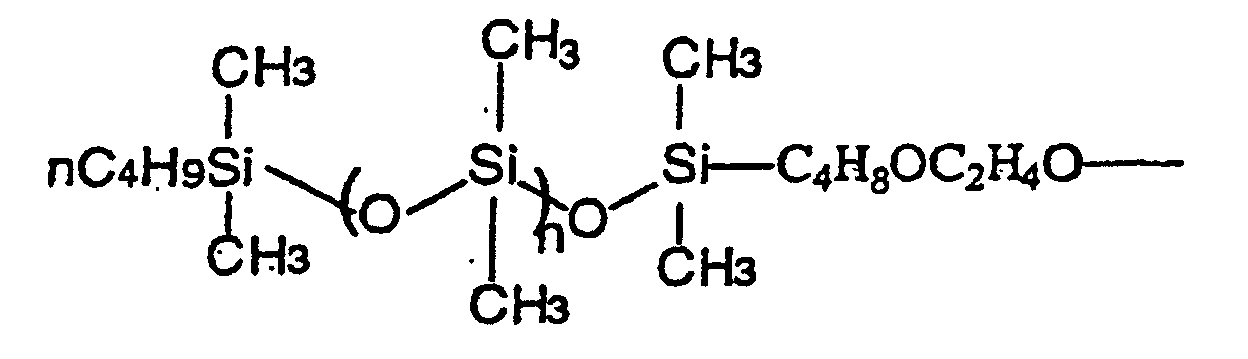
- Composition durcissable selon la revendication 1 ou la revendication 2, dans laquelle le polymère a la structure représentée par la formule (2) :dans laquelle n a une valeur d'environ 20 ou plus.

- Composition durcissable selon la revendication 1 où la revendication 2, dans laquelle la composition possède une viscosité Brookfield inférieure à environ 500 000 cP à 25°C.
- Composition durcissable selon la revendication 1 ou la revendication 2, dans laquelle la composition durcissable contient environ 60% en poids ou plus de silicone.
- Dispersion d'uréthane à terminaison silanol fabriquée au moyen de la composition durcissable selon la revendication 1.
- Composition durcie comprenant le produit de réaction d'une composition durcissable selon la revendication 1 ou la revendication 2 et un durcisseur.
- Revêtement comprenant la composition durcie selon la revendication 8, dans lequel le revêtement possède une énergie superficielle inférieure à environ 35 dynes/cm.
- Composition durcissable selon la revendication 2, dans laquelle le rapport entre le nombre de groupes oléfiniques et le nombre de groupes hydrure avant la formation du produit d'hydrosilylation a une valeur d'environ 20:1 ou plus.
- Composition durcissable selon la revendication 2, dans laquelle n a une valeur d'environ 400 ou plus.
- Procédé de fabrication d'une composition durcissable, ledit procédé comprenant les étapes consistant à :(a) se procurer plusieurs molécules de polymère, chaque molécule comprenant plusieurs groupes oléfiniques et au moins deux groupes fonctionnels organiques ;(b) se procurer plusieurs molécules de monohydrure d'organosiloxane ayant la structure représentée par la formule (4) :dans laquelle R4 a la structure représentée par la formule (5) :
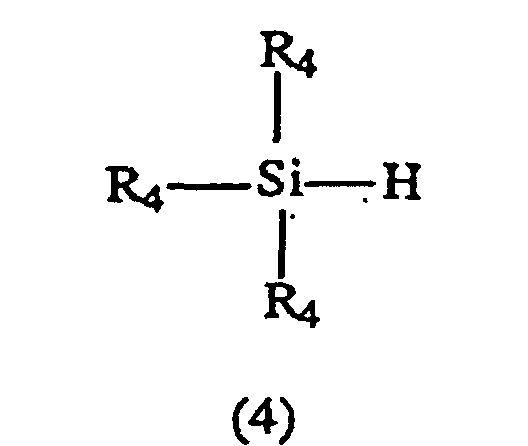 dans laquelle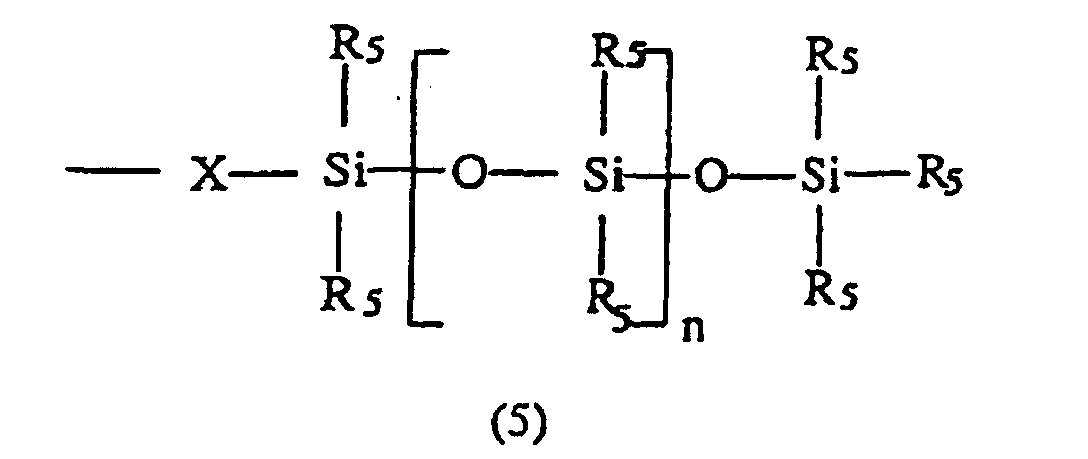
n a une valeur d'environ 200 ou plus ;
R5 représente un radical organique monovalent ; et
X représente un atome d'oxygène ou un groupe de liaison organique divalent ; et(c) faire réagir les plusieurs groupes oléfiniques du polymère avec le monohydrure d'organosiloxane pour former la composition durcissable. - Procédé de fabrication d'une composition durcissable, ledit procédé comprenant les étapes consistant à :(a) se procurer plusieurs molécules de polymère, chaque molécule de polymère comprenant plusieurs groupes oléfiniques et au moins deux groupes fonctionnels organiques ;(b) se procurer plusieurs molécules de dihydrure d'organosiloxane ayant la structure représentée par la formule (6) :dans laquelle
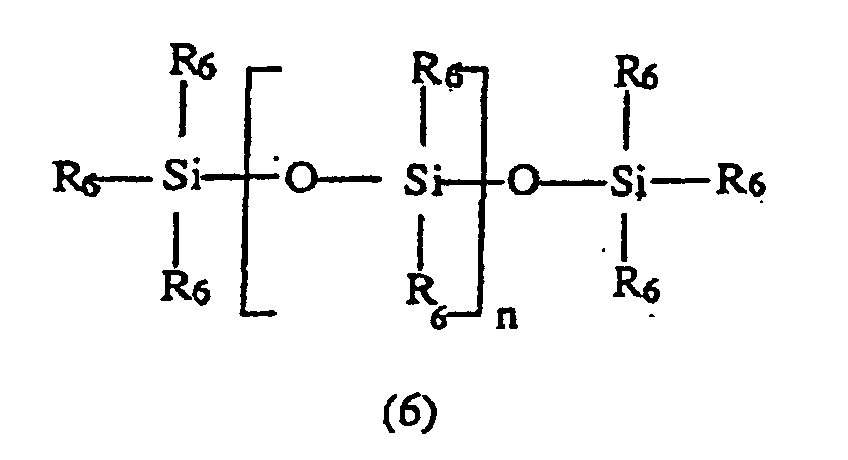
n a une valeur d'environ 200 ou plus ;
R6 est choisi indépendamment dans le groupe constitué par les radicaux organiques monovalents, les radicaux organosiloxane et l'atome d'hydrogène, à condition que deux groupes R6 soient des atomes d'hydrogène ;(c) réticuler les molécules de polymère en faisant réagir au moins une partie des groupes oléfiniques de la molécule de polymère avec au moins une partie des groupes hydrure du dihydrure d'organosiloxane pour former une composition durcissable comprenant environ 45% en poids ou plus de silicone.
Applications Claiming Priority (3)
| Application Number | Priority Date | Filing Date | Title |
|---|---|---|---|
| US09/365,274 US6271309B1 (en) | 1999-07-30 | 1999-07-30 | Curable compositions comprising the hydrosilation product of olefin-containing polymers and organosiloxane hydrides, cured compositions made therefrom, and methods of making same |
| US365274 | 1999-07-30 | ||
| PCT/US2000/019514 WO2001009250A1 (fr) | 1999-07-30 | 2000-07-18 | Compositions durcissables comprenant le produit d'hydrosilation de polymeres contenant des groupes olefiniques et d'hydrures d'organosiloxane, compositions durcies pouvant etre obtenues a partir de ces compositions et leurs procedes de production |
Publications (2)
| Publication Number | Publication Date |
|---|---|
| EP1200525A1 EP1200525A1 (fr) | 2002-05-02 |
| EP1200525B1 true EP1200525B1 (fr) | 2005-02-16 |
Family
ID=23438187
Family Applications (1)
| Application Number | Title | Priority Date | Filing Date |
|---|---|---|---|
| EP00950410A Expired - Lifetime EP1200525B1 (fr) | 1999-07-30 | 2000-07-18 | Compositions durcissables comprenant le produit d'hydrosilation de polymeres contenant des groupes olefiniques et d'hydrures d'organosiloxane, compositions durcies pouvant etre obtenues a partir de ces compositions et leurs procedes de production |
Country Status (7)
| Country | Link |
|---|---|
| US (1) | US6271309B1 (fr) |
| EP (1) | EP1200525B1 (fr) |
| JP (1) | JP2003521568A (fr) |
| KR (1) | KR20020035112A (fr) |
| CA (1) | CA2379158A1 (fr) |
| DE (1) | DE60018187T2 (fr) |
| WO (1) | WO2001009250A1 (fr) |
Families Citing this family (29)
| Publication number | Priority date | Publication date | Assignee | Title |
|---|---|---|---|---|
| US6991887B1 (en) * | 2000-11-01 | 2006-01-31 | Battelle Memorial Institute | Photopatternable sorbent and functionalized films |
| US7959198B2 (en) * | 2002-05-16 | 2011-06-14 | Labor Saving Systems, Ltd. | Magnetic line retrieval system and method |
| JP4101632B2 (ja) * | 2002-11-01 | 2008-06-18 | 株式会社カネカ | 硬化性組成物および復元性、クリープ性改善方法 |
| KR101061352B1 (ko) * | 2002-12-20 | 2011-08-31 | 케모센트릭스 | 인간 종양-발현된 ccxckr2의 저해물질 |
| CN100429279C (zh) * | 2003-05-12 | 2008-10-29 | 株式会社钟化 | 固化性组合物 |
| US8003744B2 (en) * | 2003-08-25 | 2011-08-23 | Kaneka Corporation | Curing composition with improved heat resistance |
| US7128412B2 (en) | 2003-10-03 | 2006-10-31 | Xerox Corporation | Printing processes employing intermediate transfer with molten intermediate transfer materials |
| US20050074260A1 (en) * | 2003-10-03 | 2005-04-07 | Xerox Corporation | Printing apparatus and processes employing intermediate transfer with molten intermediate transfer materials |
| WO2005097907A1 (fr) * | 2004-04-01 | 2005-10-20 | Kaneka Corporation | Composition vulcanisable |
| WO2005097908A1 (fr) * | 2004-04-01 | 2005-10-20 | Kaneka Corporation | Composition vulcanisable à simple composant |
| WO2005097906A1 (fr) * | 2004-04-01 | 2005-10-20 | Kaneka Corporation | Composition vulcanisable à simple composant |
| US20070203297A1 (en) * | 2004-04-01 | 2007-08-30 | Kaneka Corporation | Curable Composition |
| US7105622B2 (en) * | 2004-06-02 | 2006-09-12 | The University Of Akron | Hybrid polyurethanes |
| US8030427B2 (en) * | 2004-06-09 | 2011-10-04 | Kaneka Corporation | Curable composition |
| WO2006070637A1 (fr) * | 2004-12-28 | 2006-07-06 | Kaneka Corporation | Composition durcissable |
| EP1873208B2 (fr) * | 2005-04-15 | 2024-10-09 | Kaneka Corporation | Composition durcissable et article durci d une transparence excellente |
| DE602006018346D1 (de) * | 2005-09-30 | 2010-12-30 | Kaneka Corp | Härtbare zusammensetzung mit verbesserter härtung und lagerstabilität |
| US7956123B2 (en) * | 2005-10-24 | 2011-06-07 | Momentive Performance Materials Inc. | Solvent resistant polyurethane adhesive compositions |
| TW200813175A (en) * | 2006-07-25 | 2008-03-16 | Fujifilm Hunt Smart Surfaces Llc | Polysiloxane based in situ polymer blends-compositions, articles and methods of preparation thereof |
| JP5457025B2 (ja) * | 2008-12-25 | 2014-04-02 | 三井化学株式会社 | オレフィン樹脂系塗料 |
| JP5769942B2 (ja) * | 2010-09-17 | 2015-08-26 | 大日本印刷株式会社 | 積層体およびその製造方法 |
| WO2012135281A2 (fr) * | 2011-03-29 | 2012-10-04 | Alzo International, Inc. | Polymères à base d'hydrocarbures insaturés réticulés par une silicone |
| CN102964974A (zh) * | 2011-04-25 | 2013-03-13 | 陶氏环球技术有限公司 | 湿气固化防污涂料组合物 |
| EP2726870B1 (fr) | 2011-06-29 | 2018-10-03 | Academia Sinica | Capture, purification et libération d'une substance biologique utilisant un revêtement de surface |
| TW201623605A (zh) | 2014-04-01 | 2016-07-01 | 中央研究院 | 用於癌症診斷及預後之方法及系統 |
| US10112198B2 (en) | 2014-08-26 | 2018-10-30 | Academia Sinica | Collector architecture layout design |
| US10107726B2 (en) | 2016-03-16 | 2018-10-23 | Cellmax, Ltd. | Collection of suspended cells using a transferable membrane |
| JP6869333B2 (ja) | 2016-09-02 | 2021-05-12 | 株式会社ブリヂストン | ポリマーセメントのその場ヒドロシリル化により調製される複数のシラン官能基を有するシス−1,4−ポリジエンの製造 |
| CN110105535A (zh) * | 2019-05-21 | 2019-08-09 | 华侨大学 | 一种硅烷偶联剂接枝改性水性聚氨酯的制备方法 |
Family Cites Families (14)
| Publication number | Priority date | Publication date | Assignee | Title |
|---|---|---|---|---|
| JPS5277194A (en) * | 1975-12-23 | 1977-06-29 | Shin Etsu Chem Co Ltd | Preparation of polybutadiene derivatives |
| US4417069A (en) | 1983-02-22 | 1983-11-22 | General Electric Company | Method of preparing β-phenylethylchlorosilanes |
| JP3015444B2 (ja) | 1990-10-17 | 2000-03-06 | 株式会社トクヤマ | 剥離紙 |
| US5233071A (en) | 1992-03-17 | 1993-08-03 | E. I. Du Pont De Nemours And Company | Hydrosilation of fluorinated olefins with cobalt catalysts |
| JPH0625661A (ja) | 1992-07-09 | 1994-02-01 | Nippon Telegr & Teleph Corp <Ntt> | 赤外可視波長上方変換材料 |
| US5484950A (en) | 1992-12-21 | 1996-01-16 | Polyset Company, Inc. | Process for selective monoaddition to silanes containing two silicon-hydrogen bonds and products thereof |
| JPH06256661A (ja) * | 1993-03-04 | 1994-09-13 | Shin Etsu Chem Co Ltd | オルガノポリシロキサングラフト樹脂組成物 |
| US5554686A (en) | 1993-08-20 | 1996-09-10 | Minnesota Mining And Manufacturing Company | Room temperature curable silane-terminated polyurethane dispersions |
| CA2115002C (fr) | 1994-02-04 | 1999-08-03 | Ashok Sengupta | Revetement de polyurethane a base d'eau |
| CA2192188C (fr) | 1994-06-30 | 2008-08-19 | Joel D. Oxman | Composition de moulage et de revetement a temoin visuel de polymerisation |
| US5703163A (en) | 1995-05-31 | 1997-12-30 | Fluorochem, Inc. | Loop polymers |
| US5550272A (en) | 1995-10-02 | 1996-08-27 | General Electric Company | Method for hydrosilating unsaturated monomers |
| US5691435A (en) | 1996-01-25 | 1997-11-25 | Wacker-Chemie Gmbh | Crosslinkable compositions |
| ATE247149T1 (de) * | 1996-05-15 | 2003-08-15 | Kaneka Corp | Härtbare zusammensetzung, durch verwendung davon hergestellter schaum und verfahren zur herstellung |
-
1999
- 1999-07-30 US US09/365,274 patent/US6271309B1/en not_active Expired - Lifetime
-
2000
- 2000-07-18 CA CA002379158A patent/CA2379158A1/fr not_active Abandoned
- 2000-07-18 KR KR1020027001273A patent/KR20020035112A/ko not_active Withdrawn
- 2000-07-18 DE DE60018187T patent/DE60018187T2/de not_active Expired - Lifetime
- 2000-07-18 JP JP2001514047A patent/JP2003521568A/ja active Pending
- 2000-07-18 WO PCT/US2000/019514 patent/WO2001009250A1/fr not_active Ceased
- 2000-07-18 EP EP00950410A patent/EP1200525B1/fr not_active Expired - Lifetime
Also Published As
| Publication number | Publication date |
|---|---|
| US6271309B1 (en) | 2001-08-07 |
| WO2001009250A1 (fr) | 2001-02-08 |
| KR20020035112A (ko) | 2002-05-09 |
| JP2003521568A (ja) | 2003-07-15 |
| EP1200525A1 (fr) | 2002-05-02 |
| CA2379158A1 (fr) | 2001-02-08 |
| DE60018187D1 (de) | 2005-03-24 |
| DE60018187T2 (de) | 2005-12-29 |
Similar Documents
| Publication | Publication Date | Title |
|---|---|---|
| EP1200525B1 (fr) | Compositions durcissables comprenant le produit d'hydrosilation de polymeres contenant des groupes olefiniques et d'hydrures d'organosiloxane, compositions durcies pouvant etre obtenues a partir de ces compositions et leurs procedes de production | |
| US5554686A (en) | Room temperature curable silane-terminated polyurethane dispersions | |
| CA2311457C (fr) | Dispersions de polyurethane a base aqueuse, stables et a terminaison silane, durcissables a temperature ambiante et contenant du fluor et/ou du silicone, et revetements a faible tension de surface obtenus | |
| KR101425916B1 (ko) | 수중 가교제 분산액의 제조방법 | |
| US5017322A (en) | Process for inhibiting fouling of an underwater surface | |
| US4902767A (en) | High slip urethane-siloxane coatings | |
| US20020142169A1 (en) | Two-component polyurethane binders as primers | |
| KR102780057B1 (ko) | 아스파르트산 에스테르-기능성 폴리실록산, 그것의 제조 및 그것의 용도 | |
| CN101336276A (zh) | 甲硅烷基化的聚氨酯-聚脲保护性涂料组合物 | |
| JP2005015644A (ja) | 新規化合物およびそれを含有する硬化性樹脂組成物 | |
| CN113637409B (zh) | 单组份聚氨酯防水涂料组合物及其制备方法 | |
| US20050010011A1 (en) | NCO compounds with covalently bonded polyhedral oligomeric silicon-oxygen cluster units | |
| CN113692430A (zh) | 底漆组合物 | |
| US11028287B2 (en) | Moisture-curable omniphobic coatings | |
| CN117757345B (zh) | 一种适用于金属基材的水性涂料组合物 | |
| JP4666832B2 (ja) | ウェザーストリップゴム用コーティング剤組成物 | |
| CN120758168A (zh) | 一种高强度有机硅改性防污涂料树脂、组合物及其制备方法 | |
| JP2628409B2 (ja) | 塗料組成物 | |
| JPH02286760A (ja) | 塗料組成物 | |
| BR112021007374B1 (pt) | Polissiloxanos funcionais modificados com éster de ácido aspártico e uso do mesmos, composição curável e uso da mesma, composições curadas, artigos, composição de revestimento, revestimento, artigos compósitos e processo para a fabricação dos compostos | |
| JPH02286757A (ja) | 塗料組成物 | |
| WO2002090432A1 (fr) | Composition de resine et utilisation correspondante | |
| KR20120120908A (ko) | 수분 경화성 항오손 코팅 조성물 | |
| HK1123820B (en) | Process for the preparation of dispersions of cross-linking agents in water |
Legal Events
| Date | Code | Title | Description |
|---|---|---|---|
| PUAI | Public reference made under article 153(3) epc to a published international application that has entered the european phase |
Free format text: ORIGINAL CODE: 0009012 |
|
| 17P | Request for examination filed |
Effective date: 20020215 |
|
| AK | Designated contracting states |
Kind code of ref document: A1 Designated state(s): AT BE CH CY DE DK ES FI FR GB GR IE IT LI LU MC NL PT SE |
|
| AX | Request for extension of the european patent |
Free format text: AL;LT;LV;MK;RO;SI |
|
| GRAP | Despatch of communication of intention to grant a patent |
Free format text: ORIGINAL CODE: EPIDOSNIGR1 |
|
| RBV | Designated contracting states (corrected) |
Designated state(s): DE FR GB IT |
|
| RIC1 | Information provided on ipc code assigned before grant |
Ipc: 7C 09D 183/10 B Ipc: 7C 08L 83/10 A |
|
| GRAJ | Information related to disapproval of communication of intention to grant by the applicant or resumption of examination proceedings by the epo deleted |
Free format text: ORIGINAL CODE: EPIDOSDIGR1 |
|
| GRAP | Despatch of communication of intention to grant a patent |
Free format text: ORIGINAL CODE: EPIDOSNIGR1 |
|
| RIC1 | Information provided on ipc code assigned before grant |
Ipc: 7C 09D 183/10 B Ipc: 7C 08L 83/10 A |
|
| GRAS | Grant fee paid |
Free format text: ORIGINAL CODE: EPIDOSNIGR3 |
|
| GRAA | (expected) grant |
Free format text: ORIGINAL CODE: 0009210 |
|
| AK | Designated contracting states |
Kind code of ref document: B1 Designated state(s): DE FR GB IT |
|
| REG | Reference to a national code |
Ref country code: GB Ref legal event code: FG4D |
|
| REG | Reference to a national code |
Ref country code: IE Ref legal event code: FG4D |
|
| REF | Corresponds to: |
Ref document number: 60018187 Country of ref document: DE Date of ref document: 20050324 Kind code of ref document: P |
|
| PLBE | No opposition filed within time limit |
Free format text: ORIGINAL CODE: 0009261 |
|
| STAA | Information on the status of an ep patent application or granted ep patent |
Free format text: STATUS: NO OPPOSITION FILED WITHIN TIME LIMIT |
|
| ET | Fr: translation filed | ||
| 26N | No opposition filed |
Effective date: 20051117 |
|
| PGFP | Annual fee paid to national office [announced via postgrant information from national office to epo] |
Ref country code: GB Payment date: 20120718 Year of fee payment: 13 |
|
| PGFP | Annual fee paid to national office [announced via postgrant information from national office to epo] |
Ref country code: DE Payment date: 20120711 Year of fee payment: 13 Ref country code: FR Payment date: 20120719 Year of fee payment: 13 Ref country code: IT Payment date: 20120717 Year of fee payment: 13 |
|
| GBPC | Gb: european patent ceased through non-payment of renewal fee |
Effective date: 20130718 |
|
| REG | Reference to a national code |
Ref country code: FR Ref legal event code: ST Effective date: 20140331 |
|
| PG25 | Lapsed in a contracting state [announced via postgrant information from national office to epo] |
Ref country code: GB Free format text: LAPSE BECAUSE OF NON-PAYMENT OF DUE FEES Effective date: 20130718 Ref country code: DE Free format text: LAPSE BECAUSE OF NON-PAYMENT OF DUE FEES Effective date: 20140201 |
|
| REG | Reference to a national code |
Ref country code: DE Ref legal event code: R119 Ref document number: 60018187 Country of ref document: DE Effective date: 20140201 |
|
| PG25 | Lapsed in a contracting state [announced via postgrant information from national office to epo] |
Ref country code: IT Free format text: LAPSE BECAUSE OF NON-PAYMENT OF DUE FEES Effective date: 20130718 Ref country code: FR Free format text: LAPSE BECAUSE OF NON-PAYMENT OF DUE FEES Effective date: 20130731 |