EP1202997B1 - Silanes hydrolysables et polymerisables a faible viscosite et leur utilisation - Google Patents
Silanes hydrolysables et polymerisables a faible viscosite et leur utilisation Download PDFInfo
- Publication number
- EP1202997B1 EP1202997B1 EP00951376A EP00951376A EP1202997B1 EP 1202997 B1 EP1202997 B1 EP 1202997B1 EP 00951376 A EP00951376 A EP 00951376A EP 00951376 A EP00951376 A EP 00951376A EP 1202997 B1 EP1202997 B1 EP 1202997B1
- Authority
- EP
- European Patent Office
- Prior art keywords
- compounds
- radicals
- och
- optionally
- silanes
- Prior art date
- Legal status (The legal status is an assumption and is not a legal conclusion. Google has not performed a legal analysis and makes no representation as to the accuracy of the status listed.)
- Expired - Lifetime
Links
- 0 CCC*C(C)CCC(*1)C1C(*)(CC)*C(CC)(CC)C(CC1C=CC*1)[C@@]1C*CC1 Chemical compound CCC*C(C)CCC(*1)C1C(*)(CC)*C(CC)(CC)C(CC1C=CC*1)[C@@]1C*CC1 0.000 description 4
- XHMCQVLYNLNETO-UHFFFAOYSA-N CN/C(/C(OCCOC)=O)=N\C Chemical compound CN/C(/C(OCCOC)=O)=N\C XHMCQVLYNLNETO-UHFFFAOYSA-N 0.000 description 1
Classifications
-
- C—CHEMISTRY; METALLURGY
- C07—ORGANIC CHEMISTRY
- C07F—ACYCLIC, CARBOCYCLIC OR HETEROCYCLIC COMPOUNDS CONTAINING ELEMENTS OTHER THAN CARBON, HYDROGEN, HALOGEN, OXYGEN, NITROGEN, SULFUR, SELENIUM OR TELLURIUM
- C07F7/00—Compounds containing elements of Groups 4 or 14 of the Periodic Table
- C07F7/02—Silicon compounds
- C07F7/08—Compounds having one or more C—Si linkages
- C07F7/18—Compounds having one or more C—Si linkages as well as one or more C—O—Si linkages
- C07F7/1804—Compounds having Si-O-C linkages
-
- A—HUMAN NECESSITIES
- A61—MEDICAL OR VETERINARY SCIENCE; HYGIENE
- A61K—PREPARATIONS FOR MEDICAL, DENTAL OR TOILETRY PURPOSES
- A61K6/00—Preparations for dentistry
- A61K6/20—Protective coatings for natural or artificial teeth, e.g. sealings, dye coatings or varnish
-
- A—HUMAN NECESSITIES
- A61—MEDICAL OR VETERINARY SCIENCE; HYGIENE
- A61K—PREPARATIONS FOR MEDICAL, DENTAL OR TOILETRY PURPOSES
- A61K6/00—Preparations for dentistry
- A61K6/30—Compositions for temporarily or permanently fixing teeth or palates, e.g. primers for dental adhesives
-
- A—HUMAN NECESSITIES
- A61—MEDICAL OR VETERINARY SCIENCE; HYGIENE
- A61K—PREPARATIONS FOR MEDICAL, DENTAL OR TOILETRY PURPOSES
- A61K6/00—Preparations for dentistry
- A61K6/80—Preparations for artificial teeth, for filling teeth or for capping teeth
- A61K6/884—Preparations for artificial teeth, for filling teeth or for capping teeth comprising natural or synthetic resins
- A61K6/887—Compounds obtained by reactions only involving carbon-to-carbon unsaturated bonds
-
- A—HUMAN NECESSITIES
- A61—MEDICAL OR VETERINARY SCIENCE; HYGIENE
- A61K—PREPARATIONS FOR MEDICAL, DENTAL OR TOILETRY PURPOSES
- A61K6/00—Preparations for dentistry
- A61K6/80—Preparations for artificial teeth, for filling teeth or for capping teeth
- A61K6/884—Preparations for artificial teeth, for filling teeth or for capping teeth comprising natural or synthetic resins
- A61K6/891—Compounds obtained otherwise than by reactions only involving carbon-to-carbon unsaturated bonds
- A61K6/896—Polyorganosilicon compounds
Definitions
- the invention relates to hydrolyzable and polymerizable silanes with lower Viscosity, process for their preparation and their use, especially in dental masses.
- EP-A-0 682 033 and EP-A-0 450 624 are hydrolyzable and polymerizable silanes known, the hydroxyl or carbonyl groups or Have urethane groups.
- the molecules described there are relatively inflexible and have a high condensate viscosity, for example in the Requires use in composite materials, thinner monomers use.
- the addition of diluent monomers has the grave one Disadvantage that the risk of increased residual monomer triggering and thus a there is increased toxicological concern.
- the object of the present invention is to prepare organically modified silanes places that are hydrolyzable and merisable and that are low-viscosity and flexible are without evaporating from the formulated masses, and thus alone can be processed to dental masses, for example, without it Addition of dilution monomers is required.
- R ' preferably has the following meaning: Alkylene, alkenylene, arylene, arylene alkylene or alkylene arylene each having 0 to 5 carbon atoms, it being possible for these radicals to be interrupted by oxygen and sulfur atoms or by amino groups.
- silanes according to the invention are low-viscosity and flexible and evaporate from the masses formulated with them not from you alone, in mixtures or together with other hydrolyzable, condensable or polymerizable Components for scratch-resistant coatings, fillings, adhesives or Sealants, molded articles or embedding materials are processed.
- the silanes according to the invention can be used universally and can be in one inorganic-organic composite system, i.e. into an inorganic-organic Network.
- the silanes of the formula I can be polymerized via the residues B and via the residues D hydrolyzable.
- An inorganic Network with Si-O-Si units are built, while the rest of B contained double bonds with the formation of an organic network polymerize.
- the alkyl radicals are, for example, straight-chain, branched or cyclic radicals 1 to 20, in particular with 1 to 10 carbon atoms and preferably lower Alkyl radicals with 1 to 6, particularly preferably with 1 to 4 carbon atoms.
- Specific Examples are methyl, ethyl, n-propyl, i-propyl, n-butyl, s-butyl, i-butyl, t-butyl, n-pentyl, n-hexyl, cyclohexyl, 2-ethylhexyl, dodecyl and octadecyl.
- alkenyl radicals are, for example, straight-chain, branched or cyclic radicals with 2 to 20, preferably with 2 to 10 carbon atoms and preferably lower Alkenyl radicals with 2 to 6 carbon atoms, such as vinyl, allyl and 2-butenyl.
- Preferred aryl radicals have 6-20, particularly preferably 6-15 carbon atoms.
- Preferred acyl residues have 1-15 carbon atoms, preferably 1-10 Carbon atoms.
- Preferred arylalkyl and alkylaryl radicals have 7-25, preferred 7 - 15 carbon atoms.
- Preferred alkylene radicals have 2-15, especially preferably 2 - 10 carbon atoms.
- Preferred arylene groups have 6-25, especially preferably 6 - 15 carbon atoms.
- Preferred alkylene arylene groups have 7-25, especially preferably 7-15 carbon atoms.
- Preferred alkoxy, acyloxy, alkylcarbonyl or Alkoxycarbonyl radicals have 1-15, particularly preferably 1-10 carbon atoms.
- preferred Alkylamino and dialkylamino radicals have 1-15, particularly preferably 1-10, carbon atoms.
- Preferred aryl radicals are phenyl, biphenyl and naphthyl.
- the alkoxy, acyloxy, Alkylamino, dialkylamino, alkylcarbonyl, alkoxycarbonyl, arylalkyl, alkylaryl, Alkylene and alkylene and alkylene arylene radicals are preferably derived from the above mentioned alkyl and aryl radicals.
- the radicals mentioned can optionally carry one or more substituents, for example halogen, alkyl, hydroxyalkyl, alkoxy, aryloxy, alkylcarbonyl, alkoxycarbonyl, furfuryl, tetrahydrofurfuryl, amino, monoalkylamino, dialkylamino, trialkylammonium, amido, hydroxy, formyl, carboxy, mercapto, cyano, Isocyanato, nitro, epoxy, SO 3 H or PO 4 H 2 .
- substituents for example halogen, alkyl, hydroxyalkyl, alkoxy, aryloxy, alkylcarbonyl, alkoxycarbonyl, furfuryl, tetrahydrofurfuryl, amino, monoalkylamino, dialkylamino, trialkylammonium, amido, hydroxy, formyl, carboxy, mercapto, cyano, Isocyanato, nitro, epoxy, SO 3
- halogens fluorine, chlorine and bromine and especially chlorine are preferred.
- the rest B is in each case with a group -R'- connected.
- R alkyl, aryl, cycloyalkyl
- R alkyl, aryl, cycloyalkyl
- n 1, 2, 3, 4, 5, 6, 7, 8, 9, 10
- R alkyl, aryl, cycloyalkyl
- R alkyl, aryl, cycloalkyl
- U has the above meaning.
- the equimolar addition product is converted into a derivative according to the invention by subjecting it to a further addition reaction.
- silanes according to the invention can also be used alone or together with other hydrolyzable, condensable and / or polymerizable Components are processed into polymers by subsequent hydrolytic condensation can be solidified.
- Silica (hetero) polycondensates modified with organic groups, and processes for their production are in large numbers known.
- Such condensates find for the various purposes, for example as molding compounds or as Varnishes for coatings. Because of the diverse application possibilities of this However, there is also a constant need to modify the substance class already known condensates, on the one hand, thereby creating new areas of application to open up and on the other hand to their properties for certain To optimize uses even further.
- organically modified, hydrolyzable and condensable silanes in Coating, filling, adhesive and sealing compounds, in moldings and Investment materials according to the prior art through the silanes according to the invention replace.
- the silanes according to the invention optionally hydrolyzed with the addition of other co-condensable components and polycondensed.
- the polycondensation is preferably carried out after Sol-gel processes, as described, for example, in DE-A-2 758 414, DE-A-2 758 415, DE-A-3 011 761, DE-A-3 826 715 and DE-A-3 835 968.
- the silanes according to the invention are used to build up the organic network optionally with the addition of other copolymerizable components polymerized.
- the polymerization can, for example, be thermally, redox-induced, covalently nucleophilic and / or photochemically using methods, as for example in DE-A-3 143 820, DE-A-3 826 715 and DE-A-3 835 968 are described.
- Compounds can be added as further polymerizable components, which are free-radically and / or ionically polymerizable.
- Ionic polymerizable compounds that are added can contain, for example, ring systems that are cationic ring-opening are polymerizable, such as spiro orthoesters, spiro orthocarbonates, bicyclic Spiro orthoesters, mono- or oligoepoxides or oxetanes or spirosilanes, as they do are known from DE-C-4 125 201.
- ring systems that are cationic ring-opening are polymerizable, such as spiro orthoesters, spiro orthocarbonates, bicyclic Spiro orthoesters, mono- or oligoepoxides or oxetanes or spirosilanes, as they do are known from DE-C-4 125 201.
- silane-linked cyclic systems add that can be polymerized with.
- Such systems are for example those containing epoxides.
- Such systems are in the Preparation of the spirosilanes described in DE-C-4 125 201.
- the silanes according to the invention are highly reactive systems which Poly (hetero) condensates lead, for example, when exposed to UV radiation in the shortest possible time to mechanically stable coatings or molded or filled bodies to lead.
- the silanes according to the invention are simple addition reactions can be produced and a suitable selection of the starting compounds have variable number of reactive groups of different functionality.
- the silanes according to the invention have relatively high molecular weights and accordingly a reduced volatility compared to pure (Meth) acrylate monomers, so that the toxic hazard during the Processing and application is less.
- polysiloxanes with a further reduced level are formed Volatility, which completely eliminates the toxicity problem of the acrylate components remedy.
- Silanes silica (hetero) polycondensates according to the invention are available be provided, which are adapted in a variety of ways to predetermined areas of application can be and therefore in all areas in which previously Silica (hetero) polycondensates were used, can be used, but also open up new uses, for example in the field optics, electronics, medicine, especially dental medicine, the Optoelectronics and packaging for food.
- silanes according to the invention can either be used as such or in compositions that are additionally adapted to the intended use Contain additives, for example conventional paint additives, solvents, fillers, Photoinitiators, thermal initiators, leveling agents and pigments.
- Contain additives for example conventional paint additives, solvents, fillers, Photoinitiators, thermal initiators, leveling agents and pigments.
- silanes according to the invention or the silane-containing compositions are suitable for example for the production of coating, filler, or Bulk materials, of adhesives and injection molding compounds, of fibers, particles, Films, adhesion promoters, impression materials and embedding materials.
- Coatings and moldings made from the silanes according to the invention have the Advantage that they can be structured photochemically.
- Special areas of application are, for example, the coating of substrates made of metal, plastic, paper, Ceramics (by dipping, pouring, brushing, spraying, electrostatic spraying, Electrocoating), the use for optical, optoelectric or electronic Components, the manufacture of fillers, the manufacture of scratch-resistant, abrasion-resistant corrosion protection coatings of molded articles, for example by injection molding, molding, pressing, rapid prototyping or extrusion, and the Production of composites, for example with fibers, fillers or fabrics.
- silanes of the formula I can also be used hydrolytically condensable compounds of silicon, boron, aluminum, of phosphorus, tin, lead, transition metals, lanthanides or Actinides can be used. These compounds can either as such or already used in precondensed form for the production of the polycondensates become. It is preferred if at least 10 mol%, in particular at least 80 Mol% and especially at least 90 mol%, based on monomeric compounds, of the (hetero) polycondensates used to produce the silica Starting materials are silicon compounds.
- the silica (hetero) polycondensates at least 5 mol%, for example 25 to 100 mol%, in particular 50 to 100 mol%, and especially 75 to 100 mol%, each based on monomeric compounds, on one or more of the silanes according to the invention are based.
- silanes are described, for example, in DE-C-34 07 087.
- silanes according to the invention must be used for further processing Poly (hetero) condensates are not necessarily isolated. It is also possible, in a one-pot process, first to produce these silanes and then - if necessary after adding further hydrolyzable compounds - hydrolytically to condense.
- the silanes of the formula IX can be polymerized via the radicals G and via the radicals X hydrolyzable.
- An inorganic Network with Si-O-Si units are built, while those in the rest of G contained double bonds with the formation of an organic network polymerize.
- radicals X and R can each be the same or one have different meanings.
- hydrolyzable aluminum compounds which are optionally used, those are particularly preferred which have the general formula AIR 0 3 , in which the radicals R 0 , which may be the same or different, are selected from halogen, alkoxy, alkoxycarbonyl and hydroxy.
- R 0 which may be the same or different, are selected from halogen, alkoxy, alkoxycarbonyl and hydroxy.
- R 0 which may be the same or different
- Aluminum alkoxides and halides are particularly preferred aluminum compounds.
- concrete examples can be mentioned: Al (OCH 3 ) 3 , Al (OC 2 H 5 ) 3 , Al (OnC 3 H 7 ) 3 , Al (OiC 3 H 7 ) 3 , Al (OC 4 H 9 ) 3 , Al (OiC 4 H 9 ) 3 , Al (OsC 4 H 9 ) 3 , AlCl 3 , AlCl- (OH) 2 .
- Compounds that are liquid at room temperature such as aluminum sec-butoxide and aluminum isopropylate are particularly preferred.
- Suitable hydrolyzable titanium or zirconium compounds which can optionally be used are those of the general formula MX y R z , in which M denotes Ti or Zr, y is an integer from 1 to 4, in particular 2 to 4, z for 0, 1, 2 or 3, preferably 0, 1 or 2, and X and R are as defined in the case of the general formula I. This also applies to the preferred meanings. It is particularly preferred if y is 4.
- complexed Ti or Zr connections are used.
- Additional preferred complexing agents are here acrylic acid and methacrylic acid.
- Zr and Ti compounds that can be used are as follows: TiCl 4 , Ti (OC 2 H 5 ) 4 , Ti (OC 3 H 7 ) 4 , Ti (OiC 3 H 7 ) 4 , Ti (OC 4 H 9 ) 4 , Ti (2-ethylhexoxy) 4 , ZrCl 4 , Zr (OC 2 H 5 ) 4 , Zr- (OC 3 H 7 ) 4 , Zr (OiC 3 H 7 ) 4 , Zr (OC 4 H 9 ) 4 , Zr (2-ethylhexoxy) 4 , ZrOCl 2 .
- hydrolyzable compounds which can be used to prepare the polyheterocondensates are, for example, boron trihalides and boric acid esters, such as BCl 3 , B (OCH 3 ) 3 and B (OC 2 H 5 ) 3 , tin tetrahalides and tin tetraalkoxides, such as SnCl 4 and Sn (OCH 3 ) 4 , and vanadyl compounds such as VOCl 3 and VO (OCH 3 ) 3 .
- boron trihalides and boric acid esters such as BCl 3 , B (OCH 3 ) 3 and B (OC 2 H 5 ) 3
- tin tetrahalides and tin tetraalkoxides such as SnCl 4 and Sn (OCH 3 ) 4
- vanadyl compounds such as VOCl 3 and VO (OCH 3 ) 3 .
- the preparation of the poly (hetero) condensates can be carried out on this In the usual way.
- the hydrolytic condensation in the most cases are done by the one to be hydrolyzed Silicon compounds, either as such or dissolved in a suitable Solvent are present, the required water at room temperature or below lighter cooling directly (preferably with stirring and in the presence of a Hydrolysis and condensation catalyst) and the resulting mixture then stir for some time (one to several hours).
- a solvent comes alongside the lower aliphatic Alcohols (e.g. ethanol or i-propanol) also ketones, preferably lower dialkyl ketones, such as acetone or methyl isobutyl ketone, ether, preferably lower dialkyl ethers such as diethyl ether or dibutyl ether, THF, amides, esters, in particular ethyl acetate, dimethylformamide, amines, in particular Triethylamine, and their mixtures in question.
- ketones e.g. ethanol or i-propanol
- ether preferably lower dialkyl ethers such as diethyl ether or dibutyl ether
- THF amides, esters, in particular ethyl acetate, dimethylformamide
- amines in particular Triethylamine, and their mixtures in question.
- spirosilanes are used to produce the poly (hetero) condensates
- hydrolysis is preferred in an environment which is basic with respect to the spirosilanes carried out. This is done either through a basic solvent, such as for example triethylamine, or by adding basic hydrolysis and Condensation catalysts such as KOH, methylimidazole are produced.
- the starting compounds do not necessarily all have to be at the beginning hydrolysis (polycondensation), but in certain cases it may even prove advantageous if only a part of these connections is first brought into contact with water and later the rest Connections are added.
- hydrolyzable compounds precipitate during hydrolysis and Avoiding polycondensation as much as possible can add water in several stages, for example in three stages.
- a tenth to a twentieth of that for hydrolysis required amount of water can be added.
- the Add a fifth to a tenth of the amount of water required take place, and after further brief stirring, the rest can finally be added become.
- the condensation time depends on the respective output components and their proportions, the catalyst optionally used, the Reaction temperature, etc. In general, the polycondensation takes place at Normal pressure, but it can also with increased or reduced pressure be performed.
- the poly (hetero) condensate obtained in this way can either as such or after partial or almost complete removal of the solvent used to be processed further.
- the excess water and the solvent formed and optionally additionally used by a replace other solvent to stabilize the poly (hetero) condensate.
- the reaction mixture can be, for example, in vacuo at light increased temperature so far that they can still be easily with a other solvents can be added.
- the final curing of the poly (hetero) condensates takes place after the addition of suitable ones Initiators thermal, redox-induced, covalent-nucleophilic or photochemical, whereby also run several curing mechanisms in parallel and / or in succession can.
- Initiators thermal, redox-induced, covalent-nucleophilic or photochemical, whereby also run several curing mechanisms in parallel and / or in succession can.
- the C C double bonds linked and the organic network is built up. Because of the relative High molecular weights of the silanes according to the invention are experienced in the Hardening only a small volume shrinkage.
- the poly (hetero) condensate is cured photochemically, it becomes Photoinitiators added, with thermal curing thermal initiators and at redox-induced hardening starter-activator systems.
- the initiator can be added in customary amounts. For example a mixture containing 30 to 50 wt .-% solid (polycondensate) initiators in an amount of, for example, 0.5 to 5% by weight, in particular 1 to 3 % By weight, based on the mixture, are added.
- Silanes used other components that contain reactive double bonds can also run a polymerization that is thermal and / or photochemical and / or covalently-nucleophilic and / or redox-initiated.
- the commercially available photoinitiators can be used, for example become.
- Examples include Irgacure 184 (1-hydroxycyclohexylphenyl ketone), Irgacure 500 (1-hydroxycyclohexylphenyl ketone-benzophenone), and others from Ciba-Geigy available photo initiators of the Irgacure type: Darocure 1173, 1116, 1398, 1174 and 1020 (available from Merck), benzophenone, 2-chlorothioxanthone, 2-methylthioxanthone, 2-isopropylthioxanthone, benzoin, 4,4'-dimethoxybenzoin etc. Cures with visible light, such as For example in the dental field, camphor quinone, for example, can be used as an initiator be used.
- Organic peroxides in the form of in particular come as thermal initiators Diacyl peroxides, peroxydicarbonates, alkyl peresters, dialkyl peroxides, perketals, Ketone peroxides and alkyl hydroperoxides in question. Concrete and preferred Examples of thermal initiators are dibenzoyl peroxide, t-butyl perbenzoate and Azobisisobutyronitrile.
- starter-activator systems can be used, such as for example aromatic amines (for example N, N-bis (2-hydroxy-ethyl) -p-toluidine) as activators or as starters, for example Dibenzoyl peroxide, with their concentration or their Concentration ratio the curing time according to the respective Use case can be set.
- aromatic amines for example N, N-bis (2-hydroxy-ethyl) -p-toluidine
- starters for example Dibenzoyl peroxide, with their concentration or their Concentration ratio the curing time according to the respective Use case can be set.
- Further amines are, for example, DE-A-4 310 733.
- initiators In the case of covalent-nucleophilic hardening, for example, initiators are used Compounds with at least one amino group added. Suitable amines are see for example DE-A-4 405 261.
- An initiator-based lacquer (poly (hetero) condensate) based on the Silanes according to the invention can then be used for coatings on substrates become.
- Common coating methods can be used for this coating are used, for example dipping, flooding, pouring, spinning, rolling, Spraying, painting, electrostatic spraying and electrocoating.
- the varnish is not necessarily must contain solvents.
- Starting substances (silanes) with two alkoxy groups on the Si atom can also be without Addition of solvents to be worked.
- the applied lacquer is preferably allowed to dry. Then, depending on the type of initiator, it can be redox-induced, thermal or be cured photochemically in a manner known per se. Of course Combinations of curing methods are also possible.
- the applied varnish is hardened by irradiation, it can differ from It is advantageous to use thermal curing after radiation curing to carry out, especially to remove any solvent that is still present or to include other reactive groups in the hardening.
- Silanes that are already polymerizable groups can exist in certain Cases prove to be advantageous to these condensates before or at their Further processing (hardening) further compounds (preferably pure organic nature) with, for example, unsaturated groups.
- Preferred examples of such compounds are acrylic acid and methacrylic acid and compounds derived therefrom, in particular esters of preferably monohydric alcohols (for example C 1-4 alkanols), (meth) acrylonitrile, styrene and mixtures thereof. If the poly (hetero) condensates are used for the production of coating varnishes, such compounds can simultaneously act as solvents or diluents.
- the production of moldings or molding compounds from poly (hetero) condensates based on the silanes according to the invention can be used with anyone in this field usual method take place, for example by injection molding, molding, Extrusion. Also for the production of composite materials (e.g. with Glass fiber reinforcement) are the poly (hetero) condensates based on suitable silanes according to the invention.
- Output compounds are available which are the production of inorganic-organic composite polymers with the most varied and in wide range of adjustable properties or the modification of enable existing composite polymers.
- the use of such materials extends to a wide variety of purposes, including the Use as bulk materials, composites, adhesives, casting compounds, Coating materials, adhesion promoters and binders for ceramic particles (ceramic molding process), for the production or priming of fillers and fibers, from grinding wheels, for use in reaction extruders, etc.
- For the organic polymerization comes the photochemical, the thermal as well as the chemically (2-component, anaerobic, redox etc.) induced implementation in question.
- the combination of self-hardening with, for example, photo-induced or thermal curing is also possible.
- the mixture is allowed to cool, the catalyst is filtered off and the solvent is drawn in reduced pressure.
Landscapes
- Health & Medical Sciences (AREA)
- Oral & Maxillofacial Surgery (AREA)
- Veterinary Medicine (AREA)
- Epidemiology (AREA)
- Life Sciences & Earth Sciences (AREA)
- Animal Behavior & Ethology (AREA)
- General Health & Medical Sciences (AREA)
- Public Health (AREA)
- Chemical & Material Sciences (AREA)
- Plastic & Reconstructive Surgery (AREA)
- Organic Chemistry (AREA)
- Silicon Polymers (AREA)
- Addition Polymer Or Copolymer, Post-Treatments, Or Chemical Modifications (AREA)
- Paints Or Removers (AREA)
- Dental Preparations (AREA)
- Sealing Material Composition (AREA)
Claims (16)
- Silanes hydrolysables et polymérisables de la formule générale I :
- B =
- vinylcyclopropyle,
ou des radicaux de méthacrylate (y compris les radicaux d'acrylate correspondants) du groupe suivant :

 n = 2, 3, 4, 5, 6, 7,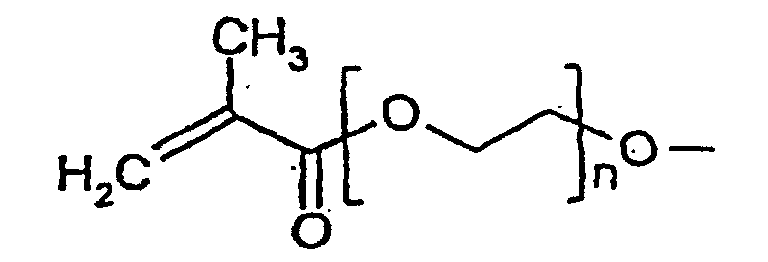
ou des mélanges avec n moyen < 10n = 0, 1, 2, 3, 4, 5, 6, 7, 8, 9, 10
 n = 1, 2, 3, 4, 5, 6, 7, 8, 9, 10
 n = 0, 1, 2, 3, 4, 5, 6, 7, 8, 9, 10
 R = alkyle, aryle, alkylaryle
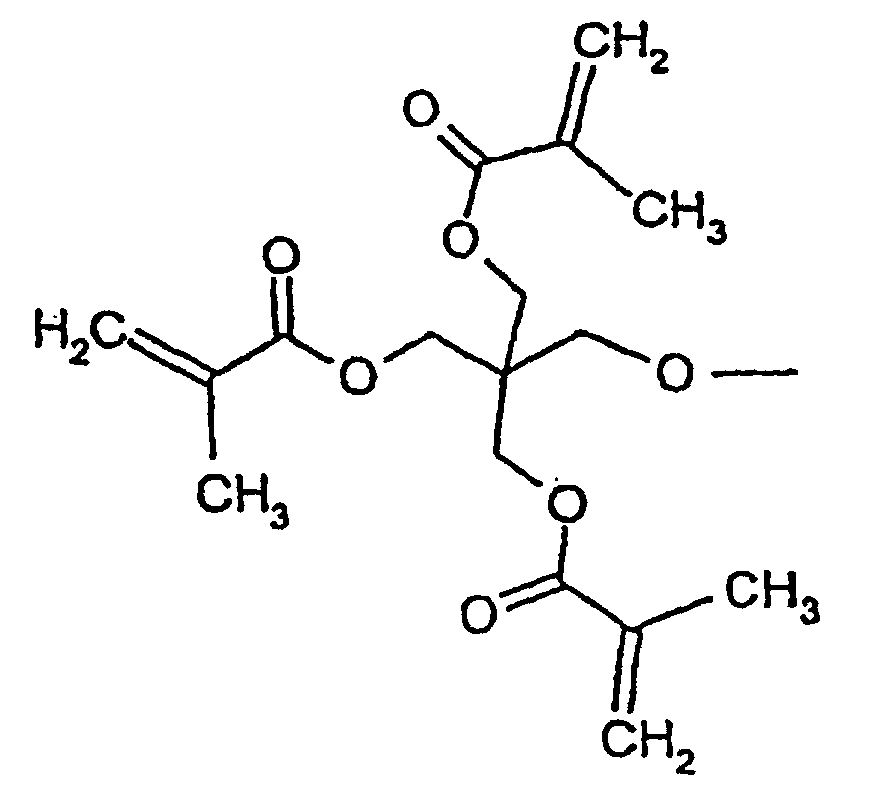 n = 1, 2, 3, 4, 5

- R'
- = alkylène, alcénylène, arylène, arylènealkylène ou alkylènearylène ayant chacun 0 à 10 atomes de carbone, ces radicaux pouvant être interrompus par des atomes d'oxygène et de soufre ou par des groupes amino,
- U=
- R = alkyle, aryle, cycloalkyle,
 R = alkyle, aryle, cycloalkyle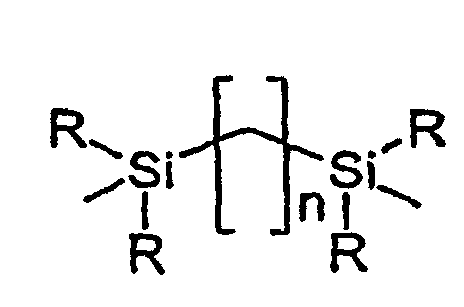
n = 1,2,3,4,5,6,7,8,9,10R = alkyle, aryle, cycloalkyle R = alkyle, aryle, cycloalkyle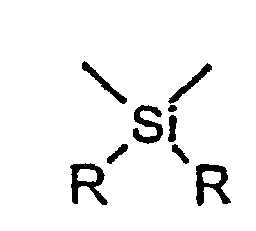
- D =
- -(CH2)n-Si(CH3)2(OC2H5), avec n = 0 à 10
-(CH2)n-Si(CH3)(OC2H5)2, avec n = 0 à 10
-(CH2)n-Si(OCH3)3, avec n = 0 à 10
-(CH2)n-Si(C2H5)2(OCH3), avec n = 0 à 10
-(CH2)n-Si(C2H5)(OCH3)2, avec n = 0 à 10
-(CH2)n-Si(OC2H5)3, avec n = 0 à 10
-(CH2)n-Si(CH3)2(OCH3) avec n = 0 à 10
-(CH2)n-Si(CH3)(OCH3)2, avec n = 0 à 10
-(CH2)n-Si(C2H5)2(OC2H5), avec n = 0 à 10
-(CH2)n-Si(C2H5)(OC2H5)2, avec n = 0 à 10
-(CH2)n-Si(CH3)(C2H5)(OCH3), avec n = 0 à 10
-(CH2)n-Si(CH3)(C2H5)(OC2H5), avec n = 0 à 10
-(CH2)n-Si(CH3)(OC2H5)(OCH3), avec n = 0 à 10
-(CH2)n-Si(C2H5)(OC2H5)(OCH3), avec n = 0 à 10
-(CH2)n-Si(OC2H5)2(OCH3), avec n = 0 à 10
-(CH2)n-Si(OC2H5)(OCH3)2, avec n = 0 à 10
-(CH2)n-Si(CH3)(OC(CH3)=CH2)2, avec n = 0 à 10
-(CH2)n-Si(C2H5)(OC(CH3)=CH2)2, avec n = 0 à 10
-(CH2)n-Si(CH3)2(OC(CH3)=CH2), avec n = 0 à 10
-(CH2)n-Si(C2H5)2(OC(CH3)=CH2), avec n = 0 à 10
-(CH2)n-Si(OCH3)(OC(CH3)=CH2)2, avec n = 0 à 10
-(CH2)n-Si(OC2H5)(OC(CH3)=CH2)2, avec n = 0 à 10
-(CH2)n-Si(OCH3)(OC(CH3)=CH2), avec n = 0 à 10
-(CH2)n-Si(OC2H5)2(OC(CH3)=CH2), avec n = 0 à 10
-(CH2)n-Si(C6H5)(OC2H5)2, avec n = 0 à 10
-(CH2)n-Si(C6H5)(OCH3)2, avec n = 0 à 10
-(CH2)n-Si(C6H5)(OCH3)(OC2H5), avec n = 0 à 10
-(CH2)n-Si(C6H5)(OC(CH3)=CH2)2, avec n = 0 à 10
- Silanes suivant la revendication 1, caractérisés en ce que, dans la formule générale, le radical R' a la signification suivante :
- R' =
- alkylène, alcénylène, arylène, arylènealkylène ou alkylènearylène comportant chacun 0 à 5 atomes de carbone, ces radicaux pouvant être interrompus par des atomes d'oxygène et de soufre ou par des groupes amino.
- Procédé de préparation des silanes suivant l'une des revendications 1 et 2, caractérisé en ce qu'on fait réagir de manière équimolaire un composé de dihydridosilicium avec un composé d'alcénylsilane, qui contient des groupes hydrolysables, et en ce qu'on fait réagir le groupe hydridosilyle subsistant, par une nouvelle hydrosilylation, avec un composé organique au moins deux fois insaturé.
- Utilisation de silanes suivant l'une des revendications 1 et 2, pour la préparation de polycondensats d'acide silicique ou d'hétéropolycondensats d'acide silicique par condensation hydrolytique d'un ou de plusieurs composés du silicium condensables par hydrolyse et éventuellement d'autres éléments du groupe de B, Al, P, Sn, Pb, des métaux de transition, des lanthanides et des actinides, et/ou des précondensats dérivés des composés précités, éventuellement en présence d'un catalyseur et/ou d'un solvant, par action d'eau ou d'humidité, caractérisée en ce qu'on sélectionne 5 à 100 moles %, sur base des composés monomères des composés condensables par hydrolyse, dans des silanes de la formule générale I :
- Utilisation suivant la revendication 4, caractérisée en ce que, comme composés condensables par hydrolyse, on met en oeuvre des composés, éventuellement sous forme précondensée, qui sont polymérisables par voie radicalaire ou ionique.
- Utilisation suivant l'une des revendications 4 et 5, caractérisée en ce que, comme autres composés du silicium condensables par hydrolyse, on met en oeuvre un ou plusieurs composés de la formule générale VI, éventuellement sous forme précondensée :
- X =
- hydrogène, halogène, hydroxy, alcoxy, acyloxy, alkyl-carbonyle, alcoxycarbonyle ou NR"2,
- R =
- alkyle, alcényle, aryle, alkylaryle ou arylalkyle,
- R" =
- hydrogène, alkyle ou aryle,
- R10 =
- alkylène ou alcénylène, ces radicaux pouvant être interrompus par des atomes d'oxygène ou de soufre ou des groupes NH,
- Z' =
- halogène ou un groupe amino, amide, aldéhyde, alkyl-carbonyle, carboxy, mercapto, cyano, alcoxy, alcoxy-carbonyle, acide sulfonique, acide phosphorique, acryloxy, méthacryloxy, époxy ou vinyle, éventuellement substitué,
- e=
- 0, 1, 2 ou 3,
- f=
- 0, 1, 2 ou 3, avec e + f = 1, 2 ou 3.
- Utilisation suivant l'une des revendications 4 à 6, caractérisée en ce que, comme autres composés du silicium condensables par hydrolyse, on met en oeuvre un ou plusieurs composés de la formule générale VIII, éventuellement sous forme précondensée :
- Y =
- un substituant qui contient un radical de 1,4,6-trioxaspiro-[4,4]-nonane substitué ou non substitué,
- n =
- 1, 2 ou 3,
- m =
- 1, 2 ou 3, avec n + m ≦ 4.
- Utilisation suivant l'une des revendications 4 à 7, caractérisée en ce que, comme autres composants condensables par hydrolyse, on met en oeuvre un ou plusieurs composés d'aluminium, de titane ou de zirconium solubles dans le milieu réactionnel, éventuellement sous forme précondensée, répondant aux formules :
- Utilisation suivant une ou plusieurs des revendications 4 à 8, caractérisée en ce qu'on ajoute au polycondensat un ou plusieurs amorceurs et en ce que le polycondensat durcit par voie thermique, photochimique, covalente-nucléophile ou induite par oxydoréduction.
- Utilisation suivant une ou plusieurs des revendications 4 à 8, caractérisée en ce qu'on ajoute au polycondensat, avant la polymérisation, un ou plusieurs composants polymérisables par voie radicalaire et/ou ionique.
- Utilisation des silanes suivant la revendication 1, pour la préparation de polymères par polymérisation radicalaire d'un ou de plusieurs composés contenant des doubles liaisons C=C et éventuellement d'autres composés polymérisables par voie radicalaire et éventuellement par polymérisation ionique d'un ou de plusieurs composés polymérisables par voie ionique, par action de chaleur et/ou d'un rayonnement électromagnétique et/ou de manière induite par oxydoréduction et/ou par voie covalente-nucléophile, éventuellement en présence d'un ou de plusieurs amorceurs et/ou d'un solvant, caractérisée en ce qu'on sélectionne 5 à 100 moles %, sur base des composés monomères, dans des silanes de la formule I:
- Utilisation suivant la revendication 11, caractérisée en ce que, comme composés polymérisables par voie cationique, on met en oeuvre un ou plusieurs silanes de la formule générale VIII :
- Utilisation suivant une ou plusieurs des revendications 11 et 12, caractérisée en ce qu'on condense par hydrolyse le polymère, éventuellement en présence d'autres composés du silicium condensables par hydrolyse et éventuellement d'autres éléments du groupe de B, Al, Sn, Pb, des métaux de transition, des lanthanides et des actinides, et/ou de précondensats dérivés des composés cités ci-dessus, par action d'eau ou d'humidité, éventuellement en présence d'un catalyseur et/ou d'un solvant.
- Utilisation suivant la revendication 13, caractérisée en ce que, comme autres composés du silicium condensables, on met en oeuvre un ou plusieurs composés de la formule générale VI, éventuellement sous forme précondensée :
- Utilisation suivant l'une des revendications 4 à 10, caractérisée en ce que, comme autres composés du silicium condensables, on met en oeuvre un ou plusieurs composés de la formule générale IX, éventuellement sous forme précondensée :
- X =
- hydrogène, halogène, hydroxy, alcoxy, acyloxy, alkyl-carbonyle, alcoxycarbonyle ou NR"2,
- R =
- alkyle, alcényle, aryle, alkylaryle ou arylalkyle,
- R' =
- alkylène, alcénylène, arylène, arylènealkylène ou alkylènearylène comportant chacun 0 à 10 atomes de carbone, ces radicaux pouvant être interrompus par des atomes d'oxygène et de soufre ou par des groupes amino,
- R"=
- hydrogène, alkyle ou aryle,
- G =
- un radical organique linéaire ou ramifié comportant au moins une double liaison C=C et 4 à 50 atomes de carbone,
- A
- = O, S ou NH, pour d = 1, et
- Z =
- CO, et
- R20=
- alkylène, arylène ou alkylènearylène comportant chacun 1 à 10 atomes de carbone, ces radicaux pouvant être interrompus par des atomes d'oxygène et de soufre ou par des groupes amino, et
- R21=
- COOH,
- A =
- O, S ou NH, pour d = 1, et
- Z=
- CO, et
- R20 =
- alkylène, arylène ou alkylènearylène comportant chacun 1 à 10 atomes de carbone, ces radicaux pouvant être interrompus par des atomes d'oxygène et de soufre ou par des groupes amino, et
- R21
- = H,
- A =
- O, S, NH ou COO, pour d = 1, et
- Z =
- CHR, où R est égal à H, alkyle, aryle ou alkylaryle, et
- R20 =
- alkylène, arylène ou alkylènearylène comportant chacun 1 à 10 atomes de carbone, ces radicaux pouvant être interrompus par des atomes d'oxygène et de soufre ou par des groupes amino, et
- R21
- = OH,
- A =
- O, S, NH ou COO, pour d = 0, et
- R20 =
- alkylène, arylène ou alkylènearylène comportant chacun 1 à 10 atomes de carbone, ces radicaux pouvant être interrompus par des atomes d'oxygène et de soufre ou par des groupes amino, et
- R21
- = OH,
- A
- = S, pour d = 1, et
- Z=
- CO, et
- R20 =
- N, et
- R21 =
- H,
a = 1, 2 ou 3,b = 0, 1 ou 2,a + b = 3,c =1, 2, 3 ou 4,d = 0 ou 1. - Utilisation des silanes suivant l'une des revendications 1 et 2, dans le domaine dentaire, pour la préparation de matières de remplissage, de ciments, de matières de couronnes et de ponts provisoires, de matières de revêtement, de laques, de matières de scellement, de matières adhérisantes, de matières primaires et de matières liantes.
Applications Claiming Priority (3)
| Application Number | Priority Date | Filing Date | Title |
|---|---|---|---|
| DE19934407 | 1999-07-22 | ||
| DE19934407A DE19934407A1 (de) | 1999-07-22 | 1999-07-22 | Hydrolysierbare und polymerisierbare Silane mit geringer Viskosität und deren Verwendung |
| PCT/EP2000/006639 WO2001007444A1 (fr) | 1999-07-22 | 2000-07-12 | Silanes hydrolysables et polymerisables a faible viscosite et leur utilisation |
Publications (2)
| Publication Number | Publication Date |
|---|---|
| EP1202997A1 EP1202997A1 (fr) | 2002-05-08 |
| EP1202997B1 true EP1202997B1 (fr) | 2003-09-17 |
Family
ID=7915685
Family Applications (1)
| Application Number | Title | Priority Date | Filing Date |
|---|---|---|---|
| EP00951376A Expired - Lifetime EP1202997B1 (fr) | 1999-07-22 | 2000-07-12 | Silanes hydrolysables et polymerisables a faible viscosite et leur utilisation |
Country Status (7)
| Country | Link |
|---|---|
| US (1) | US6852822B1 (fr) |
| EP (1) | EP1202997B1 (fr) |
| JP (1) | JP2003505557A (fr) |
| AT (1) | ATE250071T1 (fr) |
| AU (1) | AU765541B2 (fr) |
| DE (2) | DE19934407A1 (fr) |
| WO (1) | WO2001007444A1 (fr) |
Families Citing this family (104)
| Publication number | Priority date | Publication date | Assignee | Title |
|---|---|---|---|---|
| DE10026432A1 (de) | 2000-05-29 | 2002-02-14 | 3M Espe Ag | Präpolymere (Meth)acrylate mit polycyclischen oder aromatischen Segmenten |
| ATE396212T1 (de) * | 2001-03-30 | 2008-06-15 | Johnson & Johnson Vision Care | Monomere, polymere und damit hergestellte ophthalmische linsen und kontaktlinsen |
| US7134875B2 (en) | 2002-06-28 | 2006-11-14 | 3M Innovative Properties Company | Processes for forming dental materials and device |
| US6773261B2 (en) | 2002-06-28 | 2004-08-10 | 3M Innovative Properties Company | Processes for forming dental materials |
| DE10261241A1 (de) * | 2002-12-20 | 2004-07-15 | 3M Espe Ag | Dentalmaterial mit bakteriostatischen und/oder bakteriziden Substanzen |
| US20040206932A1 (en) | 2002-12-30 | 2004-10-21 | Abuelyaman Ahmed S. | Compositions including polymerizable bisphosphonic acids and methods |
| AU2004266623B8 (en) | 2003-08-12 | 2011-10-27 | 3M Deutschland Gmbh | Self-etching dental compositions and methods |
| US7064152B2 (en) | 2003-09-26 | 2006-06-20 | 3M Innovative Properties Company | Arylsulfinate salts in photoinitiator systems for polymerization reactions |
| US7026367B2 (en) | 2003-09-26 | 2006-04-11 | 3M Innovative Properties Company | Photoiniators having triarylsulfonium and arylsulfinate ions |
| US7250452B2 (en) | 2003-09-26 | 2007-07-31 | 3M Innovative Properties Company | Dental compositions and methods with arylsulfinate salts |
| US7030169B2 (en) | 2003-09-26 | 2006-04-18 | 3M Innovative Properties Company | Arylsulfinate salts in initiator systems for polymeric reactions |
| JP4645016B2 (ja) * | 2003-10-29 | 2011-03-09 | 東レ株式会社 | シリコーン化合物の製造方法 |
| US7649029B2 (en) | 2004-05-17 | 2010-01-19 | 3M Innovative Properties Company | Dental compositions containing nanozirconia fillers |
| US7090721B2 (en) | 2004-05-17 | 2006-08-15 | 3M Innovative Properties Company | Use of nanoparticles to adjust refractive index of dental compositions |
| US7090722B2 (en) | 2004-05-17 | 2006-08-15 | 3M Innovative Properties Company | Acid-reactive dental fillers, compositions, and methods |
| US7156911B2 (en) | 2004-05-17 | 2007-01-02 | 3M Innovative Properties Company | Dental compositions containing nanofillers and related methods |
| AU2005269869B2 (en) | 2004-07-08 | 2011-12-01 | 3M Innovative Properties Company | Dental methods, compositions, and kits including acid-sensitive dyes |
| CN1988875B (zh) * | 2004-07-14 | 2012-05-02 | 3M埃斯佩股份公司 | 含有含不饱和碳硅烷的组分的牙科组合物 |
| CA2573507A1 (fr) * | 2004-07-14 | 2006-01-19 | 3M Espe Ag | Composition dentaire contenant des composes contenant des carbosilanes insatures |
| AU2004321432A1 (en) * | 2004-07-14 | 2006-01-19 | 3M Espe Ag | Dental composition containing Si-H functional carbosilane components |
| AU2005275246B2 (en) * | 2004-07-14 | 2011-10-06 | 3M Deutschland Gmbh | Dental compositions containing carbosilane monomers |
| EP1781724B1 (fr) | 2004-07-14 | 2009-07-08 | 3M Innovative Properties Company | Compositions pour chirurgie dentaire contenant des polymères de type carbosilane |
| CA2575976A1 (fr) | 2004-08-11 | 2006-02-23 | 3M Innovative Properties Company | Compositions auto-adhesives comprenant une pluralite de composes acides |
| US20060047134A1 (en) * | 2004-08-25 | 2006-03-02 | Frank Molock | Process for the production of (trimethylsilyloxy)silylalkylglycerol methacrylates |
| ES2338002T3 (es) * | 2004-10-21 | 2010-05-03 | Coltene Ag | Material sellante y/o adhesivo provisional. |
| CN101115459B (zh) | 2004-11-16 | 2012-03-21 | 3M创新有限公司 | 包括含磷表面处理的牙科填料 |
| AU2005306857A1 (en) | 2004-11-16 | 2006-05-26 | 3M Innovative Properties Company | Dental compositions with calcium phosphorus releasing glass |
| CN102342889A (zh) | 2004-11-16 | 2012-02-08 | 3M创新有限公司 | 包括酪蛋白酸盐的牙科组合物及其应用 |
| KR101277869B1 (ko) | 2004-11-16 | 2013-07-30 | 쓰리엠 이노베이티브 프로퍼티즈 컴파니 | 포스페이트 염을 포함하는 치과용 충전제 및 조성물 |
| DE102005018351B4 (de) * | 2005-04-20 | 2008-05-29 | Fraunhofer-Gesellschaft zur Förderung der angewandten Forschung e.V. | Verwendung widerstandsfähiger, langlebiger Komposite im Dentalbereich |
| WO2006122081A1 (fr) | 2005-05-09 | 2006-11-16 | 3M Innovative Properties Company | Compositions dentaires contenant des monomeres hybrides |
| US20090012209A1 (en) | 2005-08-05 | 2009-01-08 | Gunther Eckhardt | Dental compositions containing a surface-modified filler |
| EP1787627A1 (fr) * | 2005-11-17 | 2007-05-23 | 3M Innovative Properties Company | Materiau d`empreinte dentaire antimicrobien |
| US8026296B2 (en) | 2005-12-20 | 2011-09-27 | 3M Innovative Properties Company | Dental compositions including a thermally labile component, and the use thereof |
| US7896650B2 (en) | 2005-12-20 | 2011-03-01 | 3M Innovative Properties Company | Dental compositions including radiation-to-heat converters, and the use thereof |
| US7776940B2 (en) | 2005-12-20 | 2010-08-17 | 3M Innovative Properties Company | Methods for reducing bond strengths, dental compositions, and the use thereof |
| AU2006332839A1 (en) | 2005-12-29 | 2007-07-12 | 3M Innovative Properties Company | Dental compositions and initiator systems with polycyclic aromatic component |
| WO2007079166A1 (fr) | 2005-12-29 | 2007-07-12 | 3M Innovative Properties Company | Compositions dentaires contenant une charge traitee en surface pour la stabilite de conservation |
| DE602006016102D1 (de) | 2006-05-31 | 2010-09-23 | 3M Innovative Properties Co | Polymerisierbare Zusammensetzungen enthaltend Salze aus Barbitursäure-Derivaten |
| CN101516319B (zh) | 2006-09-13 | 2015-11-25 | 3M创新有限公司 | 包含有机凝胶因子的牙科用组合物、产品及方法 |
| US9539065B2 (en) | 2006-10-23 | 2017-01-10 | 3M Innovative Properties Company | Assemblies, methods, and kits including a compressible material |
| US20080096150A1 (en) | 2006-10-23 | 2008-04-24 | 3M Innovative Properties Company | Dental articles, methods, and kits including a compressible material |
| JP5507256B2 (ja) | 2006-12-13 | 2014-05-28 | スリーエム イノベイティブ プロパティズ カンパニー | 酸性成分及び光退色性染料を有する歯科用組成物の使用方法 |
| WO2008082881A1 (fr) * | 2006-12-28 | 2008-07-10 | 3M Innovative Properties Company | Matériaux et compositions contenant du (méth)acryloyle, et procédés |
| WO2008083067A2 (fr) | 2006-12-28 | 2008-07-10 | 3M Innovative Properties Company | Compositions dentaires à fluorescence des dents naturelles |
| EP2109436B1 (fr) | 2006-12-28 | 2012-01-25 | 3M Innovative Properties Company | Composition adhésive pour tissu dur |
| JP2011509921A (ja) | 2007-10-01 | 2011-03-31 | スリーエム イノベイティブ プロパティズ カンパニー | ポリマー性充填剤を有する歯科矯正用組成物 |
| CN102112097B (zh) | 2007-11-01 | 2013-08-07 | 3M创新有限公司 | 牙科组合物以及具有颜色稳定的胺电子供体的引发剂系统 |
| JP2009114091A (ja) * | 2007-11-02 | 2009-05-28 | Fujifilm Corp | (メタ)アクリレート化合物 |
| US20100260849A1 (en) * | 2007-12-13 | 2010-10-14 | Rusin Richard P | Remineralizing compositions and methods |
| EP2229122B1 (fr) | 2007-12-13 | 2012-02-22 | 3M Innovative Properties Company | Article orthodontique contenant une composition partiellement durcie, procédé de fabrication et méthode d'utilisation associés |
| KR101587297B1 (ko) * | 2008-01-15 | 2016-01-20 | 도아고세이가부시키가이샤 | 옥세타닐기를 갖는 유기 규소 화합물 및 그의 제조 방법 및 경화성 조성물 |
| EP2090280B1 (fr) * | 2008-02-18 | 2019-10-16 | Coltène/Whaledent AG | Composition à deux composants pour le remplissage d'une butée d'implant |
| CN102196799B (zh) * | 2008-09-04 | 2013-02-06 | 3M创新有限公司 | 含有联苯二(甲基)丙烯酸酯单体的牙科用组合物 |
| EP2341885A2 (fr) * | 2008-09-30 | 2011-07-13 | 3M Innovative Properties Company | Composition orthodontique contenant des minéraux modifiés par la chaleur |
| JP5282520B2 (ja) * | 2008-10-15 | 2013-09-04 | 信越化学工業株式会社 | シランカップリング剤、これを用いた環状ポリオレフィンの改質方法及び有機ケイ素化合物の製造方法 |
| BRPI0914427C8 (pt) | 2008-10-15 | 2018-07-24 | 3M Innovative Properties Co | composição dental endurecível |
| BRPI0914464A2 (pt) * | 2008-10-22 | 2015-10-27 | 3M Innovative Properties Co | "composição dentária endurecível, artigos dentários e monômero bifenil di(met)acrilato" |
| WO2010068359A1 (fr) * | 2008-12-11 | 2010-06-17 | 3M Innovative Properties Company | Particules de phosphate de calcium traitées en surface pour soins buccaux et compositions dentaires |
| US8110613B2 (en) * | 2008-12-26 | 2012-02-07 | Toagosei Co., Ltd. | Process for producing silicon compound having oxetanyl group |
| CN102665605B (zh) | 2009-12-22 | 2016-06-01 | 3M创新有限公司 | 牙科用组合物、铣削块和方法 |
| US9370404B2 (en) | 2010-08-11 | 2016-06-21 | Bhaskar V. Velamakanni | Aesthetic and abrasion resistant coated dental articles and methods of making the same |
| WO2012021434A2 (fr) | 2010-08-11 | 2012-02-16 | 3M Innovative Properties Company | Articles dentaires revêtus de polymère et leur procédé de fabrication |
| EP2603161A1 (fr) | 2010-08-11 | 2013-06-19 | 3M Innovative Properties Company | Couronnes dentaires revêtues et leur procédé de fabrication |
| EP2603162B1 (fr) | 2010-08-11 | 2018-05-02 | 3M Innovative Properties Company | Articles dentaires comprenant des revêtements en céramique et à microparticules et leur procédé de fabrication |
| CN103119050B (zh) | 2010-09-15 | 2016-08-24 | 3M创新有限公司 | 取代的糖类化合物和牙科用组合物 |
| EP2637629A2 (fr) | 2010-11-10 | 2013-09-18 | 3M Innovative Properties Company | Composition adhésive appropriée pour un usage dentaire |
| EP3649980B1 (fr) | 2010-12-30 | 2021-08-11 | 3M Innovative Properties Co. | Ensembles dentaires collables comprenant un matériau compressible |
| WO2012128752A1 (fr) * | 2011-03-21 | 2012-09-27 | Momentive Performance Materials Inc. | Monomères siloxanes contenant une liaison de carbosiloxane de résistance à l'hydrolyse, procédé pour leur préparation et films minces les contenant pour une application aux lentilles de contact |
| WO2012128751A1 (fr) * | 2011-03-21 | 2012-09-27 | Momentive Performance Materials, Inc. | Composition contenant des monomères carbosiloxanes organo-modifiés et leurs utilisations |
| WO2012129143A1 (fr) | 2011-03-24 | 2012-09-27 | 3M Innovative Properties Company | Adhésif dentaire comprenant un composant polymère revêtu |
| JP5585508B2 (ja) * | 2011-03-25 | 2014-09-10 | 信越化学工業株式会社 | 環状オレフィン付加重合体及びその製造方法 |
| KR20130005889A (ko) | 2011-07-07 | 2013-01-16 | 엘지전자 주식회사 | 투명 복합 소재 및 그 제조 방법 |
| JP5459280B2 (ja) * | 2011-09-12 | 2014-04-02 | 信越化学工業株式会社 | オルガノキシシリル基又はシロキシ基含有エチルノルボルネン化合物の製造方法 |
| EP2935468B1 (fr) | 2012-12-20 | 2020-02-26 | 3M Innovative Properties Company | Nanoparticules à fonction triorganoborane-amine, compositions et procédés |
| EP2976369B1 (fr) | 2013-03-19 | 2018-02-07 | 3M Innovative Properties Company | Procédés de polymérisation radicalaire et articles associés |
| JP6157654B2 (ja) | 2013-06-28 | 2017-07-05 | スリーエム イノベイティブ プロパティズ カンパニー | 酸改質ナノ粒子、二部分型重合性組成物、及び方法 |
| CN105705112B (zh) | 2013-10-04 | 2018-02-27 | 3M创新有限公司 | 牙科研磨坯料、牙科修复体以及形成牙科研磨坯料的方法 |
| US20170190937A1 (en) | 2014-06-24 | 2017-07-06 | 3M Innovative Properties Company | Adhesive precursor composition, two-part adhesive kit, and method of making an adhesive composition |
| CN106536578B (zh) | 2014-07-22 | 2020-03-17 | 3M创新有限公司 | 自由基聚合方法和由此而得的制品 |
| WO2016044151A1 (fr) | 2014-09-16 | 2016-03-24 | 3M Innovative Properties Company | Procédés de polymérisation radicalaire et articles ainsi obtenus |
| EP3201238B1 (fr) | 2014-09-30 | 2022-02-23 | 3M Innovative Properties Company | Procédés de polymérisation radicalaire et articles ainsi obtenus |
| DE102014116389A1 (de) | 2014-11-11 | 2016-05-12 | Voco Gmbh | Radikalisch härtbare dentale Zusammensetzungen |
| DE102014116402A1 (de) | 2014-11-11 | 2016-05-12 | Voco Gmbh | Verwendung radikalisch härtbarer Zusammensetzungen in generativen Fertigungsverfahren |
| EP3237382A1 (fr) | 2014-12-22 | 2017-11-01 | 3M Innovative Properties Company | Alkyle stériquement encombré et agents de stabilisation à la lumière d'oxyalkyle |
| CN107108501A (zh) | 2014-12-22 | 2017-08-29 | 3M创新有限公司 | 空间受阻胺和氧烷基胺光稳定剂 |
| US20170283444A1 (en) | 2014-12-22 | 2017-10-05 | 3M Innovative Properties Company | Sterically hindered amine and oxyalkyl amine light stabilizers |
| EP3237426A1 (fr) | 2014-12-22 | 2017-11-01 | 3M Innovative Properties Company | Amine stériquement encombrée et agents de stabilisation à la lumière d'oxyalkylamine |
| JP6659716B2 (ja) | 2015-03-05 | 2020-03-04 | スリーエム イノベイティブ プロパティズ カンパニー | セラミック繊維を有する複合材料 |
| EP3850022A4 (fr) | 2018-09-14 | 2022-07-06 | 3M Innovative Properties Company | Matériaux composites comprenant des fibres céramiques et des nanoagrégats, produits dentaires, kits et procédés de fabrication et utilisation associée |
| WO2021191773A1 (fr) | 2020-03-25 | 2021-09-30 | 3M Innovative Properties Company | Appareil dentaire à image graphique |
| CN111269259A (zh) * | 2020-03-27 | 2020-06-12 | 吉林奥来德光电材料股份有限公司 | 化合物、光电器件封装用组合物、制备方法、封装薄膜 |
| CN111303200B (zh) * | 2020-04-03 | 2022-08-05 | 万华化学集团股份有限公司 | 一种硅氧烷助剂及其制备方法和应用 |
| US11970596B2 (en) | 2020-09-25 | 2024-04-30 | 3M Innovative Properties Company | Photopolymerizable compositions and reaction products thereof |
| WO2022144843A1 (fr) | 2020-12-30 | 2022-07-07 | 3M Innovative Properties Company | Ensembles orthodontiques pouvant être fixés et procédés de fixation |
| EP4284292B1 (fr) | 2021-01-29 | 2025-05-28 | Solventum Intellectual Properties Company | Films multicouches ayant des structures discrètes recouvertes d'une couche de séparation perméable aux ions, appareils dentaires fabriqués à partir de ces films et méthode de fabrication de ces appareils dentaires |
| WO2022195364A1 (fr) | 2021-03-17 | 2022-09-22 | 3M Innovative Properties Company | 4,4'-spirobi[chromane]-2,2'-diones polymérisables et compositions durcissables les comprenant |
| WO2022263987A1 (fr) | 2021-06-16 | 2022-12-22 | 3M Innovative Properties Company | Copolymère polymérisable par voie radicalaire, composition polymérisable par voie radicalaire le contenant, et produit de réaction polymérisé obtenu à partir de celle-ci |
| CN117836333A (zh) | 2021-09-01 | 2024-04-05 | 3M创新有限公司 | 可自由基聚合的组合物、其聚合的方法以及聚合的组合物 |
| CN113683955A (zh) * | 2021-10-09 | 2021-11-23 | 广东雷能电力集团有限公司 | 一种复合有机硅涂料及其制备方法和应用 |
| US20240400865A1 (en) | 2021-10-28 | 2024-12-05 | 3M Innovative Properties Company | Photopolymerizable composition, methods of bonding and sealing, and at least partially polymerized composition |
| CN118525068A (zh) | 2021-12-14 | 2024-08-20 | 3M创新有限公司 | 粘合剂组合物的可固化前体 |
| CN119053645A (zh) * | 2022-04-20 | 2024-11-29 | 大金工业株式会社 | 表面处理剂 |
| CN118496255B (zh) * | 2024-04-22 | 2025-06-24 | 南京工业大学 | 一种支链化有机硅消泡剂及其制备方法和应用 |
Family Cites Families (11)
| Publication number | Priority date | Publication date | Assignee | Title |
|---|---|---|---|---|
| US5378790A (en) * | 1992-09-16 | 1995-01-03 | E. I. Du Pont De Nemours & Co. | Single component inorganic/organic network materials and precursors thereof |
| JP2657259B2 (ja) * | 1993-02-01 | 1997-09-24 | 信越化学工業株式会社 | 複合材料用改質剤組成物及びそれを用いた複合材料 |
| JP3690689B2 (ja) * | 1993-11-04 | 2005-08-31 | 信越化学工業株式会社 | 有機けい素化合物 |
| DE4339399A1 (de) * | 1993-11-18 | 1995-05-24 | Thera Ges Fuer Patente | Durch Polymerisation einer ethylenisch polymerisierbaren Masse in Formen hergestellte Formkörper (Inserts) |
| DE4433139A1 (de) | 1994-09-16 | 1996-03-21 | Thera Ges Fuer Patente | Hydrophilierte Zahnabdruckmassen |
| DE19648283A1 (de) | 1996-11-21 | 1998-05-28 | Thera Ges Fuer Patente | Polymerisierbare Massen auf der Basis von Epoxiden |
| JP3950197B2 (ja) * | 1997-06-12 | 2007-07-25 | 東レ・ダウコーニング株式会社 | シリコーン含有有機重合体の製造方法 |
| DE19730515A1 (de) * | 1997-07-16 | 1999-01-21 | Espe Dental Ag | Abformmaterial auf Silikonbasis |
| DE19736665A1 (de) | 1997-08-22 | 1999-02-25 | Espe Dental Ag | Härtbare Masse mit Silan-Dendrimeren |
| US6280748B1 (en) | 1998-06-12 | 2001-08-28 | Dow Corning Toray Silicone, Ltd. | Cosmetic raw material cosmetic product and method for manufacturing cosmetic products |
| DE19860361A1 (de) | 1998-12-24 | 2000-06-29 | Espe Dental Ag | Vernetzbare Monomere auf Cyclosiloxanbasis, deren Herstellung und deren Verwendung in polymerisierbaren Massen |
-
1999
- 1999-07-22 DE DE19934407A patent/DE19934407A1/de not_active Withdrawn
-
2000
- 2000-07-12 JP JP2001512528A patent/JP2003505557A/ja active Pending
- 2000-07-12 AT AT00951376T patent/ATE250071T1/de not_active IP Right Cessation
- 2000-07-12 AU AU64342/00A patent/AU765541B2/en not_active Ceased
- 2000-07-12 WO PCT/EP2000/006639 patent/WO2001007444A1/fr not_active Ceased
- 2000-07-12 US US10/031,612 patent/US6852822B1/en not_active Expired - Lifetime
- 2000-07-12 DE DE50003750T patent/DE50003750D1/de not_active Expired - Lifetime
- 2000-07-12 EP EP00951376A patent/EP1202997B1/fr not_active Expired - Lifetime
Also Published As
| Publication number | Publication date |
|---|---|
| JP2003505557A (ja) | 2003-02-12 |
| EP1202997A1 (fr) | 2002-05-08 |
| DE50003750D1 (de) | 2003-10-23 |
| WO2001007444A1 (fr) | 2001-02-01 |
| DE19934407A1 (de) | 2001-01-25 |
| ATE250071T1 (de) | 2003-10-15 |
| AU765541B2 (en) | 2003-09-18 |
| AU6434200A (en) | 2001-02-13 |
| WO2001007444B1 (fr) | 2001-03-22 |
| US6852822B1 (en) | 2005-02-08 |
Similar Documents
| Publication | Publication Date | Title |
|---|---|---|
| EP1202997B1 (fr) | Silanes hydrolysables et polymerisables a faible viscosite et leur utilisation | |
| EP0682033B1 (fr) | Silanes hydrolysables et polymérisables | |
| EP0781290B1 (fr) | Silanes pouvant subir une hydrolyse et une polymerisation ou une polyaddition | |
| EP0450624B1 (fr) | Hétéropolycondensats polymérisables d'acide silicique et leur emploi | |
| EP0525392B1 (fr) | Silanes hydrolysables et polymérisables | |
| EP0799832B1 (fr) | Silanes fluorées hydrolysables, procédé pour les préparer et leur utilisation pour la production de polycondensats d'acide silicique et d'hétéropolycondensats d'acide silicique | |
| EP1159281B1 (fr) | Silanes hydrolysables et polymerisables | |
| EP1141094B1 (fr) | Monomeres reticulables a base de cyclosiloxane, leur preparation et leur utilisation dans des matieres polymerisables | |
| WO2001004186A1 (fr) | Polycondensats d'acide silicique modifies organiquement, leur production et leur utilisation | |
| EP0618242B1 (fr) | Systèmes auto-durcissants | |
| EP0694550B1 (fr) | Silanes hydrolysables et polymerisables | |
| EP0867443B1 (fr) | Oxetanesilanes hydrolysables et polymérisables | |
| DE19714320A1 (de) | Hydrolysierbare und polymerisierbare Vinylcyclopropansilane | |
| EP0668326A2 (fr) | Systèmes auto-réticulables de manière covalente-nucléophile |
Legal Events
| Date | Code | Title | Description |
|---|---|---|---|
| PUAI | Public reference made under article 153(3) epc to a published international application that has entered the european phase |
Free format text: ORIGINAL CODE: 0009012 |
|
| 17P | Request for examination filed |
Effective date: 20020220 |
|
| AK | Designated contracting states |
Kind code of ref document: A1 Designated state(s): AT BE CH CY DE DK ES FI FR GB GR IE IT LI LU MC NL PT SE |
|
| AX | Request for extension of the european patent |
Free format text: AL;LT;LV;MK;RO;SI |
|
| 17Q | First examination report despatched |
Effective date: 20021014 |
|
| GRAH | Despatch of communication of intention to grant a patent |
Free format text: ORIGINAL CODE: EPIDOS IGRA |
|
| GRAH | Despatch of communication of intention to grant a patent |
Free format text: ORIGINAL CODE: EPIDOS IGRA |
|
| GRAA | (expected) grant |
Free format text: ORIGINAL CODE: 0009210 |
|
| AK | Designated contracting states |
Kind code of ref document: B1 Designated state(s): AT BE CH CY DE DK ES FI FR GB GR IE IT LI LU MC NL PT SE |
|
| PG25 | Lapsed in a contracting state [announced via postgrant information from national office to epo] |
Ref country code: IT Free format text: LAPSE BECAUSE OF FAILURE TO SUBMIT A TRANSLATION OF THE DESCRIPTION OR TO PAY THE FEE WITHIN THE PRESCRIBED TIME-LIMIT;WARNING: LAPSES OF ITALIAN PATENTS WITH EFFECTIVE DATE BEFORE 2007 MAY HAVE OCCURRED AT ANY TIME BEFORE 2007. THE CORRECT EFFECTIVE DATE MAY BE DIFFERENT FROM THE ONE RECORDED. Effective date: 20030917 Ref country code: GB Free format text: LAPSE BECAUSE OF FAILURE TO SUBMIT A TRANSLATION OF THE DESCRIPTION OR TO PAY THE FEE WITHIN THE PRESCRIBED TIME-LIMIT Effective date: 20030917 Ref country code: IE Free format text: LAPSE BECAUSE OF FAILURE TO SUBMIT A TRANSLATION OF THE DESCRIPTION OR TO PAY THE FEE WITHIN THE PRESCRIBED TIME-LIMIT Effective date: 20030917 Ref country code: FI Free format text: LAPSE BECAUSE OF FAILURE TO SUBMIT A TRANSLATION OF THE DESCRIPTION OR TO PAY THE FEE WITHIN THE PRESCRIBED TIME-LIMIT Effective date: 20030917 Ref country code: NL Free format text: LAPSE BECAUSE OF FAILURE TO SUBMIT A TRANSLATION OF THE DESCRIPTION OR TO PAY THE FEE WITHIN THE PRESCRIBED TIME-LIMIT Effective date: 20030917 Ref country code: CY Free format text: LAPSE BECAUSE OF FAILURE TO SUBMIT A TRANSLATION OF THE DESCRIPTION OR TO PAY THE FEE WITHIN THE PRESCRIBED TIME-LIMIT Effective date: 20030917 Ref country code: FR Free format text: LAPSE BECAUSE OF FAILURE TO SUBMIT A TRANSLATION OF THE DESCRIPTION OR TO PAY THE FEE WITHIN THE PRESCRIBED TIME-LIMIT Effective date: 20030917 |
|
| REG | Reference to a national code |
Ref country code: GB Ref legal event code: FG4D Free format text: NOT ENGLISH |
|
| REG | Reference to a national code |
Ref country code: CH Ref legal event code: EP |
|
| REF | Corresponds to: |
Ref document number: 50003750 Country of ref document: DE Date of ref document: 20031023 Kind code of ref document: P |
|
| REG | Reference to a national code |
Ref country code: IE Ref legal event code: FG4D Free format text: GERMAN |
|
| REG | Reference to a national code |
Ref country code: CH Ref legal event code: NV Representative=s name: SERVOPATENT GMBH |
|
| PG25 | Lapsed in a contracting state [announced via postgrant information from national office to epo] |
Ref country code: GR Free format text: LAPSE BECAUSE OF FAILURE TO SUBMIT A TRANSLATION OF THE DESCRIPTION OR TO PAY THE FEE WITHIN THE PRESCRIBED TIME-LIMIT Effective date: 20031217 Ref country code: DK Free format text: LAPSE BECAUSE OF FAILURE TO SUBMIT A TRANSLATION OF THE DESCRIPTION OR TO PAY THE FEE WITHIN THE PRESCRIBED TIME-LIMIT Effective date: 20031217 Ref country code: SE Free format text: LAPSE BECAUSE OF FAILURE TO SUBMIT A TRANSLATION OF THE DESCRIPTION OR TO PAY THE FEE WITHIN THE PRESCRIBED TIME-LIMIT Effective date: 20031217 |
|
| PG25 | Lapsed in a contracting state [announced via postgrant information from national office to epo] |
Ref country code: PT Free format text: LAPSE BECAUSE OF FAILURE TO SUBMIT A TRANSLATION OF THE DESCRIPTION OR TO PAY THE FEE WITHIN THE PRESCRIBED TIME-LIMIT Effective date: 20031226 |
|
| PG25 | Lapsed in a contracting state [announced via postgrant information from national office to epo] |
Ref country code: ES Free format text: LAPSE BECAUSE OF FAILURE TO SUBMIT A TRANSLATION OF THE DESCRIPTION OR TO PAY THE FEE WITHIN THE PRESCRIBED TIME-LIMIT Effective date: 20031228 |
|
| LTIE | Lt: invalidation of european patent or patent extension |
Effective date: 20030917 |
|
| NLV1 | Nl: lapsed or annulled due to failure to fulfill the requirements of art. 29p and 29m of the patents act | ||
| GBV | Gb: ep patent (uk) treated as always having been void in accordance with gb section 77(7)/1977 [no translation filed] |
Effective date: 20030917 |
|
| REG | Reference to a national code |
Ref country code: IE Ref legal event code: FD4D |
|
| PG25 | Lapsed in a contracting state [announced via postgrant information from national office to epo] |
Ref country code: AT Free format text: LAPSE BECAUSE OF NON-PAYMENT OF DUE FEES Effective date: 20040712 Ref country code: LU Free format text: LAPSE BECAUSE OF NON-PAYMENT OF DUE FEES Effective date: 20040712 |
|
| PGFP | Annual fee paid to national office [announced via postgrant information from national office to epo] |
Ref country code: BE Payment date: 20040722 Year of fee payment: 5 |
|
| PLBE | No opposition filed within time limit |
Free format text: ORIGINAL CODE: 0009261 |
|
| STAA | Information on the status of an ep patent application or granted ep patent |
Free format text: STATUS: NO OPPOSITION FILED WITHIN TIME LIMIT |
|
| PG25 | Lapsed in a contracting state [announced via postgrant information from national office to epo] |
Ref country code: MC Free format text: LAPSE BECAUSE OF NON-PAYMENT OF DUE FEES Effective date: 20040731 |
|
| 26N | No opposition filed |
Effective date: 20040618 |
|
| EN | Fr: translation not filed | ||
| PG25 | Lapsed in a contracting state [announced via postgrant information from national office to epo] |
Ref country code: BE Free format text: LAPSE BECAUSE OF NON-PAYMENT OF DUE FEES Effective date: 20050731 |
|
| BERE | Be: lapsed |
Owner name: *3M ESPE A.G. Effective date: 20050731 |
|
| REG | Reference to a national code |
Ref country code: CH Ref legal event code: PFA Owner name: 3M ESPE AG Free format text: 3M ESPE AG#ESPE PLATZ#82229 SEEFELD (DE) -TRANSFER TO- 3M ESPE AG#ESPE PLATZ#82229 SEEFELD (DE) |
|
| REG | Reference to a national code |
Ref country code: CH Ref legal event code: PFUS Owner name: 3M DEUTSCHLAND GMBH, DE Free format text: FORMER OWNER: 3M ESPE AG, DE |
|
| REG | Reference to a national code |
Ref country code: DE Ref legal event code: R082 Ref document number: 50003750 Country of ref document: DE Representative=s name: ABITZ & PARTNER, DE |
|
| REG | Reference to a national code |
Ref country code: DE Ref legal event code: R081 Ref document number: 50003750 Country of ref document: DE Owner name: 3M DEUTSCHLAND GMBH, DE Free format text: FORMER OWNER: 3M ESPE AG, 82229 SEEFELD, DE Effective date: 20120514 Ref country code: DE Ref legal event code: R082 Ref document number: 50003750 Country of ref document: DE Representative=s name: ABITZ & PARTNER, DE Effective date: 20120514 Ref country code: DE Ref legal event code: R082 Ref document number: 50003750 Country of ref document: DE Representative=s name: ABITZ & PARTNER PATENTANWAELTE MBB, DE Effective date: 20120514 |
|
| PGFP | Annual fee paid to national office [announced via postgrant information from national office to epo] |
Ref country code: CH Payment date: 20150713 Year of fee payment: 16 Ref country code: DE Payment date: 20150707 Year of fee payment: 16 |
|
| REG | Reference to a national code |
Ref country code: DE Ref legal event code: R119 Ref document number: 50003750 Country of ref document: DE |
|
| REG | Reference to a national code |
Ref country code: CH Ref legal event code: PL |
|
| PG25 | Lapsed in a contracting state [announced via postgrant information from national office to epo] |
Ref country code: LI Free format text: LAPSE BECAUSE OF NON-PAYMENT OF DUE FEES Effective date: 20160731 Ref country code: DE Free format text: LAPSE BECAUSE OF NON-PAYMENT OF DUE FEES Effective date: 20170201 Ref country code: CH Free format text: LAPSE BECAUSE OF NON-PAYMENT OF DUE FEES Effective date: 20160731 |