EP0682033B1 - Silanes hydrolysables et polymérisables - Google Patents
Silanes hydrolysables et polymérisables Download PDFInfo
- Publication number
- EP0682033B1 EP0682033B1 EP95103181A EP95103181A EP0682033B1 EP 0682033 B1 EP0682033 B1 EP 0682033B1 EP 95103181 A EP95103181 A EP 95103181A EP 95103181 A EP95103181 A EP 95103181A EP 0682033 B1 EP0682033 B1 EP 0682033B1
- Authority
- EP
- European Patent Office
- Prior art keywords
- compounds
- general formula
- radicals
- alkylene
- alkyl
- Prior art date
- Legal status (The legal status is an assumption and is not a legal conclusion. Google has not performed a legal analysis and makes no representation as to the accuracy of the status listed.)
- Expired - Lifetime
Links
Classifications
-
- C—CHEMISTRY; METALLURGY
- C08—ORGANIC MACROMOLECULAR COMPOUNDS; THEIR PREPARATION OR CHEMICAL WORKING-UP; COMPOSITIONS BASED THEREON
- C08G—MACROMOLECULAR COMPOUNDS OBTAINED OTHERWISE THAN BY REACTIONS ONLY INVOLVING UNSATURATED CARBON-TO-CARBON BONDS
- C08G77/00—Macromolecular compounds obtained by reactions forming a linkage containing silicon with or without sulfur, nitrogen, oxygen or carbon in the main chain of the macromolecule
- C08G77/04—Polysiloxanes
- C08G77/22—Polysiloxanes containing silicon bound to organic groups containing atoms other than carbon, hydrogen and oxygen
-
- C—CHEMISTRY; METALLURGY
- C07—ORGANIC CHEMISTRY
- C07F—ACYCLIC, CARBOCYCLIC OR HETEROCYCLIC COMPOUNDS CONTAINING ELEMENTS OTHER THAN CARBON, HYDROGEN, HALOGEN, OXYGEN, NITROGEN, SULFUR, SELENIUM OR TELLURIUM
- C07F7/00—Compounds containing elements of Groups 4 or 14 of the Periodic Table
- C07F7/02—Silicon compounds
- C07F7/08—Compounds having one or more C—Si linkages
- C07F7/18—Compounds having one or more C—Si linkages as well as one or more C—O—Si linkages
- C07F7/1804—Compounds having Si-O-C linkages
-
- C—CHEMISTRY; METALLURGY
- C08—ORGANIC MACROMOLECULAR COMPOUNDS; THEIR PREPARATION OR CHEMICAL WORKING-UP; COMPOSITIONS BASED THEREON
- C08F—MACROMOLECULAR COMPOUNDS OBTAINED BY REACTIONS ONLY INVOLVING CARBON-TO-CARBON UNSATURATED BONDS
- C08F230/00—Copolymers of compounds having one or more unsaturated aliphatic radicals, each having only one carbon-to-carbon double bond, and containing phosphorus, selenium, tellurium or a metal
- C08F230/04—Copolymers of compounds having one or more unsaturated aliphatic radicals, each having only one carbon-to-carbon double bond, and containing phosphorus, selenium, tellurium or a metal containing a metal
- C08F230/08—Copolymers of compounds having one or more unsaturated aliphatic radicals, each having only one carbon-to-carbon double bond, and containing phosphorus, selenium, tellurium or a metal containing a metal containing silicon
- C08F230/085—Copolymers of compounds having one or more unsaturated aliphatic radicals, each having only one carbon-to-carbon double bond, and containing phosphorus, selenium, tellurium or a metal containing a metal containing silicon the monomer being a polymerisable silane, e.g. (meth)acryloyloxy trialkoxy silanes or vinyl trialkoxysilanes
-
- C—CHEMISTRY; METALLURGY
- C08—ORGANIC MACROMOLECULAR COMPOUNDS; THEIR PREPARATION OR CHEMICAL WORKING-UP; COMPOSITIONS BASED THEREON
- C08G—MACROMOLECULAR COMPOUNDS OBTAINED OTHERWISE THAN BY REACTIONS ONLY INVOLVING UNSATURATED CARBON-TO-CARBON BONDS
- C08G77/00—Macromolecular compounds obtained by reactions forming a linkage containing silicon with or without sulfur, nitrogen, oxygen or carbon in the main chain of the macromolecule
- C08G77/04—Polysiloxanes
- C08G77/20—Polysiloxanes containing silicon bound to unsaturated aliphatic groups
-
- C—CHEMISTRY; METALLURGY
- C08—ORGANIC MACROMOLECULAR COMPOUNDS; THEIR PREPARATION OR CHEMICAL WORKING-UP; COMPOSITIONS BASED THEREON
- C08G—MACROMOLECULAR COMPOUNDS OBTAINED OTHERWISE THAN BY REACTIONS ONLY INVOLVING UNSATURATED CARBON-TO-CARBON BONDS
- C08G77/00—Macromolecular compounds obtained by reactions forming a linkage containing silicon with or without sulfur, nitrogen, oxygen or carbon in the main chain of the macromolecule
- C08G77/48—Macromolecular compounds obtained by reactions forming a linkage containing silicon with or without sulfur, nitrogen, oxygen or carbon in the main chain of the macromolecule in which at least two but not all the silicon atoms are connected by linkages other than oxygen atoms
- C08G77/58—Metal-containing linkages
-
- C—CHEMISTRY; METALLURGY
- C08—ORGANIC MACROMOLECULAR COMPOUNDS; THEIR PREPARATION OR CHEMICAL WORKING-UP; COMPOSITIONS BASED THEREON
- C08G—MACROMOLECULAR COMPOUNDS OBTAINED OTHERWISE THAN BY REACTIONS ONLY INVOLVING UNSATURATED CARBON-TO-CARBON BONDS
- C08G79/00—Macromolecular compounds obtained by reactions forming a linkage containing atoms other than silicon, sulfur, nitrogen, oxygen, and carbon with or without the latter elements in the main chain of the macromolecule
Definitions
- the invention relates to hydrolyzable and polymerizable Silanes, process for their preparation and their use for the production of silica polycondensates or heteropolycondensates and for the production of polymers or Heteropolymers.
- Hydrolyzable, organically modified silanes find one Wide range of uses in the production of scratch-resistant coatings for a wide variety of substrates, for production of fillers, of adhesive and sealing compounds or of Molded articles. These silanes are either alone, in Mixtures or in the presence of other hydrolyzable and / or condensable components hydrolytically condensed, the final curing being thermal, photochemical, covalently nucleophilic or redox-induced.
- scratch-resistant coatings which result from the hydrolytic condensation of a mixture which, inter alia, consists of a hydrolyzable titanium or zirconium compound and a hydrolyzable, organofunctional silane R ' m (R''Y) n SiX (4- mn) , where R 'is, for example, alkyl or alkenyl, R''is, for example, alkylene or alkenylene and X is a hydrolyzable radical.
- DE 3536716 A1 discloses adhesives and sealants which have been obtained by hydrolytic condensation of one or more organosilanes of the general formula R m SiX 4-m and optionally one or more of the components SiX 4 and / or R n (R ''Y) p SiX 4-np , where R and R''is, for example, alkyl, alkenyl, aryl, alkylaryl, arylalkyl, alkenylaryl or arylalkenyl, X is, for example, hydrogen, halogen, hydroxy, alkoxy or acyloxy, and Y is, for example, a halogen or a optionally substituted amino, amide, aldehyde, alkylcarbonyl, carboxy, hydroxyl, mercapto or cyano group.
- silanes with reactive double bonds are also known, such as (meth) acryloxysilanes of the following type, where R is hydrogen or methyl and X is, for example, halogen or alkoxy.
- These silanes can be hydrolyzed and polymerized and can be used for the production of the above-mentioned systems. They offer the great advantage that the resulting coating, the resulting filler, adhesive or sealing compound or the resulting shaped body can be cured thermally, photochemically, covalently-nucleophilically or redox-induced by polymerization on the reactive double bonds.
- the object of the present invention is therefore new, organic to provide modified silanes that are hydrolyzable and polymerizable, that alone, in mixtures or together with other hydrolyzable, condensable or polymerizable components to create scratch-resistant coatings, to fillers, adhesives or sealants, to molded articles or can be processed into embedding materials.
- This Silanes should be universally applicable, and they should be in an inorganic-organic composite system, i.e. into an inorganic-organic Network can be installed. Further should these silanes be quick and easy, i.e. without elaborate Be synthesis process.
- the chain between Silicon and reactive double bond if necessary a hydroxyl or carboxyl group.
- the silanes of the formula I can be polymerized via the radicals B. and hydrolyzable via the residues X.
- About the hydrolyzable Groups can be an inorganic network with Si-O-Si units be built up while those contained in rest B. Polymerize double bonds to form an organic network.
- the alkyl residues are e.g. straight chain, branched or cyclic Radicals with 1 to 20, in particular with 1 to 10 carbon atoms and preferably lower alkyl radicals with 1 to 6, particularly preferably with 1 to 4 carbon atoms.
- Specific Examples are methyl, ethyl, n-propyl, i-propyl, n-butyl, i-butyl, s-butyl, t-butyl, n-pentyl, n-hexyl, cyclohexyl, 2-ethylhexyl, Dodecyl and octadecyl.
- alkenyl residues are e.g. straight chain, branched or cyclic radicals with 2 to 20, preferably with 2 to 10 carbon atoms and preferably lower alkenyl radicals with 2 to 6 Carbon atoms, e.g. Vinyl, allyl and 2-butenyl.
- Preferred aryl radicals are phenyl, biphenyl and naphthyl.
- the Alkoxy, acyloxy, alkylamino, dialkylamino, alkylcarbonyl, Alkoxycarbonyl, arylalkyl, alkylaryl, alkylene and alkylenearylene residues are preferably derived from the above Alkyl and aryl residues.
- Specific examples are methoxy, Ethoxy, n- and i-propoxy, n-, i-, s- and t-butoxy, monomethylamino, Monoethylamino, dimethylamino, diethylamino, N-ethylanilino, Acetyloxy, propionyloxy, methylcarbonyl, Ethylcarbonyl, methoxycarbonyl, ethoxycarbonyl, benzyl, 2-phenylethyl and tolyl.
- the radicals mentioned can optionally carry one or more substituents, for example halogen, alkyl, hydroxyalkyl, alkoxy, aryl, aryloxy, alkylcarbonyl, alkoxycarbonyl, furfuryl, tetrahydrofurfuryl, amino, monoalkylamino, dialkylamino, trialkylammonium, amido, hydroxy, formyl, carboxy, mercapto, Cyano, isocyanato, nitro, epoxy, SO 3 H or PO 4 H 2 .
- halogens are fluorine, chlorine and bromine and in particular Chlorine preferred.
- radicals X and R can be the same or have different meanings.
- B is preferably derived from a substituted or unsubstituted compound having two or more acrylate or methacrylate groups. Such compounds are referred to below as (meth) acrylates.
- the substituents can be selected from the substituents mentioned above.
- the group -AH can be -OH, -SH, -NH 2 or -COOH and c can have values from 1 to 4.
- the alkyl radicals are straight-chain, branched or cyclic Radicals with 1 to 20, in particular with 1 to 10 carbon atoms and preferably lower alkyl radicals with 1 to 6, especially preferably with 1 to 4 carbon atoms.
- Specific Examples are methyl, ethyl, n-propyl, i-propyl, n-butyl, i-butyl, s-butyl, t-butyl, n-pentyl, n-hexyl, cyclohexyl, 2-ethylhexyl, Dodecyl and octadecyl.
- Preferred aryl radicals are Phenyl, biphenyl and naphthyl.
- these carboxyl groups bring about very specific molecular properties and, on the other hand, enable their further modification.
- the carboxyl groups act as charge carriers, which makes the use of the silanes according to the invention in dispersions or emulsions or in electrocoating very advantageous.
- the carboxyl groups cause acid catalysis, for example during a sol-gel process, which has the great advantage that a later separation step, namely the removal of the catalyst, is omitted.
- the carboxyl groups increase the water solubility of the silanes according to the invention, so that they can be used as or in water-based paints.
- the carboxyl groups serve as adhesion-promoting groups for inorganic and for organic surfaces.
- the carboxyl group is capable of complexing titanium, zirconium, tin and other metals, which has a particularly positive effect on the X-ray opacity, the contact toxicity and the increase in the refractive index.
- an aminoolefin (B (NH 2 ) c ) is used in the production according to type a)
- this has the consequence that, in addition to double bond polymerization, a further curing mechanism is available in the case of an intermolecular reaction, and on the other hand, the carboxyl group, which in the hardened state is disruptive for certain applications, is eliminated.
- an amide or amine-containing additive is required for other systems that do not contain amine.
- the silanes according to the invention can also be used alone or together with other hydrolyzable, condensable and / or polymerizable components processed into polymers by subsequent hydrolytic condensation can be solidified.
- Silicic acid (hetero) polycondensates with organic groups are modified, and processes for their preparation (e.g. starting from hydrolytically condensable organosilanes after the sol-gel process) are known in large numbers.
- Such condensates find for the most varied of uses, e.g. as molding compounds, as varnishes for coatings, etc. Due to the wide range of applications this substance class also exists a constant need to modify the already known Condensates, on the one hand, thereby creating a new area of application to open up and secondly to their properties to optimize even further for certain purposes.
- the silanes according to the invention are basic or acidic Environment hydrolyzable and condensable, without this
- the invention Silanes, optionally with the addition of other co-condensables Components hydrolyzed and polycondensed.
- the polycondensation is preferably carried out by the sol-gel process, as it e.g. in DE-A1 2758414, 2758415, 3011761, 3826715 and 3835968.
- the invention Silanes optionally with the addition of other copolymerisable Components polymerized.
- the polymerization can e.g. thermal, redox-induced, covalent-nucleophilic and / or done photochemically using methods such as they e.g. described in DE-A1 3143820, 3826715 and 3835968 are.
- Compounds can be used as further polymerizable components are added, which can be polymerized by free radicals and / or ionically are.
- Ionically polymerizable Compounds that can be added contain e.g. Ring systems that can be polymerized cationically to open a ring are, e.g. Spiro orthoesters, spiro orthocarbonates, bicyclic spiro orthoesters, mono- or oligoepoxides or spiro-silanes as known from DE 4125201 C1 are.
- silane-linked cyclic Add systems that are polymerized with can.
- Such systems are e.g. those containing epoxides.
- Such systems are in the manufacture of spirosilanes DE 4125201 C1.
- the silanes according to the invention are highly reactive systems which lead to poly (hetero) condensates, e.g. with UV radiation to mechanically stable within a very short time Coatings or moldings or packing.
- the invention Silanes can be prepared by simple addition reactions and can by appropriate selection of the starting compounds a variable number of reactive groups of different Have functionality.
- silanes according to the invention have relatively high molecular weights and accordingly a reduced volatility compared to the (meth) acrylate monomers mentioned at the beginning, see above that the toxic hazard during processing and Application is lower.
- polysiloxanes are formed again decreased volatility, which is the toxicity problem completely fix the acrylic components.
- silica (hetero) polycondensates via the silanes according to the invention to provide which are adapted in a variety of ways to specified areas of application can be, and therefore in all areas which have previously used silica (hetero) polycondensates can be used, but also new uses open, e.g. in the field of optics, electronics, medicine, optoelectronics and Packaging for food etc.
- the silanes according to the invention can either be used as such be or in compositions that additionally contain additives adapted to the intended use, e.g. usual Paint additives, solvents, fillers, photoinitiators, thermal initiators, leveling agents and pigments.
- additives adapted to the intended use e.g. usual Paint additives, solvents, fillers, photoinitiators, thermal initiators, leveling agents and pigments.
- the silanes according to the invention or the silane-containing compositions are e.g. for the production of coating, Filler or bulk materials, of adhesives and injection molding compounds, of fibers, particles, foils, adhesion promoters, of impression materials and embedding materials.
- Coatings and molded articles from the silanes according to the invention have the Advantage that they can be structured photochemically. Specific Areas of application are e.g. the coating of substrates made of metal, plastic, paper, ceramics etc.
- silanes of the formula I according to the invention further hydrolytically condensable compounds of silicon, boron, aluminum, phosphorus, tin, of lead, transition metals, lanthanides or actinides be used.
- These connections can either be as such or already in precondensed form for production of the polycondensates are used. It is preferred if at least 10 mol%, in particular at least 80 mol% and especially at least 90 mol%, based on momomeric Compounds used to manufacture silica (hetero) polycondensates Starting materials used silicon compounds are.
- the silica is (hetero) polycondensates at least 5 mol%, e.g. 25 to 100 mol%, in particular 50 to 100 mol% and especially 75 to 100 mol%, each based on monomeric compounds, on one or underlying several of the silanes according to the invention.
- alkyl residues are e.g. straight chain, branched or cyclic Residues with 1 to 20, preferably with 1 to 10 carbon atoms, and lower alkyl radicals are particularly preferred with 1 to 6 carbon atoms.
- Specific examples are Methyl, ethyl, n-propyl, i-propyl, n-butyl, s-butyl, t-butyl, i-butyl, n-pentyl, n-hexyl, cyclohexyl, 2-ethylhexyl, dodecyl and octadecyl.
- alkenyl residues are e.g. straight chain, branched or cyclic radicals having 2 to 20, preferably having 2 to 10, carbon atoms, and lower alkenyl radicals are particularly preferred with 2 to 6 carbon atoms, e.g. Vinyl, allyl or 2-butenyl.
- Preferred aryl radicals are phenyl, biphenyl and naphthyl.
- alkoxy, acyloxy, alkylcarbonyl, alkoxycarbonyl and Amino residues are preferably derived from the above Alkyl and aryl residues. Specific examples are methoxy, Ethoxy, n- and i-propoxy, n-, i-, s- and t-butoxy, methylamino, Ethylamino, dimethylamino, diethylamino, N-ethylanilino, Acetyloxy, propionyloxy, methylcarbonyl, ethylcarbonyl, methoxycarbonyl, Ethoxycarbonyl, benzyl, 2-phenylethyl and tolyl.
- the radicals mentioned can optionally carry one or more substituents, for example halogen, alkyl, hydroxyalkyl, alkoxy, aryl, aryloxy, alkylcarbonyl, alkoxycarbonyl, furfuryl, tetrahydrofurfuryl, amino, alkylamino, dialkylamino, trialkylammonium, amido, hydroxy, formyl, carboxy, mercapto, Cyano, nitro, epoxy, SO 3 H and PO 4 H 2 .
- substituents for example halogen, alkyl, hydroxyalkyl, alkoxy, aryl, aryloxy, alkylcarbonyl, alkoxycarbonyl, furfuryl, tetrahydrofurfuryl, amino, alkylamino, dialkylamino, trialkylammonium, amido, hydroxy, formyl, carboxy, mercapto, Cyano, nitro, epoxy, SO 3 H and PO 4 H 2 .
- Fluorine, chlorine and bromine are preferred among the halogens.
- silanes are described in DE 40 11 044 and in EP 91 105 355.
- the alkyl residues are e.g. straight chain, branched or cyclic Residues with 1 to 20, preferably with 1 to 10 carbon atoms, and lower alkyl radicals are particularly preferred with 1 to 6 carbon atoms.
- Specific examples are Methyl, ethyl, n-propyl, i-propyl, n-butyl, s-butyl, t-butyl, i-butyl, n-pentyl, n-hexyl, cyclohexyl, 2-ethylhexyl, dodecyl and octadecyl.
- alkenyl residues are e.g. straight chain, branched or cyclic radicals having 2 to 20, preferably having 2 to 10, carbon atoms, and lower alkenyl radicals are particularly preferred with 2 to 6 carbon atoms, e.g. Vinyl, allyl or 2-butenyl.
- Preferred aryl radicals are phenyl, biphenyl and naphthyl.
- alkoxy, acyloxy, alkylcarbonyl, alkoxycarbonyl and Amino residues are preferably derived from the above Alkyl and aryl residues. Specific examples are methoxy, Ethoxy, n- and i-propoxy, n-, i-, s- and t-butoxy, methylamino, Ethylamino, dimethylamino, diethylamino, N-ethylanilino, Acetyloxy, propionyloxy, methylcarbonyl, ethylcarbonyl, methoxycarbonyl, Ethoxycarbonyl, benzyl, 2-phenylethyl and tolyl.
- the radicals mentioned can optionally carry one or more substituents, for example halogen, alkyl, hydroxyalkyl, alkoxy, aryl, aryloxy, alkylcarbonyl, alkoxycarbonyl, furfuryl, tetrahydrofurfuryl, amino, alkylamino, dialkylamino, trialkylammonium, amido, hydroxy, formyl, carboxy, mercapto, Cyano, nitro, epoxy, SO 3 H and PO 4 H 2 .
- substituents for example halogen, alkyl, hydroxyalkyl, alkoxy, aryl, aryloxy, alkylcarbonyl, alkoxycarbonyl, furfuryl, tetrahydrofurfuryl, amino, alkylamino, dialkylamino, trialkylammonium, amido, hydroxy, formyl, carboxy, mercapto, Cyano, nitro, epoxy, SO 3 H and PO 4 H 2 .
- Fluorine, chlorine and bromine are preferred among the halogens.
- B is preferably derived from a substituted one or unsubstituted compound B 'with two or more Acrylate or methacrylate groups (such compounds are referred to below as (meth) acrylates).
- the substituents can selected from the above-mentioned substituents his.
- silanes according to the invention must be used for further processing not necessarily extra for the poly (hetero) condensates be isolated. It is also possible in a one-pot process, to produce these silanes first and then - if necessary after adding further hydrolyzable compounds - to condense hydrolytically.
- spirosilanes can be hydrolyzed via the residues X and polymerizable via the radicals Y and they are in DE 4125201 C1 described in detail.
- the alkyl residues are e.g. straight chain, branched or cyclic Residues with 1 to 20, preferably with 1 to 10 carbon atoms, and lower alkyl radicals are particularly preferred with 1 to 6 carbon atoms.
- Specific examples are Methyl, ethyl, n-propyl, i-propyl, n-butyl, s-butyl, t-butyl, i-butyl, n-pentyl, n-hexyl, cyclohexyl, 2-ethylhexyl, dodecyl and octadecyl.
- alkenyl residues are e.g. straight chain, branched or cyclic radicals having 2 to 20, preferably having 2 to 10, carbon atoms, and lower alkenyl radicals are particularly preferred with 2 to 6 carbon atoms, e.g. Vinyl, allyl or 2-butenyl.
- Preferred aryl radicals are phenyl, biphenyl and naphthyl.
- alkoxy, acyloxy, alkylcarbonyl, alkoxycarbonyl and Amino residues are preferably derived from the above Alkyl and aryl residues. Specific examples are methoxy, Ethoxy, n- and i-propoxy, n-, i-, s- and t-butoxy, methylamino, Ethylamino, dimethylamino, diethylamino, N-ethylanilino, Acetyloxy, propionyloxy, methylcarbonyl, ethylcarbonyl, methoxycarbonyl, Ethoxycarbonyl, benzyl, 2-phenylethyl and tolyl.
- the radicals mentioned can optionally carry one or more substituents, for example halogen, alkyl, hydroxyalkyl, alkoxy, aryl, aryloxy, alkylcarbonyl, alkoxycarbonyl, furfuryl, tetrahydrofurfuryl, amino, alkylamino, dialkylamino, trialkylammonium, amido, hydroxy, formyl, carboxy, mercapto, Cyano, nitro, epoxy, SO 3 H and PO 4 H 2 .
- substituents for example halogen, alkyl, hydroxyalkyl, alkoxy, aryl, aryloxy, alkylcarbonyl, alkoxycarbonyl, furfuryl, tetrahydrofurfuryl, amino, alkylamino, dialkylamino, trialkylammonium, amido, hydroxy, formyl, carboxy, mercapto, Cyano, nitro, epoxy, SO 3 H and PO 4 H 2 .
- Fluorine, chlorine and bromine are preferred among the halogens.
- hydrolyzable aluminum compounds which are optionally used, those are particularly preferred which have the general formula AlR ° 3 , in which the radicals R °, which may be the same or different, are selected from halogen, alkoxy, alkoxycarbonyl and hydroxyl.
- R ° which may be the same or different, are selected from halogen, alkoxy, alkoxycarbonyl and hydroxyl.
- R ° which may be the same or different
- Aluminum alkoxides and halides are particularly preferred aluminum compounds.
- concrete examples can be mentioned Al (OCH 3 ) 3 , Al (OC 2 H 5 ) 3 , Al (OnC 3 H 7 ) 3 , Al (OiC 3 H 7 ) 3 , Al (OC 4 H 9 ) 3 , Al (OiC 4 H 9 ) 3 , Al (OsC 4 H 9 ) 3 , AlCl 3 , AlCl (OH) 2 .
- Suitable hydrolyzable titanium or zirconium compounds which can optionally be used, are those of the general formula MX y R z , in which M denotes Ti or Zr, y is an integer from 1 to 4, in particular 2 to 4, z for 0, 1, 2 or 3, preferably 0, 1 or 2, and X and R are as defined in the case of the general formula I. This also applies to the preferred meanings. It is particularly preferred if y is 4.
- Al compounds can also be complexed Ti or Zr compounds are used.
- Additional preferred complexing agents here are acrylic acid and methacrylic acid, wherein silanes according to the invention, the acrylic or Have methacrylic groups, also used for complexation can be.
- silanes according to the invention there is a big advantage of the silanes according to the invention in that for complexation of Ti and / or Zr compounds no additional complexing agents must be used.
- hydrolyzable compounds that can be used to prepare the polyheterocondensates are, for example, boron trihalides and boric acid esters, such as BCl 3 , B (OCH 3 ) 3 and B (OC 2 H 5 ) 3 , tin tetrahalides and tin tetraalkoxides, such as SnCl 4 and Sn (OCH 3 ) 4 , and vanadyl compounds such as VOCl 3 and VO (OCH 3 ) 3 .
- boron trihalides and boric acid esters such as BCl 3 , B (OCH 3 ) 3 and B (OC 2 H 5 ) 3
- tin tetrahalides and tin tetraalkoxides such as SnCl 4 and Sn (OCH 3 ) 4
- vanadyl compounds such as VOCl 3 and VO (OCH 3 ) 3 .
- the hydrolytic condensation in the most cases are done by the one to be hydrolyzed Silicon compounds, either as such or dissolved in a suitable solvent, the required Water at room temperature or under lighter Cooling is added directly (preferably with stirring and in the presence a hydrolysis and condensation catalyst) and the resulting mixture then for some time (one to several hours).
- aliphatic alcohols e.g. ethanol or i-propanol
- ketones preferably lower dialkyl ketones, such as acetone or methyl isobutyl ketone, ether, preferably lower dialkyl ether such as diethyl ether or dibutyl ether, THF, amides, Esters, especially ethyl acetate, dimethylformamide, Amines, especially triethylamine, and their mixtures in Question.
- the hydrolysis is preferably carried out in an environment which is basic with respect to the spirosilanes. This is either generated by a basic solvent, such as triethylamine, or by adding basic hydrolysis and condensation catalysts, such as NH 3 , NaOH, KOH, methylimidazole, etc.
- a basic solvent such as triethylamine
- basic hydrolysis and condensation catalysts such as NH 3 , NaOH, KOH, methylimidazole, etc.
- the starting compounds do not necessarily have to already all present at the start of hydrolysis (polycondensation) but in certain cases it can even turn out to be prove beneficial if only part of these compounds is first brought into contact with water and later the remaining compounds are added.
- the condensation time depends on the respective starting components and their proportions, if applicable used catalyst, the reaction temperature, etc. Im in general, the polycondensation takes place at normal pressure can, however, also with increased or with reduced pressure be performed.
- the poly (hetero) condensate thus obtained can either as such or after partial or almost complete removal of the solvent used can be processed further. In some cases, it may prove beneficial in the excess obtained from the product obtained after the polycondensation Water and the formed and possibly additional solvent used by another solvent to replace to stabilize the poly (hetero) condensate.
- the reaction mixture can e.g. in a vacuum are thickened so far at a slightly elevated temperature, that they were still easily taken up with another solvent can be.
- varnishes for the coating e.g. of plastics such as PVC, PC, PMMA, PE, PS etc., of glass, paper, wood, ceramics, metal etc.
- customary paint additives are added, such as. Colorants (pigments or dyes), fillers, Oxidation inhibitors, flame retardants, leveling agents, UV absorbers, Stabilizers or the like.
- additions to Increase in conductivity e.g. graphite powder, silver powder etc.
- inorganic and / or organic fillers in Question how organic and inorganic particles, (glass) fibers, Minerals etc.
- the poly (hetero) condensates are finally cured after adding suitable initiators, thermally, redox-induced, covalently nucleophilic or photochemically, also several hardening mechanisms in parallel and / or in succession can expire.
- suitable initiators thermally, redox-induced, covalently nucleophilic or photochemically, also several hardening mechanisms in parallel and / or in succession can expire.
- the are in the course of the polymerization C C double bonds linked and it becomes the organic Network established. Because of the relatively high molecular weights the silanes according to the invention experience this at Hardening only a small volume shrinkage.
- Ionically polymerizable Compounds that can be added contain e.g. Ring systems that can be polymerized cationically, ring-opening such as spiro orthoesters, spiro orthocarbonates, bicyclic Spiro orthoesters, mono- or oligoepoxides or spirosilanes of the general formula VIII.
- the initiator can be added in customary amounts. So can e.g. a mixture containing 30 to 50 wt .-% solid (Polycondensate) contains initiators in an amount of e.g. 0.5 to 5% by weight, in particular 1 to 3% by weight added to the mixture.
- a mixture containing 30 to 50 wt .-% solid (Polycondensate) contains initiators in an amount of e.g. 0.5 to 5% by weight, in particular 1 to 3% by weight added to the mixture.
- silanes according to the invention used further components which contain reactive double bonds, e.g. Silanes according to the general formula VII, so these double bonds also run a polymerization, the thermal and / or photochemically and / or covalently nucleophilic and / or redox can be initiated.
- photoinitiators e.g. the commercially available be used.
- examples include Irgacure 184 (1-hydroxycyclohexylphenyl ketone), Irgacure 500 (1-hydroxycyclohexylphenyl ketone / benzophenone), and others available from Ciba-Geigy Irgacure-type photoinitiators; Darocure 1173, 1116, 1398, 1174 and 1020 (available from Merck), Benzophenone, 2-chlorothioxanthone, 2-methylthioxanthone, 2-isopropylthioxanthone, Benzoin, 4,4'-Dimethoxybenzoin etc. Is done followed by curing with visible light, e.g. in the dental field, for example, as initiator Camphorquinone used become.
- organic initiators come as thermal initiators Peroxides in the form of diacyl peroxides, peroxydicarbonates, alkyl peresters, Dialkyl peroxides, perketals, ketone peroxides and alkyl hydroperoxides in question.
- thermal initiators are dibenzoyl peroxide, t-butyl perbenzoate and azobisisobutyronitrile.
- starters / activator systems can be used for this such as aromatic amines (e.g. N, N-bis- (2-hydroxy-ethyl) -p-toluidine) as activators or as starters e.g. Dibenzoyl peroxide, with their concatration or their Concentration ratio corresponding to the curing time can be adjusted to the respective application.
- aromatic amines e.g. N, N-bis- (2-hydroxy-ethyl) -p-toluidine
- starters e.g. Dibenzoyl peroxide
- Concentration ratio corresponding to the curing time can be adjusted to the respective application.
- Amines are e.g. can be found in DE 4310733.
- the initiators used are e.g. Compounds with at least one amino group added.
- Suitable amines are e.g. can be found in DE 4405261.
- a lacquer provided with an initiator (poly (hetero) condensate) on the basis of the silanes according to the invention can then for Coatings of substrates are used.
- Coating can be carried out using conventional coating methods e.g. Diving, flooding, pouring, spinning, rolling, Spraying, painting, electrostatic spraying and electrocoating.
- the Lacquer does not necessarily have to contain solvents. Especially when using starting substances (silanes) with two alkoxy groups on the Si atom can also be added without Solvents are worked.
- the varnish applied is preferably left dry. Then, depending on the type of initiator, he can redox-induced, thermal or photochemical in an be hardened in a known manner. Of course Combinations of curing methods are also possible.
- the applied lacquer is hardened by irradiation it may prove beneficial after radiation curing to carry out a thermal hardening, in particular in order to remove existing solvent or other to include reactive groups in the hardening.
- polymerizable groups are already present in the poly (hetero) condensates based on the silanes according to the invention, it may prove advantageous in certain cases to add further compounds (preferably purely organic in nature) to these condensates before or during their further processing (curing) eg to add unsaturated groups.
- Preferred examples of such compounds are acrylic acid and methacrylic acid and compounds derived therefrom, in particular esters of preferably monohydric alcohols (for example C 1-4 alkanols), (meth) acrylonitrile, styrene and mixtures thereof. If the poly (hetero) condensates are used to produce coating varnishes, such compounds can simultaneously act as solvents or diluents.
- the production of moldings or molding compositions from poly (hetero) condensates based on the silanes according to the invention can be done with any method used in this field take place, e.g. by pressing, injection molding, molding, extrusion etc. Also for the production of composite materials (e.g. with glass fiber reinforcement) the poly (hetero) condensates are on the base of the silanes according to the invention.
- silanes in the manufacture of hydrolytically condensable Polymers.
- the silanes according to the invention alone or together with others radical and / or polymerized ionically polymerizable components, wherein the final hardening by hydrolytic condensation about the hydrolyzable groups of the silanes according to the invention and possibly other hydrolyzable components.
- the first is by polymerization organic network built up and then through hydrolytic Condensation the inorganic.
- Ionically polymerizable compounds added can contain e.g. Ring systems that are cationic, are polymerizable to open the ring, such as spiro orthoesters, Spiroorthocarbonates, bicyclic spiroorthoesters, mono- or oligoepoxides or spirosilanes of the general formula VIII.
- silanes according to the invention can be used before the polymerization other hydrolyzable and polymerizable compounds of silicon are added, if necessary in precondensed Form, which are then polymerized with.
- silicon compounds are derived e.g. of epoxy-containing Silanes are therefore cationically polymerizable and are among others for the production of spiro-silanes according to DE 4125201 C1 used. These systems are in DE 4125201 C1 described.
- silicon compounds can also be used, which e.g. derived from those of the general formula VII and are radically polymerizable. These systems are at the manufacture of the poly (hetero) condensates already closer have been described.
- the polymerization is covalently nucleophilic and / or redox-induced and / or thermally and / or photochemically Add suitable initiators.
- the relatively high molecular weight is responsible for this the silanes according to the invention.
- the reaction mass If the polymerization is carried out photochemically, the reaction mass If photoinitiators are added, the polymerization takes place thermally, thermal initiators are added and with redox-induced polymerization starter / activator systems.
- silanes according to the invention were components with spiro groups added, this can also be a polymerization expire that can be initiated thermally or photochemically is. As photoinitiators for this e.g. those in the trade available are used.
- the initiator can be added in customary amounts. So can e.g. a mixture containing 30 to 50 wt .-% solid (Polycondensate) contains initiator in an amount of e.g. 0.5 to 5% by weight, in particular 1 to 3% by weight added to the mixture.
- a mixture containing 30 to 50 wt .-% solid (Polycondensate) contains initiator in an amount of e.g. 0.5 to 5% by weight, in particular 1 to 3% by weight added to the mixture.
- the polymer obtained in this way can now be Structure of the inorganic network, possibly in the presence further, hydrolytically condensable compounds of silicon and possibly other elements from the Group B, Al, P, Sn, Pb, the transition metals, the lanthanides and the actinides, and / or of the compounds mentioned above derived precondensates, by the action of Water or moisture, possibly in the presence of a Catalyst and / or a solvent, hydrolytically condense.
- the polymers contain hydrolyzable groups X, e.g. Alkoxy groups, making it an inorganic network (Si-O-Si units) can be built.
- hydrolyzable compounds that may be used of silicon are those of the general formula VI, optionally in precondensed form, is preferred. This Systems were already used in the production of the poly (hetero) condensates described in detail and with concrete Examples prove.
- hydrolyzable aluminum compounds those which have the general formula AlR ° 3 are particularly preferred, and suitable hydrolyzable titanium or zirconium compounds which can optionally be used are those of the general formula MX y R z .
- hydrolyzable compounds that can be added to the polymer are, for example, boron trihalides and boric acid esters, such as BCl 3 , B (OCH 3 ) 3 and B (OC 2 H 5 ) 3 , tin tetrahalides and tin tetraalkoxides, such as SnCl 4 and Sn (OCH 3 ) 4 , and vanadyl compounds such as VOCl 3 and VO (OCH 3 ) 3 .
- boron trihalides and boric acid esters such as BCl 3 , B (OCH 3 ) 3 and B (OC 2 H 5 ) 3
- tin tetrahalides and tin tetraalkoxides such as SnCl 4 and Sn (OCH 3 ) 4
- vanadyl compounds such as VOCl 3 and VO (OCH 3 ) 3 .
- hydrolytic condensation can also be used here in the usual manner in this area.
- the hydrolytic condensation can in most cases in that the polymer to be hydrolyzed, either as such or solved in a suitable Solvent is present, the required water Room temperature or with slight cooling, preferably with stirring and in the presence of a hydrolysis and Condensation catalyst.
- the multifunctional silanes according to the invention there are starting compounds available which are the preparation of inorganic-organic composite polymers with a wide variety and adjustable in a wide range Properties or the modification of existing composite polymers enable.
- the use of such materials extends focus on various purposes and among others for use as bulk materials, composites, adhesives, Potting compounds, coating materials, adhesion promoters and binders for ceramic particles (ceramic molding process), for the production or priming of fillers and fibers, from grinding wheels, as an insert in the reaction extruder etc.
- For the organic polymerization comes the photochemically, the thermal as well as the chemical (2-component, anaerobic, redox, etc.) induced implementation in question.
- the combination self-hardening with e.g. photo-induced or thermal curing is also possible.
- the solution of 53.5 g (0.1 mol) of product from Example 1 in 100 ml of ethyl acetate is mixed with 4.4 g of water (self-catalysis by the acid function or with added catalyst) for the hydrolysis and condensation of the ethoxy groups and stirred. After complete conversion (detection via H 2 O titration), the resulting solution can be used, for example, for coating (with subsequent curing, ie polymerization of the methacrylic groups) of any substrates.
- the propanol-containing solution from Example 3 (37.5 mmol of zirconium complex) in 38 ml of ethyl acetate is mixed with 2.7 g of water (including catalyst) and stirred after the addition of 2.5 g (7.5 mmol) of 1.12-dodecanediol dimethacrylate for the hydrolysis and condensation of the ethoxy or propoxy groups .
- the solution can be used, for example, for coating any substrates (with subsequent curing, ie polymerization of the methacrylate groups).
- the propanol-containing solution from Example 3 (0.1 mol of zirconium complex) is admixed with 7.1 g of water (including catalyst) and stirred after the addition of 200 ml of ethyl acetate for the hydrolysis and condensation of the ethoxy or propoxy groups. After a few hours (detection via H 2 O titration), the solution can be used, for example, to coat any substrates (with subsequent curing, ie polymerization of the methacrylate groups).
- a solvent-free resin for example for the production of moldings, the above solution is shaken out with water, filtered, evaporated and completely freed from volatile constituents at the oil pump. The clear resin is obtained in a yield of approx. 96% and can therefore be used for curing.
Landscapes
- Chemical & Material Sciences (AREA)
- Organic Chemistry (AREA)
- Health & Medical Sciences (AREA)
- Chemical Kinetics & Catalysis (AREA)
- Medicinal Chemistry (AREA)
- Polymers & Plastics (AREA)
- Addition Polymer Or Copolymer, Post-Treatments, Or Chemical Modifications (AREA)
- Silicon Polymers (AREA)
Claims (20)
- Silanes hydrolysables et polymérisables de formule générale I,dans laquelle les restes et indices ont la signification suivante :

- B
- = un reste organique à chaíne droite ou ramifié ayant au moins une double liaison C = C et de 4 à 50 atomes de carbone,
- X
- = hydrogène, halogène, hydroxy, alkoxy, acyloxy, alkylcarbonyl, alkoxycarbonyl, ou NR''2,
- R
- = alkyle, alkényle, aryle, alkylaryle ou arylalkyle,
- R'
- = alkylène, arylène, arylènalkylène, ou alkylénarylène ayant respectivement de 0 à 10 atomes de carbone, ces restes pouvant être interrompus par des atomes d'oxygène et de soufre ou par des groupes amino,
- R''
- = hydrogène, alkyle ou aryle,
- A
- = O, S, ou NH pour d = 1 et
Z1 = CO et
R1 = alkylène, arylène, ou alkylènarylène avec respectivement de 1 à 10 atomes de carbone, ces restes pouvant être interrompus par des atomes d'oxygène et de soufre ou par des groupes amino et,
R2 = COOH, ou - A
- = O, S, ou NH pour d = 1 et
Z = CO et
R1 = alkylène, arylène ou alkylènarylène avec respectivement de 1 à 10 atomes de carbone, ces restes pouvant être interrompus par des atomes d'oxygène et de soufre ou par des groupes amino, et
R2 = H, ou - A
- = O, S, NH ou COO pour d = 1 et
Z = CHR3, avec R3 égale H, alkyle, aryle ou alkylaryle, et
R1 = alkylène, arylène, ou alkylènarylène avec respectivement de 1 à 10 atomes de carbone, ces restes pouvant être interrompus par des atomes d'oxygène et de soufre ou par des groupes amino, et
R2 = OH, ou - A
- = O, S, NH ou COO pour d = O et
R1 = alkylène, arylène, ou alkylènarylène avec respectivement de 1 à 10 atomes de carbone, ces restes pouvant être interrompus par des atomes d'oxygène et de soufre ou par des groupes amino et
R2 = OH, ou - A
- = S, pour d = 1 et
Z = CO et
R1 = N et
R2 = H - a
- = 1, 2 ou 3,
- b
- = 0,1 ou 2,
- a+b
- = 3
- c
- = 1, 2, 3 ou 4
- Silanes selon la revendication 1, caractérisés en ce que
dans la formule générale I, les restes et indices ont la signification suivante :- X
- = alkoxy en C1-C4, de préférence méthoxy et éthoxy, ou halogène, de préférence le chlore,
- R
- = alkyle en C1-C4, de préférence le méthyle et l'éthyle,
- R'
- = alkylène en C1-C4, de préférence méthylène, éthylène et propylène,
- Silanes selon la revendication 1 ou 2,
caractérisés en ce que
B dans la formule générale I représente un reste organique substitué ou non substitué avec un ou plusieurs groupes acrylate et/ou méthacrylate. - Silanes selon la revendication 3,
caractérisés en ce que
dans la formule générale I, B dérive d'esters d'acide acrylique du triméthylolpropane, du pentaérythritol, du dipentaérythritol, des (alkane en C2-C4)diols, des polyéthylèneglycols, des polypropylèneglycols, ou du bis-phénol A éventuellement substitué et/ou alkoxylé. - Procédé d'obtention des silanes selon la revendication 1,
caractérisé en ce qu'
on soumet d'une manière connue en soi,a) un anhydride d'acide carboxylique cyclique de formule générale II,à une réaction d'addition avec un composé de formule générale B(AH)c, dans laquelle B et c sont définis comme à la revendication 1 et A signifie O, S ou NH, oudans laquelle X, R, R', a, b et a+b sont définis comme à la revendication 1, et R1 signifie un alkylène, un arylène, ou un alkylènarylène,b) un dérivé d'acide carboxylique de formule générale III,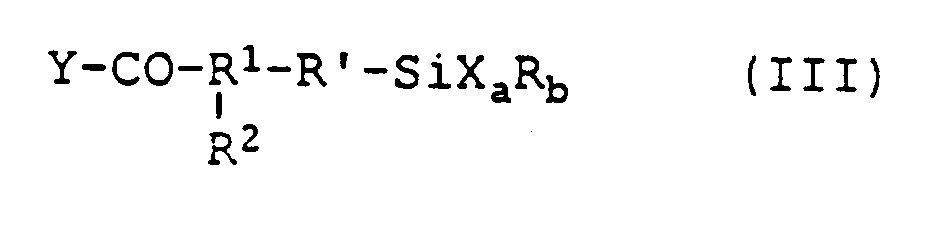 à une réaction de condensation avec un composé de formule générale B(AH)c, dans laquelle B et c sont définis comme à la revendication 1 et A signifie O, S ou NH, oudans laquelle X, R, R', a, b et a+b sont définis comme à la revendication 1, Y est égal à Cl, OH ou OR*, R2 est égal à H et R1 et R* signifient un alkylène ou un alkylènarylène,c) un époxyde éventuellement substitué de formule générale IV ou IX
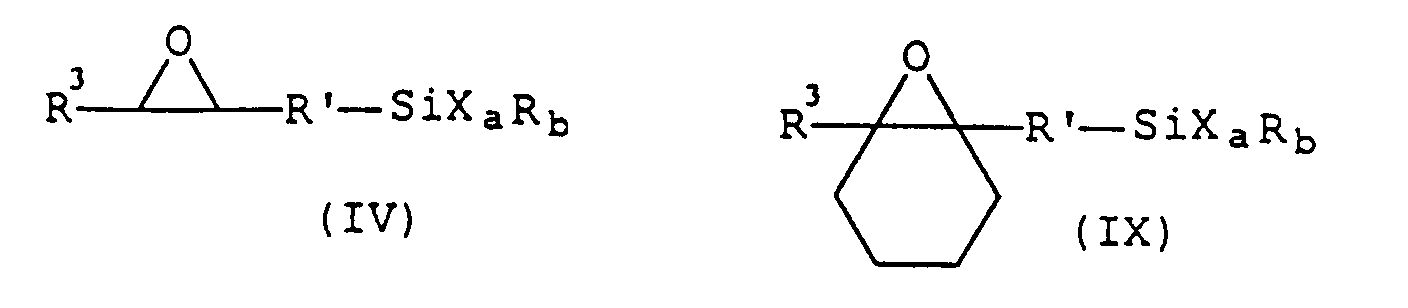 à une réaction d'addition avec un composé de formule générale B(AH)c dans laquelle B et c sont définis comme à la revendication 1 et A signifie O, S, NH ou COO, oudans lesquelles X, R, R', R3, a, b, et a+b sont définis comme à la revendication 1,d) un silane de formule générale V,à une réaction d'addition avec un composé de formule générale B(AH)c dans laquelle B et c sont définis comme à la revendication 1 et A signifie du soufre.dans laquelle X, R, R', a, b et a+b sont définis comme à la revendication 1,
 - Utilisation des silanes selon la revendication 1, pour l'obtention de polycondensats d'acide silicique ou d'hétéropolycondensats d'acide silicique, par condensation hydrolytique de un ou plusieurs composés du silicium condensables hydrolytiquement, et le cas échéant d'autres éléments choisis dans le groupe B, Al, P, Sn, Pb, des métaux de transition, des lanthanides et des actinides et/ou des précondensats dérivés des composés mentionnés ci-dessus, le cas échéant en présence d'un catalyseur et/ou d'un solvant, par action d'eau ou d'humidité,
caractérisée en ce que
de 5 à 100 % molaire, sur la base de composés monomères, des composés condensables hydrolytiquement, sont choisis parmi les silanes de formule générale I, dans laquelle les restes et indices sont définis comme à la revendication 1. - Utilisation selon la revendication 6,
caractérisée en ce qu'
on met en oeuvre comme autres composés condensables hydrolytiquement, des composés le cas échéant sous forme précondensée, qui sont polymérisables par voie radicalaire ou ionique. - Utilisation selon la revendication 6 ou 7,
caractérisée en ce qu'
on utilise comme autres composés du silicium condensables hydrolytiquement, un ou plusieurs composés de formule générale VI, le cas échéant sous forme précondensée,- R
- = alkyle, alkényle, aryle, alkylaryle, ou arylalkyle,
- R''
- = alkylène ou alkénylène dans lesquels ces restes peuvent être interrompus par des atomes d'oxygène ou de soufre ou des groupes NH,
- X
- = hydrogène, halogène, hydroxy, alkoxy, acyloxy, alkylcarbonyle, alkoxycarbonyle ou NR'2, avec R' = hydrogène, alkyle ou aryle,
- Z'
- = halogène ou un groupe éventuellement substitué amino, amide, aldéhyde, alkylcarbonyle, carboxy, mercapto, cyano, alkoxy, alkoxycarbonyle, acide sulfonique, acide phophorique, acryloxy, méthacryloxy, époxy ou vinyle,
- a
- = 0, 1, 2 ou 3
- b
- = 0, 1, 2 ou 3 avec
- Utilisation selon l'une ou plusieurs des revendications 6 à 8,
caractérisée en ce qu'
on met en oeuvre comme autres composés du silicium condensables hydrolytiquement, un ou plusieurs composés de formule générale VII, le cas échéant sous forme précondensée,- A
- = O, S, PR', POR', NHC(O)O ou NHC(O)NR', avec R' = hydrogène, alkyle ou aryle,
- B
- = reste organique à chaíne droite ou ramifié, qui dérive d'un composé B' avec au moins une (pour l = 1, et A = NHC(O)O ou NHC(O)NR') ou au moins deux double liaisons C=C, et de 5 à 50 atomes de carbone, avec R' = hydrogène, alkyle ou aryle
- R
- = alkyle, alkényle, aryle, alkylaryle ou arylalkyle,
- R2
- = alkylène, arylène, ou alkylènarylène,
- X
- = hydrogène, halogène, hydroxy, alkoxy, acyloxy, alkylcarbonyle, alkoxycarbonyle, ou NR'2, avec R' = hydrogène, alkyle ou aryle,
- n
- = 1, 2 ou 3
- k
- = 0, 1 ou 2
- l
- = 0 ou 1
- x
- = un nombre entier dont la valeur maximale correspond au nombre de double liaisons dans le composé B' moins 1, ou est égal au nombre de double liaisons dans le composé B', quand l = 1 et A représente NHC(O)O ou NHC(O)NHR'.
- Utilisation selon la revendication 9,
caractérisée en ce qu'
on met en oeuvre un composé de formule générale VII dans lequel le reste B dérive d'un composé B' substitué ou non substitué avec deux ou davantage de groupes acrylate et/ou méthacrylate. - Utilisation selon l'une ou plusieurs des revendications 6 à 10,
caractérisée en ce qu'
on met en oeuvre comme autres composés condensables hydrolytiquement du silicium, un ou plusieurs composés de formule générale VIII, le cas échéant sous forme précondensée,- R
- = alkyle, alkényle, aryle, alkylaryle ou arylalkyle,
- X
- = hydrogène, halogène, hydroxy, alkoxy, acyloxy, alkylcarbonyle, alkoxycarbonyle, ou NR'2, avec R' = hydrogène, alkyle ou aryle,
- Y
- = un substituant qui renferme un reste 1, 4, 6-trioxaspiro[4,4]nonane, substitué ou non substitué,
- n
- = 1, 2 ou 3
- m
- = 1, 2 ou 3 avec n+m ≤ 4
- Utilisation selon l'une ou plusieurs des revendications 6 à 11,
caractérisée en ce qu'
on met en oeuvre comme autres composants condensables hydrolytiquement, un ou plusieurs composés de l'aluminium, du titane ou du zirconium éventuellement sous forme précondensée de formule :- R°
- représente un halogène, un hydroxy, un alkoxy ou un acyloxy,
- y
- est un nombre entier allant de 1 à 4, en particulier de 2 à 4,
- z
- représente 0, 1, 2 ou 3, de préférence 0, 1 ou 2, et X et
- R
- sont définis comme dans le cas de la formule générale (I).
- Utilisation selon l'une ou plusieurs des revendications 6 à 12,
caractérisée en ce qu'
on ajoute au polycondensat un ou plusieurs promoteurs et on durcit le polycondensat thermiquement, photochimiquement, par voie nucléophile covalente, ou par induction redox. - Utilisation selon l'une ou plusieurs des revendications 6 à 13,
caractérisée en ce qu'
on ajoute au polycondensat avant la polymérisation, un ou plusieurs composants polymérisables par voie radicalaire et/ou ionique. - Utilisation des silanes selon la revendication 1, pour la production de polymérisats obtenus par polymérisation radicalaire de composés contenant une ou plusieurs double liaisons C=C et le cas échéant d'autres composés polymérisables par voie radicalaire, et le cas échéant par polymérisation par voie ionique d'un ou plusieurs composés polymérisables par voie ionique, par action de la chaleur et/ou d'un rayonnement électromagnétique, et/ou par induction redox et/ou d'une manière nucléophile covalente, le cas échéant en présence d'un ou plusieurs promoteurs et/ou d'un solvant,
caractérisée en ce que
de 5 à 100 pour cent molaire sur la base des composés mono-mères sont choisis parmi les silanes de formule I,dans laquelle les restes et indices sont définis comme à la revendication 1.
- Utilisation selon la revendication 15,
caractérisée en ce qu'
on met en oeuvre comme composés polymérisables par voie cationique, un ou plusieurs silanes de formule générale VIII, - Utilisation selon la revendication 15 ou la revendication 16,
caractérisée en ce qu'
on met en oeuvre comme composés polymérisables par voie cationique, un ou plusieurs spiroorthoesters, spiroorthocarbonates, spiroorthoesters bicycliques, méthacryloylspiroorthoesters, mono- ou oligoepoxydes. - Utilisation selon l'une ou plusieurs des revendications 15 à 17,
caractérisée en ce qu'
on met en oeuvre comme autres composés polymérisables par voie radicalaire, un ou plusieurs composés de formule générale VII, - Utilisation selon l'une ou plusieurs des revendications 15 à 18,
caractérisée en ce qu'
on condense par voie hydrolytique le polymérisat, le cas échéant en présence d'autres composés condensables hydrolytiquement du silicium, et le cas échéant d'autres éléments choisis dans le groupe B, Al, P, Sn, Pb, des métaux de transition, des lanthanides, et des actinides, et/ou des précondensats dérivés des composés mentionnés ci-dessus, par action de l'eau ou de l'humidité, le cas échéant en présence d'un catalyseur et/ou d'un solvant. - Utilisation selon la revendication 19,
caractérisée en ce qu'
on met en oeuvre comme autres composés condensables du silicium, un ou plusieurs composés de formule générale VI, éventuellement sous forme précondensée,
Applications Claiming Priority (2)
| Application Number | Priority Date | Filing Date | Title |
|---|---|---|---|
| DE4416857A DE4416857C1 (de) | 1994-05-13 | 1994-05-13 | Hydrolysierbare und polymerisierbare Silane, Verfahren zu deren Herstellung sowie deren Verwendung |
| DE4416857 | 1994-05-13 |
Publications (3)
| Publication Number | Publication Date |
|---|---|
| EP0682033A2 EP0682033A2 (fr) | 1995-11-15 |
| EP0682033A3 EP0682033A3 (fr) | 1998-04-15 |
| EP0682033B1 true EP0682033B1 (fr) | 2000-09-27 |
Family
ID=6518020
Family Applications (1)
| Application Number | Title | Priority Date | Filing Date |
|---|---|---|---|
| EP95103181A Expired - Lifetime EP0682033B1 (fr) | 1994-05-13 | 1995-03-06 | Silanes hydrolysables et polymérisables |
Country Status (5)
| Country | Link |
|---|---|
| US (2) | US5717125A (fr) |
| EP (1) | EP0682033B1 (fr) |
| AT (1) | ATE196634T1 (fr) |
| DE (2) | DE4416857C1 (fr) |
| DK (1) | DK0682033T3 (fr) |
Cited By (4)
| Publication number | Priority date | Publication date | Assignee | Title |
|---|---|---|---|---|
| WO2003057761A1 (fr) * | 2002-01-12 | 2003-07-17 | Basf Coatings Ag | Sols de polysiloxane, leur procede de production et leur utilisation |
| EP2716276A2 (fr) | 2012-10-05 | 2014-04-09 | VOCO GmbH | Kit et procédé de fabrication indirecte d'inlays composites |
| DE102013104600A1 (de) | 2013-01-11 | 2014-07-17 | Fraunhofer-Gesellschaft zur Förderung der angewandten Forschung e.V. | Schichten oder dreidimensionale Formkörper mit zwei Bereichen unterschiedlicher Primär- und/oder Sekundärstruktur, Verfahren zur Herstellung des Formkörpers und Materialien zur Durchführung dieses Verfahrens |
| WO2014108539A1 (fr) | 2013-01-11 | 2014-07-17 | Maris Techcon | Boîtier optique et son processus de préparation |
Families Citing this family (100)
| Publication number | Priority date | Publication date | Assignee | Title |
|---|---|---|---|---|
| DE4416857C1 (de) * | 1994-05-13 | 1995-06-29 | Fraunhofer Ges Forschung | Hydrolysierbare und polymerisierbare Silane, Verfahren zu deren Herstellung sowie deren Verwendung |
| DE4423811C1 (de) * | 1994-07-06 | 1996-01-18 | Fraunhofer Ges Forschung | Hydrolysierbare und polymerisierbare Silane, Verfahren zu deren Herstellung und deren Verwendung |
| GB9507910D0 (en) * | 1995-04-13 | 1995-05-31 | Minnesota Mining & Mfg | Adhesion promotion of orthopaedic implants |
| US5792881A (en) * | 1995-07-06 | 1998-08-11 | Fraunhofer-Gesellschaft Zur Forderung Der Angewandten Forschung E.V. | Thiolsilanes, method of their production and of their use |
| US6222055B1 (en) * | 1995-07-06 | 2001-04-24 | Fraunhofer-Gesellschaft Zur Foerderung Der Angwandten Forschung E.V. | Hydrolyzable and polymerizable and/or polyadditive silanes |
| DE19619046A1 (de) * | 1996-05-02 | 1997-11-06 | Ivoclar Ag | Verwendung einer Zusammensetzung als Dentalmaterial und Dentalmaterial |
| DE19650288A1 (de) * | 1996-12-04 | 1998-07-02 | Fraunhofer Ges Forschung | Metallackdrähte |
| WO1998028307A1 (fr) * | 1996-12-23 | 1998-07-02 | Sartomer Company, Inc. | Monomeres et oligomeres de silane polymerisables par radicaux libres et procede de fabrication |
| US6391463B1 (en) | 1996-12-23 | 2002-05-21 | Sartomer Technology Co., Inc. | Silicon-containing alkoxylated (meth)acrylate monomers |
| DE19932628A1 (de) * | 1998-09-10 | 2000-03-16 | Fraunhofer Ges Forschung | Oxygenatormembran |
| EP0985443B1 (fr) * | 1998-09-10 | 2010-10-27 | Fraunhofer-Gesellschaft zur Förderung der angewandten Forschung e.V. | Membranes semi-perméables |
| DE19846608B4 (de) * | 1998-09-10 | 2006-04-27 | Fraunhofer-Gesellschaft zur Förderung der angewandten Forschung e.V. | Semipermeable Membranen |
| DE19846556A1 (de) | 1998-10-09 | 2000-04-13 | Degussa | Dentalwerkstoff aufweisend poröse Glaskeramiken, poröse Glaskeramiken, Verfahren und Verwendung |
| US6162938A (en) | 1998-11-19 | 2000-12-19 | 3M Innovative Properties Company | Secondary amine-functional silanes, silane-functional polymers therefrom, and resulting cured polymers |
| DE19903177C5 (de) * | 1999-01-21 | 2010-09-16 | Ivoclar Vivadent Ag | Verwendung von Materialien auf der Basis von Polysiloxanen als Dentalmaterialien |
| US6569917B1 (en) | 1999-01-21 | 2003-05-27 | Ivoclar Ag | Dental materials based on polysiloxanes |
| DE19909894A1 (de) | 1999-03-06 | 2000-09-07 | Basf Coatings Ag | Sol-Gel-Überzug für einschichtige oder mehrschichtige Lackierungen |
| DE19910895A1 (de) * | 1999-03-11 | 2000-09-21 | Fraunhofer Ges Forschung | Hydrolysierbare und polymerisierbare Silane |
| DE19915378A1 (de) * | 1999-04-06 | 2000-10-12 | Inst Neue Mat Gemein Gmbh | Haushaltsgeräte mit katalytischer Zusammensetzung |
| DE19915377A1 (de) | 1999-04-06 | 2000-10-12 | Inst Neue Mat Gemein Gmbh | Katalytische Zusammensetzung, Verfahren zu ihrer Herstellung und ihre Verwendung |
| WO2001008639A1 (fr) * | 1999-07-28 | 2001-02-08 | Dentsply International Inc. | Macromonomeres contenant du siloxane et composites dentaires de ceux-ci |
| DE19940858A1 (de) | 1999-08-27 | 2001-03-01 | Basf Coatings Ag | Sol-Gel-Überzug für einschichtige oder mehrschichtige Lackierungen |
| DE10012308A1 (de) | 2000-03-14 | 2001-09-27 | Fraunhofer Ges Forschung | Anorganische Hohlfasern |
| US6296944B1 (en) * | 2000-03-30 | 2001-10-02 | General Electric Company | Curable silicone adhesive compositions |
| DE10101537A1 (de) * | 2001-01-15 | 2002-08-08 | Dentsply Detrey Gmbh | Verfahren zur Herstellung einer polymerisierbaren Dentalzusammensetzung |
| US7101942B2 (en) | 2001-01-19 | 2006-09-05 | Ivoclar Vivadent Ag | Dental materials based on metal oxide clusters |
| WO2002088222A1 (fr) * | 2001-03-13 | 2002-11-07 | Fraunhofer-Gesellschaft Zur Foerderung Der Angewandten Forschung E.V. | Silanes organiquement polymerisables et contenant du phosphore, et polycondensats d'acide silique realises avec ces silanes |
| DE10114290B4 (de) * | 2001-03-23 | 2004-08-12 | Ivoclar Vivadent Ag | Desktop-Verfahren zur Herstellung von Dentalprodukten unter Verwendung des 3D-Plottings |
| DE10150256A1 (de) * | 2001-10-11 | 2003-07-10 | Envision Technologies Gmbh I I | Verfahren und Vorrichtung zum Herstellen von dreidimensionalen Objekten |
| DE10242106A1 (de) | 2002-09-11 | 2004-04-15 | Fraunhofer-Gesellschaft zur Förderung der angewandten Forschung e.V. | Phosphorgruppenhaltige Carbonsäurederivate mit organisch polymerisierbaren Gruppen |
| US20080237907A1 (en) * | 2003-07-11 | 2008-10-02 | Klee Joachim E | Process for the preparation of a polymerizable dental composition |
| DE10349766A1 (de) * | 2003-10-24 | 2005-06-16 | Fraunhofer-Gesellschaft zur Förderung der angewandten Forschung e.V. | Kieselsäurepolykondensate mit verzweigtkettigen, urethan-, säureamid- und/oder carbonsäureestergruppenhaltigen Resten |
| DE102005018059A1 (de) | 2003-10-24 | 2006-10-26 | Fraunhofer-Gesellschaft zur Förderung der angewandten Forschung e.V. | Verfahren zum Verbrücken von Hydroxy- oder Carbonsäuregruppen enthaltenden, organisch polymerisierbaren Silanen oder Silanharzeinheiten, sowie Produkte dieses Verfahrens |
| DE102004011497B4 (de) | 2004-03-09 | 2008-05-21 | Ivoclar Vivadent Ag | Dentalwerkstoffe mit verbesserter Verträglichkeit |
| US20060004121A1 (en) * | 2004-03-10 | 2006-01-05 | Xingzhe Ding | Polymer-brush modified fillers for composites |
| DE602005014972D1 (de) * | 2004-05-26 | 2009-07-30 | Dentsply Detrey Gmbh | Teilchen |
| US20060009536A1 (en) * | 2004-07-12 | 2006-01-12 | Guang-Way Jang | Functionalized sol-gel material, sol-gel film derived therefrom, and method for preparing the same |
| DE102004059378A1 (de) * | 2004-12-09 | 2006-06-22 | Consortium für elektrochemische Industrie GmbH | Alpha-Aminomethyl-alkoxysilane mit hoher Reaktivität und verbesserter Stabilität |
| US20060172247A1 (en) * | 2005-01-28 | 2006-08-03 | Norbert Abels | Orthodontic brackets coated to increase resistance to wear and deformation |
| US20060189707A1 (en) * | 2005-02-24 | 2006-08-24 | Norbert Abels | Kits and methods for coating a dental filling material to increase wear resistance and durability |
| EP2277939B1 (fr) * | 2005-03-24 | 2017-02-22 | Bridgestone Corporation | Compoundage d'une composition de caoutchouc renforcé à l'aide de silicium présentant un faible taux d'émission de VOC |
| DE102005018351B4 (de) * | 2005-04-20 | 2008-05-29 | Fraunhofer-Gesellschaft zur Förderung der angewandten Forschung e.V. | Verwendung widerstandsfähiger, langlebiger Komposite im Dentalbereich |
| JP4817710B2 (ja) * | 2005-05-16 | 2011-11-16 | 旭化成イーマテリアルズ株式会社 | シランカップリング剤 |
| KR20080033280A (ko) * | 2005-07-18 | 2008-04-16 | 신젠타 파티서페이션즈 아게 | 살미생물제로서의 피라졸-4-카복스아미드 유도체 |
| DE102005053721A1 (de) * | 2005-11-10 | 2007-05-16 | Fraunhofer Ges Forschung | Reaktive Partikel, deren Herstellung und Verwendung |
| DE102005057460A1 (de) * | 2005-12-01 | 2007-06-06 | Wacker Chemie Ag | Zu hochfesten Elastomeren vernetzbare ionisch und/oder organometallisch funktionalisierte Siliconpolymere |
| DE102006032077A1 (de) * | 2006-07-11 | 2008-01-17 | Fraunhofer-Gesellschaft zur Förderung der angewandten Forschung e.V. | Hybride Polymermaterialien durch Copolymerisation |
| KR20100015534A (ko) * | 2007-03-13 | 2010-02-12 | 바스프 코포레이션 | 실란을 함유하는 막―형성 물질, 가교제 및 코팅 조성물, 코팅 조성물 제조 방법 및 코팅된 기판 |
| US7772333B2 (en) * | 2007-03-13 | 2010-08-10 | Basf Coatings Gmbh | Film-forming material containing resin with -Si(OR)3 and crosslinkable groups |
| US8501895B2 (en) | 2007-05-23 | 2013-08-06 | Bridgestone Corporation | Method for making alkoxy-modified silsesquioxanes and amino alkoxy-modified silsesquioxanes |
| US7915368B2 (en) | 2007-05-23 | 2011-03-29 | Bridgestone Corporation | Method for making alkoxy-modified silsesquioxanes |
| DE102007060334A1 (de) * | 2007-08-17 | 2009-02-19 | Evonik Degussa Gmbh | Silane-basierendes und wässriges Beschichtungssystem, dessen Herstellung und Verwendung |
| US8962746B2 (en) | 2007-12-27 | 2015-02-24 | Bridgestone Corporation | Methods of making blocked-mercapto alkoxy-modified silsesquioxane compounds |
| US8097674B2 (en) | 2007-12-31 | 2012-01-17 | Bridgestone Corporation | Amino alkoxy-modified silsesquioxanes in silica-filled rubber with low volatile organic chemical evolution |
| US8794282B2 (en) | 2007-12-31 | 2014-08-05 | Bridgestone Corporation | Amino alkoxy-modified silsesquioxane adhesives for improved metal adhesion and metal adhesion retention to cured rubber |
| EP2228049B1 (fr) | 2009-03-09 | 2016-11-09 | Dentsply DeTrey GmbH | Composition dentaire |
| EP2316407B1 (fr) | 2009-10-30 | 2021-04-28 | Dentsply DeTrey GmbH | Composition dentaire |
| US8642691B2 (en) | 2009-12-28 | 2014-02-04 | Bridgestone Corporation | Amino alkoxy-modified silsesquioxane adhesives for improved metal adhesion and metal adhesion retention to cured rubber |
| DE102010003883A1 (de) | 2010-04-12 | 2011-10-13 | Voco Gmbh | Lichthärtbares Kompositmaterial |
| DE102010003884A1 (de) | 2010-04-12 | 2011-10-13 | Voco Gmbh | Dualhärtende, mehrkomponentige dentale Zusammensetzung |
| DE102010003881A1 (de) | 2010-04-12 | 2011-10-13 | Voco Gmbh | Dentale Abdeckmasse |
| EP2436366B1 (fr) | 2010-09-30 | 2015-07-29 | VOCO GmbH | Matériau composite comprenant un monomère doté d'une structure polyalicyclique comme matériau de scellement |
| US9023916B2 (en) | 2010-09-30 | 2015-05-05 | Voco Gmbh | Composite material comprising a monomer with a polyalicyclic structure element |
| US9079828B2 (en) | 2010-09-30 | 2015-07-14 | Voco Gmbh | Polymerizable compounds comprising a polyalicylic structure element |
| EP2436364B1 (fr) | 2010-09-30 | 2017-05-31 | VOCO GmbH | Composition de laque comprenant un monomère doté d'un élément structurel polyalicyclique |
| EP2436363B1 (fr) | 2010-09-30 | 2017-01-18 | VOCO GmbH | Composition comprenant un monomère doté d'un élément structurel polyalicyclique destiné à remplir et/ou sceller un canal radiculaire |
| EP2450025B1 (fr) | 2010-11-08 | 2012-11-28 | VOCO GmbH | Dérivés d'acide phosphorique polymérisables comprenant un élément structurel polyalicyclique |
| EP2527321A1 (fr) | 2011-05-27 | 2012-11-28 | Fraunhofer-Gesellschaft zur Förderung der angewandten Forschung e.V. | Liaisons polymérisables dotées d'esters de (méth)acryloyl et de groupes sulfonate ou sulfate ainsi que leur utilisation |
| US9353226B2 (en) | 2011-05-27 | 2016-05-31 | Fraunhofer-Gesellschaft zur Förderung der angewandten Forschung e.V. | Compounds containing (meth)acrylate groups and sulfonate or sulfate groups, polymers and condensates made therefrom and use of the polymers and condensates |
| DE102011050672B4 (de) | 2011-05-27 | 2020-06-25 | Fraunhofer-Gesellschaft zur Förderung der angewandten Forschung e.V. | Kieselsäure(hetero)polykondensate mit (Meth)acrylresten und entweder Sulfonat- oder Sulfatgruppen, für deren Herstellung geeignete Silane sowie Verfahren zum Herstellen der Kondensate und der Silane |
| JP2011256394A (ja) * | 2011-08-09 | 2011-12-22 | Asahi Kasei E-Materials Corp | 感光性耐熱性樹脂前駆体組成物 |
| DE102011053865A1 (de) | 2011-09-22 | 2013-03-28 | Fraunhofer-Gesellschaft zur Förderung der angewandten Forschung e.V. | Hydrolysierbare und polymerisierbare Silane mit einstellbarer räumlicher Verteilung der funktionellen Gruppen sowie deren Verwendung |
| EP2578200B1 (fr) | 2011-10-04 | 2018-03-28 | VOCO GmbH | Compositions pour l'infiltration et/ou le scellement de la matière dentaire dure et procédé correspondant |
| DE102012202005A1 (de) | 2011-10-12 | 2013-04-18 | Fraunhofer-Gesellschaft zur Förderung der angewandten Forschung e.V. | Gefüllte und ungefüllte, organisch modifizierte, gegebenenfalls organisch vernetzte Kieselsäure(hetero)polysilikate als Dentalmaterialien für die "Chairside"-Behandlung |
| DE102011054440A1 (de) | 2011-10-12 | 2013-04-18 | Fraunhofer-Gesellschaft zur Förderung der angewandten Forschung e.V. | Kieselsäurepolykondensate mit cyclischen olefinhaltigen Strukturen, Verfahren zu deren Herstellung sowie deren Verwendung |
| DE102011056693A1 (de) * | 2011-12-20 | 2013-06-20 | Fraunhofer-Gesellschaft zur Förderung der angewandten Forschung e.V. | Form zur Herstellung von Kunststoffschaumteilen mit hybridpolymerer Beschichtung zur Verbesserung der Entformung |
| DE102012001979A1 (de) | 2012-02-02 | 2013-08-08 | Voco Gmbh | Härtbares Gemisch umfassend Weichmacher mit einem polyalicyclischen Strukturelement zur Anwendung bei der Herstellung dentaler Werkstoffe |
| DE102012001978A1 (de) | 2012-02-02 | 2013-08-08 | Voco Gmbh | Dentale Kompositmaterialien enthaltend tricyclische Weichmacher |
| US9695331B2 (en) | 2012-04-10 | 2017-07-04 | Arkema France | Silicon-containing (meth) acrylate compounds |
| DE102012104139A1 (de) | 2012-05-11 | 2013-11-14 | Fraunhofer-Gesellschaft zur Förderung der angewandten Forschung e.V. | Verwendung eines ungefüllten oder mit Füllstoff gefüllten, organisch modifizierten Kieselsäure(hetero)polykondensats in medizinischen und nichtmedizinischen Verfahren zum Verändern der Oberfläche eines Körpers aus einem bereits ausgehärteten, ungefüllten oder mit Füllstoff gefüllten Kieselsäure(hetero)polykondensat, insbesondere für die zahnmedizinische "Chairside"-Behandlung |
| DE102012109685A1 (de) | 2012-10-11 | 2014-04-17 | Fraunhofer-Gesellschaft zur Förderung der angewandten Forschung e.V. | Verfahren zur Umwandlung reaktiver Gruppen an Si-C-gebundenen Resten von Silanen unter gleichzeitiger Vergrößerung von deren räumlichem Abstand zueinander |
| WO2014078195A1 (fr) | 2012-11-13 | 2014-05-22 | 3M Innovative Properties Company | Composition anti-salissure durcissable, procédé d'utilisation et articles |
| TWI504606B (zh) * | 2013-08-06 | 2015-10-21 | Daxin Materials Corp | 多壓克力基化合物與感光性樹脂組成物 |
| DE102013108594A1 (de) | 2013-08-08 | 2015-02-12 | Fraunhofer-Gesellschaft zur Förderung der angewandten Forschung e.V. | Silane und Kieselsäure(hetero)polykondensate mit über Kupplungsgruppen angebundenen Aromaten, die sich als oder für Matrixsysteme mit hoher Transluzenz und guter Mechanik eignen |
| DE102013110582A1 (de) | 2013-09-24 | 2015-04-09 | Fraunhofer-Gesellschaft zur Förderung der angewandten Forschung e.V. | Elektrochrome Materialien mit verbesserter Temperaturstabilität |
| US9289360B2 (en) | 2014-04-17 | 2016-03-22 | Dentsply International Inc. | Dental composition |
| DE102014210432A1 (de) | 2014-06-03 | 2015-12-03 | Voco Gmbh | Polysiloxanverbindung und daraus herstellbare Dentalmaterialien |
| EP3011949B1 (fr) | 2014-10-23 | 2021-05-05 | VOCO GmbH | Materiau dentaire durcissable |
| DE102014115751B4 (de) | 2014-10-29 | 2020-08-27 | Fraunhofer-Gesellschaft zur Förderung der angewandten Forschung e.V. | Mit aromatischen Resten und mit Hydroxygruppen substituierte Silane und Kieselsäure(hetero)polykondensate sowie Derivate davon, die sich als solche oder als Komposite für (Matrix-)Systeme mit hoher Transluzenz und guter Mechanik eignen |
| DE102014116402A1 (de) | 2014-11-11 | 2016-05-12 | Voco Gmbh | Verwendung radikalisch härtbarer Zusammensetzungen in generativen Fertigungsverfahren |
| DE102014116389A1 (de) | 2014-11-11 | 2016-05-12 | Voco Gmbh | Radikalisch härtbare dentale Zusammensetzungen |
| US11401440B2 (en) | 2014-12-31 | 2022-08-02 | Bridgestone Corporation | Amino alkoxy-modified silsesquioxane adhesives for adhering steel alloy to rubber |
| DE102015112800A1 (de) | 2015-04-09 | 2016-10-13 | Fraunhofer-Gesellschaft zur Förderung der angewandten Forschung e.V. | Mehrteilig aufgebaute Dentalprothese sowie Verfahren und Vorrichtung zu ihrer Herstellung |
| DE102015114397A1 (de) | 2015-08-28 | 2017-03-02 | Fraunhofer-Gesellschaft zur Förderung der angewandten Forschung e.V. | Misch- und Formverfahren für gefüllte Duromere aus organisch vernetzbaren Kompositmassen, insbesondere für dentale Zwecke |
| DE102017211562B4 (de) | 2017-07-06 | 2021-12-02 | Fraunhofer-Gesellschaft zur Förderung der angewandten Forschung e.V. | Beschichtete Cellulosefaser, Verfahren zu deren Herstellung, faserverstärkter Verbundwerkstoff, Verfahren zu dessen Herstellung und dessen Verwendung |
| DE102018114690A1 (de) | 2018-06-19 | 2019-12-19 | Voco Gmbh | Thermowirksame dentale Kompositzusammensetzung |
| DE102018117631B4 (de) * | 2018-07-20 | 2025-04-10 | Fraunhofer-Gesellschaft zur Förderung der angewandten Forschung eingetragener Verein | Verfahren zur Fertigung von patientenindividuellen Komfort-Ohrpassstücken für die Hörakustik-, Audio- und Gehörschutzbranche, damit hergestellte Formkörper und deren Verwendung |
| DE102018117617A1 (de) | 2018-07-20 | 2020-01-23 | Fraunhofer-Gesellschaft zur Förderung der angewandten Forschung e.V. | Herstellung von Formkörpern aus einem anorganisch-organischen Hybridpolymer mit hoher Auflösung mittels 3D-Druck, Formkörper mit hohen Biegefestigkeiten und E-Moduln und deren Anwendung für dentale Zwecke |
| DE102018128576A1 (de) | 2018-11-14 | 2020-05-14 | Fraunhofer-Gesellschaft zur Förderung der angewandten Forschung e.V. | Dreidimensionale Gerüststrukturen mit selektiv funktionalisierten Polymersystemen, deren Verwendung und Verfahren zu deren Herstellung |
| DE102019122174A1 (de) | 2019-08-19 | 2021-02-25 | Voco Gmbh | Dentale polymerisierbare Zusammensetzung auf der Basis kondensierter Silane |
Family Cites Families (17)
| Publication number | Priority date | Publication date | Assignee | Title |
|---|---|---|---|---|
| DE2758414A1 (de) * | 1977-12-28 | 1979-07-12 | Fraunhofer Ges Forschung | Kieselsaeureheteropolykondensate, verfahren zu deren herstellung und deren verwendung bei der zuechtung lebender zellen |
| DE2758415A1 (de) * | 1977-12-28 | 1979-07-12 | Fraunhofer Ges Forschung | Kieselsaeureheteropolykondensate, verfahren zu deren herstellung und deren verwendung als membranen und adsorbentien |
| DE3011761C2 (de) * | 1980-03-26 | 1983-11-24 | Fraunhofer-Gesellschaft zur Förderung der angewandten Forschung e.V., 8000 München | Verfahren zum Verbinden von Substraten durch Heißsiegeln |
| DE3143820A1 (de) * | 1981-11-04 | 1983-05-11 | Dr. Thilo & Co. Contactlinsen GmbH Menicon-Deutschland-Vertrieb, 8029 Sauerlach | Kieselsaeureeheteropolykondensat und dessen verwendung fuer optische linsen, insbesondere kontaktlinsen |
| DE3407087C3 (de) * | 1984-02-27 | 1994-07-07 | Fraunhofer Ges Forschung | Verfahren und Lack zur Herstellung von kratzfesten Beschichtungen |
| DE3536716A1 (de) * | 1985-10-15 | 1987-04-16 | Fraunhofer Ges Forschung | Kleb- und dichtungsmassen und deren verwendung |
| JPS6414228A (en) * | 1987-07-08 | 1989-01-18 | Shinetsu Chemical Co | Organosilicon compound |
| DE3826715A1 (de) * | 1988-08-05 | 1990-02-22 | Fraunhofer Ges Forschung | Verfahren zum beschichten von substraten mit einem isolierenden ueberzug |
| JPH02107650A (ja) * | 1988-10-17 | 1990-04-19 | Toshiba Silicone Co Ltd | 無機ケイ素質充填剤用処理剤 |
| DE3835968A1 (de) * | 1988-10-21 | 1990-06-21 | Fraunhofer Ges Forschung | Verfahren zur herstellung von materialien mit einem strukturierten ueberzug |
| DE4011044A1 (de) * | 1990-04-05 | 1991-10-10 | Fraunhofer Ges Forschung | Silane, verfahren zu ihrer herstellung und ihre verwendung zur herstellung von polymerisaten und polykondensaten |
| DE4125201C1 (fr) * | 1991-07-30 | 1992-10-01 | Fraunhofer-Gesellschaft Zur Foerderung Der Angewandten Forschung Ev, 8000 Muenchen, De | |
| DE4310733A1 (de) * | 1993-04-01 | 1994-10-06 | Fraunhofer Ges Forschung | Selbsthärtende Systeme |
| US5616757A (en) * | 1993-04-08 | 1997-04-01 | Bausch & Lomb Incorporated | Organosilicon-containing materials useful for biomedical devices |
| DE4405261A1 (de) * | 1994-02-18 | 1995-08-24 | Fraunhofer Ges Forschung | Kovalent-nucleophil selbsthärtende Systeme |
| DE4416857C1 (de) * | 1994-05-13 | 1995-06-29 | Fraunhofer Ges Forschung | Hydrolysierbare und polymerisierbare Silane, Verfahren zu deren Herstellung sowie deren Verwendung |
| US5487948A (en) * | 1995-01-26 | 1996-01-30 | General Electric Company | Bis(bis-silylalkyl) dicarboxylates as adhesion promoters and compositions containing them |
-
1994
- 1994-05-13 DE DE4416857A patent/DE4416857C1/de not_active Expired - Lifetime
-
1995
- 1995-03-06 AT AT95103181T patent/ATE196634T1/de active
- 1995-03-06 DE DE59508749T patent/DE59508749D1/de not_active Expired - Lifetime
- 1995-03-06 DK DK95103181T patent/DK0682033T3/da active
- 1995-03-06 EP EP95103181A patent/EP0682033B1/fr not_active Expired - Lifetime
- 1995-05-11 US US08/439,204 patent/US5717125A/en not_active Expired - Lifetime
-
1997
- 1997-02-25 US US08/805,985 patent/US6124491A/en not_active Expired - Lifetime
Cited By (7)
| Publication number | Priority date | Publication date | Assignee | Title |
|---|---|---|---|---|
| WO2003057761A1 (fr) * | 2002-01-12 | 2003-07-17 | Basf Coatings Ag | Sols de polysiloxane, leur procede de production et leur utilisation |
| EP2716276A2 (fr) | 2012-10-05 | 2014-04-09 | VOCO GmbH | Kit et procédé de fabrication indirecte d'inlays composites |
| DE102013008176A1 (de) | 2012-10-05 | 2014-04-10 | Voco Gmbh | Kit und Verfahren zur indirekten chairside Herstellung von Kompositinlays |
| US9833387B2 (en) | 2012-10-05 | 2017-12-05 | Voco Gmbh | Kit and method for indirect chairside production of composite inlays |
| DE102013104600A1 (de) | 2013-01-11 | 2014-07-17 | Fraunhofer-Gesellschaft zur Förderung der angewandten Forschung e.V. | Schichten oder dreidimensionale Formkörper mit zwei Bereichen unterschiedlicher Primär- und/oder Sekundärstruktur, Verfahren zur Herstellung des Formkörpers und Materialien zur Durchführung dieses Verfahrens |
| WO2014108539A1 (fr) | 2013-01-11 | 2014-07-17 | Maris Techcon | Boîtier optique et son processus de préparation |
| WO2014108546A2 (fr) | 2013-01-11 | 2014-07-17 | Fraunhofer-Gesellschaft zur Förderung der angewandten Forschung e.V. | Couches ou corps moulés tridimensionnels comportant deux zones de structures primaires et/ou secondaires différentes, procédé de production du corps moulé et matériaux pour la mise en oeuvre de ce procédé |
Also Published As
| Publication number | Publication date |
|---|---|
| DK0682033T3 (da) | 2000-10-16 |
| US6124491A (en) | 2000-09-26 |
| DE59508749D1 (de) | 2000-11-02 |
| US5717125A (en) | 1998-02-10 |
| EP0682033A3 (fr) | 1998-04-15 |
| ATE196634T1 (de) | 2000-10-15 |
| DE4416857C1 (de) | 1995-06-29 |
| EP0682033A2 (fr) | 1995-11-15 |
Similar Documents
| Publication | Publication Date | Title |
|---|---|---|
| DE4416857C1 (de) | Hydrolysierbare und polymerisierbare Silane, Verfahren zu deren Herstellung sowie deren Verwendung | |
| EP0781290B1 (fr) | Silanes pouvant subir une hydrolyse et une polymerisation ou une polyaddition | |
| EP1202997B1 (fr) | Silanes hydrolysables et polymerisables a faible viscosite et leur utilisation | |
| EP0799832B1 (fr) | Silanes fluorées hydrolysables, procédé pour les préparer et leur utilisation pour la production de polycondensats d'acide silicique et d'hétéropolycondensats d'acide silicique | |
| EP0450624B1 (fr) | Hétéropolycondensats polymérisables d'acide silicique et leur emploi | |
| EP1159281B1 (fr) | Silanes hydrolysables et polymerisables | |
| EP0525392B1 (fr) | Silanes hydrolysables et polymérisables | |
| EP1141094B1 (fr) | Monomeres reticulables a base de cyclosiloxane, leur preparation et leur utilisation dans des matieres polymerisables | |
| EP0618242B1 (fr) | Systèmes auto-durcissants | |
| WO2001004186A1 (fr) | Polycondensats d'acide silicique modifies organiquement, leur production et leur utilisation | |
| EP0978525A2 (fr) | Siloxanes oligomères contenant des groupes acryloxypropyle ou méthacryloxypropyle | |
| WO1998052992A1 (fr) | Oligomeres obtenus a partir d'organosilanes | |
| DE19726829A1 (de) | Verwendung von nanoskaligen Metalloxid-Teilchen als Polymerisationskatalysatoren | |
| EP0694550B1 (fr) | Silanes hydrolysables et polymerisables | |
| EP0867443B1 (fr) | Oxetanesilanes hydrolysables et polymérisables | |
| US6222055B1 (en) | Hydrolyzable and polymerizable and/or polyadditive silanes | |
| EP0668326A2 (fr) | Systèmes auto-réticulables de manière covalente-nucléophile | |
| CH634859A5 (de) | Polymere alkoxysilane und ihre verwendung. | |
| DE10156622A1 (de) | Oligomere Silasesquioxane, Verfahren zu deren Herstellung und Verwendung |
Legal Events
| Date | Code | Title | Description |
|---|---|---|---|
| PUAI | Public reference made under article 153(3) epc to a published international application that has entered the european phase |
Free format text: ORIGINAL CODE: 0009012 |
|
| AK | Designated contracting states |
Kind code of ref document: A2 Designated state(s): AT BE CH DE DK FR GB IT LI LU NL SE |
|
| PUAL | Search report despatched |
Free format text: ORIGINAL CODE: 0009013 |
|
| AK | Designated contracting states |
Kind code of ref document: A3 Designated state(s): AT BE CH DE DK FR GB IT LI LU NL SE |
|
| 17P | Request for examination filed |
Effective date: 19980424 |
|
| 17Q | First examination report despatched |
Effective date: 19990806 |
|
| GRAG | Despatch of communication of intention to grant |
Free format text: ORIGINAL CODE: EPIDOS AGRA |
|
| GRAG | Despatch of communication of intention to grant |
Free format text: ORIGINAL CODE: EPIDOS AGRA |
|
| GRAH | Despatch of communication of intention to grant a patent |
Free format text: ORIGINAL CODE: EPIDOS IGRA |
|
| GRAH | Despatch of communication of intention to grant a patent |
Free format text: ORIGINAL CODE: EPIDOS IGRA |
|
| GRAA | (expected) grant |
Free format text: ORIGINAL CODE: 0009210 |
|
| AK | Designated contracting states |
Kind code of ref document: B1 Designated state(s): AT BE CH DE DK FR GB IT LI LU NL SE |
|
| REF | Corresponds to: |
Ref document number: 196634 Country of ref document: AT Date of ref document: 20001015 Kind code of ref document: T |
|
| REG | Reference to a national code |
Ref country code: CH Ref legal event code: NV Representative=s name: PA ALDO ROEMPLER Ref country code: CH Ref legal event code: EP |
|
| REG | Reference to a national code |
Ref country code: DK Ref legal event code: T3 |
|
| REF | Corresponds to: |
Ref document number: 59508749 Country of ref document: DE Date of ref document: 20001102 |
|
| ET | Fr: translation filed | ||
| ITF | It: translation for a ep patent filed | ||
| GBT | Gb: translation of ep patent filed (gb section 77(6)(a)/1977) |
Effective date: 20001205 |
|
| PLBE | No opposition filed within time limit |
Free format text: ORIGINAL CODE: 0009261 |
|
| STAA | Information on the status of an ep patent application or granted ep patent |
Free format text: STATUS: NO OPPOSITION FILED WITHIN TIME LIMIT |
|
| 26N | No opposition filed | ||
| REG | Reference to a national code |
Ref country code: GB Ref legal event code: IF02 |
|
| REG | Reference to a national code |
Ref country code: CH Ref legal event code: PFA Owner name: FRAUNHOFER-GESELLSCHAFT ZUR FOERDERUNG DER ANGEWA Free format text: FRAUNHOFER-GESELLSCHAFT ZUR FOERDERUNG DER ANGEWANDTEN FORSCHUNG E.V.#LEONRODSTRASSE 54#80636 MUENCHEN (DE) -TRANSFER TO- FRAUNHOFER-GESELLSCHAFT ZUR FOERDERUNG DER ANGEWANDTEN FORSCHUNG E.V.#HANSASTRASSE 27 C#80686 MUENCHEN (DE) |
|
| REG | Reference to a national code |
Ref country code: CH Ref legal event code: PCAR Free format text: ALDO ROEMPLER PATENTANWALT;BRENDENWEG 11 POSTFACH 154;9424 RHEINECK (CH) |
|
| PGFP | Annual fee paid to national office [announced via postgrant information from national office to epo] |
Ref country code: DE Payment date: 20140325 Year of fee payment: 20 Ref country code: LU Payment date: 20140324 Year of fee payment: 20 Ref country code: NL Payment date: 20140320 Year of fee payment: 20 Ref country code: CH Payment date: 20140324 Year of fee payment: 20 Ref country code: SE Payment date: 20140324 Year of fee payment: 20 Ref country code: DK Payment date: 20140325 Year of fee payment: 20 |
|
| PGFP | Annual fee paid to national office [announced via postgrant information from national office to epo] |
Ref country code: FR Payment date: 20140319 Year of fee payment: 20 Ref country code: IT Payment date: 20140327 Year of fee payment: 20 Ref country code: AT Payment date: 20140320 Year of fee payment: 20 |
|
| PGFP | Annual fee paid to national office [announced via postgrant information from national office to epo] |
Ref country code: GB Payment date: 20140324 Year of fee payment: 20 |
|
| PGFP | Annual fee paid to national office [announced via postgrant information from national office to epo] |
Ref country code: BE Payment date: 20140320 Year of fee payment: 20 |
|
| REG | Reference to a national code |
Ref country code: DE Ref legal event code: R071 Ref document number: 59508749 Country of ref document: DE |
|
| REG | Reference to a national code |
Ref country code: DK Ref legal event code: EUP Effective date: 20150306 |
|
| REG | Reference to a national code |
Ref country code: CH Ref legal event code: PL |
|
| REG | Reference to a national code |
Ref country code: NL Ref legal event code: V4 Effective date: 20150306 |
|
| REG | Reference to a national code |
Ref country code: GB Ref legal event code: PE20 Expiry date: 20150305 |
|
| REG | Reference to a national code |
Ref country code: AT Ref legal event code: MK07 Ref document number: 196634 Country of ref document: AT Kind code of ref document: T Effective date: 20150306 |
|
| REG | Reference to a national code |
Ref country code: SE Ref legal event code: EUG |
|
| PG25 | Lapsed in a contracting state [announced via postgrant information from national office to epo] |
Ref country code: GB Free format text: LAPSE BECAUSE OF EXPIRATION OF PROTECTION Effective date: 20150305 |