EP1203572A2 - Verfahren zur Herstellung von merhschichtigen dünnen Pflastern mit einem Trägermaterial auf Polyurethanbasis - Google Patents
Verfahren zur Herstellung von merhschichtigen dünnen Pflastern mit einem Trägermaterial auf Polyurethanbasis Download PDFInfo
- Publication number
- EP1203572A2 EP1203572A2 EP01122414A EP01122414A EP1203572A2 EP 1203572 A2 EP1203572 A2 EP 1203572A2 EP 01122414 A EP01122414 A EP 01122414A EP 01122414 A EP01122414 A EP 01122414A EP 1203572 A2 EP1203572 A2 EP 1203572A2
- Authority
- EP
- European Patent Office
- Prior art keywords
- polyurethane
- adhesive
- auf
- layer
- nip
- Prior art date
- Legal status (The legal status is an assumption and is not a legal conclusion. Google has not performed a legal analysis and makes no representation as to the accuracy of the status listed.)
- Granted
Links
Images

Classifications
-
- A—HUMAN NECESSITIES
- A61—MEDICAL OR VETERINARY SCIENCE; HYGIENE
- A61F—FILTERS IMPLANTABLE INTO BLOOD VESSELS; PROSTHESES; DEVICES PROVIDING PATENCY TO, OR PREVENTING COLLAPSING OF, TUBULAR STRUCTURES OF THE BODY, e.g. STENTS; ORTHOPAEDIC, NURSING OR CONTRACEPTIVE DEVICES; FOMENTATION; TREATMENT OR PROTECTION OF EYES OR EARS; BANDAGES, DRESSINGS OR ABSORBENT PADS; FIRST-AID KITS
- A61F13/00—Bandages or dressings; Absorbent pads
- A61F13/02—Adhesive bandages or dressings
- A61F13/0276—Apparatus or processes for manufacturing adhesive dressings or bandages
- A61F13/0279—Apparatus or processes for manufacturing adhesive dressings or bandages by attaching individual patches on moving webs
-
- Y—GENERAL TAGGING OF NEW TECHNOLOGICAL DEVELOPMENTS; GENERAL TAGGING OF CROSS-SECTIONAL TECHNOLOGIES SPANNING OVER SEVERAL SECTIONS OF THE IPC; TECHNICAL SUBJECTS COVERED BY FORMER USPC CROSS-REFERENCE ART COLLECTIONS [XRACs] AND DIGESTS
- Y10—TECHNICAL SUBJECTS COVERED BY FORMER USPC
- Y10T—TECHNICAL SUBJECTS COVERED BY FORMER US CLASSIFICATION
- Y10T156/00—Adhesive bonding and miscellaneous chemical manufacture
- Y10T156/10—Methods of surface bonding and/or assembly therefor
- Y10T156/1002—Methods of surface bonding and/or assembly therefor with permanent bending or reshaping or surface deformation of self sustaining lamina
- Y10T156/1007—Running or continuous length work
- Y10T156/1023—Surface deformation only [e.g., embossing]
Definitions
- the invention relates to a method for producing multilayered thin Paving with a carrier material based on polyurethane.
- Multilayered thin plasters with a carrier material based on polyurethane are usually produced by spreading the polyurethane composition on a carrier material and laminating it together with a squeegee before curing with an adhesive, preferably also made of polyurethane. So far it has not been possible to produce very thin carrier layers made of polyurethane. If the squeegee gap is set to a very low height, a thin polyurethane layer can be produced, but due to the high viscosity of the polyurethane, a mass of liquor will accumulate in front of the squeegee. This mass of liquor from the reactive polyurethane blocks over time, so that continuous operation is impossible.
- foam wound dressings such as those from the Beiersdorf company are available under the names Cutinova ® thin and Cutinova ® hydro Manufacturing process explained in more detail. Et al these are described in DE 42 33 289 A1, in DE 196 18 825 A1 and WO 97/43328.
- the polyurethane gel foam then consists of a polyaddition product of a polyether polyol (Levagel ® from Bayer AG) with an aromatic or aliphatic Diisocyanate (Desmodur ® Bayer AG), in which a polyacrylate superabsorbent powder (Favor ®, Stockhausen) was incorporated.
- the polyurethane gel can, depending on the ratio from OH equivalents of the polyol to reactive isocyanate groups, weak or can be adjusted to be highly adhesive on the skin.
- the flat polyurethane gel foam with a thickness of 1 to 6 mm is covered on one side in front of a doctor blade by a polyurethane film. Patches of the appropriate size are punched out of the bale goods.
- the punched-out large wound dressings are ideal for treating chronic or difficult-to-heal wounds from patients who need inpatient care.
- the object of the invention is to provide a method which is capable of very thin, possibly multilayered plasters with a polyurethane backing in to manufacture a continuous process.
- the roll gap of two smooth rollers formed.
- the roll nip has an upper embossing roll and one lower smooth roll is formed.
- the embossing makes it possible, on the one hand, to bring the polyurethane layer to the desired thickness on the running carrier web and, on the other hand, to generate targeted material accumulations in the closed polyurethane layer, in order to be able to punch out any shaped plaster.
- Various embossments can be present in the embossing roller in order to achieve a change in the polyurethane layer.
- these can have the shape of a semi-concave lens. This leads to raised centers in the polyurethane layer, which taper towards the edge. Ellipsoids, cuboids, cubes or other geometric shapes are also possible to create special shapes in the PU layer.
- the lens has a polyurethane layer after the stamping sloping towards the edge from a point in the middle.
- this point lies in the center of the surface in order to achieve a symmetrical appearance of the sloping layer.
- the bevelling can also be irregular, depending on the need and application of the patch.
- the height of the edge zone is a maximum of 50% of the total height of the product, heights of the edge zone of less than 0.2 mm are preferred.
- the course of the contour from the center to the edge is determined by the selected shape, i.e. the mold determines the design of the contour.
- nip In order to achieve the desired reduction in thickness, preference is given to in the nip generates a pressure of at least 4 bar, in particular 5 bar.
- the polyurethane layer further preferably has a thickness after the nip 10 to 100 microns, especially 40 to 60 microns.
- the adhesive further preferably has a thickness of 20 to 100 after the nip ⁇ m, in particular 40 to 60 ⁇ m.
- the carrier film preferably consists of a transparent, multilayer, water vapor-permeable polyurethane, polyethylene, polypropylene, polyamide or polyester film.
- a transparent, multilayer, water vapor-permeable polyurethane polyethylene, polypropylene, polyamide or polyester film.
- these have a thickness of 10 to 100 ⁇ m, in particular 40 to 60 ⁇ m. The advantageous thickness results from the requirement for a rigid material that prevents rolling up under mechanical stress.
- this consists of a skin-friendly PSA made of polyacrylate, in which to increase the adhesion to skin Tackifier (for example a hydrocarbon resin) is incorporated.
- skin Tackifier for example a hydrocarbon resin
- the release layer is preferably a release paper which is siliconized on one side.
- the polyurethane layer is particularly transparent, highly permeable to water vapor and adhesive.
- a superabsorbent polymer is preferably used to store liquid incorporated as a powder.
- the polyurethane layer serves as good cushioning and as a store of exudate that the wound emerges.
- the ethylene oxide content is in the polyether polyols used according to the invention preferably ⁇ 20% by weight.
- the polyether polyols are known per se and are described, for example, by Polymerization of epoxides, such as ethylene oxide, propylene oxide, butylene oxide or tetrahydrofuran, with itself or through the addition of these epoxides, preferably from Ethylene oxide and propylene oxide - optionally in a mixture with one another or separately successively - on starter components with at least two reactive hydrogen atoms, such as water, ethylene glycol, propylene glycol, diethylene glycol, dipropylene glycol, Glycerin, trimethylolpropane, pentaerythritol, sorbitol or succrose.
- epoxides such as ethylene oxide, propylene oxide, butylene oxide or tetrahydrofuran
- Monomeric or trimerized hexamethylene diisocyanate is used as the isocyanate component or by using biuret, uretdione, allophanate groups or by prepolymerization Polyether polyols or mixtures of polyether polyols based on the known Starter components with 2 or> 2 reactive H atoms and epoxides, such as ethylene oxide or propylene oxide with an OH number of ⁇ 850, preferably 100 to 600, modified Hexamethylene diisocyanate used. Modified hexamethylene diisocyanate is preferred. in particular by prepolymerization with polyether diols OH number 200 to 600 modified hexamethylene diisocyanate. Very particularly preferred are modifications of hexamethylene diisocyanate with polyether diols of the OH number 200-600, whose residual monomeric hexamethylene diisocyanate content is less than 0.5% by weight lies.
- the catalysts used for the polyurethane gels according to the invention are the anhydrous ones Polyether polyols a) soluble bismuth (III) carboxylates based on linear, branched, saturated or unsaturated carboxylic acids with 2 to 18, preferably 6 to 18, carbon atoms in question.
- Bi (III) salts of branched saturated carboxylic acids are preferred tertiary carboxyl groups, such as 2,2-dimethyl-octanoic acid (for example Versatic acids, Shell). Preparations of these bi (III) salts in excess are very suitable Proportions of these carboxylic acids.
- a solution of 1 mol has proven to be excellent of the Bi (III) salt of Versatic 10-acid (2,2-dimethyloctanoic acid) in excess of 3 mol of this acid with a Bi content of approx. 17%.
- the catalysts are preferably used in amounts of 0.03 to 0.1% by weight, based on the polyol a) used.
- the antioxidants used for the polyurethane gels according to the invention are sterically hindered phenolic stabilizers, such as BHT (2,6-di-tert-butyl-4-methylphenol), Vulkanox BKF (2.2 min -methylene-bis- (6-tert-butyl-4-methylphenol) (Bayer AG), Irganox 1010 (pentaerythrityl tetrakis [3- (3,5-di-tert-butyl-4-hydroxyphenyl) propionate]), Irganox 1076 (octadecyl 3- (3,5-di-tert-butyl-4-hydroxyphenyl) propionate) (Ciba-Geigy) or tocopherol (vitamin E). Those of the ⁇ -tocopherol type are preferred used.
- BHT 2,6-di-tert-butyl-4-methylphenol
- Vulkanox BKF 2.2 min -methylene-
- the antioxidants are preferably used in amounts of 0.15 to 0.5% by weight, based on the polyol a).
- the isocyanate index (ratio of the free NCO groups used in the reaction to the free OH groups) of the polyurethane gel compositions according to the invention is in the range from 0.30 to 0.70, preferably in the range, depending on the functionality of the isocyanate and polyol components used from 0.45 to 0.60.
- the isocyanate index required for gel formation can be easily estimated using the following formula: f ( polyol ) • ( f ( isocyanate ) -1) • identification number ⁇ 2 identification number ⁇ 2 f ( polyol ) • ( f ( isocyanate ) -1) f: functionality of the isocyanate or polyol component
- the polyurethane gel compositions according to the invention are produced by customary processes, as described, for example, in Becker / Braun, Kunststoff-Handbuch, Vol. 7, Polyurethane, p. 121 ff, Carl-Hauser, 1983.
- the polyurethane gels can be made from those known per se from polyurethane chemistry Starting compounds are prepared by methods known per se, as they are described for example in DE 31 03 499 A1, DE 31 03 500 A1 and EP 0 147 588 A1 become. It is essential, however, that when selecting the yellow-forming components The conditions defined above are observed, otherwise, instead of self-adhesive Gels non-sticky, elastic gels can be obtained.
- Preferred polyhydroxyl compounds are polyether polyols as described in the above mentioned disclosure documents are mentioned in detail.
- the polyisocyanate components are both (cyclo) aliphatic and aromatic Suitable isocyanates.
- Preferred (cyclo) aliphatic polyisocyanates are 1,6-hexamethylene diisocyanate as well as its biurets and trimerisates or hydrogenated diphenylmethane diisocyanate ( "MDI") - types.
- Preferred aromatic polyisocyanates are those which are obtained by distillation, such as MDI mixtures of 4,4'- and 2,4'-isomers or 4,4'-MDI, as well as tolylene diisocyanate (“TDI”) types.
- the diisocyanates can in particular, for example, from the group of unmodified aromatic or aliphatic diisocyanates or from prepolymerization modified products formed with amines, polyols or polyether polyols become.
- the polyurethane mass can be unfoamed, foamed, unfilled or with additional Fillers such as superabsorbents, titanium dioxide, zinc oxide, plasticizers, Dyes etc. are used.
- additional Fillers such as superabsorbents, titanium dioxide, zinc oxide, plasticizers, Dyes etc. are used.
- the polyurethane mass in the central zone Doping agents.
- Hydrogels can also be used in semi-solid to solid form with active ingredients for the central zone.
- the polyurethane gels can optionally contain additives known per se from polyurethane chemistry, such as, for example, fillers and short fibers on an inorganic or organic basis, metal pigments, surface-active substances or liquid extenders such as substances with a boiling point above 150 ° C.
- additives known per se from polyurethane chemistry such as, for example, fillers and short fibers on an inorganic or organic basis, metal pigments, surface-active substances or liquid extenders such as substances with a boiling point above 150 ° C.
- organic fillers are heavy spar, chalk, gypsum, kieserite, soda, titanium dioxide, cerium oxide, quartz sand, kaolin, soot and hollow microspheres.
- organic fillers for example, powders based on polystyrene, polyvinyl chloride, urea formaldehyde and polyhydrazodicarbonamide can be used.
- the short fibers are, for example, glass fibers of 0.1-1 mm in length or fibers of organic origin, such as polyester or polyamide fibers.
- Metal powders such as iron or copper powder, can also be used in gel formation.
- the dyes or color pigments known per se in the coloring of polyurethanes on an organic or inorganic basis can be used, such as, for example, iron oxide or chromium oxide pigments, pigments based on phthalocyanine or monoazo.
- surface-active substances which may be mentioned are cellulose powder, activated carbon and silica preparations.
- additives of polymeric vinyl compounds, polyacrylates and other usual in adhesive technology Copolymers or adhesives based on natural materials up to a content of 10 % By weight, based on the weight of the gel mass, are added.
- Preferred water-absorbing materials are water-absorbing salts of polyacrylates and their copolymers known as superabsorbers, in particular the sodium or potassium salts. They can be non-networked or networked and are also available as commercial products. Products such as those disclosed in DE 37 13 601 A1 and also superabsorbents of the new generation with only small proportions of dry water and high swelling capacity under pressure are particularly suitable. Preferred products are weakly crosslinked polymers based on acrylic acid / sodium acrylate. Such sodium polyacrylates are available as Favor 22-SK (Chemische Fabrik Stockhausen GmbH, Germany). Other absorbers, for example carboxymethyl cellulose and karaya, are also suitable.
- the degree of foaming can be determined by the amount of foaming agent incorporated vary within wide limits.
- the self-adhesive product through a siliconized paper or a particularly siliconized film covered, so that the adhesive side during the Storage is protected.
- the method according to the invention makes it possible to produce thin PU plasters with a polyurethane mass as a wound dressing in one operation.
- products can even be produced which have very to extremely thin edges.
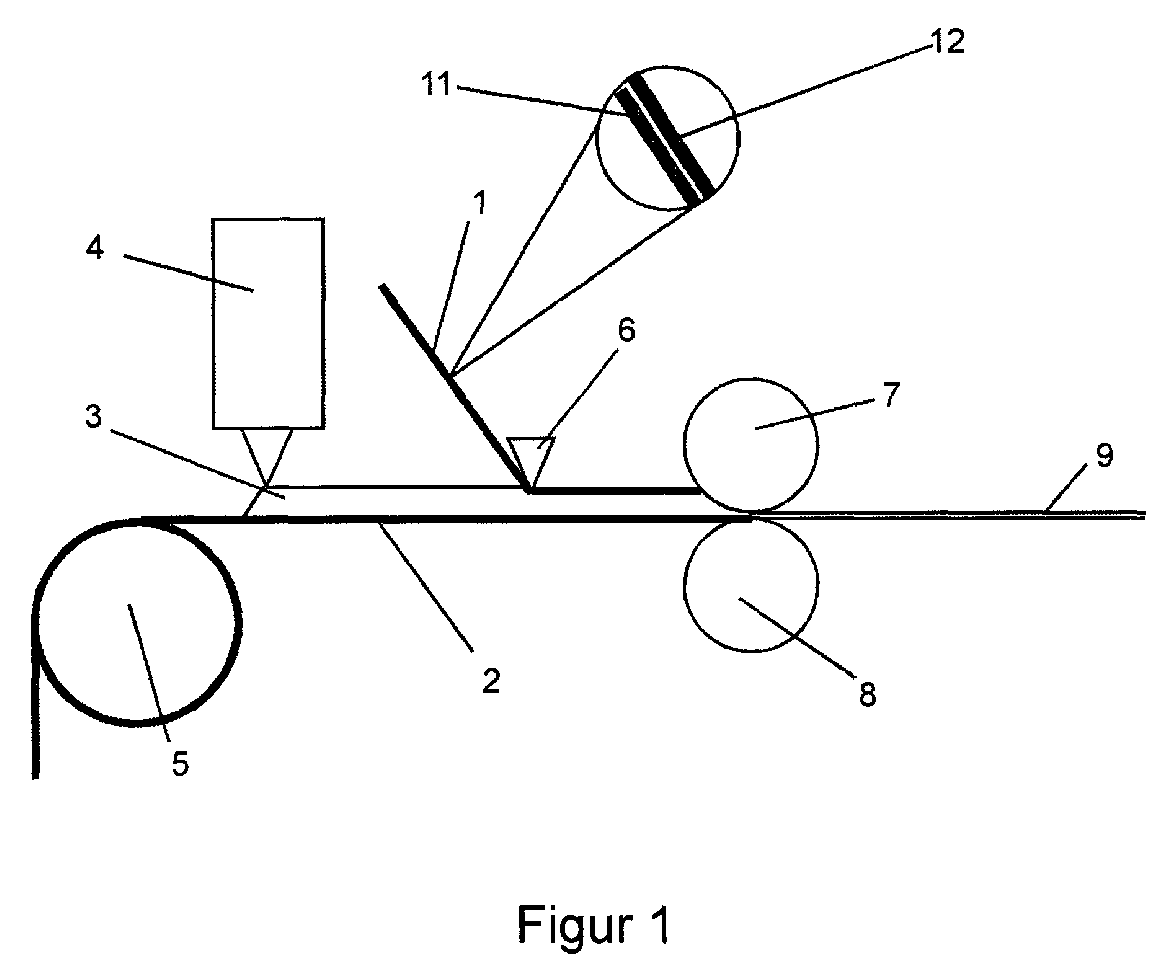
- a layer of polyurethane 11 is applied to an intermediate carrier 12.
- an adhesive 3 is applied to a separating layer 2.
- the separating layer 2 is moved under a container 4 via a roller 5, from which the adhesive 3 is applied to the separating layer 5 in a certain layer thickness.
- the composite 1 made of uncured polyurethane 11 and intermediate carrier 12 is laminated together with the adhesive 3 on the separating layer 2 by a doctor blade 6 and fed to a nip which is formed from the two rollers 7 and 8.
- the polyurethane 11 and the adhesive 3 are rolled out to the final thickness in the nip.
- the nip can be formed by two smooth rollers 7, 8, the upper roller 7 can also be an embossing roller.
Landscapes
- Health & Medical Sciences (AREA)
- Engineering & Computer Science (AREA)
- Life Sciences & Earth Sciences (AREA)
- Biomedical Technology (AREA)
- Heart & Thoracic Surgery (AREA)
- Vascular Medicine (AREA)
- Manufacturing & Machinery (AREA)
- Animal Behavior & Ethology (AREA)
- General Health & Medical Sciences (AREA)
- Public Health (AREA)
- Veterinary Medicine (AREA)
- Materials For Medical Uses (AREA)
- Laminated Bodies (AREA)
- Medicinal Preparation (AREA)
- Polyurethanes Or Polyureas (AREA)
Abstract
Description
Nicht möglich war es bisher, sehr dünne Trägerschichten aus Polyurethan herzustellen. Wird nämlich der Rakelspalt auf eine sehr geringe Höhe eingestellt, so kann zwar eine dünne Polyurethanschicht erzeugt werden, allerdings kommt es vor dem Rakel bedingt durch die hohe Viskosität des Polyurethans zu einer Ansammlung einer Masseflotte. Diese Masseflotte aus dem reaktiven Polyurethan verblockt im Laufe der Zeit, so daß ein kontinuierlicher Betrieb unmöglich ist.
Die ausgestanzten großflächigen Wundauflagen eignen sich hervorragend zur Versorgung von chronischen oder schwerheilenden Wunden von Patienten, die stationär versorgt werden müssen.
In der Prägewalze können verschiedene Einprägungen vorhanden sein, um eine Veränderung der Polyurethanschicht zu erzielen. Beispielsweise können diese die Form einer halbkonkaven Linse aufweisen. Dies führt in der Polyurethanschicht zu erhöhten Zentren, die sich zum Rand hin abschrägen. Möglich sind auch Ellipsoide, Quader, Würfel oder andere geometrische Formen, um spezielle Formen in der PU-Schicht zu erzeugen.
Die Höhe der Randzone beträgt maximal 50% von der Gesamthöhe des Produktes, bevorzugt werden Höhen der Randzone von kleiner 0,2 mm. Der Konturierungsverlauf vom Zentrum zum Rand wird durch die gewählte Form festgelegt, das heißt, die Gießform bestimmt das Design der Kontur.
In einer vorteilhaften Ausführungsform weisen diese eine Dicke von 10 bis 100 µm, insbesondere 40 bis 60 µm, auf.
Die vorteilhafte Dicke resultiert aus der Anforderung nach einem biegesteifen Material, das das Aufrollen bei mechanischer Belastung unterbindet.
Die Isocyanatkennzahl (Verhältnis der bei der Reaktion eingesetzten freien NCO-Gruppen zu den freien OH-Gruppen) der erfindungsgemäßen Polyurethan-Gelmassen liegt je nach der Funktionalität der eingesetzten Isocyanat- und Polyolkomponenten im Bereich von 0,30 bis 0,70, bevorzugt im Bereich von 0,45 bis 0,60. Die für eine Gelbildung erforderliche Isocyanatkennzahl kann sehr einfach nach der folgenden Formel abgeschätzt werden:
Die erfindungsgemäßen Polyurethan-Gelmassen werden hergestellt nach üblichen Verfahren, wie sie beispielsweise beschrieben sind in Becker/Braun, Kunststoff- Handbuch, Bd. 7, Polyurethane, S. 121 ff, Carl-Hauser, 1983.
Die hydrophilen Polyurethangelschäume sind demnach erhältlich aus
- a) einem oder mehreren Polyisocyanaten,
- b) einer oder mehreren Polyhydroxylverbindungen mit einem mittleren Molekulargewicht zwischen 1000 und 12000, und einer mittleren OH-Zahl zwischen 20 und 112,
- c) gegebenenfalls Katalysatoren oder Beschleunigern für die Reaktion zwischen Isocyanat- und Hydroxylgruppen sowie gegebenenfalls
- d) aus der Polyurethanchemie an sich bekannten Füll- und Zusatzstoffen,
Als organische Füllstoffe seien beispielsweise Schwerspat, Kreide, Gips, Kieserit, Soda, Titandioxid, Ceroxid, Quarzsand, Kaolin, Russ und Mikrohohlkugeln genannt.
An organischen Füllstoffen können zum Beispiel Pulver auf Basis von Polystyrol, Polyvinylchlorid, Hamstoff-Formaldehyd und Polyhydrazodicarbonamid eingesetzt werden. Als Kurzfasern kommen zum Beispiel Glasfasern von 0,1 - 1 mm Länge oder Fasern organischer Herkunft, wie zum Beispiel Polyester- oder Polyamidfasern, in Frage. Metallpulver, wie zum Beispiel Eisen oder Kupferpulver, können ebenfalls bei der Gelbildung mitverwendet werden. Um den Gelen die gewünschte Färbung zu verleihen, können die bei der Einfärbung von Polyurethanen an sich bekannten Farbstoffe oder Farbpigmente auf organischer oder anorganischer Basis verwendet werden, wie zum Beispiel Eisenoxid- oder Chromoxidpigmente, Pigmente auf Phthalocyanin- oder Monoazo-Basis. Als oberflächenaktive Substanzen seien zum Beispiel Cellulosepulver, Aktivkohle und Kieselsäurepräparate genannt.
Bevorzugte Produkte sind schwach vernetzte Polymerisate auf der Basis Acrylsäure/Natriumacrylat. Solche Natrium-polyacrylate sind als Favor 22-SK (Chemische Fabrik Stockhausen GmbH, Deutschland) erhältlich.
Weitere Absorber, zum Beispiel Carboxymethylcellulose und Karaya, sind ebenfalls geeignet.
Bei der bevorzugten Verfahrensvariante mit der geprägten Walze können sogar Produkte hergestellt werden, die sehr bis äußerst dünne Ränder aufweisen.
Gleichzeitig wird auf eine Trennlage 2 eine Klebemasse 3 aufgetragen. Dazu wird über eine Walze 5 die Trennlage 2 unter einen Behälter 4 gefahren, aus dem die Klebmasse 3 in einer gewissen Schichtdicke auf die Trennlage 5 aufgegeben wird.
In dem Walzenspalt werden das Polyurethan 11 sowie die Klebmasse 3 auf die endgültige Dicke ausgewalzt.
Claims (6)
- Verfahren zur Herstellung von mehrschichtigen dünnen Pflastern mit einem Trägermaterial auf Polyurethanbasis, wobeia) zumindest eine Schicht eines Polyurethans auf einen Zwischenträger aufgebracht wird,b) auf eine Trennlage eine Klebemasse aufgetragen wird,c) das nicht ausgehärtete Polyurethan auf dem Zwischenträger und die Klebmasse auf der Trennlage insbesondere von einem Rakel zusammenkaschiert werden,d) nach dem Rakel das Laminat in einen Walzenspalt geführt wird, in dem das Polyurethan sowie die Klebmasse auf die endgültige Dicke ausgewalzt werden.
- Verfahren nach Anspruch 1, dadurch gekennzeichnet, daß der Walzenspalt von zwei Glattwalzen gebildet wird.
- Verfahren nach Anspruch 1, dadurch gekennzeichnet, daß der Walzenspalt von einer oberen Prägewalze und einer unteren Glattwalze gebildet wird.
- Verfahren nach zumindest einem der vorherigen Ansprüche, dadurch gekennzeichnet, daß im Walzenspalt ein Druck von zumindest 4 bar, insbesondere 5 bar erzeugt wird.
- Verfahren nach zumindest einem der vorherigen Ansprüche, dadurch gekennzeichnet, daß die Polyurethanschicht nach dem Walzenspalt eine Dicke von 10 bis 100 µm, insbesondere 40 bis 60 µm, aufweist.
- Verfahren nach zumindest einem der vorherigen Ansprüche, dadurch gekennzeichnet, daß der Kleber nach dem Walzenspalt eine Dicke von 20 bis 100 µm, insbesondere 40 bis 60 µm, aufweist.
Applications Claiming Priority (2)
| Application Number | Priority Date | Filing Date | Title |
|---|---|---|---|
| DE10047700 | 2000-09-22 | ||
| DE10047700A DE10047700A1 (de) | 2000-09-22 | 2000-09-22 | Verfahren zur Herstellung von mehrschichtigen dünnen Pflastern mit einem Trägermaterial auf Polyurethanbasis |
Publications (3)
| Publication Number | Publication Date |
|---|---|
| EP1203572A2 true EP1203572A2 (de) | 2002-05-08 |
| EP1203572A3 EP1203572A3 (de) | 2004-01-21 |
| EP1203572B1 EP1203572B1 (de) | 2005-11-23 |
Family
ID=7657709
Family Applications (1)
| Application Number | Title | Priority Date | Filing Date |
|---|---|---|---|
| EP01122414A Expired - Lifetime EP1203572B1 (de) | 2000-09-22 | 2001-09-20 | Verfahren zur Herstellung von merhschichtigen dünnen Pflastern mit einem Trägermaterial auf Polyurethanbasis |
Country Status (6)
| Country | Link |
|---|---|
| US (1) | US6616793B2 (de) |
| EP (1) | EP1203572B1 (de) |
| AT (1) | ATE310479T1 (de) |
| AU (1) | AU7558301A (de) |
| DE (2) | DE10047700A1 (de) |
| ES (1) | ES2252129T3 (de) |
Families Citing this family (4)
| Publication number | Priority date | Publication date | Assignee | Title |
|---|---|---|---|---|
| DE10121471A1 (de) * | 2001-05-02 | 2002-11-07 | Beiersdorf Ag | Oberflächendotierte wirkstoffhaltige Pflaster |
| DE10212866A1 (de) * | 2002-03-22 | 2003-10-09 | Beiersdorf Ag | Narbenreduktionspflaster |
| DE10301837A1 (de) * | 2003-01-20 | 2004-07-29 | Beiersdorf Ag | Verfahren zur Herstellung von Pflastern |
| DE102008059054A1 (de) | 2008-11-26 | 2010-05-27 | Otto Bock Pur Life Science Gmbh | Polyurethanpflaster für die transdermale Applikation von Wirkstoffen und Verfahren zu dessen Herstellung |
Family Cites Families (9)
| Publication number | Priority date | Publication date | Assignee | Title |
|---|---|---|---|---|
| US4499896A (en) * | 1982-03-30 | 1985-02-19 | Minnesota Mining And Manufacturing Co. | Reservoir wound dressing |
| US5393798A (en) * | 1992-06-05 | 1995-02-28 | Spenco Medical Corporation | Hydrogel material and method of preparation |
| DE4308445A1 (de) * | 1993-03-17 | 1994-09-22 | Beiersdorf Ag | Wundverbände auf Basis hydrophiler Polyurethangelschäume und Verfahren zu deren Herstellung |
| US5844013A (en) * | 1992-10-02 | 1998-12-01 | Beiersdorf Ag | Hydrophilic polyurethane gel foams, particularly for treating deep wounds, wound dressing based on hydrophilic polyurethane gel foams and method of manufacture |
| US5935363A (en) * | 1996-07-11 | 1999-08-10 | Hollister Incorporated | Process for making contoured hydrocolloid-containing adhesive dressings |
| US5974974A (en) * | 1997-07-01 | 1999-11-02 | Polyfibron Technologies, Inc. | Substantially transparent printing blankets and methods for using same |
| DE19815762A1 (de) * | 1998-04-08 | 1999-10-14 | Beiersdorf Ag | Trägermaterial für Pflaster und Wundverbände |
| DE19826592A1 (de) * | 1998-06-15 | 1999-12-16 | Lohmann Therapie Syst Lts | Verfahren zur Herstellung eines aus einzelnen Schichten bestehenden Laminats |
| US6309500B1 (en) * | 1998-11-02 | 2001-10-30 | Robert Jensen | Method for manufacturing contoured and laminated materials |
-
2000
- 2000-09-22 DE DE10047700A patent/DE10047700A1/de not_active Withdrawn
-
2001
- 2001-09-20 EP EP01122414A patent/EP1203572B1/de not_active Expired - Lifetime
- 2001-09-20 AT AT01122414T patent/ATE310479T1/de not_active IP Right Cessation
- 2001-09-20 ES ES01122414T patent/ES2252129T3/es not_active Expired - Lifetime
- 2001-09-20 US US09/957,222 patent/US6616793B2/en not_active Expired - Fee Related
- 2001-09-20 DE DE50108152T patent/DE50108152D1/de not_active Expired - Lifetime
- 2001-09-21 AU AU75583/01A patent/AU7558301A/en not_active Abandoned
Also Published As
| Publication number | Publication date |
|---|---|
| DE10047700A1 (de) | 2002-04-11 |
| DE50108152D1 (de) | 2005-12-29 |
| ATE310479T1 (de) | 2005-12-15 |
| ES2252129T3 (es) | 2006-05-16 |
| US20020104610A1 (en) | 2002-08-08 |
| EP1203572B1 (de) | 2005-11-23 |
| AU7558301A (en) | 2002-03-28 |
| EP1203572A3 (de) | 2004-01-21 |
| US6616793B2 (en) | 2003-09-09 |
Similar Documents
| Publication | Publication Date | Title |
|---|---|---|
| EP1490118B1 (de) | Narbenreduktionspflaster | |
| EP0665856B1 (de) | Hydrophile polyurethangelschäume, insbesondere zur behandlung von tiefen wunden, wundverbände auf basis hydrophiler polyurethangelschäume und verfahren zur herstellung | |
| EP3582816B1 (de) | Verfahren zur herstellung eines klebstofffreien wundkontaktverbundmaterials | |
| EP1190723B1 (de) | Selbsthaftende Wundverbände mit haftfähigem Wundversorgungsbereich | |
| DE69626890T2 (de) | Polyurethanelastomere die verbesserte Anfangsfestigkeiten und Entformungszeiten aufweisen und für ihre Herstellung geeignete Polyoxyalkylen-Polyole | |
| EP0147588B1 (de) | Selbsthaftende Flächengebilde, Verfahren zu deren Herstellung und deren Verwendung | |
| EP2179749B1 (de) | Polyurethangelschäume | |
| EP1190722B1 (de) | Verband | |
| DE10132141B4 (de) | Polyurethanschaumzusammensetzung und Verfahren zu ihrer Herstellung | |
| DE69623753T2 (de) | Verbesserte Formtrennung, Festigkeit bei dem Entformen und Wasserabsorption aufweisende Polyurethan-Elastomere, sowie zu deren Herstellung geeignete trübungsfreie Polyole | |
| DE19618825A1 (de) | Hydrophile, selbstklebende Polyurethan-Gelmassen | |
| EP0301214A2 (de) | Orthopädische Stützverbände mit Reaktivharz | |
| DE4233289A1 (de) | Hydrophile Polyurethanschaumgele und Verfahren zu deren Herstellung | |
| EP2470580A2 (de) | Hydrophile, aliphatische polyurethan-schäume | |
| EP3235520A1 (de) | Verfahren zur herstellung eines partikel umfassenden schaums, schaum mit hoher retention und wundauflage umfassend einen solchen schaum | |
| DE68908459T2 (de) | Prepolymerzusammensetzung, Verfahren zu ihrer Herstellung und ihre Verwendung. | |
| WO2009053394A1 (de) | Polyurethan-laminierharz, laminat, enthaltend das polyurethanlaminierharz und skier oder snowboards, enthaltend das laminat | |
| DE4308445A1 (de) | Wundverbände auf Basis hydrophiler Polyurethangelschäume und Verfahren zu deren Herstellung | |
| EP1203572B1 (de) | Verfahren zur Herstellung von merhschichtigen dünnen Pflastern mit einem Trägermaterial auf Polyurethanbasis | |
| WO2004064879A1 (de) | Pflaster mit bedruckter wundauflage und transparenter fixierfolie | |
| EP1438943B1 (de) | Verfahren zur Herstellung von Pflastern | |
| DE10116757A1 (de) | Verwendung von offenzelligen, hydrophilen, aliphatischen Polymethan-Schaumstoffen in Hygieneartikeln | |
| EP0715526B1 (de) | Wundversorgungsartikel mit selektivem absorptionsvermögen | |
| DE3881560T2 (de) | Fluor enthaltende Polyurethane und Polyisocyanatverbindungszusammensetzung zu ihrer Herstellung. | |
| EP4603523A1 (de) | Verfahren zur herstellung eines isocyanat-terminierten präpolymers |
Legal Events
| Date | Code | Title | Description |
|---|---|---|---|
| PUAI | Public reference made under article 153(3) epc to a published international application that has entered the european phase |
Free format text: ORIGINAL CODE: 0009012 |
|
| AK | Designated contracting states |
Kind code of ref document: A2 Designated state(s): AT BE CH CY DE DK ES FI FR GB GR IE IT LI LU MC NL PT SE TR |
|
| AX | Request for extension of the european patent |
Free format text: AL;LT;LV;MK;RO;SI |
|
| PUAL | Search report despatched |
Free format text: ORIGINAL CODE: 0009013 |
|
| AK | Designated contracting states |
Kind code of ref document: A3 Designated state(s): AT BE CH CY DE DK ES FI FR GB GR IE IT LI LU MC NL PT SE TR |
|
| AX | Request for extension of the european patent |
Extension state: AL LT LV MK RO SI |
|
| RIC1 | Information provided on ipc code assigned before grant |
Ipc: 7C 09J 7/02 B Ipc: 7A 61F 13/02 A |
|
| 17P | Request for examination filed |
Effective date: 20040721 |
|
| 17Q | First examination report despatched |
Effective date: 20040813 |
|
| AKX | Designation fees paid |
Designated state(s): AT BE CH CY DE DK ES FI FR GB GR IE IT LI LU MC NL PT SE TR |
|
| GRAP | Despatch of communication of intention to grant a patent |
Free format text: ORIGINAL CODE: EPIDOSNIGR1 |
|
| GRAS | Grant fee paid |
Free format text: ORIGINAL CODE: EPIDOSNIGR3 |
|
| GRAA | (expected) grant |
Free format text: ORIGINAL CODE: 0009210 |
|
| AK | Designated contracting states |
Kind code of ref document: B1 Designated state(s): AT BE CH CY DE DK ES FI FR GB GR IE IT LI LU MC NL PT SE TR |
|
| PG25 | Lapsed in a contracting state [announced via postgrant information from national office to epo] |
Ref country code: NL Free format text: LAPSE BECAUSE OF FAILURE TO SUBMIT A TRANSLATION OF THE DESCRIPTION OR TO PAY THE FEE WITHIN THE PRESCRIBED TIME-LIMIT Effective date: 20051123 Ref country code: IT Free format text: LAPSE BECAUSE OF FAILURE TO SUBMIT A TRANSLATION OF THE DESCRIPTION OR TO PAY THE FEE WITHIN THE PRESCRIBED TIME-LIMIT;WARNING: LAPSES OF ITALIAN PATENTS WITH EFFECTIVE DATE BEFORE 2007 MAY HAVE OCCURRED AT ANY TIME BEFORE 2007. THE CORRECT EFFECTIVE DATE MAY BE DIFFERENT FROM THE ONE RECORDED. Effective date: 20051123 Ref country code: IE Free format text: LAPSE BECAUSE OF FAILURE TO SUBMIT A TRANSLATION OF THE DESCRIPTION OR TO PAY THE FEE WITHIN THE PRESCRIBED TIME-LIMIT Effective date: 20051123 Ref country code: FI Free format text: LAPSE BECAUSE OF FAILURE TO SUBMIT A TRANSLATION OF THE DESCRIPTION OR TO PAY THE FEE WITHIN THE PRESCRIBED TIME-LIMIT Effective date: 20051123 |
|
| REG | Reference to a national code |
Ref country code: GB Ref legal event code: FG4D Free format text: NOT ENGLISH |
|
| REG | Reference to a national code |
Ref country code: CH Ref legal event code: EP |
|
| REF | Corresponds to: |
Ref document number: 50108152 Country of ref document: DE Date of ref document: 20051229 Kind code of ref document: P |
|
| REG | Reference to a national code |
Ref country code: IE Ref legal event code: FG4D Free format text: LANGUAGE OF EP DOCUMENT: GERMAN |
|
| REG | Reference to a national code |
Ref country code: CH Ref legal event code: NV Representative=s name: BOVARD AG PATENTANWAELTE |
|
| GBT | Gb: translation of ep patent filed (gb section 77(6)(a)/1977) |
Effective date: 20060130 |
|
| PG25 | Lapsed in a contracting state [announced via postgrant information from national office to epo] |
Ref country code: SE Free format text: LAPSE BECAUSE OF FAILURE TO SUBMIT A TRANSLATION OF THE DESCRIPTION OR TO PAY THE FEE WITHIN THE PRESCRIBED TIME-LIMIT Effective date: 20060223 Ref country code: GR Free format text: LAPSE BECAUSE OF FAILURE TO SUBMIT A TRANSLATION OF THE DESCRIPTION OR TO PAY THE FEE WITHIN THE PRESCRIBED TIME-LIMIT Effective date: 20060223 Ref country code: DK Free format text: LAPSE BECAUSE OF FAILURE TO SUBMIT A TRANSLATION OF THE DESCRIPTION OR TO PAY THE FEE WITHIN THE PRESCRIBED TIME-LIMIT Effective date: 20060223 |
|
| PG25 | Lapsed in a contracting state [announced via postgrant information from national office to epo] |
Ref country code: PT Free format text: LAPSE BECAUSE OF FAILURE TO SUBMIT A TRANSLATION OF THE DESCRIPTION OR TO PAY THE FEE WITHIN THE PRESCRIBED TIME-LIMIT Effective date: 20060424 |
|
| NLV1 | Nl: lapsed or annulled due to failure to fulfill the requirements of art. 29p and 29m of the patents act | ||
| REG | Reference to a national code |
Ref country code: ES Ref legal event code: FG2A Ref document number: 2252129 Country of ref document: ES Kind code of ref document: T3 |
|
| REG | Reference to a national code |
Ref country code: IE Ref legal event code: FD4D |
|
| ET | Fr: translation filed | ||
| PLBE | No opposition filed within time limit |
Free format text: ORIGINAL CODE: 0009261 |
|
| STAA | Information on the status of an ep patent application or granted ep patent |
Free format text: STATUS: NO OPPOSITION FILED WITHIN TIME LIMIT |
|
| PG25 | Lapsed in a contracting state [announced via postgrant information from national office to epo] |
Ref country code: MC Free format text: LAPSE BECAUSE OF NON-PAYMENT OF DUE FEES Effective date: 20060930 Ref country code: BE Free format text: LAPSE BECAUSE OF NON-PAYMENT OF DUE FEES Effective date: 20060930 |
|
| 26N | No opposition filed |
Effective date: 20060824 |
|
| PG25 | Lapsed in a contracting state [announced via postgrant information from national office to epo] |
Ref country code: AT Free format text: LAPSE BECAUSE OF NON-PAYMENT OF DUE FEES Effective date: 20060920 |
|
| BERE | Be: lapsed |
Owner name: BEIERSDORF A.G. Effective date: 20060930 |
|
| PG25 | Lapsed in a contracting state [announced via postgrant information from national office to epo] |
Ref country code: TR Free format text: LAPSE BECAUSE OF FAILURE TO SUBMIT A TRANSLATION OF THE DESCRIPTION OR TO PAY THE FEE WITHIN THE PRESCRIBED TIME-LIMIT Effective date: 20051123 Ref country code: LU Free format text: LAPSE BECAUSE OF NON-PAYMENT OF DUE FEES Effective date: 20060920 |
|
| PG25 | Lapsed in a contracting state [announced via postgrant information from national office to epo] |
Ref country code: CY Free format text: LAPSE BECAUSE OF FAILURE TO SUBMIT A TRANSLATION OF THE DESCRIPTION OR TO PAY THE FEE WITHIN THE PRESCRIBED TIME-LIMIT Effective date: 20051123 |
|
| REG | Reference to a national code |
Ref country code: CH Ref legal event code: PFA Owner name: BEIERSDORF AG Free format text: BEIERSDORF AG#UNNASTRASSE 48#20245 HAMBURG (DE) -TRANSFER TO- BEIERSDORF AG#UNNASTRASSE 48#20245 HAMBURG (DE) |
|
| REG | Reference to a national code |
Ref country code: FR Ref legal event code: PLFP Year of fee payment: 16 |
|
| REG | Reference to a national code |
Ref country code: FR Ref legal event code: PLFP Year of fee payment: 17 |
|
| REG | Reference to a national code |
Ref country code: FR Ref legal event code: PLFP Year of fee payment: 18 |
|
| PGFP | Annual fee paid to national office [announced via postgrant information from national office to epo] |
Ref country code: GB Payment date: 20200922 Year of fee payment: 20 Ref country code: FR Payment date: 20200914 Year of fee payment: 20 |
|
| PGFP | Annual fee paid to national office [announced via postgrant information from national office to epo] |
Ref country code: CH Payment date: 20200921 Year of fee payment: 20 |
|
| PGFP | Annual fee paid to national office [announced via postgrant information from national office to epo] |
Ref country code: DE Payment date: 20200930 Year of fee payment: 20 Ref country code: ES Payment date: 20201120 Year of fee payment: 20 |
|
| REG | Reference to a national code |
Ref country code: DE Ref legal event code: R071 Ref document number: 50108152 Country of ref document: DE |
|
| REG | Reference to a national code |
Ref country code: GB Ref legal event code: PE20 Expiry date: 20210919 |
|
| REG | Reference to a national code |
Ref country code: CH Ref legal event code: PL |
|
| PG25 | Lapsed in a contracting state [announced via postgrant information from national office to epo] |
Ref country code: GB Free format text: LAPSE BECAUSE OF EXPIRATION OF PROTECTION Effective date: 20210919 |
|
| REG | Reference to a national code |
Ref country code: ES Ref legal event code: FD2A Effective date: 20211228 |
|
| PG25 | Lapsed in a contracting state [announced via postgrant information from national office to epo] |
Ref country code: ES Free format text: LAPSE BECAUSE OF EXPIRATION OF PROTECTION Effective date: 20210921 |