EP1205558A1 - Procede de production de glycosides - Google Patents
Procede de production de glycosides Download PDFInfo
- Publication number
- EP1205558A1 EP1205558A1 EP00953526A EP00953526A EP1205558A1 EP 1205558 A1 EP1205558 A1 EP 1205558A1 EP 00953526 A EP00953526 A EP 00953526A EP 00953526 A EP00953526 A EP 00953526A EP 1205558 A1 EP1205558 A1 EP 1205558A1
- Authority
- EP
- European Patent Office
- Prior art keywords
- hydroxyl group
- reaction
- acetyllactosaminide
- lactoside
- lactose
- Prior art date
- Legal status (The legal status is an assumption and is not a legal conclusion. Google has not performed a legal analysis and makes no representation as to the accuracy of the status listed.)
- Withdrawn
Links
Images

Classifications
-
- C—CHEMISTRY; METALLURGY
- C07—ORGANIC CHEMISTRY
- C07H—SUGARS; DERIVATIVES THEREOF; NUCLEOSIDES; NUCLEOTIDES; NUCLEIC ACIDS
- C07H15/00—Compounds containing hydrocarbon or substituted hydrocarbon radicals directly attached to hetero atoms of saccharide radicals
- C07H15/02—Acyclic radicals, not substituted by cyclic structures
- C07H15/04—Acyclic radicals, not substituted by cyclic structures attached to an oxygen atom of the saccharide radical
-
- C—CHEMISTRY; METALLURGY
- C12—BIOCHEMISTRY; BEER; SPIRITS; WINE; VINEGAR; MICROBIOLOGY; ENZYMOLOGY; MUTATION OR GENETIC ENGINEERING
- C12P—FERMENTATION OR ENZYME-USING PROCESSES TO SYNTHESISE A DESIRED CHEMICAL COMPOUND OR COMPOSITION OR TO SEPARATE OPTICAL ISOMERS FROM A RACEMIC MIXTURE
- C12P19/00—Preparation of compounds containing saccharide radicals
- C12P19/14—Preparation of compounds containing saccharide radicals produced by the action of a carbohydrase (EC 3.2.x), e.g. by alpha-amylase, e.g. by cellulase, hemicellulase
Definitions
- the present invention relates to a method for producing lactosyl glycosides or N-acetyllactosaminyl glycosides. More specifically, the present invention relates to a method for producing lactosyl glycosides or N-acetyllactosaminyl glycosides, using an enzyme having an activity of cleaving a ⁇ -1,4 glucosyl bond.
- Oligosaccharides and glycoconjugates are present in animals and plants, for example, biological cells, body fluids, fruits, seeds, etc. These components have essential functions to maintain or regulate biological functions such as the transmission of biological information on the surface of a cell membrane, the morphogenesis of cells, the maintenance of a specific structure that is composed of covalent bonds with proteins, just like genes and proteins.
- Glycolipids certain kinds of glycoconjugates, are classified into sphingoglycolipids, glycoglycerolipids and others. Sphingoglycolipids are present mostly in animal tissues, and are classified roughly into four series, namely the globo-, the lacto-, the ganglio-, and the gala-series, depending on their basic sugar chain component. Three of those series, the globo-, the lacto-, and the ganglio-series, have a lactose unit and lactosylceramide unit in which lactose is bound to ceramide as the basic backbone, and are classified depending on the saccharide to be added next.
- Lactosylceramide has a Gal ⁇ 1-4Glc unit, that is, a lactose unit. It has come to be known that bacteria recognize this lactose unit to recognize the sequence of a glycoconjugate. The mechanism that a microorganism adheres to a host cell via a sugar chain plays an important role as a model of inter-cell recognition. Furthermore, it has come to be known that bacteria not only recognize the end of a sugar chain on the surface of a cell for binding, but also recognize the sugar chain structure inside the sugar chain. For example, it is known that E. coli, microorganisms belonging to genus Pseudomonas, Actinomycetes, and propionibacteria recognize the lactose unit that is present inside of various sugar chains as well.
- lactosylceramide as described above plays a physiologically important role in such as adhesion of cells. Therefore, lactosyl glycoside can be used for the applications of medicine, food and the like, but it is not easy to produce the lactosyl glycoside at present.
- glycosides As glycoconjugates, the glycosides which are composed of sugar unit (glucose, galactose and N-acetyllactosaminide), and glycerol as the aglycon, are known. Naturally occurring components such as glyceroyl glucoside (2-O- ⁇ -D-Glucosylglycerol, (2R)-1-O- ⁇ -D-Glucosylglycerol, and (2S)-1-O- ⁇ -D-Glucosylglycerol) are known as the glycoside for glucose.
- Glyceroyl galactoside (1-O- ⁇ -D-Galactosylglycerol) as a chemically synthesized substance is known as the glycoside for galactose.
- the glycoside for N-acetyllactosaminide the existence of O- ⁇ -D-Galactopyranosyl-(1 ⁇ 4)-O- ⁇ -D-2-Acetyl-amino-2-deoxyl-Glucopyranosyl-(1 ⁇ 2)-Glycerol is reported.
- glycosides glyceroyl glucoside, glyceroyl galactoside and the like are characterized by their taste, their moisture retaining properties, and their physiological functions. These substances are also useful as a starting material for the synthesis of glycoglycerolipids.
- Glycoglycerolipids are present widely in organisms, ranging from microorganisms to higher plants, and are reported to have emulsification stability and carcinogenic promoter suppressing effects. Therefore, compounds in which saccharides having different structures are added to glycerol can be expected to have new functions or to be applied as new starting materials of glycoglycerolipids.
- N-Acetyllactosaminyl glycosides are known to be present in a receptor recognized by Staphylococcus or the core unit of the sugar chain structure recognized by influenza viruses A and B, Sendai virus, Newcastle disease virus and the like, and participate in the recognition of cells. Therefore, the N-acetyllactosaminyl glycosides are useful for medical applications, but it is not easy to produce N-acetyllactosaminyl glycosides at present.
- 5-64594 describes a transfer reaction of high-mannose type of sugar chains to saccharides by using endo- ⁇ -N-acetylglucosaminidase derived from Arthrobacter protophormiae.
- K. Yamamoto et al., Biochem. Biophys. Res. Commun., vol. 203, pp. 244-252 (1994) describe a transfer reaction of a sugar chain to a saccharide by using endo- ⁇ -acetylglucosaminidase derived from Mucor hiemalis.
- 10-245402 describes a transfer reaction of (Man) 6 -GlcNAc using endo- ⁇ -N-acetylglucosaminidase.
- Japanese Laid-Open Patent Publication (Tokkai) No. 10-33194 describes a transfer reaction of Gal ⁇ 1-3GlcNAc using lacto-N-biosidase.
- the present invention is directed to a method for producing a lactosyl glycoside or an N-acetyllactosaminyl glycoside comprising using a transfer reaction represented by the following formula in the presence of an enzyme having an activity of cleaving a ⁇ 1,4 glucosyl bond: LacA-X+Y ⁇ LacA-Y+X, wherein LacA represents lactose or N-acetyllactosaminide; X represents hydrogen (H), a saccharide, a glycoconjugate, or a phenolic compound; and Y represents a compound having an alcoholic hydroxyl group or a phenolic hydroxyl group.
- Y is a compound having an alcoholic hydroxyl group.
- the compound having an alcoholic hydroxyl group is an aliphatic alcohol or a saccharide.
- the compound having an alcoholic hydroxyl group is an amino acid, a peptide or a protein having a serine or threonine residue.
- X is hydrogen
- the enzyme having an activity of cleaving a ⁇ -1,4 glucosyl bond is exo-cellobiohydrolase, ⁇ -D-glucosidase, and/or cellulase.
- the present invention is also directed to glyceroyl N-acetyllactosaminide (O- ⁇ -D-Galactopyranosyl-(1 ⁇ 4)-O- ⁇ -D-2-Acetyl-amino-2-deoxyl-Glucopyranosyl-(1 ⁇ 1)-Glycerol) represented by the structural formula (I):
- the present invention is directed to a method for producing a lactosyl glycoside or an N-acetyllactosaminyl glycoside characterized by using a transfer reaction represented by the following formula in the presence of an enzyme having an activity of cleaving a ⁇ 1,4 glucosyl bond: LacA-X + Y ⁇ LacA-Y + X
- the enzymes used in the present invention there is no limitation regarding the enzymes used in the present invention, as long as they have an activity of cleaving a ⁇ 1,4 glucosyl bond. Either endo-type or exo-type emzyme can be used. Preferable examples of the enzymes include exo-cellobiohydrolase, ⁇ -D-glucosidase, and cellulase. These enzymes can be used alone or in combination.
- Microorganisms that produce the enzymes having an activity of cleaving a ⁇ 1,4 glucosyl bond can be also used in the present invention.
- Microorganisms that produce the enzymes having an activity of cleaving a ⁇ 1,4 glucosyl bond, culture medium or extracts thereof, or purified products can be used in the present invention.
- Microorganisms that produce the enzymes having an activity of cleaving a ⁇ 1,4 glucosyl bond are known.
- bacteria examples include microorganisms belonging to genus Bacillus, Cellvibrio, Cellulomonas, Pseudomonas, Sporocytophaga, Acetivibrio, Clostridium, Bacterioides, Treponema, and Ruminococcus.
- filamentous fungi examples include fungi belonging to genus Humicola, Tricoderma, Myrothecium, Aspergillus, Irpex, Penicillium, and Pellicularia.
- actinomyces examples include microorganisms belonging to genus Streptomyces, and Thermonospola.
- lactose or N-acetyllactosaminide donor represented by the formula LacA-X examples include lactose or N-acetyllactosaminide (when X is hydrogen), and saccharides, glycoconjugates or phenolic compounds containing lactose or N-acetyllactosaminide.
- saccharides as the lactose donor and/or the N-acetyllactosaminide donor include oligosaccharides containing lactose or N-acetyllactosaminide connected with a ⁇ -glucoside linkage.
- glycoconjugates as the lactose donor and/or the N-acetyllactosaminide donor examples include glycoproteins, proteoglycans, and glycolipids having lactose or N-acetyllactosaminide at their end.
- glycolipids sphingoglycolipids are preferable, and one having lactose or N-acetyllactosaminide at the end of a ceramide, which is a component of sphingoglycolipid, or an analogue of the ceramide is preferably used.
- the phenolic compounds as the lactose or N-acetyllactosaminide donor.
- examples thereof include phenol and its derivatives (e.g., para-nitrophenol), tyrosine and its derivatives, salicylic acid and its derivatives having lactose or N-acetyllactosaminide.
- LacA-X is lactose or N-acetyllactosaminide
- a condensation reaction occurs between LacA-X and an acceptor Y, and this reaction also is included in the transfer reaction referred to in the present invention.
- Y which is the acceptor of lactose or N-acetyllactosaminide.
- Examples of the compounds having an alcoholic hydroxyl group as the acceptor of lactose or N-acetyllactosaminide include aliphatic alcohols, amino acids, and saccharides.
- Aliphatic alcohols have a structure of aliphatic hydrocarbon in which one or more hydrogen atom(s) is substituted with a hydroxyl group, and can be classified into primary alcohols, secondary alcohols, and tertiary alcohols, depending on the number of alkyl groups binding to a carbon atom bound to the hydroxyl group. They can be classified into monohydric alcohols, dihydric alcohols and polyhydric alcohols, depending on the number of binding of hydroxyl group.
- Examples of primary alcohols include methanol, ethanol, butanol, propanol, hexanol (cis-3-hexanol), octanol, allyl alcohol, geraniol, and citronellol.
- secondary alcohols examples include isopropanol, and sec-butanol.
- tertiary alcohols examples include t-butylalcohol.
- a typical example of a monohydric alcohol is methanol
- a typical example of a dihydric alcohol is ethylene glycol
- a typical example of a trihydric alcohol is glycerol.
- alicyclic alcohols having a ring structure such as menthol and santalol are included in the aliphatic alcohols.
- amino acids having an alcoholic hydroxyl group examples include serine and threonine.
- peptides and proteins containing the residue of an amino acid having an alcoholic hydroxyl group such as serine and threonine, or peptides containing tyrosine having a phenolic hydroxyl group as described later can be also used as the acceptor of the present invention.
- saccharides having an alcoholic hydroxyl group include monosaccharides such as glucose and mannose.
- oligosaccharides include: starch-related oligosaccharides such as maltooligosaccharides, isomaltooligosaccharides, cyclodextrin, gentiooligosaccharides and nigerooligosaccharides; sugar-related oligosaccharides such as maltooligosylsucroses, fructooligosaccharides, paratinose, lactosucrose, xylosylfructoside, raffinose and stachyose; lactose-related oligosaccharides such as galactooligosaccharides, lactosucrose and lactulose; xylooligosaccharides; agarooligosaccharides; chitin/chitosan oligosaccharides; mannooligosaccharides;
- Examples of the compounds having a phenolic hydroxyl group include phenol and its derivatives, tyrosine and its derivatives, salicylic acids and their derivatives, and soybean isoflavones such as genistein.
- glycoconjugates such as glycoproteins and sphingoglycolipids, conjugated lipids such as ceramide, flavonoid analogues such as flavonol have a hydroxyl group, and can be used as the acceptor.
- lactosyl or N-acetyllactosaminyl transfer reaction It is sufficient to mix a lactosyl or N-acetyllactosaminyl donor, an enzyme having an activity of cleaving a ⁇ -1,4 glucosyl bond, and a lactosyl or N-acetyllactosaminyl acceptor in an appropriate ratio to allow to react.
- concentrations of the lactosyl or N-acetyllactosaminyl donor and acceptor in the transfer reaction there is no particular limitation regarding the concentrations of the lactosyl or N-acetyllactosaminyl donor and acceptor in the transfer reaction, and the concentrations can be determined as appropriate by those skilled in the art, in view of the efficiency of the reaction or the like.
- concentration of the enzyme used there is no particular limitation regarding the concentration of the enzyme used, and the concentration can be determined as appropriate by those skilled in the art, in view of the concentration of the substrate, the reaction temperature, the reaction time or the like.
- the amount of the enzyme to be used can be determined by performing a preliminary test.
- reaction temperature is in the range of about ⁇ 20°C of the optimum temperature of the enzyme used. More preferably, it is in the range of about ⁇ 10°C of the optimum temperature of the enzyme.
- the reaction is performed in the range of about ⁇ 3 of the optimum pH of the enzyme used, more preferably about ⁇ 2 of the optimum pH of the enzyme.
- a suitable buffer routinely used by those skilled in the art can be used.
- a small amount of a solvent or a surfactant can be added to water to dissolve the substrate to increase the reaction efficiency.
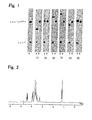
- a lactosyl transfer reaction was performed by using aliphatic alcohols as the acceptor.
- the lactose donor p-nitrophenyl- ⁇ -D-lactoside (hereinafter, referred to as "Lac-pNP") was used, and ethanol, butanol, hexanol, octanol, isopropanol, and t-butylalcohol, which are aliphatic alcohols, were used as the lactose acceptor.
- the enzyme cellulase (manufactured by Kyowa Hakko Kogyo Co., Ltd.) derived from Trichoderma reesei was used.
- R shows a mixture of lactose (Lac) and Lac-pNP, and the Rf value (0.13) of the lactose is smaller than that (0.43) of Lac-pNP.
- S refers to a reaction mixture
- B refers to a blank. The blank was obtained by adding water instead of the enzyme for reaction.
- (1), (2), (3), (4), (5) and (6) show the results when ethanol, butanol, hexanol, octanol, isopropanol, and t-butylalcohol, respectively, were used as the substrate.
- Lactose (Lac) that had not been present in an early stage of the reaction was produced in all the reaction mixtures S of (1) to (6), and alkyl lactoside corresponding to each substrate of (1) to (6) (ethyl lactoside, butyl lactoside, hexyl lactoside, octyl lactoside, isopropyl lactoside, and t-butyl lactoside, respectively) was further produced.
- alkyl lactoside corresponding to each substrate of (1) to (6) ethyl lactoside, butyl lactoside, hexyl lactoside, octyl lactoside, isopropyl lactoside, and t-butyl lactoside, respectively
- the Rf value (0.38) of the butyl lactoside of (2) and the Rf value (0.45) of the t-butyl lactoside of (6) were close to the Rf value (0.43) of Lac-pNP, so that in the TLC of Figure 1, (2) and (6) were difficult to distinguish from Lac-pNP visually.
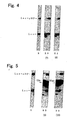
- the reaction product ((1)) obtained using ethanol as the lactose acceptor of Example 1 was analyzed. A reaction was performed for 27 hours, and the reaction product was heated at 100°C for 10 minutes, and centrifuged at 17,000 rpm for 10 minutes to give a supernatant. The supernatant was evaporated to dryness, and then dissolved in 10 ml of 25% aqueous methanol. The solution was loaded to Toyopearl HW-40S gel filtration column ( ⁇ 2.5 ⁇ 80 cm), and fractionated into 10ml fractions with a 25% aqueous methanol as the eluent at a flow rate of 1.0 ml per min.
- the fractions were detected by measuring the UV absorption at 210 nm and 300 nm and the color-development (485 nm) by the phenol-sulfuric acid method.
- the fractions of tube Nos. 34 to 44 were pooled and evaporated to dryness.
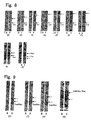
- a lactosyl transfer reaction to an amino acid having an alcoholic hydroxyl group was performed.
- the same enzyme and lactose donor as that in Example 1 were used.
- As a reaction mixture 400 ⁇ l of 15 mM acetate buffer (pH 5.0) containing 0.5 mg of the enzyme, 0.94 mg of Lac-pNP, and 50 mg of serine or 15 mg of threonine were prepared, and allowed to react at 40°C for 24 hours. After the reaction, analysis was performed by TLC in the same manner as in Example 1. The results are shown in Figure 4.
- R shows a mixture of Lac and Lac-pNP
- S shows a reaction mixture
- B shows a blank.
- the results when serine was used as the acceptor is shown in (7)
- the results when threonine was used as the acceptor is shown in (8).
- the substrate Lac-pNP disappeared and seryl lactoside and threonyl lactoside were produced, respectively.
- the Rf values of the seryl lactoside and the threonyl lactoside were 0.27 and 0.29, respectively, and were close to the Rf value (0.34) of lactose so that the seryl lactoside and the threonyl lactoside were not distinctly separated from lactose but they appeared as a broad band.
- a lactosyl transfer reaction to a monosaccharide having an alcoholic hydroxyl group was performed.
- the same enzyme and lactose donor as in Example 1 were used.
- As a reaction mixture 400 ⁇ l of 15 mM acetate buffer (pH 5.0) containing 0.5 mg of the enzyme, 0.94 mg of Lac-pNP, and 70 mg of glucose or mannose were prepared, and allowed to react at 40°C for 24 hours. After the reaction, analysis was performed by TLC in the same manner as in Example 1. The results are shown in Figure 5.
- R shows a mixture of Lac and Lac-pNP
- S shows a reaction mixture
- B shows a blank.
- the results when glucose was used as the acceptor is shown in (9)
- the results when mannose was used as the acceptor is shown in (10).
- the substrate Lac-pNP disappeared and glucosyl lactoside and mannosyl lactoside were produced, respectively.
- the Rf values of the glucosyl lactoside and the mannosyl lactoside were 0.24 and 0.25, respectively, and were smaller than the Rf value (0.34) of lactose (Lac) so that they were distinctly separated from lactose.
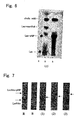
- a lactosyl transfer reaction to L-menthol which is one of alicyclic alcohols having an alcoholic hydroxyl group.
- the same enzyme and lactose donor as that in Example 1 were used.
- As a reaction mixture 400 ⁇ l of 15 mM acetate buffer (pH 5.0) containing 1 mg of the enzyme, 1 mg of Lac-pNP, 5 mg of L-menthol, and 2 wt% of cholic acid as a surfactant were prepared, and allowed to react at 40°C for 24 hours. After the reaction, analysis was performed by TLC in the same manner as in Example 1. The results are shown in Figure 6.
- R shows a mixture of Lac and Lac-pNP
- S shows a reaction mixture
- B shows a blank.
- the spots other than that of L-mentholyl lactoside and the cholic acid having an Rf value of 0.81 seem to indicate some reaction products.
- N-acetyllactosaminide donor p-nitrophenyl- ⁇ -N-acetyllactosaminide (hereinafter, referred to as "LacNAc-pNP”) was used.
- R shows LacNAc and LacNAc-pNP
- B shows a blank.
- the substrate LacNAc-pNP (Rf 0.56) disappeared, and LacNAc (Rf value of 0.30) and new spots indicated by the arrows having Rf values of 0.38, 0.46, and 0.56 appeared, and they were found to correspond to methyl N-acetyllactosaminide (1), ethyl N-acetyllactosaminide (2) and propyl N-acetyllactosaminide (3), respectively.
- the spot of the ethyl N-acetyllactosaminide (2) by TLC matched the spot of a specimen (manufactured by Carbiochem).
- a lactosyl transfer reaction (condensation of lactose) using an aliphatic alcohol and a saccharide having an alcoholic hydroxyl group as an acceptor was performed.
- the donor lactose was used.
- the acceptor methanol, ethanol, propanol, butanol, hexanol, octanol, dodecanol, allyl alcohol, and mannose were used.
- the spot of ethyl lactoside (2) by TLC matched that of the transfer reaction product of Lac-pNP and ethanol in Example 1 and a specimen (manufactured by Sigma Corporation). Separation and purification were performed in the same manner as described in Example 2, and a portion of the obtained dried product was analyzed by FAB/MAS, 1 H-NMR and 13 C-NMR. The results are shown below.
- the eluate was fractionated into 10 ml fractions and the reaction product was detected by color-development (485 nm) by the phenol-sulfuric acid method.
- Fractions Nos. 21 to 28 were collected and lyophilized to give about 5 mg of the reaction product. The purity of this product was confirmed to be 99% or more by TLC and liquid chromatography.
- the reaction mixture that seemed to contain dodecyl lactoside (7) was applied to ODS column ( ⁇ 3.5 ⁇ 60 cm) using Chromatorex-ODS DM1020T.
- the column was washed with 65% methanol in five volume of the column, and then eluted with 75% methanol (a flow rate of 2.5 ml/min). Fractionation was performed at 30 ml/fraction, and the reaction product was detected by color-development (485 nm) by the phenol-sulfuric acid method. Fractions Nos. 17 to 23 were collected and lyophilized to give about 5 mg of the reaction product. The purity of this product was confirmed to be 99% or more by TLC and liquid chromatography.
- N-acetyllactosaminyl transfer reaction (condensation of N-acetyllactosaminide) to an aliphatic alcohol and a saccharide having an alcoholic hydroxyl group was performed.
- the eluate was fractionated into 5 ml fractions and the reaction product was detected by color-development (485 nm) by the phenol-sulfuric acid method.
- Fractions Nos. 11 to 14 were collected and lyophilized to give about 5 mg of the reaction product. The purity of this product was confirmed to be 99% or more by TLC and liquid chromatography
- the reaction mixture that seemed to contain mannosyl N-acetyllactosaminide (4) was applied to activated carbon column ( ⁇ 2.5 ⁇ 25 cm) using activated carbon for chromatography (manufactured by Wako Pure Chemical Industries, Ltd.) and eluted at a flow rate of 1.5 ml/min with a linear gradient of a water/ethanol solution (0 ⁇ 30%; 2L).
- the eluate was fractionated into 15 ml fractions and the reaction product was detected by color-development (485 nm) by the phenol-sulfuric acid method.
- Fractions Nos. 80 to 102 were collected and lyophilized to give about 5 mg of the reaction product. The purity of this product was confirmed to be 99% or more by TLC and liquid chromatography.
- Examples 7 and 8 indicate that lactose and N-acetyllactosaminide themselves are condensed with a compound having an alcoholic hydroxyl group in the presence of the enzyme that cleaves the ⁇ -1,4 glucoside bond, so that a corresponding glycoside is produced.
- reaction mixture was treated with aniline acetate, and LacNAc was removed. Thereafter, this reaction mixture was loaded to an activated carbon column ( ⁇ 5 ⁇ 50 cm) using the same support as above to elute an adsorbate at a flow rate of 5 ml/min.
- a water/methanol solution (linear gradient, 0 ⁇ 20%; 6L) was used as the developing solvent.
- the eluate was fractionated into 50 ml fractions and the reaction product was detected by color-development (485 nm) by the phenol-sulfuric acid method. Fractions Nos. 115 to 125 were collected and lyophilized to give about 10 mg of a dried product as the reaction product. The purity of this product was confirmed to be 99% or more by TLC and liquid chromatography.
- the obtained compound is a novel substance different from the conventionally reported compounds in the binding pattern between galactose and N-acetylglucosamine, and the binding pattern between N-acetylglucosamine and glycerol.
- a novel glycoside in which N-acetyllactosamine is added to glycerol can be obtained. Therefore, known properties and physiological functions and totally novel functions of the conventional glycoside providing glycerol as an aglycon can be expected, and the glycoside of the present invention can be used as a new backbone (raw) material of useful substances such as glyceroglycolipids.
- the present invention allows lactosyl glycosides and N-acetyllactosaminyl glycosides that are useful as foods, functional food materials, medicines and reagents to be produced under mild conditions, with high yield and in mass quantity and be supplied inexpensively. Furthermore, the lactosyl glycosides and the N-acetyllactosaminyl glycosides according to the present invention contribute to research in medical science and biochemistry.
Landscapes
- Chemical & Material Sciences (AREA)
- Organic Chemistry (AREA)
- Engineering & Computer Science (AREA)
- Life Sciences & Earth Sciences (AREA)
- Genetics & Genomics (AREA)
- Biochemistry (AREA)
- Biotechnology (AREA)
- General Health & Medical Sciences (AREA)
- Wood Science & Technology (AREA)
- Zoology (AREA)
- Health & Medical Sciences (AREA)
- General Chemical & Material Sciences (AREA)
- Bioinformatics & Cheminformatics (AREA)
- General Engineering & Computer Science (AREA)
- Chemical Kinetics & Catalysis (AREA)
- Microbiology (AREA)
- Crystallography & Structural Chemistry (AREA)
- Molecular Biology (AREA)
- Preparation Of Compounds By Using Micro-Organisms (AREA)
- Saccharide Compounds (AREA)
Applications Claiming Priority (3)
| Application Number | Priority Date | Filing Date | Title |
|---|---|---|---|
| JP23326299 | 1999-08-19 | ||
| JP23326299 | 1999-08-19 | ||
| PCT/JP2000/005576 WO2001014575A1 (fr) | 1999-08-19 | 2000-08-18 | Procede de production de glycosides |
Publications (2)
| Publication Number | Publication Date |
|---|---|
| EP1205558A1 true EP1205558A1 (fr) | 2002-05-15 |
| EP1205558A4 EP1205558A4 (fr) | 2004-06-16 |
Family
ID=16952335
Family Applications (1)
| Application Number | Title | Priority Date | Filing Date |
|---|---|---|---|
| EP00953526A Withdrawn EP1205558A4 (fr) | 1999-08-19 | 2000-08-18 | Procede de production de glycosides |
Country Status (6)
| Country | Link |
|---|---|
| US (1) | US6797496B1 (fr) |
| EP (1) | EP1205558A4 (fr) |
| JP (1) | JP4504607B2 (fr) |
| AU (1) | AU6597400A (fr) |
| CA (1) | CA2381856A1 (fr) |
| WO (1) | WO2001014575A1 (fr) |
Cited By (2)
| Publication number | Priority date | Publication date | Assignee | Title |
|---|---|---|---|---|
| DE102008059904A1 (de) * | 2008-12-02 | 2010-06-10 | Beiersdorf Ag | Schäumende oder schäumbare Zubereitungen mit einem Gehalt an Alkyl-Lactosiden |
| DE102008059905A1 (de) * | 2008-12-02 | 2010-06-10 | Beiersdorf Ag | Gelförmige Zubereitungen auf der Basis von Alkyl-Lactosiden |
Families Citing this family (2)
| Publication number | Priority date | Publication date | Assignee | Title |
|---|---|---|---|---|
| EP1676923A4 (fr) * | 2003-08-26 | 2007-02-28 | Seikagaku Kogyo Co Ltd | Agent de decoupage de la chaine du sucre |
| CN113121619B (zh) * | 2021-04-20 | 2023-06-09 | 江西师范大学 | 有机硫脲催化的酚羟基糖苷化方法 |
Family Cites Families (14)
| Publication number | Priority date | Publication date | Assignee | Title |
|---|---|---|---|---|
| JPS5982096A (ja) * | 1982-10-29 | 1984-05-11 | Toyobo Co Ltd | ステロイド配糖体の製造法 |
| JPH0269192A (ja) | 1988-09-02 | 1990-03-08 | Kao Corp | 酵素を用いたグリコシドの製造方法 |
| JP2780788B2 (ja) | 1988-09-20 | 1998-07-30 | 東京電力株式会社 | ブラシ洗浄装置 |
| FR2640997A1 (en) * | 1988-12-22 | 1990-06-29 | Ajinomoto Kk | Process for the manufacture of a galactose transfer product. |
| JPH0335787A (ja) | 1989-06-29 | 1991-02-15 | Ajinomoto Co Inc | ガラクトース転移生成物の製造方法 |
| JPH02209884A (ja) * | 1989-02-10 | 1990-08-21 | Snow Brand Milk Prod Co Ltd | ガラクトオリゴ糖の製造方法 |
| JP2903221B2 (ja) | 1989-03-16 | 1999-06-07 | 花王株式会社 | 配糖体の製造法 |
| FI81403C (fi) | 1989-04-11 | 1990-10-10 | Valmet Paper Machinery Inc | Luftfoerdelningsroer i en pappersmaskin. |
| EP0456986B1 (fr) * | 1990-03-16 | 1995-12-20 | Suntory Limited | Bêta-galactosyltransférase thermorésistante, son procédé de production et son utilisation |
| JP2970932B2 (ja) | 1990-03-16 | 1999-11-02 | サントリー株式会社 | 新規耐熱性β―ガラクトシル基転移酵素、その製造法及びその用途 |
| US5472859A (en) * | 1993-08-02 | 1995-12-05 | Brown, Jr.; R. Malcolm | Enzymatic method for synthesis of cellulose 1 |
| JPH1033194A (ja) | 1996-07-26 | 1998-02-10 | Takara Shuzo Co Ltd | 糖質又は複合糖質の製造方法 |
| JPH1066595A (ja) | 1996-08-27 | 1998-03-10 | Unitika Ltd | アルコール性化合物の配糖体の製造方法 |
| JPH10245402A (ja) | 1997-03-04 | 1998-09-14 | Noguchi Inst | 新規糖鎖−アルキルグリコシド誘導体およびその製造法 |
-
2000
- 2000-08-18 US US10/049,964 patent/US6797496B1/en not_active Expired - Fee Related
- 2000-08-18 AU AU65974/00A patent/AU6597400A/en not_active Abandoned
- 2000-08-18 JP JP2001518886A patent/JP4504607B2/ja not_active Expired - Fee Related
- 2000-08-18 CA CA002381856A patent/CA2381856A1/fr not_active Abandoned
- 2000-08-18 EP EP00953526A patent/EP1205558A4/fr not_active Withdrawn
- 2000-08-18 WO PCT/JP2000/005576 patent/WO2001014575A1/fr not_active Ceased
Cited By (2)
| Publication number | Priority date | Publication date | Assignee | Title |
|---|---|---|---|---|
| DE102008059904A1 (de) * | 2008-12-02 | 2010-06-10 | Beiersdorf Ag | Schäumende oder schäumbare Zubereitungen mit einem Gehalt an Alkyl-Lactosiden |
| DE102008059905A1 (de) * | 2008-12-02 | 2010-06-10 | Beiersdorf Ag | Gelförmige Zubereitungen auf der Basis von Alkyl-Lactosiden |
Also Published As
| Publication number | Publication date |
|---|---|
| AU6597400A (en) | 2001-03-19 |
| US6797496B1 (en) | 2004-09-28 |
| WO2001014575A1 (fr) | 2001-03-01 |
| CA2381856A1 (fr) | 2001-03-01 |
| JP4504607B2 (ja) | 2010-07-14 |
| EP1205558A4 (fr) | 2004-06-16 |
Similar Documents
| Publication | Publication Date | Title |
|---|---|---|
| Previato et al. | Primary structure of the oligosaccharide chain of lipopeptidophosphoglycan of epimastigote forms of Trypanosoma cruzi. | |
| CZ294859B6 (cs) | Syntéza amino-deoxy-disacharidů a amino-deoxy-oligosacharidů | |
| Vic et al. | Chemoenzymatic synthesis of ethyl 1-thio-(β-D-galactopyranosyl)-O-β-D-glycopyranosyl disaccharides using the β-galactosidase from Bacillus circulans | |
| Fernández-Mayoralas | Synthesis and modification of carbohydrates using glycosidases and lipases | |
| Koyota et al. | Structure of the main saccharide chain in the acrosome reaction-inducing substance of the starfish, Asterias amurensis | |
| DMIITRIEV et al. | Somatic Antigens of Pseudomonas aeruginosa: The Structure of the Polysaccharide Chain of Ps. aeruginosa O‐Serogroup 7 (Lanyi) Lipopolysaccharide | |
| Sugita et al. | Studies on glycosphingolipids of larvae of the green-bottle fly, Lucilia caesar I. Isolation and characterization of glycosphingolipids having novel sugar sequences | |
| Veerkamp | Biochemical changes in Bifidobacterium bifidum var. Pennsylvanicus after cell wall inhibition V. structure of the galactosyldiglycerides | |
| CZ283463B6 (cs) | Enzymatický způsob syntézy uhlohydrátů | |
| Kremnický et al. | Trichoderma reesei acetyl esterase catalyzes transesterification in water | |
| Baer et al. | Synthesis of O-β-L-fucopyranosyl-(1→ 3)-O-β-D-galactopyranosyl-(1→ 4)-D-glucopyranose (3′-O-β-L-fucopyranosyllactose) | |
| Corsaro et al. | Structural determination of the phytotoxic mannan exopolysaccharide from Pseudomonas syringae pv. ciccaronei | |
| US6797496B1 (en) | Process for producing glycosides | |
| WO1991003174A1 (fr) | Procede pour obtenir des composants d'arômes et des arômes a partir de leurs precurseurs de nature glycosidique, les composants d'arôme et les arômes ainsi obtenus | |
| US6420142B1 (en) | Method for enzymatic splitting of rutinosides | |
| Izzo et al. | α-Rhamnosidase activity in the marine isolate Novosphingobium sp. PP1Y and its use in the bioconversion of flavonoids | |
| AU618588B2 (en) | Process for obtaining aroma components and aromas from their precursors of a glycosidic nature, and aroma components and aromas thereby obtained | |
| JPWO2001014575A1 (ja) | 配糖体の製造方法 | |
| Wilkinson et al. | Polar lipids of Pseudomonas vesicularis: presence of a heptosyldiacylglycerol | |
| Bastida et al. | Regioselective hydrolysis of peracetylated α-D-glucopyranose catalyzed by immobilized lipases in aqueous medium. A facile preparation of useful intermediates for oligosaccharide synthesis | |
| Dahiya et al. | Biotransformation of sucrose into hexyl-α-D-glucopyranoside and-polyglucosides by whole cells of Microbacterium paraoxydans | |
| JP5892750B2 (ja) | N−アセチルグルコサミンがαで結合した糖誘導体の調製方法 | |
| Stevenson et al. | High-yield syntheses of ethyl and 2-fluoroethyl β-d-galactopyranosides using Streptococcus thermophilus β-galactosidase | |
| Tamai et al. | Less polar glycolipids in Alaskan pollack brain: isolation and characterization of acyl galactosyl diacylglycerol, acyl galactosyl ceramide, and acyl glucosyl ceramide. | |
| Gardossi et al. | Enzymatic regioselective deprotection of peracetylated mono-and disaccharides |
Legal Events
| Date | Code | Title | Description |
|---|---|---|---|
| PUAI | Public reference made under article 153(3) epc to a published international application that has entered the european phase |
Free format text: ORIGINAL CODE: 0009012 |
|
| 17P | Request for examination filed |
Effective date: 20020222 |
|
| AK | Designated contracting states |
Kind code of ref document: A1 Designated state(s): AT BE CH CY DE DK ES FI FR GB GR IE IT LI LU MC NL PT SE |
|
| RBV | Designated contracting states (corrected) |
Designated state(s): DE |
|
| RIC1 | Information provided on ipc code assigned before grant |
Ipc: 7C 12P 19/14 A |
|
| A4 | Supplementary search report drawn up and despatched |
Effective date: 20040429 |
|
| 17Q | First examination report despatched |
Effective date: 20041213 |
|
| GRAP | Despatch of communication of intention to grant a patent |
Free format text: ORIGINAL CODE: EPIDOSNIGR1 |
|
| STAA | Information on the status of an ep patent application or granted ep patent |
Free format text: STATUS: THE APPLICATION IS DEEMED TO BE WITHDRAWN |
|
| 18D | Application deemed to be withdrawn |
Effective date: 20051229 |