EP1205598A1 - Verfahren zur Behandlung von Cellulosefasern sowie die dabei erhaltenen Produkte - Google Patents
Verfahren zur Behandlung von Cellulosefasern sowie die dabei erhaltenen Produkte Download PDFInfo
- Publication number
- EP1205598A1 EP1205598A1 EP00850190A EP00850190A EP1205598A1 EP 1205598 A1 EP1205598 A1 EP 1205598A1 EP 00850190 A EP00850190 A EP 00850190A EP 00850190 A EP00850190 A EP 00850190A EP 1205598 A1 EP1205598 A1 EP 1205598A1
- Authority
- EP
- European Patent Office
- Prior art keywords
- cellulose fibres
- fibres
- wood extractives
- extractives
- cellulose
- Prior art date
- Legal status (The legal status is an assumption and is not a legal conclusion. Google has not performed a legal analysis and makes no representation as to the accuracy of the status listed.)
- Withdrawn
Links
- 229920003043 Cellulose fiber Polymers 0.000 title claims abstract description 105
- 238000000034 method Methods 0.000 title claims abstract description 65
- 238000010521 absorption reaction Methods 0.000 claims abstract description 64
- 239000002023 wood Substances 0.000 claims abstract description 64
- 239000012530 fluid Substances 0.000 claims abstract description 38
- 229920002678 cellulose Polymers 0.000 claims abstract description 5
- 239000001913 cellulose Substances 0.000 claims abstract description 5
- 206010021639 Incontinence Diseases 0.000 claims abstract description 4
- CURLTUGMZLYLDI-UHFFFAOYSA-N Carbon dioxide Chemical compound O=C=O CURLTUGMZLYLDI-UHFFFAOYSA-N 0.000 claims description 46
- 229910002092 carbon dioxide Inorganic materials 0.000 claims description 35
- 239000000284 extract Substances 0.000 claims description 27
- 239000002250 absorbent Substances 0.000 claims description 24
- 230000002745 absorbent Effects 0.000 claims description 24
- 239000007788 liquid Substances 0.000 claims description 17
- 239000001569 carbon dioxide Substances 0.000 claims description 16
- 230000032683 aging Effects 0.000 claims description 11
- 230000002209 hydrophobic effect Effects 0.000 claims description 11
- 229920005610 lignin Polymers 0.000 claims description 11
- 150000003626 triacylglycerols Chemical class 0.000 claims description 11
- 238000004519 manufacturing process Methods 0.000 claims description 10
- 239000000126 substance Substances 0.000 claims description 10
- 230000003247 decreasing effect Effects 0.000 claims description 9
- 239000003960 organic solvent Substances 0.000 claims description 8
- 238000004458 analytical method Methods 0.000 claims description 5
- 235000014113 dietary fatty acids Nutrition 0.000 claims description 5
- 239000000194 fatty acid Substances 0.000 claims description 5
- 229930195729 fatty acid Natural products 0.000 claims description 5
- 150000004665 fatty acids Chemical class 0.000 claims description 5
- 239000011347 resin Substances 0.000 claims description 5
- 229920005989 resin Polymers 0.000 claims description 5
- KFZMGEQAYNKOFK-UHFFFAOYSA-N Isopropanol Chemical compound CC(C)O KFZMGEQAYNKOFK-UHFFFAOYSA-N 0.000 claims description 4
- ATUOYWHBWRKTHZ-UHFFFAOYSA-N Propane Chemical compound CCC ATUOYWHBWRKTHZ-UHFFFAOYSA-N 0.000 claims description 4
- 239000002253 acid Substances 0.000 claims description 4
- 150000007513 acids Chemical class 0.000 claims description 4
- OTMSDBZUPAUEDD-UHFFFAOYSA-N Ethane Chemical compound CC OTMSDBZUPAUEDD-UHFFFAOYSA-N 0.000 claims description 3
- VGGSQFUCUMXWEO-UHFFFAOYSA-N Ethene Chemical compound C=C VGGSQFUCUMXWEO-UHFFFAOYSA-N 0.000 claims description 3
- 239000005977 Ethylene Substances 0.000 claims description 3
- 238000010561 standard procedure Methods 0.000 claims description 3
- XDTMQSROBMDMFD-UHFFFAOYSA-N Cyclohexane Chemical compound C1CCCCC1 XDTMQSROBMDMFD-UHFFFAOYSA-N 0.000 claims description 2
- 229930182558 Sterol Natural products 0.000 claims description 2
- AFYPFACVUDMOHA-UHFFFAOYSA-N chlorotrifluoromethane Chemical compound FC(F)(F)Cl AFYPFACVUDMOHA-UHFFFAOYSA-N 0.000 claims description 2
- 239000001294 propane Substances 0.000 claims description 2
- QQONPFPTGQHPMA-UHFFFAOYSA-N propylene Natural products CC=C QQONPFPTGQHPMA-UHFFFAOYSA-N 0.000 claims description 2
- 125000004805 propylene group Chemical group [H]C([H])([H])C([H])([*:1])C([H])([H])[*:2] 0.000 claims description 2
- 150000003432 sterols Chemical class 0.000 claims description 2
- 235000003702 sterols Nutrition 0.000 claims description 2
- YMWUJEATGCHHMB-UHFFFAOYSA-N Dichloromethane Chemical compound ClCCl YMWUJEATGCHHMB-UHFFFAOYSA-N 0.000 description 69
- 239000000047 product Substances 0.000 description 40
- 238000000605 extraction Methods 0.000 description 32
- 150000001875 compounds Chemical class 0.000 description 16
- 239000000123 paper Substances 0.000 description 15
- 229960004424 carbon dioxide Drugs 0.000 description 14
- -1 lignin Chemical class 0.000 description 11
- 230000008569 process Effects 0.000 description 8
- 239000000463 material Substances 0.000 description 7
- 239000000203 mixture Substances 0.000 description 7
- 239000002904 solvent Substances 0.000 description 7
- 238000000638 solvent extraction Methods 0.000 description 7
- LSNNMFCWUKXFEE-UHFFFAOYSA-L sulfite Chemical compound [O-]S([O-])=O LSNNMFCWUKXFEE-UHFFFAOYSA-L 0.000 description 7
- OKKJLVBELUTLKV-UHFFFAOYSA-N Methanol Chemical compound OC OKKJLVBELUTLKV-UHFFFAOYSA-N 0.000 description 6
- 239000000835 fiber Substances 0.000 description 6
- PEDCQBHIVMGVHV-UHFFFAOYSA-N Glycerol Natural products OCC(O)CO PEDCQBHIVMGVHV-UHFFFAOYSA-N 0.000 description 5
- 229920000297 Rayon Polymers 0.000 description 4
- 239000000654 additive Substances 0.000 description 4
- 230000008859 change Effects 0.000 description 4
- 150000002148 esters Chemical class 0.000 description 4
- 239000003925 fat Substances 0.000 description 4
- 238000004537 pulping Methods 0.000 description 4
- 239000001993 wax Substances 0.000 description 4
- 238000009736 wetting Methods 0.000 description 4
- 229920001131 Pulp (paper) Polymers 0.000 description 3
- 229920002522 Wood fibre Polymers 0.000 description 3
- 150000007824 aliphatic compounds Chemical class 0.000 description 3
- 238000004364 calculation method Methods 0.000 description 3
- 230000001419 dependent effect Effects 0.000 description 3
- 230000007613 environmental effect Effects 0.000 description 3
- 238000005259 measurement Methods 0.000 description 3
- VLKZOEOYAKHREP-UHFFFAOYSA-N n-Hexane Chemical compound CCCCCC VLKZOEOYAKHREP-UHFFFAOYSA-N 0.000 description 3
- 238000003860 storage Methods 0.000 description 3
- 239000004094 surface-active agent Substances 0.000 description 3
- BZLVMXJERCGZMT-UHFFFAOYSA-N Methyl tert-butyl ether Chemical compound COC(C)(C)C BZLVMXJERCGZMT-UHFFFAOYSA-N 0.000 description 2
- 239000004952 Polyamide Substances 0.000 description 2
- 239000004743 Polypropylene Substances 0.000 description 2
- QAOWNCQODCNURD-UHFFFAOYSA-L Sulfate Chemical compound [O-]S([O-])(=O)=O QAOWNCQODCNURD-UHFFFAOYSA-L 0.000 description 2
- 239000000853 adhesive Substances 0.000 description 2
- 230000001070 adhesive effect Effects 0.000 description 2
- 150000001298 alcohols Chemical class 0.000 description 2
- 230000008901 benefit Effects 0.000 description 2
- 238000004061 bleaching Methods 0.000 description 2
- 239000000356 contaminant Substances 0.000 description 2
- 238000007796 conventional method Methods 0.000 description 2
- 239000011162 core material Substances 0.000 description 2
- 230000000694 effects Effects 0.000 description 2
- 239000007789 gas Substances 0.000 description 2
- 238000004817 gas chromatography Methods 0.000 description 2
- 239000003607 modifier Substances 0.000 description 2
- 238000010587 phase diagram Methods 0.000 description 2
- 150000002989 phenols Chemical class 0.000 description 2
- 229920000747 poly(lactic acid) Polymers 0.000 description 2
- 229920002647 polyamide Polymers 0.000 description 2
- 229920000728 polyester Polymers 0.000 description 2
- 229920001155 polypropylene Polymers 0.000 description 2
- 239000002964 rayon Substances 0.000 description 2
- 239000004627 regenerated cellulose Substances 0.000 description 2
- 230000000717 retained effect Effects 0.000 description 2
- 241000894007 species Species 0.000 description 2
- 229910021653 sulphate ion Inorganic materials 0.000 description 2
- 150000003505 terpenes Chemical class 0.000 description 2
- IJGRMHOSHXDMSA-UHFFFAOYSA-N Atomic nitrogen Chemical compound N#N IJGRMHOSHXDMSA-UHFFFAOYSA-N 0.000 description 1
- 244000025254 Cannabis sativa Species 0.000 description 1
- 235000012766 Cannabis sativa ssp. sativa var. sativa Nutrition 0.000 description 1
- 235000012765 Cannabis sativa ssp. sativa var. spontanea Nutrition 0.000 description 1
- ZAMOUSCENKQFHK-UHFFFAOYSA-N Chlorine atom Chemical compound [Cl] ZAMOUSCENKQFHK-UHFFFAOYSA-N 0.000 description 1
- 229920000742 Cotton Polymers 0.000 description 1
- 206010020751 Hypersensitivity Diseases 0.000 description 1
- VVQNEPGJFQJSBK-UHFFFAOYSA-N Methyl methacrylate Chemical compound COC(=O)C(C)=C VVQNEPGJFQJSBK-UHFFFAOYSA-N 0.000 description 1
- 229920005372 Plexiglas® Polymers 0.000 description 1
- 230000000996 additive effect Effects 0.000 description 1
- 238000004026 adhesive bonding Methods 0.000 description 1
- 239000012736 aqueous medium Substances 0.000 description 1
- 230000009286 beneficial effect Effects 0.000 description 1
- 235000009120 camo Nutrition 0.000 description 1
- 235000005607 chanvre indien Nutrition 0.000 description 1
- 239000003153 chemical reaction reagent Substances 0.000 description 1
- 239000003795 chemical substances by application Substances 0.000 description 1
- 239000000460 chlorine Substances 0.000 description 1
- 229910052801 chlorine Inorganic materials 0.000 description 1
- BHQCQFFYRZLCQQ-OELDTZBJSA-N cholic acid Chemical compound C([C@H]1C[C@H]2O)[C@H](O)CC[C@]1(C)[C@@H]1[C@@H]2[C@@H]2CC[C@H]([C@@H](CCC(O)=O)C)[C@@]2(C)[C@@H](O)C1 BHQCQFFYRZLCQQ-OELDTZBJSA-N 0.000 description 1
- 239000006184 cosolvent Substances 0.000 description 1
- 238000010586 diagram Methods 0.000 description 1
- 229910001873 dinitrogen Inorganic materials 0.000 description 1
- 238000001035 drying Methods 0.000 description 1
- 238000004049 embossing Methods 0.000 description 1
- 230000001815 facial effect Effects 0.000 description 1
- 239000012467 final product Substances 0.000 description 1
- 235000013305 food Nutrition 0.000 description 1
- 239000003205 fragrance Substances 0.000 description 1
- ZZUFCTLCJUWOSV-UHFFFAOYSA-N furosemide Chemical compound C1=C(Cl)C(S(=O)(=O)N)=CC(C(O)=O)=C1NCC1=CC=CO1 ZZUFCTLCJUWOSV-UHFFFAOYSA-N 0.000 description 1
- 150000002314 glycerols Chemical class 0.000 description 1
- 239000001307 helium Substances 0.000 description 1
- 229910052734 helium Inorganic materials 0.000 description 1
- SWQJXJOGLNCZEY-UHFFFAOYSA-N helium atom Chemical compound [He] SWQJXJOGLNCZEY-UHFFFAOYSA-N 0.000 description 1
- 239000011487 hemp Substances 0.000 description 1
- 230000006872 improvement Effects 0.000 description 1
- 239000012535 impurity Substances 0.000 description 1
- ULYZAYCEDJDHCC-UHFFFAOYSA-N isopropyl chloride Chemical compound CC(C)Cl ULYZAYCEDJDHCC-UHFFFAOYSA-N 0.000 description 1
- 239000002655 kraft paper Substances 0.000 description 1
- 238000011031 large-scale manufacturing process Methods 0.000 description 1
- 231100001231 less toxic Toxicity 0.000 description 1
- 235000009408 lignans Nutrition 0.000 description 1
- 230000007246 mechanism Effects 0.000 description 1
- 230000005012 migration Effects 0.000 description 1
- 238000013508 migration Methods 0.000 description 1
- 230000007935 neutral effect Effects 0.000 description 1
- 238000010606 normalization Methods 0.000 description 1
- 230000035515 penetration Effects 0.000 description 1
- 238000005191 phase separation Methods 0.000 description 1
- 229920000642 polymer Polymers 0.000 description 1
- 238000002360 preparation method Methods 0.000 description 1
- 238000000746 purification Methods 0.000 description 1
- 235000007586 terpenes Nutrition 0.000 description 1
- 239000010409 thin film Substances 0.000 description 1
- 231100000331 toxic Toxicity 0.000 description 1
- 230000002588 toxic effect Effects 0.000 description 1
- 231100000419 toxicity Toxicity 0.000 description 1
- 230000001988 toxicity Effects 0.000 description 1
- 238000001291 vacuum drying Methods 0.000 description 1
- XLYOFNOQVPJJNP-UHFFFAOYSA-N water Substances O XLYOFNOQVPJJNP-UHFFFAOYSA-N 0.000 description 1
Images


Classifications
-
- D—TEXTILES; PAPER
- D21—PAPER-MAKING; PRODUCTION OF CELLULOSE
- D21C—PRODUCTION OF CELLULOSE BY REMOVING NON-CELLULOSE SUBSTANCES FROM CELLULOSE-CONTAINING MATERIALS; REGENERATION OF PULPING LIQUORS; APPARATUS THEREFOR
- D21C9/00—After-treatment of cellulose pulp, e.g. of wood pulp, or cotton linters ; Treatment of dilute or dewatered pulp or process improvement taking place after obtaining the raw cellulosic material and not provided for elsewhere
- D21C9/08—Removal of fats, resins, pitch or waxes; Chemical or physical purification, i.e. refining, of crude cellulose by removing non-cellulosic contaminants, optionally combined with bleaching
Definitions
- the present invention relates to a method using a supercritical or near supercritical fluid for removal of wood extractives from cellulose fibres and products comprising cellulose fibres to improve the qualities thereof and to cellulose fibres and products comprising cellulose fibres having improved qualities.
- Kitchen towels and household towels are products, which should have good wetting and absorption properties such as absorption rate and absorption capacity, especially with respect to absorption of a liquid such as an aqueous medium. Also very important is the rate for the uptake of a liquid. This means that when wiping liquid from a surface it is necessary for the towel to absorb the liquid as quickly as possible or in other words to remove the liquid from the surface by in some way binding it to the towel by e.g. an absorption process.
- absorption boosters may be surfactants.
- absorption booster in general it is regarded as leading to a decrease in the strength properties of the towel and the capillary pressure of the fibrous web.
- absorption boosters like, e.g. surfactants, is that they tend to loose their wettability property with time. It is also important to mention that chemicals should be avoided, as much as possible, in hygiene paper due to problems with toxicity and allergic reactions.
- cellulose fibres and products comprising cellulose fibres normally are subject to ageing phenomena, i.e. their behaviour with respect to e.g. wettability and absorption rate change during storage. After a certain period of time it is generally found that the wetting and absorption properties of the products have significantly decreased as compared to the wetting and absorption properties directly after production. Other properties like colour and strength of the cellulose fibres and products comprising cellulose fibres may also be affected.
- One reason for this phenomenon is the outflow of so called "wood extractives", i.e .
- wood extractives will migrate from the inner side of the cellulose fibres or the inner side of the cellulose fibre product to the outer or outermost surface of the cellulose fibres or cellulose fibre product and more or less homogeneously coat or cover the outer surface with such wood extractives.
- wood extractives generally are of a hydrophobic nature this means that the outer surface of the cellulose fibres or the outer surface of the cellulose fibre product, i.e. that surface which is to be exposed to the liquid to be absorbed, becomes more hydrophobic and, accordingly, it will tend to repel an aqueous based liquid. The result is that the wettability properties decrease.
- the "wood extractives” are contemplated to be fibre compounds, such as, e.g. low molecular fatty acids. Suggested, as a theory, is that after migration from the interior of the fibres, these compounds covers the fibres and make them more hydrophobic. As a result the surface tension is reduced which in turn leads to a decrease in the absorption properties and the tissue product becomes less wettable.
- DCM dichloromethane
- It is an object of the invention to provide a method for reducing the level of or substantially removing wood extractives imparting - due to ageing - decreased absorption rate from cellulose fibres comprising contacting the fibres with a supercritical or near supercritical fluid to extract the wood extractives and removing the extract from the fibres so as to obtain improved cellulose fibres with a reduced content of extractives which impart decreased absorption rate.
- the use of such a method during manufacturing of cellulose fibres or an absorbent product containing cellulose fibres will prevent or slow down ageing processes and lead to an increased quality of the cellulose fibres or the product thereof, especially with respect to increased absorption properties such as, e.g. an increased absorption rate of a liquid to the cellulose fibres or to a product comprising cellulose fibres due to the removal of the ageing substances in an early phase.
- cellulose fibres and/or products comprising cellulose fibres having improved qualities, e.g. absorption properties such as the absorption rate.
- the present invention relates to a method for reducing the level of or removing wood extractives from cellulose fibres, wherein the fibres are brought into contact with a supercritical or near supercritical fluid for a period of time sufficient to reduce the level of or to substantially remove the wood extractives.
- the invention also refers to the use of a supercritical fluid or near supercritical fluid for reducing the level of or substantially removing wood extractives from cellulose fibres.
- the invention refers to extracted cellulose fibres or products produced thereof, such as a fibrous web, tissue paper, sanitary napkin, baby diaper, incontinence garment, non-woven industrial wipes, comprising reduced levels of or being substantially free from wood extractives.
- the invention provides a method for reducing the level of or substantially removing a more specific group of wood extractives compared to the relatively unspecific extraction of wood extractives which is obtained by using well-known methods employing organic solvent extraction.
- the composition of wood extractives removed from the cellulose fibres is different compared with the composition of wood extractives obtained after extracting cellulose fibres with dimethylchloromethane (DCM).
- DCM dimethylchloromethane
- the most hydrophobic compounds such as triglycerides and sterylestes are extracted in a more efficient way while the less hydrophobic compounds, such as lignin, are extracted to a decreased degree and retained in the fibres.
- lignin can be extracted to various extents.
- the invention refers to a stratified product comprising cellulose fibres comprising at least one outer layer and possibly at least one middle layer, wherein at least one of the outer layers have a high amount of extracted virgin cellulose fibres or pulp.
- the method according to the invention will increase the qualities of the resulting absorbent product, such as the absorption rate of the final product comprising cellulose fibres by preventing the disadvantages generally observed by ageing of such product. Further, the method considers environmental aspects since a supercritical fluid like, e.g., carbon dioxide, CO 2 , is less toxic and not flammable compared to known alternatives like, e.g., DCM. As a further advantage, the method according to the invention is much cheaper compared to conventional extraction methods due to the use of less expensive fluids e.g. the use of CO 2 .
- the present invention relates to the use of a supercritical or near supercritical fluid (SF) for removing wood extractives from cellulose fibres and absorbent products comprising improved cellulose fibres.
- SF supercritical or near supercritical fluid
- improved cellulose fibres is used to denote any kind of cellulose fibres that have been subjected to the method according to the present invention, i.e. improved cellulose fibres are cellulose fibres which have been subject to a purification procedure in which an amount of impurities like wood extractives have been removed from the fibres.
- cellulose fibre is intended to mean any natural cellulose containing fibres, e.g. wood fibre, cotton fibre or hemp fibre, preferably virgin cellulose fibres or substantially virgin fibres.
- the major component in pulp is the natural cellulose fibre.
- virgin pulp with cellulose fibre is intended to mean not reclaimed.
- Virgin pulp according to this definition is made from such cellulose fibres and may be the result of mechanical, chemical (e.g. sulphate or sulphite), or chemimechanical pulping.
- wood extractives is intended to mean compounds, such as aliphatic compounds (mainly fats and waxes), terpenes, terpenoids and phenolic compounds, such compounds being inherent in and extractable from the cellulose.
- Wood extractives mainly include hydrophobic compounds e.g. fatty acids, resin acids, fats (glycerol esters e.g triglycerides) and waxes (esters of other alcohols, e.g. sterylesters) defined according to an analytical procedure for quantitative determination of wood extractives and lignins ( ⁇ rs ⁇ , F and Holmbom, B. J. Pulp and Paper Sci . 1994, 20:J361-J365).
- supercritical or near supercritical fluid is intended to mean any fluid presented under supercritical or near supercritical pressure and temperature conditions, within narrow ranges for the specific fluid wherein still most of the fluid behaves supercritical.
- critical temperature and the critical pressure is abbreviated T c and P c , respectively.
- the present invention uses a supercritical or a near supercritical fluid, such as, e.g., carbon dioxide to remove an amount of wood extractives from cellulose fibres.
- a supercritical or a near supercritical fluid such as, e.g., carbon dioxide
- the critical temperature and pressure for pure carbon dioxide are 31.1°C and 73.8 bar, respectively.
- carbon dioxide or any other solvent employed
- the advantages of the invention can be achieved even though the pressure and/or temperature used are not above the critical values for pure carbon dioxide (or any other solvent employed). It is in this sense that the term "near supercritical" is used herein.
- Wood extractives can be divided into three subgroups: aliphatic compounds (mainly fats and waxes), terpenes and terpenoids, and phenolic compounds.
- aliphatic compounds mainly fats and waxes
- terpenes and terpenoids mainly terpenes and terpenoids
- phenolic compounds mainly aliphatic compounds exist in the resin.
- the fatty acids occur mostly as esters (glycerol esters) present as di- or triglycerides.
- Compounds which are, according to the invention, of specific interest to remove are hydrophobic compounds, such as fats i.e. esters of glycerol, e.g. tri- and diglycerides; waxes i.e. esters of alcohols, e.g. sterylesters, fatty acids and resin acids.
- wood extractives denotes a relatively large and unspecific group of compounds, namely such compounds contained in the wood or cellulose fibres that are extractable by means of an organic solvent.
- the amount and composition of the wood extractives extracted from specific cellulose fibres depend on i) the specific organic solvent used, ii) the conditions employed during extraction such as, e.g., the temperature, the flow conditions and the number of extractions, and iii) the specific type of cellulose fibres or wood fibres employed.
- the wood extractives which are of main interest to remove from the cellulose fibres are those which give rise to an unwanted ageing phenomenon, namely a decrease in the wetting and absorption properties, strength and/or colour of the fibres.
- the improved cellulose fibres obtained according to the invention may of course still contain wood extractives of any of the above-mentioned types; the main point is that some of the unwanted wood extractives have been removed to a degree that is sufficient to obtain improved properties of the cellulose fibres, cf. above.
- the cellulose fibres used according to the invention may be any cellulose fibre or product comprising cellulose fibres. However, preferably virgin cellulose fibres are used, since such fibre includes a high content of wood extractives. During storage, cellulose fibre is aged due to outflow of so called "wood extractives". Virgin fibres and pulps contain wood extractives although the contents varies greatly among different wood species and also due to the pulping and bleaching conditions used in the production of different pulps. Even low levels of wood extractives such as the level found in bleached chemical pulps can affect the absorption properties of the fibres in a negative way.
- the extractives In reclaimed pulps the extractives consists mainly of additives originating from the paper making process, printing and other converting processes to make the paper suitable for its purpose, so called extractable stickies.
- the wood extractives are only a minor part of the extractable stickies in such pulps.
- the cellulose fibres to be used according to the invention may be selected from the group consisting of Kraft (sulphate) pulp, sulphite pulp, mechanical pulp and HTCTMP pulp (High Temperature Chemi Thermo Mechanical Pulp).
- the level of these wood extractives is reduced or substantially removed compared to conventional extraction methods using DCM according to standard SCAN C 7:62.
- the ratio is calculated between the total extract content - measured according to Example 1 - and the extract content obtained by a standard method SCAN C 7:62 is at least about 0.5 such as at least about 0.55, 0.6, 0.65, 0.7, 0.75, 0.8, 0.85, 0.90 or about 0.95.
- the removal of triglycerides and/or sterylesters is beneficial and their removal increases the absorption rate in the final cellulose fibres and products comprising cellulose fibres.
- the relative amount of sterylesters and/or triglycerides in the extract is higher, ⁇ 2 times for sterylesters and ⁇ 3 times for triglycerides, using supercritical fluid CO 2 as the extraction method compared to solvent extraction using DCM (Fig. 3).
- the amount of lignin is retained in the cellulose fibres to a high degree.
- the amount of lignin extracted can be varied to some extent by adding a solvent modifier such as methanol to the CO 2 and by adjusting pressure and temperature.
- the lignin content of the extract is ⁇ 5%,
- the method according to the invention for reducing the level of or substantially removing wood extractives from cellulose fibres implies the use of a supercritical or near supercritical fluid.
- a supercritical or near supercritical fluid examples of such fluids are CO 2 , ethane and ethylene.
- Further examples of fluids to be used according to the present invention are given in table 1 below.
- CO 2 is used, due to the fact that it is readily available and rather inexpensive as well as not toxic or not flammable.
- the cellulose fibres could be treated at any stage such as before or after bleaching.
- the supercritical or near supercritical fluid is used at a temperature and pressure optimal for the fluid, with pressures above from about 70 bar, preferably from 140 and most preferably from 200 bar to about 500 bar and temperatures above about 25° C, preferably in the range from about 31° C to 150° C and most preferably in the range from 31° C to 90° C.
- An example of a phase diagram for CO 2 , with the supercritical fluid region marked, is shown in figure 2.
- the cellulose fibres are contacted with the supercritical or near supercritical fluid under conditions where the temperature is at least the critical temperature (T C ) for the intended supercritical fluid, or at least about 1.5, such as at least about 2 times higher than T C and/or the pressure is at least the critical pressure (P C ) for the intended supercritical fluid, or at least about 2, at least about 3, at least about 4, at least about 5 such as at least about 6 times higher than P C .
- T C critical temperature
- P C critical pressure
- the extraction apparatus used may be the one shown in figure 1.
- an extractor (1) in the form of a heated oven (2) with a sample cell (3) included, having a supercritical fluid supply tank (4), a supercritical fluid pump (5), a modifier pump (6), extract collection tube/s (7) all connected in a tubing system (8).
- the process according to the invention may be as follows. A pulp sample is prepared. Then the pulp sample is homogenised and packed into a sample cartridge, further placed into the sample cell (3). CO 2 is supplied from the supply tank (4) pumped and controlled via (5) and (6) into the heated oven (2) and over the sample cell (3). The sample is extracted by carbondioxide at a specified temperature and pressure. The resulting extract is then collected (7) by trapping the extract into a vial filled with an organic solvent e.g. DCM.
- an organic solvent e.g. DCM.
- the present invention also refers to extracted cellulose fibres, preferably based on or substantially based on virgin cellulose fibre, which fibres have reduced levels of or are substantially free of wood extractives.
- An improved fibrous web made of cellulose fibres has, at least after an initial period of time of at least about two days, such as at least about 10, 90 or about 180 days, a higher liquid absorption rate, such as at least about 5, 12, 20, 30 or about 50% higher, than a fibrous web made of parent cellulose fibres as evidenced by the method described in Example 3.
- the Present invention also refers to a fibrous web comprising the improved cellulose fibres described above.
- the fibrous web comprises cellulose fibres which have a reduced level of or is substantially free from wood extractives which impart - due to ageing - decreased absorption rate of the cellulose fibres.
- the fibrous web described above has a liquid absorption rate at almost the same order of magnitude during storage for such as at least about 2, 10, 30, 90 or about 180 days. Further, such fibrous web is used for the production of an absorbent product.
- the cellulose fibres according to the present invention is useful for preparing absorbent products such as tissue paper, non-woven and absorbent articles such as baby diapers, incontinence garments and sanitary napkins.
- the tissue paper comprises e.g. kitchen towel, household towel, toilet paper, handkerchief and facials.
- the non-woven comprises polymeric fibres, such as regenerated cellulose (viscose, rayon), polypropylene, polyester, polylactide, or polyamide.
- the non-woven can be bonded by any of the regular types of bonding mechanism, e.g. by thermo-bonding, by entangling or by hydro entangling. This type of non-woven are mostly used for industrial and offset wipes.
- the fibres according to the invention is used mainly in the surface and acquisition material and in the absorption core.
- the tissue paper, nonwoven and surface, acquisition and core materials of the absorbent articles should comprise at least 10% preferably at least 30% and most preferably at least 50 % by weight of the extracted cellulose fibres.
- the present invention refers to a stratified absorbent product such as tissue or nonwoven based on the above extracted cellulose fibres.
- the stratified absorbent product of the invention comprises at least one outer layer and at least possibly one middle layer, at least one of the outer layers having at least about 10%, such as at least about 30% or at least about 50% by weight of the dried sheet of the extracted cellulose fibres.
- a multi-ply tissue paper or nonwoven absorbent product At least one outer surface having at least about 10%, such as at least about 30% or at least about 50% by weight of the dried sheet of the extracted cellulose fibres.
- This absorbent product could be built up of two plies being stratified as above or not being stratified.
- the absorbent product could further have three or more plies whereby at least one of the outer plies should contain extracted pulp.
- the outer plies may be multi- or single-layered.
- the tissue product may also comprise man-made polymeric fibres, such as regenerated cellulose (viscose, rayon), polypropylene, polyester, polylactide, or polyamide.
- the tissue may contain up to 50% by weight of polymeric fibres. Different amounts of polymeric fibres can be used in different layers and/or plies.
- a stratified or multi-layered product means an absorbent product where the layers have been brought together when they are still wet either through the use of a multi-layered headbox or by couching together several wet webs. This gives a stratified or multi-layered web (ply) where the layers are very hard to separate.
- a multi-ply product means an absorbent product where two or more plies are laid together when dry to work as one unit.
- the layers can be plybonded although it is not necessary.
- the plybonding can be achieved through mechanical plybonding, e.g. through embossing or knurling. It can also be achieved through adhesive bonding of the plies, e.g. in a dot pattern, as continuos network or with adhesive applied all over the plies.
- This example describes, without limiting the invention, the extraction of pulp with CO 2 as the supercritical fluid.
- Wood extractives are defined as the amount of material, which can be extracted from a virgin fibre pulp sample with neutral organic solvents (e.g. hexane, dichloromethane).
- neutral organic solvents e.g. hexane, dichloromethane.
- the pulp sample is homogenised and packed into a sample cartridge.
- the cartridge is placed in the extractor (1) in the sample cell (2) where it is extracted by carbondioxide at a specific temperature and pressure.
- the resulting extract is trapped and collected in a vial (6) filled with dichloromethane (DCM) (figure 1).
- DCM dichloromethane
- Carbondioxide, CO 2 Air Liquide, SFC quality pressurised with 110 bar helium and DCM (Riedel deHa ⁇ n, p.a. quality).
- the pulp used in this particular example is bleached sulphite pulp "Excellent" from SCA Hygiene Products GmbH in Mannheim.
- FIG. 1 A principal drawing of an extractor to use in this invention is illustrated in figure 1. This figure is not intended to limit the invention.
- ISCO SF 3560 with two pumps and automated extractor (figure 1) Sample cartridge for use at high temperature (crystalline polymer) Collection vials 20 ml Balance with an accuracy of 0.0001 g Vials 4 ml
- the collection vials at 100°C.
- the vials are cooled in a vacuum dessicator after drying and weighed to the nearest 0.0001 g.
- the dry matter of the pulp is determined according to ISO 638:1979. An exact amount of the sample is weighed to the nearest 0.0001 g into the sample cartridge (a rod can be used for this purpose).
- the sample cartridges are placed in the extractor.
- the weighed collection vials are also placed in the extractor.
- a computer file describing the method for extraction of fibre pulp is loaded from the control unit of the extractor.
- This method file uses the following extraction parameters: Extraction chamber temperature 80°C Extraction chamber pressure 448 bar Restrictor temperature 80°C Collection temperature 30°C Restriction flow (CO 2 ) 1.5 ml/min Extraction time 40 min Collector solvent Dichloromethane
- the collection vials are evaporated under nitrogen gas flow to dryness.
- the vials are subsequently dried in a vacuum drying oven at 40°C for three hours.
- the vials with the dried extract are then weighed to the nearest 0.0001 g.
- Extract content (We-Wc) x 100 Ws x DM
- Results are shown in figure 3a. The results show that the method according to the invention is at least as sufficient as the DCM method.
- This example is a comparison between super critical CO 2 extraction and solvent extraction with dichloromethane (DCM) of different pulp materials.
- DCM dichloromethane
- the pulp samples are prepared according to the invention with the method described in Example 1.
- the total extract content and the composition of the extractives in the extracts are shown in figure 3.
- This example describes the absorption rate in sheets prepared from extracted or unextracted sulphite pulp.
- Absorption rate is the mean velocity with which a liquid drop of a defined volume is fully absorbed into a paper sheet.
- the mean velocity is calculated in that the defined volume is divided by the time needed for the liquid drop of the defined volume to be fully absorbed into the paper.
- the absorption time needed is dependent on both the wettability i.e. surface chemistry and the basis weight, i . e . network structure of the cellulose fibres used.
- a tissue sheet made from a dynamic sheet former called Formette was used in a lab scale equipment for the manufacturing of Formette sheets.
- the absorption was measured using a high-speed video system.
- the drop volume is 5 ⁇ l and the number of drops measured is 10.
- the distance between drop and sample surface before application of drop is 5 mm and each drop is applied and measured on an individual and well separated spot.
- the absorption rate is measured using the high-speed video system.
- the measurements are not made under climatised conditions.
- the temperature is normally varying between 20-25° C while the relative humidity normally varies between 30-75%. Therefore one should pay most attention to the difference between materials measured at the same occasions, i . e . under the same conditions rather than comparing absolute numbers of absorption time and rate from different occasions.
- Due to the variation in basis weight, normalised absorption times have also been calculated, assuming a linear relationship with decreasing values between the basis weight and the absorption time i . e . the higher the basis weight, the lower the absorption time.
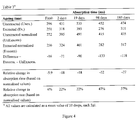
- results are shown in figure 4.
- the difference between the unextracted and extracted samples obtained the same day are all significant (95% confidence interval), where the extracted samples show a faster absorption time.
- the relative decrease in absorption time as well as the relative change in absorption rate is improved already after two days.
- the results show an improvement over time. Due to variations in temperature and relative humidity, one should pay most attention to the difference between materials measured at the same occasions, i.e. under the same conditions rather than comparing absolute numbers of absorption time and rate from different occasions.
- This procedure refers to a published method ( ⁇ rs ⁇ , F and Holmbom, B. J. Pulp and Paper Sci . 1994, 20:J361-J365).
- This analytical procedure has been developed to enable a quantitative determination of wood extractives and lignins in papermaking processes.
- extraction with supercritical carbon dioxide replaces published extraction step with methyl tert.butyl ether (MTBE).
- Sililation and gas chromatography (GC) for the determination of extractives follow the extraction procedure.
- GC gas chromatography
- a short thin-film capillary column enables direct determination of free fatty and resin acids, sterols, steryl estes, triglycerides and lignanes. All samples are determined quantitatively relative a standard.
Landscapes
- Life Sciences & Earth Sciences (AREA)
- Engineering & Computer Science (AREA)
- Wood Science & Technology (AREA)
- Extraction Or Liquid Replacement (AREA)
Priority Applications (4)
| Application Number | Priority Date | Filing Date | Title |
|---|---|---|---|
| EP00850190A EP1205598A1 (de) | 2000-11-10 | 2000-11-10 | Verfahren zur Behandlung von Cellulosefasern sowie die dabei erhaltenen Produkte |
| PCT/SE2001/002437 WO2002038857A1 (en) | 2000-11-10 | 2001-11-06 | Method of treating cellulose fibres and products obtained thereby |
| AU2002212928A AU2002212928A1 (en) | 2000-11-10 | 2001-11-06 | Method of treating cellulose fibres and products obtained thereby |
| US09/986,708 US20020096274A1 (en) | 2000-11-10 | 2001-11-09 | Method of treating cellulose fibers and products obtained thereby |
Applications Claiming Priority (1)
| Application Number | Priority Date | Filing Date | Title |
|---|---|---|---|
| EP00850190A EP1205598A1 (de) | 2000-11-10 | 2000-11-10 | Verfahren zur Behandlung von Cellulosefasern sowie die dabei erhaltenen Produkte |
Publications (1)
| Publication Number | Publication Date |
|---|---|
| EP1205598A1 true EP1205598A1 (de) | 2002-05-15 |
Family
ID=8175687
Family Applications (1)
| Application Number | Title | Priority Date | Filing Date |
|---|---|---|---|
| EP00850190A Withdrawn EP1205598A1 (de) | 2000-11-10 | 2000-11-10 | Verfahren zur Behandlung von Cellulosefasern sowie die dabei erhaltenen Produkte |
Country Status (1)
| Country | Link |
|---|---|
| EP (1) | EP1205598A1 (de) |
Cited By (3)
| Publication number | Priority date | Publication date | Assignee | Title |
|---|---|---|---|---|
| EP1375522A3 (de) * | 2002-06-26 | 2004-01-07 | Nihon Zaikei Kabushiki Kaisha | Verfahren zur Herstellung von Celluloseacetat |
| CN100339397C (zh) * | 2003-03-25 | 2007-09-26 | 赛尔江株式会社 | 制造纤维素模塑件的方法及其植物组分提取装置 |
| WO2008028960A1 (en) | 2006-09-08 | 2008-03-13 | Linde Aktiengesellschaft | Process for the deresination of pulp and use of carbon dioxide or (bi)carbonate therefor |
Citations (3)
| Publication number | Priority date | Publication date | Assignee | Title |
|---|---|---|---|---|
| GB1365118A (en) * | 1970-09-17 | 1974-08-29 | Star Paper Mill A S And Papiri | Sanitary absorbent products |
| WO1990002836A1 (en) * | 1988-09-16 | 1990-03-22 | University Of South Florida | Supercritical delignification of wood |
| US5009746A (en) * | 1990-10-12 | 1991-04-23 | Kimberly-Clark Corporation | Method for removing stickies from secondary fibers using supercritical CO2 solvent extraction |
-
2000
- 2000-11-10 EP EP00850190A patent/EP1205598A1/de not_active Withdrawn
Patent Citations (3)
| Publication number | Priority date | Publication date | Assignee | Title |
|---|---|---|---|---|
| GB1365118A (en) * | 1970-09-17 | 1974-08-29 | Star Paper Mill A S And Papiri | Sanitary absorbent products |
| WO1990002836A1 (en) * | 1988-09-16 | 1990-03-22 | University Of South Florida | Supercritical delignification of wood |
| US5009746A (en) * | 1990-10-12 | 1991-04-23 | Kimberly-Clark Corporation | Method for removing stickies from secondary fibers using supercritical CO2 solvent extraction |
Cited By (6)
| Publication number | Priority date | Publication date | Assignee | Title |
|---|---|---|---|---|
| EP1375522A3 (de) * | 2002-06-26 | 2004-01-07 | Nihon Zaikei Kabushiki Kaisha | Verfahren zur Herstellung von Celluloseacetat |
| AU2003204273B2 (en) * | 2002-06-26 | 2004-08-05 | Celjan Co. Ltd | Process for manufacturing cellulose acetate |
| AU2003204273C1 (en) * | 2002-06-26 | 2005-02-24 | Celjan Co. Ltd | Process for manufacturing cellulose acetate |
| US6984731B2 (en) | 2002-06-26 | 2006-01-10 | Nihon Zaikei Kabushiki Kaisha | Process for manufacturing cellulose acetate |
| CN100339397C (zh) * | 2003-03-25 | 2007-09-26 | 赛尔江株式会社 | 制造纤维素模塑件的方法及其植物组分提取装置 |
| WO2008028960A1 (en) | 2006-09-08 | 2008-03-13 | Linde Aktiengesellschaft | Process for the deresination of pulp and use of carbon dioxide or (bi)carbonate therefor |
Similar Documents
| Publication | Publication Date | Title |
|---|---|---|
| US20020096274A1 (en) | Method of treating cellulose fibers and products obtained thereby | |
| DE69531063T2 (de) | Tissuepapierprodukt, das eine quaternäre ammoniumverbindung, eine polysiloxanverbindung und bindemittel enthält | |
| FI126055B (en) | A method of making a film from fibril pulp and a fibril pulp film | |
| KR0180014B1 (ko) | 습식 적층 종이시이트 형태의 흡수 구조물 및 그의 제조를 위한 연속식의 습식 적층 제지방법 | |
| RU2705616C1 (ru) | Способ получения нетканого материала | |
| KR100249609B1 (ko) | 오일과 폴리하이드록시 화합물을 함유하는 부드러운 티슈지 | |
| JP5213785B2 (ja) | 複合体シートの製造方法 | |
| FI100812B (fi) | Kuidutettu selluloosatuote ja menetelmä sen valmistamiseksi | |
| CZ283401B6 (cs) | Způsob přípravy hygienického papíru | |
| CZ106495A3 (en) | Paper articles containing chemical softening composition | |
| MX2008002256A (es) | Estructuras fibrosas suavizadas masivamente. | |
| DE112023001829T5 (de) | Weiche hygienetuchprodukte umfassend nicht-holzfasern | |
| KR102003648B1 (ko) | 벌크가 향상된 바이오패드 제조방법 및 이의 제조방법으로 제조된 바이오패드 | |
| AU5098299A (en) | Paper towel | |
| US20220218161A1 (en) | Dispersible wipes reinforced with a binding agent | |
| CA3263587A1 (en) | Premium sanitary tissue products comprising short fibers | |
| CN1205042A (zh) | 吸收性纤维素材料及其生产 | |
| FI74483C (fi) | Kalandrerad skiva av pressad torv. | |
| JPS605708B2 (ja) | ポリグリセロールエステル類を含有する繊維製品処理用組成物 | |
| Deville et al. | Liquid absorbent bamboo fiber foams: Towards 100% ligno-cellulosic menstrual absorbent pads | |
| CN115106062B (zh) | 一种复合天然固相萃取剂、其制备方法和一种白藜芦醇的纯化方法 | |
| FR2884530A1 (fr) | Support fibreux destine a etre impregne de liquide. | |
| SE1451552A1 (sv) | Sized fluff pulp | |
| AU670183B2 (en) | Absorbent article for collecting non-aqueous liquids and a method for manufacturing the absorbent article | |
| MX2008002253A (es) | Estructura fibrosa que comprende un sistema de aceite. |
Legal Events
| Date | Code | Title | Description |
|---|---|---|---|
| PUAI | Public reference made under article 153(3) epc to a published international application that has entered the european phase |
Free format text: ORIGINAL CODE: 0009012 |
|
| AK | Designated contracting states |
Kind code of ref document: A1 Designated state(s): AT BE CH CY DE DK ES FI FR GB GR IE IT LI LU MC NL PT SE TR |
|
| AX | Request for extension of the european patent |
Free format text: AL;LT;LV;MK;RO;SI |
|
| 17P | Request for examination filed |
Effective date: 20021021 |
|
| AKX | Designation fees paid |
Designated state(s): AT BE CH CY DE DK ES FI FR GB GR IE IT LI LU MC NL PT SE TR |
|
| STAA | Information on the status of an ep patent application or granted ep patent |
Free format text: STATUS: THE APPLICATION IS DEEMED TO BE WITHDRAWN |
|
| 18D | Application deemed to be withdrawn |
Effective date: 20040601 |