EP1205648B1 - Procédé et dispositif pour le chauffage d'un catalysateur - Google Patents
Procédé et dispositif pour le chauffage d'un catalysateur Download PDFInfo
- Publication number
- EP1205648B1 EP1205648B1 EP01122604A EP01122604A EP1205648B1 EP 1205648 B1 EP1205648 B1 EP 1205648B1 EP 01122604 A EP01122604 A EP 01122604A EP 01122604 A EP01122604 A EP 01122604A EP 1205648 B1 EP1205648 B1 EP 1205648B1
- Authority
- EP
- European Patent Office
- Prior art keywords
- exhaust gas
- catalytic converter
- heating method
- temperature
- main catalytic
- Prior art date
- Legal status (The legal status is an assumption and is not a legal conclusion. Google has not performed a legal analysis and makes no representation as to the accuracy of the status listed.)
- Expired - Lifetime
Links
Images
Classifications
-
- F—MECHANICAL ENGINEERING; LIGHTING; HEATING; WEAPONS; BLASTING
- F02—COMBUSTION ENGINES; HOT-GAS OR COMBUSTION-PRODUCT ENGINE PLANTS
- F02D—CONTROLLING COMBUSTION ENGINES
- F02D41/00—Electrical control of supply of combustible mixture or its constituents
- F02D41/02—Circuit arrangements for generating control signals
- F02D41/021—Introducing corrections for particular conditions exterior to the engine
- F02D41/0235—Introducing corrections for particular conditions exterior to the engine in relation with the state of the exhaust gas treating apparatus
- F02D41/024—Introducing corrections for particular conditions exterior to the engine in relation with the state of the exhaust gas treating apparatus to increase temperature of the exhaust gas treating apparatus
- F02D41/025—Introducing corrections for particular conditions exterior to the engine in relation with the state of the exhaust gas treating apparatus to increase temperature of the exhaust gas treating apparatus by changing the composition of the exhaust gas, e.g. for exothermic reaction on exhaust gas treating apparatus
-
- F—MECHANICAL ENGINEERING; LIGHTING; HEATING; WEAPONS; BLASTING
- F01—MACHINES OR ENGINES IN GENERAL; ENGINE PLANTS IN GENERAL; STEAM ENGINES
- F01N—GAS-FLOW SILENCERS OR EXHAUST APPARATUS FOR MACHINES OR ENGINES IN GENERAL; GAS-FLOW SILENCERS OR EXHAUST APPARATUS FOR INTERNAL-COMBUSTION ENGINES
- F01N13/00—Exhaust or silencing apparatus characterised by constructional features
- F01N13/009—Exhaust or silencing apparatus characterised by constructional features having two or more separate purifying devices arranged in series
-
- F—MECHANICAL ENGINEERING; LIGHTING; HEATING; WEAPONS; BLASTING
- F01—MACHINES OR ENGINES IN GENERAL; ENGINE PLANTS IN GENERAL; STEAM ENGINES
- F01N—GAS-FLOW SILENCERS OR EXHAUST APPARATUS FOR MACHINES OR ENGINES IN GENERAL; GAS-FLOW SILENCERS OR EXHAUST APPARATUS FOR INTERNAL-COMBUSTION ENGINES
- F01N13/00—Exhaust or silencing apparatus characterised by constructional features
- F01N13/011—Exhaust or silencing apparatus characterised by constructional features having two or more purifying devices arranged in parallel
-
- F—MECHANICAL ENGINEERING; LIGHTING; HEATING; WEAPONS; BLASTING
- F01—MACHINES OR ENGINES IN GENERAL; ENGINE PLANTS IN GENERAL; STEAM ENGINES
- F01N—GAS-FLOW SILENCERS OR EXHAUST APPARATUS FOR MACHINES OR ENGINES IN GENERAL; GAS-FLOW SILENCERS OR EXHAUST APPARATUS FOR INTERNAL-COMBUSTION ENGINES
- F01N3/00—Exhaust or silencing apparatus having means for purifying, rendering innocuous, or otherwise treating exhaust
- F01N3/08—Exhaust or silencing apparatus having means for purifying, rendering innocuous, or otherwise treating exhaust for rendering innocuous
- F01N3/0807—Exhaust or silencing apparatus having means for purifying, rendering innocuous, or otherwise treating exhaust for rendering innocuous by using absorbents or adsorbents
- F01N3/0814—Exhaust or silencing apparatus having means for purifying, rendering innocuous, or otherwise treating exhaust for rendering innocuous by using absorbents or adsorbents combined with catalytic converters, e.g. NOx absorption/storage reduction catalysts
-
- F—MECHANICAL ENGINEERING; LIGHTING; HEATING; WEAPONS; BLASTING
- F01—MACHINES OR ENGINES IN GENERAL; ENGINE PLANTS IN GENERAL; STEAM ENGINES
- F01N—GAS-FLOW SILENCERS OR EXHAUST APPARATUS FOR MACHINES OR ENGINES IN GENERAL; GAS-FLOW SILENCERS OR EXHAUST APPARATUS FOR INTERNAL-COMBUSTION ENGINES
- F01N3/00—Exhaust or silencing apparatus having means for purifying, rendering innocuous, or otherwise treating exhaust
- F01N3/08—Exhaust or silencing apparatus having means for purifying, rendering innocuous, or otherwise treating exhaust for rendering innocuous
- F01N3/0807—Exhaust or silencing apparatus having means for purifying, rendering innocuous, or otherwise treating exhaust for rendering innocuous by using absorbents or adsorbents
- F01N3/0871—Exhaust or silencing apparatus having means for purifying, rendering innocuous, or otherwise treating exhaust for rendering innocuous by using absorbents or adsorbents using means for controlling, e.g. purging, the absorbents or adsorbents
- F01N3/0885—Regeneration of deteriorated absorbents or adsorbents, e.g. desulfurization of NOx traps
-
- F—MECHANICAL ENGINEERING; LIGHTING; HEATING; WEAPONS; BLASTING
- F02—COMBUSTION ENGINES; HOT-GAS OR COMBUSTION-PRODUCT ENGINE PLANTS
- F02D—CONTROLLING COMBUSTION ENGINES
- F02D41/00—Electrical control of supply of combustible mixture or its constituents
- F02D41/008—Controlling each cylinder individually
- F02D41/0082—Controlling each cylinder individually per groups or banks
-
- Y—GENERAL TAGGING OF NEW TECHNOLOGICAL DEVELOPMENTS; GENERAL TAGGING OF CROSS-SECTIONAL TECHNOLOGIES SPANNING OVER SEVERAL SECTIONS OF THE IPC; TECHNICAL SUBJECTS COVERED BY FORMER USPC CROSS-REFERENCE ART COLLECTIONS [XRACs] AND DIGESTS
- Y02—TECHNOLOGIES OR APPLICATIONS FOR MITIGATION OR ADAPTATION AGAINST CLIMATE CHANGE
- Y02T—CLIMATE CHANGE MITIGATION TECHNOLOGIES RELATED TO TRANSPORTATION
- Y02T10/00—Road transport of goods or passengers
- Y02T10/10—Internal combustion engine [ICE] based vehicles
- Y02T10/12—Improving ICE efficiencies
Definitions
- the present invention relates to a heating method for a lean-burnable multi-cylinder internal combustion engine downstream catalytic converter device according to the preamble of claim 1 and an exhaust system for carrying out this method.
- Modern catalyst systems comprise at least one small volume precatalyst arranged close to the engine and at least one downstream large volume main catalytic converter.
- a NO x storage catalytic converter is often used as the main catalyst, which stores nitrogen oxides in lean operation, which are converted in the intermittent catalyst regeneration under reducing conditions in the rich exhaust gas into harmless nitrogen.
- the NO x storage catalyst is specifically emptied here so that it retains its full absorption capacity for nitrogen oxides, which decreases continuously with increasing nitrogen oxide loading in the lean phase.
- a desulfurization or de-Sutfattechnik of the NO x storage catalyst is therefore carried out in practice by setting a sufficiently high catalyst temperature and lowering the oxygen content in the exhaust gas, ie reducing the lambda value, with sufficiently high pollutant content at periodic intervals .
- the lambda value in the NO x storage catalyst should in this case be less than 1.05, but preferably less than 1.00, since a de-sulfation at higher lambda values would not occur at all or only at too low a reaction rate, which would be undesirable De-sulfation times would be associated. As the temperature of the catalyst increases, the rate of desulfation accelerates disproportionately.
- the precatalyst serves to accelerate the light off after a cold start and to aid in NO x storage at low temperatures of less than about 250 ° C.
- the precatalyst can also be used to heat the NO x storage to its desulfurization by the pollutant content in the engine exhaust after setting appropriate operating conditions for an exothermic pollutant conversion on the primary catalyst is selectively increased to the bound in the pollutants chemical energy on the primary catalytic converter in heat energy to convert, and thus to use for heating the downstream NO x storage catalytic converter.
- the exhaust gas of an engine via at least two parallel connected pre-catalysts, wherein the pre-catalysts are each acted upon by only a part of the cylinder with exhaust gas.
- the exhaust gas is enriched via a post-injection so that at least one precatalyst with lean exhaust gas and at least one precatalyst with rich exhaust gas are applied.
- the object of the present invention is to optimize this known method with regard to the temperature control in the catalyst device, not only a fast and reliable heating to the desired main catalyst temperature should be ensured, but in particular also possibly catalyst damaging temperatures - be it in the main catalyst or in the pre-catalysts - to be reliably avoided.
- the object is also to provide an exhaust system for carrying out the method.
- the lambda values of the pre-catalysts each supplied exhaust gases or a spread between them is controlled in response to a desired increase in temperature of the catalyst device.
- the temperature of the catalyst device in particular the main catalyst temperature, can be controlled as required by corresponding operation of the respective cylinders via the lambda values of the exhaust gases supplied to the primary catalytic converters in order to increase the temperature as quickly and catalyst-conserving as possible by optionally utilizing the chemically stored energy in the exhaust gas To reach temperature level and the desired catalyst regeneration, such as a de-sulfation or a NO x regeneration to perform.
- the temperatures and the temperature gradients in the individual catalysts of the catalyst device can be selectively adjusted by suitable selection of the lambda values in the individual exhaust gas paths taking into account and minimizing the occurring heat losses.
- the difference or the spread between the lambda values in the individual exhaust paths is hereby limited to a maximum value depending on the operating point for safety reasons.
- the difference or the spread between the lambda values essentially depends on the desired temperature increase in the main catalytic converter, the maximum value for protecting the catalytic converter device being determined from excessively high temperatures as a function of the main catalytic converter temperature and / or the temperature gradient in the main catalytic converter and / or the exhaust gas mass flow. In addition, however, other safety relevant factors, such as. Temperatures or the temperature gradients in the pre-catalysts, be taken into account.
- the spread between the lambda values is preferably at most about 0.85 to 1.21 up to a main catalyst temperature of 500 ° C.
- the lambda values are preferably set in such a way that the total exhaust gas before the main catalytic converter contains a maximum of about 4 kW of chemically convertible energy.
- the spread between the lambda values is to avoid undesirable overtemperatures for safety reasons with decreasing difference between a certain target main catalyst temperature for the respective Regeneration or heating and the determined current main catalyst temperature and / or with increasing temperature gradients in the main catalyst is reduced, preferably above a main catalyst temperature of about 700-770 ° C in particular about 720 ° C, and / or a temperature gradient of more than 300 K / min no Spread between the lambda values more occurs. Below a temperature gradient in the main catalyst of about 150 K / min, however, preferably still no narrowing of the spread between the lambda values in the individual exhaust gas paths.
- a complementary embodiment is that the precatalysts are acted upon in a generic method of a different number of cylinders with exhaust gas, so that each different levels of exhaust gas mass flows are supplied with different amounts of pollutants by appropriate choice of the respective oxygen content an optimal adjustment of the exhaust gas composition Achieve high energy release on the main catalyst.
- This very flexible method for selectively controlling the release of energy on the catalyst device and for heating it is particularly suitable for internal combustion engines with more than 4 cylinders, but it can also be used profitably for 4-cylinder engines, as it is easier and easier than that of the prior Technique known banking of the cylinder is applied.
- a precatalyst of a cylinder rich exhaust gas can be supplied with a lot of carbon monoxide and hydrogen, while a parallel-connected precatalyst with low-emission and easily oxidizable exhaust gas is applied to three lean-operated cylinder. Since only a small amount of pollutant is reacted on the fat-operated precatalyst due to the low oxygen content and on the lean pre-catalyst due to the low pollutant content only a small amount of oxygen, the remaining greater proportion of pollutants and oxygen is fed to the downstream main catalyst, where he implemented exothermic is and causes the desired increase in temperature under optimal energy utilization.
- each of the cylinders via a respective associated exhaust path with a precatalyst and the pollutant conversion on the downstream main catalyst or thereby caused
- the cylinders are controlled as required by means of an associated control device.
- the control is operating point-dependent, wherein the adjustment of the lambda values in particular in dependence on the determined loading of the main catalyst with sulfur and / or nitrogen oxides; the current driving situation, such as the driving speed, the speed, a speed gradient, etc .; the proper functioning of safety or exhaust gas relevant components, such as the injection system or a throttle valve; the respective pollutant and oxygen content of the exhaust gas; and the current temperature profile in the catalyst device, in particular the main catalyst temperature and a desired target main catalyst temperature, takes place.
- the required information about the exhaust gas quality and the temperature profile in the catalyst device, the controller receives from the measured signals of connected lambda probes, NO x sensors and temperature sensors, which will be described in more detail below.
- the oxygen content of the exhaust gas in the individual exhaust gas paths is monitored in particular via respectively assigned lambda probes, which are preferably connected upstream and / or downstream of the precatalysts and the main catalytic converter.
- exhaust paths may also be connected to one another via a connection path and be monitored via a common lambda probe arranged in the connection path, which exhaust gas is supplied from both connected paths.
- a further preferred variant of the method can also be to monitor and adjust the desired mean oxygen content for heating the main catalytic converter by means of at least one lambda probe arranged downstream of a combination of the parallel exhaust gas paths to a common exhaust gas path, which can be upstream and / or downstream of the main catalytic converter.
- the parallel exhaust paths can hereby at least partially also be equipped with lambda probes.
- the rich or lean pre-catalyst operated by appropriate operation of the cylinder with a specific target lambda input, while the associated lean or richly operated pre-catalyst exhaust gas supplied is controlled to a desired average lambda value.
- the exhaust gas regulated to the desired mean lambda value in particular in the case of a mean stoichiometric operation with ⁇ 1, can also be forced via a wobble into a forced amplitude.
- the mode of operation of the individual cylinders during heating is preferably changed after a certain number of heating operations, in particular one or two, so that the associated primary catalytic converters are only exposed to rich or lean exhaust gas for a corresponding number of heating operations.
- the precatalysts are operated substantially stoichiometrically over the course of time.
- the cylinders and the respective associated primary catalytic converters without a corresponding change in the mode of operation when heating always only rich or only lean and to use specially designed for a rich or lean mode of operation pre-catalysts.
- a corresponding design can be carried out, for example, by a suitable choice of the carrier materials and / or the volumes and / or the cell geometries and / or the cell numbers and / or the carrier material thicknesses and / or the washcoats and / or the respective coatings.
- the precatalysts used here can preferably be designed for a good HC conversion in lean operation or a good partial HC ⁇ CO oxidation in rich operation.
- exhaust gas paths with different exhaust gas run lengths between the internal combustion engine and the pre-catalytic converters and / or with different cross sections and / or different funnel shapes can preferably also be used.
- the mentioned merging of the parallel exhaust gas paths to a common exhaust gas path may in this case preferably take place adjacent to the primary catalytic converters or adjacent to the main catalytic converter.
- For a combination of the exhaust paths close behind the pre-catalysts speaks the lower heat loss of a single-flow exhaust system and the better mixing of the exhaust gases from the merged paths.
- For a merger close to the main catalyst speaks against it, that any subsequent reactions in the exhaust system only close before or already in the main catalyst and thus the heat loss occurring in the utilization of the energy released for Katalysatoretzloomung is minimized.
- the lean and the rich exhaust gases according operated cylinders are preferably combined in each case in a common exhaust path and fed to an associated precatalyst.
- the main catalyst it is preferable to use an NO x storage catalyst or a 3-way catalyst.
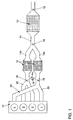
- the illustrated exhaust system comprises a large-volume NO x storage catalytic converter 10 with two parallel-connected small-volume primary catalytic converters 12 in associated exhaust gas paths 14a, 14b located in front of an associated engine or an internal combustion engine 16 forks and are connected via manifold 20 each with two cylinders (1-4) of this internal combustion engine 16.
- the one exhaust path 14a is in this case connected to the first and fourth cylinders (1 or 4), while the other exhaust path 14b is connected to the second and third cylinders (2 or 3).
- the two parallel exhaust gas paths 14a, 14b are also connected to one another before the precatalysts 12 via a connection path 14c. Behind the precatalysts 12, the two exhaust gas paths 14a, 14b are combined to form a common exhaust gas path 14, in which the NO x storage catalytic converter 10 is arranged.
- the exact location of the merging of the parallel exhaust paths 14a, 14b to a common exhaust path 14, depending on the nature and dimensions of the exhaust system 10, 12, 14 and the associated internal combustion engine 16 are determined, for example, by optimization calculations. For a combination of the two exhaust paths 14a, 14b adjacent to the pre-catalysts 12, the lower heat loss of the then single-flow exhaust line 14 and the better mixing of the exhaust gases from the two parallel exhaust paths 14a, 14b on a longest possible common exhaust path 14.
- Each of the two precatalysts 12 is preceded by a lambda probe 18 for detecting and monitoring the oxygen content of the exhaust gas supplied to the precatalysts 12 in the associated exhaust gas paths 14a, 14b.
- a lambda probe 18 is also arranged in the connection path 14 c.
- each of the NO x storage catalytic converter 10 in the common exhaust path 14 a lambda probe 18 upstream and downstream.
- the NO x storage catalytic converter 10 and the two pre-catalytic converters 12 are furthermore each preceded by a temperature sensor (not shown) for local detection of the exhaust gas temperature, which is not only used to control the optimum NO x storage by monitoring an optimum storage temperature range and optionally initiate temperature-increasing measures, but also to monitor the reaction kinetic and safety-related regeneration temperature ranges to be observed for a NO x regeneration or de-sulfation and the temperature gradients occurring in the catalysts 10, 12.
- the catalytic activity of the NO x storage catalytic converter 10 can be monitored by a temperature comparison between the exhaust gases flowing into the NO x storage catalytic converter 10 and the outflowing exhaust gases.
- the NO x storage catalytic converter 10 is additionally followed by an NO x sensor (not shown) for measuring the nitrogen oxide emission, which serves to determine catalyst activity irregularities by detecting NO x breakthroughs.
- the lambda sensors 18, the temperature sensor and the NO x sensor are connected to a (also not shown) control device for detecting and evaluating the respective measurement signals and for controlling the cylinder operation as required in response to the loading of the NO x storage catalyst 10 with sulfur and / or Nitrogen oxides, the current driving situation, the proper functioning of safety or emission-related components, the pollutant and oxygen content of the exhaust gas, the height of the exhaust gas mass flow, the current temperature profile in the catalyst device 10, 12, in particular the temperature of the NO x storage catalytic converter 10, and a desired target NO x storage catalytic converter temperature connected.
- a control device for detecting and evaluating the respective measurement signals and for controlling the cylinder operation as required in response to the loading of the NO x storage catalyst 10 with sulfur and / or Nitrogen oxides, the current driving situation, the proper functioning of safety or emission-related components, the pollutant and oxygen content of the exhaust gas, the height of the exhaust gas mass flow, the current temperature profile in the catalyst device 10, 12, in particular the temperature of the NO x storage
- the load state of the NO x storage catalytic converter 10 (and the pre-catalytic converters 12) is determined by means of a (not shown) associated special device or the aforementioned control device, for example via the cumulative fuel consumption since a last de-sulfation process with sulfur simplifying with a sufficient accuracy for the practice of a hundred percent efficiency in the sulfur storage and a negligible degradation in a NO x regeneration can be assumed.
- a (not shown) associated special device or the aforementioned control device for example via the cumulative fuel consumption since a last de-sulfation process with sulfur simplifying with a sufficient accuracy for the practice of a hundred percent efficiency in the sulfur storage and a negligible degradation in a NO x regeneration can be assumed.
- other determination options are conceivable.
- the loading state of the NO x storage catalytic converter 10 with nitrogen oxides is determined in a known manner and the catalyst activity is monitored by an on-board diagnosis.
- Exceeding a maximum allowable NO x - or sulfur loading or when an irregularity of catalyst activity occurs, which is detected for example by measuring NO x breakthroughs by means of the downstream NO x sensor is checked by checking safety or exhaust gas relevant components for proper operation and / or the current driving situation to comply with predetermined driving parameters first checked the permissibility of a corresponding regeneration measure.
- the cylinders 1 and 4 or 2 and 3 the internal combustion engine 16 in opposite directions until reaching the required for the de-sulfation lambda values in the direction of fat or lean, so that the exhaust gas 14a rich exhaust gas and the other pre-catalyst 12 via the exhaust path 14b lean exhaust gas is fed to the one pre-catalyst ,
- the difference between the lambda values of the exhaust gases in the two exhaust gas paths 14a, 14b or the spreading of the lambda values depends essentially on the desired temperature increase in the NO x storage catalytic converter 10. To avoid possible catalyst-damaging excess temperatures, however, this spread becomes dependent on the determined temperature of the NO x storage catalyst 10, the temperature difference in this catalyst 10 and the exhaust gas mass flow limited to a maximum value.
- the spread is set operating point dependent so that the exhaust gas before the NO x storage catalyst 10 contains a maximum of about 4 kW of chemically convertible energy. Up to a catalyst temperature of about 500 ° C, this results in a spread between the lambda values of a maximum of about 0.85 to 1.21.
- the spread between the lambda values in the individual exhaust gas paths 14a, 14b is measured with decreasing difference between a predetermined target temperature of the NO x storage catalytic converter 10 and the measured catalyst temperature and increasing temperature gradient in the NO x storage lcatalysator 10 is reduced.
- a substantially stoichiometric exhaust gas with ⁇ 1 is provided in the middle of all cylinders.
- the oxygen content of the exhaust gas supplied to the primary catalytic converters 12 is detected via the upstream lambda sensors 18 arranged in the respective exhaust gas path 14a or 14b and forwarded to the control device (not shown) for monitoring the oxygen content and controlling it by suitable operation of the cylinders 1-4 ,
- the oxygen content of the sum exhaust gas is monitored via the lambda probe 18 arranged in the connection path 14c and the lambda probes 18 arranged in the common exhaust path 14, although monitoring by one of these lambda probes 18 is already sufficient.
- both the rich and the lean-burned pre-catalyst 12 can be acted upon by an exhaust whose oxygen content corresponds to a specific target lambda value, while the associated lean or richly operated pre-catalyst 12 in the exhaust gas path 14a or 14b supplied to parallel exhaust gas the desired mean lambda value is regulated.
- the exhaust gas in the respectively regulated exhaust gas path 14a or 14b can also be impressed via a wobble with a forced amplitude.
- the mode of operation of the cylinders is changed after each de-sulfation or heating operation, so that the fat-operated cylinders 1 and 4 lean and the lean-burned cylinders 2 and 3 are operated richly in the next heating operation and the pre-catalytic converters thus operate in the Temporal means are operated substantially stoichiometrically.
- the two exhaust gas paths 14a and 14b can also be designed such that they have different exhaust gas run lengths between the internal combustion engine 16 and the respective primary catalytic converter 12, different exhaust gas pipe cross sections and different funnel shapes.
- the described method according to the invention can also be used analogously for the need-based heating of 3-way card analyzers.
- the heating method according to the invention for a catalyst device 10, 12 has been described above with reference to an exhaust system 10, 12, 14 with two parallel arranged pre-catalysts 12, each via an associated exhaust path 14a, 14b with 2 cylinders 1 and 4 or 2 and 3 of an associated internal combustion engine 16 are connected.
- the one primary catalytic converter 12 can be connected to one cylinder 1 via the exhaust gas path 14a, for example, while the other primary catalytic converter 12 in the parallel exhaust gas path 14b of the remaining three cylinders 2-4 with Exhaust gas is applied.
- a corresponding exhaust system according to the above explanations is of particular interest for engines with more than four cylinders, in which the number of possible combinations increases accordingly.
- each exhaust path 14a and 14b is acted upon by three cylinders with exhaust gas.
- it is also an asymmetrical division in the ratio 2 to 4 or 1 to 5 between the two exhaust paths conceivable.
- the individual cylinders 1-4 of the internal combustion engine 16 can also be connected to a precatalyst 12 via associated exhaust paths, the individual cylinders 1-4 being operated in a rich, lean or stoichiometric manner as required become.
- a precatalyst 12 There is also another assignment between the cylinders 1 - 4 and the pre-catalytic converters 12 possible, for example, the exhaust gases of two cylinders 1 and 2 are combined in a common exhaust path with an associated pre-catalyst, while the remaining two cylinders 3 and 4 each have a associated exhaust path are connected to a pre-catalyst 12. The same applies to internal combustion engines with more than four cylinders.
Landscapes
- Engineering & Computer Science (AREA)
- Chemical & Material Sciences (AREA)
- Combustion & Propulsion (AREA)
- Mechanical Engineering (AREA)
- General Engineering & Computer Science (AREA)
- Chemical Kinetics & Catalysis (AREA)
- Electrical Control Of Air Or Fuel Supplied To Internal-Combustion Engine (AREA)
- Exhaust Gas After Treatment (AREA)
Claims (33)
- Procédé pour chauffer un dispositif de catalyse (10, 12) raccordé en aval d'un moteur à combustion interne (16) à plusieurs cylindres et apte à fonctionner en conditions pauvres, qui comprend un catalyseur principal (10) et des précatalyseurs (12) montés en parallèle et dont chacun n'est alimenté en gaz d'échappement que par certains des cylindres (1-4) par l'intermédiaire de parcours de gaz d'échappement (14a, 14b) qui y sont associés, dans lequel du gaz d'échappement riche est amené à au moins l'un des précatalyseurs (12) et du gaz d'échappement pauvre est amené à au moins l'un des précatalyseurs (12), les substances nocives présentes dans le gaz d'échappement réagissant de manière exothermique dans le catalyseur principal (10) en fonction de la teneur en oxygène du gaz d'échappement particulier, caractérisé en ce que les valeurs lambda des gaz d'échappement amenés à chacun des précatalyseurs (12) ou un étalement entre ces valeurs sont commandés en fonction d'une augmentation souhaitée de la température du catalyseur principal (10), la différence ou l'étalement entre les valeurs lambda étant limités à une valeur maximale définie.
- Procédé de chauffage selon la revendication 1, caractérisé en ce que la valeur maximale est définie en fonction de la température du catalyseur principal, du gradient de température dans le catalyseur principal (10) et/ou du débit massique de gaz d'échappement.
- Procédé de chauffage selon l'une des revendications précédentes, caractérisé en ce que jusqu'à une température du catalyseur principal de 500°C, l'étalement des valeurs lambda est compris au maximum entre 0,85 et 1,21.
- Procédé de chauffage selon l'une des revendications précédentes, caractérisé en ce que l'étalement des valeurs lambda est réglé en fonction du point de fonctionnement de telle sorte qu'en amont du catalyseur principal (10), le gaz d'échappement contienne au maximum 4 kW d'énergie convertible chimiquement.
- Procédé de chauffage selon l'une des revendications précédentes, caractérisé en ce que la différence entre les valeurs lambda diminue quand la différence entre une température définie de consigne du catalyseur principal et la température mesurée du catalyseur principal décroît et/ou quand le gradient de température croît dans le catalyseur principal (10).
- Procédé de chauffage selon la revendication 5, caractérisé en ce que l'étalement des valeurs lambda dans les différents parcours de gaz d'échappement (14a, 14b) n'est pas rétréci lorsque le gradient de température dans le catalyseur principal (10) n'atteint pas 150 K/min.
- Procédé de chauffage selon la revendication 5, caractérisé en ce qu'il n'y a plus d'étalement des valeurs lambda dans les différents parcours de gaz d'échappement (14a, 14b) lorsque la température du catalyseur principal est de 700 à 770°C et/ou quand le gradient de température est supérieur à 300 K/min.
- Procédé de chauffage selon la revendication 7, caractérisé en ce qu'il n'y a plus d'étalement lorsque la température du catalyseur principal dépasse 720°C.
- Procédé de chauffage selon l'une des revendications précédentes, caractérisé en ce que les précatalyseurs (12) sont alimentés en gaz d'échappement par un nombre différent de cylindres (1-4) ou par des cylindres (1-4) distincts.
- Procédé de chauffage selon l'une des revendications précédentes, caractérisé en ce que le gaz d'échappement amené aux cylindres (1-4) présente en moyenne un rapport d'air essentiellement stoechiométrique.
- Procédé de chauffage selon l'une des revendications précédentes, caractérisé en ce que le mode de fonctionnement des cylindres (1-4) change à intervalles de temps définis.
- Procédé de chauffage selon l'une des revendications précédentes, caractérisé en ce que le changement de mode de fonctionnement a lieu après une ou deux opérations de chauffage.
- Procédé de chauffage selon l'une des revendications 1 à 10, caractérisé en ce qu'on utilise des précatalyseurs (12) qui, moyennant une sélection appropriée des matériaux de support, du volume, de la géométrie et/ou du nombre des alvéoles, de l'épaisseur du matériau de support, de l'imprégnateur et/ou des revêtements, sont spécialement adaptés à des taux élevés de conversion des substances nocives en conditions de fonctionnement pauvres ou riches.
- Procédé de chauffage selon la revendication 13, caractérisé en ce qu'on utilise des précatalyseurs (12) étudiés pour assurer une bonne conversion des HC en conditions pauvres ou une bonne oxydation partielle des HC en CO en conditions riches.
- Procédé de chauffage selon l'une des revendications précédentes, caractérisé en ce qu'entre le moteur à combustion (16) et les précatalyseurs (12), on utilise des parcours de gaz d'échappement (14a, 14b) de longueurs, de sections transversales et/ou de formes d'entonnoir différentes.
- Procédé de chauffage selon l'une des revendications précédentes, caractérisé en ce que les parcours de gaz d'échappement (14a, 14b) sont surveillés au moyen de sondes lambda (18) respectives qui leur sont associées.
- Procédé de chauffage selon l'une des revendications précédentes, caractérisé en ce que des parcours de gaz d'échappement (14a, 14b) sont reliés l'un à l'autre au moyen d'un parcours de liaison (14c) et sont surveillés par une sonde lambda (18) agencée dans le parcours de liaison (14c).
- Procédé de chauffage selon l'une des revendications précédentes, caractérisé en ce que les parcours de gaz d'échappement (14a, 14b) se rejoignent en un parcours de gaz d'échappement commun (14) en amont du catalyseur principal (10).
- Procédé de chauffage selon la revendication 18, caractérisé en ce que la jonction a lieu au voisinage des précatalyseurs (12) ou du catalyseur principal (10).
- Procédé de chauffage selon les revendications 18 ou 19, caractérisé en ce que la teneur moyenne en oxygène dans le parcours commun de gaz d'échappement (14) est surveillée par au moins une sonde lambda (18) située en amont et/ou en aval du catalyseur principal (10).
- Procédé de chauffage selon l'une des revendications précédentes, caractérisé en ce que les gaz d'échappement pauvres ou riches des cylindres en fonctionnement (1 et 4 ou 2 et 3) sont rassemblés dans un parcours commun de gaz d'échappement (14a ou 14b) et sont amenés à un précatalyseur associé (12).
- Procédé de chauffage selon l'une des revendications précédentes, caractérisé en ce que le gaz d'échappement riche ou pauvre d'un parcours de gaz d'échappement (14a, 14b) est ajusté à une valeur définie de consigne et en ce que le gaz d'échappement pauvre ou riche dans un parcours de gaz d'échappement parallèle associé (14b ou 14a) est régulé à une valeur lambda moyenne définie.
- Procédé de chauffage selon la revendication 22, caractérisé en ce que dans le parcours de gaz d'échappement parallèle (14b ou 14a), la valeur lambda est régulée en fonction de la valeur lambda effective mesurée dans l'autre parcours de gaz d'échappement (14a ou 14b) associé et non régulé.
- Procédé de chauffage selon l'une des revendications précédentes, caractérisé en ce que l'on imprime une amplitude fixe au gaz d'échappement au moyen d'une excursion de fréquence.
- Procédé de chauffage selon l'une des revendications précédentes, caractérisé en ce que le catalyseur principal (10) est un catalyseur à accumulation de NOx ou un catalyseur à 3 voies.
- Installation de gaz d'échappement pour un moteur à combustion (16) à plusieurs cylindres apte à fonctionner en conditions pauvres, qui présente un catalyseur principal (10) et des précatalyseurs (12) montés en parallèle dans les parcours respectifs de gaz d'échappement (14a, 14b) qui leur sont associés, caractérisée en ce que les parcours de gaz d'échappement (14a, 14b) sont reliés l'un à l'autre par un parcours de liaison (14c) qui comprend une sonde lambda (18) et qui est agencé en amont d'un emplacement de jonction des parcours de gaz d'échappement (14a, 14b).
- Installation de gaz d'échappement selon la revendication 26, caractérisée en ce qu'en amont du catalyseur principal (10), les parcours de gaz d'échappement (14a, 14b) se rejoignent en un parcours commun de gaz d'échappement (14) qui comprend au moins une sonde lambda (18) en amont et/ou en aval du catalyseur principal (10).
- Installation de gaz d'échappement selon les revendications 26 ou 27, caractérisée en ce qu'entre le moteur à combustion (16) et les précatalyseurs (12), les parcours de gaz d'échappement (14a, 14b) présentent différentes longueurs, sections transversales et/ou formes en entonnoir.
- Installation de gaz d'échappement selon l'une des revendications 26 à 28, caractérisée en ce que chacun des parcours de gaz d'échappement parallèles (14a, 14b) est relié à un nombre différent de cylindres (1-4) ou à des cylindres (1-4) distincts.
- Installation de gaz d'échappement selon l'une des revendications 26 à 29, caractérisée en ce que des détecteurs de température sont agencés en amont et/ou en aval des catalyseurs (10, 12).
- Installation de gaz d'échappement selon l'une des revendications 26 à 30, caractérisée en ce que, par une sélection appropriée de la nature de support, du nombre d'alvéoles et de l'épaisseur des matériaux de support, de l'imprégnateur et/ou des revêtements, les précatalyseurs (12) sont spécialement adaptés à des taux élevés de conversion des substances nocives en conditions de fonctionnement pauvres ou riches.
- Installation de gaz d'échappement selon l'une des revendications 26 à 31, caractérisée en ce que le catalyseur principal (10) comprend un catalyseur à accumulation de NOx ou un catalyseur à 3 voies.
- Installation de gaz d'échappement selon l'une des revendications 26 à 32, caractérisée par un dispositif de détermination de la charge en soufre et/ou en oxydes d'azote du catalyseur principal (10) et un dispositif associé de commande qui commande sélectivement ou collectivement les cylindres (1-4) du moteur à combustion (16) en fonction de la charge définie du catalyseur principal (10) en soufre et/ou en oxydes d'azote, des conditions de roulage, du fonctionnement correct des composants qui concernent la sécurité ou le gaz d'échappement, des teneurs en substances nocives et en oxygène du gaz d'échappement, du niveau de débit massique de gaz d'échappement, de l'évolution effective de la température dans le dispositif de catalyse (10, 12) et de la température de consigne que l'on souhaite dans le catalyseur principal.
Applications Claiming Priority (2)
| Application Number | Priority Date | Filing Date | Title |
|---|---|---|---|
| DE10055665 | 2000-11-10 | ||
| DE10055665A DE10055665A1 (de) | 2000-11-10 | 2000-11-10 | Verfahren und Vorrichtung zur Katalysatorbeheizung |
Publications (3)
| Publication Number | Publication Date |
|---|---|
| EP1205648A2 EP1205648A2 (fr) | 2002-05-15 |
| EP1205648A3 EP1205648A3 (fr) | 2003-09-10 |
| EP1205648B1 true EP1205648B1 (fr) | 2006-03-15 |
Family
ID=7662777
Family Applications (1)
| Application Number | Title | Priority Date | Filing Date |
|---|---|---|---|
| EP01122604A Expired - Lifetime EP1205648B1 (fr) | 2000-11-10 | 2001-09-26 | Procédé et dispositif pour le chauffage d'un catalysateur |
Country Status (2)
| Country | Link |
|---|---|
| EP (1) | EP1205648B1 (fr) |
| DE (2) | DE10055665A1 (fr) |
Cited By (1)
| Publication number | Priority date | Publication date | Assignee | Title |
|---|---|---|---|---|
| EP2071147A4 (fr) * | 2006-10-06 | 2011-04-27 | Toyota Motor Co Ltd | Appareil d'épuration des gaz d'échappement pour moteur à combustion interne |
Families Citing this family (10)
| Publication number | Priority date | Publication date | Assignee | Title |
|---|---|---|---|---|
| DE10254683A1 (de) * | 2002-11-22 | 2004-06-03 | Robert Bosch Gmbh | Verfahren zum Betreiben einer mehrzylindrigen Brennkraftmaschine mit einem NOx-Speicherkatalysator |
| DE10261911A1 (de) * | 2002-12-30 | 2004-07-29 | Volkswagen Ag | Verfahren zur Steuerung der Temperatur eines Katalysators sowie Mehrzylindermotor mit lambdasplitfähiger Abgasreinigungsanlage |
| DE10310024B4 (de) | 2003-02-28 | 2012-09-27 | Volkswagen Ag | Verfahren zur Aufheizung eines Katalysators |
| DE10347446B4 (de) * | 2003-10-13 | 2010-01-07 | Audi Ag | Verfahren zur Aufheizung und zur Desulfatisierung eines Hauptkatalysators einer mehrflutigen Abgaslage einer mehrzylindrigen Brennkraftmaschine eines Fahrzeugs, insbesondere eines Kraftfahrzeugs |
| DE102005027990B4 (de) * | 2005-06-17 | 2007-05-10 | Audi Ag | Vorrichtung zur dynamischen Überprüfung einer Abgassonde |
| EP1939420A1 (fr) * | 2006-12-30 | 2008-07-02 | Umicore AG & Co. KG | Méthode de désulfurisation des catalyseurs à accumulation d'oxyde d'azote d'un système d'échappement pour un moteur à mélange pauvre |
| US7797929B2 (en) | 2007-05-21 | 2010-09-21 | Ford Global Technologies, Llc | Low temperature emission control |
| DE102012003310B4 (de) * | 2012-02-18 | 2022-01-27 | Volkswagen Aktiengesellschaft | Verfahren und Vorrichtung zur Aufheizung eines Abgaskatalysators |
| JP6597593B2 (ja) | 2016-12-27 | 2019-10-30 | トヨタ自動車株式会社 | 内燃機関の制御装置 |
| DE102021207702A1 (de) | 2021-07-20 | 2023-01-26 | Psa Automobiles Sa | Verfahren und Abgastrakt zur Speicherung von Abgas während einer Katalysatoraufheizphase |
Citations (1)
| Publication number | Priority date | Publication date | Assignee | Title |
|---|---|---|---|---|
| EP0950803A2 (fr) * | 1998-04-15 | 1999-10-20 | Nissan Motor Co., Ltd. | Dispositif de purification de gaz d'échappement d'un moteur à combustion interne |
Family Cites Families (10)
| Publication number | Priority date | Publication date | Assignee | Title |
|---|---|---|---|---|
| JPH0763048A (ja) * | 1993-08-20 | 1995-03-07 | Ngk Insulators Ltd | 排ガス浄化システム及び排ガス浄化方法 |
| DE4344277A1 (de) * | 1993-12-23 | 1995-06-29 | Bayerische Motoren Werke Ag | Brennkraftmaschine mit einem Start-Katalysator |
| DE19626835A1 (de) * | 1995-07-08 | 1997-01-09 | Volkswagen Ag | Dieselbrennkraftmaschine mit NOx-Speicher |
| DE19529835A1 (de) * | 1995-08-12 | 1997-02-13 | Opel Adam Ag | Abgasstrang eines Ottomotors |
| JP3454334B2 (ja) * | 1996-06-18 | 2003-10-06 | トヨタ自動車株式会社 | 排気浄化方法及びその装置 |
| US5983627A (en) * | 1997-09-02 | 1999-11-16 | Ford Global Technologies, Inc. | Closed loop control for desulfating a NOx trap |
| US6205773B1 (en) * | 1998-07-07 | 2001-03-27 | Toyota Jidosha Kabushiki Kaisha | Exhaust gas purification device for an internal combustion engine |
| DE19852294A1 (de) * | 1998-11-12 | 2000-05-18 | Bayerische Motoren Werke Ag | Abgasanlage einer Mehrzylinder-Brennkraftmaschine |
| JP3680611B2 (ja) * | 1999-02-03 | 2005-08-10 | 日産自動車株式会社 | 内燃機関の排気浄化装置 |
| DE19910664A1 (de) * | 1999-03-11 | 2000-09-14 | Volkswagen Ag | Verfahren zur De-Sulfatierung eines NOx-Speicherkatalysators |
-
2000
- 2000-11-10 DE DE10055665A patent/DE10055665A1/de not_active Ceased
-
2001
- 2001-09-26 DE DE50109204T patent/DE50109204D1/de not_active Expired - Lifetime
- 2001-09-26 EP EP01122604A patent/EP1205648B1/fr not_active Expired - Lifetime
Patent Citations (1)
| Publication number | Priority date | Publication date | Assignee | Title |
|---|---|---|---|---|
| EP0950803A2 (fr) * | 1998-04-15 | 1999-10-20 | Nissan Motor Co., Ltd. | Dispositif de purification de gaz d'échappement d'un moteur à combustion interne |
Cited By (2)
| Publication number | Priority date | Publication date | Assignee | Title |
|---|---|---|---|---|
| EP2071147A4 (fr) * | 2006-10-06 | 2011-04-27 | Toyota Motor Co Ltd | Appareil d'épuration des gaz d'échappement pour moteur à combustion interne |
| US8297041B2 (en) | 2006-10-06 | 2012-10-30 | Toyota Jidosha Kabushiki Kaisha | Exhaust gas purification apparatus for internal combustion engine |
Also Published As
| Publication number | Publication date |
|---|---|
| EP1205648A3 (fr) | 2003-09-10 |
| EP1205648A2 (fr) | 2002-05-15 |
| DE10055665A1 (de) | 2002-10-31 |
| DE50109204D1 (de) | 2006-05-11 |
Similar Documents
| Publication | Publication Date | Title |
|---|---|---|
| EP1060003B1 (fr) | PROCEDE DE REGULATION D'UN CATALYSEUR ABSORBEUR DE NOx | |
| EP3572634B1 (fr) | Procédé et dispositif de traitement des gaz d'échappement d'un moteur à combustion interne | |
| DE19816276A1 (de) | Verfahren zum Betreiben einer Brennkraftmaschine | |
| EP3208450B1 (fr) | Procédé de fonctionnement d'un moteur à combustion interne et moteur à trois cylindres destiné à exécuter ledit procédé | |
| WO2000064566A1 (fr) | Installation pour nettoyer les gaz d'echappement issus d'un moteur a combustion interne et procede pour faire fonctionner une telle installation | |
| EP1581733B1 (fr) | Procede de regulation de la temperature d'un catalyseur, et moteur multicylindre pourvu d'un systeme de purification de gaz d'echappement a division lambda | |
| EP1205648B1 (fr) | Procédé et dispositif pour le chauffage d'un catalysateur | |
| EP3608519A1 (fr) | Procédé et dispositif de traitement d'échappement d'un moteur à combustion | |
| DE102012003310A1 (de) | Verfahren und Vorrichtung zur Aufheizung eines Abgaskatalysators | |
| DE10309422B4 (de) | Verfahren und Vorrichtung zur Kalibrierung eines NOx-Sensors | |
| DE10114456B4 (de) | Vorrichtung und Verfahren zur Koordination von abgasrelevanten Maßnahmen | |
| DE102015215365A1 (de) | Verfahren zur Regeneration von Abgasnachbehandlungskomponenten eines Verbrennungsmotors sowie Abgasnachbehandlungsvorrichtung für einen Verbrennungsmotor | |
| DE10160704B4 (de) | Verfahren zum Betrieb von Abgasreinigungsvorrichtungen | |
| EP1255922B1 (fr) | Dispositif et procede pour commander le mode de fonctionnement d'un moteur multicylindre pour vehicules automobiles comprenant une installation de purification des gaz d'echappement a plusieurs flux | |
| EP1204815B1 (fr) | Procede de reglage de la temperature des gaz d'echappement d'un moteur a combustion interne a melange pauvre pendant une desulfuration d'un catalyseur | |
| DE10226873B4 (de) | Verfahren zur Steuerung der Betriebsartenwahl einer Verbrennungskraftmaschine | |
| EP1391592B1 (fr) | Procédé de commande d'un moteur à combustion interne avec un système de purification de gaz d'échappement | |
| EP1235977B1 (fr) | Procede et dispositif pour commander une phase de chauffage d'au moins un catalyseur place dans le canal d'echappement des gaz d'un moteur a combustion interne | |
| DE10330367A1 (de) | Verfahren und Vorrichtung zur Entschwefelung eines Katalysators | |
| DE10338181B4 (de) | Verfahren und Vorrichtung zur Temperaturbeeinflussung eines Katalysatorsystems | |
| DE10130053B4 (de) | Verfahren und Vorrichtung zur Entschwefelung eines NOX-Speicherkatalysators | |
| DE19859176A1 (de) | Verfahren zum Überprüfen der Funktionsfähigkeit einer Lambdasonde | |
| DE10018062A1 (de) | Mehrzylindermotor für Kraftfahrzeuge mit einer mehrflutigen Abgasreinigungsanlage und Verfahren zur Steuerung eines Betriebs des Mehrzylindermotors | |
| DE102005063204B4 (de) | Auslegung und Betrieb einer magerlauffähigen Brennkraftmaschine mit angepasster Abgasnachbehandlung | |
| DE10260886B4 (de) | Verfahren zur Durchführung einer NOx-Regeneration sowie Mehrzylindermotor mit mehrflutiger Abgasreinigungsanlage |
Legal Events
| Date | Code | Title | Description |
|---|---|---|---|
| PUAI | Public reference made under article 153(3) epc to a published international application that has entered the european phase |
Free format text: ORIGINAL CODE: 0009012 |
|
| AK | Designated contracting states |
Kind code of ref document: A2 Designated state(s): AT BE CH CY DE DK ES FI FR GB GR IE IT LI LU MC NL PT SE TR |
|
| AX | Request for extension of the european patent |
Free format text: AL;LT;LV;MK;RO;SI |
|
| PUAL | Search report despatched |
Free format text: ORIGINAL CODE: 0009013 |
|
| AK | Designated contracting states |
Kind code of ref document: A3 Designated state(s): AT BE CH CY DE DK ES FI FR GB GR IE IT LI LU MC NL PT SE TR |
|
| AX | Request for extension of the european patent |
Extension state: AL LT LV MK RO SI |
|
| RIC1 | Information provided on ipc code assigned before grant |
Ipc: 7F 01N 3/08 A Ipc: 7F 02D 41/02 B Ipc: 7F 02D 41/34 B Ipc: 7F 02D 41/14 B Ipc: 7F 01N 3/20 B |
|
| 17P | Request for examination filed |
Effective date: 20040310 |
|
| AKX | Designation fees paid |
Designated state(s): DE ES FR GB IT |
|
| 17Q | First examination report despatched |
Effective date: 20040422 |
|
| GRAP | Despatch of communication of intention to grant a patent |
Free format text: ORIGINAL CODE: EPIDOSNIGR1 |
|
| GRAS | Grant fee paid |
Free format text: ORIGINAL CODE: EPIDOSNIGR3 |
|
| RIN1 | Information on inventor provided before grant (corrected) |
Inventor name: POTT, EKKEHARD, DR. Inventor name: HAHN, HERMANN, DR. Inventor name: HINZE, SOEREN |
|
| GRAA | (expected) grant |
Free format text: ORIGINAL CODE: 0009210 |
|
| AK | Designated contracting states |
Kind code of ref document: B1 Designated state(s): DE ES FR GB IT |
|
| PG25 | Lapsed in a contracting state [announced via postgrant information from national office to epo] |
Ref country code: IT Free format text: LAPSE BECAUSE OF FAILURE TO SUBMIT A TRANSLATION OF THE DESCRIPTION OR TO PAY THE FEE WITHIN THE PRESCRIBED TIME-LIMIT;WARNING: LAPSES OF ITALIAN PATENTS WITH EFFECTIVE DATE BEFORE 2007 MAY HAVE OCCURRED AT ANY TIME BEFORE 2007. THE CORRECT EFFECTIVE DATE MAY BE DIFFERENT FROM THE ONE RECORDED. Effective date: 20060315 |
|
| REG | Reference to a national code |
Ref country code: GB Ref legal event code: FG4D Free format text: NOT ENGLISH |
|
| REF | Corresponds to: |
Ref document number: 50109204 Country of ref document: DE Date of ref document: 20060511 Kind code of ref document: P |
|
| PG25 | Lapsed in a contracting state [announced via postgrant information from national office to epo] |
Ref country code: ES Free format text: LAPSE BECAUSE OF FAILURE TO SUBMIT A TRANSLATION OF THE DESCRIPTION OR TO PAY THE FEE WITHIN THE PRESCRIBED TIME-LIMIT Effective date: 20060626 |
|
| GBT | Gb: translation of ep patent filed (gb section 77(6)(a)/1977) |
Effective date: 20060705 |
|
| PLBE | No opposition filed within time limit |
Free format text: ORIGINAL CODE: 0009261 |
|
| STAA | Information on the status of an ep patent application or granted ep patent |
Free format text: STATUS: NO OPPOSITION FILED WITHIN TIME LIMIT |
|
| 26N | No opposition filed |
Effective date: 20061218 |
|
| EN | Fr: translation not filed | ||
| PG25 | Lapsed in a contracting state [announced via postgrant information from national office to epo] |
Ref country code: FR Free format text: LAPSE BECAUSE OF FAILURE TO SUBMIT A TRANSLATION OF THE DESCRIPTION OR TO PAY THE FEE WITHIN THE PRESCRIBED TIME-LIMIT Effective date: 20070309 |
|
| PG25 | Lapsed in a contracting state [announced via postgrant information from national office to epo] |
Ref country code: FR Free format text: LAPSE BECAUSE OF FAILURE TO SUBMIT A TRANSLATION OF THE DESCRIPTION OR TO PAY THE FEE WITHIN THE PRESCRIBED TIME-LIMIT Effective date: 20060315 |
|
| PGFP | Annual fee paid to national office [announced via postgrant information from national office to epo] |
Ref country code: GB Payment date: 20130930 Year of fee payment: 13 |
|
| GBPC | Gb: european patent ceased through non-payment of renewal fee |
Effective date: 20140926 |
|
| PG25 | Lapsed in a contracting state [announced via postgrant information from national office to epo] |
Ref country code: GB Free format text: LAPSE BECAUSE OF NON-PAYMENT OF DUE FEES Effective date: 20140926 |
|
| PGFP | Annual fee paid to national office [announced via postgrant information from national office to epo] |
Ref country code: DE Payment date: 20150930 Year of fee payment: 15 |
|
| REG | Reference to a national code |
Ref country code: DE Ref legal event code: R082 Ref document number: 50109204 Country of ref document: DE |
|
| REG | Reference to a national code |
Ref country code: DE Ref legal event code: R119 Ref document number: 50109204 Country of ref document: DE |
|
| PG25 | Lapsed in a contracting state [announced via postgrant information from national office to epo] |
Ref country code: DE Free format text: LAPSE BECAUSE OF NON-PAYMENT OF DUE FEES Effective date: 20170401 |