EP1205995B1 - Sekundärbatterie mit protonenleitendem Polymer - Google Patents
Sekundärbatterie mit protonenleitendem Polymer Download PDFInfo
- Publication number
- EP1205995B1 EP1205995B1 EP01126869A EP01126869A EP1205995B1 EP 1205995 B1 EP1205995 B1 EP 1205995B1 EP 01126869 A EP01126869 A EP 01126869A EP 01126869 A EP01126869 A EP 01126869A EP 1205995 B1 EP1205995 B1 EP 1205995B1
- Authority
- EP
- European Patent Office
- Prior art keywords
- secondary battery
- hydrogensulfate
- proton
- sulfuric acid
- electrolyte
- Prior art date
- Legal status (The legal status is an assumption and is not a legal conclusion. Google has not performed a legal analysis and makes no representation as to the accuracy of the status listed.)
- Expired - Lifetime
Links
- 229920001940 conductive polymer Polymers 0.000 title claims description 16
- QAOWNCQODCNURD-UHFFFAOYSA-N Sulfuric acid Chemical compound OS(O)(=O)=O QAOWNCQODCNURD-UHFFFAOYSA-N 0.000 claims description 55
- 239000003792 electrolyte Substances 0.000 claims description 25
- QAOWNCQODCNURD-UHFFFAOYSA-M hydrogensulfate Chemical compound OS([O-])(=O)=O QAOWNCQODCNURD-UHFFFAOYSA-M 0.000 claims description 17
- 239000011149 active material Substances 0.000 claims description 14
- 229920000642 polymer Polymers 0.000 claims description 13
- 150000001450 anions Chemical class 0.000 claims description 12
- SIKJAQJRHWYJAI-UHFFFAOYSA-N Indole Chemical compound C1=CC=C2NC=CC2=C1 SIKJAQJRHWYJAI-UHFFFAOYSA-N 0.000 claims description 10
- -1 polyphenylenevinylene Polymers 0.000 claims description 6
- 239000013638 trimer Substances 0.000 claims description 6
- XLYOFNOQVPJJNP-UHFFFAOYSA-N water Substances O XLYOFNOQVPJJNP-UHFFFAOYSA-N 0.000 claims description 6
- PZOUSPYUWWUPPK-UHFFFAOYSA-N indole Natural products CC1=CC=CC2=C1C=CN2 PZOUSPYUWWUPPK-UHFFFAOYSA-N 0.000 claims description 5
- RKJUIXBNRJVNHR-UHFFFAOYSA-N indolenine Natural products C1=CC=C2CC=NC2=C1 RKJUIXBNRJVNHR-UHFFFAOYSA-N 0.000 claims description 5
- 229920000767 polyaniline Polymers 0.000 claims description 5
- 125000002887 hydroxy group Chemical group [H]O* 0.000 claims description 3
- 150000002500 ions Chemical class 0.000 claims description 3
- 125000001140 1,4-phenylene group Chemical group [H]C1=C([H])C([*:2])=C([H])C([H])=C1[*:1] 0.000 claims description 2
- HSFWRNGVRCDJHI-UHFFFAOYSA-N alpha-acetylene Natural products C#C HSFWRNGVRCDJHI-UHFFFAOYSA-N 0.000 claims description 2
- 229920000547 conjugated polymer Polymers 0.000 claims description 2
- 229920000553 poly(phenylenevinylene) Polymers 0.000 claims description 2
- 229920001197 polyacetylene Polymers 0.000 claims description 2
- 229920000414 polyfuran Polymers 0.000 claims description 2
- 229920000128 polypyrrole Polymers 0.000 claims description 2
- 229920000123 polythiophene Polymers 0.000 claims description 2
- 229910052739 hydrogen Inorganic materials 0.000 claims 1
- 239000001257 hydrogen Substances 0.000 claims 1
- CHKVPAROMQMJNQ-UHFFFAOYSA-M potassium bisulfate Chemical group [K+].OS([O-])(=O)=O CHKVPAROMQMJNQ-UHFFFAOYSA-M 0.000 claims 1
- 229910000343 potassium bisulfate Inorganic materials 0.000 claims 1
- 125000001453 quaternary ammonium group Chemical group 0.000 claims 1
- 239000002019 doping agent Substances 0.000 description 12
- 239000000654 additive Substances 0.000 description 10
- 230000000694 effects Effects 0.000 description 9
- 230000000996 additive effect Effects 0.000 description 8
- 239000007864 aqueous solution Substances 0.000 description 7
- 238000006243 chemical reaction Methods 0.000 description 7
- 230000006866 deterioration Effects 0.000 description 6
- 230000000052 comparative effect Effects 0.000 description 5
- 239000002671 adjuvant Substances 0.000 description 4
- 239000013626 chemical specie Substances 0.000 description 4
- 239000000203 mixture Substances 0.000 description 4
- 239000000126 substance Substances 0.000 description 4
- AZQWKYJCGOJGHM-UHFFFAOYSA-N 1,4-benzoquinone Chemical compound O=C1C=CC(=O)C=C1 AZQWKYJCGOJGHM-UHFFFAOYSA-N 0.000 description 3
- 238000002425 crystallisation Methods 0.000 description 3
- 230000008025 crystallization Effects 0.000 description 3
- KEQXNNJHMWSZHK-UHFFFAOYSA-L 1,3,2,4$l^{2}-dioxathiaplumbetane 2,2-dioxide Chemical compound [Pb+2].[O-]S([O-])(=O)=O KEQXNNJHMWSZHK-UHFFFAOYSA-L 0.000 description 2
- OKTJSMMVPCPJKN-UHFFFAOYSA-N Carbon Chemical compound [C] OKTJSMMVPCPJKN-UHFFFAOYSA-N 0.000 description 2
- VEXZGXHMUGYJMC-UHFFFAOYSA-N Hydrochloric acid Chemical compound Cl VEXZGXHMUGYJMC-UHFFFAOYSA-N 0.000 description 2
- NBIIXXVUZAFLBC-UHFFFAOYSA-N Phosphoric acid Chemical compound OP(O)(O)=O NBIIXXVUZAFLBC-UHFFFAOYSA-N 0.000 description 2
- 230000004913 activation Effects 0.000 description 2
- 229910052924 anglesite Inorganic materials 0.000 description 2
- 239000011230 binding agent Substances 0.000 description 2
- 229910052799 carbon Inorganic materials 0.000 description 2
- 150000001768 cations Chemical class 0.000 description 2
- 230000008859 change Effects 0.000 description 2
- 238000010276 construction Methods 0.000 description 2
- 239000007772 electrode material Substances 0.000 description 2
- 238000005868 electrolysis reaction Methods 0.000 description 2
- 239000000463 material Substances 0.000 description 2
- 239000012528 membrane Substances 0.000 description 2
- 238000000034 method Methods 0.000 description 2
- 238000005502 peroxidation Methods 0.000 description 2
- 239000002002 slurry Substances 0.000 description 2
- 239000007784 solid electrolyte Substances 0.000 description 2
- JOXIMZWYDAKGHI-UHFFFAOYSA-N toluene-4-sulfonic acid Chemical compound CC1=CC=C(S(O)(=O)=O)C=C1 JOXIMZWYDAKGHI-UHFFFAOYSA-N 0.000 description 2
- 239000012808 vapor phase Substances 0.000 description 2
- YHYLDEVWYOFIJK-UHFFFAOYSA-N 1h-indole-5-carbonitrile Chemical compound N#CC1=CC=C2NC=CC2=C1 YHYLDEVWYOFIJK-UHFFFAOYSA-N 0.000 description 1
- 229910020669 PbOx Inorganic materials 0.000 description 1
- QAOWNCQODCNURD-UHFFFAOYSA-L Sulfate Chemical compound [O-]S([O-])(=O)=O QAOWNCQODCNURD-UHFFFAOYSA-L 0.000 description 1
- 239000002253 acid Substances 0.000 description 1
- 239000000853 adhesive Substances 0.000 description 1
- 230000001070 adhesive effect Effects 0.000 description 1
- 125000000217 alkyl group Chemical group 0.000 description 1
- 229910000147 aluminium phosphate Inorganic materials 0.000 description 1
- PYKYMHQGRFAEBM-UHFFFAOYSA-N anthraquinone Natural products CCC(=O)c1c(O)c2C(=O)C3C(C=CC=C3O)C(=O)c2cc1CC(=O)OC PYKYMHQGRFAEBM-UHFFFAOYSA-N 0.000 description 1
- 150000004056 anthraquinones Chemical class 0.000 description 1
- QVGXLLKOCUKJST-UHFFFAOYSA-N atomic oxygen Chemical compound [O] QVGXLLKOCUKJST-UHFFFAOYSA-N 0.000 description 1
- 239000006229 carbon black Substances 0.000 description 1
- 230000021615 conjugation Effects 0.000 description 1
- 238000010281 constant-current constant-voltage charging Methods 0.000 description 1
- 239000013078 crystal Substances 0.000 description 1
- 230000001419 dependent effect Effects 0.000 description 1
- 238000010494 dissociation reaction Methods 0.000 description 1
- 230000005593 dissociations Effects 0.000 description 1
- 239000008151 electrolyte solution Substances 0.000 description 1
- 230000008014 freezing Effects 0.000 description 1
- 238000007710 freezing Methods 0.000 description 1
- XLYOFNOQVPJJNP-ZSJDYOACSA-N heavy water Substances [2H]O[2H] XLYOFNOQVPJJNP-ZSJDYOACSA-N 0.000 description 1
- 238000007731 hot pressing Methods 0.000 description 1
- 230000006872 improvement Effects 0.000 description 1
- 239000011159 matrix material Substances 0.000 description 1
- 230000007246 mechanism Effects 0.000 description 1
- 230000003647 oxidation Effects 0.000 description 1
- 238000007254 oxidation reaction Methods 0.000 description 1
- 229910052760 oxygen Inorganic materials 0.000 description 1
- 239000001301 oxygen Substances 0.000 description 1
- 229920000098 polyolefin Polymers 0.000 description 1
- 239000000843 powder Substances 0.000 description 1
- 230000001737 promoting effect Effects 0.000 description 1
- 239000002994 raw material Substances 0.000 description 1
- 230000009467 reduction Effects 0.000 description 1
- 239000011347 resin Substances 0.000 description 1
- 229920005989 resin Polymers 0.000 description 1
- 150000003839 salts Chemical class 0.000 description 1
- 238000007086 side reaction Methods 0.000 description 1
- 239000000243 solution Substances 0.000 description 1
- 150000003467 sulfuric acid derivatives Chemical class 0.000 description 1
Images
Classifications
-
- H—ELECTRICITY
- H01—ELECTRIC ELEMENTS
- H01M—PROCESSES OR MEANS, e.g. BATTERIES, FOR THE DIRECT CONVERSION OF CHEMICAL ENERGY INTO ELECTRICAL ENERGY
- H01M4/00—Electrodes
- H01M4/02—Electrodes composed of, or comprising, active material
- H01M4/36—Selection of substances as active materials, active masses, active liquids
- H01M4/60—Selection of substances as active materials, active masses, active liquids of organic compounds
- H01M4/602—Polymers
- H01M4/606—Polymers containing aromatic main chain polymers
- H01M4/608—Polymers containing aromatic main chain polymers containing heterocyclic rings
-
- H—ELECTRICITY
- H01—ELECTRIC ELEMENTS
- H01M—PROCESSES OR MEANS, e.g. BATTERIES, FOR THE DIRECT CONVERSION OF CHEMICAL ENERGY INTO ELECTRICAL ENERGY
- H01M10/00—Secondary cells; Manufacture thereof
- H01M10/05—Accumulators with non-aqueous electrolyte
- H01M10/058—Construction or manufacture
- H01M10/0585—Construction or manufacture of accumulators having only flat construction elements, i.e. flat positive electrodes, flat negative electrodes and flat separators
-
- H—ELECTRICITY
- H01—ELECTRIC ELEMENTS
- H01M—PROCESSES OR MEANS, e.g. BATTERIES, FOR THE DIRECT CONVERSION OF CHEMICAL ENERGY INTO ELECTRICAL ENERGY
- H01M10/00—Secondary cells; Manufacture thereof
- H01M10/05—Accumulators with non-aqueous electrolyte
- H01M10/052—Li-accumulators
- H01M10/0525—Rocking-chair batteries, i.e. batteries with lithium insertion or intercalation in both electrodes; Lithium-ion batteries
-
- H—ELECTRICITY
- H01—ELECTRIC ELEMENTS
- H01M—PROCESSES OR MEANS, e.g. BATTERIES, FOR THE DIRECT CONVERSION OF CHEMICAL ENERGY INTO ELECTRICAL ENERGY
- H01M10/00—Secondary cells; Manufacture thereof
- H01M10/05—Accumulators with non-aqueous electrolyte
- H01M10/056—Accumulators with non-aqueous electrolyte characterised by the materials used as electrolytes, e.g. mixed inorganic/organic electrolytes
- H01M10/0564—Accumulators with non-aqueous electrolyte characterised by the materials used as electrolytes, e.g. mixed inorganic/organic electrolytes the electrolyte being constituted of organic materials only
- H01M10/0566—Liquid materials
- H01M10/0567—Liquid materials characterised by the additives
-
- H—ELECTRICITY
- H01—ELECTRIC ELEMENTS
- H01M—PROCESSES OR MEANS, e.g. BATTERIES, FOR THE DIRECT CONVERSION OF CHEMICAL ENERGY INTO ELECTRICAL ENERGY
- H01M10/00—Secondary cells; Manufacture thereof
- H01M10/36—Accumulators not provided for in groups H01M10/05-H01M10/34
-
- H—ELECTRICITY
- H01—ELECTRIC ELEMENTS
- H01M—PROCESSES OR MEANS, e.g. BATTERIES, FOR THE DIRECT CONVERSION OF CHEMICAL ENERGY INTO ELECTRICAL ENERGY
- H01M4/00—Electrodes
- H01M4/02—Electrodes composed of, or comprising, active material
- H01M4/36—Selection of substances as active materials, active masses, active liquids
- H01M4/58—Selection of substances as active materials, active masses, active liquids of inorganic compounds other than oxides or hydroxides, e.g. sulfides, selenides, tellurides, halogenides or LiCoFy; of polyanionic structures, e.g. phosphates, silicates or borates
-
- H—ELECTRICITY
- H01—ELECTRIC ELEMENTS
- H01M—PROCESSES OR MEANS, e.g. BATTERIES, FOR THE DIRECT CONVERSION OF CHEMICAL ENERGY INTO ELECTRICAL ENERGY
- H01M4/00—Electrodes
- H01M4/02—Electrodes composed of, or comprising, active material
- H01M4/36—Selection of substances as active materials, active masses, active liquids
- H01M4/60—Selection of substances as active materials, active masses, active liquids of organic compounds
-
- H—ELECTRICITY
- H01—ELECTRIC ELEMENTS
- H01M—PROCESSES OR MEANS, e.g. BATTERIES, FOR THE DIRECT CONVERSION OF CHEMICAL ENERGY INTO ELECTRICAL ENERGY
- H01M4/00—Electrodes
- H01M4/02—Electrodes composed of, or comprising, active material
- H01M4/62—Selection of inactive substances as ingredients for active masses, e.g. binders, fillers
- H01M4/621—Binders
- H01M4/622—Binders being polymers
-
- H—ELECTRICITY
- H01—ELECTRIC ELEMENTS
- H01M—PROCESSES OR MEANS, e.g. BATTERIES, FOR THE DIRECT CONVERSION OF CHEMICAL ENERGY INTO ELECTRICAL ENERGY
- H01M2300/00—Electrolytes
- H01M2300/0002—Aqueous electrolytes
- H01M2300/0005—Acid electrolytes
-
- H—ELECTRICITY
- H01—ELECTRIC ELEMENTS
- H01M—PROCESSES OR MEANS, e.g. BATTERIES, FOR THE DIRECT CONVERSION OF CHEMICAL ENERGY INTO ELECTRICAL ENERGY
- H01M2300/00—Electrolytes
- H01M2300/0002—Aqueous electrolytes
- H01M2300/0005—Acid electrolytes
- H01M2300/0011—Sulfuric acid-based
-
- H—ELECTRICITY
- H01—ELECTRIC ELEMENTS
- H01M—PROCESSES OR MEANS, e.g. BATTERIES, FOR THE DIRECT CONVERSION OF CHEMICAL ENERGY INTO ELECTRICAL ENERGY
- H01M4/00—Electrodes
- H01M4/02—Electrodes composed of, or comprising, active material
- H01M4/13—Electrodes for accumulators with non-aqueous electrolyte, e.g. for lithium-accumulators; Processes of manufacture thereof
- H01M4/137—Electrodes based on electro-active polymers
-
- H—ELECTRICITY
- H01—ELECTRIC ELEMENTS
- H01M—PROCESSES OR MEANS, e.g. BATTERIES, FOR THE DIRECT CONVERSION OF CHEMICAL ENERGY INTO ELECTRICAL ENERGY
- H01M4/00—Electrodes
- H01M4/02—Electrodes composed of, or comprising, active material
- H01M4/62—Selection of inactive substances as ingredients for active masses, e.g. binders, fillers
-
- Y—GENERAL TAGGING OF NEW TECHNOLOGICAL DEVELOPMENTS; GENERAL TAGGING OF CROSS-SECTIONAL TECHNOLOGIES SPANNING OVER SEVERAL SECTIONS OF THE IPC; TECHNICAL SUBJECTS COVERED BY FORMER USPC CROSS-REFERENCE ART COLLECTIONS [XRACs] AND DIGESTS
- Y02—TECHNOLOGIES OR APPLICATIONS FOR MITIGATION OR ADAPTATION AGAINST CLIMATE CHANGE
- Y02E—REDUCTION OF GREENHOUSE GAS [GHG] EMISSIONS, RELATED TO ENERGY GENERATION, TRANSMISSION OR DISTRIBUTION
- Y02E60/00—Enabling technologies; Technologies with a potential or indirect contribution to GHG emissions mitigation
- Y02E60/10—Energy storage using batteries
-
- Y—GENERAL TAGGING OF NEW TECHNOLOGICAL DEVELOPMENTS; GENERAL TAGGING OF CROSS-SECTIONAL TECHNOLOGIES SPANNING OVER SEVERAL SECTIONS OF THE IPC; TECHNICAL SUBJECTS COVERED BY FORMER USPC CROSS-REFERENCE ART COLLECTIONS [XRACs] AND DIGESTS
- Y02—TECHNOLOGIES OR APPLICATIONS FOR MITIGATION OR ADAPTATION AGAINST CLIMATE CHANGE
- Y02P—CLIMATE CHANGE MITIGATION TECHNOLOGIES IN THE PRODUCTION OR PROCESSING OF GOODS
- Y02P70/00—Climate change mitigation technologies in the production process for final industrial or consumer products
- Y02P70/50—Manufacturing or production processes characterised by the final manufactured product
Definitions
- This invention relates to a secondary battery of a proton conductive polymer, particularly the secondary battery wherein capacity characteristic and cycle characteristics are improved.
- a secondary battery of a proton conductive polymer consists of a construction, wherein a positive electrode is formed on a positive electrode collector and a negative electrode is formed on a negative electrode collector and these electrodes are piled up via a separator, and aqueous or non-aqueous solution containing a proton source as an electrolyte is filled therein.
- a method of forming an electrode consists of preparing a slurry by adding an adhesive to the powder of a raw material polymer which is doped or not doped and a conductive adjuvant on a collector such as a conductive rubber sheet, injecting the slurry into a desired mold and forming an electrode having a desired electrode density and membrane thickness by a hot-press.
- a battery is constructed by arranging the positive electrode and the negative electrode, thus formed, facing to each other via a separator.
- An aqueous solution of sulfuric acid is particularly utilized as an electrolyte wherein the sulfuric acid supplies a proton to the system by dissociating in two steps.
- the dissociation constant (pK 2 ) of the second step (Formula (2)) is 1.9 which is comparatively small and the dominant anion in the aqueous solution is HSO 4 - of the first step (Formula (1))
- Fig.4 illustrates a graph showing a comparison of terminal voltages vs. capacities in the electrolyte between 40 wt% and 20 wt% sulfuric acid (Comparative Example 2 and 3 described later).
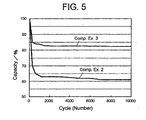
- the graph indicates that increasing the concentration of sulfuric acid improves the initial capacity; however, the cycle characteristics in the case of 40 wt% sulfuric acid are remarkably reduced as shown in Fig.5 .
- HSO 4 - is doped as a dopant in the polymer and a secondary battery having a high capacity can be formed by increasing the electric conductivity of the electrode material by raising the sulfuric acid concentration.
- the sulfuric acid concentration of the battery of a proton conductive polymer is set up at about 20 %.
- the initial doping rate into the electrode at this sulfuric acid concentration was not sufficiently obtained and the capacity was not satisfactory enough because the concentration of the electrolyte was changed by an electrochemical doping accompanied by charge/discharge. Furthermore, the cycle characteristic was hardly sufficient and the low temperature characteristic was also insufficient.
- the purpose of this invention is to provide a secondary battery of a proton conductive polymer having both an excellent capacity and excellent cycle characteristics.
- the inventors found that the cause of the deterioration of the cycle characteristics when increasing the concentration of sulfuric acid for the purpose of a sufficient doping was due to promoting the deterioration of the electrode material by the state of peroxidation which was simultaneously brought about by the high proton concentration in the system. Therefore, in order to increase the dopant anion concentration and restrict an increase in proton concentration of the system simultaneously, a material was added which is not a source of a proton but can supply an anion equivalent to the anion species present in the system. In this way it became possible to increase only the dopant (anion species) concentration without changing the concentration of proton, raise the capacity and improve the cycle characteristics.
- This invention relates to a secondary battery according to claim 1.
- the dependent claims relate to preferred embodiments.
- the activity of the active material of the electrode can be increased sufficiently by increasing only the concentration of the dopant anion without increasing the proton concentration in the system and it is possible to restrict the volume change of the electrode and the structural deterioration, and provide a battery having a longer life than conventional one by having the same dopant species of the additive as the chemical species of the electrolyte.
- the low temperature characteristic is improved by the effect of molar depression of freezing point since the concentration of chemical species in the system is raised without increasing sulfuric acid concentration by adding the additive.
- Japanese Patent Application No. 1998-090174 discloses a polymer battery with reduced and oxidized polyaniline and polypyridine, polypyrimidine, and p- and n-dope type ⁇ -conjugate conductive polymers, and benzoquinone and anthraquinone or derivatives thereof used as the constituting materials of a positive and a negative electrode.
- a charge/discharge reaction according to the reaction formula (3) described below occurs and electrolysis of water (reaction formula (4) and (5)) also occurs as a side reaction resulting in a decrease in water content. If the battery is left as a state of over-discharge, the concentration of sulfuric acid reduces by the self-discharge which causes to lower the density of the solution and increase the solubility of PbSO 4 resulting in dissolving out a large amount of Pb 2+ which combines with OH - and O 2- to form a crystal of PbO x . Furthermore, since the pH of the electrolyte increases and the electric potential reduces by the oxidation, a non-reducing PbSO 4 is crystallized out in the neighborhood of a positive electrode grid by the reduction.
- Negative electrode 2H 3 O + + 2e - ⁇ H 2 +2H 2 O (4)
- a conductive polymer exhibits an electric conductivity by doping. Therefore, the effect of the doping reaction on the activity of the conductive polymer depends on the concentration of the electrolyte. As described above, if the concentration is too high, the structure of the electrode deteriorates by the state of peroxidation, and on the other hand, if the concentration is too low, the activity is insufficient, the battery capacity cannot be increased, and the charge/discharge becomes worse.
- a chemical substance which can supply a dopant but not a proton in an electrolyte consisting of an aqueous solution of sulfuric acid without increasing the proton concentration in the doping reaction of the conductive polymer of a counter electrode.
- a chemical and electrochemical activation effect of an active material of the counter electrode is realized by intervening a dopant in sufficient amount for the doping reaction.
- the deterioration of the electrode structure due to the high proton concentration is restricted and the electrode activity is raised by the improvement of the doping efficiency resulting in a high capacity of the battery.
- the proton ratio with regard to all ions in the electrolyte, of 5 to 40 % is preferable and 5 to 20 % is more preferable.
- too high ratio may not be practical because the viscosity of the electrolyte becomes high and crystallization will occur at low temperature and therefore a range, with regard to all ions in the electrolyte, of 30 to 60 % is preferable and 30 to 50 % is more preferable.
- hydrogensulfate as an additive chemical substance, hydrogensulfate was selected which can supply hydrogensulfate ion (HSO 4 - ) indicating the same chemical species as a dopant anion in the aqueous solution of sulfuric acid, i.e., the electrolyte.
- hydrogensulfate has a large solubility in water (about 50 %/ 25°C H 2 O) and is a chemical substance having a high cation transference number because of its large acidity
- even its small addition at a temperature of using condition of the battery of a proton conductive polymer helps to reduce the inner resistance of the battery at low temperature and can increase the discharge capacity larger than the conventional one.
- the concentration of sulfuric acid in the electrolyte is preferably 5 to 40 wt%, more preferably 5 to 20 wt% and the weight ratio of the hydrogensulfate to be added to 100 parts of sulfuric acid is preferably 5 to 45 parts, more preferably 5 to 30 parts. If the concentration of sulfuric acid is low, the addition of the hydrogensulfate is preferably set in somewhat larger amount.
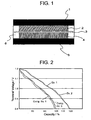
- FIG.1 is a conceptual drawing of a secondary battery of a proton conductive polymer relating to the invention.
- a positive electrode 2 is provided on a positive electrode collector 1 and a negative electrode 4 is provided on a negative electrode collector 5 and these electrodes are piled up facing to each other via a separator 3 to construct a battery.
- the separator 3 separates the positive electrode and the negative electrode completely by being supported by a gasket 6 ; however, the separator may be provided only in an area of separating both electrodes so that the electrolyte may not be separated.
- Each electrode contains an active material of a polymer electrode and a conductive adjuvant such as carbon black, all of which are dispersed in a binder matrix or molded by hot-pressing.
- Polymers used as an active material are, for example, ⁇ conjugated polymers such as polyaniline, polythiophene, polypyrrole, polyacetylene, poly-p-phenylene, polyphenylenevinylene, polyperinaphthalene, polyfuran, polyfurane, polythienylene, polypyridinediyl, polyisothianaphthene, polyquinoxaline, polypyridine, polypyrimidine, indole trimer, polyaminoanthraquinone and the derivatives of these polymers, and a polymer containing a hydroxyl group (hydroxyl group formed by conjugation of oxygen in quinone) such as polyanthraquinone and polybenzoquinone.
- ⁇ conjugated polymers such as polyaniline, polythiophen
- the active material of the positive electrode is preferably selected from a group consisting of polyaniline, polydianiline, polydiaminoanthraquinone, polybiphenylaniline, polynaphthylaniline, indole trimer and their derivatives;
- the active material of the negative electrode is preferably selected from a group consisting of polypyridine, polypyrimidine, polyquinoxaline and their derivatives.
- a combination of the indole trimer described below or its derivatives as the active material of the positive electrode and polyquinoxaline described below as the active material of the negative electrode is particularly preferable.
- this invention is not construed as being limited to the secondary battery containing the electrolyte of the aqueous solution of sulfuric acid and can also be applied to a system of other electrolytes of protonic acid such as system of hydrochloric acid or phosphoric acid if they can increase only dopant species without increasing a proton concentration.
- Polyfluorovinylidene (mean molecular weight: 1100) resin as a binder was added by 8 wt% to a mixture of a trimer (5-cyanoindole) as an active material of a positive electrode and carbon grown in the vapor phase as a conductive adjuvant in a weight ratio of 3 : 1 and the mixture was completely stirred by a homogenizer.
- the mixture was injected into a mold of desired size to form a positive electrode having a desired electrode-density and thickness by a hot-press.
- a mixture of polyphenylquinoxaline as an active material of a negative electrode and KB600, carbon grown in the vapor phase, as a conductive adjuvant in a weight ratio of 3 : 1 was completely stirred by a homogenizer and was injected into a mold of desired size to form a negative electrode having a desired electrode-density and thickness by a hot-press.
- the positive electrode and the negative electrode made as described above were piled up facing to each other via a porous membrane of polyolefin having the thickness of 20 to 50 ⁇ m as a separator to make a secondary battery.
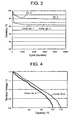
- Fig.2 indicates capacity changes vs. terminal voltages and Fig.3 shows a graph indicating capacity changes up to 10000 cycles.
Landscapes
- Chemical & Material Sciences (AREA)
- Chemical Kinetics & Catalysis (AREA)
- Electrochemistry (AREA)
- General Chemical & Material Sciences (AREA)
- Engineering & Computer Science (AREA)
- Manufacturing & Machinery (AREA)
- Inorganic Chemistry (AREA)
- Materials Engineering (AREA)
- Physics & Mathematics (AREA)
- Condensed Matter Physics & Semiconductors (AREA)
- General Physics & Mathematics (AREA)
- Secondary Cells (AREA)
- Battery Electrode And Active Subsutance (AREA)
Claims (6)
- Sekundärbatterie aus einem protonenleitenden Polymer, wobei eine positive Elektrode und eine negative Elektrode einander mittels eines Separators in einem Elektrolyten, der Schwefelsäure, Hydrogensulfat und Wasser umfasst, gegenüberliegen und nur ein Proton in einem π-konjugierten Polymer ausgewählt aus der Gruppe aus Polyanilin, Polythiophen, Polypyrrol, Polyacetylen, Poly-p-phenylen, Polyphenylenvinylen, Polyperinaphthalin, Polyfuran, Polyfuran, Polythienylen, Polypyridindiyl, Polyisothianaphthen, Polychinoxalin, Polypyridin, Polypyrimidin, Indoltrimer, Polyaminoanthrachinon und den Derivaten dieser Polymere oder ein Proton eines eine Hydroxylgruppe enthaltendem Polymer ausgewählt aus der Gruppe aus Polyanthrachinon und Polybenzochinon als ein aktives Material einer Elektrode in der positiven Elektrode und in der negativen Elektrode an einer Ladung/Entladung teilnimmt, und ein Protonenverhältnis 5 bis 40 % ist und ein Anionenverhältnis 30 bis 60 % ist, jeweils auf alle Ionen in dem Elektrolyten bezogen, und das Anionenverhältnis mindestens höher als das Protonenverhältnis ist.
- Sekundärbatterie gemäß Anspruch 1, wobei das Hydrogensulfat Kaliumhydrogensulfat ist.
- Sekundärbatterie gemäß Anspruch 1, wobei das Hydrogensulfat quaternäres Ammoniumhydrogensulfat ist.
- Sekundärbatterie gemäß einem der Ansprüche 1 bis 3, wobei die Konzentration der Schwefelsäuren dem Elektrolyten 5 bis 40 Gew.-% ist.
- Sekundärbatterie gemäß einem der Ansprüche 1 bis 4, wobei die Konzentration des Hydrogensulfats, das zu dem Elektrolyten gegeben wird, derart ist, dass ein Gewichtsverhältnis von der Schwefelsäure zu dem Hydrogensulfat 100 Teile der Schwefelsäure zu 5 bis 45 Teile des Hydrogensulfats ist.
- Sekundärbatterie gemäß einem der Ansprüche 1 bis 5, wobei das aktive Material der positiven Elektrode ausgewählt ist aus einer Gruppe aus Polyanilin, Polydianilin, Polydiaminoanthrachinon, Polybiphenylanilin, Polynaphthylanilin, Indoltrimer und deren Derivaten und das aktive Material der negativen Elektrode ausgewählt ist aus einer Gruppe aus Polypyridin, Polypyrimidin, Polychinoxalin und deren Derivaten.
Applications Claiming Priority (2)
| Application Number | Priority Date | Filing Date | Title |
|---|---|---|---|
| JP2000345256A JP3708426B2 (ja) | 2000-11-13 | 2000-11-13 | プロトン伝導型ポリマー2次電池 |
| JP2000345256 | 2000-11-13 |
Publications (3)
| Publication Number | Publication Date |
|---|---|
| EP1205995A2 EP1205995A2 (de) | 2002-05-15 |
| EP1205995A3 EP1205995A3 (de) | 2006-03-01 |
| EP1205995B1 true EP1205995B1 (de) | 2008-09-24 |
Family
ID=18819319
Family Applications (1)
| Application Number | Title | Priority Date | Filing Date |
|---|---|---|---|
| EP01126869A Expired - Lifetime EP1205995B1 (de) | 2000-11-13 | 2001-11-12 | Sekundärbatterie mit protonenleitendem Polymer |
Country Status (7)
| Country | Link |
|---|---|
| US (1) | US6800395B2 (de) |
| EP (1) | EP1205995B1 (de) |
| JP (1) | JP3708426B2 (de) |
| KR (1) | KR100413360B1 (de) |
| CN (1) | CN1259746C (de) |
| DE (1) | DE60135896D1 (de) |
| TW (1) | TW522580B (de) |
Families Citing this family (22)
| Publication number | Priority date | Publication date | Assignee | Title |
|---|---|---|---|---|
| JP3471304B2 (ja) | 2000-09-18 | 2003-12-02 | Necトーキン株式会社 | インドール系化合物を用いた二次電池及びキャパシタ |
| JP3727264B2 (ja) * | 2001-11-02 | 2005-12-14 | Necトーキン株式会社 | インドール系化合物を用いた電気化学セル |
| JP3538185B2 (ja) | 2002-02-26 | 2004-06-14 | Necトーキン株式会社 | インドール系化合物を用いた二次電池及びキャパシタ |
| JP4073025B2 (ja) * | 2003-04-22 | 2008-04-09 | Necトーキン株式会社 | 電気化学セル |
| JP2005209576A (ja) * | 2004-01-26 | 2005-08-04 | Nec Tokin Corp | 共重合体化合物及びそれを用いた電気化学セル |
| JP2005276516A (ja) * | 2004-03-23 | 2005-10-06 | Nec Tokin Corp | 二次電池およびその製造方法 |
| JP2007194105A (ja) * | 2006-01-20 | 2007-08-02 | Nec Tokin Corp | プロトン伝導型ポリマー電池 |
| US7790332B2 (en) * | 2006-07-03 | 2010-09-07 | Appliedus Corporation | Fuel cells and methods of manufacturing the same |
| CN103187179B (zh) * | 2011-12-27 | 2016-08-31 | 财团法人工业技术研究院 | 储能组件 |
| CN102911178A (zh) * | 2012-10-22 | 2013-02-06 | 华东师范大学 | 一类三聚吲哚衍生物及其制备方法 |
| JP6241911B2 (ja) * | 2012-11-13 | 2017-12-06 | 日東電工株式会社 | 活物質粒子、蓄電デバイス用正極、蓄電デバイスおよび活物質粒子の製造方法 |
| WO2015023974A1 (en) * | 2013-08-15 | 2015-02-19 | The Regents Of The University Of California | A multicomponent approach to enhance stability and capacitance in polymer-hybrid supercapacitors |
| GB201505530D0 (en) * | 2015-03-31 | 2015-05-13 | Cambridge Display Tech Ltd | Improved charge storage device and system |
| WO2016191292A2 (en) * | 2015-05-22 | 2016-12-01 | University Of Houston System | Lead-acid batteries with fast charge acceptance |
| US20160369466A1 (en) * | 2015-06-17 | 2016-12-22 | Apollo Sun Global Co., Ltd. | Heating pad applied for melting snow on roads |
| US11034796B1 (en) | 2015-08-06 | 2021-06-15 | Cornell University | Poly(arylamine)s and uses thereof |
| KR102645762B1 (ko) * | 2015-10-27 | 2024-03-11 | 메사추세츠 인스티튜트 오브 테크놀로지 | 전기화학적 기체 분리 방법 |
| CN110223854B (zh) * | 2019-06-20 | 2021-09-28 | 兰州交通大学 | 一种具有高储能活性的新型聚氨基蒽醌-还原氧化石墨烯复合电极材料的制备方法及其应用 |
| KR20220053626A (ko) | 2019-08-28 | 2022-04-29 | 메사추세츠 인스티튜트 오브 테크놀로지 | 루이스 산 기체의 전기화학적 포집 |
| US11598012B2 (en) | 2019-08-28 | 2023-03-07 | Massachusetts Institute Of Technology | Electrochemically mediated gas capture, including from low concentration streams |
| CN112002890B (zh) * | 2020-09-15 | 2021-11-12 | 安徽工业大学 | 一种锂硫电池正极材料及其制备方法 |
| CN112531162B (zh) * | 2020-12-06 | 2023-01-31 | 西北工业大学 | 基于氮杂共轭多孔聚合物的水系质子电池电极及其制备方法 |
Family Cites Families (8)
| Publication number | Priority date | Publication date | Assignee | Title |
|---|---|---|---|---|
| NL7010059A (de) * | 1970-07-08 | 1972-01-11 | ||
| JPS62259418A (ja) * | 1986-05-02 | 1987-11-11 | 日本ケミコン株式会社 | 電解コンデンサ用電解液 |
| JP3216450B2 (ja) | 1994-12-09 | 2001-10-09 | トヨタ自動車株式会社 | 鉛蓄電池用の電解液 |
| NZ306364A (en) * | 1995-05-03 | 1999-04-29 | Unisearch Ltd | High energy density vanadium electrolyte solutions, preparation thereof and redox cells and batteries containing the electrolyte solution |
| JP3039484B2 (ja) * | 1997-10-24 | 2000-05-08 | 日本電気株式会社 | ポリマー電池 |
| JPH11288740A (ja) * | 1998-04-02 | 1999-10-19 | Nec Corp | ポリマー電池 |
| JP2943792B1 (ja) * | 1998-04-03 | 1999-08-30 | 日本電気株式会社 | プロトン伝導型ポリマー電池およびその製造方法 |
| JP2943801B1 (ja) * | 1998-08-03 | 1999-08-30 | 日本電気株式会社 | ポリマー電池用の電極の製造方法 |
-
2000
- 2000-11-13 JP JP2000345256A patent/JP3708426B2/ja not_active Expired - Fee Related
-
2001
- 2001-10-15 TW TW090125453A patent/TW522580B/zh not_active IP Right Cessation
- 2001-10-24 KR KR10-2001-0065743A patent/KR100413360B1/ko not_active Expired - Fee Related
- 2001-11-12 CN CNB011349069A patent/CN1259746C/zh not_active Expired - Fee Related
- 2001-11-12 EP EP01126869A patent/EP1205995B1/de not_active Expired - Lifetime
- 2001-11-12 DE DE60135896T patent/DE60135896D1/de not_active Expired - Fee Related
- 2001-11-13 US US09/986,791 patent/US6800395B2/en not_active Expired - Fee Related
Also Published As
| Publication number | Publication date |
|---|---|
| CN1259746C (zh) | 2006-06-14 |
| TW522580B (en) | 2003-03-01 |
| US6800395B2 (en) | 2004-10-05 |
| DE60135896D1 (de) | 2008-11-06 |
| JP3708426B2 (ja) | 2005-10-19 |
| KR100413360B1 (ko) | 2004-01-03 |
| EP1205995A3 (de) | 2006-03-01 |
| JP2002151141A (ja) | 2002-05-24 |
| US20020086203A1 (en) | 2002-07-04 |
| EP1205995A2 (de) | 2002-05-15 |
| CN1353471A (zh) | 2002-06-12 |
| KR20020037262A (ko) | 2002-05-18 |
Similar Documents
| Publication | Publication Date | Title |
|---|---|---|
| EP1205995B1 (de) | Sekundärbatterie mit protonenleitendem Polymer | |
| KR100478554B1 (ko) | 전해액 및 이것을 사용한 전기화학 셀 | |
| US7035084B2 (en) | Secondary battery and capacitor using indole polymeric compound | |
| US6899974B2 (en) | Secondary battery of proton conductive polymer | |
| US20020073534A1 (en) | Method for manufacturing polymer battery | |
| JP3701952B2 (ja) | セル電極およびこの電極を用いた電気化学セル | |
| KR100540701B1 (ko) | 전기 화학 셀 | |
| KR100480195B1 (ko) | 인돌 화합물을 사용하는 2차 전지 및 커패시터 | |
| KR20190044313A (ko) | 리튬-황 배터리를 위한 전도성 고분자가 코팅된 셀레늄-황 화합물 전극 물질 및 이를 이용한 리튬-황 전지 | |
| JP2001118577A (ja) | インドール系高分子を含む電極の製造方法およびそれを用いた二次電池 | |
| US6678150B2 (en) | Capacitor element using quinoxaline compound | |
| JP4073025B2 (ja) | 電気化学セル | |
| JP2765974B2 (ja) | 二次電池 | |
| JPH0298069A (ja) | 二次電池 | |
| JPH02100265A (ja) | 二次電池 | |
| HK1053850B (en) | Electrolytic solution and electrochemical cell using the same |
Legal Events
| Date | Code | Title | Description |
|---|---|---|---|
| PUAI | Public reference made under article 153(3) epc to a published international application that has entered the european phase |
Free format text: ORIGINAL CODE: 0009012 |
|
| AK | Designated contracting states |
Kind code of ref document: A2 Designated state(s): AT BE CH CY DE DK ES FI FR GB GR IE IT LI LU MC NL PT SE TR |
|
| AX | Request for extension of the european patent |
Free format text: AL;LT;LV;MK;RO;SI |
|
| RAP1 | Party data changed (applicant data changed or rights of an application transferred) |
Owner name: NEC TOKIN CORPORATION |
|
| PUAL | Search report despatched |
Free format text: ORIGINAL CODE: 0009013 |
|
| AK | Designated contracting states |
Kind code of ref document: A3 Designated state(s): AT BE CH CY DE DK ES FI FR GB GR IE IT LI LU MC NL PT SE TR |
|
| AX | Request for extension of the european patent |
Extension state: AL LT LV MK RO SI |
|
| 17P | Request for examination filed |
Effective date: 20060412 |
|
| 17Q | First examination report despatched |
Effective date: 20060904 |
|
| AKX | Designation fees paid |
Designated state(s): DE GB |
|
| GRAP | Despatch of communication of intention to grant a patent |
Free format text: ORIGINAL CODE: EPIDOSNIGR1 |
|
| GRAS | Grant fee paid |
Free format text: ORIGINAL CODE: EPIDOSNIGR3 |
|
| GRAA | (expected) grant |
Free format text: ORIGINAL CODE: 0009210 |
|
| AK | Designated contracting states |
Kind code of ref document: B1 Designated state(s): DE GB |
|
| REG | Reference to a national code |
Ref country code: GB Ref legal event code: FG4D |
|
| REF | Corresponds to: |
Ref document number: 60135896 Country of ref document: DE Date of ref document: 20081106 Kind code of ref document: P |
|
| PGFP | Annual fee paid to national office [announced via postgrant information from national office to epo] |
Ref country code: DE Payment date: 20090123 Year of fee payment: 8 |
|
| PGFP | Annual fee paid to national office [announced via postgrant information from national office to epo] |
Ref country code: GB Payment date: 20081128 Year of fee payment: 8 |
|
| PLBE | No opposition filed within time limit |
Free format text: ORIGINAL CODE: 0009261 |
|
| STAA | Information on the status of an ep patent application or granted ep patent |
Free format text: STATUS: NO OPPOSITION FILED WITHIN TIME LIMIT |
|
| 26N | No opposition filed |
Effective date: 20090625 |
|
| GBPC | Gb: european patent ceased through non-payment of renewal fee |
Effective date: 20091112 |
|
| PG25 | Lapsed in a contracting state [announced via postgrant information from national office to epo] |
Ref country code: DE Free format text: LAPSE BECAUSE OF NON-PAYMENT OF DUE FEES Effective date: 20100601 |
|
| PG25 | Lapsed in a contracting state [announced via postgrant information from national office to epo] |
Ref country code: GB Free format text: LAPSE BECAUSE OF NON-PAYMENT OF DUE FEES Effective date: 20091112 |