EP1206452B1 - Verfahren zur herstellung von benzoperhydroisoindolen - Google Patents
Verfahren zur herstellung von benzoperhydroisoindolen Download PDFInfo
- Publication number
- EP1206452B1 EP1206452B1 EP00953267A EP00953267A EP1206452B1 EP 1206452 B1 EP1206452 B1 EP 1206452B1 EP 00953267 A EP00953267 A EP 00953267A EP 00953267 A EP00953267 A EP 00953267A EP 1206452 B1 EP1206452 B1 EP 1206452B1
- Authority
- EP
- European Patent Office
- Prior art keywords
- 3ars
- isoindole
- hexahydro
- methoxyphenyl
- benzo
- Prior art date
- Legal status (The legal status is an assumption and is not a legal conclusion. Google has not performed a legal analysis and makes no representation as to the accuracy of the status listed.)
- Expired - Lifetime
Links
- 0 CCC[C@@]1(*)[C@@](*)(C*(C2)N)[C@]2(*)C(*C)C(CCC2C)C1CC2(*)N Chemical compound CCC[C@@]1(*)[C@@](*)(C*(C2)N)[C@]2(*)C(*C)C(CCC2C)C1CC2(*)N 0.000 description 3
Classifications
-
- C—CHEMISTRY; METALLURGY
- C07—ORGANIC CHEMISTRY
- C07D—HETEROCYCLIC COMPOUNDS
- C07D209/00—Heterocyclic compounds containing five-membered rings, condensed with other rings, with one nitrogen atom as the only ring hetero atom
- C07D209/56—Ring systems containing three or more rings
- C07D209/58—[b]- or [c]-condensed
- C07D209/62—Naphtho [c] pyrroles; Hydrogenated naphtho [c] pyrroles
-
- A—HUMAN NECESSITIES
- A61—MEDICAL OR VETERINARY SCIENCE; HYGIENE
- A61K—PREPARATIONS FOR MEDICAL, DENTAL OR TOILETRY PURPOSES
- A61K31/00—Medicinal preparations containing organic active ingredients
- A61K31/33—Heterocyclic compounds
- A61K31/395—Heterocyclic compounds having nitrogen as a ring hetero atom, e.g. guanethidine or rifamycins
- A61K31/40—Heterocyclic compounds having nitrogen as a ring hetero atom, e.g. guanethidine or rifamycins having five-membered rings with one nitrogen as the only ring hetero atom, e.g. sulpiride, succinimide, tolmetin, buflomedil
- A61K31/403—Heterocyclic compounds having nitrogen as a ring hetero atom, e.g. guanethidine or rifamycins having five-membered rings with one nitrogen as the only ring hetero atom, e.g. sulpiride, succinimide, tolmetin, buflomedil condensed with carbocyclic rings, e.g. carbazole
- A61K31/4035—Isoindoles, e.g. phthalimide
-
- A—HUMAN NECESSITIES
- A61—MEDICAL OR VETERINARY SCIENCE; HYGIENE
- A61P—SPECIFIC THERAPEUTIC ACTIVITY OF CHEMICAL COMPOUNDS OR MEDICINAL PREPARATIONS
- A61P35/00—Antineoplastic agents
-
- Y—GENERAL TAGGING OF NEW TECHNOLOGICAL DEVELOPMENTS; GENERAL TAGGING OF CROSS-SECTIONAL TECHNOLOGIES SPANNING OVER SEVERAL SECTIONS OF THE IPC; TECHNICAL SUBJECTS COVERED BY FORMER USPC CROSS-REFERENCE ART COLLECTIONS [XRACs] AND DIGESTS
- Y02—TECHNOLOGIES OR APPLICATIONS FOR MITIGATION OR ADAPTATION AGAINST CLIMATE CHANGE
- Y02P—CLIMATE CHANGE MITIGATION TECHNOLOGIES IN THE PRODUCTION OR PROCESSING OF GOODS
- Y02P20/00—Technologies relating to chemical industry
- Y02P20/50—Improvements relating to the production of bulk chemicals
- Y02P20/55—Design of synthesis routes, e.g. reducing the use of auxiliary or protecting groups
Definitions
- the present invention relates to a new process for the preparation of benzoperhydroisindole type compounds of general formula (I):
- the famesyl transferase protein is an enzyme which catalyzes the transfer of the famesyl group of famesyl pyrophosphate (FPP) to the terminal cysteine residue of the tetrapeptide CAAX sequence of a number of proteins and in particular of the protein p21Ras, expressing the ras oncogene. .
- the ras oncogene H-, N- or K- ras ) is known to play a key role in cell signaling pathways and cell division processes.
- the mutation of the ras oncogene or its overexpression is often associated with human cancer: the mutated p21Ras protein is found in many human cancers and in particular in more than 50% of colon cancers and 90% of pancreatic cancers (Kohl et al ., Science, 260, 1834-1837, 1993).
- the inhibition of farnesyl transferase and consequently of famesylation of the p21Ras protein blocks the ability of the mutated p21Ras protein to induce cell proliferation and to transform normal cells into cancer cells.
- farnesyl transferase inhibitors are also active on tumor cell lines not expressing mutated or overexpressed ras , but having the mutation of an oncogene or the overexpression of an oncoprotein, the signaling pathway uses famesylation of a protein, such as a normal ras (Nagasu et al., Cancer Research 55, 5310-5314, 1995; Sepp-Lorenzino et al., Cancer Research 55, 5302-5309, 1995) or as rhoB (Wei et al, Molecular and Cellular Biology, 19, 1831-1840, 1999).
- Farnesyl transferase inhibitors are inhibitors of cell proliferation and therefore anti-tumor and anti-leukemic agents.
- the present invention therefore relates to a process for the preparation of optical isomers compounds described in applications WO 98/29390, FR 2772764 incorporated here by reference.
- the compounds of general formula (I) are preferably present in dextrorotatory form.
- optical isomer or forms optically active defines the pure form of said optical isomer or possibly the mixture of "enriched” optical isomers, ie containing mainly said optical isomer or said form.
- the process for preparing the products of general formula (I) uses the intermediate of general formula (X): in which A, R 3 , R 4 , R 5 , R 6 are as defined in general formula (I), in racemic form, leading to subsequent products also in racemic form.
- the stereochemistry of the products of general formula (X) under racemic form can be resolved by forming the optical isomers (X ') of the products of general formula (X).
- This step makes it possible to implement the subsequent steps of the process for the preparation from the optical isomers of formula (X ') of the products of general formula (X). in which A, R 3 , R 4 , R 5 and R 6 are defined as above.
- optical isomers of general formula (X ') can be obtained from the compounds of general formula (X) as follows:
- the separation of the optical isomers of general formula (X ′) from the compounds of general formula (X) can be carried out from the compounds of general formula (X) in the form of a racemic mixture, advantageously by enzymatic resolution.
- the enantiomeric resolution can be obtained by carrying out an enantiospecific enzymatic reaction.
- an enzyme it is preferably possible to use an enzyme making it possible to separate the enantiomers of general formula (X ') of desired stereochemistry, such as levogyres of other enantiomers, such as dextrorotatory or their derivatives.
- the enzyme used is chosen from lipases, esterases or proteases.
- a lipase or an esterase is used to prepare the product of general formula (X ′) in levorotatory form.
- a protease or a lipase is used to prepare the product of general formula (X ′) in dextrorotatory form.
- proteases and lipases making it possible to obtain the product of general formula X ′ in dextrorotatory form, the following are preferred: Pronase® (Boehringer Mannheim.), Subtilisin (Novo Nordisk), Alacalase 2.4 L (Novo Nordisk), Protease Nagarse (Sigma), EH 16 (Altus Biologics), EH 15 (Altus Biologies), EH 11 (Altus Biol. ), Lipase M (Amano Enzymes)
- the enzymes used can be commercially available, or derived from suitable microorganisms, which can be chosen, for example, from the Catalog of the American Type Culture Collection (ATCC), optionally genetically modified, according to conventional methods known to those skilled in the art. , including in particular the use of isolated enzymes or cellular extracts.
- ATCC American Type Culture Collection
- a protease is used to prepare the product of general formula (X ') in dextrorotatory form.
- the reaction is carried out from a mixture of a solution containing the product of general formula (X) in racemic form, in an organic hydrocarbon solvent such as cyclohexane, and an aqueous solution of potassium hydrogen phosphate. , preferably adjusted to pH between 6 and 8, for example using phosphoric acid, to which is added an aqueous solution of the appropriate enzyme.
- concentration of the product of general formula (X) in the reaction mixture is between 5 and 50 g / l.
- the volume of the organic solution represents 10 to 30% of the total volume of the aqueous solution.
- the quantity of enzyme used in the reaction mixture is between 0.4 and 4 MU / l (1 MU: unit of enzymatic activity).
- the reaction is carried out at a temperature between 20 and 40 ° C, with stirring and its progress can be followed by chiral HPLC.
- the organic phase can then optionally be separated from the aqueous phase and then clarified by adding a solvent or a mixture of suitable solvents, such as, for example, aliphatic alcohols such as ethanol.
- Candida lipase Antartica "fraction B” such as the enzyme Chirazyme® L2 sold by Boerhringer Mannheim, can carry out the reaction leading to the compound of general formula (X ') with an enantiomeric excess greater than 90%.
- the present invention also relates to the use of the compound of general formula (X ') for the preparation of the compounds of general formula (I) in the form of optical isomers: The subsequent steps of the process are then carried out on the optical isomer of general formula (X ′) in the same way as for the process described in applications WO 98/29390 and FR2772764 using the racemic mixture of general formula (X) .
- the product of general formula (X ') is transformed into product of general formula (IX), in the form of optical isomers, preferably the levorotatory isomer: in which A, R 3 , R 4, R 5 , R 6 are as defined in general formula I, G 1 represents a group protecting the amine function, such as benzyl, by the action of an N-trialcoylsilylmethyl-N- alkoxymethyl-amine carrying a protective group for the amine function such as a benzyl radical, such as N-trimethylsilylmethyl-Nn.butoxymethyl-benzylamine which can be prepared under the conditions described in Chem. Pharm. Bull., 276 (1985).
- reaction is carried out in an organic solvent such as halogenated aliphatic hydrocarbon such as dichloromethane in the presence of an acid strong such as trifluoroacetic acid at a temperature between 0 ° C and reflux of the reaction mixture.
- organic solvent such as halogenated aliphatic hydrocarbon such as dichloromethane
- an acid strong such as trifluoroacetic acid
- G 1 represents a benzyl radical
- G 1 represents a benzyl radical
- the reaction of the product of general formula (II) in the form acid on the product of general formula (III) is carried out by operating in a solvent organic such as a halogenated aliphatic hydrocarbon such as dichloromethane in presence of a condensing agent such as 1-ethyl-3- [3- (dimethylamino) propyl] carbodiimide hydrochloride, 1,3-dicyclohexylcarbodiimide or hexafluorophosphate benzotriazol-1-yloxytris (dimethylamino) phosphonium and optionally an activating agent such as hydroxybenzotriazole to a temperature between 0 ° C and the reflux temperature of the reaction mixture.
- a solvent organic such as a halogenated aliphatic hydrocarbon such as dichloromethane
- a condensing agent such as 1-ethyl-3- [3- (dimethylamino) propyl] carbodiimide hydrochloride,
- reaction of the product of general formula (II) in the form of methyl ester on a product of general formula (III) is carried out by operating in an organic solvent such as dioxane or a halogenated aliphatic hydrocarbon such as dichloromethane at a temperature between 0 ° C and the temperature of reflux of the reaction mixture.
- organic solvent such as dioxane or a halogenated aliphatic hydrocarbon such as dichloromethane
- reaction of the product of general formula (II) in the form of halide on the product of general formula (III) is carried out by operating in a organic solvent such as a halogenated aliphatic hydrocarbon such as dichloromethane in the presence of a base (tertiary aliphatic amine) at a temperature between 0 ° C and the reflux temperature of the reaction mixture.
- a organic solvent such as a halogenated aliphatic hydrocarbon such as dichloromethane
- a base tertiary aliphatic amine
- reaction of the product of general formula (II) in the form anhydride on the product of general formula (III) is carried out by operating in a organic solvent such as a halogenated aliphatic hydrocarbon such as dichloromethane in the presence of a base (tertiary aliphatic amine, pyridine or 4-dimethylaminopyridine) at a temperature between 0 and 50 ° C.
- a organic solvent such as a halogenated aliphatic hydrocarbon such as dichloromethane
- a base tertiary aliphatic amine, pyridine or 4-dimethylaminopyridine
- reaction of the halide of general formula (IV) on the product of general formula (III) is carried out in an organic or hydro-organic medium such as a dioxane-water mixture in the presence of a mineral (soda) or organic base (triethylamine) at a temperature between 0 and 50 ° C.
- an organic or hydro-organic medium such as a dioxane-water mixture in the presence of a mineral (soda) or organic base (triethylamine) at a temperature between 0 and 50 ° C.
- reaction of the product of general formula (V) with the product of general formula (III) is carried out in an inert organic solvent such as tetrahydrofuran or toluene in the presence of an activating agent such as 4-dimethylamino-pyridine or 4-pyrrolidino-pyridine at a temperature included between 0 and 50 ° C.
- an activating agent such as 4-dimethylamino-pyridine or 4-pyrrolidino-pyridine
- esterification is carried out by means of an alcohol of general formula R 6 -OH in which R 6 is defined as above by operating in an acid medium or by means of an alkyl halide of general formula R 6 -Hal in which Hal represents a halogen atom (iodine) operating in an alkaline medium (alkali or alkaline earth metal carbonate such as cesium carbonate) operating in an organic solvent such as dimethylformamide at a temperature between 0 and 50 ° C.
- R 6 -OH in which R 6 is defined as above by operating in an acid medium or by means of an alkyl halide of general formula R 6 -Hal in which Hal represents a halogen atom (iodine) operating in an alkaline medium (alkali or alkaline earth metal carbonate such as cesium carbonate) operating in an organic solvent such as dimethylformamide at a temperature between 0 and 50 ° C.
- R 7 and R 8 When at least one of the symbols R 7 and R 8 is substituted by an amino radical, it is particularly advantageous to protect it with a protective group such as a tert- butoxycarbonyl, benzyloxycarbonyl or benzyl radical before the condensation of the amine of general formula HN (R 7 ) (R 8 ) on the appropriate acid and then to replace the protective group with a hydrogen atom, for example by hydrogenolysis using hydrogen in the presence of a catalyst such as palladium on carbon, when it represents a benzyl or benzyloxycarbonyl radical, or by hydrolysis in an acid medium, when it represents a tert -butoxycarbonyl or benzyloxycarbonyl radical.
- a protective group such as a tert- butoxycarbonyl, benzyloxycarbonyl or benzyl radical
- a protective group such as a tert- butoxycarbonyl, benzyloxycarbonyl or benzyl radical
- R 7 and R 8 When at least one of the symbols R 7 and R 8 is substituted by a carboxy radical, it is particularly advantageous to protect it with a protective group such as an alkyl radical optionally substituted by a phenyl radical such as the benzyl radical before condensation of the amine of general formula HN (R 7 ) (R 8 ) on the appropriate acid and then replacing the protective group with a hydrogen atom, for example by hydrogenolysis using hydrogen in the presence of a catalyst such as palladium on carbon or by saponification under the conditions described above.
- a protective group such as an alkyl radical optionally substituted by a phenyl radical such as the benzyl radical
- HN (R 7 ) (R 8 ) phenyl radical
- reaction of the acid of general formula T-CO-OH under acid form on the product of general formula (VI) is carried out by operating in a organic solvent such as a halogenated aliphatic hydrocarbon such as dichloromethane in the presence of a condensing agent such as 1-ethyl-3- [3- (dimethylamino) propyl] carbodiimide hydrochloride, 1,1-dicyclohexylcarbodiimide or benzotriazol-1-oxy tris (dimethylamino) phosphonium hexafluorophosphate, optionally in the presence of an activating agent such as hydroxybenzotriazole to a temperature between 0 and 50 ° C.
- a condensing agent such as 1-ethyl-3- [3- (dimethylamino) propyl] carbodiimide hydrochloride, 1,1-dicyclohexylcarbodiimide or benzotriazol-1-oxy tris (dimethyla
- reaction of the acid of general formula T-CO-OH under form of halide, when T is different from a hydrogen atom, on the product of general formula (VI) is carried out by operating in an organic solvent such as halogenated aliphatic hydrocarbon such as dichloromethane in the presence of a base (tertiary aliphatic amine) at a temperature between 0 and 50 ° C.
- organic solvent such as halogenated aliphatic hydrocarbon such as dichloromethane
- reaction of the acid of general formula T-CO-OH under form of anhydride on the product of general formula (VI) is carried out by operating in an organic solvent such as a halogenated aliphatic hydrocarbon such as dichloromethane in the presence of a base (tertiary aliphatic amine, pyridine or 4-dimethylaminopyridine) at a temperature between 0 and 50 ° C.
- organic solvent such as a halogenated aliphatic hydrocarbon such as dichloromethane
- a base tertiary aliphatic amine, pyridine or 4-dimethylaminopyridine
- reaction of a T-CO-OH compound with a VI compound can be followed possibly the replacement of ester functions or amine functions protected carried by T respectively by carboxy or amino radicals in the conditions described above.
- T When T is substituted by an amino radical, it is particularly advantageous to protect it with a protective group such as a benzyloxycarbonyl or tert- butoxycarbonyl radical before the acid of general formula T-CO-OH is condensed on the amine appropriate then replace the protective group with a hydrogen atom, for example by hydrogenolysis using hydrogen in the presence of a catalyst such as palladium on carbon or by hydrolysis in an acid medium.
- a protective group such as a benzyloxycarbonyl or tert- butoxycarbonyl radical before the acid of general formula T-CO-OH is condensed on the amine appropriate then replace the protective group with a hydrogen atom, for example by hydrogenolysis using hydrogen in the presence of a catalyst such as palladium on carbon or by hydrolysis in an acid medium.
- T When T is substituted by a carboxy radical, it is particularly advantageous to protect it with a protective group such as a methyl radical, ethyl or benzyl prior to the condensation of the acid of general formula T-CO-OH on the appropriate amine then replace the protective group with a hydrogen atom for example by hydrogenolysis using hydrogen in the presence of a catalyst such as palladium on carbon or by saponification in the conditions described above.
- a protective group such as a methyl radical, ethyl or benzyl
- R represents a radical of general formula
- R represents a radical of general formula
- A, Ar, R 1 , R 2 , R 3 , R 4 , R 5 , X and Y are defined according to the general formula I.
- the strong acid is trifluoromethanesulfonic acid optionally in the presence of trifluoromethanesulfonic anhydride.
- thionation is carried out under the usual conditions at phosphorus pentasulfide by operating in an organic solvent such as tetrahydrofuran at a temperature between 0 and 50 ° C.
- the products of general formula (I) in which one of the symbols R 1 or R 2 represents an alkylcarbonyloxy radical can be obtained by acylation of a product of general formula (I) in which one of the symbols R 1 or R 2 represents a hydroxy radical by means of an aliphatic acid or a derivative of this acid such as a halide or anhydride under the usual conditions of esterification.
- the products of general formula (III) in the form of optical isomers preferably the dextrorotatory isomer
- the intramolecular cyclization of the Friedel-Crafts type of the product of general formula (VIII) to product of general formula (III) can be carried out by the action of an excess of 3 to 20 molar equivalents of a strong acid such as acid trifluoromethanesulfonic, optionally in the presence of anhydride trifluoromethanesulfonic in catalytic amount or optionally added in additions successive, operating in an organic solvent such as dichloromethane at a temperature between 0 ° C and reflux from a few minutes to several days.
- a strong acid such as acid trifluoromethanesulfonic
- This reaction can optionally be followed by the saponification of the product. obtained, and optionally followed depending on the case of the replacement of the benzyl radical by a hydrogen atom.
- the product of general formula (VIII), in the form of optical isomers, preferably the levorotatory isomer, can be obtained in turn in a conventional manner by the action of an organomagnesium derivative of general formula Ar-Mg-X in which Ar is defined as above and X represents a halogen atom, or an organolithian of general formula Ar-Li in which Ar is defined as above on a product of general formula (IX): in the form of optical isomers, preferably the levorotatory isomer, in which A, R 3 , R 4 , R 5 , R 6 and G 1 are defined as above, under the usual conditions.
- the compounds of general formula (III) in the form of optical isomers preferably the isomer dextrorotatory can be obtained from the compounds of general formula (IX) under form of optical isomers, preferably the levorotatory isomer via the formation of a stable and characterizable intermediate of general formula (XV) in the form of isomers optics, preferably the levorotatory isomer characterized by the presence of a function arylethylenic in position 7.
- the compounds of general formula III in the form of optical isomers preferably the dextrorotatory isomer in which A, R 3 , R 4 , R 5 , Ar and R are as defined in general formula I and G 1 represents a benzyl radical
- the ketone derivative of general formula (IX) is treated with a excess of hydrazine hydrate, from 3 to 20 molar equivalents, at reflux in a solvent, such as ethanol, from a few minutes to a few hours.
- a solvent such as ethanol
- the hydrazone thus obtained is then agitated with an excess of iodine, in the presence of an aliphatic tertiary amine such as triethylamine, at a temperature in the region of 20 ° C for a few hours to lead to an iodoethylene derivative.
- the coupling between the iodoethylene derivative, or the triflate enol, obtained previously and an arylboronic acid, conventionally obtained and optionally isolated in the form of trimeric anhydride is carried out by stirring in a two-phase system consisting of an organic solvent, preferably a mixture of toluene and methanol, and a basic aqueous solution, preferably a 2N solution of sodium carbonate, in the presence of a catalytic amount of palladium derivative (0), preferably tetrakis (triphenylphosphine) palladium, at a temperature close to reflux for a few hours to lead to the arylethylene compound of general formula (XV).
- a two-phase system consisting of an organic solvent, preferably a mixture of toluene and methanol, and a basic aqueous solution, preferably a 2N solution of sodium carbonate
- the coupling between the iodoethylene derivative, or the triflate of enol, obtained previously with an arylestannan, conventionally obtained is carried out by stirring in a polar aprotic organic solvent, preferably dimethylformamide or N-methyl-pyrrolidone, in the presence of an amount palladium (0) derivative catalytic, preferably tetrakis (triphenylphosphine) palladium, at a temperature between 50 ° and 100 ° C for a few hours to lead to the arylethylene compound of formula general (XV).
- a polar aprotic organic solvent preferably dimethylformamide or N-methyl-pyrrolidone
- palladium (0) derivative catalytic preferably tetrakis (triphenylphosphine) palladium
- a second preparation process makes it possible to obtain the compounds of general formula (III) in the form of optical isomers, preferably the dextrorotatory isomer as defined above from the compounds of formula general (IX) in the form of optical isomers, preferably the levorotatory isomer via the formation of the intermediate of general formula (XV) in the form of isomers optical, preferably the levorotatory isomer possibly isolable.
- This second process is particularly advantageous when the aryl radical Ar represents a nucleus substituted phenyl, in para or meta-para or meta-para-meta 'positions by electron donor groups, or a heterocyclic radical naturally rich in electrons or a heterocyclic radical suitably substituted by groups electron donors, this second process consists in reacting directly, according to tandem intermolecular then intramolecular cyclization reactions of the Friedel-Crafts type, an aromatic or heterocyclic hydrocarbon Ar-H with a compound of general formula (IX) in an organic solvent in the presence of an excess of strong acid, such as trifluoromethanesulfonic acid, or optionally a Lewis acid, such than aluminum chloride.
- the developed procedure consists in condensing the product of formula general (IX) with an excess of trifluoromethanesulfonic acid (from 5 to 20 equivalents molars) in an organic solvent such as dichloromethane at a temperature neighbor of the ambient from a few hours to several days. According to the number of molar equivalents and the concentration of trifluoromethane sulfonic acid as well that the nature of the radical Ar and of the substituents which it carries, this reaction leads to directly to the compounds of general formula (III) or intermediate to compounds of general formula (XV) which are then cyclized as described previously in compounds of general formula (III).
- the compounds of general formula (I) or (III) can be obtained by functionalization of the substituents of the aromatic ring Ar of the compounds of general formula (I) or (III) corresponding, by application or adaptation of the known methods of usual functionalizations , such as, and not limited to: functional substitution reactions (for example the replacement of a halogen atom by a cyano group by coupling with palladium), dealkylation reactions (for example by BBr 3 ), alkylation reactions (in particular alkylation-cyclization reactions by action of BBr 2 ).
- functional substitution reactions for example the replacement of a halogen atom by a cyano group by coupling with palladium
- dealkylation reactions for example by BBr 3
- alkylation reactions in particular alkylation-cyclization reactions by action of BBr 2 ).
- Another object of the present invention also relates to the use of the compounds of general formula (XV) in the claimed process: in the form of optical isomers, preferably the levorotatory isomer in which A, R 3 , R 4 , R 5 and Ar are as defined in general formula I, G 1 represents a benzyl radical and R 6 represents an alkyl radical containing 1 to 3 carbon atoms.
- the carboxy function of a product of general formula (III) or (I) is transformed into an amino radical via an isocyanate which can be obtained by pyrolysis of the acid azide which can itself be obtained by the action of an azide of alkali metal on the corresponding acid halide.
- Classically isocyanate intermediate thus obtained is condensed with benzyl alcohol, then the carbamate of benzyl obtained is transformed into amino radical either by hydrogenolysis or by acid hydrolysis under the conditions described above.
- the reduction is carried out by means of a double hydride of lithium and aluminum by operating in an organic solvent such as an ether such as tetrahydrofuran at a temperature between 0 and 50 ° C.
- an organic solvent such as an ether such as tetrahydrofuran at a temperature between 0 and 50 ° C.
- the products of general formula (I) in the form of optical isomers can also be obtained from the products of general formula (IX) in the form of optical isomers, preferably the levorotatory isomer by coupling of the side chain to form the product of general formula (VIII): in the form of optical isomers, preferably the levorotatory isomer in which A, R 1 , R 2 , R 3 , R 4 , R 5 , R 6 , X and Y are defined as above, then indifferently by cyclization of the cycloperhydroisoindole nucleus and possibly modification of the substituent R:
- the product of general formula (XIII) in the form of optical isomers preferably the levorotatory isomer is transformed into product of general formula: in the form of optical isomers, preferably the levorotatory isomer in which A, Ar, R 1 , R 2 , R 3 , R 4 , R 5 , R 6 , X and Y are defined as above, by the action of a metal derivative of general formula Ar-Mg-X or Ar-Li in which X represents a halogen atom on a product of general formula (XIII) by operating under the conditions described above for the action of an organomagnesium derivative or organo-lithian of general formula Ar-Mg-X or Ar-Li on a product of general formula (IX).
- the product of general formula (XIV) in the form of optical isomers preferably the levorotatory isomer is transformed into product of general formula (I) in the form of optical isomers, preferably the dextrorotatory isomer in which A, Ar, R 1 , R 2 , R 3 , R 4 , R 5 , R 6 , X and Y are defined as above, by the action of trifluoromethanesulfonic acid, or of a Lewis acid, on the product of general formula (XIV ) by operating under the conditions described above for the action of trifluoromethanesulfonic acid, or of a Lewis acid, on a product of general formula (VIII).
- the products of general formula (X) can be obtained by esterification of the corresponding 3-oxo-cyclohex-1-ene-1-carboxylic acids in which A, R 3 , R 4 and R 5 are defined as above by means of an aliphatic alcohol containing 1 to 3 carbon atoms in the presence of a mineral acid such as hydrochloric acid or sulfuric acid at a temperature between 0 ° C and the reflux temperature of the reaction mixture, or by means of an alkyl halide (iodide), in the presence of an organic base, such as 1,8-diazabicyclo [5.4. 0] undec-7-ene, or mineral, such as cesium carbonate, operating in a solvent chosen from tetrahydrofuran, dimethylformamide, acetone or dioxane.
- a mineral acid such as hydrochloric acid or sulfuric acid at a temperature between 0 ° C and the reflux temperature of the reaction mixture
- an alkyl halide iodide
- 3-oxo-cyclohex-1-ene-1-carboxylic acids in which R 3 , R 4 and R 5 are defined as above, can be obtained from 3-oxo-6-phenylcyclohexane-1- acids ol-1-carboxylic in which A, R 3 , R 4 and R 5 are defined as above, either by thermal dehydration, by heating to a temperature in the region of 190 ° C (according to J. Org. Chem., 1971 p.3707) or by heating at reflux of toluene in the presence of p.toluenesulfonic acid, or by the action of a mineral base such as sodium hydroxide at a temperature between 0 and 50 ° C.
- a mineral base such as sodium hydroxide
- the 3-oxo-6-phenyl-cyclohexane-1-ol-1-carboxylic acids in which R 3 , R 4 and R 5 are defined as above, can be obtained by the action of pyruvic acids, where A, R 3 , R 4 , R 5 are defined as above, or possibly corresponding esters, more particularly in the case where R 5 does not represent a hydrogen atom, on methylvinyl ketone, generally operating in an alcoholic medium such as 'A methanol-water mixture in the presence of a mineral base such as sodium hydroxide (according to J. Org. Chem., 1971, 3707).
- Pyruvic acids can be obtained, more particularly in the case where R 5 represents a hydrogen atom, either by hydrolysis of the corresponding ⁇ -acetamidovinylic acids where A, R 3 , R 4 , R 5 are defined as above, by heating in hydrochloric acid according to Org. Synth. 1943 p.519, either by hydrolysis of the corresponding hydantoines, where A, R 3 , R 4 , R 5 are defined as above by heating in 20% sodium hydroxide according to Org. Synth. Coll. Flight. V p.627.
- ⁇ -acetamidovinylic acids can be obtained from the corresponding aldehydes where A, R 3 , R 4 are defined as previously according to Org. Synth. 1939 ⁇ l, by the action of N-acetylglycine at reflux of acetic anhydride in the presence of sodium acetate. The intermediate azlactones thus obtained are then hydrolyzed to ⁇ -acetamidocinnamic acids by heating at reflux in aqueous acetone.
- Hydantoines can be obtained by heating aldehydes correspondents, according to Org. Synth. Coll. Vol V p.267, with hydantoin in presence of an organic base such as piperidine at a temperature close to 130 ° C.
- Pyruvates can be obtained, more particularly in the case where R 5 does not represent a hydrogen atom but an alkyl or alkylthio radical, from carboxylic acids, by action of the corresponding dianion, generally obtained by action of an organic base such as n-butyllithium on the acid, on ethyl oxalate at a temperature in the region of -70 ° C, followed by decarboxylation, operating in the conditions described in Tetrahedron Lett., 1981, 2439-42.
- reaction mixtures obtained by the various processes described above are treated according to conventional physical methods (evaporation, extraction, distillation, chromatography, crystallization for example) or chemical (formation of salts by example).
- the compounds of formula (I) can optionally be converted into addition salts with a mineral or organic acid by the action of such an acid within an organic solvent such as an alcohol, a ketone, an ether or a solvent chlorine. These salts are also part of the invention.
- the products of general formula (I) can be in the form of non-toxic and pharmaceutically acceptable salts.
- non-toxic salts include the salts with mineral acids (hydrochloric, sulfuric, hydrobromic, phosphoric, nitric) or with organic acids (acetic, propionic, succinic, maleic, hydroxymaleic, benzoic, fumaric, methanesulfonic, trifluoroacetic or oxalic acids) or with mineral bases (soda, potash, lithine, lime) or organic bases (tertiary amines such as triethylamine, piperidine, benzylamine) depending on the nature of the compounds of general formula (I).
- mineral acids hydroochloric, sulfuric, hydrobromic, phosphoric, nitric
- organic acids acetic, propionic, succinic, maleic, hydroxymaleic, benzoic, fumaric, methanesulfonic, trifluoroacetic or oxalic acids
- mineral bases sina, potash, lithine, lime
- organic bases tertiary amines
- step B of Example 1 The operation is carried out according to step B of Example 1, but starting from 6- (3-thienyl) -3-oxo-cyclohexene-1-carboxylate methyl- (RS), to give 6- (3-thienyl) -3-oxo-cyclohexene-1-carboxylate methyl- (RS) in levorotatory form.
- Step B of Example 1 was carried out using 3-oxo-6-phenyl-cyclohex-1-ene-carboxylate methyl- (R, S) in racemic form with different enzymes,; the results were as follows:
Landscapes
- Health & Medical Sciences (AREA)
- Chemical & Material Sciences (AREA)
- Organic Chemistry (AREA)
- Veterinary Medicine (AREA)
- Medicinal Chemistry (AREA)
- Pharmacology & Pharmacy (AREA)
- Life Sciences & Earth Sciences (AREA)
- Animal Behavior & Ethology (AREA)
- General Health & Medical Sciences (AREA)
- Public Health (AREA)
- Epidemiology (AREA)
- Chemical Kinetics & Catalysis (AREA)
- General Chemical & Material Sciences (AREA)
- Nuclear Medicine, Radiotherapy & Molecular Imaging (AREA)
- Indole Compounds (AREA)
- Pharmaceuticals Containing Other Organic And Inorganic Compounds (AREA)
- Nitrogen Condensed Heterocyclic Rings (AREA)
- Preparation Of Compounds By Using Micro-Organisms (AREA)
- Plural Heterocyclic Compounds (AREA)
- Heterocyclic Carbon Compounds Containing A Hetero Ring Having Oxygen Or Sulfur (AREA)
- Organic Low-Molecular-Weight Compounds And Preparation Thereof (AREA)
Claims (12)
- Verfahren zur Herstellung von Verbindungen der allgemeinen Formel I in Form ihrer optischen Isomere:worin:
 undAund in diesem Fall R3 und R4 für ein Wasserstoffatom stehen,entweder für einen mit dem Isoindolkern anellierten Phenylrest steht
und in diesem Fall:R3 und R4 gleich oder verschieden sind und für ein Wasserstoff- oder Halogenatom oder einen Alkyl-, Hydroxyl-, Alkyloxy-, Alkylcarbonyloxy-, Mercapto-, Alkylthio-, Alkylsulfonyl- oder Alkylsulfinyl-, Amino-, Alkylamino- oder Dialkylamino-, Alkyloxycarbonylamino-, Carboxyl-, Alkyloxycarbonyl-, Carbamoyl-, Alkylcarbamoyloder Dialkylcarbamoyl-, Formyl-, Alkylcarbonyl-, Cyano- oder Trifluormethylrest stehen,oder für ein monocyclisches oder kondensiertes bi- oder tricyclisches System steht, wobei jeder gesättigte oder ungesättigte Ring 4 bis 7 Glieder enthält und mindestens einer der Ringe 1 bis 4 gleiche oder verschiedene, unabhängig von einander unter Stickstoff-, Sauerstoff- und Schwefelatomen ausgewählte Heteroatome enthält;Ar fürwobei bei allen diesen Resten Alkyl 1 bis 4 Kohlenstoffatome enthält,einen gegebenenfalls durch ein oder mehrere Atome oder einen oder mehrere Reste, die gleich oder verschieden sind und unter Halogenatomen und Alkylresten mit 1 bis 4 Kohlenstoffatomen, Alkenylresten mit 2 bis 4 Kohlenstoffatomen, Hydroxyl-, Mercapto-, Alkylthio-, Alkylsulfonyl- oder Alkylsulfinyl-, Amino-, Alkylamino- oder Dialkylamino-, Formyl-, Alkylcarbonyl-, Carboxyl-, Alkoxycarbonyl-, Carbamoyl-, Alkylcarbamoyl- oder Dialkylcarbamoyl-, Cyano- oder Trifluormethylresten und Alkoxyresten mit 1 bis 4 Kohlenstoffatomen, deren Alkylteil gegebenenfalls perhalogeniert ist, ausgewählt sind, substituierten Phenylrest,einen mit einem 4- bis 7-gliedrigen Heterocyclus mit einem oder mehreren, unter Sauerstoff-, Stickstoff- und Schwefelatomen ausgewählten Heteroatomen kondensierten Phenylrest,einen aromatischen oder nicht aromatischen polycylischen Rest odereinen 5- bis 12-gliedrigen aromatischen oder nicht aromatischen heterocyclischen Rest, der ein oder mehrere, unter Sauerstoff-, Stickstoff- und Schwefelatomen ausgewählte Heteroatome enthält, über eine Kohlenstoff-Kohlenstoff-Bindung an den kondensierten Ring gebunden ist und gegebenenfalls durch ein oder mehrere Atome oder einen oder mehrere Reste, die gleich oder verschieden sind und unter Halogenatomen und Alkylresten, Alkenylresten mit 2 bis 4 Kohlenstoffatomen, Hydroxylresten, Alkoxyresten mit 1 bis 4 Kohlenstoffatomen, Mercapto-, Alkylthio-, Alkylsulfonyl- oder Alkylsulfinyl-, Amino-, Alkylamino- oder Dialkylamino-, Formyl-, Alkylcarbonyl-, Carboxyl-, Alkoxycarbonyl-, Carbamoyl-, Alkylcarbamoyl- oder Dialkylcarbamoyl-, Cyano- oder Trifluormethylresten ausgewählt sind, substituiert ist, steht,R für einen Rest der allgemeinen Formelsteht,X1 für eine Einfachbindung oder ein Sauerstoff- oder Schwefelatom steht,m für eine ganze Zahl mit einem Wert von 0 oder 1 steht,n für eine ganze Zahl mit einem Wert von 0, 1 oder 2 steht,ein oder mehrere Methylenreste durch einen Carboxyl-, Alkoxycarbonyl-, Carbamoyl-, Alkylcarbamoyl-, Dialkylcarbamoyl-, Amino-, Alkylamino- oder Dialkylaminorest substituiert sein können, wobei bei allen diesen Resten Alkyl 1 bis 4 Kohlenstoffatome enthält,Z fürbedeutet, steht odereinen Carboxylrest,einen Rest COOR6, worin R6 einen geradkettigen oder verzweigten Alkylrest mit 1 bis 3 Kohlenstoffatomen bedeutet, odereinen Rest der Formel CON(R7) (R8), worinR7 ein Wasserstoffatom oder einen geradkettigen oder verzweigten Alkylrest mit 1 bis 6 Kohlenstoffatomen bedeutet undR8ein Wasserstoffatom,einen Hydroxylrest,einen gegebenenfalls durch ein oder mehrere Atome oder einen oder mehrere Reste, die gleich oder verschieden sind und unter Halogenatomen und Alkyl- und Alkyloxyresten ausgewählt sind, wobei bei diesen Resten Alkyl 1 bis 4 Kohlenstoffatome enthält, substituierten Arylsulfonylrest,einen 5- bis 7-gliedrigen Heterocyclus, der ein oder mehrere, unter Stickstoff-, Sauerstoff- und Schwefelatomen ausgewählte Heteroatome enthält und über ein Heteroatom gebunden sein kann,einen gegebenenfalls durch einen oder zwei Reste, die gleich oder verschieden sind und unterausgewählt sind, substituierten Aminorest,Alkylresten mit 1 bis 4 Kohlenstoffatomen,gegebenenfalls durch einen oder mehrere Reste, die gleich oder verschieden sind und unter Alkylund Alkyloxyresten ausgewählt sind, wobei bei diesen Resten Alkyl 1 bis 4 Kohlenstoffatome enthält, substituierten Arylresten,5- bis 7-gliedrigen Heterocyclylresten mit einem oder mehreren, unter Stickstoff-, Sauerstoff- und Schwefelatomen ausgewählten Heteroatomen undgegebenenfalls durch einen oder mehrere Reste, die gleich oder verschieden sind und unter Alkylund Alkyloxyresten ausgewählt sind, wobei bei diesen Resten Alkyl 1 bis 4 Kohlenstoffatome enthält, substituierten Arylcarbonylresteneinen gegebenenfalls durch einen Phenylrest substituierten, geradkettigen oder verzweigten Alkyloxyrest mit 1 bis 6 Kohlenstoffatomen,einen geradkettigen oder verzweigten Alkylrest mit 1 bis 6 Kohlenstoffatomen, wie Methyl, der gegebenenfalls durch einen Aminorest, Alkylaminorest, Dialkylaminorest, Hydroxylrest, Alkoxyrest mit 1 bis 4 Kohlenstoffatomen, einen Mercaptorest, einen Alkylthiorest, einen Alkyloxycarbonylrest, einen Carboxylrest, einen Cyanorest, einen gegebenenfalls substituierten 5- bis 12-gliedrigen mono- oder polycyclischen aromatischen Rest, der gegebenenfalls ein oder mehrere, unter Sauerstoff-, Stickstoff- und Schwefelatomen ausgewählte Heteroatome enthält, substituiert ist, oder einen gegebenenfalls durch ein oder mehrere Halogenatome oder eine oder mehrere Hydroxyl-, Amino- oder Trifluormethylgruppen oder durch einen oder mehrere Alkylreste, Alkenylreste, Alkoxyreste, Alkylthioreste, Alkylaminoreste, Alkylcarbonylreste oder Alkoxycarbonylreste mit 2 bis 4 Kohlenstoffatomen, Carbamoyl-, Alkylcarbamoyl- oder Dialkylcarbamoylreste mit 1 bis 8 Kohlenstoffatomen im Alkylteil oder Formylreste substituierten Phenylrest oder auch einen 1-oder 2-NaphthylrestZ füreinen Rest PO(OR9)2, worin R9 ein Wasserstoffatom oder einen geradkettigen oder verzweigten Alkylrest mit 1 bis 6 Kohlenstoffatomen bedeutet, odereinen Rest -NH-CO-T, worin T ein Wasserstoffatom oder einen gegebenenfalls durch einen Amino-, Carboxyl-, Alkyloxycarbonyl-, Hydrodxyl-, Alkyloxy-, Mercaptooder Alkylthiorest substituierten, geradkettigen oder verzweigten Alkylrest mit 1 bis 6 Kohlenstoffatomen bedeutet, oder aucheinen Restmit einem Anion, wie Trifluormethansulfonat, als Gegenion,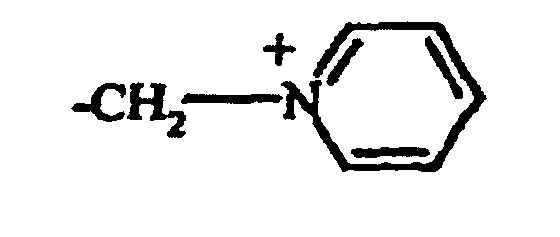
wobei bei allen bei der Definition von Z vorgeschlagenen Resten mit einer Alkylgruppe Alkyl 1 bis 4 Kohlenstoffatome enthält,
steht,R1 und R2 gleich oder verschieden sind und für ein Wasserstoffatom, ein Halogenatom oder einen gegebenenfalls durch einen Dialkylaminorest, worin jeder Alkylteil 1 bis 4 Kohlenstoffatome aufweist oder mit dem Stickstoffatom eines 5- oder 6-gliedrigen gesättigten Heterocyclus bildet, substituierten Alkyl- oder Alkyloxyrest, einen Alkylthiorest, einen Alkyloxycarbonylrest stehen oder auch
zueinander in ortho-Stellung stehen und einen gegebenenfalls ungesättigten Heterocyclus, der 1 oder 2, unter Stickstoff und Sauerstoff ausgewählte Heteroatome enthält und gegebenenfalls durch ein Halogenatom oder einen Alkyl- oder Alkyloxyrest substituiert ist, bilden
wobei bei allen bei der Definition von R1 und R2 vorgeschlagenen Resten mit einer Alkylgruppe Alkyl 1 bis 4 Kohlenstoffatome enthält,R5 für ein Wasserstoffatom oder einen Alkyloder Alkylthiorest steht, wobei bei der Definition von R5 Alkyl 1 bis 4 Kohlenstoffatome enthält,X für ein Sauerstoff- oder Schwefelatom oder eine -NH-Gruppe, -CO-Gruppe, Methylengruppe, Alken-1,1-diylgruppe, wie Vinyldiyl, oder Cycloalkan-1,1-diylgruppe mit 3 bis 6 Kohlenstoffatomen steht,
Y für ein Sauerstoff- oder Schwefelatom steht,
und Salzen des Produkts der allgemeinen Formel (I),
dadurch gekennzeichnet, daß man von dem Produkt der allgemeinen Formel (X') in Form eines optischen Isomers:das aus einem Produkt der allgemeinen Formel (X) in racemischer Form: durch Einwirkung eines Enzyms erhalten wird, ausgeht und dann
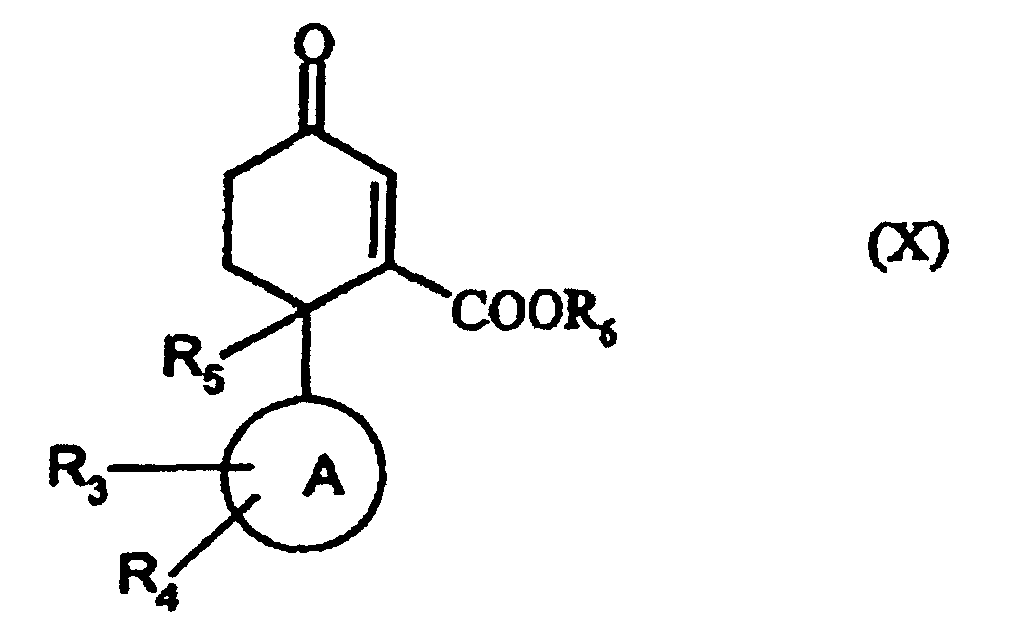
das Produkt der allgemeinen Formel (X') in Form von optischen Isomeren durch Umsetzung mit einem N-Trialkylsilylmethyl-N-alkoxymethylamin mit einer Schutzgruppe für die Aminfunktion in das Produkt der allgemeinen Formel (IX):in Form von optischen Isomeren überführt, wobei A, R3, R4, R5 und R6 die bei der allgemeinen Formel I angegebene Bedeutung besitzen und G1 für eine Schutzgruppe für die Aminfunktion steht,
wobei man das Produkt der allgemeinen Formel (IX) danach durch:in das Produkt der allgemeinen Formel (I) umwandelt.1. Cyclisierung des Cycloperhydroisoindolkerns unter Bildung der Verbindungen der allgemeinen Formel (III)in Form von optischen Isomeren,
wobei:über die Bildung eines Zwischenprodukts der allgemeinen Formel (XV)A, Ar, R, R3, R4 und R5 die bei der allgemeinen Formel I angegebene Bedeutung besitzen undG1 für ein Wasserstoffatom steht,in Form von optischen Isomeren, vorzugsweise des linksdrehenden Isomers, wobei A, R3, R4, R5, R6, Ar und G1 die bei Verbindung (IX) angegebene Bedeutung besitzen,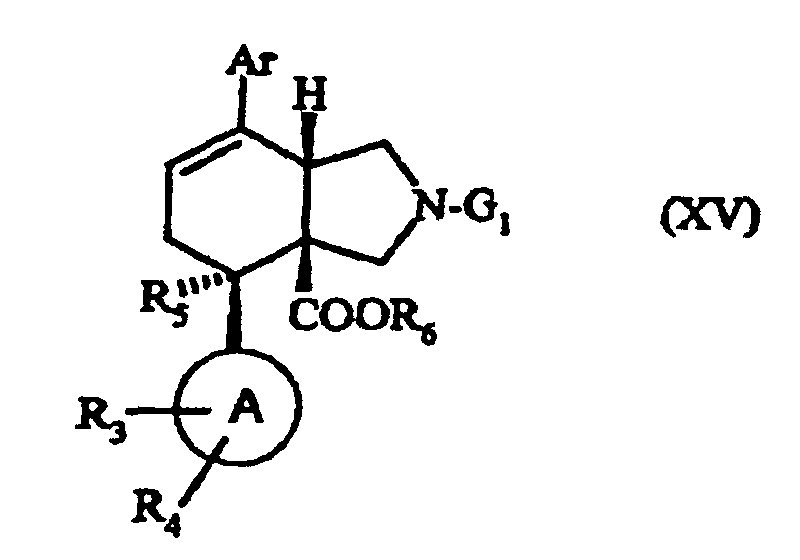
anschließende unterschiedslose Kupplung mit der Seitenkette und gegebenenfalls Modifizierung des Substituenten R zur Bildung der Produkte der allgemeinen Formel (I), oder2. durch Kupplung der Seitenkette zur Bildung des Produkts der allgemeinen Formel (VIII):in Form von optischen Isomeren, wobei A, R1, R2, R3, R4, R5, R6, X und Y die oben angegebene Bedeutung besitzen,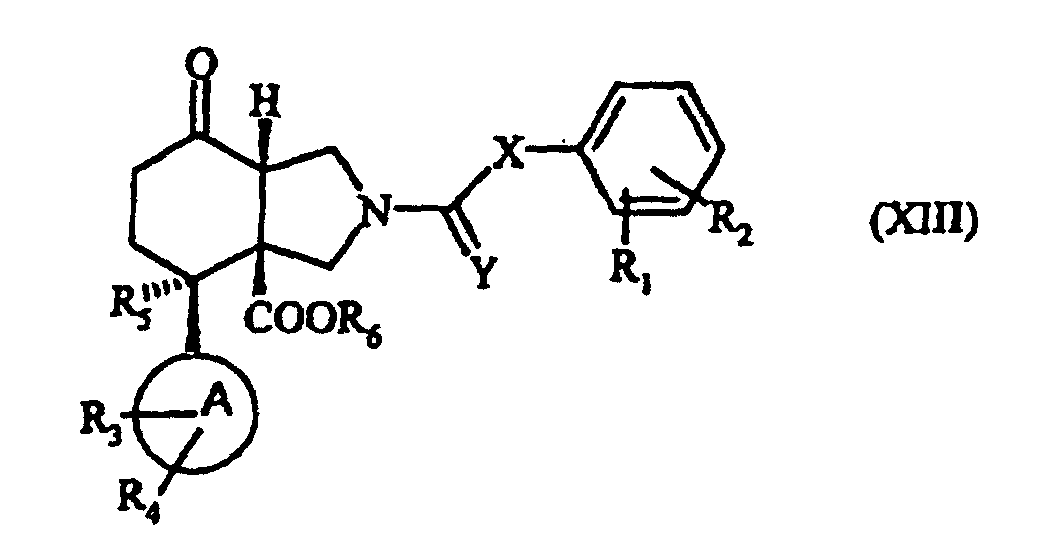
anschließende unterschiedslose Cyclisierung des Cycloperhydroisoindolkerns und gegebenenfalls Modifizierung des Substituenten R zur Bildung der Produkte der allgemeinen Formel (I) in Form von optischen Isomeren - Verfahren zur Herstellung von Verbindungen der allgemeinen Formel (I) nach Anspruch 1, bei dem in der allgemeinen Formel (I):in Form ihrer optischen Isomere und ihrer Salze.Aund R3 und R4 für ein Wasserstoffatom stehen,entweder für einen mit dem Isoindolring anellierten Phenylrestoder einen Thienyl- oder Indolylrest stehtAr für einen 2,3-Dihydro-1,4-benzodioxin-6-yl-, 2,3-Dihydrobenzofuran-5-yl- oder Benzothien-2-ylrest oder einen Phenylrest, der gegebenenfalls in 4-Stellung substituiert ist, vorzugsweise durch einen Methyl-, Trifluormethyl- oder Methoxyrest oder ein Chlor- oder Bromatom, oder in 2,4-Stellung durch ein Chloratom substituiert ist, steht,R für einen Carboxylrest, einen Rest -COOMe oder auch einen Rest -CON(R7)(R8), worin R8 für einen durch einen 3-Pyridylrest substituierten Methylrest steht, wenn R7 für Wasserstoff steht,eines der Symbole R1 oder R2 für ein Wasserstoffatom steht und das andere der Symbole für einen Methoxyrest steht und besonders vorteilhaft in ortho-Stellung des Phenylrings gebunden ist,R5 für ein Wasserstoffatom oder einen Methylrest steht,X für eine Methylen- oder Vinyldiylgruppe steht undY für ein Sauerstoffatom steht,
- Verfahren zur Herstellung von Verbindungen der allgemeinen Formel (I) nach einem der vorhergehenden Ansprüche, dadurch gekennzeichnet, daß man die Produkte der allgemeinen Formel (I) einzeln unter:in Form ihrer optischen Isomere und ihrer Salze auswählt.(3aRS,4SR,9SR,9aRS)-4,9-Ethano-2-[2-(2-methoxyphenyl)propenoyl]-9-(4-methylphenyl)-2,3,3a,4,9,9a-hexahydro-1H-benzo[f]isoindol-3acarbonsäuremethylester(3aRS,4SR,9SR,9aRS)-4,9-Ethano-2-[(2-methoxyphenyl)propenoyl]-9-(4-methylphenyl)-2,3,3a,4,9,9a-hexahydro-1H-benzo[f]isoindol-3acarbonsäure(3aRS,4SR,9SR,9aRS)-4,9-Ethano-2-[(2-methoxyphenyl)acetyl]-9-(4-methylphenyl)-2,3,3a,4,9,9ahexahydro-1H-benzo[f]isoindol-3a-carbonsäure(3aRS,4SR,9SR,9aRS)-4,9-Ethano-9-(4-methoxyphenyl)-2-[(2-methoxyphenyl)acetyl]-2,3,3a,4,9,9ahexahydro-1H-benzo[f]isoindol-3a-carbonsäure(3aRS,4SR,9SR,9aRS)-4,9-Ethano-2-[(2-methoxyphenyl)acetyl]-9-(4-methylsulfanylphenyl)-2,3,3a,4,9,9a-hexahydro-1H-benzo[f]isoindol-3acarbonsäure(3aRS,4SR,9SR,9aRS)-4,9-Ethano-9-(4-fluorphenyl)-2-[(2-methoxyphenyl)acetyl]-2,3,3a,4,9,9a-hexahydro-1H-benzo[f]isoindol-3a-carbonsäure(3aRS,4SR,9SR,9aRS)-4,9-Ethano-2-[(2-methoxyphenyl)acetyl]-9-(3-methylphenyl)-2,3,3a,4,9,9ahexahydro-1H-benzo[f]isoindol-3a-carbonsäure(3aRS,4SR,9SR,9aRS)-4,9-Ethano-9-(3-methoxyphenyl)-2-[(2-methoxyphenyl)acetyl]-2,3,3a,4,9,9ahexahydro-1H-benzo[f]isoindol-3a-carbonsäure(3aRS,4SR,9SR,9aRS)-9-(3,4-Dimethylphenyl)-4,9-ethano-2-[(2-methoxyphenyl)acetyl]-2,3,3a,4,9,9ahexahydro-1H-benzo[f]isoindol-3a-carbonsäuremethylester(3aRS,4SR,9SR,9aRS)-9-(3,4-Dimethylphenyl)-4,9-ethano-2-[(2-methoxyphenyl)acetyl]-2,3,3a,4,9,9ahexahydro-1H-benzo[f]isoindol-3a-carbonsäure(3aRS,4SR,9SR,9aRS)-3a-N-Benzylcarbamoyl-4,9-ethano-2-[2-(2-methoxyphenyl)propenoyl]-9-(4-methylphenyl)-2,3,3a,4,9,9a-hexahydro-1H-benzo[f]-isoindol(3aRS,4SR,9SR,9aRS)-3a-Carbamoyl-4,9-ethano-2-[2-(2-methoxyphenyl)propenoyl]-9-(4-methylphenyl)-2,3,3a,4,9,9a-hexahydro-1H-benzo[f]isoindol(3aRS,4SR,9SR,9aRS)-4,9-Ethano-2-[2-(2-methoxyphenyl)propenoyl]-9-(4-methylphenyl)-2,3,3a,4,9,9a-hexahydro-1H-benzo[f]isoindol-3ahydroxamsäurebenzylester(3aRS,4SR,9SR,9aRS)-4,9-Ethano-2-[2-(2-methoxyphenyl)propenoyl]-9-(4-methylphenyl)-3,3a,4,9,9ahexahydro-1H-benzo[f]isoindol-3a-hydroxamsäure(3aRS,4SR,9SR,9aRS)-4,9-Ethano-2-[2-(2-methoxyphenyl)propenoyl]-9-(4-methylphenyl)-2,3,3a,4,9,9a-hexahydro-1H-benzo[f]isoindol-3a-N-(3-pyridylmethyl)carboxamid(3aRS,4SR,9SR,9aRS)-4,9-Ethano-2-[2-(2-methoxyphenyl)propenoyl]-9-(4-methylphenyl)-2,3,3a,4,9,9a-hexahydro-1H-benzo[f]isoindol-3a-N-(4-pyridylmethyl)carboxamid(3aRS,4SR,9SR,9aRS)-4,9-Ethano-2-[2-(2-methoxyphenyl)propenoyl]-9-(4-methylphenyl)-2,3,3a,4,9,9a-hexahydro-1H-benzo[f]isoindol-3ahydroxamsäuremethylester(3aRS,4SR,9SR,9aRS)-4,9-Ethano-2-[2-(2-methoxyphenyl)propenoyl]-9-(4-methylphenyl)-2,3,3a,4,9,9a-hexahydro-1H-benzo[f]isoindol-3a-N',N'-dimethylcarbohydrazid(3aRS,4SR,9SR,9aRS)-4,9-Ethano-2-[2-(2-methoxyphenyl)propenoyl]-9-(4-methylphenyl)-2,3,3a,4,9,9a-hexahydro-1H-benzo[f]isoindol-3a-N'phenylcarbohydrazid(3aRS,4SR,9SR,9aRS)-4,9-Ethano-2-[2-(2-methoxyphenyl)propenoyl]-9-(4-methylphenyl)-2,3,3a,4,9,9a-hexahydro-1H-benzo[f]isoindol-3a-N',N'-pentamethylencarbohydrazid(3aRS,4SR,9SR,9aRS)-4,9-Ethano-2-[2-(methoxyphenyl)propenoyl]-9-(4-methylphenyl)-3a-phenylsulfonylaminocarbonyl-2,3,3a,4,9,9a-hexahydro-1Hbenzo[f]isoindol(3aRS,4SR,9SR,9aRS)-4,9-Ethano-2-[2-(2-methoxyphenyl)propenoyl]-9-(4-methylphenyl)-2,3,3a,4,9,9a-hexahydro-1H-benzo[f]isoindol-3a-N-(N-oxo-3pyridyl)methylcarboxamid(3aRS,4SR,9SR,9aRS)-4,9-Ethano-2-[2-(2-methoxyphenyl)propenoyl]-9-(4-methylphenyl)-2,3,3a,4,9,9a-hexahydro-1H-benzo[f]isoindol-3a-N'-(4-methoxyphenyl)carbohydrazid(3aRS,4SR,9SR,9aRS)-4,9-Ethano-2-[2-(2-methoxyphenyl)propenoyl]-9-(4-methylphenyl)-2,3,3a,4,9,9a-hexahydro-1H-benzo[f]isoindol-3a-N'methyl-N'-phenylcarbohydrazid(3aRS,4SR,9SR,9aRS)-4,9-Ethano-2-[2-(2-methoxyphenyl)propenoyl]-9-(4-methylphenyl)-2,3,3a,4,9,9a-hexahydro-1H-benzo[f]isoindol-3a-N'-(2-methylphenyl)carbohydrazid(3aRS,4SR,9SR,9aRS)-9-(2,3-Dihydro-1,4-benzodioxin-6-yl)-4,9-ethano-2-[2-(2-methoxyphenyl)-propenoyl]-2,3,3a,4,9,9a-hexahydro-1H-benzo[f]-isoindol-3a-carbonsäuremethylester(3aRS,4SR,9SR,9aRS)-9-(2,3-Dihydro-1,4-benzodioxin-6-yl)-4,9-ethano-2-[2-(2-methoxyphenyl)-propenoyl]-2,3,3a,4,9,9a-hexahydro-1H-benzo[f]-isoindol-3a-carbonsäure(3aRS,4SR,9SR,9aRS)-9-(2,3-Dihydro-1,4-benzodioxin-6-yl)-4,9-ethano-2-[2-(2-methoxyphenyl)-propenoyl)]-2,3,3a,4,9,9a-hexahydro-1H-benzo[f]-isoindol-3a-[N-(3-pyridylmethyl)carboxamid(3aRS,4SR,9SR,9aRS)-9-(2,3-Dihydro-1,4-benzodioxin-6-yl)-4,9-ethano-2-[2-(2-methoxyphenyl)-propenoyl)]-2,3,3a,4,9,9a-hexahydro-1H-benzo[f]-isoindol-3a-N-(2-thienylmethyl)carboxamid(3aRS,4SR,9SR,9aRS)-4,9-Ethano-2-[(2-methoxyphenyl)acetyl]-9-(3,4,5-trimethylphenyl)-2,3,3a,4,9,9a-hexahydro-1H-benzo[f]isoindol-3acarbonsäure(3aRS,4SR,9SR,9aRS)-4,9-Ethano-2-[2-(2-methoxyphenyl)propenoyl]-9-(2-methylphenyl)-2,3,3a,4,9,9a-hexahydro-1H-benzo[f]isoindol-3acarbonsäure(3aRS,4SR,9SR,9aRS)-4,9-Ethano-2-[2-(2-methoxyphenyl)propenoyl]-9-(4-trifluormethylphenyl)-2,3,3a,4,9,9a-hexahydro-1H-benzo[f]isoindol-3acarbonsäuremethylester(3aRS,4SR,9SR,9aRS)-4,9-Ethano-2-[2-(2-methoxyphenyl)propenoyl]-9-(4-trifluormethylphenyl)-2,3,3a,4,9,9a-hexahydro-1H-benzo[f]isoindol-3acarbonsäure(3aRS,4SR,9SR,9aRS)-4,9-Ethano-2-[2-(2-methoxyphenyl)propenoyl]-9-(4-trifluormethylphenyl)-2,3,3a,4,9,9a-hexahydro-1H-benzo[f]isoindol-3a-N-(4-pyridylmethyl)carboxamid(3aRS,4SR,9SR,9aRS)-4,9-Ethano-2-[2-(2-methoxyphenyl)propenoyl]-9-(4-trifluormethylphenyl)-2,3,3a,4,9,9a-hexahydro-1H-benzo[f]isoindol-3a-N'benzoylcarbohydrazid(3aRS,4SR,9SR,9aRS)-4,9-Ethano-2-[2-(2-methoxyphenyl)propenoyl]-9-(4-trifluormethylphenyl)-2,3,3a,4,9,9a-hexahydro-1H-benzo[f]isoindol-3a-N'phenylcarbohydrazid(3aRS,4SR,9SR,9aRS)-4,9-Ethano-2-[2-(2-methoxyphenyl)propenoyl]-9-(2-naphthyl)-2,3,3a,4,9,9ahexahydro-1H-benzo[f]isoindol-3a-carbonsäuremethylester(3aRS,4SR,9SR,9aRS)-4,9-Ethano-2-[2-(2-methoxyphenyl)propenoyl]-9-(2-naphthyl)-2,3,3a,4,9,9ahexahydro-1H-benzo[f]isoindol-3a-carbonsäure(3aRS,4SR,9SR,9aRS)-4,9-Ethano-2-[2-(2-methoxyphenyl)propenoyl]-9-(5-methyl-2-thienyl)-2,3,3a,4,9,9a-hexahydro-1H-benzo[f]isoindol-3acarbonsäuremethylester(3aRS,4SR,9SR,9aRS)-4,9-Ethano-2-[2-(2-methoxyphenyl)propenoyl]-9-(5-methyl-2-thienyl)-2,3,3a,4,9,9a-hexahydro-1H-benzo[f]isoindol-3acarbonsäure(3aRS,4SR,9SR,9aRS)-9-(4-Bromphenyl)-4,9-ethano-2-[2-(2-methoxyphenyl)propenoyl]-2,3,3a,4,9,9a-hexahydro-1H-benzo[f]isoindol-3a-carbonsäuremethylester(3aRS,4SR,9SR,9aRS)-9-(4-Bromphenyl)-4,9-ethano-2-[2-(2-methoxyphenyl)propenoyl]-2,3,3a,4,9,9a-hexahydro-1H-benzo[f]isoindol-3a-carbonsäure(3aRS,4SR,9SR,9aRS)-9-(3,4-Dichlorphenyl)-4,9-ethano-2-[2-(2-methoxyphenyl)propenoyl]-2,3,3a,4,9,9a-hexahydro-1H-benzo[f]isoindol-3acarbonsäure(3aRS,4SR,9SR,9aRS)-4,9-Ethano-2-[2-(2-methoxyphenyl)propenoyl]-9-(4-chlorphenyl)-2,3,3a,4,9,9ahexahydro-2H-benzo[f]isoindol-3a-carbonsäuremethylester(3aRS,4SR,9SR,9aRS)-9-(4-Chlorphenyl)-4,9-ethano-2-[2-(2-methoxyphenyl)propenoyl]-2,3,3a,4,9,9ahexahydro-1H-benzo[f]isoindol-3a-carbonsäure(3aRS,4SR,9SR,9aRS)-4,9-Ethano-2-[2-(2-methoxyphenyl)propenoyl]-9-(4-methoxy-3-methylphenyl)-2,3,3a,4,9,9a-hexahydro-1H-benzo[f]isoindol-3acarbonsäure(3aRS,4SR,9SR,9aRS)-4,9-Ethano-2-[2-(2-methoxyphenyl)propenoyl)-9-(3-indolyl)-2,3,3a,4,9,9ahexahydro-1H-benzo[f]isoindol-3a-carbonsäuremethylester(3aRS,4SR,9SR,9aRS)-4,9-Ethano-9-(4-isopropylphenyl)-2-[(2-methoxyphenyl)acetyl]-2,3,3a,4,9,9ahexahydro-1H-benzo[f]isoindol-3a-carbonsäure(3aRS,4SR,9SR,9aRS)-4,9-Ethano-9-(4-isopropylphenyl)-2-[2-(2-methoxyphenyl)propenoyl]-2,3,3a,4,9,9a-hexahydro-1H-benzo[f]isoindol-3acarbonsäure(3aRS,4SR,9SR,9aRS)-4,9-Ethano-2-[2-(2-methoxyphenyl)propenoyl]-9-(3-thienyl)-2,3,3a,4,9,9ahexahydro-1H-benzo[f]isoindol-3a-carbonsäuremethylester(3aRS,4SR,9SR,9aRS)-4,9-Ethano-9-(4-ethylphenyl)-2-[2-(2-methoxyphenyl)propenoyl]-2,3,3a,4,9,9ahexahydro-1H-benzo[f]isoindol-3a-carbonsäuremethylester(3aRS,4SR,9SR,9aRS)-4,9-Ethano-9-(4-ethylphenyl)-2-[2-(2-methoxyphenyl)propenoyl]-2,3,3a,4,9,9ahexahydro-1H-benzo[f]isoindol-3a-carbonsäure(3aRS,4SR,9SR,9aRS)-9-(2,3-Dihydrobenzofuran-5-yl)-4,9-ethano-2-[2-(2-methoxyphenyl)propenoyl]-2,3,3a,4,9,9a-hexahydro-1H-benzo[f]isoindol-3acarbonsäuremethylester(3aRS,4SR,9SR,9aRS)-9-(2,3-Dihydrobenzofuran-5-yl)-4,9-ethano-2-[2-(2-methoxyphenyl)propenoyl]-2,3,3a,4,9,9a-hexahydro-1H-benzo[f]isoindol-3acarbonsäure(3aRS,4SR,9SR,9aRS)-9-(2,3-Dihydrobenzofuran-5-yl)-4,9-ethano-2-[2-(2-methoxyphenyl)propenoyl)]-2,3,3a,4,9,9a-hexahydro-1H-benzo[f]isoindol-3a-N-(3-pyridylmethyl)carboxamid(3aRS,4SR,9SR,9aRS)-4,9-Ethano-9-(4-fluorphenyl)-2-[2-(2-methoxyphenyl)propenoyl]-2,3,3a,4,9,9ahexahydro-1H-benzo[f]isoindol-3a-carbonsäuremethylester(3aRS,4SR,9SR,9aRS)-4,9-Ethano-9-(4-fluorphenyl)-2-[2-(2-methoxyphenyl)propenoyl]-2,3,3a,4,9,9ahexahydro-1H-benzo[f]isoindol-3a-carbonsäure(3aRS,4SR,9SR,9aRS)-9-(4-Chlor-3-fluorphenyl)-4,9-ethano-2-[2-(2-methoxyphenyl)propenoyl]-2,3,3a,4,9,9a-hexahydro-1H-benzo[f]isoindol-3acarbonsäuremethylester(3aRS,4SR,9SR,9aRS)-9-(4-Chlor-3-fluorphenyl)-4,9-ethano-2-[2-(2-methoxyphenyl)propenoyl]-2,3,3a,4,9,9a-hexahydro-1H-benzo[f]isoindol-3acarbonsäure(3aRS,4SR,9SR,9aRS)-4,9-Ethano-2-[2-(2-methoxyphenyl)propenoyl]-9-(3-methylphenyl)-2,3,3a,4,9,9a-hexahydro-1H-benzo[f]isoindol-3acarbonsäuremethylester(3aRS,4SR,9SR,9aRS)-4,9-Ethano-2-[2-(2-methoxyphenyl)propenoyl]-9-(3-methylphenyl)-2,3,3a,4,9,9a-hexahydro-1H-benzo[f]isoindol-3acarbonsäure(3aRS,4SR,9SR,9aRS)-9-(1,3-Benzodioxol-5-yl)-4,9-ethano-2-[2-(2-methoxyphenyl)propenoyl]-2,3,3a,4,9,9a-hexahydro-1H-benzo[f]isoindol-3acarbonsäuremethylester(3aRS,4SR,9SR,9aRS)-9-(3,4-Dimethylphenyl)-4,9-ethano-2[2-(2-methoxyphenyl)propenoyl]-2,3,3a,4,9,9a-hexahydro-1H-benzo[f]isoindol-3acarbonsäuremethylester(3aRS,4SR,9SR,9aRS)-9-(3,4-Dimethylphenyl)-4,9-ethano-2[2-(2-methoxyphenyl)propenoyl]-2,3,3a,4,9,9a-hexahydro-1H-benzo[f]isoindol-3acarbonsäure(3aRS,4SR,9SR,9aRS)-4,9-Ethano-9-(4-methoxyphenyl)-2-[2-(2-methoxyphenyl)propenoyl]-2,3,3a,4,9,9a-hexahydro-1H-benzo[f]isoindol-3acarbonsäuremethylester(3aRS,4SR,9SR,9aRS)-4,9-Ethano-9-(4-methoxyphenyl)-2-[2-(2-methoxyphenyl)propenoyl]-2,3,3a,4,9,9a-hexahydro-1H-benzo[f]isoindol-3acarbonsäure(3aRS,4SR,9SR,9aRS)-4,9-Ethano-9-(4-methoxyphenyl)-2-[2-(2-methoxyphenyl)propenoyl]-2,3,3a,4,9,9a-hexahydro-1H-benzo[f]isoindol-3a-N-(3-pyridylmethyl)carboxamid(3aRS,4SR,9SR,9aRS)-4,9-Ethano-9-(4-methoxyphenyl)-2-[2-(2-methoxyphenyl)propenoyl]-2,3,3a,4,9,9a-hexahydro-1H-benzo[f]isoindol-3a-N'phenylcarbohydrazid(3aRS,4SR,9SR,9aRS)-4,9-Ethano-9-(4-methoxyphenyl)-2-[2-(2-methoxyphenyl)propenoyl]-2,3,3a,4,9,9a-hexahydro-1H-benzo[f]isoindol-3ahydroxamsäure(3aRS,4SR,9SR,9aRS)-4,9-Ethano-9-(4-methoxyphenyl)-2-[2-(2-methoxyphenyl)propenoyl]-2,3,3a,4,9,9a-hexahydro-1H-benzo[f]isoindol-3a-N'-(3-pyridyl)carbohydrazid(3aRS,4SR,9SR,9aRS)-4,9-Ethano-9-(4-methoxyphenyl)-2-[2-(2-methoxyphenyl)propenoyl]-2,3,3a,4,9,9a-hexahydro-1H-benzo[f]isoindol-3a-N-(3-thienylmethyl)carboxamid(RS)- und (SR)-2-{(3aRS,4SR,9SR,9aRS)-4,9-Ethano-9-(4-methoxyphenyl)-2-[2-(2-methoxyphenyl)-propenoyl]-2,3,3a,4,9,9a-hexahydro-1H-benzo[f]-isoindol-3a-carbonylamino}phenylessigsäure(3aRS,4SR,9SR,9aRS)-4,9-Ethano-2-[2-(2-methoxyphenyl)propenoyl]-9-(4-trifluormethoxyphenyl)-2,3,3a,4,9,9,9a-hexahydro-1H-benzo[f]isoindol-3acarbonsäure(3aRS,4SR,9SR,9aRS)-9-(3-Bromphenyl)-4,9-ethano-2-[2-(2-methoxyphenyl)propenoyl]-2,3,3a,4,9,9ahexahydro-1H-benzo[f]isoindol-3a-carbonsäuremethylester(3aRS,4SR,9SR,9aRS)-9-(3-Bromphenyl)-4,9-ethano-2-[2-(2-methoxyphenyl)propenoyl]-2,3,3a,4,9,9ahexahydro-1H-benzo[f]isoindol-3a-carbonsäure(3aRS,4SR,9SR,9aRS)-4,9-Ethano-9-(3-fluorphenyl-2-[2-(2-methoxyphenyl)propenoyl]-2,3,3a,4,9,9ahexahydro-1H-benzo[f]isoindol-3a-carbonsäuremethylester(3aRS,4SR,9SR,9aRS)-4,9-Ethano-9-(3-fluorphenyl)-2-[2-(2-methoxyphenyl)propenoyl])-2,3,3a,4,9,9ahexahydro-1H-benzo[f]isoindol-3a-carbonsäure(3aRS,4SR,9SR,9aRS)-4,9-Ethano-9-(3-fluorphenyl)-2-[2-(2-methoxyphenyl)propenoyl)]-2,3,3a,4,9,9ahexahydro-1H-benzo[f]isoindol-3a-[N-(3-pyridylmethyl)carboxamid(3aRS,4SR,9SR,9aRS)-9-(3-Chlorphenyl)-4,9-ethano-2-[2-(2-methoxyphenyl)propenoyl]-2,3,3a,4,9,9ahexahydro-1H-benzo[f]isoindol-3a-carbonsäuremethylester(3aRS,4SR,9SR,9aRS)-9-(3-Chlorphenyl)-4,9-ethano-2-[2-(2-methoxyphenyl)propenoyl]-2,3,3a,4,9,9ahexahydro-1H-benzo[f]isoindol-3a-carbonsäure(3aRS,4SR,9SR,9aRS)-9-(3-Chlorphenyl)-4,9-ethano-2-[2-(2-methoxyphenyl)propenoyl)]-2,3,3a,4,9,9ahexahydro-1H-benzo[f]isoindol-3a-[N-(3-pyridylmethyl)carboxamid(3aRS,4SR,9SR,9aRS)-9-(3-N,N-Dimethylaminophenyl)-4,9-ethano-2-[2-(2-methoxyphenyl)propenoyl]-2,3,3a,4,9,9,9a-hexahydro-1H-benzo[f]isoindol-3acarbonsäuremethylester(3aRS,4SR,9SR,9aRS)-9-(3-N,N-Dimethylaminophenyl)-4,9-ethano-2-[2-(2-methoxyphenyl)propenoyl]-2,3,3a,4,9,9,9a-hexahydro-1H-benzo[f]isoindol-3acarbonsäure(3aRS,4SR,9SR,9aRS)-9-(3-Aminophenyl)-4,9-ethano-2-[2-(2-methoxyphenyl)propenoyl]-2,3,3a,4,9,9,9ahexahydro-1H-benzo[f]isoindol-3a-carbonsäuremethylester-hydrochlorid(3aRS,4SR,9SR,9aRS)-9-(4-N,N-Dimethylaminophenyl)-4,9-ethano-2-[2-(2-methoxyphenyl)propenoyl]-2,3,3a,4,9,9,9a-hexahydro-1H-benzo[f]isoindol-3acarbonsäuremethylester(3aRS,4SR,9SR,9aRS)-9-(4-Cyanophenyl)-4,9-ethano-2-[2-(2-methoxyphenyl)propenoyl]-2,3,3a,4,9,9,9ahexahydro-1H-benzo[f]isoindol-3a-carbonsäure(3aRS,4SR,9SR,9aRS)-9-(3-Cyanophenyl)-4,9-ethano-2-[2-(2-methoxyphenyl)propenoyl]-2,3,3a,4,9,9,9ahexahydro-1H-benzo[f]isoindol-3acarbonsäuremethylester(3aRS,4SR,9SR,9aRS)-4,9-Ethano-9-(3-hydroxy-4-methoxyphenyl)-2-[2-(2-methoxyphenyl)propenoyl]-2,3,3a,4,9,9a-hexahydro-1H-benzo[f]isoindol-3acarbonsäure(3aRS,4SR,9SR,9aRS)-4,9-Ethano-5-methoxy-2-[2-(2-methoxyphenyl)propenoyl]-9-(4-methylphenyl)-2,3,3a,4,9,9a-hexahydro-1H-benzo[f]isoindol-3acarbonsäuremethylester(3aRS,4SR,9SR,9aRS)-4,9-Ethano-5-methoxy-2-[2-(2-methoxyphenyl)propenoyl]-9-(4-methylphenyl)-2,3,3a,4,9,9a-hexahydro-1H-benzo[f]isoindol-3acarbonsäure(3aRS,4SR,9SR,9aRS)-4,9-Ethano-2[2-(2-methoxyphenyl)propenoyl]-4-methyl-9-(4-methoxyphenyl)-2,3,3a,4,9,9a-hexahydro-1H-benzo[f]isoindol-3acarbonsäure(3aRS,4SR,9SR,9aRS)-9-(Benzothien-2-yl)-4,9-ethano-2-[2-(2-methoxyphenyl)propenoyl)]-2,3,3a,4,9,9a-hexahydro-1H-benzo[f]isoindol-3acarbonsäure(3aRS,4SR,9SR,9aRS)-9-(2,4-Dichlorphenyl)-4,9-ethano-2-[2-(2-methoxyphenyl)propenoyl)]-2,3,3a,4,9,9a-hexahydro-1H-benzo[f]isoindol-3acarbonsäure(3aRS,4SR,8SR,8aRS)-4,8-Ethano-2-[2-(2-methoxyphenyl)propenoyl]-8-phenyl-2,3,3a,4,8,8ahexahydro-1H-thieno[2,3-f]isoindol-3a-carbonsäure(3aRS,4SR,8SR,8aRS)-4,8-Ethano-2-[2-(2-methoxyphenyl)propenoyl]-8-(4-methylphenyl)-2,3,3a,4,8,8a-hexahydro-1H-thieno[2,3-f]isoindol-3a-carbonsäure(3aRS,4SR,8SR,8aRS)-4,8-Ethano-2-[2-(2-methoxyphenyl)propenoyl]-8-(4-trifluormethylphenyl)-2,3,3a,4,8,8a-hexahydro-1H-thieno[2,3-f]isoindol-3a-carbonsäure(3aRS,4SR,8SR,8aRS)-N-Benzyl-4,8-ethano-2-[2-(2-methoxyphenyl)propenoyl]-8-(4-trifluormethylphenyl)-2,3,3a,4,8,8a-hexahydro-1H-thieno[2,3-f]-isoindol-3a-carboxamid(3aRS,4SR,10SR,10aRS)-4,9-Ethano-2-[2-(2-methoxyphenyl)propenoyl]-10-(4-methylphenyl)-2,3,3a,4,10,10a-hexahydro-1H-indolo[2,3-f]-isoindol-3a-carbonsäure(3aRS,4SR,8SR,8aRS)-N-(3-Pyridyl)methyl-4,8-ethano-2-[2-(2-methoxyphenyl)propenoyl]-8-(4-methylphenyl)-2,3,3a,4,8,8a-hexahydro-1H-thieno-[2,3-f]isoindol-3a-carboxamid(3aRS,4SR,8SR,8aRS)-4,8-Ethano-8-(4-methoxyphenyl)-2-[2-(2-methoxyphenyl)propenoyl]-2,3,3a,4,8,8a-hexahydro-1H-thieno[2,3-f]isoindol-3a-carbonsäuremethylester(3aRS,4SR,8SR,8aRS)-4,8-Ethano-8-(4-methoxyphenyl)-2-[2-(2-methoxyphenyl)propenoyl]-2,3,3a,4,8,8a-hexahydro-1H-thieno[2,3-f]isoindol-3a-carbonsäure(3aRS,4SR,8SR,8aRS)-N-(3-Pyridyl)methyl-8-(benzo-1,4-dioxan-6-yl)-4,8-ethano-2-[2-(2-methoxyphenyl)propenoyl]-2,3,3a,4,8,8a-hexahydro-1Hthieno[2,3-f]isoindol-3a-carboxamid
- Verfahren zur Herstellung von Verbindungen der allgemeinen Formel (I) nach einem der vorhergehenden Ansprüche, dadurch gekennzeichnet, daß man die Verbindungen der allgemeinen Formel (I) einzeln unter:in Form ihrer optischen Isomere und ihrer Salze auswählt.(3aRS,4SR,9SR,9aRS)-4,9-Ethano-2-[2-(2-methoxyphenyl)propenoyl]-9-(4-methylphenyl)-2,3,3a,4,9,9a-hexahydro-1H-benzo[f]isoindol-3acarbonsäure(3aRS,4SR,9SR,9aRS)-9-(Benzothien-2-yl)-4,9-ethano-2-[2-(2-methoxyphenyl)propenoyl)]-2,3,3a,4,9,9a-hexahydro-1H-benzo[f]isoindol-3acarbonsäure(3aRS,4SR,9SR,9aRS)-9-(2,4-Dichlorphenyl)-4,9-ethano-2-[2-(2-methoxyphenyl)propenoyl)]-2,3,3a,4,9,9a-hexahydro-1H-benzo[f]isoindol-3acarbonsäure(3aRS,4SR,9SR,9aRS)-9-(3,4-Dichlorphenyl)-4,9-ethano-2-[2-(2-methoxyphenyl)propenoyl]-2,3,3a,4,9,9a-hexahydro-1H-benzo[f]isoindol-3acarbonsäure(3aRS,4SR,9SR,9aRS)-9-(4-Bromphenyl)-4,9-ethano-2-[2-(2-methoxyphenyl)propenoyl]-2,3,3a,4,9,9ahexahydro-1H-benzo[f]isoindol-3a-carbonsäure(3aRS,4SR,9SR,9aRS)-4,9-Ethano-2-[2-(2-methoxyphenyl)propenoyl]-9-(4-chlorphenyl)-2,3,3a,4,9,9a-hexahydro-1H-benzo[f]isoindol-3acarbonsäure(3aRS,4SR,9SR,9aRS)-9-(2,3-Dihydrobenzofuran-5-yl)-4,9-ethano-2-[2-(2-methoxyphenyl)propenoyl]-2,3,3a,4,9,9a-hexahydro-1H-benzo[f]isoindol-3acarbonsäuremethylester(3aRS,4SR,8SR,8aRS)-4,8-Ethano-2-[2-(2-methoxyphenyl)propenoyl]-8-(4-methylphenyl)-2,3,3a,4,8,8a-hexahydro-1H-thieno[2,3-f]isoindol-3a-carbonsäure
- Verfahren zur Herstellung von Verbindungen der allgemeinen Formel (I) nach Anspruch 1, dadurch gekennzeichnet, daß man die Produkte der allgemeinen Formel (I) in Form ihres rechtsdrehenden Enantiomers erhält.
- Verfahren zur Herstellung von Verbindungen der Formel (X') in Form von optischen Isomeren:worin

A, R3, R4, R5 und R6 die in Anspruch 1 angegebene Bedeutung besitzen, dadurch gekennzeichnet, daß man auf Verbindungen der allgemeinen Formel (X) in Form eines racemischen Gemischs:in einem Gemisch aus einem KohlenwasserstoffLösungsmittel und einer wäßrigen Lösung mit einem pH-Wert zwischen 6 und 8 ein unter Lipasen, Esterasen und Proteasen ausgewähltes Enzym einwirken läßt.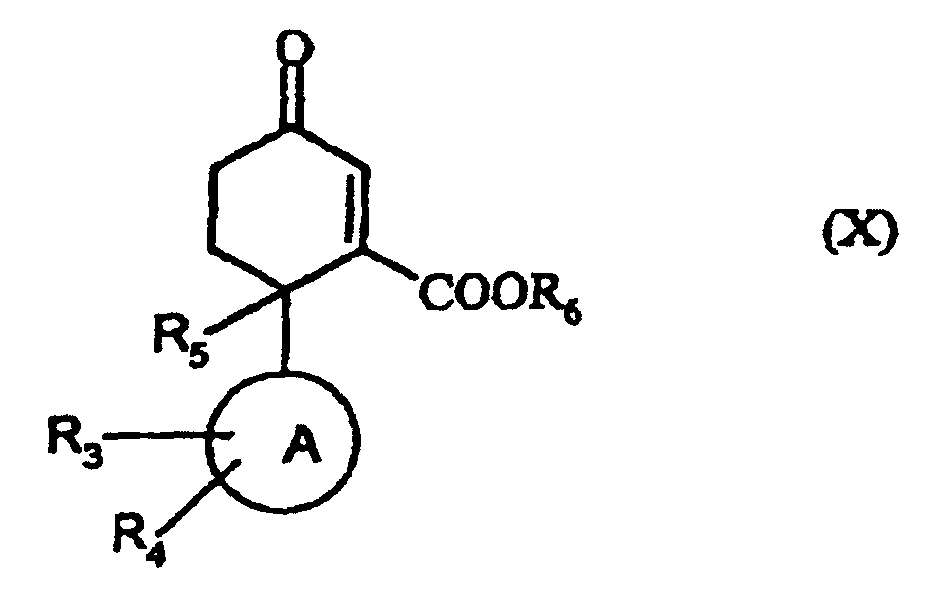
- Verfahren nach Anspruch 6, dadurch gekennzeichnet, daß man das Enzym unter Lipasen und Esterasen auswählt.
- Verfahren nach Anspruch 7, dadurch gekennzeichnet, daß man die Lipasen und Esterasen auswählt unter: EC 3.1.1.3 Candida antartica fraction B (Chirazyme® L2, Roche Diagnostic, früher Boehringer Mannheim), EC 3.1.1.3 Pseudomonas cepacia (Lipase PS-C, Amano Enzymes), EC 3.1.1.1 (ESL 01, Diversa, früher Recombinant Biocatalyst), EC 3.1.1.3 Candida antartica fraction B (SP 525, Novozyme, früher Novo Nordisk), EC 3.1.1.3 Pseudomonas sp. (Chirazyme® L6, Roche Diagnostic, früher Boehringer Mannheim), EC 3.1.1.3 Rhizomucor miehei (Esterase 30000, DSM, früher Gist Brocades).
- Verfahren nach Anspruch 8, dadurch gekennzeichnet, daß es sich bei dem Enzym um EC 3.1.1.3 Candida antartica fraction B (Chirazyme® L2, Roche Diagnostic, früher Boehringer Mannheim) handelt.
- Verfahren nach Anspruch 7, dadurch gekennzeichnet, daß man die Proteasen und Lipasen auswählt unter: EC 3.4.21.80 Streptomyces griseus (Pronase®, Roche Diagnostic, früher Boehringer Mannheim), EC 3.4.21.62 Bacillus licheniformis (Subtilisin, Novozyme, früher Novo Nordisk), EC 3.4.21.62 Bacillus licheniformis (Alcalase 2,4 L, Novozyme, früher Novo Nordisk), EC 3.4.21.14 Bacillus subtilis (Protease Nagarse, Sigma Aldrich), EC 3.4.21.62 Bacillus licheniformis (EH 16, Altus Biologics), EC 3.4.21.62 Bacillus sp. (EH 15, Altus Biologics), EC 3.1.1.3 Candida antartica fraction A (EH 11, Altus Biologics), EC 3.1.1.3 Mucor javanicus (Lipase M, Amano Enzymes).
- Verfahren nach Anspruch 6, dadurch gekennzeichnet, daß es sich bei dem organischen Lösungsmittel um Cyclohexan handelt.
- Verfahren nach Anspruch 6, dadurch gekennzeichnet, daß es sich bei der wäßrigen Lösung um eine Kaliumhydrogenphosphatlösung handelt.
Priority Applications (1)
| Application Number | Priority Date | Filing Date | Title |
|---|---|---|---|
| SI200030554T SI1206452T1 (en) | 1999-07-22 | 2000-07-20 | Novel method for preparing benzoperhydroisoindole compounds |
Applications Claiming Priority (3)
| Application Number | Priority Date | Filing Date | Title |
|---|---|---|---|
| FR9909508 | 1999-07-22 | ||
| FR9909508A FR2796641B1 (fr) | 1999-07-22 | 1999-07-22 | Nouveau procede de preparation de composes benzoperhydroisoindole |
| PCT/FR2000/002082 WO2001007408A2 (fr) | 1999-07-22 | 2000-07-20 | Nouveau procede de preparation de composes benzoperhydroisoindole |
Publications (2)
| Publication Number | Publication Date |
|---|---|
| EP1206452A2 EP1206452A2 (de) | 2002-05-22 |
| EP1206452B1 true EP1206452B1 (de) | 2004-11-03 |
Family
ID=9548392
Family Applications (1)
| Application Number | Title | Priority Date | Filing Date |
|---|---|---|---|
| EP00953267A Expired - Lifetime EP1206452B1 (de) | 1999-07-22 | 2000-07-20 | Verfahren zur herstellung von benzoperhydroisoindolen |
Country Status (14)
| Country | Link |
|---|---|
| US (1) | US6291679B1 (de) |
| EP (1) | EP1206452B1 (de) |
| JP (1) | JP2003505448A (de) |
| AT (1) | ATE281434T1 (de) |
| AU (1) | AU6578400A (de) |
| CA (1) | CA2379859A1 (de) |
| DE (1) | DE60015563T2 (de) |
| DK (1) | DK1206452T3 (de) |
| ES (1) | ES2230139T3 (de) |
| FR (1) | FR2796641B1 (de) |
| IL (1) | IL146811A0 (de) |
| PT (1) | PT1206452E (de) |
| SI (1) | SI1206452T1 (de) |
| WO (1) | WO2001007408A2 (de) |
Families Citing this family (10)
| Publication number | Priority date | Publication date | Assignee | Title |
|---|---|---|---|---|
| US7253283B2 (en) * | 2004-01-16 | 2007-08-07 | Bristol-Myers Squibb Company | Tricyclic modulators of the glucocorticoid receptor, AP-1, and/or NF-κB activity and use thereof |
| US7326728B2 (en) * | 2004-01-16 | 2008-02-05 | Bristol-Myers Squibb Company | Modulators of glucocorticoid receptor, AP-1, and/or NF-κβ activity and use thereof |
| US7605264B2 (en) * | 2004-01-16 | 2009-10-20 | Bristol-Myers Squibb Company | Heterocyclic modulators of the glucocorticoid receptor, AP-1, and/or NF-κB activity and use thereof |
| US7273881B2 (en) * | 2004-01-16 | 2007-09-25 | Bristol-Myers Squibb Company | Modulators of glucocorticoid receptor, AP-1, and/or NF-κB activity and use thereof |
| US7625921B2 (en) * | 2004-01-16 | 2009-12-01 | Bristol-Myers Squibb Company | Modulators of the glucocorticoid receptor, AP-1, and/or NF-κB activity and use thereof |
| US7569689B2 (en) * | 2004-01-16 | 2009-08-04 | Bristol-Myers Squibb Company | Modulators of the glucocorticoid receptor, AP-1, and/or NF-κB activity and use thereof |
| US7642273B2 (en) * | 2005-01-13 | 2010-01-05 | Bristol-Myers Squibb Company | Modulators of the glucocorticoid receptor, AP-1, and/or NF-κB activity and use thereof |
| US7361654B2 (en) | 2005-01-13 | 2008-04-22 | Bristol-Myers Squibb Co. | Substituted heteroaryl amide modulators of glucocorticoid receptor, AP-1, and/or NF-κB activity and use thereof |
| US7317024B2 (en) | 2005-01-13 | 2008-01-08 | Bristol-Myers Squibb Co. | Heterocyclic modulators of the glucocorticoid receptor, AP-1, and/or NF-κB activity and use thereof |
| US7411071B2 (en) * | 2005-01-13 | 2008-08-12 | Bristol-Myers Squibb Company | Modulators of the glucocorticoid receptor, AP-1, and/or NF-κB activity and use thereof |
Family Cites Families (8)
| Publication number | Priority date | Publication date | Assignee | Title |
|---|---|---|---|---|
| DE3922752A1 (de) * | 1989-07-11 | 1991-01-17 | Boehringer Ingelheim Kg | Verfahren zur herstellung von r-(+) -3-oxocycloalkancarbonsaeureniederalkylestern |
| KR100362338B1 (ko) | 1993-11-05 | 2003-04-08 | 워너-램버트 캄파니 | 단백질:파르네실트랜스퍼라아제의치환디-및트리펩티드억제제 |
| FR2736641B1 (fr) | 1995-07-10 | 1997-08-22 | Rhone Poulenc Rorer Sa | Nouveaux inhibiteurs de farnesyl transferase, leur preparation et les compositions pharmaceutiques qui les contiennent |
| US6013662A (en) * | 1996-12-30 | 2000-01-11 | Rhone-Poulenc Rorer S.A. | Farnesyl transferase inhibitors, their preparation, the pharmaceutical compositions which contain them and their use in the preparation of medicaments |
| FR2757855B1 (fr) * | 1996-12-30 | 1999-01-29 | Rhone Poulenc Rorer Sa | Nouveaux inhibiteurs de farnesyl transferase, leur preparation et les compositions pharmaceutiques qui les contiennent |
| US6124465A (en) * | 1997-11-25 | 2000-09-26 | Rhone-Poulenc S.A. | Farnesyl transferase inhibitors, their preparation, the pharmaceutical compositions which contain them and their use in the preparation of medicaments |
| EP1042329A1 (de) * | 1997-12-23 | 2000-10-11 | Aventis Pharma S.A. | Farnesyltransferase inhibitoren, verfahren zu ihrer herstellung, diese enthaltende pharmazeutische zubereitungen und ihre verwendung als arzneimittel |
| FR2772764B1 (fr) | 1997-12-23 | 2000-01-14 | Rhone Poulenc Rorer Sa | Nouveaux inhibiteurs de farnesyle transferase, leur preparation, les compositions pharmaceutiques qui les contiennent et leur utilisation pour la preparation de medicaments |
-
1999
- 1999-07-22 FR FR9909508A patent/FR2796641B1/fr not_active Expired - Fee Related
- 1999-07-26 US US09/360,646 patent/US6291679B1/en not_active Expired - Fee Related
-
2000
- 2000-07-20 ES ES00953267T patent/ES2230139T3/es not_active Expired - Lifetime
- 2000-07-20 WO PCT/FR2000/002082 patent/WO2001007408A2/fr not_active Ceased
- 2000-07-20 AT AT00953267T patent/ATE281434T1/de not_active IP Right Cessation
- 2000-07-20 PT PT00953267T patent/PT1206452E/pt unknown
- 2000-07-20 CA CA002379859A patent/CA2379859A1/fr not_active Abandoned
- 2000-07-20 JP JP2001512495A patent/JP2003505448A/ja not_active Withdrawn
- 2000-07-20 IL IL14681188A patent/IL146811A0/xx unknown
- 2000-07-20 DE DE60015563T patent/DE60015563T2/de not_active Expired - Fee Related
- 2000-07-20 EP EP00953267A patent/EP1206452B1/de not_active Expired - Lifetime
- 2000-07-20 SI SI200030554T patent/SI1206452T1/xx unknown
- 2000-07-20 AU AU65784/00A patent/AU6578400A/en not_active Abandoned
- 2000-07-20 DK DK00953267T patent/DK1206452T3/da active
Also Published As
| Publication number | Publication date |
|---|---|
| SI1206452T1 (en) | 2005-04-30 |
| FR2796641A1 (fr) | 2001-01-26 |
| AU6578400A (en) | 2001-02-13 |
| DK1206452T3 (da) | 2005-03-14 |
| WO2001007408A2 (fr) | 2001-02-01 |
| DE60015563T2 (de) | 2005-12-22 |
| DE60015563D1 (de) | 2004-12-09 |
| EP1206452A2 (de) | 2002-05-22 |
| US6291679B1 (en) | 2001-09-18 |
| IL146811A0 (en) | 2002-07-25 |
| CA2379859A1 (fr) | 2001-02-01 |
| FR2796641B1 (fr) | 2001-09-21 |
| JP2003505448A (ja) | 2003-02-12 |
| PT1206452E (pt) | 2005-02-28 |
| WO2001007408A3 (fr) | 2001-05-17 |
| ES2230139T3 (es) | 2005-05-01 |
| ATE281434T1 (de) | 2004-11-15 |
Similar Documents
| Publication | Publication Date | Title |
|---|---|---|
| EP0711280B1 (de) | Perhydroisoindolderivate als substanz p antagonisten | |
| EP0635003B1 (de) | Perhydroisoindole derivate als substanz p antagonisten | |
| CA2203618C (fr) | Nouveaux inhibiteurs de metalloproteases, leur procede de preparation et les compositions pharmaceutiques qui les contiennent | |
| FR2757855A1 (fr) | Nouveaux inhibiteurs de farnesyl transferase, leur preparation et les compositions pharmaceutiques qui les contiennent | |
| KR20080036060A (ko) | 프레가발린의 중간체의 제조에 효소 분할을 이용하는 방법 | |
| EP0421861A1 (de) | 2-Hydroxythiophen- und Furanderivate kondensiert mit einem stickstoffhaltigen Ring, Verfahren zu ihrer Herstellung und ihre therapeutische Anwendung | |
| EP0580502A1 (de) | 3-(Hydroxybenzylidenyl)-Indolin-2-one und diese enthaltende Arzneimittel | |
| EP1206452A2 (de) | Verfahren zur herstellung von benzoperhydroisoindolen | |
| EP0887350B1 (de) | Chromenderivate, Verfahren zu ihrer Herstellung und diese enthaltende pharmazeutische Zubereitungen | |
| EP0614893B1 (de) | Benzoxazinderivate, deren Herstellung und deren Verwendung in Therapie | |
| EP0452204B1 (de) | 3-Aminochroman-Derivate, Verfahren zu deren Herstellung und diese enthaltende pharmazeutische Zusammensetzungen | |
| EP0828851B1 (de) | Tripeptidylpeptidase-inhibitoren | |
| FR2707085A1 (fr) | Nouveaux dérivés d'alpha amino acides, leur procédé de préparation et les compositions pharmaceutiques qui les contiennent. | |
| EP0967207A1 (de) | Nitronderivate, Verfahren zu deren Herstellung und sie enthaltende pharmazeutische Zusammensetzungen | |
| EP0635002B1 (de) | Neue perhydroisoindolderivate und ihre herstellung | |
| US5698696A (en) | Process for preparing 2,3-dihydro-benzofuranol derivatives | |
| EP0536035A1 (de) | 1,8-Benzonaphthyridinderivate und antimikrobielle Zusammensetzungen | |
| WO2003011833A1 (fr) | Derives des indazoles ou des indoles, leur utilisation en medecine humaine et plus particulierement en cancerologie | |
| KR20150023689A (ko) | β-아미노부티릴 치환된 5,6,7,8-테트라히드로[1,4]디아졸로[4,3-알파]피라진-7-일 화합물의 제조를 위한 신규 합성 경로 | |
| CA2315144A1 (fr) | Nouveaux inhibiteurs de farnesyle transferase, leur preparation, les compositions pharmaceutiques qui les contiennent et leur utilisation pour la preparation de medicaments | |
| JPH10500861A (ja) | キラル化合物とその分割 | |
| KR100451413B1 (ko) | 클루이베로마이시스 마르시아누스의 카르보닐 환원효소를이용한 카르보닐 화합물의 환원반응 | |
| US20050192441A1 (en) | Methods for the preparation of stereoisomerically enriched amines | |
| FR2703679A1 (fr) | Nouveaux dérivés de perhydroisoindole, leur préparation et les compositions pharmaceutiques qui les contiennent. | |
| FR2796640A1 (fr) | Nouveaux inhibiteurs de farnesyle transferase, leur preparation, les compositions pharmaceutiques qui les contiennent et leur utilisation pour la preparation de medicaments |
Legal Events
| Date | Code | Title | Description |
|---|---|---|---|
| PUAI | Public reference made under article 153(3) epc to a published international application that has entered the european phase |
Free format text: ORIGINAL CODE: 0009012 |
|
| 17P | Request for examination filed |
Effective date: 20020222 |
|
| AX | Request for extension of the european patent |
Free format text: AL;LT PAYMENT 20020222;LV PAYMENT 20020222;MK;RO PAYMENT 20020222;SI PAYMENT 20020222 |
|
| 17Q | First examination report despatched |
Effective date: 20020705 |
|
| GRAP | Despatch of communication of intention to grant a patent |
Free format text: ORIGINAL CODE: EPIDOSNIGR1 |
|
| GRAS | Grant fee paid |
Free format text: ORIGINAL CODE: EPIDOSNIGR3 |
|
| GRAA | (expected) grant |
Free format text: ORIGINAL CODE: 0009210 |
|
| AK | Designated contracting states |
Kind code of ref document: B1 Designated state(s): AT BE CH CY DE DK ES FI FR GB GR IE IT LI LU MC NL PT SE |
|
| AX | Request for extension of the european patent |
Extension state: LT LV RO SI |
|
| REG | Reference to a national code |
Ref country code: GB Ref legal event code: FG4D Free format text: NOT ENGLISH |
|
| REG | Reference to a national code |
Ref country code: CH Ref legal event code: EP |
|
| REF | Corresponds to: |
Ref document number: 60015563 Country of ref document: DE Date of ref document: 20041209 Kind code of ref document: P |
|
| REG | Reference to a national code |
Ref country code: IE Ref legal event code: FG4D Free format text: FRENCH |
|
| REG | Reference to a national code |
Ref country code: GR Ref legal event code: EP Ref document number: 20050400196 Country of ref document: GR |
|
| REG | Reference to a national code |
Ref country code: SE Ref legal event code: TRGR |
|
| REG | Reference to a national code |
Ref country code: PT Ref legal event code: SC4A Free format text: AVAILABILITY OF NATIONAL TRANSLATION Effective date: 20041229 |
|
| GBT | Gb: translation of ep patent filed (gb section 77(6)(a)/1977) |
Effective date: 20050211 |
|
| REG | Reference to a national code |
Ref country code: DK Ref legal event code: T3 |
|
| REG | Reference to a national code |
Ref country code: ES Ref legal event code: FG2A Ref document number: 2230139 Country of ref document: ES Kind code of ref document: T3 |
|
| PG25 | Lapsed in a contracting state [announced via postgrant information from national office to epo] |
Ref country code: MC Free format text: LAPSE BECAUSE OF NON-PAYMENT OF DUE FEES Effective date: 20050731 |
|
| REG | Reference to a national code |
Ref country code: CH Ref legal event code: NV Representative=s name: PATENTANWAELTE SCHAAD, BALASS, MENZL & PARTNER AG |
|
| PLBE | No opposition filed within time limit |
Free format text: ORIGINAL CODE: 0009261 |
|
| STAA | Information on the status of an ep patent application or granted ep patent |
Free format text: STATUS: NO OPPOSITION FILED WITHIN TIME LIMIT |
|
| 26N | No opposition filed |
Effective date: 20050804 |
|
| PGFP | Annual fee paid to national office [announced via postgrant information from national office to epo] |
Ref country code: PT Payment date: 20070622 Year of fee payment: 8 |
|
| PGFP | Annual fee paid to national office [announced via postgrant information from national office to epo] |
Ref country code: DE Payment date: 20070712 Year of fee payment: 8 Ref country code: IE Payment date: 20070712 Year of fee payment: 8 |
|
| PGFP | Annual fee paid to national office [announced via postgrant information from national office to epo] |
Ref country code: DK Payment date: 20070718 Year of fee payment: 8 |
|
| PGFP | Annual fee paid to national office [announced via postgrant information from national office to epo] |
Ref country code: LU Payment date: 20070730 Year of fee payment: 8 |
|
| PGFP | Annual fee paid to national office [announced via postgrant information from national office to epo] |
Ref country code: ES Payment date: 20070824 Year of fee payment: 8 |
|
| PGFP | Annual fee paid to national office [announced via postgrant information from national office to epo] |
Ref country code: AT Payment date: 20070711 Year of fee payment: 8 Ref country code: CH Payment date: 20070713 Year of fee payment: 8 Ref country code: CY Payment date: 20070705 Year of fee payment: 8 Ref country code: FI Payment date: 20070712 Year of fee payment: 8 |
|
| PGFP | Annual fee paid to national office [announced via postgrant information from national office to epo] |
Ref country code: GB Payment date: 20070718 Year of fee payment: 8 |
|
| PGFP | Annual fee paid to national office [announced via postgrant information from national office to epo] |
Ref country code: BE Payment date: 20070925 Year of fee payment: 8 Ref country code: IT Payment date: 20070730 Year of fee payment: 8 Ref country code: NL Payment date: 20070703 Year of fee payment: 8 Ref country code: SE Payment date: 20070704 Year of fee payment: 8 |
|
| PGFP | Annual fee paid to national office [announced via postgrant information from national office to epo] |
Ref country code: FR Payment date: 20070710 Year of fee payment: 8 |
|
| PGFP | Annual fee paid to national office [announced via postgrant information from national office to epo] |
Ref country code: GR Payment date: 20070618 Year of fee payment: 8 |
|
| REG | Reference to a national code |
Ref country code: PT Ref legal event code: MM4A Free format text: LAPSE DUE TO NON-PAYMENT OF FEES Effective date: 20090120 |
|
| REG | Reference to a national code |
Ref country code: CH Ref legal event code: PL |
|
| REG | Reference to a national code |
Ref country code: DK Ref legal event code: EBP |
|
| EUG | Se: european patent has lapsed | ||
| GBPC | Gb: european patent ceased through non-payment of renewal fee |
Effective date: 20080720 |
|
| LTLA | Lt: lapse of european patent or patent extension |
Effective date: 20080720 |
|
| NLV4 | Nl: lapsed or anulled due to non-payment of the annual fee |
Effective date: 20090201 |
|
| REG | Reference to a national code |
Ref country code: IE Ref legal event code: MM4A |
|
| PG25 | Lapsed in a contracting state [announced via postgrant information from national office to epo] |
Ref country code: AT Free format text: LAPSE BECAUSE OF NON-PAYMENT OF DUE FEES Effective date: 20080720 Ref country code: DE Free format text: LAPSE BECAUSE OF NON-PAYMENT OF DUE FEES Effective date: 20090203 |
|
| REG | Reference to a national code |
Ref country code: FR Ref legal event code: ST Effective date: 20090331 |
|
| PG25 | Lapsed in a contracting state [announced via postgrant information from national office to epo] |
Ref country code: NL Free format text: LAPSE BECAUSE OF NON-PAYMENT OF DUE FEES Effective date: 20090201 Ref country code: PT Free format text: LAPSE BECAUSE OF NON-PAYMENT OF DUE FEES Effective date: 20090120 Ref country code: FI Free format text: LAPSE BECAUSE OF NON-PAYMENT OF DUE FEES Effective date: 20080720 |
|
| PG25 | Lapsed in a contracting state [announced via postgrant information from national office to epo] |
Ref country code: GR Free format text: LAPSE BECAUSE OF NON-PAYMENT OF DUE FEES Effective date: 20090204 Ref country code: GB Free format text: LAPSE BECAUSE OF NON-PAYMENT OF DUE FEES Effective date: 20080720 Ref country code: CH Free format text: LAPSE BECAUSE OF NON-PAYMENT OF DUE FEES Effective date: 20080731 Ref country code: LI Free format text: LAPSE BECAUSE OF NON-PAYMENT OF DUE FEES Effective date: 20080731 |
|
| REG | Reference to a national code |
Ref country code: SI Ref legal event code: KO00 Effective date: 20090407 |
|
| PG25 | Lapsed in a contracting state [announced via postgrant information from national office to epo] |
Ref country code: DK Free format text: LAPSE BECAUSE OF NON-PAYMENT OF DUE FEES Effective date: 20080731 Ref country code: IE Free format text: LAPSE BECAUSE OF NON-PAYMENT OF DUE FEES Effective date: 20080721 Ref country code: CY Free format text: LAPSE BECAUSE OF NON-PAYMENT OF DUE FEES Effective date: 20080720 |
|
| PG25 | Lapsed in a contracting state [announced via postgrant information from national office to epo] |
Ref country code: IT Free format text: LAPSE BECAUSE OF NON-PAYMENT OF DUE FEES Effective date: 20080720 Ref country code: FR Free format text: LAPSE BECAUSE OF NON-PAYMENT OF DUE FEES Effective date: 20080731 |
|
| REG | Reference to a national code |
Ref country code: ES Ref legal event code: FD2A Effective date: 20080721 |
|
| PG25 | Lapsed in a contracting state [announced via postgrant information from national office to epo] |
Ref country code: ES Free format text: LAPSE BECAUSE OF NON-PAYMENT OF DUE FEES Effective date: 20080721 |
|
| PG25 | Lapsed in a contracting state [announced via postgrant information from national office to epo] |
Ref country code: BE Free format text: LAPSE BECAUSE OF NON-PAYMENT OF DUE FEES Effective date: 20080731 Ref country code: LU Free format text: LAPSE BECAUSE OF NON-PAYMENT OF DUE FEES Effective date: 20080720 Ref country code: SE Free format text: LAPSE BECAUSE OF NON-PAYMENT OF DUE FEES Effective date: 20080721 |