EP1207191A2 - Gazéificateur à lit fixe et méthode de gazéification de déchets organiques - Google Patents
Gazéificateur à lit fixe et méthode de gazéification de déchets organiques Download PDFInfo
- Publication number
- EP1207191A2 EP1207191A2 EP01126577A EP01126577A EP1207191A2 EP 1207191 A2 EP1207191 A2 EP 1207191A2 EP 01126577 A EP01126577 A EP 01126577A EP 01126577 A EP01126577 A EP 01126577A EP 1207191 A2 EP1207191 A2 EP 1207191A2
- Authority
- EP
- European Patent Office
- Prior art keywords
- organic waste
- furnace
- oxygen
- steam
- feed rate
- Prior art date
- Legal status (The legal status is an assumption and is not a legal conclusion. Google has not performed a legal analysis and makes no representation as to the accuracy of the status listed.)
- Granted
Links
Images


Classifications
-
- C—CHEMISTRY; METALLURGY
- C09—DYES; PAINTS; POLISHES; NATURAL RESINS; ADHESIVES; COMPOSITIONS NOT OTHERWISE PROVIDED FOR; APPLICATIONS OF MATERIALS NOT OTHERWISE PROVIDED FOR
- C09C—TREATMENT OF INORGANIC MATERIALS, OTHER THAN FIBROUS FILLERS, TO ENHANCE THEIR PIGMENTING OR FILLING PROPERTIES ; PREPARATION OF CARBON BLACK ; PREPARATION OF INORGANIC MATERIALS WHICH ARE NO SINGLE CHEMICAL COMPOUNDS AND WHICH ARE MAINLY USED AS PIGMENTS OR FILLERS
- C09C1/00—Treatment of specific inorganic materials other than fibrous fillers; Preparation of carbon black
- C09C1/44—Carbon
- C09C1/48—Carbon black
- C09C1/482—Preparation from used rubber products, e.g. tyres
-
- C—CHEMISTRY; METALLURGY
- C10—PETROLEUM, GAS OR COKE INDUSTRIES; TECHNICAL GASES CONTAINING CARBON MONOXIDE; FUELS; LUBRICANTS; PEAT
- C10J—PRODUCTION OF PRODUCER GAS, WATER-GAS, SYNTHESIS GAS FROM SOLID CARBONACEOUS MATERIAL, OR MIXTURES CONTAINING THESE GASES; CARBURETTING AIR OR OTHER GASES
- C10J3/00—Production of combustible gases containing carbon monoxide from solid carbonaceous fuels
- C10J3/02—Fixed-bed gasification of lump fuel
-
- C—CHEMISTRY; METALLURGY
- C10—PETROLEUM, GAS OR COKE INDUSTRIES; TECHNICAL GASES CONTAINING CARBON MONOXIDE; FUELS; LUBRICANTS; PEAT
- C10J—PRODUCTION OF PRODUCER GAS, WATER-GAS, SYNTHESIS GAS FROM SOLID CARBONACEOUS MATERIAL, OR MIXTURES CONTAINING THESE GASES; CARBURETTING AIR OR OTHER GASES
- C10J3/00—Production of combustible gases containing carbon monoxide from solid carbonaceous fuels
- C10J3/02—Fixed-bed gasification of lump fuel
- C10J3/20—Apparatus; Plants
-
- C—CHEMISTRY; METALLURGY
- C10—PETROLEUM, GAS OR COKE INDUSTRIES; TECHNICAL GASES CONTAINING CARBON MONOXIDE; FUELS; LUBRICANTS; PEAT
- C10J—PRODUCTION OF PRODUCER GAS, WATER-GAS, SYNTHESIS GAS FROM SOLID CARBONACEOUS MATERIAL, OR MIXTURES CONTAINING THESE GASES; CARBURETTING AIR OR OTHER GASES
- C10J3/00—Production of combustible gases containing carbon monoxide from solid carbonaceous fuels
- C10J3/58—Production of combustible gases containing carbon monoxide from solid carbonaceous fuels combined with pre-distillation of the fuel
- C10J3/60—Processes
- C10J3/64—Processes with decomposition of the distillation products
- C10J3/66—Processes with decomposition of the distillation products by introducing them into the gasification zone
-
- C—CHEMISTRY; METALLURGY
- C10—PETROLEUM, GAS OR COKE INDUSTRIES; TECHNICAL GASES CONTAINING CARBON MONOXIDE; FUELS; LUBRICANTS; PEAT
- C10J—PRODUCTION OF PRODUCER GAS, WATER-GAS, SYNTHESIS GAS FROM SOLID CARBONACEOUS MATERIAL, OR MIXTURES CONTAINING THESE GASES; CARBURETTING AIR OR OTHER GASES
- C10J3/00—Production of combustible gases containing carbon monoxide from solid carbonaceous fuels
- C10J3/72—Other features
- C10J3/723—Controlling or regulating the gasification process
-
- C—CHEMISTRY; METALLURGY
- C10—PETROLEUM, GAS OR COKE INDUSTRIES; TECHNICAL GASES CONTAINING CARBON MONOXIDE; FUELS; LUBRICANTS; PEAT
- C10J—PRODUCTION OF PRODUCER GAS, WATER-GAS, SYNTHESIS GAS FROM SOLID CARBONACEOUS MATERIAL, OR MIXTURES CONTAINING THESE GASES; CARBURETTING AIR OR OTHER GASES
- C10J2300/00—Details of gasification processes
- C10J2300/09—Details of the feed, e.g. feeding of spent catalyst, inert gas or halogens
- C10J2300/0903—Feed preparation
- C10J2300/0906—Physical processes, e.g. shredding, comminuting, chopping, sorting
-
- C—CHEMISTRY; METALLURGY
- C10—PETROLEUM, GAS OR COKE INDUSTRIES; TECHNICAL GASES CONTAINING CARBON MONOXIDE; FUELS; LUBRICANTS; PEAT
- C10J—PRODUCTION OF PRODUCER GAS, WATER-GAS, SYNTHESIS GAS FROM SOLID CARBONACEOUS MATERIAL, OR MIXTURES CONTAINING THESE GASES; CARBURETTING AIR OR OTHER GASES
- C10J2300/00—Details of gasification processes
- C10J2300/09—Details of the feed, e.g. feeding of spent catalyst, inert gas or halogens
- C10J2300/0913—Carbonaceous raw material
- C10J2300/0946—Waste, e.g. MSW, tires, glass, tar sand, peat, paper, lignite, oil shale
-
- C—CHEMISTRY; METALLURGY
- C10—PETROLEUM, GAS OR COKE INDUSTRIES; TECHNICAL GASES CONTAINING CARBON MONOXIDE; FUELS; LUBRICANTS; PEAT
- C10J—PRODUCTION OF PRODUCER GAS, WATER-GAS, SYNTHESIS GAS FROM SOLID CARBONACEOUS MATERIAL, OR MIXTURES CONTAINING THESE GASES; CARBURETTING AIR OR OTHER GASES
- C10J2300/00—Details of gasification processes
- C10J2300/09—Details of the feed, e.g. feeding of spent catalyst, inert gas or halogens
- C10J2300/0953—Gasifying agents
- C10J2300/0959—Oxygen
-
- C—CHEMISTRY; METALLURGY
- C10—PETROLEUM, GAS OR COKE INDUSTRIES; TECHNICAL GASES CONTAINING CARBON MONOXIDE; FUELS; LUBRICANTS; PEAT
- C10J—PRODUCTION OF PRODUCER GAS, WATER-GAS, SYNTHESIS GAS FROM SOLID CARBONACEOUS MATERIAL, OR MIXTURES CONTAINING THESE GASES; CARBURETTING AIR OR OTHER GASES
- C10J2300/00—Details of gasification processes
- C10J2300/09—Details of the feed, e.g. feeding of spent catalyst, inert gas or halogens
- C10J2300/0953—Gasifying agents
- C10J2300/0973—Water
-
- C—CHEMISTRY; METALLURGY
- C10—PETROLEUM, GAS OR COKE INDUSTRIES; TECHNICAL GASES CONTAINING CARBON MONOXIDE; FUELS; LUBRICANTS; PEAT
- C10J—PRODUCTION OF PRODUCER GAS, WATER-GAS, SYNTHESIS GAS FROM SOLID CARBONACEOUS MATERIAL, OR MIXTURES CONTAINING THESE GASES; CARBURETTING AIR OR OTHER GASES
- C10J2300/00—Details of gasification processes
- C10J2300/18—Details of the gasification process, e.g. loops, autothermal operation
- C10J2300/1838—Autothermal gasification by injection of oxygen or steam
-
- Y—GENERAL TAGGING OF NEW TECHNOLOGICAL DEVELOPMENTS; GENERAL TAGGING OF CROSS-SECTIONAL TECHNOLOGIES SPANNING OVER SEVERAL SECTIONS OF THE IPC; TECHNICAL SUBJECTS COVERED BY FORMER USPC CROSS-REFERENCE ART COLLECTIONS [XRACs] AND DIGESTS
- Y02—TECHNOLOGIES OR APPLICATIONS FOR MITIGATION OR ADAPTATION AGAINST CLIMATE CHANGE
- Y02P—CLIMATE CHANGE MITIGATION TECHNOLOGIES IN THE PRODUCTION OR PROCESSING OF GOODS
- Y02P20/00—Technologies relating to chemical industry
- Y02P20/141—Feedstock
- Y02P20/143—Feedstock the feedstock being recycled material, e.g. plastics
-
- Y—GENERAL TAGGING OF NEW TECHNOLOGICAL DEVELOPMENTS; GENERAL TAGGING OF CROSS-SECTIONAL TECHNOLOGIES SPANNING OVER SEVERAL SECTIONS OF THE IPC; TECHNICAL SUBJECTS COVERED BY FORMER USPC CROSS-REFERENCE ART COLLECTIONS [XRACs] AND DIGESTS
- Y02—TECHNOLOGIES OR APPLICATIONS FOR MITIGATION OR ADAPTATION AGAINST CLIMATE CHANGE
- Y02P—CLIMATE CHANGE MITIGATION TECHNOLOGIES IN THE PRODUCTION OR PROCESSING OF GOODS
- Y02P20/00—Technologies relating to chemical industry
- Y02P20/141—Feedstock
- Y02P20/145—Feedstock the feedstock being materials of biological origin
Definitions
- the present invention generally relates to combustion of organic waste and, more specifically, to a fixed-bed gasification furnace for gasifying organic waste such as scrap tires and waste plastics, and a method for gasifying organic waste by using such a furnace.
- organic waste such as scrap tires and waste plastics has been directly incinerated only for the purpose of generating steam by means of a heat exchanger and utilizing the steam as a heat source.
- organic waste has not practically been used as an ingredient or resource for other products.
- scrap tires When scrap tires are taken as an example of organic waste, they are composed of 50-60 % of volatiles, 20-30 % of fixed carbon, and 10-15 % of inorganic matter such as steel and ash, as shown in Table 1. Since scrap tires include steel wires, it is difficult to crush them into small pieces. Accordingly, it has been conventional practice to burn whole scrap tires in a stoker or kiln or to crush scrap tires to about 10 cm cubes and burn them in a stoker or kiln. However, these combustion methods involve the following problems:
- FIG. 3 an example of a conventional fixed-bed gasification furnace for gasifying organic waste such as scrap tires and waste plastics is illustrated in Fig. 3.
- volatiles present in organic waste 206 fed from above are pyrolyzed and gasified by the heat evolved as a result of the partial combustion of fixed carbon present in the underlying residue, thus yielding a residue 207 consisting largely of fixed carbon.
- the fixed carbon present in residue 207 is partially burned and gasified with a gasifying agent 211 which is a mixture of an oxygen-containing gas and steam and which is supplied to a space below a perforated plate 204 through a valve 212, and the fixed carbon serves to supply the heat required to pyrolyze the volatiles.
- a gasifying agent 211 which is a mixture of an oxygen-containing gas and steam and which is supplied to a space below a perforated plate 204 through a valve 212, and the fixed carbon serves to supply the heat required to pyrolyze the volatiles.
- the pyrolysis temperature of volatiles is high (e.g., 700°C or above), C-C bonds are severed extensively, so that a low-molecular hydrocarbon gas consisting of low-molecular components such as methane (CH 4 ), ethane (C 2 H 6 ) and ethylene (C 2 H 4 ) are produced in high proportions.
- the pyrolysis temperature is low (e.g., 500-700°C)
- a high-molecular hydrocarbon gas containing aromatic compounds such as benzene (C 6 H 6 ), toluene (C 7 H 8 ) and naphthalene (C 10 H 8 ) is produced. This situation is schematically shown in Fig. 4.
- the gas produced in the gasification furnace is introduced into a combustion furnace for the formation of carbon black, and burned in a low-oxygen environment to form carbon black.
- a gas consisting of low-molecular components is predominantly burned by reaction with oxygen, creating a high-temperature field.
- a high-molecular hydrocarbon gas undergoes dehydrogenation and polycondensation repeatedly and thereby grows to form carbon black.
- pyrolysis temperature is higher than 700°C, C-C bonds present in volatiles will be severed extensively to produce low-molecular hydrocarbons, such as methane (CH 4 ), ethane (C 2 H 6 ) and ethylene (C 2 H 4 ). If it is lower than 500°C, the pyrolysis will not proceed satisfactorily.
- the quantity of heat required to pyrolyze and gasify volatiles at a temperature of 500-700°C will be only about 5-10 of the total quantity of heat possessed by organic waste.
- the content of fixed carbon in organic waste is high (e.g., 20 %), the combustion of all fixed carbon will evolve an excessive quantity of heat.
- the resulting change in the feed rate of the gasifying agent is delayed because of the time lag of the change in the height of the organic waste layer.
- the supply of heat by the partial combustion and gasification of fixed carbon according to the above equations (1) and (2) also becomes unbalanced, so that the internal temperature of the gasification furnace may be fluctuated.
- the pyrolysis temperature of volatiles depending on equation (3) may be fluctuated to depart from its appropriate range. That is, if the feed rate of organic waste decreases, the gasifying agent/organic waste ratio temporarily becomes unduly high, resulting a rise in pyrolysis temperature.
- the partial combustion/gasification temperature of fixed carbon needs to be held down. Since the reaction rate of fixed carbon is reduced thereby, the organic waste layer becomes thick, requiring a large-sized fixed-bed gasification furnace.
- the rate of feed of organic waste to the gasification furnace decreases, the height of the organic waste layer is reduced and the oxygen/organic waste ratio temporarily becomes unduly high, resulting in a rise in the internal temperature of the gasification furnace. Accordingly, the height of the organic waste layer within the furnace is measured continuously, and the feed rate of the oxygen-containing gas is decreased in response to a reduction in the height of the layer or organic waste (i.e., a decrease in the amount of organic waste within the furnace) so as to maintain an appropriate oxygen/organic waste ratio. Moreover, the internal temperature of the furnace (i.e., the temperature just above the organic waste layer) is also measured continuously, and the feed rate of steam is increased in response to a rise in temperature so as to suppress the temperature rise.
- the feed rate of the oxygen-containing gas is increased in response to a rise in the height of the organic waste layer (i.e., an increase in the amount of organic waste within the furnace) so as to maintain an appropriate oxygen/organic waste ratio.
- the feed rate of steam is decreased in response to a drop in temperature so as to suppress the temperature drop.
- the internal temperature of the gasification furnace can be controlled precisely so as to remain substantially constant in spite of variation in the feed rate of organic waste. Consequently, the pyrolysis temperature of volatiles is also kept substantially constant, so that an organic waste-gasified gas containing large amounts of high-molecular hydrocarbon components and having stabilized properties can be produced.
- the gasification furnace of the present invention is suitable for use as a gasification furnace in a process for producing carbon black by using organic waste as raw material. However, it is also suitable for use a fixed-bed gasification furnace for gasifying organic waste and coal to recover fuel oils and combustible gases.
- Fig. 1 is a schematic view illustrating an example of the fixed-bed gasification furnace of the present invention.
- This fixed-bed gasification furnace 301 has an organic waste charging chute 304 connected to the upper part of a cylindrical gasification furnace casing 302, an organic waste-gasified gas outlet 305 provided at the top thereof, and a perforated plate 303 disposed in the lower part thereof and functioning to hold the organic waste charged thereinto and supply a gasifying agent uniformly.
- a mixing vessel 306 To the bottom of gasification furnace casing 302 or its side wall below perforated plate 303 is connected a mixing vessel 306 by way of a pipeline.
- This mixing vessel 306 serves to prepare a gasifying agent 318 by mixing an oxygen-containing gas 16 and steam 317 supplied through valves 307' and 307", respectively.
- Perforated plate 303 has a gently sloping umbrella-like shape and is mounted rotatably.
- This fixed-bed gasification furnace 301 is equipped with an ultrasonic level meter 313 serving as a means for measuring the height of the layer of organic waste fed to the furnace and also with a thermocouple 314 serving as a means for measuring the internal temperature of the gasification furnace.
- a controller 315 is installed which controls the degree of opening of valves 307' and 307" in response to signals from these ultrasonic level meter 313 and thermocouple 314.
- the degree of opening of valves 307' and 307" are controlled by the single controller 315.
- valves 307' and 307" may be controlled by two separate controllers.
- a gasifying agent 318 was prepared by introducing an oxygen-containing gas 316 and steam 317 into a mixing vessel 306 while regulating their feed rates by means of valves 307' and 307", respectively, and supplied to a space below the rotating perforated plate 303.
- a volatiles pyrolysis region 309 corresponding to the upper part of the scrap tire layer volatiles were pyrolyzed and gasified.
- the resulting residue 310 consisting largely of fixed carbon moved downward and was partially burned and gasified in a fixed carbon partial combustion/gasification region 311.
- the gas obtained by the pyrolysis and gasification of volatiles and the gas obtained by the partial combustion and gasification of fixed carbon were mixed together and withdrawn through an organic waste-gasified gas outlet 305 as an organic waste-gasified gas 312.
- the distance (h) between the top of gasification furnace casing 302 and the upper surface of the layer of scrap tires (organic waste) 308 was measured by means of ultrasonic level meter 313.
- the height of the layer of scrap tires (organic waste) 308 was determined as (H-h).
- controller 315 regulated the feed rate of the oxygen-containing gas by controlling the degree of opening of valve 307'.
- thermocouple 3114 the internal temperature of the gasification furnace (i.e., the temperature just above the organic waste layer which is almost equal to the temperature of the organic waste-gasified gas) was measured by means of thermocouple 314. In response to the difference between this value and a preset value, controller 315 regulated the feed rate of steam by controlling the degree of opening of valve 307".
- Scrap tires contain 60-70 % by weight of volatiles (such as raw rubber and oil), 20-30 % by weight of fixed carbon, and 10-15% by weight of inorganic components.
- oxygen be supplied in amount as expressed by a molar equivalent ratio (O 2 /C) of 0.4-0.5 based on the fixed carbon present in scrap tires and that steam be supplied in an amount as expressed by a molar equivalent ratio (H 2 O/C) of 1.0-1.5 based on the fixed carbon present in scrap tires.
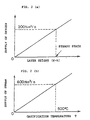
- a gasification furnace having a capacity for treating scrap tires at a rate of 1 ton per hour, the feed rates of oxygen and steam are controlled as shown in Fig. 2.
- Fig. 2(a) is a graph showing the relationship between the height (H-h) of the scrap tire layer and the oxygen feed rate controlled in response thereto. This graph indicates that the oxygen feed rate is 200 Nm 3 /h in a steady state (i.e., when the layer height is equal to a preset value) and that the oxygen feed rate is increased as the layer height becomes larger or decreased as the layer height becomes smaller, in response to a deviation from the preset value of the layer height.
- Fig. 2(b) is a graph showing the relationship between the internal temperature (T) of the gasification furnace and the steam feed rate controlled in response thereto. This graph indicates that the steam feed rate is 600 Nm 3 /h when the temperature is equal to a preset value of 500°C and that the steam feed rate is increased as the temperature becomes higher or decreased as the temperature becomes lower, in response to a deviation from the preset value of the temperature.
Landscapes
- Chemical & Material Sciences (AREA)
- Organic Chemistry (AREA)
- Engineering & Computer Science (AREA)
- Combustion & Propulsion (AREA)
- Oil, Petroleum & Natural Gas (AREA)
- Processing Of Solid Wastes (AREA)
- Gasification And Melting Of Waste (AREA)
Applications Claiming Priority (3)
| Application Number | Priority Date | Filing Date | Title |
|---|---|---|---|
| JP29818894 | 1994-12-01 | ||
| JP29818894A JP3426749B2 (ja) | 1994-12-01 | 1994-12-01 | 固定床ガス化炉及び有機系廃棄物のガス化法 |
| EP95111105A EP0693539B1 (fr) | 1994-07-20 | 1995-07-14 | Combustion de déchets organiques |
Related Parent Applications (2)
| Application Number | Title | Priority Date | Filing Date |
|---|---|---|---|
| EP95111105A Division EP0693539B1 (fr) | 1994-07-20 | 1995-07-14 | Combustion de déchets organiques |
| EP95111105.3 Division | 1995-07-14 |
Publications (3)
| Publication Number | Publication Date |
|---|---|
| EP1207191A2 true EP1207191A2 (fr) | 2002-05-22 |
| EP1207191A3 EP1207191A3 (fr) | 2002-09-04 |
| EP1207191B1 EP1207191B1 (fr) | 2005-09-21 |
Family
ID=17856362
Family Applications (1)
| Application Number | Title | Priority Date | Filing Date |
|---|---|---|---|
| EP01126577A Expired - Lifetime EP1207191B1 (fr) | 1994-12-01 | 1995-07-14 | Gazéificateur à lit fixe et méthode de gazéification de déchets organiques |
Country Status (4)
| Country | Link |
|---|---|
| EP (1) | EP1207191B1 (fr) |
| JP (1) | JP3426749B2 (fr) |
| DE (1) | DE69534480T2 (fr) |
| ES (1) | ES2246281T3 (fr) |
Cited By (5)
| Publication number | Priority date | Publication date | Assignee | Title |
|---|---|---|---|---|
| WO2005028595A1 (fr) * | 2003-08-28 | 2005-03-31 | Tk Energi A/S | Appareil et procede pour la production de gaz combustibles a partir d'une matiere organique |
| WO2011101022A1 (fr) * | 2010-02-16 | 2011-08-25 | Big Dutchman International Gmbh | Équipement de gazéification et procédé de gazéification |
| CN102206513A (zh) * | 2011-04-24 | 2011-10-05 | 陈金明 | 一种具有捕点加料的垃圾热解气化炉 |
| US9422491B2 (en) | 2011-03-22 | 2016-08-23 | Big Dutchman International Gmbh | Shaft gasifier for operating with hypostoichiometric oxidation |
| CN110218585A (zh) * | 2019-06-17 | 2019-09-10 | 中科聚信洁能热锻装备研发股份有限公司 | 一种测控煤气化炉温度的装置和方法 |
Families Citing this family (1)
| Publication number | Priority date | Publication date | Assignee | Title |
|---|---|---|---|---|
| DE102015208923B4 (de) * | 2015-05-13 | 2019-01-03 | Entrade Energiesysteme Ag | Zyklonabscheider sowie Festbettvergaser zum Erzeugen eines Produktgases aus kohlenstoffhaltigen Einsatzstoffen mit einem solchen Zyklonabscheider |
Family Cites Families (3)
| Publication number | Priority date | Publication date | Assignee | Title |
|---|---|---|---|---|
| US4321877A (en) * | 1978-09-25 | 1982-03-30 | Midland-Ross Corporation | Gasification furnace |
| DE3721476C1 (de) * | 1987-06-30 | 1988-12-22 | Asea Brown Boveri | Verfahren zum Regeln der Wirbelschichthoehe in einem Pyrolysereaktor sowie Anordnung zur Durchfuehrung des Verfahrens |
| DE3929925A1 (de) * | 1989-09-08 | 1991-03-21 | Metallgesellschaft Ag | Verfahren zum regeln der vergasung fester brennstoffe im drehrost-gaserzeuger |
-
1994
- 1994-12-01 JP JP29818894A patent/JP3426749B2/ja not_active Expired - Fee Related
-
1995
- 1995-07-14 ES ES01126577T patent/ES2246281T3/es not_active Expired - Lifetime
- 1995-07-14 EP EP01126577A patent/EP1207191B1/fr not_active Expired - Lifetime
- 1995-07-14 DE DE69534480T patent/DE69534480T2/de not_active Expired - Fee Related
Cited By (9)
| Publication number | Priority date | Publication date | Assignee | Title |
|---|---|---|---|---|
| WO2005028595A1 (fr) * | 2003-08-28 | 2005-03-31 | Tk Energi A/S | Appareil et procede pour la production de gaz combustibles a partir d'une matiere organique |
| WO2011101022A1 (fr) * | 2010-02-16 | 2011-08-25 | Big Dutchman International Gmbh | Équipement de gazéification et procédé de gazéification |
| CN102844409A (zh) * | 2010-02-16 | 2012-12-26 | 大荷兰人国际有限公司 | 气化装置和气化方法 |
| CN102844409B (zh) * | 2010-02-16 | 2014-12-03 | 大荷兰人国际有限公司 | 气化装置和气化方法 |
| US9115321B2 (en) | 2010-02-16 | 2015-08-25 | Big Dutchman International Gmbh | Gasification device and method |
| US9422491B2 (en) | 2011-03-22 | 2016-08-23 | Big Dutchman International Gmbh | Shaft gasifier for operating with hypostoichiometric oxidation |
| CN102206513A (zh) * | 2011-04-24 | 2011-10-05 | 陈金明 | 一种具有捕点加料的垃圾热解气化炉 |
| CN102206513B (zh) * | 2011-04-24 | 2013-07-03 | 陈金明 | 一种具有捕点加料的垃圾热解气化炉 |
| CN110218585A (zh) * | 2019-06-17 | 2019-09-10 | 中科聚信洁能热锻装备研发股份有限公司 | 一种测控煤气化炉温度的装置和方法 |
Also Published As
| Publication number | Publication date |
|---|---|
| DE69534480T2 (de) | 2006-06-22 |
| EP1207191A3 (fr) | 2002-09-04 |
| EP1207191B1 (fr) | 2005-09-21 |
| ES2246281T3 (es) | 2006-02-16 |
| DE69534480D1 (de) | 2005-10-27 |
| JP3426749B2 (ja) | 2003-07-14 |
| JPH08157836A (ja) | 1996-06-18 |
Similar Documents
| Publication | Publication Date | Title |
|---|---|---|
| EP1207192B1 (fr) | Gazéificateurs à lit fixe et méthodes de gazéification de déchets organiques | |
| US3890111A (en) | Transfer line burner system using low oxygen content gas | |
| US6790383B2 (en) | Method of gasifying carbonaceous materials | |
| US5226927A (en) | Wood gasifier | |
| Susanto et al. | A moving-bed gasifier with internal recycle of pyrolysis gas | |
| EP0693539A2 (fr) | Combustion de déchets organiques | |
| AU647520B2 (en) | Process and apparatus for fixed bed coal gasification | |
| EP1207190B1 (fr) | Gazéificateur à lit fixe pour déchets organiques | |
| JPH0649874B2 (ja) | 石炭の噴流層ガス化方法 | |
| US3876392A (en) | Transfer line burner using gas of low oxygen content | |
| US4543894A (en) | Process for staged combustion of retorted oil shale | |
| AU602610B2 (en) | Control of suspension density using radiation source | |
| EP1207191B1 (fr) | Gazéificateur à lit fixe et méthode de gazéification de déchets organiques | |
| KR101643969B1 (ko) | 가연성 분진을 사용하여 작동되는 가스화 반응기 시동 장치 및 가스화 반응기 시동 방법 | |
| Kikuchi et al. | Ash-agglomerating gasification of coal in a spouted bed reactor | |
| JP3572121B2 (ja) | 有機系廃棄物のガス化炉及びガス化方法 | |
| US2698227A (en) | Preparation of synthesis gases from carbonaceous solids | |
| JP3377638B2 (ja) | 固定床ガス化炉及び有機系廃棄物ガス化方法 | |
| JPH11302665A (ja) | バイオマスと化石燃料を用いたガス化方法 | |
| US4372756A (en) | Two-stage coal gasification process | |
| US2618544A (en) | Gasification of carbonaceous materials | |
| EP1207341A2 (fr) | Procédé de combustion de déchets organiques dans un four de combustion | |
| JP3426750B2 (ja) | 固定床ガス化炉及び有機系廃棄物ガス化方法 | |
| AU2003274480B2 (en) | Method for predicting amount of gas produced during coal gasification | |
| GB651370A (en) | Method of producing fuel gases |
Legal Events
| Date | Code | Title | Description |
|---|---|---|---|
| PUAI | Public reference made under article 153(3) epc to a published international application that has entered the european phase |
Free format text: ORIGINAL CODE: 0009012 |
|
| 17P | Request for examination filed |
Effective date: 20011115 |
|
| AC | Divisional application: reference to earlier application |
Ref document number: 693539 Country of ref document: EP |
|
| PUAL | Search report despatched |
Free format text: ORIGINAL CODE: 0009013 |
|
| AK | Designated contracting states |
Kind code of ref document: A3 Designated state(s): BE DE ES FR GB IT NL |
|
| RIC1 | Information provided on ipc code assigned before grant |
Free format text: 7C 10J 3/16 A, 7C 10J 3/20 B, 7C 10J 3/72 B, 7F 23G 5/027 B |
|
| AKX | Designation fees paid |
Designated state(s): BE DE ES FR GB IT NL |
|
| 17Q | First examination report despatched |
Effective date: 20031222 |
|
| GRAP | Despatch of communication of intention to grant a patent |
Free format text: ORIGINAL CODE: EPIDOSNIGR1 |
|
| GRAS | Grant fee paid |
Free format text: ORIGINAL CODE: EPIDOSNIGR3 |
|
| GRAA | (expected) grant |
Free format text: ORIGINAL CODE: 0009210 |
|
| AC | Divisional application: reference to earlier application |
Ref document number: 0693539 Country of ref document: EP Kind code of ref document: P |
|
| AK | Designated contracting states |
Kind code of ref document: B1 Designated state(s): BE DE ES FR GB IT NL |
|
| REG | Reference to a national code |
Ref country code: GB Ref legal event code: FG4D |
|
| REF | Corresponds to: |
Ref document number: 69534480 Country of ref document: DE Date of ref document: 20051027 Kind code of ref document: P |
|
| REG | Reference to a national code |
Ref country code: ES Ref legal event code: FG2A Ref document number: 2246281 Country of ref document: ES Kind code of ref document: T3 |
|
| ET | Fr: translation filed | ||
| PLBE | No opposition filed within time limit |
Free format text: ORIGINAL CODE: 0009261 |
|
| STAA | Information on the status of an ep patent application or granted ep patent |
Free format text: STATUS: NO OPPOSITION FILED WITHIN TIME LIMIT |
|
| 26N | No opposition filed |
Effective date: 20060622 |
|
| PGFP | Annual fee paid to national office [announced via postgrant information from national office to epo] |
Ref country code: ES Payment date: 20080808 Year of fee payment: 14 Ref country code: DE Payment date: 20080717 Year of fee payment: 14 |
|
| PGFP | Annual fee paid to national office [announced via postgrant information from national office to epo] |
Ref country code: NL Payment date: 20080715 Year of fee payment: 14 Ref country code: IT Payment date: 20080728 Year of fee payment: 14 Ref country code: FR Payment date: 20080718 Year of fee payment: 14 |
|
| PGFP | Annual fee paid to national office [announced via postgrant information from national office to epo] |
Ref country code: GB Payment date: 20080716 Year of fee payment: 14 |
|
| PGFP | Annual fee paid to national office [announced via postgrant information from national office to epo] |
Ref country code: BE Payment date: 20090126 Year of fee payment: 14 |
|
| BERE | Be: lapsed |
Owner name: *MITSUBISHI JUKOGYO K.K. Effective date: 20090731 |
|
| GBPC | Gb: european patent ceased through non-payment of renewal fee |
Effective date: 20090714 |
|
| NLV4 | Nl: lapsed or anulled due to non-payment of the annual fee |
Effective date: 20100201 |
|
| REG | Reference to a national code |
Ref country code: FR Ref legal event code: ST Effective date: 20100331 |
|
| PG25 | Lapsed in a contracting state [announced via postgrant information from national office to epo] |
Ref country code: FR Free format text: LAPSE BECAUSE OF NON-PAYMENT OF DUE FEES Effective date: 20090731 |
|
| PG25 | Lapsed in a contracting state [announced via postgrant information from national office to epo] |
Ref country code: GB Free format text: LAPSE BECAUSE OF NON-PAYMENT OF DUE FEES Effective date: 20090714 |
|
| PG25 | Lapsed in a contracting state [announced via postgrant information from national office to epo] |
Ref country code: DE Free format text: LAPSE BECAUSE OF NON-PAYMENT OF DUE FEES Effective date: 20100202 Ref country code: BE Free format text: LAPSE BECAUSE OF NON-PAYMENT OF DUE FEES Effective date: 20090731 |
|
| REG | Reference to a national code |
Ref country code: ES Ref legal event code: FD2A Effective date: 20090715 |
|
| PG25 | Lapsed in a contracting state [announced via postgrant information from national office to epo] |
Ref country code: ES Free format text: LAPSE BECAUSE OF NON-PAYMENT OF DUE FEES Effective date: 20090715 |
|
| PG25 | Lapsed in a contracting state [announced via postgrant information from national office to epo] |
Ref country code: IT Free format text: LAPSE BECAUSE OF NON-PAYMENT OF DUE FEES Effective date: 20090714 |
|
| PG25 | Lapsed in a contracting state [announced via postgrant information from national office to epo] |
Ref country code: NL Free format text: LAPSE BECAUSE OF NON-PAYMENT OF DUE FEES Effective date: 20100201 |