EP1208965B1 - Rouleaux de gaufrage pour papier - Google Patents
Rouleaux de gaufrage pour papier Download PDFInfo
- Publication number
- EP1208965B1 EP1208965B1 EP20010127608 EP01127608A EP1208965B1 EP 1208965 B1 EP1208965 B1 EP 1208965B1 EP 20010127608 EP20010127608 EP 20010127608 EP 01127608 A EP01127608 A EP 01127608A EP 1208965 B1 EP1208965 B1 EP 1208965B1
- Authority
- EP
- European Patent Office
- Prior art keywords
- roll
- depressions
- calender
- calender according
- embossing
- Prior art date
- Legal status (The legal status is an assumption and is not a legal conclusion. Google has not performed a legal analysis and makes no representation as to the accuracy of the status listed.)
- Expired - Lifetime
Links
- 238000004049 embossing Methods 0.000 title claims description 32
- 239000002344 surface layer Substances 0.000 claims description 3
- 239000002184 metal Substances 0.000 description 4
- 229910052751 metal Inorganic materials 0.000 description 4
- 239000011248 coating agent Substances 0.000 description 3
- 238000000576 coating method Methods 0.000 description 3
- 229920001971 elastomer Polymers 0.000 description 3
- 239000000463 material Substances 0.000 description 3
- 238000000034 method Methods 0.000 description 3
- 238000003801 milling Methods 0.000 description 3
- 239000004033 plastic Substances 0.000 description 3
- 230000003746 surface roughness Effects 0.000 description 3
- 230000000694 effects Effects 0.000 description 2
- 238000000227 grinding Methods 0.000 description 2
- 238000007373 indentation Methods 0.000 description 2
- 239000010410 layer Substances 0.000 description 2
- 238000003754 machining Methods 0.000 description 2
- 230000002093 peripheral effect Effects 0.000 description 2
- 229910001018 Cast iron Inorganic materials 0.000 description 1
- 239000002253 acid Substances 0.000 description 1
- 238000003490 calendering Methods 0.000 description 1
- 230000007423 decrease Effects 0.000 description 1
- 230000003247 decreasing effect Effects 0.000 description 1
- 239000000806 elastomer Substances 0.000 description 1
- 238000005530 etching Methods 0.000 description 1
- 238000007730 finishing process Methods 0.000 description 1
- 239000003292 glue Substances 0.000 description 1
- 239000006223 plastic coating Substances 0.000 description 1
- 238000003825 pressing Methods 0.000 description 1
Images
Classifications
-
- B—PERFORMING OPERATIONS; TRANSPORTING
- B31—MAKING ARTICLES OF PAPER, CARDBOARD OR MATERIAL WORKED IN A MANNER ANALOGOUS TO PAPER; WORKING PAPER, CARDBOARD OR MATERIAL WORKED IN A MANNER ANALOGOUS TO PAPER
- B31F—MECHANICAL WORKING OR DEFORMATION OF PAPER, CARDBOARD OR MATERIAL WORKED IN A MANNER ANALOGOUS TO PAPER
- B31F1/00—Mechanical deformation without removing material, e.g. in combination with laminating
- B31F1/07—Embossing, i.e. producing impressions formed by locally deep-drawing, e.g. using rolls provided with complementary profiles
-
- B—PERFORMING OPERATIONS; TRANSPORTING
- B31—MAKING ARTICLES OF PAPER, CARDBOARD OR MATERIAL WORKED IN A MANNER ANALOGOUS TO PAPER; WORKING PAPER, CARDBOARD OR MATERIAL WORKED IN A MANNER ANALOGOUS TO PAPER
- B31F—MECHANICAL WORKING OR DEFORMATION OF PAPER, CARDBOARD OR MATERIAL WORKED IN A MANNER ANALOGOUS TO PAPER
- B31F2201/00—Mechanical deformation of paper or cardboard without removing material
- B31F2201/07—Embossing
- B31F2201/0707—Embossing by tools working continuously
- B31F2201/0715—The tools being rollers
- B31F2201/0723—Characteristics of the rollers
- B31F2201/0728—Material
-
- B—PERFORMING OPERATIONS; TRANSPORTING
- B31—MAKING ARTICLES OF PAPER, CARDBOARD OR MATERIAL WORKED IN A MANNER ANALOGOUS TO PAPER; WORKING PAPER, CARDBOARD OR MATERIAL WORKED IN A MANNER ANALOGOUS TO PAPER
- B31F—MECHANICAL WORKING OR DEFORMATION OF PAPER, CARDBOARD OR MATERIAL WORKED IN A MANNER ANALOGOUS TO PAPER
- B31F2201/00—Mechanical deformation of paper or cardboard without removing material
- B31F2201/07—Embossing
- B31F2201/0707—Embossing by tools working continuously
- B31F2201/0715—The tools being rollers
- B31F2201/0723—Characteristics of the rollers
- B31F2201/073—Rollers having a multilayered structure
-
- B—PERFORMING OPERATIONS; TRANSPORTING
- B31—MAKING ARTICLES OF PAPER, CARDBOARD OR MATERIAL WORKED IN A MANNER ANALOGOUS TO PAPER; WORKING PAPER, CARDBOARD OR MATERIAL WORKED IN A MANNER ANALOGOUS TO PAPER
- B31F—MECHANICAL WORKING OR DEFORMATION OF PAPER, CARDBOARD OR MATERIAL WORKED IN A MANNER ANALOGOUS TO PAPER
- B31F2201/00—Mechanical deformation of paper or cardboard without removing material
- B31F2201/07—Embossing
- B31F2201/0707—Embossing by tools working continuously
- B31F2201/0715—The tools being rollers
- B31F2201/0723—Characteristics of the rollers
- B31F2201/0733—Pattern
-
- B—PERFORMING OPERATIONS; TRANSPORTING
- B31—MAKING ARTICLES OF PAPER, CARDBOARD OR MATERIAL WORKED IN A MANNER ANALOGOUS TO PAPER; WORKING PAPER, CARDBOARD OR MATERIAL WORKED IN A MANNER ANALOGOUS TO PAPER
- B31F—MECHANICAL WORKING OR DEFORMATION OF PAPER, CARDBOARD OR MATERIAL WORKED IN A MANNER ANALOGOUS TO PAPER
- B31F2201/00—Mechanical deformation of paper or cardboard without removing material
- B31F2201/07—Embossing
- B31F2201/0784—Auxiliary operations
Definitions
- the invention relates to a paper embossing calender comprising a hard roll having an unyielding surface and a soft roll having a compliant surface layer which together form a nip, the soft roll having depressions in the surface corresponding to an embossing pattern.
- Such an embossing calender is known from EP 0 498 623 A2.
- the hard roller has projections which press a path passing through the nip between the hard and soft rollers into recesses formed in the soft roller.
- the recesses in the soft roller are burned out with the help of a laser.
- JP 10 315 325 A describes a stamping device for a film with a metal embossing roller and a cooperating rubber roller.
- the metal roll has a surface roughness of 0.4 to 5 ⁇ m
- the rubber roll has a surface roughness of 0.2 to 2.5 ⁇ m .
- Embossing is a finishing process in which a paper web is provided with a pattern that can be perceived visually and / or by feel. This embossing is done so far in that a pattern is provided in the surface of the hard roller, which is either pressed directly into the paper web or the fact that the hard roller first works on the soft roller and there generates the image of the pattern, so that at subsequent passage through the paper web, the pattern is stamped on both sides in the paper web, so to speak.
- the processing of the hard roller is relatively expensive.
- wear of the soft roller is likely to be noticeable for a relatively short time, which reduces the life of the soft roller.
- DE 87 12 013 U1 shows a calendering calender with a hard roll and a soft roll whose roll cover consists of elastomers.
- the roll cover has a rough surface which may be rough ground, sandblasted or otherwise structured. This would be to produce papers that are smooth on the side, with which they rest against the hard roller, but rough on the other side. Such papers are used for example for labels whose back must be particularly receptive to glue.
- the invention has for its object to provide a further embossing process available.
- the hard roll is considered to be a roll having an unyielding surface. Such rolls are usually made of metal. At least its surface is formed of a correspondingly hard metal layer.
- the soft roll is a roll having a compliant, ie elastic surface layer, which is usually formed by a coating which is arranged on a carrier.
- the formerly common paper rolls are Today almost completely replaced by rollers with plastic coverings. Such plastic coverings have the advantage that they can be made relatively smooth. In the case of the paper embossing calender, therefore, initially two rolls act together, which have smooth surfaces. However, an embossed pattern is incorporated into the smooth surface of the soft roll.
- the paper web when the paper web is passed through the nip between the hard and soft rolls, it undergoes a different treatment in the recessed areas of the soft roll than in the remaining areas.
- the paper web is smoothed on both sides, while it remains untreated in the recessed areas. In this way, a pattern can be imprinted in the paper web.
- the life of the soft roll remains relatively high because the coating of the soft roll is not significantly more reshaped than is the case with "normal" calenders in which a soft roll and a hard roll co-operate.
- the embossing pattern remains relatively long. Making the embossing patterns is easier in the soft roll than in the hard roll because the material presents less resistance to machining on the surface of the soft roll.
- the recesses are greater than 0.1 mm. With such a size, a sufficient distance between the bottom of the recesses and the remaining areas is created so that patterns can be embossed.
- the recesses are greater than 1 mm. This makes it possible to grind the soft roller several times. Experience has shown that in a regrinding about 0.25 mm material is removed. This allows embossing for a longer period of time perform. On the other hand, if you want to create a new pattern every time you regrind, you will choose the indentations with a depth of less than 0.2 mm.
- the recesses each have bottom surfaces whose roughness is greater than that of the surface.
- This embodiment has several advantages. First, it is not necessary to smooth the bottom surfaces. On the contrary, after the indentations have been introduced, they can be left in the roughness caused by the machining process. Above all, one can also accept that the depth of the recesses has decreased sharply after several regrinding operations. Even if the paper web then contacts the bottom surface of the recesses, the pattern can still be seen.
- surface areas remaining between the recesses have a roughness of ⁇ 1 ⁇ m .
- the surface of the soft roller is so relatively smooth, which can be achieved with modern plastic.
- the roughness Ra is between 0.3 and 1 ⁇ m .
- the roughness should in any case be so small that the surface areas between the recesses result in no matting, in which the paper surface is roughened.
- the smoothness of the surface areas of a freshly ground soft roll corresponds to the smoothness of the hard roll surface after a predetermined operating time.
- the surface of the hard roll is so smooth, so that gives a relatively high smoothness when embossing the one side of the paper web, while the other side of the paper web is smoothed only in the surface areas between the wells.
- a freshly smoothed soft roller often has a Rauhingkeitswert Ra in the range of 0.3 to 0.5 ⁇ m, which varies in the course of operation to about 1 ⁇ m.
- a hard roller for example from chilled cast iron, has a surface roughness of about 0.08 ⁇ m, the ⁇ after a certain operating time to 0.5 m degrades after grinding. When this value is reached, a revision is usually required again.
- the recesses are milled or rotated. Milling is a relatively easy way to make the wells. With turning, it is preferable to produce patterns which extend laterally in the paper web in the longitudinal direction.
- the depressions may be etched. This makes it possible to create much more complex patterns, for example with the aid of photolithographic methods. However, the handling of the roller during etching is somewhat more expensive.
- the line load in the nip is in the range of 100 to 400 N / mm, preferably 150 to 250 N / mm.
- This line load is capable of producing a noticeable difference in the surface areas between the recesses and the recesses, so that the embossing pattern is easily recognizable.
- the hard roll is heated to a surface temperature in the range of 50 to 150 ° C, preferably 100 to 130 ° C. In the nip then arise appropriate temperatures that are useful for a corresponding deformation of the paper web in the nip.
- the rollers rotate at a peripheral speed in the range of 600 to 100 m / min, preferably from 700 to 950 m / min.
- the calender is designed as an on-line calender. So you can effect the embossing of the paper web immediately following a paper or coating machine. Thus, the cost of embossing is kept relatively small.
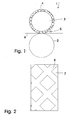
- Fig. 1 shows schematically a paper embossing calender 1 with a hard roll 2, which has a smooth surface, and a soft roll 3, which has a plastic coating 4, whose surface is also smooth.
- the roughness Ra of the surface of the soft roll 3 is in the range of 0.3 to 1 .mu.m , ie the roll 3 after grinding has a roughness Ra in the range of 0.3 to 0.5 .mu.m , which is then in operation increases to about 1 ⁇ m.
- the roughness of the surface of the hard roller 2 lies in the same order of magnitude.
- the roughness decreases during operation from about 0.08 ⁇ m to about 0.5 ⁇ m , before a revision is required becomes.
- the surface of the hard roller can be even smoother.
- the two rollers 2, 3 together form a nip 5, through which a paper web 6 is guided.
- the paper embossing calender 1 is intended exclusively for embossing paper webs 6.
- Fig. 2 shows a section of a development of the surface of the soft roll 3, i. a view of the radial outside of the lining. 4
- the covering 4 thus has depressions 7 on its surface, remaining between the surface regions or webs 8 whose roughness corresponds to the roughness of the original surface of the lining 4.
- the roughness in the bottom surfaces of the depressions 7 can and should be greater than the roughness of the remaining surface regions 8.
- the paper web 6 is pressurized in the nip 5.
- non-illustrated pressing elements act on the two rollers 2, 3, that in Nip 5 a Strekkenlast of 100 to 400 N / mm prevails.
- the line load is in the range of 150 to 250 N / mm.
- the areas adjacent to the surface areas 8 of the paper web 6 also smoother. This then leads to 6 different areas arise on the surface of the paper web, which can be distinguished visually and possibly also by feeling clear from each other. For example, the regions of the paper web 6 which have been applied to the surface regions 8 shine more strongly than those which have covered the depressions 7.
- the recesses 7 have a depth of more than 1 mm. Even if one grinds the remaining surface areas 8 several times and a material removal of the order of 0.25 mm takes place with each regrinding operation, a sufficiently large reserve is available so that the paper embossing pattern can be obtained over a relatively long period of time.
- the regrinding again provides a completely smooth surface of the roller 3, in which a new pattern can be incorporated.
- the recesses 7 can be produced in several ways. A particularly simple way is that the recesses 7 are milled. In this case, a milling tool 7 in the elastic pad 4 of the soft Roller 3 is sunk and acts on the soft roller 3 so that only the webs or remaining surface areas 8 remain.
- Another, also relatively simple way to produce the embossing pattern is to turn off the soft roller 3 in certain areas to produce the recesses 7. Such processing is particularly advantageous when the pattern extends linearly in the longitudinal direction of the embossed paper web.
- the remaining surface areas 8 are covered with an acid-proof layer, and the recesses 7 are then produced by the application of acid. This can be much finer structures than when milling.
- the embossing calender 1 can be used as an on-line calender, i. the paper web can be embossed immediately following a paper or coater.
- the rollers 2, 3 rotate at a peripheral speed of the order of 600 to 1000 m / min. Despite this relatively high speed, it is possible to emboss the patterns with the desired quality.
Landscapes
- Engineering & Computer Science (AREA)
- Mechanical Engineering (AREA)
- Shaping Of Tube Ends By Bending Or Straightening (AREA)
- Machines For Manufacturing Corrugated Board In Mechanical Paper-Making Processes (AREA)
- Paper (AREA)
Claims (12)
- Calandre de gaufrage pour papier, comprenant un rouleau dur qui présente une surface non flexible, et un rouleau mou avec une couche de surface flexible, lesquels forment ensemble une ligne de contact, le rouleau mou présentant des renfoncements dans la surface, lesquels correspondent à un motif de gaufrage, caractérisée en ce que le rouleau mou (3) présente une surface lisse ayant une rugosité Ra ≤ 1 µm et le rouleau dur (2) présente une surface lisse dont la rugosité se trouve dans un ordre de grandeur correspondant.
- Calandre selon la revendication 1, dans laquelle les renfoncements sont supérieurs à 0,1 mm.
- Calandre selon la revendication 1 ou 2, dans laquelle les renfoncements sont supérieurs à 1 mm.
- Calandre selon l'une quelconque des revendications 1 à 3, dans laquelle les renfoncements présentent à chaque fois des surfaces de fond dont la rugosité est supérieure à celle de la surface.
- Calandre selon l'une quelconque des revendications 1 à 4, dans laquelle les régions de surface (8) subsistant entre les renfoncements (7) présentent une rugosité < 1 µm.
- Calandre selon la revendication 5, dans laquelle le lissé des régions de surface (8) d'un rouleau mou fraîchement meulé correspond au lissé de la surface du rouleau dur (2).
- Calandre selon l'une quelconque des revendications 1 à 6, dans laquelle les renfoncements (7) sont fraisés ou creusés au tour.
- Calandre selon l'une quelconque des revendications 1 à 6, dans laquelle les renfoncements (7) sont gravés.
- Utilisation d'une calandre selon l'une quelconque des revendications 1 à 8, dans laquelle la charge linéaire dans la ligne de contact (5) est comprise dans la plage de 100 à 400 N/mm, de préférence de 150 à 250 N/mm.
- Utilisation d'une calandre selon l'une quelconque des revendications 1 à 8, dans laquelle le rouleau dur (2) est chauffé à une température de surface dans la plage de 50 à 150°C, de préférence de 100 à 130°C.
- Utilisation d'une calandre selon l'une quelconque des revendications 1 à 8, dans laquelle les rouleaux (2, 3) tournent à une vitesse périphérique dans la plage de 600 à 1000 m/min, de préférence de 700 à 950 m/min.
- Utilisation d'une calandre selon l'une quelconque des revendications 1 à 8, dans laquelle la calandre (1) est montée en ligne.
Applications Claiming Priority (2)
| Application Number | Priority Date | Filing Date | Title |
|---|---|---|---|
| DE2000158993 DE10058993B4 (de) | 2000-11-28 | 2000-11-28 | Papierprägekalander |
| DE10058993 | 2000-11-28 |
Publications (3)
| Publication Number | Publication Date |
|---|---|
| EP1208965A2 EP1208965A2 (fr) | 2002-05-29 |
| EP1208965A3 EP1208965A3 (fr) | 2004-03-17 |
| EP1208965B1 true EP1208965B1 (fr) | 2006-01-18 |
Family
ID=7664934
Family Applications (1)
| Application Number | Title | Priority Date | Filing Date |
|---|---|---|---|
| EP20010127608 Expired - Lifetime EP1208965B1 (fr) | 2000-11-28 | 2001-11-20 | Rouleaux de gaufrage pour papier |
Country Status (2)
| Country | Link |
|---|---|
| EP (1) | EP1208965B1 (fr) |
| DE (2) | DE10058993B4 (fr) |
Cited By (1)
| Publication number | Priority date | Publication date | Assignee | Title |
|---|---|---|---|---|
| WO2016159966A1 (fr) * | 2015-03-31 | 2016-10-06 | Kimberly-Clark Worldwide, Inc. | Produits de papier mousseline en rouleau du type lisse et volumineux |
Families Citing this family (3)
| Publication number | Priority date | Publication date | Assignee | Title |
|---|---|---|---|---|
| ATE421613T1 (de) * | 2002-01-29 | 2009-02-15 | Metso Paper Inc | Verarbeitungsvorrichtung zum verarbeiten einer gegebenenfalls beschichteten faserstoffbahn |
| CN103415443B (zh) | 2011-01-25 | 2016-08-24 | 利乐拉瓦尔集团及财务有限公司 | 一种用于储存液体食物的包装、一种用于形成所述包装的一部分的胚件以及一种胚件卷 |
| MX2022015935A (es) | 2020-07-03 | 2023-01-24 | Essity Hygiene & Health Ab | Rollos sin nucleo de un producto de papel tisu y metodos de fabricacion de rollos sin nucleo. |
Family Cites Families (8)
| Publication number | Priority date | Publication date | Assignee | Title |
|---|---|---|---|---|
| US3619446A (en) * | 1968-02-02 | 1971-11-09 | Rowland Products Inc | Method for making resiliently faced rolls |
| US4610743A (en) * | 1980-08-29 | 1986-09-09 | James River-Norwalk, Inc. | Pattern bonding and creping of fibrous substrates to form laminated products |
| DE3236459C1 (de) * | 1982-10-01 | 1984-03-29 | Windmöller & Hölscher, 4540 Lengerich | Verfahren zur Herstellung von mit Kunststoff beschichteten sanitaeren Papierbahnen |
| DE3705100A1 (de) * | 1987-02-18 | 1988-09-01 | Benecke Gmbh J | Verfahren zur herstellung einer oberflaechenstruktur von praegewalzen sowie nach dem verfahren hergestellte praegewalze |
| DE8712013U1 (de) * | 1987-09-04 | 1987-10-22 | Kleinewefers Gmbh, 4150 Krefeld | Santinierkalander |
| CA2060567C (fr) * | 1991-02-04 | 1997-06-10 | Galyn Arlyn Schulz | Machine pour gaufrer une bande fibreuse |
| DE4345128A1 (de) * | 1993-12-30 | 1995-07-06 | Detroit Holding Ltd | Vorrichtung zum Prägen |
| JPH10315325A (ja) * | 1997-05-20 | 1998-12-02 | Mitsubishi Chem Mkv Co | エンボスされたポリプロピレン系樹脂フィルム及びその製造方法 |
-
2000
- 2000-11-28 DE DE2000158993 patent/DE10058993B4/de not_active Expired - Fee Related
-
2001
- 2001-11-20 DE DE50108741T patent/DE50108741D1/de not_active Expired - Lifetime
- 2001-11-20 EP EP20010127608 patent/EP1208965B1/fr not_active Expired - Lifetime
Cited By (4)
| Publication number | Priority date | Publication date | Assignee | Title |
|---|---|---|---|---|
| WO2016159966A1 (fr) * | 2015-03-31 | 2016-10-06 | Kimberly-Clark Worldwide, Inc. | Produits de papier mousseline en rouleau du type lisse et volumineux |
| US10040265B2 (en) | 2015-03-31 | 2018-08-07 | Kimberly-Clark Worldwide, Inc. | Smooth and bulky rolled tissue products |
| US10814579B2 (en) | 2015-03-31 | 2020-10-27 | Kimberly-Clark Worldwide, Inc. | Smooth and bulky rolled tissue products |
| US11548258B2 (en) | 2015-03-31 | 2023-01-10 | Kimberly-Clark Worldwide, Inc. | Smooth and bulky rolled tissue products |
Also Published As
| Publication number | Publication date |
|---|---|
| DE50108741D1 (de) | 2006-04-06 |
| DE10058993B4 (de) | 2004-07-29 |
| EP1208965A2 (fr) | 2002-05-29 |
| DE10058993A1 (de) | 2002-06-06 |
| EP1208965A3 (fr) | 2004-03-17 |
Similar Documents
| Publication | Publication Date | Title |
|---|---|---|
| DE69929506T2 (de) | Saugfähiges Haushaltpapier | |
| DE69807681T2 (de) | Hochdruckprägen und durch hochdruckprägen hergestelltes papier | |
| DE69714458T2 (de) | Geprägte warenbahn | |
| DE19506301C2 (de) | Kalander für Papierbahnen | |
| DE10308124B3 (de) | Verfahren zum Festwalzen von Übergängen zwischen Lagerzapfen und Wangen von Kurbelwellen | |
| DE10058993B4 (de) | Papierprägekalander | |
| DE60016175T2 (de) | Vorrichtung und Verfahren zum Prägen von Papier oder Vliesstoff, sowie das hergestellte Produkt | |
| DE102012107827A1 (de) | Verfahren zur Erzeugung von Glanzeffekten auf Presswerkzeugen | |
| EP0745724B1 (fr) | Presse à rouleaux | |
| DE2362322A1 (de) | Kalander zur verwendung beim satinieren einer papierbahn | |
| DE102006053086B4 (de) | Verfahren zum Herstellen eines Schraubenschlüssels | |
| EP0928843B1 (fr) | Dispositif de pressage | |
| DE19742639C2 (de) | Federring | |
| DE19820268B4 (de) | Prägewerkzeug zum miteinander Verbinden oder Prägen einer oder mehrerer Lagen bahnförmiger Materialien, Verfahren zum Herstellen einer Prägeform für ein Prägewerkzeug, Verwendung einer Prägeform als Urform sowie Verfahren zum Herstellen von miteinander verbundenen oder geprägten Lagen bahnförmiger Materialien | |
| DE10050348C2 (de) | Walzenanordnung, insbesondere Riffelwalzenanordnung | |
| DE4321061A1 (de) | Verfahren und Vorrichtung zur Beeinflussung von Dicke und Glanz und/oder Glätte bei der Behandlung von Faserstoffbahnen | |
| DE19712370C2 (de) | Kalander, insbesondere für Papierbahnen | |
| EP2921293B1 (fr) | Presse à chaud pour plaques en bois | |
| EP1329549B1 (fr) | Calandre | |
| EP1225275B1 (fr) | Procédé pour le fonctionnement d' un calandre et calendre | |
| DE102022116423A1 (de) | Presswerkzeug und Verfahren zur Herstellung eines Presswerkzeugs | |
| DE60202199T2 (de) | Anordnung zum einstellen des profils einer faserstoffbahn | |
| AT40733B (de) | Verfahren zur Herstellung von gekörnten Musterplatten für die Kattundruckerei. | |
| DE174377C (fr) | ||
| DE3831429A1 (de) | Pressenpartie in einer papiermaschine |
Legal Events
| Date | Code | Title | Description |
|---|---|---|---|
| PUAI | Public reference made under article 153(3) epc to a published international application that has entered the european phase |
Free format text: ORIGINAL CODE: 0009012 |
|
| AK | Designated contracting states |
Kind code of ref document: A2 Designated state(s): AT BE CH CY DE DK ES FI FR GB GR IE IT LI LU MC NL PT SE TR |
|
| AX | Request for extension of the european patent |
Free format text: AL;LT;LV;MK;RO;SI |
|
| RIN1 | Information on inventor provided before grant (corrected) |
Inventor name: ROTHFUSS, ULRICH Inventor name: ZIMMERMANN, LOTHAR Inventor name: GANASINSKI, MICHAEL Inventor name: LEIGRAF, REINHARD |
|
| PUAL | Search report despatched |
Free format text: ORIGINAL CODE: 0009013 |
|
| AK | Designated contracting states |
Kind code of ref document: A3 Designated state(s): AT BE CH CY DE DK ES FI FR GB GR IE IT LI LU MC NL PT SE TR |
|
| AX | Request for extension of the european patent |
Extension state: AL LT LV MK RO SI |
|
| 17P | Request for examination filed |
Effective date: 20040212 |
|
| 17Q | First examination report despatched |
Effective date: 20040521 |
|
| AKX | Designation fees paid |
Designated state(s): DE FI SE |
|
| GRAP | Despatch of communication of intention to grant a patent |
Free format text: ORIGINAL CODE: EPIDOSNIGR1 |
|
| GRAS | Grant fee paid |
Free format text: ORIGINAL CODE: EPIDOSNIGR3 |
|
| GRAA | (expected) grant |
Free format text: ORIGINAL CODE: 0009210 |
|
| AK | Designated contracting states |
Kind code of ref document: B1 Designated state(s): DE FI SE |
|
| REF | Corresponds to: |
Ref document number: 50108741 Country of ref document: DE Date of ref document: 20060406 Kind code of ref document: P |
|
| REG | Reference to a national code |
Ref country code: SE Ref legal event code: TRGR |
|
| RAP2 | Party data changed (patent owner data changed or rights of a patent transferred) |
Owner name: VOITH PATENT GMBH |
|
| PG25 | Lapsed in a contracting state [announced via postgrant information from national office to epo] |
Ref country code: SE Free format text: LAPSE BECAUSE OF NON-PAYMENT OF DUE FEES Effective date: 20061121 |
|
| PLBE | No opposition filed within time limit |
Free format text: ORIGINAL CODE: 0009261 |
|
| STAA | Information on the status of an ep patent application or granted ep patent |
Free format text: STATUS: NO OPPOSITION FILED WITHIN TIME LIMIT |
|
| 26N | No opposition filed |
Effective date: 20061019 |
|
| EUG | Se: european patent has lapsed | ||
| PGFP | Annual fee paid to national office [announced via postgrant information from national office to epo] |
Ref country code: DE Payment date: 20101119 Year of fee payment: 10 |
|
| PGFP | Annual fee paid to national office [announced via postgrant information from national office to epo] |
Ref country code: FI Payment date: 20111114 Year of fee payment: 11 |
|
| PG25 | Lapsed in a contracting state [announced via postgrant information from national office to epo] |
Ref country code: FI Free format text: LAPSE BECAUSE OF NON-PAYMENT OF DUE FEES Effective date: 20121120 |
|
| REG | Reference to a national code |
Ref country code: DE Ref legal event code: R119 Ref document number: 50108741 Country of ref document: DE Effective date: 20130601 |
|
| PG25 | Lapsed in a contracting state [announced via postgrant information from national office to epo] |
Ref country code: DE Free format text: LAPSE BECAUSE OF NON-PAYMENT OF DUE FEES Effective date: 20130601 |