EP1209281A2 - Gefärbter und/oder bedruckter Vliesstoff - Google Patents
Gefärbter und/oder bedruckter Vliesstoff Download PDFInfo
- Publication number
- EP1209281A2 EP1209281A2 EP01127619A EP01127619A EP1209281A2 EP 1209281 A2 EP1209281 A2 EP 1209281A2 EP 01127619 A EP01127619 A EP 01127619A EP 01127619 A EP01127619 A EP 01127619A EP 1209281 A2 EP1209281 A2 EP 1209281A2
- Authority
- EP
- European Patent Office
- Prior art keywords
- radical
- alkyl
- optionally substituted
- general formula
- nonwoven fabric
- Prior art date
- Legal status (The legal status is an assumption and is not a legal conclusion. Google has not performed a legal analysis and makes no representation as to the accuracy of the status listed.)
- Withdrawn
Links
- 239000004745 nonwoven fabric Substances 0.000 claims abstract description 72
- 238000000034 method Methods 0.000 claims abstract description 67
- 239000004952 Polyamide Substances 0.000 claims abstract description 27
- 229920002647 polyamide Polymers 0.000 claims abstract description 27
- 229920000728 polyester Polymers 0.000 claims abstract description 26
- 210000003632 microfilament Anatomy 0.000 claims abstract description 22
- 239000003658 microfiber Substances 0.000 claims abstract description 15
- 229920002635 polyurethane Polymers 0.000 claims abstract description 10
- 239000004814 polyurethane Substances 0.000 claims abstract description 10
- 229920001059 synthetic polymer Polymers 0.000 claims abstract description 9
- 229920001410 Microfiber Polymers 0.000 claims abstract description 4
- -1 2 Chemical class 0.000 claims description 405
- 125000000217 alkyl group Chemical group 0.000 claims description 72
- 150000003254 radicals Chemical class 0.000 claims description 58
- 125000000449 nitro group Chemical group [O-][N+](*)=O 0.000 claims description 44
- 239000000986 disperse dye Substances 0.000 claims description 43
- 150000001875 compounds Chemical class 0.000 claims description 41
- 230000008569 process Effects 0.000 claims description 33
- 125000004093 cyano group Chemical group *C#N 0.000 claims description 31
- 239000000975 dye Substances 0.000 claims description 31
- 238000004140 cleaning Methods 0.000 claims description 27
- 238000004043 dyeing Methods 0.000 claims description 26
- 125000001033 ether group Chemical group 0.000 claims description 26
- 238000007639 printing Methods 0.000 claims description 26
- 229910052736 halogen Inorganic materials 0.000 claims description 25
- 150000002367 halogens Chemical class 0.000 claims description 25
- 239000003795 chemical substances by application Substances 0.000 claims description 22
- CIUQDSCDWFSTQR-UHFFFAOYSA-N [C]1=CC=CC=C1 Chemical class [C]1=CC=CC=C1 CIUQDSCDWFSTQR-UHFFFAOYSA-N 0.000 claims description 19
- 238000004040 coloring Methods 0.000 claims description 19
- 230000002829 reductive effect Effects 0.000 claims description 19
- 125000006705 (C5-C7) cycloalkyl group Chemical group 0.000 claims description 18
- 125000003545 alkoxy group Chemical group 0.000 claims description 17
- 239000000203 mixture Substances 0.000 claims description 17
- 125000004845 (C1-C6) alkylsulfonylamino group Chemical group 0.000 claims description 14
- 125000004453 alkoxycarbonyl group Chemical group 0.000 claims description 12
- 239000000460 chlorine Substances 0.000 claims description 12
- 229920002302 Nylon 6,6 Polymers 0.000 claims description 11
- 125000001997 phenyl group Chemical group [H]C1=C([H])C([H])=C(*)C([H])=C1[H] 0.000 claims description 11
- 229920000139 polyethylene terephthalate Polymers 0.000 claims description 11
- 239000005020 polyethylene terephthalate Substances 0.000 claims description 11
- 125000005236 alkanoylamino group Chemical group 0.000 claims description 10
- 239000000835 fiber Substances 0.000 claims description 10
- 125000004430 oxygen atom Chemical group O* 0.000 claims description 10
- 125000001731 2-cyanoethyl group Chemical group [H]C([H])(*)C([H])([H])C#N 0.000 claims description 8
- 125000003170 phenylsulfonyl group Chemical group C1(=CC=CC=C1)S(=O)(=O)* 0.000 claims description 8
- 230000002378 acidificating effect Effects 0.000 claims description 7
- 125000003236 benzoyl group Chemical group [H]C1=C([H])C([H])=C(C([H])=C1[H])C(*)=O 0.000 claims description 7
- 125000001589 carboacyl group Chemical group 0.000 claims description 7
- 239000001044 red dye Substances 0.000 claims description 7
- 229910052717 sulfur Inorganic materials 0.000 claims description 7
- 239000000984 vat dye Substances 0.000 claims description 7
- 125000004739 (C1-C6) alkylsulfonyl group Chemical group 0.000 claims description 6
- RDFLLVCQYHQOBU-GPGGJFNDSA-O Cyanin Natural products O([C@H]1[C@H](O)[C@H](O)[C@H](O)[C@H](CO)O1)c1c(-c2cc(O)c(O)cc2)[o+]c2c(c(O[C@H]3[C@H](O)[C@@H](O)[C@H](O)[C@H](CO)O3)cc(O)c2)c1 RDFLLVCQYHQOBU-GPGGJFNDSA-O 0.000 claims description 6
- 229910052794 bromium Inorganic materials 0.000 claims description 6
- 229910052801 chlorine Inorganic materials 0.000 claims description 6
- RDFLLVCQYHQOBU-ZOTFFYTFSA-O cyanin Chemical compound O[C@@H]1[C@@H](O)[C@H](O)[C@@H](CO)O[C@H]1OC(C(=[O+]C1=CC(O)=C2)C=3C=C(O)C(O)=CC=3)=CC1=C2O[C@H]1[C@H](O)[C@@H](O)[C@H](O)[C@@H](CO)O1 RDFLLVCQYHQOBU-ZOTFFYTFSA-O 0.000 claims description 6
- 125000001841 imino group Chemical group [H]N=* 0.000 claims description 6
- 125000004434 sulfur atom Chemical group 0.000 claims description 6
- 239000000988 sulfur dye Substances 0.000 claims description 6
- 239000001045 blue dye Substances 0.000 claims description 5
- 125000001495 ethyl group Chemical group [H]C([H])([H])C([H])([H])* 0.000 claims description 5
- 229910052739 hydrogen Inorganic materials 0.000 claims description 5
- 125000002887 hydroxy group Chemical group [H]O* 0.000 claims description 5
- GRVDJDISBSALJP-UHFFFAOYSA-N methyloxidanyl Chemical compound [O]C GRVDJDISBSALJP-UHFFFAOYSA-N 0.000 claims description 5
- BNJMRELGMDUDDB-UHFFFAOYSA-N $l^{1}-sulfanylbenzene Chemical class [S]C1=CC=CC=C1 BNJMRELGMDUDDB-UHFFFAOYSA-N 0.000 claims description 4
- TUCNEACPLKLKNU-UHFFFAOYSA-N acetyl Chemical compound C[C]=O TUCNEACPLKLKNU-UHFFFAOYSA-N 0.000 claims description 4
- 239000002253 acid Substances 0.000 claims description 4
- 125000001797 benzyl group Chemical group [H]C1=C([H])C([H])=C(C([H])=C1[H])C([H])([H])* 0.000 claims description 4
- 125000003917 carbamoyl group Chemical group [H]N([H])C(*)=O 0.000 claims description 4
- 125000000753 cycloalkyl group Chemical group 0.000 claims description 4
- 238000010017 direct printing Methods 0.000 claims description 4
- QUPDWYMUPZLYJZ-UHFFFAOYSA-N ethyl Chemical compound C[CH2] QUPDWYMUPZLYJZ-UHFFFAOYSA-N 0.000 claims description 4
- TUJKJAMUKRIRHC-UHFFFAOYSA-N hydroxyl Chemical compound [OH] TUJKJAMUKRIRHC-UHFFFAOYSA-N 0.000 claims description 4
- WCYWZMWISLQXQU-UHFFFAOYSA-N methyl Chemical compound [CH3] WCYWZMWISLQXQU-UHFFFAOYSA-N 0.000 claims description 4
- 125000000951 phenoxy group Chemical group [H]C1=C([H])C([H])=C(O*)C([H])=C1[H] 0.000 claims description 4
- 125000004568 thiomorpholinyl group Chemical group 0.000 claims description 4
- 238000010023 transfer printing Methods 0.000 claims description 4
- 125000004204 2-methoxyphenyl group Chemical group [H]C1=C([H])C(*)=C(OC([H])([H])[H])C([H])=C1[H] 0.000 claims description 3
- 125000000094 2-phenylethyl group Chemical group [H]C1=C([H])C([H])=C(C([H])=C1[H])C([H])([H])C([H])([H])* 0.000 claims description 3
- 125000004207 3-methoxyphenyl group Chemical group [H]C1=C([H])C(*)=C([H])C(OC([H])([H])[H])=C1[H] 0.000 claims description 3
- 125000004172 4-methoxyphenyl group Chemical group [H]C1=C([H])C(OC([H])([H])[H])=C([H])C([H])=C1* 0.000 claims description 3
- RZVAJINKPMORJF-UHFFFAOYSA-N Acetaminophen Chemical compound CC(=O)NC1=CC=C(O)C=C1 RZVAJINKPMORJF-UHFFFAOYSA-N 0.000 claims description 3
- PXGOKWXKJXAPGV-UHFFFAOYSA-N Fluorine Chemical compound FF PXGOKWXKJXAPGV-UHFFFAOYSA-N 0.000 claims description 3
- 150000007513 acids Chemical class 0.000 claims description 3
- 150000001412 amines Chemical class 0.000 claims description 3
- 229910052799 carbon Inorganic materials 0.000 claims description 3
- 125000004122 cyclic group Chemical group 0.000 claims description 3
- 125000005842 heteroatom Chemical group 0.000 claims description 3
- 125000000956 methoxy group Chemical group [H]C([H])([H])O* 0.000 claims description 3
- AJDUTMFFZHIJEM-UHFFFAOYSA-N n-(9,10-dioxoanthracen-1-yl)-4-[4-[[4-[4-[(9,10-dioxoanthracen-1-yl)carbamoyl]phenyl]phenyl]diazenyl]phenyl]benzamide Chemical compound O=C1C2=CC=CC=C2C(=O)C2=C1C=CC=C2NC(=O)C(C=C1)=CC=C1C(C=C1)=CC=C1N=NC(C=C1)=CC=C1C(C=C1)=CC=C1C(=O)NC1=CC=CC2=C1C(=O)C1=CC=CC=C1C2=O AJDUTMFFZHIJEM-UHFFFAOYSA-N 0.000 claims description 3
- 229910052757 nitrogen Inorganic materials 0.000 claims description 3
- 125000004433 nitrogen atom Chemical group N* 0.000 claims description 3
- KHUXNRRPPZOJPT-UHFFFAOYSA-N phenoxy radical Chemical class O=C1C=C[CH]C=C1 KHUXNRRPPZOJPT-UHFFFAOYSA-N 0.000 claims description 3
- 239000001043 yellow dye Substances 0.000 claims description 3
- VOLGAXAGEUPBDM-UHFFFAOYSA-N $l^{1}-oxidanylethane Chemical compound CC[O] VOLGAXAGEUPBDM-UHFFFAOYSA-N 0.000 claims description 2
- 125000004174 2-benzimidazolyl group Chemical group [H]N1C(*)=NC2=C([H])C([H])=C([H])C([H])=C12 0.000 claims description 2
- WKBOTKDWSSQWDR-UHFFFAOYSA-N Bromine atom Chemical compound [Br] WKBOTKDWSSQWDR-UHFFFAOYSA-N 0.000 claims description 2
- ZAMOUSCENKQFHK-UHFFFAOYSA-N Chlorine atom Chemical compound [Cl] ZAMOUSCENKQFHK-UHFFFAOYSA-N 0.000 claims description 2
- MYMOFIZGZYHOMD-UHFFFAOYSA-N Dioxygen Chemical compound O=O MYMOFIZGZYHOMD-UHFFFAOYSA-N 0.000 claims description 2
- 229920000571 Nylon 11 Polymers 0.000 claims description 2
- 229920002292 Nylon 6 Polymers 0.000 claims description 2
- OCBFFGCSTGGPSQ-UHFFFAOYSA-N [CH2]CC Chemical compound [CH2]CC OCBFFGCSTGGPSQ-UHFFFAOYSA-N 0.000 claims description 2
- 125000003342 alkenyl group Chemical group 0.000 claims description 2
- 125000005036 alkoxyphenyl group Chemical group 0.000 claims description 2
- 150000008055 alkyl aryl sulfonates Chemical class 0.000 claims description 2
- LCIYFINKFGDAHD-UHFFFAOYSA-N azepane;3-nitrobenzoic acid Chemical compound C1CCCNCC1.OC(=O)C1=CC=CC([N+]([O-])=O)=C1 LCIYFINKFGDAHD-UHFFFAOYSA-N 0.000 claims description 2
- GDTBXPJZTBHREO-UHFFFAOYSA-N bromine Substances BrBr GDTBXPJZTBHREO-UHFFFAOYSA-N 0.000 claims description 2
- 239000007859 condensation product Substances 0.000 claims description 2
- 229910052731 fluorine Inorganic materials 0.000 claims description 2
- 239000011737 fluorine Substances 0.000 claims description 2
- 125000004464 hydroxyphenyl group Chemical group 0.000 claims description 2
- 238000007641 inkjet printing Methods 0.000 claims description 2
- 125000002757 morpholinyl group Chemical group 0.000 claims description 2
- 230000007935 neutral effect Effects 0.000 claims description 2
- 229910052760 oxygen Inorganic materials 0.000 claims description 2
- 239000001301 oxygen Substances 0.000 claims description 2
- 125000004193 piperazinyl group Chemical group 0.000 claims description 2
- 125000003386 piperidinyl group Chemical group 0.000 claims description 2
- 229920000747 poly(lactic acid) Polymers 0.000 claims description 2
- 229920001707 polybutylene terephthalate Polymers 0.000 claims description 2
- 239000004626 polylactic acid Substances 0.000 claims description 2
- WEMXRTXQKRXSIO-UHFFFAOYSA-N propanenitrile Chemical compound [CH2]CC#N WEMXRTXQKRXSIO-UHFFFAOYSA-N 0.000 claims description 2
- 125000000719 pyrrolidinyl group Chemical group 0.000 claims description 2
- 150000003856 quaternary ammonium compounds Chemical class 0.000 claims description 2
- 238000007650 screen-printing Methods 0.000 claims description 2
- PXQLVRUNWNTZOS-UHFFFAOYSA-N sulfanyl Chemical compound [SH] PXQLVRUNWNTZOS-UHFFFAOYSA-N 0.000 claims description 2
- QGKMIGUHVLGJBR-UHFFFAOYSA-M (4z)-1-(3-methylbutyl)-4-[[1-(3-methylbutyl)quinolin-1-ium-4-yl]methylidene]quinoline;iodide Chemical compound [I-].C12=CC=CC=C2N(CCC(C)C)C=CC1=CC1=CC=[N+](CCC(C)C)C2=CC=CC=C12 QGKMIGUHVLGJBR-UHFFFAOYSA-M 0.000 claims 1
- 125000006700 (C1-C6) alkylthio group Chemical group 0.000 claims 1
- MCSXGCZMEPXKIW-UHFFFAOYSA-N 3-hydroxy-4-[(4-methyl-2-nitrophenyl)diazenyl]-N-(3-nitrophenyl)naphthalene-2-carboxamide Chemical compound Cc1ccc(N=Nc2c(O)c(cc3ccccc23)C(=O)Nc2cccc(c2)[N+]([O-])=O)c(c1)[N+]([O-])=O MCSXGCZMEPXKIW-UHFFFAOYSA-N 0.000 claims 1
- 229920001634 Copolyester Polymers 0.000 claims 1
- 125000005228 aryl sulfonate group Chemical group 0.000 claims 1
- 125000004190 benzothiazol-2-yl group Chemical group [H]C1=C([H])C([H])=C2N=C(*)SC2=C1[H] 0.000 claims 1
- 125000003356 phenylsulfanyl group Chemical group [*]SC1=C([H])C([H])=C([H])C([H])=C1[H] 0.000 claims 1
- ZMZDMBWJUHKJPS-UHFFFAOYSA-N thiocyanic acid Chemical compound SC#N ZMZDMBWJUHKJPS-UHFFFAOYSA-N 0.000 claims 1
- 238000004519 manufacturing process Methods 0.000 abstract description 5
- QTBSBXVTEAMEQO-UHFFFAOYSA-N Acetic acid Chemical compound CC(O)=O QTBSBXVTEAMEQO-UHFFFAOYSA-N 0.000 description 27
- HEMHJVSKTPXQMS-UHFFFAOYSA-M Sodium hydroxide Chemical compound [OH-].[Na+] HEMHJVSKTPXQMS-UHFFFAOYSA-M 0.000 description 21
- XLYOFNOQVPJJNP-UHFFFAOYSA-N water Substances O XLYOFNOQVPJJNP-UHFFFAOYSA-N 0.000 description 20
- 229910001868 water Inorganic materials 0.000 description 20
- 125000004178 (C1-C4) alkyl group Chemical group 0.000 description 17
- 239000004753 textile Substances 0.000 description 14
- 238000010438 heat treatment Methods 0.000 description 11
- JVBXVOWTABLYPX-UHFFFAOYSA-L sodium dithionite Chemical compound [Na+].[Na+].[O-]S(=O)S([O-])=O JVBXVOWTABLYPX-UHFFFAOYSA-L 0.000 description 11
- 125000004169 (C1-C6) alkyl group Chemical group 0.000 description 9
- 239000000463 material Substances 0.000 description 9
- 239000000126 substance Substances 0.000 description 9
- BPRYUXCVCCNUFE-UHFFFAOYSA-N 2,4,6-trimethylphenol Chemical compound CC1=CC(C)=C(O)C(C)=C1 BPRYUXCVCCNUFE-UHFFFAOYSA-N 0.000 description 8
- 238000011282 treatment Methods 0.000 description 8
- 230000001976 improved effect Effects 0.000 description 7
- 125000004191 (C1-C6) alkoxy group Chemical group 0.000 description 6
- UHOKSCJSTAHBSO-UHFFFAOYSA-N indanthrone blue Chemical compound C1=CC=C2C(=O)C3=CC=C4NC5=C6C(=O)C7=CC=CC=C7C(=O)C6=CC=C5NC4=C3C(=O)C2=C1 UHOKSCJSTAHBSO-UHFFFAOYSA-N 0.000 description 6
- 229920003023 plastic Polymers 0.000 description 6
- 239000004033 plastic Substances 0.000 description 6
- 210000004243 sweat Anatomy 0.000 description 6
- 238000000859 sublimation Methods 0.000 description 5
- 230000008022 sublimation Effects 0.000 description 5
- 125000001424 substituent group Chemical group 0.000 description 5
- ZYECOAILUNWEAL-NUDFZHEQSA-N (4z)-4-[[2-methoxy-5-(phenylcarbamoyl)phenyl]hydrazinylidene]-n-(3-nitrophenyl)-3-oxonaphthalene-2-carboxamide Chemical compound COC1=CC=C(C(=O)NC=2C=CC=CC=2)C=C1N\N=C(C1=CC=CC=C1C=1)/C(=O)C=1C(=O)NC1=CC=CC([N+]([O-])=O)=C1 ZYECOAILUNWEAL-NUDFZHEQSA-N 0.000 description 4
- 238000010521 absorption reaction Methods 0.000 description 4
- 229920006149 polyester-amide block copolymer Polymers 0.000 description 4
- 238000012360 testing method Methods 0.000 description 4
- 238000005406 washing Methods 0.000 description 4
- RYYXDZDBXNUPOG-UHFFFAOYSA-N 4,5,6,7-tetrahydro-1,3-benzothiazole-2,6-diamine;dihydrochloride Chemical compound Cl.Cl.C1C(N)CCC2=C1SC(N)=N2 RYYXDZDBXNUPOG-UHFFFAOYSA-N 0.000 description 3
- 239000000654 additive Substances 0.000 description 3
- 125000000484 butyl group Chemical group [H]C([*])([H])C([H])([H])C([H])([H])C([H])([H])[H] 0.000 description 3
- 239000000969 carrier Substances 0.000 description 3
- 230000008859 change Effects 0.000 description 3
- 239000003638 chemical reducing agent Substances 0.000 description 3
- 239000006185 dispersion Substances 0.000 description 3
- 238000001035 drying Methods 0.000 description 3
- 239000004744 fabric Substances 0.000 description 3
- 230000001965 increasing effect Effects 0.000 description 3
- 125000000959 isobutyl group Chemical group [H]C([H])([H])C([H])(C([H])([H])[H])C([H])([H])* 0.000 description 3
- 125000001449 isopropyl group Chemical group [H]C([H])([H])C([H])(*)C([H])([H])[H] 0.000 description 3
- 125000002496 methyl group Chemical group [H]C([H])([H])* 0.000 description 3
- 238000013508 migration Methods 0.000 description 3
- 125000001436 propyl group Chemical group [H]C([*])([H])C([H])([H])C([H])([H])[H] 0.000 description 3
- 125000002914 sec-butyl group Chemical group [H]C([H])([H])C([H])([H])C([H])(*)C([H])([H])[H] 0.000 description 3
- 125000004200 2-methoxyethyl group Chemical group [H]C([H])([H])OC([H])([H])C([H])([H])* 0.000 description 2
- 125000005916 2-methylpentyl group Chemical group 0.000 description 2
- SLRMQYXOBQWXCR-UHFFFAOYSA-N 2154-56-5 Chemical class [CH2]C1=CC=CC=C1 SLRMQYXOBQWXCR-UHFFFAOYSA-N 0.000 description 2
- 229910019142 PO4 Inorganic materials 0.000 description 2
- 125000002777 acetyl group Chemical group [H]C([H])([H])C(*)=O 0.000 description 2
- XREZMAAQVYVESP-UHFFFAOYSA-N acetyloxymethyl 2-[n-[2-(acetyloxymethoxy)-2-oxoethyl]-2-[2-[2-[bis[2-(acetyloxymethoxy)-2-oxoethyl]amino]-4-fluorophenoxy]ethoxy]-5-fluoroanilino]acetate Chemical compound CC(=O)OCOC(=O)CN(CC(=O)OCOC(C)=O)C1=CC(F)=CC=C1OCCOC1=CC=C(F)C=C1N(CC(=O)OCOC(C)=O)CC(=O)OCOC(C)=O XREZMAAQVYVESP-UHFFFAOYSA-N 0.000 description 2
- 125000004063 butyryl group Chemical group O=C([*])C([H])([H])C([H])([H])C([H])([H])[H] 0.000 description 2
- 125000004432 carbon atom Chemical group C* 0.000 description 2
- JBTHDAVBDKKSRW-UHFFFAOYSA-N chembl1552233 Chemical compound CC1=CC(C)=CC=C1N=NC1=C(O)C=CC2=CC=CC=C12 JBTHDAVBDKKSRW-UHFFFAOYSA-N 0.000 description 2
- 229920001577 copolymer Polymers 0.000 description 2
- ZYGHJZDHTFUPRJ-UHFFFAOYSA-N coumarin Chemical compound C1=CC=C2OC(=O)C=CC2=C1 ZYGHJZDHTFUPRJ-UHFFFAOYSA-N 0.000 description 2
- 239000002270 dispersing agent Substances 0.000 description 2
- 238000005108 dry cleaning Methods 0.000 description 2
- 125000002485 formyl group Chemical group [H]C(*)=O 0.000 description 2
- 125000003187 heptyl group Chemical group [H]C([*])([H])C([H])([H])C([H])([H])C([H])([H])C([H])([H])C([H])([H])C([H])([H])[H] 0.000 description 2
- 125000003104 hexanoyl group Chemical group O=C([*])C([H])([H])C([H])([H])C([H])([H])C([H])([H])C([H])([H])[H] 0.000 description 2
- 125000004051 hexyl group Chemical group [H]C([H])([H])C([H])([H])C([H])([H])C([H])([H])C([H])([H])C([H])([H])* 0.000 description 2
- 230000006872 improvement Effects 0.000 description 2
- 125000001972 isopentyl group Chemical group [H]C([H])([H])C([H])(C([H])([H])[H])C([H])([H])C([H])([H])* 0.000 description 2
- JVTAAEKCZFNVCJ-UHFFFAOYSA-N lactic acid Chemical compound CC(O)C(O)=O JVTAAEKCZFNVCJ-UHFFFAOYSA-N 0.000 description 2
- 125000001971 neopentyl group Chemical group [H]C([*])([H])C(C([H])([H])[H])(C([H])([H])[H])C([H])([H])[H] 0.000 description 2
- 125000002347 octyl group Chemical group [H]C([*])([H])C([H])([H])C([H])([H])C([H])([H])C([H])([H])C([H])([H])C([H])([H])C([H])([H])[H] 0.000 description 2
- 125000001147 pentyl group Chemical group C(CCCC)* 0.000 description 2
- 239000010452 phosphate Substances 0.000 description 2
- 229920000058 polyacrylate Polymers 0.000 description 2
- 229920001296 polysiloxane Polymers 0.000 description 2
- 238000002360 preparation method Methods 0.000 description 2
- 125000001501 propionyl group Chemical group O=C([*])C([H])([H])C([H])([H])[H] 0.000 description 2
- 238000010186 staining Methods 0.000 description 2
- 125000000999 tert-butyl group Chemical group [H]C([H])([H])C(*)(C([H])([H])[H])C([H])([H])[H] 0.000 description 2
- 125000001973 tert-pentyl group Chemical group [H]C([H])([H])C([H])([H])C(*)(C([H])([H])[H])C([H])([H])[H] 0.000 description 2
- 239000002562 thickening agent Substances 0.000 description 2
- 210000001519 tissue Anatomy 0.000 description 2
- 238000012546 transfer Methods 0.000 description 2
- 125000003774 valeryl group Chemical group O=C([*])C([H])([H])C([H])([H])C([H])([H])C([H])([H])[H] 0.000 description 2
- 238000003466 welding Methods 0.000 description 2
- 239000000080 wetting agent Substances 0.000 description 2
- 125000006219 1-ethylpentyl group Chemical group [H]C([H])([H])C([H])([H])C([H])([H])C([H])([H])C([H])(*)C([H])([H])C([H])([H])[H] 0.000 description 1
- 125000004343 1-phenylethyl group Chemical group [H]C1=C([H])C([H])=C(C([H])=C1[H])C([H])(*)C([H])([H])[H] 0.000 description 1
- 125000004974 2-butenyl group Chemical group C(C=CC)* 0.000 description 1
- 125000003541 2-chlorobenzoyl group Chemical group ClC1=C(C(=O)*)C=CC=C1 0.000 description 1
- 125000000954 2-hydroxyethyl group Chemical group [H]C([*])([H])C([H])([H])O[H] 0.000 description 1
- 125000006228 2-isobutoxyethyl group Chemical group [H]C([H])([H])C([H])(C([H])([H])[H])C([H])([H])OC([H])([H])C([H])([H])* 0.000 description 1
- 125000005924 2-methylpentyloxy group Chemical group 0.000 description 1
- 125000005975 2-phenylethyloxy group Chemical group 0.000 description 1
- QOXOZONBQWIKDA-UHFFFAOYSA-N 3-hydroxypropyl Chemical group [CH2]CCO QOXOZONBQWIKDA-UHFFFAOYSA-N 0.000 description 1
- 125000001999 4-Methoxybenzoyl group Chemical group [H]C1=C([H])C(=C([H])C([H])=C1OC([H])([H])[H])C(*)=O 0.000 description 1
- 125000000242 4-chlorobenzoyl group Chemical group ClC1=CC=C(C(=O)*)C=C1 0.000 description 1
- 125000004860 4-ethylphenyl group Chemical group [H]C1=C([H])C(=C([H])C([H])=C1*)C([H])([H])C([H])([H])[H] 0.000 description 1
- SXIFAEWFOJETOA-UHFFFAOYSA-N 4-hydroxy-butyl Chemical group [CH2]CCCO SXIFAEWFOJETOA-UHFFFAOYSA-N 0.000 description 1
- 125000004861 4-isopropyl phenyl group Chemical group [H]C1=C([H])C(=C([H])C([H])=C1*)C([H])(C([H])([H])[H])C([H])([H])[H] 0.000 description 1
- 125000000590 4-methylphenyl group Chemical group [H]C1=C([H])C(=C([H])C([H])=C1*)C([H])([H])[H] 0.000 description 1
- FHVDTGUDJYJELY-UHFFFAOYSA-N 6-{[2-carboxy-4,5-dihydroxy-6-(phosphanyloxy)oxan-3-yl]oxy}-4,5-dihydroxy-3-phosphanyloxane-2-carboxylic acid Chemical compound O1C(C(O)=O)C(P)C(O)C(O)C1OC1C(C(O)=O)OC(OP)C(O)C1O FHVDTGUDJYJELY-UHFFFAOYSA-N 0.000 description 1
- ITMNEINISUYYJO-UHFFFAOYSA-N 7-phenyl-3-(4-propoxyphenyl)furo[2,3-f][1]benzofuran-2,6-dione Chemical compound C1=CC(OCCC)=CC=C1C(C(O1)=O)=C2C1=CC1=C(C=3C=CC=CC=3)C(=O)OC1=C2 ITMNEINISUYYJO-UHFFFAOYSA-N 0.000 description 1
- USFZMSVCRYTOJT-UHFFFAOYSA-N Ammonium acetate Chemical compound N.CC(O)=O USFZMSVCRYTOJT-UHFFFAOYSA-N 0.000 description 1
- 239000005695 Ammonium acetate Substances 0.000 description 1
- SSUFDOMYCBCHML-UHFFFAOYSA-N CCCCC[S](=O)=O Chemical group CCCCC[S](=O)=O SSUFDOMYCBCHML-UHFFFAOYSA-N 0.000 description 1
- SNRUBQQJIBEYMU-UHFFFAOYSA-N Dodecane Natural products CCCCCCCCCCCC SNRUBQQJIBEYMU-UHFFFAOYSA-N 0.000 description 1
- 239000004129 EU approved improving agent Substances 0.000 description 1
- LFQSCWFLJHTTHZ-UHFFFAOYSA-N Ethanol Chemical compound CCO LFQSCWFLJHTTHZ-UHFFFAOYSA-N 0.000 description 1
- 239000004721 Polyphenylene oxide Substances 0.000 description 1
- QQONPFPTGQHPMA-UHFFFAOYSA-N Propene Chemical class CC=C QQONPFPTGQHPMA-UHFFFAOYSA-N 0.000 description 1
- 229920000297 Rayon Polymers 0.000 description 1
- YUDRVAHLXDBKSR-UHFFFAOYSA-N [CH]1CCCCC1 Chemical compound [CH]1CCCCC1 YUDRVAHLXDBKSR-UHFFFAOYSA-N 0.000 description 1
- 229940072056 alginate Drugs 0.000 description 1
- 229920000615 alginic acid Polymers 0.000 description 1
- 235000010443 alginic acid Nutrition 0.000 description 1
- 125000005194 alkoxycarbonyloxy group Chemical group 0.000 description 1
- 125000004414 alkyl thio group Chemical group 0.000 description 1
- 235000019257 ammonium acetate Nutrition 0.000 description 1
- 229940043376 ammonium acetate Drugs 0.000 description 1
- 239000001000 anthraquinone dye Substances 0.000 description 1
- 239000002216 antistatic agent Substances 0.000 description 1
- 150000004945 aromatic hydrocarbons Chemical class 0.000 description 1
- 125000004104 aryloxy group Chemical group 0.000 description 1
- 239000012752 auxiliary agent Substances 0.000 description 1
- 239000000987 azo dye Substances 0.000 description 1
- 230000000740 bleeding effect Effects 0.000 description 1
- CODNYICXDISAEA-UHFFFAOYSA-N bromine monochloride Chemical compound BrCl CODNYICXDISAEA-UHFFFAOYSA-N 0.000 description 1
- 125000004744 butyloxycarbonyl group Chemical group 0.000 description 1
- 238000004364 calculation method Methods 0.000 description 1
- 150000001733 carboxylic acid esters Chemical class 0.000 description 1
- 239000012876 carrier material Substances 0.000 description 1
- 238000003889 chemical engineering Methods 0.000 description 1
- 238000010924 continuous production Methods 0.000 description 1
- 229960000956 coumarin Drugs 0.000 description 1
- 235000001671 coumarin Nutrition 0.000 description 1
- 125000000113 cyclohexyl group Chemical group [H]C1([H])C([H])([H])C([H])([H])C([H])(*)C([H])([H])C1([H])[H] 0.000 description 1
- 125000001511 cyclopentyl group Chemical group [H]C1([H])C([H])([H])C([H])([H])C([H])(*)C1([H])[H] 0.000 description 1
- 125000002704 decyl group Chemical group [H]C([H])([H])C([H])([H])C([H])([H])C([H])([H])C([H])([H])C([H])([H])C([H])([H])C([H])([H])C([H])([H])C([H])([H])* 0.000 description 1
- 239000013530 defoamer Substances 0.000 description 1
- 150000002009 diols Chemical class 0.000 description 1
- TUXJTJITXCHUEL-UHFFFAOYSA-N disperse red 11 Chemical compound C1=CC=C2C(=O)C3=C(N)C(OC)=CC(N)=C3C(=O)C2=C1 TUXJTJITXCHUEL-UHFFFAOYSA-N 0.000 description 1
- 238000009826 distribution Methods 0.000 description 1
- 125000003438 dodecyl group Chemical group [H]C([H])([H])C([H])([H])C([H])([H])C([H])([H])C([H])([H])C([H])([H])C([H])([H])C([H])([H])C([H])([H])C([H])([H])C([H])([H])C([H])([H])* 0.000 description 1
- 230000000694 effects Effects 0.000 description 1
- 230000002708 enhancing effect Effects 0.000 description 1
- 150000002170 ethers Chemical class 0.000 description 1
- 125000003754 ethoxycarbonyl group Chemical group C(=O)(OCC)* 0.000 description 1
- 125000006125 ethylsulfonyl group Chemical group 0.000 description 1
- 150000002191 fatty alcohols Chemical class 0.000 description 1
- 238000007730 finishing process Methods 0.000 description 1
- 125000005843 halogen group Chemical group 0.000 description 1
- 125000005059 halophenyl group Chemical group 0.000 description 1
- 125000000268 heptanoyl group Chemical group O=C([*])C([H])([H])C([H])([H])C([H])([H])C([H])([H])C([H])([H])C([H])([H])[H] 0.000 description 1
- 238000010409 ironing Methods 0.000 description 1
- 230000001788 irregular Effects 0.000 description 1
- 125000005929 isobutyloxycarbonyl group Chemical group [H]C([H])([H])C([H])(C([H])([H])[H])C([H])([H])OC(*)=O 0.000 description 1
- 125000005928 isopropyloxycarbonyl group Chemical group [H]C([H])([H])C([H])(OC(*)=O)C([H])([H])[H] 0.000 description 1
- 239000004310 lactic acid Substances 0.000 description 1
- 235000014655 lactic acid Nutrition 0.000 description 1
- 125000000040 m-tolyl group Chemical group [H]C1=C([H])C(*)=C([H])C(=C1[H])C([H])([H])[H] 0.000 description 1
- 125000001160 methoxycarbonyl group Chemical group [H]C([H])([H])OC(*)=O 0.000 description 1
- 125000004170 methylsulfonyl group Chemical group [H]C([H])([H])S(*)(=O)=O 0.000 description 1
- UJJUJHTVDYXQON-UHFFFAOYSA-N nitro benzenesulfonate Chemical compound [O-][N+](=O)OS(=O)(=O)C1=CC=CC=C1 UJJUJHTVDYXQON-UHFFFAOYSA-N 0.000 description 1
- 125000001400 nonyl group Chemical group [H]C([*])([H])C([H])([H])C([H])([H])C([H])([H])C([H])([H])C([H])([H])C([H])([H])C([H])([H])C([H])([H])[H] 0.000 description 1
- 125000003261 o-tolyl group Chemical group [H]C1=C([H])C(*)=C(C([H])=C1[H])C([H])([H])[H] 0.000 description 1
- 239000001048 orange dye Substances 0.000 description 1
- 150000007524 organic acids Chemical class 0.000 description 1
- 239000007800 oxidant agent Substances 0.000 description 1
- 238000004806 packaging method and process Methods 0.000 description 1
- LEVJVKGPFAQPOI-UHFFFAOYSA-N phenylmethanone Chemical class O=[C]C1=CC=CC=C1 LEVJVKGPFAQPOI-UHFFFAOYSA-N 0.000 description 1
- MTZWHHIREPJPTG-UHFFFAOYSA-N phorone Chemical compound CC(C)=CC(=O)C=C(C)C MTZWHHIREPJPTG-UHFFFAOYSA-N 0.000 description 1
- 239000004014 plasticizer Substances 0.000 description 1
- 229920000570 polyether Polymers 0.000 description 1
- 229920000151 polyglycol Polymers 0.000 description 1
- 239000010695 polyglycol Substances 0.000 description 1
- 229920000642 polymer Polymers 0.000 description 1
- 125000004742 propyloxycarbonyl group Chemical group 0.000 description 1
- 102220085978 rs141230910 Human genes 0.000 description 1
- 230000009183 running Effects 0.000 description 1
- 150000003839 salts Chemical class 0.000 description 1
- 125000005930 sec-butyloxycarbonyl group Chemical group [H]C([H])([H])C([H])([H])C([H])(OC(*)=O)C([H])([H])[H] 0.000 description 1
- 230000013707 sensory perception of sound Effects 0.000 description 1
- 239000003352 sequestering agent Substances 0.000 description 1
- 239000004094 surface-active agent Substances 0.000 description 1
- 239000000979 synthetic dye Substances 0.000 description 1
- 238000007669 thermal treatment Methods 0.000 description 1
- 125000002948 undecyl group Chemical group [H]C([*])([H])C([H])([H])C([H])([H])C([H])([H])C([H])([H])C([H])([H])C([H])([H])C([H])([H])C([H])([H])C([H])([H])C([H])([H])[H] 0.000 description 1
- 238000009736 wetting Methods 0.000 description 1
Classifications
-
- D—TEXTILES; PAPER
- D06—TREATMENT OF TEXTILES OR THE LIKE; LAUNDERING; FLEXIBLE MATERIALS NOT OTHERWISE PROVIDED FOR
- D06P—DYEING OR PRINTING TEXTILES; DYEING LEATHER, FURS OR SOLID MACROMOLECULAR SUBSTANCES IN ANY FORM
- D06P3/00—Special processes of dyeing or printing textiles, or dyeing leather, furs, or solid macromolecular substances in any form, classified according to the material treated
- D06P3/82—Textiles which contain different kinds of fibres
- D06P3/8204—Textiles which contain different kinds of fibres fibres of different chemical nature
- D06P3/8214—Textiles which contain different kinds of fibres fibres of different chemical nature mixtures of fibres containing ester and amide groups
-
- D—TEXTILES; PAPER
- D06—TREATMENT OF TEXTILES OR THE LIKE; LAUNDERING; FLEXIBLE MATERIALS NOT OTHERWISE PROVIDED FOR
- D06P—DYEING OR PRINTING TEXTILES; DYEING LEATHER, FURS OR SOLID MACROMOLECULAR SUBSTANCES IN ANY FORM
- D06P3/00—Special processes of dyeing or printing textiles, or dyeing leather, furs, or solid macromolecular substances in any form, classified according to the material treated
- D06P3/02—Material containing basic nitrogen
- D06P3/04—Material containing basic nitrogen containing amide groups
- D06P3/24—Polyamides; Polyurethanes
- D06P3/26—Polyamides; Polyurethanes using dispersed dyestuffs
-
- D—TEXTILES; PAPER
- D06—TREATMENT OF TEXTILES OR THE LIKE; LAUNDERING; FLEXIBLE MATERIALS NOT OTHERWISE PROVIDED FOR
- D06P—DYEING OR PRINTING TEXTILES; DYEING LEATHER, FURS OR SOLID MACROMOLECULAR SUBSTANCES IN ANY FORM
- D06P3/00—Special processes of dyeing or printing textiles, or dyeing leather, furs, or solid macromolecular substances in any form, classified according to the material treated
- D06P3/34—Material containing ester groups
- D06P3/52—Polyesters
- D06P3/54—Polyesters using dispersed dyestuffs
-
- Y—GENERAL TAGGING OF NEW TECHNOLOGICAL DEVELOPMENTS; GENERAL TAGGING OF CROSS-SECTIONAL TECHNOLOGIES SPANNING OVER SEVERAL SECTIONS OF THE IPC; TECHNICAL SUBJECTS COVERED BY FORMER USPC CROSS-REFERENCE ART COLLECTIONS [XRACs] AND DIGESTS
- Y10—TECHNICAL SUBJECTS COVERED BY FORMER USPC
- Y10T—TECHNICAL SUBJECTS COVERED BY FORMER US CLASSIFICATION
- Y10T442/00—Fabric [woven, knitted, or nonwoven textile or cloth, etc.]
- Y10T442/20—Coated or impregnated woven, knit, or nonwoven fabric which is not [a] associated with another preformed layer or fiber layer or, [b] with respect to woven and knit, characterized, respectively, by a particular or differential weave or knit, wherein the coating or impregnation is neither a foamed material nor a free metal or alloy layer
- Y10T442/2008—Fabric composed of a fiber or strand which is of specific structural definition
-
- Y—GENERAL TAGGING OF NEW TECHNOLOGICAL DEVELOPMENTS; GENERAL TAGGING OF CROSS-SECTIONAL TECHNOLOGIES SPANNING OVER SEVERAL SECTIONS OF THE IPC; TECHNICAL SUBJECTS COVERED BY FORMER USPC CROSS-REFERENCE ART COLLECTIONS [XRACs] AND DIGESTS
- Y10—TECHNICAL SUBJECTS COVERED BY FORMER USPC
- Y10T—TECHNICAL SUBJECTS COVERED BY FORMER US CLASSIFICATION
- Y10T442/00—Fabric [woven, knitted, or nonwoven textile or cloth, etc.]
- Y10T442/20—Coated or impregnated woven, knit, or nonwoven fabric which is not [a] associated with another preformed layer or fiber layer or, [b] with respect to woven and knit, characterized, respectively, by a particular or differential weave or knit, wherein the coating or impregnation is neither a foamed material nor a free metal or alloy layer
- Y10T442/2861—Coated or impregnated synthetic organic fiber fabric
-
- Y—GENERAL TAGGING OF NEW TECHNOLOGICAL DEVELOPMENTS; GENERAL TAGGING OF CROSS-SECTIONAL TECHNOLOGIES SPANNING OVER SEVERAL SECTIONS OF THE IPC; TECHNICAL SUBJECTS COVERED BY FORMER USPC CROSS-REFERENCE ART COLLECTIONS [XRACs] AND DIGESTS
- Y10—TECHNICAL SUBJECTS COVERED BY FORMER USPC
- Y10T—TECHNICAL SUBJECTS COVERED BY FORMER US CLASSIFICATION
- Y10T442/00—Fabric [woven, knitted, or nonwoven textile or cloth, etc.]
- Y10T442/20—Coated or impregnated woven, knit, or nonwoven fabric which is not [a] associated with another preformed layer or fiber layer or, [b] with respect to woven and knit, characterized, respectively, by a particular or differential weave or knit, wherein the coating or impregnation is neither a foamed material nor a free metal or alloy layer
- Y10T442/2861—Coated or impregnated synthetic organic fiber fabric
- Y10T442/2893—Coated or impregnated polyamide fiber fabric
-
- Y—GENERAL TAGGING OF NEW TECHNOLOGICAL DEVELOPMENTS; GENERAL TAGGING OF CROSS-SECTIONAL TECHNOLOGIES SPANNING OVER SEVERAL SECTIONS OF THE IPC; TECHNICAL SUBJECTS COVERED BY FORMER USPC CROSS-REFERENCE ART COLLECTIONS [XRACs] AND DIGESTS
- Y10—TECHNICAL SUBJECTS COVERED BY FORMER USPC
- Y10T—TECHNICAL SUBJECTS COVERED BY FORMER US CLASSIFICATION
- Y10T442/00—Fabric [woven, knitted, or nonwoven textile or cloth, etc.]
- Y10T442/60—Nonwoven fabric [i.e., nonwoven strand or fiber material]
- Y10T442/608—Including strand or fiber material which is of specific structural definition
- Y10T442/614—Strand or fiber material specified as having microdimensions [i.e., microfiber]
- Y10T442/626—Microfiber is synthetic polymer
Definitions
- the present invention relates to a colored and / or printed Nonwoven fabric from unsplit and / or at least partially split Containing microfibers and / or microfilaments made of synthetic polymers at least one polyester component and at least one Polyamide component and optionally at least one Polyurethane component and a process for its production.
- Textile materials made from plastics can be used with conventional Textile dyeing or textile printing processes are in general only insufficiently colored or printed. Difficulty in dyeing or printing especially when the textile material is different Plastic components, such as polyester and polyamide. Becomes e.g. the polyester content of such a textile material with a Colored disperse dye, it often happens that the polyamide portion of the Material is soiled by the dye and / or the dye underneath Heat exposure from the polyester component to the polyamide component migrated. This results in poor color fastness and inadequate Equality of the dyed textile material. Other plastic components, such as polyurethane, are often only by disperse dyes soiled.
- the dyeing or printing of nonwovens is particularly problematic consist of a mixture of microfibers, such as Polyester / polyamide split fibers, because the split fibers in the nonwoven are irregular are distributed.
- microfibers such as Polyester / polyamide split fibers
- the split fibers in the nonwoven are irregular are distributed.
- polyamide / polyester microfiber fabrics usually only one component, generally the weft Polyamide / polyester split fibers.
- the fiber density i.e. the number of fibers per Area unit, higher than in corresponding woven or knitted fabrics, so that e.g. increased amounts of dye are required to dye such nonwovens.
- the object of the present invention was therefore to find suitable ones Select disperse dyes to avoid the disadvantages mentioned and thus a dyed and / or printed non-split nonwoven and / or at least partially split microfibers and / or microfilaments made of synthetic polymers containing at least one polyester component and at least one polyamide component and optionally at least to provide a polyurethane component that is characterized by a good Color uniformity, sufficient color fastness, especially washing, welding, Water and rub fastness as well as sufficient fastness to chemical Cleaning, and characterized by a good depth of color.
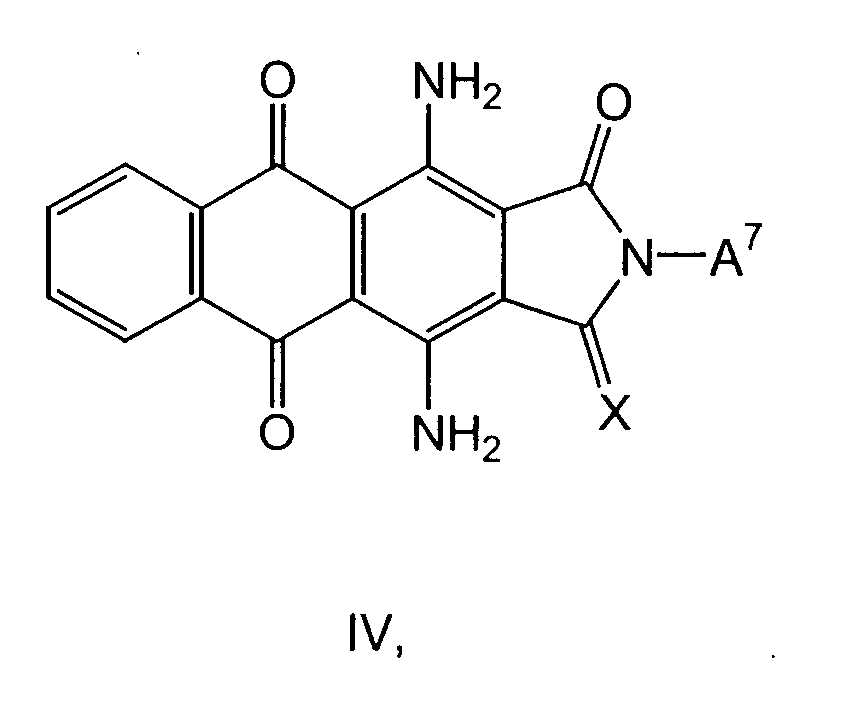
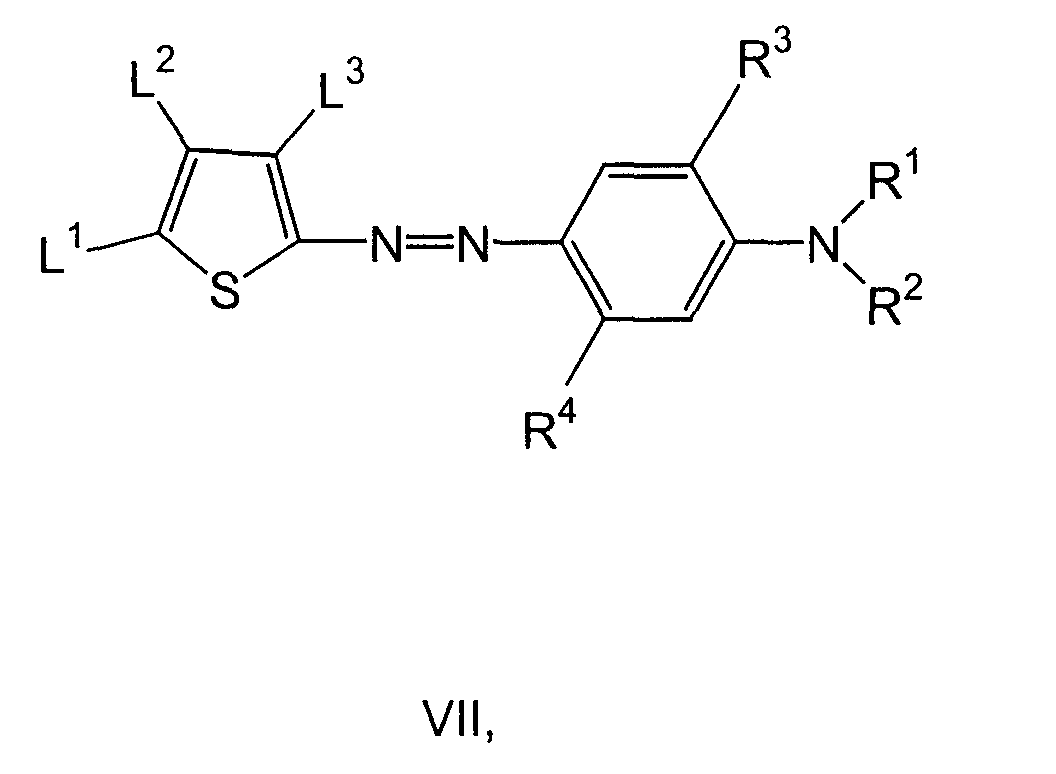
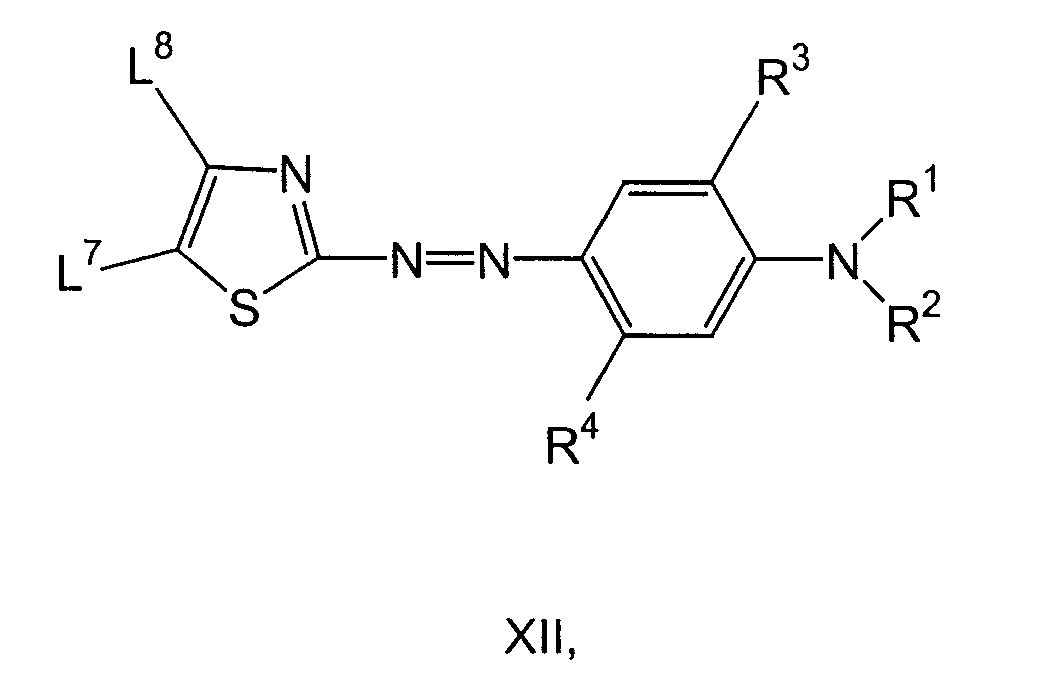
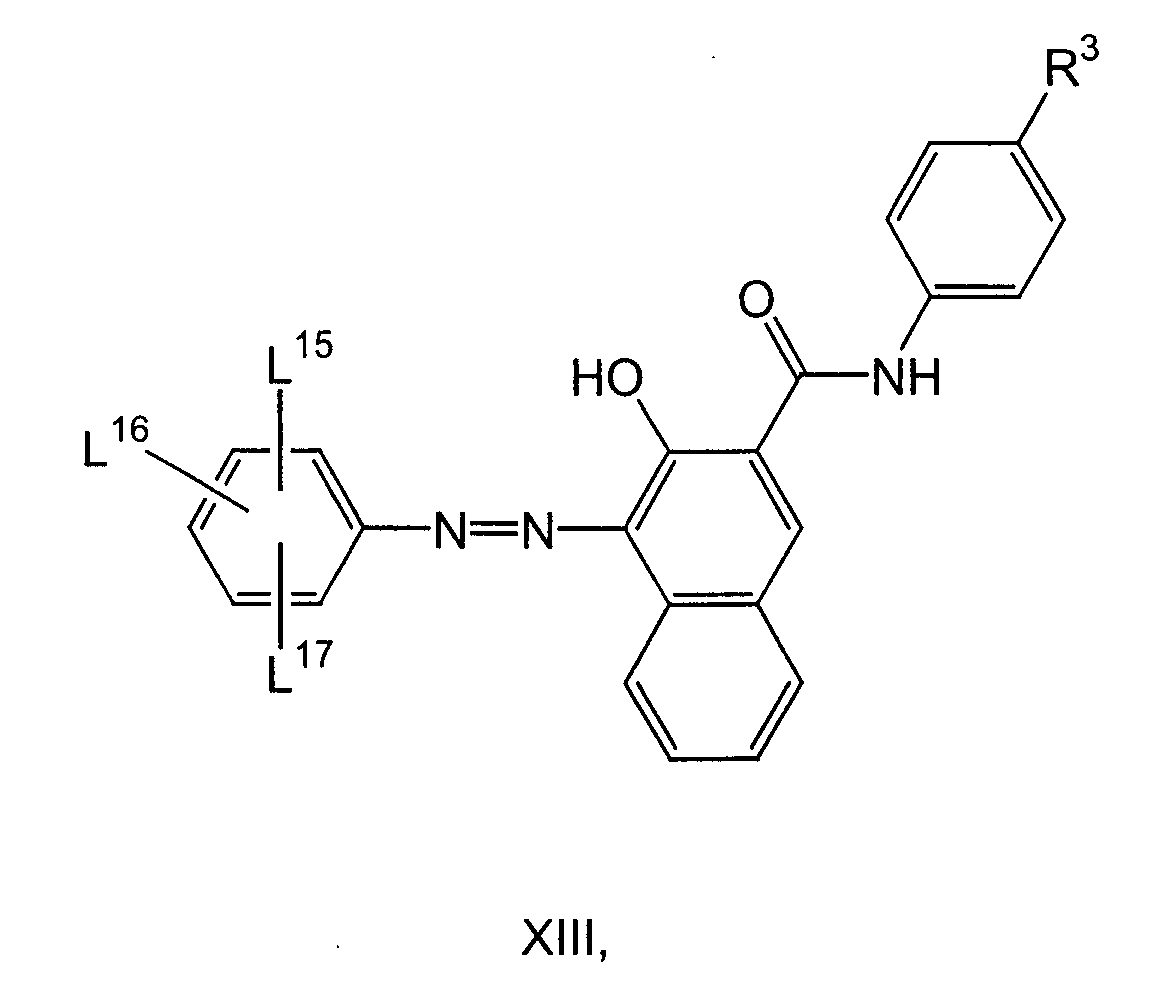
- This task was colored by providing a and / or printed nonwoven fabric from unsplit and / or at least partially split microfibers and / or microfilaments made of synthetic Polymers containing at least one polyester component and at least a polyamide component and optionally at least one Solved polyurethane component with at least one disperse dye selected from the group of compounds of the following general Formulas I to XIII, Palanil® Cyanin B and Dispersol® Deep Red SF colored and / or has been printed.
- substituents in the general formulas I to XIII given above represent an alkyl or alkylene radical or contain such a radical, these radicals can in each case be branched or unbranched. Unless otherwise stated, the alkyl radicals can preferably be substituted at least once, particularly preferably once or twice.
- the substituents on the alkyl radicals can preferably be selected from the group of cyclohexyl, phenyl, C 1-4 -alkylphenyl, C 1-4 -alkoxyphenyl, halophenyl, C 1-8 -alkanoyloxy, C 1-8 -alkylamino-carbonyloxy , C 1-20 alkoxycarbonyl, C 1-20 alkoxycarbonyloxy, cyclohexyloxy, phenoxy, halogen, hydroxy and cyano.
- the alkyl chain of the C 1-20 alkoxycarbonyl or C 1-20 alkoxycarbonyloxy radical optionally contains at least one ether group as a chain link in the alkyl chain and / or is optionally substituted with a phenyl or phenoxy radical.
- substituents in the general formulas I to XIII given above represent or contain a substituted phenyl radical, this can - unless otherwise stated - preferably be mono-, di- or trisubstituted.
- the substituents on the phenyl radical can preferably be selected from the group of C 1-8 alkyl, C 1-8 alkoxy, halogen, preferably Br or Cl, a CN and nitro group.
- radicals L 2 , L 8 , L 15 , L 16 , L 17 , R 1 , R 2 , R 3 , R 4 , R 8 , R 10 , R 11 , R 12 or R 13 in one of the above Formula represents an alkyl radical
- this can preferably be selected from the group of methyl, ethyl, propyl, isopropyl, butyl, isobutyl, sec-butyl, pentyl, isopentyl, neopentyl, tert-pentyl, hexyl and 2-methylpentyl.
- radical L 2 or L 8 in one of the formulas given above represents an alkylthio or an optionally substituted phenylthio radical
- this can preferably be selected from the group of methylthio, ethylthio, propylthio, isopropylthio, butylthio, isobutylthio, pentylthio, Hexylthio, benzylthio, 1-phenylethylthio, 2-phenylethylthio, phenylthio, 2-methylphenylthio, 2-methoxyphenylthio and 2-chlorophenylthio.
- one of the radicals L 2 , L 8 , L 15 , L 16 , L 17 , R 3 or R 4 in one of the formulas given above represents an alkoxy radical, this is preferably selected from the group of methoxy, ethoxy, propoxy , Isopropoxy, butoxy, isobutoxy, sec-butoxy, pentyloxy, isopentyloxy, neopentyloxy, tert. Pentyloxy, hexyloxy and 2-methylpentoxy.
- one of the radicals L 1 , L 2 , L 7 , L 8 , L 15 , L 16 , L 17 , R 10 , R 11 or R 12 in one of the formulas given above represents an alkyl or phenylsulfonyl radical, this can preferably are selected from the group consisting of methylsulfonyl, ethylsulfonyl, propylsulfonyl, isopropylsulfonyl, butylsulfonyl, isobutylsulfonyl, sec.
- butylsulfonyl pentylsulfonyl, Isopentylsulfonyl, Neopentylsulfonyl, hexylsulfonyl, phenylsulfonyl, 2-methylphenylsulfonyl, 2-methoxyphenylsulfonyl, and 2-chlorophenylsulfonyl.
- one of the radicals L 3 , L 7 , L 8 , L 14 , L 15 , L 16 or L 17 in one of the formulas given above represents an alkoxycarbonyl radical
- this can preferably be selected from the group of methoxycarbonyl, ethoxycarbonyl, Propoxycarbonyl, isopropoxycarbonyl, butoxycarbonyl, isobutoxycarbonyl and sec-butoxycarbonyl.
- one of the radicals L 15 , L 16 or L 17 in one of the formulas given above represents a substituted alkoxycarbonyl or phenylazo radical
- this can preferably be selected from the group of 2-phenoxyethoxycarbonyl, 2-phenoxypropoxycarbonyl, 3-phenoxypropoxycarbonyl, 2 -Phenoxybutoxycarbonyl, 4-phenoxybutoxycarbonyl, 4-phenylazo, 4-nitrophenylazo or 2,4-dinitro-6-bromophenylazo.
- radical L 2 or L 8 in one of the formulas given above represents an alkoxy radical substituted by an alkoxy radical or phenyl radical
- this can preferably be selected from the group of 2-methoxyethoxy, 2-ethoxyethoxy, 2-methoxypropoxy, 3-methoxypropoxy, 2-ethoxypropoxy, 3-ethoxypropoxy, 2-methoxybutoxy, 4-methoxybutoxy, 2-ethoxybutoxy, 4-ethoxybutoxy, 5-methoxypentyloxy, 5-ethoxypentyloxy, 6-methoxyhexyloxy, 6-ethoxyhexyloxy, benzyloxy 1-phenylethoxy and 2-phenylethoxy.
- one of the radicals R 1 , R 2 , R 11 , R 12 or R 13 in one of the formulas given above represents a C 5-7 cycloalkyl radical, this can preferably represent a cyclopentyl or cyclohexyl radical.
- one of the radicals L 1 or L 7 in one of the formulas given above represents a C 1-6 alkanoyl radical, this can preferably be selected from the group consisting of formyl, acetyl, propionyl, butyryl, isobutyryl, pentanoyl and hexanoyl.
- one of the radicals R 10 , R 11 or R 12 in one of the formulas given above represents a C 1-12 alkyl radical with optionally at least one ether group
- this can preferably be selected from the group of heptyl, octyl, 2- Ethylhexyl, nonyl, decyl, undecyl, dodecyl, 4,7-dioxanonyl, 4,8-dioxadecyl, 4,6-dioxaundecyl, 3,6,9-trioxaundecyl, 4,7,10-trioxaundecyl and 4,7,10- Trioxadodecyl.
- one of the radicals R 1 , R 2 , R 10 , R 11 or R 12 in one of the formulas given above represents an optionally substituted alkyl radical with optionally at least one ether group as chain link in the alkyl chain
- this can preferably be selected from the Group of 2-methoxyethyl, 2-ethoxyethyl, 2-propoxyethyl, 2-butoxyethyl, 2-isobutoxyethyl, 2-methoxypropyl, 3-methoxypropyl, 1-methoxyprop-2-yl, 2-ethoxypropyl, 3-ethoxypropyl, 2-propoxypropyl, 3-propoxypropyl, 3,6-dioxaheptyl, 3,6-dioxaoctyl, 4,7-dioxaoctyl, 2-hydroxyethyl, 3-hydroxypropyl, 4-hydroxybutyl, 2-phenoxyethyl, 2-phenoxypropyl, 4-phenoxybutyl, 2-cyan
- one of the radicals R 1 , R 2 , R 10 , R 11 or R 12 in one of the formulas given above represents a C 1-4 -alkoxycarbonyl-C 1-4 -alkyl radical
- this can preferably be selected from the Group of 2-methoxycarbonylethyl, 2-ethoxycarbonylethyl, 2-methoxycarbonylpropyl, 3-methoxycarbonylpropyl, 2-ethoxycarbonylpropyl, 3-ethoxycarbonylpropyl, 2-butoxycarbonylpropyl, 3-butoxycarbonylpropyl, 4-methoxycarbonylbutyl and 4-ethoxycarbonylbutyl.
- one of the radicals R 1 , R 2 , R 10 , R 11 or R 12 in one of the formulas given above represents a C 3-6 alkenyl radical, this can preferably be selected from the group of prop-2-enes -1-yl, 2-methyl-prop-2-en-1-yl, but-2-en-1-yl and but-3-en-1-yl.
- one of the radicals R 10 , R 11 or R 12 in one of the above formulas represents an alkanoyl or an optionally substituted benzoyl radical
- this can preferably be selected from the group consisting of formyl, acetyl, propionyl, butyryl, isobutyryl, Pentanoyl, hexanoyl, heptanoyl, octanyl, 2-ethylhexanoyl, benzoyl, 2-methylbenzoyl, 3-methylbenzoyl, 4-methylbenzoyl, 2-methoxybenzoyl, 3-methoxybenzoyl, 4-methoxybenzoyl, 2-chlorobenzoyl, 3-chlorobenzoyl and 4-chlorobenzoyl
- one of the radicals A 1 , A 2 or A 7 in one of the formulas given above represents an alkyl radical
- this can preferably be selected from the group of methyl, ethyl, propyl, isopropyl, butyl, isobutyl, sec-butyl, tert-butyl, pentyl, isopentyl, neopentyl, tert-pentyl, hexyl, 2-methylpentyl, heptyl, 1-ethylpentyl, octyl, 2-ethylhexyl and isooctyl.
- radical A 7 in one of the above formulas represents an alkyl radical with at least one ether group
- this can preferably be selected from the group of 2-methoxyethyl, 2-ethoxyethyl, 2-propoxyethyl, 2-isopropoxyethyl, 2-butoxyethyl, 2 -lsobutoxyethyl, 2-methoxypropyl, 3-methoxypropyl, 1-methoxyprop-2-yl, 2-ethoxypropyl, 3-ethoxypropyl, 2-propoxypropyl, 3-propoxypropyl, 2-butoxypropyl, 3-butoxypropyl, 2-methoxybutyl, 4-methoxybutyl , 2-ethoxybutyl, 4-ethoxybutyl, 2-propoxybutyl, 4-propoxybutyl, 3,6-dioxaheptyl, 3,6-dioxaoctyl, 4,8-dioxanonyl, 3,7-dio
- radical G 2 is a monoalkylsulfamoyl radical
- this can preferably be selected from the group of methylsulfamoyl, ethylsulfamoyl, propylsulfamoyl, isopropylsulfamoyl, butylsulfamoyl, pentylsulfamoyl, hexylsulfamoyl, heptylsulfamoyloylamylamyll, octylsulfamoyl, octylsulfamoyl, octylsulfamoyl, octylsulfamoyl, octylsulfamoyl, octylsulfamoyl, octylsulfamoyl, octylsulfamoyl, octylsulf
- one of the radicals A 1 or A 2 in one of the formulas given above represents an optionally substituted phenyl radical
- this can preferably be selected from the group of phenyl, 2-methylphenyl, 3-methylphenyl, 4-methylphenyl, 2- Ethylphenyl, 3-ethylphenyl, 4-ethylphenyl, 2-propylphenyl, 3-propylphenyl, 4-propylphenyl, 2-isopropylphenyl, 3-isopropylphenyl, 4-isopropylphenyl, 2-butylphenyl, 3-butylphenyl , 4-butylphenyl, 2,4-dimethylphenyl, 2-methoxyphenyl, 3-methoxyphenyl, 4-methoxyphenyl, 2-ethoxyphenyl-, 3-ethoxyphenyl-, 4-ethoxyphenyl-, 2-propoxyphenyl-, 3-propoxyphenyl-, 4-propoxyphenyl
- one of the radicals W 1 or W 2 in one of the formulas given above represents an alkyl radical, this can preferably be selected from the group of methyl, ethyl, propyl, isopropyl, butyl, isobutyl, sec-butyl and tert-butyl ,
- disperse dyes of the general formulas I to XIII are known per se and can be prepared according to customary methods known to the person skilled in the art Methods are manufactured or are on the market, for example under the Designations Dispersol®, Palanil®, Terasil®, Teratop®, Foron®, Dianix® or Available to buy Serilen®.
- the disperse dyes Palanil® Cyanin B and Dispersol® Deep Red SF are also commercially available.
- azo dyes of the above formulas II, VI, VII, VIII, IX, X, XII and XIII are, for example, in Venkataraman "The Chemistry of Synthetic Dyes ", Vol. VI, Academic Press, New York, London 1972 or in EP-0-201 896. The corresponding descriptions are hereby as Reference introduced and are considered part of the disclosure.
- the coumarin dyes of the above formulas III and XI are for example in Ullmann's Encyclopedia of Chemical Engineering, 4th edition, Volume 17, page 469.
- the corresponding literature description is hereby introduced as a reference and is considered part of the disclosure.
- the benzodifuranone dyes of formula I above are for example in Y. Ueda et al. "Sumikaron Brilliant Red S-BWF - a new Benzodifuranone-type disperse dye "in Sumitomo Kayaku Shi, 1994-II of 29. November 1994.
- the corresponding literature description will hereby introduced as a reference and is considered part of the disclosure.
- Further Benzodifuranone dyes (Chemical Abstract numbers 79694-17-0, 126877-05-2 and 126877-06-3) and their mixture are, for example, in Committee on Ways and Means, Subcommittee on Trade, Hearing Advisory, April 20, 2000, No. TR-20 described.
- the corresponding Literature description is hereby also introduced as a reference and is considered as Part of the revelation.
- a black or gray colored and / or printed is also preferred Nonwoven fabric made from unsplit and / or at least partially split Containing microfibers and / or microfilaments made of synthetic polymers at least one polyester component and at least one Polyamide component and optionally at least one Polyurethane component with a mixture of dyes from a Red dye, a yellow dye and a blue dye selected from the Group of the above-mentioned disperse dyes colored and / or has been printed.
- a black or gray colored and / or printed nonwoven fabric made of unsplit and / or at least partially split microfibers and / or microfilaments made of synthetic polymers containing at least one polyester component and at least one polyamide component and optionally at least one polyurethane component, which is mixed with a dye mixture of an orange dye of the general formula II given above, wherein L 15 and L 16 each for H, L 16 for a nitro group in the 4-position, R 1 for a radical - CH 2 CH 2 CN, R 2 for a radical -C 2 H 4 O-CO-CH 2 -O-phenyl and R 3 and R 4 each represent H, a red dye of the above general formula I, wherein A 1 represents a phenyl radical and A 2 represents the rest of the formula -C 6 H 4 -OCH 2 -CO-OC 2 H 4 -OC 2 H 5 or with Dianix® dark red AM-2B, and a blue dye of the above general formula II, preferably Dianix® dark
- polyester / polyamide microfibers or Polyester / polyamide microfilaments can preferably be made by methods as described in EP 0 814 188.
- the corresponding description is hereby introduced as a reference and is considered part of the disclosure.
- the titer of the microfibers present in the nonwoven fabric is preferably and / or microfilaments ⁇ 1 dtex.
- the polyamide component of the nonwoven preferably consists of polyamide 6, Polyamide 66 or polyamide 11.
- the polyester component of the nonwoven preferably consists of polyethylene terephthalate, polypropylene terephthalate, polybutylene terephthalate, polylactic acid, their mixtures or copolyesters.
- Corresponding copolyesters can be obtained either by partially exchanging the acid component and / or the diol component during the preparation of the polyester, as for example in Büttner "Basically Modified Polyester Fibers” in "Die Angewandte Makromolekulare Chemie” 40/41, 1974, page 57 -70 (No. 593) or GG Kulkarni, Colorage, August 21, 1986, pages 30 to 33.
- the corresponding literature descriptions are hereby introduced as a reference and are considered part of the disclosure.
- the nonwoven fabric used for coloring can also preferably be used as Polyester component have a polyester based on lactic acid, such as they are described in EP 1 091 028. The corresponding description is hereby introduced as a reference and is considered part of the disclosure.
- the nonwoven is a staple fiber nonwoven or a spunbonded nonwoven unsplit and / or at least partially split microfibers and / or Microfilaments.
- the production of such nonwovens can be done according to the usual Methods known to those skilled in the art are carried out.
- the production of such Spunbonded nonwovens can preferably be made by methods such as those in the EP 0 814 188. The corresponding description is hereby introduced as a reference and is considered part of the disclosure.
- the weight per unit area of the nonwoven used for coloring can vary over a wide range.
- the basis weight of the nonwoven is preferably 15 to 350 g / m 2 , particularly preferably 50 to 300 g / m 2 and very particularly preferably 80 to 200 g / m 2 .
- Another object of the present invention is a method for Dyeing and / or printing the described nonwoven according to which nonwoven used for dyeing or printing with at least one Disperse dye selected from the group consisting of compounds of the general formulas I to XIII given above, Palanil® Cyanin B and Dispersol® Deep Red SF is treated.
- the nonwoven fabric is colored with one or more of the above mentioned disperse dyes by the exhaust process, according to which Draws dye from the dye bath onto the nonwoven.
- the coloring can, if required, even in the presence of dyeing accelerators, so-called Carriers.
- the dyeing temperature, dyeing time and pH value can be changed during the Vary the coloring according to the exhaust method over a wide range.
- the dyeing temperature is preferably 60 to 145 ° C., particularly preferably 80 to 140 ° C and very particularly preferably 120 to 135 ° C.
- the dyeing time is preferably 5 to 120 minutes, particularly preferably 20 to 60 minutes and most preferably 25 to 45 minutes.
- the pH will preferably set to 2 to 11.
- the pH is particularly preferably in the acidic to neutral range, very particularly preferably 4 to 6.
- the dyebath is then preferably cooled and, if necessary, the dyed bath Nonwoven fabric preferably washed with water.
- the dyeing according to the exhaust process usually includes one Post-cleaning by customary methods known to those skilled in the art, preferably an acidic or alkaline, reductive post-cleaning to to remove excess or poorly adhering dye.
- alkaline reductive post-cleaning takes place at a temperature of 60 to 150 ° C, preferably at 80 to 85 ° C, with conventional, known to those skilled in the art Amounts of base and reducing agent such as sodium hydroxide and sodium hydrosulfite or thiourea dioxide.
- thermosol processes it is also preferred to carry out the method according to the invention, by one or more of the above disperse dyes mechanically by a continuous process, for example by padding, is applied to the nonwoven used for coloring and under thermal treatment, possibly in the presence of moisture, in the Fibers are migrated, dried and fixed.
- a continuous process for example by padding
- thermosol processes it is also known as thermosol processes.
- Padding is preferably carried out at a temperature of 5 to 100 ° C. particularly preferably from 10 to 40 ° C. and very particularly preferably at 15 up to 30 ° C.
- the fixing temperature and the fixing time can be changed during staining vary over a wide range according to this method.
- the fixing temperature is 80 to 240 ° C, particularly preferably 100 to 220 ° C and most preferably 150 to 210 ° C.
- the fixing time is preferred 1 second to 30 minutes, particularly preferably 15 seconds to 10 minutes and most preferably 45 seconds to 5 minutes.
- the coloring usually a subsequent cleaning follows the usual, the expert known methods, preferably an acidic or alkaline, reductive Post-cleaning, on.
- Alkaline reductive post-cleaning is preferred at a temperature of 60 to 150 ° C, preferably at 80 to 85 ° C with usual amounts of base and reducing agent known to the person skilled in the art, such as sodium hydroxide and sodium hydrosulfite or Thiourea dioxide.
- the nonwoven fabric with one or more of the above Disperse dyes are printed, this can be done according to the usual, the expert known methods.
- the corresponding printing paste can be after usual methods known to those skilled in the art are prepared and contains preferably at least the selected disperse dye (s) and a thickener.
- the nonwoven is preferably printed with a Direct printing process, particularly preferably with a rotary, screen or Inkjet printing process, the desired pattern using a Printing stencil on which nonwoven is printed.
- the nonwoven fabric is also preferably printed using a transfer printing process, where one or more of the above Disperse dyes, if appropriate in the presence of color accelerators (Carriers) and / or other customary auxiliaries known to the person skilled in the art, such as. Wetting or anti-migration agents, first on a transfer medium, such as. Paper, padded or printed, dried and then under Exposure to pressure and heat is transferred to the nonwoven.
- the Exposure time is preferably 1 second to 30 minutes, especially preferably 10 seconds to 5 minutes and very particularly preferably 30 to 120 seconds.
- the temperature on exposure is preferably 100 to 240 ° C, particularly preferably 150 to 220 ° C and very particularly preferred 175 to 215 ° C.
- the appropriate pressure and temperature can can be determined by a specialist on the basis of simple preliminary tests.
- Post-cleaning is usually followed by post-cleaning according to the usual methods known to the person skilled in the art, preferably an acidic or alkaline method, reductive post-cleaning, on.
- An alkaline, reductive is preferred Post-cleaning at a temperature of 60 to 150 ° C, preferably at 80 to 85 ° C, with conventional amounts of base and Reducing agents such as e.g. Sodium hydroxide and sodium hydrosulfite or Thiourea dioxide.
- the transfer printing process can also be carried out with pretreatment of the Printing the nonwoven fabric with a dye accelerator (carrier) be carried out as described, for example, in “The New THK Textile Aid Catalog 2000 ", Deutscher fraverlag GmbH 1999, Frankfurt am Main, pages 86 to 88 or in "Rath Textbook of Textile Chemistry", 3rd edition Springer Verlag Berlin, Heidelberg, New York, 1972 pages 625 and 626.
- a dye accelerator carrier
- the ecologically compatible, chloroaromatic-free carriers based on polyglycol ethers, N-alkyl phthalimides, Carboxylic acid compounds, fatty alcohol ethoxylates and Alkylamides, alkylarylsulfonates, aromatic hydrocarbons or Mixtures of at least two of these compounds can be used.
- the carrier is usually padded onto the nonwoven fabric, dried and optionally fixed at temperatures of preferably 150 to 240 ° C., particularly preferably 175 to 215 ° C.
- the person skilled in the art can determine the suitable amount of the respective carrier with the aid of simple preliminary tests.
- the non-woven fabric pretreated in this way can then be printed in accordance with the previously described transfer printing process. Pretreatment with a carrier often leads to an increased and thus improved color depth of the printed nonwoven.
- the fixation of the disperse dye can, if necessary, after Intermediate drying of the nonwoven, after padding or printing after the direct printing or transfer process also with heated rollers elevated temperatures.
- the temperature is preferably around Softening point of the polymers used.
- the nonwoven fabric With conventional, known to the expert Reserve funds. By reservation, the printed dye not accepted or destroyed at the reserved location, so that when Printing the nonwoven fabric creates the desired pattern.
- the coloring effect of the disperse dyes and the fastness of the coloring can, depending on that, for coloring or printing used methods or the amount of dye used vary.
- the appropriate amount of disperse dye and the corresponding Conditions that are required to achieve the desired coloration of the Achieving nonwoven fabric can be done by the expert by simple preliminary tests be determined.
- the nonwovens used according to the invention often have one unwanted shrinkage, such as a washing or Ironing shrink.
- the nonwoven fabric can shrink at temperatures of preferably 60 to 130 ° C under mechanical influence.
- This treatment can preferably be as Post-treatment after dyeing and / or printing with the above specified disperse dyes at a temperature of preferably 60 to 130 ° C are carried out.
- the treatment can be preferably low-tension or Connect tension-free drying of the nonwoven. This can be optional without side guidance with continuous operation or as a strand in Tumble with discontinuous work done.
- the process is carried out after the dyeing or printing of the nonwoven or after the reductive cleaning or during or after the equipment of the Nonwoven fabric or after its packaging, an aftertreatment with a the color fastness improving agent carried out.
- the color fastness in particular further improves the wet fastness of the dyed or printed nonwoven become.
- Preferred agents for improving color fastness are preferred Compounds selected from the group of optionally substituted Aryl sulfonic acids, hydroxyarylsulfonic acids, aryl sulfonates, Hydroxyarylsulfonaten, Alkylarylsulfonaten, polycondensed functional Amines, monomeric or polymeric quaternary ammonium compounds as well where appropriate, their corresponding condensation products are used. These are for example in "Der Eisen THK-Textile Aid Catalog 2000", German suverlag GmbH 1999, Frankfurt am Main, pages 98-109 and 132-134 described. The corresponding description is hereby used for reference introduced and is considered part of the revelation.
- the agent used to improve the color fastness is preferred in an amount of 0.1 to 15% by weight, preferably 2 to 5% by weight on the nonwoven or other textile material used, the rinsing bath added, which is the dyeing and / or printing with the above specified disperse dyes or cleaning.
- the Rinse bath preferably has a temperature of 20 to 150 ° C, especially preferably from 40 to 70 ° C.
- the duration of the rinsing process is preferably 1 to 150 minutes, preferably 20 to 100 minutes.
- the treatment with the color fastness improving agent also take place during the finishing process, whereby the agent preferably integrated into the equipment fleet.
- the agent preferably integrated into the equipment fleet.
- Agent in this case in an amount of 0.1 to 100 g / l liquor, especially preferably in an amount of 20 to 50 g / l liquor, added to the liquor.
- the agent preferably undergoes heat treatment at a temperature of 70 to 150 ° C are carried out. This can e.g. even during the drying of the Nonwoven or when fixing the equipment chemicals.
- the process can also be used for dyeing or printing the nonwoven at least one of the above-mentioned disperse dyes Exception of dye mixtures, the Dispersol® Deep Red SF, Dispersol® Marine XF and optionally Dispersol® Yellow-Brown XF contain another Dyeing or printing the polyamide component with a dye selected from the group of vat dyes, leuco vat dyes, Sulfur dyes and soluble sulfur dyes according to the usual Methods known to those skilled in the art are carried out. Coloring with the different Dye classes can preferably also take place in a dye bath.
- vat dyes Suitable vat dyes, leuco vat dyes, sulfur dyes and Soluble sulfur dyes are known to the person skilled in the art.
- the colored or printed nonwoven can be treated with a color-deepening aid.
- All chemicals that change the angle of refraction of the light on the surface of the nonwoven fabric, for example by forming a film, such that the calculation index between the air and the nonwoven fabric has a value greater than 1 are suitable as color-deepening agents.
- Suitable chemicals are, for example, polyacrylates, polyurethanes and polysiloxanes, which are also commercially available under the name Badena® Eco 282, Finistrol® KSE-D, Baypret® USV and Arristan® 64.
- the color-deepening auxiliary can be applied by customary methods known to the person skilled in the art.
- the color-deepening can preferably be applied to the textile material, preferably to the nonwoven fabric used in accordance with the invention, and at temperatures from 40 to 12 using the padding process at a pH of 2 to 12, preferably 3 to 9, particularly preferably 4 to 8 180 ° C, preferably 100 to 160 ° C for a period of 1 second to 120 minutes, preferably from 5 seconds to 45 minutes, particularly preferably from 30 seconds to 2 minutes.
- the respectively suitable amount of the color-deepening agent can vary and can be determined by a person skilled in the art by simple preliminary tests.
- the suitable amount is preferably 10 to 100 g / l liquor, particularly preferably 20 to 50 g / l liquor.
- the finishing liquor can also contain other auxiliary agents known to those skilled in the art, such as, for example, gripping agents, plasticizers, additives for crease-free finishing, hydrophilizing agents, antistatic agents, hydrophobizing agents or oleophobicizing agents, as described, for example, in "The New THK Textile Aid Catalog 2000", Deutscher fraverlag GmbH 1999, Frankfurt am Main, pages 141-261. The corresponding description is hereby introduced as a reference and is considered part of the disclosure.
- the equipment fleet can also contain the authenticity-improving agents described above.
- the nonwoven fabric printed and / or dyed according to the invention from unsplit and / or at least partially split microfibers and / or microfilaments made of synthetic polymers containing at least one polyester component and at least one polyamide component and optionally at least a polyurethane component is characterized by good color levelness, adequate color fastness even after heat treatment, especially Wash, sweat, water and rub fastness as well as sufficient Fastness to chemical cleaning and a good depth of color.
- the fastness to washing of the colored and / or printed according to the invention Nonwoven was made according to EN ISO 105 C06 A2S, the sweat fastness according to EN ISO 105 E04, water fastness according to EN ISO 105 E01, rub fastness EN ISO 105 X12, the light fastness according to EN ISO 105 B02 and the fastness chemical cleaning (dry cleaning) determined according to EN ISO 105 D01.
- EN ISO 105 C06 A2S The fastness to washing of the colored and / or printed according to the invention Nonwoven was made according to EN ISO 105 C06 A2S, the sweat fastness according to EN ISO 105 E04, water fastness according to EN ISO 105 E01, rub fastness EN ISO 105 X12, the light fastness according to EN ISO 105 B02 and the fastness chemical cleaning (dry cleaning) determined according to EN ISO 105 D01.
- the corresponding descriptions are hereby introduced as a reference and are therefore considered part of the revelation.
- the reflectance values R were determined using a Coloraflash colorimeter C22S measured by the company Optronik.
- a spunbonded nonwoven fabric consisting of partially split microfilaments made of 70% by weight of polyethylene terephthalate and 30% by weight of polyamide 66 with a basis weight of 100 g / m 2 and a titer of approximately 0.15 dtex was produced in a one-step exhaust process with a liquor ratio of 1:10 with 2% by weight (based on the weight of the nonwoven used) of the disperse dye Teratop® Blau BGE (disperse dye of the general formula IV, where X is O and A 7 is a 3-methoxypropyl radical, Color Index: Disperse Blue 60) colored.
- the disperse dye Teratop® Blau BGE (disperse dye of the general formula IV, where X is O and A 7 is a 3-methoxypropyl radical, Color Index: Disperse Blue 60) colored.
- the dye was dispersed with 2 g / l liquor of a dispersant based on a fatty amine ethoxylate and 1 g / l liquor of a sequestering agent based on an organic acid and salts.
- the pH was adjusted to 4.5 with ammonium acetate / acetic acid.
- the mixture was then heated to 130 ° C. at a rate of 1.5 ° C. per minute, dyed at this temperature for 45 minutes and cooled to 80 ° C. at 1.5 ° C. per minute.
- the dyed nonwoven fabric was then rinsed under cold running water for 5 minutes.
- a spunbonded nonwoven fabric consisting of partially split microfilaments made of 70% by weight of polyethylene terephthalate and 30% by weight of polyamide 66 with a basis weight of 100 g / m 2 and a titer of approximately 0.15 dtex was used in the padding process with a liquor, the 2nd g / l liquor of a wetting agent based on an alkyl phosphate, 10 g / l liquor of an anti-migration agent based on acrylate copolymers and 60 g / l liquor of the disperse dye Palanil® fluorescent red B, colored. The pH was adjusted to 6.5 with acetic acid. The fleet intake was 100%. After padding, the dyed nonwoven fabric was dried at 130 ° C.
- the dyed nonwoven fabric was then rinsed under cold, flowing water for 5 minutes and carried out by reductive cleaning with 6 ml / l of a 32% strength by weight sodium hydroxide solution and 2 g / l of sodium hydrosulfite for 20 minutes at 85.degree , It was then rinsed again with cold water, neutralized with acetic acid and rinsed again with cold water for 1 minute.
- a spunbonded nonwoven consisting of partially split microfilaments made of 70% by weight of polyethylene terephthalate and 30% by weight of polyamide 66 with a basis weight of 100 g / m 2 and a titer of approximately 0.15 dtex was produced in a direct printing process with a printing paste, the 975 g / kg of a stock paste consisting of 500 g / kg of a natural alginate thickener, 10 g / kg of a mild oxidizing agent based on nitrobenzenesulfonate, 12 g / kg of a fixing aid based on alkyl amide and 4 g / kg of a defoamer based on alcohol and 474 g / kg of water and 25 g / kg of the disperse dye Palanil® Navy Blue 3GR-CF (disperse dye of the general formula II, in which L 15 for a nitro group in the 2-position, L 16 for a nitro group in the 4- Position, L 17 for a
- the reductive cleaning was carried out with 6 ml / l float of a 32% by weight sodium hydroxide solution and 2 g / l float sodium hydrosulfite for 20 minutes at 85 ° C. It was then rinsed again with cold water, neutralized with acetic acid and rinsed again with cold water for 1 minute. To deepen the color, the dyed nonwoven fabric was then padded with a liquor which contained 25 g / l liquor of the polyacrylate Badena® Eco 282, at pH 6, adjusted with acetic acid. The wet pick-up was 100% by weight. The mixture was then dried at 100 ° C. for 120 seconds and fixed at 150 ° C. for 60 seconds.
- a spunbonded nonwoven fabric consisting of partially split microfilaments made of 70% by weight of polyethylene terephthalate and 30% by weight of polyamide 66 with a basis weight of 100 g / m 2 and a titer of approximately 0.15 dtex was used with a liquor which was 40 g / l Fleet of a carrier based on an N-alkylphthalimide / carboxylic ester preparation contained, padded. The wet pick-up was approximately 100% by weight. The mixture was then dried at 110 ° C. for 150 seconds and fixed at 180 ° C. for 60 seconds. The nonwoven fabric pretreated in this way was treated for 45 seconds at a pressure of 1.2 bar and a temperature of 210 ° C.
- a spunbonded nonwoven fabric consisting of partially split microfilaments made of 35% by weight of polyamide 66 and 65% by weight of polyethylene terephthalate is dyed in a one-step exhaust process with the sublimation-resistant disperse dye Dispersol® Rubin XF (mixture of at least two red dyes of the general formula II).
- the disperse dye is stirred in 1 g / l liquor of the wetting agent Sandacid®PB (Clariant) and 2 g / l of the dispersant Sandogen® EDP (Clariant).
- the pH is adjusted to pH 4.5 with acetic acid.
- the fleet ratio is 1:10.
- the coloring takes place in 45 min at 130 ° C.
- a spunbonded nonwoven consisting of partially split microfilaments made of 35% by weight of polyamide 66 and 65% by weight of polyethylene terephthalate is extracted in a one-step process using the disperse dye Dispersol® Yellow Brown XF (disperse dye of the general formula II, in which L 15 is a Cl residue in the 2-position, L 16 for a nitro group in the 4-position, L 17 for a Br radical in the 6-position, R 1 and R 2 each for a methoxycarbonylethyl radical and R 3 and R 4 each for H. , Color Index Disperse Brown 19). This is followed by reductive cleaning with sodium dithionite.
- Disperse dye Dispersol® Yellow Brown XF disperse dye of the general formula II, in which L 15 is a Cl residue in the 2-position, L 16 for a nitro group in the 4-position, L 17 for a Br radical in the 6-position, R 1 and R 2 each for a methoxycarbonylethyl radical and R 3 and R
- a spunbonded nonwoven consisting of partially split microfilaments made of 35% by weight of polyamide 66 and 65% by weight of polyethylene terephthalate is mixed with the disperse dye Teratop® Blau BGE (disperse dye of the general formula IV, where X is O and A 7 is a 3-methoxypropyl -Rest is printed, Color Index: Disperse Blue 60, Ciba Specialty Chemicals). Reductive cleaning with sodium dithionite is then carried out. The dispersion stain is then treated with 3% Mesitol®NBSJ at 70 ° C for 20 min. Finally, rinse with cold water.
- the disperse dye Teratop® Blau BGE (disperse dye of the general formula IV, where X is O and A 7 is a 3-methoxypropyl -Rest is printed, Color Index: Disperse Blue 60, Ciba Specialty Chemicals).
- Reductive cleaning with sodium dithionite is then carried out.
- the dispersion stain is then treated
Landscapes
- Engineering & Computer Science (AREA)
- Textile Engineering (AREA)
- Nonwoven Fabrics (AREA)
- Treatment Of Fiber Materials (AREA)
- Treatments For Attaching Organic Compounds To Fibrous Goods (AREA)
- Coloring (AREA)
Abstract
Description

A1 und A2, gleich oder verschieden, für H, einen C1-8-Alkyl- oder einen gegebenenfalls substituierten Phenyl-Rest, vorzugsweise für einen gegebenenfalls in ortho-, meta- oder para-Stellung mit einem C1-8-Alkoxy- oder -O-CH2-C3-7-Cycloalkyl-Rest substituierten Phenyl-Rest stehen, wobei die Alkylkette des Alkoxy-Restes oder der Cycloalkyl-Ring gegebenenfalls zumindest eine Ethergruppe als Ketten- bzw. Ringglied aufweist oder für einen Rest der Formel -C6H4-OCH2-COOC2H4OC2H5 stehen,



einer der Reste A5 oder A6 für einen Hydroxyl-Rest steht und der jeweils andere Rest A5 oder A6 die Gruppe NH-A1' bedeutet, worin A1' für H, einen C1-8-Alkyl-Rest oder einen gegebenenfalls substituierten Phenyl-Rest steht,
oder die Reste A5 und A6 jeweils für H stehen,



gefärbt und/oder bedruckt worden ist.
gefärbt und/oder bedruckt worden ist.
Polyester/Polyamid-Mikrofilamente kann vorzugsweise nach Verfahren erfolgen, wie sie in der EP 0 814 188 beschrieben werden. Die entsprechende Beschreibung wird hiermit als Referenz eingeführt und gilt als Teil der Offenbarung.
Entsprechende Copolyester lassen sich entweder durch teilweisen Austausch der Säure-Komponente und/oder der Diol-Komponente bei der Herstellung des Polyesters erhalten, wie beispielsweise in Büttner "Basisch modifizierte Polyesterfasern" in "Die Angewandte Makromolekulare Chemie" 40/41, 1974, Seiten 57-70 (Nr. 593) oder G.G. Kulkarni, Colourage, 21. August 1986, Seiten 30 bis 33 beschrieben. Die entsprechenden Literaturbeschreibungen werden hiermit als Referenz eingeführt und gelten als Teil der Offenbarung.
Der so vorbehandelte Vliesstoff kann dann gemäß dem zuvor beschriebenen Transfer-Druckverfahren bedruckt werden.
Die Vorbehandlung mit einem Carrier führt vielfach zu einer erhöhten und damit verbesserten Farbtiefe des bedruckten Vliesstoffs.
Geeignete Zusatzstoffe sind beispielsweise in den entsprechenden Musterkarten der Farbstoffhersteller sowie in "Der neue THK-Textilhilfsmittelkatalog 2000", Deutscher Fachverlag GmbH 1999, Frankfurt am Main, Seiten 57 bis 140 beschrieben. Die entsprechende Beschreibung wird hiermit als Referenz eingeführt und gilt somit als Teil der Offenbarung.
Sofern der gebildete Film aus Chemikalien besteht, welche die Farbstoffe auch gegen äußere Einflüsse schützen, wie z.B. Badena® Eco 282, so kann gleichzeitig auch eine Verbesserung der Farbechtheit erzielt werden.
Das farbvertiefende Hilfsmittel kann nach üblichen, dem Fachmann bekannten Methoden aufgebracht werden. Vorzugsweise kann das farbvertiefende mit Hilfe des Klotzverfahrens bei einem pH-Wert von 2 bis 12, vorzugsweise von 3 bis 9, besonders bevorzugt von 4 bis 8 auf das textile Material, vorzugsweise auf den erfindungsgemäß zum Einsatz kommenden Vliesstoff aufgebracht und bei Temperaturen von 40 bis 180 °C, vorzugsweise 100 bis 160 °C während einer Dauer von 1 Sekunde bis 120 Minuten, bevorzugt von 5 Sekunden bis 45 Minuten, besonders bevorzugt von 30 Sekunden bis 2 Minuten fixiert. Die jeweils geeingete Menge des farbvertiefenden Mittels kann variieren und kann vom Fachmann durch einfach Vorversuche ermittelt werden. Für Badena® Eco 282 beträgt die geeignete Menge vorzugsweise 10 bis 100 g/l Flotte, besonders bevorzugt 20 bis 50 g/l Flotte.
Die Ausrüstungsflotte kann dabei neben dem farbvertiefenden Hilfsmittel auch noch andere, dem Fachmann bekannte Hilfsmittel, wie beispielsweise griffgebende Mittel, Weichmachungsmittel, Additive zur Knitterfreiausrüstung, Hydrophilisierungsmittel, Antistatika, Hydrophobiermittel oder Oleophobiermittel enthalten, wie sie z.B. in "Der neue THK - Textilhilfsmittelkatalog 2000", Deutscher Fachverlag GmbH 1999, Frankfurt am Main, Seiten 141-261 beschrieben sind. Die entsprechende Beschreibung wird hiermit als Referenz eingeführt und gilt als Teil der Offenbarung. Daneben kann die Ausrüstungsflotte ferner auch die vorstehend beschriebenen echtheitsverbessernden Agenzien enthalten.
- λmax
- Wellenlänge im Absorbtionsmaximum
- R
- Remissionswert im Absorbtionsmaximum (λmax)
Die Farbechtheiten nach einer Hitzebehandlung bei 180 °C für 1 Minute, die die Sublimationsbeständigkeit der Färbung belegen soll, sowie die Farbvertiefung, die sich durch die Nachbehandlung ergibt, sind in der nachfolgenden Tabelle 1 aufgeführt.
Zur Farbvertiefung wurde der gefärbte Vliesstoff anschließend mit einer Flotte geklotzt, die 25 g/l Flotte des Polyacrylates Badena® Eco 282 enthielt, bei pH 6, eingestellt mit Essigsäure, enthielt. Die Naßaufnahme lag bei 100 Gew.-%. Anschließend wurde 120 Sekunden bei 100 °C getrocknet und 60 Sekunden bei 150 °C fixiert.
Im Vergleich zu einer unbehandelten Färbung werden bei der mit Mesitol®NBSJ behandelten Färbung nach Hitzebehandlung 1 min bei 180°C deutlich bessere Farbechtheiten, wie aus Tabelle 2 ersichtlich ist.
| Farbechtheiten | ||||||
| Wäsche 40°C EN ISO 105 C06-A2S | Schweiß sauer EN ISO 105 E04 | Schweiß alkalisch EN ISO 105 E04 | Wasser EN ISO 105 E01 | Trockenreinigung EN ISO 105 D01 | Reibechtheit EN ISO 105 X 12 | |
| Beispiel 1 | 3-4S / 4C | 4S / 4C | 4S / 4-5C | 4S / 4-5C | 4-5S / 4-5C | 4-5 trocken |
| Teratop® Blau BGE | 4-5-naß | |||||
| Beispiel 2 | 4S / 4C | 4S / 3-4C | 4S / 3-4C | 4S / 4C | 4-5S / 4C | 4-5 trocken |
| Palanil® Leuchtrot B | 4-5-naß | |||||
| Beispiel 3 | 4S / 4C | 4-5S / 4C | 4S / 4C | 4-5S / 4-5C | 4S / 4C | 4-5 trocken |
| Palanil® Marineblau | 4-5-naß | |||||
| 3GR-CF | ||||||
| Beispiel 4 | 4S / 4C | 4-5S / 4-5C | 4-5S / 4-5C | 4-5S / 4-CC | 4S / 3-4C | 4-5 trocken |
| Palanil® Rot3BLS-CF | 4-5-naß | |||||
| Note 5 = sehr gut; Note 1 = sehr schlecht | ||||||
| S = Anbluten von Multifaser-Begleitgewebe // C = Farbänderung der Probe |
| Farbvertiefung: | ||
| K/S-Wert vor Behandlung mit dem farbvertiefenden Hilfsmittel | K/S-Wert nach Behandlung mit dem farbvertiefenden Hilfsmittel | |
| Beispiel 1 | ||
| Teratop® Blau BGE | 2,0 (bei λmax = 680 nm) | 2,4 (bei λmax = 680 nm) |
| Beispiel 3 | ||
| Palanil® Marineblau 3 GR- | 4,2 (bei λmax = 618 nm) | 4,8 (bei λmax = 618 nm) |
| CF |
| Vergleich der Farbechtheiten von unbehandelten und behandelten Färbungen: | ||||||
| Beispiel 5 Farbe: rotviolett | Beispiel 7 Farbe: orange | Beispiel 8 Farbe: blau | ||||
| unbehandelt | behandelt | unbehandelt | behandelt | unbehandelt | behandelt | |
| Wäsche 40°C | 3-4S / 4C | 4S / 4C | 3-4S / 3-4C | 4S / 3-4C | 3S / 4C | 4S / 4C |
| EN ISO 105 C06-A2S | ||||||
| Wasser | 4S / 4C | 4-5S / 4C | 3-4S / 4C | 4-5S / 4C | 4S / 4-5C | 4-5S / 4-5C |
| EN ISO 105 E01 | ||||||
| Schweiß sauer | 3-4S / 4C | 4S / 4C | 3-4S / 4C | 4-5S / 4C | 45 / 4C | 4-5S / 4C |
| EN ISO 105 E04 | ||||||
| Schweiß alkalisch | 3S / 4C | 3-4S / 4C | 3S / 3-4C | 4S / 3-4C | 4S / 4C | 4-5S / 4C |
| EN ISO 105 E04 |
| Beispiel 9 Farbe: rot | Beispiel 6 Farbe: rotviolett | ||
| unbehandelt | behandelt | unbehandelt | behandelt |
| 4-5S / 4-5C | 4-5S / 4-5C | 3-4S / 4C | 4S / 4C |
| 3S / 4-5C | 4S / 4-5C | 4S / 4C | 4-5S / 4C 4C |
| 3-4S / 4C | 4-5S / 4C | 3-4S / 4C | 4S / 4C |
| 3S / 4-5C | 4S / 4-5C | 3-4S / 4C | 4S / 4C |
| Note 5 = sehr gut; Note 1 = sehr schlecht | |||
| S = Anbluten von Begleitgewebe // C = Farbänderung der Probe |
Farbe: rotviolett
1,10 % Dispersol®Rubin XF
Farbe: orange
1,20% Dispersol®Gelbbraun XF (BASF)
Farbe: blau
2,00 % Teratop®Blau BGE (Ciba)
Farbe: rot
1,10 % Dispersol®Tiefrot SF (BASF)
3,00 % Indanthren® Rot FBB (BASF)
Farbe: rotviolett
1,10% Dispersol®Rubin XF
3,00% Indanthren®Rot FBB (BASF)
Claims (42)
- Gefärbter und/oder bedruckter Vliesstoff aus ungesplitteten und/oder zumindest teilweise gesplitteten Mikrofasern und/oder Mikrofilamenten aus synthetischen Polymeren enthaltend wenigstens eine Polyesterkomponente und wenigstens eine Polyamidkomponente und gegebenenfalls wenigstens eine Polyurethankomponente, dadurch gekennzeichnet, daß er mit wenigstens einem Dispersionsfarbstoff ausgewählt aus der Gruppe von1, Verbindungen der allgemeinen Formel Iworin
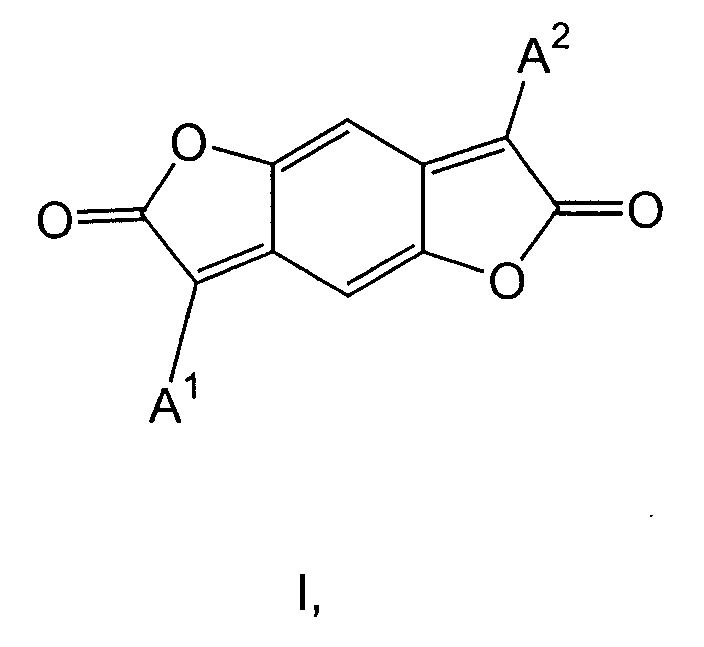 A1 und A2, gleich oder verschieden, für H, einen C1-8-Alkyl- oder einen gegebenenfalls substituierten Phenyl-Rest stehen,2, Verbindungen der allgemeinen Formel IIworin
 L15, L16 und L17, gleich oder verschieden, für H, Halogen, einen C1-6-Alkyl- oder C1-6-Alkoxy-Rest, eine Nitro- oder Cyano-Gruppe, einen C1-6-Alkylsulfonyl-Rest oder für einen gegebenenfalls substituierten C1-4-Alkoxycarbonyl-, Phenylsulfonyl- oder Phenylazo-Rest stehen,R1 und R2, gleich oder verschieden, für H, einen gegebenenfalls substituierten C1-6-Alkyl-Rest mit gegebenenfalls zumindest einer Ethergruppe als Kettenglied in der Alkylkette, einen C1-4-Alkoxycarbonyl-C1-4-alkyl, einen Aryloxy-C1-4-alkylcarbonyloxy-C1-4-alkyl, einen C1-4-Alkoxycarbonyloxy-C1-4-alkyl-, einen C5-7-Cycloalkyl-, einen ggf. substituierten Benzyl- oder einen C3-6-Alkenyl-Rest stehen,R3 für H, einen C1-6-Alkyl- oder C1-6-Alkoxy-Rest steht,R4 für H, einen C1-6-Alkyl-, C1-6-Alkoxy-, C1-6-Alkylsulfonylamino- oder für einen gegebenenfalls substituierten C1-6-Alkanoylamino- oder Benzoylamino-Rest steht,3, Verbindungen der allgemeinen Formel IIIworin
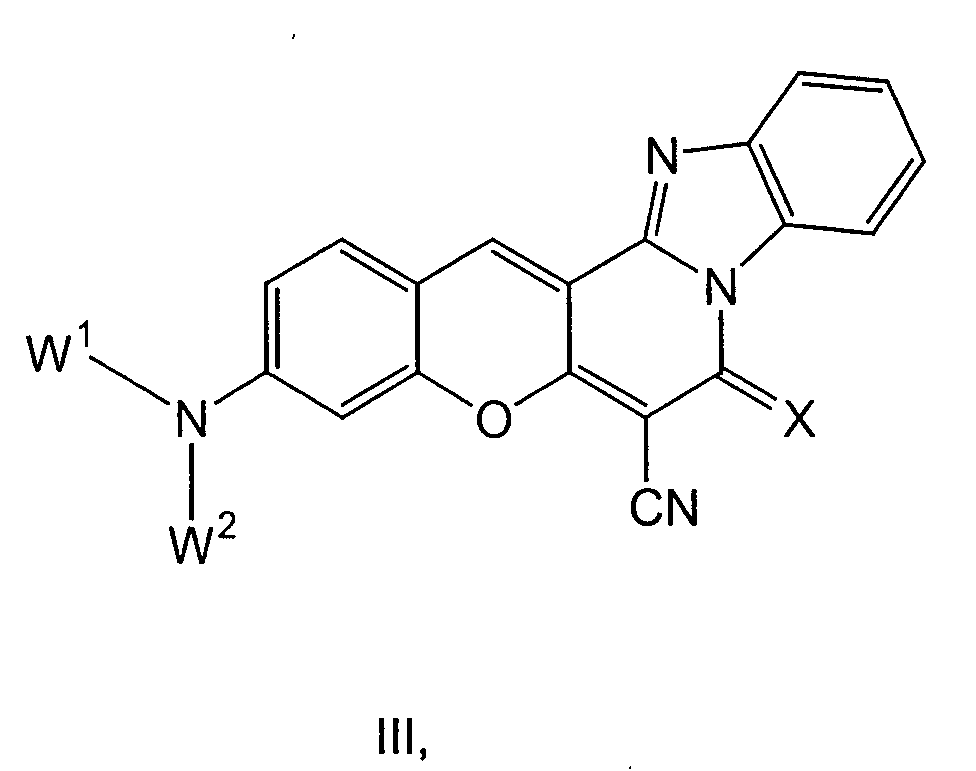 W1 und W2, gleich oder verschieden, für einen C1-4-Alkyl-Rest stehen,X für ein Sauerstoffatom, Schwefelatom oder eine Imino-Gruppe steht,4, Verbindungen der allgemeinen Formel IVworin
 A7 für H oder für einen C1-8-Alkyl-Rest mit gegebenenfalls zumindest einer Ethergruppe als Kettenglied in der Alkylkette steht,X für ein Sauerstoffatom, ein Schwefelatom oder eine Iminogruppe steht,5, Verbindungen der allgemeinen Formel Vworin
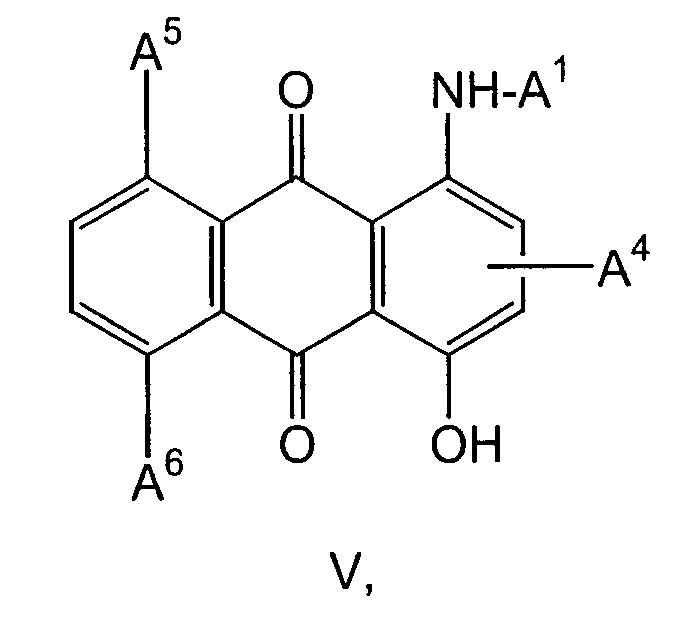 einer der Reste A5 oder A6 für einen Hydroxyl-Rest steht und der jeweils andere Rest A5 oder A6 die Gruppe NH-A1' bedeutet, worin A1' für H, einen C1-8-Alkyl-Rest oder einen gegebenenfalls substituierten Phenyl-Rest steht,A1 für H, einen C1-8-Alkyl-Rest oder für einen gegebenenfalls substituierten Phenyl-Rest steht,A4 für Halogen, einen Hydroxyphenyl-, einen Phenoxy-, einen C1-4-Alkoxyphenyl- oder 1-Oxyhexan-6-ol-(-O-C6H12-OH)-Rest oder für die Gruppe para-G1-Phenylen-G2 steht, worin G1 für ein Sauerstoff- oder Schwefelatom und G2 für einen C1-8-Monoalkylsulfamoyl-Rest steht, dessen Alkylkette gegebenenfalls zumindest eine Ethergruppe als Kettenglied aufweist,
oder die Reste A5 und A6 jeweils für H stehen,6, Verbindungen der allgemeinen Formel VIworin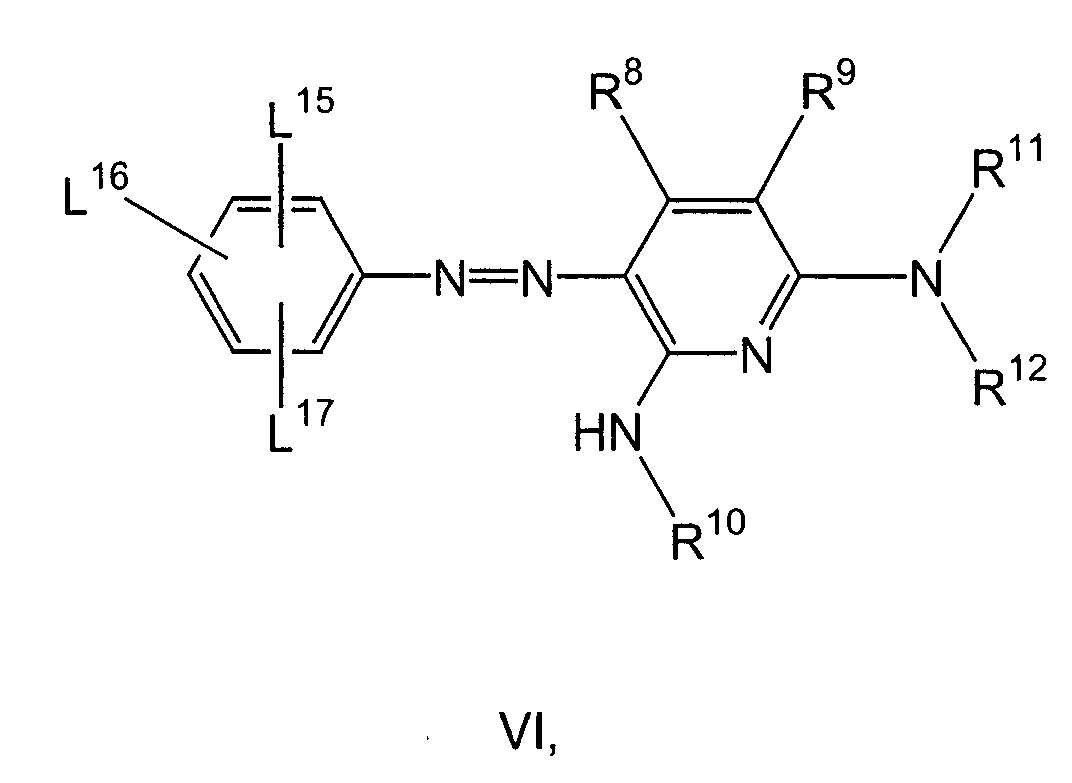 oder die Reste R11 und R12 gemeinsam mit dem sie verbindenden Stickstoffatom für ein 5- oder 6-gliedriges gesättigtes Ringsystem mit gegebenenfalls wenigstens einem weiteren Heteroatom stehen,L15, L16 und L17, gleich oder verschieden, für H, Halogen, einen C1-6-Alkyl-, C1-6-Alkoxy- oder C1-6-Alkylsulfonyl-Rest, eine Nitro- oder Cyano-Gruppe oder für einen gegebenenfalls substituierten C1-4-Alkoxycarbonyl-, Phenylsulfonyl- oder Phenylazo-Rest stehen,R8 für H oder einen C1-6-Alkyl-Rest steht,R9 für einen Carbamoyl- oder Acetyl-Rest oder für eine Cyano-Gruppe steht,R10, R11 und R12, gleich oder verschieden, für H, einen gegebenenfalls substituierten C1-12-Alkyl-Rest mit gegebenenfalls zumindest einer Ethergruppe als Kettenglied in der Alkylkette stehen, einen C1-4-Alkoxycarbonyl-C1-4-alkyl-, einen Aryloxy-C1-4-alkylcarbonyloxy-C1-4alkyl-, einen C1-4-Alkoxycarbonyloxy-C1-4-alkyl-, einen C5-7-Cycloalkyl-, einen gegebenenfalls substituierten Phenyl- oder Benzyl-, C3-6-Alkenyl-, einen gegebenenfalls substituierten Benzoyl-, C1-8-Alkanoyl-, C1-6-Alkylsulfonyl- oder einen gegebenenfalls substituierten Phenylsulfonyl-Rest stehen,7, Verbindungen der allgemeinen Formel VIIworin
 L1 für eine Nitro- oder Cyano-Gruppe, für einen C1-6-Alkanoyl-, Benzoyl-, C1-6-Alkylsulfonyl-Rest oder für einen gegebenenfalls substituierten Phenylsulfonyl-Rest Rest steht,L2 für H, einen C1-6-Alkyl-, Halogen-, Hydroxy- oder Mercapto-Rest, einen gegebenenfalls wenigstens einfach mit einem Phenyl- oder C1-4-Alkoxy-Rest substituierten C1-6-Alkoxy-Rest, einen gegebenenfalls substituierten Phenoxy-Rest, einen gegebenenfalls wenigstens einfach mit einem Phenyl-Rest substituierten C1-6-Alkylthio-Rest, einen gegebenenfalls substituierten Phenylthio-Rest, einen C1-6-Alkylsulfonyl-Rest oder für einen gegebenenfalls substituierten Phenylsulfonyl-Rest steht,L3 für H, eine Cyano- oder Nitro-Gruppe oder für einen C1-4-Alkoxycarbonyl-Rest steht,R1 und R2, gleich oder verschieden, für H, einen gegebenenfalls substituierten C1-6-Alkyl-Rest mit gegebenenfalls zumindest einer Ethergruppe als Kettenglied in der Alkylkette, einen C1-4-Alkoxycarbonyl-C1-4-alkyl, einen Aryloxy-C1-4-alkylcarbonyloxy-C1-4-alkyl-, einen C1-4-Alkoxycarbonyloxy-C1-4-alkyl-, einen C5-7 Cycloalkyl-, einen ggf. substituierten Benzyl- oder einen C3-6-Alkenyl-Rest stehen,R3 für H, einen C1-6-Alkyl- oder C1-6-Alkoxy-Rest steht,R4 für H, einen C1-6-Alkyl-, C1-6-Alkoxy-, C1-6-Alkylsulfonylamino, einen gegebenenfalls substituierten C1-6-Alkanoylamino oder Benzoylamino-Rest steht,8, Verbindungen der allgemeinen Formel VIIIworin
 L14 für H, Halogen, eine Cyano-, -SCN- oder Nitro-Gruppe oder für einen C1-4-Alkoxycarbonyl-Rest steht,R1 und R2, gleich oder verschieden, für H, einen gegebenenfalls substituierten C1-6-Alkyl-Rest mit gegebenenfalls zumindest einer Ethergruppe als Kettenglied in der Alkylkette, einen C1-4-Alkoxycarbonyl-C1-4-alkyl-, einen Aryloxy-C1-4-alkylcarbonyloxy-C1-4-alkyl-, einen C1-4-Alkoxycarbonyloxy-C1-4-alkyl-, einen C5-7 Cycloalkyl-, einen ggf. substituierten Benzyl- oder einen C3-6-Alkenyl-Rest stehenR3 für H, einen C1-6-Alkyl- oder C1-6-Alkoxy-Rest steht,R4 für H, einen C1-6-Alkyl, C1-6-Alkoxy, C1-6-Alkylsulfonylamino, einen gegebenenfalls substituierten C1-6-Alkanoylamino- oder Benzoylamino-Rest steht,9, Verbindungen der allgemeinen Formel IXworin
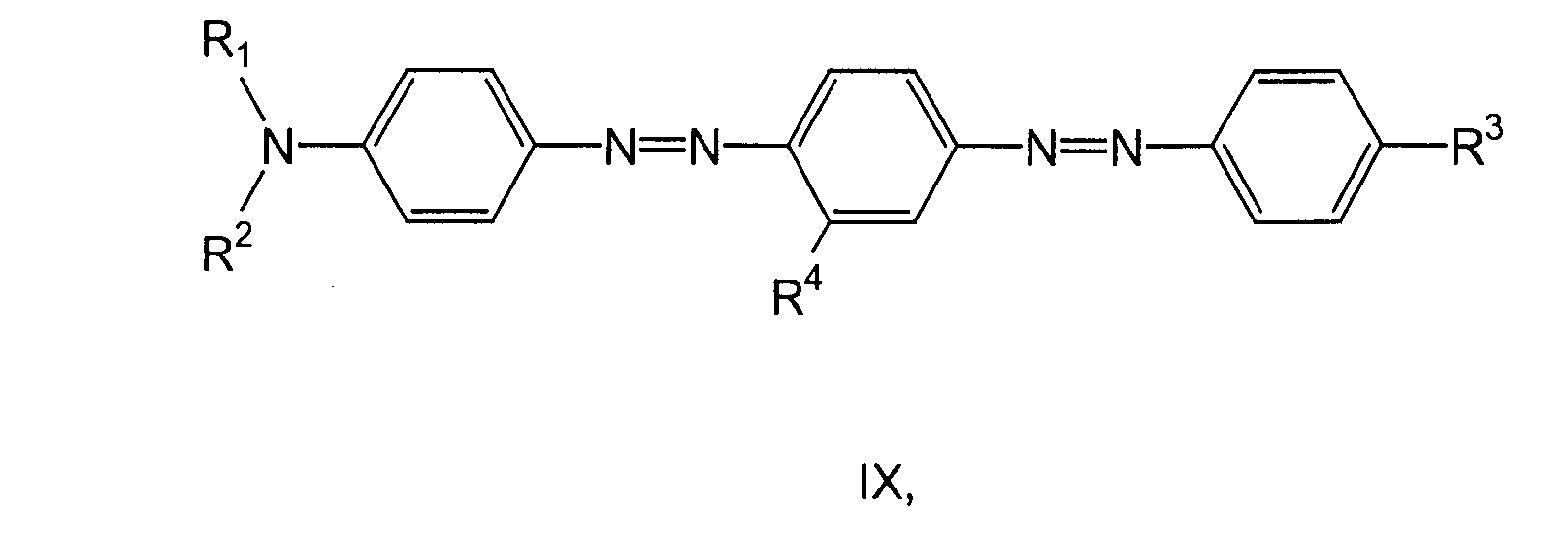 R1 und R2, gleich oder verschieden, für H, einen gegebenenfalls substituierten C1-6-Alkyl-Rest mit gegebenenfalls zumindest einer Ethergruppe als Kettenglied in der Alkylkette, einen C1-4-Alkoxycarbonyl-, einen C1-4-Alkoxycarbonyl-C1-4-alkyl, einen Aryloxy-C1-4alkylcarbonyloxy-C1-4-alkyl-, einen C1-4-Alkoxycarbonyloxy-C1-4-alkyl-, einen C5-7 Cycloalkyl-, einen ggf. substituierten Benzyl- oder einen C3-6-Alkenyl-Rest steht,R3 für H, einen Hydroxy-, C1-6-Alkyl- oder C1-6-Alkoxy-Rest steht,R4 für H, einen C1-6-Alkyl-, C1-6-Alkoxy-, C1-6-Alkylsulfonylamino-, einen gegebenenfalls substituierten C1-6-Alkanoylamino- oder Benzoylamino-Rest steht,10, Verbindungen der allgemeinen Formel Xworin
 R8 für H oder einen C1-6-Alkyl-Rest steht,R9 für eine Cyano-Gruppe oder für einen Carbamoyl- oder Acetyl-Rest steht,R13 für H, einen C1-6-Alkyl- oder C1-6-Alkoxy-Rest steht,R14 für einen gegebenenfalls wenigstens einfach mit Halogen, einer Nitrooder Cyano-Gruppe substituierten Phenyl-Rest steht,11, Verbindungen der allgemeinen Formel XIworin
W1 und W2, gleich oder verschieden, für einen C1-4-Alkyl-Rest stehen, W3 für einen Benzimidazol-2-yl-, 5-Chlorbenzoxazol-2-yl-, Benzthiazol-2-yl-, 4-Hydroxychinazolin-2-yl- oder 5-Phenyl-1,2,3-thiadiazol-2-yl-Rest steht,12, Verbindungen der allgemeinen Formel XIIworin L7 für eine Nitro- oder Cyano-Gruppe, einen C1-6-Alkanoyl-, Benzoyl-, C1-4-Alkoxycarbonyl-, C1-6-Alkylsulfonyl oder einen gegebenenfalls substituierten Phenylsulfonyl-Rest steht,L8 für H, Halogen, eine Cyano-Gruppe, einen C1-6-Alkyl-, einen gegebenenfalls wenigstens einfach mit einem Phenyl- oder C1-4-Alkoxy-Rest substituierten C1-6-Alkoxy-Rest, einen gegebenenfalls wenigstens einfach mit einem Phenyl-Rest substituierten C1-6-Alkylthio-Rest, einen gegebenenfalls substituierten Phenylthio-Rest, einen C1-6-Alkylsulfonyl-Rest, einen gegebenenfalls substituierten Phenylsulfonyl-Rest oder für einen C1-4-Alkoxycarbonyl-Rest steht,R1 und R2, gleich oder verschieden, für H, einen gegebenenfalls substituierten C1-6-Alkyl-Rest mit gegebenenfalls zumindest einer Ethergruppe als Kettenglied in der Alkylkette, einen C5-7 Cycloalkyl-, einen ggf. substituierten Benzyl- oder einen C3-6-Alkenyl-Rest steht,R3 für H, einen C1-6-Alkyl- oder C1-6-Alkoxy-Rest steht,R4 für H, einen C1-6-Alkyl-, C1-6-Alkoxy-, C1-6-Alkylsulfonylamino-, einen gegebenenfalls substituierten C1-6-Alkanoylamino- oder Benzoylamino-Rest steht,13, der Verbindungen der allgemeinen Formel XIIIworin
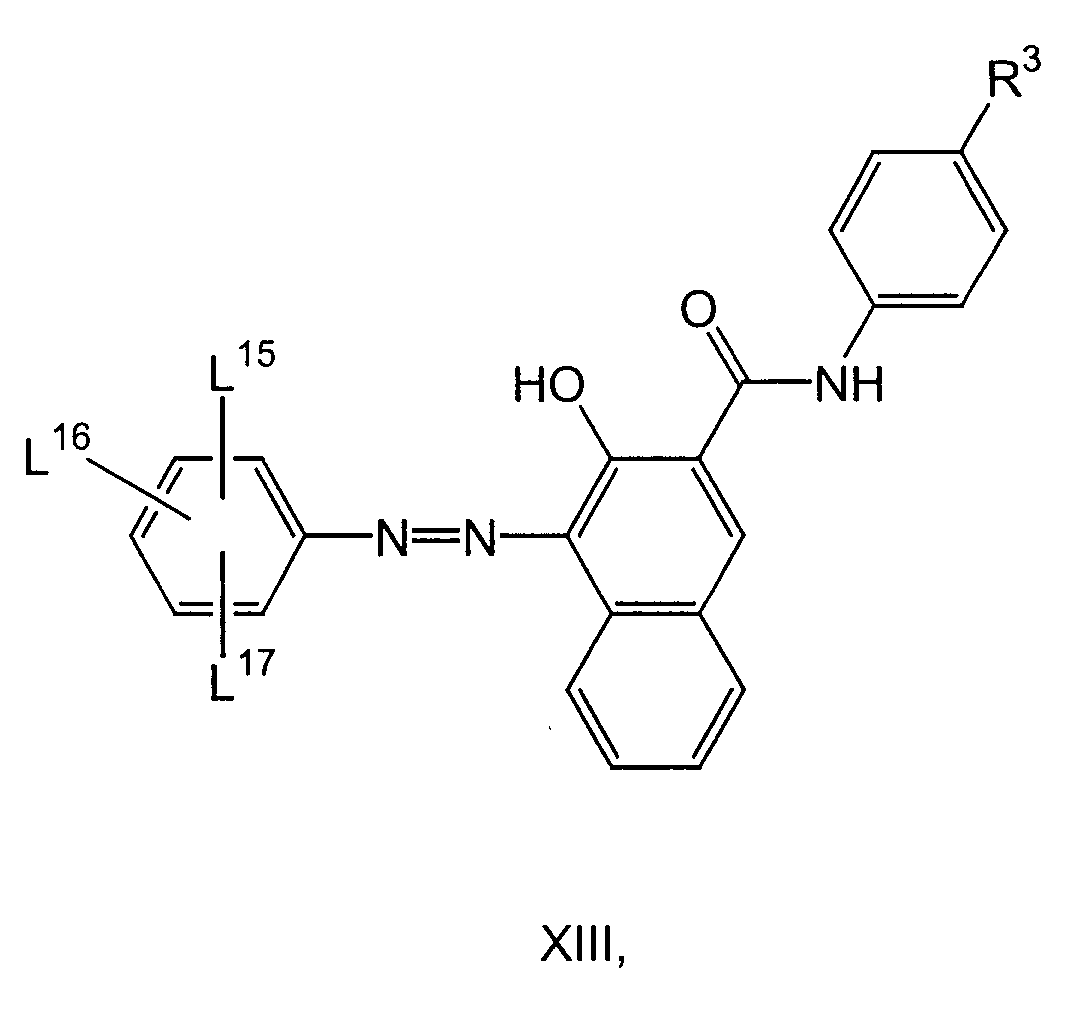 und Palanil® Cyanin B und Dispersol® Tiefrot SFL15, L16 und L17, gleich oder verschieden, für H, Halogen, eine Nitro- oder Cyano-Gruppe, einen C1-6-Alkyl-, C1-6-Alkoxy-, einen gegebenenfalls substituierten C1-4-Alkoxycarbonyl-Rest, einen C1-6-Alkylsulfonyl-Rest, einen gegebenenfalls substituierten Phenylsulfonyl- oder Phenylazo-Rest steht,R3 für H, einen C1-6-Alkyl- oder C1-6-Alkoxy-Rest steht,
gefärbt und/oder bedruckt worden ist. - Vliesstoff gemäß Anspruch 1, dadurch gekennzeichnet, daß in der allgemeinen Formel I A1 und A2, gleich oder verschieden, für einen gegebenenfalls in ortho-, meta- oder para-Stellung mit einem C1-8-Alkoxyoder -O-CH2-C3-7-Cycloalkyl-Rest substituierten Phenyl-Rest stehen, wobei die Alkylkette des Alkoxy-Restes oder der Cycloalkyl-Ring gegebenenfalls zumindest eine Ethergruppe als Kettenglied in der Alkylkette oder im Cycloalkyl-Ring aufweist, oder für einen Rest der Formel -C6H4-OCH2-COOC2H4OC2H5 steht.
- Vliesstoff gemäß Anspruch 1 oder 2, dadurch gekennzeichnet, daß in der allgemeinen Formel IIL15, L16 und L17, gleich oder verschieden, für H, Cl, Br oder für eine Nitrooder Cyano-Gruppe stehen,R1 und R2, gleich oder verschieden, für einen Methoxycarbonylethyl-, 2-Acetyloxyethyl-, 2-Cyanoethyl-, Ethyl- oder Propyl-Rest oder für einen Rest der Formel -C2H4-O-CO-OCH3 oder -C2H4-O-CO-CH2-O-Phenyl stehen,R3 für H, einen Methoxy- oder Ethoxy-Rest steht,R4 für H, einen Acetylamino-, Ethanoylamino-, Benzoylamino- oder Methylsulfonylamino-Rest steht.
- Vliesstoff gemäß einem der Ansprüche 1 bis 3, dadurch gekennzeichnet, daß in der allgemeinen Formel IIIW1 und W2 für einen Ethyl-Rest stehen,X für ein Sauerstoffatom oder eine Iminogruppe steht.
- Vliesstoff gemäß einem der Ansprüche 1 bis 4, dadurch gekennzeichnet, daß in der allgemeinen Formel IVA7 für einen 3-Methoxypropyl- oder 4,7-Dioxaoctyl-Rest steht,X für ein Sauerstoffatom steht.
- Vliesstoff gemäß einem der Ansprüche 1 bis 5, dadurch gekennzeichnet, daß in der allgemeinen Formel VA1 für H steht,A4 für Fluor, Chlor, Brom, einen 1-Oxyhexan-6-ol-, 2-Methoxyphenyl-, 3-Methoxyphenyl-, 4-Methoxyphenyl-, 2-Ethoxyphenyl-, 3-Ethoxyphenyl-, 4-Ethoxyphenyl- oder Phenoxy-Rest steht,A5 und A6 jeweils für H stehen.
- Vliesstoff gemäß einem der Ansprüche 1 bis 6, dadurch gekennzeichnet, daß in der allgemeinen Formel VIoder die Reste R11 und R12 gemeinsam mit dem sie verbindenden Stickstoffatom für einen Pyrrolidinyl-, Piperidinyl-, Morpholinyl-, Thiomorpholinyl-, Thiomorpholinyl-S,S-dioxid-, Piperazinyl-, oder einen N-(C1-4-Alkyl)piperazinyl-Rest, vorzugsweise einen N-Methyl- oder N-Ethylpiperazinyl-Rest, stehen.L15, L16 und L17, gleich oder verschieden, für H oder für eine Nitro- oder Cyano-Gruppe stehen,R8 für einen Methyl-Rest steht,R9 für eine Cyano-Gruppe steht,R10, R11 und R12, gleich oder verschieden, für H, einen unsubstituierten Phenyl-, Cyanoethyl-, Methoxycarbonylethyl- oder -3-Oxa-5-hydroxypentyl-(C2H4-O-C2H4-OH)-Rest stehen,
- Vliesstoff gemäß einem der Ansprüche 1 bis 7, dadurch gekennzeichnet, daß in der allgemeinen Formel VIIL1 für eine Nitro-Gruppe steht,L2 für H steht,L3 für H, eine Nitro-Gruppe oder für einen C1-4-Alkoxycarbonyl-Rest steht,R1 und R2, gleich oder verschieden, für einen Methoxycarbonyethyl-, 2-Acetyloxyethyl- oder 2-Cyanethyl-Rest stehen,R3 für H steht,R4 für H oder einen C1-3-Alkyl-Rest steht.
- Vliesstoff gemäß einem der Ansprüche 1 bis 8, dadurch gekennzeichnet, daß in der allgemeinen Formel VIIIL14 für eine -SCN- oder Nitro-Gruppe, steht,R1 und R2, gleich oder verschieden, für einen Acetyloxyethyl-, Cyanoethyloder Methoxycarbonylethyl-Rest steht,R3 für H, einen C1-6-Alkyl- oder C1-6-Alkoxy-Rest steht,R4 für H oder einen C1-3-Alkyl-Rest, steht.
- Vliesstoff gemäß einem der Ansprüche 1 bis 9, dadurch gekennzeichnet, daß in der allgemeinen Formel IXR1 und R2, gleich oder verschieden, für H, einen Acetyloxyethyl- oder Methoxycarbonyl-Rest steht,R3 für einen Hydroxy-Rest steht,R4 für H oder einen C1-3-Alkyl-Rest steht.
- Vliesstoff gemäß einem der Ansprüche 1 bis 10, dadurch gekennzeichnet, daß in der allgemeinen Formel XR8 für einen Methyl-Rest steht,R9 für eine Cyano-Gruppe steht,R13 für einen C1-3-Alkyl-Rest steht,R14 für einen unsubstituierten Phenyl-Rest steht.
- Vliesstoff gemäß einem der Ansprüche 1 bis 11, dadurch gekennzeichnet, daß in der allgemeinen Formel XIW1 und W2 jeweils für einen Ethyl-Rest stehen.
- Vliesstoff gemäß einem der Ansprüche 1 bis 12, dadurch gekennzeichnet, daß in der allgemeinen Formel XIIL7 für eine Nitro-Gruppe steht,L8 für H steht,R1 und R2, gleich oder verschieden, für einen Cyanoethyl-, 2-Phenylethyl-, Methoxycarbonylethyl- oder Acetyloxyethyl-Rest stehen,R3 für H steht,R4 für einen C1-3-Alkyl-Rest steht.
- Vliesstoff gemäß einem der Ansprüche 1 bis 13, dadurch gekennzeichnet, daß in der allgemeinen Formel XIIIL15, L16 und L17 für H, stehen,R3 für einen Methoxy-Rest steht.
- Vliesstoff gemäß Anspruch 1, dadurch gekennzeichnet, daß er mit wenigstens einem Dispersionsfarbstoff ausgewählt aus der Gruppe vonund Palanil® Leuchtrot B und Dispersol® Rubin XF1, der Verbindung der allgemeinen Formel IV, worin X für ein Sauerstoffatom und der Rest A7 für einen 3-Methoxypropyl-Rest stehen,2, der Verbindung der allgemeinen Formel II, worin L15 für eine Nitro-Gruppe in 2-Stellung, L16 für eine Nitro-Gruppe in 4-Stellung, L17 für einen Br-Rest in 6-Stellung, R1 und R2 jeweils für einen 2-Acetyloxyethyl-Rest, R3 für einen Methoxy-Rest und R4 für einen Acetylamino-Rest stehen,3, der Verbindung der allgemeinen Formel II, worin L15 für einen Cl-Rest in 2-Stellung, L16 für eine Nitro-Gruppe in 4-Stellung, L17 für H in 6-Stellung, R1 und R2 jeweils für einen Acetyloxyethyl-Rest, R3 für H und R4 für einen Acetylamino-Rest stehen,4, der Verbindung der allgemeinen Formel II, worin L15 für einen Cl-Rest in 2-Stellung, L16 für eine Nitro-Gruppe in 4-Stellung, L17 für einen Br-Rest in 6-Stellung, R1 und R2 jeweils für einen Methoxycarbonylethyl-Rest und R3 und R4 jeweils für H stehen,
gefärbt und/oder bedruckt worden ist. - Vliesstoff gemäß einem der Ansprüche 1 bis 14, dadurch gekennzeichnet, daß er mit einem Farbstoffgemisch aus einem Rotfarbstoff, einem Gelbfarbstoff und einem Blaufarbstoff gefärbt und/oder bedruckt worden ist.
- Vliesstoff gemäß Anspruch 16, dadurch gekennzeichnet, daß er mit einem Farbstoffgemisch aus einem Gelbfarbstoff der allgemeinen Formel II, einem Rotfarbstoff der allgemeinen Formel I und einem Blaufarbstoff der allgemeinen Formel II gefärbt und/oder bedruckt worden ist.
- Vliesstoff gemäß einem der Ansprüche 1 bis 17, dadurch gekennzeichnet, daß er aus wenigstens einer Polyesterkomponente und wenigstens einer Polyamidkomponente besteht.
- Vliesstoff gemäß Anspruch 18, dadurch gekennzeichnet, daß der Vliesstoff aus 5 bis 95 Gew.-% Polyester und 95 bis 5 Gew.-% Polyamid, vorzugsweise aus 15 bis 85 Gew.-% Polyester und 85 bis 15 Gew-% Polyamid, besonders bevorzugt aus 30 bis 70 Gew.-% Polyester und 70 bis 30 Gew.-% Polyamid besteht.
- Vliesstoff gemäß einem der Ansprüche 1 bis 19, dadurch gekennzeichnet, daß der Titer der Mikrofasern und/oder Mikrofilamente ≤ 1 dtex beträgt.
- Vliesstoff gemäß einem der Ansprüche 1 bis 20, dadurch gekennzeichnet, daß das Polyamid ausgewählt ist aus der Gruppe von Polyamid 6, Polyamid 66 und Polyamid 11.
- Vliesstoff gemäß einem der Ansprüche 1 bis 21, dadurch gekennzeichnet, daß der Polyester ausgewählt ist aus der Gruppe von Polyethylenterephthalat, Polypropylenterephthalat, Polybutylenterephthalat, Polymilchsäure, deren Mischungen und Copolyestern.
- Vliesstoff gemäß einem der Ansprüche 1 bis 22, dadurch gekennzeichnet, daß er ein Stapelfaservliesstoff ist.
- Vliesstoff gemäß einem der Ansprüche 1 bis 22, dadurch gekennzeichnet, daß er ein Spinnvliesstoff ist.
- Vliesstoff gemäß einem der Ansprüche 1 bis 24, dadurch gekennzeichnet, daß er ein Flächengewicht von 15 bis 350 g/m2, vorzugsweise von 50 bis 300 g/m2, besonders bevorzugt von 80 bis 200 g/m2 aufweist.
- Verfahren zur Herstellung eines gefärbten oder bedruckten Vliesstoffs gemäß einem oder mehreren der Ansprüche 1 bis 25, dadurch gekennzeichnet, daß der Vliesstoff mit wenigstens einem Dispersionsfarbstoff ausgewählt aus der Gruppe von Verbindungen der allgemeinen Formel I bis XIII gemäß Anspruch 1, Palanil® Cyanin B und Dispersol® Tiefrot SF behandelt wird.
- Verfahren gemäß Anspruch 26, dadurch gekennzeichnet, daß die Färbung nach dem Ausziehverfahren erfolgt.
- Verfahren gemäß Anspruch 27, dadurch gekennzeichnet, daß die Färbetemperatur 60 bis 145 °C, vorzugsweise 80 bis 140 °C, besonders bevorzugt 120 bis 135 °C beträgt.
- Verfahren gemäß Anspruch 27 oder 28, dadurch gekennzeichnet, daß die Färbezeit 5 bis 120 Minuten, vorzugsweise 20 bis 60 Minuten, besonders bevorzugt 25 bis 45 Minuten beträgt.
- Verfahren gemäß einem der Ansprüche 27 bis 29, dadurch gekennzeichnet, daß der pH-Wert während der Färbung 2 bis 11 beträgt, vorzugsweise im sauren bis neutralen liegt, besonders bevorzugt 4 bis 6 beträgt.
- Verfahren gemäß Anspruch 26, dadurch gekennzeichnet, daß die Färbung nach dem Thermosolverfahren erfolgt.
- Verfahren gemäß Anspruch 31, dadurch gekennzeichnet, daß die Fixiertemperatur 80 bis 240 °C, vorzugsweise 100 bis 220 °C, besonders bevorzugt 150 bis 210 °C beträgt.
- Verfahren gemäß Anspruch 31 oder 32, dadurch gekennzeichnet, daß die Fixierzeit zwischen 1 Sekunde und 30 Minuten, vorzugsweise 15 Sekunden bis 10 Minuten, besonders bevorzugt 45 Sekunden bis 5 Minuten beträgt.
- Verfahren gemäß Anspruch 26, dadurch gekennzeichnet, daß das Bedrucken nach einem Direktdruckverfahren, vorzugsweise nach dem Rotations-, Sieb- oder Inkjekt-Druckverfahren erfolgt.
- Verfahren gemäß Anspruch 26, dadurch gekennzeichnet, daß das Bedrucken nach einem Transfer-Druckverfahren erfolgt.
- Verfahren gemäß einem der Ansprüche 26 bis 35, dadurch gekennzeichnet, daß nach der Färbung oder dem Bedrucken des Vliesstoffs eine Reinigung, vorzugsweise eine alkalische oder saure, reduktive Reinigung, besonders bevorzugt eine alkalische, reduktive Reinigung bei erhöhter Temperatur, durchgeführt wird.
- Verfahren gemäß einem der Ansprüche 26 bis 36, dadurch gekennzeichnet, daß nach der Färbung oder dem Bedrucken, nach der reduktiven Reinigung, während oder nach der Ausrüstung oder nach der Konfektionierung eine Nachbehandlung mit einem die Farbechtheit verbessernden Agenz durchgeführt wird.
- Verfahren gemäß Anspruch 37, dadurch gekennzeichnet, daß das die Farbechtheit verbessernde Agenz ausgewählt ist aus der Gruppe von ggf. substituierten Arylsulfonsäuren, Hydroxyarylsulfonsäuren, Arylsulfonaten, Hydroxyarylsulfonaten, Alkylarylsulfonaten, polykondensierten funktionellen Aminen, monomeren oder polymeren quartären Ammoniumverbindungen und ggf. deren entsprechenden Kondensationsprodukten.
- Verfahren gemäß Anspruch 37 oder 38, dadurch gekennzeichnet, daß das die Farbechtheit verbessernde Agenz in einer Menge von 0,1 bis 15 Gew.-%, vorzugsweise 2 bis 5 Gew.-%, bezogen auf den eingesetzten Vliesstoff, dem Spülbad beigegeben worden ist.
- Verfahren gemäß Anspruch 39, dadurch gekennzeichnet, daß das Spülbad eine Temperatur von 20°C bis 150°C, vorzugsweise von 40°C bis 70°C hat.
- Verfahren gemäß Anspruch 39 oder 40, dadurch gekennzeichnet, daß der Spülvorgang im Spülbad 1 min bis 150 min, vorzugsweise 20 bis 100 Minuten dauert.
- Verfahren gemäß einem der Ansprüche 26 bis 41, dadurch gekennzeichnet, daß zusätzlich eine Färbung oder ein Bedrucken mit wenigstens einem Farbstoff ausgewählt aus der Gruppe von Küpenfarbstoffen, Leukoküpenfarbstoffen, Schwefelfarbstoffen und wasserlöslichen Schwefelfarbstoffen erfolgt.
Applications Claiming Priority (6)
| Application Number | Priority Date | Filing Date | Title |
|---|---|---|---|
| DE10058791 | 2000-11-27 | ||
| DE10058791 | 2000-11-27 | ||
| DE10061124 | 2000-12-07 | ||
| DE10061124 | 2000-12-07 | ||
| DE10125843 | 2001-05-25 | ||
| DE10125843A DE10125843A1 (de) | 2000-11-27 | 2001-05-25 | Gefärbter und/oder bedruckter Vliesstoff |
Publications (2)
| Publication Number | Publication Date |
|---|---|
| EP1209281A2 true EP1209281A2 (de) | 2002-05-29 |
| EP1209281A3 EP1209281A3 (de) | 2003-08-27 |
Family
ID=27214170
Family Applications (1)
| Application Number | Title | Priority Date | Filing Date |
|---|---|---|---|
| EP20010127619 Withdrawn EP1209281A3 (de) | 2000-11-27 | 2001-11-20 | Gefärbter und/oder bedruckter Vliesstoff |
Country Status (2)
| Country | Link |
|---|---|
| US (1) | US20020151235A1 (de) |
| EP (1) | EP1209281A3 (de) |
Cited By (2)
| Publication number | Priority date | Publication date | Assignee | Title |
|---|---|---|---|---|
| DE10229516A1 (de) * | 2002-07-02 | 2004-02-12 | Carl Freudenberg Kg | Verfahren zur farblichen Gestaltung von Vliesstoffen |
| CN109440490A (zh) * | 2018-10-12 | 2019-03-08 | 山东理工大学 | 聚乳酸纤维染色用偶氮结构乳酸酯型分散染料及其制备方法和染色工艺 |
Families Citing this family (17)
| Publication number | Priority date | Publication date | Assignee | Title |
|---|---|---|---|---|
| EP1336682A3 (de) * | 2002-02-18 | 2004-01-02 | Carl Freudenberg KG | Verfahren zur Reduzierung des Pillings |
| DE10219929A1 (de) * | 2002-05-03 | 2003-12-04 | Freudenberg Carl Kg | Verfahren zur Verbesserung von Weichheit und/oder Fall von Vliesstoffen |
| US20040248492A1 (en) * | 2003-06-06 | 2004-12-09 | Reemay, Inc. | Nonwoven fabric printing medium and method of production |
| JP2006008871A (ja) * | 2004-06-25 | 2006-01-12 | Dystar Japan Ltd | ポリ乳酸系繊維用分散染料 |
| GB0421145D0 (en) * | 2004-09-23 | 2004-10-27 | Unilever Plc | Laundry treatment compositions |
| ES2322864T3 (es) * | 2004-09-23 | 2009-06-30 | Unilever N.V. | Composiciones de tratamiento de ropa sucia. |
| EP1984559A1 (de) * | 2006-02-17 | 2008-10-29 | Huntsman Advanced Materials (Switzerland) GmbH | Verfahren zum färben von polyester |
| CN100402531C (zh) * | 2006-07-05 | 2008-07-16 | 浙江工业大学 | 3,7-二芳基苯并二呋喃-2,6-二酮系化合物作为三阶非线性光学材料的应用 |
| CN101215245B (zh) * | 2007-01-05 | 2011-11-30 | 浙江龙盛集团股份有限公司 | 一种含双酯的单偶氮化合物、制备与应用及染料组合物 |
| US20080177089A1 (en) | 2007-01-19 | 2008-07-24 | Eugene Steven Sadlowski | Novel whitening agents for cellulosic substrates |
| US8715368B2 (en) | 2010-11-12 | 2014-05-06 | The Procter & Gamble Company | Thiophene azo dyes and laundry care compositions containing the same |
| CN102197950B (zh) * | 2011-03-18 | 2013-11-06 | 亿安(厦门)无纺布有限公司 | 涤纶印花无纺地毯及其制造方法 |
| EP2573213B1 (de) * | 2011-09-23 | 2017-10-25 | Covestro Deutschland AG | Sauerstoffverzehrelektrode und verfahren zu ihrer herstellung |
| CN104530752B (zh) * | 2014-12-19 | 2017-09-22 | 浙江闰土股份有限公司 | 分散染料组合物、分散染料及其制备方法和用途 |
| KR101942305B1 (ko) * | 2016-11-25 | 2019-01-25 | 아크로마코리아 주식회사 | 신규의 피리딘 적색 분산 염료 조성물 및 그 제조방법 |
| CN109554003B (zh) * | 2018-12-21 | 2020-09-11 | 浙江闰土股份有限公司 | 一种分散染料组合物、分散染料及其的制备方法和用途 |
| US12391054B2 (en) * | 2020-03-10 | 2025-08-19 | Kyocera Document Solutions Inc. | Treatment liquid for ink-jet printing, ink-jet textile printing device, and ink-jet textile printing method |
Family Cites Families (6)
| Publication number | Priority date | Publication date | Assignee | Title |
|---|---|---|---|---|
| US3493316A (en) * | 1966-05-09 | 1970-02-03 | Allied Chem | Dyed fiber products |
| US3635653A (en) * | 1967-11-13 | 1972-01-18 | Allied Chem | Polyester polyamide blend fiber dyed with azo disperse dye |
| DE2658061C2 (de) * | 1976-12-22 | 1978-10-19 | Hoechst Ag, 6000 Frankfurt | Verfahren zum Färben von Mischgeweben aus modifizierten Polyesterfasern und Wolle nach einem VerweilprozeB |
| JPH0544176A (ja) * | 1991-08-06 | 1993-02-23 | Toyobo Co Ltd | ポリエステルとポリアミドから成る混用繊維の染色方法 |
| JPH0782673A (ja) * | 1993-09-10 | 1995-03-28 | Mitsubishi Kasei Hoechst Kk | ポリエステルとポリアミドからなる混用繊維の高温染色法 |
| DE19754025A1 (de) * | 1997-12-05 | 1999-06-10 | Basf Ag | Farbstoffzubereitungen, enthaltend Azofarbstoffe |
-
2001
- 2001-11-20 EP EP20010127619 patent/EP1209281A3/de not_active Withdrawn
- 2001-11-27 US US09/996,863 patent/US20020151235A1/en not_active Abandoned
Cited By (3)
| Publication number | Priority date | Publication date | Assignee | Title |
|---|---|---|---|---|
| DE10229516A1 (de) * | 2002-07-02 | 2004-02-12 | Carl Freudenberg Kg | Verfahren zur farblichen Gestaltung von Vliesstoffen |
| CN109440490A (zh) * | 2018-10-12 | 2019-03-08 | 山东理工大学 | 聚乳酸纤维染色用偶氮结构乳酸酯型分散染料及其制备方法和染色工艺 |
| CN109440490B (zh) * | 2018-10-12 | 2021-01-01 | 山东理工大学 | 聚乳酸纤维染色用偶氮结构乳酸酯型分散染料及其制备方法和染色工艺 |
Also Published As
| Publication number | Publication date |
|---|---|
| US20020151235A1 (en) | 2002-10-17 |
| EP1209281A3 (de) | 2003-08-27 |
Similar Documents
| Publication | Publication Date | Title |
|---|---|---|
| EP1209281A2 (de) | Gefärbter und/oder bedruckter Vliesstoff | |
| CH503153A (de) | Verfahren zum kontinuierlichen Färben oder Bedrucken von Textilmaterial aus linearen, hochmolekularen Estern aromatischer Polycarbonsäuren mit polyfunktionellen Alkoholen | |
| EP0613976B1 (de) | Verwendung von Acrylamidpolymeren als Faltenverhinderungsmittel | |
| DE2520527A1 (de) | Waessrige praeparate von in wasser unloeslichen bis schwerloeslichen farbstoffen oder optischen aufhellern sowie deren verwendung | |
| DE2521988A1 (de) | Trockenes thermisches verfahren zum faerben und bedrucken von mit kationischen farbstoffen anfaerbbarem organischem material | |
| EP0591736B1 (de) | Verwendung von Pyridinfarbstoffen im textilen Bereich, Farbstoffmischungen, enthaltend Pyridinfarbstoffe, sowie Triazolopyridinfarbstoffe mit einem Thienylrest | |
| DE2449324A1 (de) | Transferdruckverfahren zum faerben und bedrucken von mit kationischen farbstoffen anfaerbbarem organischem material | |
| DE2548051C2 (de) | Verfahren zum Färben von Textilmaterialien aus einem aromatischen Polyester oder Cellulosetriacetat oder von Textilmaterialien, welche Gemische aus einem aromatischen Polyester und einem synthetischen Polyamid sind | |
| DE10125843A1 (de) | Gefärbter und/oder bedruckter Vliesstoff | |
| DE10135940B4 (de) | Verfahren zur Herstellung gefärbter und/oder bedruckter Vliesstoffe und deren Verwendung | |
| EP1409788A1 (de) | Verfahren zum färben und/oder bedrucken von textilem material | |
| WO2003004762A2 (de) | Gefärbter und/oder bedruckter vliesstoff | |
| EP0099333B1 (de) | Umdruckträger für den thermischen Trockendruck von Cellulosefasern | |
| DE69521820T2 (de) | Farbstoffzusammensetzung und Verfahren zum Färben von hydrophoben Fasern | |
| DE4002482A1 (de) | Verfahren zum faerben und bedrucken von mischgeweben aus polyester und natuerlichen fasermaterialien | |
| CH179075A (de) | Kapillaraktives Mittel. | |
| DE69310291T2 (de) | Verfahren zum Färben von synthetischen Fasermaterialien und gefärbte synthetische Fasermaterialien | |
| DE10229516A1 (de) | Verfahren zur farblichen Gestaltung von Vliesstoffen | |
| DE2832011C2 (de) | Verfahren zum Färben und Bedrucken von Stoffen auf Kunstfaserbasis mit Dispersionsfarbstoffen und Färbemischungen | |
| DE2901823C2 (de) | Verfahren zum Bedrucken von textilen Materialien | |
| EP0885936B1 (de) | Farbstoffmischungen | |
| DE1032211B (de) | Verfahren zum Faerben von Polyamidfasermaterial | |
| DE3921039A1 (de) | Verfahren zum faerben von glasfasern | |
| DE10229518A1 (de) | Verfahren zur Farbgebung von Vliesstoffen | |
| DD204277A5 (de) | Verfahren zum kontinuierlichen faerben von fasergut |
Legal Events
| Date | Code | Title | Description |
|---|---|---|---|
| PUAI | Public reference made under article 153(3) epc to a published international application that has entered the european phase |
Free format text: ORIGINAL CODE: 0009012 |
|
| AK | Designated contracting states |
Kind code of ref document: A2 Designated state(s): AT BE CH CY DE DK ES FI FR GB GR IE IT LI LU MC NL PT SE TR |
|
| AX | Request for extension of the european patent |
Free format text: AL;LT;LV;MK;RO;SI |
|
| PUAL | Search report despatched |
Free format text: ORIGINAL CODE: 0009013 |
|
| AK | Designated contracting states |
Designated state(s): AT BE CH CY DE DK ES FI FR GB GR IE IT LI LU MC NL PT SE TR |
|
| AX | Request for extension of the european patent |
Extension state: AL LT LV MK RO SI |
|
| AKX | Designation fees paid | ||
| REG | Reference to a national code |
Ref country code: DE Ref legal event code: 8566 |
|
| STAA | Information on the status of an ep patent application or granted ep patent |
Free format text: STATUS: THE APPLICATION IS DEEMED TO BE WITHDRAWN |
|
| 18D | Application deemed to be withdrawn |
Effective date: 20040228 |