EP1214830B1 - Procede de limitation de service d'envoi de message - Google Patents
Procede de limitation de service d'envoi de message Download PDFInfo
- Publication number
- EP1214830B1 EP1214830B1 EP99936509A EP99936509A EP1214830B1 EP 1214830 B1 EP1214830 B1 EP 1214830B1 EP 99936509 A EP99936509 A EP 99936509A EP 99936509 A EP99936509 A EP 99936509A EP 1214830 B1 EP1214830 B1 EP 1214830B1
- Authority
- EP
- European Patent Office
- Prior art keywords
- message
- record
- network
- address
- communication
- Prior art date
- Legal status (The legal status is an assumption and is not a legal conclusion. Google has not performed a legal analysis and makes no representation as to the accuracy of the status listed.)
- Expired - Lifetime
Links
- 238000000034 method Methods 0.000 title claims abstract description 25
- 238000004891 communication Methods 0.000 claims abstract description 53
- 230000005540 biological transmission Effects 0.000 claims abstract description 15
- 230000002265 prevention Effects 0.000 description 4
- 238000010586 diagram Methods 0.000 description 2
- 102220475756 Probable ATP-dependent RNA helicase DDX6_S30A_mutation Human genes 0.000 description 1
- 230000000903 blocking effect Effects 0.000 description 1
- 230000001419 dependent effect Effects 0.000 description 1
- 238000011161 development Methods 0.000 description 1
- 230000018109 developmental process Effects 0.000 description 1
- 238000005516 engineering process Methods 0.000 description 1
- 230000011664 signaling Effects 0.000 description 1
- 210000004509 vascular smooth muscle cell Anatomy 0.000 description 1
Images


Classifications
-
- H—ELECTRICITY
- H04—ELECTRIC COMMUNICATION TECHNIQUE
- H04W—WIRELESS COMMUNICATION NETWORKS
- H04W12/00—Security arrangements; Authentication; Protecting privacy or anonymity
- H04W12/08—Access security
-
- H—ELECTRICITY
- H04—ELECTRIC COMMUNICATION TECHNIQUE
- H04L—TRANSMISSION OF DIGITAL INFORMATION, e.g. TELEGRAPHIC COMMUNICATION
- H04L63/00—Network architectures or network communication protocols for network security
- H04L63/10—Network architectures or network communication protocols for network security for controlling access to devices or network resources
- H04L63/101—Access control lists [ACL]
-
- H—ELECTRICITY
- H04—ELECTRIC COMMUNICATION TECHNIQUE
- H04W—WIRELESS COMMUNICATION NETWORKS
- H04W4/00—Services specially adapted for wireless communication networks; Facilities therefor
- H04W4/12—Messaging; Mailboxes; Announcements
- H04W4/14—Short messaging services, e.g. short message services [SMS] or unstructured supplementary service data [USSD]
Definitions
- the present invention relates to a method for restricting a message service in a communication network.
- the present invention is further related to a network and a terminal for a use in said network and which are capable of restricting a message service.
- SMS short message service
- PLMN public land mobile networks
- the operator of a network might like to have a possibility to suppress the use of the short message service, for example for roaming subscribers whose home operator does not have a charging agreement with the visited subscriber.
- Document WO 99/20063 discloses a method and an apparatus for identifying a sender of a short message, with which a mobile terminated short message service could be prevented.
- Reference GSM 03.15 of the European Telecommunications Standards Institute discloses a technical realization of operator determined barring (ODB), wherein the barring is applied or changed in the home location register (HLR) of the corresponding home PLMN and an invocation of the barring is in the mobile originated case done in the visitor location register (VLR) and in the mobile terminated case done in the HLR.
- HLR home location register
- VLR visitor location register
- the ODB is tightly effected to a mobile switching center which is currently visited by a mobile station.
- the ODB is defined in the HLR, it can only be effected for home subscribers and not for visitor subscriber.
- Document US5903726 discloses a method for restricting a message service in a communication network, wherein the sender and the receiver are identified by the respective addresses.
- the document discloses keeping a record containing information about certain addresses with which a message communication is not allowed and analysing and preventing communication of a message if it is related to an address which is not allowed.
- US5903726 only discloses message restriction at the receiving end and the restriction takes place in the HLR.
- This object can be achieved by a method for restricting a message service in a communication network, wherein at least a sender and a recipient are to be involved if a message communication takes place in said network, and each of which can be identified by a respective address; said method comprising the steps of keeping a record containing information about certain addresses with which a message communication is not allowed; receiving a request for establishing a message communication; analyzing on the basis of the information in the record whether a message communication is allowed; and preventing the transmission of a message if said message is related to an address which is not allowed according to the analyzing step.
- a network being capable of restricting a message service, comprising at least one sender and one recipient, wherein each has an address; a plurality of switching centers, wherein a terminal is always related to a visited switching center; a record in which information about the addresses being not allowed is written; an analyzing means for analyzing said record whether an address is unallowed; and means, operable to prevent the transmission of a message if said message is related to an address which is not allowed according to the analysis of the analyzing means.
- an embodiment of the present invention proposes a terminal for use in a network, said network comprising at least one sender and one recipient, wherein each has an address; a plurality of switching centers, wherein said terminal is always related to a visited switching center; characterized in that said terminal comprises a record in which information about the addresses being not allowed is written; an analyzing means for analyzing said record whether an address is unallowed; and means, operable to prevent the transmission of a message if said message is related to an address which is not allowed according to the analysis of the analyzing means.
- the present invention can be not only effected in a visited switching center, but also in an interworking switching center.
- a specific restriction can be defined by either the operator or a subscriber of the network, whereby for example message services originating from foreign countries or, more common, from "foreign" message service centers can be restricted.
- the present invention provides a method for restriction which can not only applied to home subscribers but also to visitor subscribers.
- the method according to the present invention saves switch capacity, link capacity between a switching center of a network and a message service center of that switching center, and also the capacity of said message service center.
- a message service in a communication network can be restricted on the basis of addresses of elements of the network which are involved in a corresponding message communication.
- the deciding entity who judges upon the allowance of a message communication can of course be an operator of the network. In that case, this operator most likely intends to define restrictions for the whole network, e.g. restrictions for home subscribers or visitor subscribers or for all subscribers of the network, but maybe also only for a group for subscribers, as will be explained later.
- the subscribers of the network might want to have a specific message communication configuration for their network terminals, in order to define unallowed destinations or unallowed origins. Accordingly, an A-subscriber might prohibit the sending of messages from his terminal to certain addresses, while a B-subscriber might not permit to receive messages with his terminal from unwanted addresses.
- the relevant addresses among the involved network elements for the decision upon an allowance of a message communication are the originating subscriber and the originating or terminating message service center.
- the involved message service center can be regarded as originating or terminating, however, it is stated that for a message communication there is usually only one message service center necessary, the addresses of which message service center then serves as an originating address or terminating address.
- a decision on the A-subscriber address and the B-subscriber address is also possible and thus included in the present invention.
- a schematic diagram of a basic structure of an example for a communication network According to a PLMN as the above mentioned example for such a communication network, there is a mobile switching center 11, which switches incoming and outgoing calls, and particularly incoming and outgoing messages as those of the SMS. Terminals 12, 13 of the PLMN, usually mobile stations, are in case of a connection to the PLMN always related to a mobile switching center. The mobile switching center to which these terminals currently are related is referred to as a visited mobile switching center 11 (VMSC).
- VMSC visited mobile switching center 11
- interworking mobile switching center 15 For the handling of the short message service, there is a short message service center 14 (SMSC) linked to the network via an interworking functionality of a mobile switching center.
- This mobile switching center is hereinafter called interworking mobile switching center 15 (IWMSC).
- IWMSC interworking mobile switching center 15
- this IWMSC 15 can also be regarded as a gateway mobile switching center GMSC, which denotation is not used herein for the sake of simplicity.
- a message to be transmitted is thus at any time in either direction on the way between a terminal and a SMSC.
- At least the subscribers of the terminals 12, 13, and the message service center 14 comprise addresses A12, A13, and A14, respectively.
- addresses A12, A13, and A14 it is clearly defined whether a subscriber is a home subscriber 12 or a visitor subscriber 13 (so-called “roamer”) in the current PLMN and whether the SMSC used for a short message transmission is a home or foreign SMSC.
- the addresses A12, A13 and A14 of the network elements to be involved in a message transmission are highly suitable to judge upon the allowance of a communication with these elements.
- foreign networks can be barred one by one. That is, the operator can, for example, define a prevention for all subscribers with the same country code (CC) and/or the same network code (NDC). Thus, a restriction can be defined for a group of subscribers.
- CC country code
- NDC network code
- SMSC 14 If in a further mobile originated case a home subscriber 12 intends to use a SMSC 14 out of the home PLMN, this might also be unwanted by the operator. However, the connection to the foreign unallowed SMSC 14 is established via the IWMSC 15, and thus, a restriction can be made in the IWMSC 15 due to the SMSC address A14. In that manner, a SMSC barring can be valid for the whole visitor network.
- the A-subscriber address can be used for a restriction in the VMSC 11, possibly according to a different reason.
- the subscribers can be barred in groups as explained above.
- the examples for the restriction of a subscriber-address based restriction in either mobile originated case or mobile terminated case can included such groups as all subscribers of an operator, or all subscribers having a specific type of subscription like being private subscribers, being employees of a (specific) company or all being members of a family.
- a message transmission is prevented at the position in the network where a respective address is detected as "unwanted".
- the prevention is located in the VMSC 11 and the IWMSC 15, as can be gathered from the foregoing examples.
- means for writing a decision information upon unallowed addresses to a record for that purpose means for analyzing this record of information about unwanted addresses as well as the record itself are located in the VMSC 11 and the IWMSC 15, respectively. However, as mentioned above, in principal they can also be located in a terminal.
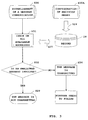
- Fig. 2 wherein reference numeral 26 denotes decision means, 27 analyzing means, 28 a record, and 29 preventing means.
- these means for performing the present invention are all included in the same location of the network, i.e. in the same network element.
- this advantage of the present invention can be achieved that at the same network location where certain addresses are determined as to be unallowed for a message communication for which reason the decision means 26 are configured in accordance to this decision upon these certain addresses, there is a record 28 held which contains information about these certain addresses written thereto by the decision means 26 (step S26), and an analyzing means 27 to check (step S27) whether an address is unallowed. Consequently, also the preventing means 29 to which the result of the analysis of said analyzing means 27 is returned (step 529) is included with the other means in said network location.
- a deciding entity among the above given examples configures the decision means 26 upon a judgement on addresses by which it is determined whether they shall be allowed for a message communication or not.
- a following step S26 there is information about the addresses which are not allowed written in a record 28.
- step S30 When at any later time a message communication is established in the network in a step S30, then the method proceeds to a step S31, wherein the analyzing means 27 being located in the responsible network element checks all available information in the record 28. The result of this analysis is taken in a step S27 and forwarded to a step S32. Therein the result of the analysis is checked, whether an unallowed address is involved or not. If this is the case, then the transmission of the message will be prevented by the preventing means 29 in a step S29. If the answer is "no", the message will be transmitted further in a step S34 with more steps to follow.
- the present invention proposes a method for restricting a message service in a communication network, wherein at least a sender 12, 13, 14 and a recipient 12, 13, 14 are to be involved if a message communication takes place in said network, and each of which can be identified by a respective address A12, A13, A14; said method comprising the steps of keeping a record 28 containing information about certain addresses with which a message communication is not allowed; receiving a request for establishing a message communication S30; analyzing S31, S27, S32 on the basis of the information in the record whether a message communication is allowed; and preventing S29 the transmission of a message if said message is related to an address which is not allowed according to the analyzing step.
- the present invention further proposes a network being capable of restricting a message service, and a terminal for use in the network.
Landscapes
- Engineering & Computer Science (AREA)
- Computer Security & Cryptography (AREA)
- Computer Networks & Wireless Communication (AREA)
- Signal Processing (AREA)
- Computer Hardware Design (AREA)
- Computing Systems (AREA)
- General Engineering & Computer Science (AREA)
- Mobile Radio Communication Systems (AREA)
- Data Exchanges In Wide-Area Networks (AREA)
Abstract
Claims (12)
- Procédé de restriction d'un service de messagerie dans un réseau de communication, dans lequel
au moins un envoyeur (12, 13, 14) et un receveur (12, 13, 14) sont impliqués si une communication de message se produit dans ledit réseau, et dont chacun peut être identifié par une adresse respective (A12, A13, A14) ;
ledit procédé comprenant les étapes consistant à
conserver un enregistrement (28) contenant des informations concernant certaines adresses avec lesquelles une communication de message n'est pas autorisée ;
décider (S30A) si une communication de message avec une certaine adresse est autorisée ou non, et écrire (S26) des informations d'adresses n'étant pas autorisées dans ledit enregistrement (28), de manière à déterminer le contenu dudit enregistrement (28) ;
recevoir une requête pour établir une communication de message (S30) ;
analyser (S31, S27, S32) sur la base des informations dans l'enregistrement si une communication de message est autorisée ; et
prévenir (S29) la transmission d'un message si ledit message concerne une adresse qui n'est pas autorisée conformément à l'étape d'analyse,
caractérisé en ce que ladite étape de décision (S30A) et ladite étape de prévention (S29) sont effectuées dans un centre de commutation (11, 15) dudit réseau de communication, et ledit enregistrement (28) est conservé dans ledit centre de commutation (11, 15). - Procédé selon la revendication 1, dans lequel l'un parmi ledit envoyeur et ledit receveur est un centre de service de messagerie (14).
- Procédé selon la revendication 1, dans lequel ledit centre de commutation est un centre de commutation visité (11), auquel un terminal d'un abonné étant impliqué dans ladite communication de message est associé à la fois, lorsque ledit message doit être transmis.
- Procédé selon la revendication 1, dans lequel ledit centre de commutation est un centre de commutation d'interfonctionnement (15) qui doit être impliqué, si une communication de message se produit.
- Procédé selon la revendication 1 ou 2, dans lesquels ledit contenus dudit enregistrement sont spécifiques de l'abonné.
- Procédé selon la revendication 5, dans lequel ledit enregistrement est commun à un groupe d'abonnés.
- Réseau étant capable de restreindre un service de messagerie, comprenant
au moins un envoyeur (12, 13, 14) et un receveur (12, 13, 14) dont chacun a une adresse (A12, A13, A14) ;
une pluralité de centres de commutation, dans lequel un terminal est toujours relié à un centre de commutation visité (11) ;
un enregistrement (28) dans lequel des informations concernant les adresses n'étant pas autorisées sont écrites ;
des moyens d'analyse (27) pour analyser à l'aide dudit enregistrement (28), si une adresse n'est pas autorisée ;
des moyens (29), fonctionnels pour prévenir la transmission d'un message si ledit message est associé à une adresse qui n'est pas autorisée conformément à l'analyse des moyens d'analyse (27) ; et
des moyens de décision (26) pour décider de l'autorisation pour une adresse à être impliquée dans une communication de message,
caractérisé en ce que
ledit enregistrement (28), lesdits moyens d'analyse (27), lesdits moyens de prévention (29) et lesdits moyens de décision (26) sont situés dans chacun desdits centres de commutation (11). - Réseau selon la revendication 7, dans lequel l'un parmi ledit envoyeur et ledit receveur est un centre de service de messagerie (14).
- Réseau selon la revendication 7, comprenant en outre au moins un centre de commutation d'interfonctionnement (15), dans lequel ledit enregistrement (28), lesdits moyens d'analyse (27), lesdits moyens de prévention (29) et lesdits moyens de décision (26) sont situés dans ledit centre de commutation d'interfonctionnement (15).
- Réseau selon la revendication 7, dans lequel ledit enregistrement dans lequel des informations concernant les adresses non autorisées sont écrites concerne au moins une adresse correspondant audit au moins un envoyeur émettant un message à un centre de commutation pour communication plus avant audit receveur par l'intermédiaire d'un centre de service de messagerie dudit réseau.
- Elément de réseau capable de restreindre un service de messagerie entre au moins un envoyeur (12, 13, 14) et un receveur (12, 13, 14), et comprenant un centre de commutation, dans lequel chacun a une adresse (A12, A13, A14) comprenant :un enregistrement (28) dans lequel des informations concernant des adresses non autorisées sont écrites ;des moyens d'analyse (27) pour analyser à l'aide dudit enregistrement (28) si une adresse n'est pas autorisée ;des moyens (29), opérationnels pour prévenir la transmission d'un message si ledit message est associé à une adresse qui n'est pas autorisée conformément à l'analyse des moyens d'analyse (27) ; etdes moyens de décision (26) pour décider d'une autorisation d'une adresse dans une communication de message, dans lequelledit enregistrement (28), lesdits moyens d'analyse (27), lesdits moyens de prévention (29) et lesdits moyens de décision (26) sont situés dans ledit élément de réseau comprenant un centre de commutation.
- Elément de réseau selon la revendication 11, dans lequel ledit enregistrement dans lequel des informations concernant les adresses non autorisées sont écrites concerne au moins une adresse correspondant audit au moins un envoyeur émettant un message au centre de commutation pour communication plus avant audit receveur par l'intermédiaire d'un centre de service de messagerie dudit réseau.
Applications Claiming Priority (1)
| Application Number | Priority Date | Filing Date | Title |
|---|---|---|---|
| PCT/EP1999/004847 WO2001005118A1 (fr) | 1999-07-09 | 1999-07-09 | Procede de limitation de service d'envoi de message |
Publications (2)
| Publication Number | Publication Date |
|---|---|
| EP1214830A1 EP1214830A1 (fr) | 2002-06-19 |
| EP1214830B1 true EP1214830B1 (fr) | 2007-06-27 |
Family
ID=8167366
Family Applications (1)
| Application Number | Title | Priority Date | Filing Date |
|---|---|---|---|
| EP99936509A Expired - Lifetime EP1214830B1 (fr) | 1999-07-09 | 1999-07-09 | Procede de limitation de service d'envoi de message |
Country Status (7)
| Country | Link |
|---|---|
| US (1) | US20020168978A1 (fr) |
| EP (1) | EP1214830B1 (fr) |
| CN (1) | CN1149808C (fr) |
| AU (1) | AU5158399A (fr) |
| BR (1) | BR9917399A (fr) |
| DE (1) | DE69936404T2 (fr) |
| WO (1) | WO2001005118A1 (fr) |
Families Citing this family (25)
| Publication number | Priority date | Publication date | Assignee | Title |
|---|---|---|---|---|
| US7319858B2 (en) | 2001-11-16 | 2008-01-15 | Cingular Wireless Ii, Llc | System and method for querying message information |
| US8660537B2 (en) | 2001-11-16 | 2014-02-25 | At&T Mobility Ii Llc | System for the storage and retrieval of messages |
| US7317697B2 (en) | 2001-11-16 | 2008-01-08 | At&T Mobility Ii Llc | System for handling file attachments |
| US7401148B2 (en) | 2001-11-16 | 2008-07-15 | At&T Mobility Ii Llc | System for customer access to messaging and configuration data |
| US7454195B2 (en) * | 2001-11-16 | 2008-11-18 | At&T Mobility Ii, Llc | System for the centralized storage of wireless customer information |
| US7487262B2 (en) | 2001-11-16 | 2009-02-03 | At & T Mobility Ii, Llc | Methods and systems for routing messages through a communications network based on message content |
| US7617328B2 (en) | 2001-11-16 | 2009-11-10 | At&T Mobility Ii Llc | System for translation and communication of messaging protocols into a common protocol |
| US7549096B2 (en) | 2001-11-16 | 2009-06-16 | At&T Mobility Ii Llc | Methods and systems for tracking and playing back errors in a communications network |
| US7657253B2 (en) | 2001-11-16 | 2010-02-02 | At&T Mobility Ii Llc | System and method for providing message notification |
| US7793334B2 (en) | 2001-11-16 | 2010-09-07 | At&T Mobility Ii Llc | System and method for password protecting a distribution list |
| US6950706B2 (en) | 2002-04-26 | 2005-09-27 | Medtronic, Inc. | Wave shaping for an implantable medical device |
| AU2003250131A1 (en) * | 2002-07-25 | 2004-02-16 | Telefonaktiebolaget Lm Ericsson (Publ) | Method for restricting the transmission of short messages |
| EP1387539A1 (fr) * | 2002-08-02 | 2004-02-04 | Siemens Aktiengesellschaft | Procédé et système pour le blocage des messages non-sollicités |
| JP2004172923A (ja) * | 2002-11-20 | 2004-06-17 | Nec Corp | 携帯電話端末及びそれに用いる有料サービス制限方法 |
| US20040167892A1 (en) * | 2003-02-25 | 2004-08-26 | Evan Kirshenbaum | Apparatus and method for translating between different role-based vocabularies for multiple users |
| US7248885B2 (en) * | 2003-05-09 | 2007-07-24 | Lucent Technologies Inc. | Automatic/timed silencing of mobile phone from a network |
| FR2858498A1 (fr) * | 2003-07-29 | 2005-02-04 | France Telecom | Procede de securisation de requetes d'acces a des services, terminal et module logiciel pour mettre en oeuvre le procede |
| CN101341727B (zh) * | 2003-09-26 | 2012-04-18 | 迪斯尼企业公司 | 父母控制的蜂窝电话 |
| US20050130629A1 (en) * | 2003-12-10 | 2005-06-16 | Kelkar Uday R. | Message management in wireless communications devices and methods |
| FI20040023A0 (fi) * | 2004-01-09 | 2004-01-09 | Nokia Corp | Viestien lähetyksen ohjaus viestintäjärjestelmässä |
| US20050186974A1 (en) * | 2004-02-05 | 2005-08-25 | Yigang Cai | Short message service (SMS), multimedia message service (MMS), call screening and filtering |
| JP4632439B2 (ja) | 2005-08-05 | 2011-02-16 | 株式会社スクウェア・エニックス | 通信制御プログラム及びコンピュータ端末 |
| US7522909B2 (en) * | 2005-12-20 | 2009-04-21 | Alcatel-Lucent Usa Inc. | Content access control system for a mobile communication network |
| CN101635992B (zh) * | 2008-07-21 | 2012-12-19 | 中兴通讯股份有限公司 | 一种寻呼消息的发送方法 |
| US8787876B1 (en) * | 2010-11-15 | 2014-07-22 | Cellco Partnership | Parental control of mobile message content |
Family Cites Families (15)
| Publication number | Priority date | Publication date | Assignee | Title |
|---|---|---|---|---|
| FR2711866B1 (fr) * | 1993-10-26 | 1996-05-24 | Alcatel Mobile Comm France | Installation de radio-téléphone numérique à terminaux mobiles. |
| US5797098A (en) * | 1995-07-19 | 1998-08-18 | Pacific Communication Sciences, Inc. | User interface for cellular telephone |
| US5867787A (en) * | 1995-07-31 | 1999-02-02 | Northern Telecom Limited | Overload control for an integrated MSC/HLR switch |
| US5815404A (en) * | 1995-10-16 | 1998-09-29 | Xilinx, Inc. | Method and apparatus for obtaining and using antifuse testing information to increase programmable device yield |
| US5903726A (en) * | 1996-06-26 | 1999-05-11 | Mci Communications Corporation | System using portion of a short message payload to identify short message service types and delivering the message if user subscribes to the services |
| US6169893B1 (en) * | 1997-04-04 | 2001-01-02 | Nortel Networks Limited | Wireless communication system that supports multiple standards, multiple protocol revisions, multiple extended services and multiple extended services delivery options and method of operation therefor |
| US7580707B2 (en) * | 1997-04-04 | 2009-08-25 | Nortel Networks Limited | Wireless communication system that supports multiple standards, multiple protocol revisions, multiple extended services and multiple extended services delivery options and method of operation therefor |
| US6101393A (en) * | 1997-11-20 | 2000-08-08 | Ericsson Inc. | Selective acceptance of short message service (SMS) messages in a cellular telephone network |
| US6188892B1 (en) * | 1998-02-13 | 2001-02-13 | Qualcomm Inc. | System and method for base station initiated call setup |
| US6256515B1 (en) * | 1998-04-29 | 2001-07-03 | Metro One Telecommunications, Inc. | Call management system for wireless telephones |
| KR100273043B1 (ko) * | 1998-05-14 | 2000-12-01 | 윤종용 | 이동 교환기의 위치등록 요구 방법 |
| WO1999063772A1 (fr) * | 1998-06-02 | 1999-12-09 | Siemens Aktiengesellschaft | Procede et systeme de communication mobile pour assurer la commande d'un service de messagerie courte |
| US6912230B1 (en) * | 1999-02-05 | 2005-06-28 | Tecore | Multi-protocol wireless communication apparatus and method |
| WO2001019093A1 (fr) * | 1999-09-02 | 2001-03-15 | Nokia Corporation | Commande d'appel dans des reseaux intelligents |
| US6795711B1 (en) * | 1999-10-07 | 2004-09-21 | Nokia Mobile Phones Ltd | Multimedia message content adaptation |
-
1999
- 1999-07-09 DE DE69936404T patent/DE69936404T2/de not_active Expired - Lifetime
- 1999-07-09 AU AU51583/99A patent/AU5158399A/en not_active Abandoned
- 1999-07-09 EP EP99936509A patent/EP1214830B1/fr not_active Expired - Lifetime
- 1999-07-09 WO PCT/EP1999/004847 patent/WO2001005118A1/fr not_active Ceased
- 1999-07-09 CN CNB998167967A patent/CN1149808C/zh not_active Expired - Lifetime
- 1999-07-09 BR BR9917399-9A patent/BR9917399A/pt not_active IP Right Cessation
-
2002
- 2002-01-04 US US10/041,702 patent/US20020168978A1/en not_active Abandoned
Non-Patent Citations (1)
| Title |
|---|
| None * |
Also Published As
| Publication number | Publication date |
|---|---|
| US20020168978A1 (en) | 2002-11-14 |
| CN1357191A (zh) | 2002-07-03 |
| WO2001005118A1 (fr) | 2001-01-18 |
| BR9917399A (pt) | 2002-03-19 |
| DE69936404D1 (de) | 2007-08-09 |
| EP1214830A1 (fr) | 2002-06-19 |
| DE69936404T2 (de) | 2008-03-06 |
| AU5158399A (en) | 2001-01-30 |
| CN1149808C (zh) | 2004-05-12 |
Similar Documents
| Publication | Publication Date | Title |
|---|---|---|
| US20020168978A1 (en) | Method for the restriction of a message service | |
| US5678179A (en) | Message transmission system and method for a radiocommunication system | |
| US10034232B2 (en) | Subscriber identification management broker for fixed/mobile networks | |
| EP2098082B1 (fr) | Procédé et appareil de service de messagerie SMS sous contrôle parental | |
| AU2014227509B2 (en) | Subscriber Identification Management Broker for Fixed/Mobile Networks | |
| GB2473753A (en) | Automatic provision of a subscriber network identifier (e.g. IMSI) from a central network server to a roaming mobile device. | |
| EP1379097A1 (fr) | Procédé pour fournir de l'information sur un utilisateur d'un appareil mobile illégal | |
| EP2597847B1 (fr) | Système de télécommunications d'identificateur unifié d'arrivée | |
| US8774773B1 (en) | Systems and methods for selectively allowing communication of a voice-call-availability status for a mobile device | |
| US7389115B2 (en) | Method for handling service requests in a mobile telecommunication network | |
| AU732382B2 (en) | A message transmission system and method for a radiocommunication system | |
| CA2309333C (fr) | Systeme et procede de transmission de messages pour systeme de radiocom unications | |
| KR101717977B1 (ko) | 단문메시지의 부가서비스 관리 시스템 및 그 방법 | |
| WO2004012469A1 (fr) | Procede permettant de limiter la transmission de messages courts |
Legal Events
| Date | Code | Title | Description |
|---|---|---|---|
| PUAI | Public reference made under article 153(3) epc to a published international application that has entered the european phase |
Free format text: ORIGINAL CODE: 0009012 |
|
| 17P | Request for examination filed |
Effective date: 20020108 |
|
| AK | Designated contracting states |
Kind code of ref document: A1 Designated state(s): DE ES FR GB IT NL |
|
| AX | Request for extension of the european patent |
Free format text: AL;LT;LV;MK;RO;SI |
|
| RIN1 | Information on inventor provided before grant (corrected) |
Inventor name: OHMAN, ISMO Inventor name: MOLNAR, VALERIA |
|
| RBV | Designated contracting states (corrected) |
Designated state(s): DE ES FR GB IT NL |
|
| GRAP | Despatch of communication of intention to grant a patent |
Free format text: ORIGINAL CODE: EPIDOSNIGR1 |
|
| GRAS | Grant fee paid |
Free format text: ORIGINAL CODE: EPIDOSNIGR3 |
|
| 17Q | First examination report despatched |
Effective date: 20070115 |
|
| GRAA | (expected) grant |
Free format text: ORIGINAL CODE: 0009210 |
|
| AK | Designated contracting states |
Kind code of ref document: B1 Designated state(s): DE ES FR GB IT NL |
|
| REG | Reference to a national code |
Ref country code: GB Ref legal event code: FG4D |
|
| REF | Corresponds to: |
Ref document number: 69936404 Country of ref document: DE Date of ref document: 20070809 Kind code of ref document: P |
|
| ET | Fr: translation filed | ||
| PG25 | Lapsed in a contracting state [announced via postgrant information from national office to epo] |
Ref country code: ES Free format text: LAPSE BECAUSE OF FAILURE TO SUBMIT A TRANSLATION OF THE DESCRIPTION OR TO PAY THE FEE WITHIN THE PRESCRIBED TIME-LIMIT Effective date: 20071008 |
|
| PG25 | Lapsed in a contracting state [announced via postgrant information from national office to epo] |
Ref country code: IT Free format text: LAPSE BECAUSE OF FAILURE TO SUBMIT A TRANSLATION OF THE DESCRIPTION OR TO PAY THE FEE WITHIN THE PRESCRIBED TIME-LIMIT Effective date: 20070627 |
|
| PLBE | No opposition filed within time limit |
Free format text: ORIGINAL CODE: 0009261 |
|
| STAA | Information on the status of an ep patent application or granted ep patent |
Free format text: STATUS: NO OPPOSITION FILED WITHIN TIME LIMIT |
|
| GBPC | Gb: european patent ceased through non-payment of renewal fee |
Effective date: 20070927 |
|
| 26N | No opposition filed |
Effective date: 20080328 |
|
| PG25 | Lapsed in a contracting state [announced via postgrant information from national office to epo] |
Ref country code: GB Free format text: LAPSE BECAUSE OF NON-PAYMENT OF DUE FEES Effective date: 20070927 |
|
| PGFP | Annual fee paid to national office [announced via postgrant information from national office to epo] |
Ref country code: NL Payment date: 20100707 Year of fee payment: 12 |
|
| PGFP | Annual fee paid to national office [announced via postgrant information from national office to epo] |
Ref country code: FR Payment date: 20100805 Year of fee payment: 12 |
|
| REG | Reference to a national code |
Ref country code: NL Ref legal event code: V1 Effective date: 20120201 |
|
| REG | Reference to a national code |
Ref country code: FR Ref legal event code: ST Effective date: 20120330 |
|
| PG25 | Lapsed in a contracting state [announced via postgrant information from national office to epo] |
Ref country code: FR Free format text: LAPSE BECAUSE OF NON-PAYMENT OF DUE FEES Effective date: 20110801 |
|
| PG25 | Lapsed in a contracting state [announced via postgrant information from national office to epo] |
Ref country code: NL Free format text: LAPSE BECAUSE OF NON-PAYMENT OF DUE FEES Effective date: 20120201 |
|
| REG | Reference to a national code |
Ref country code: DE Ref legal event code: R082 Ref document number: 69936404 Country of ref document: DE Representative=s name: TBK, DE Ref country code: DE Ref legal event code: R081 Ref document number: 69936404 Country of ref document: DE Owner name: NOKIA TECHNOLOGIES OY, FI Free format text: FORMER OWNER: NOKIA CORP., 02610 ESPOO, FI |
|
| PGFP | Annual fee paid to national office [announced via postgrant information from national office to epo] |
Ref country code: DE Payment date: 20180723 Year of fee payment: 20 |
|
| REG | Reference to a national code |
Ref country code: DE Ref legal event code: R082 Ref document number: 69936404 Country of ref document: DE Representative=s name: TBK, DE Ref country code: DE Ref legal event code: R081 Ref document number: 69936404 Country of ref document: DE Owner name: PROVENANCE ASSET GROUP LLC, PITTSFORD, US Free format text: FORMER OWNER: NOKIA TECHNOLOGIES OY, ESPOO, FI |
|
| REG | Reference to a national code |
Ref country code: DE Ref legal event code: R071 Ref document number: 69936404 Country of ref document: DE |