EP1216432B1 - Progressive linse - Google Patents
Progressive linse Download PDFInfo
- Publication number
- EP1216432B1 EP1216432B1 EP00969060A EP00969060A EP1216432B1 EP 1216432 B1 EP1216432 B1 EP 1216432B1 EP 00969060 A EP00969060 A EP 00969060A EP 00969060 A EP00969060 A EP 00969060A EP 1216432 B1 EP1216432 B1 EP 1216432B1
- Authority
- EP
- European Patent Office
- Prior art keywords
- lens element
- approximately
- viewing zone
- ophthalmic lens
- progressive ophthalmic
- Prior art date
- Legal status (The legal status is an assumption and is not a legal conclusion. Google has not performed a legal analysis and makes no representation as to the accuracy of the status listed.)
- Expired - Lifetime
Links
- 230000000750 progressive effect Effects 0.000 title claims abstract description 74
- 230000004438 eyesight Effects 0.000 claims abstract description 38
- 230000003287 optical effect Effects 0.000 claims abstract description 28
- 208000001491 myopia Diseases 0.000 claims abstract description 19
- 238000012937 correction Methods 0.000 claims abstract description 15
- 238000000034 method Methods 0.000 claims abstract description 8
- 230000004075 alteration Effects 0.000 claims abstract description 7
- 230000002093 peripheral effect Effects 0.000 claims abstract description 7
- 238000013461 design Methods 0.000 claims description 16
- 201000009310 astigmatism Diseases 0.000 claims description 11
- 238000009826 distribution Methods 0.000 claims description 8
- 230000008859 change Effects 0.000 claims description 6
- 230000001747 exhibiting effect Effects 0.000 claims description 5
- 230000006870 function Effects 0.000 claims description 5
- 238000005259 measurement Methods 0.000 claims description 4
- 230000009467 reduction Effects 0.000 claims description 4
- 230000005043 peripheral vision Effects 0.000 claims 2
- 230000001419 dependent effect Effects 0.000 claims 1
- 239000000843 powder Substances 0.000 claims 1
- 238000007792 addition Methods 0.000 description 32
- 239000000463 material Substances 0.000 description 14
- 230000000007 visual effect Effects 0.000 description 9
- 230000006978 adaptation Effects 0.000 description 5
- 238000000576 coating method Methods 0.000 description 4
- 239000000975 dye Substances 0.000 description 4
- JHQVCQDWGSXTFE-UHFFFAOYSA-N 2-(2-prop-2-enoxycarbonyloxyethoxy)ethyl prop-2-enyl carbonate Chemical compound C=CCOC(=O)OCCOCCOC(=O)OCC=C JHQVCQDWGSXTFE-UHFFFAOYSA-N 0.000 description 3
- 101150027068 DEGS1 gene Proteins 0.000 description 3
- 230000004308 accommodation Effects 0.000 description 3
- 238000005266 casting Methods 0.000 description 3
- 230000003247 decreasing effect Effects 0.000 description 3
- 230000004424 eye movement Effects 0.000 description 3
- 239000000203 mixture Substances 0.000 description 3
- 230000003667 anti-reflective effect Effects 0.000 description 2
- 239000011248 coating agent Substances 0.000 description 2
- 230000036544 posture Effects 0.000 description 2
- 230000035807 sensation Effects 0.000 description 2
- 230000035945 sensitivity Effects 0.000 description 2
- 208000012639 Balance disease Diseases 0.000 description 1
- 206010028813 Nausea Diseases 0.000 description 1
- 238000005299 abrasion Methods 0.000 description 1
- 230000002350 accommodative effect Effects 0.000 description 1
- 239000003795 chemical substances by application Substances 0.000 description 1
- 230000007812 deficiency Effects 0.000 description 1
- 208000002173 dizziness Diseases 0.000 description 1
- 238000009472 formulation Methods 0.000 description 1
- 239000011521 glass Substances 0.000 description 1
- 239000003112 inhibitor Substances 0.000 description 1
- 238000004519 manufacturing process Methods 0.000 description 1
- 230000004048 modification Effects 0.000 description 1
- 238000012986 modification Methods 0.000 description 1
- 239000000178 monomer Substances 0.000 description 1
- 230000008693 nausea Effects 0.000 description 1
- 230000008447 perception Effects 0.000 description 1
- 230000008569 process Effects 0.000 description 1
- 239000003381 stabilizer Substances 0.000 description 1
- 230000009182 swimming Effects 0.000 description 1
- 230000002123 temporal effect Effects 0.000 description 1
- 229920001169 thermoplastic Polymers 0.000 description 1
- 229920001187 thermosetting polymer Polymers 0.000 description 1
- 239000004416 thermosoftening plastic Substances 0.000 description 1
- 235000012431 wafers Nutrition 0.000 description 1
Images






Classifications
-
- G—PHYSICS
- G02—OPTICS
- G02C—SPECTACLES; SUNGLASSES OR GOGGLES INSOFAR AS THEY HAVE THE SAME FEATURES AS SPECTACLES; CONTACT LENSES
- G02C7/00—Optical parts
- G02C7/02—Lenses; Lens systems ; Methods of designing lenses
- G02C7/06—Lenses; Lens systems ; Methods of designing lenses bifocal; multifocal ; progressive
- G02C7/061—Spectacle lenses with progressively varying focal power
- G02C7/063—Shape of the progressive surface
-
- G—PHYSICS
- G02—OPTICS
- G02C—SPECTACLES; SUNGLASSES OR GOGGLES INSOFAR AS THEY HAVE THE SAME FEATURES AS SPECTACLES; CONTACT LENSES
- G02C7/00—Optical parts
- G02C7/02—Lenses; Lens systems ; Methods of designing lenses
- G02C7/06—Lenses; Lens systems ; Methods of designing lenses bifocal; multifocal ; progressive
- G02C7/061—Spectacle lenses with progressively varying focal power
-
- G—PHYSICS
- G02—OPTICS
- G02C—SPECTACLES; SUNGLASSES OR GOGGLES INSOFAR AS THEY HAVE THE SAME FEATURES AS SPECTACLES; CONTACT LENSES
- G02C2202/00—Generic optical aspects applicable to one or more of the subgroups of G02C7/00
- G02C2202/08—Series of lenses, lens blanks
Definitions
- the present invention relates to a progressive ophthalmic lens and in particular to a progressive ophthalmic lens exhibiting improved functionality and ease of adaptation, particularly for the first-time or part-time wearer, and taking into account wearer sensitivity to swim, and to a process for producing such lenses.
- Progressive lenses have heretofore been designed on the basis that they have distance, near and intermediate viewing zones.
- the intermediate zone joins the near and distance zones in a cosmetically acceptable way, in the sense that no discontinuities in the lens should be visible to people observing the lens of the wearer.
- the design of the intermediate zone is based on a line called the "eye path" along which the optical power of the lens increases more or less uniformly.
- prior art progressive lenses present the wearer with significant adaptation difficulties. For example, a wearer who utilises progressive lenses for reading purposes may generally be inconvenienced by the limited width of vision for near tasks. Similarly, new progressive spectacle wearers may be sensitive to swim and may be unable or unwilling to learn new head postures dictated by prior art progressive lenses. Document US 4,854,689 discloses progressive ophthalmic lenses.
- the progressive lens could more closely relate to the requirements of the individual wearer and to the natural eye movements of a wearer in performing intermediate and near tasks in particular and thus make adaptation to a progressive prescription easier.
- a progressive ophthalmic lens element including a lens surface having an upper viewing zone having a surface power corresponding to distance vision, a lower viewing zone having a greater surface power than the upper viewing zone to achieve a refracting power corresponding to near vision; and -an intermediate zone extending across the lens element having a surface power varying from that of the upper viewing zone to that of the lower viewing zone and including a corridor of relatively low surface astigmatism; the lens surface including a relatively high, relatively wide lower viewing zone; and a relatively wide intermediate zone.
- the present invention accordingly provides a progressive ophthalmic lens element exhibiting a balance in zone sizes which provides the wearer with significantly improved near and intermediate vision, thus making spectacles including the progressive ophthalmic lenses more acceptable to the first time or part-time wearer, or a wearer with a near vision priority, and making adaptation thereto a much simpler task.
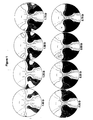
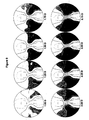
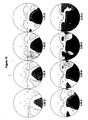
- the area of the lower viewing zone when ray traced to a 0.4 m object distance is over 150 mm 2 .
- the progressive lens design according to this aspect of the present invention may be such that the ratio of the area of clear vision of the upper (or distance) viewing zone to the lower (or near) viewing zone is in the range between approximately 2.50 and 3.00.
- This clear vision size ratio is indicative of effective relative zone sizes and illustrates the improved balance of zone sizes between the distance and near viewing zones in the ophthalmic lens elements for wearers with a near vision priority according to the present invention.
- the progressive design lens according to this aspect of the present invention includes a surface design of the peripheral regions of the lens to reduce or minimise the phenomenon of "swim".
- swipe we mean wearer perception of the unnatural movement of objects within the visual field during dynamic visual tasks, which may lead to a sense of unsteadiness, dizziness or nausea.
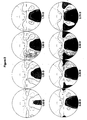
- the lens surface areas that are critical for reducing the swim sensation are within a pair of generally horizontally disposed opposed segments approximately ⁇ 22.5° above and below a generally horizontal axis passing through the fitting cross. -
- the opposed segments may have a radius of approximately 15 mm from the fitting cross, preferably approximately 20 mm, more preferably approximately 25 mm.
- the minimisation of the swimming sensation may be achieved by reducing optical aberrations contributing to swim.
- a surface correction(s) may provide a reduction in the sagittal addition power within the opposed segments.
- the surface(s) may be such that the difference between maximum and minimum sagittal addition power is less than approximately 0.75* Add diopters. This may significantly reduce the phenomenon of swim for a wearer, in use.
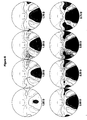
- the progressive lens design may exhibit a small amount of addition power (eg. 0.05 D to 0.4 D), proximate the fitting cross depending on the nominal addition power of the lens element and the base curve.
- a small amount of addition power eg. 0.05 D to 0.4 D
- the corridor of the intermediate viewing zone is thus effectively extended a small distance into the upper (or distance) viewing zone, allowing peripheral blur values to be reduced and the zone available for clear vision at intermediate distances to be increased.
- the ophthalmic lens element according to the present invention may form one of a series of lens elements.
- each lens element including a lens surface having an upper viewing zone having a surface power to achieve a refracting power corresponding to distance vision; a lower viewing zone having a greater surface power than the upper viewing zone to achieve a refracting power corresponding to near vision; and an intermediate zone extending across the lens element having a surface power varying from that of the upper viewing zone to that of the lower viewing zone and including a corridor of relatively low surface astigmatism;
- the progressive ophthalmic lens series including lens elements having a base curve suitable for use in providing a range of distance prescriptions for one or more of emmetropes, hyperopes and myopes, each lens element differing in prescribed addition power and including a progressive design including a relatively high, relatively wide lower viewing zone and a relatively wide intermediate zone; the dimensions of the intermediate and lower viewing zones being related to the prescribed addition power of the wearer.
- the present invention accordingly relates to a progressive ophthalmic lens series exhibiting improved functionality and ease of adaptation, as it takes into account factors including one or more of the following: wearers' sensitivity to swim and natural eye movements.
- the progressive lens element within the series also exhibits a distance/near zone balance more appropriate for a part-time wearer or a wearer with a near vision priority than those provided by general purpose prior art progressive lenses.
- each progressive ophthalmic lens element in a series according to the present invention exhibits a relatively high lower viewing, or near vision, zone.
- the relatively high lower viewing zone may reduce the need for the wearer to learn new head postures for reading purposes.
- the lens elements having a base curve suitable for emmetropes have an upper viewing zone and lower viewing zone such that the ratio of the area of clear vision of the upper viewing zone to the lower viewing zone is in the range between approximately 2.50 and 3.00.
- each lens element in the series may have a progressive lens design exhibiting a small amount of addition power proximate the fitting cross; the addition power component proximate the fitting cross being related to the prescribed addition power and/or depth of focus of the wearer.
- the addition power proximate the fitting cross of a progressive lens element is in the range from 0.05 to 0.40 D, the fitting cross addition power increasing with the addition power for each of the base curves, and with the increasing base curve for each addition power.
- the lens elements may exhibit an increase in corridor length within increasing addition power.
- the relatively high, relatively wide lower viewing zone may permit useful reading from a point (the highest reading point) approximately 10 to 12 mm below the fitting cross.
- the effective corridor length is approximately 10 to 12 mm.
- the lower viewing zone may permit useful reading from a point (the highest reading point) approximately 12 mm below the fitting cross. Then the effective corridor length is approximately 12 mm. It will be understood that the slight increase in effective corridor length at higher addition powers permits an increased effective lower or near viewing zone size and/or lower peripheral blur.
- highest reading point we mean the highest point along the eye path where the wearer can read normal size text at the 40 cm reading distance without perceiving the blur. This is equal to the nominal prescribed add minus the effective depth of focus for near vision which is around 0.50 D for a broad range of addition powers.
- the progressive lens design of each lens element in this series includes a surface correction to reduce or minimise the phenomenon of "swim".
- the surface modification to reduce swim may be provided within a pair of generally horizontally disposed opposed segments generally centred at the fitting cross of each ophthalmic lens element.
- the opposed segments may extend approximately ⁇ 22.5° above and below a generally horizontal axis passing through the fitting cross.
- the opposed segments may have a radius of approximately 15 mm from the fitting cross, preferably approximately 20 mm, more preferably approximately 25 mm.
- the swim surface correction(s) may be such as to reduce optical aberrations contributing to swim.
- the swim surface correction(s) may take the form of a reduction in the sagittal addition power variations within the segments defined above.
- the difference between maximum and minimum sagittal addition power within the opposed segments is less than approximately 0.75*Add (in diopters)
- each lens element within the series exhibits a substantially constant ratio of the area of clear vision of the upper (or distance) viewing zone to the lower (or near) viewing zone for all addition powers.
- the clear vision zone size ratio may generally be in the range between approximately 2.50 and 3.00.
- the generally constant clear vision zone size ratio may thus provide the wearer with a generally constant area for clear foveal vision independent of addition power.
- the progressive lens design of each lens element within the series exhibits a substantially constant area of clear vision on the lens surface within the lower viewing zone for a specified base curve. Accordingly the design of each progressive lens element within the series provides the wearer with a generally constant, improved area of clear vision for near tasks across a range of addition powers.
- the lens element series according to Claim 21 wherein the lens element series exhibits a slight decrease in the area of the zone clear for distance vision on the lens surface inside a 22 mm radius circle centred on the GC and constrained by the Add/4 diopters RMS power error contour ray traced in the as worn configuration for an infinite object distance with increasing base curve.
- corridor we mean an area of the intermediate zone of varying power bounded by nasal and temporal contours of tolerable aberration for foveal vision.
- the corridor has a "corridor length" (L), which corresponds to the length of the segment of the visual fixation locus which extends from the vertical height of the fitting cross (FC) to the vertical height of the near zone measurement point.
- L the length of the segment of the visual fixation locus which extends from the vertical height of the fitting cross (FC) to the vertical height of the near zone measurement point.
- the power progression begins at the fitting cross (FC) height.
- effective corridor length as used herein we mean the length from the “fitting cross” (FC) to the highest reading point (HRP) on the lens surface.
- lens element we mean all forms of individual refractive optical bodies employed in the ophthalmic arts, including, but not limited to, lenses, lens wafers and semi-finished lens blanks requiring further finishing to a particular patient's prescription. Also included are formers used in the manufacture of progressive glass lenses and moulds for the casting of progressive lenses in polymeric material such as the material sold under the trade designation CR39.
- tigmatism or surface astigmatism we mean a measure of the degree to which the curvature of the lens varies among intersecting planes which are normal to the surface of the lens at a point on the surface.
- each lens element includes a surface correction to improve optical properties proximate the peripheries of the lens element.
- the distribution of RMS power error may be varied proximate the peripheries of the upper (distance) and/or lower (near) viewing zones.
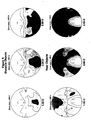
- the distribution of RMS power error exhibits a relatively low gradient proximate the distance periphery and a relatively high gradient proximate the near periphery.
- the relative values of these gradients can be quantified by examining the ratio of the maximum vertical rate of change of the ray traced RMS power error along the 12 mm long vertical lines centred on the fitting cross (FC) and horizontally offset 15 mm from the FC, to the maximum horizontal rate of change - of the RMS power error at the level of the near vision measurement point (NMP).
- this ratio may be less than approximately 0.60 and may preferably vary from approximately 0.40 to 0.60.
- the location of the corridor of the ophthalmic lens element may be dictated at least in part by the visual fixation locus; the visual fixation locus being inset generally horizontally nasally below the fitting cross (FC) of the lens element.
- visual fixation locus we mean the set of points which are the intersection of the lens surface and the patient's line of sight as he or she fixates on objects in the median plane. The term does not signify a required, continuous eye movement path. Rather, the visual fixation locus indicates the set of points corresponding to variously positioned objects in the median plane.
- the visual fixation locus takes into account the fact that the wearer may or may not use the accommodative reserve for a particular fixation. As a result, points at different locations in the visual fixation locus are provided having a power sufficient for comfortable use at the appropriate object distances.
- the fitting cross (FC) is generally located at (0,y FC ).
- the value of y FC may vary, for example, from approximately 2 mm to 6 mm above the geometric centre of the lens element.
- a method of designing an ophthalmic lens element including a first lens surface having an upper viewing zone having a surface power corresponding to distance vision, a lower viewing zone having a greater surface power than the upper viewing zone to achieve a refracting power corresponding to near vision; and an intermediate zone extending across the lens element having a surface power varying from that of the upper viewing zone to that of the lower viewing zone and including a corridor of relatively low surface astigmatism; the ophthalmic lens element including a relatively high, relatively wide lower viewing zone; and a relatively wide intermediate zone, which method includes selecting a merit function relating to at least one optical characteristic of the lens to be minimised with an appropriate distribution of the optimisation weights on the lens surface; and solving the global minimisation problem using the Finite Element Method; and fabricating an ophthalmic lens element having a lens surface shaped according to said optimised surface description.
- the ophthalmic lens element may be formulated from any suitable material.
- a polymeric material may be used.
- the polymeric material may be of any suitable type.
- the polymeric material may include a thermoplastic or thermoset material.
- a material of the diallyl glycol carbonate type, for example CR-39 (PPG Industries) may be used.
- the polymeric article may be formed from cross-linkable polymeric casting compositions, for example as described in Applicants' United States Patent 4,912,155 , United States Patent Application No. 07/781,392 , Australian Patent Applications 50581/93 , 50582/93 , 81216/87 , 74160/91 and European Patent Specification 453159A2 , the entire disclosures of which are incorporated herein by reference.
- the polymeric material may include a dye, preferably a photochromic dye, which may, for example, be added to the monomer formulation used to produce the polymeric material.
- the ophthalmic lens element according to the present invention may further include standard additional coatings to the front or back surface, including electrochromic coatings.
- the front lens surface may include an anti-reflective (AR) coating, for example of the type described in United States Patent 5,704,692 to Applicants, the entire disclosure of which is incorporated herein by reference.
- AR anti-reflective
- the front lens surface may include an abrasion resistant coating. e.g. of the type described in United States Patent 4,954,591 to Applicants, the entire disclosure of which is incorporated herein by reference.
- the front and back surfaces may further include one or more additions conventionally used in casting compositions such as inhibitors, dyes including thermochromic and photochromic dyes, e.g. as described above, polarising agents, UV stabilisers and materials capable of modifying refractive index.
Landscapes
- Health & Medical Sciences (AREA)
- Ophthalmology & Optometry (AREA)
- Physics & Mathematics (AREA)
- General Health & Medical Sciences (AREA)
- General Physics & Mathematics (AREA)
- Optics & Photonics (AREA)
- Eyeglasses (AREA)
Claims (32)
- Element einer progressiven ophthalmischen Linse, die eine Linsenoberfläche aufweist, mit:einem oberen Sehbereich mit einem Flächenbrechwert, der einer Fernsicht entspricht;einem unterem Sehbereich, der einen größeren Flächenbrechwert als der obere Sehbereich aufweist, um eine Brechleistung zu erhalten, die einer Kurzsicht entspricht; undeinem Zwischenbereich, der sich über das Linsenelement erstreckt, mit einem Flächenbrechwert, der von jenem des oberen Sehbereichs bis zu jenem des unteren Sehbereichs variiert und einen Korridor mit relativ niedrigem Flächenastigmatismus enthält;wobei die Linsenoberfläche aufweist:einen Zwischenbereich und einen unteren Sehbereich, die eine effektive Korridorlänge von ungefähr 10 bis ungefähr 12 mm bieten;dadurch gekennzeichnet, dass der obere und der unter Sehbereich so gewählt sind, dass das Verhältnis des Bereichs der Klarsicht des oberen Sehbereichs zum unteren Sehbereich unter ungefähr 3,00 und über ungefähr 2,50 liegt; undwobei der Bereich der Klarsicht durch Sehstrahlverfolgung der Linse in der getragenen Konfiguration für eine spezifische Objektdistanz bestimmt wird, wobei die spezifische Objektdistanz für die Fernsicht unendlich ist und für die Nahsicht 0,4 m beträgt, und wobei der Bereich innerhalb einer Add/4-Dioptrien-Kontur des RMS-Leistungsfehlers innerhalb eines Kreises mit einem Radius von 22 mm, zentriert im geometrischen Zentrum der Linse, berechnet wird.
- Progressives ophthalmisches Linsenelement nach Anspruch 1,
wobei der untere Sehbereich größer als ungefähr 150 mm2 ist. - Progressives ophthalmisches Linsenelement nach Anspruch 2,
wobei die Höhe des unteren Sehbereichs durch die Add/4-Dioptrien-Kontur des RMS-Leistungsfehlers im Bereich von ungefähr 10 bis 12 mm unter dem Passungskreuz liegt. - Progressives ophthalmisches Linsenelement nach Anspruch 1, weiters mit einer Oberflächenkorrektur bzw. mit Oberflächenkorrekturen in den Umfangsbereichen des Linsenelements, die agiert bzw. agieren, um die optischen Abweichungen, die zum Phänomen des Verschwimmens beitragen, zu reduzieren oder minimieren.
- Progressives ophthalmisches Linsenelement nach Anspruch 4,
wobei die Oberflächenkorrektur bzw. die Oberflächenkorrekturen agiert bzw. agieren, um die optischen Abweichungen in den Linsenoberflächenbereichen zu reduzieren, einschließlich eines Paars gegenüberliegender Sektoren, die allgemein horizontal angeordnet und ungefähr ±22,5° oberhalb und unterhalb einer allgemein horizontalen Achse liegen, die durch das Passungskreuz des Linsenelements verläuft. - Progressives ophthalmisches Linsenelement nach Anspruch 5,
wobei die gegenüberliegenden Sektoren einen Radius von ungefähr 15 mm vom Passungskreuz aufweisen. - Progressives ophthalmisches Linsenelement nach Anspruch 5,
wobei die gegenüberliegenden Sektoren einen Radius von ungefähr 20 mm vom Passungskreuz aufweisen. - Progressives ophthalmisches Linsenelement nach Anspruch 4,
wobei die Oberflächenkorrektur bzw. die Oberflächenkorrekturen eine Verringerung der Variation der sagittalen Addition innerhalb der gegenüberliegenden Sektoren liefert bzw. liefern. - Progressives ophthalmisches Linsenelement nach Anspruch 8,
wobei die Oberflächenkorrektur bzw. die Oberflächenkorrekturen so gewählt ist bzw. sind, dass der Unterschied zwischen der maximalen und minimalen sagittalen Addition unter ungefähr 0,75*-Add-Dioptrien liegt. - Progressives ophthalmisches Linsenelement nach Anspruch 1,
wobei das Linsendesign eine kleine Menge an Addition nahe dem Passungskreuz aufweist, je nach nominaler Addition des Linsenelements. - Progressives ophthalmisches Linsenelement nach Anspruch 10,
wobei das Linsendesign ungefähr 0,05 D bis 0,4 D Addition nahe dem Passungskreuz aufweist, je nach nominaler Addition des Linsenelements. - Progressives ophthalmisches Linsenelement nach Anspruch 1, weiters mit einer Oberflächenkorrektur, um die optischen Eigenschaften nahe den Umfängen des Linsenelements zu verbessern.
- Progressives ophthalmisches Linsenelement nach Anspruch 12,
wobei die Verteilung des RMS-Leistungsfehlers nahe den Umfängen der oberen und/oder unteren Sehbereiche variiert wird, um das periphere Sehen zu verbessern. - Progressives ophthalmisches Linsenelement nach Anspruch 13,
wobei die Verteilung des RMS-Leistungsfehlers nahe dem Distanzumfang einen relativ niedrigen Gradienten und nahe dem Umfang einen relativ hohen Gradienten aufweist. - Progressives ophthalmisches Linsenelement nach Anspruch 14,
wobei das Verhältnis der maximalen Veränderungsrate des mit Sehstrahlverfolgung ermittelten RMS-Leistungsfehlers entlang den 12mm-langen vertikalen Linien, zentriert auf dem Passungskreuz (PZ) und horizontal versetzten 15 mm vom FC zur maximalen horizontalen Veränderungsrate des RMS-Leistungsfehlers auf der Ebene des Nahsicht-Messpunkts (NMP) von ungefähr 0,4 bis ungefähr 0,8 variiert. - Reihe von progressiven ophthalmischen Linsenelementen, wobei jedes Linsenelement eine Linsenoberfläche aufweist, mit:einem oberen Sehbereich mit einem Flächenbrechwert, um eine Brechleistung zu erhalten die einer Fernsicht entspricht;einem unterem Sehbereich, der einen größeren Flächenbrechwert als der obere Sehbereich aufweist, um eine Brechleistung zu erhalten, die einer Kurzsicht entspricht; undeinem Zwischenbereich, der sich über das Linsenelement erstreckt, mit einem Flächenbrechwert, der von jenem des oberen Sehbereichs bis zu jenem des unteren Sehbereichs variiert und einen Korridor mit relativ niedrigem Flächenastigmatismus enthält;wobei die Reihe an progressiven ophthalmischen Linsenelementen aufweist:Linsenelemente mit einer Grundbiegung, die geeignet ist, um zum Bereitstellen eines Bereichs an Distanzverschreibung für einen oder mehreren von Normalsichtigen, Weitsichtigen und Kurzsichtigen verwendet zu werden, wobei sich jedes Linsenelement in seiner verschriebenen Addition unterscheidet und ein progressives Design aufweist, mit:einem Zwischenbereich und einem unteren Sehbereich, die eine effektive Korridorlänge von ungefähr 10 bis ungefähr 12 mm bieten;dadurch gekennzeichnet, dass der obere und der unter Sehbereich so gewählt sind, dass das Verhältnis des Bereichs der Klarsicht des oberen Sehbereichs zum unteren Sehbereich unter ungefähr 3,00 und über ungefähr 2,50 liegt; undwobei der Bereich der Klarsicht durch Sehstrahlverfolgung der Linse in der getragenen Konfiguration für eine spezifische Objektdistanz bestimmt wird, wobei die spezifische Objektdistanz für die Fernsicht unendlich ist und für die Nahsicht 0,4 m beträgt, und wobei der Bereich innerhalb einer Add/4-Dioptrien-Kontur des RMS-Leistungsfehlers innerhalb eines Kreises mit einem Radius von 22 mm, zentriert im geometrischen Zentrum der Linse, berechnet wird;wobei die Dimensionen des Zwischenbereichs und des unteren Sehbereichs mit der verschriebenen Addition des Trägers in Zusammenhang stehen.
- Reihe an progressiven ophthalmischen Linsenelementen nach Anspruch 16, wobei jedes Linsenelement der Reihe ein progressives Linsendesign enthält, das eine kleine Menge an Addition nahe dem Passungskreuz aufweist, je nach verschriebener Addition und Grundbiegung.
- Reihe an progressiven ophthalmischen Linsenelementen nach Anspruch 17, wobei die Addition nahe dem Passungskreuz eines progressiven Linsenelements im Bereich von 0,05 bis 0,40 D liegt, wobei die Addition des Passungskreuzes mit der Addition für jede der Grundbiegungen und mit der sich erhöhenden Grundbiegung für jede Addition steigt.
- Reihe an progressiven ophthalmischen Linsenelementen nach Anspruch 17, wobei die Linsenelement-Reihe im für Fernsicht klaren Bereich auf die Linsenoberfläche innerhalb eines Kreises mit einem Radius von 22 mm, zentriert auf der GC und eingeschränkt durch den Sehstrahl der Add/4-Dioptrien-Kontur des RMS-Leistungsfehlers, detektiert in der getragenen Konfiguration für eine unendliche Objektdistanz mit steigender Grundbiegung, eine leichte Abnahme aufweist.
- Reihe an progressiven ophthalmischen Linsenelementen nach Anspruch 19, wobei die Linsenelemente innerhalb steigender Addition eine Erhöhung der Korridorlänge aufweisen.
- Reihe an progressiven ophthalmischen Linsenelementen nach Anspruch 20, wobei die Linsenelemente für niedrige oder mittlere Addition eine Erhöhung der effektiven Korridorlänge von ungefähr 10 bis 12 mm aufweisen und für höhere Addition eine effektive Korridorlänge von ungefähr 12 mm aufweisen.
- Reihe an progressiven ophthalmischen Linsenelementen nach Anspruch 18, wobei das progressive Linsendesign jedes Linsenelements in der Reihe eine Oberflächenkorrektur bzw. Oberflächenkorrekturen in den Umfangsbereichen des Linsenelements aufweist bzw. aufweisen, um das Phänomen des Verschwimmens zu reduzieren oder minimieren.
- Reihe an progressiven ophthalmischen Linsenelementen nach Anspruch 18, wobei die Oberflächenkorrektur bzw. die Oberflächenkorrekturen agiert bzw. agieren, um die optischen Abweichungen in den Linsenoberflächenbereichen zu reduzieren, einschließlich eines Paars gegenüberliegender Sektoren, die allgemein horizontal angeordnet und ungefähr ±22,5° oberhalb und unterhalb einer allgemein horizontalen Achse liegen, die durch das Passungskreuz des Linsenelements verläuft.
- Reihe an progressiven ophthalmischen Linsenelementen nach Anspruch -23, wobei die gegenüberliegenden Sektoren einen Radius von ungefähr 15 mm oder mehr aufweisen.
- Reihe an progressiven ophthalmischen Linsenelementen nach Anspruch 24, wobei die Oberflächenkorrektur eine Verringerung der Variation der sagittalen Addition innerhalb der gegenüberliegenden Sektoren ist.
- Reihe an progressiven ophthalmischen Linsenelementen nach Anspruch 25, wobei der Unterschied zwischen der maximalen und minimalen sagittalen Addition innerhalb jeder der gegenüberliegenden Sektoren unter ungefähr 0,75°-Add-Dioptrien liegt.
- Reihe an progressiven ophthalmischen Linsenelementen nach Anspruch 16, wobei jedes Element der Reihe einen im Wesentlichen konstanten Klarsichtbereich auf der Linsenoberfläche innerhalb des unteren Sehbereichs aufweist.
- Reihe an progressiven ophthalmischen Linsenelementen nach Anspruch 16, wobei jedes Linsenelement eine Oberflächenkorrektur aufweist, um die optischen Eigenschaften nahe den Umfängen des Linsenelements zu verbessern.
- Reihe an progressiven ophthalmischen Linsenelementen nach Anspruch 28, wobei die Verteilung des RMS-Leistungsfehler nahe den Umfängen der oberen und/oder unteren Sehbereiche variiert wird, um das periphere Sehen zu verbessern.
- Reihe an progressiven ophthalmischen Linsenelementen nach Anspruch 29, wobei die Verteilung des RMS-Leistungsfehlers nahe dem Distanzumfang einen relativ niedrigen Gradienten und nahe dem Umfang einen relativ hohen Gradienten aufweist.
- Reihe an progressiven ophthalmischen Linsenelementen nach Anspruch 30, wobei die Grundelemente das Verhältnis der maximalen Veränderungsrate des mit Sehstrahlverfolgung ermittelten RMS-Leistungsfehlers entlang den 12mm-langen vertikalen Linien, zentriert auf dem Passungskreuz (PZ) und horizontal versetzten 15 mm vom FC zur maximalen horizontalen Veränderungsrate des RMS-Leistungsfehlers auf der Ebene des Nahsicht-Messpunkts (NMP) variierend von ungefähr 0,4 bis ungefähr 0,8 aufweisen.
- Verfahren zum Gestalten eines ophthalmischen Linsenelements, die eine erste Linsenoberfläche aufweist, mit:einem oberen Sehbereich mit einem Flächenbrechwert, der einer Fernsicht entspricht;einem unterem Sehbereich, der einen größeren Flächenbrechwert als der obere Sehbereich aufweist, um eine Brechleistung zu erhalten, die einer Kurzsicht entspricht; undeinem Zwischenbereich, der sich über das Linsenelement erstreckt, mit einem Flächenbrechwert, der von jenem des oberen Sehbereichs bis zu jenem des unteren Sehbereichs variiert und miteinem Korridor mit relativ niedrigem Flächenastigmatismus; wobei das ophthalmische Linsenelement enthält:einen Zwischenbereich und einen unteren Sehbereich, die eine effektiven Korridorlänge von ungefähr 10 bis ungefähr 12 mm bieten;wobei der obere und der unter Sehbereich so gewählt sind, dass das Verhältnis des Bereichs der Klarsicht des oberen Sehbereichs zum unteren Sehbereich unter ungefähr 3,00 und über ungefähr 2,50 liegt; undwobei der Bereich der Klarsicht durch Sehstrahlverfolgung der Linse in der getragenen Konfiguration für eine spezifische Objektdistanz bestimmt wird, wobei die spezifische Objektdistanz für die Fernsicht unendlich ist und für die Nahsicht 0,4 m beträgt, und wobei der Bereich innerhalb einer Add/4-Dioptrien-Kontur des RMS-Leistungsfehlers innerhalb eines Kreises mit einem Radius von 22 mm, zentriert im geometrischen Zentrum der Linse berechnet wird;wobei das Verfahren umfasst:Auswählen einer Leistungsfunktion, die sich auf zumindest ein optisches Merkmal der Linse bezieht, die mit einer geeigneten Verteilung der Optimisierungsgewichte auf der Linsenoberfläche minimiert werden soll;Lösen des allgemeinen Minimisierungsproblems unter Verwendung der Finite-Element-Methode; undHerstellen eines ophthalmischen Linsenelements, das eine Linsenoberfläche aufweist, die gemäß der optimierten Oberflächenbeschreibung geformt ist.
Applications Claiming Priority (5)
| Application Number | Priority Date | Filing Date | Title |
|---|---|---|---|
| AUPP322099 | 1999-10-01 | ||
| AUPQ3220A AUPQ322099A0 (en) | 1999-10-01 | 1999-10-01 | Progressive lens |
| AUPQ3269A AUPQ326999A0 (en) | 1999-10-05 | 1999-10-05 | Progressive lens |
| AUPP326999 | 1999-10-05 | ||
| PCT/AU2000/001196 WO2001025837A1 (en) | 1999-10-01 | 2000-09-29 | Progressive lens |
Publications (3)
| Publication Number | Publication Date |
|---|---|
| EP1216432A1 EP1216432A1 (de) | 2002-06-26 |
| EP1216432A4 EP1216432A4 (de) | 2005-05-18 |
| EP1216432B1 true EP1216432B1 (de) | 2009-03-04 |
Family
ID=25646164
Family Applications (1)
| Application Number | Title | Priority Date | Filing Date |
|---|---|---|---|
| EP00969060A Expired - Lifetime EP1216432B1 (de) | 1999-10-01 | 2000-09-29 | Progressive linse |
Country Status (5)
| Country | Link |
|---|---|
| US (1) | US6793340B1 (de) |
| EP (1) | EP1216432B1 (de) |
| CA (1) | CA2386062A1 (de) |
| MX (1) | MXPA02003264A (de) |
| WO (1) | WO2001025837A1 (de) |
Families Citing this family (48)
| Publication number | Priority date | Publication date | Assignee | Title |
|---|---|---|---|---|
| US7023594B2 (en) | 2000-06-23 | 2006-04-04 | E-Vision, Llc | Electro-optic lens with integrated components |
| US6619799B1 (en) | 1999-07-02 | 2003-09-16 | E-Vision, Llc | Optical lens system with electro-active lens having alterably different focal lengths |
| US7775660B2 (en) | 1999-07-02 | 2010-08-17 | E-Vision Llc | Electro-active ophthalmic lens having an optical power blending region |
| US7066597B2 (en) | 2001-12-05 | 2006-06-27 | Sola International Holdings Limited | Balanced progressive lens |
| AU2002365669B2 (en) * | 2001-12-05 | 2007-11-29 | Carl Zeiss Vision Australia Holdings Ltd | Balanced progressive lens |
| AUPR949101A0 (en) | 2001-12-14 | 2002-01-24 | Sola International Holdings Ltd | Method for prescribing and/or dispensing ophthalmic lenses |
| US8915588B2 (en) | 2004-11-02 | 2014-12-23 | E-Vision Smart Optics, Inc. | Eyewear including a heads up display |
| US9801709B2 (en) | 2004-11-02 | 2017-10-31 | E-Vision Smart Optics, Inc. | Electro-active intraocular lenses |
| US8778022B2 (en) | 2004-11-02 | 2014-07-15 | E-Vision Smart Optics Inc. | Electro-active intraocular lenses |
| FR2884325B1 (fr) * | 2005-04-08 | 2007-06-01 | Essilor Int | Lentille ophtalmique |
| ZA200710463B (en) * | 2005-05-05 | 2009-03-25 | Carl Zeiss Vision Au Holding | An array of progressive opthalmic lens elements |
| FR2888344B1 (fr) * | 2005-07-11 | 2007-09-14 | Essilor Int | Lentille ophtalmique |
| FR2893151B1 (fr) * | 2005-11-08 | 2008-02-08 | Essilor Int | Lentille ophtalmique. |
| FR2894038B1 (fr) * | 2005-11-29 | 2008-03-07 | Essilor Int | Lentille ophtalmique. |
| FR2895092B1 (fr) | 2005-12-16 | 2008-02-29 | Essilor Int | Procede de determination d'une lentille ophtalmique. |
| MX2008011484A (es) | 2006-03-08 | 2008-11-27 | Scient Optics Inc | Metodo y aparato para la mejoria universal de la vision. |
| EP2069854B1 (de) * | 2006-09-15 | 2015-04-08 | Carl Zeiss Vision Australia Holdings Ltd. | Augenoptisches linsenelement |
| AR064985A1 (es) | 2007-01-22 | 2009-05-06 | E Vision Llc | Lente electroactivo flexible |
| US20080189838A1 (en) * | 2007-02-12 | 2008-08-14 | Mage Jerome J M | Multi-base lens goggle |
| AU2008218240B2 (en) | 2007-02-23 | 2014-01-30 | E-Vision Smart Optics, Inc. | Ophthalmic dynamic aperture |
| US7926940B2 (en) | 2007-02-23 | 2011-04-19 | Pixeloptics, Inc. | Advanced electro-active optic device |
| US7883207B2 (en) | 2007-12-14 | 2011-02-08 | Pixeloptics, Inc. | Refractive-diffractive multifocal lens |
| CA2679977A1 (en) * | 2007-03-07 | 2008-09-18 | Pixeloptics, Inc. | Multifocal lens having a progressive optical power region and a discontinuity |
| US20080273169A1 (en) | 2007-03-29 | 2008-11-06 | Blum Ronald D | Multifocal Lens Having a Progressive Optical Power Region and a Discontinuity |
| FR2916864B1 (fr) * | 2007-05-31 | 2010-01-08 | Essilor Int | Verre ophtalmique progressif de correction de myopie et procede de realisation d'un tel verre |
| USD649991S1 (en) | 2007-08-27 | 2011-12-06 | Carl Zeiss Vision Gmbh | Lens blank having a surface pattern applied thereto |
| US7926941B2 (en) * | 2007-12-14 | 2011-04-19 | Pixeloptics Inc. | Multiple layer multifocal composite lens |
| US7744215B2 (en) * | 2007-12-25 | 2010-06-29 | Pixeloptics, Inc. | Multiple layer multifocal composite lens |
| US8154804B2 (en) | 2008-03-25 | 2012-04-10 | E-Vision Smart Optics, Inc. | Electro-optic lenses for correction of higher order aberrations |
| NL2002540C2 (en) | 2009-02-17 | 2010-08-18 | Oculentis B V | Ophthalmic lens with optical sectors. |
| EP2246729A1 (de) * | 2009-04-30 | 2010-11-03 | Essilor International (Compagnie Générale D'Optique) | Verfahren zur Beurteilung eines optischen Merkmals eines Brillenglasdesigns |
| US8833936B2 (en) * | 2009-11-09 | 2014-09-16 | Carl Zeiss Vision International Gmbh | Ophthalmic lens element |
| WO2013103985A2 (en) | 2012-01-06 | 2013-07-11 | Pixeloptics, Inc. | Eyewear docking station and electronic module |
| KR102299750B1 (ko) * | 2014-04-01 | 2021-09-08 | 에씰로 앙터나시오날 | 보충 이미지를 출력하도록 구성되는 다중 초점 안과용 안경 렌즈 |
| ES2973138T3 (es) | 2016-04-12 | 2024-06-18 | E Vision Smart Optics Inc | Lentes electroactivas con puentes resistivos elevados |
| IL249288A0 (en) * | 2016-11-29 | 2017-03-30 | Shamir Optical Ind Ltd | Ophthalmic lens |
| US10330950B2 (en) | 2017-02-23 | 2019-06-25 | Indizen Optical Technologies of America, LLC | Progressive lenses with reduced peripheral mean sphere |
| US11209671B2 (en) * | 2018-08-20 | 2021-12-28 | Shamir Optical Industry Ltd. | Progressive optical designs for different add powers |
| US12124114B2 (en) | 2018-09-28 | 2024-10-22 | Hoya Lens Thailand Ltd. | System of progressive addition lens, design method of progressive addition lens, and progressive addition lens group |
| US12357509B2 (en) | 2019-04-05 | 2025-07-15 | Amo Groningen B.V. | Systems and methods for improving vision from an intraocular lens in an incorrect position and using refractive index writing |
| US11564839B2 (en) | 2019-04-05 | 2023-01-31 | Amo Groningen B.V. | Systems and methods for vergence matching of an intraocular lens with refractive index writing |
| US11529230B2 (en) | 2019-04-05 | 2022-12-20 | Amo Groningen B.V. | Systems and methods for correcting power of an intraocular lens using refractive index writing |
| US11678975B2 (en) | 2019-04-05 | 2023-06-20 | Amo Groningen B.V. | Systems and methods for treating ocular disease with an intraocular lens and refractive index writing |
| US12377622B2 (en) | 2019-04-05 | 2025-08-05 | Amo Groningen B.V. | Systems and methods for vergence matching with an optical profile and using refractive index writing |
| US11583389B2 (en) | 2019-04-05 | 2023-02-21 | Amo Groningen B.V. | Systems and methods for correcting photic phenomenon from an intraocular lens and using refractive index writing |
| US11944574B2 (en) | 2019-04-05 | 2024-04-02 | Amo Groningen B.V. | Systems and methods for multiple layer intraocular lens and using refractive index writing |
| US11583388B2 (en) | 2019-04-05 | 2023-02-21 | Amo Groningen B.V. | Systems and methods for spectacle independence using refractive index writing with an intraocular lens |
| US11520308B2 (en) | 2020-07-29 | 2022-12-06 | Indizen Optical Technologies of America, LLC | Progressive lenses with variable reduced peripheral mean sphere |
Family Cites Families (44)
| Publication number | Priority date | Publication date | Assignee | Title |
|---|---|---|---|---|
| US2878721A (en) | 1954-02-03 | 1959-03-24 | Farrand Optical Co Inc | Multifocal ophthalmic lenses |
| DE2610203B2 (de) * | 1976-03-11 | 1981-01-22 | Optische Werke G. Rodenstock, 8000 Muenchen | Progressives Brillenglas |
| DE2814916C3 (de) * | 1978-04-06 | 1982-01-07 | Optische Werke G. Rodenstock, 8000 München | Brillenglas mit einem zwischen Fernteil und Nahteil liegenden Progressionsbereich |
| US4676610A (en) * | 1983-07-22 | 1987-06-30 | Sola International Holdings Ltd. | Method of making progressive lens surface and resulting article |
| US5771089A (en) | 1984-08-17 | 1998-06-23 | Optische Werke G. Rodenstock | Progressive spectacle lens |
| FR2588973B1 (fr) * | 1985-10-23 | 1988-01-08 | Essilor Int | Lentille ophtalmique progressive |
| GB8528460D0 (en) * | 1985-11-19 | 1985-12-24 | Sola Int Holdings | Multifocal lens |
| US4861153A (en) | 1986-12-19 | 1989-08-29 | American Optical Corporation | Progressive addition spectacle lens |
| US4838675A (en) | 1987-06-19 | 1989-06-13 | Sola International Holdings, Ltd. | Method for improving progressive lens designs and resulting article |
| DE4012609A1 (de) | 1990-04-19 | 1991-10-24 | Zeiss Carl Fa | Gleitsichtflaeche fuer eine gleitsichtbrillenlinse |
| DE4210008A1 (de) | 1992-03-27 | 1993-09-30 | Zeiss Carl Fa | Brillenlinse |
| FR2699294B1 (fr) | 1992-12-11 | 1995-02-10 | Essilor Int | Lentille ophtalmique multifocale progressive. |
| US5920372A (en) | 1992-12-15 | 1999-07-06 | Optische Werke G. Rodenstock | Ophthalmic lens having an astigmatic effect |
| DE4242267A1 (de) * | 1992-12-15 | 1994-06-16 | Rodenstock Optik G | Brillenglas mit astigmatischer Wirkung |
| FR2701770B1 (fr) * | 1993-02-18 | 1995-05-12 | Essilor Int | Lentille ophtalmique à vision simultanée pour la correction de la presbytie et jeu de deux telles lentilles ophtalmiques pour un même porteur . |
| FR2704327B1 (fr) * | 1993-04-23 | 1995-06-23 | Essilor Int | Paire de lentilles ophtalmiques multifocales progressives. |
| CA2195858A1 (en) | 1994-10-21 | 1996-05-02 | Simon John Edwards | Enhanced ophthalmic lens |
| FR2726374B1 (fr) | 1994-10-28 | 1996-12-27 | Essilor Int | Lentille ophtalmique multifocale progressive |
| JP3196877B2 (ja) | 1995-04-18 | 2001-08-06 | ホーヤ株式会社 | 累進多焦点レンズ |
| FR2733328B1 (fr) | 1995-04-21 | 1997-06-13 | Essilor Int | Lentille ophtalmique multifocale progressive |
| IL117937A0 (en) | 1995-05-04 | 1996-08-04 | Johnson & Johnson Vision Prod | Combined multifocal toric lens designs |
| JP3674992B2 (ja) * | 1995-08-08 | 2005-07-27 | 株式会社ニコン | 累進焦点レンズ |
| JP3196880B2 (ja) | 1995-09-22 | 2001-08-06 | ホーヤ株式会社 | 累進多焦点レンズ |
| EP0809126B1 (de) | 1995-11-24 | 2003-03-19 | Seiko Epson Corporation | Gleitsichtglas mit progressiver fläche und astigmatismuskorrektur auf der rückseite |
| JPH09251143A (ja) | 1996-03-14 | 1997-09-22 | Nikon Corp | 累進焦点レンズ |
| JP4425350B2 (ja) | 1996-04-04 | 2010-03-03 | カール・ツァイス・ヴィジョン・オーストラリア・ホールディングス・リミテッド | プログレッシブレンズ要素及びその設計方法並びに使用方法 |
| AUPN944096A0 (en) | 1996-04-24 | 1996-05-16 | Sola International Holdings Ltd | Progressive lens |
| DE29724752U1 (de) | 1996-07-05 | 2004-03-11 | Rodenstock Gmbh | Progressives Brillenglas |
| AUPO625797A0 (en) | 1997-04-17 | 1997-05-15 | Sola International Holdings Ltd | Spectacles bearing sunglass lenses |
| ES2197481T5 (es) | 1997-07-18 | 2011-10-26 | Carl Zeiss Vision Australia Holdings Ltd. | Elementos de lentes ópticas con alta curvatura. |
| AUPO903197A0 (en) * | 1997-09-09 | 1997-10-02 | Sola International Holdings Ltd | Improved progressive lens |
| US6089710A (en) | 1998-07-20 | 2000-07-18 | Oracle Lens Manufacturing Corporation | Single-vision ophthalmic lens series |
| US6102544A (en) * | 1997-10-16 | 2000-08-15 | Essilor International | Multifocal ophthalmic lens |
| FR2769998B1 (fr) * | 1997-10-16 | 1999-12-31 | Essilor Int | Lentille ophtalmique multifocale |
| FR2769997B1 (fr) | 1997-10-16 | 1999-12-31 | Essilor Int | Lentille ophtalmique multifocale |
| AUPP474898A0 (en) | 1998-07-17 | 1998-08-13 | Sola International Holdings Ltd | Optical lens |
| CA2292909A1 (en) | 1998-06-04 | 1999-12-09 | Sola International Holdings Ltd. | Shaped ophthalmic lenses |
| US6343861B1 (en) | 1998-06-12 | 2002-02-05 | Sola International Holdings, Ltd. | Myopia lens |
| US6220704B1 (en) * | 1998-06-12 | 2001-04-24 | Seiko Epson Corporation | Progressive power lens |
| US6086203A (en) * | 1998-09-03 | 2000-07-11 | Johnson & Johnson Vision Care, Inc. | Progressive addition lenses |
| CA2348075A1 (en) | 1998-10-21 | 2000-04-27 | Sola International Holdings Ltd. | Spectacle frames |
| US6149271A (en) * | 1998-10-23 | 2000-11-21 | Innotech, Inc. | Progressive addition lenses |
| US6142627A (en) | 1998-12-01 | 2000-11-07 | Sola International, Inc. | Short-corridor progressive lens |
| AUPQ065599A0 (en) | 1999-05-31 | 1999-06-24 | Sola International Holdings Ltd | Progressive lens |
-
2000
- 2000-09-29 EP EP00969060A patent/EP1216432B1/de not_active Expired - Lifetime
- 2000-09-29 MX MXPA02003264A patent/MXPA02003264A/es active IP Right Grant
- 2000-09-29 US US10/089,781 patent/US6793340B1/en not_active Expired - Lifetime
- 2000-09-29 CA CA002386062A patent/CA2386062A1/en not_active Abandoned
- 2000-09-29 WO PCT/AU2000/001196 patent/WO2001025837A1/en not_active Ceased
Also Published As
| Publication number | Publication date |
|---|---|
| EP1216432A4 (de) | 2005-05-18 |
| MXPA02003264A (es) | 2002-09-30 |
| CA2386062A1 (en) | 2001-04-12 |
| EP1216432A1 (de) | 2002-06-26 |
| WO2001025837A1 (en) | 2001-04-12 |
| US6793340B1 (en) | 2004-09-21 |
Similar Documents
| Publication | Publication Date | Title |
|---|---|---|
| US6793340B1 (en) | Progressive lens | |
| CA2375162C (en) | Progressive lens | |
| US7066597B2 (en) | Balanced progressive lens | |
| US7159983B2 (en) | Multifocal lenses for pre-presbyopic individuals | |
| US4274717A (en) | Ophthalmic progressive power lens and method of making same | |
| US9033494B2 (en) | Multifocal lens having a progressive optical power region and a discontinuity | |
| US8876288B2 (en) | Progressive multifocal ophthalmic lens | |
| CA2251948A1 (en) | Progressive lens | |
| US8757799B2 (en) | Progressive multifocal ophthalmic lens | |
| AU772399B2 (en) | Progressive lens | |
| AU771955B2 (en) | Progressive lens | |
| Miller | Morris | |
| US8092012B2 (en) | Single vision spectacle lens | |
| AU2002365669B2 (en) | Balanced progressive lens | |
| GB1569764A (en) | Progressive power ophthalmic lens | |
| GB1569766A (en) | Multifocal ophthalmic lens | |
| HK1151862A1 (en) | Progressive reading and intermediate distance lens defined by employment of a zernike expansion | |
| HK1151862B (en) | Progressive reading and intermediate distance lens defined by employment of a zernike expansion | |
| MXPA00004272A (en) | Myopia lens |
Legal Events
| Date | Code | Title | Description |
|---|---|---|---|
| PUAI | Public reference made under article 153(3) epc to a published international application that has entered the european phase |
Free format text: ORIGINAL CODE: 0009012 |
|
| 17P | Request for examination filed |
Effective date: 20020411 |
|
| AK | Designated contracting states |
Kind code of ref document: A1 Designated state(s): AT BE CH CY DE DK ES FI FR GB GR IE IT LI LU MC NL PT SE |
|
| AX | Request for extension of the european patent |
Free format text: AL;LT;LV;MK;RO;SI |
|
| RIN1 | Information on inventor provided before grant (corrected) |
Inventor name: FISHER, SCOTT, WARREN Inventor name: POPE, DAVID ROBERT Inventor name: MORRIS, MICHAEL, ALAN Inventor name: VARNAS, SAULIUS, RAYMOND |
|
| A4 | Supplementary search report drawn up and despatched |
Effective date: 20050405 |
|
| RIC1 | Information provided on ipc code assigned before grant |
Ipc: 7G 02C 7/02 B Ipc: 7G 02C 7/06 A |
|
| GRAP | Despatch of communication of intention to grant a patent |
Free format text: ORIGINAL CODE: EPIDOSNIGR1 |
|
| GRAS | Grant fee paid |
Free format text: ORIGINAL CODE: EPIDOSNIGR3 |
|
| GRAA | (expected) grant |
Free format text: ORIGINAL CODE: 0009210 |
|
| RAP1 | Party data changed (applicant data changed or rights of an application transferred) |
Owner name: CARL ZEISS VISION AUSTRALIA HOLDINGS LTD. |
|
| AK | Designated contracting states |
Kind code of ref document: B1 Designated state(s): AT BE CH CY DE DK ES FI FR GB GR IE IT LI LU MC NL PT SE |
|
| REG | Reference to a national code |
Ref country code: GB Ref legal event code: FG4D |
|
| REG | Reference to a national code |
Ref country code: CH Ref legal event code: EP |
|
| REG | Reference to a national code |
Ref country code: IE Ref legal event code: FG4D |
|
| REF | Corresponds to: |
Ref document number: 60041705 Country of ref document: DE Date of ref document: 20090416 Kind code of ref document: P |
|
| PG25 | Lapsed in a contracting state [announced via postgrant information from national office to epo] |
Ref country code: NL Free format text: LAPSE BECAUSE OF FAILURE TO SUBMIT A TRANSLATION OF THE DESCRIPTION OR TO PAY THE FEE WITHIN THE PRESCRIBED TIME-LIMIT Effective date: 20090304 Ref country code: FI Free format text: LAPSE BECAUSE OF FAILURE TO SUBMIT A TRANSLATION OF THE DESCRIPTION OR TO PAY THE FEE WITHIN THE PRESCRIBED TIME-LIMIT Effective date: 20090304 |
|
| NLV1 | Nl: lapsed or annulled due to failure to fulfill the requirements of art. 29p and 29m of the patents act | ||
| PG25 | Lapsed in a contracting state [announced via postgrant information from national office to epo] |
Ref country code: SE Free format text: LAPSE BECAUSE OF FAILURE TO SUBMIT A TRANSLATION OF THE DESCRIPTION OR TO PAY THE FEE WITHIN THE PRESCRIBED TIME-LIMIT Effective date: 20090604 Ref country code: AT Free format text: LAPSE BECAUSE OF FAILURE TO SUBMIT A TRANSLATION OF THE DESCRIPTION OR TO PAY THE FEE WITHIN THE PRESCRIBED TIME-LIMIT Effective date: 20090304 |
|
| PG25 | Lapsed in a contracting state [announced via postgrant information from national office to epo] |
Ref country code: BE Free format text: LAPSE BECAUSE OF FAILURE TO SUBMIT A TRANSLATION OF THE DESCRIPTION OR TO PAY THE FEE WITHIN THE PRESCRIBED TIME-LIMIT Effective date: 20090304 |
|
| PG25 | Lapsed in a contracting state [announced via postgrant information from national office to epo] |
Ref country code: ES Free format text: LAPSE BECAUSE OF FAILURE TO SUBMIT A TRANSLATION OF THE DESCRIPTION OR TO PAY THE FEE WITHIN THE PRESCRIBED TIME-LIMIT Effective date: 20090615 Ref country code: PT Free format text: LAPSE BECAUSE OF FAILURE TO SUBMIT A TRANSLATION OF THE DESCRIPTION OR TO PAY THE FEE WITHIN THE PRESCRIBED TIME-LIMIT Effective date: 20090818 |
|
| PLBE | No opposition filed within time limit |
Free format text: ORIGINAL CODE: 0009261 |
|
| STAA | Information on the status of an ep patent application or granted ep patent |
Free format text: STATUS: NO OPPOSITION FILED WITHIN TIME LIMIT |
|
| PG25 | Lapsed in a contracting state [announced via postgrant information from national office to epo] |
Ref country code: DK Free format text: LAPSE BECAUSE OF FAILURE TO SUBMIT A TRANSLATION OF THE DESCRIPTION OR TO PAY THE FEE WITHIN THE PRESCRIBED TIME-LIMIT Effective date: 20090304 |
|
| 26N | No opposition filed |
Effective date: 20091207 |
|
| PG25 | Lapsed in a contracting state [announced via postgrant information from national office to epo] |
Ref country code: MC Free format text: LAPSE BECAUSE OF NON-PAYMENT OF DUE FEES Effective date: 20090930 |
|
| REG | Reference to a national code |
Ref country code: CH Ref legal event code: PL |
|
| PG25 | Lapsed in a contracting state [announced via postgrant information from national office to epo] |
Ref country code: IE Free format text: LAPSE BECAUSE OF NON-PAYMENT OF DUE FEES Effective date: 20090929 |
|
| PG25 | Lapsed in a contracting state [announced via postgrant information from national office to epo] |
Ref country code: CH Free format text: LAPSE BECAUSE OF NON-PAYMENT OF DUE FEES Effective date: 20090930 Ref country code: LI Free format text: LAPSE BECAUSE OF NON-PAYMENT OF DUE FEES Effective date: 20090930 Ref country code: GR Free format text: LAPSE BECAUSE OF FAILURE TO SUBMIT A TRANSLATION OF THE DESCRIPTION OR TO PAY THE FEE WITHIN THE PRESCRIBED TIME-LIMIT Effective date: 20090605 |
|
| PG25 | Lapsed in a contracting state [announced via postgrant information from national office to epo] |
Ref country code: LU Free format text: LAPSE BECAUSE OF NON-PAYMENT OF DUE FEES Effective date: 20090929 |
|
| PG25 | Lapsed in a contracting state [announced via postgrant information from national office to epo] |
Ref country code: CY Free format text: LAPSE BECAUSE OF FAILURE TO SUBMIT A TRANSLATION OF THE DESCRIPTION OR TO PAY THE FEE WITHIN THE PRESCRIBED TIME-LIMIT Effective date: 20090304 |
|
| REG | Reference to a national code |
Ref country code: FR Ref legal event code: PLFP Year of fee payment: 17 |
|
| REG | Reference to a national code |
Ref country code: FR Ref legal event code: PLFP Year of fee payment: 18 |
|
| REG | Reference to a national code |
Ref country code: FR Ref legal event code: PLFP Year of fee payment: 19 |
|
| PGFP | Annual fee paid to national office [announced via postgrant information from national office to epo] |
Ref country code: FR Payment date: 20190925 Year of fee payment: 20 Ref country code: IT Payment date: 20190925 Year of fee payment: 20 Ref country code: DE Payment date: 20190918 Year of fee payment: 20 |
|
| PGFP | Annual fee paid to national office [announced via postgrant information from national office to epo] |
Ref country code: GB Payment date: 20190920 Year of fee payment: 20 |
|
| REG | Reference to a national code |
Ref country code: DE Ref legal event code: R071 Ref document number: 60041705 Country of ref document: DE |
|
| REG | Reference to a national code |
Ref country code: GB Ref legal event code: PE20 Expiry date: 20200928 |
|
| PG25 | Lapsed in a contracting state [announced via postgrant information from national office to epo] |
Ref country code: GB Free format text: LAPSE BECAUSE OF EXPIRATION OF PROTECTION Effective date: 20200928 |