EP1217012A1 - Particules polymériques poreuses, échangeurs d'anions résistants aux alcalis, leur procédé de fabrication, colonne de chromatographie ionique, et procédé de mesure d'anions - Google Patents
Particules polymériques poreuses, échangeurs d'anions résistants aux alcalis, leur procédé de fabrication, colonne de chromatographie ionique, et procédé de mesure d'anions Download PDFInfo
- Publication number
- EP1217012A1 EP1217012A1 EP01121490A EP01121490A EP1217012A1 EP 1217012 A1 EP1217012 A1 EP 1217012A1 EP 01121490 A EP01121490 A EP 01121490A EP 01121490 A EP01121490 A EP 01121490A EP 1217012 A1 EP1217012 A1 EP 1217012A1
- Authority
- EP
- European Patent Office
- Prior art keywords
- ion
- group
- alkali
- column
- anion exchanger
- Prior art date
- Legal status (The legal status is an assumption and is not a legal conclusion. Google has not performed a legal analysis and makes no representation as to the accuracy of the status listed.)
- Withdrawn
Links
- 150000001450 anions Chemical class 0.000 title claims abstract description 128
- 229920000642 polymer Polymers 0.000 title claims abstract description 74
- 238000000034 method Methods 0.000 title claims abstract description 68
- 239000002245 particle Substances 0.000 title claims abstract description 52
- 238000004255 ion exchange chromatography Methods 0.000 title claims abstract description 41
- 239000003513 alkali Substances 0.000 title claims abstract description 38
- 239000003480 eluent Substances 0.000 claims abstract description 60
- 150000002500 ions Chemical class 0.000 claims abstract description 58
- 125000006850 spacer group Chemical group 0.000 claims abstract description 22
- 229910052811 halogen oxide Inorganic materials 0.000 claims abstract description 21
- 238000005259 measurement Methods 0.000 claims abstract description 15
- 125000000623 heterocyclic group Chemical group 0.000 claims abstract description 14
- QJGQUHMNIGDVPM-UHFFFAOYSA-N nitrogen group Chemical group [N] QJGQUHMNIGDVPM-UHFFFAOYSA-N 0.000 claims abstract description 14
- 229920000307 polymer substrate Polymers 0.000 claims abstract description 8
- 125000001453 quaternary ammonium group Chemical group 0.000 claims abstract description 8
- -1 bromate ion Chemical class 0.000 claims description 55
- 239000000758 substrate Substances 0.000 claims description 43
- 125000002887 hydroxy group Chemical group [H]O* 0.000 claims description 40
- 238000000926 separation method Methods 0.000 claims description 32
- KRHYYFGTRYWZRS-UHFFFAOYSA-M Fluoride anion Chemical compound [F-] KRHYYFGTRYWZRS-UHFFFAOYSA-M 0.000 claims description 27
- 125000003055 glycidyl group Chemical group C(C1CO1)* 0.000 claims description 27
- 229920002554 vinyl polymer Polymers 0.000 claims description 24
- 150000001875 compounds Chemical class 0.000 claims description 23
- 229920001577 copolymer Polymers 0.000 claims description 23
- VEXZGXHMUGYJMC-UHFFFAOYSA-M Chloride anion Chemical compound [Cl-] VEXZGXHMUGYJMC-UHFFFAOYSA-M 0.000 claims description 22
- IOVCWXUNBOPUCH-UHFFFAOYSA-M Nitrite anion Chemical compound [O-]N=O IOVCWXUNBOPUCH-UHFFFAOYSA-M 0.000 claims description 22
- 229940005654 nitrite ion Drugs 0.000 claims description 21
- PAMIQIKDUOTOBW-UHFFFAOYSA-N 1-methylpiperidine Chemical compound CN1CCCCC1 PAMIQIKDUOTOBW-UHFFFAOYSA-N 0.000 claims description 20
- CPELXLSAUQHCOX-UHFFFAOYSA-M Bromide Chemical compound [Br-] CPELXLSAUQHCOX-UHFFFAOYSA-M 0.000 claims description 20
- 229940006460 bromide ion Drugs 0.000 claims description 20
- NBIIXXVUZAFLBC-UHFFFAOYSA-K phosphate Chemical compound [O-]P([O-])([O-])=O NBIIXXVUZAFLBC-UHFFFAOYSA-K 0.000 claims description 20
- 229940085991 phosphate ion Drugs 0.000 claims description 20
- XTEGARKTQYYJKE-UHFFFAOYSA-M Chlorate Chemical compound [O-]Cl(=O)=O XTEGARKTQYYJKE-UHFFFAOYSA-M 0.000 claims description 18
- 125000000217 alkyl group Chemical group 0.000 claims description 18
- 125000004432 carbon atom Chemical group C* 0.000 claims description 18
- 229940005989 chlorate ion Drugs 0.000 claims description 18
- QBWCMBCROVPCKQ-UHFFFAOYSA-M chlorite Chemical compound [O-]Cl=O QBWCMBCROVPCKQ-UHFFFAOYSA-M 0.000 claims description 17
- 229940005993 chlorite ion Drugs 0.000 claims description 17
- PPBRXRYQALVLMV-UHFFFAOYSA-N Styrene Chemical compound C=CC1=CC=CC=C1 PPBRXRYQALVLMV-UHFFFAOYSA-N 0.000 claims description 16
- QAOWNCQODCNURD-UHFFFAOYSA-L Sulfate Chemical compound [O-]S([O-])(=O)=O QAOWNCQODCNURD-UHFFFAOYSA-L 0.000 claims description 16
- SXDBWCPKPHAZSM-UHFFFAOYSA-M bromate Inorganic materials [O-]Br(=O)=O SXDBWCPKPHAZSM-UHFFFAOYSA-M 0.000 claims description 16
- 239000011148 porous material Substances 0.000 claims description 16
- 125000005843 halogen group Chemical group 0.000 claims description 15
- NHNBFGGVMKEFGY-UHFFFAOYSA-N Nitrate Chemical compound [O-][N+]([O-])=O NHNBFGGVMKEFGY-UHFFFAOYSA-N 0.000 claims description 13
- JUJWROOIHBZHMG-UHFFFAOYSA-N pyridine Substances C1=CC=NC=C1 JUJWROOIHBZHMG-UHFFFAOYSA-N 0.000 claims description 12
- 238000005349 anion exchange Methods 0.000 claims description 11
- AHKZTVQIVOEVFO-UHFFFAOYSA-N oxide(2-) Chemical compound [O-2] AHKZTVQIVOEVFO-UHFFFAOYSA-N 0.000 claims description 10
- 125000003545 alkoxy group Chemical group 0.000 claims description 9
- 229940006477 nitrate ion Drugs 0.000 claims description 9
- AVFZOVWCLRSYKC-UHFFFAOYSA-N 1-methylpyrrolidine Chemical compound CN1CCCC1 AVFZOVWCLRSYKC-UHFFFAOYSA-N 0.000 claims description 7
- AHVYPIQETPWLSZ-UHFFFAOYSA-N N-methyl-pyrrolidine Natural products CN1CC=CC1 AHVYPIQETPWLSZ-UHFFFAOYSA-N 0.000 claims description 7
- 238000007127 saponification reaction Methods 0.000 claims description 7
- RXYPXQSKLGGKOL-UHFFFAOYSA-N 1,4-dimethylpiperazine Chemical compound CN1CCN(C)CC1 RXYPXQSKLGGKOL-UHFFFAOYSA-N 0.000 claims description 6
- KZTWONRVIPPDKH-UHFFFAOYSA-N 2-(piperidin-1-yl)ethanol Chemical compound OCCN1CCCCC1 KZTWONRVIPPDKH-UHFFFAOYSA-N 0.000 claims description 6
- BSKHPKMHTQYZBB-UHFFFAOYSA-N 2-methylpyridine Chemical compound CC1=CC=CC=N1 BSKHPKMHTQYZBB-UHFFFAOYSA-N 0.000 claims description 6
- ITQTTZVARXURQS-UHFFFAOYSA-N 3-methylpyridine Chemical compound CC1=CC=CN=C1 ITQTTZVARXURQS-UHFFFAOYSA-N 0.000 claims description 6
- GRFNBEZIAWKNCO-UHFFFAOYSA-N 3-pyridinol Chemical compound OC1=CC=CN=C1 GRFNBEZIAWKNCO-UHFFFAOYSA-N 0.000 claims description 6
- FKNQCJSGGFJEIZ-UHFFFAOYSA-N 4-methylpyridine Chemical compound CC1=CC=NC=C1 FKNQCJSGGFJEIZ-UHFFFAOYSA-N 0.000 claims description 6
- 238000006243 chemical reaction Methods 0.000 claims description 6
- 125000004435 hydrogen atom Chemical group [H]* 0.000 claims description 6
- UBQKCCHYAOITMY-UHFFFAOYSA-N pyridin-2-ol Chemical compound OC1=CC=CC=N1 UBQKCCHYAOITMY-UHFFFAOYSA-N 0.000 claims description 6
- UMJSCPRVCHMLSP-UHFFFAOYSA-N pyridine Natural products COC1=CC=CN=C1 UMJSCPRVCHMLSP-UHFFFAOYSA-N 0.000 claims description 6
- 150000001732 carboxylic acid derivatives Chemical class 0.000 claims description 5
- 239000000178 monomer Substances 0.000 claims description 5
- 229920001567 vinyl ester resin Polymers 0.000 claims description 5
- 238000004132 cross linking Methods 0.000 claims description 4
- WNRWEBKEQARBKV-UHFFFAOYSA-N 1-(2-chloroethyl)piperidine Chemical compound ClCCN1CCCCC1 WNRWEBKEQARBKV-UHFFFAOYSA-N 0.000 claims description 3
- RMGFLMXDCGQKPS-UHFFFAOYSA-N 1-(2-chloroethyl)pyrrolidine Chemical compound ClCCN1CCCC1 RMGFLMXDCGQKPS-UHFFFAOYSA-N 0.000 claims description 3
- PVOAHINGSUIXLS-UHFFFAOYSA-N 1-Methylpiperazine Chemical compound CN1CCNCC1 PVOAHINGSUIXLS-UHFFFAOYSA-N 0.000 claims description 3
- WGCYRFWNGRMRJA-UHFFFAOYSA-N 1-ethylpiperazine Chemical compound CCN1CCNCC1 WGCYRFWNGRMRJA-UHFFFAOYSA-N 0.000 claims description 3
- ONQBOTKLCMXPOF-UHFFFAOYSA-N 1-ethylpyrrolidine Chemical compound CCN1CCCC1 ONQBOTKLCMXPOF-UHFFFAOYSA-N 0.000 claims description 3
- UKANCZCEGQDKGF-UHFFFAOYSA-N 1-methylpiperidin-3-ol Chemical compound CN1CCCC(O)C1 UKANCZCEGQDKGF-UHFFFAOYSA-N 0.000 claims description 3
- BAUWRHPMUVYFOD-UHFFFAOYSA-N 1-methylpiperidin-4-ol Chemical compound CN1CCC(O)CC1 BAUWRHPMUVYFOD-UHFFFAOYSA-N 0.000 claims description 3
- FYVMBPXFPFAECB-UHFFFAOYSA-N 2-(1-methylpyrrolidin-2-yl)ethanol Chemical compound CN1CCCC1CCO FYVMBPXFPFAECB-UHFFFAOYSA-N 0.000 claims description 3
- MYGXGCCFTPKWIH-UHFFFAOYSA-N 4-chloro-1-methylpiperidine Chemical compound CN1CCC(Cl)CC1 MYGXGCCFTPKWIH-UHFFFAOYSA-N 0.000 claims description 3
- GCNTZFIIOFTKIY-UHFFFAOYSA-N 4-hydroxypyridine Chemical compound OC1=CC=NC=C1 GCNTZFIIOFTKIY-UHFFFAOYSA-N 0.000 claims description 3
- YBDRFJXGJQULGH-UHFFFAOYSA-N 4-methyl-1h-pyridin-2-one Chemical compound CC1=CC=NC(O)=C1 YBDRFJXGJQULGH-UHFFFAOYSA-N 0.000 claims description 3
- JEAVIRYCMBDJIU-UHFFFAOYSA-N 6-methyl-1h-pyridin-2-one Chemical compound CC1=CC=CC(O)=N1 JEAVIRYCMBDJIU-UHFFFAOYSA-N 0.000 claims description 3
- HTLZVHNRZJPSMI-UHFFFAOYSA-N N-ethylpiperidine Chemical compound CCN1CCCCC1 HTLZVHNRZJPSMI-UHFFFAOYSA-N 0.000 claims description 3
- 125000003118 aryl group Chemical group 0.000 claims description 3
- XLYOFNOQVPJJNP-UHFFFAOYSA-M hydroxide Chemical compound [OH-] XLYOFNOQVPJJNP-UHFFFAOYSA-M 0.000 claims description 3
- RJUAEBLXGFKZMS-UHFFFAOYSA-N piperidin-1-ylmethanol Chemical compound OCN1CCCCC1 RJUAEBLXGFKZMS-UHFFFAOYSA-N 0.000 claims description 3
- 125000006615 aromatic heterocyclic group Chemical group 0.000 claims description 2
- 239000007795 chemical reaction product Substances 0.000 claims description 2
- GLUUGHFHXGJENI-UHFFFAOYSA-N diethylenediamine Natural products C1CNCCN1 GLUUGHFHXGJENI-UHFFFAOYSA-N 0.000 claims description 2
- CHRJZRDFSQHIFI-UHFFFAOYSA-N 1,2-bis(ethenyl)benzene;styrene Chemical compound C=CC1=CC=CC=C1.C=CC1=CC=CC=C1C=C CHRJZRDFSQHIFI-UHFFFAOYSA-N 0.000 claims 1
- HEMHJVSKTPXQMS-UHFFFAOYSA-M Sodium hydroxide Chemical compound [OH-].[Na+] HEMHJVSKTPXQMS-UHFFFAOYSA-M 0.000 description 81
- XLYOFNOQVPJJNP-UHFFFAOYSA-N water Substances O XLYOFNOQVPJJNP-UHFFFAOYSA-N 0.000 description 58
- 239000000243 solution Substances 0.000 description 45
- IJGRMHOSHXDMSA-UHFFFAOYSA-N Atomic nitrogen Chemical compound N#N IJGRMHOSHXDMSA-UHFFFAOYSA-N 0.000 description 42
- 238000004458 analytical method Methods 0.000 description 32
- 230000014759 maintenance of location Effects 0.000 description 23
- 238000004519 manufacturing process Methods 0.000 description 22
- 229910052757 nitrogen Inorganic materials 0.000 description 21
- 238000005342 ion exchange Methods 0.000 description 19
- VEXZGXHMUGYJMC-UHFFFAOYSA-N Hydrochloric acid Chemical compound Cl VEXZGXHMUGYJMC-UHFFFAOYSA-N 0.000 description 16
- 238000012856 packing Methods 0.000 description 16
- 229920005989 resin Polymers 0.000 description 16
- 239000011347 resin Substances 0.000 description 16
- 238000005406 washing Methods 0.000 description 16
- 230000000052 comparative effect Effects 0.000 description 15
- 239000000126 substance Substances 0.000 description 13
- IAZDPXIOMUYVGZ-UHFFFAOYSA-N Dimethylsulphoxide Chemical compound CS(C)=O IAZDPXIOMUYVGZ-UHFFFAOYSA-N 0.000 description 12
- 150000001449 anionic compounds Chemical class 0.000 description 12
- 239000000203 mixture Substances 0.000 description 12
- 229910001412 inorganic anion Inorganic materials 0.000 description 11
- 239000000463 material Substances 0.000 description 10
- WFDIJRYMOXRFFG-UHFFFAOYSA-N Acetic anhydride Chemical compound CC(=O)OC(C)=O WFDIJRYMOXRFFG-UHFFFAOYSA-N 0.000 description 9
- KWYUFKZDYYNOTN-UHFFFAOYSA-M Potassium hydroxide Chemical compound [OH-].[K+] KWYUFKZDYYNOTN-UHFFFAOYSA-M 0.000 description 9
- CSCPPACGZOOCGX-UHFFFAOYSA-N Acetone Chemical compound CC(C)=O CSCPPACGZOOCGX-UHFFFAOYSA-N 0.000 description 8
- CDBYLPFSWZWCQE-UHFFFAOYSA-L Sodium Carbonate Chemical compound [Na+].[Na+].[O-]C([O-])=O CDBYLPFSWZWCQE-UHFFFAOYSA-L 0.000 description 8
- 238000001035 drying Methods 0.000 description 8
- 239000011259 mixed solution Substances 0.000 description 8
- GETQZCLCWQTVFV-UHFFFAOYSA-N trimethylamine Chemical compound CN(C)C GETQZCLCWQTVFV-UHFFFAOYSA-N 0.000 description 8
- 238000010828 elution Methods 0.000 description 7
- 238000009472 formulation Methods 0.000 description 7
- 229920002451 polyvinyl alcohol Polymers 0.000 description 7
- UHOVQNZJYSORNB-UHFFFAOYSA-N Benzene Chemical compound C1=CC=CC=C1 UHOVQNZJYSORNB-UHFFFAOYSA-N 0.000 description 6
- OKKJLVBELUTLKV-UHFFFAOYSA-N Methanol Chemical compound OC OKKJLVBELUTLKV-UHFFFAOYSA-N 0.000 description 6
- 239000004372 Polyvinyl alcohol Substances 0.000 description 6
- UIIMBOGNXHQVGW-UHFFFAOYSA-M Sodium bicarbonate Chemical compound [Na+].OC([O-])=O UIIMBOGNXHQVGW-UHFFFAOYSA-M 0.000 description 6
- ZMANZCXQSJIPKH-UHFFFAOYSA-N Triethylamine Chemical compound CCN(CC)CC ZMANZCXQSJIPKH-UHFFFAOYSA-N 0.000 description 6
- 150000003512 tertiary amines Chemical class 0.000 description 6
- BVKZGUZCCUSVTD-UHFFFAOYSA-L Carbonate Chemical compound [O-]C([O-])=O BVKZGUZCCUSVTD-UHFFFAOYSA-L 0.000 description 5
- XTXRWKRVRITETP-UHFFFAOYSA-N Vinyl acetate Chemical compound CC(=O)OC=C XTXRWKRVRITETP-UHFFFAOYSA-N 0.000 description 5
- KGBXLFKZBHKPEV-UHFFFAOYSA-N boric acid Chemical compound OB(O)O KGBXLFKZBHKPEV-UHFFFAOYSA-N 0.000 description 5
- 239000004327 boric acid Substances 0.000 description 5
- 239000011248 coating agent Substances 0.000 description 5
- 238000000576 coating method Methods 0.000 description 5
- 0 *N1CCCC1 Chemical compound *N1CCCC1 0.000 description 4
- SHKUUQIDMUMQQK-UHFFFAOYSA-N 2-[4-(oxiran-2-ylmethoxy)butoxymethyl]oxirane Chemical compound C1OC1COCCCCOCC1CO1 SHKUUQIDMUMQQK-UHFFFAOYSA-N 0.000 description 4
- 239000004696 Poly ether ether ketone Substances 0.000 description 4
- 230000007423 decrease Effects 0.000 description 4
- 230000006872 improvement Effects 0.000 description 4
- 229910001410 inorganic ion Inorganic materials 0.000 description 4
- 229920002530 polyetherether ketone Polymers 0.000 description 4
- 238000010992 reflux Methods 0.000 description 4
- 229910000029 sodium carbonate Inorganic materials 0.000 description 4
- 238000003756 stirring Methods 0.000 description 4
- 239000008399 tap water Substances 0.000 description 4
- 235000020679 tap water Nutrition 0.000 description 4
- 229910019142 PO4 Inorganic materials 0.000 description 3
- YXFVVABEGXRONW-UHFFFAOYSA-N Toluene Chemical compound CC1=CC=CC=C1 YXFVVABEGXRONW-UHFFFAOYSA-N 0.000 description 3
- 239000002253 acid Substances 0.000 description 3
- 150000003973 alkyl amines Chemical group 0.000 description 3
- 239000007864 aqueous solution Substances 0.000 description 3
- 238000011088 calibration curve Methods 0.000 description 3
- BVKZGUZCCUSVTD-UHFFFAOYSA-N carbonic acid Chemical compound OC(O)=O BVKZGUZCCUSVTD-UHFFFAOYSA-N 0.000 description 3
- 238000004128 high performance liquid chromatography Methods 0.000 description 3
- 238000006116 polymerization reaction Methods 0.000 description 3
- 238000000746 purification Methods 0.000 description 3
- 230000009467 reduction Effects 0.000 description 3
- 239000004065 semiconductor Substances 0.000 description 3
- 230000035945 sensitivity Effects 0.000 description 3
- 235000017557 sodium bicarbonate Nutrition 0.000 description 3
- 229910000030 sodium bicarbonate Inorganic materials 0.000 description 3
- KOMNUTZXSVSERR-UHFFFAOYSA-N 1,3,5-tris(prop-2-enyl)-1,3,5-triazinane-2,4,6-trione Chemical compound C=CCN1C(=O)N(CC=C)C(=O)N(CC=C)C1=O KOMNUTZXSVSERR-UHFFFAOYSA-N 0.000 description 2
- HNSDLXPSAYFUHK-UHFFFAOYSA-N 1,4-bis(2-ethylhexyl) sulfosuccinate Chemical compound CCCCC(CC)COC(=O)CC(S(O)(=O)=O)C(=O)OCC(CC)CCCC HNSDLXPSAYFUHK-UHFFFAOYSA-N 0.000 description 2
- FJKROLUGYXJWQN-UHFFFAOYSA-N 4-hydroxybenzoic acid Chemical compound OC(=O)C1=CC=C(O)C=C1 FJKROLUGYXJWQN-UHFFFAOYSA-N 0.000 description 2
- DKPFZGUDAPQIHT-UHFFFAOYSA-N Butyl acetate Natural products CCCCOC(C)=O DKPFZGUDAPQIHT-UHFFFAOYSA-N 0.000 description 2
- OKTJSMMVPCPJKN-UHFFFAOYSA-N Carbon Chemical compound [C] OKTJSMMVPCPJKN-UHFFFAOYSA-N 0.000 description 2
- CURLTUGMZLYLDI-UHFFFAOYSA-N Carbon dioxide Chemical compound O=C=O CURLTUGMZLYLDI-UHFFFAOYSA-N 0.000 description 2
- YNAVUWVOSKDBBP-UHFFFAOYSA-N Morpholine Chemical compound C1COCCN1 YNAVUWVOSKDBBP-UHFFFAOYSA-N 0.000 description 2
- 229910002651 NO3 Inorganic materials 0.000 description 2
- 230000002378 acidificating effect Effects 0.000 description 2
- 125000001931 aliphatic group Chemical group 0.000 description 2
- 125000004429 atom Chemical group 0.000 description 2
- 239000000872 buffer Substances 0.000 description 2
- 239000007853 buffer solution Substances 0.000 description 2
- 239000006227 byproduct Substances 0.000 description 2
- 229910052799 carbon Inorganic materials 0.000 description 2
- 239000007771 core particle Substances 0.000 description 2
- 239000002537 cosmetic Substances 0.000 description 2
- 238000009792 diffusion process Methods 0.000 description 2
- 230000003028 elevating effect Effects 0.000 description 2
- 125000004185 ester group Chemical group 0.000 description 2
- UIWXSTHGICQLQT-UHFFFAOYSA-N ethenyl propanoate Chemical compound CCC(=O)OC=C UIWXSTHGICQLQT-UHFFFAOYSA-N 0.000 description 2
- 238000011156 evaluation Methods 0.000 description 2
- 230000007717 exclusion Effects 0.000 description 2
- 125000000524 functional group Chemical group 0.000 description 2
- FUZZWVXGSFPDMH-UHFFFAOYSA-N hexanoic acid Chemical compound CCCCCC(O)=O FUZZWVXGSFPDMH-UHFFFAOYSA-N 0.000 description 2
- 239000003014 ion exchange membrane Substances 0.000 description 2
- ZFSLODLOARCGLH-UHFFFAOYSA-N isocyanuric acid Chemical group OC1=NC(O)=NC(O)=N1 ZFSLODLOARCGLH-UHFFFAOYSA-N 0.000 description 2
- 239000004816 latex Substances 0.000 description 2
- 229920000126 latex Polymers 0.000 description 2
- XNGIFLGASWRNHJ-UHFFFAOYSA-N phthalic acid Chemical compound OC(=O)C1=CC=CC=C1C(O)=O XNGIFLGASWRNHJ-UHFFFAOYSA-N 0.000 description 2
- 239000001488 sodium phosphate Substances 0.000 description 2
- 229910000162 sodium phosphate Inorganic materials 0.000 description 2
- 239000012086 standard solution Substances 0.000 description 2
- 239000007858 starting material Substances 0.000 description 2
- RYFMWSXOAZQYPI-UHFFFAOYSA-K trisodium phosphate Chemical compound [Na+].[Na+].[Na+].[O-]P([O-])([O-])=O RYFMWSXOAZQYPI-UHFFFAOYSA-K 0.000 description 2
- JAMNSIXSLVPNLC-UHFFFAOYSA-N (4-ethenylphenyl) acetate Chemical compound CC(=O)OC1=CC=C(C=C)C=C1 JAMNSIXSLVPNLC-UHFFFAOYSA-N 0.000 description 1
- PRJNEUBECVAVAG-UHFFFAOYSA-N 1,3-bis(ethenyl)benzene Chemical compound C=CC1=CC=CC(C=C)=C1 PRJNEUBECVAVAG-UHFFFAOYSA-N 0.000 description 1
- UWFRVQVNYNPBEF-UHFFFAOYSA-N 1-(2,4-dimethylphenyl)propan-1-one Chemical compound CCC(=O)C1=CC=C(C)C=C1C UWFRVQVNYNPBEF-UHFFFAOYSA-N 0.000 description 1
- OZAIFHULBGXAKX-UHFFFAOYSA-N 2,2'-azo-bis-isobutyronitrile Substances N#CC(C)(C)N=NC(C)(C)C#N OZAIFHULBGXAKX-UHFFFAOYSA-N 0.000 description 1
- BJELTSYBAHKXRW-UHFFFAOYSA-N 2,4,6-triallyloxy-1,3,5-triazine Chemical compound C=CCOC1=NC(OCC=C)=NC(OCC=C)=N1 BJELTSYBAHKXRW-UHFFFAOYSA-N 0.000 description 1
- RCXHRHWRRACBTK-UHFFFAOYSA-N 3-(oxiran-2-ylmethoxy)propane-1,2-diol Chemical compound OCC(O)COCC1CO1 RCXHRHWRRACBTK-UHFFFAOYSA-N 0.000 description 1
- 229940090248 4-hydroxybenzoic acid Drugs 0.000 description 1
- LSNNMFCWUKXFEE-UHFFFAOYSA-M Bisulfite Chemical compound OS([O-])=O LSNNMFCWUKXFEE-UHFFFAOYSA-M 0.000 description 1
- BRLQWZUYTZBJKN-UHFFFAOYSA-N Epichlorohydrin Chemical compound ClCC1CO1 BRLQWZUYTZBJKN-UHFFFAOYSA-N 0.000 description 1
- 239000004793 Polystyrene Substances 0.000 description 1
- NINIDFKCEFEMDL-UHFFFAOYSA-N Sulfur Chemical compound [S] NINIDFKCEFEMDL-UHFFFAOYSA-N 0.000 description 1
- 230000009471 action Effects 0.000 description 1
- 125000002015 acyclic group Chemical group 0.000 description 1
- 150000001412 amines Chemical group 0.000 description 1
- QVGXLLKOCUKJST-UHFFFAOYSA-N atomic oxygen Chemical compound [O] QVGXLLKOCUKJST-UHFFFAOYSA-N 0.000 description 1
- 239000002585 base Substances 0.000 description 1
- XMQFTWRPUQYINF-UHFFFAOYSA-N bensulfuron-methyl Chemical compound COC(=O)C1=CC=CC=C1CS(=O)(=O)NC(=O)NC1=NC(OC)=CC(OC)=N1 XMQFTWRPUQYINF-UHFFFAOYSA-N 0.000 description 1
- 150000001555 benzenes Chemical class 0.000 description 1
- 239000001569 carbon dioxide Substances 0.000 description 1
- 229910002092 carbon dioxide Inorganic materials 0.000 description 1
- 150000001768 cations Chemical class 0.000 description 1
- 230000008859 change Effects 0.000 description 1
- OSVXSBDYLRYLIG-UHFFFAOYSA-N chlorine dioxide Inorganic materials O=Cl=O OSVXSBDYLRYLIG-UHFFFAOYSA-N 0.000 description 1
- TVWHTOUAJSGEKT-UHFFFAOYSA-N chlorine trioxide Chemical compound [O]Cl(=O)=O TVWHTOUAJSGEKT-UHFFFAOYSA-N 0.000 description 1
- QBWCMBCROVPCKQ-UHFFFAOYSA-N chlorous acid Chemical compound OCl=O QBWCMBCROVPCKQ-UHFFFAOYSA-N 0.000 description 1
- 239000000498 cooling water Substances 0.000 description 1
- 239000003431 cross linking reagent Substances 0.000 description 1
- 238000010790 dilution Methods 0.000 description 1
- 239000012895 dilution Substances 0.000 description 1
- 125000002084 dioxo-lambda(5)-bromanyloxy group Chemical group *OBr(=O)=O 0.000 description 1
- 238000010494 dissociation reaction Methods 0.000 description 1
- 230000005593 dissociations Effects 0.000 description 1
- 230000000694 effects Effects 0.000 description 1
- 238000000909 electrodialysis Methods 0.000 description 1
- XBRDBODLCHKXHI-UHFFFAOYSA-N epolamine Chemical compound OCCN1CCCC1 XBRDBODLCHKXHI-UHFFFAOYSA-N 0.000 description 1
- YCUBDDIKWLELPD-UHFFFAOYSA-N ethenyl 2,2-dimethylpropanoate Chemical compound CC(C)(C)C(=O)OC=C YCUBDDIKWLELPD-UHFFFAOYSA-N 0.000 description 1
- MEGHWIAOTJPCHQ-UHFFFAOYSA-N ethenyl butanoate Chemical compound CCCC(=O)OC=C MEGHWIAOTJPCHQ-UHFFFAOYSA-N 0.000 description 1
- BLZSRIYYOIZLJL-UHFFFAOYSA-N ethenyl pentanoate Chemical compound CCCCC(=O)OC=C BLZSRIYYOIZLJL-UHFFFAOYSA-N 0.000 description 1
- 239000003337 fertilizer Substances 0.000 description 1
- 239000007789 gas Substances 0.000 description 1
- GPRLSGONYQIRFK-UHFFFAOYSA-N hydron Chemical compound [H+] GPRLSGONYQIRFK-UHFFFAOYSA-N 0.000 description 1
- 230000001771 impaired effect Effects 0.000 description 1
- 238000007689 inspection Methods 0.000 description 1
- 230000002452 interceptive effect Effects 0.000 description 1
- 238000011835 investigation Methods 0.000 description 1
- 239000007788 liquid Substances 0.000 description 1
- 238000013508 migration Methods 0.000 description 1
- 230000005012 migration Effects 0.000 description 1
- 238000002156 mixing Methods 0.000 description 1
- 230000007935 neutral effect Effects 0.000 description 1
- 150000007524 organic acids Chemical class 0.000 description 1
- 229910052760 oxygen Inorganic materials 0.000 description 1
- 239000001301 oxygen Substances 0.000 description 1
- 229920001467 poly(styrenesulfonates) Polymers 0.000 description 1
- 229920002223 polystyrene Polymers 0.000 description 1
- 238000002360 preparation method Methods 0.000 description 1
- 230000002035 prolonged effect Effects 0.000 description 1
- 238000003908 quality control method Methods 0.000 description 1
- 239000002994 raw material Substances 0.000 description 1
- 150000003839 salts Chemical class 0.000 description 1
- 238000007613 slurry method Methods 0.000 description 1
- 239000002689 soil Substances 0.000 description 1
- 230000006641 stabilisation Effects 0.000 description 1
- 238000011105 stabilization Methods 0.000 description 1
- 125000001424 substituent group Chemical group 0.000 description 1
- 229910052717 sulfur Inorganic materials 0.000 description 1
- 239000011593 sulfur Substances 0.000 description 1
- 238000012360 testing method Methods 0.000 description 1
- 229910021642 ultra pure water Inorganic materials 0.000 description 1
- 239000012498 ultrapure water Substances 0.000 description 1
Images

Classifications
-
- B—PERFORMING OPERATIONS; TRANSPORTING
- B01—PHYSICAL OR CHEMICAL PROCESSES OR APPARATUS IN GENERAL
- B01J—CHEMICAL OR PHYSICAL PROCESSES, e.g. CATALYSIS OR COLLOID CHEMISTRY; THEIR RELEVANT APPARATUS
- B01J41/00—Anion exchange; Use of material as anion exchangers; Treatment of material for improving the anion exchange properties
- B01J41/08—Use of material as anion exchangers; Treatment of material for improving the anion exchange properties
- B01J41/12—Macromolecular compounds
- B01J41/14—Macromolecular compounds obtained by reactions only involving unsaturated carbon-to-carbon bonds
-
- B—PERFORMING OPERATIONS; TRANSPORTING
- B01—PHYSICAL OR CHEMICAL PROCESSES OR APPARATUS IN GENERAL
- B01J—CHEMICAL OR PHYSICAL PROCESSES, e.g. CATALYSIS OR COLLOID CHEMISTRY; THEIR RELEVANT APPARATUS
- B01J41/00—Anion exchange; Use of material as anion exchangers; Treatment of material for improving the anion exchange properties
- B01J41/20—Anion exchangers for chromatographic processes
-
- C—CHEMISTRY; METALLURGY
- C08—ORGANIC MACROMOLECULAR COMPOUNDS; THEIR PREPARATION OR CHEMICAL WORKING-UP; COMPOSITIONS BASED THEREON
- C08F—MACROMOLECULAR COMPOUNDS OBTAINED BY REACTIONS ONLY INVOLVING CARBON-TO-CARBON UNSATURATED BONDS
- C08F8/00—Chemical modification by after-treatment
- C08F8/44—Preparation of metal salts or ammonium salts
Definitions
- the present invention relates to a porous polymer particle, an alkali-resistant anion exchanger, a producing method thereof, a packing material for a suppressor-system ion chromatography column, comprising the anion exchanger, a column for a suppressor-system ion chromatography, and a method for measuring anions using the column.
- the present invention relates to a porous polymer particle capable of satisfactorily separating and analyzing inorganic ions such as fluoride ion, chloride ion, nitrite ion, bromide ion, nitrate ion, sulfate ion arid phosphate ion, within a short period of time under an isocratic condition of using a hydroxide-type eluent at a constant concentration; an alkali-resistant anion exchanger for suppressor-system ion chromatography; a producing method thereof; a column for suppressor-system ion chromatography using the anion exchanger; a method for measuring anions using the column; and a measuring method capable of satisfactorily separating and analyzing halogen oxide ions such as chlorite ion, chlorate ion and bromate ion, simultaneously with other inorganic ions (e.g., fluoride ion, chloride ion, nitrite ion
- a sample containing an ion species is injected into an ion exchange column while feeding an eluent into the column and the ions (kind, amount) separated and eluted from the column with a time gap due to the difference in the retention time are detected by a high-sensitivity detector such as electrical conductivity detector.
- the ion chromatography includes "a suppressor system” using a suppressor and "a non-suppressor system” using no suppressor.
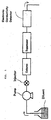
- the suppressor is an apparatus of displacing a cation in a liquid by a hydrogen ion. As shown in Fig. 1, the suppressor is connected between the separation column and the detector and at the time of detecting ions by an electrical conductivity detector, undertakes an action to decrease the electrical conductivity of the background and thereby increase the measurement sensitivity.
- the suppressor system a mixed solution of sodium carbonate and sodium hydrogencarbonate, a boric acid buffer, an aqueous sodium hydroxide solution, an aqueous potassium hydroxide solution or the like is passed through as the eluent to separate the sample ion in the separation column and thereafter the ion separated is detected by an electrical conductivity detector through a suppressor.
- the electrical conductivity measured by the detector is recognized as a signal superposed by the contribution of the ion species in the sample.
- the suppressor converts a salt or a base in the eluent to an acid having a lower degree of dissociation, whereby the electrical conductivity of the background is reduced and the measurement sensitivity of signals by the ion species in the sample is improved.
- the suppressor system requires an exclusive apparatus as compared with the non-suppressor system but since high sensitivity can be attained, this system is indispensable for the control of pure water, chemicals and the like used in the semiconductor art.
- the anion exchanger heretofore predominantly used for the suppressor-system column includes a pellicular-type ion exchanger obtained by sulfonating a styrene/divinylbenzene-type substrate and coating an anion exchangeable latex thereon, and a porous chemical bond-type ion exchanger obtained by introducing an anion exchange group into a polyvinyl alcohol substrate.
- the pellicular-type ion exchanger restricts the migration of ions only to the surface of the packing and does not allow their entering into pores, therefore, this ion exchanger is advantageous in that (1) the diffusion is almost prevented from occurring and (2) the ion does not interfere with the substrate.
- this ion exchanger is disadvantageous in that the usable surface area of the packing is limited in view of the structure and therefore, the column efficiency is limited.
- the column used at present already has a large length of 250 mm and more increase of the column length is not practical.
- the pellicular-type ion exchanger cannot satisfy the requirement to have higher performance than the current theoretical plate number of 6,000 plates/column.
- the porous chemical bond-type ion exchanger is excellent in the effective surface area of the packing because the ion migrates into pores to undertake the ion exchange, therefore, this ion exchanger has a possibility of achieving higher performance than the pellicular-type ion exchanger using a styrene/divinylbenzene-type copolymer substrate.
- the present inventors have proposed a porous chemical bond-type ion exchanger originated in a polyvinyl alcohol substrate having a sufficiently high alkali resistance even under the alkali conditions in the analysis of anions by the suppressor system, and a production method thereof (see, JP-A-2001-40032, the term "JP-A” as used herein means an "unexamined published Japanese patent application”).
- a method of adding a salt compound of boric acid to the eluent is disclosed (see, JP-A-2000-180429).
- the problems can be overcome by changing the composition of the eluent.
- a hydroxide-type eluent used as the eluent for the suppressor system such as aqueous sodium hydroxide solution and aqueous potassium hydroxide solution, usually comprises a single component and therefore, the problem cannot be overcome by the eluent. Accordingly, in the measurement by the suppressor system using an alkaline eluent, special means must be used for achieving both the improvement in retention of fluoride ion and the reduction in elution time of divalent or greater valence anions (particularly phosphate ion out of the seven kinds of standard inorganic anions).
- the methods heretofore employed are classified into two groups. One is a gradient analysis method of using an eluent graded in the concentration, and the other is a method of setting the ion exchanger packed into the column to a large ion exchange capacity and using an eluent in a high concentration of about 40 mM.
- the first method has a problem in that at least two kinds of solutions different in the concentration must be prepared so as to impart a concentration gradient, an apparatus and an operation for absorbing and mixing these solutions using two pumps are required, and a stabilization time for returning the eluent to the original concentration every each measurement is necessary.
- the second method has a problem in that since the eluent concentration is high, a high voltage must be applied for electrodialysis in the suppressor equipment using a continuous regeneration-type ion exchange membrane, which is being widely used at present, and this shortens the lifetime of the suppressor.
- the present inventors have previously proposed a production method for anion exchangers which are obtained by introducing a tertiary heterocyclic amine into an acrylate- or methacrylate-type polymer through a spacer molecule, and a column packed with this anion exchanger (JP-A-2000-221179).
- the matters proposed are a column for a non-suppressor system ion chromatography which uses an acidic eluent, and a method for producing a packing material for the column, and this is not used for measuring anions as a column for suppressor-system ion chromatography using an alkaline eluent.
- IonPac AS9-HC, IonPac AS9-SC and IonPac AS12A are already available from Dionex Corporation.
- a styrene/divinylbenzene-type copolymer is used as a substrate and a quaternary alkylamine is introduced as an anion exchange group.
- the separation degree R of chlorite ion and bromate ion, and the separation degree R of chlorate ion and bromide ion cannot be made 1.5 or more at the same time (in general, the separation degree R is preferably 1.5 or more).
- R 2 ⁇ (t 2 -t 1 ) / (w 1 +w 2 ) wherein w 1 and w 2 represent respective peak widths, and t 1 and t 2 represent respective retention times.
- the present invention has been made under these circumstances and the object of the present invention is to provide an anion exchanger for ion chromatography column, wherein in a suppressor-system ion chromatography using a hydroxide-type eluent, an eluent of low concentration (for example, 20 mM or less) can be used, the gradient analysis cannot be relied on (that is, an isocratic condition at a constant concentration can be used), the elution time of phosphate ion can be shortened to the time period on the order of a dozen of minutes to tens of minutes, fluoride ion which is difficult to hold can be satisfactorily separated from a water dip, and at the same time, chloride ion and nitrite ion can be satisfactorily separated.
- an eluent of low concentration for example, 20 mM or less
- the gradient analysis that isocratic condition at a constant concentration can be used
- the elution time of phosphate ion can
- the object of the present invention includes providing a production method of the anion exchanger, a packing material for a suppressor-system ion chromatography column using the anion exchanger, a column for ion chromatography, a method for inexpensively and precisely measuring anions using the column, and a measuring method capable of separating and analyzing halogen oxide ions such as bromate ion, chlorite ion and chlorate ion simultaneously with seven kinds of standard inorganic anions, that is, fluoride ion, chloride ion, nitrite ion, bromide ion, nitrate ion, sulfate ion and phosphate ion.
- halogen oxide ions such as bromate ion, chlorite ion and chlorate ion simultaneously with seven kinds of standard inorganic anions, that is, fluoride ion, chloride ion, nitrite ion, bromide ion, nitrate ion,
- the present inventors have found that by using a column packed with an alkali-resistant anion exchanger comprising a porous polymer having a structure such that a nitrogen-containing heterocyclic group containing a quaternary ammonium structure is bonded to the alkali-resistant polymer substrate through a spacer, seven kinds of standard inorganic anions can be satisfactorily separated without relying on the gradient analysis in the suppressor-system ion chromatography using a hydroxide-type eluent and also that bromate ion, chlorite ion and chlorate ion can be separated and analyzed simultaneously with seven kinds of standard inorganic anions, namely, fluoride ion, chloride ion, nitrite ion, bromide ion, nitrate ion, sulfate ion and phosphate ion.
- the present invention has been accomplished based on these findings.
- the present invention relates to a porous polymer particle, an alkali-resistant anion exchanger, a producing method thereof, a packing material for a suppressor-system ion chromatography column comprising the anion exchanger, a column for suppressor-system ion chromatography, and a method for measuring anions using the column.
- an aromatic or non-aromatic nitrogen-containing heterocyclic compound is used for the starting material of a nitrogen-containing heterocyclic group containing a quaternary ammonium structure.
- an aromatic or non-aromatic nitrogen-containing heterocyclic compound is used for the starting material of a nitrogen-containing heterocyclic group containing a quaternary ammonium structure.
- the compound may further have a substituent on the carbon constituting the ring.
- Examples of the aromatic nitrogen-containing heterocyclic compound include a (substituted) pyridine compound represented by the following formula (1): wherein R represents an alkyl or alkoxy group having from 1 to 5 carbon atoms, which may be substituted by a hydroxyl group or a halogen atom, or a halogen atom, m represents an integer of 0 to 5, and when m is 2 or more, the plurality of R may be the same or different.
- non-aromatic nitrogen-containing heterocyclic compound examples include a 1-(substituted)alkylpyrrolidine compound represented by the following formula (2), a 1-(substituted)alkylpiperidine compound represented by formula (3) and a 1,4-di(substituted)alkylpiperazine compound represented by formula (4).
- R represents an alkyl group having from 1 to 5 carbon atoms, which may be substituted by a hydroxyl group or a halogen atom
- R 1 represents a hydroxyl group or an alkyl or alkoxy group having from 1 to 5 carbon atoms, which may be substituted by a hydroxyl group
- n represents an integer of 0 to 2
- R represents an alkyl group having from 1 to 5 carbon atoms, which may be substituted by a hydroxyl group or a halogen atom
- R 1 represents a hydroxyl group or an alkyl or alkoxy group having from 1 to 5 carbon atoms, which may be substituted by a hydroxyl group
- p represents an integer of 0 to 2
- R 2 and R 3 may be the same or different and each represents a hydrogen atom or an alkyl group having from 1 to 5 carbon atoms, which may be substituted by a hydroxyl group or a halogen atom, provided that R 2 and R 3 are not
- aromatic nitrogen-containing heterocyclic compound examples include pyridine, 2-methylpyridine, 3-methylpyridine, 4-methylpyridine, 2-hydroxy-4-methylpyridine, 2-hydroxy-6-methylpyridine, 2-hydroxypyridine, 3-hydroxypyridine and 4-hydroxypyridine.
- the nitrogen-containing heterocyclic ring of the non-aromatic nitrogen-containing heterocyclic compound can contain organochemically allowable oxygen or sulfur in place of carbon.
- organochemically allowable oxygen or sulfur in place of carbon.
- examples thereof include a compound represented by formula (5): a compound represented by formula (6): a compound represented by formula (7): and a compound represented by formula (8): (wherein R, R 1 , n and p have the same meanings as above).
- non-aromatic nitrogen-containing heterocyclic compound examples include 1-methylpyrrolidine, 1-ethylpyrrolidine, 1-methylpiperidine, 1-ethylpiperidine, 1-(2-hydroxyethyl)piperidine, 1-(hydroxymethyl)piperidine, 1-(2-hydroxyethyl)pyrrolidine, 2-(2-hydroxyethyl)-1-methylpyrrolidine, 3-hydroxy-1-methylpiperidine, 4-hydroxy-1-methylpiperidine, 4-chloro-1-methylpiperidine, 1-(2-chloroethyl)piperidine, 1-(2-chloroethyl)pyrrolidine, 1-methylpiperazine, 1-ethylpiperazine, 1-methyl-2-(hydroxyethyl)morpholine and 1,4-dimethylpiperazine.
- the amount of the anion exchange group introduced is preferably from 4 to 200 ⁇ eq/g, more preferably from 8 to 50 ⁇ eq/g.
- the form of the packing material manufactured by introducing the ion exchange group includes an alkali-resistant porous chemical bond-type ion exchanger and a pellicular-type ion exchanger.
- the above-described nitrogen-containing heterocyclic compound is bonded to an alkali-resistant polymer through a spacer to produce an ion exchange group.
- a porous polymer used as a substrate of the porous chemical bond-type ion exchanger is not particularly limited insofar as the polymer has resistance against alkali.
- the polymer include a polyvinyl alcohol-type copolymer and a styrene/divinylbenzene-type copolymer.
- a spacer molecule having a group capable of bonding to a tertiary heterocyclic amine compound is bonded to this alkali-resistant porous polymer and further, a tertiary heterocyclic amine compound is reacted therewith to produce an amine exchange group.
- the spacer molecule provides an intervention of multiple atoms, usually 3 to 20 atoms, between the substrate surface and the ion exchange group.
- the spacer molecule is bonded to the alkali-resistant porous polymer at one end and to the ion exchange group at the another end, as a result, this molecule acts as a spacer for elongating the distance between the substrate and the ion exchange group, and has a function of preventing the ion and the substrate from interfering with each other and also preventing diffusion of peaks.
- the spacer molecule is preferably a compound containing a glycidyl group which bonds to a tertiary heterocyclic amine compound.
- Specific examples thereof include epichlorohydrin, 1,4-butanediol diglycidyl ether, ethylene glycol diglycidyl ether and glycerol glycidyl ether.
- the bond between the spacer molecule and the alkali-resistant porous polymer may be any insofar as the bond is not cleaved under the pH condition used for the analysis of anions.
- the porous chemical bond-type ion exchanger can be produced by a method of incorporating an ester bond into an alkali-resistant porous polymer, saponifying and thereby converting it into a hydroxyl group, and reacting the polymer with a diglycidyl compound containing two or more diglycidyl groups as a spacer molecule within the same molecule.
- a diglycidyl compound containing two or more diglycidyl groups as a spacer molecule within the same molecule.
- 1-methylpiperidine is introduced into the hydroxyl group of the substrate through the spacer 1,4-butanediol diglycidyl ether is schematically shown below.
- the production method is described in greater detail by referring to an alkali-resistant polyvinyl alcohol-type copolymer as an example.
- a copolymer of a carboxylic acid vinyl ester and a crosslinkable monomer having an isocyanurate ring are saponified and thereby the ester groups of the copolymer are partially converted into a hydroxyl group.
- the substrate is elevated in the hydrophilicity and prevented from the interference with ion.
- the hydroxyl group works out to an active site necessary for the reaction with a spacer molecule.
- the saponification is preferably performed such that the hydroxyl group is present in an amount of at least 0.5 meq/g to 5 meq/g, preferably from 1.0 to 3 meq/g. If the amount of the hydroxyl group is less than 0.5 meq/g, the glycidyl group-containing group cannot be introduced in a sufficiently large amount, whereas if it exceeds 5 meq/g, the substrate decreases in the strength and this disadvantageously makes it difficult to improve the performance of the column by reducing the particle size of the substrate.
- the amount of the hydroxyl group is determined by reacting a hydroxyl group with an acetic anhydride and measuring the amount of the acetic anhydride consumed or the change in the weight after the reaction. At this time, in the case where the functional group of the substrate also reacts, the functional group is protected and then, the amount of the hydroxyl group is determined by the above-described method.
- the amount of the hydroxyl group at the time of reacting 1 g of dry substrate with 1 mmol of acetic anhydride is defined as 1 mmol/g.
- the carboxylic acid vinyl ester which is preferably used in this method is a compound having one or more polymerizable carboxylic acid vinyl ester group.
- examples thereof include vinyl acetate, vinyl propionate, vinyl butyrate, vinyl valerate and vinyl pivalate. These are used individually or in combination of two or more thereof.
- preferred are vinyl acetate and vinyl propionate which are hydrophilic and facilitated in the polymerization and saponification.
- the increase in the mass after the glycidyl compound reaction is from 103 to 140 assuming that the mass of the polyvinyl alcohol-type copolymer is 100. If the increase in the mass is less than 103, the resistance against alkali is not sufficiently high and this is not preferred, whereas if the increase in the mass exceeds 140, soft particles or occurrence of association among particles may disadvantageously result.
- the increase in the mass is preferably from 104 to 135, more preferably from 105 to 125.
- the anion exchanger obtained by the above-described method is a porous particle.
- the pore size of the porous particle is from 50 to 300 ⁇ , preferably from 50 to 150 ⁇ , more preferably from 50 to 100 ⁇ . If the pore size is less than 50 ⁇ , the glycidyl group-containing group cannot be introduced into the inside of pores and this is not preferred, whereas if it exceeds 300 ⁇ , the strength of the particle disadvantageously decreases.
- the pore size is controlled by a method commonly used for the packing material used in high-performance liquid chromatography.
- the pore size may be determined by the reverse size exclusion method or BET (Brunauer-Emmett-Teller) method described in J. Chromatogr., 387, 65 (1987), however, in the present invention, unless otherwise indicated, the average pore size is determined according to the method described in Angew.Chem. Int. Ed. Engl. , 17. 901-908 (1978).
- BET Brunauer-Emmett-Teller
- the column In the measurement, particles to be measured are filled in the column, the column is connected with an HPLC apparatus, THF is flown as an eluent, and the retention capacity is measured for a plurality of standard polystyrenes and benzenes having a molecular weight over a wide range.
- the results obtained are plotted on a graph where the molecular weight M (logarithmic scale is preferred because of easy viewing) and the retention capacity (ml) are graduated on the axis Y and the axis X, respectively.
- the curve drawn by smoothly connecting the thus-plotted points is called a calibration curve.
- M m at the node (called average pore point) between the straight line and the calibration curve is read and the value obtained is substituted to the following formula (X) equivalent to the empirical formula (11) described in the above-described publication, page 905, whereby the average pore size ⁇ m [ ⁇ ] is calculated.
- [Eq. 2] ⁇ m [ ⁇ ] 0.62 ⁇ (M m ) 0.59
- the average pore point is used and defined by the present inventors.
- the average pore point means a point when assuming that the entire pore volume is 100%, the integrated volume from the minimum volume (a size where benzene is just fitted) reaches 50%.
- the above-described equation is used for converting the standard polystyrene-equivalent molecular weight into the diameter of a pore for allowing just fitting thereof.
- the pellicular-type ion exchanger is a particle obtained by coating the surface of a core particle with a latex having introduced thereinto an ion exchange group.
- the core particle include sulfonated polystyrene.
- the anion exchanger of the present invention suitably has a particle size of 1 to 30 ⁇ m, preferably from 2 to 20 ⁇ m, and in the case of porous chemical bond-type ion exchanger, more preferably from 2 to 10 ⁇ m.
- the particle size of the resin is usually on the order of 5 t 15 ⁇ m. If the particle size of the anion exchanger exceeds 30 ⁇ m, the theoretical plate number of the column disadvantageously decreases, whereas if the particle size is less than 1 ⁇ m, the column pressure excessively elevates and the packing becomes extremely difficult.
- the particle size is measured by a Coulter counter.
- the anion exchanger of the present invention is packed into a column for ion chromatography in accordance with a known packing method such as slurry method.
- the column according to the present invention has alkali resistance and is used as a high-sensitive column for suppressor-system ion chromatography.
- the column using the anion exchanger according to the present invention is stable against the eluent (e.g., a mixed solution of sodium carbonate and sodium hydrogencarbonate, a boric acid buffer, an aqueous sodium hydroxide solution, an aqueous potassium hydroxide solution) used in the suppressor-system ion chromatography.
- eluent e.g., a mixed solution of sodium carbonate and sodium hydrogencarbonate, a boric acid buffer, an aqueous sodium hydroxide solution, an aqueous potassium hydroxide solution
- This column is useful for the use in combination with an alkaline eluent having a pH of 9 or more, more preferably from 9 to 13.
- this column is useful for the case where the column is used in combination with a hydroxide-type eluent containing hydroxide ion as anion.
- the method for measuring anions of the present invention can be performed in accordance with conventional suppressor-system ion chromatography.
- the column used for suppressor-system ion chromatography is packed with the anion exchanger of the present invention
- good separation of main inorganic anions e.g., phosphate ion, fluoride ion, chloride ion, nitrite ion, bromide ion, nitrate ion, sulfate ion
- concentration of the eluent not only in the case of using a carbonic acid-type eluent or a boric acid-type eluent but also when a hydroxide-type eluent is used.
- the method for measuring anions according to the present invention can satisfactorily separate halogen oxide ions (e.g., bromate ion, chlorite ion, chlorate ion) simultaneously with main anions (e.g., phosphate ion, fluoride ion, chloride ion, nitrite ion, bromide ion, nitrate ion, sulfate ion). More specifically, even when the above-described ions are analyzed at the same time, the separation degree of chlorite ion and bromate ion and the separation degree of chlorate ion and bromide ion both can be 1.5 or more in the measurement. In the case of simultaneously analyzing halogen oxide ion, a suppressor may or may not be used.
- the eluent which can be used for the analysis of halogen oxide ions is not particularly limited and, needless to say about a carbonic acid buffer, a hydroxide-type eluent such as potassium hydroxide and sodium hydroxide may be used in the case of suppressor system.
- a hydroxide-type eluent such as potassium hydroxide and sodium hydroxide
- an eluent obtained by adjusting an organic acid such as p-hydroxybenzoic acid and phthalic acid to a pH in the region from weak acid to the vicinity of neutral may be used.
- the method for measuring anions of the present invention is useful for the analysis of trace components in the environment, such as anions in air, water (e.g., river water, tap water, spa water, limnetic water, drainage) and soil extract solution; the analysis of food and fertilizer; analysis of anions in cosmetic starting materials; the analysis of anions in coating raw materials, coating material or surface treating solution; the analysis of ultrapure water, mixed acid, air, lead frame or wafer in the semiconductor field; the quality control in the pharmaceutical field; and the analysis of circulating water, cooling water or the like at the electric power plant.
- the method for measuring anions of the present invention is also useful for the analysis of water subjected to an advanced water purification treatment and containing halogen oxide ions as a by-product of the treatment.
- a polyvinyl alcohol-type polymer produced by the following method was used as a substrate resin into which an anion exchange group is introduced.
- a uniformly mixed solution containing 100 g of vinyl acetate, 180 g of triallyl isocyanurate, 150 g of butyl acetate and 10 g of 2,2-azobisisobutyronitrile, and 1,400 mL of water having dissolved therein a small amount of polyvinyl alcohol and sodium phosphate were charged into a 5 L-volume three-neck flask equipped with a reflux condenser and the resulting mixed solution was stirred for 10 minutes. Subsequently, while stirring under nitrogen stream, polymerization was performed at 60°C for 16 hours to obtain a particulate polymer. This polymer was filtrated, washed, extracted with acetone and then dried.
- the obtained polymer was charged together with 3 L of an aqueous 1N sodium hydroxide solution (NaOH) into a 5 L-volume three-neck flask equipped with a reflux condenser, a nitrogen inlet tube and a stirrer, and saponified while stirring at 15°C for 20 hours under nitrogen stream.
- the resulting polymer was filtered, washed and dried.
- the density of hydroxyl group was 2.1 meq/g.
- an anion exchanger was manufactured according to the following procedure.
- 1,4-BGE 1,4-butanediol diglycidyl ether
- the anion exchanger obtained above was packed into a polyether ether ketone resin (PEEK)-made column having an inside diameter of 4.0 mm and a length of 250 mm to prepare an anion exchange column.
- PEEK polyether ether ketone resin
- DX-320 manufactured by Dionex Corporation
- a suppressor as the ion chromatograph
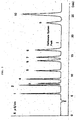
- 25 ⁇ l of an aqueous solution containing 2 mg/L of F - , 3 mg/L of Cl - , 5 mg/L of NO 2 - , 10 mg/L of Br - , 10 mg/L of NO 3 - , 15 mg/L of SO 4 2- and 15 mg/L of PO 4 3- was injected as a standard solution into the ion chromatograph while flowing an aqueous 15 mM sodium hydroxide solution as the eluent at 1.0 ml/min at a column temperature of 35°C.
- Fig. 2 shows the chromatogram obtained.
- 1,4-BGE was introduced according to the same formulation as in Example 1.
- the anion exchanger obtained above was packed into the same column as in Example 1 and measured in the same manner as in Example 1.
- 1,4-BGE was introduced according to the same formulation as in Example 1.
- the anion exchanger obtained above was packed into the same column as in Example 1 and measured in the same manner as in Example 1.
- 1,4-BGE was introduced according to the same formulation as in Example 1.
- anion exchanger was immersed in an aqueous 1N sodium hydroxide solution and treated at 60°C for 5 hours, followed by water washing and drying.
- the thus-obtained anion exchanger had an average particle size of 5 ⁇ m and an ion exchange capacity of about 20 ⁇ eq/g.
- the anion exchanger obtained above was packed into the same column as in Example 1 and measured in the same manner as in Example 1.
- 1,4-BGE was introduced according to the same formulation as in Example 1.
- anion exchanger was immersed in an aqueous 1N sodium hydroxide solution and treated at 60°C for 5 hours, followed by water washing and drying.
- the thus-obtained anion exchanger had an average particle size of 5 ⁇ m and an ion exchange capacity of about 20 ⁇ eq/g.
- the anion exchanger obtained above was packed into the same column as in Example 1 and measured in the same manner as in Example 1.
- a styrene/divinylbenzene-type resin produced by the following method was used as a substrate resin into which an ion exchange group is introduced.
- a uniformly mixed solution containing 105 g of 4-acetoxystyrene, 70 g of m-divinylbenzene, 75 g of toluene and 3.5 g of 2,2-azobisisobutylonitrile were suspended in 1,250 mL of water having dissolved therein 10% polyvinyl alcohol and homogenized. Subsequently, the homogenized solution was transferred to a 2 L-volume separable flask and polymerized at 70°C for 6 hours to obtain a particulate polymer. This polymer was filtrated, washed with water and acetone, air-dried and then classified by air separation to obtain particles of 3 to 6 ⁇ m.
- the anion exchanger obtained above was packed into the same column as in Example 1 and measured in the same manner as in Example 1.
- Example 1 1-methylpiperidine 1.00 5.2 15.6
- Example 2 1-methylpyrrolidine 0.95 5.0 15.2
- Example 3 pyridine 0.90 5.0 15.8
- Example 4 1-methylpiperidine 0.85 5.5 19.6 Comparative Example 1 alkanolamine immeasurable due to overlapping of peaks 1.8 34.0 Comparative Example 2 trimethylamine 0.79 3.4 16.0 Comparative Example 3 triethylamine 0.68 3.2 14.1
- the fluoride ion can be satisfactorily separated from water dip and at the same time, the separation of chloride ion and nitrite ion can be satisfactorily attained.
- the substrate resin is not limited to the polyvinyl alcohol-type resin but the introduction of a heterocyclic amine is effective also for other resins.
- a polyvinyl alcohol-type polymer produced by the following method was used as a substrate resin into which an ion exchange group is introduced.
- a uniformly mixed solution comprising 100 g of vinyl acetate, 180 g of triallyl isocyanurate, 150 g of butyl acetate and 10 g of 2,2-azobisisobutylonitrile, and 1,400 mL of water having dissolved therein a small amount of polyvinyl alcohol and sodium phosphate were charged into a 5 L-volume three-neck flask equipped with a reflux condenser and the resulting mixed solution was stirred for 10 minutes. Subsequently, while stirring under nitrogen stream, polymerization was performed at 60°C for 16 hours to obtain a particulate polymer. This polymer was filtrated, washed, extracted with acetone and then dried.
- the obtained polymer was charged together with 3 L of an aqueous 1N sodium hydroxide (NaOH) solution into a 5 L-volume three-neck flask equipped with a reflux condenser, a nitrogen inlet tube and a stirrer, and saponified while stirring at 15°C for 20 hours under nitrogen stream.
- the resulting polymer was filtered, washed and dried.
- the density of hydroxyl group was 2.1 meq/g.
- an anion exchanger was manufactured according to the following procedure.
- the anion exchanger obtained above was packed into a polyether ether ketone resin (PEEK)-made column having an inside diameter of 4.0 mm and a length of 250 mm to prepare an anion exchange column.
- PEEK polyether ether ketone resin
- 761 Compact IC manufactured by Metrohm Ltd.
- 1,4-BGE was introduced according to the same formulation as in Example 1.
- the anion exchanger obtained above was packed into the same column as in Example 5 and measured in the same manner as in Example 1.
- 1,4-BGE was introduced according to the same formulation as in Example 1.
- anion exchanger was immersed in an aqueous 1N sodium hydroxide solution and treated at 100°C for 20 hours, followed by water washing and drying.
- the thus-obtained anion exchanger had an average particle size of 5 ⁇ m and an ion exchange capacity of about 30 ⁇ eq/g.
- the anion exchanger obtained above was packed into the same column as in Example 5 and measured in the same manner as in Example 1.
- Example 5 the kind of tertiary amine introduced, the separation degree of chlorite ion and bromate ion, the separation degree of chlorate ion and bromide ion, and the retention time of sulfate ion are shown in Table 2.
- the retention time of sulfate ion is shown to verify that three columns can be properly evaluated by agreeing the elution position of sulfate ion which is largest in the retention time.
- the separation degree R is preferably 1.5 or more.
- Fig. 3 shows a chromatogram of the analysis using the column produced in Example 5. It is seen that the fluoride ion can be satisfactorily separated from the water dip (a negative peak generated due to water in the sample), the carbonic acid dip can be separated from other ion peaks, and excellent properties of the porous chemical bond-type anion exchanger derived from a polyvinyl alcohol-type substrate can be reflected.
- the column for suppressor-system ion chromatography packed with the anion exchanger of the present invention can reduce the elution time of phosphate ion to 20 minutes or less under an isbcratic condition using a hydroxide-type eluent having a low concentration of 20 mM or less, can satisfactorily separate the fluoride ion which is difficult to hold, from a water dip and can satisfactorily separate chloride ion and nitrite ion, so that in the analysis using the above-described eluent, the measuring time can be shortened and the life of continuous regeneration-type ion exchange membrane suppressor can be prolonged.
- the column for ion chromatography packed with the anion exchanger of the present invention can analyze the halogen oxide ions such as bromate ion, chlorite ion and chlorate ion, simultaneously with seven kinds of standard inorganic anions.
- the present invention is useful in the field over a wide range, such as environment, food, agriculture, cosmetics, coating material, semiconductor, medical preparation and electric power.
- the present invention is particularly useful for the analysis of several ppb of nitrite ion in the presence of a dozen of ppm of chloride ion in tap water or the like or for the analysis of water containing halogen oxide ion generated as a by-product, for example, water subjected to advanced water purification.
- Fig. 1 is a schematic view showing a fundamental structure of ion chromatography.
- Fig. 2 shows a chromatogram sampled by injecting a test aqueous solution containing seven kinds of standard ions into a separation column prepared by packing the ion exchanger of the present invention obtained in Example 1.
- Fig. 3 shows a chromatogram when halogen oxide ion is analyzed simultaneously with seven kinds of inorganic anions by the measuring method of the present invention, obtained in Example 5.
Landscapes
- Chemical & Material Sciences (AREA)
- Organic Chemistry (AREA)
- Chemical Kinetics & Catalysis (AREA)
- Analytical Chemistry (AREA)
- General Chemical & Material Sciences (AREA)
- Health & Medical Sciences (AREA)
- Medicinal Chemistry (AREA)
- Polymers & Plastics (AREA)
- Solid-Sorbent Or Filter-Aiding Compositions (AREA)
- Manufacture Of Macromolecular Shaped Articles (AREA)
- Addition Polymer Or Copolymer, Post-Treatments, Or Chemical Modifications (AREA)
Applications Claiming Priority (4)
| Application Number | Priority Date | Filing Date | Title |
|---|---|---|---|
| JP2000386002 | 2000-12-19 | ||
| JP2000386002 | 2000-12-19 | ||
| JP2001133064A JP4717253B2 (ja) | 2000-12-19 | 2001-04-27 | 多孔質重合体粒子、耐アルカリ性陰イオン交換体、その製造方法、イオンクロマトグラフィー用カラム、及び陰イオン測定方法 |
| JP2001133064 | 2001-04-27 |
Publications (1)
| Publication Number | Publication Date |
|---|---|
| EP1217012A1 true EP1217012A1 (fr) | 2002-06-26 |
Family
ID=26606135
Family Applications (1)
| Application Number | Title | Priority Date | Filing Date |
|---|---|---|---|
| EP01121490A Withdrawn EP1217012A1 (fr) | 2000-12-19 | 2001-09-07 | Particules polymériques poreuses, échangeurs d'anions résistants aux alcalis, leur procédé de fabrication, colonne de chromatographie ionique, et procédé de mesure d'anions |
Country Status (2)
| Country | Link |
|---|---|
| EP (1) | EP1217012A1 (fr) |
| JP (1) | JP4717253B2 (fr) |
Cited By (9)
| Publication number | Priority date | Publication date | Assignee | Title |
|---|---|---|---|---|
| WO2006083022A1 (fr) * | 2005-02-04 | 2006-08-10 | Showa Denko K.K. | Garniture pour chromatographie ionique |
| CN102798681A (zh) * | 2012-08-17 | 2012-11-28 | 红云红河烟草(集团)有限责任公司 | 一种测定烟用接装纸中硝酸根和亚硝酸根离子的方法 |
| EP2570182A1 (fr) * | 2011-09-15 | 2013-03-20 | InstrAction GmbH | Sorbant comportant à sa surface un résidu aliphatique cationique ou protonisable pour la purification de molécules organiques |
| CN104267131A (zh) * | 2014-09-30 | 2015-01-07 | 浙江工业大学 | 一种检测弱酸盐中痕量无机阴离子的离子色谱单泵-柱切换系统 |
| CN104267131B (zh) * | 2014-09-30 | 2017-01-04 | 浙江工业大学 | 一种检测弱酸盐中痕量无机阴离子的离子色谱单泵-柱切换系统 |
| CN109828077A (zh) * | 2018-12-27 | 2019-05-31 | 河海大学 | 离子色谱检测海洋孔隙水中常量离子的方法 |
| EP3721998A1 (fr) | 2019-04-10 | 2020-10-14 | Philipps-Universität Marburg | Procédé de production d'une surface hydrophile sur des particules de copolymère ps / dvb |
| CN112730641A (zh) * | 2020-12-01 | 2021-04-30 | 广州汇元医药科技有限公司 | 一种n-甲基哌嗪的离子色谱测定法 |
| CN118624805A (zh) * | 2024-08-08 | 2024-09-10 | 山东齐都药业有限公司 | 一种测定复方硫酸钠片溶出曲线的方法 |
Families Citing this family (5)
| Publication number | Priority date | Publication date | Assignee | Title |
|---|---|---|---|---|
| DE102007034733A1 (de) * | 2007-07-23 | 2009-01-29 | Lanxess Deutschland Gmbh | Verfahren zur Herstellung monodisperser Chelatharze |
| JP5029402B2 (ja) * | 2008-02-12 | 2012-09-19 | 横河電機株式会社 | イオンクロマトグラフを用いた連続分析方法 |
| US20140179018A1 (en) * | 2011-08-12 | 2014-06-26 | Shimadzu Corporation | Method for analyzing halogen oxoacids |
| JP7087594B2 (ja) * | 2018-04-04 | 2022-06-21 | 東ソー株式会社 | イオンクロマトグラフィーによる陰イオンの分析方法 |
| EP4019126A1 (fr) * | 2020-12-22 | 2022-06-29 | Metrohm Ag | Procédé de modification d'un matériau de support polymère, matériau de support polymère pouvant être obtenu selon un tel procédé, colonne de chromatographie, procédé de séparation chromatographique et utilisation d'un matériau de support polymère |
Citations (10)
| Publication number | Priority date | Publication date | Assignee | Title |
|---|---|---|---|---|
| JPS5235779A (en) * | 1975-09-16 | 1977-03-18 | Cosmo Co Ltd | Method of producing macroporous anion-exchange resin |
| FR2333005A1 (fr) * | 1975-11-27 | 1977-06-24 | Sumitomo Chemical Co | Procede de preparation d'un polymere tres absorbant, par saponification d'un copolymere reticule ester vinylique/acide carboxylique insature |
| GB2034328A (en) * | 1978-10-26 | 1980-06-04 | Kureha Chemical Ind Co Ltd | Crosslinked polyvinyl alcohol gel for chromatography |
| FR2460971A1 (fr) * | 1979-07-12 | 1981-01-30 | Kuraray Co | Copolymeres d'alcool vinylique contenant des radicaux cationiques, utilisables en papeterie, et procede pour leur preparation |
| US4298700A (en) * | 1979-06-08 | 1981-11-03 | Rohm And Haas Company | Crosslinked basic polymer and preparation thereof |
| EP0043074A2 (fr) * | 1980-06-25 | 1982-01-06 | Asahi Kasei Kogyo Kabushiki Kaisha | Garnissage liquide pour la chromatographie à haute vélocité et son procédé de fabrication |
| EP0066165A1 (fr) * | 1981-05-18 | 1982-12-08 | Asahi Kasei Kogyo Kabushiki Kaisha | Un gel poreux entièrement activé |
| EP0556688A1 (fr) * | 1992-02-21 | 1993-08-25 | Wolff Walsrode Aktiengesellschaft | Procédé de préparation de polymères contenant des groupes ammonium |
| JPH0977790A (ja) * | 1995-09-11 | 1997-03-25 | Asahi Medical Co Ltd | 糖脂質抗体吸着材 |
| JP2001040032A (ja) * | 1999-05-27 | 2001-02-13 | Showa Denko Kk | 耐アルカリ性高強度陰イオン交換体及びその製造方法 |
Family Cites Families (9)
| Publication number | Priority date | Publication date | Assignee | Title |
|---|---|---|---|---|
| JPS6017448B2 (ja) * | 1981-09-26 | 1985-05-02 | 丸善石油株式会社 | アミノメチル化ポリメタヒドロキシスチレン系高分子電解質の架橋物の製法 |
| JPS59155404A (ja) * | 1983-02-22 | 1984-09-04 | Asahi Chem Ind Co Ltd | 塩基性官能基を有するイオン交換樹脂とその製法 |
| JPS59177141A (ja) * | 1983-03-29 | 1984-10-06 | Asahi Chem Ind Co Ltd | 陰イオン交換方法 |
| JPS60150839A (ja) * | 1984-01-20 | 1985-08-08 | Asahi Chem Ind Co Ltd | 陰イオン交換体 |
| JPS6279356A (ja) * | 1985-10-02 | 1987-04-11 | Showa Denko Kk | 陰イオン交換クロマトグラフイ−用胆体及びその製造方法 |
| JPS63130605A (ja) * | 1986-11-20 | 1988-06-02 | Tokuyama Soda Co Ltd | 陰イオン交換体の製造方法 |
| JPS63267448A (ja) * | 1987-04-27 | 1988-11-04 | Hitachi Chem Co Ltd | 陰イオン交換樹脂及びその製造方法 |
| JPH01113655A (ja) * | 1987-10-27 | 1989-05-02 | Yokogawa Electric Corp | 陰イオン交換樹脂の製造方法 |
| US5670550A (en) * | 1995-06-07 | 1997-09-23 | The Regents Of The University Of California Office Of Technology Transfer | Ion exchange polymers for anion separations |
-
2001
- 2001-04-27 JP JP2001133064A patent/JP4717253B2/ja not_active Expired - Lifetime
- 2001-09-07 EP EP01121490A patent/EP1217012A1/fr not_active Withdrawn
Patent Citations (10)
| Publication number | Priority date | Publication date | Assignee | Title |
|---|---|---|---|---|
| JPS5235779A (en) * | 1975-09-16 | 1977-03-18 | Cosmo Co Ltd | Method of producing macroporous anion-exchange resin |
| FR2333005A1 (fr) * | 1975-11-27 | 1977-06-24 | Sumitomo Chemical Co | Procede de preparation d'un polymere tres absorbant, par saponification d'un copolymere reticule ester vinylique/acide carboxylique insature |
| GB2034328A (en) * | 1978-10-26 | 1980-06-04 | Kureha Chemical Ind Co Ltd | Crosslinked polyvinyl alcohol gel for chromatography |
| US4298700A (en) * | 1979-06-08 | 1981-11-03 | Rohm And Haas Company | Crosslinked basic polymer and preparation thereof |
| FR2460971A1 (fr) * | 1979-07-12 | 1981-01-30 | Kuraray Co | Copolymeres d'alcool vinylique contenant des radicaux cationiques, utilisables en papeterie, et procede pour leur preparation |
| EP0043074A2 (fr) * | 1980-06-25 | 1982-01-06 | Asahi Kasei Kogyo Kabushiki Kaisha | Garnissage liquide pour la chromatographie à haute vélocité et son procédé de fabrication |
| EP0066165A1 (fr) * | 1981-05-18 | 1982-12-08 | Asahi Kasei Kogyo Kabushiki Kaisha | Un gel poreux entièrement activé |
| EP0556688A1 (fr) * | 1992-02-21 | 1993-08-25 | Wolff Walsrode Aktiengesellschaft | Procédé de préparation de polymères contenant des groupes ammonium |
| JPH0977790A (ja) * | 1995-09-11 | 1997-03-25 | Asahi Medical Co Ltd | 糖脂質抗体吸着材 |
| JP2001040032A (ja) * | 1999-05-27 | 2001-02-13 | Showa Denko Kk | 耐アルカリ性高強度陰イオン交換体及びその製造方法 |
Non-Patent Citations (3)
| Title |
|---|
| DATABASE WPI Section Ch Week 197717, Derwent World Patents Index; Class A91, AN 1977-30166Y, XP002194779 * |
| DATABASE WPI Section Ch Week 199722, Derwent World Patents Index; Class A96, AN 1997-241750, XP002194778 * |
| DATABASE WPI Section Ch Week 200132, Derwent World Patents Index; Class A14, AN 2001-303888, XP002194777 * |
Cited By (17)
| Publication number | Priority date | Publication date | Assignee | Title |
|---|---|---|---|---|
| WO2006083022A1 (fr) * | 2005-02-04 | 2006-08-10 | Showa Denko K.K. | Garniture pour chromatographie ionique |
| EP2570182A1 (fr) * | 2011-09-15 | 2013-03-20 | InstrAction GmbH | Sorbant comportant à sa surface un résidu aliphatique cationique ou protonisable pour la purification de molécules organiques |
| WO2013037994A1 (fr) * | 2011-09-15 | 2013-03-21 | Instraction Gmbh | Sorbant comprenant un résidu aliphatique cationique ou protonable sur sa surface destiné à la purification de molécules organiques |
| CN103974766A (zh) * | 2011-09-15 | 2014-08-06 | 因思特艾克申有限公司 | 用于有机分子提纯、表面上具有正离子或质子化脂族残基的吸附剂 |
| US9452415B2 (en) | 2011-09-15 | 2016-09-27 | Instraction Gmbh | Sorbent comprising on its surface a cationic or protonizable aliphatic residue for the purification of organic molecules |
| CN102798681A (zh) * | 2012-08-17 | 2012-11-28 | 红云红河烟草(集团)有限责任公司 | 一种测定烟用接装纸中硝酸根和亚硝酸根离子的方法 |
| CN104267131A (zh) * | 2014-09-30 | 2015-01-07 | 浙江工业大学 | 一种检测弱酸盐中痕量无机阴离子的离子色谱单泵-柱切换系统 |
| CN104267131B (zh) * | 2014-09-30 | 2017-01-04 | 浙江工业大学 | 一种检测弱酸盐中痕量无机阴离子的离子色谱单泵-柱切换系统 |
| CN109828077A (zh) * | 2018-12-27 | 2019-05-31 | 河海大学 | 离子色谱检测海洋孔隙水中常量离子的方法 |
| EP3721998A1 (fr) | 2019-04-10 | 2020-10-14 | Philipps-Universität Marburg | Procédé de production d'une surface hydrophile sur des particules de copolymère ps / dvb |
| WO2020208026A1 (fr) | 2019-04-10 | 2020-10-15 | Philipps-Universität Marburg | Procédé pour la génération d'une surface hydrophile sur des particules de copolymère ps/dvb |
| CN113905821A (zh) * | 2019-04-10 | 2022-01-07 | 瑞士万通集团公司 | 用于在ps/dvb共聚物颗粒上形成亲水表面的方法 |
| RU2806022C2 (ru) * | 2019-04-10 | 2023-10-25 | Метром Аг | Способ формирования гидрофильной поверхности на частицах сополимера полистирол/дивинилбензол (ps/dvb) |
| CN113905821B (zh) * | 2019-04-10 | 2025-01-28 | 瑞士万通集团公司 | 用于在ps/dvb共聚物颗粒上形成亲水表面的方法 |
| US12291618B2 (en) | 2019-04-10 | 2025-05-06 | Metrohm Ag | Method for producing a hydrophilic surface on PS/DVB copolymer particles |
| CN112730641A (zh) * | 2020-12-01 | 2021-04-30 | 广州汇元医药科技有限公司 | 一种n-甲基哌嗪的离子色谱测定法 |
| CN118624805A (zh) * | 2024-08-08 | 2024-09-10 | 山东齐都药业有限公司 | 一种测定复方硫酸钠片溶出曲线的方法 |
Also Published As
| Publication number | Publication date |
|---|---|
| JP2002249517A (ja) | 2002-09-06 |
| JP4717253B2 (ja) | 2011-07-06 |
Similar Documents
| Publication | Publication Date | Title |
|---|---|---|
| US6881761B2 (en) | Porous polymer particle, anion exchanger, producing method thereof, column for ion chromatography, and method for measuring anions | |
| EP1217012A1 (fr) | Particules polymériques poreuses, échangeurs d'anions résistants aux alcalis, leur procédé de fabrication, colonne de chromatographie ionique, et procédé de mesure d'anions | |
| CA2247945C (fr) | Resines d'echange d'anions portant au moins deux groupes differents d'echange d'ions contenant de l'azote | |
| Barron et al. | Effect of functional group structure on the selectivity of low-capacity anion exchangers for monovalent anions | |
| US7166226B2 (en) | Ion exchange cryptands covalently bound to substrates | |
| US20020194901A1 (en) | Porous polymer particle, alkali-resistant anion exchanger, producing method thereof, column for ion chromatography, and method for measuring anions | |
| JP4207362B2 (ja) | 耐アルカリ性高強度陰イオン交換体及びその製造方法 | |
| EP0043074A2 (fr) | Garnissage liquide pour la chromatographie à haute vélocité et son procédé de fabrication | |
| US20030066336A1 (en) | Method for measuring anions | |
| EP1160260B1 (fr) | Particules polymériques poreuses, échangeurs d'anions, leur procédé de fabrication, colonne de chromatographie ionique, et procédé de mesure d'anions | |
| EP1855801A1 (fr) | Garniture pour chromatographie ionique | |
| HK1044006A (en) | Porous polymer particle, anion exchanger, producing method thereof, column for ion chromatography, and method for measuring anions | |
| CN113019349A (zh) | 一种阴离子色谱固定相的制备方法 | |
| JP2002194117A (ja) | 陰イオン交換体、その製造方法、イオンクロマトグラフィー用カラム及び陰イオンの測定方法 | |
| JP5901081B2 (ja) | ヘモグロビン類測定用カラム充填剤、ヘモグロビン類測定用カラム充填剤の製造方法、及び、液体クロマトグラフィーによるヘモグロビン類の測定方法 | |
| US4808540A (en) | Method for chromatographical analysis of anions | |
| JPH0622687B2 (ja) | 表面官能型陰イオン交換樹脂 | |
| JP5408766B2 (ja) | ヘモグロビン類測定用カラム充填剤、ヘモグロビン類測定用カラム充填剤の製造方法、及び、液体クロマトグラフィーによるヘモグロビン類の測定方法 | |
| Glad et al. | Functional membranes for flow buffering | |
| WO2024028225A1 (fr) | Matériau échangeur d'ions fonctionnalisé par un acide | |
| JP2007144346A (ja) | イオン交換体 | |
| JPH10177015A (ja) | 陰イオンの分析法並びに陰イオン分析セット | |
| JP2023109603A (ja) | 陽イオンクロマトグラフィー用充填剤および陽イオンクロマトグラフィー分析用カラム | |
| Rogers et al. | Process for separating and recovering an anionic dye from an aqueous solution | |
| CA1147495A (fr) | Methode et dispositif d'analyse quantitative par chromatographie |
Legal Events
| Date | Code | Title | Description |
|---|---|---|---|
| PUAI | Public reference made under article 153(3) epc to a published international application that has entered the european phase |
Free format text: ORIGINAL CODE: 0009012 |
|
| AK | Designated contracting states |
Kind code of ref document: A1 Designated state(s): AT BE CH CY DE DK ES FI FR GB GR IE IT LI LU MC NL PT SE TR |
|
| AX | Request for extension of the european patent |
Free format text: AL;LT;LV;MK;RO;SI |
|
| 17P | Request for examination filed |
Effective date: 20021219 |
|
| AKX | Designation fees paid |
Designated state(s): AT BE CH CY DE DK ES FI FR GB GR IE IT LI LU MC NL PT SE TR |
|
| 17Q | First examination report despatched |
Effective date: 20061122 |
|
| STAA | Information on the status of an ep patent application or granted ep patent |
Free format text: STATUS: THE APPLICATION IS DEEMED TO BE WITHDRAWN |
|
| 18D | Application deemed to be withdrawn |
Effective date: 20081114 |