EP1217565A2 - Computer implementierte Methode und System für die Verhandlung von Programmendezeiten - Google Patents
Computer implementierte Methode und System für die Verhandlung von Programmendezeiten Download PDFInfo
- Publication number
- EP1217565A2 EP1217565A2 EP01310260A EP01310260A EP1217565A2 EP 1217565 A2 EP1217565 A2 EP 1217565A2 EP 01310260 A EP01310260 A EP 01310260A EP 01310260 A EP01310260 A EP 01310260A EP 1217565 A2 EP1217565 A2 EP 1217565A2
- Authority
- EP
- European Patent Office
- Prior art keywords
- broadcast
- request
- programme
- bandwidth
- time
- Prior art date
- Legal status (The legal status is an assumption and is not a legal conclusion. Google has not performed a legal analysis and makes no representation as to the accuracy of the status listed.)
- Withdrawn
Links
Images



Classifications
-
- H—ELECTRICITY
- H04—ELECTRIC COMMUNICATION TECHNIQUE
- H04N—PICTORIAL COMMUNICATION, e.g. TELEVISION
- H04N21/00—Selective content distribution, e.g. interactive television or video on demand [VOD]
- H04N21/20—Servers specifically adapted for the distribution of content, e.g. VOD servers; Operations thereof
- H04N21/25—Management operations performed by the server for facilitating the content distribution or administrating data related to end-users or client devices, e.g. end-user or client device authentication, learning user preferences for recommending movies
- H04N21/262—Content or additional data distribution scheduling, e.g. sending additional data at off-peak times, updating software modules, calculating the carousel transmission frequency, delaying a video stream transmission, generating play-lists
- H04N21/26208—Content or additional data distribution scheduling, e.g. sending additional data at off-peak times, updating software modules, calculating the carousel transmission frequency, delaying a video stream transmission, generating play-lists the scheduling operation being performed under constraints
- H04N21/26216—Content or additional data distribution scheduling, e.g. sending additional data at off-peak times, updating software modules, calculating the carousel transmission frequency, delaying a video stream transmission, generating play-lists the scheduling operation being performed under constraints involving the channel capacity, e.g. network bandwidth
-
- H—ELECTRICITY
- H04—ELECTRIC COMMUNICATION TECHNIQUE
- H04N—PICTORIAL COMMUNICATION, e.g. TELEVISION
- H04N7/00—Television systems
- H04N7/16—Analogue secrecy systems; Analogue subscription systems
- H04N7/162—Authorising the user terminal, e.g. by paying; Registering the use of a subscription channel, e.g. billing
- H04N7/165—Centralised control of user terminal ; Registering at central
Definitions
- This invention relates to a computer implemented scheduling and booking method and system to assist broadcast service providers in automatically defining broadcast schedules of programmes of different types from a number of programme content providers.
- broadcast service providers are a group of businesses that broadcast programmes, such as sports, cartoons, news, documentaries, etc., to public subscribers via media such as a cable system or a satellite network.
- the broadcast service providers own and operate the facilities from which the broadcasts originate. Construction and operation of these facilities usually involve substantial capital investment. To recoup the investment and make a profit, the broadcast service providers charge fees for the use of their facilities.
- broadcast service providers operate their businesses by renting broadcast network capacity to content providers, i.e., organizations that create or aggregate content for the business-to-business or consumer market.
- Content providers can be producers of virtually any type of programme content, such as sports events, drama and comedy shows, business training material, education courses, infomercial, data, etc.
- Network capacity is basically defined as the amount of capacity (bandwidth) that the operator controls for a facility, this usually being measured in Kbit/sec.
- the bandwidth typically is a fixed quantity which is a function of the broadcast medium, such as wire or fiber optic cable and satellite.
- the broadcast service provider often can only operate over a given bandwidth as assigned by a Governmental agency, such as the Federal Communications Commission in the United States.
- the bandwidth is usually available to the broadcast service provider to rent on a 24 hour per day basis, but this also may be subject to Government regulations and contractual provisions.
- transponder space can be a certain amount or all of the bandwidth available to the broadcast service provider for a certain period of time.
- a broadcast server provider may have available a 1 megabit ⁇ sec capacity and the content provider needs only 200 Kbit ⁇ sec to broadcast his content for a one hour time period.
- the broadcast server provider has 800 Kbit/sec space to rent to one or more other content providers for the same time period.
- a content provider has had to sign a rental contract commitment (booking) for a considerable amount of network capacity over a long period of time (for example, several hundred hours of 100 Kbit/sec capacity to be used over a six month period). This often required a substantial up front monetary investment by the content provider.
- the practice of requiring a substantial up front payment and broadcast time commitment was based on the need of the broadcast service providers to secure the business of content providers by contractually binding their customers.
- the broadcast service providers Due to competition and the advances in technology, the prices of selling transponder space are falling, thereby eroding a main revenue stream of the broadcast service providers. Thus, the broadcast service providers are looking for new ways to increase their revenue.
- the new market of energizing content providers represents an interesting financial opportunity for broadcast service providers. To accommodate this, the broadcast service providers must try to restructure their businesses to rent a maximum amount of their network capacity, such as by being able to sell pieces of available transponder space to numerous content providers.
- PCT Publication No. WO 99/49663 entitled METHOD AND SYSTEM FOR BROADCAST TRANSMISSION OF MEDIA OBJECTS," which is assigned to the assignee of the subject application, discloses a new broadband broadcast platform system that supports advanced network management features.
- the system and method of that application hereafter called CECTM, assembles content from a number of different content providers, for example, news and infomercials, as well as all other types of content, and provides for distribution of the content at different times of broadcast depending upon the needs of the content provider in the distribution of a particular programme. That is, the programmes have different durations, require different network capacity and are scheduled for broadcast at different times.
- a content provider may want to rent only the network capacity (transponder space) required for one single content transmission, e.g., 128 Kbit/sec, during 50 seconds on a given date. Such a request does not require the need of a long-term rental contract.
- a content provider can directly define a broadcast plan by specifying transmission specific parameters such as programme desired, start and stop time, required bandwidth and transmission priority. Transmission priority is usually assigned by negotiation between the broadcast service provider and content providers, depending on factors such as price charged for the transponder space at a desired programme broadcast time. For example, a content provider pays a low price when he agrees to have his programme broadcast at any free time of the network capacity.
- Such a programme would have a low transmission priority as compared to a programme guaranteed to be broadcast at a specific time for which the content provider pays a higher rate. Also, priority can be assigned by time of broadcast since the number of potential subscribers available to view a programme depends on this, e.g., evening prime time hours as compared to early morning hours.
- the broadcast service provider can define new business models based on parameters such as volume of transmitted content, transmission time, content type and number of subscribers. These parameters can be combined to define the cost of broadcast services offered to content providers. For example, the broadcast service provider can decide to charge content providers based on the volume of content transmitted, regardless of transmission time. Alternatively, a higher charge could be applied if the content is transmitted during prime time hours, i.e., a time during which traffic tends to be more intense.
- a computer implemented method for booking and scheduling a request for broadcast of a programme content by a station having a fixed bandwidth broadcast capability comprising the steps of:
- the present invention relates to a scheduling and booking system and method to be used interactively between content providers who wish to rent transponder space and a broadcast service provider who operates a facility having a defined channel capacity over which programmes are to be broadcast.
- the broadcast service provider operates a computer system that maintains a schedule of programmes that are booked for transmission.
- the schedule includes the programme parameters of duration and bandwidth required for transmission, as well as the date and time of transmission.
- a content provider who wishes to rent transponder space to broadcast a programme submits a request to the broadcast service provider, which request includes at least the programme duration and required bandwidth.
- the request also can include additional parameters, such as a specific time of day for the broadcast and broadcast date.
- the system checks the request against the programmes already booked for broadcast and advises if the request can be satisfied or rejects the request because of an existing booking.
- the check made is to determine if the bandwidth is available, this being the difference between the maximum channel capacity and the bandwidth of already booked programmes, is sufficient to accommodate the bandwidth needed for the requested programme. It is possible that the broadcast channel capacity can accommodate transmission of two (or more) programmes at the same time so long as the maximum channel capacity is not exceeded.
- the check can be made specific to such designated times and dates. If a request is accepted, meaning that it can be satisfied, a reply confirmation is generated and the programme request is booked on the schedule.
- the system if a request cannot be satisfied, the system generates a list of available alternative times and dates that can satisfy the request.
- the party making the request can select one or more of the available alternatives and resubmit the request.
- the process of checking the new request against the programme booked is repeated and a reply is given whether the new request has been accepted or rejected. If accepted, a confirmation is given and, if rejected, another list of alternatives is provided.
- the invention seeks to provide a system and method for maintaining a schedule for a broadcast service provider which is able to book or reject additional programme broadcast requests based on the available channel capacity and can accommodate scheduling based on a request of programme duration and required bandwidth and time and date of broadcast.
- the invention can be configured to schedule programme transmissions from requests made by a plurality of content providers, to maintain a schedule of programmes to be transmitted based on programme duration and required transmission bandwidth, to accommodate requests for transmission of other programmes within the maximum channel capacity of a broadcast station, and to determine if a request of a programme broadcast from a content provider can be satisfied based on the duration and bandwidth of the programme as compared to programmes already booked by a broadcast service provider.
- Fig. 1 shows the overall concept of a broadcast system that provides assistance to content providers when planning the distribution of multimedia content to one or more end-user devices 22 over a broadcast network 20.
- the end-user devices 22 can be any one of a television receiver, personal computer, Web-TV appliance or similar device.
- the devices 22 receive signals over the network 20 which can be a cable, telephone wires, satellite, or conventional AM or FM broadcast.
- the receiver 22 is compatible with the network and can include any necessary converter box or circuitry. All of this is conventional.
- a content provider desires to request the distribution of certain of its programme content. It does this by issuing a broadcast request using a scheduler application (described below) from a scheduler station 14 connected locally or remotely to a broadcast center 16.
- the scheduler station 14 can be a computer available to the content provider that provides access to the broadcast center 16. This can be done, for example, on the Internet, by modem, or by dedicated line.
- the broadcast center 16 includes, or is connected to activate, the necessary transmission equipment (not shown), e.g., satellite link transmitter, TV or cable transmitter, etc.
- the broadcast center 16 includes the necessary apparatus for a scheduling and booking system, described below, to manage use of the bandwidth available on the broadcast network 20.
- the broadcast request made by the content provider from the scheduler station 14 includes information used by the scheduling and booking system to determine the availability of the requested exact time or other times for transmission of the content.
- the system operates to determine a transmission time for each broadcast request of a content provider and ensures that at no time will the amount of bandwidth requested exceed the total amount of bandwidth available at the broadcast network 20.
- This equipment includes a computer of the necessary capacity that operates with an application programme to perform the scheduling and booking process, as described below.
- This booking process uses the interaction between the booking system at the broadcast center 16 and the request made by a content provider through the scheduler station 14. This is described in Figs. 3-6.
- Fig. 2 shows a broadcast plan of a broadcast service provider, that is, the schedule of programmes booked to be broadcast from the broadcast center, for a brief period of time.
- the plan can include content from one content provider or an assembly of content from different providers.
- Fig. 2 shows only the time layout plan. As seen, over certain periods of time of one day, e.g., from 15:10 to about 15:20, there are blocks of time for programme transmission of both sport news and stock market updates.
- the two different programmes are broadcast at the same time but on different portions of the bandwidth spectrum available to the broadcast service provider.
- a stock market update is broadcast at the same time as the sports news and continues over from about 16:00 to 16:05 with world news.
- Another stock market update is to be broadcast from about 16:20 to about 16:46 together with the world news which continues to about 16:45.
- the remainder of the programme content is similarly analyzed show to somewhat past 16:00.
- the broadcast plan of Fig. 2 is kept by the computer of the broadcast service provider over a period of time limited basically only by the capacity of the booking system computer. That is, there is a schedule of all of the programmes booked for transmission by the network. This will include many programmes of different duration and having different bandwidth requirements.
- the broadcast service provider must keep the schedule on an accurate up-to-date basis and assure that adequate bandwidth is available for all booked programmes.
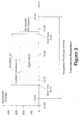
- Fig. 3 shows the broadcast transmission parameters of a sample programme. This is the information of the request that is transmitted by the scheduler user 14 to the scheduling and booking system at the broadcast center 16.
- the information is: content: e.g. sport news (optional) duration - 30 minutes (required) bandwidth required - 260 kbit/sec (required) requested broadcast interval - start 15:05 (required) - end 16:00 where start and end are meant to include date and time.
- the requested broadcast interval RBI is the time interval specified by the scheduler user during which he or she expects the content to be sent out. As described below in connection with Fig. 6, the booking system attempts at step 105 to determine if the transmission can be executed during the RBI.
- step 107 alternative transmission times outside the RBI are examined and, if any are found, they are proposed to the scheduler user.
- the RBI is at least as long in time as the required transmission duration, but otherwise can be of any length.
- a long RBI indicates that the user has ascribed a lower priority to the requested transmission because it permits the booking system to schedule the transmission far into the future.
- the goal of the scheduling and booking system at the broadcast center 16 is to verify the availability of broadcast resources in order to accommodate the scheduler user request into the broadcast center.
- the broadcast start and end times are arranged in such a way that the broadcast takes place in the time frame requested by the scheduler user, e.g., start time 15:05 and end time 16:00.
- the open ended start and end lines could give to the request a lower priority and a lower pricing rate, since the broadcast service provider can satisfy the request at any time that bandwidth is available.
- Fig. 4 shows the checking of whether or not a broadcast request can be satisfied.
- the request that is to be checked is the world news, shown in a dotted (time) block R, with the duration, here in a requested start-end time period, on the horizontal axis.
- the height of the block R represents the bandwidth required to broadcast the programme.
- the information of each of the blocks S, the schedule of the already accepted booked requests, is already stored in the booking system computer.
- Fig. 4 the total available bandwidth of the broadcast service provider is shown between the two horizontal lines A and B. If no programme has been booked for a particular time period, the space between lines A and B would be empty. The space F above each booked programme block S to the line B indicates the bandwidth that is free and can accept one or more additional programmes for broadcast. As can be seen, because of its required bandwidth, the programme request R can be satisfied only during the time period of the middle one of the already scheduled blocks S. This is not sufficient to satisfy the request which requires a longer time duration.
- Fig. 5 shows a situation where the same duration and bandwidth request R as in Fig. 4 is made for the same time but perhaps on a different situation.
- the request R can be satisfied during the time period from about 16:00 to 17:15 since there is available bandwidth.
- the request also could be satisfied starting about 15 minutes earlier, but the requested broadcast interval does not start so early.
- Fig. 6 is a flow chart of the operation of the system and method.
- the content provider defines one or more broadcast requests and the associated parameters.
- the request includes programme duration and the bandwidth required for broadcast.
- the time of broadcast and desired date also can be provided.
- the content e.g., news, sports, etc., preferably is also provided for information purposes. If the content provider does not know the required bandwidth, a sample of the content can be sent to the broadcast center for analysis.
- a broadcast request can be made minutes, hours, days, weeks or months in advance of the actual broadcast. Also, the actual content to be broadcast even may not be available at the time the request is made. In fact, the content is not required to be available until actual broadcast time.
- a broadcast request preferably is entered in a standard format this is understood by the computer of the scheduler 14 and the booking system.
- the scheduler has a data entry screen with fields in which to enter the various request parameters.
- the broadcast request is sent to the booking system by the scheduler station 14.
- a number of requests can be sent in serial form as a batch transmission.
- the booking system receives the requests in S105.
- Each request is checked in S107 for the availability of bandwidth over the required programme time duration and usually during a requested specified time frame (start and end time). This is described with respect to Figs. 4-5.
- a request for a specified time can be made to be satisfied for only one day or for any fixed number of days. That is, a schedule is kept in the booking system computer and is consulted for each request made. If the requested required bandwidth for the programme duration is open, so that the transmission can be executed as requested, the booking system in S109 books the request and informs the scheduler station accordingly.
- the content provider receives the confirmation of the booking of his request and stores it in S111.
- the system determines in S121 and S123 if the request can be properly executed at a different time.
- the booking system extends its checking of the programme transmission duration and bandwidth requested by the content provider through the scheduler station. That is, when a request has been rejected and a set of available alternate times/dates is to be generated, the computer takes the request R and checks it against the booked programmes S on the schedule over a period of time. This can be before or after a requested time.
- the schedule is the booked programmes, each with a start and end time, along a horizontal time line and the bandwidths of the programmes in the vertical direction as shown in Figs. 4-5.
- the programme request (Fig. 3) is scanned against this schedule data set to see what time and dates are available to accommodate it (see Figs. 4-5).
- the booking system can be programmemed to seek alternate broadcast times in any format, e.g., for certain times of any one or more days (Monday to Sunday), at given times during the day, and to the end of a calendar date. These factors also can be specified in the request.
- the booking system rejects the broadcast request and informs the scheduler station 14 who receives the notice in S127.
- the content provider typically would then seek another broadcast service provider.
- the booking system sends a list of these to the scheduler station 14.
- the alternate time or times are proposed, such as on a display, to the user at the scheduler station for consideration by the user.
- this acceptance is sent as a new request to the booking system where it is again checked for availability and booked in S137.
- a confirmation is sent to the user in S139 and the programme is booked for transmission.
- the cancellation of a booked programme also can be accommodated. That is, if a content provider wishes to cancel a confirmed and booked request, assuming it is permitted to do this under terms of the booking contract, a cancellation notice is sent from the scheduler station 14.
- the booking programme removes the programme time that has been booked and this is again made available for booking to satisfy a new request. It should be understood that each confirmation typically is assigned and identification number with which the booking is associated. The system computer can use this number to easily identify the specific parameters of the booking to be cancelled.
- the scheduler station 14 allows the content provider user to define the broadcast plan off-line.
- the scheduler station includes a local database 42 that stores broadcast requests before they are submitted to the booking system in the broadcast center 16.
- broadcast requests can be defined and submitted before the corresponding content is available.
- the basic information necessary for making the request the minimum bandwidth required and content size, that is, the length of time of the programme.
- the content type e.g., audio/video streaming, file, data streaming also is usually provided as information to the broadcast service provider. Other information can be submitted such as preferred broadcast times (start-stop) and dates.
- the programme content has to be transferred to the broadcast center 16 before the transmission is supposed to start.
- Content can be uploaded to the broadcast center in two different ways as shown in Fig. 7:
Landscapes
- Engineering & Computer Science (AREA)
- Multimedia (AREA)
- Signal Processing (AREA)
- Computer Networks & Wireless Communication (AREA)
- Databases & Information Systems (AREA)
- Computer Security & Cryptography (AREA)
- Two-Way Televisions, Distribution Of Moving Picture Or The Like (AREA)
- Information Transfer Between Computers (AREA)
- Computer And Data Communications (AREA)
- Management, Administration, Business Operations System, And Electronic Commerce (AREA)
- Data Exchanges In Wide-Area Networks (AREA)
Applications Claiming Priority (2)
| Application Number | Priority Date | Filing Date | Title |
|---|---|---|---|
| US738390 | 2000-12-15 | ||
| US09/738,390 US7113738B2 (en) | 2000-12-15 | 2000-12-15 | Decision support method for planning broadcast transmissions |
Publications (2)
| Publication Number | Publication Date |
|---|---|
| EP1217565A2 true EP1217565A2 (de) | 2002-06-26 |
| EP1217565A3 EP1217565A3 (de) | 2003-11-12 |
Family
ID=24967794
Family Applications (1)
| Application Number | Title | Priority Date | Filing Date |
|---|---|---|---|
| EP01310260A Withdrawn EP1217565A3 (de) | 2000-12-15 | 2001-12-07 | Computer implementierte Methode und System für die Verhandlung von Programmendezeiten |
Country Status (2)
| Country | Link |
|---|---|
| US (2) | US7113738B2 (de) |
| EP (1) | EP1217565A3 (de) |
Cited By (5)
| Publication number | Priority date | Publication date | Assignee | Title |
|---|---|---|---|---|
| WO2003045053A1 (en) * | 2001-11-20 | 2003-05-30 | Nokia Corporation | A method and a system for communicating bandwidth information of a digital broadcast network |
| EP1535263A4 (de) * | 2002-09-06 | 2007-10-24 | Visible World Inc | System zum verfassen und editieren personalisierter nachrichtenkampagnen |
| US7729385B2 (en) | 2004-11-01 | 2010-06-01 | Nokia Corporation | Techniques for utilization of spare bandwidth |
| EP2357563A1 (de) * | 2002-06-03 | 2011-08-17 | Nokia Siemens Networks GmbH & Co. KG | Datenfunkplanungssystem und Verfahren |
| EP2267995A3 (de) * | 2000-04-07 | 2014-07-02 | Sony Corporation | Verwaltungsvorrichtung- und Verfahren |
Families Citing this family (23)
| Publication number | Priority date | Publication date | Assignee | Title |
|---|---|---|---|---|
| US7130805B2 (en) * | 2001-01-19 | 2006-10-31 | International Business Machines Corporation | Method and apparatus for generating progressive queries and models for decision support |
| MXPA04003915A (es) | 2001-10-24 | 2004-09-06 | Fantastic Corp | Metodos para la multidifusion de contenidos. |
| US7599689B2 (en) * | 2002-04-22 | 2009-10-06 | Nokia Corporation | System and method for bookmarking radio stations and associated internet addresses |
| US7623824B2 (en) * | 2002-12-16 | 2009-11-24 | Nokia Corporation | Broadcast media bookmarks |
| US8320922B2 (en) * | 2002-08-07 | 2012-11-27 | Qualcomm Incorporated | Registration in a broadcast communications system |
| DE10245086A1 (de) * | 2002-09-27 | 2004-04-08 | Trisa Holding Ag | Verfahren zur Herstellung einer Zahnbürste |
| US7991396B2 (en) * | 2003-06-09 | 2011-08-02 | Qualcomm Incorporated | Method and apparatus for broadcast application in a wireless communication system |
| US20050198317A1 (en) * | 2004-02-24 | 2005-09-08 | Byers Charles C. | Method and apparatus for sharing internet content |
| JP4029873B2 (ja) * | 2004-09-02 | 2008-01-09 | 富士通株式会社 | 同報通話システムにおける通信帯域制御方法、同報通話システムに用いられるサーバ装置および利用者端末、プログラム |
| KR100727072B1 (ko) * | 2005-10-28 | 2007-06-12 | 주식회사 케이티프리텔 | 방송 컨텐츠 정보 제공 방법 및 시스템 |
| US20080097848A1 (en) * | 2006-07-27 | 2008-04-24 | Patrick Julien | Day Part Frame Criteria |
| US20080095052A1 (en) * | 2006-07-27 | 2008-04-24 | Patrick Julien | Network Control Time Spans |
| US20080103904A1 (en) * | 2006-07-27 | 2008-05-01 | Patrick Julien | Fine-Grained Criteria Targeting |
| US20080091497A1 (en) * | 2006-07-27 | 2008-04-17 | Patrick Julien | Broadcast Days |
| US20080097824A1 (en) * | 2006-07-27 | 2008-04-24 | Patrick Julien | Campaign Performance Report |
| JP2008072700A (ja) * | 2006-08-18 | 2008-03-27 | Hitachi Communication Technologies Ltd | 無線基地局、無線端末および無線通信システムにおける通信制御方法 |
| US8594558B2 (en) * | 2007-06-07 | 2013-11-26 | Qualcomm Incorporated | Methods and apparatuses of providing multimedia content to a mobile device |
| KR101421587B1 (ko) * | 2007-08-23 | 2014-07-22 | 삼성전자주식회사 | 무선 영상 전화 단말간의 선호 영상 규격을 결정하는 방법및 장치 |
| US8611375B2 (en) * | 2008-09-05 | 2013-12-17 | Samsung Electronics Co., Ltd. | Method for EMBS-unicast interactivity and EMBS paging |
| US8434121B2 (en) * | 2009-10-16 | 2013-04-30 | At&T Intellectual Property I, L.P. | System and method for monitoring whole home digital video recorder usage for internet protocol television |
| US20120047201A1 (en) * | 2010-08-20 | 2012-02-23 | Nikhil Jain | Apparatus and method of acquiring or distributing content |
| US9872276B2 (en) * | 2015-01-12 | 2018-01-16 | Google Llc | Scheduling of software package transmissions on a multimedia broadcast multicast service channel |
| US20230388753A1 (en) * | 2020-10-19 | 2023-11-30 | Interdigital Patent Holdings, Inc. | Methods for power efficient broadcasting in wlan |
Family Cites Families (16)
| Publication number | Priority date | Publication date | Assignee | Title |
|---|---|---|---|---|
| US5659350A (en) | 1992-12-09 | 1997-08-19 | Discovery Communications, Inc. | Operations center for a television program packaging and delivery system |
| JP3288199B2 (ja) * | 1995-06-30 | 2002-06-04 | 富士通株式会社 | ビデオデータ配信装置 |
| US5886995A (en) * | 1996-09-05 | 1999-03-23 | Hughes Electronics Corporation | Dynamic mapping of broadcast resources |
| US5790070A (en) * | 1997-05-05 | 1998-08-04 | Motorola, Inc. | Network and method for controlling steerable beams |
| US6041359A (en) * | 1997-06-09 | 2000-03-21 | Microsoft Corporation | Data delivery system and method for delivering computer data over a broadcast network |
| EP0899955A3 (de) * | 1997-08-27 | 2001-01-31 | Matsushita Electric Industrial Co., Ltd. | Vorrichtung zur Erzeugung von Steuerinformation für ein Rundfunksystem |
| US6016311A (en) * | 1997-11-19 | 2000-01-18 | Ensemble Communications, Inc. | Adaptive time division duplexing method and apparatus for dynamic bandwidth allocation within a wireless communication system |
| DE69927198T2 (de) * | 1998-03-19 | 2006-06-29 | Hitachi, Ltd. | Rundfunk-Informationsversorgungssystem |
| US6477707B1 (en) * | 1998-03-24 | 2002-11-05 | Fantastic Corporation | Method and system for broadcast transmission of media objects |
| US6748451B2 (en) * | 1998-05-26 | 2004-06-08 | Dow Global Technologies Inc. | Distributed computing environment using real-time scheduling logic and time deterministic architecture |
| US6571391B1 (en) * | 1998-07-09 | 2003-05-27 | Lucent Technologies Inc. | System and method for scheduling on-demand broadcasts for heterogeneous workloads |
| US6374405B1 (en) * | 1999-02-17 | 2002-04-16 | Opentv, Corp. | Module scheduling with a time interval and ending time |
| DE60003905T2 (de) | 1999-04-18 | 2004-06-03 | Video Networks Inc. | System und verfahren zur dynamischen zuteilung der zeit und bandbreite |
| US6529706B1 (en) * | 1999-09-13 | 2003-03-04 | Rockwell Collins, Inc. | Aircraft satellite communications system for distributing internet service from direct broadcast satellites |
| US6678740B1 (en) * | 2000-01-14 | 2004-01-13 | Terayon Communication Systems, Inc. | Process carried out by a gateway in a home network to receive video-on-demand and other requested programs and services |
| US6567660B1 (en) * | 2000-08-01 | 2003-05-20 | Command Audio Corporation | On-demand information service using wireless cellular communications system |
-
2000
- 2000-12-15 US US09/738,390 patent/US7113738B2/en not_active Ceased
-
2001
- 2001-12-07 EP EP01310260A patent/EP1217565A3/de not_active Withdrawn
-
2008
- 2008-09-26 US US12/239,620 patent/USRE43207E1/en not_active Expired - Lifetime
Cited By (7)
| Publication number | Priority date | Publication date | Assignee | Title |
|---|---|---|---|---|
| EP2267995A3 (de) * | 2000-04-07 | 2014-07-02 | Sony Corporation | Verwaltungsvorrichtung- und Verfahren |
| WO2003045053A1 (en) * | 2001-11-20 | 2003-05-30 | Nokia Corporation | A method and a system for communicating bandwidth information of a digital broadcast network |
| EP2357563A1 (de) * | 2002-06-03 | 2011-08-17 | Nokia Siemens Networks GmbH & Co. KG | Datenfunkplanungssystem und Verfahren |
| EP1535263A4 (de) * | 2002-09-06 | 2007-10-24 | Visible World Inc | System zum verfassen und editieren personalisierter nachrichtenkampagnen |
| US10134313B2 (en) | 2002-09-06 | 2018-11-20 | Visible World, Inc. | System for authoring and editing personalized message campaigns |
| US11398171B2 (en) | 2002-09-06 | 2022-07-26 | Freewheel Media, Inc. | System for authoring and editing personalized message campaigns |
| US7729385B2 (en) | 2004-11-01 | 2010-06-01 | Nokia Corporation | Techniques for utilization of spare bandwidth |
Also Published As
| Publication number | Publication date |
|---|---|
| USRE43207E1 (en) | 2012-02-21 |
| US20020111134A1 (en) | 2002-08-15 |
| US7113738B2 (en) | 2006-09-26 |
| EP1217565A3 (de) | 2003-11-12 |
Similar Documents
| Publication | Publication Date | Title |
|---|---|---|
| USRE43207E1 (en) | Decision support method for planning broadcast transmissions | |
| EP1207699A2 (de) | Verfahren und Vorrichtung zur Bereitstellung von Werbung | |
| US10817910B2 (en) | System and method for integrated, automated inventory management and advertisement delivery | |
| US11109114B2 (en) | Advertisement management method, system, and computer program product | |
| US7913276B2 (en) | Data-providing system, transmission server, data terminal, apparatus, authoring apparatus and data-providing method | |
| US20030158789A1 (en) | Electronic merchandise distribution system, electronic merchandise distribution method, and program | |
| US20050289630A1 (en) | Apparatus, method and system for self service digital media broadcast | |
| US20040093253A1 (en) | System and method for delivering and managing advertisements | |
| JP2001519626A (ja) | 有料プログラムパッケージ販売促進を備えるインタラクティブテレビジョンプログラムガイドシステム | |
| DE202006021056U1 (de) | System zum Kaufen von Sendezeit | |
| EP1204909A2 (de) | Verfahren und system für verkauf und ankauf von media werbung über ein verteiltes kommunikationsnetzwerk | |
| WO2001003041A1 (en) | System and method for short notice advertising placement | |
| US20030163810A1 (en) | Advertisement time frame transaction method and system | |
| EP1385105A1 (de) | System und verfahren zur verwaltung der verteilung von werbung | |
| KR20000063733A (ko) | 인터넷을 통해 멀티미디어 시청시 적립금 지급 방법 및시스템 | |
| US7415514B2 (en) | Method and system for providing and utilizing total package program with advertisement | |
| US20030121048A1 (en) | Broadcast channel link server and method therefor | |
| WO2016093588A1 (ko) | 방송 광고 제어 시스템 및 그 방법 | |
| KR102859603B1 (ko) | 예약 매니저를 통한 골프예약 시스템 | |
| US20260129253A1 (en) | Mediahub for controlling and monitoring the distribution of targeted assets | |
| EP1434152A1 (de) | Programmerzeugungsunterstützungssystem | |
| US20030214912A1 (en) | System and method for the management of procurement and provisioning of video transmission services | |
| JP2025181712A (ja) | 情報処理装置、情報処理方法、プログラム、及び情報処理装置 | |
| KR20030089043A (ko) | 맞춤형 시간제 음식점 예약 시스템 및 방법 | |
| WO2000078046A1 (en) | Distributing advertisement over a network |
Legal Events
| Date | Code | Title | Description |
|---|---|---|---|
| PUAI | Public reference made under article 153(3) epc to a published international application that has entered the european phase |
Free format text: ORIGINAL CODE: 0009012 |
|
| AK | Designated contracting states |
Kind code of ref document: A2 Designated state(s): AT BE CH CY DE DK ES FI FR GB GR IE IT LI LU MC NL PT SE TR |
|
| AX | Request for extension of the european patent |
Free format text: AL;LT;LV;MK;RO;SI |
|
| PUAL | Search report despatched |
Free format text: ORIGINAL CODE: 0009013 |
|
| AK | Designated contracting states |
Kind code of ref document: A3 Designated state(s): AT BE CH CY DE DK ES FI FR GB GR IE IT LI LU MC NL PT SE TR |
|
| AX | Request for extension of the european patent |
Extension state: AL LT LV MK RO SI |
|
| RIC1 | Information provided on ipc code assigned before grant |
Ipc: 7H 04L 29/06 B Ipc: 7H 04L 12/56 B Ipc: 7H 04B 7/185 B Ipc: 7H 04N 7/173 B Ipc: 7G 06F 17/60 A |
|
| 17P | Request for examination filed |
Effective date: 20040510 |
|
| AKX | Designation fees paid |
Designated state(s): AT BE CH CY DE DK ES FI FR GB GR IE IT LI LU MC NL PT SE TR |
|
| AXX | Extension fees paid |
Extension state: SI Payment date: 20040510 Extension state: RO Payment date: 20040510 Extension state: MK Payment date: 20040510 Extension state: LV Payment date: 20040510 Extension state: LT Payment date: 20040510 Extension state: AL Payment date: 20040510 |
|
| 17Q | First examination report despatched |
Effective date: 20040629 |
|
| RAP1 | Party data changed (applicant data changed or rights of an application transferred) |
Owner name: THE FANTASTIC IP GMBH |
|
| APBN | Date of receipt of notice of appeal recorded |
Free format text: ORIGINAL CODE: EPIDOSNNOA2E |
|
| APBR | Date of receipt of statement of grounds of appeal recorded |
Free format text: ORIGINAL CODE: EPIDOSNNOA3E |
|
| APAF | Appeal reference modified |
Free format text: ORIGINAL CODE: EPIDOSCREFNE |
|
| RAP1 | Party data changed (applicant data changed or rights of an application transferred) |
Owner name: DARBY & MOHAINE, LLC |
|
| APBT | Appeal procedure closed |
Free format text: ORIGINAL CODE: EPIDOSNNOA9E |
|
| STAA | Information on the status of an ep patent application or granted ep patent |
Free format text: STATUS: THE APPLICATION HAS BEEN WITHDRAWN |
|
| 18W | Application withdrawn |
Effective date: 20130125 |