EP1217729A2 - Rundfunkdatenempfänger und adaptive Verstärkungsregelungsschwellwerte zur Optimierung der empfangenen Signalqualität - Google Patents
Rundfunkdatenempfänger und adaptive Verstärkungsregelungsschwellwerte zur Optimierung der empfangenen Signalqualität Download PDFInfo
- Publication number
- EP1217729A2 EP1217729A2 EP01309758A EP01309758A EP1217729A2 EP 1217729 A2 EP1217729 A2 EP 1217729A2 EP 01309758 A EP01309758 A EP 01309758A EP 01309758 A EP01309758 A EP 01309758A EP 1217729 A2 EP1217729 A2 EP 1217729A2
- Authority
- EP
- European Patent Office
- Prior art keywords
- receiver
- signal
- frequency
- broadcast data
- levels
- Prior art date
- Legal status (The legal status is an assumption and is not a legal conclusion. Google has not performed a legal analysis and makes no representation as to the accuracy of the status listed.)
- Withdrawn
Links
- 230000003044 adaptive effect Effects 0.000 title description 2
- 238000000034 method Methods 0.000 claims abstract description 30
- 230000008569 process Effects 0.000 claims abstract description 7
- 238000003860 storage Methods 0.000 claims description 8
- 230000008859 change Effects 0.000 claims description 7
- 230000004044 response Effects 0.000 claims description 6
- 230000004075 alteration Effects 0.000 claims description 4
- 238000001914 filtration Methods 0.000 description 7
- 230000005540 biological transmission Effects 0.000 description 5
- 238000012545 processing Methods 0.000 description 5
- 230000001419 dependent effect Effects 0.000 description 4
- 238000009826 distribution Methods 0.000 description 3
- 230000000694 effects Effects 0.000 description 3
- 238000009434 installation Methods 0.000 description 3
- 238000013459 approach Methods 0.000 description 2
- 230000015556 catabolic process Effects 0.000 description 2
- 238000006731 degradation reaction Methods 0.000 description 2
- 238000004519 manufacturing process Methods 0.000 description 2
- 239000000523 sample Substances 0.000 description 2
- 230000009471 action Effects 0.000 description 1
- 239000000969 carrier Substances 0.000 description 1
- 238000006243 chemical reaction Methods 0.000 description 1
- 238000013461 design Methods 0.000 description 1
- 238000010586 diagram Methods 0.000 description 1
- 238000005259 measurement Methods 0.000 description 1
- 238000003672 processing method Methods 0.000 description 1
- 238000010845 search algorithm Methods 0.000 description 1
Images


Classifications
-
- H—ELECTRICITY
- H04—ELECTRIC COMMUNICATION TECHNIQUE
- H04N—PICTORIAL COMMUNICATION, e.g. TELEVISION
- H04N5/00—Details of television systems
- H04N5/44—Receiver circuitry for the reception of television signals according to analogue transmission standards
- H04N5/4446—IF amplifier circuits specially adapted for B&W TV
-
- H—ELECTRICITY
- H04—ELECTRIC COMMUNICATION TECHNIQUE
- H04N—PICTORIAL COMMUNICATION, e.g. TELEVISION
- H04N21/00—Selective content distribution, e.g. interactive television or video on demand [VOD]
- H04N21/40—Client devices specifically adapted for the reception of or interaction with content, e.g. set-top-box [STB]; Operations thereof
- H04N21/41—Structure of client; Structure of client peripherals
- H04N21/426—Internal components of the client ; Characteristics thereof
-
- H—ELECTRICITY
- H04—ELECTRIC COMMUNICATION TECHNIQUE
- H04N—PICTORIAL COMMUNICATION, e.g. TELEVISION
- H04N21/00—Selective content distribution, e.g. interactive television or video on demand [VOD]
- H04N21/40—Client devices specifically adapted for the reception of or interaction with content, e.g. set-top-box [STB]; Operations thereof
- H04N21/43—Processing of content or additional data, e.g. demultiplexing additional data from a digital video stream; Elementary client operations, e.g. monitoring of home network or synchronising decoder's clock; Client middleware
- H04N21/438—Interfacing the downstream path of the transmission network originating from a server, e.g. retrieving encoded video stream packets from an IP network
- H04N21/4383—Accessing a communication channel
-
- H—ELECTRICITY
- H04—ELECTRIC COMMUNICATION TECHNIQUE
- H04N—PICTORIAL COMMUNICATION, e.g. TELEVISION
- H04N21/00—Selective content distribution, e.g. interactive television or video on demand [VOD]
- H04N21/40—Client devices specifically adapted for the reception of or interaction with content, e.g. set-top-box [STB]; Operations thereof
- H04N21/43—Processing of content or additional data, e.g. demultiplexing additional data from a digital video stream; Elementary client operations, e.g. monitoring of home network or synchronising decoder's clock; Client middleware
- H04N21/442—Monitoring of processes or resources, e.g. detecting the failure of a recording device, monitoring the downstream bandwidth, the number of times a movie has been viewed, the storage space available from the internal hard disk
- H04N21/44209—Monitoring of downstream path of the transmission network originating from a server, e.g. bandwidth variations of a wireless network
-
- H—ELECTRICITY
- H04—ELECTRIC COMMUNICATION TECHNIQUE
- H04N—PICTORIAL COMMUNICATION, e.g. TELEVISION
- H04N5/00—Details of television systems
- H04N5/44—Receiver circuitry for the reception of television signals according to analogue transmission standards
- H04N5/46—Receiver circuitry for the reception of television signals according to analogue transmission standards for receiving on more than one standard at will
Definitions
- the invention to which this application relates is to the use of amplitude gain control in the receiving and processing of digital and/or analogue radio frequency (RF) signals by broadcast data receivers.
- Broadcast Data receivers are typically used in conjunction with a television set and/ or the components thereof and can also be provided as an integral part thereof.
- the broadcast data receiver is provided to receive video and audio data carried on said analogue and digital signals, process the same and generate audio and or video for the television or radio programmes for the user.
- the programmes are typically carried on various selectable television channels and the data is carried on RF signals over a frequency range.
- the receiver typically includes one or a number of tuners which allow the receiver to tune to a particular frequency in response to a user selection of a particular channel.
- the data and signals can be carried by any of a number of transmission media from the broadcaster to the receiver location such as satellite, cable or terrestrial system whereby the data is transmitted to all the broadcast data receivers at a large number of different locations.
- the signal quality which is received can be affected by a number of influences depending on whether the signal is an analogue or digital signal and so action which is taken in respect of reducing interference for one signal at a first frequency may not be appropriate for another signal at another frequency.
- the alteration of the signal receiving components and parameters at the broadcast data receiver is typically achieved by the adjustment and control of the gain levels at the front end of the receiving means by (RF) amplitude gain control, and the gain at the end of the receiving components Intermediate Frequency (IF) gain control, and after filtering of the signal but prior to the demodulation of the data.
- Direct conversion (or ZIF - zero intermediate frequency) satellite (and other) tuners often employ a multiplicity of Amplitude Gain Control (AGC) loops to cater for varying signal input level. Unlike a conventional (superheterodyne) tuner the ultimate channel filtering is performed very near the actual demodulation stage of the processing of the signal and removed from the antenna input as far as possible.
- AGC Amplitude Gain Control
- the RF amplifier, mixer IF (intermediate frequency) stages and A/D (analogue to digital converter) are subject to adjacent channel signal frequencies - often the whole transponder's content, and this can severely affect the quality of the selected signal frequency which is used for subsequent processing and generation of television programmes and, in due time, affect the quality of generation of the television programme for the user.
- Optimum receiver performance is therefore dependent upon optimum gain distribution within the receiver, which is dependent not just upon the required signal quality, but also upon the rest of the signals visible to the various stages within the receiver.
- receivers which receive signals via a particular transmission means are only given here as an illustration, and the invention as set out is equally applicable to any signal whose quality can be measured in a multi-signal environment (e.g. cable; terrestrial or satellite, digital and/or analogue television transmission systems.)
- a multi-signal environment e.g. cable; terrestrial or satellite, digital and/or analogue television transmission systems.
- the aim of the present invention is therefore to provide apparatus and a method whereby the received signal quality can be optimised for each particular receiver and at a particular location and with respect to a particular channel.
- a system for the generation of television programmes selected from a plurality of television channels said system including a broadcast data receiver, said receiver provided to receive any or any combination of analogue and /or digital data signals at a series of different frequencies, said signals carrying data which when received and processed by the receiver allows the generation of television programmes which are displayed to a user, said broadcast receiver including a tuner and first and second AGC's which allow the adjustment of first and second gain levels when receiving a signal and characterised in that, when a signal frequency is selected in response to the user selection of a television channel to be generated by the receiver, the receiver tunes to the required frequency, receives the signal and the receiver then adjusts the first and/or second gain levels to determine the appropriate gain levels which provide the optimum signal for that signal frequency with regard to predefined parameters.
- the optimisation and setting of the gain control levels is performed for each new signal frequency selected when a new channel is selected by the receiver user.
- the optimisation process is repeated either continuously or at regular intervals. This is the case even when the channel remains unchanged so as to take into account any alterations in conditions at the receiver or in the transmission system during the selection of said signal frequency.
- the receiver includes storage means in which previously selected settings for receiving particular signal frequencies are stored.
- the receiver sets the receiving parameters in accordance with those stored in the storage means and then starts from those settings when subsequently checking to ascertain whether those settings are providing the optimum signal reception at that instant.
- standard settings may be input into the storage means to provide a starting point for each signal frequency from which the receiver tuner commences when the signal frequency is first chosen in use.
- a series of common default settings are first referred to by the receiver.
- a broadcast data receiver said receiver provided to receive any or any combination of analogue and /or digital data signals, said signals transmitted at different frequencies within a frequency range, said signals carrying data which when received and processed by the receiver allows the generation of audio and video for television programmes which are displayed to a user via a television
- said broadcast receiver including a tuner and first and second AGC's which allow the adjustment of first and second gain levels when receiving a signal and characterised in that when a signal frequency is selected in response to the user selection of a television channel to be generated by the receiver, the receiver tunes to the required frequency, receives the signal and the receiver then checks and, if necessary, adjusts the first and/or second gain levels to determine those appropriate gain levels which provide the optimum signal for that signal frequency at that instant.
- the metric such as the bit error rate BER
- the invention provides for the dynamic control of the AGC characteristics of the multiplicity of AGC loops to optimise the received signal quality.
- the receiver adapts to a particular receiver installation and adapts the signal receiving means to suit the particular location and hence provide the optimal signal reception characteristics on a signal by signal basis.
- the signal quality can be measured with reference to the demodulator error correcting circuitry in the receiver and requires no human intervention.
- an algorithm can be used to 'pick the best from N options' or in an alternative embodiment a complex multidimensional parameter maximisation search is adopted (or any step in between).
- An alternative method of optimisation is to use a combination of the principles of 'fuzzy logic' and non-linear filters.
- the optimisation can be determined with respect to a particular value or characteristic, or metric, such as a bit error rate (BER), by altering the AGC values and hence arriving at the AGC value or values which provide the optimal signal quality at a particular frequency.
- BER bit error rate
- This method can cope with a very noisy metric, even one suffering from impulsive noise, and the possibility of the optimum settings changing over time.
- the broadcast data receiver is provided with default AGC settings with respect to which the receiver operates when first rendered operational. Once operational, the method is employed to adapt the operating characteristics with respect to signal affecting factors at the location of the broadcast data receiver.
- a method for receiving a data carrier signal selected from one of a range of signal frequencies said data, once received, processed and used to generate video and audio for a television or radio programme by a broadcast data receiver connected to a display screen and speakers, said method comprising receiving a user selection of a particular television channel via the broadcast data receiver, identifying the signal frequency for that channel and tuning the receiver utilising a tuner to receive the frequency signal, and characterised in that upon signal frequency reception adjusting at least first and second amplitude gain control levels and assessing the change in signal quality, said quality determined with respect to predefined parameters, and, upon identifying the optimum signal maintaining those amplitude gain control levels.
- the method according to claim 16 characterised in that the method is repeated for every new frequency signal selection or is repeated continuously while the broadcast data receiver is operational.
- the adaptive nature of the system comes into effect in terms of the RF and IF amplitude gain values at the amplifiers 2,4 respectively and which are respectively controlled by the RF AGC and IF AGC controls 10,12 via the AGC generator 14.
- the AGC levels for the respective RF and IF AGC which are allocated to provide optimal signal quality are dependent upon the particular signal frequency selected and the surrounding "environment conditions" for that signal. For instance, if there are larger signal data carriers at adjacent frequencies to the selected signal frequency which may cause interference, it is better to have a higher level IF gain in the base band after some initial filtering. However, if the selected signal is larger or closer to the noise floor then a higher RF gain level is better. So the exact optimum gain levels and relative gain levels is largely dependent upon many external factors and, it will be appreciated, varies from frequency signal to frequency signal.
- the quality of the selected signal is maximised using a process which is effective once the signal is selected and utilises manipulation of the RF and IF gain levels and distribution.
- BER bit error rate
- a more complex case involves a two dimensional search in 'AGC space' to minimise the BER. In this case if there are more than two AGC levels then the dimensions to be searched also increase.
- the Figure 1 illustrates a typical tuner which can be used in a broadcast data receiver and the circuit diagram is representative of the current generation of tuners.
- These tuners suffer from a disadvantage when it comes to multiple signal frequency handling because the channel filtering 15 is near the end of the signal frequency processing chain, so previous stages are exposed to unwanted, uncooperative signals. Dynamic optimisation of the selected signal quality improves the operational margin of the receiving system, so any further system degradation can be better tolerated.
- adjustment of the AGC threshold control voltages changes the balance of the gain distribution between the RF and IF gain controlled stages 2,4 to optimise performance for the particular signal frequency situations found when the same are selected.
- FIG. 2 A more advanced tuner is illustrated in Figure 2.
- the baseband filter 20 is still not matched to the signal and energy from adjacent signal frequencies may well appear at the input of the analogue to digital converter 22, reducing the number of data bits available for the selected signal.
- the control system automatically checks the actual operating characteristics and if it detects that there are strong adjacent signals to the selected signal, it will alter the operating parameters as described and thereby optimise the data generated from the selection of the frequency signal
- the system and optimisation method is applied at least for every selection of a frequency signal in response to a user channel selection at the broadcast data receiver and preferably continuously or periodically refreshed for best performance during the reception of a particular frequency signal. Also, it is advantageous to learn and store the optimal settings for a given frequency and band which will then act as the new default setting for the frequency signal when it is next selected. However the system and method will still be employed but the resulting search effort required on reacquisition of a previously selected signal frequency is reduced.
- the area of search may have to be restricted to certain bounds to avoid false peaks in the signal quality.
- FIG. 3-8 a more detailed example of a method and system which can be used to optimise a frequency signal is described.
- a satellite transmission system installation is provided and is found to be operating in a sub optimal manner, perhaps due to poor reception and/or a wide variation of frequency signal levels within the 'visible' frequency range.
- the invention allows this system to be more tolerant of further signal degradations (e.g rainfall) upon satisfactory operation of the receiver system.
- the optimum point of operation at a selected frequency signal is the minima 28 of a metric curve 26, see Figure 3.
- a portion 30 of the curve of Figure 3 is shown in Figure 4 and the normal operating value of the control variable is shown by the point 'O'.
- the gradient around this point shows which way to change the control variable to get closer to the optimum i.e the minima of the curve. As the gradient reduces, the amount by which the control variable should be changed should also reduced so that the optimum point is not stepped over.
- a simple way of getting the curve gradients is to alter the control variable value, and after the change has had an effect, re-measure the metric. This is done for a point below O in value, point 'B', and above O in value, point 'A'.
- Both gradients can be evaluated in the same sense, i.e. with respect to the positive direction of the control variable. If the offset between 'O' and 'B', and that between 'O' and 'A' are the same, then a value proportional to the gradient can be obtained by dividing the metric value at 'B' by that at 'O', and that at 'O' by 'A'.
- the overhead here would be choosing the order in which to do the divisions (always larger divided by smaller), and the application of a sign as required by the fuzzy logic rules.
- this "spiky or impulsive" noise is removed by using a median filter, a form of non-linear filter, wherein a series of samples are ranked in numerical order, and the middle value is chosen as representative.
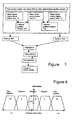
- sample 3 of the ranked samples would be the representative one as illustrated in Figure 6, and the filtered gradient samples can now be passed to the final stage of the method.
- a standard fuzzy logic block as shown in Figure 5 can be used to process the gradient samples and the input membership functions should take the form of Figure 6. It is not recommended to reduce the number of classes, but more could be added for increased accuracy, at the expense of more computational effort if required.
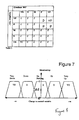
- the top-left 4 entries should never occur (as these refer to a maximum in the curve) and that is why they have 'do nothing' rules associated with them.
- the Gradient 'BO' is the gradient estimate from point 'B' to 'O', similarly for Gradient 'OA'.
- Columns and row headings are from the input membership functions and the Figure table entries refer to the output membership functions shown in Figure 8.
- symmetric membership functions can be used, as this is computationally less demanding.
- the subsequent adjustments to the parameters, such as the AGC control levels which are made are made in dependence on the Change indications from the Figures 7 and 8 with respect to the Bit Error Rate of the selected signal frequency.
- the invention although described with reference to the method to optimise the AGC take-over point against the measured metric of the bit error rate (BER) for a demodulator and which gives the best BER depending on whether it was limited by the tuner noise-figure, adjacent channel interference or intermodulation products (Ips), can be extended to several other control loops within a product, e.g setting the correct black level. All of these have metric vs. control value curves that are non-constant, and have noisy metrics.
- BER bit error rate
- Ips intermodulation products
Landscapes
- Engineering & Computer Science (AREA)
- Multimedia (AREA)
- Signal Processing (AREA)
- Computer Networks & Wireless Communication (AREA)
- Databases & Information Systems (AREA)
- Circuits Of Receivers In General (AREA)
Applications Claiming Priority (2)
| Application Number | Priority Date | Filing Date | Title |
|---|---|---|---|
| GBGB0028300.2A GB0028300D0 (en) | 2000-11-21 | 2000-11-21 | Adaptive nature a AGC thresholds and gains to maximise received signal quality |
| GB0028300 | 2000-11-21 |
Publications (2)
| Publication Number | Publication Date |
|---|---|
| EP1217729A2 true EP1217729A2 (de) | 2002-06-26 |
| EP1217729A3 EP1217729A3 (de) | 2004-10-27 |
Family
ID=9903528
Family Applications (1)
| Application Number | Title | Priority Date | Filing Date |
|---|---|---|---|
| EP01309758A Withdrawn EP1217729A3 (de) | 2000-11-21 | 2001-11-20 | Rundfunkdatenempfänger und adaptive Verstärkungsregelungsschwellwerte zur Optimierung der empfangenen Signalqualität |
Country Status (3)
| Country | Link |
|---|---|
| US (1) | US20020060751A1 (de) |
| EP (1) | EP1217729A3 (de) |
| GB (1) | GB0028300D0 (de) |
Cited By (1)
| Publication number | Priority date | Publication date | Assignee | Title |
|---|---|---|---|---|
| US7606544B2 (en) | 2004-12-28 | 2009-10-20 | Microtune (Texas), L.P. | System for dynamic control of automatic gain control take-over-point and method of operation |
Families Citing this family (7)
| Publication number | Priority date | Publication date | Assignee | Title |
|---|---|---|---|---|
| FR2824986B1 (fr) * | 2001-05-18 | 2003-10-31 | St Microelectronics Sa | Composant electronique permettant le decodage d'un canal de transmission radiofrequence vehiculant des informations numeriques codees, en particulier pour la telediffusion numerique par satellite |
| JP4295479B2 (ja) * | 2002-07-16 | 2009-07-15 | アルプス電気株式会社 | テレビジョンチューナ |
| DE502005008989D1 (de) * | 2004-07-23 | 2010-03-25 | Betr Forsch Inst Angew Forsch | Ultraschallempfänger mit frühzeitiger Signaldigitalisierung und dessen Verwendung |
| US7460840B2 (en) * | 2004-12-28 | 2008-12-02 | Broadcom Corporation | Method of test characterization of an analog front end receiver in a communication system |
| MX2007015379A (es) * | 2005-06-06 | 2008-02-19 | Lutron Electronics Co | Sistema de comunicacion de linea de energia. |
| KR100725405B1 (ko) * | 2005-10-20 | 2007-06-07 | 삼성전자주식회사 | Pll 주파수 합성기를 구비하지 않은 무선 수신 장치 및이를 이용한 무선 수신 방법 |
| JPWO2009107359A1 (ja) * | 2008-02-29 | 2011-06-30 | パナソニック株式会社 | 増幅回路及びそれを用いた受信装置 |
Citations (1)
| Publication number | Priority date | Publication date | Assignee | Title |
|---|---|---|---|---|
| US6091765A (en) * | 1997-11-03 | 2000-07-18 | Harris Corporation | Reconfigurable radio system architecture |
Family Cites Families (9)
| Publication number | Priority date | Publication date | Assignee | Title |
|---|---|---|---|---|
| US5572264A (en) * | 1994-02-14 | 1996-11-05 | Hitachi, Ltd. | High definition TV signal receiver |
| GB9508592D0 (en) * | 1995-04-27 | 1995-06-14 | Rca Thomson Licensing Corp | Rf filter and agc circuit |
| JPH10248040A (ja) * | 1997-03-05 | 1998-09-14 | Sanyo Electric Co Ltd | テレビジョン受像機 |
| JPH10276125A (ja) * | 1997-03-28 | 1998-10-13 | Matsushita Electric Ind Co Ltd | 移動無線受信装置 |
| JPH11136154A (ja) * | 1997-10-31 | 1999-05-21 | Sony Corp | 受信装置 |
| JP3439987B2 (ja) * | 1998-06-12 | 2003-08-25 | 日本放送協会 | 受信装置 |
| US6369857B1 (en) * | 1999-05-13 | 2002-04-09 | Sarnoff Corporation | Receiver for analog and digital television signals |
| US6735423B1 (en) * | 1999-05-18 | 2004-05-11 | General Instrument Corporation | Method and apparatus for obtaining optimal performance in a receiver |
| JP3710658B2 (ja) * | 1999-09-29 | 2005-10-26 | 株式会社東芝 | 自動利得制御回路および受信機 |
-
2000
- 2000-11-21 GB GBGB0028300.2A patent/GB0028300D0/en not_active Ceased
-
2001
- 2001-11-20 EP EP01309758A patent/EP1217729A3/de not_active Withdrawn
- 2001-11-21 US US09/988,991 patent/US20020060751A1/en not_active Abandoned
Patent Citations (1)
| Publication number | Priority date | Publication date | Assignee | Title |
|---|---|---|---|---|
| US6091765A (en) * | 1997-11-03 | 2000-07-18 | Harris Corporation | Reconfigurable radio system architecture |
Cited By (1)
| Publication number | Priority date | Publication date | Assignee | Title |
|---|---|---|---|---|
| US7606544B2 (en) | 2004-12-28 | 2009-10-20 | Microtune (Texas), L.P. | System for dynamic control of automatic gain control take-over-point and method of operation |
Also Published As
| Publication number | Publication date |
|---|---|
| GB0028300D0 (en) | 2001-01-03 |
| US20020060751A1 (en) | 2002-05-23 |
| EP1217729A3 (de) | 2004-10-27 |
Similar Documents
| Publication | Publication Date | Title |
|---|---|---|
| KR100382192B1 (ko) | 튜너용자동이득제어회로장치 | |
| US7515888B2 (en) | Systems and method for a highly integrated, multi-mode tuner | |
| KR100426041B1 (ko) | 수신기의 최적의 성능을 얻기 위한 방법 및 장치 | |
| US6014547A (en) | System for enhancing the performance of a CATV settop terminal | |
| KR100617778B1 (ko) | 수신신호 열화 보상장치 및 방법 | |
| US20040229561A1 (en) | Tuner | |
| US20070042734A1 (en) | Tuner and broadcasting signal receiver including the same | |
| US7697898B2 (en) | Method and apparatus for processing a frequency modulated (FM) signal using an adaptive equalizer | |
| CN101953067A (zh) | 接收机内的增益分配 | |
| EP1217729A2 (de) | Rundfunkdatenempfänger und adaptive Verstärkungsregelungsschwellwerte zur Optimierung der empfangenen Signalqualität | |
| EP2246988B1 (de) | Rundfunkempfänger | |
| US6651021B2 (en) | System using adaptive circuitry to improve performance and provide linearity and dynamic range on demand | |
| US7623601B2 (en) | Controlling gain in a satellite receiver | |
| US7065337B2 (en) | Tuner for digital terrestrial broadcast signals | |
| US7499694B1 (en) | Tuner alignment | |
| US20020191120A1 (en) | Automatically adjusted AGC take over point | |
| KR20060057434A (ko) | 인접 채널의 간섭 영향을 줄이는 튜닝 방법 및 그 장치 | |
| US7158191B2 (en) | Video signal processing apparatus | |
| KR20060121219A (ko) | 자동 이득 제어 장치 및 방법 | |
| US7881670B1 (en) | Non-capture one-tuner smart antenna | |
| CN106452551A (zh) | 接收装置 | |
| JPH0730880A (ja) | Catvコンバータ | |
| KR20030013199A (ko) | 디지털 방송용 튜너 자동 측정 방법 | |
| KR20000021884A (ko) | 자동이득제어전압을 이용한 채널 탐색방법 |
Legal Events
| Date | Code | Title | Description |
|---|---|---|---|
| PUAI | Public reference made under article 153(3) epc to a published international application that has entered the european phase |
Free format text: ORIGINAL CODE: 0009012 |
|
| AK | Designated contracting states |
Kind code of ref document: A2 Designated state(s): AT BE CH CY DE DK ES FI FR GB GR IE IT LI LU MC NL PT SE TR |
|
| AX | Request for extension of the european patent |
Free format text: AL;LT;LV;MK;RO;SI |
|
| PUAL | Search report despatched |
Free format text: ORIGINAL CODE: 0009013 |
|
| AK | Designated contracting states |
Kind code of ref document: A3 Designated state(s): AT BE CH CY DE DK ES FI FR GB GR IE IT LI LU MC NL PT SE TR |
|
| AX | Request for extension of the european patent |
Extension state: AL LT LV MK RO SI |
|
| RIC1 | Information provided on ipc code assigned before grant |
Ipc: 7H 04N 5/44 B Ipc: 7H 03G 3/00 B Ipc: 7H 03G 3/30 A |
|
| 17P | Request for examination filed |
Effective date: 20050426 |
|
| AKX | Designation fees paid |
Designated state(s): AT BE CH CY DE DK ES FI FR GB GR IE IT LI LU MC NL PT SE TR |
|
| RIN1 | Information on inventor provided before grant (corrected) |
Inventor name: BEALES,STEPHEN C/O PACE MICRO TECHNOLOGY PLC Inventor name: GARRETT, PETER Inventor name: ROWE, JAMES |
|
| 17Q | First examination report despatched |
Effective date: 20060906 |
|
| STAA | Information on the status of an ep patent application or granted ep patent |
Free format text: STATUS: THE APPLICATION IS DEEMED TO BE WITHDRAWN |
|
| 18D | Application deemed to be withdrawn |
Effective date: 20080701 |