EP1217761A2 - CDMA-Kommunikationsgerät für Übertragung mit adaptiven Gruppenantennen - Google Patents
CDMA-Kommunikationsgerät für Übertragung mit adaptiven Gruppenantennen Download PDFInfo
- Publication number
- EP1217761A2 EP1217761A2 EP01128764A EP01128764A EP1217761A2 EP 1217761 A2 EP1217761 A2 EP 1217761A2 EP 01128764 A EP01128764 A EP 01128764A EP 01128764 A EP01128764 A EP 01128764A EP 1217761 A2 EP1217761 A2 EP 1217761A2
- Authority
- EP
- European Patent Office
- Prior art keywords
- signal
- phase difference
- data
- base station
- reception
- Prior art date
- Legal status (The legal status is an assumption and is not a legal conclusion. Google has not performed a legal analysis and makes no representation as to the accuracy of the status listed.)
- Withdrawn
Links
Images



Classifications
-
- H—ELECTRICITY
- H04—ELECTRIC COMMUNICATION TECHNIQUE
- H04B—TRANSMISSION
- H04B7/00—Radio transmission systems, i.e. using radiation field
- H04B7/02—Diversity systems; Multi-antenna system, i.e. transmission or reception using multiple antennas
- H04B7/04—Diversity systems; Multi-antenna system, i.e. transmission or reception using multiple antennas using two or more spaced independent antennas
- H04B7/06—Diversity systems; Multi-antenna system, i.e. transmission or reception using multiple antennas using two or more spaced independent antennas at the transmitting station
- H04B7/0613—Diversity systems; Multi-antenna system, i.e. transmission or reception using multiple antennas using two or more spaced independent antennas at the transmitting station using simultaneous transmission
- H04B7/0615—Diversity systems; Multi-antenna system, i.e. transmission or reception using multiple antennas using two or more spaced independent antennas at the transmitting station using simultaneous transmission of weighted versions of same signal
- H04B7/0619—Diversity systems; Multi-antenna system, i.e. transmission or reception using multiple antennas using two or more spaced independent antennas at the transmitting station using simultaneous transmission of weighted versions of same signal using feedback from receiving side
- H04B7/0621—Feedback content
- H04B7/0634—Antenna weights or vector/matrix coefficients
-
- H—ELECTRICITY
- H04—ELECTRIC COMMUNICATION TECHNIQUE
- H04B—TRANSMISSION
- H04B1/00—Details of transmission systems, not covered by a single one of groups H04B3/00 - H04B13/00; Details of transmission systems not characterised by the medium used for transmission
- H04B1/69—Spread spectrum techniques
- H04B1/707—Spread spectrum techniques using direct sequence modulation
-
- H—ELECTRICITY
- H04—ELECTRIC COMMUNICATION TECHNIQUE
- H04B—TRANSMISSION
- H04B2201/00—Indexing scheme relating to details of transmission systems not covered by a single group of H04B3/00 - H04B13/00
- H04B2201/69—Orthogonal indexing scheme relating to spread spectrum techniques in general
- H04B2201/707—Orthogonal indexing scheme relating to spread spectrum techniques in general relating to direct sequence modulation
- H04B2201/70701—Orthogonal indexing scheme relating to spread spectrum techniques in general relating to direct sequence modulation featuring pilot assisted reception
-
- H—ELECTRICITY
- H04—ELECTRIC COMMUNICATION TECHNIQUE
- H04B—TRANSMISSION
- H04B7/00—Radio transmission systems, i.e. using radiation field
- H04B7/02—Diversity systems; Multi-antenna system, i.e. transmission or reception using multiple antennas
- H04B7/04—Diversity systems; Multi-antenna system, i.e. transmission or reception using multiple antennas using two or more spaced independent antennas
- H04B7/06—Diversity systems; Multi-antenna system, i.e. transmission or reception using multiple antennas using two or more spaced independent antennas at the transmitting station
- H04B7/0613—Diversity systems; Multi-antenna system, i.e. transmission or reception using multiple antennas using two or more spaced independent antennas at the transmitting station using simultaneous transmission
- H04B7/0615—Diversity systems; Multi-antenna system, i.e. transmission or reception using multiple antennas using two or more spaced independent antennas at the transmitting station using simultaneous transmission of weighted versions of same signal
- H04B7/0617—Diversity systems; Multi-antenna system, i.e. transmission or reception using multiple antennas using two or more spaced independent antennas at the transmitting station using simultaneous transmission of weighted versions of same signal for beam forming
Definitions
- the present invention relates to a CDMA communication terminal, and relates more particularly to a CDMA communication terminal for communicating with an adaptive array antenna communication device.
- information (data) signal is multiplied by a first complex-valued weight factor to obtain a first weighted signal.
- This first weighted signal and a first pilot signal are then added to obtain a first sum signal.
- This first sum signal is then orthogonally modulated and transmitted from a first antenna element.
- the data signal is also multiplied by a second complex-valued weight factor to obtain a second weighted signal.
- This second weighted signal and a second pilot signal are added to obtain a second sum signal.
- This second sum signal is orthogonally modulated and transmitted from a second antenna element.
- Both of these transmission signals are received by the communication terminal in different phases because those signals are transmitted through different signal reception paths, that is, directly or after being reflected by buildings, etc. Therefore, accurate communication cannot be ensured.
- a CDMA communication terminal receives through plural reception paths of transmission signals transmitted from first and second antenna elements of a base station.
- the CDMA communication terminal then calculates phase difference data indicating a phase difference between first and second known signals according to the plural reception paths.
- the CDMA communication terminal feedbacks the calculated phase difference data for updating first and second weights used in a base station for modulating the transmission signals.
- the phase difference of the first and second known signals are calculated for each reception path, and all calculated phase differences are combined to determine the phase difference data.
- the received power of the first known signal and the received power of the second known signal according to the plural reception paths are compared to obtain resulting power comparison data as update data.
- a CDMA communication system comprises a base station 10 and a mobile station (communication terminal) 20.
- the base station 10 comprises a transmission data generator 11, multipliers 12a and 12b, a first pilot (first pilot) generator 13a, a second pilot (second pilot) generator 13b, adders 14a and 14b, orthogonal modulators 15a and 15b, antenna elements 16a and 16b, a receiving antenna 17, and a weight demodulator 18.
- the mobile station 20 comprises a receiving antenna 21, a RAKE synthesis demodulator 22, a weight modulator 25, a transmission antenna 26, a pilot demodulator 28, a phase difference calculator 29 and an antenna-receiving power difference comparator 30.
- the transmission data generator 11 of base station 10 outputs a first data (information) signal after spectrum-spreading (code-spreading) to multiplier 12a, and outputs a second data (information) signal after spectrum-spreading to multiplier 12b.
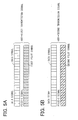
- Each data signal is a complex signal consisting of plural data symbols as shown in Figs. 5A and 5B.
- Multiplier 12a obtains a first weighted signal by calculating the complex value product of a first complex-valued weight and the data signal from the transmission data generator 11 after spectrum-spreading.
- Multiplier 12b obtains a second weighted signal by calculating the complex value product of the data signal from the transmission data generator 11 after spectrum-spreading and a second complex-valued weight.
- First pilot generator 13a outputs a first pilot signal (first known signal) after spectrum-spreading to adder 14a.
- This first pilot signal is a complex signal, and as shown in Fig. 5A consists of multiple first pilot symbols.
- Second pilot generator 13b outputs a second pilot signal (second known signal) after spectrum-spreading to adder 14b.
- This second pilot signal is a complex signal, and as shown in Fig. 5B consists of multiple second pilot symbols.
- first and second pilot symbols are mutually different.
- the spreading code used for spectrum-spreading the first and second pilot symbols are the same, and the spreading codes used for spectrum-spreading the first and second pilot signals are different from those used for spectrum-spreading the data signal.
- adder 14a determines the complex sum of the first pilot signal after spectrum-spreading from first pilot generator 13a and first weighted signal from multiplier 12a, and outputs a first sum signal.
- Adder 14b determines the complex sum of the second pilot signal after spectrum-spreading from second pilot generator 13b and the second weighted signal from multiplier 12b, and outputs a second sum signal.
- the orthogonal modulator 15a orthogonally modulates the first sum signal from adder 14a, and outputs the first transmission signal from antenna element 16a as an electromagnetic wave (RF signal).
- the first transmission signal is thus the sum of the data signal and first pilot signal.
- Orthogonal modulator 15b orthogonally modulates the second sum signal from adder 14b to output the second transmission signal from antenna element 16b as an electromagnetic wave (RF signal).
- the second transmission signal is thus the sum of the data signal and second pilot signal.
- the weight demodulator 18 demodulates a feedback signal showing phase difference information and power comparison information further described below, updates the first and second complex-valued weights based on the feedback signal, outputs first complex-valued weight to multiplier 12a, and outputs second complex-valued weight to multiplier 12b.
- Fig. 2 shows the operation of pilot demodulator 28, antenna phase difference calculator 29, and antenna-receiving power comparator 30.
- Fig. 3 shows the operation of antenna phase difference calculator 29 in detail.
- Fig. 4 shows the operation of antenna-receiving power comparator 30 in detail.
- the receiving antenna 21 of the mobile station 20 receives the sum of the first and second transmission signals from base station 10 as the reception signals through various reception paths.
- the paths include a direct path without any reflection by a building and other paths with reflection by buildings, etc.
- the RAKE synthesis demodulator 22 receives the reception signal from receiving antenna 21 through the plural reception paths, demodulates and RAKE synthesizes the plural reception paths to the individual reception paths to obtain the data signal.
- the demodulator RAKE synthesis demodulator demodulates according to the plural reception paths of the transmission signals transmitted from the base station 10 and aligns the signal arrival timing at each of the plural reception paths.
- the transmission signals are demodulated before being synthesized.
- the pilot demodulator 28 has antenna pilot demodulators 280, 281, ..., 28n (where n is the number of reception paths).
- Antenna pilot demodulators 280, 281, ... , 28n demodulate first and second pilot signals for each reception path.
- the first and second pilot signals R(K,L) demodulated to the respective reception paths are defined in equation (1).
- R(K,L) A(K,L) exp(j ⁇ (K,L))
- A(K,L) is the amplitude of the received pilot signal
- ⁇ (K,L) is the phase rotation on the transmission path between the base station 10 and mobile station 20.
- antenna pilot demodulator 281 demodulates the first pilot signal R(1,1) and the second pilot signal R(2,1) based on reception path PH1.
- Antenna pilot demodulator 282 demodulates first pilot signal R(1,2) and second pilot signal R(2,2) based on reception path PH2.
- Antenna pilot demodulator 28n demodulates first pilot signal R(1,n) and second pilot signal R(2,n) based on reception path PHn.
- antenna phase difference calculator 29 calculates the phase difference (phase difference Angle(n)) between the first and second pilot signals for each reception path PH1 to PHn. More specifically, as shown in Fig. 3, it calculates the phase difference Angle(1), Angle(2),..., Angle(n) for the first and second pilot signals for each reception path PH1, PH2, ..., PHn as defined in equation (2), equation (3), and equation (4) at step S100.
- notation * indicates a complex conjugate.
- Angle(1) R(1,1) x R(2,1)*
- Angle(2) R(1,2) x R(2,2)*
- Angle(n) R(1,n) x R(2,n)*
- antenna phase difference calculator 29 determines sum Angle_a at step S110 as defined in equation (5) by vector-addition of phase difference Angle(1), Angle(2), ..., Angle(n). More specifically, by vector-adding phase differences Angle(1), Angle(2), ... , Angle(n), antenna phase difference calculator 29 determines average Angle_a as the average phase difference Angle (1), Angle (2), ..., Angle(n) using the magnitude of the reception signals on each reception path as the weight, and defines this average Angle_a as the phase difference information (phase difference between antenna elements) at step S120.
- Angle_a Angle(1) + Angle(2) + ... + Angle(n)
- the first and second weighted signals of the first and second transmission signals from antenna elements 16a and 16b must be received at the same receiving power in a specific area. This is because in addition to the first and second weighted signals arriving in inverse phase at the area where a null point is formed in a specific area, the first and second weighted signals cancel each other as a result of the first and second weighted signals being received at the same receiving power.
- the first and second weighted signals reach mobile station 20 in a specific area at the same receiving power and in the same phase, the first and second weighted signals do not cancel each other at the mobile station 20, good signal synthesis of the first and second weighted signals is possible, and precise data signal demodulation is possible using this synthesis signal.
- the first and second complex-valued weights must also function so that the first and second weighted signals arrive at the mobile station 20 with the same amplitude.
- highly accurate amplitude difference information for the first and second pilot signals received by mobile station 20 and therefore highly accurate power comparison data for the first and second pilot signals is required.
- high precision power comparison data is needed in addition to high precision phase difference data for the first and second pilot signals.
- values that are more appropriate as the first and second complex-valued weights can be obtained if high precision phase difference data and high precision power comparison data can be determined for the first and second pilot signals.
- the antenna-receiving power comparator 30 described below is therefore used.
- the sum of squares (power) of the amplitude of the second pilot signal is determined for each reception path, and sum Po_2 is determined at step S200 by adding the sum of squares (power) for the plural reception paths in the second pilot signal.
- Po_2 A(2,1) 2 + A(2,2) 2 + ... + A(2,n) 2
- the antenna-receiving power comparator 30 then compares sum Po_1 and sum Po_2 at step S210 to obtain power comparison result (Po_1 - Po_2).
- weight modulator 25 modulates the feedback signal indicating the power comparison result from antenna-receiving power comparator 30 and the phase difference of antenna phase difference calculator 29, and transmits the feedback signal from transmission antenna 26 as an electromagnetic wave.
- the receiving antenna 17 of base station 10 then receives and outputs the feedback signal to weight demodulator 18.
- the weight demodulator 18 demodulates the feedback signal to obtain the power comparison result and calculated phase difference, and updates the first and second complex-valued weights based on this power comparison result and calculated phase difference.
- a specific process whereby the weight demodulator 18 updates the first and second complex-valued weights is described below.
- the m-th (where m is a natural number) first complex-valued weight W1(m) of antenna element 16a can be denoted as defined in equation (8), in which notation A1 is the amplitude and ⁇ 1(m) is the phase.
- W1(m) A1 exp (j • ⁇ 1(m))
- the m-th second complex-valued weight W2(m) of antenna element 16b can be denoted as defined in equation (9), in which notation A2 is the amplitude and ⁇ 2(m) is the phase.
- W2(m) A2 exp (j • ⁇ 2(m))
- the weight demodulator 18 updates the first and second complex-valued weights as described below.
- the first and second weighted signals will arrive with the same amplitude at the mobile station 20 by using the first and second complex-valued weights shown in equations (14) and (15) or (16) and (17).
- the above preferred embodiment is compared with an exemplary CDMA communication system shown in Fig. 6.
- This system shown in Fig. 6 is different from the preferred embodiment in that the phase difference is calculated with respect to a single path a first pilot demodulator 23a, a second pilot demodulator 23b and a weight calculator 24 are used in the mobile station.
- the first pilot demodulator 23a receives the reception signal from receiving antenna 21, and demodulates the first pilot signal based only on one reception path of the reception signal.
- the second pilot demodulator 23b receives the reception signal from receiving antenna 21, and demodulates the second pilot signal based only on one reception path of the reception signal.
- the weight calculator 24 compares the phases of the first and second pilot signals to obtain the phase difference data, and outputs a phase comparison signal indicating this phase difference information.
- This phase difference information indicates the condition of the communication path (phase rotation) between the base station and mobile station, and is used to update (determine) the first and second complex-valued weights described below.
- the weight modulator 25 modulates the phase comparison signal, and outputs the modulated signal as a feedback signal from transmission antenna 26.
- the receiving antenna 17 of base station 10 then receives and outputs the feedback signal from the transmission antenna 26 of mobile station 20 to the weight demodulator 18.
- the weight demodulator 18 demodulates the feedback signal to obtain the phase difference data, and based on this phase difference data updates the first and second complex-valued weights.
- the first and second complex-valued weights are updated so that the first and second weighted signals arrive at the mobile station 20 in the same phase.
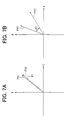
- this phase difference information is determined based on only one reception path of the signal received through receiving antenna 21 of the mobile station 20. This is further described below with reference to Figs. 7A and 7B using an example in which reception paths PH1 and PH2 of the reception signal are received by the mobile station 20.
- Figs. 7A and 7B show the first reception path PH1 of the reception signal and the second reception path PH2 in I/Q coordinates (polar coordinates).
- the error of the phase difference data is small when the phase difference ⁇ 1 between the vectors indicating the phase difference between the first reception path PH1 of the reception signal and the second reception path PH2 is small.
- the phase difference vectors indicating the phase difference between the first reception path PH1 of the reception signal and the second reception path PH2 is large ⁇ 2 (> ⁇ 1) and the phase difference data is obtained based on only one of reception paths PH1 and PH2, error in the phase difference data will also be large.
- the vectors indicating the phase difference between reception paths PH1 and PH2 indicate the condition of the respective communication paths between the base station and mobile station.
- error in the first and second complex-valued weights becomes great when the phase difference error is great, and the first and second complex-valued weights are unable to function to good effect.
- the present embodiment provides the following advantages.
- the phase difference data is very accurate because the antenna phase difference calculator 29 determines the phase difference information (the phase difference between the antenna elements) for each of plural reception paths. Furthermore, the first and second complex-valued weights can be updated to good effect because they are updated in the base station 10 according to this phase difference data.
- the antenna-receiving power comparator 30 compares the power of the first and second pilot signals for plural reception paths.
- the first and second complex-valued weights are also more appropriate because the first and second complex-valued weights are updated according to the phase difference data and this power comparison information.
- first pilot generator 13a and second pilot generator 13b of base station 10 in this embodiment use mutually different first and second pilot symbols to generate mutually different first and second pilot signals, and use the same spread code for spectrum-spreading, but the invention shall not be so limited.
- mutually identical first and second pilot symbols can be used while using different spread codes used for spectrum-spreading.
- the present embodiment is described using an example in which the first and second transmission signals transmitted from base station 10 are spectrum spread using different spread codes for the data signal and first pilot signal (or second pilot signal), but the invention shall not be so limited.
- the data signal and first pilot signal can be transmitted on a time division basis while spectrum-spreading the data signal and first pilot signal using the same spread code.
- the present embodiment is described using an example in which the amplitude and phase of the first and second complex-valued weights are changed to update the first and second complex-valued weights, but the invention shall not be so limited as it is possible to change only the phase of the first and second complex-valued weights. It is also possible for the base station 10 to multiply only one of the data signals output from transmission data generator 11 by the complex-valued weight instead of respectively multiplying the data signals output from transmission data generator 11 by the first and second complex-valued weights. In this case it is possible to use only one of the multipliers 12a and 12b in the base station 10 shown in Fig. 1.
- the mobile station 20 used in an embodiment of the present invention can be a cellular phone, a mobile car telephone, or a PHS, PDA, or other communication terminal.
- the circuit design of the mobile station 20 shown in Fig. 1 can also be applied to the CDMA communication system base station.
- the base station 10 is described using two antenna elements (16a, 16b) by way of example, but the invention shall not be so limited and three or more antenna elements can be used.
Landscapes
- Engineering & Computer Science (AREA)
- Computer Networks & Wireless Communication (AREA)
- Signal Processing (AREA)
- Physics & Mathematics (AREA)
- Mathematical Physics (AREA)
- Mobile Radio Communication Systems (AREA)
- Radio Transmission System (AREA)
- Variable-Direction Aerials And Aerial Arrays (AREA)
Applications Claiming Priority (2)
| Application Number | Priority Date | Filing Date | Title |
|---|---|---|---|
| JP2000391125A JP2002198875A (ja) | 2000-12-22 | 2000-12-22 | Cdma方式の通信端末 |
| JP2000391125 | 2000-12-22 |
Publications (2)
| Publication Number | Publication Date |
|---|---|
| EP1217761A2 true EP1217761A2 (de) | 2002-06-26 |
| EP1217761A3 EP1217761A3 (de) | 2005-01-12 |
Family
ID=18857339
Family Applications (1)
| Application Number | Title | Priority Date | Filing Date |
|---|---|---|---|
| EP01128764A Withdrawn EP1217761A3 (de) | 2000-12-22 | 2001-12-03 | CDMA-Kommunikationsgerät für Übertragung mit adaptiven Gruppenantennen |
Country Status (3)
| Country | Link |
|---|---|
| US (1) | US20020080743A1 (de) |
| EP (1) | EP1217761A3 (de) |
| JP (1) | JP2002198875A (de) |
Cited By (1)
| Publication number | Priority date | Publication date | Assignee | Title |
|---|---|---|---|---|
| WO2004042961A1 (ja) | 2002-11-07 | 2004-05-21 | Sony Ericsson Mobile Communications Japan, Inc. | 無線送受信装置 |
Families Citing this family (11)
| Publication number | Priority date | Publication date | Assignee | Title |
|---|---|---|---|---|
| JP4165238B2 (ja) * | 2003-01-29 | 2008-10-15 | 日本電気株式会社 | パスサーチ回路及びその方法ならびにプログラム |
| US7242722B2 (en) * | 2003-10-17 | 2007-07-10 | Motorola, Inc. | Method and apparatus for transmission and reception within an OFDM communication system |
| WO2006068413A1 (en) * | 2004-12-21 | 2006-06-29 | Electronics And Telecommunications Research Institute | Method for selecting switched beam using pilot signal and system thereof |
| US7302265B1 (en) | 2005-03-16 | 2007-11-27 | Sprint Spectrum L.P. | Method of selecting carrier frequency for call origination |
| JP5278035B2 (ja) * | 2009-02-25 | 2013-09-04 | ソニー株式会社 | 通信装置及び通信方法、コンピューター・プログラム、並びに通信システム |
| US8325648B1 (en) | 2009-04-29 | 2012-12-04 | Sprint Spectrum L.P. | Methods and systems for assigning a wireless communication device to a carrier frequency |
| US8320313B1 (en) | 2009-06-19 | 2012-11-27 | Sprint Spectrum L.P. | Method and system for carrier frequency management based on slot contention |
| CN102549940B (zh) * | 2009-10-08 | 2015-02-25 | 皇家飞利浦电子股份有限公司 | 用于操作蜂窝通信网中的无线电站的方法 |
| US8798013B1 (en) | 2011-03-25 | 2014-08-05 | Sprint Spectrum L.P. | Method and system for management of data transmission in timeslots |
| JP2015076700A (ja) * | 2013-10-08 | 2015-04-20 | 株式会社Nttドコモ | 無線装置、無線制御装置及び通信制御方法 |
| WO2017132956A1 (zh) * | 2016-02-04 | 2017-08-10 | 华为技术有限公司 | 天线阵列的相位调整方法及装置 |
Family Cites Families (13)
| Publication number | Priority date | Publication date | Assignee | Title |
|---|---|---|---|---|
| US3717814A (en) * | 1971-09-23 | 1973-02-20 | Bell Telephone Labor Inc | Cophasing diversity communication system with pilot feedback |
| US6134261A (en) * | 1998-03-05 | 2000-10-17 | At&T Wireless Svcs. Inc | FDD forward link beamforming method for a FDD communications system |
| US6067324A (en) * | 1998-06-30 | 2000-05-23 | Motorola, Inc. | Method and system for transmitting and demodulating a communications signal using an adaptive antenna array in a wireless communication system |
| EP1054519A1 (de) * | 1999-05-11 | 2000-11-22 | Alcatel | Diversityübertragung in einem Mobilfunksystem |
| KR100316777B1 (ko) * | 1999-08-24 | 2001-12-12 | 윤종용 | 차세대 이동 통신 시스템에서의 폐쇄 루프 전송 안테나 다이버시티 방법 및 이를 위한 기지국 장치 및 이동국 장치 |
| US6115406A (en) * | 1999-09-10 | 2000-09-05 | Interdigital Technology Corporation | Transmission using an antenna array in a CDMA communication system |
| US6728307B1 (en) * | 1999-09-13 | 2004-04-27 | Nokia Mobile Phones Ltd | Adaptive antenna transmit array with reduced CDMA pilot channel set |
| JP4187377B2 (ja) * | 2000-02-23 | 2008-11-26 | 富士通株式会社 | 無線送受信機及び電波放射方向制御方法 |
| WO2001067627A1 (en) * | 2000-03-06 | 2001-09-13 | Fujitsu Limited | Cdma receiver and searcher of the cdma receiver |
| JP4531969B2 (ja) * | 2000-12-21 | 2010-08-25 | 三菱電機株式会社 | アダプティブアンテナ受信装置 |
| JP3558053B2 (ja) * | 2001-06-06 | 2004-08-25 | 日本電気株式会社 | 適応アンテナ受信装置 |
| EP1359684A1 (de) * | 2002-04-30 | 2003-11-05 | Motorola Energy Systems Inc. | Drahtlose Übertragung unter Verwendung einer adaptiven Antennengruppe |
| KR100526542B1 (ko) * | 2003-05-15 | 2005-11-08 | 삼성전자주식회사 | 이동 통신 시스템에서 다중안테나를 사용하는송신다이버시티 방식을 사용하여 데이터를 송수신하는장치 및 방법 |
-
2000
- 2000-12-22 JP JP2000391125A patent/JP2002198875A/ja not_active Withdrawn
-
2001
- 2001-11-28 US US09/998,535 patent/US20020080743A1/en not_active Abandoned
- 2001-12-03 EP EP01128764A patent/EP1217761A3/de not_active Withdrawn
Cited By (2)
| Publication number | Priority date | Publication date | Assignee | Title |
|---|---|---|---|---|
| WO2004042961A1 (ja) | 2002-11-07 | 2004-05-21 | Sony Ericsson Mobile Communications Japan, Inc. | 無線送受信装置 |
| EP1560351A4 (de) * | 2002-11-07 | 2011-03-09 | Sony Ericsson Mobile Comm Jp | Funksende-/empfangs vorrichtung |
Also Published As
| Publication number | Publication date |
|---|---|
| EP1217761A3 (de) | 2005-01-12 |
| US20020080743A1 (en) | 2002-06-27 |
| JP2002198875A (ja) | 2002-07-12 |
Similar Documents
| Publication | Publication Date | Title |
|---|---|---|
| KR0164250B1 (ko) | 스펙트럼 확산 통신용 수신기 및 중계기 | |
| US6864839B2 (en) | Radio transceiver and method of controlling direction of radio-wave emission | |
| EP1231720A2 (de) | Angepasstes Antennenempfangsgerät | |
| US7929922B2 (en) | Radio communication system, a transmitter and a receiver | |
| US20090011789A1 (en) | Multiple basestation communication system having adaptive antennas | |
| EP0992813A2 (de) | Funkempfangspeilantennengerät | |
| EP1217761A2 (de) | CDMA-Kommunikationsgerät für Übertragung mit adaptiven Gruppenantennen | |
| WO1994009568A1 (en) | Adaptive co-channel interference reduction system for cellular telephone central base stations | |
| IL199352A (en) | Transmission examples that are corrugated moving for many simultaneous transmitters to support signal separation in the receiver | |
| EP1262032B1 (de) | Verfahren mit funksender zur verbesserung des funkverbindungsbetriebs | |
| CN1691541B (zh) | 形成波束的方法和装置 | |
| EP1028544A1 (de) | Basisstation und funkübertragungsverfahren | |
| EP2127095A1 (de) | Wellige übertragungsmuster zur stützung der signaltrennung an einem empfänger | |
| US7373177B2 (en) | Data transmission method and arrangement | |
| WO2002027970A1 (en) | Beam steering in a cellular communication system | |
| EP0858175A2 (de) | Empfänger für Pilotgestütze Kodemultiplexvielfachzugriffsnachrichtenübertragung | |
| JP2003524991A (ja) | 受信アンテナダイバシティを伴うデュアルコード通信システム | |
| US20020098815A1 (en) | Adaptive array antenna system and method for determining radio signal direction of adaptive array antenna | |
| EP1093186A1 (de) | Funksender und verfahren zur einstellung der senderrichtung | |
| JP2002232334A (ja) | アダプティブアレイアンテナ装置及び通信端末 | |
| JP2002084217A (ja) | 基地局装置および到来方向推定方法 | |
| EP1170885A1 (de) | Gerät zur messung der tiefe des signalschwinders, verfahren und tragbares nachrichtenendgerät dafür | |
| JPH09119970A (ja) | 通信測位装置 | |
| WO2001024406A1 (en) | Base station system, and wireless communication method | |
| JP3138243B2 (ja) | アダプティブアレイ装置 |
Legal Events
| Date | Code | Title | Description |
|---|---|---|---|
| PUAI | Public reference made under article 153(3) epc to a published international application that has entered the european phase |
Free format text: ORIGINAL CODE: 0009012 |
|
| AK | Designated contracting states |
Kind code of ref document: A2 Designated state(s): AT BE CH CY DE DK ES FI FR GB GR IE IT LI LU MC NL PT SE TR |
|
| AX | Request for extension of the european patent |
Free format text: AL;LT;LV;MK;RO;SI |
|
| PUAL | Search report despatched |
Free format text: ORIGINAL CODE: 0009013 |
|
| AK | Designated contracting states |
Kind code of ref document: A3 Designated state(s): AT BE CH CY DE DK ES FI FR GB GR IE IT LI LU MC NL PT SE TR |
|
| AX | Request for extension of the european patent |
Extension state: AL LT LV MK RO SI |
|
| 17P | Request for examination filed |
Effective date: 20050602 |
|
| AKX | Designation fees paid |
Designated state(s): DE FR GB |
|
| STAA | Information on the status of an ep patent application or granted ep patent |
Free format text: STATUS: THE APPLICATION IS DEEMED TO BE WITHDRAWN |
|
| 18D | Application deemed to be withdrawn |
Effective date: 20060325 |