EP1217768A2 - Verfahren zum speichern oder übertragen von Zusatzinformationen und Empfänger dafür - Google Patents
Verfahren zum speichern oder übertragen von Zusatzinformationen und Empfänger dafür Download PDFInfo
- Publication number
- EP1217768A2 EP1217768A2 EP01310786A EP01310786A EP1217768A2 EP 1217768 A2 EP1217768 A2 EP 1217768A2 EP 01310786 A EP01310786 A EP 01310786A EP 01310786 A EP01310786 A EP 01310786A EP 1217768 A2 EP1217768 A2 EP 1217768A2
- Authority
- EP
- European Patent Office
- Prior art keywords
- information
- additional information
- key
- additional
- processing terminal
- Prior art date
- Legal status (The legal status is an assumption and is not a legal conclusion. Google has not performed a legal analysis and makes no representation as to the accuracy of the status listed.)
- Withdrawn
Links
Images


Classifications
-
- H—ELECTRICITY
- H04—ELECTRIC COMMUNICATION TECHNIQUE
- H04H—BROADCAST COMMUNICATION
- H04H60/00—Arrangements for broadcast applications with a direct linking to broadcast information or broadcast space-time; Broadcast-related systems
- H04H60/27—Arrangements for recording or accumulating broadcast information or broadcast-related information
-
- H—ELECTRICITY
- H04—ELECTRIC COMMUNICATION TECHNIQUE
- H04H—BROADCAST COMMUNICATION
- H04H60/00—Arrangements for broadcast applications with a direct linking to broadcast information or broadcast space-time; Broadcast-related systems
- H04H60/35—Arrangements for identifying or recognising characteristics with a direct linkage to broadcast information or to broadcast space-time, e.g. for identifying broadcast stations or for identifying users
- H04H60/46—Arrangements for identifying or recognising characteristics with a direct linkage to broadcast information or to broadcast space-time, e.g. for identifying broadcast stations or for identifying users for recognising users' preferences
-
- H—ELECTRICITY
- H04—ELECTRIC COMMUNICATION TECHNIQUE
- H04H—BROADCAST COMMUNICATION
- H04H60/00—Arrangements for broadcast applications with a direct linking to broadcast information or broadcast space-time; Broadcast-related systems
- H04H60/61—Arrangements for services using the result of monitoring, identification or recognition covered by groups H04H60/29-H04H60/54
- H04H60/65—Arrangements for services using the result of monitoring, identification or recognition covered by groups H04H60/29-H04H60/54 for using the result on users' side
-
- H—ELECTRICITY
- H04—ELECTRIC COMMUNICATION TECHNIQUE
- H04H—BROADCAST COMMUNICATION
- H04H60/00—Arrangements for broadcast applications with a direct linking to broadcast information or broadcast space-time; Broadcast-related systems
- H04H60/76—Arrangements characterised by transmission systems other than for broadcast, e.g. the Internet
- H04H60/78—Arrangements characterised by transmission systems other than for broadcast, e.g. the Internet characterised by source locations or destination locations
- H04H60/80—Arrangements characterised by transmission systems other than for broadcast, e.g. the Internet characterised by source locations or destination locations characterised by transmission among terminal devices
-
- H—ELECTRICITY
- H04—ELECTRIC COMMUNICATION TECHNIQUE
- H04H—BROADCAST COMMUNICATION
- H04H2201/00—Aspects of broadcast communication
- H04H2201/10—Aspects of broadcast communication characterised by the type of broadcast system
- H04H2201/20—Aspects of broadcast communication characterised by the type of broadcast system digital audio broadcasting [DAB]
Definitions
- the present invention relates to receivers. More specifically, the present invention relates to a receiver capable of receiving a broadcast in which additional information is multiplexed with main information including audio information (acoustic signal) or video information, such as a digital radio broadcast. The present invention also relates to a method of storing the additional information obtained by receiving the broadcast and a method of transferring the additional information to a location remote from the receiver.
- main information including audio information (acoustic signal) or video information, such as a digital radio broadcast.
- the present invention also relates to a method of storing the additional information obtained by receiving the broadcast and a method of transferring the additional information to a location remote from the receiver.
- DAB Digital Audio Broadcasting
- the list of proposed types of additional information includes: (1) ID of broadcasting service, and information such as title and category; (2) information regarding program content, e.g., information such as artist name and song title in the case of a music program; (3) timestamp (time-of-day information); and (4) other accompanying information).
- the accompanying information is, for example, text data showing words of a song broadcast in the program, concert information of an artist on the program, etc. It is also possible, for example, to compress the jacket of a CD including a song broadcast in the program based on JPEG (Joint Photographic Experts Group) format, broadcasting the payload (the substantial data) of the JPEG file and header information indicating a JPEG file as the accompanying information which constitutes part of the additional information.
- JPEG Joint Photographic Experts Group
- a receiver capable of receiving a digital radio broadcast of the type described above additional information received together with audio information is stored on a memory and displayed on a display such as an LCD (liquid crystal display).
- a display such as an LCD (liquid crystal display).
- the memory of the receiver is of relatively small capacity, the memory is not capable of storing a large amount of data. Furthermore, data processing capability of a receiver is relatively low. Therefore, secondary use of the additional information is not allowed, in particular, use of the additional information at a location remote from the receiver. Furthermore, the screen of the display is relatively small, resulting in an unsatisfactory display quality.
- the additional information received by the receiver may be transferred to an information processing terminal such as a PC (personal computer), so that the additional information is displayed on a display having a larger screen and store an a storage device having a larger capacity.
- an information processing terminal such as a PC (personal computer)
- the additional information may be transferred from the information processing terminal onto a communications network and thereby transferred to other information processing terminals connected to the communications network. This allows secondary use of the additional information, in particular, use of the additional information at a location remote from the receiver.
- the method of storing or transferring the additional information on the information processing terminal will, for example, (1) directly store or transfer all the information transferred from the receiver; (2) store or transfer additional information currently displayed based on user's selection; or (3) store or transfer additional information of programs which have been reserved using a timer.
- the additional information cannot be stored or transferred if the user is not present at the location of the receiver during reception.
- the additional information cannot be stored or transferred if the user is not aware of the existence or the content of a program in advance.
- EPG electronic program guide
- the present invention in one aspect thereof, provides a method of storing additional information, including the steps of receiving additional information obtained and transferred by a receiver capable of receiving a broadcast in which the additional information is multiplexed with main information including an audio signal or a video signal; determining whether preset key information is included in the transferred additional information; and storing the additional information in a storage medium if the key information is included.
- the present invention in another aspect thereof, provides a method of transferring additional information, including the steps of receiving a broadcast in which additional information is multiplexed with main information including an audio signal or a video signal, thereby obtaining the additional information; determining whether preset key information is included in the additional information obtained; and transferring the additional information to an external device if the key information is included.
- the present invention in another aspect thereof, provides a method of storing additional information, including the steps of receiving a broadcast in which additional information is multiplexed with main information including an audio signal or a video signal, thereby obtaining the additional information; determining whether preset key information is included in the additional information obtained; transferring the additional information to an information processing terminal if the key information is included; and storing the additional information transferred to the information processing terminal in a storage medium of the information processing terminal.
- the present invention in another aspect thereof, provides a receiver including a receiving unit capable of receiving a broadcast in which additional information is multiplexed with main information including an audio signal or a video signal; a control unit which determines whether key information preset in the receiver is included in the additional information received by the receiving unit; and a communications unit which transfers the additional information received by the receiving unit to an external device if the control unit determines that the key information is included in the additional information.
- the present invention in another aspect thereof, provides an information processing terminal including a data communications unit for receiving additional information obtained and transferred by a receiver capable of receiving a broadcast in which the additional information is multiplexed with main information including an audio signal or a video signal; a control unit which determines whether preset key information is included in the transferred additional information; and a storage device for storing the additional information if the control unit determines that the key information is included in the additional information.
- the present invention in another aspect thereof, provides a method of transferring additional information, including the steps of transmitting to a first information processing terminal additional information obtained by a receiver capable of receiving a broadcast in which the additional information is multiplexed with main information including an audio signal or a video signal; determining on the first information processing terminal whether key information preset in the first information processing terminal is included in the transmitted additional information; and transferring the additional information from the first information processing terminal to a second information processing terminal at a destination if the key information is included.
- the present invention in another aspect thereof, provides a method of transferring additional information, including the steps of receiving additional information by a receiver capable of receiving a broadcast in which the additional information is multiplexed with main information including an audio signal or a video signal; determining on the receiver whether key information preset in the receiver is included in the received additional information; transmitting the additional information to a first information processing apparatus at a source if the key information is included; and transferring the additional information from the first information processing terminal to a second information processing terminal at a destination via a communications network.
- the present invention in another aspect thereof, provides an information processing terminal including a data communications unit for receiving additional information obtained and transferred by a receiver capable of receiving a broadcast in which the additional information is multiplexed with main information including an audio signal or a video signal; a control unit which determines whether preset key information is included in the transferred additional information; and a network communications unit for transmitting the additional information onto a communications network if the control unit determines that the key information is included in the additional information.
- the information received by the receiver only additional information including the key information preset by the user in the information processing terminal or the receiver, such as the user's favorite program categories and artist names, is stored on the information processing terminal. Accordingly, information desired by the user is stored on the information processing terminal efficiently using the storage capacity of the information processing terminal.
- the user is allowed to correctly store desired additional information on the information processing terminal even if the user is absent during reception or the user is not aware of a program in advance.
- the additional information received by the receiver only additional information including the key information preset by the user in the information processing terminal at the source or the receiver, such as the user's favorite program categories and artist names, is transferred from the information processing terminal at the source to the information processing terminal at the destination via the communications network. Accordingly, the user is allowed to correctly transfer only desired additional information to a location remote from the receiver and receive the additional information at the remote location, even if the user is absent at the location of the receiver during reception or if the user in not aware of a program in advance.
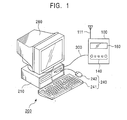
- Fig. 1 shows a system for implementing a method of storing additional information according to an embodiment of the present invention.
- a receiver 100 and an information processing apparatus, a PC 200 herein, are connected via communication means 300.
- the receiver 100 is capable of receiving a digital radio broadcast in which additional information is multiplexed with audio information.
- the receiver 100 includes an operation unit 140 having various buttons, keys, etc., a display unit implemented herein by a liquid crystal display (LCD) 160, and a data communications unit to be described later, and is connected to an antenna 111.
- LCD liquid crystal display
- the PC 200 includes a main unit 210 including a CPU and a storage device, an operation unit 240 including a keyboard 241, a mouse 242, etc., a display unit 260 such as a CRT display or an LCD, a data communications unit to be described later, and a network communications unit to be described later.
- the communications means 300 allows communications between the receiver 100 and the PC 200 by wire or wireless based on, for example, USB (Universal Serial Bus) or Bluetooth (a standard for short-distance wireless communications), and has a transmission rate sufficient for transfer of additional information.
- USB Universal Serial Bus
- Bluetooth a standard for short-distance wireless communications
- Fig. 2 shows the receiver 100 in the embodiment.
- audio information is digitized by PCM (pulse code modulation), compressed, for example, based on MPEG (Moving Picture Experts Group)-1 Audio Layer-II, and channel-coded (with error correction function). Furthermore, additional information is also channel-coded.
- the audio information and the additional information are then multiplexed and modulated, for example, by OFDM (orthogonal frequency division multiplexing), and transmitted in the form of an RF signal.
- OFDM orthogonal frequency division multiplexing
- a tuner 112 selects a broadcast signal received by an antenna 111.
- the signal is frequency-converted for demodulation, and then channel-decoded in a channel decoder 113.
- audio information included in the broadcast signal is expanded in an audio decoder 114 and converted into an analog signal in a D/A converter 115.
- the analog audio signal is amplified in audio amps 116 and 117, and then supplied to speakers 118 and 119.
- the receiver 100 may be implemented, for example, as an on-vehicle device or as a portable device.
- the speakers 118 and 119 will be provided on vehicles, and in the latter case, for example, headphones or earphones will be connected instead of the speakers 118 and 119.
- the additional information which has been channel-decoded in the channel decoder 113 is fed to a system controller 120 of the receiver 100.
- the system controller 120 includes a CPU 121, a ROM 123, and a RAM 124 connected to each other via a bus 122.
- the ROM 123 stores programs of a routine for storing additional information, a sorting routine, a routine for searching within current broadcast, a routine for wait reception, etc. to be described later, and static data such as text fonts for displaying the additional information.
- the RAM 124 functions as a work area for the CPU 121.
- a memory 130 for storing the additional information is connected to the bus 122.
- a portion of the RAM 124 may be used in place of the memory 130.
- the memory 130 is implemented with a relatively small storage capacity, and therefore, when the memory 130 becomes full, older additional information is deleted in order to accommodate new additional information.
- an operation unit 140, an LCD driving unit 150, and a data communications unit 170 are connected to the bus 122, and the LCD 160 is connected to the LCD driving unit 150.
- the data communications unit 170 constitutes part of the communications means 300 described earlier.
- Fig. 3 shows the PC 200 in the embodiment.
- the PC 200 includes a CPU 211, a cache memory 213, a main memory 214, and a storage device 215 connected to each other via a bus 212.
- the storage device 215 is, for example, a hard disk device.
- the storage device 215 stores an OS (operating system) and application programs including a storing routine to be described later and also stores additional information transferred from the receiver 100 as will be described later.
- OS operating system
- an operation unit 240, a display control unit 250, and a data communications unit 270 are connected to the bus 212, and a display unit 260 is connected to the display control unit 250.
- the data communications unit 270 constitutes part of the communications unit 300 described earlier.
- the additional information received and obtained by the receiver 100 is transferred to the PC 200 via the communications means 300. It is determined on the PC 200 whether key information preset in the PC 200 is included in the additional information transferred from the receiver 100. If the key information is included, the additional information is stored in the storage device 215.
- the key information is preset in the PC 200 by the user using the operation unit 240.
- the key information corresponds to information which may be included in the additional information, for example, the user's favorite program categories and artists.
- the additional information is in the form of text data
- the key information corresponds to a character string which may be included in the payload of the additional information.
- the key information is not limited to a single keyword, and may be set using a plurality of keywords with logic OR and logic AND.
- the name of an artist “Taro Yamada” will not always be described as “Taro Yamada” in the additional information multiplexed with audio information, and may be described instead as “Yamada Taro”, “TARO Yamada”, “T. Yamada”, “TARO YAMADA”, etc.
- the name of an American artist several descriptions are possible, for example, the middle name being included or omitted.
- the description may differ depending on the country in which the program is broadcast and the character system used in the region. For example, the description may be in Chinese characters.
- Figs. 4 and 5 respectively show a transfer routine to be executed by the CPU 121 of the receiver 100 and a storing routine to be executed by the CPU 211 of the PC 200 when additional information is selected on the PC 200.
- the CPU 121 of the receiver 100 starts the transfer routine 10 upon reception of a broadcast in step 11. First, it is determined in step 12 whether the additional information of the received program has been obtained. If the additional information has been obtained, the routine proceeds to step 13, in which the additional information is stored in the memory 130. The routine then proceeds to step 14, in which the data communications unit 170 transfers the additional information to the PC 200. If it is determined in step 12 that the additional information has not been obtained, the routine is exited.
- the CPU 211 of the PC 200 starts the storing routine 20 when the data communications unit 270 receives the additional information from the receiver 100 in step 21.
- the received additional information is temporarily stored in the main memory 214.
- the routine then proceeds to step 23, in which it is determined whether the key information which has been set in the PC 200 as described earlier is included in the additional information. If the additional information is included, the routine proceeds from step 23 to step 24, in which the additional information is stored in the storage device 215 as an additional information file.
- step 23 the routine proceeds from step 23 to step 26, in which the additional information is deleted from the main memory 214, and the storing routine is exited.
- information desired by the user is stored on the PC 200 efficiently using the storage capacity of the storage device 215 of the PC 200.
- the information can be stored correctly on the PC 200 even if the user is absent during reception or the user is not aware of the existence or the content of a program in advance.
- the additional information is, for example, of the type that includes a header portion and a data portion.
- the header portion includes information indicating the format, data length, etc. of the payload in the data portion. For example, if the payload in the data portion is a JPEG file, the header portion includes information indicating a JPEG file, the data length or the image size.
- the user is allowed to set information which may be included in the header portion of the additional information, for example, information indicating the format of the payload in the data portion, as key information, so that only the payload in the data portion is stored on the PC 200.
- the method may be such that in addition to the additional information, audio information of the associated program is also transferred from the receiver 100 to the PC 200, so that additional information including the key information and the audio information of the associated program are stored on the PC 200. Accordingly, the user is allowed to display the additional information and to listen to the audio information (audio signal) on the PC 200.
- information obtained by the PC 200 for example, a timestamp, user information such as tags and headings input by the user, may be additionally stored in the additional information file as accompanying information, so that the file can be readily searched and browsed later by the user.
- additional information of all the programs in broadcast including the additional information of the program being received can be received.
- the receiver 100 receives the additional information of all the programs in broadcast and transfers the additional information to the PC 200, and the PC 200 stores additional information including key information. Accordingly, the user is allowed to obtain additional information of other programs as well as that of the program being received.
- the method may be such that plural sets of additional information are stored in the memory 130 and the additional information is transferred to the PC 200 at a predetermined timing, for example, when the remaining capacity of the memory 130 falls under a predetermined value, or at a predetermined interval (e.g., 30 minutes, one hour, etc.).
- additional information may be transferred from the receiver 100 to the PC 200 in response to a request for transfer of additional information issued from the PC 200 to the receiver 100.
- the additional information which has been transferred from the PC 200 is deleted from the memory 130 of the receiver 100, preferably after the receiver 100 has received an acknowledgement from the PC 200.
- the receiver 100 determines whether the key information is included in the received additional information, and the additional information is transferred to the PC 200 if the key information is included.
- the key information is set in the PC 200, for example, by the user using the operation unit 240 in advance, and transmitted from the PC 200 to the receiver 100 when a connection is established between the receiver 100 and the PC 200 via the communications means 300.
- the key information may be set in advance by the user in the receiver 100 using the operation unit 140 thereof.
- software for the transfer routine to be executed by the CPU 121 of the receiver 100 is implemented so that when the CPU 121 determines whether the key information is included in the additional information, it is determined that the key information is included in the additional information if the additional information only differs from the key information within several variations of description as described earlier.
- Figs. 6 and 7 respectively show a transfer routine to be executed by the CPU 121 of the receiver 100 and a storing routine to be executed by the CPU 211 of the PC 200 when additional information is selected on the receiver 100.
- step 32 it is determined whether the additional information of the received program has been obtained. If the additional information has been obtained, the routine proceeds to step 33, in which the additional information is stored in the memory 130. The routine then proceeds to step 34, in which it is determined whether the key information which has been transferred from the PC 200 to the receiver 100 or which has been set in the receiver 100 is included in the additional information. If the key information is included, the routine proceeds from step 34 to step 35, in which the data communications unit 170 transfers the additional information to the PC 200. If it is determined in step 34 that the key information is not included in the additional information, or if it is determined in step 32 that the additional information of the program has not been obtained, the routine is exited immediately.
- the transfer routine is exited without transferring the additional information to the PC 200.
- the additional information temporarily stored in the memory 130 and not including the key information is deleted in step 36.
- the CPU 211 of the PC 200 starts the storing routine 40 when the data communications unit 270 receives the additional information from the receiver 100 in step 41.
- the received additional information is directly stored in the storage device 215 as an additional information file.
- the additional information received by the receiver 100 information desired by the user can be stored on the PC 200 efficiently using the storage capacity of the storage device 215 of the PC 200.
- the additional information can be stored correctly on the PC 200 even if the user is absent during reception or the user is not aware of the existence or the content of a program in advance.
- the user is allowed to set information which may be included in the header portion of the additional information as key information.
- audio information of the associated program may be transferred from the receiver 100 and stored on the PC 200.
- information obtained by the PC 200 may be stored on the PC 200 as accompanying information in association with the additional information file.
- the method may be such that the receiver 100 receives the additional information of all the programs in broadcast and transfers to and stores on the PC 200 additional information including specified key information.
- the additional information stored on the PC 200 in the manner described above can be transferred from the PC 200 to the receiver 100 via the communications means 300 and stored on the memory 130 of the receiver 100, so that the additional information can be displayed on the LCD 160.
- Figs. 8 and 9 respectively show a transfer routine to be executed by the CPU 211 of the PC 200 and a display routine to be executed by the CPU 121 of the receiver 100.
- the CPU 211 of the PC 200 starts the transfer routine 50 when the user performs an operation to display the additional information stored in the storage device 215 on the display unit 260 in step 51.
- a list of additional information stored in the storage device 215 is displayed on the display unit 260.
- the user selects desired additional information from the list of additional information displayed on the display unit 260, so that the data communications unit 270 transfers the selected additional information to the receiver 100.
- the CPU 121 of the receiver 100 starts the display routine 60 when the data communications unit 170 receives the additional information from the PC 200 in step 61.
- the received additional information is stored in the memory 130.
- the user performs an operation to display the additional information stored in the memory 130 on the LCD 160.
- the user is allowed to transfer to the memory 130 of the receiver 100 and display on the LCD 160 desired information in the additional information stored on the PC 200 as if taking a note on the receiver 100, which is useful, for example, in purchasing concert tickets, CDs, etc.
- the additional information transferred to the receiver 100 or part of the additional information may be selected and set as new key information.
- the present invention may be generally applied to cases where a broadcast in which additional information multiplexed with audio or video information is received and the additional information is stored on an information processing terminal, for example, a digital television broadcast in which additional information is multiplexed with video (and audio) information.
- the present invention may be applied to a case where a receiver is incorporated in an information processing terminal and integrated therewith.
- the additional information received by a receiver information desired by the user can be stored on an information processing terminal efficiently using the storage capacity of the information processing terminal.
- the additional information can be stored correctly on the information processing terminal even if the user is absent during reception or the user is not aware of the existence or the content of a program in advance.
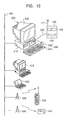
- Fig. 10 shows a system for implementing a method of transferring additional information according to an embodiment of the present invention.
- a receiver 100 is connected to a PC 200 as an example of an information processing terminal at a source via communications means 300.
- the PC 200 is connected to a communications network 400.
- the communications network 400 as examples of information processing terminals at destinations, PCs 510 and 520 are connected, and a cellular phone 530 and a pager 540 are linked via wireless communications means 630 and 640.
- a network communications unit 280 in the PC 200 transmits data onto and receives data from the communications network 400.
- the communications network 400 is, for example, the Internet or a LAN (Local Area Network), and each of the information processing terminals connected or linked to the communications network 400, including the PC 200, the PCs 510 and 520, the cellular phone 530, and the pager 540, is assigned an ID which uniquely identifies the terminal, such as an IP (Internet Protocol) address.
- IP Internet Protocol
- the receiver 100 directly transmits the received additional information to the PC 200, the PC 200 determines whether the key information preset in the PC 200 is included in the additional information received from the receiver 100, and if the key information is included, the additional information is transmitted onto the communications network 400 and transferred to an information processing terminal at a destination specified in advance.
- the key information set in the PC 200, and the method of selecting additional information based on the key information are the same as in the first embodiment of additional information storing method, and description thereof will be omitted.
- the information processing terminal at the destination is specified by the user in advance by entering an ID of the information processing terminal on the PC 200.
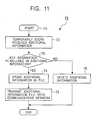
- Figs. 4 and 11 respectively show transmission routines to be executed by the CPU 121 of the receiver 100 and the CPU 211 of the PC 200.
- the transfer routine on the side of the receiver 100 is basically the same as in the embodiment described earlier.
- the CPU 121 of the receiver 100 starts the transmission routine 10 upon reception of a broadcast in step 11. First, in step 12, it is determine whether additional information of the received program has been obtained. The routine then proceeds to step 13, in which the additional information is stored in the memory 130. The routine then proceeds to step 14, in which the data communications unit 170 transfers the additional information to the PC 200.
- the CPU 211 of the PC 200 starts the transmission routine 70 on the side of the PC 200 when the data communications unit 270 receives the additional information from the receiver 100 in step 71.
- the received additional information is temporarily stored in the main memory 214.
- the routine then proceeds to step 73, in which it is determined whether the key information set in the PC 200 as described earlier is included in the additional information. If the key information is included, the routine proceeds from step 73 to step 74, in which the additional information is stored in the storage device 215 as an additional information file.
- the routine then proceeds to step 75, in which the network communications unit 280 transmits the additional information file onto the communications network 400.
- the additional information file is converted based on a protocol for the communications network 400, such as the Internet Protocol, assigned an ID of the PC 200 at the source and an ID of an information processing terminal at a destination specified by the user before being transmitted onto the communications network 400. Accordingly, the information processing terminal at the specified destination is allowed to receive the additional information including the key information.
- a protocol for the communications network 400 such as the Internet Protocol
- step 73 the routine proceeds from step 73 to step 76, in which the additional information is deleted from the main memory 214, and the transmission routine is exited without transmitting the additional information onto the communications network 400.
- the user is allowed to receive the additional information using the PC 510, the PC 520, the cellular phone 530, the pager 540, etc. at a location on business or travel where the program is not broadcast.
- the user using the receiver 100 and the PC 200 is allowed to transfer the additional information including the key information to a user of the PC 510, etc.
- the additional information is, for example, of the type that includes a header portion and a data portion.
- the receiver 100 transmits to the PC 200 the header portion as well as the data portion of the additional information
- the user is allowed to set information which may be included in the header portion of the additional information, for example, information indicating the format of the payload in the data portion, as key information, so that only the payload in the data portion is stored on the storage device 215 of the PC 200 and transmitted onto the communications network 400.
- the method may be such that in addition to the additional information, audio information of the associated program is also transmitted from the receiver 100 to the PC 200, so that the additional information including the key information and the audio information of the associated program are transmitted from the PC 200 onto the communications network 400. Accordingly, the user is allowed to display the additional information and to listen to the audio information at a location remote from the receiver 100.
- information obtained by the PC 200 for example, a timestamp, user information such as tags and headings input by the user, may be added to the additional information file as accompanying information and transmitted onto the communications network 400, so that the file can be readily searched and browsed on the information processing terminal at the destination.
- additional information of all the programs in broadcast including the additional information of the program being received can be received.
- the receiver 100 receives the additional information of all the programs in broadcast and transmits the additional information to the PC 200, and the PC 200 transmits additional information including key information onto the communications network 400. Accordingly, additional information of other programs as well as that of the program being received by the receiver 100 can be obtained at the information processing terminal at the destination.
- additional information transfer method in the system described already, it is determined on the receiver 100 whether the key information is included in the received additional information, and if the key information is included, the additional information is transmitted from the receiver 100 to the PC 200, and further transmitted from the PC 200 onto the communications network 400, so that the additional information is transferred to an information processing terminal at a specified destination.
- the key information is set in the PC 200, for example, by the user using the operation unit 240 in advance, and transmitted from the PC 200 to the receiver 100 when a connection is established between the receiver 100 and the PC 200 via the communications means 300.
- the key information may be set in advance by the user in the receiver 100 using the operation unit 140 thereof.
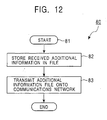
- Figs. 6 and 12 respectively show transmission routines to be executed by the CPU 121 of the receiver 100 and the CPU 211 of the PC 200 when additional information is selected on the receiver 100.
- the CPU 121 of the receiver 100 starts the transmission routine 30 on the side of the receiver 100 upon reception of a broadcast in step 31.
- step 32 it is determined whether the additional information of the received program has been obtained. If the additional information has been obtained, the routine proceeds to step 33, in which the additional information is stored in the memory 130.
- step 34 it is determined whether the key information which has been transferred from the PC 200 to the receiver 100 or which has been set in the receiver 100 is included in the additional information. If the key information is included, the routine proceeds from step 34 to step 35, in which the data communications unit 170 transfers the additional information to the PC 200.
- the transmission routine is exited without transmitting the additional information to the PC 200.
- the CPU 211 of the PC 200 starts the transmission routine 80 on the side of the PC 200 when the data communications unit 270 receives the additional information from the receiver 100 in step 81.
- the received additional information is directly stored in the storage device 215 as an additional information file.
- the routine then proceeds to step 83, in which the network communications unit 280 transmits the additional information file onto the communications network 400.
- the additional information file is converted into a format based on a protocol for the communications network 400, assigned an ID of the PC 200 at the source, and an ID of an information processing terminal at a user-specified destination before being transmitted onto the communications network 400. Accordingly, the additional information including the key information can be received at the information processing terminal at the specified destination.
- the second embodiment described above similarly to the first embodiment, even if the user is not present at the location of the receiver 100 or if the user is not aware of the program in advance, only information desired by the user is transferred to a location remote from the location of the receiver 100 so that the user is allowed to receive the information at the remote location.
- the user is allowed to set information which may be included in the header portion of the additional information as key information.
- the method may be such that in addition to the additional information including the key information, audio information of the associated program is transmitted from the receiver 100 to the PC 200, and further transmitted from the PC 200 onto the communications network 400, so that the additional information and the audio information are transferred to an information processing terminal at a destination.
- information obtained by the PC 200 may be added to the additional information file as accompanying information and transmitted onto the communications network 400.
- the method may be such that the additional information of all the programs in broadcast is received, and additional information including the key information is transferred from the receiver 100 and stored on the PC 200, and further transmitted from the PC 200 onto the communications network 400, so that the additional information is transferred to an information processing terminal at a destination.
- the embodiments have been described in the context of receiving a digital radio broadcast in which additional information is multiplexed with audio information and transferring the additional information from an information processing terminal at a source to an information processing terminal at a destination via a communications network, without limitation to digital radio broadcasting, the present invention may be generally applied to cases where a broadcast in which additional information multiplexed with audio or video information is received and the additional information is transferred from an information processing terminal at a source to an information processing terminal at a destination via a communications network, for example, a digital television broadcast in which additional information is multiplexed with video (and audio) information.
- the present invention may be applied to a case where a receiver is incorporated in an information processing terminal at a source and integrated therewith.
Landscapes
- Engineering & Computer Science (AREA)
- Signal Processing (AREA)
- Circuits Of Receivers In General (AREA)
Applications Claiming Priority (4)
| Application Number | Priority Date | Filing Date | Title |
|---|---|---|---|
| JP2000389873 | 2000-12-22 | ||
| JP2000389873A JP4556083B2 (ja) | 2000-12-22 | 2000-12-22 | 付加情報転送方法 |
| JP2000389872A JP2002190783A (ja) | 2000-12-22 | 2000-12-22 | 付加情報記録方法および受信機 |
| JP2000389872 | 2000-12-22 |
Publications (2)
| Publication Number | Publication Date |
|---|---|
| EP1217768A2 true EP1217768A2 (de) | 2002-06-26 |
| EP1217768A3 EP1217768A3 (de) | 2007-06-27 |
Family
ID=26606336
Family Applications (1)
| Application Number | Title | Priority Date | Filing Date |
|---|---|---|---|
| EP01310786A Withdrawn EP1217768A3 (de) | 2000-12-22 | 2001-12-21 | Verfahren zum speichern oder übertragen von Zusatzinformationen und Empfänger dafür |
Country Status (2)
| Country | Link |
|---|---|
| US (1) | US20020101538A1 (de) |
| EP (1) | EP1217768A3 (de) |
Citations (4)
| Publication number | Priority date | Publication date | Assignee | Title |
|---|---|---|---|---|
| EP0604871A1 (de) | 1992-12-30 | 1994-07-06 | Deutsche Thomson-Brandt Gmbh | Verfahren und Vorrichtung zur Aufnahmeprogrammierung |
| WO1996027840A1 (en) | 1995-03-04 | 1996-09-12 | Televitesse Systems Inc. | Automatic broadcast monitoring system |
| WO1999013644A1 (en) | 1997-09-05 | 1999-03-18 | Worldspace Management Corporation | System for selectively downloading information at user terminals from the internet using a satellite broadcast system |
| EP0926679A2 (de) | 1997-12-24 | 1999-06-30 | Sony Corporation | Aufzeichnungsgerät mit einer Empfangsfunktion und Aufzeichnungsgerät |
Family Cites Families (6)
| Publication number | Priority date | Publication date | Assignee | Title |
|---|---|---|---|---|
| US6061056A (en) * | 1996-03-04 | 2000-05-09 | Telexis Corporation | Television monitoring system with automatic selection of program material of interest and subsequent display under user control |
| CA2183280C (en) * | 1996-08-14 | 2009-04-14 | Rob Menard | Centralized broadcast channel real-time search system |
| US6564003B2 (en) * | 1999-11-04 | 2003-05-13 | Xm Satellite Radio Inc. | Method and apparatus for composite data stream storage and playback |
| US7010263B1 (en) * | 1999-12-14 | 2006-03-07 | Xm Satellite Radio, Inc. | System and method for distributing music and data |
| US6721489B1 (en) * | 2000-03-08 | 2004-04-13 | Phatnoise, Inc. | Play list manager |
| US8352331B2 (en) * | 2000-05-03 | 2013-01-08 | Yahoo! Inc. | Relationship discovery engine |
-
2001
- 2001-12-17 US US10/021,875 patent/US20020101538A1/en not_active Abandoned
- 2001-12-21 EP EP01310786A patent/EP1217768A3/de not_active Withdrawn
Patent Citations (4)
| Publication number | Priority date | Publication date | Assignee | Title |
|---|---|---|---|---|
| EP0604871A1 (de) | 1992-12-30 | 1994-07-06 | Deutsche Thomson-Brandt Gmbh | Verfahren und Vorrichtung zur Aufnahmeprogrammierung |
| WO1996027840A1 (en) | 1995-03-04 | 1996-09-12 | Televitesse Systems Inc. | Automatic broadcast monitoring system |
| WO1999013644A1 (en) | 1997-09-05 | 1999-03-18 | Worldspace Management Corporation | System for selectively downloading information at user terminals from the internet using a satellite broadcast system |
| EP0926679A2 (de) | 1997-12-24 | 1999-06-30 | Sony Corporation | Aufzeichnungsgerät mit einer Empfangsfunktion und Aufzeichnungsgerät |
Also Published As
| Publication number | Publication date |
|---|---|
| US20020101538A1 (en) | 2002-08-01 |
| EP1217768A3 (de) | 2007-06-27 |
Similar Documents
| Publication | Publication Date | Title |
|---|---|---|
| CN100556051C (zh) | 对无线电台和相关的因特网地址进行书签标记的系统和方法 | |
| JP5038529B2 (ja) | Fmラジオデータシステム受信機を備えるセルラハンドヘルドデバイス | |
| US20050148325A1 (en) | Method of providing service for user equipment and system | |
| JP2007510348A (ja) | データキャスティング | |
| JP2002504775A (ja) | 音響データをアドレスデータを含む他のデータと共に受信器へ送信する方法及びシステム | |
| JPH1155203A (ja) | 送受信システム | |
| EP2418791A1 (de) | Verfahren zur Verwendung verschiedener Übertragungsstandards und Rundfunkempfangsvorrichtung | |
| US20020065036A1 (en) | Receiving device | |
| KR20040103194A (ko) | 디지털 방송의 데이터 수신장치 및 그의 운용방법 | |
| JP4119838B2 (ja) | 番組関連情報取得システムおよびその方法 | |
| JP2004304430A (ja) | 番組ダイジェスト映像視聴方法およびシステム | |
| US20040088736A1 (en) | Contents providing system, mobile terminal | |
| EP1217768A2 (de) | Verfahren zum speichern oder übertragen von Zusatzinformationen und Empfänger dafür | |
| KR100645680B1 (ko) | 이동체 통신 단말, 기지국 장치 및 협역 통신 시스템 | |
| EP1734750A2 (de) | Verfahren und Vorrichtung für den Empfang von digitalem Rundfunk | |
| JP2002101405A (ja) | 放送受信システム | |
| JP4556083B2 (ja) | 付加情報転送方法 | |
| US7401350B1 (en) | Local area information terminal device | |
| US20080028423A1 (en) | Digital broadcasting system and method thereof | |
| JP3968541B2 (ja) | デジタルオーディオ放送の受信機 | |
| CN102113338B (zh) | 数据广播系统、数据广播服务器以及数据广播方法 | |
| EP1643770A2 (de) | Verfahren und Vorrichtung zum Suchen nach einem digitalen Rundfunkprogramm | |
| JP2002063104A (ja) | マルチメディア端末制御装置及び方法並びにマルチメディア端末制御プログラムを記録した記録媒体 | |
| JP2002190783A (ja) | 付加情報記録方法および受信機 | |
| JPH1013367A (ja) | データ送受信システム,およびデータ受信装置 |
Legal Events
| Date | Code | Title | Description |
|---|---|---|---|
| PUAI | Public reference made under article 153(3) epc to a published international application that has entered the european phase |
Free format text: ORIGINAL CODE: 0009012 |
|
| AK | Designated contracting states |
Kind code of ref document: A2 Designated state(s): AT BE CH CY DE DK ES FI FR GB GR IE IT LI LU MC NL PT SE TR |
|
| AX | Request for extension of the european patent |
Free format text: AL;LT;LV;MK;RO;SI |
|
| PUAL | Search report despatched |
Free format text: ORIGINAL CODE: 0009013 |
|
| AK | Designated contracting states |
Kind code of ref document: A3 Designated state(s): AT BE CH CY DE DK ES FI FR GB GR IE IT LI LU MC NL PT SE TR |
|
| AX | Request for extension of the european patent |
Extension state: AL LT LV MK RO SI |
|
| 17P | Request for examination filed |
Effective date: 20071130 |
|
| AKX | Designation fees paid |
Designated state(s): DE FR GB |
|
| 17Q | First examination report despatched |
Effective date: 20080411 |
|
| STAA | Information on the status of an ep patent application or granted ep patent |
Free format text: STATUS: THE APPLICATION IS DEEMED TO BE WITHDRAWN |
|
| 18D | Application deemed to be withdrawn |
Effective date: 20140701 |
|
| REG | Reference to a national code |
Ref country code: DE Ref legal event code: R079 Free format text: PREVIOUS MAIN CLASS: H04H0001000000 Ipc: H04H0040000000 |
|
| REG | Reference to a national code |
Ref country code: DE Ref legal event code: R079 Free format text: PREVIOUS MAIN CLASS: H04H0001000000 Ipc: H04H0040000000 Effective date: 20141203 |