EP1217774A2 - Verfahren zum transparenten Transport von SONET STS-3C Rahmen über ein Netzwerk - Google Patents
Verfahren zum transparenten Transport von SONET STS-3C Rahmen über ein Netzwerk Download PDFInfo
- Publication number
- EP1217774A2 EP1217774A2 EP01128951A EP01128951A EP1217774A2 EP 1217774 A2 EP1217774 A2 EP 1217774A2 EP 01128951 A EP01128951 A EP 01128951A EP 01128951 A EP01128951 A EP 01128951A EP 1217774 A2 EP1217774 A2 EP 1217774A2
- Authority
- EP
- European Patent Office
- Prior art keywords
- frame
- frame structure
- network
- payload
- overhead
- Prior art date
- Legal status (The legal status is an assumption and is not a legal conclusion. Google has not performed a legal analysis and makes no representation as to the accuracy of the status listed.)
- Withdrawn
Links
- 238000000034 method Methods 0.000 title claims description 26
- RGNPBRKPHBKNKX-UHFFFAOYSA-N hexaflumuron Chemical compound C1=C(Cl)C(OC(F)(F)C(F)F)=C(Cl)C=C1NC(=O)NC(=O)C1=C(F)C=CC=C1F RGNPBRKPHBKNKX-UHFFFAOYSA-N 0.000 title 1
- 102100040338 Ubiquitin-associated and SH3 domain-containing protein B Human genes 0.000 claims description 11
- 101710143616 Ubiquitin-associated and SH3 domain-containing protein B Proteins 0.000 claims description 11
- 238000012546 transfer Methods 0.000 abstract description 3
- 238000013507 mapping Methods 0.000 description 12
- 230000005641 tunneling Effects 0.000 description 5
- 238000013459 approach Methods 0.000 description 4
- 239000000284 extract Substances 0.000 description 3
- 238000012545 processing Methods 0.000 description 3
- 238000010586 diagram Methods 0.000 description 2
- 230000004075 alteration Effects 0.000 description 1
- 230000003139 buffering effect Effects 0.000 description 1
- 238000007796 conventional method Methods 0.000 description 1
- 238000000605 extraction Methods 0.000 description 1
- 238000009432 framing Methods 0.000 description 1
- 238000003780 insertion Methods 0.000 description 1
- 230000037431 insertion Effects 0.000 description 1
- 238000006467 substitution reaction Methods 0.000 description 1
Images

Classifications
-
- H—ELECTRICITY
- H04—ELECTRIC COMMUNICATION TECHNIQUE
- H04J—MULTIPLEX COMMUNICATION
- H04J3/00—Time-division multiplex systems
- H04J3/16—Time-division multiplex systems in which the time allocation to individual channels within a transmission cycle is variable, e.g. to accommodate varying complexity of signals, to vary number of channels transmitted
- H04J3/1605—Fixed allocated frame structures
- H04J3/1611—Synchronous digital hierarchy [SDH] or SONET
-
- H—ELECTRICITY
- H04—ELECTRIC COMMUNICATION TECHNIQUE
- H04J—MULTIPLEX COMMUNICATION
- H04J2203/00—Aspects of optical multiplex systems other than those covered by H04J14/05 and H04J14/07
- H04J2203/0001—Provisions for broadband connections in integrated services digital network using frames of the Optical Transport Network [OTN] or using synchronous transfer mode [STM], e.g. SONET, SDH
- H04J2203/0051—Network Node Interface, e.g. tandem connections, transit switching
-
- H—ELECTRICITY
- H04—ELECTRIC COMMUNICATION TECHNIQUE
- H04J—MULTIPLEX COMMUNICATION
- H04J2203/00—Aspects of optical multiplex systems other than those covered by H04J14/05 and H04J14/07
- H04J2203/0001—Provisions for broadband connections in integrated services digital network using frames of the Optical Transport Network [OTN] or using synchronous transfer mode [STM], e.g. SONET, SDH
- H04J2203/0089—Multiplexing, e.g. coding, scrambling, SONET
Definitions
- the present invention is related in general to telecommunications signal processing and transport and more particularly to a method of transparently transporting frame information across a network.
- Transparent transport is a technique of architecting networks so that network elements in different networks appear to be connected by a dedicated link operating under a same network protocol.
- the action of sending network traffic from one network element to a second network element at a geographically remote site through at least one other network which may be operating under a different protocol is known as tunneling.
- Tunneling enables transparent transport. Tunneling has been conventionally accomplished by encapsulating all frame elements of the first sending network's protocol (such as framing, header, redundancy check, and payload) into the payload area of the second transport network.
- the un-encapsulated protocol reaching the third destination network appears to be transported transparently through the second transport network.
- a conventional approach to achieve a 1:1 mapping as opposed to the 1:2 mapping discussed above includes inserting the line and section overhead portions of the first sending network's frame into unused protected areas of the line and section overhead portions of the second transport network's frame.
- the path overhead portion of the first sending network's frame is inserted for the path overhead portion of the second transport network's frame.
- Bit errors that affect the line and section overhead portions for the second transport network will not be transparent to the nodes of the first sending network and the third destination network.
- Attempts to address this problem include keeping track of bit errors in the second transport network by carrying forward a bit interleaved parity. This parity calculation is performed at each node of the second transport network and the number of bit errors detected across the second transport network are introduced into the un-encapsulated frame.
- the bit interleaved parity calculation includes the protected areas and there is no way of determining if the bit errors occurred in the protected areas or the non-protected areas of the header portion of the second transport network's frame. Thus, there is the possibility that too many errors are attributed to the protected areas.
- a method of transparently transporting frame information across a network is provided that substantially eliminates or greatly reduces disadvantages and problems associated with conventional frame transport techniques.
- a method of transparently transporting frame information across a network that includes placing payload information from a first frame into payload locations of a second frame.
- the first frame is. associated with a first network having a first protocol.
- the second frame is associated with a second network having a second protocol. Overhead information from the first frame is placed into payload locations of a payload for the second frame.
- the present invention provides various technical advantages over conventional frame transport techniques. For example, one technical advantage is to place frame information of a first frame structure into a second frame structure. Another technical advantage is to recover the frame information in the first frame structure after being transported in the second frame structure. Yet another technical advantage is to map overhead information of the first frame structure into payload locations of the second frame structure. Other technical advantages may be readily ascertainable by those skilled in the art from the following figures, description, and claims.
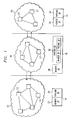
- FIGURE 1 is a simplified block diagram of a multi-network telecommunications environment 10.
- Telecommunications environment 10 includes a first network 12 that uses a first protocol to transport a first frame structure 14.
- Telecommunications environment 10 includes a second network 16 that uses a second protocol to transport a second frame structure 18.
- Telecommunications environment 10 includes a third network 20 that uses the first protocol to transport the first frame structure 14.
- Third network 20 may be a separate network with the same characteristics as first network 12 or may be a remote site within first network 12.
- First frame structure 14 includes a header portion 22 and a payload portion 24 that is transported across first network 12. For transport through second network 16, header portion 22 and payload portion 24 are placed in a payload portion 26 of second frame structure 18. Second frame structure 18 includes its own header portion 28. For transfer to third network 20, first frame structure 14 is reconstituted by second network 16 with overhead portion 22 and payload portion 24 extracted from second frame structure 18. Thus, third network 20 can transport first frame structure 14 as though the information had not been transferred through second network 16.
- First network 12 provides first frame structure 14 from one of a plurality of nodes 13 to one of a plurality of nodes 17 within second network 16.
- Node 17 extracts payload 24 from first frame structure 14 and places payload 24 into payload 26 of second frame structure 18.
- Node 17 extracts overhead 22 from first frame structure 14 and places overhead 22 into payload 26 of second frame structure 18.
- Node 17 extracts overhead 22 on a pointer follower side of a pointer processor and passes overhead 22 to a pointer generator side of the pointer processor where it is inserted into available columns of payload 26.
- Second frame structure 18 is transported through second network 16 and is received at one of a plurality of nodes 21 in third network 20. Another node 17 reconstitutes first frame structure 14 from payload 26 of second frame structure 18 prior to transfer to third network 20.
- FIGURE 2 shows an example of encapsulating information in first frame structure 14 from first network 12 into second frame structure 18 of second network 16.
- First frame structure 14 is shown as a STS-3 telecommunications signal that carries three STS-1 telecommunications signals.
- the three STS-1 telecommunications signals are byte interleaved to form.
- the STS-3 telecommunications signal is mapped into payload locations of second frame structure 18.
- First frame structure 14 includes line overhead 30, section overhead 32, and path overhead 34.
- Path overhead 34 of first frame structure 14, which may be concatenated or un-concatenated, is placed in concatenated form into path overhead locations 36 of second frame structure 18.
- Line overhead 30 and section overhead 32 are spread out within other payload locations of second frame structure 18. Specifically, line overhead 30 and section overhead 32 are placed into remaining space of path overhead 36 and into a first fixed stuff byte column 38 and a second fixed stuff byte column 40 of second frame structure 18. These fixed stuff byte columns are typically located at columns 30 and 59 of each STS-1 telecommunications signal.
- Overhead bytes within header 22 of first frame structure 14 need to mapped into second frame structure 18.
- Overhead bytes within line overhead 30 and section overhead 32 that are redundant or unused between each of the STS-1 telecommunications signals may be discarded. Examples of redundant and unused bytes include the B1, E1, and F1 bytes.
- overhead bytes may be the same between first network 12 and second network 16. Identical overhead bytes between networks need not be mapped as they can be readily recovered without any loss of data. Examples of identical bytes include the A2 and H2 bytes. By not having to map redundant or identical overhead bytes, a different mapping may be performed than that shown in FIGURE 2. The mapping of FIGURE 2 maintains location integrity for header 22 of first frame structure 14 within second frame structure 18.
- a more compact mapping may be achieved by using adjacent unused byte locations 42. More processing is required with this more compact mapping as compared to less processing for the header location integrity mapping shown. Alternatively, additional payload locations may be used for header mapping, reducing the capacity for information transport. Such an alternative may be possible if a full capacity of payload 24 is not needed to carry the information for first network 12.
- first network 12 and second network 16 are disjoint and thus there is no need to perform bit interleaved parity calculations.
- the mapping implementation becomes more simplified compared to the conventional mapping technique utilizing unused overhead space.
- the mapping can be scaleable to the lower rate STS-3 telecommunication signal level compared to the STS-48 level of conventional techniques.
- Information transport may now be achieved across differing types of networks through network unique line and section terminating network elements.
- a conventional approach for transparent transport using a slip buffer is avoided. A slip buffer resulted in disassociation between transport overhead and its payload data, causing a loss of this relationship during slip buffering.
Landscapes
- Engineering & Computer Science (AREA)
- Computer Networks & Wireless Communication (AREA)
- Signal Processing (AREA)
- Data Exchanges In Wide-Area Networks (AREA)
Applications Claiming Priority (2)
| Application Number | Priority Date | Filing Date | Title |
|---|---|---|---|
| US741632 | 2000-12-19 | ||
| US09/741,632 US20020103926A1 (en) | 2000-12-19 | 2000-12-19 | Method of transparently transporting sonet STS-3C frame information across a network |
Publications (1)
| Publication Number | Publication Date |
|---|---|
| EP1217774A2 true EP1217774A2 (de) | 2002-06-26 |
Family
ID=24981519
Family Applications (1)
| Application Number | Title | Priority Date | Filing Date |
|---|---|---|---|
| EP01128951A Withdrawn EP1217774A2 (de) | 2000-12-19 | 2001-12-06 | Verfahren zum transparenten Transport von SONET STS-3C Rahmen über ein Netzwerk |
Country Status (2)
| Country | Link |
|---|---|
| US (1) | US20020103926A1 (de) |
| EP (1) | EP1217774A2 (de) |
Cited By (3)
| Publication number | Priority date | Publication date | Assignee | Title |
|---|---|---|---|---|
| WO2002089375A3 (en) * | 2001-04-27 | 2003-01-03 | Marconi Comm Ltd | A transmission method |
| EP1282250A1 (de) * | 2001-07-30 | 2003-02-05 | Lucent Technologies Inc. | Verfahren zum transparenten Transport von Rahmen mit reduziertem Overhead zwischen zwei Netzwerken durch ein Übergangsnetzwerk, das einen gemeinsamen Rahmen mit erweiterter Nutzlast überträgt |
| FR2835990A1 (fr) * | 2002-02-11 | 2003-08-15 | France Telecom | Systeme et procede de transmission de donnees par un reseau synchrone |
Families Citing this family (3)
| Publication number | Priority date | Publication date | Assignee | Title |
|---|---|---|---|---|
| US7643500B1 (en) * | 1996-10-22 | 2010-01-05 | Sprint Communications Company L.P. | Overhead replication for SONET signals |
| US6816509B2 (en) * | 2001-03-02 | 2004-11-09 | Ciena Corporation | Data mapper and method for flexible mapping of control and data information within a SONET payload |
| US20040156389A1 (en) * | 2003-02-11 | 2004-08-12 | Lucent Technologies Inc. | Cross-layer communication solution(s) across different communication protocols |
Family Cites Families (18)
| Publication number | Priority date | Publication date | Assignee | Title |
|---|---|---|---|---|
| US4835768A (en) * | 1988-04-14 | 1989-05-30 | Bell Communications Research, Inc. | High speed digital signal framer-demultiplexer |
| US4967405A (en) * | 1988-12-09 | 1990-10-30 | Transwitch Corporation | System for cross-connecting high speed digital SONET signals |
| US5040170A (en) * | 1988-12-09 | 1991-08-13 | Transwitch Corporation | System for cross-connecting high speed digital signals |
| EP0403663B1 (de) * | 1989-01-09 | 1996-07-17 | Fujitsu Limited | Digitaler signal-multiplexer und -trenner |
| JPH0654901B2 (ja) * | 1989-02-08 | 1994-07-20 | 富士通株式会社 | フォーマット変換制御方式 |
| US5257261A (en) * | 1990-07-27 | 1993-10-26 | Transwitch Corporation | Methods and apparatus for concatenating a plurality of lower level SONET signals into higher level sonet signals |
| US5331641A (en) * | 1990-07-27 | 1994-07-19 | Transwitch Corp. | Methods and apparatus for retiming and realignment of STS-1 signals into STS-3 type signal |
| US5293376A (en) * | 1992-01-10 | 1994-03-08 | Bell Communications Research, Inc. | Upgraded telecommunication network |
| GB9401092D0 (en) * | 1994-01-21 | 1994-03-16 | Newbridge Networks Corp | A network management system |
| FI105753B (fi) * | 1997-12-31 | 2000-09-29 | Ssh Comm Security Oy | Pakettien autentisointimenetelmä verkko-osoitemuutosten ja protokollamuunnosten läsnäollessa |
| JP3782229B2 (ja) * | 1998-03-13 | 2006-06-07 | 富士通株式会社 | パス情報構築方法 |
| US6574238B1 (en) * | 1998-08-26 | 2003-06-03 | Intel Corporation | Inter-switch link header modification |
| US6389036B1 (en) * | 1998-12-17 | 2002-05-14 | Harris Breedband Wireless Access, Inc. | Airlink transport container |
| US6788681B1 (en) * | 1999-03-16 | 2004-09-07 | Nortel Networks Limited | Virtual private networks and methods for their operation |
| JP2000269912A (ja) * | 1999-03-18 | 2000-09-29 | Fujitsu Ltd | 高速sdh信号による低速sdh信号の伝送方法と伝送装置 |
| US6603776B1 (en) * | 1999-04-05 | 2003-08-05 | Lucent Technologies, Inc. & Pmc-Sierra, Inc. | System for efficient broadband data payload conversion |
| US6847644B1 (en) * | 2000-02-23 | 2005-01-25 | Cypress Semiconductor Corp. | Hybrid data transport scheme over optical networks |
| US6870813B1 (en) * | 2000-09-07 | 2005-03-22 | Nortel Networks Limited | Architectures for evolving traditional service provider networks and methods of optimization therefor |
-
2000
- 2000-12-19 US US09/741,632 patent/US20020103926A1/en not_active Abandoned
-
2001
- 2001-12-06 EP EP01128951A patent/EP1217774A2/de not_active Withdrawn
Cited By (6)
| Publication number | Priority date | Publication date | Assignee | Title |
|---|---|---|---|---|
| WO2002089375A3 (en) * | 2001-04-27 | 2003-01-03 | Marconi Comm Ltd | A transmission method |
| US8040919B2 (en) | 2001-04-27 | 2011-10-18 | Ericsson Ab | Transmission method |
| EP1282250A1 (de) * | 2001-07-30 | 2003-02-05 | Lucent Technologies Inc. | Verfahren zum transparenten Transport von Rahmen mit reduziertem Overhead zwischen zwei Netzwerken durch ein Übergangsnetzwerk, das einen gemeinsamen Rahmen mit erweiterter Nutzlast überträgt |
| US7002957B2 (en) | 2001-07-30 | 2006-02-21 | Lucent Technolgies Inc. | Method of transporting frames of information between parts of a network through an intermediate network |
| FR2835990A1 (fr) * | 2002-02-11 | 2003-08-15 | France Telecom | Systeme et procede de transmission de donnees par un reseau synchrone |
| WO2003069817A1 (fr) * | 2002-02-11 | 2003-08-21 | France Telecom | Systeme et procede de transmission de donnees par un reseau synchrone |
Also Published As
| Publication number | Publication date |
|---|---|
| US20020103926A1 (en) | 2002-08-01 |
Similar Documents
| Publication | Publication Date | Title |
|---|---|---|
| US6704326B2 (en) | Payload mapping in synchronous networks | |
| EP0993135B1 (de) | Verkettung von Containern in einem SDH-Netzwerk | |
| US6466591B1 (en) | Method and apparatus for processing of multiple protocols within data and control channels in data transmission signals | |
| EP0901306B1 (de) | Datenübertragung in einem SDH-Netzwerk | |
| US6765916B1 (en) | Method and apparatus for processing of multiple protocols within data transmission signals | |
| US6477178B1 (en) | System and method and trafficking telecommunication signals | |
| US7245641B2 (en) | Variable length packet switching system | |
| US6111871A (en) | Network design for both compressed and uncompressed ATM cells | |
| US6765933B1 (en) | Inter-chip port and method for supporting high rate data streams in SDH and SONET transport networks | |
| EP1405448B1 (de) | Verfahren und vorrichtung zur übertragung von synchronen daten | |
| US8339941B2 (en) | Methods and apparatus for selecting the better cell from redundant streams within a cell-oriented environment | |
| JPH08214009A (ja) | 広帯域セルのペイロード生成方法 | |
| US20020103926A1 (en) | Method of transparently transporting sonet STS-3C frame information across a network | |
| EP1654651B1 (de) | Verfahren und vorrichtung zur bereitstellung einer tandemverbindung, performance-überwachung und schutzarchitekturen über ethernet-protokolle | |
| JP3539551B2 (ja) | 共通搬送波上への異種データトラヒック収容フレーム及び伝送装置 | |
| US7577147B2 (en) | Transparent transmission method for administrative information of optical synchronous digital hierarchy devices of multi-vendors | |
| US6496518B1 (en) | SDH transmission system, and frame transmission method in SDH transmission system and SDH transmission unit | |
| US20040170166A1 (en) | Compression methods for packetized sonet/sdh payloads | |
| US20040156389A1 (en) | Cross-layer communication solution(s) across different communication protocols | |
| EP1111827A2 (de) | STS-n mit verbesserter Granularität | |
| US7050391B1 (en) | Method and apparatus for efficient link redundancy | |
| US7778285B2 (en) | Method and apparatus for extraction and insertion of plesiochronous overhead data | |
| US7519064B1 (en) | Virtual tributary processing using shared resources | |
| US7324539B1 (en) | Method and apparatus for processing channelized and unchannelized data within a signal |
Legal Events
| Date | Code | Title | Description |
|---|---|---|---|
| PUAI | Public reference made under article 153(3) epc to a published international application that has entered the european phase |
Free format text: ORIGINAL CODE: 0009012 |
|
| AK | Designated contracting states |
Kind code of ref document: A2 Designated state(s): AT BE CH CY DE DK ES FI FR GB GR IE IT LI LU MC NL PT SE TR |
|
| AX | Request for extension of the european patent |
Free format text: AL;LT;LV;MK;RO;SI |
|
| RIN1 | Information on inventor provided before grant (corrected) |
Inventor name: AKIN, JOHN D. Inventor name: COOK, BRIAN SCOTT |
|
| STAA | Information on the status of an ep patent application or granted ep patent |
Free format text: STATUS: THE APPLICATION HAS BEEN WITHDRAWN |
|
| 18W | Application withdrawn |
Effective date: 20030829 |