EP1219449A2 - Système de recirculation d'encre dans des imprimantes à jet d'encre - Google Patents
Système de recirculation d'encre dans des imprimantes à jet d'encre Download PDFInfo
- Publication number
- EP1219449A2 EP1219449A2 EP01204942A EP01204942A EP1219449A2 EP 1219449 A2 EP1219449 A2 EP 1219449A2 EP 01204942 A EP01204942 A EP 01204942A EP 01204942 A EP01204942 A EP 01204942A EP 1219449 A2 EP1219449 A2 EP 1219449A2
- Authority
- EP
- European Patent Office
- Prior art keywords
- ink
- ion
- exchange
- recirculation system
- collection container
- Prior art date
- Legal status (The legal status is an assumption and is not a legal conclusion. Google has not performed a legal analysis and makes no representation as to the accuracy of the status listed.)
- Withdrawn
Links
- 238000005342 ion exchange Methods 0.000 claims abstract description 25
- 229920005989 resin Polymers 0.000 claims description 20
- 239000011347 resin Substances 0.000 claims description 20
- 239000003456 ion exchange resin Substances 0.000 claims description 17
- 229920003303 ion-exchange polymer Polymers 0.000 claims description 17
- NWUYHJFMYQTDRP-UHFFFAOYSA-N 1,2-bis(ethenyl)benzene;1-ethenyl-2-ethylbenzene;styrene Chemical compound C=CC1=CC=CC=C1.CCC1=CC=CC=C1C=C.C=CC1=CC=CC=C1C=C NWUYHJFMYQTDRP-UHFFFAOYSA-N 0.000 claims description 14
- 238000000034 method Methods 0.000 claims description 12
- 150000001768 cations Chemical class 0.000 claims description 11
- -1 ammonium ions Chemical class 0.000 claims description 9
- 239000003729 cation exchange resin Substances 0.000 claims description 9
- 239000012530 fluid Substances 0.000 claims description 9
- 238000004891 communication Methods 0.000 claims description 6
- 238000007639 printing Methods 0.000 claims description 6
- 125000000129 anionic group Chemical group 0.000 claims description 5
- 125000002091 cationic group Chemical group 0.000 claims description 5
- 229910052751 metal Inorganic materials 0.000 claims description 5
- 239000002184 metal Substances 0.000 claims description 5
- 239000000203 mixture Substances 0.000 claims description 5
- 239000000356 contaminant Substances 0.000 claims description 4
- 238000012544 monitoring process Methods 0.000 claims description 4
- 229910052783 alkali metal Inorganic materials 0.000 claims description 3
- 150000001340 alkali metals Chemical class 0.000 claims description 3
- 239000003957 anion exchange resin Substances 0.000 claims description 3
- 150000003141 primary amines Chemical class 0.000 claims description 3
- 230000003134 recirculating effect Effects 0.000 claims description 3
- 150000003335 secondary amines Chemical class 0.000 claims description 3
- 150000003512 tertiary amines Chemical class 0.000 claims description 3
- 229910052784 alkaline earth metal Inorganic materials 0.000 claims description 2
- 150000001342 alkaline earth metals Chemical class 0.000 claims description 2
- 150000001412 amines Chemical group 0.000 claims description 2
- 230000006872 improvement Effects 0.000 claims description 2
- 239000000463 material Substances 0.000 claims description 2
- 238000011144 upstream manufacturing Methods 0.000 claims description 2
- 238000007641 inkjet printing Methods 0.000 abstract description 7
- 238000011282 treatment Methods 0.000 abstract description 3
- 239000000976 ink Substances 0.000 description 102
- 150000002500 ions Chemical class 0.000 description 14
- 229920001429 chelating resin Polymers 0.000 description 9
- 239000000975 dye Substances 0.000 description 9
- 239000002609 medium Substances 0.000 description 8
- 229920001467 poly(styrenesulfonates) Polymers 0.000 description 8
- 230000001105 regulatory effect Effects 0.000 description 7
- 229940023913 cation exchange resins Drugs 0.000 description 6
- 150000003839 salts Chemical class 0.000 description 5
- XEEYBQQBJWHFJM-UHFFFAOYSA-N Iron Chemical compound [Fe] XEEYBQQBJWHFJM-UHFFFAOYSA-N 0.000 description 4
- PXHVJJICTQNCMI-UHFFFAOYSA-N Nickel Chemical compound [Ni] PXHVJJICTQNCMI-UHFFFAOYSA-N 0.000 description 4
- 229920005654 Sephadex Polymers 0.000 description 4
- 239000012507 Sephadex™ Substances 0.000 description 4
- 229920002684 Sepharose Polymers 0.000 description 4
- 230000015572 biosynthetic process Effects 0.000 description 4
- 229920002678 cellulose Polymers 0.000 description 4
- 239000001913 cellulose Substances 0.000 description 4
- 239000000084 colloidal system Substances 0.000 description 4
- 238000005260 corrosion Methods 0.000 description 4
- 230000007797 corrosion Effects 0.000 description 4
- 239000001041 dye based ink Substances 0.000 description 4
- 230000008569 process Effects 0.000 description 4
- 229910021655 trace metal ion Inorganic materials 0.000 description 4
- HEMHJVSKTPXQMS-UHFFFAOYSA-M Sodium hydroxide Chemical compound [OH-].[Na+] HEMHJVSKTPXQMS-UHFFFAOYSA-M 0.000 description 3
- 239000002253 acid Substances 0.000 description 3
- 230000008901 benefit Effects 0.000 description 3
- 238000006243 chemical reaction Methods 0.000 description 3
- 238000011109 contamination Methods 0.000 description 3
- 230000001276 controlling effect Effects 0.000 description 3
- 230000002939 deleterious effect Effects 0.000 description 3
- 238000007786 electrostatic charging Methods 0.000 description 3
- 230000001172 regenerating effect Effects 0.000 description 3
- 239000002904 solvent Substances 0.000 description 3
- 229920000936 Agarose Polymers 0.000 description 2
- OYPRJOBELJOOCE-UHFFFAOYSA-N Calcium Chemical compound [Ca] OYPRJOBELJOOCE-UHFFFAOYSA-N 0.000 description 2
- 229920002307 Dextran Polymers 0.000 description 2
- DGAQECJNVWCQMB-PUAWFVPOSA-M Ilexoside XXIX Chemical compound C[C@@H]1CC[C@@]2(CC[C@@]3(C(=CC[C@H]4[C@]3(CC[C@@H]5[C@@]4(CC[C@@H](C5(C)C)OS(=O)(=O)[O-])C)C)[C@@H]2[C@]1(C)O)C)C(=O)O[C@H]6[C@@H]([C@H]([C@@H]([C@H](O6)CO)O)O)O.[Na+] DGAQECJNVWCQMB-PUAWFVPOSA-M 0.000 description 2
- FYYHWMGAXLPEAU-UHFFFAOYSA-N Magnesium Chemical compound [Mg] FYYHWMGAXLPEAU-UHFFFAOYSA-N 0.000 description 2
- 239000004793 Polystyrene Substances 0.000 description 2
- FKNQFGJONOIPTF-UHFFFAOYSA-N Sodium cation Chemical group [Na+] FKNQFGJONOIPTF-UHFFFAOYSA-N 0.000 description 2
- HCHKCACWOHOZIP-UHFFFAOYSA-N Zinc Chemical compound [Zn] HCHKCACWOHOZIP-UHFFFAOYSA-N 0.000 description 2
- 229910052788 barium Inorganic materials 0.000 description 2
- DSAJWYNOEDNPEQ-UHFFFAOYSA-N barium atom Chemical compound [Ba] DSAJWYNOEDNPEQ-UHFFFAOYSA-N 0.000 description 2
- 239000002585 base Substances 0.000 description 2
- 229910052791 calcium Inorganic materials 0.000 description 2
- 239000011575 calcium Substances 0.000 description 2
- 238000010586 diagram Methods 0.000 description 2
- 230000005684 electric field Effects 0.000 description 2
- 238000009472 formulation Methods 0.000 description 2
- 239000003112 inhibitor Substances 0.000 description 2
- 229910052742 iron Inorganic materials 0.000 description 2
- 229910052749 magnesium Inorganic materials 0.000 description 2
- 239000011777 magnesium Substances 0.000 description 2
- 239000011159 matrix material Substances 0.000 description 2
- 239000012528 membrane Substances 0.000 description 2
- 229910021645 metal ion Inorganic materials 0.000 description 2
- 229910052759 nickel Inorganic materials 0.000 description 2
- 239000002245 particle Substances 0.000 description 2
- 229920002223 polystyrene Polymers 0.000 description 2
- 230000002441 reversible effect Effects 0.000 description 2
- 229910052708 sodium Inorganic materials 0.000 description 2
- 239000011734 sodium Substances 0.000 description 2
- 229910001415 sodium ion Inorganic materials 0.000 description 2
- 239000000243 solution Substances 0.000 description 2
- 229910052712 strontium Inorganic materials 0.000 description 2
- CIOAGBVUUVVLOB-UHFFFAOYSA-N strontium atom Chemical compound [Sr] CIOAGBVUUVVLOB-UHFFFAOYSA-N 0.000 description 2
- 238000012546 transfer Methods 0.000 description 2
- XLYOFNOQVPJJNP-UHFFFAOYSA-N water Chemical compound O XLYOFNOQVPJJNP-UHFFFAOYSA-N 0.000 description 2
- 229910052725 zinc Inorganic materials 0.000 description 2
- 239000011701 zinc Substances 0.000 description 2
- DPEYHNFHDIXMNV-UHFFFAOYSA-N (9-amino-3-bicyclo[3.3.1]nonanyl)-(4-benzyl-5-methyl-1,4-diazepan-1-yl)methanone dihydrochloride Chemical compound Cl.Cl.CC1CCN(CCN1Cc1ccccc1)C(=O)C1CC2CCCC(C1)C2N DPEYHNFHDIXMNV-UHFFFAOYSA-N 0.000 description 1
- QGZKDVFQNNGYKY-UHFFFAOYSA-O Ammonium Chemical compound [NH4+] QGZKDVFQNNGYKY-UHFFFAOYSA-O 0.000 description 1
- OKTJSMMVPCPJKN-UHFFFAOYSA-N Carbon Chemical compound [C] OKTJSMMVPCPJKN-UHFFFAOYSA-N 0.000 description 1
- WHXSMMKQMYFTQS-UHFFFAOYSA-N Lithium Chemical compound [Li] WHXSMMKQMYFTQS-UHFFFAOYSA-N 0.000 description 1
- CERQOIWHTDAKMF-UHFFFAOYSA-M Methacrylate Chemical compound CC(=C)C([O-])=O CERQOIWHTDAKMF-UHFFFAOYSA-M 0.000 description 1
- 229910019142 PO4 Inorganic materials 0.000 description 1
- ZLMJMSJWJFRBEC-UHFFFAOYSA-N Potassium Chemical compound [K] ZLMJMSJWJFRBEC-UHFFFAOYSA-N 0.000 description 1
- XBDQKXXYIPTUBI-UHFFFAOYSA-N Propionic acid Chemical class CCC(O)=O XBDQKXXYIPTUBI-UHFFFAOYSA-N 0.000 description 1
- 229920002125 Sokalan® Polymers 0.000 description 1
- 238000009825 accumulation Methods 0.000 description 1
- 150000001242 acetic acid derivatives Chemical class 0.000 description 1
- 239000000654 additive Substances 0.000 description 1
- 229910001508 alkali metal halide Inorganic materials 0.000 description 1
- 229910001615 alkaline earth metal halide Inorganic materials 0.000 description 1
- 229910001420 alkaline earth metal ion Inorganic materials 0.000 description 1
- 150000001450 anions Chemical class 0.000 description 1
- 239000007864 aqueous solution Substances 0.000 description 1
- 229910052799 carbon Inorganic materials 0.000 description 1
- 238000007600 charging Methods 0.000 description 1
- 150000003841 chloride salts Chemical class 0.000 description 1
- 239000012141 concentrate Substances 0.000 description 1
- 229920001577 copolymer Polymers 0.000 description 1
- 239000006184 cosolvent Substances 0.000 description 1
- 239000008367 deionised water Substances 0.000 description 1
- 229910021641 deionized water Inorganic materials 0.000 description 1
- 238000011161 development Methods 0.000 description 1
- 230000018109 developmental process Effects 0.000 description 1
- 238000009792 diffusion process Methods 0.000 description 1
- 239000006185 dispersion Substances 0.000 description 1
- 150000002334 glycols Chemical class 0.000 description 1
- 238000010438 heat treatment Methods 0.000 description 1
- 229910052809 inorganic oxide Inorganic materials 0.000 description 1
- 239000012500 ion exchange media Substances 0.000 description 1
- 239000003014 ion exchange membrane Substances 0.000 description 1
- 239000007788 liquid Substances 0.000 description 1
- 229910052744 lithium Inorganic materials 0.000 description 1
- 230000007935 neutral effect Effects 0.000 description 1
- 150000002823 nitrates Chemical class 0.000 description 1
- 230000003287 optical effect Effects 0.000 description 1
- 230000035699 permeability Effects 0.000 description 1
- NBIIXXVUZAFLBC-UHFFFAOYSA-K phosphate Chemical compound [O-]P([O-])([O-])=O NBIIXXVUZAFLBC-UHFFFAOYSA-K 0.000 description 1
- 239000010452 phosphate Substances 0.000 description 1
- 239000000049 pigment Substances 0.000 description 1
- 229910052700 potassium Inorganic materials 0.000 description 1
- 239000011591 potassium Substances 0.000 description 1
- 238000002360 preparation method Methods 0.000 description 1
- 238000004064 recycling Methods 0.000 description 1
- 230000008929 regeneration Effects 0.000 description 1
- 238000011069 regeneration method Methods 0.000 description 1
- 238000009877 rendering Methods 0.000 description 1
- 239000012266 salt solution Substances 0.000 description 1
- 229920006395 saturated elastomer Polymers 0.000 description 1
- 238000009738 saturating Methods 0.000 description 1
- 239000003381 stabilizer Substances 0.000 description 1
- 239000000126 substance Substances 0.000 description 1
- 150000003567 thiocyanates Chemical class 0.000 description 1
- 229910021654 trace metal Inorganic materials 0.000 description 1
- 238000005406 washing Methods 0.000 description 1
- 239000002699 waste material Substances 0.000 description 1
Images


Classifications
-
- B—PERFORMING OPERATIONS; TRANSPORTING
- B41—PRINTING; LINING MACHINES; TYPEWRITERS; STAMPS
- B41J—TYPEWRITERS; SELECTIVE PRINTING MECHANISMS, i.e. MECHANISMS PRINTING OTHERWISE THAN FROM A FORME; CORRECTION OF TYPOGRAPHICAL ERRORS
- B41J2/00—Typewriters or selective printing mechanisms characterised by the printing or marking process for which they are designed
- B41J2/005—Typewriters or selective printing mechanisms characterised by the printing or marking process for which they are designed characterised by bringing liquid or particles selectively into contact with a printing material
- B41J2/01—Ink jet
- B41J2/17—Ink jet characterised by ink handling
- B41J2/18—Ink recirculation systems
Definitions
- the present invention relates generally to the field of digitally controlled ink jet printing systems. It particularly relates to improving those systems that utilize continuous ink streams, whether the systems are heated.
- One such system uses heat to deflect the stream's flow between a non-print mode and a print mode.
- Ink jet printing is only one of many digitally controlled printing systems.
- Other digital printing systems include laser electrophotographic printers, LED electrophotographic printers, dot matrix impact printers, thermal paper printers, film recorders, thermal wax printers, and dye diffusion thermal transfer printers.
- Ink jet printers have become distinguished from the other digital printing systems because of their non-impact nature, low noise, use of plain paper, and avoidance of toner transfers and filing.
- Ink jet printers can be categorized as either drop-on-demand or continuous systems. Major developments in continuous ink jet printing are as follows:
- electrostatic charging tunnels that were placed close to the point where the drops are formed in a stream.
- individual drops may be charged selectively.
- the selected drops are charged and deflected downstream by the presence of deflector plates that have a large potential difference between them.
- a gutter (sometimes referred to as a "catcher") is normally used to intercept the charged drops and establish a non-print mode, while the uncharged drops are free to strike the recording medium in a print mode as the ink stream is thereby deflected, between the "non-print” mode and the "print” mode.
- the electrostatically charged non-printed drops are passed from the gutter to collection bottles and recycled.
- the apparatus comprises an ink delivery channel, a source of pressurized ink in communication with the ink delivery channel, and a nozzle having a bore, which opens into the ink delivery channel, from which a continuous stream of ink flows.
- a droplet generator inside the nozzle causes the ink stream to break up into a plurality of droplets at a position spaced from the nozzle.
- the droplets are deflected by heat (rather than by electrostatic charge) in the nozzle bore, from a heater having a selectively actuated section; i.e. a section associated with only a portion of the nozzle bore. Selective actuation of a particular heater section, at a particular portion of the nozzle bore produces what has been termed an asymmetrical application of heat to the stream.
- Alternately actuating the sections can serve to alternate the direction in which this asymmetrical heat is applied and thereby selectively deflects the ink droplets, inter alia, between a "print” direction (onto a recording medium) and a “non-print” direction (back into a “catcher”).
- the application of heat causes deflection of ink drops 2, the magnitude of which depends upon several factors, e.g. the geometric and thermal properties of the nozzles, the pressure applied to, and the physical, chemical and thermal properties of the ink and, the flow pattern of the ink, prior to its emission from the nozzles.
- Deflected drops 2 impinge on a recording medium 19 while non-deflected drops 1 are passed from a gutter 17 to collection bottles and recycled.
- non-deflected drops 1 can impinge recording medium 19 while deflected drops 2 are collected by gutter17.
- U.S. Patent No. 6,079,821 discloses a system of this type.
- Electrostatic deflection of continuous streams of ink requires ink formulations having stringent specifications with respect to electrical conductivity.
- conductivity control components are formulated into such ink. Those components may include soluble ionizable salts such as alkali metal and alkaline earth metal halides, nitrates, thiocyanates, acetates, propionates, and amine salts. These components are unnecessary for asymmetrical heat-deflection.
- these conductive salt components are corrosive to metal parts of the printer and therefore require inclusion of corrosion inhibitors in the ink, which, in turn, must be sufficiently compatible with other formulated ink components that control for example, viscosity, conductivity, or the like.
- ink jet systems can accumulate contamination and trace metal ions from the atmosphere and internal parts as the continuous stream of ink recirculates.
- ink jet systems utilizing heat can experience a problem called kogation from insoluble inorganic salts and carbon being deposited onto the surface of the nozzles can lead to improper operation of the print head. This can occur even in electrostatic systems if heated drop generators are used.
- Ink jet systems can also experience corrosion of printhead components from inorganic salts. Accordingly, inks that can be even more expensive than electrostatic inks, and which have dyes that are pretreated as in U.S. Patent 5,755,861 by Fujioka et al. or U.S. Patent 4,786,327 by Wenzel, or U.S.
- Patent 5,069,718 by Kappele have been contemplated. These ion-exchange treatments of dyes used in drop-on-demand ink jet systems were done prior to addition of solvent vehicles such as glycols. However, neither corrosion inhibitors nor these ion-exchange pretreated inks having ion-exchanged dyes can provide protection from ink jet failure that stems from continuously accumulating contamination while recirculating the ink. An improvement, in continuous ink jet systems, that would inhibit contamination from recirculated ink would be a novel and welcomed advancement in the art, and has particularly surprising advantages in heated systems.
- an ion-exchange resin bed into the ink recirculation system of a continuous ink jet printer, particularly one having a print head that uses heat (for example, asymmetric, symmetric, segmented heaters, etc.) to deflect the streams of ink droplets and/or to form the ink droplets.
- heat for example, asymmetric, symmetric, segmented heaters, etc.
- the apparatus of the invention removes dissolved, deleterious ions from the heated ink stream with an ion-exchange resin bed. Exchanging ink-deleterious ions for the ions originally bound to the resin does not hurt ink performance. That is, the latter are non-deleterious ions.
- the non-deleterious ion-exchange resins can be micro-reticular, macro-reticular, porous or macro-porous. Such resins can be selected from three broad types, i.e. anion exchange resins, cation exchange resins, and mixed-bed resins that can sequester both anions and cations. Both strong and weak ion-exchange resins may be useful and are well known in the art.
- Figure 1 is a perspective view the print head, nozzle array, guttering apparatus of a continuous ink jet system, in use with a recording medium, but without showing an ink recirculation system.
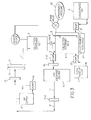
- Figure 2 is a block flow diagram of the improved continuous ink jet ink recirculation system of the present invention, having regulated pressure sources.
- Figure 3 is a block flow diagram of an alternative embodiment of the ink recirculation system of the present invention under atmospheric pressure and using in-line pumps.
- These resins can be used directly if they are of the proper metal ion form (for example, sodium ion form). Alternatively, they can be converted from the free acid form to the proper metal ion form by common techniques known in the industry for performing this conversion. Typically, in this case, a quantity of free acid form of the resin would be treated with strong base of the proper cation form, for example sodium hydroxide, to generate the proper form of the resin.
- proper metal ion form for example, sodium ion form
- a quantity of free acid form of the resin would be treated with strong base of the proper cation form, for example sodium hydroxide, to generate the proper form of the resin.
- the resin could be regenerated for re-use by exposing it to a concentrated aqueous solution containing a salt comprised of the original cation form of the resin as, for example the chloride salt, followed by washing with clean, deionized water to remove the excess regenerating salt solution.
- a concentrated aqueous solution containing a salt comprised of the original cation form of the resin as, for example the chloride salt followed by washing with clean, deionized water to remove the excess regenerating salt solution.
- This is a typical regeneration treatment known in the industry.
- the desirable form of the counterion (cation) for the ink is not restricted to sodium or other alkali metal cation such as potassium, or lithium, but may also include ammonium or substituted ammonium ions, protonated primary, secondary, or tertiary amines, alkaline-earth metal ions, etc.
- selection or preparation of the ion exchange resin is not restricted to sodium ion.
- inks containing colored or non-colored colloids can be used in this invention.
- Colloids may include inorganic oxides such as silicas or aluminas, natural and man-made clays, colored pigments, polymeric particles, and colored polymeric particles.
- Inks containing colloids may contain charged or uncharged stabilizers or additives. Charged inks containing colloids require the same considerations regarding the choice of ion-exchange types as for charged dye based inks.
- Ions that can cause problems with normal nozzle operation include multivalent metal cations such as, but not limited to, calcium, barium, zinc, strontium, magnesium, iron (III), and nickel. These are continually removed from the ink stream by the use of cation exchange resins specific to those contaminants.
- multivalent cations are removed from the inks by chelating resins, including but not limited to chelating resin such as Amberlite IRC-718 .
- the ion-exchange functionality is integrally incorporated into a resin matrix that can be of several types, including but not limited to agarose, cellulose, dextran, methacrylate, polyacrylic and polystyrene.
- cation exchange resins based on agarose include CM Sepharose CL-6B, CM Sepharose Fast Flow, SP Sepharose Fast Flow, and SP Sepharose High Performance.
- cation exchange resins that are based on cellulose include CM Cellulose and Cellulose Phosphate.
- cation exchange resins that are based nn dextran include CM Sephadex C-25, CM Sephadex C-50, SP Sephadex C-25, and SP Sephadex C-50.
- Especially useful cation exchange resins that are based on either polystyrene or polyacrylic copolymer include Amberlite 200, Amberlite IR-120 Plus (H), Dowex 50WX4, Dowex HGR-W2, Dowex 650C, Dowex M31, Dowex HCR-W2 (sodium form), Dowex HCR-W2 (H form), Amberlite IRC-50, Amberlite GC-50, Amberlite DP-1, Dowex MAC-3, and Dianion WK-100.
- an ion-exchange column (10) is inserted into the continuous ink recirculation loop, downstream from collection containers (3 and 4) and upstream from the ink supply reservoir (13), as substantially shown and described.
- continuous streams of ink are ejected and heat is applied to the ink stream, for example, by heaters within the nozzles, heaters positioned on a surface of printhead 16, etc.
- the ink is thermally steered into the "print-mode" direction (2) onto a print medium (19).
- continuous streams of ink can be thermally steered in the "non-print mode" direction into a gutter (17), which empties the ink (1) preferably into a first collection container (3).
- the ink from said first collection container (3) empties into a second collection container (4) in controlled fashion.
- the properties of the unused ink (1) contained in the second collection container (4) are monitored by fluid monitoring system (18).
- One ink property that may be monitored at (18) is dye concentration.
- the possible containers that could be needed for controlling dye concentration are shown as concentrated ink (predominantly dye) (6) and clear "make-up" fluid (predominantly solvent vehicle) (7), which are added to bottle (4) via pumps (21) and (22), respectively, if needed.
- Level sensor (5) is used to detect fluid levels in the container (4) so that the proper flow of ink throughout the system can be maintained. This ink monitoring and reconditioning is done to bring the ink back to the desired properties for optimal printer function.
- Other properties of the ink may be monitored and reconditioned as needed. Such properties include, but are not limited to, viscosity, surface tension, pH, solvent-to-cosolvent ratio, etc.
- Ink mixture (8) flowing out of the collection container (4) is filtered through 9(a) and undesired ions and trace metal contaminants are trapped in an ion-exchange column resin bed (10) prior to flowing downstream as ink stream (11).
- the ion-exchange resin bed in column (10) preferably allows attendant ion-exchange reactions to go to completion, although it must be kept in mind that the reactions are intrinsically reversible. Accordingly, the ion-exchange resin beds may be regenerated by either same-direction flow or reverse flow of a regenerating solution containing ions of the type that were originally on the column when it was freshly installed. This process displaces the collected, undesirable ions such as, but not limited to, multivalent metal cations such as, but not limited to, calcium, barium, zinc, strontium, magnesium, iron (III), and nickel, etc.
- the column may be emptied of its spent resin contents and new resin introduced. Normally, the regenerated resin would be washed further with ionically pure water to wash away excess regenerating ionic solution.
- the undesirable ions are replaced with the desired cationic species by ion-exchange, involving passing the ink through a strong acid ion exchange resin which as been treated with an excess of alkali metals, alkaline-earth metals, quaternary amines, protonated primary, secondary, or tertiary amines and ammonium ions.
- Ion-exchange columns of the present invention are sized sufficiently to fit within the ink recirculation portion of a printer.
- the resin is held in a column whose shape may vary depending on application. This variation in shape of the container may extend to also to its size, and its flow characteristics.
- the column contains enough resin to exchange the approximate amount of adventitious contaminating materials for a reasonable period of time.
- ion-exchange column Useful shapes and designs for the ion-exchange column are numerous. There is the usual cylindrical chamber filled with ion-exchange media. One can also employ a chamber consisting of one or more tubes (0.1 to 100 ⁇ diameter, for example) with ion-exchange resin coated on the interior walls of the tubes. Flow characteristics through this tubing allows intimate contact of ink with ion- exchangeable sites on the interior tube walls, thereby removing undesirable ions.
- one or more of the filters in the system can include an ion-exchange resin so as to consolidate the tasks which are more typically achieved by a separate filter and resin container or column.
- Ion-exchange resins may be provided as thin sheets, or membranes, made strong and flexible and yet permeable. Ion-exchange membranes are often difficult to obtain with the requisite strength and flexibility while maintaining the desired permeability, however the membranes can be fabricated, if desired, to determined specifications.
- Ink stream (11) is further filtered at 9(b) and the filtered and ion-exchange treated ink stream (12) flows into a pressure regulated (23) ink supply reservoir (13).
- ink (14) flows from the reservoir (13) through filter (15) and into print head (16) and the entire cycle as previously described repeats itself, after ejection from the nozzles of print head (16) until the printer is turned off.
- the filters 9(a) and 9(b) can also be integrally incorporated within the ion-exchange station 10.
- Figure 2 illustrates a vacuum system having a source 1 (23) and a source 2 (20) where the vacuum pressure is regulated.
- This system pulls the guttered ink (1) into the first collection container (3) and the ink (12) from filter 9(b) is pulled into ink supply reservoir (13) by the regulated source (23).
- the only pumps are (21) and (22) for reconstituting evaporated ink base by adding concentrate 6 or clear make-up solvent (7) respectively.
- FIG. 3 An alternative system is shown at Figure 3 where regulated pressure source (20) of Figure 2 is replaced by atmospheric pressure (20) and regulated source (23) of Figure 2 is removed. They are replaced by a pump P b just down stream from the reservoir (13), and a pump P a just up stream from filter 9(a).
- the atmospheric pressure pump system of Figure 3 alternatively powers the fluid through the recirculation process, rather than using regulated vacuum to pull the stream through the recirculation process of Figure 2.
- Other alternative means for forcing the ink through the system can be any combination of externally applied pressure, or individual pumps as can be readily envisioned by those skilled in the art.
- the throughput of such a recycling system must be appropriate for the continuous operation of the print head.
- the size and flow rate of ink through the ion-exchange column (10) must be high enough to maintain system operation.
- the number and size of the nozzles of a print head can vary widely depending on the application. Flow rates from as low as 1x10 -7 liters per second to as high as 0.1 liters per second can be employed while still maintaining system operation, depending on the number and size of the nozzles.
- the number of times on average that a particular volume of ink is recirculated through the system before it is actually printed on a receiving medium can vary widely depending on the amount of printing being done. This number can vary from as little as one time to 1000 or more times.
Landscapes
- Ink Jet (AREA)
- Inks, Pencil-Leads, Or Crayons (AREA)
Applications Claiming Priority (2)
| Application Number | Priority Date | Filing Date | Title |
|---|---|---|---|
| US751229 | 2000-12-28 | ||
| US09/751,229 US6631983B2 (en) | 2000-12-28 | 2000-12-28 | Ink recirculation system for ink jet printers |
Publications (2)
| Publication Number | Publication Date |
|---|---|
| EP1219449A2 true EP1219449A2 (fr) | 2002-07-03 |
| EP1219449A3 EP1219449A3 (fr) | 2003-05-02 |
Family
ID=25021061
Family Applications (1)
| Application Number | Title | Priority Date | Filing Date |
|---|---|---|---|
| EP01204942A Withdrawn EP1219449A3 (fr) | 2000-12-28 | 2001-12-17 | Système de recirculation d'encre dans des imprimantes à jet d'encre |
Country Status (2)
| Country | Link |
|---|---|
| US (1) | US6631983B2 (fr) |
| EP (1) | EP1219449A3 (fr) |
Cited By (4)
| Publication number | Priority date | Publication date | Assignee | Title |
|---|---|---|---|---|
| WO2012030553A3 (fr) * | 2010-08-31 | 2012-05-03 | Eastman Kodak Company | Système et procédé d'impression à fluide remis en circulation |
| US8430492B2 (en) | 2010-08-31 | 2013-04-30 | Eastman Kodak Company | Inkjet printing fluid |
| CN104245330A (zh) * | 2012-03-05 | 2014-12-24 | 富士胶卷迪马蒂克斯股份有限公司 | 油墨的再循环 |
| EP3181365A1 (fr) * | 2014-05-22 | 2017-06-21 | Rohm and Haas Company | Procédé pour la purification des encres |
Families Citing this family (28)
| Publication number | Priority date | Publication date | Assignee | Title |
|---|---|---|---|---|
| FR2827216B1 (fr) * | 2001-07-13 | 2008-03-21 | Leroux Gilles Sa | Dispositif d'impression numerique par jet d'encre et reservoir d'encre |
| US20100079559A1 (en) * | 2008-09-29 | 2010-04-01 | Greg Justice | Fluid Circulation System |
| EP2571696B1 (fr) | 2010-05-21 | 2019-08-07 | Hewlett-Packard Development Company, L.P. | Dispositif d'éjection de fluide comprenant une pompe de circulation |
| US9090084B2 (en) | 2010-05-21 | 2015-07-28 | Hewlett-Packard Development Company, L.P. | Fluid ejection device including recirculation system |
| US9963739B2 (en) | 2010-05-21 | 2018-05-08 | Hewlett-Packard Development Company, L.P. | Polymerase chain reaction systems |
| US9395050B2 (en) | 2010-05-21 | 2016-07-19 | Hewlett-Packard Development Company, L.P. | Microfluidic systems and networks |
| US8721061B2 (en) | 2010-05-21 | 2014-05-13 | Hewlett-Packard Development Company, L.P. | Fluid ejection device with circulation pump |
| US10132303B2 (en) | 2010-05-21 | 2018-11-20 | Hewlett-Packard Development Company, L.P. | Generating fluid flow in a fluidic network |
| KR101686286B1 (ko) | 2010-10-28 | 2016-12-28 | 휴렛-팩커드 디벨롭먼트 컴퍼니, 엘.피. | 순환 펌프를 구비한 유체 분사 어셈블리 |
| US9108423B2 (en) | 2011-05-31 | 2015-08-18 | Funai Electric Co., Ltd. | Consumable supply item with fluid sensing for micro-fluid applications |
| US9132656B2 (en) | 2011-05-31 | 2015-09-15 | Funai Electric Co., Ltd. | Consumable supply item with fluid sensing and pump enable for micro-fluid applications |
| US8911070B2 (en) * | 2011-11-16 | 2014-12-16 | Shenzhen China Star Optoelectronics Technology Co., Ltd. | System for recycling inkjet-printing material |
| US9010891B2 (en) * | 2012-05-04 | 2015-04-21 | Xerox Corporation | Systems and methods for in-line gel ink mixing |
| US9381739B2 (en) | 2013-02-28 | 2016-07-05 | Hewlett-Packard Development Company, L.P. | Fluid ejection assembly with circulation pump |
| US9833999B2 (en) * | 2013-11-19 | 2017-12-05 | Archroma Ip Gmbh | Inkjet printing system |
| US10558117B2 (en) * | 2015-05-20 | 2020-02-11 | Canon Kabushiki Kaisha | Imprint apparatus and article manufacturing method |
| US9975345B2 (en) * | 2015-08-20 | 2018-05-22 | Xerox Corporation | Multipurpose bottle apparatus and bottle loading mechanism and method |
| US11110704B2 (en) | 2016-04-29 | 2021-09-07 | Hewlett-Packard Development Company, L.P. | Selectively firing a fluid circulation element |
| CN109070616B (zh) * | 2016-04-29 | 2020-07-28 | 惠普发展公司,有限责任合伙企业 | 选择性地触发流体循环元件 |
| CN106423755B (zh) * | 2016-11-22 | 2019-06-25 | 京东方科技集团股份有限公司 | 涂布设备、利用其回收涂布液的方法及其清洁方法 |
| US10974517B2 (en) | 2018-10-16 | 2021-04-13 | Electronics For Imaging, Inc. | High stability ink delivery systems, and associated print systems and methods |
| WO2020222834A1 (fr) | 2019-04-30 | 2020-11-05 | Hewlett-Packard Development Company, L.P. | Éjection et circulation de fluide |
| WO2021021193A1 (fr) | 2019-07-31 | 2021-02-04 | Hewlett-Packard Development Company, L.P. | Circulation de fluide d'impression |
| WO2021126256A1 (fr) * | 2019-12-20 | 2021-06-24 | Hewlett-Packard Development Company, L.P. | Lancement de séquence d'activation d'actionneur de tête d'impression |
| WO2021150233A1 (fr) * | 2020-01-24 | 2021-07-29 | Hewlett-Packard Development Company, L.P. | Purgeur d'air de dispositif d'éjection de fluide |
| EP4240592B1 (fr) | 2021-01-14 | 2024-07-24 | Scrona AG | Tête d'impression électrohydrodynamique avec séchage intermédiaire de l'encre et procédé correspondant |
| JP7612877B2 (ja) | 2021-01-14 | 2025-01-14 | スクロナ アクチェンゲゼルシャフト | インクピンニングを有する電気流体力学的印刷ヘッド |
| US12441107B2 (en) | 2021-02-18 | 2025-10-14 | Scrona Ag | Inkjet printing system with nozzle evaporator |
Citations (8)
| Publication number | Priority date | Publication date | Assignee | Title |
|---|---|---|---|---|
| US1941001A (en) | 1929-01-19 | 1933-12-26 | Rca Corp | Recorder |
| US3373437A (en) | 1964-03-25 | 1968-03-12 | Richard G. Sweet | Fluid droplet recorder with a plurality of jets |
| US3416153A (en) | 1965-10-08 | 1968-12-10 | Hertz | Ink jet recorder |
| US4346387A (en) | 1979-12-07 | 1982-08-24 | Hertz Carl H | Method and apparatus for controlling the electric charge on droplets and ink-jet recorder incorporating the same |
| US4786327A (en) | 1986-09-29 | 1988-11-22 | Hewlett-Packard Company | Dye preparation for thermal ink-jet printheads using ion exchange |
| US5069718A (en) | 1989-05-10 | 1991-12-03 | Hewlett-Packard Company | Potassium substituted inks for ink-jet printers |
| US5755861A (en) | 1995-05-19 | 1998-05-26 | Brother Kogyo Kabushiki Kaisha | Ink composition, process for its preparation, and ink-jet recording process |
| US6079821A (en) | 1997-10-17 | 2000-06-27 | Eastman Kodak Company | Continuous ink jet printer with asymmetric heating drop deflection |
Family Cites Families (8)
| Publication number | Priority date | Publication date | Assignee | Title |
|---|---|---|---|---|
| US4153902A (en) | 1976-11-19 | 1979-05-08 | Sharp Kabushiki Kaisha | Bubble removal in an ink liquid supply for an ink jet system printer |
| JPS56126170A (en) | 1980-03-07 | 1981-10-02 | Ricoh Co Ltd | Ink viscosity detecting method in ink jet printer |
| JPS57188362A (en) * | 1981-05-15 | 1982-11-19 | Ricoh Co Ltd | Ink jet recording method |
| US4403227A (en) | 1981-10-08 | 1983-09-06 | International Business Machines Corporation | Method and apparatus for minimizing evaporation in an ink recirculation system |
| US4802989A (en) * | 1983-07-28 | 1989-02-07 | Canon Kabushiki Kaisha | System for purifying dye |
| JPS6072739A (ja) | 1983-09-30 | 1985-04-24 | Canon Inc | インク製造装置 |
| US4555712A (en) | 1984-08-03 | 1985-11-26 | Videojet Systems International, Inc. | Ink drop velocity control system |
| US6554410B2 (en) * | 2000-12-28 | 2003-04-29 | Eastman Kodak Company | Printhead having gas flow ink droplet separation and method of diverging ink droplets |
-
2000
- 2000-12-28 US US09/751,229 patent/US6631983B2/en not_active Expired - Fee Related
-
2001
- 2001-12-17 EP EP01204942A patent/EP1219449A3/fr not_active Withdrawn
Patent Citations (8)
| Publication number | Priority date | Publication date | Assignee | Title |
|---|---|---|---|---|
| US1941001A (en) | 1929-01-19 | 1933-12-26 | Rca Corp | Recorder |
| US3373437A (en) | 1964-03-25 | 1968-03-12 | Richard G. Sweet | Fluid droplet recorder with a plurality of jets |
| US3416153A (en) | 1965-10-08 | 1968-12-10 | Hertz | Ink jet recorder |
| US4346387A (en) | 1979-12-07 | 1982-08-24 | Hertz Carl H | Method and apparatus for controlling the electric charge on droplets and ink-jet recorder incorporating the same |
| US4786327A (en) | 1986-09-29 | 1988-11-22 | Hewlett-Packard Company | Dye preparation for thermal ink-jet printheads using ion exchange |
| US5069718A (en) | 1989-05-10 | 1991-12-03 | Hewlett-Packard Company | Potassium substituted inks for ink-jet printers |
| US5755861A (en) | 1995-05-19 | 1998-05-26 | Brother Kogyo Kabushiki Kaisha | Ink composition, process for its preparation, and ink-jet recording process |
| US6079821A (en) | 1997-10-17 | 2000-06-27 | Eastman Kodak Company | Continuous ink jet printer with asymmetric heating drop deflection |
Cited By (5)
| Publication number | Priority date | Publication date | Assignee | Title |
|---|---|---|---|---|
| WO2012030553A3 (fr) * | 2010-08-31 | 2012-05-03 | Eastman Kodak Company | Système et procédé d'impression à fluide remis en circulation |
| US8430492B2 (en) | 2010-08-31 | 2013-04-30 | Eastman Kodak Company | Inkjet printing fluid |
| US8434857B2 (en) | 2010-08-31 | 2013-05-07 | Eastman Kodak Company | Recirculating fluid printing system and method |
| CN104245330A (zh) * | 2012-03-05 | 2014-12-24 | 富士胶卷迪马蒂克斯股份有限公司 | 油墨的再循环 |
| EP3181365A1 (fr) * | 2014-05-22 | 2017-06-21 | Rohm and Haas Company | Procédé pour la purification des encres |
Also Published As
| Publication number | Publication date |
|---|---|
| EP1219449A3 (fr) | 2003-05-02 |
| US6631983B2 (en) | 2003-10-14 |
| US20020085076A1 (en) | 2002-07-04 |
Similar Documents
| Publication | Publication Date | Title |
|---|---|---|
| US6631983B2 (en) | Ink recirculation system for ink jet printers | |
| US5680162A (en) | Multiple chimneys for ink jet printer | |
| US5988782A (en) | Ink-jet printing apparatus | |
| DE60122428T2 (de) | Tintenstrahltinte, Tintenstrahldruckverfahren, Tintenstrahl-Druckvorrichtung,Tintenstrahldruckeinheit und Tintenpatrone | |
| JP3177128B2 (ja) | 吐出部、吐出部を用いたインクジェットカートリッジ、インクジェットプリント装置および方法 | |
| US6883895B2 (en) | Liquid ejection apparatus, head unit and ink-jet cartridge | |
| US8075125B2 (en) | Liquid spraying cartridge containing a recording liquid having a pH of over 4 and under 6 | |
| EP0699533B1 (fr) | Appareil d'enregistrement par jet d'encre et procédé | |
| JP3037181B2 (ja) | インクジェット記録装置 | |
| DE69927308T2 (de) | Tintenstrahldruckgerät | |
| JP3673617B2 (ja) | インクジェット記録装置およびインクジェット記録方法 | |
| JP3209930B2 (ja) | インクジェットプリント装置、インクジェットプリント方法およびデータ作成方法 | |
| US6585363B1 (en) | Ink-jet printing apparatus and printing method | |
| CA2094365C (fr) | Systeme d'enregistrement a jet d'encre utilisant des images decomposees | |
| US4445124A (en) | Ink jet recording process | |
| US8091980B2 (en) | External particle mitigation without exceeding drooling limitations | |
| JP4298378B2 (ja) | インクジェット記録装置および記録ヘッドの回復処理方法 | |
| EP0858896B1 (fr) | Dispositif d'impression à jet d'encre et procédé d'impression utilisant cette dispositif | |
| EP0705700B1 (fr) | Cheminées multiples pour imprimante à jet d'encre | |
| JPH08118678A (ja) | インクジェット装置および廃液吸収方法 | |
| JP2001301145A (ja) | インクジェット記録装置 | |
| JPH10230627A (ja) | インクジェット記録装置およびテストパターン作成方法 | |
| JPH10146991A (ja) | インクジェットプリント装置 | |
| JPH0872260A (ja) | インクジェット記録装置 | |
| JP2008132669A (ja) | インクジェット記録装置 |
Legal Events
| Date | Code | Title | Description |
|---|---|---|---|
| PUAI | Public reference made under article 153(3) epc to a published international application that has entered the european phase |
Free format text: ORIGINAL CODE: 0009012 |
|
| AK | Designated contracting states |
Kind code of ref document: A2 Designated state(s): AT BE CH CY DE DK ES FI FR GB GR IE IT LI LU MC NL PT SE TR |
|
| AX | Request for extension of the european patent |
Free format text: AL;LT;LV;MK;RO;SI |
|
| PUAL | Search report despatched |
Free format text: ORIGINAL CODE: 0009013 |
|
| AK | Designated contracting states |
Designated state(s): AT BE CH CY DE DK ES FI FR GB GR IE IT LI LU MC NL PT SE TR |
|
| AX | Request for extension of the european patent |
Extension state: AL LT LV MK RO SI |
|
| 17P | Request for examination filed |
Effective date: 20031007 |
|
| AKX | Designation fees paid |
Designated state(s): DE FR GB |
|
| 17Q | First examination report despatched |
Effective date: 20031218 |
|
| STAA | Information on the status of an ep patent application or granted ep patent |
Free format text: STATUS: THE APPLICATION IS DEEMED TO BE WITHDRAWN |
|
| 18D | Application deemed to be withdrawn |
Effective date: 20040429 |