EP1219657B1 - Polyarylene et procede de production correspondant - Google Patents
Polyarylene et procede de production correspondant Download PDFInfo
- Publication number
- EP1219657B1 EP1219657B1 EP00917433A EP00917433A EP1219657B1 EP 1219657 B1 EP1219657 B1 EP 1219657B1 EP 00917433 A EP00917433 A EP 00917433A EP 00917433 A EP00917433 A EP 00917433A EP 1219657 B1 EP1219657 B1 EP 1219657B1
- Authority
- EP
- European Patent Office
- Prior art keywords
- group
- substituted
- same
- represents independently
- different
- Prior art date
- Legal status (The legal status is an assumption and is not a legal conclusion. Google has not performed a legal analysis and makes no representation as to the accuracy of the status listed.)
- Expired - Lifetime
Links
Classifications
-
- C—CHEMISTRY; METALLURGY
- C08—ORGANIC MACROMOLECULAR COMPOUNDS; THEIR PREPARATION OR CHEMICAL WORKING-UP; COMPOSITIONS BASED THEREON
- C08G—MACROMOLECULAR COMPOUNDS OBTAINED OTHERWISE THAN BY REACTIONS ONLY INVOLVING UNSATURATED CARBON-TO-CARBON BONDS
- C08G61/00—Macromolecular compounds obtained by reactions forming a carbon-to-carbon link in the main chain of the macromolecule
- C08G61/02—Macromolecular compounds containing only carbon atoms in the main chain of the macromolecule, e.g. polyxylylenes
- C08G61/10—Macromolecular compounds containing only carbon atoms in the main chain of the macromolecule, e.g. polyxylylenes only aromatic carbon atoms, e.g. polyphenylenes
-
- C—CHEMISTRY; METALLURGY
- C07—ORGANIC CHEMISTRY
- C07C—ACYCLIC OR CARBOCYCLIC COMPOUNDS
- C07C67/00—Preparation of carboxylic acid esters
- C07C67/30—Preparation of carboxylic acid esters by modifying the acid moiety of the ester, such modification not being an introduction of an ester group
- C07C67/333—Preparation of carboxylic acid esters by modifying the acid moiety of the ester, such modification not being an introduction of an ester group by isomerisation; by change of size of the carbon skeleton
- C07C67/343—Preparation of carboxylic acid esters by modifying the acid moiety of the ester, such modification not being an introduction of an ester group by isomerisation; by change of size of the carbon skeleton by increase in the number of carbon atoms
- C07C67/347—Preparation of carboxylic acid esters by modifying the acid moiety of the ester, such modification not being an introduction of an ester group by isomerisation; by change of size of the carbon skeleton by increase in the number of carbon atoms by addition to unsaturated carbon-to-carbon bonds
-
- C—CHEMISTRY; METALLURGY
- C07—ORGANIC CHEMISTRY
- C07C—ACYCLIC OR CARBOCYCLIC COMPOUNDS
- C07C69/00—Esters of carboxylic acids; Esters of carbonic or haloformic acids
- C07C69/76—Esters of carboxylic acids having a carboxyl group bound to a carbon atom of a six-membered aromatic ring
-
- C—CHEMISTRY; METALLURGY
- C07—ORGANIC CHEMISTRY
- C07D—HETEROCYCLIC COMPOUNDS
- C07D307/00—Heterocyclic compounds containing five-membered rings having one oxygen atom as the only ring hetero atom
- C07D307/77—Heterocyclic compounds containing five-membered rings having one oxygen atom as the only ring hetero atom ortho- or peri-condensed with carbocyclic rings or ring systems
- C07D307/87—Benzo [c] furans; Hydrogenated benzo [c] furans
-
- C—CHEMISTRY; METALLURGY
- C07—ORGANIC CHEMISTRY
- C07F—ACYCLIC, CARBOCYCLIC OR HETEROCYCLIC COMPOUNDS CONTAINING ELEMENTS OTHER THAN CARBON, HYDROGEN, HALOGEN, OXYGEN, NITROGEN, SULFUR, SELENIUM OR TELLURIUM
- C07F17/00—Metallocenes
-
- C—CHEMISTRY; METALLURGY
- C08—ORGANIC MACROMOLECULAR COMPOUNDS; THEIR PREPARATION OR CHEMICAL WORKING-UP; COMPOSITIONS BASED THEREON
- C08G—MACROMOLECULAR COMPOUNDS OBTAINED OTHERWISE THAN BY REACTIONS ONLY INVOLVING UNSATURATED CARBON-TO-CARBON BONDS
- C08G61/00—Macromolecular compounds obtained by reactions forming a carbon-to-carbon link in the main chain of the macromolecule
- C08G61/02—Macromolecular compounds containing only carbon atoms in the main chain of the macromolecule, e.g. polyxylylenes
Definitions
- the present invention relates to a polyarylene, a teraryl and a teraryl precursor, as well as to a method for producing a polyarylene. More particularly, the invention relates to a polyarylene having terarylene recurring units on the backbone and a method for production thereof.
- Polyarylenes are of interest because the arylene group as a recurring unit has excellent thermal and chemical stability. Also, polyarylenes have been attracting considerable attention to their peculiar physical properties because of the advanced ⁇ -electron conjugated system.
- Polyphenylene s may also be either oxidized or reduced so that anions or cations are doped to form p type or n type semiconductors. Utilizing the property, it is also expected to apply poly (p-phenylene) to electrode materials or apply as display elements using a change in absorbance upon oxidation or reduction.
- polyarylenes are expected to be applicable to macro molecule light emitting elements.
- elements called macro molecule light emitting electrochemical elements (LEC) have been proposed lately and drawn attention in view of their high luminous efficiency.
- the structure includes two electrodes, between which a electrically conductive polymer material and a polymer membrane comprising polyethylene oxide having ionic conductivity and a substrate salt are inserted. It is assumed that the principle of working mechanism is based on the input of positive and negative charges from the electrodes and the transfer of both positive and negative ions of the substrate salt as a dopant, whereby a p-n junction would be formed in the membrane. If an ionic conductivity is further imparted to conductive polymer substances having an electronic conductivity, such light emitting elements will be manufactured using a sole material, not with the composite membrane mentioned above, resulting in a great advantage in manufacturing steps.
- polyarylenes which include electrochemical oxidative polymerization (a process using a cupric chloride-lithium aluminum hexafluoride-based electrolyte and applying a voltage between electrodes to produce a polymer on the electrodes); as polycondensation of substituted benzene derivatives, Wurtz-Fittig reaction (a process involving condensation of a dihalogenobenzene with an alkali metal), Ullmann reaction (a process involving condensation of diiodobenzene with a metalcopper),Grignard reaction called Yamamoto method (a process involving condensation of a dihalogenobenzene Grignard derivative with a nickel chloride-bipyridyl complex), diazonium coupling (a process involving condensation of a diazonium derivative with sodium nitrite/hydrochloric acid followed by treatment with copper chloride); as processes via precursors, dehydration of cyclohexadiene polymer, a bio-engineering method (which
- polyarylenes having terarylene recurring units are extremely rarely known. In these polyarylenes, it has been sought to introduce substituents freely into the central arylene of the terarylene unit and modify the terarylene in various ways.
- Japanese Patent Unexamined Publication (Laid-open) No. 9-309945 discloses polyphenylene copolymers. According to this patent publication, polyphenylene copolymers are synthesized using various types of monoarylenes as recurring units.
- an object of the present invention is to provide polyarylenes containing a terarylene as the recurring unit.
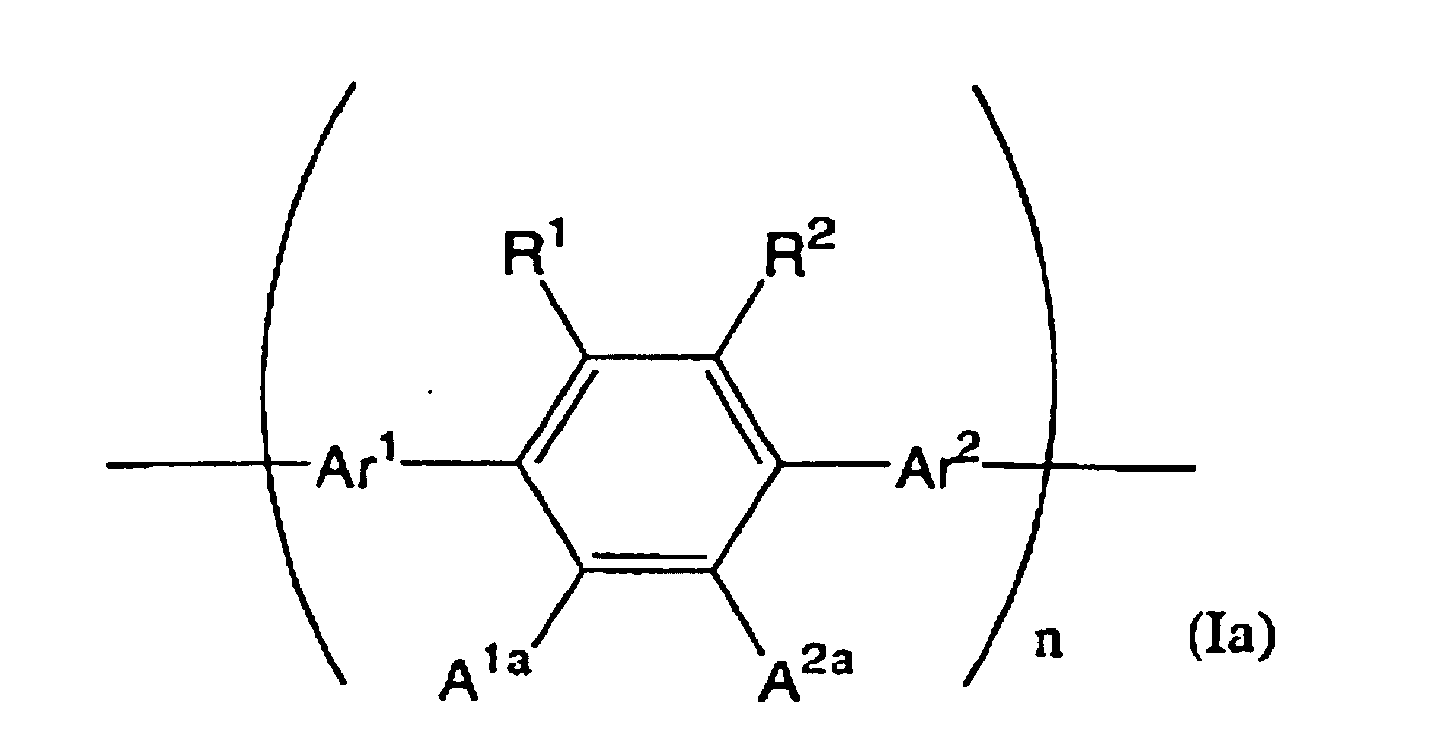
- polyarylenes comprising a recurring unit represented by formula (I) or (II) below: (wherein:
- a 1 and A 2 which may be the same or different, each represents independently a phenylene group which may optionally be substituted.
- the recurring unit is preferably a recurring unit shown by formula (I) described above, wherein R 1 and R 2 may form together a C 4 -C 20 saturated or unsaturated ring which may be intervened by an oxygen atom and may optionally be substituted.
- the C 1 -C 20 hydrocarbon group is preferably a linear or branched C 1 -C 20 alkyl group, a linear or branched C 2 -C 20 alkenyl group, a linear or branched C 2 -C 20 alkynyl group, a linear or branched C 3 -C 20 allyl group, a linear or branched C 4 -C 20 alkadienyl group, a linear or branched C 4 -C 20 polyenyl group, a C 6 -C 18 aryl group, a C 6 -C 20 alkylaryl group, a C 6 -C 20 arylalkyl group, a C 4 -C 20 cycloalkyl group, or a C 4 -C 20 cycloalkenyl group.
- a resin composition comprising the polyarylene described above and a synthetic organic polymer.
- a 1 and A 2 which may be the same or different, each represents independently a paraphenylene group which may optionally be substituted.
- the recurring unit is preferably a recurring unit shown by formula (I) described above, wherein R 1 and R 2 form together a C 4 -C 20 saturated or unsaturated ring which may be intervened by an oxygen atom and may be substituted.
- the C 1 -C 20 hydrocarbon group is preferably a linear or branched C 1 -C 20 alkyl group, a linear or branched C 2 -C 20 alkenyl group, a linear or branched C 2 -C 20 alkynyl group, a linear or branched C 3 -C 20 allyl group, a linear or branched C 4 -C 20 alkadienyl group, a linear or branched C 4 -C 20 polyenyl group, a C 6 -C 18 aryl group, a C 6 -C 20 alkylaryl group, a C 6 -C 20 arylalkyl group, a C 4 -C 20 cycloalkyl group, or a C 4 -C 20 cycloalkenyl group.
- a resin composition comprising the polyarylene described above and a synthetic organic polymer.
- X 1 and X 2 which may be the same or different, each represents independently a leaving group).
- a process for producing a teraryl which comprises reacting a metallacyclopentadiene represented by formula (V) or (VI) below: (wherein:
- M is a metal from Group IV or the lanthanide series of the Periodic Table; the anionic ligand is non-localized cyclic ⁇ 5 - coordination type ligand, a C 1 -C 20 alkoxy group, a C 6 -C 20 aryloxy group or a dialkylamide group.
- the non-localized cyclic ⁇ 5 -coordination type ligand described above is preferably a cyclopentadienyl, indenyl, fluorenyl or azulenyl group, which may be substituted.
- reaction preferably proceeds in the presence of a compound containing a metal from Groups IX-XV of the Periodic Table.
- M is a metal from Group IV or the lanthanide series of the Periodic Table; the anionic ligand is non-localized cyclic ⁇ 5 -coordination type ligand, a C 1 -C 20 alkoxy group, a C 6 -C 20 aryloxy group or a dialkylamide group.
- the non-localized cyclic ⁇ 5 -coordination type ligand described above is preferably a cyclopentadienyl, indenyl, fluorenyl or azulenyl group, which may be substituted.
- reaction preferably proceeds in the presence of a compound containing a metal from Groups IX-XV of the Periodic Table.
- polyarylenes represented by formula (I) or (II) described above are provided.
- Ar 1 and Ar 2 which may be the same or different, each represents independently an arylene having 4 to 18 carbon atoms, which maybe substituted and may contain 1 to 5 nitrogen atoms.
- Ar 1 and Ar 2 are preferably 5- to 18-membered, more preferably, 6- to 14-membered. Where the arylene contains nitrogen atoms, the number of nitrogen atoms is preferably 1 to 3, more preferably 1 or 2.
- the arylene may be a carbon ring or may be a heterocyclic ring containing 1 to 5 nitrogen atoms.
- the arylene may be a monocyclic ring or a condensed ring.
- Examples of the arylene include phenylenes (1,3- and 1,4-phenylenes), 5-amino-1,3-phenylene, 4-benzoyl-1,3-phenylene, 5-benzoyl-1,3-phenylene, 2-benzoyl-1,4-phenylene, 4,4'-biphenyldiyl, 2-carboxy-methyl-1,4-phenylene, 4-carboxymethyl-1,3-phenylene, 5-carboxymethyl-1,3-phenylene, 1,3-naphthalenediyl, 1,4-naphthalenediyl, 5-phenoxy-1,3-phenylene, 2-phenyl-1,3-phenylene, 4-phenyl-1,3-phenylene, 5-phenyl-1,3-pheny
- arylenes other than those at the 1,3- and 1,4-positions, which are not described above, there are, e.g., 2,4-quinolinediyl, 2,5-quinolinediyl, 2,6-quinolinediyl, and the like.
- Preferred examples of the arylenes are phenylene, naphthalenediyl and pyridinediyl, which may optionally be substituted, and more preferably, phenylene and naphthalenediyl which may optionally be substituted.
- substituents on the arylenes shown by Ar 1 and Ar 2 are a C 1 -C 20 hydrocarbon group, a C 1 -C 20 alkoxy group, a C 6 -C 20 aryloxy group, an amine group, hydroxy group or a group shown by formula: -Si(R 3 ) (R 4 ) (R 5 ) (wherein R 3 , R 4 and R 5 , which may be the same or different, each represents independently a C 1 -C 20 alkyl group, a C 6 -C 20 arylalkyl group, a C 1 -C 20 alkoxy group or a C 6 -C 20 arylalkyloxy group) .
- the substituents on the arylenes are not limited to those given above, so long as they are substituents that can be introduced into the arylenes prior to or after the formation of a teraryl as the monomer, and unless they interfere with the reaction. Furthermore, by introducing an appropriate protecting group, various substituents can be introduced into the arylenes by publicly known reactions for ordinary aromatic compounds, for example, through nucleophilic substitution.
- R 1 and R 2 which may be the same or different, each represents independently a C 1 -C 20 hydrocarbon group which may optionally be substituted, a C 1 -C 20 alkoxy group which may optionally be substituted, a C 6 -C 20 aryloxy group which may optionally be substituted, an amine group, hydroxy group or a group shown by formula: -Si(R 3 ) (R 4 ) (R 5 ) (wherein R 3 , R 4 and R 5 , which may be the same or different, each represents independently a C 1 -C 20 alkyl group, a C 6 -C 20 arylalkyl group, a C 1 -C 20 alkoxy group or a C 6 -C 20 arylalkyloxy group) .
- the C 1 -C 20 hydrocarbon group may be a saturated or unsaturated acyclic hydrocarbon or a saturated or unsaturated cyclic hydrocarbon. Where the C 1 -C 20 hydrocarbon group is acyclic, the group may be linear or branched.
- Examples of the C 1 -C 20 hydrocarbon group include a C 1 -C 20 alkyl group, a C 2 -C 20 alkenyl group, a C 2 -C 20 alkynyl group, a C 3 -C 20 allyl group, a C 4 -C 20 alkadienyl group, a C 4 -C 20 polyenyl group, a C 6 -C 18 aryl group, a C 6 -C 20 alkylaryl group, a C 6 -C 20 arylalkyl group, a C 4 -C 20 cycloalkyl group, and a C 4 -C 20 cycloalkenyl group.
- alkoxy group which is useful to practice the invention include, but are not limited to, methoxy, ethoxy, 2-methoxyethoxy, t-butoxy, etc.
- aryloxy group which is useful to practice the invention include, but are not limited to, phenoxy, naphthoxy, phenylphenoxy, 4-methylphenoxy, etc.
- Examples of the group shown by formula: -Si (R 3 ) (R 4 ) (R 5 ) include, but are not limited to, trimethylsilyl, triethylsilyl, trimethoxysilyl, triethoxysilyl, diphenylmethylsilyl, triphenylsilyl, triphenoxysilyl, dimethylmethoxysilyl, dimethylphenoxysilyl, methylmethoxyphenyl, etc.
- Substitutents may be introduced into the C 1 -C 20 hydrocarbon group, C 1 -C 20 alkoxy group, and C 6 -C 20 aryloxy group.
- substituents are a halogen atom, hydroxy group, amino group, etc.
- R 1 and R 2 may form together a C 4 -C 20 saturated or unsaturated ring which may be intervened by an oxygen atom and may be substituted.
- the ring is a 4- to 16-membered ring, more preferably a 4- to 12-membered ring.
- the ring may optionally be substituted with substituents such as a C 1 -C 20 hydrocarbon group, a C 1 -C 20 alkoxy group, a C 6 -C 20 aryloxy group, an amine group, hydroxy group or a group shown by formula: -Si (R 3 ) (R 4 ) (R 5 ) (wherein R 3 , R 4 and R 5 , which may be the same or different, each represents independently a C 1 -C 20 alkyl group, a C 6 -C 20 arylalkyl group, a C 1 -C 20 alkoxy group or a C 6 -C 20 arylalkyloxy group), etc.
- substituents such as a C 1 -C 20 hydrocarbon group, a C 1 -C 20 alkoxy group, a C 6 -C 20 aryloxy group, an amine group, hydroxy group or a group shown by formula: -Si (R 3 ) (R 4 ) (R 5
- the C 1 -C 20 hydrocarbon group, the C 1 -C 20 alkoxy group which may optionally be substituted, the C 6 -C 20 aryloxy group which may optionally be substituted and the amino group are the same as those given for R 1 and R 2 .
- alkoxycarbonyl group which is useful to practice the invention include, but are not limited to, methoxycarbonyl, ethoxycarbonyl, 2-methoxyethoxycarbonyl, t-butoxycarbonyl, etc.
- aryloxycarbonyl group which is useful to practice the invention include, but are not limited to, phenoxycarbonyl, naphthoxycarbonyl, phenylphenoxycarbonyl, 4-methylphenoxycarbonyl, etc.
- the polyarylenes of the present invention may also be copolymers.
- the polyarylenes may contain, e.g., one or more other recurring units.
- the other recurring unit may be an arylene.
- arylenes examples include phenylenes (1,3- and 1,4-phenylenes), 5-amino-1,3-phenylene, 4-benzoyl-1,3-phenylene, 5-benzoyl-1,3-phenylene, 2-benzoyl-1,4-phenylene, 4,4'-biphenyldiyl, 2-carboxy-methyl-1,4-phenylene, 4-carboxymethyl-1,3-phenylene, 5-carboxymethyl-1,3-phenylene, 1,3-naphthalenediyl, 1,4-naphthalenediyl, 5-phenoxy-1,3-phenylene, 2-phenyl-1,3-phenylene, 4-phenyl-1,3-phenylene, 5-phenyl-1,3-phenylene, 2-phenyl-1,4-phenylene, 2,6-pyridinediyl, 2,4-pyridinediyl, 3,5-pyridinediyl, 3,6-pyridinediyl, 5,8-quinoline
- isomers of the arylenes other than those at the 1,3- and 1,4-positions which are not described above, there are, e.g., 2,4-quinolinediyl, 2,5-quinolinediyl, 2,6-quinolinediyl, and the like.
- a resin composition e.g., a blend, comprising the polyarylene and a synthetic organic polymer.
- a resin composition comprising 1 to 99 wt% of the polyarylene and 99 tol wt% of the synthetic organic polymer.
- a resin composition comprising 1 to 99 wt% of the polyarylene and 99 tol wt% of the synthetic organic polymer.
- 10 to 90 wt% of the polyarylene and 90 to 10 wt% of the synthetic organic polymer are also provided.
- the synthetic organic polymer includes a thermoplastic polymer, a thermosetting polymer, engineering plastics, etc.
- the synthetic organic polymer may also be a copolymer.
- the thermoplastic polymer are polyolefin such as polyethylene, polypropylene, polycycloolefin, ethylene-propylene copolymer, etc.; polyvinyl chloride, polyvinylidene chloride, polyvinyl acetate, polyacrylic acid, polymethacrylic acid, polystyrene, polyamide, polyester, polycarbonate, etc.
- the thermosetting polymer are phenol resin, urea resin, melamine resin, alkyd resin, unsaturated polyester resin, epoxy resin, silicone resin and polyurethane resin.
- the engineering plastics include polyimide, polyphenylene oxide, polysulfone, etc.
- the synthetic organic polymer may be synthetic rubber such as styrene-butadiene, etc., or fluorine resin such as polytetrafluoroethylene, etc.
- the resin composition may also contain a variety of additives.
- the additives are plasticizers, antistatic agents, coloring agents, etc.
- the resin composition may further contain reinforcing agents such as glass fibers, carbon fibers, etc.
- the polyarylene or resin composition in accordance with the present invention can be prepared into the shape of fibers, films or sheets using methods publicly known to one skilled in the art. Examples of such methods include, but are not limited to, melt spinning, spinning from a solution, dry jet wet spinning, extrusion, flow casting and molding.
- the fibers, films or sheets are further processed by means of calender molding, embossing, forming or other means publicly known to one skilled in the art.
- a teraryl represented by formula (III) or (IV).
- Ar 1 , Ar 2 , R 1 , R 2 , A 1 and A 2 have the same significance as defined above.
- X 1 and X 2 which may be the same or different, each represents independently a leaving group.
- the leaving group are a halogen atom such as F, Cl, Br or I, p-toluenesulfonyl group, etc., with particular preference being Br.
- Polymerization is carried out by coupling monomers through removal of the leaving groups X 1 and X 2 with a reducing agent.
- a reducing agent e.g., metals from Groups I-XIV of the Periodic Table can be widely employed.
- the reducing agent includemetals fromGroup I of the Periodic Table such as lithium or sodium; metals from Group II such as magnesium; metals from Group XI such as copper; and metals from Group XII such as zinc.
- the polymers of the present invention can be formed by polymerization of monomers described above through reductive coupling using a nickel (0) compound described in T. Kanbara, T. Kushida, N. Saito, I. Kuwajima, K. Kubota andT. Yamamoto, Chemistry Letters, 1992, 583-586 , or through nickel catalyst-reductive coupling described in U.S. Patent No. 5,227,457 or 5,241,044 .
- an organic metal complex catalyst such as bis(triphenylphosphine)dichloronickel or dichloro(2,2'-bipyridine)nickel, PdCl 2 (2,2'-bipyridine) may be employed, since polymerization proceeds under relatively mild conditions.
- Nitrogen-containing compounds such as bipyridine, or phosphorus-containing organic compounds such as phosphine may also be co-present as a co-catalyst.
- the organic metal complex those consisting of the central metal from Groups III-XI, preferably from Groups VI-XI of the Periodic Table, with ligands such as a phosphine; an aromatic amine such as pyridine or bipyridine, a halogen atom, etc. are preferably employed.
- the central metal takes so-called tetra- to hexa-valent coordination and more preferably, is a metal from Group X of the Periodic Table.
- the phosphine include, but are not limited to, triphenylphosphine and methyldiphenylphosphine.
- the polymerization is carried out preferably at temperatures from -80°C to 300°C, more preferably at 0°C to 150°C. Pressure is applied in the range of 0.1 bar to 2500 bars, preferably 0.5 bar to 10 bars.
- the polymerization can be carried out continuously or batch-wise, in one step or in a multi-step, in a solution or a suspension, in a gaseous phase or in a supercritical medium.
- an aliphatic or aromatic solvent can be used; preferably, a polar solvent is employed.
- a polar solvent is employed.
- the solvent are an ethereal solvent such as tetrahydrofuran or diethyl ether, a halogenated hydrocarbon such as methylene chloride, a halogenated aromatic hydrocarbon such as o-dichlorobenzene, an amide such as N,N-dimethylformamide, and a sulfoxide such as dimethylsulfoxide.
- the reaction is carried out preferably in the presence of a catalyst.
- a catalyst there can be used metal compounds from Groups IV-XV of the Periodic Table, particularly metal compounds from Groups VIII-XV of the Periodic Table.
- metal salts such as CuX, NiX 2 or BiX 3 (wherein X is a halogen atom such as chlorine or bromine atom) are employed.
- the organometallic complexes, especially a nickel complex which are herein exemplified in the description on the polymerization may be employed.
- a 1a and A 2a is an electron-donating group such as an alkyloxycarbonyl group, an aryloxycarbonyl group, nitrile group, etc.
- a copper salt such as copper chloride is preferably used.
- a 1a and A 2a are an alkyl group, an aryl group, an alkoxy group, an aryloxy group, etc.
- a nickel complex is preferably used.
- the reaction is carried out preferably at temperatures from -80°C to 300°C, more preferably at -20°C to 50°C. Pressure is applied in the range of 0.1 bar to 2500 bars, preferably 0.5 bar to 10 bars.
- the reaction is preferably carried out in situ without separating the metallacyclopentadiene shown by formula (V) or (VI) described above.
- the metallacyclopentadiene shown by formula (V) or (VI) described above is provided.
- the metallacyclopentadiene can be synthesized from a metallocene according to the following equation: X 1 -Ar 1 -C ⁇ C-R 1 (VIIIa) (wherein Ar 1 , R 1 , A 1 , X 1 , L 1 and L 2 have the same significance as defined above; B is a crosslinking group; and Z 1 and Z 2 , which may be the same or different, each represents independently a ligand that can be split off) ; (wherein Ar 1 , Ar 2 , X 1 , X 2 , L 1 and L 2 have the same significance as defined above; B is a crosslinking group; and Z 1 and Z 2 , which may be the same or different, each represents independently a ligand that can be split off); (wherein Ar 1 , Ar 2 , R 1 , R 2 , X 1
- B is a crosslinking group and hydrocarbon group, which may be intervened by, e.g., an oxygen atom, especially an alkylene group which may be intervened by an oxygen atom.
- Z 1 and Z 2 there is no restriction on Z 1 and Z 2 , so long as they can be coordinated with M.
- Z 1 and Z 2 include a halogen atom, an olefin such as ethylene, an alkyl group, and the like.
- the reaction described above is carried out preferably at -120°C to 50°C, more preferably at -120°C to 0°C, in the presence of a strong base such as an alkyl lithium.
- a strong base such as an alkyl lithium.
- metal complexes containing metals from Group IV or the lanthanide metal series of the Periodic Table are preferably employed.
- Metal complexes containing a non-localized cyclic ⁇ 5 -coordination type ligand are also preferred.
- L 1 and L 2 are preferably a non-localized cyclic ⁇ 5 -coordination type ligand.
- the non-localized cyclic ⁇ 5 -coordination type ligand are unsubstituted cyclopentadienyl group and a substituted cyclopentadienyl group.
- Examples of the substituted cyclopentadienyl group include methylcyclopentadienyl, ethylcyclopentadienyl, isopropylcyclopentadienyl, t-butylcyclopentadienyl, dimethylcyclopentadienyl, diethylcyclopentadienyl, diisopropylcyclopentadienyl, di-t-butylcyclopentadienyl, tetramethylcyclopentadienyl, indenyl, 2-methylindenyl, 2-methyl-4-phenylindenyl, tetrahydroindenyl, benzindenyl, fluorenyl, benzofluorenyl, tetrahydrofluorenyl and octahydrofluorenyl groups.
- one or more atoms of the non-localized cyclic ⁇ 5 -coordination type maybe substituted for the hetero atom.
- the ligand may contain, in addition to hydrogen, one or more hetero atoms such as the elements from Group XIV and/or Groups XV, XVI and XVII, of the Periodic Table.
- the non - localized cyclic ⁇ 5 -coordination type ligand e.g., the cyclopentadienyl group may be crosslinked with the central metal by one or more crosslinking ligands that may be cyclic.
- crosslinking ligands are CH 2 , CH 2 CH 2 , CH(CH 3 )CH 2 , CH(C 4 H 9 )C(CH 3 ) 2 , C(CH 3 ) 2 , (CH 3 ) 2 Si, (CH 3 ) 2 Ge, (CH 3 ) 2 Sn, (C 6 H 5 ) 2 Si, (C 6 H 5 )(CH 3 )Si, (C 6 H 5 ) 2 Ge, (C 6 H 5 ) 2 Sn, (CH 2 ) 4 Si, CH 2 Si(CH 3 ) 2 , o-C 6 H 4 or 2,2'-(C 6 H 4 ) 2 .
- Two or more non -localized cyclic ⁇ 5 -coordination type ligands e.g., the cyclopentadienyl groups may be crosslinked with each other by one or more crosslinking ligands that may be cyclic.
- crosslinking ligands are CH 2 , CH 2 CH 2 , CH(CH 3 )CH 2 , CH(C 4 H 9 )C(CH 3 ) 2 , C(CH 3 ) 2 , (CH 3 ) 2 Si, (CH 3 ) 2 Ge, (CH 3 ) 2 Sn, (C 6 H 5 ) 2 Si, (C 6 H 5 ) (CH 3 ) Si, (C 6 H 5 ) 2 Ge, (C 6 H 5 ) 2 Sn, (CH 2 ) 4 Si, CH 2 Si(CH 3 ) 2 , O-C 6 H 4 or 2, 2' - (C 6 H 4 ) 2 .
- the metallacyclopentadienes of the present invention also embrace compounds containing two or more metallacyclopentadiene moieties. Such compounds are known as multinuclear metallocenes.
- the multinuclear metallocenes described above may have any substitution mode or any crosslinking mode.
- the independent metallocene moieties in the multinuclear metallocene may be the same or different. Examples of the multinuclear metallocenes are described in, e.g., EP -A- 632063 , Japanese Patent Unexamined Publication (Laid-open) Nos. 4-80214 and 4-85310 and EP-A-654476 .
- the metallacyclopentadienes of the present invention can be synthesized using, e.g., the metallocenes below.
- dichloro-compounds such as bis(indenyl)dichlorozirconium; bis(fluorenyl)dichlorozirconium; (indenyl)(fluorenyl)dichlorozirconium; bis(cyclopentadienyl)dichlorotitanium; (dimethylsilanediyl)bis(indenyl)dichlorozirconium; (dimethylsilanediyl)bis(tetrahydroindenyl)dichlorozirco nium; (dimethylsilanediyl) (indenyl)dichlorozirconium; (dimethylsilanediyl)bis(2-methylindenyl)dichlorozirconium; (dimethylsilanediyl)bis(2-ethylindenyl)dichlorozirconium; (dimethylsilanediyl)bis(2-ethy
- metallocens are: bis(cyclopentadienyl)dibutylzirconium; bis(indenyl)dibutylzirconium; bis(fluorenyl)dibutylzirconium; (indenyl)(fluorenyl)dibutylzirconium; (3-methyl-5-naphthylindenyl)(2,7-di-tert-butylfluorenyl)dibutylzirconium; (3-methyl-5-naphthylindenyl)(3,4,7-trimethoxyfluorenyl)dibutylzirconium; (pentamethylcyclopentadienyl)(tetrahydroindenyl)dibutylzirconium; (cyclopentadienyl)(1-octene-8-ylcyclopentadienyl)dibutylzirconium; (indenyl)
- the number average molecular weight (Mn) of polymers was determined by gel permeation chromatography, while the weight average molecular weight (Mw) was determined by elemental analysis.
- THF tetrahydrofuran
- the number average molecular weight (Mn) was 6870 and Mw/Mn was 1.7.
- the title compound is one of the compounds represented by formula (V) described above, in which R 1 and R 2 are combined together to form a group shown by formula: -CH 2 -CH 2 -O-CH 2 -CH 2 -, and the 5-membered ring intervened by the oxygen atom is condensed with zirconacyclopentadiene.
- the molecular weight was found to be 6700 by elemental analysis.
- the three isomers of the zirconacyclopenta-2,4-diene derivatives are not separated. However, these derivatives can be separated from each other by chromatography, if desired, followed by recrystallization.
- the three kinds of monomers are not separated. However, these monomers can be separated from each other by chromatography or the like. In particular, 1,5-bis(p-bromophenyl)-2,3-dimethoxycarbonyl-4,6-dibuty lbenzene, which is predominantly formed, can be readily isolated from the other isomers.
- the polyarylenes of the present invention find extensive applications as electrically conductive resins.
- the polyarylenes can be used also as resin compositions in a variety of formed shapes.
Landscapes
- Chemical & Material Sciences (AREA)
- Organic Chemistry (AREA)
- Health & Medical Sciences (AREA)
- Chemical Kinetics & Catalysis (AREA)
- Medicinal Chemistry (AREA)
- Polymers & Plastics (AREA)
- Polyoxymethylene Polymers And Polymers With Carbon-To-Carbon Bonds (AREA)
Abstract
Claims (17)
- Polyarylène comprenant un motif récurrent de formule (I) ou (II) ci-dessous :

 Ar1 et Ar2, qui peuvent être identiques ou différents, représentent chacun indépendamment un arylène possédant 4 à 18 atomes de carbone, qui peut être substitué et contenir 1 à 5 atomes d'azote ;R1 et R2, qui peuvent être identiques ou différents, représentent chacun indépendamment un groupe hydrocarboné en C1 à C20 qui peut être substitué, un groupe alcoxy en C1 à C20 qui peut être substitué, un groupe aryloxy en C6 à C20 qui peut être substitué, un groupe amine, un groupe hydroxy ou un groupe représenté par la formule : -Si (R3) (R4) (R5) (dans laquelle R3, R4 et R5, qui peuvent être identiques ou différents, représentent chacun indépendamment un groupe alkyle en C1 à C20, un groupe arylalkyle en C6 à C20, un groupe alcoxy en C1 à C20 ou un groupe arylalkyloxy en C6 à C20) ;à condition que, dans le motif récurrent de formule (I), R1 et R2 puissent former ensemble un cycle en C4 à C20 saturé ou insaturé qui peut être interrompu par un atome d'oxygène et qui peut être substitué ;A1 et A2, qui peuvent être identiques ou différents, représentent chacun indépendamment un atome d'hydrogène; un groupe hydrocarboné en C1 à C20 qui peut être substitué; un groupe alcoxy en C1 à C20 qui peut être substitué ; un groupe aryloxy en C6 à C20 qui peut être substitué; un groupe alkylaryloxy en C6 à C20 qui peut être substitué ; un groupe alcoxycarbonyle en C1 à C20 qui peut être substitué ; un groupe aryloxycarbonyle en C6 à C20 qui peut être substitué ; un groupe cyano (-CN) ; un groupe carbamoyle (-C(=O)NH2) ; un groupe haloformyle (-C (=O) -X, où X est un atome d'halogène) ; ou un groupe formyle (-C(=O)-H) ; et,n est un nombre entier égal à 2 ou plus).
 - Polyarylène selon la revendication 1, dans lequel Ar1 et Ar2, qui peuvent être identiques ou différents, représentent chacun indépendamment un groupe phénylène qui peut être substitué.
- Polyarylène selon la revendication 1 ou 2, qui contient le motif récurrent représenté par la formule (I) ci-dessus, dans laquelle R1 et R2 forment ensemble un cycle en C4 à C20 saturé ou insaturé qui peut être interrompu par un atome d'oxygène et qui peut être substitué.
- Polyarylène selon l'une quelconque des revendications 1, 2 et 3, dans lequel le groupe hydrocarboné en C1 à C20 est un groupe alkyle en C1 à C20 linéaire ou ramifié, un groupe alcényle en C2 à C20 linéaire ou ramifié, un groupe alcynyle en C2 à C20 linéaire ou ramifié, un groupe allyle en C3 à C20 linéaire ou ramifié, un groupe alcadiènyle en C4 à C20 linéaire ou ramifié, un groupe polyènyle en C4 à C20 linéaire ou ramifié, un groupe aryle en C6 à C18, un groupe alkylaryle en C6 à C20, un groupe arylalkyle en C6 à C20, un groupe cycloalkyle en C4 à C20 ou un groupe cycloalcényle en C4 à C20.
- Composition de résine comprenant le polyarylène selon l'une quelconque des revendications 1 à 4 et un polymère organique synthétique.
- Teraryle représenté par la formule (III) ou (IV) ci-dessous :

 Ar1 et Ar2, qui peuvent être identiques ou différents, représentent chacun indépendamment un arylène possédant 4 à 18 atomes de carbone, qui peut être substitué et contenir 1 à 5 atomes d'azote;R1 et R2 qui peuvent être identiques ou différents, représentent chacun indépendamment un groupe hydrocarboné en C1 à C20 qui peut être substitué, un groupe alcoxy en C1 à C20 qui peut être substitué, un groupe aryloxy en C6 à C20 qui peut être substitué, un groupe amine, un groupe hydroxy ou un groupe représenté par la formule : -Si (R3) (R4) (R5) (dans laquelle R3, R4 et R5, qui peuvent être identiques ou différents, représentent chacun indépendamment un groupe alkyle en C1 à C20, un groupe arylalkyle en C6 à C20, un groupe alcoxy en C1 à C20 ou un groupe arylalkyloxy en C6 à C20) ;à condition que, dans le motif récurrent de formule (III), R1 et R2 puissent former ensemble un cycle en C4 à C20 saturé ou insaturé qui peut être interrompu par un atome d'oxygène et qui peut être substitué ;A1 et A2, qui peuvent être identiques ou différents, représentent chacun indépendamment un atome d'hydrogène ; un groupe hydrocarboné en C1 à C20 qui peut être substitué ; un groupe alcoxy en C1 à C20 qui peut être substitué ; un groupe aryloxy en C6 à C20 qui peut être substitué ; un groupe alkylaryloxy en C6 à C20 qui peut être substitué ; un groupe alcoxycarbonyle en C1 à C20 qui peut être substitué ; un groupe aryloxycarbonyle en C6 à C20 qui peut être substitué ; un groupe cyano (-CN) ; un groupe carbamoyle (-C(=O)NH2) ; un groupe haloformyle (-C (=O) -X, où X est un atome d'halogène) ; un groupe formyle (-C(=O)-H) ; et,X1 et X2, qui peuvent être identiques ou différents, représentent chacun indépendamment un groupe partant).
 - Procédé de production d'un polyarylène, comprenant la polymérisation d'un teraryle représenté par la formule (III) ou (IV) ci-dessous :

 Ar1 et Ar2, qui peuvent être identiques ou différents, représentent chacun indépendamment un arylène possédant 4 à 18 atomes de carbone, qui peut être substitué et contenir 1 à 5 atomes d'azote ;R1 et R2, qui peuvent être identiques ou différents, représentent chacun indépendamment un groupe hydrocarboné en C1 à C20 qui peut être substitué, un groupe alcoxy en C1 à C20 qui peut être substitué, un groupe aryloxy en C6 à C20 qui peut être substitué, un groupe amine, un groupe hydroxy ou un groupe représenté par la formule : -Si (R3) (R4) (R5) (dans laquelle R3, R4 et R5, qui peuvent être identiques ou différents, représentent chacun indépendamment un groupe alkyle en C1 à C20, un groupe arylalkyle en C6 à C20, un groupe alcoxy en C1 à C20 ou un groupe arylalkyloxy en C6 à C20);à condition que, dans le motif récurrent de formule (III), R1 et R2 puissent former ensemble un cycle en C4 à C20 saturé ou insaturé qui peut être interrompu par un atome d'oxygène et qui peut être substitué ;A1 et A2, qui peuvent être identiques ou différents, représentent chacun indépendamment un atome d'hydrogène; un groupe hydrocarboné en C1 à C20 qui peut être substitué ; un groupe alcoxy en C1 à C20 qui peut être substitué ; un groupe aryloxy en C6 à C20 qui peut être substitué; un groupe alkylaryloxy en C6 à C20 qui peut être substitué ; un groupe alcoxycarbonyle en C1 à C20 qui peut être substitué ; un groupe aryloxycarbonyle en C6 à C20 qui peut être substitué ; un groupe cyano (-CN) ; un groupe carbamoyle (-C(=O)NH2) ; un groupe haloformyle (-C (=O) -X, où X est un atome d'halogène) ; ou un groupe formyle (-C(=O)-H) ; et,X1 et X2, qui peuvent être identiques ou différents, représentent chacun indépendamment un groupe partant) ; pour produire un polyarylène représenté par la formule (I) ou (II) ci-dessous :(dans lesquelles les significations de Ar1, Ar2, R1, R2, A1 et A2 sont identiques à celles définies ci-dessus ; et n est un nombre entier égal à 2 ou plus).

- Procédé de production d'un polyarylène, comprenant la réaction d'un métallacyclopentadiène représenté par la formule (V) ou (VI) ci-dessous :
 Ar1 et Ar2, qui peuvent être identiques ou différents, représentent chacun indépendamment un arylène possédant 4 à 18 atomes de carbone, qui peut être substitué et contenir 1 à 5 atomes d'azote ;R1 et R2, qui peuvent être identiques ou différents, représentent chacun indépendamment un groupe hydrocarboné en C1 à C20 qui peut être substitué, un groupe alcoxy en C1 à C20 qui peut être substitué, un groupe aryloxy en C6 à C20 qui peut être substitué, un groupe amine, un groupe hydroxy ou un groupe représenté par la formule : -Si (R3) (R4) (R5) (dans laquelle R3, R4 et R5, qui peuvent être identiques ou différents, représentent chacun indépendamment un groupe alkyle en C1 à C20, un groupe arylalkyle en C6 à C20, un groupe alcoxy en C1 à C20 ou un groupe arylalkyloxy en C6 à C20) ;à condition que, dans le métallacyclopentadiène représenté par la formule (V), R1 et R2 puissent former ensemble un cycle en C4 à C20 saturé ou insaturé qui peut être interrompu par un atome d'oxygène et qui peut être substitué ;M est un métal des groupes III à V ou de la série des lanthanides du tableau périodique ;L1 et L2, qui peuvent être identiques ou différents, représentent chacun indépendamment un ligand anionique, à condition que L1 et L2 puissent être réticulés; et,X1 et X2, qui peuvent être identiques ou différents, représentent chacun indépendamment un groupe partant) ;avec un dérivé d'alcyne représenté par la formule (VII) ci-dessous :(dans laquelle ;
A1a-C≡C-A2a (VII)
A1a et A2a, qui peuvent être identiques ou différents, représentent chacun indépendamment un atome d'hydrogène ; un groupe hydrocarboné en C1 à C20 qui peut être substitué ; un groupe alcoxy en C1 à C20 qui peut être substitué ; un groupe aryloxy en C6 à C20 qui peut être substitué ; un groupe alkylaryloxy en C6 à C20 qui peut être substitué ; un groupe alcoxycarbonyle en C1 à C20 qui peut être substitué ; un groupe aryloxycarbonyle en C6 à C20 qui peut être substitué ; un groupe cyano (-CN)) ; pour produire un teraryle représenté par la formule (IIIa) ou (IVa) ci-dessous :


- Procédé de production du polyarylène selon la revendication 8, dans lequel M est un métal du groupe IV ou de la série des lanthanides du tableau périodique, et le ligand anionique est un ligand à coordination η5 cyclique non-localisée, un groupe alcoxy en C1 à C20, un groupe aryloxy en C6 à C20 ou un groupe dialkylamide.
- Procédé de production du polyarylène selon la revendication 9, dans lequel le ligand à coordination η5 cyclique non-localisée est un cyclopentadiènyle, un indènyle, un fluorènyle ou un azulènyle, qui peut être substitué.
- Procédé de production du polyarylène selon les revendications 6 à 10, dans lequel la réaction se déroule en présence d'un composé contenant un métal des groupes IX à XV du tableau périodique.
- Métallacyclopentadiène représenté par la formule (V) ou (VI) ci-dessous :
 M est un métal des groupes III à V ou de la série des lanthanides du tableau périodique ;L1 et L2, qui peuvent être identiques ou différents, représentent chacun indépendamment un ligand anionique, à condition que L1 et L2 puissent être réticulés ;Ar1 et Ar2, qui peuvent être identiques ou différents, représentent chacun indépendamment un arylène possédant 4 à 18 atomes de carbone, qui peut être substitué et contenir 1 à 5 atomes d'azote;R1 et R2, qui peuvent être identiques ou différents, représentent chacun indépendamment un groupe hydrocarboné en C1 à C20 qui peut être substitué, un groupe alcoxy en C1 à C20 qui peut être substitué, un groupe aryloxy en C6 à C20 qui peut être substitué, un groupe amine, un groupe hydroxy ou un groupe représenté par la formule : -Si (R3) (R4) (R5) (dans laquelle R3, R4 et R5, qui peuvent être identiques ou différents, représentent chacun indépendamment un groupe alkyle en C1 à C20, un groupe arylalkyle en C6 à C20, un groupe alcoxy en C1 à C20 ou un groupe arylalkyloxy en C6 à C20) ;à condition que, dans le métallacyclopentadiène représenté par la formule (V), R1 et R2 puissent former ensemble un cycle en C4 à C20 saturé ou insaturé qui peut être interrompu par un atome d'oxygène et qui peut être substitué; et,X1 et X2, qui peuvent être identiques ou différents, représentent chacun indépendamment un groupe partant).
 - Polyarylène comprenant un motif récurrent représenté par la formule (I) ci-dessous :
 Ar1 et Ar2, qui peuvent être identiques ou différents, représentent chacun indépendamment un groupe choisi dans le groupe constitué par le 1,3-phénylène, le 1,4-phénylène, le 4,4'-biphényldiyle, le 1,3-naphtalènediyle, le 1,4-naphtalènediyle, le 2,6-pyridinediyle, le 2,4-pyridinediyle, le 3,5-pyridinediyle, le 3,6-pyridinediyle, le 5,8-quinolinediyle, le 2,4-toluènediyle et le 2,5-xylènediyle ;R1 et R2, qui peuvent être identiques ou différents, représentent chacun indépendamment un groupe hydrocarboné en C1 à C20 qui peut être substitué, un groupe alcoxy en C1 à C20 qui peut être substitué, un groupe aryloxy en C6 à C20 qui peut être substitué, un groupe amine, un groupe hydroxy ou un groupe représenté par la formule : -Si (R3) (R4)(R5) (dans laquelle R3, R4 et R5, qui peuvent être identiques ou différents, représentent chacun indépendamment un groupe alkyle en C1 à C20, un groupe arylalkyle en C6 à C20, un groupe alcoxy en C1 à C20 ou un groupe arylalkyloxy en C6 à C20) ;à condition que, dans le motif récurrent de formule (I), R1 et R2 puissent former ensemble un cycle en C4 à C20 saturé ou insaturé qui peut être interrompu par un atome d'oxygène et qui peut être substitué ;A1 et A2, qui peuvent être identiques ou différents, représentent chacun indépendamment un atome d'hydrogène ; un groupe hydrocarboné en C1 à C20 qui peut être substitué ; un groupe alcoxy en C1 à C20 qui peut être substitué ; un groupe aryloxy en C6 à C20 qui peut être substitué ; un groupe alkylaryloxy en C6 à C20 qui peut être substitué ; un groupe alcoxycarbonyle qui peut être substitué ; un groupe aryloxycarbonyle en C6 à C20 qui peut être substitué ; un groupe cyano (-CN) ; un groupe carbamoyle (-C(=O)NH2); un groupe haloformyle (-C(=O)-X, où X est un atome d'halogène) ; ou un groupe formyle (-C(=O)-H) ; et,n est un nombre entier égal à 2 ou plus).
 - Polyarylène selon la revendication 13, dans lequel Ar1 et Ar2, qui peuvent être identiques ou différents, représentent chacun indépendamment un groupe 1,4-phénylène qui peut être substitué.
- Polyarylène selon la revendication 13 ou 14, qui contient le motif récurrent représenté par la formule (I) ci-dessus, dans laquelle R1 et R2 forment ensemble un cycle en C4 à C20 saturé ou insaturé qui peut être interrompu par un atome d'oxygène et qui peut être substitué.
- Polyarylène selon l'une quelconque des revendications 13, 14 et 15, dans lequel le groupe hydrocarboné en C1 à C20 est un groupe alkyle en C1 à C20 linéaire ou ramifié, un groupe alcényle en C2 à C20 linéaire ou ramifié, un groupe alcynyle en C2 à C20 linéaire ou ramifié, un groupe allyle en C3 à C20 linéaire ou ramifié, un groupe alcadiènyle en C4 à C20 linéaire ou ramifié, un groupe polyènyle en C4 à C20 linéaire ou ramifié, un groupe aryle en C6 à C18, un groupe alkylaryle en C6 à C20, un groupe arylalkyle en C6 à C20, un groupe cycloalkyle en C9 à C20 ou un groupe cycloalcényle en C9 à C20.
- Composition de résine comprenant le polyarylène selon l'une quelconque des revendications 13 à 16 et un polymère organique synthétique.
Applications Claiming Priority (3)
| Application Number | Priority Date | Filing Date | Title |
|---|---|---|---|
| JP20195499A JP4031595B2 (ja) | 1999-07-15 | 1999-07-15 | ポリアリーレン及びその製造方法 |
| JP20195499 | 1999-07-15 | ||
| PCT/JP2000/002659 WO2001005864A1 (fr) | 1999-07-15 | 2000-04-24 | Polyarylene et procede de production correspondant |
Publications (3)
| Publication Number | Publication Date |
|---|---|
| EP1219657A1 EP1219657A1 (fr) | 2002-07-03 |
| EP1219657A4 EP1219657A4 (fr) | 2002-12-04 |
| EP1219657B1 true EP1219657B1 (fr) | 2008-03-19 |
Family
ID=16449533
Family Applications (1)
| Application Number | Title | Priority Date | Filing Date |
|---|---|---|---|
| EP00917433A Expired - Lifetime EP1219657B1 (fr) | 1999-07-15 | 2000-04-24 | Polyarylene et procede de production correspondant |
Country Status (5)
| Country | Link |
|---|---|
| US (1) | US6586554B1 (fr) |
| EP (1) | EP1219657B1 (fr) |
| JP (1) | JP4031595B2 (fr) |
| DE (1) | DE60038384T2 (fr) |
| WO (1) | WO2001005864A1 (fr) |
Families Citing this family (12)
| Publication number | Priority date | Publication date | Assignee | Title |
|---|---|---|---|---|
| DE10318096A1 (de) * | 2003-04-17 | 2004-11-11 | Covion Organic Semiconductors Gmbh | Verfahren zur Molekulargewichtskontrolle bei der Synthese von Poly(arylenvinylenen) |
| US8240252B2 (en) * | 2005-03-07 | 2012-08-14 | Nikica Maljkovic | Ammunition casing |
| US7820767B2 (en) * | 2006-03-07 | 2010-10-26 | Solvay Advanced Polymers, L.L.C. | Aromatic polyimide composition |
| US20080312387A1 (en) * | 2006-08-11 | 2008-12-18 | Solvay Advanced Polymers, L.L.C. | New Polyarylene Composition |
| ATE517946T1 (de) * | 2006-03-07 | 2011-08-15 | Solvay Advanced Polymers Llc | Neue polyarylenzusammensetzung |
| DE602007011298D1 (de) * | 2006-09-06 | 2011-01-27 | Solvay Advanced Polymers Llc | Neue aromatisches polycarbonat enthaltende zusammensetzung |
| JP2010070750A (ja) * | 2008-08-21 | 2010-04-02 | Sumitomo Chemical Co Ltd | ポリマー、高分子電解質及びその用途 |
| US9182204B2 (en) | 2011-07-28 | 2015-11-10 | Mac, Llc | Subsonic ammunition casing |
| EP2737275A4 (fr) | 2011-07-28 | 2014-09-17 | Mac Llc | Géométrie de corps de munition en polymère |
| WO2015130409A2 (fr) | 2014-01-13 | 2015-09-03 | Mac Llc | Géométrie de douille de munition polymère présentant une partie col |
| WO2015154079A1 (fr) | 2014-04-04 | 2015-10-08 | Mac, Llc | Procédé de fabrication d'enveloppe de munition subsonique |
| CN115260738B (zh) * | 2022-08-06 | 2024-03-19 | 苏州大学 | 一种抗热氧的热塑性聚氨酯及其制备方法 |
Family Cites Families (1)
| Publication number | Priority date | Publication date | Assignee | Title |
|---|---|---|---|---|
| JP4104679B2 (ja) * | 1995-11-09 | 2008-06-18 | ミシシッピ ポリマー テクノロジーズ | ポリフェニレンコポリマー |
-
1999
- 1999-07-15 JP JP20195499A patent/JP4031595B2/ja not_active Expired - Fee Related
-
2000
- 2000-04-24 US US10/030,945 patent/US6586554B1/en not_active Expired - Fee Related
- 2000-04-24 DE DE60038384T patent/DE60038384T2/de not_active Expired - Lifetime
- 2000-04-24 WO PCT/JP2000/002659 patent/WO2001005864A1/fr not_active Ceased
- 2000-04-24 EP EP00917433A patent/EP1219657B1/fr not_active Expired - Lifetime
Also Published As
| Publication number | Publication date |
|---|---|
| US6586554B1 (en) | 2003-07-01 |
| EP1219657A1 (fr) | 2002-07-03 |
| DE60038384D1 (de) | 2008-04-30 |
| EP1219657A4 (fr) | 2002-12-04 |
| WO2001005864A1 (fr) | 2001-01-25 |
| JP2001026634A (ja) | 2001-01-30 |
| DE60038384T2 (de) | 2009-04-23 |
| JP4031595B2 (ja) | 2008-01-09 |
Similar Documents
| Publication | Publication Date | Title |
|---|---|---|
| EP1262469B1 (fr) | Derives de polyacene et leur production | |
| US6956095B2 (en) | Process for producing aryl—aryl coupled compounds | |
| US6605693B1 (en) | Triptycene polymers and copolymers | |
| CN1835986B (zh) | 含有二氢菲单元的共轭聚合物及其用途 | |
| US6586554B1 (en) | Polyarylene and method for production thereof | |
| KR19980063027A (ko) | 아세틸렌기를 함유한 플로렌계 교대 공중합체 및 이를 이용한 전계발광소자 | |
| WO2006096399A2 (fr) | Polymeres d'amine aromatique de dicarbazole et dispositifs electroniques associes | |
| JPWO2001064611A1 (ja) | ポリアセン誘導体及びその製造方法 | |
| JP2009513723A (ja) | 電界発光用新規材料 | |
| WO2006096332A2 (fr) | Triarylamine biscarbazol-9-yl-substitutee contenant des polymeres et dispositifs electroniques | |
| EP1200504B1 (fr) | Procede de polymerisation | |
| CA2442125A1 (fr) | Polymeres de fluorene electroactifs comportant des groupes perfluoroalkyle, procede d'obtention de tels polymeres et dispositifs realises au moyen desdits polymeres | |
| JP5095476B2 (ja) | ポリ(ジエン−アリーレン)及びその製造方法 | |
| JP4136204B2 (ja) | ポリ(ジエン−アリーレン)及びその製造方法 | |
| US6864339B2 (en) | Process for preparing aromatic polymers | |
| JP2004091330A (ja) | フルオレン系化合物、その製造方法およびポリマーまたはオリゴマー | |
| JP4225827B2 (ja) | ポリアセン誘導体及びその製造方法 | |
| WO2005078002A1 (fr) | Dihalogénure, composé polymère et procédé pour produire ceux-ci | |
| JP5196747B2 (ja) | ルミネッセンス用高分子 | |
| JP2000256445A (ja) | ジベンゾアゼピン化合物、該ジベンゾアゼピン化合物を骨格とする高分子、および有機薄膜el素子 | |
| JP2002128891A (ja) | 新規な交互共重合体およびその製造方法 | |
| JP4346216B2 (ja) | アリールアセチレン誘導体の製造方法 | |
| TW200808859A (en) | Optoelectronic devices with multilayered structures | |
| JPH05163355A (ja) | 有機ポリゲルマンの製法 | |
| GB2471584A (en) | Dicarbazole aromatic amine polymers and electronic devices |
Legal Events
| Date | Code | Title | Description |
|---|---|---|---|
| PUAI | Public reference made under article 153(3) epc to a published international application that has entered the european phase |
Free format text: ORIGINAL CODE: 0009012 |
|
| 17P | Request for examination filed |
Effective date: 20020111 |
|
| AK | Designated contracting states |
Kind code of ref document: A1 Designated state(s): AT BE CH DE FR GB LI |
|
| A4 | Supplementary search report drawn up and despatched |
Effective date: 20021018 |
|
| AK | Designated contracting states |
Kind code of ref document: A4 Designated state(s): AT BE CH DE FR GB LI |
|
| RIC1 | Information provided on ipc code assigned before grant |
Free format text: 7C 08G 61/10 A, 7C 08G 61/02 B, 7C 07C 17/275 B, 7C 07C 25/22 B, 7C 07C 41/30 B, 7C 07C 43/225 B, 7C 07C 67/347 B, 7C 07C 69/767 B, 7C 07D 307/87 B, 7C 07F 7/00 B |
|
| RBV | Designated contracting states (corrected) |
Designated state(s): AT BE CH DE FR GB LI |
|
| RAP1 | Party data changed (applicant data changed or rights of an application transferred) |
Owner name: JAPAN SCIENCE AND TECHNOLOGY AGENCY |
|
| 17Q | First examination report despatched |
Effective date: 20050331 |
|
| 17Q | First examination report despatched |
Effective date: 20050331 |
|
| GRAP | Despatch of communication of intention to grant a patent |
Free format text: ORIGINAL CODE: EPIDOSNIGR1 |
|
| RBV | Designated contracting states (corrected) |
Designated state(s): DE FR GB |
|
| GRAS | Grant fee paid |
Free format text: ORIGINAL CODE: EPIDOSNIGR3 |
|
| GRAA | (expected) grant |
Free format text: ORIGINAL CODE: 0009210 |
|
| AK | Designated contracting states |
Kind code of ref document: B1 Designated state(s): DE FR GB |
|
| REG | Reference to a national code |
Ref country code: GB Ref legal event code: FG4D |
|
| REF | Corresponds to: |
Ref document number: 60038384 Country of ref document: DE Date of ref document: 20080430 Kind code of ref document: P |
|
| ET | Fr: translation filed | ||
| PLBE | No opposition filed within time limit |
Free format text: ORIGINAL CODE: 0009261 |
|
| STAA | Information on the status of an ep patent application or granted ep patent |
Free format text: STATUS: NO OPPOSITION FILED WITHIN TIME LIMIT |
|
| 26N | No opposition filed |
Effective date: 20081222 |
|
| PGFP | Annual fee paid to national office [announced via postgrant information from national office to epo] |
Ref country code: GB Payment date: 20140423 Year of fee payment: 15 |
|
| PGFP | Annual fee paid to national office [announced via postgrant information from national office to epo] |
Ref country code: FR Payment date: 20140409 Year of fee payment: 15 Ref country code: DE Payment date: 20140430 Year of fee payment: 15 |
|
| REG | Reference to a national code |
Ref country code: DE Ref legal event code: R119 Ref document number: 60038384 Country of ref document: DE |
|
| GBPC | Gb: european patent ceased through non-payment of renewal fee |
Effective date: 20150424 |
|
| PG25 | Lapsed in a contracting state [announced via postgrant information from national office to epo] |
Ref country code: GB Free format text: LAPSE BECAUSE OF NON-PAYMENT OF DUE FEES Effective date: 20150424 Ref country code: DE Free format text: LAPSE BECAUSE OF NON-PAYMENT OF DUE FEES Effective date: 20151103 |
|
| REG | Reference to a national code |
Ref country code: FR Ref legal event code: ST Effective date: 20151231 |
|
| PG25 | Lapsed in a contracting state [announced via postgrant information from national office to epo] |
Ref country code: FR Free format text: LAPSE BECAUSE OF NON-PAYMENT OF DUE FEES Effective date: 20150430 |